Feb 16, 2016
jpet Thanks, KB!
We don't know if lolachampcar went "all-the-way" during this session.
It can take quite some time to reach the 0A end-point at times.
4.197V seems to be the highest value.�
Feb 16, 2016
pupik Cells during driving (by load) declined to 2.6V, when I stopped it started to going up again. #54 (2.888V) was the weakest I think, but it could go up after a while.
The snap (picture) is made right after the ride.
A rest of the energy can be nicely seen in energy meter behind a driving-wheel when it's less than 30kWh, the car turns off.
I was just still driving and driving when SOC already shown 0km (0%)
I think it's not Energy Buffer 4kWh yet.
I recharged to SOC 100% to line up cells. I normally charge only 80% max. 90%
Graph is made after disconnection from charger, voltage drops to < 4.2.V.
At the end of charging was 4.2V max.
I don't know why charging stopped on 98%. Maybe was met a condition, current < 50mA per cell. Maybe high charge 22kW.�
Feb 16, 2016
pupik my Tesla-scanner working in real time...
for example heater on/off is nice "Disco" :biggrin:
resolution for voltage is high 0.001
all cells is very balanced
sorry, video is bad
�
Feb 16, 2016
jpet I think you need to make the video public. We get a "This video is private" note.�
Feb 16, 2016
pupik sorry...
now?�
Feb 16, 2016
jpet Yes! The Tesla dance! Now we only need to add a beat. :tongue:�
Feb 16, 2016
Andyw2100 I was able to view it, so I think you fixed the access issue.�
Feb 16, 2016
flathillll
 �
�
Feb 16, 2016
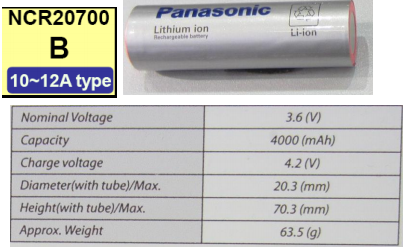
JRP3 Where did you find that, and why is the specific energy so poor?�
Feb 16, 2016
Fallenone On the official website for Powerwall, it is showin 6.4 kWh instead of 7 kWh now. I think this is the result of this thread.�
Feb 16, 2016
flathillll you think wrong. tesla has always stated 6.4 usable at 25C
stationary storage always states usable capacity going back to the days of lead and iron and sodium�
Feb 17, 2016
Fallenone But on their website just a few days ago it says 7 kWh. 7 kWh has always been the "face value" since last year too.
�
Feb 17, 2016
stopcrazypp Right, that is correct. It seems they are counting the round-trip efficiency of 92% in at 6.4kWh. However, hard to tell if it has anything to do with this thread or if things changed as it reached production (first deliveries just recently happened in Australia). Like I speculated with the S pack design, the Powerwall pack design may not have been finalized until recently.
For example they are still surveying reservation owners about their setup (namely people with microinverter based systems). I don't think they have finalized what kind of equipment they are including yet with the Powerwall (they may end up also providing an AC based system instead of only the DC one originally assumed).
https://cleantechnica.com/2016/02/16/tesla-sends-surveys-powerwall-reservation-holders/�
Feb 17, 2016
flathillll I see what you mean and I apologize for misunderstanding. Yes face value has recently been updated, not sure if it is because of us or because legally if you advertise 7 that means 6.5-7.0+
6.4 must be advertised as 6 or 6.4, but the data sheet has always stated 6.4 since launch�
Feb 17, 2016
stopcrazypp If you are talking about datasheet then you are correct after doing some digging. Datasheet always stated 6.4kWh at 25C. Website ads stated 7 kWh. I guess you are both correct.�
Feb 17, 2016
Fallenone No need to, just friendly discussion here:smile:
�
Feb 17, 2016
scaesare Interestingly, a 20mmx70mm cell has ~33% more volume than a 18mmx65mm cell. Yet the rating on that cell would seem less than 33% more than the the 18650's that Panasonic currently sells.�
Feb 17, 2016
kennybobby It's not likely a strict function of volume, but the capacity limits may be thermally constrained by the surface area from which heat can radiate--the surface area increased about 20% and the capacity increased 21%.�
Feb 17, 2016
AWDtsla If more nominal current is expected for the cell the volume may be taken up by additional electrode.�
Feb 17, 2016
Johan Tesla's 85 kWh rating needs an asterisk (up to 81 kWh, with up to ~77 kWh usa...
That doesn't sound right. Sure a larger volume to surface area ratio would limit performance at high C rates, but likely not with regular and low loads? And as has been much discussed in this thread aren't we assuming that nameplate capacity is measured under favorable conditions i.e. no high temperatures and slow discharge?
Also having heard Elon and JB saying they're not married to 18x650 makes me think this isn't some particular sweet spot dimension.�
Feb 17, 2016
AWDtsla Elon has said publicly the large prismatic cells are very difficult to cool/manage. While 18650 might not be set in stone, small cells do seem like they are.
Seems like it would be simpler to build a cooling jacket for flat cells though, however only 1-2 layers thick, not the bricks everyone else uses.�
Feb 17, 2016
JRP3 C rates might be constrained by surface area but capacity should not. As I pointed out after flathill posted that, the specific energy of that cell looks a bit worse than what Tesla is currently using, or was using in the 60's and 85's, and most certainly the new 90's.
I think the new Bolt pack only has a cooling plate on the bottom of the cells, which if it works is much easier than cooling passages between individual cells, be they prismatic or cylindrical. Presumably they can get away with that because of the less volatile nature of the NMC chemistry they are using.�
Feb 17, 2016
flathillll the two ends of a 18650 cell are 12X more conductive than the side (think direct-er connection to jelly roll)
if you heat/cool on only one end thru a base plate (with terminals on the other) only you are still doing 6X better than a full cooling jacket wrap around the entire circumference of the cell. Right now the current model s pack does not even come close to a full wrap with the wave tubes.
note with the current 18650 cell the temp spread of a cell cooled with a wrap is 1C (core is 1C hotter)
note with the gigafactory format cell the temp spread of a cell cooled with a wrap is 2C which is acceptable
note with the gigafactory format cell the temp spread of a cell cooled one one end is somewhat acceptable
note with the gigafactory format cell the temp spread of a cell cooled one both ends is acceptable (think bus "bar"
note with the LG Bolt form factor cell I would estimate the temp spread is closer to 30-40C under load (based on similar prismatic cell modeling)
note some Ford Focus EV's (which also uses liquid cooled prismatic cells) show a 20+% decline in range after ~1 year
come to the Bay Area and you can meet ex Tesla engineers at Alta Motors (BRD), Zero Motorcycles, Lightning Motorcycles, Joby, Mission Motorcycles (Apple killed the "mission" by offering 250k signing bonuses and tripling pay so now almost the whole mission team work on the iCar)�
Feb 17, 2016
Auzie Damn Apple
Moving people from labour of love to money labour
I can sense some poetic justice in the future�
Feb 17, 2016
lolachampcar Apple may have provided a soft landing for Mission personnel but that is not why Mission went away. At least I saw the writing on the wall soon enough to get (most) of my deposit back.�
Feb 17, 2016
flathillll nope Apple destroyed Mission. They lost one team member to Apple which didn't appear to be a big deal at first, but just as they were about to lock in funding to ramp production Apple poached the rest of the core team. The trick was the first person they recruited knew everyone's salary at Mission...valuable information to the poacher(apple)... Investors then pulled out and the rest is history. Even if you believe in the "mission" it is hard to turn down a huge signing bonus and salary increase. Apple is not rotten to the core but they do play to win
Funny thing is all the ex mission employees are now working as slaves on "ipad development" or other such nonsense. apple doesn't care about iCar secrecy per se. they just want to make it harder to poach their iCar team (herd of slaves). very smart. the mission bike with the integrated "combo" controller(inverter)/charger was a masterpiece and it didn't work like AC Propulsion tech which needs to use a motor wind�
Feb 17, 2016
sorka I'm very late to the party and don't have time to read through all 51 pages. Wk needs to stop creating threads that go on and on forever. Darn him
My P85D makes the EPA rated range that was advertised so it's a lot harder for me to have a beef with this issue than the 691 hp issue. 0-60 times was never my beef. It was the 70-90 passing speeds of 3 seconds with 463 hp that would have been closer to 2.1 seconds had it actually made 691 hp. But was untestable due to speed limiting the test drive vehicles to 80 MPH.
But in this case, I'm getting the range performance I was sold.
Where it gets a little sticky are my expectations that had the battery really been 85 KWh that as degradation occurred, the software could open up the hidden capacity to hide the degradation for a while. We all knew that only 76 KWh was the usable capacity before the mythical, now obviously non existent, zero mile buffer kicked in.
Now there's only 4 KWh to play with and the 17 miles that someone drove after hitting 0 was obviously a calibration issue.
But still, that doesn't translate to damages as the range performance is there and the degradation is small over 100K miles, then it's fine.
That said, if this gets out and other REAL 85KWh competitors result in lower resale value of our cars because of this, then that's another example where there could be damages.
So I have mixed feelings about this. They should only advertise the usable capacity i.e. it should have been the P76D. But failing that, they certainly shouldn't advertise more physical capacity than the pack actually has i.e P81D.
Any revelations from pages 7 to 51 that I should know about? Any super critical posts to this thread that someone remembers and can throw a link in here?�
Feb 18, 2016
kennybobby Are you talking theoretical or actual number of cells here?
Actual cells:
85 = 7104 (96s74p)
70 = 6216 (84s74p)
60 = 5376 (84s64p)�
Feb 18, 2016
pupik ****! :cursing: my source was here :biggrin::biggrin::biggrin:
SORRY... :redface:�
Feb 18, 2016
scaesare What's odd is that I recall some talks/videos from either JB, Elon or both (I honestly cant remember the specifics) seemed to indicate that, although they used the 18650 as a result of the already-established economies of scale for production, that seomthing slightly larger, such as a 20700, might be more ideal.
Certainly that one pic of a specific 20700 capacity isn't the end-all of what the format is capable of, but it would be odd for the Tesla boys to suggest larger format cells might be more ideal if there's a real thermal constraint in the application, no?�
Feb 18, 2016
sorka Wasn't that in reference to what they plan to build at the giga factory?�
Feb 18, 2016
stopcrazypp I remember the same comments from JB. If there is a thermal constraint then there is much less advantage to the 20700 form factor. Theoretically there is less module overhead costs from having larger cells (less per-cell interconnects), but if cell energy density stays the same, the cells themselves likely don't cost much less per kWh (reduction in $/kWh is traditionally largely driven by energy density improvements from using less material for the same kWh).
I guess we will find out soon with Model 3 release (maybe even have hints in the March unveiling).�
Feb 18, 2016
scaesare My (admittedly fuzzy, given the sheer number of talks/videos I've watched the last 3 years) is that the initial discussion of optimal cell size was well ahead of any information about the GF. As a matter of fact, I think there was some significant speculation that the GF might start producing larger cells BECAUSE of JB's prior comments.
In either case, regardless of where the cells are manufactured, if the lessened ratio of surface area-to-volume is a constraint, it would have been odd for JB to have made that comment...�
Feb 20, 2016
NOLA_Mike No - you pretty much know as much as the rest of us that read pages 7 - 51...�
Feb 20, 2016
dhanson865 yeah but what about pages 52 to 80?�
Feb 20, 2016
Scotty Some very strongly held positions on this thread.
While I say to each his own, I appreciate reading the greatly varied views.
I would like to get the usable energy out of the MS I paid for. That said, I'm looking for other examples to refute/support my position (whatever it may be)
My Dodge 3500 diesel truck has a 34 gallon tank. With consideration of fueling temperature, my 34 gallon tank holds 34 gallons, and while 100% of that 34 gallons is not available due to how the fuel pickup draws fuel from the bottom of the tank. It is consistent, though, when on the same level ground.
My Diesel motorhome, however, has a 130 gallon tank, but due to it's flat bottom design, only 105 gallons are available (for driving). If I'm running the diesel genset, however, the genset fuel pickup line is not able to draw fuel when the fuel leevel (capacity) dropa below 75%. Prevents the genset running you out of motive fuel.
My MS is rated at 265 miles range, but like an ICE vehicle, it will be more or less, depending on speed, winds, load, tire pressure, delta in altitude, road surface, climate, pack degradation, and so on. However, batteries do degrade over time and use, while my fuel tanks will be consistent in fuel capacity (short of a dented tank).
We are experiencing a major shift in ICE and BEV's, and also in the newer frontier on BEV implementation. I think there were huge disagreements during steam to diesel locomotive transitioins, gas vs diesel, AC (Nikola Tesla) vs DC (Thomas Edison), Coke vs Pepsi.....
I'm going to continue to follow this thread, even to those off-topic posts (like this one from me), but hope that Tesla addresses these topics in the future. Everyone has a bias, though, and don't think the positions I'm seeing will change anytime soon.�
Apr 8, 2016
marcmerlin So, I have a 90D, and the problem that I'm only seeing 75 or 76Kwh usable for driving (see details on How many Kwh usable for driving are you getting on an 85 or 90 car? (I only get 75Kwh on my 90D) ).
If my car also has a 4Kwh anti brick buffer, that means, my real pack capacity is only around 80Kwh, and I paid $3000 for the privilege of having apparently no more battery capacity than an 85D, or maybe even slightly less. I can't speak about range, calculating that is just too variable to be a useful discussion, but somehow I'm not expecting that my 90D has special changes that make it go farther than an 85D with the same batteries.
Worse, I'm actually seeing maybe 1-2Kwh usable _less_ than an 85D on a pretty new car.
See the other thread on how I calculated (I did this 4 times on 4 long legs, and the last 2 I did very carefully without stopping once).
I didn't find details on how the 90D is supposed to have an extra 5Kwh, which I'm definitely not seeing. More cells? Cells with higher capacity? other?
Thanks.�
Apr 8, 2016
Johan It seems to me the 90's will require not one (*) asterisk but two (**). Something is rotten in the state of Denmark...�
Apr 10, 2016
brec I feel fortunate that I changed (increased) the number of posts per page before the recent TMC forums software downgrade removed that preferences setting.�
Apr 12, 2016
brec I guess I shouldn't have posted that. I'm back to 20 posts/page. More work (requests) for TMC's forum server to supply the same data, more clicks and waiting for me.
(Off topic, but the thread seems dormant. I'll not continue these thoughts here, though.)�
Apr 14, 2016
rns-e There is a lot things that are rotten in Denmark - but that is a whole other story and not for this forum
Could Tesla be moving away from model number being the same as the battery size? The same way that BMW moved away from model number telling the size of the engine?�
Apr 14, 2016
Johan 1. Just to clarify if someone is wondering, "Something is rotten in the state of Denmark": this line spoken by Marcellus (and not Hamlet as is commonly believed) is one of the most recognizable lines in all of Shakespeare's works. Just thought of it as I typed my post.
2. Your suggestion to move away from battery size labelling makes a lot of sense, it's something I've advocated for quite some time. If they insist on using a number why not rather the EPA rated range number. Or some performance related number.�
Apr 14, 2016
rns-e ad 1: I know ;-)
ad 2: The numbers 40,60,75,85 and 90 combined with the letters p and d does a very good job of descriping the different trimlevels, although it may be confusing when the letters are accurate and the numbers not so much. But it is still better than some of the Chinese cars�
Apr 14, 2016
jaguar36 I wouldn't say they are moving away from it, the original 85 only has a 80kwhr battery. In addition they are advertising the 90 as having a 90kwhr battery.�
Apr 14, 2016
SageBrush Apologies for now pointing out the obvious ...
85/60 = 1.416
7104/5376 = 1.321
So unless different cells were used, either the '85' pack was less or the '60' pack was more.
And while not condoning what I also see as a misrepresentation of pack size, it seems fair to say that a buyer of an '85' could reasonably expect to obtain 41.6% longer range than a '60' model (85/60.) If Tesla programmed in a 4 kWh anti-brick to the '60' for a usable 56 kWh, then the '85' should proportionately have 56*1.41, = 79 kWh usable capacity.
Does it ?�
Apr 14, 2016
jaguar36 No, as the thread title states it only has 77kwhr usable.�
Apr 14, 2016
scaesare While that's been asserted by folks running their own battery tests, nobody has an official manufacturer's rating for the battery used by Tesla. So that's a matter of some debate.�
Apr 14, 2016
SageBrush If correct then I would view the discrepancy as ~ 2 kWh�
Apr 14, 2016
Dennis87 Can bus data from a new 85D with only 300km on odo.
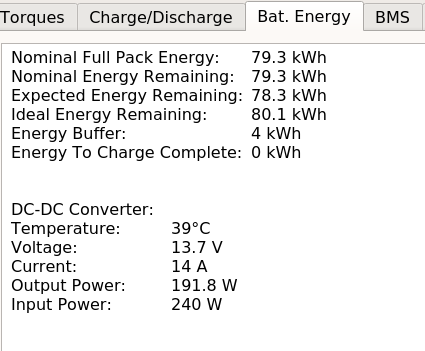
Here is can bus data from 60-90 batteries..
90 = 84.9 + 4 kWh = 88.9 kWh
85 = 79.3 + 4 kWh = 83.3 kWh
70 = 68.5 + 4 kWh = 72.5 kWh
60 = 57.0 + 2.8 kWh = 59.8 kWh�
Apr 14, 2016
FlatSix911 Interesting data ... Battery % without buffer:
90 = 94.3%
85 = 93.3%
70 = 97.8%
60 = 95.0%�
Apr 14, 2016
SageBrush I don't know how to read this. How many kWh usable at full charge ?�
Apr 14, 2016
apacheguy Very interesting. I find this troubling as the rest of us with 85s have seen no more than 76 kWh with fairly new packs. CAN3 on mine reports full energy of 75.5 kWh with a 4.0 buffer. Am I to believe my pack has already lost 4 kwh with only 14,000 miles? Doesn't seem right.
Also interesting to me was that energy remaining exceeded nominal full pack energy. Ah, ok that is ideal, i see.�
Apr 14, 2016
MarcG The way I read your screenshot is that 79.3 kWh INCULDES the 4 kWh buffer, since it says "Full Pack Energy".
So with that in mind, the available pack energy for driving, EXCLUDING the 4 kWh buffer, would be 75.3 kWh. This matches nicely with my stats that showed my P85D's pack at 75.2 kWh when it was new (now sitting at around 70 kWh after 32k miles).
Thoughts?�
Apr 14, 2016
apacheguy No. Nominal full pack energy does not include the bricking protection.�
Apr 14, 2016
MarcG Can you please point me to any such evidence? Just trying to understand.
I specifically remember when my car was new, less than 1000 miles on the odometer, I took a nonstop trip from 100% to 0% SoC (had 2 miles left of rated range left) and the trip meter showed 75 kWh since last charge.�
Apr 15, 2016
Dennis87 Nominal full pack energy does not include the buffer.
When you are driving 100-0 and get 74-75 kWh out of the battery its because of losses I think. The loss looks to be around 4-5% or 6-7% if you often uses max the power of the car and often drive at high speed.�
Apr 15, 2016
Dennis87 This is charge/discharge data from my P85D
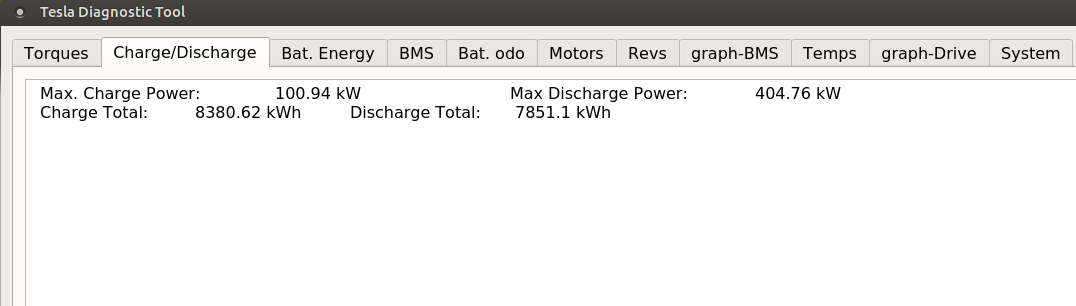
As you can see my car has charged a total of 8380.62 kWh and discharge 7851.1 kWh. That is a loss of around 6%
This I think is losses in motor/heat�
Apr 15, 2016
diamond.g Just curious, does this mean that it is possible the new MX 75D pack is just a rebranded 70?�
Apr 15, 2016
Pajda That difference means only that there is measured energy of the both charging and discharging process by the BMS. For example if you have a single 12.6 Wh cell, you must always supply 12.8-13 Wh (depends on charging rate) of energy for its full charge. Only then you are able to discharge the nominal 12.6 Wh from the cell.
So the BMS measures all energy flowing in and out of the battery. The only losses which are not measured by the BMS is the self-discharge current of the cells itself but it is not a significant value�
Apr 15, 2016
MarcG This makes no sense to me. Driving faster is reflected in the Wh/mi consumption and higher total energy (kWh) used numbers. Max battery power was not even available at the time. Anyway, the car reports the amount of energy drained from the battery from the BMS, so that's all pre-"losses" which are downstream of the battery.
The fact that driving 100% to 0% SoC only yields total usage of 75kWh is the strongest evidence that this number is the truly available amount of energy available to the driver for a trip. The 4 kWh buffer is on top of this number, giving us a total battery capacity of 79 kWh as reported by the CAN bus.
By the way, I just read an interesting and somewhat related article about 85 vs 85D efficiency and battery capacity this morning:
All-wheel-drive Tesla electric cars rated more efficient, but how?
One paragraph that especially caught my attention:
In the EPA tests, the dual-motor 85D dual-motor 85D used 10 percent less out-of-the-wall-plug electricity than the single-motor 85.�
Apr 15, 2016
AWDtsla IMHO battery losses and other things are not included in Wh/mi figures. Anyone who trusts the trip meter thinks their consumption is much better than it really is, not even including vampire drain between drives.�
Apr 15, 2016
apacheguy @Dennis87 - Would be interesting to see the 85D numbers again at 2,000 km on the odo.
Driving faster means you are pulling higher amounts of current at a greater voltage drop in the pack. This can affect capacity measurements.�
Apr 15, 2016
MarcG Possibly, except the latter part (vampire drain between drives) doesn't apply for a single trip that starts at 100% SoC and ends at 0%.
I was assuming the BMS can handle these situations to measure capacity, but I could be wrong. You would think Tesla's developers have enough knowledge to take varying current draws into account.�
Apr 15, 2016
stopcrazypp I think he is trying to say that the capacity of a battery varies depending on how much power you draw. For example, if you do a test where a battery is fully discharged in 20 hours vs a test that discharges it in 1 hour, you will measure significantly different capacity. This is because of internal resistance of the battery. At higher power draw you get less apparent capacity because you lose it to heat via internal resistance.�
Apr 15, 2016
apacheguy Right. That's also where I was going in my previous post.�
Apr 15, 2016
bswn1 So a 70D should be capable of roughly 4.6s 0-60 vs. the 5.2s it's currently rated at?�
Jun 29, 2016
darthy001 First rulings done in Norways consumer disputes commision it seems. Tesla must pay 50000NOK(~6000USD) to the owners in these rulings as far as I can see. Tesla now has 4weeks to decide if they want to continue by draggin this into the courts or end it by paying the owners according to the ruling.
This includes my own case which I brought forward to the disputes commision. Link below to a similar case. I believe 13owners went this route.
http://innsyn.e-kommune.no/innsyn_ftu_design/wfdocument.ashx?journalpostid=2016013278&dokid=233333&versjon=1&variant=P&
Still no word on the ones that actually sued Tesla. That is rumoured to be more than 200owners still waiting for Tesla to make their move. But the ruling from the consumer disputes commision will of course wheigh heavily in advantage of the owners...�
Jun 29, 2016
AWDtsla Seems like a reasonable judgment. Have you heard anything in Norway about the P90Dl not being able to hit 10.9 quarter mile?�
Jun 29, 2016
darthy001 No nothing on the P90DL, but the quarter mile isnt something that many people here really care about in the first place. I dont think there even is a dedicated dragstrip here. Old airstrips are used, but not by regular people.
Horsepower and 0-100 are the numbers we care about here. Smart or not can be discussed, but that is the fact �
�
Jun 29, 2016
mkjayakumar So this whole thing is not about am I getting the range Tesla promised, but rather my tool is longer than yours?
I really wish someone sue the disk/USB/Smart media manufacturers on not giving all the 16 GB they promised me on the package. It clearly says 16 GB, but when I shove it in the computer says 15.2 GB available space.�
Jun 29, 2016
csshih That is hardly the proper analogy.
The disk space lawsuits (which were settled by WD back in 2006) were a consistency problem with naming due to some companies using binary naming and some companies using decimal naming. Binary naming was favored by Microsoft and decimal name favored by disk manufacturers.. which they still are.
Logically, a KILObyte would be 1,000 bytes, right? Microsoft instead decided that it would be 2^10.. 1,024 bytes instead... and that has been the standard ever since.
A true 16GB disk according to Microsoft (and everyone else) would be 17,179,869,184 bytes..
In binary that is 16GB, in decimal that is 17.179GB
A true 16GB disk according to storage manufacturers would be 16,000,000,000 bytes.
In decimal that would be 16GB, in binary that would be around 14.9GB
Now, with the range it is not a case of binary vs decimal, nor is it a case of the anti-brick buffer, as the 60 kWh pack is 61.6kWh.. logically the 85kWh pack should have been slightly higher to be consistent, but it appears someone in marketing decided that saying 85 was better than the 80 it should have been.
However, the packs all had corresponding EPA estimates, so this is just a case of mistaken marketing, rather than malice.�
Jun 29, 2016
stopcrazypp The paper actually says there were two opinions. One suggested 50000NOK, the other 20000NOK (~$2400USD), but the 50000NOK decision got the majority vote. I believe it also mentions the claimant suggesting doing a free Ludicrous upgrade as compensation, but the commission didn't agree because the upgrade wouldn't have addressed the issue anyways and would have provide acceleration beyond originally advertised. Additionally the claimant suggested the difference between a P85D and 85D as compensation, and the commission also disagreed.
Here's Tesla's statement on it that indicates they might appeal.
Tesla asked to pay ~$6,000 to Model S P85D owners in Norway for misleading power output
Of course it largely depends on if it needs to reach the courts to appeal or if it can be handled by normal staff. The previous statements to the Consumer commission were written by regular staff. However, if they need a lawyer, then it may not make as much sense for Tesla to drag it out because of lawyer fees.�
Jun 29, 2016
Johan I like how the commission quickly dismissed the notion of an upgrade to Ludicrous since that would help very little with what is being complained about: a seeming lack of over 240 hp. Sure, Ludicrous would make the car noticeably quicker, but would only add a small number of measurable horse powers.
IMO that kind of shows how irrelevant the hp issue is. But that just my opinion, and I'll try to stay humble. I don't have any skin in the game and might feel differently if I had.�
Jun 29, 2016
Andyw2100 I think what is quite relevant is that the commission concluded that Tesla had misled its customers, and that the customers should be compensated to the tune of approximately $6000 US. That seems pretty black and white.�
Jun 29, 2016
Spidy It's probably better to discuss this here:
Tesla may be forced to compensate owners of P85D in Norway
Stop the Press! Tesla announces REAL HP numbers for P85D and P90L�
Jun 29, 2016
Johan Yes that too. But that was kind of obvious, the thing that I pointed to (this being an issue of only missing horse powers and not otherwise missing performance) seemed less obvious to me, but also interesting.�
Jun 29, 2016
wdolson With hard disks, manufacturers have used the unformatted capacity for years. Once you format it, you have about 10% less capacity than what the manufacturer says. I believe there were lawsuits about it, but it's still reported that way. It's the same problem with USB memory sticks.
And the 1000 bytes vs 1024 bytes thing has also been an industry standard thing from back before Microsoft was a blip on anyone's radar. The size of any memory or disk is going to be in the form of 2 to some power. Since the difference between 1000 and 1024 is only 2.4% it's been mostly interchangeable to use 1K as equals either 1000 or 1024. I learned that back in high school in the early 1980s.�
Jun 30, 2016
darthy001 Please remember that the rulings here are based on the individual claims. My claim was similar, but with lower amounts. Otherwise your comments are correct.
The ruling frmo the commision is legally binding to both parties unless Tesla brings it to the courts. Tesla has actually used hired lawyers in dealing with the commision and still got the ruling against them. They have used a very reputable norwegian lawfirm here just so that is clear.
Next step is eiher court-case or paying.
In my claim I actually liste lud-upgrade as one option more or less as an easy "out" for Tesla. For me the admittance of wrongdoing in such a case would be more than enough for me. I am perfectly aware that it comes nowhere close to the HP-numbers, but at least it brings it close or equal to the original acceleration-numbers. And those numbers are the most relevant for me personally.
The sad thing in these rulings is that they still state that the acceleration is as promised solely based on Teslas claims. They still site the motortrend numbers for 0-60mph _with_ roll-out as the truth for real 0-100kph. I believe the owners suing tesla here will easily disprove this claim adding to the issue for Tesla. 3 independant lawyers have indeed found wrongdoing in terms of the HP-numbers. In court I cannot believe the accelleration-claims would also be corrected.
The issue is indeed "silly" and mostly irellevant. I love my car, I love how it performs. I just hate the way Tesla marketed it. With honest marketing I would have been driving a 85D instead today(at a cost slightly less due to forex due to waiting for nextgen seats).
No matter what the outcome here I believe Tesla has now been taught a lesson that in countries like Norway you cannot cherry-pick your marketing numbers like this without issues.. That in itself makes me happy
PS!. This story is in at least 3major norwegian newspapers online-editions today...�
Jun 30, 2016
mkjayakumar I have no sympathy for Tesla on the issue of battery pack size. Every company misleads - except KIA - on the pack size, due to the limits the technology imposes on the bottom and top end. If only X kWh is available to me then, for all practical purposes that is my pack size. it doesn't matter if the actual capacity is X+Y.
Although on the flip side you could argue, what is really relevant is the EPA range and all other numbers are just technicalities. A car with a packsize of 100 kWh and a range of 250 miles is the same from a consumer perspective as the one with 80 kWh and 250 miles range.�
Jun 30, 2016
wdolson True. Most people don't ask about how big the gas tank is when they are buying a car. The range/mileage is the only thing consumers care about in the end.�
Jul 1, 2016
iffatall Not that I agree with the gas tank analogy, but I am sure customers will complain if the specs of Model A said it had a 10 l tank, which turned out to be 12 l really, while Model AX which basically upgraded the 10 l tank to 20 l tank in specs really had an 18 l tank.�
Jul 1, 2016
ChadFeldheimer Especially if the upgraded tank cost $10,000.�
Jul 1, 2016
scottm The thing that matters most is that the advertised range matches a controlled test that is repeatable on new vehicles.
It does not matter if the car is powered by 72 magic bunnies, or 10 liters of grape juice, or nuclear fusion reactor. If you can repeat the test and go as far, you're good. These two factors put together are the efficiency, with regulations like EPA governing it.
Stripping out one factor (e.g. arguing if 72 bunnies are equally strong, or what's the actual purptane of your grape juice) and calling out "foul" is an unbalanced equation, both energy and distance together are required for efficiency. Distance and driving pattern are carefully controllable factors in the defined test.
Real people don't drive like controlled tests. We don't achieve an EPA number all the time. But if you're calling into doubt a test result, then be prepared to repeat the real test as a control. Here's the kicker though, for battery cars, batteries degrade and Tesla says so. You can expect reduced range over time, or less efficiency on the controlled test. EPA only applies for new cars leaving the factory.
I can over achieve the expected range that EPA rating suggests for my 2 year old model S. By changing the way I drive. And ICE cars can do this too.
Car manufacturing business is notorious about claims of horsepower, at the wheel, no, at the crank, no, brake horsepower... everyone knows there's "marketing" at play there. If its really important to you that a car has a specific horsepower, maybe you pay roadtax based on HP rating? Then get a dynotest done as part of your acceptance agreement of the sale.
And the acceleration is what it is. You can decide if it goes fast enough, and vote by keeping (accepting) the car, or not. There's no buyer protection regulations about how well a vehicle must accelerate. Attach any number system you like to acceleration, bunny hops squared per centimeter.. again, whose to say without extremely precise instruments on the bunnies inside? The power curves of the various motivational forces inside the power delivery factory are mysterious ... for real people who have no way of measuring it.
If it's really important to your acceptance of a car, specify a test the car must meet at time of delivery and do it. Decide to keep the car or not. Keeping the car and saying or doing nothing at that time is implied acceptance. After a reasonable amount of time (if not defined specifically in your contract or governed by consumer protection laws or other devices) ..... it's yours!
tl;dr: make sure you're happy with the car before you've paid all the money, and if your car doesn't seem to match the test driven one, let the manufacturer know right away! You are "owed" nothing if you don't.�
Jul 1, 2016
mkjayakumar scottm: ++1
I am just a bit amused by this. It almost looks like bragging rights for a number that in the end does not matter.
Person A: Hey my car has 90kWh, but yours is only 85? is that right?
Person B: True, but your car can only go 250 miles, but mine can go 270..
Person A: Who cares? I have a bigger battery than yours.�
Jul 1, 2016
darthy001 Oh, I just realised i put my comment about Norwegian rulings yesterday in the wrong "needs an asterix"-thread
Sorry for that!
Should of course have been in the 691hp-thread..... But I think Andy indirectly corrected my mistake by crossposting it into thecorrect one�
Jul 1, 2016
yak-55 Sad commentary ... so many asterisk threads ... as to be confusing ...�
Jul 1, 2016
Andyw2100 Just need to point out that the above would not be applicable to the early P85D adopters, as we had no test drive cars to compare our cars to when we took delivery.�
Jul 1, 2016
Andyw2100 I had you covered!�
Jul 2, 2016
ChadFeldheimer I agree that range is what matters most. But that's not to say that (battery capacity) specs don't matter. After all, Tesla thinks battery capacity is important enough to name their cars after it.
What if the 85 were instead spec'd with 100kwh and named the 100? How about 1000? At what point is it sufficiently misleading to be considered false advertising?
The $10,000 70->85 upgrade appears to be overstated by ~50%. That is, instead of receiving 15kwh in additional usable capacity, one receives 10kwh. If so, is 50% misleading enough to be considered false advertising? The missing value is $3,333.
True. But when manufacturers (car or otherwise) get too egregious with the marketing, they get taken to task.�
Jul 2, 2016
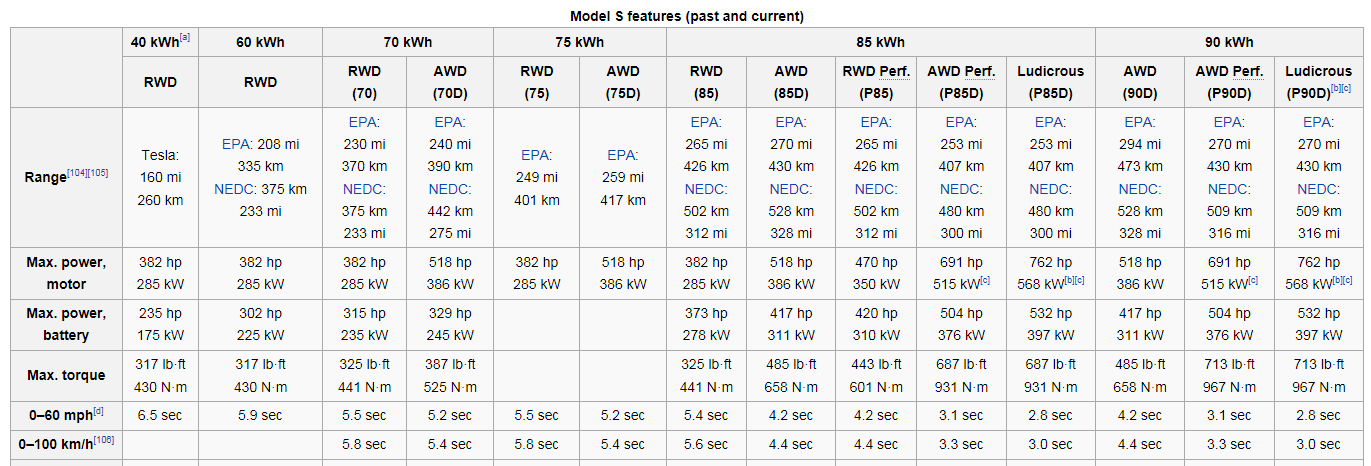
FlatSix911 Can someone summarize the listed vs. actual kWh for the Tesla batteries?
Here is a wiki table to start ...Tesla Model S - Wikipedia, the free encyclopedia
 �
�

Không có nhận xét nào:
Đăng nhận xét