Feb 7, 2016
FlasherZ If you look at my rated range and seasonality thread, you'll see I'm not afraid to range charge and will occasionally have it left at 100 pct after a trip. I'm not religious about leaving within 30 seconds of it completing the range charge our anything like that. Bottom line is that it takes a lot of long term abuse before you materially impact the battery pack, at least from what I'm seeing.�
Feb 7, 2016
Magus Late to thread and apologize if this has been mentioned already. Went through maybe 10 pages and not interested in reading all of it. At the most, I find it mildly interesting, if it's even true. If you're going to give up on your Tesla, you may as well give up your Mac, PC, smartphone or ICE. You will have to boycott a lot of producers to get this kind of thing accurate- actually it's impossible.
I am typing this on my iPhone 6 Plus 128GB. The actual capacity of the drive is 113GB. My available is much less (given usage, photos, etc.). In my entire computing life, never once has the actual capacity of a hard drive matches its advertised capacity. If you're going throw out Tesla, throw everything out sans measuring cups. It's completely unfair and dramatic to single out Tesla.
If the battery packs have been reduced in size due to weight decreases, kudos to Tesla for finding a way to improve performance and revenue. It is an intelligent strategy. Elon/Tesla owes no explanation.�
Feb 8, 2016
pupik My measured data...( for current < 20A )
from Tesla UI power meter
100% = 4.18 - 4.2V
90% = 4.09 - 4.11V
70% = 3.86 - 3.88V�
Feb 8, 2016
Troy Today, Tesla removed the 85 kWh versions from design studio worldwide. This discussion is now officially about a discontinued battery pack with different cell chemistry. In a conference call Elon talked about the difference. Listen HERE from 8:39 to 9:01.�
Feb 8, 2016
pupik Yes, but I think that Elon for us with P85D owes explanation...�
Feb 8, 2016
smac I normally go from 80% -> 60% in any one day (maybe even less).
I had concerns about my range displayed, so did a full cycle (driven non stop from the moment the 100% had stopped to exactly 0% ), then let the car sit for a week.
Result one mile of range lost in the display at next 100% charge.
I wish I had my logger back then, because I would have been able to see if the reported BMS usable had changed, I know mine says now 59.8 (which is pretty good), but what did it say before? Is the "range algo" just this multiplied by a factor, and it's actually the SoC tracking that needs a full cycle to re-calibrate and gain accuracy?�
Feb 8, 2016
Auzie +1
Any specification Tesla puts out can be heavily scrutinized. Each specified parameter is dependent on a number of variables and any deviation in these variables will yield different results. Hence, parameters or specifications are correct only under a narrow set of conditions.
It follows that each condition needs to be set and measured accurately before testing (or measuring) the parameters. That is almost impossible to carry out outside of strictly controlled laboratory conditions. Every instrument must be calibrated (certified) prior to use if used for verification purposes. No professional would disregard these requirements and claim to produce reproducible accurate results.
I find this discussion quite interesting and educational, as long as posters focus on technical details only and refrain from unfounded character accusations thrown at (Tesla) engineers. Some (not many) people seem to be bent on assigning malicious intentions to Tesla regarding specifications.
�
Feb 8, 2016
jpet Hehe, thanks.�
Feb 8, 2016
smac FTFY
In all seriousness, I find what the engineers have done remarkable! The Model S is a technical tour de force.
It's the disconnect between the techies and the sales people that I feel is behind all these asterisk style threads. It's constructive criticism to ask for them to close this gap for the long term strength of the company, I wouldn't class that as malicious.�
Feb 8, 2016
jpet I have indeed tested this 3 times by doing 2 to 3 range charges back-to-back. You can find the results in the MaxRange Tesla Battery Survey. My max range increased every time but only by 1 km. The lowest I went was 8% SoC and will do some deeper cycling when the opportunity arrises. To be honest, I don't really care about the Tesla algo. The cells are the cells and we now know we have 77 kWh available in a "85 kWh" pack. You can use your foot to select the Wh/mi or Wh/km you need and you will get the range you want.
I have been thinking about the 85 vs 81 spec these last couple of days. Is Tesla using 3.6 or 3.7 nominal voltage for its spec? Both the NCR18650A and NCR18650B are 3.6V. wk057 has tested the capacity and the CAN message is clear so there's not much debate really but maybe Tesla used 7104 x 3.2 Ah x 3.7V = 84.111 kWh?�
Feb 8, 2016
smac Thanks for this! 80% seems about right then
I will try to get the same % to V map for my 60 pack.�
Feb 8, 2016
Auzie
Lack of understanding can easily result in assigning malicious intentions
My view is that all these asterisk threads reflect more on this forum than on Tesla marketers
As for the long term, no matter what Tesla does, there will be people who will search for 'gaps' and assign malicious intentions to 'gaps'.
I see that phenomenon daily, it is far from unique to Tesla. Been there, done that.�
Feb 8, 2016
Johan The 85 is removed from the design studio, apparently.
So let's get the true capacities of the "70" and "90" and proceed with the discussion accordingly
(Reported range figures and real word achieved range with 70/90 cars doesn't suggest Tesla has changed their labelling to something closer to "the truth", which is maybe not as clear cut an entity as some would have it).�
Feb 8, 2016
lolachampcar "My view is that all these asterisk threads reflect more on this forum than on Tesla marketers"
I agree. There are many on this forum that pay attention and form their own opinions. Some of these people have determined that the hype != reality and are pointing it out. In some cases, I feel there is enough evidence to point to intent (HP, 1 foot roll out). In the end, these are all just opinions.�
Feb 8, 2016
JRP3 For me the issue is, (and it's a minor one), why did they accurately label the 60 packs but not the 85 packs, and, more importantly, will other packs be accurately labeled going forward?�
Feb 8, 2016
supratachophobia That's a pretty succinct conclusion. I don't think any of us are dissatisfied with the car. It does what it claims (when is not cold). But Tesla didn't need to fudge the numbers in the first place. There really does seem to be a disconnect between divisions. But certainly not malicious.
- - - Updated - - -
I'm fine with 80%, but that's actually what I've been using to charge for 16 months, and I think it really throws the estimated range algorithm off. So much so I had to change the display to %.�
Feb 8, 2016
jaguar36 This is the issue for me as well. Considering the 85 to 90 is a 6% increase in capacity, and the estimated range of the 90 is also only 6% more, presumably the 90kWhr pack is over specced as well.
Its such a bizarre thing, Tesla would not have been hurt in the slightest if they called the 85 an 80. Nobody is comparing its battery capacity to anyone else's. The only thing it did was push some people who were on the fence between the two packs to go to the 85. Which I guess makes Tesla a bit more money, but it doesn't seem worth the effort.�
Feb 8, 2016
apacheguy Hmm. So the difference between 100% and 90% is only 0.1 V? That makes 90% daily charging not look so great. I thought the difference was greater, like 0.15 V.�
Feb 8, 2016
jpet Everything above 4.10V is considered high voltage for a Li-Ion cell so daily charging to 90% SoC, if you need the range, is still a defendable choice.�
Feb 8, 2016
wk057 The UI supercharge voltages are not the settled cell voltages. I'll have tl go through and make a chart of actual SoC vs cell voltages, since the UI supercharger numbers are higher than actual.�
Feb 8, 2016
stopcrazypp I answered this question about 2-3 times already, but keep getting ignored. The capacities were all announced before the production packs were designed. 85kWh pack came first and 60kWh was a modification of that one (and 40kWh a software limited 60kWh pack). I have more details in the comment train I quoted, but basically for 60kWh there are constraints in how many cells they can blank out and still maintain their battery longevity and charge/discharge power goals. It would be different if they chose to use different cells for the 60kWh pack (which might have been original plan that was cancelled when people overwhelmingly chose the 85kWh and they knew they would cancel the 40kWh pack).
The "marketer" or "marketeer" theory assumes that they had designed all the packs already in 2011 and then decided to underrate the 60kWh pack and overrate the 85kWh just to give the larger pack some marketing boost. I don't think the time-line supports that theory. Rather they announced the capacities and then designed the packs to get about the same capacity as announced (the only pack that might have been designed already beforehand was the 85kWh as the primarily design).�
Feb 8, 2016
smac The other subtle thing is it helped justify the base price of the car to an extent. I clearly remember press around the time trying to use the 25 kWh difference to value how much Tesla were paying per kWh�
Feb 8, 2016
scaesare Remember, the entire "usable" voltage range of a Li-ion cell is only about 1V (i.e. from ~3.2V to 4.2V), so even thought it's not necessarily a strict linear curve, a 0.1v change for every 10% SoC is about right.�
Feb 8, 2016
JRP3 I speculated something similar as well earlier in the thread, I'm just not sure it's the definitive answer, and if Tesla should have changed the designation of the 85 when they discovered they weren't getting near 85kWh from the cells. I would have thought Tesla might have tested some actual cells before committing to a pack size.�
Feb 8, 2016
apacheguy It should not be linear at the top end. Voltage should drop sharply from 100% to 90% and then even out below 90%.
He was reporting settled cell voltages.�
Feb 8, 2016
wk057 That's not how the post reads. Current has nothing to do with settled cell voltages.
For example, no-charging/discharging 80% on the dash in my car and my wife's is 3.95V +/- 0.02V. But, for example. during supercharger the cell voltages read at 3.95V when the pack is at ~55% SoC.
5% on my P85D dash is 3.37V. A recent supercharge to 98% left my cells at 4.15V after a few minutes, with during charging voltages at 4.2V.
90% I don't seem to have in the notes I have handy (I'm not at home) but it was around 4.05V.�
Feb 8, 2016
apacheguy Ah, those numbers make more sense. I misinterpreted pupik's data.�
Feb 8, 2016
smac I've always suspected the original intent was a 14 x fully populated module pack. (so something around 70kWh). The hump of the extra 2 modules always seemed a strange design decision if for no other reason than transportation volume, and vehicle packaging freedom.
Maybe at the time they hadn't dialed in the efficiency to hit range requirements (which was saying it was a 300 mile car) or couldn't get the performance, so added the two extra modules.�
Feb 8, 2016
wk057 The front hump in the battery with the oddball module upside down on top of the 15th did strike me as a little strange. 15 modules would have made sense (since the vertical space with the 16th module is the odd thing to me, not so much the 15th spot) which would be about 75 real kWh, 71 kWh usable, or about 245 rated miles in a theoretical S75 with a nominal pack voltage of ~324V, charged ~378V.�
Feb 8, 2016
smac Good point I forgot the 15th was directly underneath the 16th!
I wonder what the 2 cycle EPA range of this theoretical 75 pack would have been, as certainly the delays in launch pushed them into the stricter testing regime. Probably very close to the magic 300 miles, as Tesla claimed 320 miles under EPA 2 cycle for the Model S with the 81kWh pack.
Model S Efficiency and Range | Tesla Motors�
Feb 8, 2016
pupik My measurement is ok. My english is bad :redface: sorry
Note that standard differences between the cells are 0.01-0.02V for settled cells < 95% SOC
for current 0 - 20A is decrease only 0 - 0.02V per cell
standard current for parking car is only 0 - 0.6A
for settled cells = current < 0.6A
100% = 4.16 - 4.19V
90% = 4.06 - 4.08V
70% = 3.85 - 3.87V
min. tolerance +/- 0.01V temperature today here is 8-10C !
so, I think optimum for long life is charging max. 80% better 75%
not forget that these are special Panasonic/Tesla cells and still isn't data sheet
and not forget Tesla warranty is 8 years�
Feb 8, 2016
jpet You might want to quickly correct this into 3.85 - 3.87V. :wink:�
Feb 8, 2016
MsElectric So are we going to create one of these threads now also for the 90 kWh battery pack? :crying:�
Feb 8, 2016
lolachampcar Why, did they get that one wrong too?�
Feb 8, 2016
MsElectric Motortrend tested it and they reported it is exactly 90 kWh :tongue:
All specs now have an "As tested by Motortrend" footnote :wink:�
Feb 8, 2016
jpet Let me guess, it has 6% more capacity than ours, so 81 kWh X 1.06 = 86 kWh
- - - Updated - - -
Here's an educated guess...
7104 X 3.2 Ah X 3.6V = 81.838 kWh
7104 X 3.4 Ah X 3.6V = 86.953 kWh�
Feb 8, 2016
wk057 As said in my first post in this thread, I haven't been able to check any data on 90's just yet. Soon I think, but not yet.
But the P90D is rated at 270 miles, and P85D at 253 miles, which points to about 82 kWh usable from an 86 kWh pack.
Showing my work:
81 kWh real capacity - 4 kWh protection = 77kWh usable ("85")
77000 Wh / 253 miles = 304.35 Wh/mi.
304.35 * 270 = 82.17 kWh
82.17 + 4 = 86.17 kWh real 90 pack capacity
But, if it were in fact 90 kWh with 86 kWh usable, that'd be ~282 miles of rated range for the P90D. So either the 90 pack is over specified or the P90D is ~5% less efficient than the P85D... which uses the same motors... and same inverter... and same everything else. Seems overstated is more likely.
This is just speculation based on some pretty reasonable assumptions... so I can't say definitely yes or no to it being wrong until I get some real data.�
Feb 8, 2016
jayx Maybe there is some misinterpretation, but it�s not exactly like going from 90% to 80% and back to 90% equals 0.1 cycle worth of wear, which would mean ten times 0.1 cycles = 1 full cycle. And it makes big difference if it�s partial cycle. Jpet linked (post #366) document which clearly says wear is much smaller if you do cycles 60% compare to 100%, I can add another one which reveal pretty awesome results � over 100000 short cycles and cells were not dead yet!: http://www.dtic.mil/cgi-bin/GetTRDoc?AD=ADA515369 I know it�s for completely different and old battery, but I think basics apply to all Li-Ion batteries, and new ones should be even better.
By the way, as 85kWh pack has just been discontinued and everyone is wondering what�s the true capacity of 70 & 90kWh packs, I think wk can get some preliminary capacity data from battery BMS via CAN logging.�
Feb 8, 2016
dirkhh That is OUTSTANDING news. Because while it is hard to round 81kWh to 85kWh, it's very easy to explain that you are rounding 86kWh to 90kWh
Which once again proves that Tesla is monitoring this forum very closely!
�
Feb 8, 2016
stopcrazypp That might be true also.
Anyways, given how the pack is designed, it seems they applied some "just in time" design (basically designing as they go along) to fit with the range promises way back in 2009. The packs do not have a signature of something that was designed at once. There are a lot of bizarre design decisions that do not make sense if everything was designed at one go.
The other one I pointed out was the decision to blank out cells while also using less modules in the 60kWh. This ruins both module commonality AND also pack production commonality (which is why I never guessed they would do that). If it was designed at the start, I see no reason why not to set the break points in capacity such that blanking cells would not be necessary.
Anyways it does not seem like they had all the packs designed already in 2011 and then had the marketers have their go at it. Rather it seems like they took their promised range numbers (which were already approaching 3 years old already) and gave rough estimates of kWh needed to achieve it (in 5kWh increments) taking into account weight. Then designed the packs to fit along with that roughly.�
Feb 8, 2016
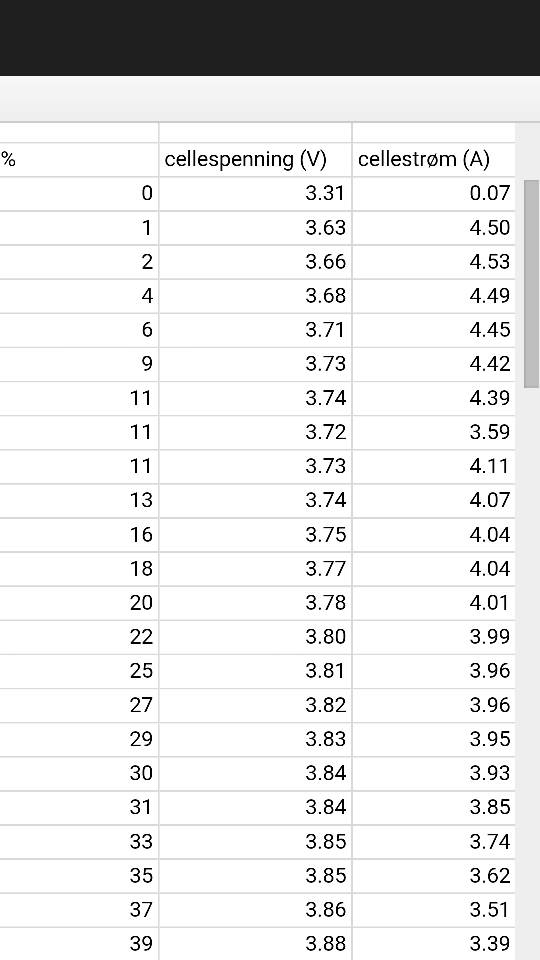
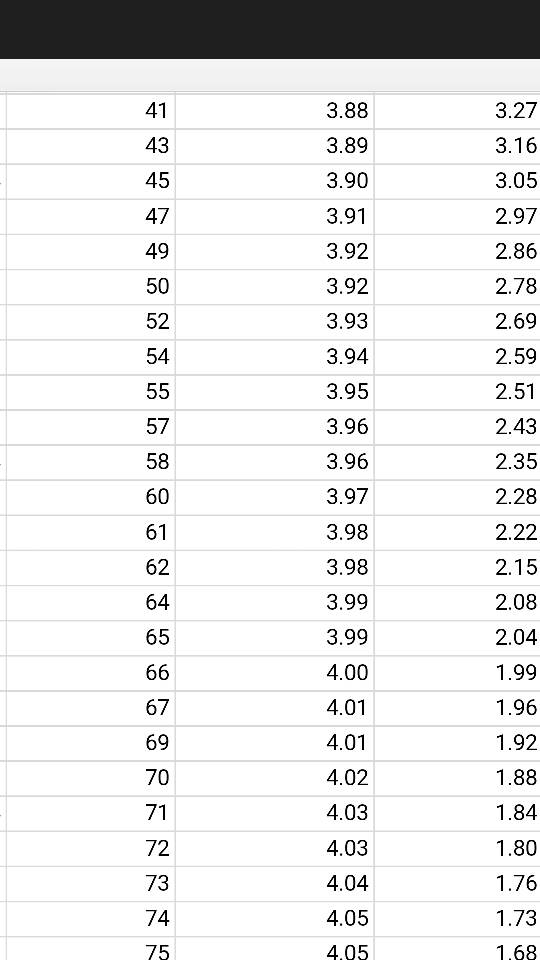
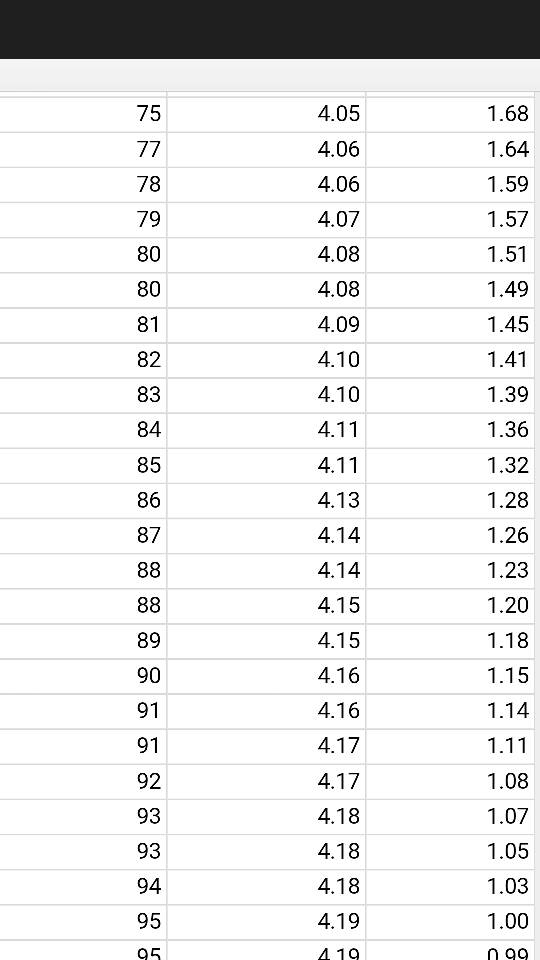
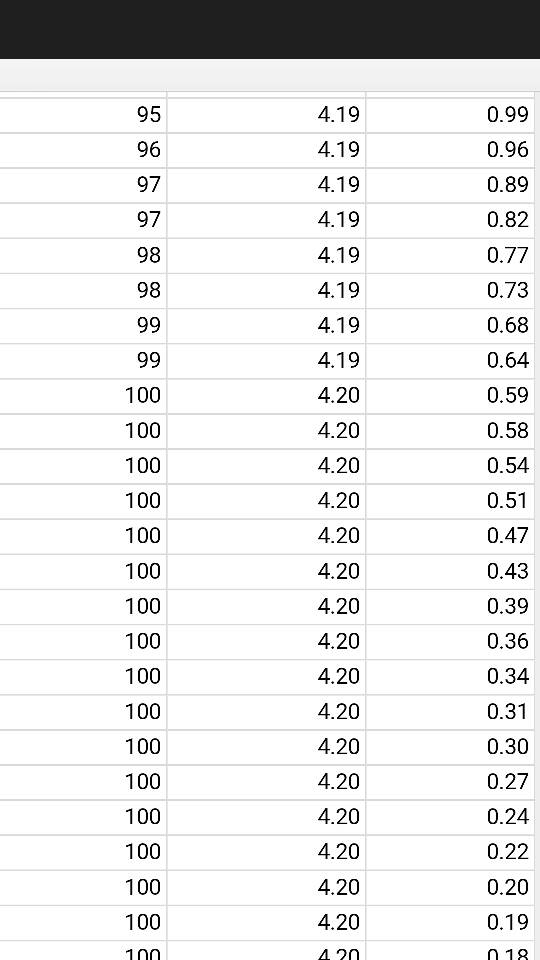
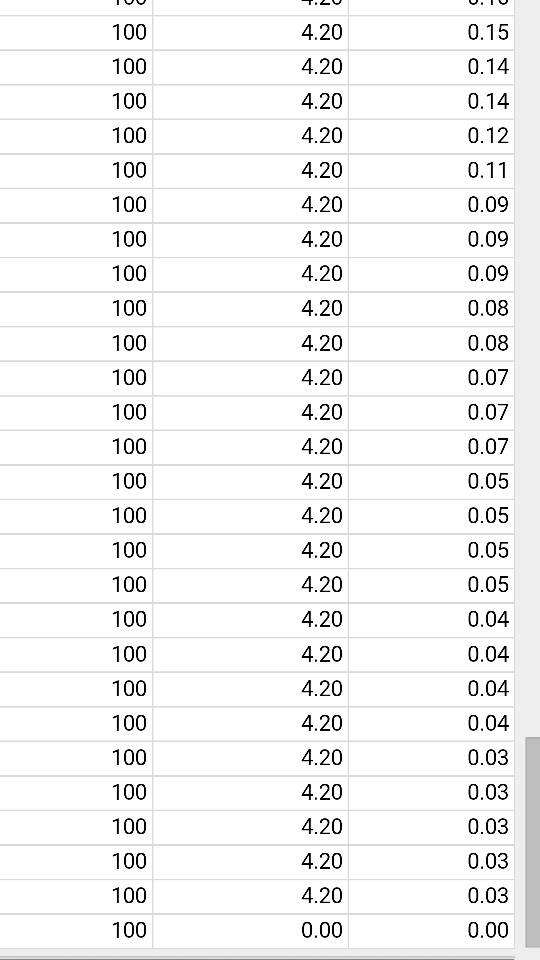
OddB Here are my notes from the UI on a 0-100 supercharge. Cell voltage and Amp calculate by dividing by 96 and 74
 �
�
Feb 8, 2016
vitaliy How much is usable in 90 kWh pack?�
Feb 8, 2016
Andyw2100 I'm pretty sure the answer to that is one of the things wk057 is trying to determine, and will be able to once he gets to log a 90.�
Feb 8, 2016
pupik yes, of course! fixed... thx�
Feb 8, 2016
AWDtsla The highest I've ever seen was 267 miles. And the rated consumption is closer to something like 312 Wh/mi, not that I've ever achieved anything close to it, my actual lifetime usage is 50% higher. Does this disagree with a P85D?�
Feb 8, 2016
Justicepool Wow, what a thread. Jason has way too much time on his hands. Good for him. I have way more important things to worry about in life than a marketing claim that has no effect whatsoever on the intended use of the product. As others have already stated numerous times in this thread, the important numbers for 99.99% of Tesla consumers is range, range, range. (And safety of course). It is utter nonsense to suggest that Tesla has some sinister motive for badging the Model S 85Kw vs. 81Kw.
I have no reason to doubt Jason's numbers are close to accurate, but are they 100% accurate, of course not because they were not replicated under the exact same conditions as Tesla and/or Panasonic. Does it matter, of course not. It is marketing pure and simple.
To those of you that get sooooo upset and claim Tesla somehow owes you a refund, get a life. Many people have tried to inject reasonable opinions in this thread, but reasonableness is not easy to find these days. This is marketing pure and simple. Now, if they misrepresented the range achieved under EPA testing methods, then one would have an issue. If they misrepresented safety ratings, then one would have an issue. I have had consultations with clients that want to sue a person, a group, or a company because they have been "wronged". One of the initial questions is "ok, what are your damages?.....Well they lied to me. Ok, what are your damages?......Well they were wrong......Ok, what are your damages?, etc., etc.,"�
Feb 9, 2016
Auzie If any measurement claims are to be taken seriously and given credibility, then some measurement method validation process needs to be followed. Publishing something on an internet forum simply lacks this validation process.
The usual way of separating weed from the chaff is to get the results submitted to a peer review and get it published. Perhaps the subject of this thread falls far below the threshold of any journal publication and peer review.
Then some other sort of validation process is required before anyone can make any credible claims. Just saying 'I have done such and such on my measurement jig on my car/garage and gotten these results' is an interesting fun topic for discussion, but it is no more than that. It is unsubstantiated to claim to be more than that.
It is unsubstantiated to make claims about Tesla battery pack capacity or anything else just by doing few measurements, but it certainly draws traffic to this thread.�
Feb 9, 2016
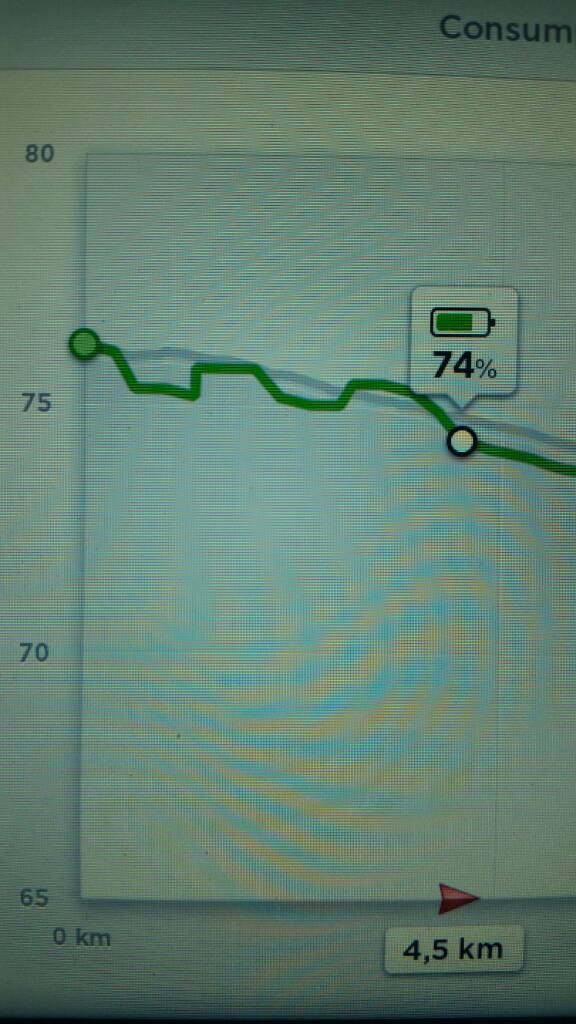
OddB Can any one explained this ? ( I dont require the answer to be verified by peer review )
The picture shows the "Energy/Trip" -line on the GUI. I switched Range Mode on and off.
It looks like I gain some extra capacity in Range Mode... ie it jumps between different percentages instead of charging the tilt of the line as is it would have done if the constant for Typical or Rated had been changed.
Is it possible that by using Rang Mode you reduce the bricking protection from 4% to 3 % ?
 �
�
Feb 9, 2016
Auzie
You just confirmed the validity of peer review process by asking peers on this forum to answer your question
Nothing wrong with that, quite the opposite
If anyone wishes to publish their work and make some sort of claims, even if that is only on the internet, then peer review is simply a quality control process.�
Feb 9, 2016
kennybobby Everybody separates their weed differently, but its always better to remove seeds and stems...
As far as your peer review and procedures comment, it is reductio ad absurdum--if nobody can post results and findings without being peer-reviewed first, then nothing will ever be discovered.
Other folks have measured cell capacity and posted on this and other internet forums with exactly the same results within significant figures. The methods and procedures for testing and making voltage and current measurements are well known and commonly established and practiced by those skilled in the art.�
Feb 9, 2016
smac Well strictly speaking the UK launch cars (and any EU car sold in 2014) should have a * against the EuroNCAP tests. Without "Emergency Braking Assist" they are not 5 star cars.
My view is this is why AP hardware was rushed out well before the AP software was ready. It was needed to get top marks in the European safety rating system�
Feb 9, 2016
CO2CLEAN Or (from a more positive perspective) the hardware was already built in cars, when they knew what hardware they needed, to (later on) also provide the AP features to buyers in 2014.�
Feb 9, 2016
smac If you were in the first batch of buyers having waited years for a car with a big deposit down, only to have it almost immediately outdated and residuals reduced by Tesla's own valuation formula, such a positive spin is hard to swallow
I get why they did it, they set the goal of 5 stars both sides of the pond, which is a rare achievement. The timing sucked for the early UK adopters though, and not all were particularly pleased with the approach.�
Feb 9, 2016
Kalllagtunet
Auzie
How large part is TSLA of your stock portifolio?�
Feb 9, 2016
AWDtsla Denial is not a river in Egypt.�
Feb 9, 2016
stopcrazypp AFAIK, there is only one other person who measured cell capacity and they did it with a 10A high power discharge (they weren't trying to get true capacity, but rather doing a power test). Someone linked it up thread, but I am a bit lazy to dig it out.
To be fair to wk057, he has offered to do a data dump (which is what peer review would involve), but his hands are tied because he is using some special equipment that he can't readily release data from for commercial reasons (for the same reason he can't disclose the details of the equipment he used).�
Feb 9, 2016
islandbayy If anyone is willing to send me a single cell, I have a special charging station that will discharge, measure, and then recharge, measure, the capacity of 18650 cells. I use it when rebuilding packs for e-bikes, laptops, scooters etc...
It would be awesome if I could keep the cell too ;-) but I will return it if requested. PM me if you are interested.�
Feb 9, 2016
wk057 I have some still mostly untouched cells (only to free them from their module and bring them to a good storage SoC) that I've had stored in my solar equipment room at 64F for a while. They're all from a D pack that had ~3k miles or so. I could send you a couple if you want to try them out on your charger (PM me an address). However, I probably have something similar (I have two of these: Amazon.com: FMA PowerLab 8 v2: Toys Games ), but I found they always register a lower capacity reading than my other equipment anyway. You'll also need a safe way to hook up to them with low resistance (the cheap 18650 holders will not do) to get a good reading safely. These cells have no protective wrap, so the +/- terminals are very close together at the positive cap side and are easily shorted out when putting them into cheap holders. And don't try soldering to them either. They explode.
I don't need them back, but I don't have very many left either, so, can't send them to everyone.�
Feb 9, 2016
bonnie I find it interesting that when Auzie makes a point that is accepted across many industries, you respond with this. Most research is able to stand up to peer review.
Why would you feel a need to take a pot shot at Auzie's post?�
Feb 9, 2016
smac Doesn't that cut both ways, as most of the claims by Tesla themselves are little more than this.
In fact, the teardown and subsequent CAN hacking provide a good indication that consumers are in fact peer reviewing Tesla's own published "findings". So far finding them lacking, and still without rebuttal.�
Feb 9, 2016
Kalllagtunet She is asking for peer review of info from from WK one the most transparent trustworthy members of this whole forum one of the few actually that contribute with facts and data not more just his opinion like the rest of us. I so far have not seen any facts presented from Auzi I have only seeing a consistent stream of post with the intention to tear down and downgrade the little objective facts WK and others have provided here or in the other astrix tread.
I simply ask for the same transparency from her. How important are TSLA in her stock portfolio?�
Feb 9, 2016
dsm363 And if someone on an Internet forum told you 1% how would you verify this? If you don't trust what they are saying already why would you trust what they told you about their portfolio?�
Feb 9, 2016
tomas New to this thread, so apologize if this has been asked and answered: WK - what was the age/usage history of the cells you tested? I know that my most significant capacity degradation (about 5%) came over first 18 months and has been very stable since. If your testing was done after that initial break-in loss, wouldn't that about foot with 85 as shipped?�
Feb 9, 2016
apacheguy Keep in mind that even peer review in scientific journals is not fullproof. A good amount of results out there are not reproducible.�
Feb 9, 2016
Kalllagtunet Of course way of doing that but thanks for emphasize my point of Auzie and others that do not share anything can discredit the work of WK and others can do this without ever revealing or in the danger of others to reveal the �backdrop� for their position in the subject discussed in these astrix treads.
Let�s not continue this discussion on Auzie. I have made my point and you got it :-D�
Feb 9, 2016
techmaven Seriously, wk057 has access to the BMS read outs. Plus, the data sheet is known to be optimistic, and that's 3.7 volts x 3200 mAh x 7104 cells = 84.1 kWh. A more realistic, testable output would be 3.6 volts x 3150 mAh x 7104 = 80.6 kWh. The fact that he even can get 81 kWh out of a spec sheet of 84 kWh is pretty impressive. Now, the fact that Tesla gives you access to 77-78 kWh of it, or about 96% of the battery and it still holds up is also pretty impressive.
Now, the issue really is, should Tesla have re-assigned the ratings based on realistic outputs, or on maximum, manufacturer ratings? There is likely a set of conditions in Panasonic's lab that can justify the original ratings. I posted the hard drive analogy earlier... you buy a 2 TB drive, that doesn't give you 2 TB of usable disk space. In the end, whatever we bought, we had 77-78 kWh of useable capacity, less if you push it hard or if it was colder. The car seems to match EPA rating of 265 miles pretty well.�
Feb 9, 2016
Auzie
Perhaps my point was not clear. I am not disputing validity of publishing any results. I find this forum quite interesting because so many people publish and discuss their measurement results.
I am disputing validity of making statements and claims based on results which were not peer reviewed.
If I were to publish any results and make statements and claims that can adversely affect a single person, I would make sure to find as many people as I can that have knowledge on the subject and I would ask them for a verification.
When it comes to legal statements and claims against manufacturers based on someone's measurements, then the courts usually go a step further and ask for a certification, not just verification.�
Feb 9, 2016
Auzie
We are civilised society - now I am making unverified statement.
All manufacturers are subject to periodic audits and certifications by various bodies to be able to legally trade and to be able to make certain claims that buyers of their products have no way of verifying.
If they fail these audits they do not get required certification and they can not trade.
These audits are quite rigorous and guaranteed to pick up anything potentially wrong with Tesla's claims that are relevant to consumers.�
Feb 9, 2016
Shaggy So is this is like the massive issue (resolved via lawsuit) about displays a time back: View-able size, CRT size such that now we have 32" Class TV with 31.5" view-able as required info? People arguing dpi of the display, etc.
If I'm told I have an 85 kwh battery, I should be able to be shown Something x number of cells = 85 kwh. Anything else is an 85 kwh equivalent or 85 kwh class (which are silly). I would accept Tesla telling me the numbers they get from their cell manufacturer and then as stated somewhere WAY back, my issue is with Tesla, Tesla's with their cell manufacturer.
Range is another number that is a different measure. It should be discussed outside of this number.
It seems this could easily be diviaded into two things. Tesla saying what the cells are as reported to them by their Manufacturer at whatever they wish to report it as (ideal, typical, whatever) and Tesla multiplies that by the number of cells and simple math gives a battery rating. Everyone can then debate if they should report that number and a usable number the so called 85/81 kwh. Both numbers are arrived at with simple math and THEN we discuss what is actually going on.
Seriously this far in and the resolution should be that Tesla can say we get 85 kwh from number of cells times... and we're done. We can then move to how come we don't get that. No if Tesla doesn't say anything, it may take an official complaint to get the info about consumers being deceived or something.
Debating methods at this point sounds very premature, the question is raised. He doesn't see how 85 kwh is ever there. We first have to find out how/why Tesla says 85 kwh, until then it's pages and pages of hypothetical. There are several variables you can try to control for, but until you know what the ideal starting point is, it's educated guessing.�
Feb 9, 2016
flathillll your forgetting to account for the 4kwh lead acid battery!
haha jk
this NCA cell only delivers the rated capacity maybe 1-3 times if discharged at 0.1C and the cell is brand spanking new
by the time the cell is installed in a pack and sold it is already a few
months old and has undergone calendar aging and cell matching cycle tests. panasonic also cycles
the cells before they are put on the boat to Tesla. after cycling they are left a full charge for a few weeks to weed out the non Tesla grade cells (very tight self discharge limit). cells with abnormal self discharge are the ones that are most likely to randomly vent fire.
I've seen 10% loss just storing NCA cells for a year. NCA shows rapid decline at first and then levels out (looking at either cycle life or calendar life)�
Feb 9, 2016
apacheguy Calendar aging for these cells has been shown to be minimal when properly stored (<= 50%). I'd be extremely surprised if Panasonic ships, or stores for a period of one week, their cells at 100% SOC.�
Feb 9, 2016
flathillll the worst thing about nca cells is they rapidly degrade. the best thing about nca cells is the degradation quickly levels out. this applies to both cycling and calendar
again Panasonic performs a short term self discharge check at full voltage at the factory and then Tesla does their own cyclihg test. if capacity looks good Tesla does its own self discharge test but this time it is done NASA style where it is tested for weeks(fully charged then put in temp
controlled room for weeks and then voltage drop measured). This is not the cheapest or easiest way to test cells but it is the best way to screen duds. comparing self discharge is the best predictor we have to screen. any outliers fail QC.
it is the reason why have 20 year old SAFT NCA cells operating perfectly right now in satellites flying outside but those cells are so precisely matched they dont even use a BMS. only mission crit sats skip the BMS. Tesla is using the most agressive
screening procedure seen outside aerospace�
Feb 9, 2016
jcaspar I find this whole thread very amusing.I suspect Tesla calculated their 85KW battery capacity by using the manufactures cell rating, which no one hear seems to know. Maybe this rating was a bit optimistic or under ideal situations (as often most such ratings are given) but I bet it added up to 85KW. The conspiracy theories here border on paranoia. All based on some non certified cell tests on which no one would ever base a battery capacity rating. Even worst case scenario, we are talking a 5% variation. This is not Volkswagen's cheating on emissions by producing up to 35X the measured pollutants to gain subsidies and tax credits from the US government. Tesla has no reason to try to intentionally mislead consumers as no car has a capacity even close to Tesla's. We all got the range we were promised. Lets move along...�
Feb 9, 2016
JRP3 Why would we move on from trying to find accurate data?�
Feb 9, 2016
AWDtsla "Maybe" but Tesla lost credibility with the HP issue. The rating was clearly BS from the beginning, it just took a long time to wade through the sea of apologists for an official answer.
The damage is already done. My willingness to recommend or talk about Tesla with other people has already been severely limited. I can't give them any honest numbers, from horsepower, to quarter mile times, to supercharge times, to battery size and range.
edit - To the bigger picture, Tesla is failing to cross the hump from early adopters who will put up with any amount of BS just because it's new and the only worthwhile electric car, to mass adoption.�
Feb 9, 2016
flathillll Tesla never lied. The motor power rating is technically correct on all the cars they have sold and so is the battery rating. They play the same game as everyone else.
Given time all cars will be required to be sold with an actual usable capacity rating but even then some people will never be happy. Should usable capacity be based on a virgin pack or should it be estimated after 8 years or should it be based on....
Until these types of questions are answered Tesla will stick to industry standards (which some may argue are
shady or misleading) but at least are technically correct and have some formal basis
again Tesla has NEVER lied with either the pack capacity or Power specs. Do you really think they are that stupid? to win you have to play the game�
Feb 9, 2016
AWDtsla Tesla already backed down on the HP issue, but the apologists keep swimming upriver?
Hmmmph.
2 years ago I would have said no. Today, I will say yes.
There is no game. They would have sold the same amount of cars with the correct HP and correct capacity. They've only lost credibility.�
Feb 9, 2016
flathillll that is only true because they have no competitors now. but be assured ALL the major automakes have Tesla killers in the stable and Tesla has no idea when they will be released. one thing you can be sure of is they will play every trick in the game book when advertising their cars. the will use the same motor regulations and the same method to calculate pack capacity. they would be stupid otherwise.
just because you dont like how the game is played doesnt change anything. the only reason new laws will be mandated to state usable capcity will be when a competitor with better cells will lobby for it to make their car look better "on paper"
making new laws to benefit your corp is another aspect of the game
the wise words of a g rapper:
f the game; player for life�
Feb 9, 2016
Ben W There's been an odd exception to this rule recently. After 64GB and 128GB (binary) flash drives, the next iteration is 192GB (binary) drives, and some marketing whiz realized that 192GB (binary) ~= 201GB (decimal). So this new generation of flash drives is universally being advertised as "200GB", rather than 192GB. Go figure.
To the nerds among us (I work at Google), the standard naming convention is to label the binary versions as "MiB", "GiB", "TiB", etc. (Mebibyte, Gibibyte, Tebibyte), relative to the decimal MB, GB, TB (Megabyte, Gigabyte, Terabyte). It takes some getting used to, but as you get into Petabyte and Exabyte territory they really start diverging, so it's useful for clarity. (Beyond exabyte, the next two steps are zettabyte and yottabyte, and the one after that is either hellabyte or brontobyte, depending who you ask.)
My reaction to this whole thread... It's universal for any marketer to ratchet up their advertised specs to the highest degree they can rationalize, because if they don't, the next guy will. So airfares are advertised with all the taxes and fees removed, food "serving" sizes are unrealistically tiny, performance of computer chips (in gigaflops/teraflops) is not practically achievable if you're trying to do anything useful, and you can't really drive a "200-watt" audio receiver at 200 watts, without destroying your speakers. (Unless you're playing a pure sine wave test tone in a vacuum. Yes, yes, I know.)
So since the Tesla battery cells can theoretically (under laboratory conditions) charge to 4.35 volts, and when you multiply that literal figure out you get 85kWh, Tesla can rationalize calling the battery pack "85kWh." The same logic goes for the "691HP", and also probably to all the other battery capacity figures from the other EV manufacturers. My guess is that the rationalizable limit for the "60kWh" battery pack might have been closer to 64kWh; not quite enough to be able to justify "65kWh", and then given that round numbers sound a lot nicer, they settled for "60kWh". If humans counted in Base 9, Tesla would doubtless have rounded these marketing figures to 63 and 81 ("70" and "100" in base 9, respectively), and then we would be arguing here about the 63 pack instead of the 81 pack.
To ordinary drivers, the EPA mileage figure is a lot more meaningful than kWh in practice, and I'm also glad their test allows driving the car past the "zero" point; it allows Tesla to set the zero point more conservatively without being penalized, which is better for drivers. And with 36k miles on my 2012 P85, my battery capacity has diminished perhaps 8% since new; I can still range-charge to about 242 rated miles on a good day. (~220 miles on a standard charge.) Lifetime efficiency is about 351Wh/mi, about 12% worse than the EPA rating. (21" rims don't help.) To me, all of this is completely and totally expected.
Just my two cents. Carry on�
Feb 9, 2016
schonelucht The burden of proof is on Tesla for making the original statement that their pack is 85kWh. They never did, so wk057 is fact checking Tesla Tesla's claims and so far they are not holding up. You may also have missed the other thread (parts on the bench) were a substantial part of wk057s research has been independently duplicated and validated (notably the cell voltages at different charge states). So if you want to be pedantic about it all, the right statement to make is that there is currently no evidence that the packs sold as 85kWh actually have said capacity.�
Feb 9, 2016
Mike K No, the accepted conclusion is that the battery pack is 85kwh. wk057 challenged this assertion and thus the burden of proof lies on him, not Tesla. I'm not saying anyone is right or wrong just that he is the one that needs to prove his claim. If you run around telling everyone I'm only worth a couple McDonalds cheeseburgers and whatever change is on the side of my seat it's on you to back that claim up. Otherwise people could just nitpick every little detail and force an explanation/ proof from anyone about anything.
Now people can either accept his data or not. That's up to them. Personally I think there are entirely too many gray areas for this to be as black and white as some want to make it. I also don't see what they had to gain from intentionally misleading which leads me to give them the benefit of the doubt.�
Feb 9, 2016
schonelucht Not by the rigorous standards that Auzie wants us to apply.�
Feb 9, 2016
Auzie That's not an argument.
My understanding is that people that pursued legal avenue against Tesla on hp issue backed down.
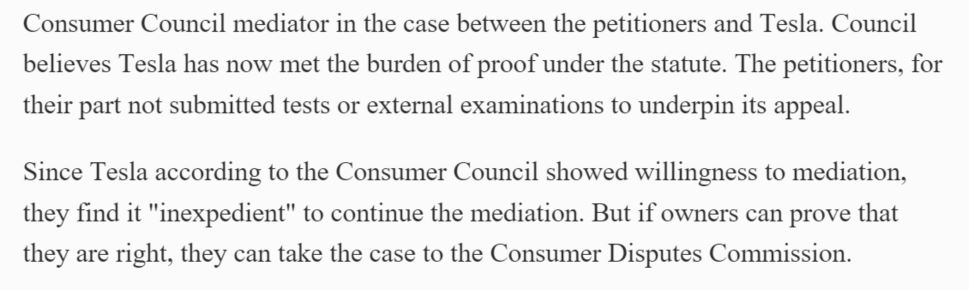
Norwegian owners lost in the first round. The details are in the relevant thread on the topic, but the most relevant article on the matter is here
Few more details in this post, courtesy of Yggdrassill
The first step mediation put the onus on the owners to prove their case if they wished to appeal to a step 2 body. Norweigan owners had a deadline to appeal to a higher body by 12.15.2015, reference here
We have not heard on the forum that anyone followed up to a step 2 complaint, most likely because no one did. They backed down because they have no case. People that have a strong case do not back down.
- - - Updated - - -
These rigorous standards apply to any legal manufacturer or they are not allowed to legally trade.�
Feb 10, 2016
schonelucht That's just not true in my jurisdiction. You don't need to show or even do peer-reviewed research before making a claim as a company in the Netherlands. I know of no actual jurisdiction where this is true in general, unless we are talking specific conformity testing (which is not applicable for battery capacity). Can you point me to specific laws or regulations that would prohibit making a claim without having gone through the full peer-reviewed+publish cycle? In fact, if so, I would be very interested in the peer reviewed studies Tesla, as a legal trading company, must have published according to you with regards to battery capacity. Let me know where I can find them.�
Feb 10, 2016
smac And I guess this ties in to what Schonelucht is saying.
Unless something is subject to regulatory standards (i.e. EPA ratings, CE approval, etc.) then marketers will stretch the figures as best they can to enhance perception of the value proposition of the product. (And in the case of regulated figures engineers do the same, just look at NEDC mpg figures, or how many products nowadays are beat to scrape by minimum standards, lots of modern stuff while cheaper is [email�protected] quality). Sometimes they go too far.
To counter this in our "civilised society", the first backstop is stuff like the advertising standards agency (in the UK) or consumer council (in Norway). Both of which requires consumers to initiate a complaint, rather than being actively policed.
I guess the ultimate backstop is then civil legal proceedings.
We've already seen that enough people were upset enough over one of Tesla's claims to call on this sort of consumer protection. There is nothing stopping them doing the same over this issue.
Agree with their decision or not, it's a headache for Tesla. (Esp. when it comes to battery measurement claims, the EU is stricter than the US, in what is deemed acceptable practice.)�
Feb 10, 2016
Auzie Not sure I fully understand your comment but I will give it a go at responding, or clarifying my previous statement.
Manufacturers are not subject to peer review but to country regulations and to applicable industry standards.
Compliance requirements and auditing bodies vary from industry to industry and from country to country. Netherlands is a developed country and as such legal requirements apply to all manufacturers.
If you are curious about automotive industry applicable standards and compliance requirements in your country, google is your friend.
Peer review is the widely accepted established validation process that helps validate research, method and findings. Most people rely on peer review process to uphold the quality and validity of their work.
On a personal note, I get peer review done even on emails, if they deal with a particularly tricky issue. It helps me not to make a fool of myself. That said, sometimes peer review falls short
- - - Updated - - -
smac I admit that such situation really sucks from your perspective
We just have to deal with the cards we are dealt, and your cards ain't all that bad :smile:�
Feb 10, 2016
schonelucht Thanks for your clarification. Now let me clarify my position. When wk057 reviews claims by Tesla, you reject conclusions based on that review as unsubstantiated, since they've only been done by one person. Yet the million times someone on this forum has taken the claim that there is actually 85kWh capacity in the battery at face value, never once was there a suggestion that maybe we shouldn't accept that number since it hasn't been reviewed or verified (if there are in fact regulatory bodies that have done that review I repeat my interest in them). That just feels not right by me.
I stand by my rephrasing for the 'technically correct is the right correct crowd' : there is no evidence whats-o-ever available that supports the claim that there is 85kWh of capacity in that battery. At least one serious experiment to find that evidence failed.�
Feb 10, 2016
smac Of course not. I'm well aware I'm fortunate to be able to afford any Tesla, whilst billions in the world cannot.
Doesn't mean I have to like their aloof approach to customers though�
Feb 10, 2016
Auzie
I find their aloof approach understandable and wise. Imagine if they drop their aloofness and show how they really feel about (some of) their customers�
Feb 10, 2016
Laserbrain +1
But maybe there is an explanation to the missing kWh - like there are explanations in Tesla's horsepower and rollout scam.
You can get the advertised BS horsepower, when you attach a power cable from a nuclear power plant to the motor and avoid the battery bottle neck.
You get the advertised 0-60 mph times when you measure the 5-60 mph time and simply define this to be the 0-60 mph time - or by testing in proximity of a black hole in space while the clock to measure the 0-60 mph time is on Earth.
And maybe you get the advertised kWh under a a certain special condition, too - maybe at a special temperature in a climate chamber at a discharge level which minimizes the internal resistance. It could be a discharge level which is so low that it cannot even power an electric bicycle - but maybe it gets you the 85 kWhs.�
Feb 10, 2016
Dennis87 We did not loose the first round. It was just not a case for the consumer council since Tesla did just reject all complaints. And I can promise you this case is not dead. We have hired advocates in consumer rights and this is going to court. We are just not sharing anything with anyone that have not paid to take this case to court in Norway.�
Feb 10, 2016
lolachampcar This thread echos the HP thread which is really no surprise. What has become clear to me is, without regard to which side is correct, there is now a discussion about Tesla's credibility where in the beginning there was not. Time will tell if it does or does not have an effect on the company.
We can discuss the battery issue further but, if the HP thread was any indication, most people staked out their positions within the first thirty pages with few moving any if at all beyond that. Proceeding from here would seem to only serve sharpening your debating skills but I doubt any hearts or minds will be changed.
From my perspective, I suspect Tesla has way more to fear from the Model X release then from their marketing gymnastics.
Look, a squirrel....
Better yet, look, Trump won NH.�
Feb 10, 2016
Auzie Consumer council found that there was no case and dropped it. Had they found otherwise, they would have taken it further on behalf of customers.
The fact that customers had to hire lawyers and pursue their own case rather than have the Council do it on their behalf looks like a loss for customers to me, in that first step.
Judging by your statement, the case has not gone to court yet. That means that the appeal to the Consumer's Dispute Commission has not been lodged as the deadline for that was 12.15.2015.�
Feb 10, 2016
Dennis87 Trust me, I know very much about this case
The consumer Council did for over 1 year ago try to force Tesla to stop the pricing including fuel savings ++. Tesla have still not done anything about that and the Consumer council have not been able to do any more. They don't have any real "power" and the cases must go to court if one of the sides don't agree. So to not waste any more time we did follow up this case as a group with our own lawyers.�
Feb 10, 2016
rns-e maybe the missing 5 kWh will come as a mobile range extender?
http://www.marketwatch.com/story/tesla-motors-ceo-elon-musk-confirmed-the-concept-of-mobile-batteries-as-range-extenders-2016-02-04�
Feb 10, 2016
Auzie Thanks
If you have gone to court as a group and hired lawyers privately, I find it is strange that there is no mention of the court case in media. Court cases are public and difficult to hide from media. Customers have nothing to gain by being secretive about their court case�
Feb 10, 2016
JRP3 On the other hand the general public has no idea how large their ICE is, it's HP rating, or the actual size of their gas tank. I think it's more of the early adopters and enthusiasts who really care about such details. As long as the vehicle performs pretty much as advertised I don't think most people will sweat the details the way we do. Certainly I hope Tesla will be more accurate in the future, I like "under promise and over deliver" myself, but I'm not sure it will really affect the brand if things are slightly off. "Your mileage may vary" is generally accepted as part of life.�
Feb 10, 2016
jaguar36 It depends on who you are talking about. Most folks who buy a Camry or a Fusion, sure. However I bet anyone who's got a Mustang GT or a Camaro SS know exactly how much HP it has and how big the engine is. Now they might not know what the torque curve looks like and how that effects their performance, but I bet they know those headline numbers.
I also bet that if it turned out that either one of those cars was making 5% less HP at the crank than what was advertised there would be a giant stink about it.�
Feb 10, 2016
JRP3 I'm more referring to the high volume Model 3 buyers who just want to get a really good EV with enough range at a reasonable price.�
Feb 10, 2016
Kalllagtunet You need a peer review of your stated facts... I do not think any that know the issue will do... So you are back to pure speculation.�
Feb 10, 2016
LetsGoFast They do if the complaint has not yet been filed. It appears that they have decided to pursue an alternate remedy through the courts instead of the consumer council because they perceive that the council was a waste of time due to its limited enforcement capability. You may choose to believe that instead they thought it was unlikely that they would prevail, but I have found Dennis87 to be generally honest about the process and see no reason to disbelieve him now.
In terms of the success of their legal action, time will tell. Eventually, the details of the case will indeed be public, as you stated. Although sometimes litigants like Tesla find that they are more amenable to a settlement once there is an actual court case.�
Feb 10, 2016
stopcrazypp Step two of the Consumer Council (Forbrukerr�det, step two called Consumer Dispute Committee) is able to make a binding decision (aka meaning it has the force of law). Of course after that either side can appeal that decision by going to an actual court.
The Norwegian Consumer Ombudsman (Forbrukerombudet) that targeted the fuel issue is a different group that has no enforcement ability. I forgot the exact name, but in Norwegian it is not the same. I will have to dig up the older posts where someone explained this.
Edit: links
http://www.teslamotorsclub.com/showthread.php/56627-Stop-the-Press!-Tesla-announces-REAL-HP-numbers-for-P85D-and-P90L/page252?p=1273281&viewfull=1#post1273281
http://www.teslamotorsclub.com/showthread.php/56627-Stop-the-Press!-Tesla-announces-REAL-HP-numbers-for-P85D-and-P90L/page251?p=1272744&viewfull=1#post1272744
This should really be in the HP thread, but thank you for the reminder of the deadline. It seems like complainants dropped their case with the Consumer group if there is no news at all about it after almost two months past the deadline.�
Feb 10, 2016
darthy001 To my knowledge about 70 individual norwegian P85D-owners have gone together and hired lawyers to protest the ridiculous response from Tesla about the HP and 0-100claims for the P85D.
Remaining population of complaints, including myself, are still pursuing the non-court option.
And @Auzie the complaint was far from dropped. The council just commented that Tesla had no intent of meeting us half way and sent the case to the next and final step in the non-court part of the norwegian consumer system.
The others didnt want to put this in the hands of this voluntary and _free_ system and hired lawyers instead.
I know because I was, along all other who complained, asked to join the suit, but I opted for the free option that ends up in a binding decision for both parties(at least in theory). Now it is up to Tesla to respond if they dare go that route. They have already complained to the consumer council that some of the remaining complaints are more detailed than the one they originally cherrypicked in the first round. Go figure
This is far from over. I have no real hope of anything here to be honest, but Teslas responses and attitude in this case made me complain out of spite... The ones lawyring up though seems to have a nice case based on Teslas last complaint to the consumer council since it honestly makes them look scared and somewhat panicking.
- - - Updated - - -
Incorrect, Tesla has actually asked for more time in order to answer other and more detailed complaints. Tesla also complained because they believed that they were done after the first round. No deadlines have passed. New deadline for the ones complaining is the 7th of march to decide if they want to continue to the last step.
The ones who are "suing" Tesla has chosen to do so under the radar so far. I assume in order to give Tesla an option to settle in silence before the case actually goes to court.�
Feb 10, 2016
stopcrazypp So you are saying that the complainants decided to continue to step two (Consumer Dispute Committee)? Any links to this in the news? I thought the case was dropped given there were no further updates on this (I asked couple of times in the other thread).�
Feb 10, 2016
Dennis87 The number is much more than 70�
Feb 10, 2016
darthy001 Yes, and I am one of them personally. Deadline to decide is 7th of march for the complainants. I stopped reading the other thread to save my sanity
- - - Updated - - -
Damn, sort of regret not joining if that is true�
Feb 10, 2016
stopcrazypp I see your update to the comment. I posted before that. So I guess that it isn't in step 2 yet, but deadline extended because Tesla had to answer other complaints (I thought the Consumer Council allowed them to consolidate it into one response and step 1 was ended from what was reported originally, but I guess not).�
Feb 10, 2016
darthy001 That is appearantly what Tesla believed as well. In "round 2" it seems they have to respond to each individual complaint and they soon realised that the one they originally answered most likely was one of the most poorly written ones.
Personally I am just following the motions to be honest. Dont really care anymore, but want to show Tesla that I dont approve a the same time. Thus the free option and no law-suit from me.
PS! Been reading this thread mostly out of entertainment-value and because wk057 keeps making my day with his nerdking-skills�
Feb 10, 2016
flathillll The 85kwh rating is in no way a scam. That is below the true rated capacity. While Wk can claim to be Tesla battery expert, he is in no way a Tesla cell expert. He is the most valuable member on the forum, and the information he is providing is very valuable, but be careful interpreting what he is reporting.
Anyone familiar with NCA cells would know that the fact he is measuring/calculating ~81kWh on a pack over 6 months old (guessing roughtly from time of cell mfg+transport+testing+install+whatever) is actually showing Tesla has the best cells on the market. Remember Tesla's Panasonic cells are actually made by Sanyo Automotive & Industrial Systems Company. If you look at any Sanyo NCA cell data sheet you will see they only guarantee a 80% recoverable capacity with the following conditions:
1) less than one month if stored from -20 to 50C
2) less than 3 months if stored from -20 to 40C
3) less than 1 year if stored from -20 to 20C
An absolutely shite guarantee right? An that is ONLY if you store the cells at exactly the right voltage and exactly the right humidity. Yes that is the present state of the art! A one month old cells stored at 50C could lose 20% of its capacity and still be within spec!
Again ~81 kWh that Wk is measuring/calculating is phenomenally good. If the pack was brand new it would actually measure closer to 86 kwh. Wk is really doing disservice spreading misinformation by jumping to conclusions, but his cell testing cycle data will show the best thing about NCA cells is the degradation starts to level out, making them the only cells that can last ~20 years in an automotive application (estimated 70% capacity after 20 years).
Again this is how the game is played. All ebikes, power tools, golf carts, and other EV's rate their battery pack based on the rated capacity of the cell given on the cell's datasheet. Typical capacity is higher than the rated capacity.
Again the more information the better, but please don't scare people into thinking they have been scammed!
Tesla's only obligation is to rate the pack at or below rated capacity of the cells. In case of the 60 kWh model they underrated the battery for two reasons:
1) to get more people to upgrade to the 85 kWh pack (duh)
2) the smaller pack needs more leeway to ensure long life as the pack capacity will be utilized more fully more often. Tesla is hoping the packs will hit 80% (worst case usage) after 8 years for both the 85 and 60 packs. Remember the goal with the roadster was 70% after 8 years (best case usage) so this is a big jump in lifespan.�
Feb 10, 2016
Kalllagtunet Flat
How do you explan the measurements for the 60 pack? A special variant of the cell that increase capacity after storage?�
Feb 10, 2016
RAW84 Then why don't they sell the 60 kWh pack as a 65 kWh? Since he measured/calculated that pack to be 61 kWh.�
Feb 10, 2016
flathillll
Tesla's only obligation is to rate the pack at or below rated capacity of the cells.In case of the 60 kWh model they underrated the battery for two reasons:
1) to get more people to upgrade to the 85 kWh pack with a larger difference "on paper" (duh)
2) the smaller pack needs more leeway to ensure long life as the pack capacity will be utilized more fully more often. This is why the 40 pack was actually a 60. Tesla is hoping the packs will hit 80% (worst case usage) after 8 years for both the 85 and 60 packs. Remember the goal with the roadster was 70% after 8 years (best case usage) so this is a big jump in predicted lifespan.�
Feb 10, 2016
scaesare While I'm of the opinion that the "leeway" idea has some merit in this discussion, I point out that this is not why the 40's were actually de-rated 60's.
The 40's were ordered in such small numbers, that maintaining a separate model no longer made sense, and Tesla discontinued the 40. In order to fulfill existing reservations, Tesla just derated the 60KW packs and called it a day. But they were originally going to be be physically built at 40KW capacity... no "leeway" was built in to them.�
Feb 10, 2016
flathillll That is wrong. The 40 was discontinued for two main reasons:
1) It didn't feel like a Tesla when Elon drove it. It was too slow (based on the max allowable amp draw on each cell that would still yield on long life 40 pack)
2) They could not guarantee the pack would not rapidly degrade given how a 40 pack would likely be used (full range charge down to 0 often, higher average amp draw on each cell).
The 3rd reason you gave was another reason they did it but not the main reasons. Even with the 60 pack there is a good chance it might drop below 80% after 8 years worst in worst case usage conditions. It is going to be close. Funny thing about electric cars is the larger the pack the less the mfg has to worry about warranty concerns or simply looking bad in the public eye (like the Leaf). Larger pack is less likely to be fully utilized and remember when you double the size of any battery pack you half the amp draw on the the cells (given system voltage and power draw held constant). Average power draw is actually rather independent of which pack size you have.�
Feb 10, 2016
lolachampcar I'm pretty sure they tossed the 40 because it was ordered in insufficient quantities to have it produced. That is my recollection from the earnings call in the day.
Of course, that could have just been for the financial community's consumption but the company was reasonably accurate in their statements back then.�
Feb 10, 2016
flathillll ""When we were testing the 40 kWh pack, it was kind of a sluggish car. It didn't feel good. It didn't feel like a Tesla.""
-Elon�
Feb 10, 2016
scaesare That's SAME INTERVIEW goes on to say:
" Few had shown interest in that most accessible version, which accounted for only about 4 percent of total orders, but there was more to it than that. "Customers recognized that it was really a hobbled car, the equivalent of a hobbled horse," Musk tells us. He believes that people want the Model S to be their primary car, and a car with such limited range wouldn't fill that role."
None of which supports your claim that the 40KWh packs were actually originally going to be software-limited 60's. As a matter of fact, if they were going to be the same cell format as 60's all along, then the current draw could have been identical to the 60's as well.
If anything that article argues against your assertion the 40's were originally 60's in disguise.
And then there's the fact that if you google "Tesla 40KW cancelled" you get a zillion hits with some variation of this Wired article:
"The decision to eliminate the Model S with the 40 kWh battery was based purely on demand"�
Feb 10, 2016
flathillll it is not a claim. that is the reason I have been told in person
the article we both linked to says as much in print if you read between the lines
"there was more to it than that"
meaning the demand wasnt the reason the 40 was canceled.
The 40 kWh tier was unceremoniously killed on April Fools' Day. Few had shown interest in that most accessible version, which accounted for only about 4 percent of total orders, but there was more to it than that. "�
Feb 10, 2016
WarpedOne Say flathill is right and poor longevity of 40kWh pack was the main reason for cancellation.
Only a fool would admit this out loud and offer bigger pack made of same (now seen as poor) cells.
This would be one marvelous company suicide.
There are many fools out there, not so many working at tesla motors. Even when you are humble and honest, fools misunderstand and run crusades.�
Feb 10, 2016
flathillll it wasnt that they couldnt make a long life 40 pack it is just performance and pack life are intertwined
Tesla chose the less profitable route that was best for its customers�

Không có nhận xét nào:
Đăng nhận xét