Feb 10, 2016
smac Would you like to buy a bridge in Brooklyn ?
Cut through the hype and spin and customers are well below Tesla's share price (and Elon's personal wealth and ego) in the pecking order.�
Feb 10, 2016
flathillll You don't know how wrong you are. Anyway all this 40 pack talk is besides the point.
The point is Tesla's 85kWh rating is correct and ~81kWh measured on a relatively new pack is to be expected given the cell chemistry. There is no hype or spin. That is how the industry rates battery packs. No asterisk is need on the 85kWh rating when advertised to the public. What you should do is measure a Leaf or eGolf or BMW i3 or SoulEV or Leaf pack capacity after a few years and compare it to a Tesla of the same age used in the same manner (same pack percentage used on average). Only then will you realize Tesla has the 2nd most honest capacity rating of any EV sold today (relatively). The only car that performs better is the Fit EV but it uses cells with shite energy density (lithium-titanate)
GM is already lobbying for all cars to be advertised with only the usable capacity and that must not include the 100% charge capacity if 100% charge is not the default charge setting, and the buffer cannot be included. What they don't tell you is GM cars use NMC chem which is designed to fail right after the warranty is up (manganese dissolution in electrolyte unstoppable, first principles...) and have a tiny buffer
The Great Lightbulb Conspiracy - IEEE Spectrum�
Feb 10, 2016
smac Then please enlighten me on one thing Tesla have done in the last year that has been positive for the customer, not their headlines?�
Feb 10, 2016
tomas BUMP - hey, can anybody answer my question? WK or anybody who has wallowed in this thread? It seems pretty fundamental data to the assessment.
Nah, I guess y'all would rather just argue.�
Feb 10, 2016
flathillll What are you even getting at. Elon will actually tell you Tesla stock is overvalued when it is overvalued. He cares so much about the mission he often cries. Not a sign of an ego maniac ill bent on pumping up the stock price. You think the Model X design shows profit is the chief concern? Tesla is a labor of love.
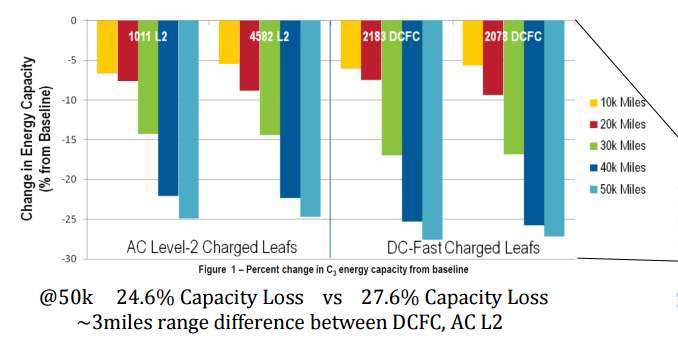
Currently the DOE is benchmarking battery life on every EV on the market except the Tesla Model S and X!
Here are the leaf results so far showing calendar aging is dominant (unstoppable) with manganese cells (almost independent of whether you charge at 6.6 kw or using Chademo)
 �
�
Feb 10, 2016
smac @Flathill, have you ever even been in the same room as Elon, or is this all based on what you have read on the 'Net?
Anyway, this is the same old "The end justifies the means" rhetoric. My point still stands, what have Tesla done in the last year that has been in the favor of their customers?�
Feb 10, 2016
flathillll That is such a stupid question I am not about to dignify it with a real response�
Feb 10, 2016
smac It's an honest question as I actually have (twice)... And even I'm still not convinced of the altruistic nature of the business.�
Feb 10, 2016
flathillll That's fine but I'm still not going to answer it. I'm sure others will.
For another reference point let's look at another manganese cell used this time in the Chevy Volt, which only operates over a very tiny ultra conservative charge/discharge band (hybrid).
Here is the Constant Power Discharge Test Results from the DOE showing again why the LG Bolt (Manganese cell) will be a piece of junk:
0 miles = 16.5 kWh
8478 miles = 15.56 kWh (6% change)
23314 miles = 14.27 kWh (14% change)
No matter how much you baby your Leaf (Nissan/NEC Manganese now and LG Manganese next), or i3 (Samsung SDI Manganese), or LG Bolt (LG Manganese) calendar aging is going to get ya
as intended by design,planned obsolescence
�
Feb 10, 2016
Auzie Thank you for a peer review, this thread really needed it�
Feb 10, 2016
flathillll No problem. If you are interested in why a long-term self discharge test is used by Tesla (which actually degrades the cells before they are even built into a pack and is view by bean counters as a "waste" of money)
https://batteryworkshop.msfc.nasa.gov/presentations/05_Consideration%20of%20Internal%20Shorts%20for%20the%20Spacesuit%20Li-Ion%20Battery_JNeubauer.pdf
Tesla always prioritizes safety above all. That is why the Model 3 is not going to use prismatic packs even though it would be easier/cheaper/denser�
Feb 10, 2016
Johan So the argument is that at some point, as the individual cells came fresh off the line they could (did) together deliver a total if 85kWhs of energy, once?�
Feb 10, 2016
flathillll No it would be more than once if they were brand new, but yes NCA cells rapidly degrade at first whether cycled or not. Again this is industry standard practice to rate a battery pack based on the cell spec. In time you will see that the NCA cells are bested suited for EV use as the calendar aging almost stops at one point and then aging is dependent on how they are used (max charge, temp, how long stored at max charge, etc). Almost all other EV's on the market except the Fit EV use manganese based cells which are designed to fail (calendar aging rate almost constant in some cases, no real pla�teau, in other cases can appear to plateau and then there is sharp increase, non-linear).
Again we have 20 year old SAFT NCA cells in space right now. Tesla is not hoping their models are correct like everyone else. GM is working with LG. The goal of the lifespan modeling is to last the warranty period and then rapidly decline (sharp increase in internal resistance after it appears to plateau)�
Feb 10, 2016
LetsGoFast Why doesn't the range drop sharply in the first few weeks or months of ownership if the cell capacity rapidly drops?�
Feb 10, 2016
flathillll The cells are already months old and used (aka thoroughly tested) before they are built into a pack. And even then with your Model you will notice range degrades more rapidly and then starts levels out (never truly levels out). Tesla also has the ability to change the the usable pack capacity (what 0 miles really means) which they probably won't do. The goal is to deliver 80% of the miles you got when new after 8 years, not 80% of 85kwh after 8 years. It likely will be 80% of 85kwh for most cars, but Tesla again left some leeway for themselves.
None of this is in writing! No one really knows what will happen for sure which is why the Tesla battery guarantee is so ambiguous. All we do know is the first gen Model S cells are performing/aging excellent so far as predicted/modeled by Dalhousie
Wait until you guys figure our that the Model S performance decreases with time as the cells age. Wait my gas car performance never varied with time!!!!Tesla are junk!!! Lithium cells suck right now but Tesla is doing the best it can.�
Feb 10, 2016
wk057 So one person who has been against pretty much everything I've ever posted on this forum comes up with some claim that Tesla does NASA style testing on every cell with no evidence that even remotely backs this claim (I've seen zero evidence of this, nor have I even remotely heard of this with Tesla anywhere before now), posts info not even related to Tesla cells, and a link to some document that doesn't even contain the word "Tesla", let alone relates to anything Tesla does, as "evidence".
One "word": lol.
I guess we'll just ignore everyone else that comes to or has already come to the same or similar conclusions as myself because of this one person. Makes sense to me.
Anyway, I sent off a couple of cells from storage to islandbayy today that I pulled from storage yesterday. While I was at it, I grabbed a random one that I had previously done tests on and threw it on for some slow testing. It had self discharged a little, but nothing major. Did a full charge/discharge cycle on it, thermal controlled, and compared to the data I had for it before. Now, this cell has been sitting in my storage at ~17C for over 6 months. Prior to that it had been removed from a module from a D-pack that sat in storage for several months. Prior to that it was in a late VIN P85 that was in an accident after ~3k miles. It's well over a year old, for sure, probably closer to 2 years than 1 year. Since my last test of it 6 months ago it lost...... *drum roll*..... 11 mWh of capacity. That's miliwatt hours. I mean, that's essentially zero. Most test equipment wouldn't even be able to measure that. The majority of that minuscule loss is just from the cycling I just did to it anyway. That's less than 0.1% capacity loss after 6 months, on a cell that's probably 18 months old and spent most of its life sitting. Oh, and the capacity of this cell measured at 11.33 Wh today. So again, calendar life degradation of these cells is virtually non-existent, for whatever reason, which is impressive.
But this again points out that these cells do NOT follow any of the datasheets available publicly. I think that is one of the most important things to realize here.�
Feb 10, 2016
flathillll Which supports what I just wrote a minute ago: "In time you will see that the NCA cells are bested suited for EV use as the calendar aging almost stops at one point and then aging is dependent on how they are used"
�\_(?)_/�?�
Feb 10, 2016
wk057 Um... you actually just posted the exact opposite of that and of what I just presented. Get your story straight.
�
Feb 10, 2016
flathillll Yes to clarify: in the first quote I was reference "calendar aging". In the second quote I was referencing what happens as the cells "age" (in general which includes cycle aging and calendar aging and everything else)
I had it right the first time but if you are being pedantic...
Again you have a noble purpose and it is good to share information, but to suggest Tesla has some sort of nefarious intent with regards to any of their specs is plain WRONG and I will call you out on it everytime�
Feb 10, 2016
wk057 I was going to continue to share data and results from actual Tesla cells, actual Tesla modules, and actual Tesla packs that I've tested personally in an effort to get the thread back on topic... but never mind. I'm not wasting my time.
If one person with no first hand experience with the actual cells and data at hand is able to so badly derail the thread, and even be praised for doing the so, then I'm just wasting my time continuing to provide input here. Definitely have much better things to do. Summary of my findings remains in the first post.
Unsubscribed. You'll find no further posts on this subject from me here.�
Feb 10, 2016
Auzie
Hmmm I find this a bit harsh
As far as anyone's contribution here is concerned, no one is offering any credentials to support their claims and perhaps there is no need to.
Poster's contributions can be judged by the content and information they present, not by association with Elon.
Every post stands on its own merit and nothing else.
Regarding pot shot at Tesla - Tesla delivered 50580 cars in 2015. I can imagine that means something to 50580 happy drivers, but I understand that may mean nothing to you.�
Feb 10, 2016
flathillll Again you have a noble purpose and it is good to share information, but to suggest Tesla has some sort of nefarious intent with regards to any of their specs is plain WRONG and I will call you out on it everytime. Why not start a new thread and focus on the data this time.�
Feb 10, 2016
JRP3 You should probably tell Elon that the manganese based cells he chose for daily powerwall cycling and long life are designed to fail....
http://fortune.com/2015/05/18/tesla-grid-batteries-chemistry/�
Feb 10, 2016
flathillll I am fully aware of the fact the powerwall uses NMC cells. What you fail to note is the 7kwh pack measures closer to double that new. The reserve can be changed with time so they can honor the 10 year warranty.
you can imagine when u bolt a battery to a wood wall safety wins out over energy density. NMC cells suck for an EV�
Feb 10, 2016
bridaus Isn't there room for both wk and flathilll in this thread? Wk you do a disservice to your data and cause if you give up so easily. Your data speaks for itself, and I think flathilll theories or knowledge have a place too. Nothing either of you are saying disproves the other. And if either of you could disprove the other respectfully, everyone would learn from it. Why does everyone have to take things so personally? It's the internet folks. Post away, the electrons don't hurt and data wins. I happen to think you are both right when the drama is stripped away.�
Feb 10, 2016
jcaspar Maybe the serval software upgrades I have gotten for my car that have cost me exactly zero $$ ??
- - - Updated - - -
Now this makes total since to me. Until someone can do the calculations based on the rated capacity of a new cell, all these homemade guestimations are simply interesting reading but have no real relevance to the pack rating.
- - - Updated - - -
Hear hear! I agree, both are right. I think the truth is when brand new, the pack has 85KW (or more) capacity but after sitting around for several month, it likely drops to 81+KW which is still plenty to give us the EPA rated range and more than any other production EV on the planet (ignoring the 90D and the Roadster 3.0)
�
Feb 10, 2016
JRP3 Source?�
Feb 10, 2016
stopcrazypp This is the first I heard that Tesla pre-cycles their cells before putting them into a pack. I think this is a "citation required" claim.
When I looked at the NCR18650A graph 5 years ago, I took the baseline to be 5 cycles (because of the steep drop), but I didn't really expect Tesla would necessarily do that.

http://www.teslamotorsclub.com/showthread.php/5220-Panasonic-cells-for-Model-S/page2?p=61317&viewfull=1#post61317
Also on the whole 40kWh discussion. It was possible to build a 40kWh that had both longevity and performance, but would have required different cells than the 85kWh. If 40kWh made up 50% instead of less than 5% of orders, then Tesla might have went that route.
Going back down memory lane in that thread shows I speculated the 160 and 230 mile packs (AKA 40kWh / 60kWh) would use custom lower capacity cells and that they would outsell the 300 mile (AKA 85kWh pack) handily.
- - - Updated - - -
His claim is Tesla pre-cycles the cells so that they are past the rapid degradation stage before installing them into packs (and primary reason to do that is to weed out bad cells).�
Feb 10, 2016
jcaspar Makes perfect sense they would precycle. Who would want to see their range drop significantly in the first month of ownership, (even if it was from 300 miles to 265)�
Feb 10, 2016
stopcrazypp It'll be more like from 274 miles to 265 miles in the first 1000 miles or so, if using today's EPA numbers.
The 300 mile in my graph from 5 years ago is from before the new 5-cycle EPA ratings (the production Model S actually got 320 miles under the older 2-cycle tests the Roadster used).
I get your point though. It'll be very alarming to a new owner to lose almost 10 miles of range within the first month. Would be very tough to explain and keep a customer confident. Problem is 5.5x degradation rate in the first 5 cycles.�
Feb 11, 2016
Auzie flathillll's posts are as valid as anyone else's here. I do not see his posts "being against yours" in this thread. He seems to be challenging some of your interpretations, but not your results.
Even if someone contradicts your posts, most people would see that as a great opportunity to argue their points and perhaps some debaters might reevaluate their position, at least partially.
Flathillll seems to be offering expanded perspective on cells behaviour. The validity of his claim is unknown. It is as valid as anything else in this thread and in general on the internet forum like this one. It is up to each reader to evaluate the validity of anything here, without the evidence.�
Feb 11, 2016
cynix I'm pretty sure smac was asking if Tesla has done anything that's good for their customers but not good for their news headlines. His point was that things like free software updates, while good for the customers, are great for the headlines, so Tesla is driven by profit to do these things, not by altruism.�
Feb 11, 2016
JRP3
A citation would be nice, but I think it would be prudent for Tesla to cycle cells at least a few times for QC, both before and after they are assembled into a pack. I'd be surprised if they didn't. On the other hand, I'd expect that Panasonic would also cycle the cells a few times and only rate them for capacity after those cycles had reduced the initial capacity.�
Feb 11, 2016
jaguar36 I'd be surprised if anyone was precycling the cells significantly. It'd be a logistical nightmare if each pack or cell had to spend a couple days being cycled. Large inventories are the death of a modern production system and having a whole warehouse full of packs that are stuck for a couple of days would be a huge detriment.
Not to mention I think it would be pretty obvious to anyone who has been on our a tour if they were doing this, and its never been mentioned.�
Feb 11, 2016
scaesare If that's the question being asked, I can think of a couple:
-Voluntary seat latch strike plate recall
-Voluntary seatbelt recall�
Feb 11, 2016
JRP3 It wouldn't be days to put the cells through a few cycles to see how they behave, especially since that behavior is critical to the company.
It's possible that Tesla is trusting Panasonic to do all the test cycling in advance, but I'd certainly expect Tesla to put a couple cycles on the completed packs as well. Frankly I don't see how they could not.�
Feb 11, 2016
rage_777 So if Tesla pre-cycles their batteries, then why not measure the batteries then get them back up to 85 kWh? So, if the pack is measuring 81kWh, they should have designed it to hold more.
If flathill is saying the powerwall has double the 7kWh, why didn't Tesla think of that for the 85kWh pack and have it at 90kWh so after the pre-cycles it's now 85?
I also don't believe this stuff about its "ideal" rating is 85kWh so we'll say it an 85kWh battery. That is what a Mathematician would do not an Engineer. Theoretically the motor has 792 bhp at 0 rpms, but realistically it will take milliseconds to get there.�
Feb 11, 2016
JRP3 Because with the specific energy density of the original cells they really didn't have the room to over size the pack that much.�
Feb 11, 2016
stopcrazypp Well if you look at the Panasonic graph I posted, it is clear Panasonic didn't cycle their cells a few times before rating them (at least didn't cycle past the point of rapid degradation). From the NCR18650A sheet, their "3100mAh" nameplate rating is based on a brand new cell and this rating is used for retail advertising. Within 5 cycles it drops to 3000 mAh (losing 20mAh every cycle), but after that the degradation rate slows by 5.5x (to ~3.6mAh per cycle).
- - - Updated - - -
The Powerwall I believe is rated on usable capacity (as is most grid based energy storage) and also has a cycling guarantee (x-amount of cycles). No EV out there is rated on usable capacity, but rather on nameplate capacity. So different ratings for different applications.�
Feb 11, 2016
JRP3 Well they have to cycle them at least once to get a rating. I think there would be at least a formation charge, a discharge, another charge and discharge for capacity and resistance rating, and then at least one partial charge to 50%. But yes that wouldn't get it past the steep loss part. Frankly there should be a baseline standard where a cell can't be marketed at a capacity if it's still in the steep loss curve.�
Feb 11, 2016
AWDtsla If the cell can't leave the factory with a a certain capacity you can't label it with that capacity. Imagine if they did that to anything else. Like say gasoline "Oh yeah it was full gallon in the underground tank, but by the time it made it to your car, 5% was gone, sorry we didn't mean it"�
Feb 11, 2016
rage_777 So Tesla engineers knew that were size constrained, knew that the cells that they were going to get from Panasonic were already not going to give them the max capacity listed on the label when they got them, but still listed the battery size as 85 kWh. Then instead of correcting this with the 90 kWh battery, they decided to then list it as a 90 kWh battery instead of an 85 kWh battery (to make more money).
- - - Updated - - -
Yet, Tesla keeps wanting to be NOT like the other EV companies. So why do it like everybody else does it?�
Feb 11, 2016
tomas Should have bought an olds 88 I guess.�
Feb 11, 2016
JRP3 Actually a small amount does evaporate from the nozzle as you pump, but yeah.
They may not have known that when the designed the first 85 packs.
We don't know that to be true, at least I'm not aware of anyone testing a 90 kWh pack outside of the car.�
Feb 11, 2016
flathillll There is a difference between being "honest" and stupid. When everyone is forced to state the usable capacity based on some technical standard only then will Tesla do it.�
Feb 11, 2016
AWDtsla You frankly don't have to. There is clearly only 83kWh (or less) usable. This thread has basically taken "We give Tesla the benefit of a doubt" to "Here's proof the capacity was never there". Any reason we should extend that from the 85 to the 90 now? Credibility is the thing in question.�
Feb 11, 2016
Chickenlittle They do not recommend routine greater than 90 % charging but occasional fine.�
Feb 11, 2016
flathillll Tesla is NOT "pre-cycling" their cells. They are QC'd at Panasonic with one cycle (battery of measurements) and then a quick self-discharge test, and then QC'd at Tesla once with once cycle (battery of measurement) and then a longer term self-discharge test. If Panasonic was SAFT all the testing would be done at the cell mfg, but Panasonic is not that type of cell supplier. Some mil-spec QC tests done at SAFT last up to 4 months, before the cells are given the OK.
Interesting you found the the rapid decline in capacity (3+% !) for the first 5 cycles with your NCR18650A cell which is a NNP (NEW NICKEL PLATFORM, A.K.A NCA) chem. OMG CALL THE COPS AND HIRE A LAWYER AND SELL ALL YOUR PANASONIC STOCK AND SWEAR TO NEVER BUY ANOTHER PANASONIC PRODUCT AGAIN
You will find if you take a brand new cell and cycle it twice and then leave it full charged for a few weeks (simulating a long-term self-discharge test), when you measure the capacity the 3rd time, it may be closer to the capacity of cell that was not stored fully charged for a few weeks and cycled maybe 5-8 times depending on which NNP cell you have exactly (NCR-18650,18650F,A,B,E,BF)
The cell can be "broken-in" either by cycling or simply increasing the calendar aging rate artificially, but like I said Tesla's goal is not to pre-cycle or "break-in" the cells, it is to screen for duds (aka out-of-family outliers) which abnormally high self discharge.
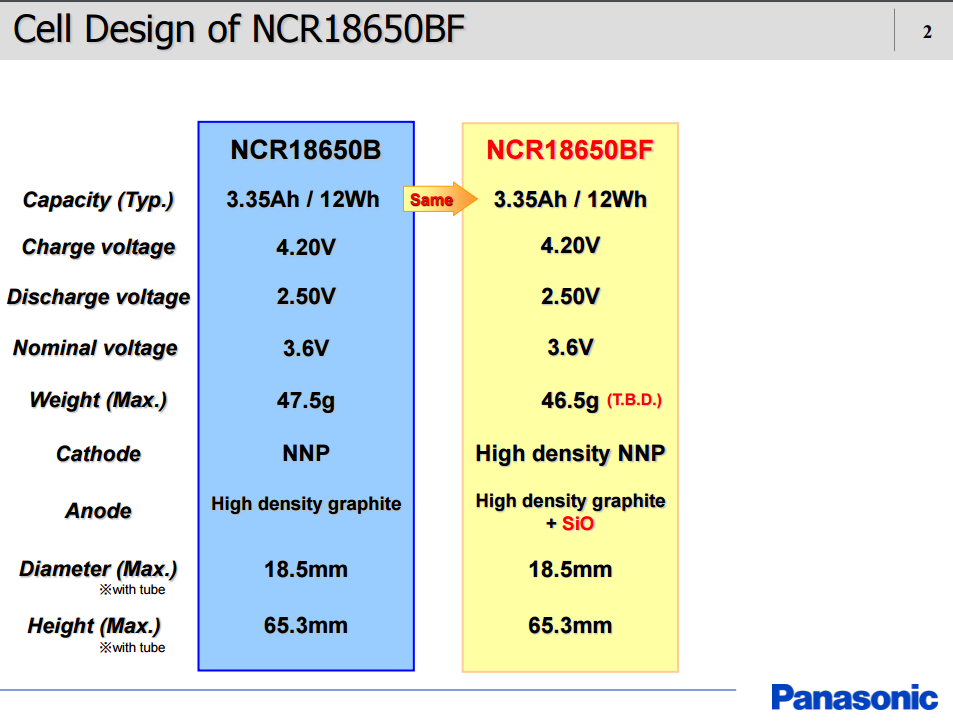
In any case, I don't think any of the off-the-shelf NNP cells are Tesla cells. I even have one of the newer NCR18650BF cells which are similar to the cells used in the 90 pack (High density NNP Cathode and Silicon monoxide Anode). It does appear to "break-in" slower which could explain why some 90 packs appear to lose capacity faster than new than the 85 pack.
Again none of the NNP cells are Tesla cells. One of the first tests I requested okashira do when he got his hands on some Model S cells a couple years ago is a zero-volt storage tested where a resistor is used to short out the cell and then the cell is stored. I am happy to report after a year stored at 0V the cell recoved to 94% full capacity!
The reason why I requested this test is because I heard a rumor Quallion was involved in the Model S cell design. Now this does not mean for sure the cells have Quallion "Zero-Volt" tech but all signs are pointing to yes.... If true this means the Model S pack in cannot be bricked (unless there is a imbalance that cause some cells to pull others negative).
Note okashira sells both cells, modules, and custom packs made using Model S cells (which custom cell holders that pack the cells tighter than off the shelf ones). He pioneered a method to remove the cells from the holders without a scratch by using solvent. One of the first things I had him check is to tear out the can seal and soak it in the solvent. I wanted to make sure the solvent would not compromise the can seal. After a week in the solvent there was not softening, swelling, shrinkage, or cracking of the seal.
On a side note one of the reasons the cells are glued in place is because these consumer type 18650's don't have a hermetic seal. Gluing them in place stops vibration that can break the bond wire fuse (main purpose), but the other benefit is it serves the better seal the cell against humidity.
I suspect the gigafactory cell will use a mil-spec glass-metal hermetic seal which will allow them to drop a hundred pounds in adhesive. The new Model 3 pack uses flex PCB interconnects (positive and negative connection made on one side of cell) and the other "terminal" side is base plate cooled. Cooling thru one end of the cell is much more effective than even a full wrap around the can (which is impractical anyways). Again flex PCB means the pack is much simpler to make and there are no bond wire fuses that quickly break with vibration, and most importantly tighter packing (but still a bit or airspace to prevent runaway if that one dud you didn't catch vents fire). The LG Bolt soft pouch prismatic pack is a disaster waiting to happen.�
Feb 11, 2016
wk057 Added this note to the first post:
Hint on upcoming project: My instrument cluster is looking pretty epic. �
�
Feb 11, 2016
flathillll From your first post:
Tapping out?
One "word": lol.
Maybe next time you should keep your "conclusions" to yourself given their implications....
�\_(?)_/�?�
Feb 11, 2016
okashira The cells are NCR18650BE, I said this a year ago...
Yes, you can get 11.9Wh out of a cell when new, even close to new.
They are rated at 3200 mAh.
I don't have a problem with Tesla's 85kWh rating
I don't know what Tesla cells you tested, but NCR18650B's are pretty poor performers. NCR18650BE will have much lower impedance because the B has a PTC, which increases resistance.
All modern cells no longer use a PTC.
500mA is too fast drain to measure Wh capacity. You need to use a quasi-static discharge... barring that... 50mA might be slow enough to get a proper Wh reading.
Also make sure you're charging to 4.2V with a 50mA charge cut. Kelvin connections are also a necessity.�
Feb 11, 2016
wk057 Seems the forum doesn't want me to unsubscribe to this thread. It keeps popping back up in my list, so, guess I'll try later.
No, just done having to defend my data and conclusions against people with no credibility. Private discussions elsewhere are much more appealing and useful at this point. My absence in this thread is in no way "tapping out" since that would imply that I somehow have lost the battle, which I clearly have not. It's a fight not worth fighting. Again, the data speaks for itself. I've logs from over 20 cars, from brand new to a signature VIN S00XXX. Not a single one shows pack capacity at or even close to 85 kWh as reported by the car itself. Data which matches my own testing of cells outside the car, and the tests of others.
I don't care what Tesla does with the cells prior to delivering them to customers, or not. If the product I received doesn't meet spec, then it doesn't meet spec. Plain and simple. People are welcome to verify this for themselves, and I invite them to do so. I've outlined the relevant BMS CAN messages here.
First, let's actually quote things with context.
This was obviously my attempt to show that the capacity difference was significant, using a monetary value derived from Tesla's own pricing, for folks who may or may not have understood the delta.
I could care less about the implications of what the data tells. The data says that customers never received a pack that Tesla labeled "85 kWh" that could actually be charged to 85 kWh in or out of the vehicle. That's a fact based on mountains of data, including admission of the cars themselves.
If the data said that the pack was say an 86 kWh pack (it does not) we wouldn't be having this conversation, and people would be praising Tesla for under promising on the spec and everyone would be happy. Instead it's data that shows that the spec doesn't match the advertised spec, however little the delta, and for whatever reason that triggers half of the forum to jump on the dog pile with the messenger at the bottom.
Personally, I'm just curious as to what the blog post that Tesla will eventually post in response to this issue, trying to explain it away like the P85D range issue and P85D horsepower issue, will read. The range issue blog I'm reasonably certain I personally triggered with my side by side testing of the P85 and P85D... either that or it was a complete coincidence that Tesla posted their blog post exactly as I was doing my pre-announced and publicized side by side testing.
- - - Updated - - -
Actual final post here, since I respect okashira on this, and if desired he's welcome to continue this discussion in private.
I'm not sure how you came to the conclusion that they're NCR18650BE. We can't both have the same cells, awesome test equipment, and come to drastically different conclusions. Some variable is different.
I'm well aware of how to test the cells. Actually, the latest iteration of the equipment being developed for this that I've been field testing for the company designing it includes complete thermal controls capable of holding the cell anywhere from -20C to 75C and capacity calculations accurate to a ridiculous +/- 5 mWh. It's literally accurate enough to measure degradation from cycle to cycle, and I really wish I could share more information on the equipment because it's absolutely awesome. I know quite a bit about the cells and how to test them, and I had even made my own cycler for them prior to hooking up with the company I'm assisting. Using my lower end equipment I never got close to 11.9 Wh. I thought I did a few times, but it turned out to be an issue with the hardware (because the cells definitely don't hold 13+ Wh). Using the new equipment we've tried many different methods of charging and discharging the cell in an attempt to recover 11.9 Wh, or even close to it, and have not been able to. Thermal controlled, uncontrolled, constant current, constant power, varied power, varied current, etc etc etc. No dice on 11.9 Wh.
Fun that we have conflicting data, though. However, Tesla's BMS does in fact agree with mine pretty much exactly... so, not sure where that leaves us. Edit: Added data point being that I collect mountains of charge/discharge data from my ~16000 cells in my solar setup, and they also match nicely with my other data extrapolated out to the large scale full pack. I've not discharged my solar pack down to nothing, but I have charged it to 100% several time, and have discharged it on a few occasions below the voltage Tesla considers 0%... and the data still matches up with my single cell testing.�
Feb 11, 2016
hockeythug I highly doubt that.�
Feb 11, 2016
wk057 Tada! There, I made a liar out of myself just for you.�
Feb 11, 2016
okashira Let me get a new cell in my tester, I am sure I will get 11.9Wh out of one. ;-)
My test equipment is only accurate to 0.002Ah or so. :-/
Yes, they are NCR18650BE. If it quacks like a duck, looks like a duck....
Seriously, I am suprised you would debate this and it was settled.
-They both have the same DCIR.
-They both look the same (and this is important - the Model S cell and the NCR18650BE are the ONLY two cells in the world in existence that have the exact same triangular top.) NO OTHER PANASONIC CELL EVER MADE HAS THIS TRIANGLE TOP!
-They both have the same capacity
-They both have the same discharge curve profile
-They have matching weight to +/- 0.01g
-They cycle the same
-They have the same temperature response to DCIR.
To get +/- 5 mWh is not really that special? Any decent DC load can do that. It would only require about 0.002mV accuracy and about 0.1% accuracy on current. Any decent multimeter over $300 can read that....
My cheap 8-channel chinese cycle tester will consistently hold 0.001V across the range of 2.5-4.2V, calibrated with a benchtop fluke of course.
Btw: Model S modules make for a great power supply for a spot welder:
I have pulled 3,900 amps welding straight to the bus bar. Good thing for only 9ms.
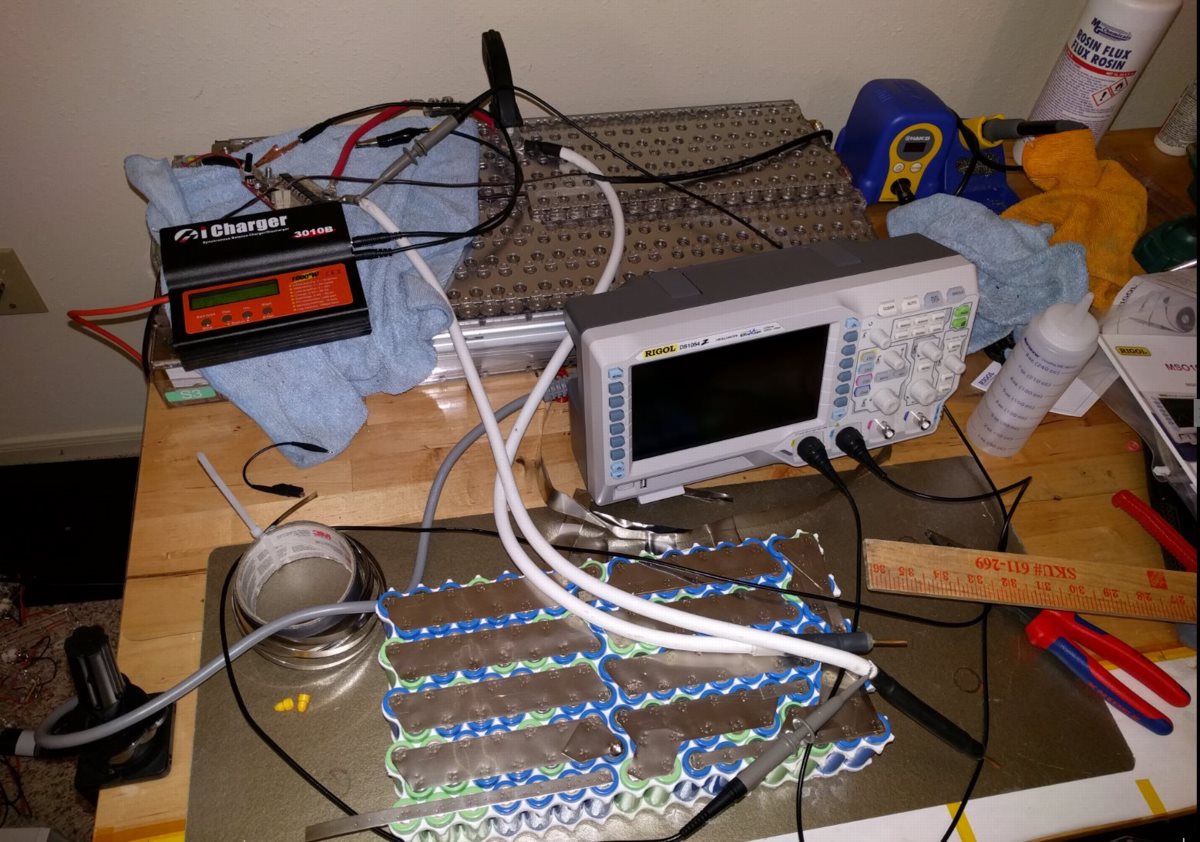
The scope is there - just finished measuring current of the spot welder.
The battery on the bottom is a 20 series 7 parallel pack made from Model S cells for an E-bike.
The cells were pulled from a 2014 85 with about 5k miles.
I have a 2015 70D in the driveway that we're about to tear into. I am hoping we get lucky and they are the new high cap cells - likely NCR18650GA.
- - - Updated - - -
Yes, I left two Model S cells discharged to 0V for a year. I kept them shorted out with a 400 ohm resister.
After about 10 months, I removed the resister and let them sit for another month. They slowly picked up about 0.4V.
I charged the cell to 4.2V and the cell still held around 94% capacity.
Endless-sphere.com View topic - Tesla Model S 18650 Cell Test Data
It did pick up some impedance, however.�
Feb 11, 2016
apacheguy @okashira - If what you are saying is true and the cells are 11.9 Wh, how do you explain the 77 kWh nominal full pack energy reported by the BMS?�
Feb 11, 2016
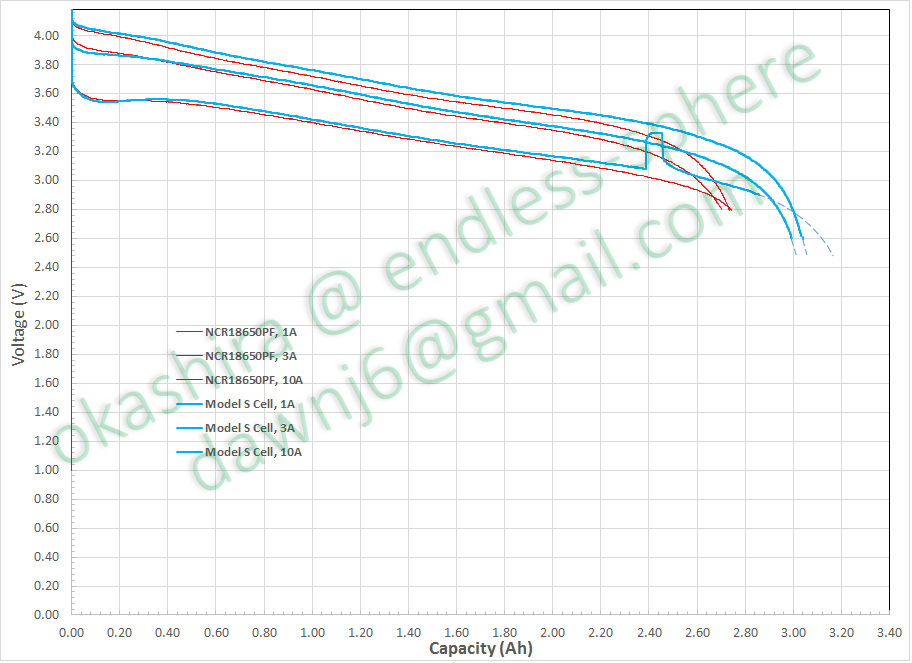
kennybobby Was there another set of test data than what you posted here last year? This looks more like 3Ah x 3.6V = 10.8 Wh
 �
�
Feb 11, 2016
Andyw2100 Well, then it must be true. I mean even though there is lots of data supporting what wk057 has reported in the opening post, we should definitely just assume it is all wrong. That makes a lot of sense.
A vendetta, huh? Is that why he has said over and over again that the lack of degradation the Tesla pack demonstrates is amazing? I don't know about the vendettas you are used to, but the ones I'm familiar with don't generally involve the people waging them having both positive and negative things to say about the target of the vendetta.
Most don't find the mods here oppressive. In fact, I'm going to guess just a handful do. The mods are volunteers, do a very hard job, and do it well. They deserve our gratitude and respect. They do not deserve to be insulted with comments like the above.
And very noticeably missing from Tesla's official reply was any statement about the specifications of the battery packs being accurate. If Tesla is confident that the specs are accurate, why not say that?�
Feb 11, 2016
flathillll Yes I do not trust the self proclaimed battery expert who has not shared much details about his instrumentation or methods used to test individual cells before thrashing Tesla let alone raw data
now all over the internet we have headlines such as "battery expert shows blah blah blah"
Here is a rational post from the reddit thread:
"TL;DR: Numerous plausible justifications of cell capacity disparity still remain in within ambiguity of disclosed tests.
I certainly don't think the "expert" (clearly he's experienced but maybe not being a total pro [frosty + exhaustively thorough] about it prior to throwing bombshells?) Maybe it's not warranted, but I can't shake the feeling that he (wk057) has a chip on his shoulder from the HP debates (irrespective of the merits of that debate) as he's openly professed "ranting". The following took minimal effort to find, but he didn't seem to address them thoroughly in his thread (I only read the one linked and briefly his other old threads.) I'm taking his results with a grain of salt until there's more detail as I don't want to get sucked into any ostensible (tame) vendetta. Maybe my doubt is misplaced I dunno. =?"�
Feb 11, 2016
AWDtsla LOL. So let's do a quick hand integration and arrive at Wh by subtraction. Take the two limits, 4V and 3Ah, that is 12Wh. Since we have a curve we know it MUST be a value less than that. OK, now each square is .2V*.2Ah=0.04Wh. Now count all the full squares between those lines and the top curve, estimating on the semi full ones, and subtract from 12. I got 10.96Wh. Or 77.8kWh for an 85 pack with 7104 cells.
Hmmmmm�
Feb 11, 2016
stopcrazypp Look at test conditions. That is 1A discharge at the slowest one. You aren't going to get the nameplate capacity of any cell at 1A discharge. That test was what I referred to before, where he wasn't trying to get max capacity. To do that most testers use a 0.2A load (he suggested even lower up thread).
For reference, the EPA UDDS cycle is 19.6mph average speed and Model S gets 320+ miles on it, so 16+ hours of discharge, probably 17+ hours if looking at nameplate (AKA C/16 to C/17 discharge). That nicely works out roughly to 0.2A for the cells in question.�
Feb 11, 2016
MikeBur Thanks Okashira,
Have you measured 11.9Wh out of one of these cells? I didn't actually see the answer in this, though may have missed it from the tears of laughter, thinking about the next potential Darwin Award for "Battery-powered spot welder", blurring my eyesight...
The only thing I could find was your old chart, though I need help agreeing to 11.9Wh from that�
Feb 12, 2016
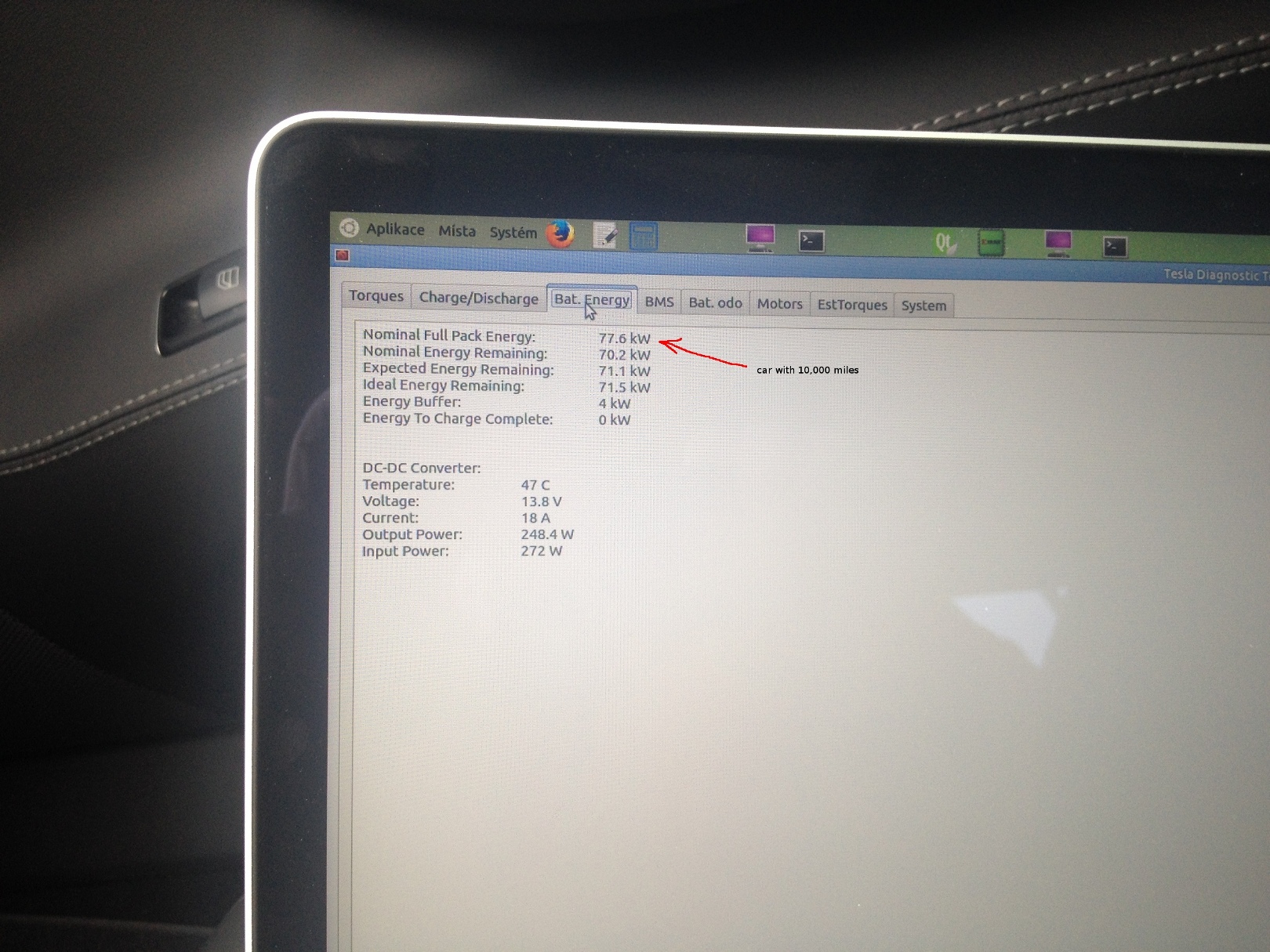
pupik Yes, almost so say Tesla CANbus my P85D with 10000 miles :wink: So, the old fact...
first question is 77.8kW + 4kW or 77.8kW - 4kW buffer
second question is how much say CANbus in your P90D ??????????
 �
�
Feb 12, 2016
Auzie
I can only imagine how Tesla engineers must feel if they have a spare moment to read this forum
I'd be very careful when publishing statements that could be defamatory. I assume you must be confident enough to defend your method and data in the court if that scenario plays out.
That said, confidence is irrelevant if it comes to court, what matters is certifications, experience, qualifications and a proper write-up that can stand the scrutiny of experts
okashira described his instruments, method and provided a link to some of his results. That notches up his credibility over anyone else that hasn't done that.
No instrumentation or method provided, hence no validity�
Feb 12, 2016
kennybobby Not everyone has the time or ability to read and keep up with the rapid pace of wk057's projects and tinkering, but he has described all the instrumentation and methods in various posts while dismantling a couple of tesla battery packs, designing and installing a huge solar array grid on his house, including wiring up all the connections, controllers and other equipment necessary to use the packs to store the solar energy and power-up his house and charge his teslas completely from that system.
And he didn't die of electrical shock or burn down his house or car, and he still has all his fingers and toes.
Oh yeah and in his free time he reverse engineered the CAN busses used by tesla so he could read the actual brick voltages, pack currents, motor torque and power, and all the diagnostic screen info, and described how all that was done in another thread.
Like i said it's difficult to keep up, but he has plenty of validity and credibility amoung the technical crowd. His knowledge, skills and abilities have been demonstrated numerous times--nobody practiced in the art of electrical engineering would doubt his results.�
Feb 12, 2016
Johan Here's another tidbit, real simple stuff, to support the notion that the 85kWh rating is misleading:
Charge fully. Drive at an even pace until you run out of charge. Note the Wh/mile that the car is giving you. Multiply by number of miles driven. You'll be lucky to get even 76.�
Feb 12, 2016
JRP3 Flathill clearly has knowledge about the cells and their characteristics, so I value his inputs. Unfortunately his posting style doesn't fit well with this forum and if he can't tone it down a touch is likely to get banned again. (No I don't have the ability to do that nor would I want to, just saying where I see this heading.) Not surprisingly he's clashed with wk who has also suffered banning in the past. It would be nice if we could just stick to data and theory and avoid personal attacks. I'd like to see wk return to this thread and compare data and methods with Okashira and others.�
Feb 12, 2016
scaesare Seconded on all points.�
Feb 12, 2016
tomas You have to factor in normal degradation. Anyone who did any research bought their tesla knowing there's a capacity drop in first year, then levels off. Anyone who does your simple test who did not do research may not factor in normal degradation or anti brick and get indignant. Bad test.�
Feb 12, 2016
Cottonwood Here is yet another example of "Specsmanship."
In the grow light industry, it is very common to rate LED lights as the sum of the individual LED ratings. For example, an array with 100, 3W LEDs is rated at 300 Watts. The rub comes in the fact that for longevity and to avoid severe heat build up, the LEDs are typically run at half or less of rated power, so a 300 W LED array typically draws less than 150 Watts from the wall. See Galaxyhydro LED Grow Plant Light 300w Greenhouse Indoor Grow Lighting as an example.
That now has gone even further with the new Chip On Board (COB) designs that use a dense array of 64 (8x8) LED chips with a reflector. Because 64x3 or 192 is almost 200, these are rated at 200 Watts per assembly. See High power COB LED Grow Light 800W Panel Flower 64x3W leds - 4*200W as an example.
Specsmanship...�
Feb 12, 2016
AWDtsla Yeah in a commodity market by shady entities. Not when you're Tesla and your nearest competitor already has quarter of the thing you're selling.�
Feb 12, 2016
Doug_G A couple of posts were moved to snippiness�
Feb 12, 2016
Pajda If they are close to NCR18650BE with 3200mAh rated capacity they can't be 11.9Wh. The only cells which are rated as ~12Wh at 3200mAh are LG or Samsung LCO cells with 4,35V charging voltage and 3,75V nominal voltage (I have tested them). But for NCA chemistry you need at least 3300mAh nominal capacity to get close to 12Wh.
I look forward to this test, but I don't expect more than 11,4Wh.�
Feb 12, 2016
LetsGoFast It would be helpful if you could restrain yourself to debating the actual technical points. Your personal assessment of wk's motivations and character is not only unhelpful, it generates noise and reduces my impression of your credibility.�
Feb 12, 2016
dsm363 mod note: one post moved to snippiness�
Feb 12, 2016
JRP3 Here is one way to get close to 12Wh from them, discharge to 0 volts for a few hours:
https://endless-sphere.com/forums/viewtopic.php?f=14&t=67721#p1022079�
Feb 12, 2016
okashira Well, it's the lack of data that led me to reply here in the first place.
If one wants to make a technical claim, argument or comparison, they need to provide the data, conditions and peer-review-able technical reporting to back it up.
Too much info is missing in the OP, but from what was said, I can point out the errors and missing information:
-500mA is too high of a current draw to make a Wh capacity determination. A quasistatc discharge rate needs to be used - or in its place a better proxy, such as a pulse discharge or a very slow discharge rate.
-Charge voltage needs to be specified
-Charge cut current needs to be specified
-Discharge cut voltage needs to be specified
-Test temperature needs to be specified
-Kelvin, aka, 2-wire voltage measurement needs to be used.
Reporting also serves another purpose - one should demonstrate they have the technical understanding to even proceed with the experiment, calculations and conclusion they come to. For example, Watts - especially Watt Hours, is not a measurable quantity - it can only be calculated. Thus, one should understand possible sources of error and uncertainty in the measured quantities and how they combine in the final calculation.
Furthermore, Measuring Watts or Watt Hours of a specific period of time of the energy consumed by some device is trivial compared to making a Watt Hour capacity determination of a battery. The second is subject to an order of magnitude of additional variables - such as some of what I specified above. (and it was not a complete list)
Thus - measurement of the energy capacity of battery becomes as much of a matter of opinion (aka - a massive set of conditions need to be agreed upon and standardized) as it is scientific fact. One should point out which variables are subject to opinion and which variables are sources of error in a measurement.
All of the items I pointed out in the list above are sources of actual technical error in the measurement, not the variables that will be subject to opinion - aka - standardization - when making a battery Watt Hour determination. Those will be things such as - acceptable cycle life, calendar life. energy buffer built into the system design, etc.
*off-topic drivel deleted�
Feb 12, 2016
techmaven I greatly appreciate both wk057's and okashira's contributions to this thread and to TMC.
In the end, even if we get data that shows that the technical labeling of the Tesla cells can be accurate, there remains an issue that I think gets to the heart of the matter.
Tesla sold us 85 kWh of cells, but Tesla's 85 kWh pack is really a 81 kWh pack in its intended use. The actual usable amount for driving is even less... at 77-78 kWh. The result still gets the intended range (265 EPA 5 cycle miles) So Tesla wrong here? Now, if the pack is "really" 81, or "really" 85, we have known that the usable amount is 77-78 kWh. I can see both sides of this. There is no standard for labeling here, and it is not uncommon for OEMs to pass along achievable specs, even if that isn't what you can actually achieve (reference my hard drive analogy).
Separately, when they then cooked up the 60 kWh version, they ended up putting in more cells to achieve whatever metrics they wanted and didn't tell us they added extra capacity. For those that are upset that Tesla didn't say so, the 208 EPA miles versus 265 EPA miles is still true. Whether they could achieve that with a 58, 60, 64 kWh pack doesn't change the rated spec. You likely bought based on the rated range spec, not the kWh difference in reality.�
Feb 12, 2016
Pajda Maybe we both read different graphs, but till now I just did not seen any graph where the Tesla cell discharge significantly more than 3100mAh. And if I look on discharge voltage curves I don't see more than 3.6V nominal voltage, so these cells are 11.16Wh at best - exactly as described Wk and you can read from Tesla BMS (d�ky pupiku :smile: ).
By the way today I have ordered a samples of NCR18650BE and add them to my test schedule.
�
Feb 12, 2016
AWDtsla Right. Even if okashira is right, if I guess at 25kW average highway cruising draw, then I get approximately 1A per cell, plus or minus depending on pack voltage, etc. So even his data says that under normal usage you'll never get 85kWh out of the pack.
...and that still doesn't explain the difference between 60 and 85. Although I don't believe EPA vs EPA is true at all for 70 vs 90.�
Feb 12, 2016
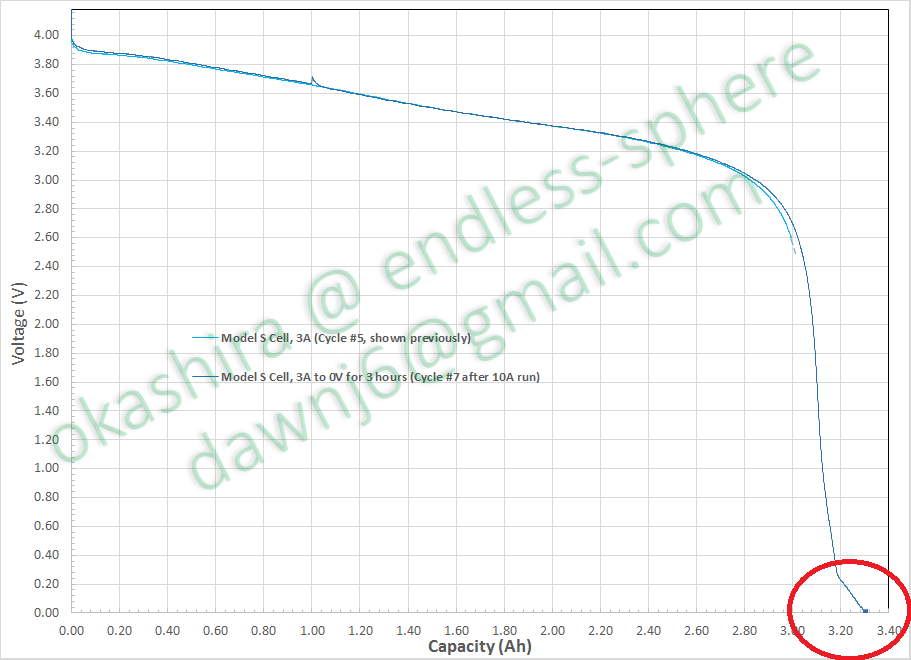
JRP3 Looks like about 3300mAh to me
 �
�
Feb 12, 2016
qwk This. Anyone can throw a cell on a test bench, and come to a conclusion. Few are hacking into and diagnosing complex systems like wk. Voicing your opinion has little to with credibility.�
Feb 12, 2016
flathillll Thanks bud. I will calm down a bit. As an EE with a metrology background and over 20 years of experience working with EV's the one thing I can tell you is the smartest scientists (excepting physicists) and engineers are usually the worst at making accurate/precise measurements. The other point to make is NONE of us have access to virgin cells. I too am almost certain the cell is the BE, but not 100%. Even getting your hands on fresh grade A BE cells is a challenge. Even if some USED Model S cells don't measure 11.9Wh that still does not allow us to draw any conclusions on whether Tesla's spec is wrong.�
Feb 12, 2016
stopcrazypp I actually responded to a similar post by you. 1A draw (which is roughly C/3 for these cells) most definitely does not simulate the UDDS EPA test. Something like C/16 or C/17 or 0.2A is the correct draw to use because it would take 16+ hours to run down the battery on a 85kWh Model S on the UDDS (and this is only the usable part).
Even if you look at EPA HWFET (48.3 mph average speed), that is 6-7 hours (AKA C/6-C/7) which is closer to a 0.5A draw.
And for purposes of this discussion we are trying to determine nameplate cell capacity, which 1A draw will not give you (esp. for a cell that is not fresh off the assembly line).�
Feb 12, 2016
scaesare So... I went looking for a the datasheet for teh NCR18650BE, after okashira pointed out the likelihood that those are the cells (or very similar) that Tesla is using. Despite their being readily available for other Panasonic NCR18650 variants, I cannot find an authoritative datasheet on the BE anywhere, whech may be telling in and of itself.
One thing I noted in looking at the NCR18650B: although Panasonic dos not list a power (in watt-hours) spec for their cells, they do list the following:
- Gravimetric energy density (in Wh/kg)
- The weight of the cell
For example:
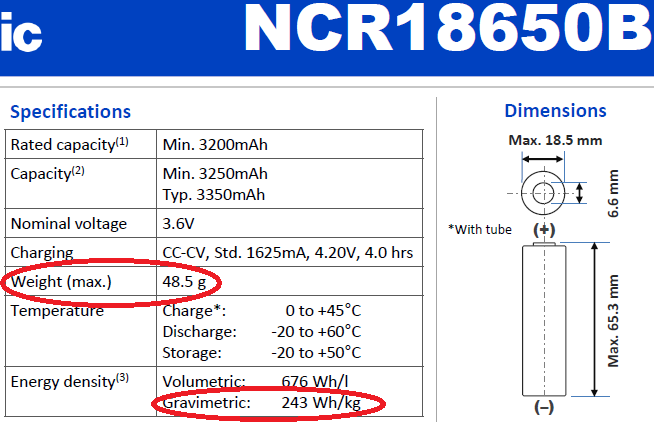
Thus, for this cell, the energy density per gram is 243/1,000=.243 Wh/g. And given the cell weighs 48.5g, we can determine the energy would compute to 0.243*48.5=11.8 Wh. Thus, we can reasonably extrapolate that these cells have a manufacturer nameplate rating of 11.8Wh,
A Tesla 85 pack with 7,104 of these cells would have a manufacturers rating of 83,827Kw/h. That rounds to 84 for whole numbers, or 85 for the nearest "5".
Given that the NCR18650BE undoubtedly has slightly different chemistry from the NCR18650B, I don't think it's outside the realm of reason to suggest that Panasonic themselves rate the cells such that the pack logically rounds to 85KW/h.
Anybody find a datasheet for the BE??�
Feb 12, 2016
MarcG Nice find! Just a quick comment though: Wh is a measure of energy, not power (that would be W) :wink:�
Feb 12, 2016
stopcrazypp I would be careful on that. The weight specifies the max cell weight. And if you see the little (1), (2), (3) footnotes that the test conditions may not be the same on the different numbers.
Manufacturers will not post an official nameplate Wh. They will give nominal voltage and nameplate capacity in mAh. You have to do the math yourself. For the cell in question, the official capacity is "3350 mAh", but everywhere it will be advertised at "3400mAh".�
Feb 12, 2016
MarcG From the linked review below, it looks like the BE cell was tested at about 10.5 Wh of total energy discharge:
Comparing Panasonic 18650 BD vs. Panasonic 18650 BE 18650 Battery | BATTERY BRO
- - - Updated - - -
Yep, and from the tests I linked above it came in at about 47g (not 48.5)�
Feb 12, 2016
scaesare Derp on my end... thanks. Corrected.
- - - Updated - - -
My point is that the rating may very well be based of what the manufacturer provides. That same spec sheet for the B lists 3350mAh @3.6Vnom as well, which equates out to > 12Wh per cell... so it may be premature to assume that these cells would have an industry accepted rating substantially less than what Tesla specs them to be to comprise their pack.�
Feb 12, 2016
stopcrazypp Not a full capacity test. Test conditions:
Charge end at 4.16 V (vs 4.2V)
20 or 25 degrees Celcius ambient temperature (difference between 20C and 25C gave a 5% difference in the NCR18650B, although the claim is less than that for NCR18650BE)
.61 ampere discharge current (vs 0.2A or even 0.05A suggested by okashira)
2.5 volt cut-off point when the discharge ends
2.5A charge rate (Panasonic is rated 0.909A)
- - - Updated - - -
I agree with your point, I just say that you have be careful in extrapolating from energy density figures when the test data and conditions may not be the same between the two specs. Simple multiplication of nominal voltage and capacity is typically how "nameplate capacity" is figured.�
Feb 12, 2016
scaesare The footnote for energy density reads:That would seem to apply specifically to the volumetric spec, not the gravimetric one I used for the calculations.
- - - Updated - - -
Yup, agreed... extrapolating is more or less of a sanity check.
Given that the numbers we DO have from manufacturer spec sheets on similar cells produce an energy rating in the correct ballpark, until which time we have an official spec for these cells, I think it's premature to claim foul. I think we agree there as well...�
Feb 12, 2016
Pajda Ok we are now looking on the same graph. :smile:
You need to read the voltage axis! Okashira in this particular test discharged the cell to 0V, but the nominal capacity for the most NCA cells is measured to 2,5V and you lose the manufacturer warranty if you discharge the cell below this value! So the nominal capacity for this test setting is ~3050mAh to 2,5V.
The second important thing is that below 3V the voltage drops rapidly for the most Li-Ion cells. So it significantly affects the usable energy. For example in the range of 3V-2,5V you got only 5% or less of energy. And in the range 2,5V-0V it is less than 1% because the lack of voltage for integration.
By the way nominal capacity/energy for the most modern cells (see datasheets) is measured under these conditions:
Charge: 0.3-0.5C with cut-off current C/50
Discharge: 0.2C
and this can be translated as you don't get significantly better capacity/energy if you set even lower testing currents.�
Feb 12, 2016
LetsGoFast Okashira,
I appreciate you laying out the case that there is room for error in wk057's data or at least that there are variables based on his methodology which he has not yet presented here. I assume that you object the spot welder comment from MikeBur, because as far as I've seen you have not stated that you have tested cells and drawn 11.9Wh from them. Will you address that aspect of his post?
If in fact, wk057's testing methodology underestimates the battery capacity in a fashion that happens to be consistent with Tesla's own BMS does it then follow that if the true capacity of the pack is 85Wh, then his calculated capacity of 61Wh for the 60 pack should actually have been ~ 64Wh?
I do find it mildly amusing that, assuming you are correct, the answer to the 85 vs 81 debate will turn out to be essentially the same as the hp debate -- the batteries could theoretically produce that much energy, just only on a test bench -- never in the actual car.�
Feb 12, 2016
stopcrazypp Maybe this is true for charge current, but definitely not for discharge, esp. when we are talking about single percentage differences being significant (we are disputing a 5% overall difference in this case). The IR losses at least partially are going to be what contributes to this (edit: mAh capacity also changes even more significantly).
For example, the test below of NCR18650B at 0.5A (~0.15C) measures 11.856Wh and at 0.2A (~0.06C) measures 12.142Wh. That is a 2.4% difference. Note that the test below cut off at 2.8V.
http://lygte-info.dk/review/batteries2012/Panasonic%20NCR18650B%203400mAh%20(Green)%20UK.html�
Feb 12, 2016
kennybobby Kelvin testing is 4-wire, not 2-wire.
A good time measuring device is also needed in addition to the current sense and voltage measurement.
The panasonic data sheet above would also correctly be interpreted as nominal 3200Ah x 3.6V = 11.52 Wh, times 7104 gives 81.84 kWh.�
Feb 12, 2016
flathillll On top of that note their inconsistent methodology:
"I always like to run through three to five discharge cycles before using the data from the discharge curve for analysis. "
Which is it 3 or 5? That can make a huge difference with an NCA cell.
Also note the claimed BE spec sheet pictured in the batterybro article (which is incomplete) has footnote 2G23X0KYKU which is actually the 18650B datasheet so this was either a Chinese forgery (happens very often) or Panasonic made an error (early release). Judging from the fact the "Cell Type NCR18650BE" is not aligned properly I would say it much more likely a forgery.
They also don't give you the date of mfg, time it was tested, or the grade of the cell. I have found it almost impossible to buy fresh Grade A cells from China or in the USA. All USA panasonic resellers on the internet buy them from the Chinese grey market. There is only one source I know of in Germany that will sell factory fresh cells direct to consumers and they are 3-4X the "street" price.�
Feb 12, 2016
techmaven Yeah, so some older Panasonic data sheets use 3.7 v nominal and you can see if you search for NCR18650B's online... lots of sellers still quote the 3.7v number. That's always been voodoo to me as to why Panasonic sometimes uses 3.6 and sometimes uses 3.7 when you look at the discharge graphs of those cells, it doesn't look like there should be a difference in nominal voltage.�
Feb 12, 2016
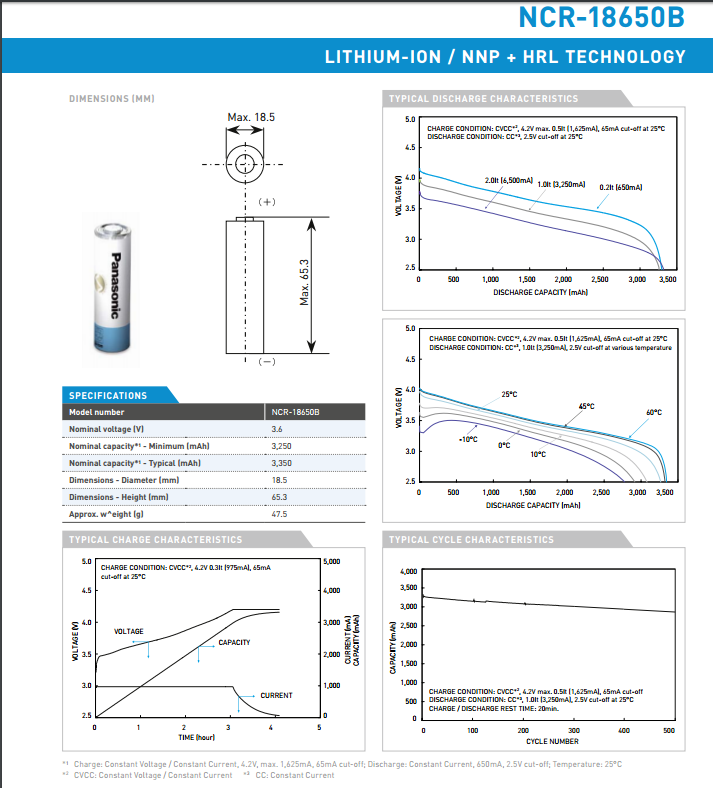
flathillll 48.5g is the max weight. The typical weight is 47.5g. In any case the Model S pack is not a 18650B...
 �
�
Feb 12, 2016
flathillll Let's see how well real experts from The Electrochemical Society do compared to the "expert" here.
They measure two NCA cells (Panasonic NCR18650A and Panasonic NCR18650B)
"A testing methodology consisting of six stages of testing was proposedand conducted on five commercially available Li-ion cells. Size measurement found some cells to notably deviate from the format associated sizing. These variations have the potential to cause standardization and exchange ability issues and can further distort battery development trend analyses that use the format as a baseline for comparing energy densities. Initial capacity testing found that the cellsfrom well-known manufacturers (Panasonic and Sanyo) performed towithin 8% of their rated capacity."
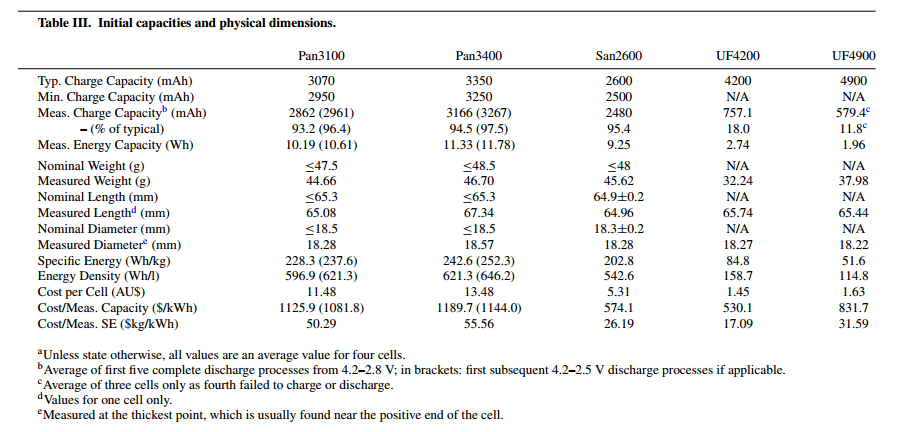
Quick short Panasonic stock
I still see problems with their comparison methodology (NO DATE OF MFG!!!, AVG OF 5 FOR FOR NCA DOWN TO ONLY 2.8V, 6TH CYCLE ONLY FOR NCA DOWN TO SPEC 2.5V MEANING NO FIRST CYCLE DOWN TO 2.5V DATA AT ALL FOR NCA CELLS) but note:
"coils removed and wires replaced in order to decrease resistance. Furthermore,four-terminal sensing was used to minimize the measuredvoltage drop due to applied currents. The voltage measurements weretaken directly from the surface of the cells, whereas the currents wereapplied via the upgraded holder wirescoils removed and wires replaced in order to decrease resistance. Furthermore,four-terminal sensing was used to minimize the measured voltage drop due to applied currents. The voltage measurements were taken directly from the surface of the cells, whereas the currents were applied via the upgraded holder wires"
. Despite the 50�130 cycles undergone representing only a relatively small fraction of the commonly assumed Li-ion cycle life of several thousand cycles, a general ageing trend is clearly visible. While the Panasonic and Sanyo cells show a capacity decrease of only 5�10%,
This inconsistent result suggests that the sample size of two cells per type and discharge cycle is insufficient for conclusive studies of the impact of slight cycle variations on ageing
http://jes.ecsdl.org/content/162/8/A1592.full.pdf
Now do you see where Tesla is coming from when it says:
"It is very difficult to replicate the exact discharge profile to extract the maximum available energy��
Feb 12, 2016
csshih wk, do you have any NCR18650BEs on hand? I can send you some if you would like to compare them.�
Feb 12, 2016
JRP3 I wonder if the new 70 and 90 packs are the BF's with Silicon?�
Feb 12, 2016
MarcG Possible. Elon did mention that they started using a bit of silicon in the anode when introducing the 90 kWh packs last July.�
Feb 12, 2016
MikeBur My apologies if you misinterpreted my original post (um #2 in the 590 previous on this thread) that said I respected and wanted additional peer review of the differing data and said I respected what you were saying, rather than opine in an attempt to tone down flathill's attempted rhetoric. The intent was to get back on track and allow me to continue reading and understanding.
I'm not sure why the need to call this out considering this was post #2 in the thread from me, perhaps it was that you misread what I wrote, or mistakenly believed I was attacking you in some way. I thought my question was valid considering your original post said you were sure you could get 11.9Wh out of the battery, though a quick area under the curve of your previous graph didn't align, so I though you were presenting additional data somewhere I couldn't find (eg on the other forum).
I also disagree that I'm a contributor to wk unsubscribing, considering my post #1 was after he said he had unsubscribed - it was attempting to have him continue to contribute... So riddle me confused
Even so, there are significantly more frequent posters here with pure opine. My belief was that not calling them out would help them self-identify. Public shaming is one form of bullying I don't believe in nor agree is acceptable.
As to me "not being technical" that's an interesting supposition based on a public forum posting... An amusing one by all accounts. Of course if you say I'm not as educated as yourself, Jason, et al on this I would agree. However, (what I believe as legitimate) requests for additional clarity bring met with ire is disappointing.�
Feb 12, 2016
stopcrazypp The other speculation is they are GAs which have slightly higher capacity than the BFs.
Side note: if the Model S cells really are BEs, that would seem to disprove the previous arguments that it is a Tesla only cell (or at least it is no longer true). I remember there were heated arguments over this back then.�
Feb 12, 2016
Auzie It seems to me that you equate having a technical skill to having credibility. My view is that the bar for credibility is much higher than that.
Here is the main reason why I can not take the claims made in this thread as credible:
The OP made serious public allegations against the third party (Tesla). These statements already damaged Tesla's reputation with some customers. The OP seems indifferent to the inflicted damage and refuses to substantiate his claims by providing his data and methodology for peer review.
The OP backed out of the discussion when challenged, rather than responding to challenges.
That said, I am not talking about who is wrong or who is right in the case of battery capacity. I'd like to think that everyone, including Tesla, deserves a fair trial, not a lynch by a mob. A fair trial implies civilized discussion and a peer review process when it comes to technical matters.�
Feb 12, 2016
apacheguy My read of this thread:
1. Measuring cell capacity is a non trivial measurement.
2. If a Model S were driven continuously on a flat road in warm, sunny weather, with a max power output of 5 kW, then perhaps it *might* be possible to get something around 85 kWh.
3. On the other hand, if the S is driven in everyday conditions the pack is more like 81 kWh with 77 kWh available to the driver. This statement is supported by data straight from Tesla's own BMS, something a lot of folks are overlooking, IMO.
Doubtful since the BF has the same Wh capacity as the B.�
Feb 12, 2016
islandbayy I got two cells from wk057 today. I am starting with my own series of tests. I don't have all the high-end equipment like some of you do, I do have one automated benchmark test her for 18 650 sell high-end equipment like some of you do, I do have one automated benchmark tester for 18650 cells and will be doing a series of low discharge rate tests.
i'm starting tonight off with a full charge and discharge at 200 mA, as that is the lowest setting for my benchmark tool. I will charge it discharge so many times, I won't show all of them on camera, as that would take absolutely forever but will still record the numbers. I am doing my first test on camera and then I will be doing a whole video series on the cells. I will also report back here with my findings. I will also be benchmarking discharge and recharge rate 200 mA, 300 mA, 500 mA, and 700 mA. I will also be doing a test with discharge, at 50 mA, using a LED, And recording both voltage and amperage draw overtime from full two dead. Like I said I don't have the equipment some of you do, but one thing I have is time and persistence.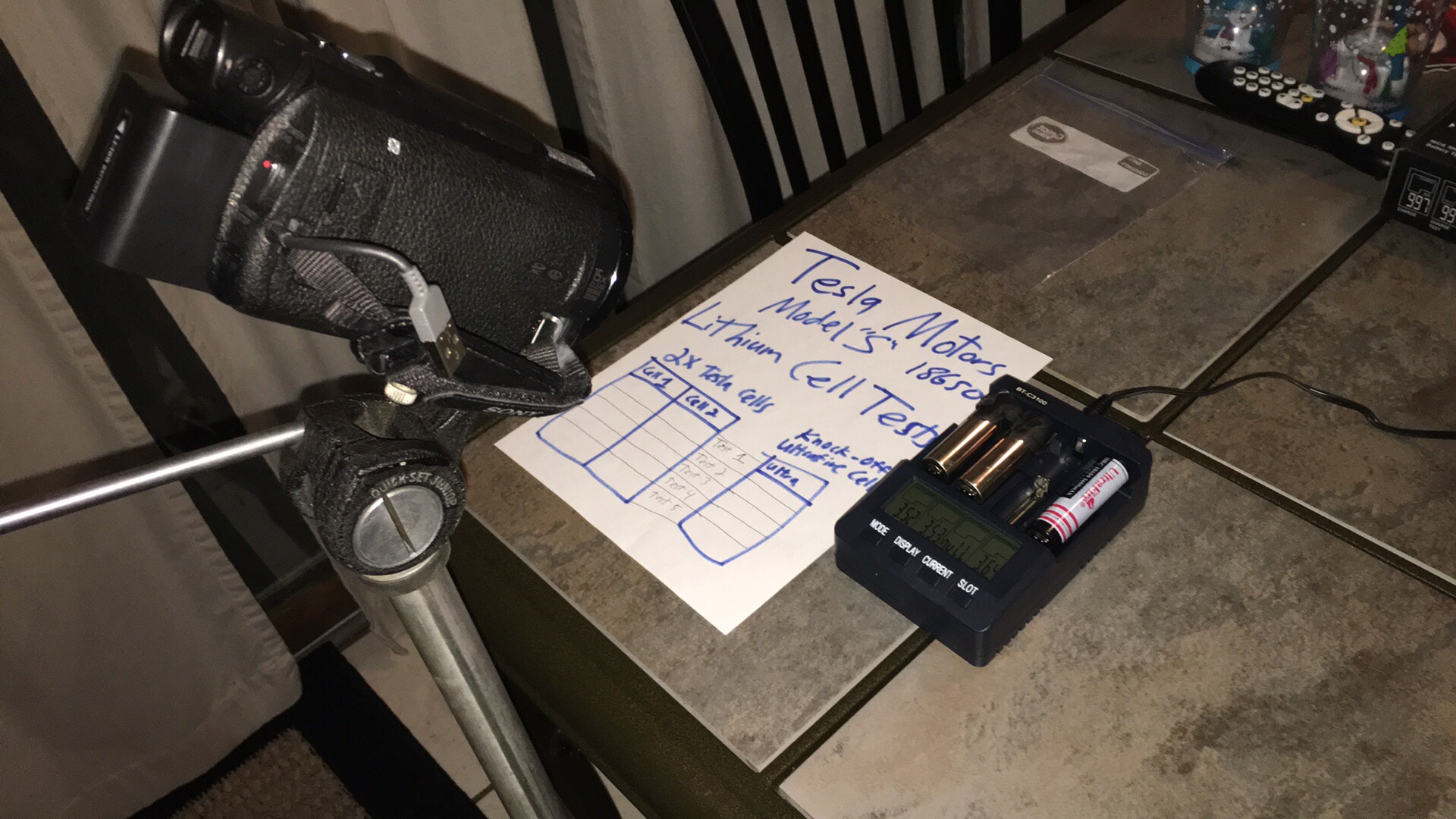 �
�
Feb 13, 2016
okashira Like wk, I see how pointless it is to continue in this thread....
I will add this - we went ahead and pulled apart the 70D. We pulled the pack apart and it does have 14 full modules. So the pack is ~74.37kWh per Tesla's original rating.
I will have another fun post in a new topic soon
- - - Updated - - -
Correct. The 90 pack is mostly likely NCR18650GA's which do have silicone nano particles in the anode.
The 70 pack (at least the one we just pulled apart) is the same old BE's - 14 full modules - so rated capacity of about 74 kWh. if you use 85*14/16.�
Feb 13, 2016
JonG my issue with tesla on this, the 0-60 performance and others is not what the truth is in all its technical detail, it's the relative specification between models. If you can make out an 85 is an 85, then using the same assumptions, cell voltages and whatever was the 60 a 60 or 61 or 65 or what? What's a 70? What's a 90? My BMW had a 2998cc engine and they called it a 3 litre - it's not the same as that, this is more significant.
Most people make a decision to buy a tesla then work out which model taking the relative performance aspects and price differentials into account, as, let's face it, there's virtually no difference in anything else. When half of that equation, namely what extra performance and range you get for your cash is dubious it's just wrong.�
Feb 13, 2016
WarpedOne It just boggles me how people contentiously fail to understand.
There are new cells and there are aged cells - calendar life.
There are uncycled cells and there are cycled cells - cycle life.
There is "high-C" discharge and there is "low-C" discharge - power profile.
There is continous discharge and there is intermittent discharge profile - power profile.
There is temperature and there is production variation - life.
Is it BF, BE or it isn't... years ago it was established that chemically, those cells are similar to what panasonic sells to general market. What those cells lack is internal protection as it is supplemented by pack services. This affects cell weight and thus cell energy density. And they probably have some additive that helps prolong performance after years of usage.
It is dead easy to measure, and kid can do it. It is hard to understand the measurements, implications and circumstances that affected them.
Anyone who feels the need to call someone apologist, fanboy has already failed in understanding.
Repeatedly demonstrated agenda of the OP is evident, one google search away.
"I didn't receive what I pay for" is pure BS. You bought a car, not a truckload of cells.�
Feb 13, 2016
cynix Tesla's 85 kWh rating needs an asterisk (up to 81 kWh, with up to ~77 kWh usa...
Isn't that exactly the problem? Whilst the total capacity of the individual cells may add up to somewhere around 85kWh, we didn't buy a truckload of cells. We bought a car, and the car as a whole only has 81kWh (as reported by its own systems).�
Feb 13, 2016
CO2CLEAN The problem is that most (if not all) people buy the car based on the testdrive, range and power (both range and power can be tested during testdrive). The range is as advertised, the acceleration is as advertised. The only "problem" I see is some people getting worked up about a technical specification that is not of any interest to most buyers and does not influence the capabilities of the car.
I do however, find this thread interesting for the information on batteries. So therefore I would like to thank all those who contributed useful information to this thread.�
Feb 13, 2016
JRP3 Makes sense that they just filled in the empty spaces in the 60 to get the 70 instead of using the newer cell chemistry. Sounds as if the 70 will have close to 70 actual, just as the 60 had slightly over 60 actual. (I'm using "actual" to differentiate from manufacturer cell rating). Very interested to see what the 90 has and what the cells turn out to be.�
Feb 13, 2016
jcaspar The new cell capacity rating is 85KWh, that's how Tesla rated it. How would you rate the battery then? 81KWh because after the first few months they test at 81KWh? What about after a year? It will be less. Will those owners be entitled to whine that their P81D only has 80KWh now and should be rebadged a P80D? Maybe you are suggesting that each car should be tested at time of sale and badged based on the exact capacity at that time, maybe a P82.5D. How about a LED digital display for the badge that could test the battery every day and display it on the side, maybe P82.123D??
All these arguments show how silly the whining on this thread is.
Let go through it, What was I told and what did I get?:
A battery rated at 85KWh, got that
An EPA range of 265, got that
What possible reason would Tesla have to try and deceive people that their 85KW battery was really only newly rated at 81KW?!?! So it looks much better against the competition like the BMW i8 with its massive 7.1KW battery?? (which would probably only test to 6.5KW with an amateur testing it) While the battery testing is interesting, It really has nothing to do with the new cell rating specification which the battery rating is based on. Show me a reference that the exact cells Tesla uses are RATED by the manufacturer at a value such that the pack makes less than 85KWh. Then this discussion will have some merit.
�
Feb 13, 2016
kennybobby Thanks for getting into the 70 and finding out about the pack--everybody has been dying to know.
So the M70 cell count would be 14 x 444 = 6216.
70,000 Wh/ 6216 cells = 11.26 Wh/cell
85,000 Wh/ 7104 cells = 11.96 Wh/cell
60,000 Wh/ 5376 cells = 11.16 Wh/cell
Somebody better peer-review my math--my sliderule is getting rusty and hard to read
oops sorry, left out the 90
90,000 Wh/ 7104 cells = 12.67 Wh/cell�
Feb 13, 2016
cynix That is what's being disputed by some people in this thread.
The number that the car's internal system reports, the first time it's charged to 100% at the factory after being assembled, rounded down to a nice round number. If say all cars have approximately 81kWh capacity, maybe plus or minus 0.x kWh due to variance, then round it down to 80.
No, so it looks better against the 60/70/70D.
This thread has merit precisely because the cell specifications are not publicly available. If they were, we wouldn't need to rely on testing by forum members.�
Feb 13, 2016
Pajda If there are cells similar to NCR18650GA in the 90kWh pack, then the asterisk is also necessary, but it would not be so big as with the 85kWh one.�
Feb 13, 2016
No2DinosaurFuel So you blindly trust numbers from manufacture? This is the point of this thread saying the numbers are funny. I guess ignorance is a bliss for some.
- - - Updated - - -
This is very short sighted. Not everyone is like you. There are legitimate people who bought the car for the specs as well as the car.
- - - Updated - - -
Thanks, finally some expert comment here. Please report back on the 70kwh.�
Feb 13, 2016
WarpedOne Sure there are people who bought the car just to tear out the cells and build stationary storage out of them.
The exact cell specs are important to them so they don't burn the whole house to the ground by over-stressing the cells.
What is short sighted is testing OLD, USED and CYCLED cells with non-representative procedure and proclaiming the result to be bona-fide proof of anything.
Did anyone disassembled a tesla cell and compared physical internals with off-the-shelf cells?
Did anyone measured the weight and volume of "the beef" (storage material) from both cells, preferably both new and undamaged?
A little knowledge is much more dangerous than no knowledge.�
Feb 13, 2016
Cebe Random data point - Eligible Electric Vehicles, the latest Ontario, Canada rebates page, lists the capacity as 80kWh. Of course, government web sites are not necessarily the source of truth.
Personally, I don't actually care one bit about what the capacity is, I'm happy with the range.�

Không có nhận xét nào:
Đăng nhận xét