Nov 13, 2015
aznt1217 That and they are shipping to other countries first (Australia namely)�
Nov 13, 2015
electracity Is the software done for Australia? I assume this is a Solaredge and Tesla collaboration. It seems to me that the storage product rollout has gone dark, and no one is asking questions.�
Nov 13, 2015
Foghat First round of production priority is to basically select customers that want a new Solarcity solar+storage package deal. Existing solar and powerwall only orders will fill in 2016.�
Nov 17, 2015
Rarity New article from Fast Company showing what looks to be a recent photo of the gigafactory. You can see that they are preparing the foundation to extend the gigafactory (it is to the right of the already-existing four-section structure).
Elon Musk Powers Up: Inside Tesla's $5 Billion Gigafactory
1.9 million square feet of floor space under roof so far. 14% completed.�
Nov 17, 2015
Cosmacelf Have there been any confirmed sightings of a production Powerwall that someone bought?�
Nov 17, 2015
techmaven Thanks for the find, but I think the area to the right has been that way for quite some time. They were going to build that out, but then added a floor to the existing structure and removed some of what they had started there.
Imagine being on a jury with Musk.
Anyways, the article mentions that a Tesla exec now touts 13.6 million square feet, up from the 10 million square feet in the original Gigafactory presentation PDF. Most the article is already well know to us Tesla observers.�
Nov 17, 2015
Foghat At least the initial production ramp is mostly Solarcity. They have a deals on both coasts with utilities for aggregation services which involves many new solar+storage combos and other customer sided devices like nest. Remember, Solarcity did a rather large 10,000 nest thermostat give away earlier this year to "select" new customers, so this might indicate a big initial powerwall order took place this year for Solarcity alone. To add, many of the initial orders through tesla energy was transferred to Solarcity sales directly. This is another indication Solarcity customers might be the first powerwall users to emerge this year.
In this case, Might find some chatter about new powerwall installs on Solarcity forums around the web.�
Nov 17, 2015
doctoxics Interesting. The partial mezzanine floor recently added to the current structure appears to account for the increase in square footage. My understanding is that the original final footprint of five plus million square feet remains unchanged.�
Nov 17, 2015
brandude87 I've heard a lot of conflicting information about the size of the Gigafactory. We heard a lot of detailed information regarding the size of the Gigafactory from Dean Haymore, Story County commissioner, in this video (skip to 2:25), posted back on July 13, 2015. Now, there's a new article out today from journalist, Max Chafkin, who visited the Gigafactory, which provides more conflicting information. Here are the facts from each of the two sources + Google Earth:
Dean Haymore (7/13/15):
Current building (Block 1) square footage: 2,500,000
Total square footage of building once complete in 2020: 24,000,000. Note: he uses the term 'structure' when referring to area, implying that this includes all square footage, including areas that are typically left out of square footage specs, such as kitchens, bathrooms, utility rooms, etc. He may also be including the surface of the roof which I will get to later in this post.
Floors: First floor will be at 0', mezzanine level at 23.5', third floor at 41', and roof at 71'. Note: 'mezzanine' seems to imply that the second floor will not be continuous, but may only exist in certain areas of the factory.
Blocks: There will be a total of 7 blocks (presumably of roughly equal size) that will be constructed to form the final building. The current structure is Block 1.
Max Chafkin (11/17/15):
Current building (Block 1) square footage: 1,900,000. Note: he uses the term 'factory space'. Therefore, this may exclude non-factory space, such as utility rooms, kitchens, bathrooms, etc.
Total square footage of building once complete in 2020: 13,600,000
Google Earth:
Using the measurement tools in Google Earth Pro, I have found the current building (Block 1) to have an 800,000 sq ft footprint as seen below:
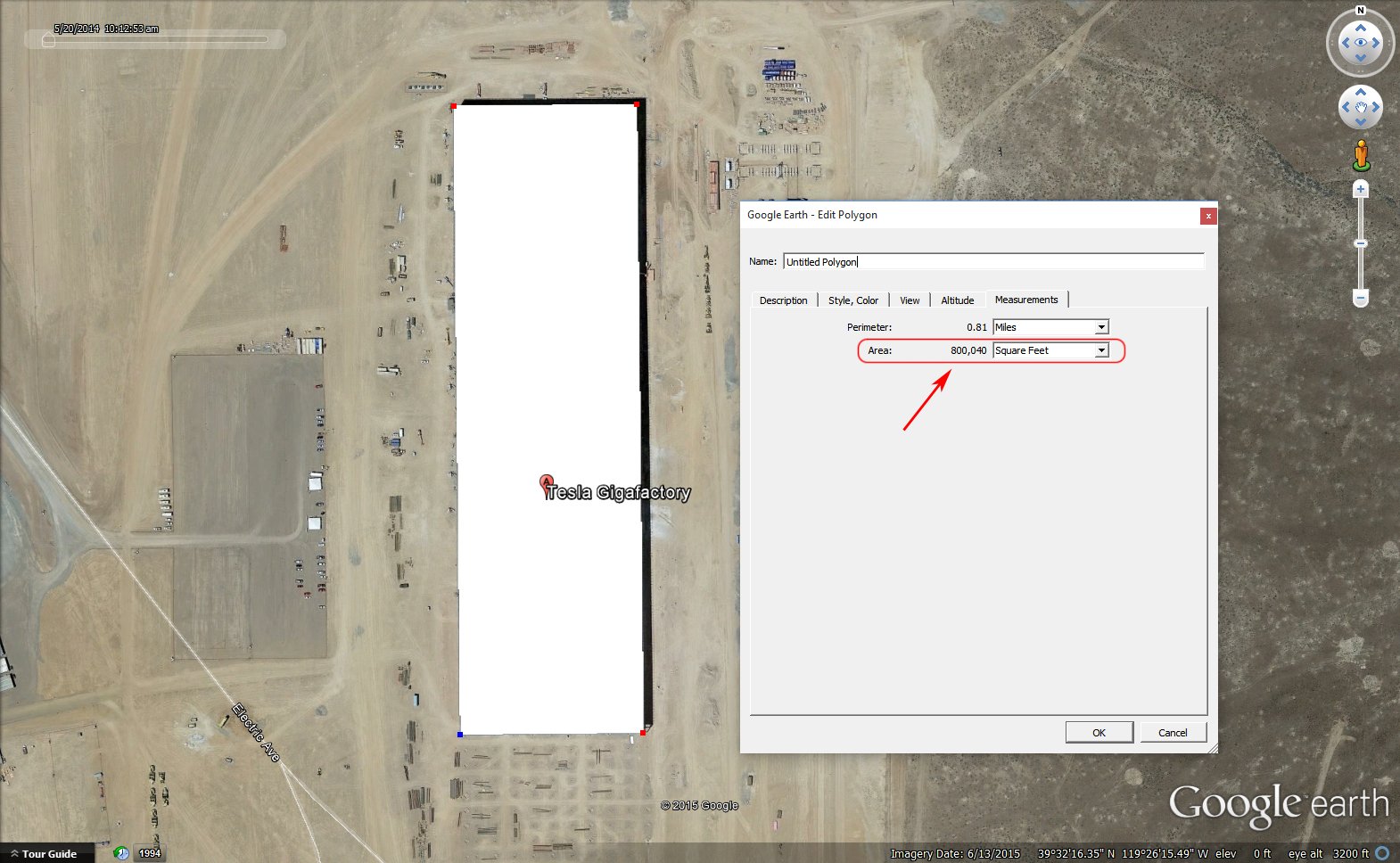
Okay, so looking at these facts, there are some obvious contradictions regarding the size of the factory. Firstly, Chafkin claims that the current building (Block 1) is 1.9 M sq ft, whereas Haymore says 2.5 M sq ft. My theory is that the difference between these two numbers is what is meant by 'square footage'. Haymore uses the word 'structure' to describe area, whereas Chafkin uses the word 'factory space'. I believe Chafkin's 1.9 M sq ft is referring to the actual usable factory space, whereas Haymore's 2.5 M sq ft refers to the entire sturcture, including kitchens, bathrooms, utility rooms, etc. Assuming this is true, Block 1 will consist of 76% 'factory space' (1.9 M sq ft / 2.5 M sq ft). This brings us to our second contradiction...
Haymore claims that Gigafactory will have a total area of 24 M sq ft ('structure') once complete in 2020, whereas Chafkin claims it will have a total area of 13.6 M sq ft ('factory space'). If we assume the completed Gigafactory will have 76% factory space, using Haymore's 24 M sq ft of stucture, there should be 18.2 M sq ft of factory space, not 13.6 M sq ft. So what happened to the other 4.6 M sq ft??? To find out, let's take a step back. Haymore claims that the Block 1 stucture is 2.5 M sq ft and that there will be 7 blocks. Using photoshop, I have overlaid an area equal to 7 times that of Block 1 over the sattellite image of the Gigafactory, and it lines up perfectly with the bounds of the construction site as well as Telsa's rendering, implying that, indeed, the final factory will by seven times the size of block 1. See my photoshopped overlay below (Block 1 outlined in red) compared to Tesla's final rendering of the factory:
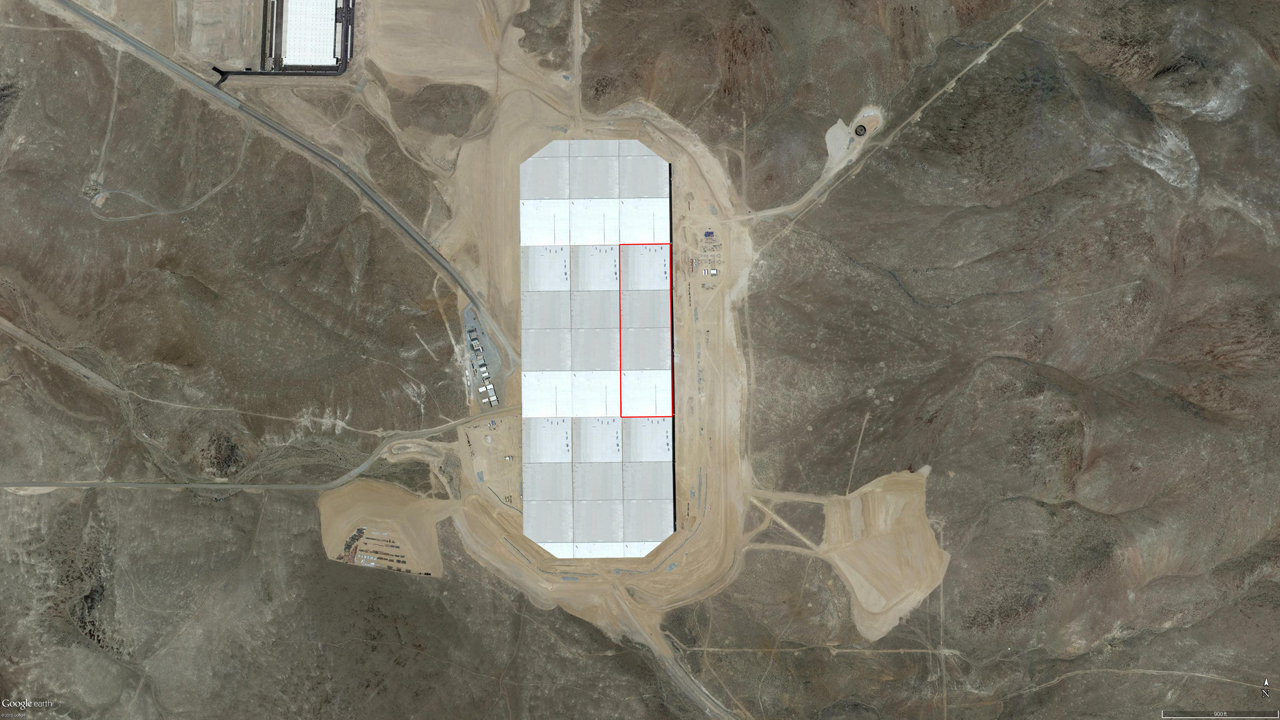
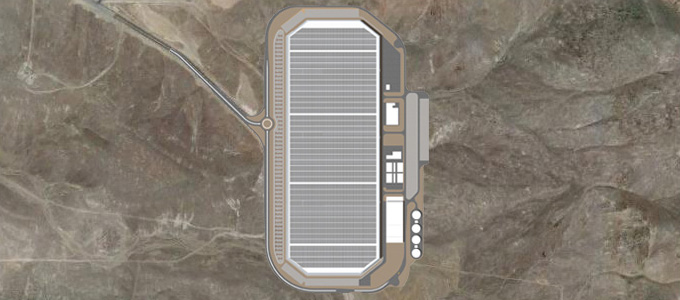
So, if we assume that the Gigafactory will be 7 times the size of Block 1, then the Gigafactory should be 17.5 M sq ft of structure (2.5 M sq ft x 7), not 24 M sq ft as stated by Haymore. So why the discrepency? First, let's look at the footprint of the factory. From Google Earth, we know that the footprint of Block 1 is 800,000 sq ft, which implys that the finaly factory will have a footprint of 5.6 M sq ft once complete (800,000 sq ft x 7). By the way, this would make the GF the largest building in the world by footprint, which no one seems to be talking about. So, if the footprint is 5.6 M sq ft and the total structure is 24 M sq ft, then there would have to be an average of 4.3 floors. One might say, "but there are only 3 floors!" However, looking at recent construction photos, I have noted in previous posts that it appears that Tesla is adding a 4th floor. See image from my earlier post below:
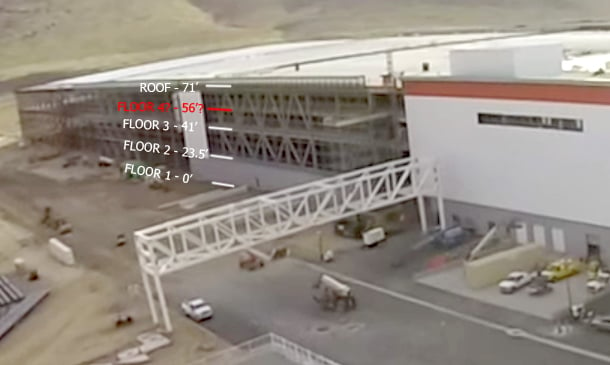
But 4 floors is still less than 4.3 floors, so what's the deal? It could be that the final factory will actually be slightly larger than 7 times it current size, giving it a footprint of 6 M sq ft, rather than 5.6 M sq ft. If that were the case, 4 floors would make it exactly 24 M sq ft. However, again, this contradicts Chafkin's claim of 13.6 M sq ft (17.9 M sq ft of structure if you assume he is implying 76% 'factory space').
So, there could be a few reasons for the discrepency:
1. Both Chafkin and Haymore are right, but their facts have been misinterpreted. It could be that Haymore's claim of 24 M sq ft includes the roof of the building (note: his claim of 2.5 M sq ft for Block 1 seems to exclude the roof, since 2.5 M sq ft x 7 blocks = 17.5 M sq ft, not 24 M sq ft). If this were the case, the actual structural area of the building (excluding roof) would be 18.4 M sq ft (24,000,000 sq ft - 800,000 sq ft * 7 blocks) or 2.63 M sq ft per block. This 18.4 M sq ft is very close to Chafkin's implied 17.9 M sq ft, so this is an extremely plausible explaination. Also, note: Haymore's claim of 2.5 M sq ft could reasonably be considered an approximation of 2.63 M sq ft per block, which would explain the discrepency of his implied 17.5 M sq ft (2.5 M sq ft x 7 blocks) of floorspace vs. 18.4 M sq ft (2.63 M sq ft x 7 blocks) of floorspace.
2. Both Chafkin and Haymore are right, but their facts have been misinterpreted. The final factory could have a much lower 'factory space' utilization of 57% (13.6 M sq ft / 24 M sq ft). I can't imagine 43% of the factory being used for something other than factory space, so this would be an extremely unlikely explaination.
3. Chafkin is wrong and Haymore's claim of a 24 M sq ft structure actually implies that there will be future floors added and that there may be areas with as many as 5 floors. I don't think that this is likely since adding a 5th floor would start to make things pretty tight. The maximum height of a 5th floor would be about 10' if they split the bottom level in two.
4. Chafkin is wrong and Haymore's claim of 24 M sq ft actually does refer to floor space, implying that the factory will be much larger than anyone else is claiming. For this to be true, however, there would need to be an average of 4.3 floors as previously stated. This does not seem likely.
5. Haymore is wrong, and the factory really will be 13.6 M sq ft of factory space (17.9 M sq ft of structure if you assume Chafkin is implying to 76% 'factory space').
6. Haymore is wrong, and Chafkin's claim of 13.6 M sq ft actually does refer to total floor space. For this to be true, however, there would need to be an average of 2.4 floors (Chafkin's claimed 1,900,000 sq ft area of block 1 / 800,000 sq ft footprint of block 1). This seems unlikely, given that you can already clearly see 4 floors (at least in some areas) from the construction photos.
In summary, I think that option 1 is the correct explaination (however, I would like to believe option 4 to be true). I think Haymore's comment about 24 M sq ft includes the surface of the roof of the GF. Therefore, I believe that the final GF will have 18.4 M sq ft of floor space (13.6 M sq ft of which will be dedicated factory space), have a footprint of 5.6 M sq ft (making it the largest building in the world by footprint), and have an average of 3.3 floors (meaning that there will be 3 floors in most areas, maybe 2 floors in some areas, and 4 floors in other areas).
So, what do you guys think? How big will the Gigafactory be, given all the facts out there?�
Nov 17, 2015
AudubonB Nice little analysis, esp. because you provide each of us to reach our own conclusions.
I find the concept of using the roof as allowable square footage to be amusing - in a positive way. If you consider that the roof is to be close to fully covered with PV panels, then why not? That's a factory component that is working [sunlight hours] * 365d/yr, and sure as shooting is providing continual value-added.�
Nov 17, 2015
brandude87 The foundation to the right (left in the photo below) of the existing structure that you are referring to has actually been there since February. The image below was taken on February 28, 2015 (see post: Tesla Gigafactory - Page 27).
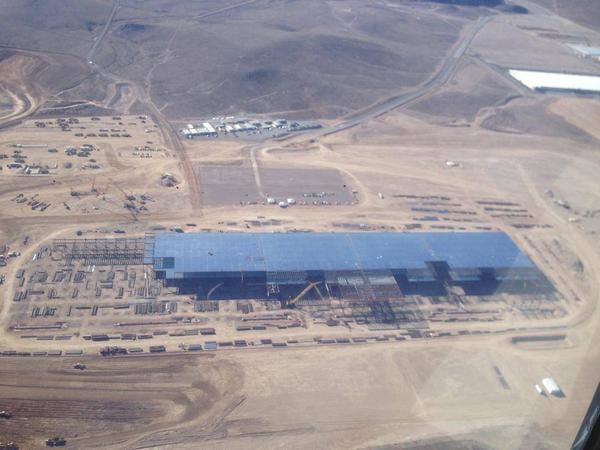
Furthurmore, Tesla had actually begun building a fifth section on that foundation, however, removed it to focus on the original four sections as referenced in my post back in May.�
Nov 17, 2015
Rarity Solid information and analysis, Brandude. The 24 million square feet is probably just the amount of concrete that Haymore thinks that he has to pour -- i.e., as you surmise, the roof is included.�
Nov 18, 2015
tftf This FC article confirms the numbers I have been posting many times, yet mixes it up in the title:
- There's basically no Gigafactory at the moment; with just 14% of the planned floor space Tesla can only make a fraction of the total cells/packs.
- The $5bn number in the FC article title however refers to the full Gigafactory project. So far, Tesla invested only around $261 million (Sept 30, 2015) plus maybe a little on equipment. Panasonic invested even much less.
- Adding the additional builings (86%) and building out the full GF will again take years. This will also be visible of course as soon as construction starts (drones, local press reports etc.).
So far there's no indication work has resumed on the additional builings as of late 2015.
Why is this important? The Model 3 can't be sold in announced numbers (Tesla's goal of 500k vehicles in total, of which maybe 350-400k units are Model3 - maybe even more if cells for the S/X continue to be imported from Japan) unless the full Gigafactory structure is completed.�
Nov 18, 2015
techmaven Tftf, the original Tesla Gigafactory PDF presentation showed the phased build out. This is nothing new, other than now the Gigafactory is to be bigger. Further, the cost savings necessary for initial Model 3 launch can be achieved with the initial phase as made clear in the presentation and subsequent remarks by various Tesla executives. Assuming 14% floor translates to actual capacity, we are talking about 4.9 GWh. However, Tesla has discussed that they have further optimized floor usage and expect better efficiency. Therefore, assuming more like 5.5 GWh, that is slightly less than all of LG Chem's worldwide automotive cell production capacity in 2015. In any case, this first phase is good for about 90,000 to 100,000 Model 3's depending on the final pack size. That is in addition to the roughly 80,000 to 100,000 Model S and X production capacity. A roughly 200,000 unit capacity in late 2017/early 2018 is quite good and they can then step up from there.
Panasonic already stated their expansion plans and allocated capital for the Gigafactory. Obviously, they cannot install the equipment until the building is ready for them. There is no way you know how much Panasonic has spent on equipment or labor so far, it isn't broken out that way in their financials.
The goal is to reach roughly 500,000 unit capacity by 2020. Nothing so far with the Gigafactory build out indicates that they won't achieve that. The fact that there is an inside space already with a certificate of occupancy, as well as Tesla Energy already moving in during 2015 indicates that they are dramatically ahead of schedule. Matter of fact, this first phase might not even be for Model 3. There is plenty of time to bring the second phase online for Model 3, which is likely 2 more years.�
Nov 18, 2015
tftf On the cell level (that's the tricky part) I see nothing "dramatically ahead of schedule".
Cells for ESS/storage by late 2016 and first cells for EV use by 2017 - these are Tesla's current estimates.
Looking at Tesla's balance sheet they will need to raise a few billion USD to complete the Model 3 and the full GF project until 2020 imho.
If readers don't agree, let me ask this simple question:
If Tesla still is so bullish on Model3 / Powerwall demand and if Tesla has ample cash why is it only building out 14% of the entire factory at the moment?
Why did they remove section 5 as outlined by poster brandude87 a few months ago: Tesla Gigafactory - Page 46
And why didn't they restart work on additional structures since then?
It's not like the remaining 86% of the factory can be added overnight in case demand is there.�
Nov 18, 2015
ggr I'm really tempted to be insulting here, but instead I'll just point out some realities.
1. Markets take time to build up. Initial sales of the first iPhone were not all that impressive, until a few months after release.
2. They get to work the bugs out of the system on 1/7th of it, not the whole thing.
3. They get to use cash flow from the first bit to contribute to building the rest of it.
4. Construction crew are also a limited resource; I imagine they had to choose between getting 1/7th of it running quickly or waiting an extra year.
With a moment's thought I could probably think of more reasons. But let me just say that these are smart people who are paid to put a lot of thought into the best ways to optimize Tesla's and their own outcomes. So second-guessing them is an interesting pastime, but you have almost none of the information needed to do it correctly. Admittedly, neither do I, but I know who I trust.�
Nov 18, 2015
tftf I see the logic behind making a large pilot line first.
My point was about uber-bullish investors reiterating the "$5 billion", "500k vehicles a year" and "Tesla's (EV) battery capacity is unmatched" mantras when the current (late 2015) reality on the ground in Nevada is very different.
Same for Tesla's current balance sheet. There are a few billions missing to complete this project and the Model3 imho - and I think there's no way this gap can be filled with internal cash-flows until 2020., i.e. Tesla has to tap outside sources again.
I doubt all Tesla retail investors are fully aware of this - especiallz since CEO Musk is already talking about additional Gigafactories overseas in the press.
Many investors think the Gigafactory will soon start churning out "batteries" (without understanding the difference between cells, modules and packs) for all "500k cars/year".
Which reiterates my bigger point about the car industry compared to other sectors: It takes a lot of time and cap-ex to add one additional $ of revenue in the car sector, probably more so than in any other sector.�
Nov 18, 2015
Cosmacelf Um, why did you think the full gigafactory wouldn't require additional funding?�
Nov 18, 2015
tftf Uhm, why did Tesla raise over $2bn in early 2014 and communicate it was primarily for the GF project - but then spend 80-90% of these funds on other stuff?
Reminder from early 2014:
All that cash is gone anyway as of late 2015 - while just 14% of the entire GF is under construction.�
Nov 18, 2015
aronth5 Seems like this is a bit of an exaggeration so Links please so we understand the context of this statement.�
Nov 18, 2015
Chickenlittle Not referring to anyone in particular but don't feed the trolls. It will encourage more posts, never satisfy them and increase their own sense of importance�
Nov 18, 2015
tftf I posted the numbers from the Tesla 10-Q reports many times, there you can see the difference between total project size (the $5bn) and what was actually spent until Sept 30, 2015.
Same for Panasonic's numbers, they can be found in their IR reports (much smaller than Tesla's investments up to now, probably not worth reporting until late 2015 and 2016 when interior build-out starts).
As for output/full size and current structure:
Tesla's first building phase nearly complete | Las Vegas Review-Journal
The FastCompany article linked a few posts ago just confirmed this 14% number.
What is being built today and then equipped by Panasonic etc. until 2017 (when EV cell production starts) is just a fraction of the total GF.
- - - Updated - - -
Do you have to add anything factual to the discussion? If so, please correct me if my numbers are wrong and/or add your own sources and links.
To sum up one last time:
- Tesla spent most of the funds raised in early 2014 on other items (not on the Gigafactory), all that cash is spent as of late 2015.
- Tesla is only building out 14% of the entire GF building structure at the moment (late 2015).
- Tesla can equip a much smaller number of Model3 cars/year unless it adds the remaining buildings. It wil again take 2-3 years to ramp up production from the moment new construction starts.
- Tesla will have to raise substantial additional funds for the completion of the GF and the Model3 (unless you believe it can cover this with positive cash-flow, if so please add your numbers or estimates how this is possible in 2016+. I don't think this is remotely possible even when assuming much slower cash-burn going forward).�
Nov 18, 2015
dc_h Beyond bull\bear conjecture, which is currently 50% of this thread, does anyone have any estimates for production in 2016? The GF has been an investment for the last 18 months and will become a positive source of cash flow in 2016. It is likely that the second 14% of the GF will start construction in the later half of 2016 as the initial plant approaches full production. If this stage is 14% of a planned 50GW facility, than GF phase 1 should be producing about 7GW annually by the end of 2016. If Tesla is generating 15% margin, how much cash flow will they have for GF phase II? Presumably they need GF phase II for the Model 3 to start and probably need GF phase III to reach full Model 3 production.
Interested in your thoughts about capital requirements and cash flow from business operations.�
Nov 18, 2015
bwa Thank you for saying what I was thinking.
By the way, this thread still has awesome posts in it. I have to sort of skip the bickering. The reason we keep the bickering around is because sometimes it borders on interesting and gets other relevant stuff going, so we can't just assume bickering is bad. But, as an intelligent reader, you get to figure out what is nothing but trolling and ... ahem ... let's see how to say this productively: find more interesting stuff to discuss. On the other hand, I enjoyed the "now I know why you post the stuff you do ..." conclusion a handful of pages back.
- - - Updated - - -
Is there a basement?
I used to walk to the second floor of a building I worked in to go to work every morning. About a hundred stair steps. From Parking 2. Up thru Parking 1, Basement, Ground, One, then finally Two. And every floor was a minimum of 20 feet tall. (Yes, the building I describe had a distinct Ground and One which were about 25 feet away from each other.)
Needless to say, Parking 2, Parking 1, and Basement were all below Ground level, away from picture sight.
- - - Updated - - -
I don't actually know, but they could easily put the PV panels on stilts and put mechanical equipment underneath them on the roof, essentially two floors worth of working parts (PV panels and various non-interesting machines such as compressors, fans, and other various motors that chug along semi-continuously, and I wouldn't be surprised if a factory had a lot of them). It's not unheard of to put some electrical equipment on roofs, too, but it's pretty common to hide as much electrical stuff down low as possible since that's where the pipes come in and where the least likely damage to the electric systems will occur, as well as a better place to put the weight of the electric equipment (but far up enough to not be flooded -- mostly it's pipe distance dictated, due to resistance heat issues). In fact, a lot of mechanical stuff tends to go down low because of its weight. But in a factory? Who knows: there could be literally many floors worth of equipment, and some of it HAS to be away from other components just to cram it all in in a safe and accessible manner. I know when I worked at the Intel Hotel (factory), they had many floors worth of equipment. One whole floor was air conditioning compressors, and it was near the top. The ground floor was so crammed with stuff that they extended a lot of that stuff into the basement, which was also crammed. I never went into the hotel fab floor proper except on its periphery, so I don't know how that looked, but from the pictures, it was crammed too (until they exported it all). And, they had literally many other buildings next to that multifloor building with more mechanical stuff offloaded into adjacent areas via pipes and wires to handle stuff that didn't need to be within a couple dozen feet of the fab floor. And there were even more tanks and junk. I suppose any factory looks like that. Come to think of it, the simple cement factory I worked at looked as big and gangly with tubes and wires and ducts, and many, many machines and processes; probably a bit larger, in fact. I've never been to a refinery, and I suppose that's even more interesting -- their footprint is certainly larger.�
Nov 18, 2015
tenstringer009 The Car and Driver 10 Best article includes some photos of the Model S around the Gigafactory. I don't think there's anything really groundbreaking in the photos, but maybe this'll be of some interest.
http://www.caranddriver.com/photo-gallery/tesla-model-s-70-70d-2016-10best-cars-feature�
Nov 19, 2015
pmadflyer The pictures in the car and Driver article are great, but I wonder where all that (giant) steel is.�
Nov 19, 2015
dalalsid This somehow seems to be your main grouse. Tesla plans to finish this by 2020 - so 5 years from now. So they have "years". I don't see what your issue is. Yes it will take lots of money and years. What is the problem with that? That they will have to raise money? There is no shortage of that in the world, especially if that Model 3 is anything even slightly more than a complete dud. And once they build one section and learn their lessons, the rest will probably go faster. The can add one at a time until 2018 and two at a time until 2020 and that should be good enough. And if any other govt. (Germany, for e.g.) gives them any incentives, they can start the second one which can send batteries to their assembly plant in Europe by 2020.
14% of 35GWh = 5GWh - still tecnically "Giga" factory�
Nov 19, 2015
tftf The main issue is that Tesla (in their PR) and most of the press is mixing up the full project and the current pilot plant.
If you add one additional factory (same size as Nevada) overseas there's a giant funding gap of $8-9 billion for battery manufacturing alone. Add to that cap-ex for Model3.
We will see how and when Tesla really closes that gap. Five years from today is basically 2021 already.
The competition isn't sleeping. BEV offerings and battery supply will look different by 2020. To quote just one current example:
Geely Auto Seeks 90% Sales From New-Energy Vehicles by 2020 - Bloomberg Business
We will see what's so unique about Tesla and how the assumed "30% or higher" battery cost reductions or the 35-50GWh compare with new battery plants from others.
Tesla is comparing its 2020 (maybe) plant with 2013 competitive figures.�
Nov 19, 2015
dalalsid Tesla has been very clear. Full production by 2020. 500k by 2020. Initial storage pack assembly - now. Initial Storage cell production 2016. Initial EV cell produciton 2017. You are the one mixing things up.�
Nov 19, 2015
chickensevil So the "completed" 14% is not the entire structure that you see, it is a small part of that. Why do I know this? Because even the latest photos of the site shows open steel frames on the far side of the building. Sure they have raised a wall around the outside coming across the full length of the building, but the backside is still not covered. You can't very well be certified to move into a structure that doesn't even have walls all the way around it. This means that the 14% is less than the size of the structure you currently see. It may even only be that first "block" of the building out of the 4 "blocks" we saw as the structure went up (with the fifth having been pulled down, for whatever reason). If you remember when Elon's brother posted photos from the roof of the building they stated that the current structure was something like 25% of the completed building. So you have most likely around half of the visible structure having been "certified" for use.
Given that we also know that the building plans are for 5 phases of construction (assuming they are still sticking with those timelines) it was suspected that phase 1 was the largest piece of the factory. What we might have actually seen happen is that phase 1 kept going in the middle of starting phase 2 (phase 2 likely started by raising more steel than needed for that first 14% of the factory).
This would imply that they are actually in the middle of Phase 2 of construction and possibly also starting Phase 3 in parallel. Again, the original timelines that were published showed this overlapping period between the phases.
Point is, you are cherry picking the data to meet your narrative, which I still don't even understand what is so negative about what you are suggesting overall anyway... but in either case, I don't think 14% is what you think it is.
Combine that with comments that they were planning to go bigger than originally stated (they added a whole extra floor on top, it was originally to only be a 2 floor building) and that they have already underestimated how much production they would get out of the usable space by doing a more optimized flow, and you don't have any accurate way of attributing the amount of money already spent vs what they still need to spend.
So to your points:
I already rebuffed this, it depends on how you look at their spending vs capital raises. Do you deny that they are sitting on 1.4B in cash? at the end of 2014 they had 1.9B, at the end of 2013 they had 845M, and 2012 201M. I said this previously, and I'll say it again. They are still sitting on enough cash currently to finish building out the factory (at least their share of it), Every time it depletes down from other spending they pull it back up again with some kind of cash flow injection (e.g. line of credit, capital raise, etc). The only thing any of those other cash flow injections after the major one happened has not been stated for is to add on to the gigafactory. All of the cash additions have been to ensure they keep enough cash on hand to continue to expand the gigafactory at a pace that works for them, while being able to grow other parts. So no, they "technically" haven't spent all the gigafactory money, because there is still 1.4B sitting as cash on hand.
To put it another way, it isn't like when you do your own personal finances that you go and physically separate out your cash. 1k for housing, 500 for car, 250 for food, 250 for other stuff... right as your paycheck comes in, you immediately separate out that cash, even though you might be getting a whole other paycheck (assuming bi-weekly paychecks) before you owe on your house. As long as you pay for your house when it is due, it doesn't matter if you pull 1k per paycheck or 2k in one paycheck does it? And if your grandma gives you 100$ and says, here I want you to buy 100$ in clothes (gigafactory raise), you turn around and spend that physical 100$ immediately on a fancy dinner with your significant other (building out fremont), but then take 100$ from other cash flows coming in like your paycheck (Tesla doing the 750M cash raise) to buy those clothes your grandma wanted, did you not still end up spending 100$ like you promised? Does it really matter that you didn't spend that specific 100$ she gave you, physically walk over to the store with that 100$ bill that she wrote on the front of it even "from grandma with love", and set it on the counter to pay for clothing??? No, it doesn't. In the end, you still spent 100$ on clothing.
Now, stop playing semantics over their cash...
See my comments above, there is no way that 14% is the full entirety of the visible structure. the visible structure is very likely greater than 25% of the total building
Cool, they are already doing that. The point at which they stated to hit 500k a year was by 2020, as long as the building is completed by 2017 as their original timelines stated it would, then they have 3 whole years to move in equipment and get things up to 500k. What we know is they are on track to start cell production well ahead of needing it for the Model 3, and their construction timeline leaves them with 3 years to fully ramp production. They didn't specify that in 2017 they would make 100k, 200k, or whatever arbitrary number of cars. They said they would *start* production in 2017 of the Model 3, and be doing 500k in 2020. I see nothing that says that they won't be able to do either of those stated goals. The specifics behind getting from 1 car to 500k hasn't been outlined yet, or even hinted at... so I am not sure what your point is here.
People have provided plenty of ways that the factory can self-fund the rest of the expansion should they decide to go that route, in this thread and in many other threads... if I recall the only rebuff was "they won't hit those margins necessary to do that", but noone ever provided a proper counter reasoning why they couldn't hit the margins... So quid pro quo, why don't *YOU* provide numbers and data as to why this isn't possible using numbers that others have been so kind to provide in the past on estimated sales, gross margins, operating costs, and assumed net profits (minus cost of expansion, cap ex, and increased spending as they grow out the sales, service, supercharging, and other things). Convenient to say "I don't think it's possible" while pushing the burden of proof off on someone who actually has responded to provide this information in the past. The best one I ever saw posted on this was by DaveT, go back and read through his thread as to how they could use the funding from one factory to enable exponential growths assuming they can maintain a remote semblance of margins of what they are doing now.�
Nov 19, 2015
JRP3 Because, as has been repeatedly pointed out, they added another floor and have found ways to fit more production capacity in a smaller footprint. It's so simple and easy to understand that one would have to actively try not to.�
Nov 19, 2015
ev-enthusiast Just wanted to say: tftf, I love you.�
Nov 19, 2015
tftf No, they are still talking about 14%.
The FC article is only a few days old, long after additional interior space (more floors etc.) was apparently added:
Elon Musk Powers Up: Inside Tesla's $5 Billion Gigafactory
1.9 million sq ft today
13.6 million sq ft "planned"
That's 14% in my book.
I don't know why some people keep saying more than that is done (see chickensevil's post) when this FC article - with direct access to Tesla sources - states these numbers clearly.
Tesla can announce 10 Gigafactories worldwide and one on Mars, buy more land in Nevada etc. - the fact remains that only 2 million sq ft are available at the moment.
Therefore the battery output capacity remains limited until the rest is built (which will be clearly visible as soon as construction starts).�
Nov 19, 2015
electracity I don't believe you guys actually believe that Musk is satisfied at the rate Tesla will be adding battery capacity. Tesla Energy alone can probably use the entire gigafactory capacity this decade.
I don't agree with tftf that there is some indicator of a problem with the M3 here. But I do wonder why a second major structure hasn't been started. The only reason I come up with is inadequate capital.
2020 begins in 50 months. Tesla needs 1gWh of battery for every 20,000 M3 produced.�
Nov 19, 2015
tftf I didn't talk about a Model3 problem here. My only prediction about the Model3 is that this car will be likely be delivered late (compared to latest 2017 release estimate), likely by 2018-2019 only and/or could cost more.
Since I assume the Model3 is late, these GF delays and capacity restrictions at 14% of the total probably won't matter a lot until the next decade - the real problem for Tesla is growing competitive pressure because of these delays:
1. New battery technologies evolving (worse ROI for Gigafactory beyond 2020) and
2. Large battery suppliers like Samsung/LG etc. ramping up production worldwide in current Li-Ion technology as well as pouch/prismatic cell costs closing in on cylindrical cell costs.�
Nov 19, 2015
JRP3 Or not
https://cleantechnica.com/2015/11/17/tesla-model-3-leaks-small-ones-cleantechnica-exclusive/�
Nov 19, 2015
austinEV @tftt If TM was pushing their existing cash into building 2-3 more structures the size of the one they have now, you would be patiently explaining why they are building too fast and they haven't even built anything in the first building and they are recklessly burning cash.
I for one am thrilled they are taking a pause to get the pilot plant doing something before rushing into the next phase.�
Nov 19, 2015
tftf Of course the March 2016 "mule unveiling" is on. I never wrote/estimated that this event will be delayed.
Remember that the Model X was shown in February of 2012 already:
Tesla Unveils Model X | Tesla Motors
I doubt that car will be shipping in volume before Q1 2016.
"Unveil" means little compared to the actual volume production date - I think volume production will start by 2018-2019 only. That's the date that counts for investors in terms of cash-flows etc.
An "unveil" or "photo op launch" with a few cars (the recent Model X launch was the prime example for that) is often nothing more than smoke and mirrors.�
Nov 19, 2015
dalalsid This is obvious. They will deliver in order: founders (loaded), sigs (loaded), production (loaded), production (not loaded). If Model 3 market is 10X Model S market (conservative estimate), then all those should be 10X, e.g. 10k sigs instead of 1k/market. If you are expecting even one 35k base Model 3 delivery before 2019, you are expecting wrong. So to meet late 2017 deadline, they can and probably will do something similar to the Model X - some founders and sigs. Expect 2018 to be only loaded cars and 2019 to be well equipped cars. The price of the Model 3 IMHO will be Model S - 35k, not Model S/2. So loaded Model 3 = loaded Model S - 35k, not loaded Model S/2.
New battery technology does not become cost competitive and volume production overnight. And if you think Tesla has no idea about any viable volume/price competitive tech that is around the corner, you are wrong once again. Anybody who makes such tech will obviously shop it to Tesla first - after all they are the most battery hungry company in the world. And the rest of the 86% of the Gigafactory and any future one can make that.
--Update--
So the only real problem I see Tesla having is media misinterpretation of the Model 3 signature as "Tesla's 35k car turned out to really be 100k", toy for the rich, waste of govt money, blah blah while the reality is different. Hopefully Tesla PR gets their act together by then, unlike the Model X.�
Nov 19, 2015
techmaven I just updated my view on LG Chem in this post: #18 which is a more appropriate thread to discuss them.
Right now, their nameplate capacity is somewhere around equal to Panasonic's capacity and somewhat equal to Gigafactory phase 1. Note that actual production is a far cry from nameplate capacity. By end of 2016, they will likely have somewhere around 50-60% of Tesla + Panasonic (for Tesla).�
Nov 19, 2015
chickensevil Wow... really??? All that detailed response, and THAT is what you got from my comments... and you wonder why people stopped engaging with you in a discussion. Way to take what I said COMPLETELY out of context and yet again cherry pick things to suit your narrative. I don't know why anyone even bothers trying with you...
I suppose I am a glutton for punishment... I did not say that more than that was *FINISHED* (or as you state "done", but done by definition means finished, completed), I stated that more than 14% was in progress. Hence the comments toward a partially complete building still being visible in the latest photos.
Or do you honestly think that any permitting and safety board is going to allow someone to move into a building that doesn't even have all of the outside walls around it (never mind whatever the interior looks like)? I mean... do you think this? If so, then you should try building something sometime... get about halfway through making like, a house, or something, leaving like one of the walls completely off the side, and then go ask health and safety if it is ok for you to move your entire family into the house, and to turn on the utilities and such. Because you will be in for a surprise.
This implies that the stated "14%" which they have started to move equipment into and begin using is closed off and completed construction such that it would pass those checks. Meanwhile they continue adding on to this "completed" building with extra construction.�
Nov 19, 2015
stopcrazypp The Gigafactory was originally planned for a maximum of 10 million square feet, so 1.9 million is right on target for a phase 1 out of 5. It's just that they have expanded their goals beyond that.
http://www.bizjournals.com/sanjose/news/2014/02/26/tesla-unveils-plans-for-10-million.html�
Nov 19, 2015
Rarity Lots of possibilities. It seems that the whole industrial center is under construction, so, for example, some workers could be turning for a few months to construction of the Switch facility.�
Nov 19, 2015
chickensevil Ummm, 1.4B is inadequate to continue? And you are making assumptions that they have stopped. That is a false statement. They have not stopped construction. Construction consists of more than just steel beams and a metal roof. See my other responses on this subject of where they are with construction... don't feel like repeating myself.
Release date and volume production are two different things and always have been for Tesla. You are likely right that investors care more about volume production rather than meeting a release date (hence why the stock hasn't currently gone anywhere after the Model X release). But All Tesla has promised is a H2 2017 *release* of the Model 3. They have not made comments either way about volume production that I can recall. So no, they won't "be late" based on what they have promised given the most recent comments from the company. That might not be what *you* want the company to do, but that doesn't mean that it is late, and it doesn't mean it will cost more.
That then makes your base of forming an assumption false, but to respond to the two points:
1. Have you listened at all to the recent interviews with Elon and JB??? They have stated plenty of times that making shifts in cells to optimize for a better battery is entirely within the capability of the factory. A new technology isn't just going to come out of nowhere. They stated that they are tracking 60 different researcher groups across the world on batteries, all serious researchers know that their primary market for their breakthrough tech is Tesla as they will happily buy it off them for whatever price, and so far... nothing... they don't even have a candidate worth starting initial discussions with, nevermind starting to implement serious testing of this cell to see if it proves worth anything. Taking a cell from the lab into mass production for vehicles takes YEARS. It isn't like we are going to wake up tomorrow and the factory will be obsolete. And any breakthrough technology is fully capable of being implemented in the factory.
2. Ok. Cool. Where is this? JRP3 has pointed out that even looking at nameplate capacity noone is close to the volume Tesla is talking about adding in one single factory. And even if they did, who cares? We need around 200 gigafactories around the world to satisfy global demand to replace all cars with electric. We don't even have 1 yet and you are "worried" about other makers encroaching on Tesla? Ok. Show me the plans for LG or Samsung to build a factory (a single factory) that is either being scouted for or already in progress with a nameplate of 30GWh or more. Even if they started tomorrow, as you said, it would take 3 years to complete construction and start production which would put 1 single factory next to Tesla starting in December of 2018. 1 factory... out of a needed 200. Are there plans in the works to go to 6TWh of production by 2018? or even 2020? Cause that is what it would take to cause a problem for Tesla having enough demand for their products. (assuming just automotive battery production, if we look at stationary storage that number goes even higher).
You keep complaining that it is taking Tesla SOOOO LONG to build this factory, and then try to say that Tesla has a risk on their hands that someone else is going to come out of nowhere with capacity. These statements conflict with one another and therefore both arguments fall apart and are now rendered invalid. You can have one argument or the other... not both.
- - - Updated - - -
PS: I'm still waiting for something proper after my response invalidating your previous points. If you don't care to provide a response then I kindly request you stop repeating them here as if it is some kind of fact. Clearly there is conjecture, you just refuse to even acknowledge the conjecture and are just spamming the thread with your comments.�
Nov 19, 2015
JRP3 Somehow you missed the first part of the quote, which was talking about Model 3 production, not the "mule unveiling". Try reading again:
�
Nov 19, 2015
tftf I didn't question that. On the other hand, they didn't adjust their GWh output numbers or project costs afaik. It's all planning. The pudding is in the 10-Q reports and actual other cap-ex until 2020.
The main issue is that Tesla keeps comparing these "planned" 2020 numbers with old 2013 numbers from competitors - both in terms of output and cost:
We know (see other battery thread: Battery for EV capacity developments ) that BYD and apparently also Samsung (I would need more confirmation) each talk about having around 35 GWh of output by 2020 as well.
Looking at LG's long EV battery customer list, they might even have/need more than that by the end of this decade.
I would therefore be wary of Tesla's claims being a global leader in terms of output and pricing by 2020 given the pace of its construction vs many smaller plants coming from competitors worldwide.�
Nov 19, 2015
AudubonB A lot of cross-currents and different topics being discussed simultaneously now; this is in reference to something three pages back...all of 12 hours ago...
For the Gigafactory, however, we have heard Mr Musk say (I'm sorry, there's no way I'll be able to find the clip but it was probably between 3 and 6 weeks ago) that the roof is pristine - zero mechanical equipment on it. I am pretty sure it was the same interview where he said he refused the engineers access to any LNG for heating/cooling of the factory or for its equipment.
Just from its processing and controls - absolutely irrespective of what it is producing - it is going to be an extremely interesting factory!�
Nov 19, 2015
Svetlin Ok, so what? Does BMW make the cheapest engines? Are they out of business because Honda makes more and cheaper engines than them?
Take a step back. The main point of contention between you and everyone else seems to be that you think disruption in the auto business is much slower than we think and that the EV market slice of the whole auto market will remain small for a long time. Therefore 100 GWh battery capacity from competitors squeezes Tesla out of the market. Everyone gets that, please stop repeating that Tesla has only built 14% of the Gigafactory.
I think we just disagree that EV market share will remain as low as you think it will be. I am betting that > 10% of new car sales in developed economies will be EV/PHEV by 2020. The more gigafactories, the merrier.�
Nov 19, 2015
tftf The main reason behind the GF is driving battery costs down afaik (besides getting enough supply for the Model3 and beyond), no?
Therefore lower costs/kWh are the driver why Tesla is constructing this factory with Panasonic as "cell maker" tenant in Nevada.
Otherwise, someone can tell me the real reason why Tesla is vertically integrating and spending billions (at least that's the plan until 2020, so far they only spent a fraction of that on the GF).�
Nov 19, 2015
stopcrazypp He didn't say the prices won't be cheaper than existing. His point was that it doesn't have to be the cheapest in the industry to be successful. All it has to do is be cheap enough to support the Model 3. This is not a zero sum game.�
Nov 19, 2015
electracity
Existing battery makers would not commit the capital to build the battery capacity that Tesla needed.�
Nov 19, 2015
dakh Many reasons:
1. Automotive cells they'll be making are not quite the same as what everyone else is making. In design, size, chemistry for sure and maybe other parameters. They even got patents on some of that. All of those changes from the way things are done currently are to optimize price per WH, specific energy, energy density, etc. of the whole pack not just individual cells.
2. There is a gain in efficiency to be had when batteries are made in the same facility as the packs and know-how of how to make finished packs I doubt Tesla will outsource to anyone.
3. By now we know Tesla moves quick on the execution (yes, humor me here -- maybe not as quick as they say, but as quick as possible). Having complete control over pack (note not just battery but whole pack) production and volume ramp is actually de-risking Model3.
4. As Musk is saying they're the big dog in cell production now so they are de-risking being disrupted by new battery tech because they're the ones who stand the best chance to get to be the first ones to use it.
I'm sure I can come up with more reasons if I sit here for another 10 minutes but that's what I could come up with at the speed of typing �
�
Nov 19, 2015
mitch672 your wasting electrons, disk space, and your time & effort arguing with TFTF, he is a long time TSLA bear, no amount of logic or reason is going to do any good with this poster.�
Nov 19, 2015
dakh I don't find it to be the case. But then again maybe other folks here have too much blind faith or are much smarter than me.�
Nov 19, 2015
JRP3 Or we've just spent a lot more time arguing with tftf and his ilk :wink: It can be entertaining, and, on rare occasions, informative.�
Nov 19, 2015
mitch672 go read his stuff in the comments of any TSLA article on "Seeking Mediocrity", TFTF stands for "Tales From The Future"�
Nov 19, 2015
AlMc I find the discussions informative. There is an 'ignore' option if any of us wish to use it.�
Nov 19, 2015
chickensevil As frustrating as it is to read some of his posts and then how he just conveniently ignores me or cherry picks my comments to twist what I said.... I don't tend to block people because I like seeing all sides. If this truly is the best of the Bear case (and he is one of the better ones out there) then it is reassuring that I have picked the right side of this investment.�
Nov 19, 2015
Oil4AsphaultOnly I guess I'm a masochist for jumping into this, but here goes.
tftf, yes, the GF is for driving down battery costs for Tesla. But it's also for ensuring battery supply for Tesla.
Based on your other link, IF both BYD and Samsung builds out their gigafactories, there would be enough batteries (from LG, Samsung, AND BYD) for 1.5 million long range BEV's (or ~5 million PHEV's in a global market of 90 million cars) in 2020. With most auto manufacturers producing some sort of EV by that time, Tesla's GF guarantees them battery supply (just like BYD's GF would only guarantee BYD's battery supply). Everyone else has to fight amongst themselves for whatever LG & Samsung can supply.
As Svetlin said, you think this is a problem because you don't think the EV market will be large enough. Am I wrong?�
Nov 20, 2015
AlMc I believe you will be rewarded for your decision in the long term, as will I. Now, that does not mean tftf will 'lose'. He/she may very well pick a good time to get out of his/her short position and make $$ as well.
PS: Nice posts on your part, I appreciate them and enjoy reading them.:wink:�
Nov 20, 2015
ev-enthusiast Same reasoning here.
It is important to understand the possible bear arguments to better understand your investments.�
Nov 20, 2015
mkjayakumar TFTF's arguments boil down to this:
If Tesla manages to bring down the cost of cells to $100/kWh, then LG will bring it down to $95 and Tesla is doomed.
If Tesla manages to bring M3 to market in late 2017/early 2018, GM will bring Bolt 8 or 10 months earlier, and Tesla is doomed.
If Tesla manages to produce 30GwH then LG will produce 31 GwH and Tesla is doomed.
Replace GM with Audi or BMW or Toyota or BYD or the new kid in the block, Faraday.
About 2 years ago it was different set of stories, which have all quietly faded away now:
There is no market for EVs so all the money sunk in battery production will bankrupt Tesla.
Battery chemistry will never improve and the cost will never come below $300/kWh for another 10 years. Tesla is doomed.
yada yada yada.
For those that have not read TFTF's articles and comments in Seeking Alpha it would seem as if he is trying to make a rational bear argument here. But in reality making a bear argument is perfectly par for the game, but TFTF and his Seeking Alpha friends are simply not pointing out the road bumps in Tesla's story - They ABSOLUTELY WANT TESLA TO FAIL AND FAIL BADLY.
They are so emotionally invested in Tesla failing.
Take for instance Paulo Santos latest article. Paulo took a non-issue and spun it into 'Tesla is cheating' story.
That is why I don't take these guys seriously.�
Nov 20, 2015
schonelucht But is it adequate to cover expenses for Model 3 R&D, Model 3 factory tooling, remaining 75% of investment in the Gigafactory and continued expansion in supercharger network, service centers and stores beyond free cash flow from sales on existing products? It would a good thing if someone could try to model these going forward. I don't understand why there is such hostility against the notion that Tesla will need to tap additional credit lines and/or do a rights offering.�
Nov 20, 2015
electracity Didn't Ron Baron a while back have a chart chowing Tesla raising 10 billion over the next ten years? Any investor who is certain the Musk doesn't care about making more money needs to also believe that he doesn't care about stock price.
Musks problem may be how to keep control of the company while constantly diluting equity. I imagine he wants as many off balance sheet partnerships as possible on the battery side.�
Nov 20, 2015
chickensevil You say that like they aren't also selling a product with a ~25% GM with a goal of breaking 30%. Do keep in mind that they are pulling in a bunch of money at the same time that they are blowing through their capital. I think between the two they have more than enough to continue to course. It is just a matter of if they want to continue the course or accelerate it further. With the ambition of "millions of cars" by 2025, I think the only way to make that happen is going to be with another capital raise. But to get the 500k a year by 2020 I don't think they need more funding. Keep in mind that all the major spending for hitting 100k a year has happened or will happen in the next month as they said the spending would be done by q4. So they can pull in cash now from that effort and ride it out to fund other things. 100k a year at 25% at 100k asp is 2.5Bn gross. Sure they will have to spend some amount of money on R&D related to the S and X, but it should be minimal comparatively to what it has been. (Not suggesting they will sell 100k in 2016, I'm more thinking 75-80 but paid for capacity should be closer to 100k so it is useful to think about that when you are talking about further R&D and Capex toward future growth. If they miss that mark and can't get that many then the money already spent has less ROI.)
Also note that at a minimum, the money spent on stamping and the paint shop gets them to 500k. So they only need to expand (of the big ticket items) the final Assembly, body production, and motor production (although I don't think any of us know that capacity.) The rest of the factory us already there to get to 500k (or will be with the gigafactory supplying the packs).�
Nov 20, 2015
schonelucht I think I specifically mentioned free cash flow from sales on existing products. Let's be generous and call it $4B before the Model 3 launch date. That means they have $5.4B cash on investments to fund model 3 R&D, expansion of the existing sales, charging, service and support infrastructure, GF investment, keeping model S and X up to date and car factory (re)tooling +expansion for model 3 production. Again, not saying it can't be done but I would not be surprised if it turns out to be not enough.�
Nov 20, 2015
austinEV I am confident it won't be enough. But predicting a capital raise is not the same as concluding that Tesla or TSLA is doomed. The equity market has been happily chipping in because they believe the plan is on track.
- - - Updated - - -
This is perfect, and I tried to make a similar point a few pages ago. TFTF can be correct about everything and it doesn't prove what he thinks it proves.�
Nov 20, 2015
chickensevil Right, I was simply putting the amount of cash flow into perspective such that it can attempt to be estimated if their 1.4B plus continued cash flows would be enough. What concerns me most about this being enough money is not the gigafactory or fremont, and it isn't the R&D spendings. It is the OpEx on continuing their growth on sales, service, and supercharging, although based on their numbers supercharging is basically not worth mentioning on the bottom line, which is why they don't. They have been nice enough to tell us the total investment in the infrastructure so far, though, so that is helpful. In any case, adding more sales and service is likely were a giant chuck of the Opex is going into, and as they keep pushing into new markets this keeps getting more costly. We are looking at them already pushing into the middle east, Mexico, South Korea, and India. At some point I would venture they will push into South American countries and African countries. And there is still large amounts of Eastern Europe left to see a service center. Even in their more covered markets, they need more service in NA and Asia. We are talking around 30 people per store and around 40 people per service center, and people are a very expensive resource. Spending on R&D or CapEx is nothing compared to this continued sink of money into paying people to help you run the business.
Anyway, That is truly what I think will be the determining factor here is their balance between expansion of sales/service against growing their capacity of products and keeping them competitive. And to get the volumes they want on the Model 3... they are going to need more service centers.�
Nov 21, 2015
MitchJi You can easily ignore his woefully uninformed posts (the best possible option). But when he posts that two plus two equals twelve how can you ignore all of the detailed responses explaining why that's incorrect?
Of course there are occasionally useful nuggets of information sprinkled in, but it's a painfully inefficient way to learn.�
Nov 21, 2015
bonaire Capital raises are not a big deal. Thousands of firms have done them and it is not a tale of doom to say Tesla will do more - whether another 1 Billion or 5 Billion by 2020. I don't think supporters will let it "go away". Dilution is not doom unless orders somehow drop to some level of inability to sustain a true growth curve. Money is not as important as order-rate (ie. sales rate). I suspect there is one more card to be shown and that would be to securitize leased cars as a financial instrument. Solar City sold securitized solar leases to Space X and possibly Tesla could do similar and offer the package to firms such as Autonation or other buyers.�
Nov 21, 2015
AlMc I want as much information as possible to make a decision about what to do with my money. Wading through the debate, engaging in it, can be tedious with much info to sift through, but I would prefer that to just always seeing one side or the other.
There is an old adage: 'keep your friends close but your enemies closer' :wink:�
Nov 21, 2015
chickensevil Do note that this is the investor thread on the gigafactory. If you are just looking for general news, then many times that can be found in the significantly more quiet thread on the gigafactory over in the general Tesla Motor section. So having the debate about the investor impact on this project that is going to cost 5B$ and potentially propel Tesla to the next level and then hopefully TSLA will follow that is important to have IMO. If this I not what you want to see and just want general news stories or general analysis on the capabilities of the building then I would suggest you to post about such things in the non-investor thread. That is the reason there are two.�
Nov 21, 2015
pmadflyer I'd have to say, this is the better thread for general news.�
Dec 1, 2015
ev-enthusiast Any news about Gigafactory progress?
Staffing should be almost completed by now.
Is TM still aming for first battery pack production end of 2015?�
Dec 3, 2015
hobbes Tesla sounds out lithium tie-up with Chilean miner Codelco: newspaper - Yahoo Finance�
Dec 3, 2015
RubberToe Vermonts Green Mountain Power is now the first utility to offer the Powerwall to customers:
Tesla Powerwall Powers Up Home Battery Market TSLA AMZN GM TGT - Investors.com�
Dec 3, 2015
Discoducky Hopefully happy end users getting their Powerwalls installed soon, maybe not end of year soon, but hopefully Q1 soon.�
Dec 3, 2015
tftf Could you at least quote my arguments accurately?
I wrote that TSLA is overvalued at current share prices (especially including future dilution due to huge cap-ex needs until at least 2020!), not doomed. It may be doomed and declare bankrupcty in a worst-case scenario, but that is not my main scenario. Someone might pick up the pieces for cheap before then (similar to its valuation in 2012).
I wrote that
1) Advanced Li-Ion EV batteries will become a commodity and LG, Samsung etc. can produce them for any car maker on equal terms with Panasonic and other suppliers as needed.
Their combined order volumes will be magnitudes bigger than Tesla's over time (assuming EV demand increases).
Meanwhile Tesla is only building a pilot plant in Nevada, right now. It can't equip 500k cars/year unless it invests additional billions (which aren't available, see balance sheet).
2) More competition and commoditization will squeeze Tesla's market value by around 2020 or even well before that.
Also, Tesla's M3 is likely late to market (and ramp-up will again be slow imho). This means Tesla will enter a very competitive EV and PHEV market below $50k by 2019-2020 when it is finally ready to ramp up M3 output.*
3) There's a risk of completely new battery technology being ready within 5-10 years and Tesla over-investing in current technology due to its vertical integration.
As a small company, Tesla doesn't have the luxury to simply write down such assets (as Renault-Nissan had to with its EV assets recently) and move on.
Your two bold (see quote) statements must be from other people, I never made those. In fact, I'm bullish on EVs long-term (1-2 decades), everybody is working on better battery technology - not just for cars, but also consumer electronics. It's obvious prices are coming down and will be competitive with ICE cars in most price categories around 2020-2025 c.p.. By then, better charging infrastructure will also be ready for EVs.
But I think most people severely underestimate the time needed to get EVs to double-digit car marketshare: The car market can't be disrupted like tech and other fast-moving sectors. Too many people still think Tesla's M3 is the next iPhone. This (tech) analogy is completely wrong imho, due to replacement and cap-ex cycles.
If there's a disruption coming in the car market it's autonomous driving or what pundits like to call "TaaS". Everybody in the industry is working on that - just as with EVs, Tesla will have no advantage there.
-------
* I still think Tesla's biggest strategic mistake is going down-market and try to build a $30-50k (upper) mass-market car. They should stick to the S and X niches imho and never build a car below $50k. If so, they also wouldn't need to build a Gigafactory.
Uninformed? Where? Can you quote specific items or quotes from here or my articles at SA and I will address them.�
Dec 3, 2015
Yggdrasill Once Tesla becomes cash-flow positive in Q1, Tesla will be able to afford the Gigafactory and a new production plant i Europe (or somewhere else).
The market won't be sufficiently competitive to warrant worry. Even if every car company ramps out EVs as fast as they can, EVs are still not likely to exceed 50% global market share in 20 years. There's plenty of time and opportunity for growth for Tesla, as the global car industry shifts to EVs.
New technology is usually expensive. Price is what's important, so there's in all likelihood no problem for Tesla to continue using NCA for 2-3 years while simultaneously getting their hands on patents for other chemistries and gradually retooling the Gigafactory. New battery technology won't be a Tesla-killer.
If Tesla doesn't increase production, Tesla is *clearly* overvalued.�
Dec 3, 2015
tftf They might be CF-positive for one quarter to please/reassure investors in early or mid 2016 but I highly doubt that they can repeat this over several quarters. Huge cap-ex for the M3 hasn't even started yet.�
Dec 3, 2015
Auzie I am so looking forward to a new revenue stream
Q3 report on Tesla Energy product:

and cell production:
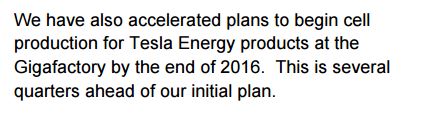
Powerwall diversifies Tesla so neatly and de-risks Gigafactory.
I expect powerwalls to sell like hot cakes. A survey by Energy Consumers Australia, a gov advisory body, established that 90% of households are looking into renewables with storage.�
Dec 4, 2015
Gerardf Not correct, next to the GigaFactory investment several M3 investments are already publicly known. Examples :
- Tesla has already done much of the R&D for the M3.
- Tesla already has a new paintshop installed that is capable of 500k / year.
You will find several sources of this :
Dürr receives largest robot order from Tesla | Spray Finishing News
The car body paint shop has two sealing, two primer and two top coat lines. It is designed to paint as many as 500,000 bodies per year. The plastic parts paint shop delivers the necessary amount of bumpers to meet body production demands. Primer and base coat are waterborne in both paint shop areas, car body and plastic parts. The clear coat is a 2k solvent based paint. The paint shop, which Tesla ordered in 2014, will be ready by end of 2015.�
Dec 4, 2015
tftf Yes, there were some investments since late 2014, but the huge investments will only follow when the M3 gets closer to a release date. (The S and X serve as good templates, see the spikes in the quarters before the models were released).
Same for the GF. As I mentioned before neither Tesla nor Panasonic invested a lot so far compared to the "full" $5 billion planned for the Gigafactory project:
Tesla invested around $261 million for construction until October 2015 and Panasonic invested just a few million so far. Even if we add some machinery to be later relocated to the GF that's certainly less than 10% of the planned total. From Tesla's latest 10-Q:
Looking at Tesla's balance sheet there is a huge cap-ex need for both the M3 and the rest of GF project in 2016-2020 imho (of course most people on this forum will disagree and say that Tesla can somehow pay for this with operational cash-flow beginning in 2016. I strongly disagree).
To repeat for those who didn't follow the thread earlier. The entire $2 billion Tesla raised in early 2014 is already gone:
�
Dec 4, 2015
Twoshedds Interesting that on the 3Q conference call the CFO said "Clearly, 2016, our CapEx should be less than 2015. And then we'll provide you further guidance on that in the next earnings call."
Musk then chimed in with "Sorry, I was going to say, like, we do have like a very strong push towards free cash flow. I mean, that is � our aspiration is to be positive � I do emphasize, this is an aspiration, not a promise, but our aspiration is to be positive cash flow in Q1."�
Dec 4, 2015
dalalsid I don't think you understand the size of the pilot and that Tesla doesnt need the entire factory overnight. Panasonic production that is currently used by Tesla + the pilot will still be vastly more than what LG can supply/will have orders for in this decade. 20,000 Bolts/year = 1.2GWh/yr. 30,000 Bolts = 1.8GWh/yr. Tesla 2015 = 4.25GWh, Tesla 2016 = 6.5GWh/yr + Storage. In 2014 Tesla was at 2.9GWh (over double of the 20,000 Bolts that GM plans annually). At it's peak sales the Chevy Volt used less than 1GWh of batteries. So your complaints about the Gigafactory being just a pilot and the entire plant not being magically up instantly are unfounded. In 2016 that pilot factory will produce more battery packs than GM ever used in a year. By 2017 when the Bolt actually has any volume, that pilot factory will produce more batteries than GM will use in that year (or has ever used in year in history) and with no known EV plans other than the Bolt, and no other EVs expected in volume until at least 2018 that use LG batteries (more likely 2020), LG is unlikely to be able to or want to compete in volume with Panasonic + Tesla. And I would assume the same applies to price.�
Dec 4, 2015
Discoducky Is the above your full argument? If so, then I would mostly agree and say this
1. Yes, eventually certain battery chemistries may become a commodity. If production escalates to 3x what it is today in a few years, sure. Since these will be used for sustainable transportation then Tesla succeeds as this is only the beginning of the massive ramp for EV's
2. You've stated previously that you think Tesla has a lead and I would agree. And I think you believe that other companies will catch up quick. Maybe by 2020? Sure, lets say that happens. Again sustainable transportation succeeds and Tesla's mission is to accelerate that and thus Tesla succeeds.
3. Sure there is this risk and Tesla is pursuing this as well. Lets say another company develops a better tech and brings it to market. Great, again accelerating sustainable transportation.
I like when you number out your arguments/thoughts so we can better discuss in a forum.
I'll add my further thoughts
A. Tesla will need more money. Sales won't be enough and there will be a need to raise more cash next year and maybe 2017. I don't worry about this **IF** Model X wins MTCOTY (Motor Trend Car of The Year) and journalists have positive reviews.
B. Autonomous Driving is the future. TaaS (Tesla as a Service) is how I think of it...Totally agree with your here. Once you've driven by algorithm, just like driving EV, you can't go back. It is so much more pleasant when in traffic or a boring commute and I could instruct my car to go off and earn money by shuttling folks around while I'm at work. The company that establishes itself as a leader here will dominate the market.
C. I appreciate your participation in this forum.
D. Building a mid priced sedan is the best thing they can do **IF** Model X is a hit. If it isn't, there will be scrambling, make no mistake, as Tesla can't afford to make a car that doesn't sell like hotcakes.
E. Building up Tesla Energy is also the best thing they can do. In fact, in the future, they'll need to grow their variants. For instance: Buy a Model 3 and get a 2kWh Powerwall/Solar array/charger for cheap. Huge upside and downside here, but this is an all in bet for sustainable energy and transportation and this is the direction Tesla is pushing and winning.�
Dec 4, 2015
austinEV I would like to suggest again that we make a thread just for talking to Bears. I had suggested "bear cave" because its cute, but it could just be "discussions with the bears" or something. The conversation could be this exactly, TFTF or someone laying out their argument, Bulls attempting to refute it and a conversation happens. This is clearly off topic for the gigafactory, and its off topic everywhere it occurs. I would create it but without buy in from a Bear there is no point.
TFTF I suggest you create it, lay out your best case point by point, close to what you did, and we start from there. By making a special place for it, those who are so emotional as to lash out probably wouldn't go there so the conversation might be more civil just by selection bias.�
Dec 4, 2015
techmaven I don't doubt there are some pretty big capex spends related to Model 3 coming in 2016 and 2017. However, there are already some pretty big spends in 2015. As mentioned before, the paint shop upgrade fills out the capacity to 500,000, or basically through 2020, through the entire Model 3 expansion. The initial Model 3 launch capacity is probably about double current factory capacity which is about 100,000-125,000 run rate a year. They are already sizing for that expansion. For example, the acquisition of the tool and die company was not for Model S or X. It's purely for Model 3. The Lanthrop facility is only necessary in the context of Model 3. I think many people look at Tesla's 2014 and 2015 capex spending as what is necessary to run the company at a steady state for Model S and then the expansion for Model X. That is not accurate. Tesla is well in the spending cycle for Model 3 and has been for some time. Of course, Tesla is managing cash through the entire Model 3 build out including the Gigafactory.
The late ramp up of the Model X - and in this context, I'm talking about the 4-6 months late that corresponds to the capex spending, not the original estimate of late 2013 given back in early 2012 before the Model S production even commenced. That 4-6 months of delay made the cash situation a problem, and that is about the worst case scenario for Tesla these days. They had to raise cash that causes the stock to drop and the product isn't ready. For the company, it turned out to be quite easy... $700 million later and they are in a confident position for the Model X launch. The hit to the stock overall wasn't even the cash raise per se, but the tardiness pushing to December. If the 2nd row seat issue didn't raise its ugly head causing an additional 2 month delay, then there is likely no medium term stock price hit at all for the cash raise.
Looking at the Gigafactory... originally, the estimate was for up to $2 billion spent by Tesla, another $2 billion by partners, and $1 billion by tax breaks and the like. Original estimate was for $4 billion to $5 billion total. The Gigafactory is now about 36% larger. So the original pilot plant of about 20% got juggled around some, including removing a partially built structure. A speech given by a Storey County representative confirms the addition of a floor to the Gigafactory, hence the footprint of the phase 1 pilot plant changed. I think this also corresponds to the "slow down" of work that was reported that was really a lull in construction as the factory was reconfigured for the additional floor. That threw some people for a loop, especially bears. Now the pilot plant is 14% of the full plant, but is really just about the same size as the original plans for the pilot plant... 2 million square feet. So the original plant was to pilot plant would have been about 20-25% of $1.6 to $2 billion, or $320 million to $500 million. Lo and behold, Tesla spent $261 million so far in construction costs (not necessarily all costs), $158.6 million in 2015, estimate up to $300 million for all of 2015:
Construction costs
Prior to 2015: $102.4 million
Total spent so far: $261 million
total for 2015: $300 million
Total estimate by end of 2015: $402.4 million
Well, $402.4 million is right within the original ballpark of the pilot factory of $320 to 500 million.
Panasonic already committed about $800 million (from memory, have to look it back up) for plant expansion in their current fiscal year. Of course, we don't know how much of that they are spending on the Gigafactory pilot plant, but given the other named projects, most of this is earmarked for the Gigafactory. Further, they really can't do all that much on site until there is an inside to work within. If Panasonic has already ordered tons and tons of equipment, is there any way for us to tell? Without sources within companies that provide such equipment or within Panasonic, we don't know. They aren't all that open with their disclosures as is typical for many companies in Japan and many parts of Asia.
Therefore, if your investment thesis is partially based on the Gigafactory being late, or not happening, I strongly suggest you re-examine the available evidence. You have to disbelieve Panasonic's IR presentation where they say they are spending large amounts of money on the Gigafactory - they don't bother to highlight expenditures that are small in their IR. All the actual data points indicate that the Gigafactory is, if anything, early. The temporary CoA was granted and Tesla Energy product assembly is in the process of happening inside the Gigafactory pilot plant. Which means there is an inside.�
Dec 4, 2015
dc_h Great discussion. Nice to see financial details and real data.
Summary:
The 400MM spent by end of 2015 will enable production to start in Q1. Tesla is on track to spend about 300MM per year through 2020 to complete the 2bn project. Tesla Energy is projected to have 1bn in 2016 sales. At 15% they can invest 150mm back into the GF and only draw 170mm from reserves. They should be on track for 2-3bn in revenue in 2017, which should produce 300-450 in free cash flow. Assuming consistent investment levels, the GF will be cash flow positive in 2017 and will improve margins for Tesla Motors by reducing battery pack costs. Other investment requirements (Model 3, etc are off track and require their own thread).
A new thread around cash flow requirements through 2020 could be very interesting.�
Dec 6, 2015
mspohr Fairly thorough review of status of Gigafactory from the perspective of economic impact on Nevada in the Reno Gazette:
Tesla Gigafactory one year later: Economic boost but lagging transparency
They do complain about lack of transparency but then they have personal experience with this as their reporters were involved in an altercation attempting to force access to the site.
Some interesting numbers on spending and economic impact.�
Dec 6, 2015
ItsNotAboutTheMoney One small addendum to that, is that it wasn't all for the GF, because at the very least some of the $2B paid off the US government loan.�
Dec 6, 2015
Foghat
If you are just coming to this thread, let me remind you: tesla energy is bringing in $1bln in revenue in 2016 and $2-3bln in 2017... And that has nothing to do with mx/ms sales or the start of m3 sales at the end of 2017/beginning of 2018.�
Dec 6, 2015
AudubonB There is an article in today's (Sun Dec 6) Reno Gazette-Journal (remember, they have a bit of a...situation...with Tesla) that raps the knuckles, not too terribly hard, both of Tesla and of certain state officials, for not being on time with statutory reporting of progress.
The terms of the tax abatement agreements provided to the Gigafactory include regular updates as to what has been accomplished; how many local employees there are; what services the county has incurred as a result of the factory and how much they have cost....basically, a whole lot of paper traces that need be kept up and that apparently a number of entities haven't been doing. It absolutely looks as though nothing even close to nefarious has occurred but it does seem to me that if someone wanted to slam Tesla, the failure of some i-dotting and t-crossing could provide a little bit of ammo.
Link here: Tesla Gigafactory one year later: Economic boost but lagging transparency�
Dec 6, 2015
Krugerrand Tesla asked for an extension, they were given one, report expected to be received any day now (a bit over 2 months from original deadline) - according to the article. Tesla Time, whatever.�
Dec 6, 2015
ggr I believe the loan was paid off out of the first fundraising round, not the one that financed the Gigafactory.�
Dec 6, 2015
AudubonB I found that prior link by digging around, as a result of a text a non-Tesloid made to me that went as follows:
"Why is Tesla downsizing giga plant so much in Sparks??? Heard an interview with the state of Nevada squawking about building a plant only 1/4 the size of what was originally proposed...State officials screaming about removing a subsidy because of it...Mayor of Sparks saying he was highly discouraged..."
Now, I can only imagine the radio station he was listening to in order to have picked up that. So I apprised him of the planned size increase; found all I could about the Mayor (only public statement in a few months is that he announced he has Parkinson's); and went hunting for what someone could have used to write that officials were screaming.
Whack-a-mole can get tiring....�
Dec 6, 2015
tftf Again, Tesla wanted to make believe (or maybe they believed it themselves back then) the public/investors that this $2 billion round would finance the Gigafactory. It didn't.
The latest 10-Q states that only $261 million have been invested so far and the RGJ article linked above even uses a lower number: $238 million.
In any case, that's a fraction of the full investment needed until 2020 while the full $2 billion raised are already spent (obviously mostly on other purposes).
PS: This article makes a good analogy with the nascent solar market. Being the "biggest" player early on doesn't garantuee success, far from it because of technology gaps in the future:
Could Falling Costs Be a Bad Omen for Tesla Motors' Gigafactory? -- The Motley Fool
Remember when Q-Cells was the biggest solar manufacturer in the world and poised to dominate the panel industry for decades thanks to economies of scale and advanced tech compared to Asian competitors? That was just a few short years ago...
Margins for all kinds of batteries have been equally razor-thin for years. Just because a new sector has exploding revenue (see solar panels, flat-screen TVs, flash chips and computer chips as recent examples...) doesn't mean op margins are good or early leaders won't be toppled by fast followers with deeper pockets.�
Dec 6, 2015
chickensevil If that was all they were doing, selling the batteries, then sure, I would be worried. But they aren't. They are sticking the batteries into a product and selling that product.
Solar panels is a commodity, batteries also a commodity, I suppose one could say that TVs are a commodity, at the very lease the screen itself which was the biggest cost factor and what had a major price collapse.
Now if you wanted to say that the price of new cars was collapsing, then maybe there would be concern. But it isn't. As long as Tesla is able to get a bottom dollar price on their cells such that it brings down the overall cost of building the car then it doesn't matter. The only concern of a collapsed price would be that they are forced to sell either with slightly less margins on the car or stick these cells in a higher cost vehicle.
Consider that LG comes out tomorrow with a 50$ cell cost. Don't you think that Tesla would be the first person they would come to and ask for their business? Tesla never wanted to build a factory but just like other things they have vertically integrated... They are doing this because noone else would.
If LG sold a 50$ cell they would buy it in an instant and make longer range cars and have the Model 3 much sooner (and at better margins).
Consider that their GM on the Model S is around 25% with a cell cost of ~175-200$ if their gigafactory becomes "obsolete at 100$ they will just stick all those cells in the Model S, buy the cheaper cells for the Model 3 and still improve the margins on their Model S in the process.
Note that the gigafactory at capacity is to supply 500k cars a year, if they want to get to millions they will need 3 more of these plants. So if LG came out tomorrow or even in the next 5 years with a 50$ cost they would just pay LG for all their cells and this magical factory that sprouted up from nowhere and happily avoid building more of their own plants.�
Dec 6, 2015
Foghat
Major point of distinction necessary here:
solar panels and batteries are not commodities. Electricity is.
solar panels and batteries are technologies that create and store electricity.
technology by definition must iterate and improve its function in order to retain value.
Tesla is a technology company. The Gigafactory produced technology.
The cell/pack technology iterates and improves its function over time. As these improvements occur, more car packs will be able to be produced given the same production space. Ie, the Gigafactory will produce much more then 500k cars worth of batteries.
Margins will increase over time as well.
Same for energy storage margins.�
Dec 6, 2015
tftf Well, first Tesla and Panasonic have to invest the missing $4.7 billion to get to such production levels.
And why should margins for EV and storage cells/batteries automatically improve over time? You seem to state this as a fact.
If or as EVs and ESS/local storage become more mainstream over the coming decades, the opposite could happen. Operating margins could get squeezed even further with growing volumes. As with the solar panel, NAND flash, TV screen examples...margins remain ultra-low today even though revenue opportunities exploded.�
Dec 6, 2015
MitchJi
No it's a foolish analogy. Solar cells were priced so high that there was almost no demand. Packs manufactured at the GF are going to cost less than disruptive prices, both for cars and for storage.
�
Dec 7, 2015
Cyberax It's a very small risk. Historically, Li-Ion battery advances required little to no changes in battery factories. That's because most of the changes are just tweaks in the chemistry of one of the elements.
Moreover, battery factories are not a huge conveyor-style facilities that require all the stages to be functioning at all times. Rather they consist of multiple parallel assembly lines that can be tweaked or upgraded independently.�
Dec 7, 2015
tftf The irony exactly is that these (now defunct or merged at firesale prices) players like Q-Cells, Suntech or LDK kept driving down prices. You are proving my / the article's point:
�
Dec 7, 2015
WarpedOne I would still LOVE to see LG's plans of their 35GWh factory in 2020.
tftf, where did you see them?�
Dec 7, 2015
dalalsid Tesla plans to use 35GWh for three models - S/X/3. If LG makes 35GWh, they should be able to supply 3 models. Maybe 1 car manufacturer that is serious or 3 that are not serious. If LG wants to do what tftf thinks it will do, it needs 350GWh, not 35GWh. It will take an order of magnitude more capacity than LG, Samsung, BYD, AESC and the rest of the world are planning combined by 2020 for the 20 or so models that tftf thinks will compete with Tesla. In short there is almost certainly no way any car manufacturer is competing with Tesla unless they exclusively tie up a battery manufacturer for the foreseeable future. If LG starts supplying anyone except GM, there goes any hope of GM outdoing Tesla. So all the noises that LG is making about supplying EV powertrains is bad for GM. If Samsung supplies anyone except BMW, then that's bad for BMW.�
Dec 7, 2015
MitchJi
No, you are probably too biased to understand my point It's not an accurate analogy.�
Dec 7, 2015
TheTalkingMule If if's and but's were candies and nuts we'd all have a Merry Christmas!
You can't compare A GE 2021 projection to what Tesla is doing tomorrow afternoon and call it apples to apples. That article takes a "new technology" soundbite and extrapolates out the savings from there. As Elon would say........"Great, show it to me."�
Dec 7, 2015
Fallenone The biggest point of building gigafactory is to bring down battery cost. And now this article claims falling cost of battery could be a bad omen for Tesla?
When I first started investing, I read a lot of articles all over the internet. Not before long I found many of the sources are pure rubbish. Motley Fool was among the first of these sources.
�
Dec 8, 2015
jhm Let's be specific falling battery costs are a really bad omen for oil and gas producers and traditional car makers long before it is a bad omen for Tesla.
The only thing keeping natural gas in electricity production is that there is not yet enough energy storage to integrate substantially more wind and solar and to make gas peakers obsolete. The only thing keeping oil demand up is a lack of electric vehicles. Both of these depend on battery production not scaling up and not cutting costs. As batteries become cheaper and more available, they will steadily erode longterm demand for both oil and natural gas.
Considering how vast the oil and gas industry is there is pretty much endless market potential for competitive battery makers. Only after the oil and gas industry has been thoroughly gutted do we need to worry about limits to addressable battery market.
To put this into perspective, OPEC has failed in internal negotiation to lower its production cap. They have been fighting about a difference of just 1 mb/d (million barrels per day). This quantity meets demand of about 25 million conventional autos. How many batteries would it take to put 25 million EVs on the road? At 40 to 60 kWh per EV, we need 1000 to 1500 GWh of batteries, just to offset demand for 1 mb/d of oil production. We are not anywhere near this scale in cumulative battery production. Hopefully, by 2030 well exceed this level in annual production, 1500 GWh batteries and 25 million EVs. Once we hit this level, demand for oil will fall over 1% each year, and everyone will agree that oil has no future.
But that day is not today. Today most investors believe oil has a long, prosperous future. Today investors are not sure if batteries and EVs will ever scale up enough to make a dint in oil demand. Today oil investors are not the least bit worried that falling battery prices will doom oil and gas. So today I am not going to worry that falling battery costs will someday doom Tesla.
Oh, yes, and when those oil investors come to see that one Gigafactory will over its lifetime of production offset demand of 1 mb/d or more. They will be happy to invest in such a virtual oil field that only costs $5B to develop.�
Dec 8, 2015
chickensevil Thank you as this was another way of saying what I was implying with my comments about LG as it relates to Tesla buying their supply. Regardless of how you cut this pie noone is planning to produce near enough batteries that it matters to Tesla... yet.
Consider that not all car makers have the same margins on their vehicles, yet we somehow still manage to have some 20 odd major car companies in existence (removing out all subsidiaries and such and just referring to the parent company itself). If the car market was as sensitive to margins such as that, then Porsche (as sub of VW) would have been the leader forever as they have the industry leading margins on their products... yet they aren't... The companies with some of the smallest margins (GM and Toyota) are making the most cars. So it is strange that someone making a cheaper component of a just part of a car would doom the entire product from being profitable... and at that, they aren't even able to make a very large volume of this hypothetically cheaper product...�
Dec 16, 2015
hobbes Musk: Tesla Gigafactory will produce cells with battery technology improvement over current products | Electrek�
Dec 16, 2015
Quant That is interesting on its own....however, as Musk has noted, the primary rationale and competitive differentiator for the Gigafactory will be economies of scale.
So, if battery tech improvement for TSLA is 7 % a year, and economies of scale give them at least 10 % better per unit of cost efficiency, then we are looking at well over 50 percent reduction in cost per KWH within 3 years, or by year end 2019. That's like a bare minimum.
And, I very much doubt anyone else will have similar scale economies and battery cost efficiency by 2019.
I think very few people truly comprehend what is coming in a few years ! People are lulled by the current crop of TSLA models at over $85 K.
2018 should be a seminal year for TSLA.�
Dec 17, 2015
jhm LG Chem Makes Big Move In U.S. Energy Storage Market | OilPrice.com
1 GWh deal for LG Chem to supply cells to AES. AES seems only interested in utility scale systems as a "complete alternative to peaking power plants."�
Dec 17, 2015
doctoxics Impressive compared to what has been done so far. The 1 GWh is to be delivered by 2020. The scale of this single sale can be compared to the 15 GWh per year of energy storage batteries the Tesla Gigafactory will be producing by 2020.�
Dec 17, 2015
jhm Yeah, Tesla is at a totally different scale. But what I see here is competition starting to ramp up. I find this very encouraging. The world needs at least a TWh of annual capacity.�
Dec 18, 2015
MitchJi The market still has not figured out the prospects for Tesla Energy.�
Dec 18, 2015
doctoxics At $250/kwh and annual production of 15 gigawatthours (15,000,000 kwh) of powerpacks (not considering powerwall or recent increases in the Gigafactory size in this analysis), Tesla's annual sales in 2020 would be 3.75 billion dollars. How do LG Chem and AES get to sales of hundreds of billions of dollars? They would need multiple Gigafactories. Perhaps a typo that should read hundreds of millions of dollars.�
Dec 20, 2015
Gerardf Initially I assumed that to.
Or maybe they mean 100's of BILLIONS of KRW, not US$. Each 100 Billion KRW is around 85M US$.
Still a nice deal and very promising for the energy storage market.
I see no Press release on their Press page : LG Chem Press Release | Press Release | Public Relations Center - Solution Partner LG Chem
A deal potentially worth 100 of Billions US$ would sure have to be mentioned.�
Dec 20, 2015
doctoxics We agree that there is a mistake of about 3 orders of magnitude. The article said dollars not South Korean won. So the error seems likely to be in the number units (should be millions and not billions), but possibly the error could be in the name of the currency (in that case, should be won and not dollars).�
Dec 21, 2015
AudubonB Our little position in Western Lithium (WLCDF) is up 46 percent over the past week. Better than a kick in the pants, which fairly describes its performance in the rest of the calendar year. Some of you don't like the company for its other product mix; that's understandable.
They did recently announce a hook-up with POSCO, Korea's largest steel producer, to help develop a prospect in northwestern Argentina; also, there is a conference call beginning at 11am EST....about one minute from now.....�

Không có nhận xét nào:
Đăng nhận xét