Jun 8, 2016
schonelucht It's not that far fetched. Panasonic essentially said the same thing during their recent investor day (question 4).�
Jun 8, 2016
JohnSnowNW They said they are "striving" to make prismatic competitive with cylindrical. I'm not really seeing an admission that they will reach cost competitive soon, or at any point.�
Jun 8, 2016
electracity Prismatic batteries are popular because they put more of the safety burden on the cell manufacturer. Tesla pack design is obviously safe. Pouch cells can perhaps beat cylinders on price, but probably at a higher C rate. Tesla probably isn't structured to compete with low end EV. The model 2 will probably be like the honda civic, which is considerably nicer than economy Chinese cars.
Tesla's advantage this decade is being the only high volume PACK manufacturer, with the possible exception of the Chinese. The cost and performance of the pack are the critical metrics. With the gigafactory in production, Tesla will likely be producing the highest value packs in the auto industry for a number of years. Everyone one else is likely a couple years behind in knowledge, and perhaps even further back when willingness to execute large volume EV is considered.�
Jun 8, 2016
JRP3 I've always assumed it will happen at some point. Assuming an energy dense chemistry that doesn't benefit from the advantages a small cylinder provides, i.e. temperature control, failure propagation, and structural layer containment. Basically a safer high C rate chemistry, such as LiFePO4 but with better energy density.�
Jun 9, 2016
dalalsid Model 3 will ship in volume before any other competitor (real competitor - not pretenders with gas backups, hybrids, lack of fast charging capability - not talking supercharging network but just the ability to charge at >100kW) ships in volume. And lets get specific about volume. Volume = >100k/yr global deliveries. As for competition before 2022, your tales are from a different simulation than ours.�
Jun 11, 2016
neroden FWIW, for my investment-grade projections, I just *assume* that there will be two major Chinese competitors who catch up to Tesla, and I don't know which ones.
It doesn't seem to matter. If we assume 2 Chinese companies, Nissan, GM, and Tesla -- and we assume they're competing only in the upper half of the automotive market (assuming some technical snag prevents EV prices from dropping to make the lower half profitable) -- that gives Tesla 1/10 of the automotive market. Seems big enough to make a lot of money, eh? �
�
Jun 11, 2016
techmaven There were some that said this years ago, and they also gave price and specific energy estimates that were wrong. Some of this is based on the hope that high voltage NMC would work, but it didn't. So any estimate based on high voltage NMC working has to be thrown out unless they manage solve the technical hurdles of massive voltage fade.
Now even Battery University says that cylindrical is cheaper:
A Look at Cell Formats and how to Build a good Battery � Battery University
Obviously, this can change with improvements in battery chemistry. But as we all know, or should know, battery chemistry changes that make it into products is a slow process. The significant changes coming in the near term involve increasing the amount of silicon in the anode and that likely isn't going to alter this equation.
Form factor is relatively immaterial anyways.�
Jun 23, 2016
Rarity Seems boring in comparison to the recent SolarCity fireworks, but...
I have been tracking gigafactory employment for a few months on LinkedIn. The past two months have shown some increases in headcount. May had a 17% increase, but the hiring slowed in June -- only a 7% increase. Currently employing at least 130. Compare to employment totals as of March 31, 2016 provided to the State of Nevada of 317.
Panasonic started hiring in June -- a 16% increase. May saw no increase. Panasonic has 29+ employees in the area (not all of whom work at the gigafactory). Compare to employment totals as of March 31, 2016 provided to the State of Nevada of 52.
�
Jun 23, 2016
NicoV Tesla will add new section (5th) to the Gigafactory by December, Battery cell manufacturing equipment by July 20th Cell production equipment installed before the grand opening?�
Jun 24, 2016
techmaven This is really big news. Not the cell production equipment installed before grand opening, I doubt anything is truly operational by that time. It seems November is a more realistic timeframe.
However, gives us a sense of timing for the next section. If they complete that section this year, and it takes 9 months or so for that section to start producing cells, we're looking exceeding the original 35 GWh of cell production estimate in 2018 - basically moving up the timetable by 2 years.
Key aspects to look at include the amount of Panasonic investment ahead of that section's completion. We want to see more than $400 million invested by Panasonic in the pilot phase. Plus, obviously, at some point Panasonic has to communicate to its shareholders the next year's capex. That will be very interesting.�
Jun 24, 2016
dakh That could also mean cell production can start but the line that goes from raw materials to ready to install car modules and powerpacks won't be ready for some time.�
Jun 24, 2016
techmaven I suspect that after installation, there is quite some time before everything works properly together. So installation could technically be finished in July, but real cell production might not be viable until much later.�
Jun 24, 2016
tftf Much later? In a mere six months (around November 2016) from now, the $5billion Gigafactory will spit out high-quality Panasonic cells faster than a machine gun (Elon's quote):
Panasonic to jump-start US battery cell output for Tesla- Nikkei Asian Review
There's a additional investments of $63 million for this new section, so we are likely already at close to $5.1 billion (since media reports talked about $billion in the past) in total cap-ex:
Tesla will add new section (5th) to the Gigafactory by December, Battery cell manufacturing equipment by July 20th
Soon Tesla can replicate this Gigafactory (one each in Europe and Asia) to widen the lead compared to legacy car makers.�
Jun 25, 2016
techmaven Yup! Behold... the Gigafactory pilot phase, which Tesla has pretty much done with its capex investment, will exceed the combined output of LG Chem, Samsung SDI, and SKI. Best thing is that Tesla will have spent more like $500 million in order to do that.
BTW, compare the $63 million against the earlier building permits... you'll note that the permits are not for everything in a section. It is bigger than sum of the permits for the shell of the pilot phase.�
Jun 29, 2016
geturchiru One question I have regarding evaluating a factory value from experts. Is it per annum output value of its product or per annum operation cost or the build cost or something else?
For the first two which are almost same minus profit, I dont see a problem matching the cap ex spend vs the progress because the raw materials cost is not yet included in spending!!�
Jun 29, 2016
tftf So a little more than $500 million built the largest battery factory in the world. Amazing. Guess Tesla and Panasonic overshot cap-ex estimates by 90% then!�
Jun 29, 2016
neroden When people call it a "$5 billion factory" they're usually referring to build cost.�
Jun 30, 2016
gigglehertz Don't bother trying to explain anything to him. "Where will they get the $5 billion?" has been his shtick for years and he isn't going to change.�
Jul 24, 2016
hobbes Taking this over here form the short term thread where @doggusfluffy posted this article:
http://www.nytimes.com/2016/07/25/business/despite-roadblocks-for-tesla-elon-musk-is-moving-full-speed-ahead.html?_r=1
This picture shows several new pads where they are preparing the foundation works:
This is also described in the article:
Good news, things are moving ahead�
![[?IMG]](https://static01.nyt.com/images/2016/07/23/business/00musk6/00musk6-superJumbo.jpg)
Jul 24, 2016
Cobbler A possible idea: how will the raw material get from a nearby Lithium-mine to the Gigafactory?
A well made road with visible centerline so that Autopilot can steer the Tesla semi's/drones to their destination. Everything automated with almost zero human interaction.
Just think about it�
Jul 25, 2016
hobbes How near is the closest lithium mine Tesla has talked to? Would be pretty cool to demonstrate the self-driving Tesla trucks on private land (no problems with authorities). Another way might be a pipeline for the brine and putting the actual lithium production right next to GF. - But if I remember correctly lithium is only a small perentage of the actual batteries, but both ways might apply to other ingredients, too.�
Jul 25, 2016
hobbes Another one form the Short-Term-Thread, thanks to @3Victoria:
Tesla Races to Finish �Gigafactory� in Time for Model 3 Rollout
�
Jul 25, 2016
TMSE How about rail cars?�
Jul 25, 2016
Electrifying Sam Jaffe, a principal with Cairn Energy Research Advisors, said Tesla should be able to scale up quickly, but getting the needed cost reductions may lag.
�What they won�t be able to do from a battery manufacturing perspective is make the cells as cheaply as they hoped. A lot of the price reductions from the gigafactory model come from the supply chain re-creation that they will be doing in North America. That won�t be ready by 2018.�?
Who is this Sam Jaffe and on what ground is he making such a claim?�
Jul 25, 2016
techmaven This is like the Reuter's article that claimed to be talking about Tesla's suppliers, but was actually including quotes from all sorts of Detroit based "experts" that have no clue what is going on a Tesla.�
Jul 26, 2016
Model 3 I do not know who he is and on what ground he is making this claims, but what he say - that you have highlighted in this quote - is totally in-line with what Telsa/Elon/J.B. have been saying all along: The full predicted price reduction they expect is based on a fully build out GF at full production. That was expected to happen in 2020. But they also expect some reduction from day one. The question is just how much is the difference? Does it qualify as "a lot"?
What I do not believe is correct in the quote is that they will not "make the cells as cheaply as they hoped". I do think they have very realistic view on what to expect - or hope for - from day one, and what to not expect until all parts of the GF is in full production.�
Jul 26, 2016
Johan ![[?IMG]](https://lh3.googleusercontent.com/blogger_img_proxy/AEn0k_u5bXT_JtveKK88EoMtcg7GcC4FEoTvTme25VwvhJd9DPVe3rfIvVGCtY7656Nuk8oKUzLgxL7i19hnIM256zs8lUGCsej_1EfwEXhmpmR9hMpqCOMLIpT4c9SgIHOuw8TYVStHBeANFk8i=s0-d)
Cairn Energy Research Advisors (Cairn ERA) is a global research and consulting firm specializing in energy storage. Cairn ERA provides strategic insight and data to enable clients to thrive in the dynamic international energy marketplace. The firm is based in Boulder, Colorado, and works with clients in Asia, Europe, the Middle East and North America. Sam Jaffe, Managing Director of Cairn ERA, is an internationally-recognized expert on energy storage and has provided expertise to the world�s largest energy and utility firms and frequently speaks at international conferences. He has been quoted in the Wall Street Journal, New York Times and a variety of business publications and online news outlets.
Sam is the founder and Managing Director of Cairn Energy Research Advisors. He has more than ten years of experience as an analyst, consultant and executive in the energy storage industry. Prior to Cairn ERA, he has worked at Navigant Research and IDC as an analyst and has also served as CEO at Panea Energy and Cygnus Energy Storage. He is an authority on battery usage on the grid, transportation and consumer electronics. He is an accomplished public speaker and a frequent keynote speaker at conferences and events throughout the world, including the Battery Show, Interbattery Korea, Stockage D�Energie and the Energy Storage Association annual meeting. He is frequently quoted in multiple press outlets, including the New York Times, The Wall Street Journal and CNBC. He lives and works in Boulder, CO.
As to the grounds... well... highly unclear.�
Jul 26, 2016
techmaven Well, Navigant has been pretty far off the mark when it comes to predicting Tesla's cost curve.
Tesla's comments thus far indicate that they believe the pilot phase is all that is necessary to drop the price for Model 3 introduction. At under $190/kWh all in price now from Osaka, dropping the price towards $150/kWh seems to be what they are aiming. However, there are additional costs to be saved and they have said that they expect pricing to drop to $100/kWh (cell or pack, unclear). The raw materials is even cheaper now.�
Jul 26, 2016
RubberToe Electrec is live blogging their tour of the Gigafactory. Tesla would not let them live stream it. Should be intreseting to see if they are allowed to shoot video or take pictures and publish them. There has got to be some stuff in there that could move the stock price, hopefully up.
Tesla Gigafactory tour, remarks by Elon Musk and JB Straubel, and more [Live Updates]
RT�
Jul 26, 2016
hobbes Boooring! But probably more efficienct I guess.�
Jul 26, 2016
hockeythug The journalists seem taken aback by the scale of the thing after seeing it in person.�
Jul 28, 2016
electracity There's no evidence that the vertical integration in cell manufacturing is happening at the gigafactory.�
Jul 28, 2016
Oil4AsphaultOnly Tesla Gigafactory tour roundup and tidbits: �This is the coolest factory in the world�
Scroll down to Panasonic's 2-story machine that made star-bellied sneetches. There might not be any cobalt/nickel/lithium arriving by the truckloads yet, but something has to feed that sneetch machine.�
Jul 28, 2016
generalenthu Its after hours and I am in the mood to recount an interesting realization. This is probably not the right thread, but whatever.
From time to time, I like to read up on the short BS on seeking alpha to keep myself entertained more than anything else. so I was reading this article by one Mr. Santos and believe it or not, I found an unlikely bullish argument. He was saying
Randy Carlson is an engineer at heart and a huge TSLA bull. And he made some bold predictions in the article that Mr. Santos refers above. If you have an engineering bent of mind, I'd highly recommend pouring a glass of red wine and reading through that article. It is a very interesting thesis he puts together, based just on the fact that the battery pack of model 3 is much larger than expected, given the energy needs. Specifically, he makes a few bold predictions.
Now I am not a battery expert by any stretch and this all sounded somewhat far fetched to me and I didn't give it much credence. Also this article was more than a month old (6/20).
- The battery is air cooled instead of liquid cooled, which is a great way to drop battery costs
- The battery pack is probably the same thickness as a Model S despite longer cells (70 MM vs 65 MM in S/X)
- Most importantly, Li-ion cells once manufactured need to be 'aged' by very slowly charging & discharging them over a few days, using expensive equipment, which requires these cells to be stored at a production location. This is why cell manufacturing needs a large foot print and expensive. Randy's contention was this was short circuited by TSLA by building the packs first from cells and then 'aging' them in the battery packs
This morning I was skimming through electrek.co and i was startled when i was reading this article. Specifically the article calls out a few things
This is only possible if the connectors are between cells rather than on top of cells, strongly hinting that the battery is air-cooled and not liquid cooled and validates Carlson's first hypothesis
This was again a Carlson prediction, that it was infact the packs being 'aged' as opposed to the cells. This closed the loop for me on why the pack costs could approach $100 / Kwh with the industry at more than twice the cost with prismatic cells.
Now here is the best part. In a different article Carlson runs the math and arrives at a 44 KWH capacity for the base Model S. This seems reasonable given that an S60, a larger, heavier, and a higher Cd car can achieve 210 miles. So long run, the battery costs for the 3 would be 5-6K for the average 40K model 3 car. This leaves a lot of room for TSLA to very comfortably make 25% GM on the car in the not too far future. If anything, I'd guess that in 2020, unless TSLA drops the prices, the GM could even approach 30%.
Really unbelieveable what Elon and JB accomplished with the gigafactory. Godspeed Tesla and TSLA!!
PS: if you know of any other thread where this would be more relevant, please drop a note. I will crosspost / link there.
PPS: Thought I was posting in the short term thread, but am going to leave it here anyways.�
Jul 28, 2016
eloder Hum, air-cooled batteries just makes no sense parring some invention that's borderline magical with this battery chemistry. Nissan uses such a system in the Leaf to cut corners on cost, and the battery degradation is absolutely awful in everywhere but the most mild of summer climates. Cold-weather performance is similarly awful in the Leaf compared to other cars (the electric smart car, despite having far worse aerodynamics and a smaller battery, actually ends up getting a bigger range than the Leaf because of the battery temperature management system as long as driving speed isn't too fast).
Supercharging with air cooling, especially if faster speeds are pushed, also doesn't seem plausible in hot summer climates.
What sort of invention could even allow lithium ion to evade the laws of chemistry by using air cooling? Is there some sort of additional info or an article that goes over the theoretical science behind how this change would work? How does "aging" a battery even improve a battery? If someone smarter than me can provide the insight, I'd love to get an idea of what's going on here.
(I figured that Model 3 margins could hit 25%, without any new fancy battery tech/improvements, simply because the car design looks far more simple than any other on the market and Elon uses exponentially more robots than any other carmaker out there. A car that needs almost no humans to produce and can conduct much of its own QA--even with a $10k battery pack, they have a ton of room to play with a cheap body on top. When I read that aging in the comment, I figured it was part of ensuring the new battery tech would realistically last in the real world.)�
Jul 28, 2016
mblakele I was curious about this too. Might be off-topic for an investor thread, but... apparently lithium-ion degradation is mostly due to growth of something called the "solid-electrolyte interphase" (SEI) layer inside each cell, on the anode. The idea seems to be that if the factory ages the new cell just right, it'll develop an SEI layer that's fairly stable, at least relative to the kind of SEI layer that would form in the wild without any special process. Maybe think of it like verdegris on copper: technically it's corrosion, but it can stabilize and even protect the underlying metal a little � not like rust on iron, which is always bad news.
More:
- Prospects for reducing the processing cost of lithium ion batteries
- https://arxiv.org/pdf/1210.3672.pdf
�
Jul 28, 2016
eloder I appreciate the links. From my rough understanding of batteries, that does help somewhat--killing the battery a little bit, but that capacity loss lets them do something crazy like air-cooled batteries without worry of them becoming Leaf 2.0.
With this process, is it possible that Tesla can use a new battery chemistry that normally could not be considered due to poor cycle life? For example I remember hearing about too much silicon in the anode not working for automotive purposes because of silicon expansion/contraction leading to battery failure. Is it possible some sort of aging process would let them use far more silicon while keeping a battery stable for decades?�
Jul 29, 2016
Model 3 If you read Randy Carlson's article you will see that it is not air-cooled battery packs he is talking about, but liquid cooled packs with air-cooled modules. Yes I know, it IS on SA, and I hate to go there and understand everybody that refuses to read anything there, but this article is worth it (even if it is on a lot of pages�
Jul 29, 2016
-=buzz=- You have to keep in mind, that for Tesla, there two factors to optimize pack cost.
First is the cell cost in $/KWh, second is the pack assembly cost which consist of a basic pack cost (enclosure,BMS,Cooling) and an assembly cost.
Even if they don't get lower cell cost per KWh at first, the new cell size, which needs 30% less cells to manage in inventory and assemble and the assumingly higher automated assembly process will still reduce the pack cost...�
Jul 29, 2016
schonelucht Panasonic is raising $3.9B to invest in the Gigafactory. Are total costs still projected to be $5B? Quite well done by Tesla then to have a minority stake in the investment yet capture the majority of the cost savings!�
Jul 29, 2016
electracity They would want to make one pack for all cars, if they could. The S/X may get the new pack later after other needed changes are made to those cars.
A standard pack would explain why the model 3 is as big as it is. One pack is also supported by Musk saying that they have no model 2 planned.
The ideal is simplification in battery sub components within the Tesla Motors and Tesla energy lines.
I think 50kwh would be a significant accomplishment in the M3.�
Jul 29, 2016
ItsNotAboutTheMoney But Tesla also plans to make pick-ups and the S and X need to offer something extra to encourage people to part with the extra money. At least for now, Tesla will want to continue to increase the S and X as cell technology allows.
Battery packs are modular, so they'd simply want a design that easily allows for different battery sizes and different numbers of modules within the batteries.�
Jul 29, 2016
electracity Tesla is unlikely to make a new platform for a pickup. Also, going after the F150 is probably not the wise place to focus. A midsize highly configurable work truck on the M3 platform is probably where they are aiming.
If the M3 is going to have ludicrous, the S/X won't be differentiated by battery from the lower price car. Like the 7 series, the differentiator is probably interior. Also if the M3 base battery is 50kwh, the feature of greater range can't be used as a feature on the S/X (except artificially). The M3 will be the long range car in the lineup.
I'm sure Tesla expects the price of the 90D to fall to where the 60D is today. We are five or so years away from EV to matching ICE in price.
So my prediction is that the Tesla technology roadmap is one car battery type.�
Jul 29, 2016
anticitizen13.7 This is an extraordinary bad idea, unless you want to build a trucklette that will be the butt of country music jokes.
A pickup truck based on Model 3 would be a disaster. How many Subaru Bajas or even Ford Rangers are there compared to midsized pickups?
You want to win? You go after the best.�
Jul 29, 2016
electracity Would that not be a good thing?
The F150 buyer will not be an EV buyer for many years. The world is not an F150 buyer either. The trick is figuring out the markets where Tesla would aim a truck-like EV.�
Jul 29, 2016
anticitizen13.7 Only if your goal is destroying your brand equity
The same could have been said about the Roadster and Model S/X.�
Jul 29, 2016
Fallenone I remember Panasonic said (or re-confirmed) they will invest up to ~$1.8B in the GF. Is part of this $3.9B going into that, or they are adding more on top of it?�
Jul 29, 2016
electracity
Most roadster and S/X owner are not driving to Trump rallies.�
Jul 29, 2016
AudubonB This discussion belongs elsewhere - as in the "Truck" thread - but I absolutely disagree with electracity and wholeheartedly, fervently agree with anticitizen 13.7 that Tesla would be in for a terrible, potentially company-threatening stumble were it to forego competing against the F-1/2/3/450 series trucks and introduce an "urban pickup" instead.
I think the Model X is as close to style iconoclasm as Tesla ever will (or even, "may") be able to get away with. Whatever the X is, it is not an SUV. If you're being charitable you can call it a CUV but, after nine months' exposure to it, I would call the X a people-carrier and that's about it. It is not worthy of having the letter "U" in its style name, in my opinion.�
Jul 29, 2016
electracity They want a vehicle they can manufacture on three continents. They want a vehicle they can manufacture in their first three to four plants. They want a vehicle not so big that it can't use gigafactory battery packs.
That isn't an F-150 direct competitor.
The El Camino Lives again!
![[?IMG]](https://lh3.googleusercontent.com/blogger_img_proxy/AEn0k_vTKmBDJj6TynoWjZiUDAQUkzKM6BvV4Syej5ZdFt5a5r0IjI8qgqbjHubIWL4HguOvxJmRBpkhfjwsA3g76aoypfivs5z7L4myvLk3U4lP7cTQXq7YlSmGvo7ankruQlbOs1Mi4WBbjPgF3Mi7kgjfTnUfJ5WC8saS=s0-d) �
�
Jul 29, 2016
Model 3 A few years ago Elon talked about building the Pickup factory in Texas.�
Jul 29, 2016
esk8mw Tesla is all about smashing EV stereotypes: small, short-range, slow, take forever to refuel, not sporty, can't tow, tiny/skinny tires, can't haul stuff, economy-level finishes, looks weird/futuristic, etc. The Roadster, S, X and 3 are basically the opposite of all those things in every way. Elon wants uncompromised vehicles that are better than ICE in every way possible.
I expect the truck to be the same way. You posted a great example of what an EV stereotype is above. I expect the Tesla truck to be the opposite. Massive towing/hauling capacity (meeting/exceeding competitors), air suspension allowing for aerodynamics/ease of loading and clearance, big wheels/tires, sizable bed, tech features including AP, a big (like 150 or 200 KW) battery and a very usable frunk.�
Jul 29, 2016
neroden It's not clear how much of the $3.9 billion is going to the Gigafactory. Part of it is, and they didn't mention any other use for the money. It certainly looks like most of it is going into the Gigafactory, so I think this is more than they were originally planning to put in.�
Jul 29, 2016
RubberToe Anyone have a link to the live stream of the Gigafactory party? Elon tweeted that it will be streamed.
RT�
Jul 29, 2016
larryep found this
�
Jul 29, 2016
gigglehertz Bjorn Nyland is live streaming:
His streaming service cuts out and switches to a new stream, so check out either his main channel:
Bj�rn Nyland
or his dedicated live channel:
Teslabjorn Live�
Jul 29, 2016
JRP3 My comments in red.
�
Jul 29, 2016
JRP3 The 3 is narrower and shorter than S/X, it can't fit those packs.�
Jul 29, 2016
tinm Finally. A link to the official Tesla upcoming live stream.
�
Jul 29, 2016
electracity I didn't say the S/X packs would be used in the model 3. I said the models S/X might be adapted to the new battery.
The measurements of the model S and the model 3 are suspiciously close. If Tesla found that the could reduce battery side impact protection on the model 3 by three inches, the cars could have the same width battery.
Similar power and size design, yet Tesla isn't going to make a standard battery pack?�
Jul 30, 2016
JRP3 That's a pretty significant difference which would expose the pack to greater side crash intrusion, and you are also ignoring the difference in length. I don't think having two physically different battery shells is that much of an issue, and the larger vehicles will always need greater pack volume to get enough range. At least up until the point volumetric energy density is much higher than today. If they can hit 400-500 miles of range and have pack space left over in the S/X then all vehicles would likely be able to share the same pack design.�
Jul 30, 2016
Yggdrasill The Model S/X could probably be able to fit the smaller Model 3 packs. You would probably just need an extra adaptor frame, to make the Model 3 pack slightly bigger. The high capacity Model 3 pack (probably 70-80 kWh) could be a low cost solution for the base Model S/X.�
Jul 30, 2016
eloder Quick question--did any of the tours go over the anode production of the cells? (If I missed it, a live stream or video link would be awesome!). If not, I'm wondering if they have some big secrets/advancements hiding there with silicon/chemistry/aging in the anode.�
Jul 30, 2016
electracity Is the model 3 battery pack shorter? The model 3 has less overhang and a smaller frunk and trunk. So the pack length may be close to the S/X.
I also think Model S II may be built on the model 3 platform.�
Jul 30, 2016
Oil4AsphaultOnly The model 3 is 80% the size of the model S, so it stands to reason that the surface area would be smaller. Whether that means being shorter, wider, or both is unknown. Since the cells themselves are 0.5cm taller (for a smaller capacity pack), then something else has to be smaller to compensate.
As for the model S II, I doubt it. What would differentiate the model 3 from the model S, if they're physically about the same size? Especially since the current model S/X platform will be around for the minibus.�
Jul 30, 2016
GSP Panasonic will also be making the new 21700 format cells in Japan. The original gigafactory plan was to make 35 GWh of cells per year, and import 15 GWh of cells year, to make 50 GWh total packs. It is likely the $3.9B includes all 50 GWh of cell production machinery.
GSP
PS. The plan is now to make about 3x as many cells, but I don't have the new numbers handy.�
Jul 30, 2016
doctoxics The Tesla truck will be way superior to the F150 (consider all of the advantages of an electric compared to a gas vehicle), that truck buyers will go electric if they can afford the Tesla pickup.�
Jul 30, 2016
JRP3 I guess we don't yet know the Model 3 wheelbase, so if it's within an inch or so of the S/X then I suppose they could fit the same length pack.�
Jul 30, 2016
JRP3 Do we know that for sure? I always assumed the cells from Japan would keep the 18650 format, at least for the next few years.�
Jul 30, 2016
3Victoria Tesla said they hoped the 21-70 to become a new standard size.�
Jul 30, 2016
Jeff N No, they didn't show us or talk about the anode production. I don't know why.�
Jul 30, 2016
3Victoria I would guess the process, chemistry, and equipment is proprietary. This distinguishes the cells from others by capacity, life-time, charging capability ...�
Jul 30, 2016
GSP No. I do not recall any announcements from Tesla or Panasonic about the format of the Made in Japan cells.
I have been assuming that Tesla would want to switch all of their packs to the 21700 format ASAP to reduce cost. However, I don't know how long "ASAP" will be, or if my assumption is correct.
Even if the change is years away, Panasonic would likely include it in their $3.9B announcement. It's more impressive that way.
GSP�
Jul 30, 2016
techmaven The primary parts they showed us last night was a single giant oven and deposition machine for baking the cathode, a few presses, and the aging room. We were in a room where they were going to have the milling machines to prepare the slurry, but it was mostly empty. Note that it is hard to have 2,000 people trample through a completed factory in a few hours - the slurry prep room would become a clean room soon enough for example, and then it would be hard to have people trample through it.
The presses were mostly covered in black plastic.
It felt like this was the last chance for Tesla to show off the innards to a large group of people, and clearly the Panasonic portions were more guarded.
It did not feel like the workers on the Tesla pack assembly side were truly working... and I suspect it had to be so, as again, 2,000 or so people wandering through would not be a good time to actually work at a normal pace.
As for Panasonic in Japan, I asked about conversion to 21-70, and some engineers said they are looking into it in a vague kind of way.�
Jul 30, 2016
JRP3 More proof this is not happening: Instagram video by Maye Musk � Jul 30, 2016 at 2:35am UTC
Those racks cannot hold a pack. Also from the tour:
Short-Term TSLA Price Movements - 2016�
Jul 30, 2016
omarsultan They showed a couple of the machines and talked to some degree about the process involved on the tour, but no a lot of details--posted some pics on the GF Party thread�
Jul 30, 2016
woof Indeed, it was clear they were not. I had the pleasure of being in the tour group with @evchels who was quite vexed that there was no actual pack production going on at all. Check her twitter feed.
I attempted to ask questions of the "experts" who clearly weren't, and they were often evasive. For example, in the section where they were supposedly filling battery pack trays for the pods that go into the PowerPack/PowerWall, one would expect to see rows and rows of cells from Japan ready to be installed. They were no where to be found. The "expert" couldn't/wouldn't tell me where the cells were. We asked "how many pods are produced per hour?" No answer.
Another question: "As you aren't producing the new cell size yet, what cells are you putting in now, and wouldn't they be the wrong size? " No answer. Near the exit were a few boxes of connectors and orange wiring harness assemblies. "Do you make those wiring harness here or elsewhere"? Answer: "Huh, I don't know. I don't think we build them here." Experts.
I did get them to admit the line was mostly hand assembly and would be soon replaced with automation. So I'm pretty convinced what we saw was nothing close to what the final line may eventually be.
That and our tour guide (admittedly a procurement engineer) kept holding up a 21-70 cell and calling it a battery. Really bugged me.�
Jul 30, 2016
techmaven The cells are in the black plastic boxes here: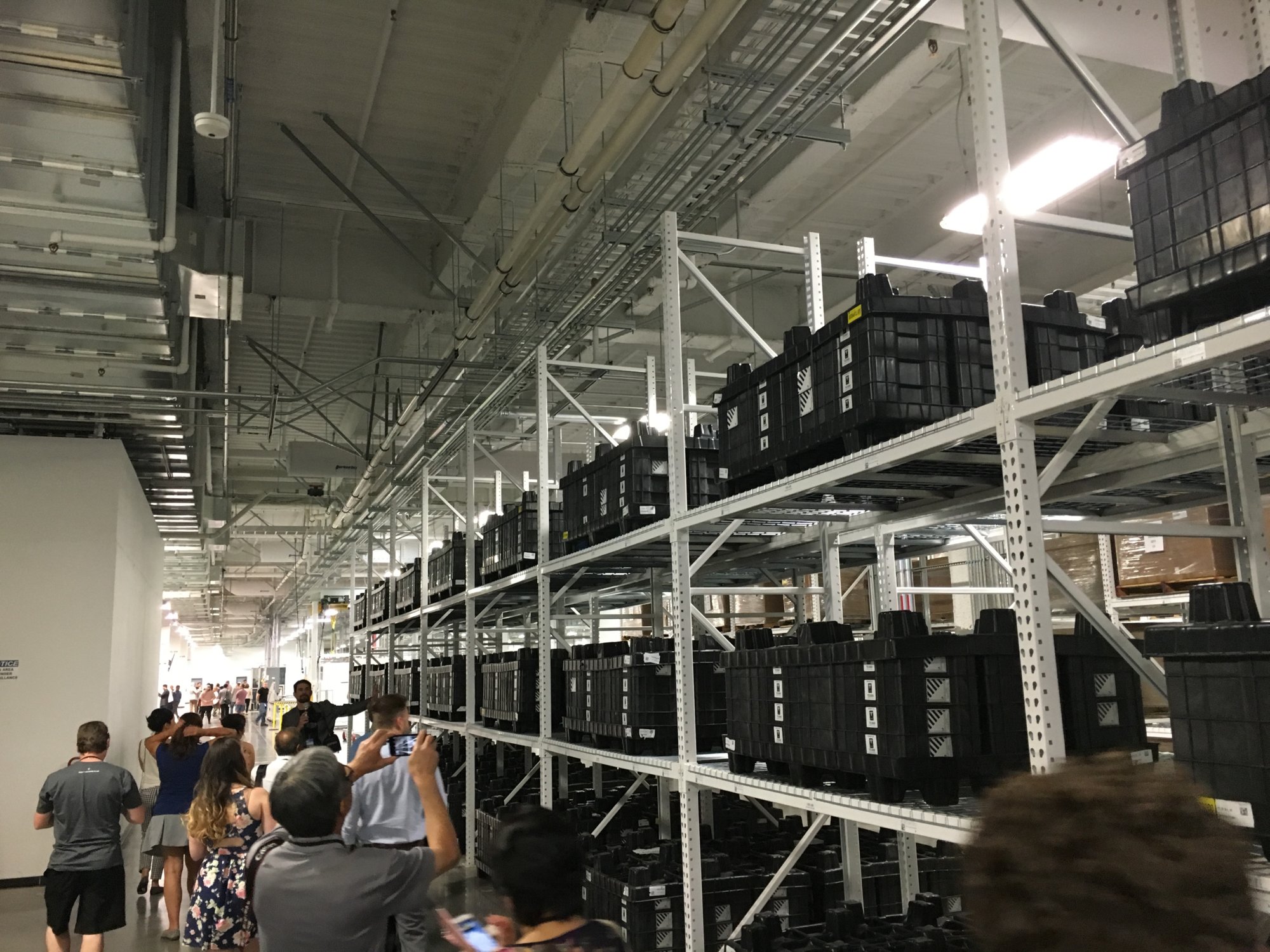
Clearly, the tour guides and many of the people we were allowed to interact with were lower tier staff. They may know their areas of expertise, but some were definitely a big cagey.
The battery modules being produced is using 18650's from Panasonic. As per various conversations I had with them, they will need to be redesigned for 21-70 cells at some point.
I suspect that the pack assembly being done right now is not the pack assembly to be done with Gigafactory cell output. The red robot I think is to be part of the new pack assembly, while the yellow ones are the ones currently assembling packs.
 �
�
Jul 30, 2016
electracity It is a bit odd that they did the Gigafactory grand opening before any of the new manufacturing has started. But the photos and info are still interesting.
It's interesting too that they have the footings poured to double the size of the current building.�
Jul 30, 2016
3Victoria As someone else stated, doing tours during operation may be very limited due to environmrntal and proprietary processes. This was the pnd chancd to let people go through most areas.�
Jul 30, 2016
dennis Just to clear a few things up - this info gathered from the press day articles and asking questions on the tour:
1) Only 21700 cells will be produced and assembled into modules at the Gigafactory
2) Cell production (in the Panasonic portion of the building) is expected to begin by the end of 2016
3) The first auto packs produced at the Gigafactory will be for Model 3 (sometime in 2017). This explains why Tesla made Chelsea unhappy.
4) For the foreseeable future S/X will continue to use 18650 cells and have their packs assembled in Fremont
5) Powerwall/Powerpack will switch to 21700 cells in 2017. I can't remember what the timing is for that but I believe it is before Model 3 is released.
6) Tesla has never shown battery module assembly operations in Fremont so I doubt they will in Reno either. Too much important IP. But we did get to see and photograph completed 18650 modules with the covers off. Module assembly is/will be done on one of the upper floors in Section A. Similarly cell creation is on the 3rd floor of the Panasonic area. I heard that is off limits to Tesla employees because of the Panasonic IP.�
Jul 30, 2016
trils0n This was my thoughts about module assembly. Never seen it at Fremont, would be surprised to see it at Reno. They did show the robots installing the finished modules (the ones with the clear plastic covers, same as in the S and X packs) into the black housings that are used in Powerwall and Powerpack. The line with the yellow robots picked up the modules on one side, installed them into the black housings, and the another robot attached the covers. There might have been more going on in that line, but it didn't seem to be all turned on when my tour went through.�
Jul 31, 2016
SBenson Finally watched the gigafactory party video.
In the past when Musk was saying things like 'building the machine that makes the machine' or 'factory as a product', I have never fully comprehended what he meant.
Once I saw it graphically how they are designing the factory, I am simply blown away. The CAD diagram for a factory looked like an integrated-circuit design. Man, this is something. Something very real. If Musk is able to really make this happen, things will transition way faster than what people are expecting.�
Jul 31, 2016
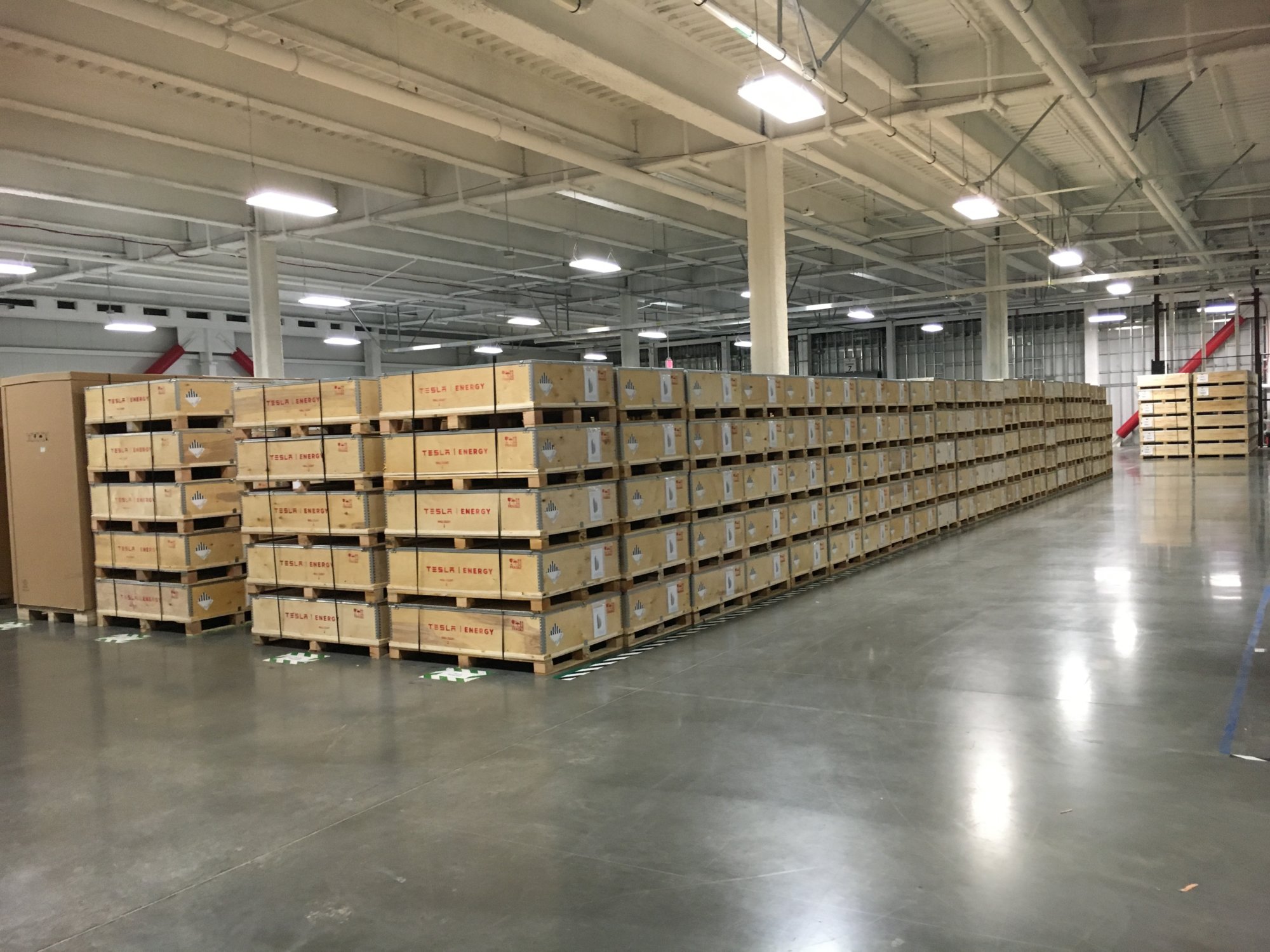
ggr That photo contains roughly 400 powerwalls, and (I was there) about 40 PowerPacks, which is a few million dollars worth of energy storage ready to be shipped. Since I can't imagine that they sit around for too long, I think the Tesla Energy revenue for Q3 will be significantly higher than for Q1 ($12M IIRC). I wonder what the curve (Q2 that is) will look like?�
Jul 31, 2016
trils0n When I took a picture of those stacks of wooden crates the tour guide said they were just empty boxes. Staging area before they get packed.�
Jul 31, 2016
ggr Ah, bummer. Still encouraging.�
Jul 31, 2016
Fallenone I was wondering why they were located near an exit for people but far away from loading area... This explains it.�
Aug 19, 2016
brian45011 Apparently the last quarterly report from Nevada"
http://diversifynevada.com/uploads/reports/Tesla_Qrtrly_Rpt_Q2_2016.pdf
"This is the final Quarterly Report for the Tesla Project per NRS 360.975, Subsection 2, which reads in part �in addition to the annual reports required to be prepared and submitted pursuant to subsection 1, for the period beginning on September 11, 2014, and ending on July 1, 2016, the Office shall, not less frequently than every calendar quarter, prepare and submit to the Governor and the Director of the Legislative Counsel Bureau for transmittal to the Legislature a report which includes, for the immediately preceding calendar quarter�:�
Aug 19, 2016
Phil Seastrand From the report:
�
Aug 25, 2016
Rarity Continuing my gigafactory employment tracking on LinkedIn, the past two months have shown slower but steady increases in Tesla headcount. July had a 9% increase while August had an 8% increase. Tesla is currently employing at least 154. Compare to Tesla employment totals as of June 30, 2016 provided to the State of Nevada of 356.
Panasonic has continued to hire at a good clip for the gigafactory. July had a 21% increase and August had a 17% increase. Panasonic has 41+ employees in the area (not all of whom work at the gigafactory). Compare to Panasonic employment totals as of June 30, 2016 provided to the State of Nevada of 63.
�
Aug 25, 2016
jvonbokel So assuming those growth rates are reflective of the real rates of growth, one could assume the following employment numbers:
Month Tesla Panasonic June 30 356 63 July 388 76 August 419 89 �
Aug 25, 2016
techmaven The investment part of the report:
It is very interesting to me that this is the first time that Panasonic's investment in a quarter is higher than Tesla's investment. Granted, it isn't by much, but still interesting. Tesla's increase QoQ was $5 million and Panasonic's was $10 million.�
Aug 25, 2016
GoTslaGo Thanks for posting!
Kind of an odd signature to that letter. Almost looks like a landscape with a bird flying above...�
Aug 26, 2016
brian45011 The prior signatory for the letters has left government for a position with a developer.�
Aug 26, 2016
brian45011 Not much of the new construction for the second phase had started before June 30th.�
Aug 26, 2016
techmaven It is interesting to note Panasonic's investment into the first phase. For those that still doubt the Gigafactory, it is a tangible non-Tesla datapoint. $202 million in cell making equipment alone is quite a bit, but I expect that Panasonic's investment into the first phase is quite high.
I forgot to ask if the ancillary, not complicated parts, like the drying racks are owned by Tesla or by Panasonic.�
Aug 26, 2016
brian45011 From the latest 10Q:
" Under our arrangement with Panasonic, we plan to purchase the full output from their production equipment located at the Gigafactory at negotiated prices. As these terms convey a right to use the production related assets as defined within ASC 840 � Leases , we will consider these leased assets beginning with the start of cell production in 2016. This will result in us recording the value of such assets within property, plant, and equipment in our consolidated balance sheet with a corresponding liability recorded to financing obligations."
Deciphering the gobbledygook, I think that means Tesla will effectively own all the equipment at the GF and will pay Panasonic for it with rental payments over the term of the lease, ie .Panasonic is financing Tesla's purchase of the equipment�
Aug 26, 2016
techmaven True... but I wonder if the drying racks, for instance, is paid by Tesla up front, or purchased by Panasonic.�
Aug 26, 2016
brian45011 No se, but if I were to guess,sounds more like a final step in cell production than anything related to pack assembly.�
Aug 26, 2016
JRP3 Yes I would consider cell aging to be part of cell production. (I'm guessing they are aging racks, since I don't know how you would "dry" a closed cell). I would assume final cell testing would take place after aging to weed out any duds.�
Aug 26, 2016
trils0n My tour guides said the cell aging room (is this the drying rack room you're talking about?) was the last part of the Panasonic section of the factory. Testing occurs after the aging process.�
Aug 28, 2016
techmaven My point was trying to figure out a more granular look at the investment breakdown between Tesla and Panasonic. Are the non-IP related, not complex items like the drying rack in the Pansonic section bought by Panasonic or by Tesla initially? There's a lot of ancillary equipment and install costs.
On a separate note, when Tesla says to Panasonic, your drying oven can be further optimized, who pays for the additional engineering and installation labor? These are questions I am pretty sure we won't get the answer easily... and I didn't think of when I went through the tour. I wish I could tour the place in about 3 months and ask follow up questions.�
Aug 29, 2016
PTADO Hey everyone, fairly new here and definitely new in the investor realm of things. Forgive me in advance if I ask any "noob" questions or clarifying questions that may have been covered in prior pages, I'll do my best to read through it and educate myself. I've always been interested in investing but never had the passion for something as much as I do with Tesla, so I'm starting here. Basically just wanted to say hello before you start seeing my name pop up in conversations and everyone is thinking "who is this guy?"
So far in reading, great stuff, and a lot of useful information in my investment research. Great community.
Quick question, since it's on topic with the last few posts, has anyone defined what exactly "Strategic Partners" means by Tesla and Panasonic? Also, do Musk and Taylor have any common relationships with critical metal hopefuls? I'm trying to untie all of this in my head.�

Không có nhận xét nào:
Đăng nhận xét