Aug 4, 2015
hobbes Thanks for pointing that out.
Clicking the link to the previous quarter in the quote above gives you the numbers 62.6 million for Q4 14, 80.6 for Q1, and Q2 was 39.8 million ($143.2 million at the end of Q1 - 183 million at end of Q2). So per quarter spending actually dropped by 50% from Q1 to Q2. Was that expected after the basic building is now done? Would that help earnings numbers or did they likely put the money into the new production line?
- - - Updated - - -
I remember they used to be reluctant to commit in the beginning, but now that they have a contract, you�re right, it is not a surprise any more.�
Aug 11, 2015
tftf Panasonic so far only invested a few million USD in the Gigafactory (GF). In any case, it won't be $3 billion (Tesla once intended to invest $2 billion on its own until 2020) in total:
http://www.reuters.com/article/2015/06/08/panasonic-autos-batteries-idUSL3N0YU31Z20150608
More importantly, Tesla's latest GF investment numbers don't make any sense to me and are very low in comparison to the $2 billion raised in 2014:
Emphasis in capital letters mine. Less cash used in last six months than in three months within the same period?
In any case, not more than $400 million (taking the highest numbers, six months should probably read three months in the latest 10-Q) will be spent by Tesla on the GF until January 2016, that is $206 million until the end of Q2 2015 plus ("up to" according to Tesla's 10-Q) 190 million in Q3 and Q4 2015.
At the same time, most if not all cash on hand will be gone by then in my opinion (with just the latest line of credit from June 2015 left as a cushion).
I can only see one result: A massive capital raise with new equity soon or very soon - because most of the $2 billion raised in 2014 (convertible bond) weren't used on the GF so far and the rest will be burned within six months on other items.�
Aug 11, 2015
techmaven Why the $3 billion? The cost of the factory is *up* to $5 billion, with nearly $1 billion in tax breaks. So $5 billion, minus $1 billion, minus $2 billion, leaves $2 billion total for Panasonic & partners for all 5 phases.
Even this article says 30-40% of the $5 billion. That's $2 billion tops, assuming both the highest cost $5 billion and the highest share of 40%. At the lowest, it's 30% of $4 billion or $1.2 billion.
Of course you would see it that way.
Tesla Gigafactory phase 1 is roughly 20% of the plant. Assuming that first part takes 25% of the total cost to start up due to the grounds prep and other work, that's $1.25 billion of the high $5 billion number. Tesla is likely paying $500 million of that, and Panasonic is paying $500 million, again, using the highest numbers. Panasonic's investments in the battery plant is well known sussed out, telegraphed in their own financial reporting and can only be done in bulk when the shell is mostly done. The shell isn't mostly done yet.
Assuming that Tesla's portion of the Gigafactory phase 1 is done by the end of 2015, that's $500-$180 = $320 million over the course of the 2nd half of the year, or $160 million a quarter. But that's using the highest number. It could be as low as $320 million for the phase 1, which is then only $140 million for the 2nd half of 2015, or $70 million a quarter.
Tesla is managing cash closely at this point... they obviously have all the numbers, they could choose to delay projects and other investments or whatever to make the cash work.
Tesla's up to $2 billion in investment will take the next 4-5 years. That's roughly $400 million a year, or $100 million a quarter.
Tesla Energy storage product launch means that the Gigafactory will start producing revenue in the first half of 2016, without needing to wait for the products to be incorporated into Model S, X, or 3. Tesla will be cash flow positive before the Gigafactory phase 1 is completed, assuming no new large capex spending.
Tesla makes a gross profit of over $200 million a quarter already. The Model X launch will likely end up nearly doubling that number on a run rate basis by the end of 2016. They could pay for the rest of the Gigafactory on increased revenues alone, with both the Model X and Tesla Energy products in 2016 and then Model 3 in 2017/2018.
I believe they will raise capital, however, as they won't be content on waiting for the revenues to pay for it. The demand for their products is too strong and they will want to move faster.�
Aug 11, 2015
tftf Tesla's own submitted forms to Nevada authorities say otherwise:
Source: http://bit.ly/1TgZewP (Reddit summary, link to original PDF document included)
That amounts to $5 billion.
All my other figures ($400 million in total until early 2016, $190 million for Q3 and Q4 2015) are taken or deducted from their 10-Q. Unfortunately, Tesla's numbers don't make sense to me, so I had to make some assumptions.
Maybe someone can explain their 10-Q filings regarding GF investments in Q1 and Q2 2015?
Until then, my outlook remains the same: Tesla will do a massive capital raise (using new equity, because the LOC from June 2015 is already borrowed against collateral assets) soon.�
Aug 11, 2015
dalalsid I take this as
Building and Site Infrastructure - $1.1bn (Tesla) - 1.1
Machinery and Equipment - Building Systems - $300m (Tesla) - 0.3
Machinery and Equipment - Module, Pack and Battery Assembly - $2.2bn (50% Tesla) - 1.1
Machinery and Equipment - Materials Processing - $1.4bn (25% - 50% Tesla) - 0.35 - 0.7
Tesla Total = 2.85B - 3.2B over 6 years (2015 - 2020) = 475M - 530M/yr average.
Easy way to get there:
400M in 2015 growing 100M each year gives 3.5B total.
So simple question: Can Tesla spend 100M more next year than it did this year and still be cash flow positive? Can it keep spending 100M more each year?�
Aug 11, 2015
techmaven Still up to $5 billion....
Dalalsid, the Tesla portions are too high I think in your assumptions. I don't see any reason to think that the Module, Pack, and battery assembly is 50% Tesla, nor the materials processing being as high as 25%.
I did forget to incorporate the expansion from the original plans... Tesla is looking to build a bigger Gigafactory than originally designed.
In any case, I'm not so sure that the Gigafactory spend is higher in the next few years... it should be roughly the same, but with a lot more revenue coming in to help pay for it.�
Aug 11, 2015
tftf We know what happened so far: They raised $2 billion in early 2014 and will at most (!) have only invested $400 million (includes other cash sources, I'm not even considering that) into the GF up to January 2016.
The CFO already announced cash-flow positive quarters (at least from operating activities) back in Q4 2013 and that didn't work except for one single Q (Q1 2014 iirc):
I therefore see a massive equity raise coming soon to finance the full GF and the Model 3.
PS: Correct 10-Q figures would also help, but the ballpark numbers remain the same.�
Aug 11, 2015
32no TFTF,
Thanks for joining the conversation here on TMC. It is nice to get out of the Seeking Alpha echo chamber sometimes. However, your whole comment is FUD. Sure, Tesla has only invested $400 million into building the Gigafactory so far, but we have no idea how much equipment they have purchased so far either, so if you're trying to say that they raised $2 billion and spent most of it on something else, you are wrong until you have sufficient facts to back it up.
Second, Deepak did indeed say that 2014 would be cash flow positive from operations, and they almost accomplished that for the whole year:
The only reason that they didn't have significant cash flow is their massive miss on guidance due to production, shipping, and holiday slip ups. If they met their guidance of 33k cars they would have been about break even and if they met their original guidance of 35k cars they would have been significantly cash flow positive.
Quarter Cash Flow From Operations Q1 2014 $58,723,000 Q2 2014 -$1,662,000 Q3 2014 -$27,996,000 Q4 2014 -$86,402,000 2014 -$57,337,000 �
Aug 11, 2015
tftf No, it will be $400 million by the end of 2015 (that's the maximum amount, i.e "up to"), after two more quarters. So far they only spent $206 million. Here's the relevant line from the latest 10-Q:
Again, this number doesn't match their Q numbers for Q1 and Q2 2015. I'm quoting the highest number above to be on the safe side.
(I'm still waiting for possible explanations for Q1 and Q2 numbers, their latest 10-Q report seems to contain errors, details outlined in my posts above).
You can call my prediction FUD. I predicted back in 2013 that the GF will cost at least $5 billion and I'm now predicting that Tesla will soon need to do a massive equity offering to keep the GF and Model 3 development going.
We will see in the next few months who was right (either Tesla can generate enough internal cash-flow or it has to tap outside sources).
I will come back and either congratulate you and other posters above on being correct or remind all of you of my prediction.
We should know by the end of Q1 2016, probably much earlier (Tesla will very likely advertise the offering as a mere "safety cushion").�
Aug 11, 2015
32no I agree that Tesla might raise cash, and if they do, it won't be until after the end of Q1 2016 because that's when the stock will be high due to the following catalysts: excellent Model X sales, free cash flow and profitability, Model 3 concept reveal and reservations, etc. This will definitely be a safety cushion capital raise because Tesla will have over $1 billion in cash left and they will be cash flow positive by then, which shows you it is definitely not the emergency cash raise you are expecting.
Anyway, if you are so confident in your predictions, why don't you tell us how many cars you think Tesla will deliver this year and next? Your friend logical thought (Mark Spiegel) said he predicts 37,000 cars this year. Do you agree with him?�
Aug 11, 2015
jhm Let's suppose that starting Q1 2016, Tesla builds out 3 GWh each quarter. I think Tesla stands to gross $50 to $60 per kWh, but to be conservative let's suppose on $40 of gross profit per kWh. So output in 2016 is about 7.5 GWh for $300M gross, 19.5 GWh in 2017 for $780M gross, and 31.5 GWh in 2018 for $1260 gross. Meanwhile Tesla ponies up $2000M for 50 GWh of capacity. This is an investment of $40M per GWh capacity or $480M per year to install 12 GWh capacity. So the combined cash flow of gross minus investment is ($180M) in 2016, then $300M in 2017, and $780M in 2018. So clearly 2016 is the tricky year to get through. Notice also that in Q4 2016 under this ramp we have capacity to make 12 GWh annually, or 3 GWh in that quarter. This grosses $120M which matches the investment rate per quarter.
Now we cannot know exactly what this ramp will look like, but notice that the first quarter of the plant is about 12.5 GWh capacity. Once that is in place, we can pretty much grow out the rest of the plant on a positive cash flow basis. I suspect this is by design. The pilot facility is the critical mass for entire project. It is sufficient rocket fuel to break free of earth's gravity. I think we can focus on the discussion of whether their is enough cash to complete the pilot.�
Aug 11, 2015
techmaven Don't forget that Tesla Energy products have been made from Panasonic's plants in Japan so far and we really don't know yet the depths of that supply and the GM, except to say somewhere in the 15% range.�
Aug 11, 2015
chickensevil On this note those were just the pilot/prototype projects. They are currently doing these in the US at Fremont and the other location that I can't recall the name. They said pretty clearly on the call that gigafactory operations are underway in these facilities and that it will be moved into their permanent location in Nevada in Q1. So they are massively derisking some of this by working on making these products now before it all goes under one roof. I believe their comments were that the target GM on these were currently right around break even but that it would change once they moved to Nevada.
About the cash raise, I will not be surprised to see one happen but not for the reason stated regarding "running out of funds". It will likely be because they are going to be looking toward acquiring another location soon combined with all the machinery they are going to need to start buying in 2016/2017 for the Model 3 that will be the need for the cash.
They could have slowed things down and slowed their growth by keeping that 2BN in funds just burning a hole in their pocket until it was totally spent on the gigafactory in 2020 or they could use that money now to push above the original volume cap of MS/MX production beyond that ~40k mark and get to making more cars. I for one, and glad they spent the money because capacticty for at least 100k a year MS/MX (maybe more) was well worth the spending.�
Aug 12, 2015
Perfectlogic The gigafactory ramp isn't nearly this steep unfortunately, they said $4-500M in revenue for 2016 last earnings and "probably at least a few billion in 2017", this is when the business starts earnings real money.�
Aug 12, 2015
JRP3 Did you also predict the increase in size of the GF?�
Aug 12, 2015
Krugerrand No, that's not at all what you said in 2013. More accurately you were saying (all over the Internet) that the GF would cost $15-20 billion, that you couldn't see any way for it to be done for less. You were firmly in the camp of 'no way Tesla is going to be able to get that kind of money/be able to finance it/blah, blah, blah'.
As far as your current prediction - it's not much of a prediction. Tesla has already left the door open for another round of 'something' per the most recent ER call and they've even labelled it for us: 'in case of macro/unexpected/ stuff'. So, you're a little late. I've no doubt, though, that you'll return having conveniently forgotten much of what you've said in the past, the timing of it all (such as the current prediction after the fact), and then try presenting it in a light that makes you look like a close friend of Dion's.�
Aug 12, 2015
tftf You must confuse me with other people (John Petersen?). I wrote $5 to $10 billion for the Gen III car project plus the battery factory (sum) back in 2013:
For The Record: Tesla Will Likely Need 5 To 10 Billion USD For Its Gen III Car And Battery Plant - Tales From The Future | Seeking Alpha
But that's not important. The important fact remains that most money raised will be used for other purposes with the GF project still in early stages:
- Tesla raised $2 billion back in 2014 (up to $2.3 bn with over-allotment), communicating that these funds will be largely used for the GF project
- Only $ 206 million was invested in the GF until the end of Q2 2015 in total (maybe less, their 10-Q numbers don't seem to match. Also, their report to the GOED in Nevada only mentions $183 million)
- Cash on hand (and of course this includes all other cash/earlier capital rounds) was down to $ 1.1 billion by the end of Q2, cap-ex and op-ex will likely rise in Q3 2015
- Tesla will only invest a further $190 million in the GF until the end of 2015 (from 10-Q: $300 million - $110 million combined for Q1/Q2 2015. These numbers can't be verified because of likely 10-Q errors, I'm again using the highest numbers)�
Aug 14, 2015
chickensevil Oh, no you don't get off that easy, just because you happened to mention a number that Tesla has also used.
tesla's original number was 4-5 billion with only 2/3 of that capacity earmarked for the car production which comes in at 500k a year. So taking a simple fraction on the assumed worst number that would be 3.3BN to produce 500k cars.
you stated 5-10 B based one 250-500k cars. So matching numbers up one for one, you are saying 500k at 10B and tesla originally stated (in the worst case) 3.3B for 500k that makes you way off the mark on the costs.
i appreciate that way back then you tried to pull from legitimate number sources, but what you didn't take into account was how much cost savings they are actually expecting to get out of all this by going to such a large scale.
now we still have a projected 5B spending from Tesla (last I heard) and yet they have already said they are going to get much more capacity out of that than originally planned. So that drags down the cost per car even lower if sticking to 500k as they are still looking at only 35GWh going to the cars with the rest to storage.
there were plenty of flaws with that article, though it was a valiant effort to come up with a number before I think anyone had a number in their head. But don't go patting yourself on the back when the data doesn't even remotely match your claims...�
Aug 14, 2015
MitchJi Has anyone figured out how much Tesla will save by using solar and wind plus batteries? I believe that producing lithium cells is energy intensive (drying) and energy prices in Japan have to be much higher?�
Aug 14, 2015
jhm Ok, suppose my ramp is likely about 3 months too early. So that would be more like 4.5 GWh in 2016, grossing about $140M. This is about 1.7GWh for TE products and the rest of it goes to vehicle production.
But to make 90k Model X/S, Tesla will need about 7 GWh. Add to that about 1.7 GWh for TE. So if Tesla moves most of the packing to Sparks, 7.5 GWh may not be that far off.
To be clear, when I am talking about gross profit per kWh, I am thinking about both auto and TE packs.�
Aug 14, 2015
bwa After working in one of Intel's "hotels" (they rent manufacturing space to "tool owners" who actually own the factory machines making chips) and many other big building construction projects (Facebook, Apple, HP, etc.), I'm almost certain the big costs for tooling the factory are yet to come. Less than a billion on their building seems reasonable in this picture; think house vs. furnishings, then take out scarcity of homes and add in super expensive furnishings, and you have a miniature factory analog. Those machines in factories are expensive, and in addition, there's a lot of building finish work yet to do, and a lot of factory facility work too like process plumbing and areas.�
Aug 15, 2015
jhm Awhile back, we had a post that broke down expenses. If memory serves me, $1.1B was for land and building, $0.3B for core systems, and the rest, $3.6B, for equipment. So I assume Tesla is fully on the hook for the first $1.4B and just a fraction of the $3.6B. Does anyone recall Panasonic's contribution was to be? My impression was that Panasonic and other partners would buy their own equipment to the tune of $2B.
The tricky thing has been trying to understand how quickly Tesla would need to burn its own cash. So my simple mental model has been that Tesla would need to set down about $1B for land and initial construction then roll out $40M per incremental GWh. So on 50 GWh this is a total investment of $3B. Under this model, the one quarter pilot facility is fully equipped at a total cost of $1.5B, that is, $1B upfront plus $0.5B for 12.5GWh.
Completion of the pilot plant is the crossover point for cash flow. If we assume that that Tesla is able to raise incremental cash of $40/kWh or more (and I do believe $50 is more realistic), then the pilot facility is able to generate at least $500M in incremental cash per year. This is sufficient to complete the remaining 37.5 GWh of the GF, an incremental investment of $1.5B, within 3 years. So completion of the pilot facility is the point at which the Gigafactory becomes self-funding.
In terms of timing, my hope is that the pilot is complete by the end of 2016. And completion of 50 GWh capacity is achieved by end of 2019. This implies linear growth in capacity one 4 years. My view is that if Tesla wants to accelerate growth, they will start launch multiple GF campuses.
Surely my basic model could be fine tuned, but I think the insight about the roll of the pilot facility is really key. That is, Tesla spends about half their full contribution on a quarter scale pilot, which is sufficient to self-fund the completion of the entire facility. It think this is a very Musk-like way to view the world. Investor view the $5B price tag and easily miss that, through partner contributions and self-funding post-pilot, the capital requirements to Tesla are quite low. Tesla only needed to raise $1.5 plus a margin for safety, which they accomplished last year. Now if they want to accelerate gigafactory expansion, faster than originally planned, this may require additional capital, but this is strictly for acceleration.�
Aug 16, 2015
chickensevil What I would be careful of is assuming margins that high from just the pilot plant. I believe they had always tried to stick to the "30% cheaper" target when the factory is fully operational, not from the outset. It may be that they get nice numbers like 50$ profit per kWh produced, but I wouldn't calculate everything on that as it seems generous. They did say that the TE part of the business would go gross profitable once they move into NV, but haven't locked in a short term number yet. I know we are hoping they can self fund the one factory so they can use extra money elsewhere, but we should really plan for it not hitting those types of numbers until 2018/2019.�
Aug 16, 2015
MitchJi Hi,
A large portion of the following savings will happen quickly. And I think it's safe to assume that they can negotiate the contracts for raw materials, so that they get the prices from the beginning.
�
Aug 17, 2015
jhm My thinking here is that $60/kWh is 30% reduction on auto battery packs. $50/kWh is 20% on Powerpacks. $40/kWh is an extra bit of conservatism on the two preceeding numbers. Also the one quarter pilot will have been operating for about 12 months before it reaches its 12.5 GWh capacity in 2017. So hopefully that will be sufficient experience and scale to get most of the efficiencies hoped for at full scale.�
Aug 18, 2015
tftf The model calculations (done for subsidy calculations in Nevada by third parties) indeed have the building/construction part (shell) at "only" $1bn or $1.1bn until late 2017.
That is not the issue.
The issue is that Tesla will have soon spent (because they had some cash on hand before the early 2014 capital raise) about 90% of the $2bn+ convertible bond on other items and not on the Gigafactory project.
That is just the beginning because R&D on the Model3 will soon kick in.
The biggest sell-side bull analyst (Adam Jonas, Morgan Stanley) just issued a new report that another $14 bn (!) of cap-ex requirements for 2015-2020 are needed.
We will see where all this money is coming from and how much is needed to complete the first battery factory - even if Panasonic chips in 30-40% of the total until 2020.
I predicted a huge equity raise in earlier posts - the recent rounded of $650 m from last week was just the appetizer in my opinion.
Tesla will need to raise billions and billions until 2020 - since they already have convertible bonds and a line of credit (collaterals pledged) outstanding the only way do it will be once again new equity offerings imho.
PS: When will Tesla fix their 10-Q in relation to GF expenses or is everything ok with it?�
Aug 18, 2015
Krugerrand You predicted nothing, but I did predict you'd lay claim to it. The equity raise had already been stated by Elon/Tesla at the ER. All you did was repeat what everyone who listened to the call had heard themselves.�
Aug 18, 2015
tftf I wrote the $650 million from last week was just an appetizer. It was not the huge equity raise. Tesla will need (fresh) billions in the next 6-18 months imho. That was my prediction and it hasn't happened yet - except for the appetizer (first of many rounds, maybe they wait until the new CFO is in place for the main course).
As I wrote above, even uber-bullish sell-side analysts like Adam Jonas predict a cap-ex of about $14bn until 2020.
Either you...
a) disagree with him (e.g. Tesla will need much less, but where will the growth come from then in a cap-ex intensive industry like cars ?)
b) think Tesla can magically generate these funds with internal cash-flows from now on (14 billion ?!)
c) think Tesla can tap other sources again (new bonds, new line of credits, new partnerships...)
or otherwise Tesla will have massive equity offerings for the completion of the Gigafactory and other projects like the Model 3.�
Aug 18, 2015
Krugerrand Uh, huh. You do realize people can scroll back and reread old posts, right? They can even view old posts in other threads.�
Aug 18, 2015
tftf If readers missed the details of my question here they are again:
Tesla's latest Gigafactory investment numbers don't make any sense to me (and are very low in comparison to the $2+ billion raised in early 2014):
Emphasis in capital letters mine. Less cash was used in last six months than in three months within the same period?
Even if Tesla meanwhile received cash-backs from Nevada I don't see how basic accounting rules would allow to directly subtract cash expenses and somehow arrive at a lower number (and I don't see other explanations).
There was also no 10-Q/A or similar filed so far.�
Aug 28, 2015
RobStark Rare Earth And Bacanora Sign Lithium Supply Deal With Tesla Motors
On condition that the Sonora project reaches certain performance milestones in the next two years, Tesla will buy lithium hydroxide to feed the manufacturing of batteries at its Gigafactory in Nevada. One of the conditions will be that the Sonora project can supply lithium hydroxide in accordance with volumes and time frames which Tesla will determine.
The supply deal is for an initial five years, starting from when Tesla makes its first order, with an option for this to be extended by another five years.
"The selection of the Sonora lithium project as one of the lithium suppliers to the Tesla Gigafactory is a landmark transaction that will support the development and commercialization of the Sonora lithium project. " said Rare Earth Chairman David Lenigas.
http://www.lse.co.uk/AllNews.asp?cod...h_Tesla_Motors�
Aug 28, 2015
WarpedOne Share price (BCN.L) just went from 70 over 90. +30% overnight.�
Aug 28, 2015
32no I'm a bit late to the party, but on the last page tftf claimed that Morgan Stanley says Tesla needs to spend $14 billion in Capital Expenditures through 2020 to meet their goals. This is false, and I am pretty sure tftf deliberately left out a caveat about that $14 billion, because I have seen him post it correctly before. That $14 billion is for Capital expenditures AND R&D. I'd say about $7-$8 billion of that is Capital expenditures.�
Aug 28, 2015
Benz Seeking Alpha:
Tesla Motors signs lithium deal with Bacanora
- Tesla Motors enters a long-term lithium supply agreement with Bacanora.
- The deal includes performance milestones which must be met by Bacanora before lithium hydroxide is purchased to supply Tesla's Gigafactory.
�
Aug 28, 2015
Johan BCN.V: Summary for BACANORA MINERALS LTD- Yahoo! Finance�
Aug 28, 2015
Ampster In my mind R & D ARE capitalized so in a broad sense the total is still $14 billion of cash to raise to cover those needs.�
Aug 28, 2015
Johan Bacanora up 43%. Did anyone buy just for sh**ts?�
Aug 28, 2015
Cosmacelf Interesting that Bacanora is still an exploratory stage company. Looks like they have proven reserves, but have not yet set up actual mining operations. I wonder how quickly a company can start producing lithium hydroxide starting from scratch?�
Aug 28, 2015
Krugerrand Wasn't there a second company also involved: Rare Earth Minerals PLC?�
Aug 28, 2015
tftf Yes, and I didn't leave out the R&D deliberately, $14 bn in cash are needed in total including R&D, I simply didn't spell it out in every post. Here's the exact quote from the report so 32no hopefully has a clear piece of mind:
I find it somewhat funny when my forum posts are scrutinized in every detail, yet when I repeatedly asked about/pointed out errors (or at least unclear numbers) in Tesla's 10-Q (Gigafactory expenses for Q1 and Q2 2015, see my previous posts in this thread) I get no answer.
So may I ask for a last time:
1. Do you think Tesla's latest 10-Q contains no errors in the quoted sections related to the GF expenses? After all, this is a public company with a huge market cap, reported numbers in SEC filings matter.
2. Even if the 10-Q contains no errors, don't you find it strange that about 80-90% of the funds ($2bn+) raised in early 2014 were spent on other items (ex-Gigafactory), especially since new money was again raised in 2015 (twice if one adds the line of credit)?�
Aug 28, 2015
MitchJi Yes.
http://www.wsj.com/articles/tesla-secures-lithium-hydroxide-supply-for-its-battery-factory-1440767689�
Sep 1, 2015
neroden There's something tftf has missed regarding capital raises.
Tesla has repeatedly taken out secured loans against their land, buildings, and equipment. This is a form of capital raise. However, Tesla hasn't been doing it the traditional way, which is to take out a mortgage *before* purchasing; they've been purchasing in cash and then taking out loans against the equipment afterwards.
The Gigafactory will be no exception. A lot of cash has been spent building it. However, expect a bunch of that cash to be recovered by promptly taking out a loan against the constructed building. Not great for earnings, but great for cashflow.�
Sep 1, 2015
electracity They are depreciating the building costs regardless of the financing. If/how they finance the building is primarily only a question of liquidity and cost of capital. The had plenty of cash when they started the project, so they funded the first stages internally.�
Sep 2, 2015
neroden Well, basically any debt is not great for earnings, because interest. But there's a tradeoff between paying interest and dilution.�
Sep 2, 2015
ggies07 Just saw this pop up:
Scott Lucas ?@ScottLucasNV 21m21 minutes ago
Did @elonmusk play Nevada over lithium mining? Or did state lawmakers just fail to do their homework?http://lasvegassun.com/news/2015/sep/02/tesla-lithium-deal-mexico-has-state-lawmakers/ �
Elon Musk ?@elonmusk 6m6 minutes ago
@ScottLucasNV Lithium deal is not exclusive & has many contingencies. The press on this matter is unwarranted.�
Sep 3, 2015
Ampster The critical issue is the rate of return on the assets. If it is greater than the cost of debt then the shareholders benefit from the leverage.
A well managed company would not take on debt if the return on that cash was less than the cost of that money.�
Sep 4, 2015
tftf Well, that's a question I raised before:
Even if Tesla got cash-backs in Q2 2015 (e.g. state incentives, sell and lease back operations...) basic accounting rules call for cash expenses to be booked and _not_ netted out directly, no?!
The numbers therefore still don't make sense to me:
In any case, assuming upper numbers, this will only amount to a total investment of around $400 million until 2016 (since Tesla announced they will only spend "up to $190 million" in Q3 and Q4 of 2015 on the GF project) and their total investment according to the latest 10-Q is as follows:
That is obviously only a fraction of what the GF is supposed to cost in total until 2020 ($5 billion).
In summary, here's a huge gap to be filled between 2016-2020: About $4.4 billion!
That's assuming that Panasonic invests $200 million until the end of 2015 (see Paulo Sousa's recent SA article for sources or quoted below*) and Tesla the upper $400 million until the same date (both are rounded numbers).
___
* "Panasonic was committing to little around $200 million or so in Gigafactory investment (tens of billions of yen - forget about the $480 million number that's bandied about as that refers to the investment in the entire automotive operations). If Tesla cuts its own investment, why would the other suppliers keep their own commitments?"�
Sep 4, 2015
techmaven
It is probably more instructive to examine the Gigafactory in phases. Originally, the Gigafactory was 35 GWh of cell production, 50 GWh of battery production. Originally in 5 phases, which is 7 GWh each. Presumably Panasonic supplies at least 7 GWh of this from the existing Osaka plants.
Total cost was to be $4 to $5 billion, with $1 billion coming from the state in terms of tax cuts, rebates, etc. So the actual construction costs were to be $3 billion to $4 billion. Part of this is Tesla's part, around $1.5 to 2 billion. There's up front land and clearing cost and infrastructure to get started, say $100 million. Since then, Tesla has added a floor in there, so the costs are probably on the higher side since this is going to be a bigger factory than originally proposed.
So taking the high side... $4 billion in construction costs, $780 million per phase + $100 million up front clearing and land. That means this first portion for Tesla is probably about $490 million and Panasonic's is $390 million. The timing is such that Tesla's spend for this phase is front loaded, with Panasonic's being back loaded with the first phase opening sometime in Q2, 2016. The actual breakdown is expected to be $1.1 billion in the factory itself and another $3.9 billion in equipment.
Costs for the Gigafactory include construction costs, land costs, equipment costs, labor costs and so forth. In Tesla's filings, they refer to construction costs, to opex labor costs, to land costs, and so forth.
From the latest 10-Q, the capex cash spend for the Gigafactory construction is expected to be $300 million for 2015.
Here are the construction costs listed so far from their reports:
end of 2014: $106.6 million
Q1: $146.2 million
Q2: $206.6 million
I think there is confusion because construction costs != total costs. Also, there are places where they talk about spending cash towards the Gigafactory, but that's just showing how much of their cash pile went to it, not a total spend amount. Total costs obviously include land and opex (Tesla employee labor), but that hasn't been broken out.
Panasonic's costs cannot have been very significant up until the point where the plant is ready to take equipment. As it turns out, the completion date of the first phase is soon after Panasonic's 2016 fiscal year (April 2015 to March 2016). According to Panasonic's latest annual report, they are going to spend 165 billion yen in strategic investments in their Automotive and Industrial Systems (AIS) company. 60% of that is automotive related. That's $832 million dollars using today's exchange rate. Assuming the Ficosa International acquisition comes from that amount, we subtract $275 million. That leaves $557 million left for the Gigafactory and other investments. That leaves plenty of room for the roughly $400 million necessary for phase 1 of the Gigafactory. Here is the direct quote from the annual report:
Panasonic, like many companies in the Asia does not provide much specifics beyond the current fiscal year.
So, in summary, for phase 1, we're looking at maybe $900 million in costs for phase 1. Tesla has already spent $206.6 million in construction costs + a chunk of opex. They are looking to spend about $200 million more this year, bringing their part to about $410 million of the estimated $490 million. Panasonic is looking to spend $557 million in strategic investments through March 31, 2016, of which the Gigafactory is presumably a huge chunk of that. So phase 1 looks like it's shaping up.�
Sep 7, 2015
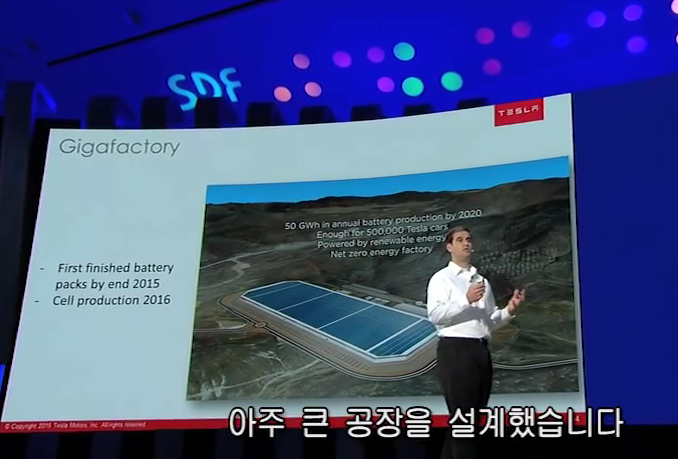
hobbes Just watched a video of JB Straubel an found this slide, which says GigaFactory will be producing battery packs already this year - is this new or did I miss it? To avoid confusion, it still says cell production 2016. Talk is from May 20 at Seoul Digital Forum.
https://youtu.be/4D9erJtiwuU?t=12m3s
�
Sep 7, 2015
Trev Page Panasonic could be sending finished cells to the Gigafactory for final Model S/X battery pack assembly and also the Powerwall and Powerpacks to increase production of current the final assembly being done at the Fremont plant.
Actual cell production won't begin until next year as they still have to outfit the Gigafactory with the machinery to do so. What is still unknown however is if they will make 18650 cells there or the new rumoured 20700 cells for Model 3 or maybe both.�
Sep 7, 2015
ScepticMatt New to me at least.
He also said that the Model 3 will have a ~40% volumetric energy density improvement over the first Model S (~950 Wh/l in that graph)
Tesla Reimagines the Century-old Power Grid - JB Straubel | SDF2015 - YouTube�
Sep 7, 2015
Trev Page Yeah, this comes from a new cell form factor. The rumour going around is they will increase the size of the current 18650 cell to something like 20700 which should yield around 35% more capacity and be produced for the same cost as the 18650s thus the much bandied 30% cost savings of the battery technology.�
Sep 7, 2015
Cosmacelf On the Nevada lawmakers and the Mexican Lithium mine.
The deal with Nevada never said anything about mining because Nevada didn't need it to make it work out. The lawmakers are just being politicians, feigning outrage at a populist topic. In reality, the Mexican "mine" is just a spreadsheet right now. It will take a while to start production, meanwhile Tesla needs to buy Lithium from somewhere else.�
Sep 8, 2015
StapleGun New drone footage. The walls are starting to come up! Tesla Gigafactory - Drone fly over - September 2015 - YouTube�
Sep 8, 2015
hobbes
Cool, thanks! Looks good.�
Sep 8, 2015
Solarguy Great flyover update. It's hard for me to put the true size into perspective until I was able to relate the known size of the large earth moving machines on the far side to the size of the structure. Truly massive and magnificent!! Thanks for sharing.�
Sep 9, 2015
winfield100 was that a "guard" coyote? at end of footage. kinda shy�
Sep 17, 2015
Twoshedds Jefferies analyst Dan Dolev sees a gross margin tailwind of 1000bps due to, his estimated, incredible shrinking battery costs. Is the Gigafactory becoming more and more valuable even before is has produced a single battery pack?
http://www.streetinsider.com/Analyst+Comments/Jeffereis+Sees+1%2C000bps+of+GM+Tailwind+for+Tesla+%28TSLA%29%3B+PT+Up+to+%24365/10899606.html�
Oct 2, 2015
brandude87 I believe the analyst's estimates are too conservative. In this article from Monday, Elon claims that they will be capable of producing a 1,000 km (621 mi) range car by 2017, and a 1,200 km (746 mi) range car by 2020. This would imply a 217% and 261% range increase (as well as battery density) over Tesla's current top range of 286 miles for the Model S 90D. Assuming that Tesla's current pack cost is $200/kWh (not $250/kWh as the analyst suggests), the pack cost would be $92/kWh in 2017 and $77/kWh in 2020, not the $126/kWh ($88 cells + $38 pack components) that the analyst suggests. Based on these calculations, the 50 kWh battery for the Model 3 would cost $4,600 in 2017 and $3,850 in 2020.
This is consistent with Elon's claim that battery densisty will improve at 5 - 10% per year if you assume that they will double in 2016 once the Gigafactory starts producing packs. If you take today's range, 286 miles, double it for 2016, then increase that by 7.5% (average of 5 to 10% claim) for 2017, you get 615 miles, pretty spot on with Elon's claim of a 621 mile range by 2017. If you continue to increase the range by 7.5% per year, you get 764 miles by 2020, again, pretty close to Elon's claim of a 746 mile range by 2020.�
Oct 2, 2015
phigment Please don't take his estimates out of context. That range was quoted relative to current hypermilers. i.e. the current record for distance on a given charge is 800km.�
Oct 2, 2015
ZenMan Elon's quote was taken out of context. He did not claim that "everyday" range would be 1,000km by 2017 and 1,200km by 2020. They were referencing a Tesla Model S owner that set the range record by only going 24mph on a fairly flat rd. So they were speaking about a very specific not real world range example. Elon's extrapolations were based on this one example, and should not be interpreted to apply to normal driving and rated range.�
Oct 2, 2015
brandude87 "A Model S was recently driven 452 miles (723km) on a single charge, but drove at an average speed of just 24mph. Musk says his predictions account for driving at a more realistic speed."
This statement implies that his predictions were based on real world range as opposed to record breaking range.
Edit: I found a link to the original interview, and after watching it, I agree that he was referring to record range, not everyday range. Sorry for the confusion.�
Oct 4, 2015
MitchJi But getting to 600 miles from 450-500 by 2017 due to battery improvements is still a pretty big jump.�
Oct 4, 2015
JRP3 The current low speed distance record is now at 550 miles at 22mph average. http://evobsession.com/tesla-model-s-distance-record-shattered/�
Oct 7, 2015
Papafox The Reno Gazette Journal published a story today about recent gigafactory permits that will enable interior work to commence. Those permits include work for:
- mechanical piping at $7 million
- phase one roofing at $4.5 million
- exterior building walls at $3 million
- electrical switchyard at $2 million
- exterior hardscapes at $ 1 million
The story also mentions how a permit for a data center on the Tesla site has been issued.�
Oct 8, 2015
Cosmacelf Quadcopter flight in early October. Can anyone decode what we are seeing on the roof? Tesla Gigafactory - Drone fly over - October- 2015 - YouTube�
Oct 8, 2015
electracity
Probably just containers of roofing material. The white layer is presumably a fabric of some kind.
Interesting how the roof is void of ancillary openings. It certainly will be good for installing solar.�
Oct 8, 2015
hobbes Very cool video, thanks for posting. Looks much more finished now, not only the completed walls, but also all the infrastructure surrounding the factory, most notably the substation. Good to see some progress here while the stock price action is rather depressing. Looking at the pictures, I can now imagine that Tesla will really be able to produce cells in spring.
- - - Updated - - -
Think the white material on the roof is for insulation.�
Oct 8, 2015
AudubonB Thank you.
With all the many months' discussions of initial footprint versus the absolutely final size of the full-blown factory - there is at least one clue given here. SOME features in any factory are less easily scalable than others: it is relatively easy to knock a factory wall down and make a particular fab-site twice, or thrice as large.
However, it is a very costly pain in the neck to re-locate and expand, for example, an electrical substation. And look at the substation as shown: it has its required guard-fence around slightly more than two times the footprint of the extant towers, transformers, etc. In other words, to me, Tesla is planning eventually on ?at least doubling the final size of the substation. Cool.�
Oct 8, 2015
brandude87 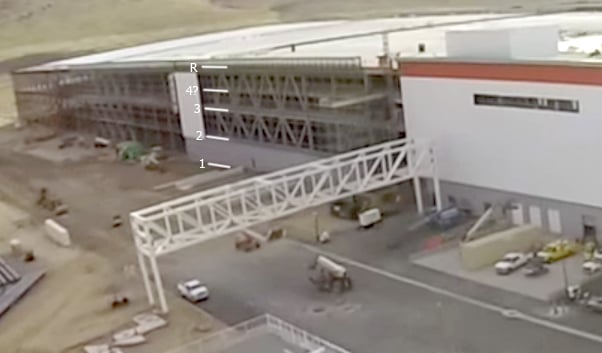
Did Tesla just add a 4th floor to the Gigafactory??? See white labels in image above, taken from the latest video. Also, note the placement of the strip of windows to the right which appear to be in line of the 4th floor.�
Oct 8, 2015
jvonbokel Good eye. I would guess that floors one and two are for production, and that portions of "floor three" will be split into two levels of offices.
Also, it could be that some of that space will house HVAC equipment or other stuff that might normally go on the roof, since it will be covered in solar.�
Oct 9, 2015
Twoshedds 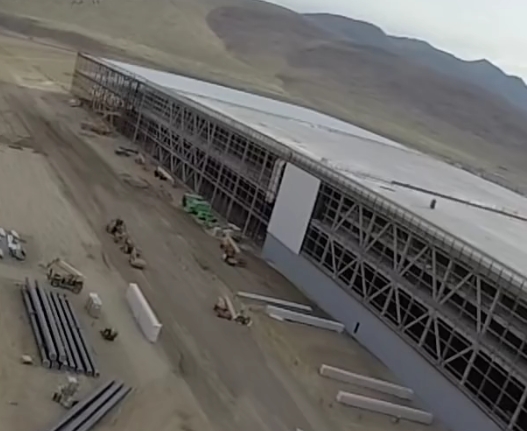
I'm not so sure about a 4th floor. This image from is a different angle and it appears to show only 3 levels.�
Oct 9, 2015
Cattledog I don't think there's a floor where you indicate level two, I think you're seeing level one beyond. The beams at level two are likely there to reduce the unbraced length of the columns, allowing them to be smaller than if they weren't there.�
Oct 9, 2015
brandude87 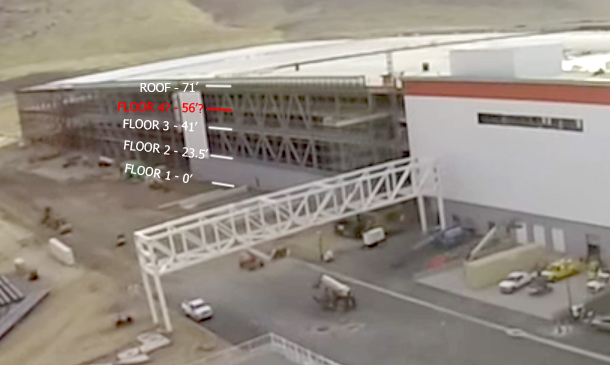
As confirmed in this video (skip to 2:25), we know that there is a second floor at 23.5', a third floor at 41', and roof at 71' as labeled in the photo above. The elusive 4th floor appears to be halfway between the third floor and roof, so around 56' above ground.�
Oct 9, 2015
pmadflyer I'd imagine you'd want to build the section containing the offices first.�
Oct 9, 2015
jvonbokel That is a cool video, and helps explain why Tesla chose Reno, among other interesting details about the Gigafactory (*6* commercial kitchens onsite, including sushi). It also does confirm at least 2 floors above ground, at 23.5' and 41'. 5.5" concrete on each floor, apparently, which sounds impressive to me, but I have no frame of reference.�
Oct 9, 2015
Dutchie Maybe it is me, but this factory does not look that GIGA to me. Will there be more build?�
Oct 9, 2015
chickensevil As has been stated many times in this thread the current building is like 1/4th-1/5th the size of the final building.�
Oct 9, 2015
Dutchie Sorry..�
Oct 9, 2015
chickensevil Didn't mean to come across so harshly. No apology necessary. But yeah, it will get bigger. I would also note that the building looks smaller than it is because there isn't a lot to reference against. But if you look closely there are cars that look like little ants in the footage. While it may look like a two story building the height is actually 71ft tall! That's over the height of a standard seven story building!�
Oct 9, 2015
ecarfan Yes it is difficult to appreciate the scale of the building from the wide angle camera drone footage. The first section being built is just a small fraction of the total planned building. The scale is so huge I have trouble grasping just how big the complete structure will be.�
Oct 13, 2015
Twoshedds Trouble at the Gigafactory site: Panicking journalists allegedly trespassing at the Gigafactory ran over two Tesla employees in a Jeep - Quartz�
Oct 13, 2015
Gwgan Journalists Trespass, Assault Tesla employees at the Gigafactory | Tesla Motors�
Oct 13, 2015
palmer_md Wow. Unbelieveable that such a thing could happen. So sad. I hope the employees recover and I hope the newspaper employees are charged to the full extent of the law. Completely unacceptable!�
Oct 20, 2015
Twoshedds Very good presentation by J.B. Straubel - Tesla Motors - JB Straubel - University of Nevada, Reno - 10/11/15 - YouTube
Gigafactory ahead of schedule, employees to start working there in the coming weeks.�
Oct 20, 2015
brandude87 Interesting video. Thanks for posting! A few interesting tidbits:
1:01:00 - JB mentioned that there will be solar panels on the hillside (as well as the roof of the Gigafactory), but mentioned nothing of wind (shown in the original Gigafactory renderings). Have they abandoned wind power?
1:01:40 - There will be no "just in case" natural gas line to the Gigafactory. Instead, a heat pump will be used which will be more efficient than natural gas. The factory will have zero emmissions.
35:27 - A new construction photo:
 �
�
Oct 20, 2015
Quant I agree ! Great job by JB and some good info both re Model 3 work in progress and Gigafactory progress/ hiring plans !�
Oct 20, 2015
Oil4AsphaultOnly With sunlight and dry weather being more consistent, maybe wind resources aren't as cost effective in Reno? In which case, only solar + batteries + 1 geothermal plant? I think they have a contract with a nearby plant?�
Oct 21, 2015
VolkerP What plant could be easier to power with intermittent solar power than a battery factory?�
Oct 27, 2015
MitchJi
It's inefficient to produce heat for cell production with solar PV (or wind).
�
Oct 29, 2015
hobbes Looks like Tesla deal with LG is only for Roadster upgrade batteries:
Panasonic Q2 profit beats estimates, reassures on Tesla - Yahoo Finance
Good from a Tesla point of view, everything going as planned, and Panasonic focusing more on Li-ion batteries is a good sign for the long-term, too.
�
Oct 29, 2015
electracity Interesting. It seems that LG is willing to work with desirable companies on small projects.
Anything different about roadster batteries that might fit LG?�
Oct 29, 2015
austinEV What? It has been the plan from day 1 to use solar power for production. You seem to be flatly suggesting that they plan to use grid power?�
Oct 29, 2015
Cosmacelf I suspect the poster was commenting that it is cheaper to use natural gas for high heat processes rather than electricity, however the electricity is produced.
But I wonder if they instead used industrial heat pumps to generate heat, and then used the cooling side to air condition the buildings. This might even be more efficient.�
Oct 29, 2015
trils0n According to JB, they are not going to use nat gas. No nat gas pipelines were installed to the gigafactory. Heat pumps turned out to be the most efficient way.�
Oct 29, 2015
hobbes That�s how I interpreted that comment too - using absorbers is a more direct way to heat a building: (em solar radiation -> heat) instead of (em solar radiation->electricity->battery->electricity->heat).�
Oct 31, 2015
MitchJi 1. I was not suggesting that they are planning to do anything, I have no idea what they are planning to do.
2. I was stating obvious facts. Generating heat with electricity is not efficient and using batteries for storage for that makes even less sense.
3. I think they should compare concentrating solar, using tubes with parabolic mirrors or mirrors focused on towers to heat fluid. Same technologies used to generate electricity from solar 24/7. Then compare that with using heat pumps.�
Oct 31, 2015
Perfectlogic PV solar is half the price of concentrated solar, I'm sure they looked at all options and found PV solar to be the cheapest which also makes sense if you follow LCOE developements and consider the location of the factory. Tesla will be able to produce electricity from PV solar at around 3-4 cents/kwh, perhaps add in 1-2 cents for load balancing. Doesn't surprise me at all that solar is the cheapest solution for all their energy needs.�
Oct 31, 2015
MitchJi Electricity is not an efficient way to produce heat.�
Oct 31, 2015
jhm Speaking of the price of solar, I wonder if Tesla is going to rush to install all GF in 2017. The 30% ITC tax credit for solar will step down to 10% in 2017, unless Congress acts to extend it.�
Oct 31, 2015
Perfectlogic Efficiency is not what matters though, cost is.
@jhm
Tesla will definately install the panels before 30% ITC expiration, regardless of how far along they are with the rest of the factory.�
Oct 31, 2015
Off Shore You may want to explain that to folks who built aluminum plants.�
Oct 31, 2015
RobStark I was thinking Tesla would use panels from Solar City's Buffalo solar panel Gigafactory.�
Oct 31, 2015
bwa I'd like to see some analysis for this. It must be something like the amount of heat, speed of heat, level of heat, efficiency of heat transfer, heat retention, heat format, etc.. Am I getting warm? Pun only incidental.
I mean, if you take mirrors and point them at a manufacturing process, the sun could bring any focus point to pretty much any desired temperature, given enough mirrors. Add in tracking and/or holographic tracking, and it becomes a question of tracking and mirror cost vs. other heat source cost.
Are some of the needed chemical reactions in PV manufacturing actually requiring certain types of fuel that cannot be done with focused sunlight? You could turn sunlight into lasers and heat up pretty much any point to any level, without even using electricity at all.
So, ok, electricity itself may be inefficient. Fair enough. I'd still like to know the details.�
Nov 1, 2015
Cobos I believe the idea is that electricity is a high value energy source, while heat is a very low value energy source. But since all processes produce heat as a waste product, turning any energy source into heat is a very efficient conversion. As energy can't go anywhere, where should the energy go? As transporting eletricity is fairly efficient over short distances i.e. a few thousand yards. The only loss is there. Norway gets about 60 or 70% of it's heat from electric heating. The only reason other countries don't do that is because they have cheaper sources of energy, like CH4.
Cobos�
Nov 1, 2015
jhm 1 kWh = 0.003414 MMBTU. So NG at around $3/MMBTU is about 1 c/kWh. This is only puting a price on heat energy, but that of course is only part of the story. Consider the difference between arc welding and welding with gas. In arc welding the use of energy is quite focused heating up metal first before waste heat is lost to the environment. In welding with gas a lot of heat is lost to the environment before it heats the metal. So when you look at the efficiency of actually heating metal it is plausible that electricity is more cost effective than gas owing to differences in electrical conductivity verses heat diffusion.
I do not know the engineering well enough to quantify this, so I am only arguing for plausibility. Certainly aluminum plants run cost efficiently off of hydroelectric power so there must be process efficiencies that make this work. The GF will need to heat a lot of metal and the waste heat can be captured for other uses. Natural gas is all waste heat used both to heat metal and everything else. Focused energy is worth more than waste heat.
- - - Updated - - -
Yeah, the question this leaves for me is whether Riverbend can scale up production fast enough. The GF roof will likely want the high 22% efficiency panels Silevo is producing. The roof may support about 100 MW which is the annual output of the piliot plant in the Bay Area. SolarCity certainly has other customers who need high efficiency panels too. So they really need to fire up Riverbend ASAP.
Solar efficiency is not an issue for ground mount systems. There they may just go with the lowest cost per Watt which they can source from China.
Anybody got an estimate on the total MW solar the GF will install?�
Nov 1, 2015
Bangor Bob Electricity is not a PRICE efficient way to produce heat. Mostly because carbon pollution is free. But electric resistance heating is nearly 100% efficient. Heat pumps can be 3-4x that depending on how big of a temperature differential you're trying to achieve.
Best answer is to redesign your manufacturing processes so they don't need a lot of heat in the first place.�
Nov 1, 2015
jhm That's exactly right. Minimize and reuse waste heat through better process design. Also the GF is to be carbon emissions free just like the car. This is is important to customers, and it is also critical demonstration of the concept of moving to a carbon neutral economy. You can use batteries to move electricity toward carbon neutrality, and if you feed cabon neutral energy into the Gigafactory to make those batteries, you've got a closed loop. Moreover those batteries need to support cabon neutral transportation, mining and all other supply chain operations. Of course, it will take along time to clean up all upstream carbon, but it is critical that GF itself not be a net carbon emitter just like the Tesla cars. And yes, Tesla needs to clean up auto manufacturing as well.�
Nov 2, 2015
hobbes Once you have electricity, that�s right. But starting with radiation coming from the sun, the more efficient way is going directly to heat, because photovoltaics has a efficiency of twenty-something percent at the best AFAIK. If you need a lot of electricity for other means than heating which is likely, it might be more simple and flexible to just employ photovoltaics though.�
Nov 3, 2015
tftf From the Q3 shareholder letter:
Since I don't think they will produce a large number of (or maybe even any, the Model3 won't go on sale for quite some time) EV cells before making stationary cells in 2016: What we now know is that there is no cell production in Nevada until late 2016 at the earliest.
Summary: Tesla will continue to import current cells from Panasonic Japan in 2016, but assemble them in Nevada (instead of their car plant in CA) going forward.�
Nov 3, 2015
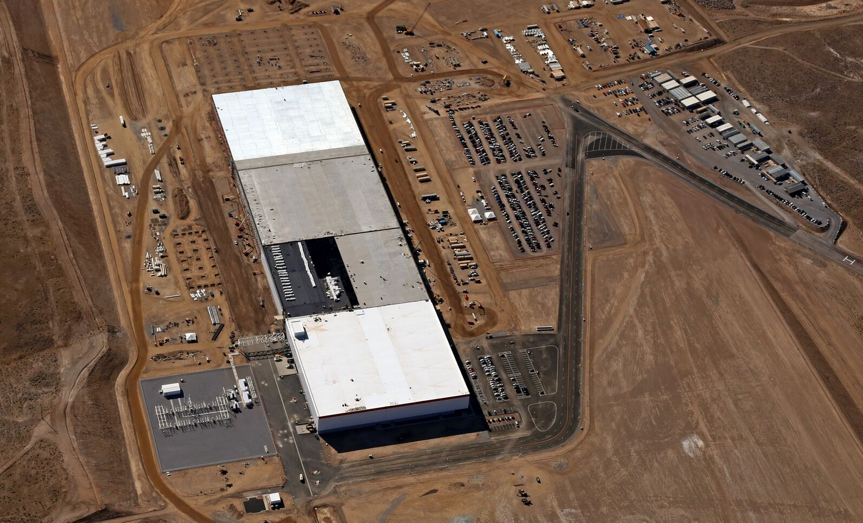
chickensevil Photo from the shareholder's letter
 �
�
Nov 3, 2015
tftf Since Tesla just confirmed there won't be EV cell production in Nevada until 2017 (first stationary energy use cell production by the end of 2016) I wonder how Tesla can state with confidence on the latest CC that the rest of the industry is far off ("no one is even close to us") in terms of battery pricing.
As a reminder (cross-posted from the Q3 2015 CC thread) here's GM pricing for 2016 from supplier LG Chem:
LG Chem of course has supply contracts with many large car makers for both PHEVs and EVs. They can achieve high economies of scale long-term given their customer list.
PS: And yes, this price is on the cell level as outlined in the quote. The analyst caller from GS on the Q3 2015 CC (around 21-min mark) was unsure about this.�
Nov 3, 2015
chickensevil Maybe I missed something, but where did they say the EV cell production wouldn't happen until 2017? All they confirmed that I heard was that stationary production wouldn't happen until end of 2016. Maybe I missed something?
Also, it might be a minor distinction but their 145$ per kWh is stated at the cell level and all that people have been estimating for Tesla with reasonable confidence is at the pack level. Depending on how big GM is planning on making their packs vs how small Tesla is willing to drop their pack sizes this could be a reasonable distinction. What I am implying here is that maybe at the cell level Tesla is already seeing at or around that price with the expectation to drop it by 30% when the gigafactory comes online? Many numbers have been thrown around over the years, so it is a little tough to keep it all straight, but I seem to recall that their last statements on cost reduction was basically implying that the 30% was their minimum at this point (as opposed to some optimistic number) and that it would come simply because of scale... so the other price reductions (5-6% every year) should be safe to add on top of that 30%... just a guess here.
So if Elon is seeing that GM has put their cards on the table and is still laughing at the 4 of a kind they laid out, then maybe it is because they know they are sitting on the Royal Flush and it doesn't matter what GM throws down. That or he is bluffing hard core on a 2 pair hoping that GM is somehow lying about their cards? But that doesn't really make any sense to me.
One final point of conjecture, 145$/kwh doesn't state how they are fairing in the energy density part. I could tell you I had 145$/kWh on some lead acids... doesn't mean it would *EVER* make sense to put them in the car...�
Nov 3, 2015
dc_h Just to be clear, the earnings letters states that stationary products have already begun production at the Gigafactory. Tesla will also begin cell production before the end of 2016 and all goals, unlike the Model X, have moved to the left. The GF will not be cash flow positive, but it will be profitable and the GF will be more and more self funding moving into 2017, freeing cash flow from S & X for the Model 3 ramp up.
"In early Q4, we relocated production from Fremont to an automated assembly line at the Gigafactory.This positions us for strong growth in 2016, but the Gigafactory pull-ahead will push some Tesla Energy Q4 production anddeliveries into Q1."�
Nov 3, 2015
techmaven On just a currency basis, the current cells supplied by Panasonic to Tesla may already be below $145/kWh. Of course, the exact cell pricing has not been released, but given various statements in 2012 and 2013, we had expected cell pricing to be significantly under $200/kWh at that point in time. Tesla re-negotiated the supplier agreement with Panasonic in the fall of 2013 and from Tesla's 10-Q, we know that the cell prices are paid in yen. Assuming $180/kWh in the fall of 2013, that's already $144 today. There was a SAE report that Tesla was paying $160/kWh, so at that price, Tesla is already paying $128/kWh.
Further, there is integration costs... and Tesla may know that the final pricing at the pack level may be far lower than GM's.
Finally, there are technological improvements... Tesla's current cell is already much better than the chemistry that LG can supply in 2017. Tesla has already hinted several times that they expect to improve their current cell at least once, if not twice before the Model 3 ships. That also lowers the per kWh price.�
Nov 3, 2015
JRP3 They "confirmed" no such thing, they merely stated that stationary use cell production would happen by the end of 2016. That does not mean vehicle cell production could not start sooner.
You seem to conveniently forget how LG freaked out when GM announced that price, probably because it's a loss leader and none of their other customers are getting that pricing.�
Nov 3, 2015
tftf How about listening to the actual Q3 CC around the 50-51 minute mark?
Tesla will only start EV cell production by 2017 in Nevada.
This answer comes straight from the CTO (Straubel).�
Nov 3, 2015
dhanson865
+1 listen to the call guys.
I had to play that section 3 times to get this rough transcription, it still has errors but it's pretty close considering both guys stutter/stumble with unrehearsed Q&A.
49:33 Our next call...
Q - Colin Rush, can you talk about acceleration of ramp of the Gigafactory? What are you seeing... 2016, when will we see cells [from there] going into cars
A - JB we've accelerated storage products ... we do expect to start product of cells in second half next year*, which is again ahead of plan. Some of those cells will be initially allocated for Tesla Energy products. And we are still targeting around 2017 for the first cell production that would be for going into vehicles and going into the Model 3 so that remains on target.
*I interpret that as 2H 2016.
That leaves ambiguity for if cells from the gigafactory will be used for S/X before 3 but says no car cell use for 2016.�
Nov 3, 2015
Yuri_G
"We do expect that cell production will start up in the second half of next year." 50:15
Not the end of 2016.�
Nov 3, 2015
dc_h According to the shareholder letter, which the CFO would have signed off on, "We have also accelerated plans to begin cellproduction for Tesla Energy products at theGigafactory by the end of 2016. This is severalquarters ahead of our initial plan."
We can quibble over the details, but Tesla is ahead of schedule at the GF. They are moving battery production out of Freemont to free up resources to build more cars and prepare for the Model 3. They are building product and generating cash flow at the GF and automating the battery pack production, increasing productivity to drive down costs. You are entitled to your own narrative, but not your own facts. Personally I was hedged and concerned about the bearish model, but based on this solid report, Tesla is positioned for a long run of positive news. Making delivery numbers for 2015, which the market discounted. Ramping up Model X in 2015, which the market discounted. Going live in the GF in 2015, which the market did not anticipate, all leading up to the Model 3 pre-reveal in March, which many expected to be delayed. All things considered, being sold out for the GF through 2017, seems more important than producing cells in December 2016 or March 2017.�

Không có nhận xét nào:
Đăng nhận xét