May 25, 2015
daniel Ox9EFD You can't just take X% improvement per year in batteries and assume that trend just continues. You need to look at actual battery chemistries coming up.
There are a few companies doing solid-state Lithium batteries: Sakti3, Quantumscape.
From an interview of Ann Marie Sastry, CEO of Sakti3, she said they will be in consumer electronics in two years, from 2014. So next year. They claim 1100kWh/l (not sure how much that is in kWh/kg), and a $100/kWh target. Of course, I think it was Edison who said the battery industry turns people into liars.
The point is rather, it is hard to project out more than 3-5 years with reasonable accuracy.
Here it is: The Charge of the Battery Brigade - Autoline This Week 1833 - YouTube�
May 25, 2015
daniel Ox9EFD I take back the Sakti3 comment. I couldn't find any information on energy density by weight. I thought I was just missing something but it seems they intentionally did not publish it.�
May 25, 2015
dmckinstry I assume your 1100 kWh/l is a typo. Actually she said 1100 Wh/l. That's still not bad. 1.7 - 4.4 times that of current technology.
But, if it could be afforded, 1100 kWh/l would give us 110 kWh Tesla with a 100 cc battery.�
May 25, 2015
JRP3 As I recall Lux has consistently overstated battery costs, and I'd say they are still doing so with Tesla, though getting closer to the mark than ever before.�
May 26, 2015
daniel Ox9EFD Oops. Yes. 1100 Wh/l. I was thinking about kWh/kg while typing.
Here might be the catch - they did not publish kWh/kg. This might be quite relevant since you could expect an all solid state battery to be heavier than current ones.
It might still be a leap in technology, but we don't know. I sent them a message a day ago asking what is the energy density be weight.�
May 26, 2015
mrdoubleb Didn`t Elon say in one of the recent ER class or on a conference or something that they are already below $200 per kwh? I think it was the same call where he said he would be very disappointed if they would not get below $100 within 10 years.�
May 26, 2015
jhm I wish Tesla would start reporting their battery cost every quarter just like how SolarCity reports their cost per Watt every quarter. It would be good for the industry to know where they stand. The problem with Lux is that they lull the industry into thinking that they have time to wait for someone else to solve their battery problem. The industry has a false sense of security in the status quo. It's time for Tesla to set the record straight.�
May 26, 2015
Zapped Funny thing; I recently saw a similar battery (and better) in the movie Knight and Day�
May 26, 2015
Model 3 It's been reported that their current price (as of their last contract with Panasonic) is $180/kWh for the battery cells. But to Lux's defence - they are talking abut the price for the cells *and* the battery they are enclosed in - including electronics. But still.... �
�
May 26, 2015
mrdoubleb Ok, fair enough.�
May 26, 2015
jhm Right, so Lux is put the non-cell cost of the battery at $5950 for a 85 kWh pack. That still seems steep. Can we break that down a bit?�
May 26, 2015
chickensevil The only way I can see counting a cost that high is some form of amortization of the R&D cost that went into making and designing the pack... Because there is no way I could see Tesla's material costs and minor labor coming in at 70$/kWh not counting the cells. The pack has to cost less than that.�
May 26, 2015
brandude87 Yeah, I'm surprised more people aren't talking about this. I photoshopped a comparison of the Gigafactory using images from February 28 (airplane shot) and May 17, 2015 (4k drone video). You can clearly see that since February, all of section 5 has been completely removed. Why would Tesla do this? Were they short on supplies and needed to focus on completing sections 1-4? Was it due to a design change? Thoughts?
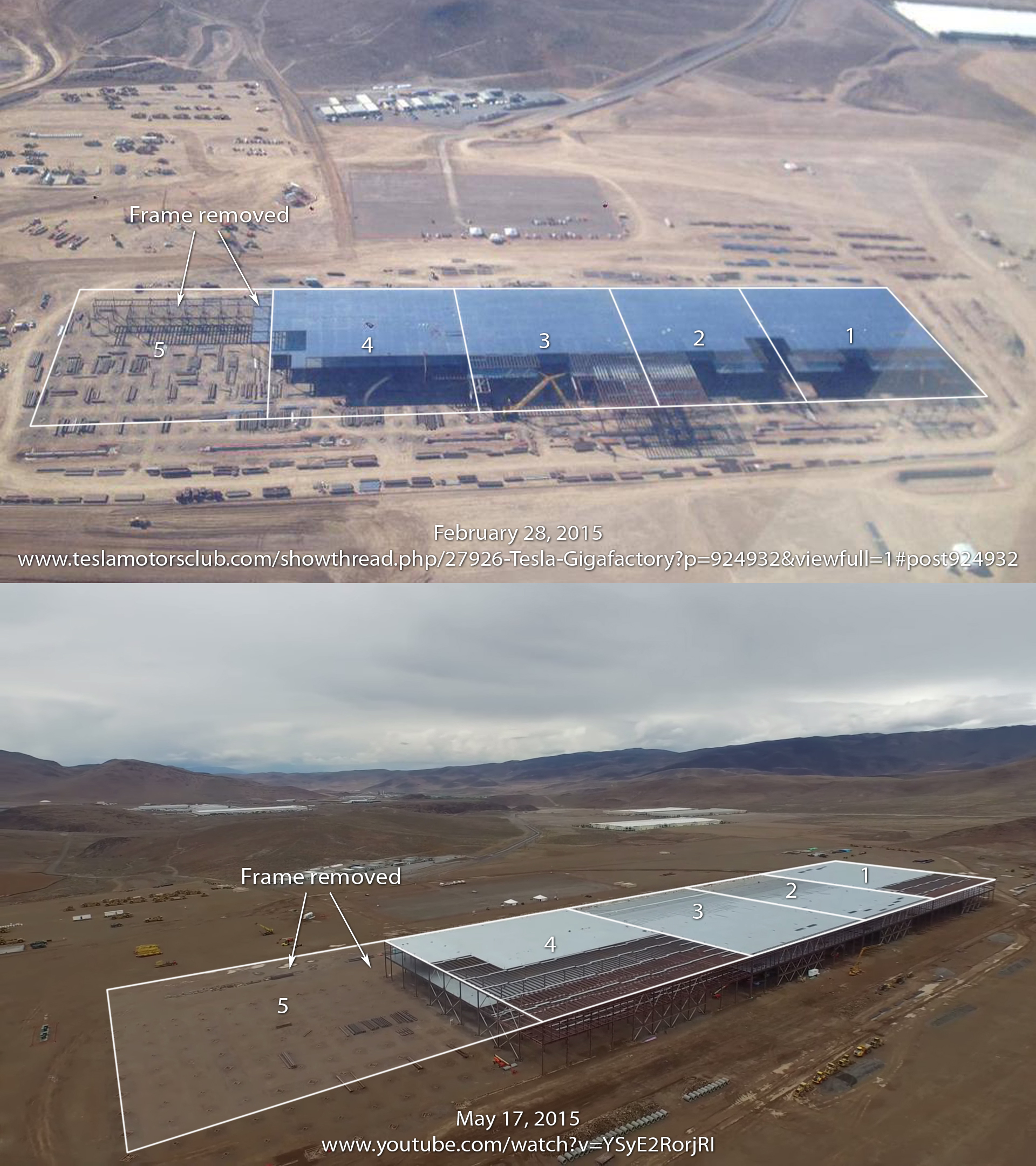 �
�
May 26, 2015
jhm Is it posible that sections 1-5 in the first photo is sections 1-4 in the second photo? It's hard to see definite markers in this.�
May 26, 2015
Gerasimental Using the carpark and incoming road (above section 4 in the 1st image), it does seem that the frame has been removed. As you come down that road to the GF and look right you'd have seen quite a lot of frame in February and just look at empty space now.�
May 26, 2015
brandude87 No, it looks pretty clear to me. I've removed the white borders in the image below to make it more clear.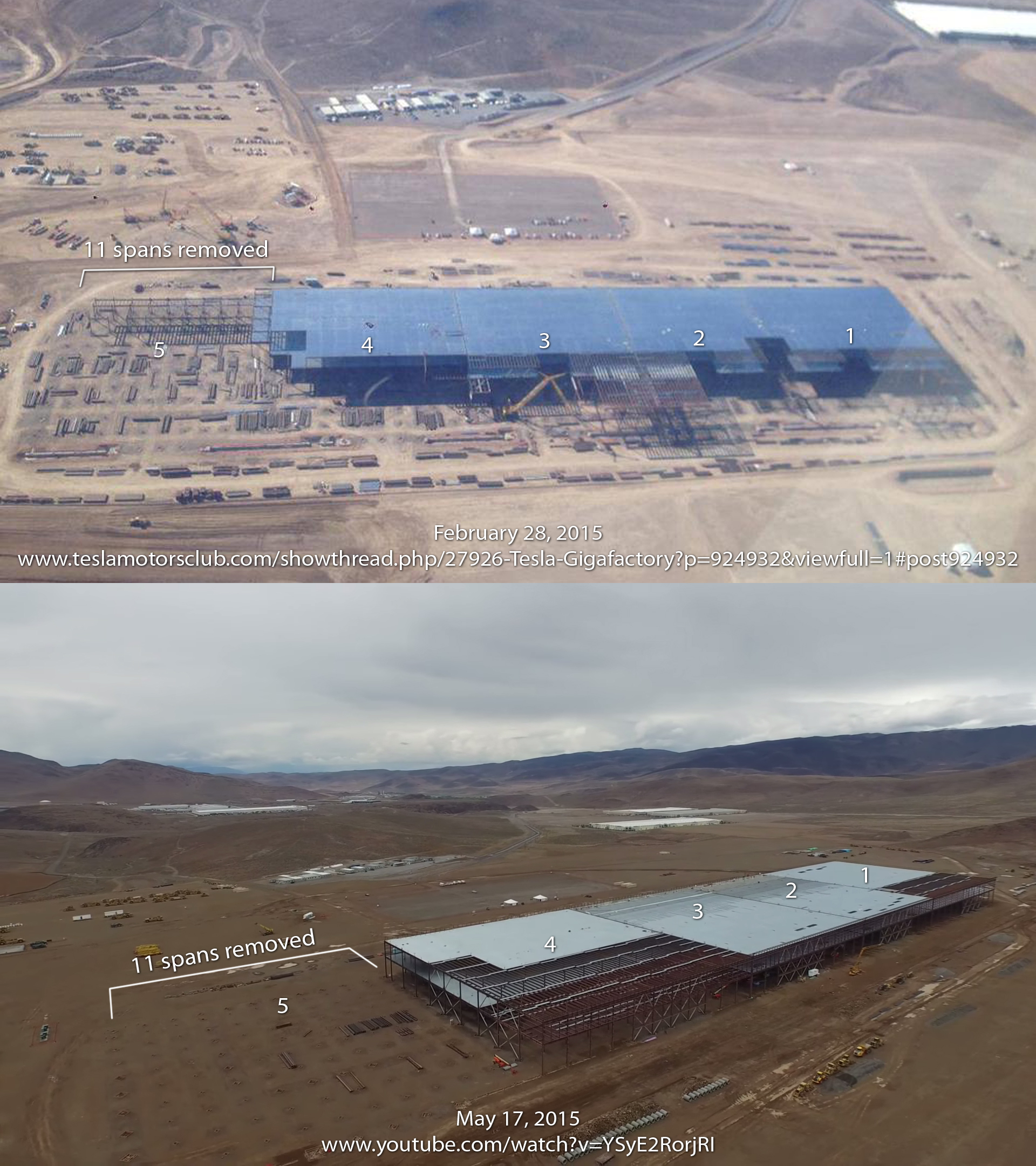 �
�
May 26, 2015
vgrinshpun I think that the spans (11) were removed in conjunction with the planned expansion of the GF, by possibly 50%, mentioned by Elon during the ER. It might be that either the sections breakdown, and/or orientation of sections required changes due to the new increased footprint of the GF.�
May 27, 2015
brandude87 Increasing building size by 50% with such short notice seems a bit impractical for many reasons (cost, time, engineering, etc.), so I think Elon meant that they were going to make the process 50% more efficient. In addition to making the factory more efficient, he probably wants to start pack production sooner than initially planned to help meet demand. My theory is that they halted (and even cannibalized) section 5 so that they could divert all resources to completing sections 1-4 first. This is evidenced by the complete lack of spare beams lying around. Perhaps sections 1-5 were meant to house the core pack production and they found a way to cram it into just 4 sections. This would be consistent with the goal of increasing Gigafactory efficiency. Thoughts?�
May 27, 2015
Fanatic
Seams reasonable enough. Now roofing has been completed on section 1 as labeled in previous posts. More concrete work has been done on section 2-3.. Think its possible they expand the factory by a couple of sections in the future. their site it huge, they will have plenty of land to do it!�
May 27, 2015
vgrinshpun We are all speculating, so in general a lot of things could be plausible. However, given the conversation Elon Musk had with Andrea James during the ER, expanding production by increasing output per the square foot of the GF building is unlikely, as they specifically discussed availability of additional space at the GF Site to expand the building and production because of surprisingly strong stationary storage demand.
I think they are more likely planning for increase of the final building size, and this might require re-calibration of the construction phasing and/or size and quantity of the building sections.�
May 27, 2015
pmadflyer Hey. I was the first person to mention it in the main GF (non-investors) thread. Thanks for making the image though.�
May 27, 2015
brandude87 You may very well be right. If so, the Gigafactory would easily become the largest building in the world by square footage on the ground (footprint), beating out the Aalsmeer Flower Auction building.
Sorry, pmadflyer, I didn't mean to steal your thunder. Props to you for first noticing the removal of the structure in section 5!�
May 27, 2015
adiggs And that is why you put things together with screws and bolts instead of nails
(sorry - been building a chicken coop over the spring and I couldn't resist)�
May 29, 2015
doggusfluffy The striking thing for me about this video is how tiny the massive equipment looks and just how incredibly far away the other end of the jobsite is. I hope the employee breakroom is somewhere near the middle!�
Jun 4, 2015
Fanatic Think this company is quite interesting. They state that in dec 2015 they will increase "monthly production capacity for lithium nickel oxide will rise from the current 850 tons to 1,850 tons." Due to demand of Panasonic/Tesla.
Wonder if they will establish a facility to process the material close to the factory. Read somewhere that the area thats been cleared east of the factory will be the place for a processing plant.
http://www.smm.co.jp/E/uploaded_files/141020-1e.pdf
Elon stated that SMM will have a section in the factory at an interview at MIT last year.
He continued stating that will be a section for Hitachi and SMM then a section for Panasonic at last Tesla would assemble it to packs.
https://www.youtube.com/watch?v=PULkWGHeIQQ
Is it the investment in GF 1 that is implied in this article, not for another one?
https://www.yahoo.com/autos/s/tesla-urges-japanese-battery-suppliers-gigafactory-risk-110000530.html
One can only speculate but if I were to build a GF I would like the suppliers take some risk as well.�
Jun 9, 2015
RobStark Elon just said at the shareholders meeting that production of cells start in the middle of next year.
Previously, it was toward end of 2016.�
Jun 9, 2015
Benz I thought that previously (Q1 ER Conference Call?) I have heard him say Q1 2016?
If that's correct, than this would be a delay of at least three months, right?�
Jun 9, 2015
LargeHamCollider I also had q1 2016 in my head but don't recall the source.�
Jun 9, 2015
32no It was the Q1 shareholder letter:
I think what he meant was that Q1 2016 they will start final stages of gearing up in Phase 1 of Gigfactory 1 in order to start production soon after.�
Jun 10, 2015
jvonbokel Actually I think the "new products" that quote is referring to are the Powerwall and Powerpack. Those will begin production in Fremont in Q1, then expand into the Gigafactory in Q3, which fits with the timeline mentioned yesterday for starting cell production at the Gigafactory in the middle of the year.
Edit: Scratch that, I misread the quote. It is saying Powerwall/Powerpack production starting Q3 2015, then moving to Gigafactory Q1 2016. Seems odd for the timeline to shift by that much in such a short time, but I'd be more inclined to think one was a mistake or miscommunication than that the underlying schedule had changed that much.�
Jun 10, 2015
jjkroll Remember that cell production, at the Gigafactory, does not need to happen for pack production to start. I took this to mean that Powerwall/Powerpack production equipment will be operational in the Gigafactory in Q1 2016. They will use Panasonic sourced cells, from Japan, until Gigafactory cell production comes online later. So they will need to split the cell supply between Fremont and Gigafactory for awhile.�
Jun 10, 2015
jvonbokel That sounds like a reasonable interpretation, and would fit with the various timelines mentioned.�
Jun 14, 2015
MitchJi Hi,
The powerpacks are very similar to the automobile packs. JB said that their profit margin on powerpacks (priced at $250 per kWh) assembled in fremont is about 20%. He then said that the profit margin on powerpacks produced at the GF will be a little better. Two things will reduce the price substantially, economies of scale, "at least 30%", and cells with increased energy density. So packs assembled in fremont cost tesla about $200 per kWh, and with full GF economies of scale, a maximum of $140 per kWh!
Does anyone know at what point the GF is supposed to reach either full or substantial economies of scale? Because maximum price of $140 per kWh, in addition to looking really good for M3 pricing also looks really good for either MS and MX margins, or price reductions.
The problem that drastically superior solid state cells pose for the GF, is that the production process is different as compared to current lithium cells.�
Jun 14, 2015
ggies07 Thanks for the tidbits. If I remember correctly, the full scale is supposed to hit around 2020.�
Jun 14, 2015
32no Where and when did JB say this? Do you have a link?�
Jun 14, 2015
rtz How about an update on the rail link? Can anyone confirm the "end of the line" is still at where the arrow points too? I don't know if that route is certain. Or would they branch off the main line from the north?
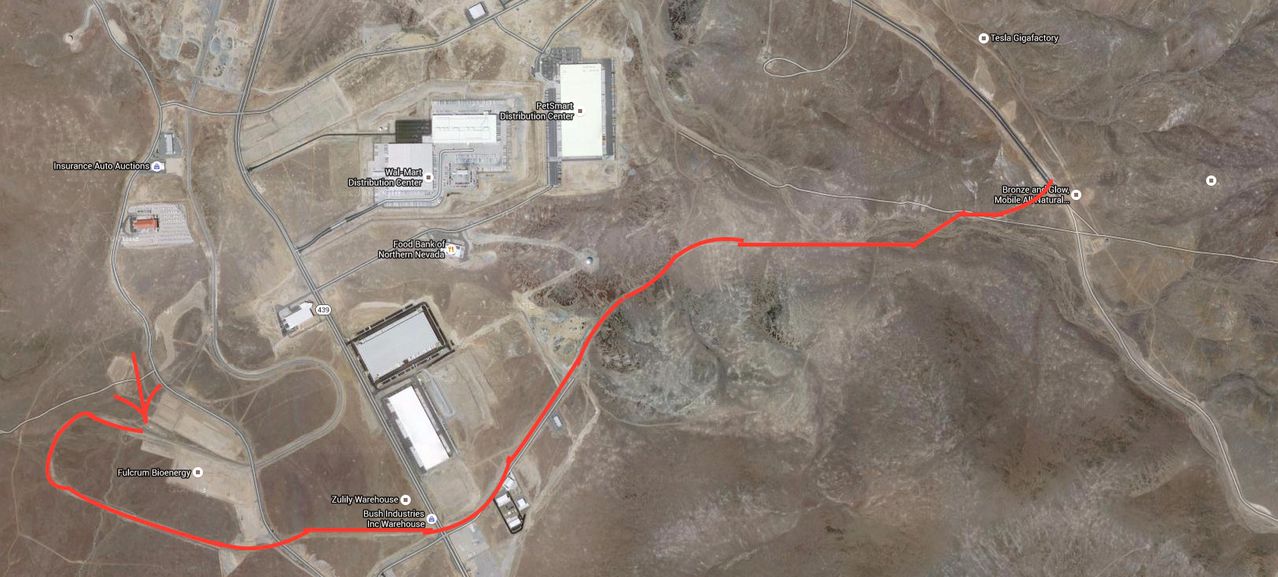
Google Maps�
Jun 15, 2015
chickensevil I believe it was stated elsewhere previously that it would be a new branch off from the north. Could be wrong...�
Jun 16, 2015
hummingbird At video link below JB actually said better than $100 per kWh by 2020 (which is only 5 years from now). JB was the keynote at 2015 EIA Energy Conference yesterday talking about this but that video is not yet available ( 2015 EIA Energy Conference )
Here, in early June he said $100 by 2020: (go to mark 36:00)
Elon Musk and JB Straubel share their vision on energy (2015) - YouTube
At $100 per kWh, cars like the Nissan Leaf and VW e-Golf with 200-mile range will hit price point of $20,000 before government subsidies. At that point the utility industry will be completely transformed as well. Pretty amazing.�
Jun 16, 2015
strangethingintheland I note the videos which quote JB Straubel giving the 2020 scenario. However, the reference to the 20% margins was, I believe in the most recent quarterly conference call. And I remember it a little differently. Namely, while we are still making things in Fremont the margins would be modest, but once we transfer assembly to the GF we can expect margins in the 20's.�
Jun 16, 2015
MartinAustin Just a thought... while Tesla Motors is in the business to accelerate the change to sustainable transport (and note, the words "make profit" are not contained in that phrase), the other manufacturers are still in the business to "make as much profit as we can every year." This means, they will price their electric cars as high as they possibly can - and claim that batteries are just darned expensive. If this means pricing them at n-500 where n is the price of a Tesla Model 3, they might do that. If Tesla can't produce enough cars to meet demand, the other manufacturers might be able to get a taste, and buyers won't mind paying n-500.
Something else to watch: Tesla says "no servicing required to meet the warranty." Will the other manufacturers also say this? The dealer-service cartel may be hard pressed to match it.
(sort of OT, apologies)�
Jun 16, 2015
RobStark
Tesla needs big huge profits to fund expansion.
It can't get the capital otherwise.
Wall Street won't fund unprofitable business that have no plans to be profitable.
Unless Apple or Google hands over billions interest free.
I don't think GM can sell the Bolt for N-500.
The Bolt will be seen functionally as a $15k econobox with a $22,500 premium for being electric.
Dealers will need big discounts to move anything more than compliance numbers.
Supply and demand will work itself out in the long run.�
Jun 17, 2015
Robert.Boston Tesla is profitable on an operating basis. If Tesla had stopped all R&D, it would have earned profits of $39.4 MM in 2015Q1. Probably, its SG&A would have been lower, too, if Tesla were content with its current scale. But doing those things would result in the stock price collapsing. Tesla is a growth play, and as long as investors think that Elon Musk has great plans for their money, he will have no problem going to Wall Street for capital.�
Jun 17, 2015
AudubonB Along gigafactory investor possibilities, here is a heads-up: consider following the fate & fortune of Canada's Inco (founded in part, by the way, by none other than TA Edison...).
Controlled for the past ten years now by Brazil's Cia. Vale do Rio Doce, ("Vale"), this largest producer of nickel in the world now is up for being spun off - at least in part. There might be a role for Tesla to secure a position in the world's lowest-cost, North American based, supplier of nickel.
17 June news: Vale Said to Hire Canada's Stikeman Elliott for Base Metals IPO - Bloomberg Business�
Jun 18, 2015
austinEV I think we are lucky the general market has our back today.�
Jun 22, 2015
MitchJi Hi,
I apologize. I made a mistake. Here are two links, and the quote, by EM:
http://edge.media-server.com/m/p/hdd83nv6
http://www.thestreet.com/story/13142191/1/tesla-motors-tsla-earnings-report-q1-2015-conference-call-transcript.html
I got a little confused, because the numbers don't work, unless they are selling the Powerpacks for zero profit.
Here's an interview with Jim Chen, in which he states that EM said that the GF will reduce costs by 33% due to economies of scale, logistics (shipping costs), and efficiency (example cells go from cell production straight to packs?).
I'm sure that they know enough to be sure that they are not losing money on the packs produced in Fremont! Remember that these packs are very similar to Model S packs.
I wanted some idea of how long it might be until they realized substantial savings. The Jim Chen video helped. I think that they should get to at least close to 20% savings pretty quickly because in addition logistics and efficiency they should negotiate some long term supplier contracts at or very close to the start of production.
So even if we assume 10% profit on the packs produced in Fremont (which IMO would be foolishly low), by the beginning of 2017 they should have costs that are a max of $175 per kWh.
And by the beginning of 2017 they should be able to reduce Model S-X prices, or increase margins, or increase pack sizes due to GF cost reductions.�
Jun 22, 2015
Model 3 ... or just add some of today's options as standard, and add some new and fancy options with greater revenue. This is what I think they will do, and that is more or less what they have been doing so far.�
Jun 23, 2015
jvonbokel My money is on the bolded parts of your comments, but regardless of my opinion, it's clear they will have multiple options for differentiating the S&X from the Model III, which will allow Model S & X sales to continue unabated (and possibly even keep growing) and fuel profits while the Model III may initially be a drag on profit, or contribute relatively little to the bottom line.�
Jun 25, 2015
jhm Tesla's first building phase nearly complete | Las Vegas Review-Journal
This report offers some good details regarding the Gigafactory. Tesla is required to give a quarterly report to NV lawmakers. I wonder if this can be made available to investors as well.
So they are moving quickly to complete the first 14% of the GF, 900k Sq ft out out a 6.4M Sq ft footprint. Still shooting for 10M Sq ft manufacturing area. Next come installation of equipment in this first segment.
Tesla is considering making GF1 50% to 100% larger. We've heard some talk earlier about a 50% increase for more stationary capacity, but it may be significant that Tesla is now talking about doubling the size of GF1 with lawmakers. NV stands essentially to get a second Gigafactory for no added incentives from the state. That has got to burn Texas and California. So I'm wondering if we'll see another round of negotiations with all the states that would love to land the second Gigafactory. Nevada may just get it by default. It should be fun to watch.�
Jun 25, 2015
MikeC Love to see the progress. I will point out that the "50-100%" was attributed to the ER CC, which is not accurate because Elon only said 50% on the CC.�
Jun 26, 2015
hobbes That sounds very promising! Some more info from the same Nevada official here:
Economic officials say Tesla factory will open in a year - Yahoo Finance�
Jun 26, 2015
Rarity The Review Journal's source for that assertion appears to be the Q1 analyst call. However, I recall Musk using much less ambitious language in the analyst call than 50-100%.
Edit: Oops. MikeC got here before me...
And I note that this seems to be the first time that we've caught wind of the footprint: 5.8 million square feet (540,000 square meters).�
Jun 28, 2015
neroden Probably not, but if they managed to get control or partial control *cheap enough*, it would be a good deal for Tesla's vertical integration plans. The nickel mining also produces cobalt (a lot of people have been wondering where Tesla will get a North American cobalt supply) and managanese (also used in the new Tesla Powerwall batteries). That's three of the metals where supply has been in question.�
Jun 30, 2015
AudubonB For those who follow events in the materials supplier world, two of the junior Lithium plays have just (30 Jun) announced that they are merging: Western Lithium (WLCDF/WLC.TO) and Lithium Americas (LAC.TO).
Corporate announcement here: Western Lithium and Lithium Americas Announce Merger, Consolidating Strategic Lithium Deposits in North and South America - Yahoo Finance
Western bases its hopes on a NW Nevada source; LAC holds positions in the salars of northwesternmost Argentina. Each company has a current market cap on the order of $50-60mm. Western will be the surviving corporate entity.�
Jun 30, 2015
AlMc �
Jun 30, 2015
jhm The source seems to be Steve Hill, who is referencing the earnings report conference call. The journalist did not fact check Hill. So did Hill simply misrepresent the CC, or does he know additional information which he inaccurately attributes to the CC? Given his privileged access to Tesla he very well may know more than was released in the CC, and he may have believed there was no breach of confidentiality on the matter because the CC is public information.
If my memory serves me, didn't Musk make some statements suggesting that Tesla would not be pursuing a second Gigafactory any time soon? If someone has that quote handy, that would be helpful. My concern about that quote was that it s
did not really jibe with GF1 at only 50 GWh while reaching for a larger stationary market. GF1 at 75 GWh buys Tesla just 12 months that they can delay pursuing GF2. So my ears tingle at the suggestion that GF1 could be expanded to 100 GWh because that allows Tesla to delay GF2 by about 20 months.�
Jun 30, 2015
Rarity All good thoughts. Musk could change his mind, of course. But some 80% of the factory costs are in the equipment rather than the structure, meaning that the distinction between a plus-sized GF1 and a normal-sized GF1 & GF2 combo is somewhat arbitrary.
Perhaps Tesla should seek to limit the growth in the size of GF1 given that one of the major points of the factory is that it can be replicated -- as Intel does with its fabs. There probably are not too many places on the globe where you can site a factory with a footprint of, say, 12 million square feet.�
Jun 30, 2015
WarpedOne That's not a problem as GF has modular design. One replicates modules as many times as he chooses.
Say GF1 has 8 modules and GF2 can have just 6 or 10.�
Jun 30, 2015
jhm I'm not concerned about the cost. The ROI on the Gigafactory is too high to worry about that. What concerns me is the ability to scale up production in a timely manner. Growing revenue at 50% per year places great demands on battery production capacity, and shifting more capacity to stationary places even greater demands on this capacity. At 33% stationary, Tesla will need 40 GWh of capacity in 2019, but at 66% stationary, 60 GWh capacity is needed. So if Tesla is serious about the stationary, additional Gigafactory capacity will need to come online in 2018. So if GF1 is limited to 50 GWh, this gives only 3 years to site and build GF2. That is a seriously tight timeline. Now if GF1 is expanded to 75 GWh, then 2019 is covered, but 90 GWh of capacity will be needed in 2020. So this gives Tesla 4 years to site and build GF2. If GF2 is expanded to 100 GWh, then 2020 is covered, but 135 GWh will be needed in 2021.
So growing at 50% annually imposes a relentless timeline for Gigafactory development. In my opinion, Tesla should be selecting a site for GF2 right now. The difficulty, however, is in bringing investors along for GF2 before the pilot facility has demonstrated the desired capabilities. This is why GF1 needs to be expanded at least to 75 GWh and the pilot needs to demonstrate success in 2016. Without both of these, Tesla will not be able to pursue aggressively the stationary market.�
Jun 30, 2015
JRP3 On the other hand, density improvements and possible manufacturing improvements, such as being developed by 24M, could significantly increase production within an existing facility.�
Jun 30, 2015
pmadflyer I recall about the same time as Project Tiger was first theorized to be the ground for GF1, there was another massive ground clearing operation that ended when the gigafactory was officially announced as being in Sparks, NV. Does anyone else recall this, or am I confused?�
Jun 30, 2015
roblab No. Now that GM is "serious" (read GM thread about the Bolt) obviously they will build the next several GFs to support their entries into the electric car field. LG won't be able to support the demand, and GM will soon discover that they need to build their own batteries in order to sell Bolts at a decent price.�
Jun 30, 2015
chickensevil I would remind you that as part of the deal Tesla had access to purchase a substantial amount of extra land as part of their deal when selecting that site. Clearly they had expansion *at some point* in mind when they went there.
Given their timeline of starting GF1 seriously around the June-ish timeframe last year and starting targeting the start of production in early to mid 2016, I would think that they would need to select another site right about the time the first cells are coming out of GF1 in order to target the start of production in 2018. Also keep in mind that Panasonic is increasing their output with additional factories and such which will likely lead to more capacity that way.�
Jun 30, 2015
jhm I'm not sure what you are saying "no" to. Do you mean this in jest. I certainly believe that GM needs to make their own batteries, perhaps in a JV as Tesla does, to keep their cost undercontrol.
In another thread, I was just commenting about the situation perhaps by 2020 where Tesla has cost down to $100/kWh while other automakers are paying suppliers perhaps $300/kWh. In this sort of scenario, Tesla has cost advantage over gas drivetrains, while ICE is still cheaper than batteries for competitors. This would be a distressing situation for competitors. Margins are compressed on conventional vehicles, but even worse if they try to sell EVs. The rate at which they lose market share pretty much depends on how quickly Tesla can roll out Gigafactory capacity. To avoid this nightmare scenario, they cannot afford to rely on suppliers that are going to charge a premium well above Tesla's internal cost of batteries, and their suppliers must be motivated to scale up production at least as fast as Tesla. That is a really tall order for a supplier. I wish GM all the best in cultivating the supply chain they're going to need.�
Jun 30, 2015
jhm Yeah, I'm in basic agreement with your points. Nevada was selected in part because it was quite willing to support Tesla's ambition to build fast. So I see it as an ideal place for speed. Other locations may not be so accomodating. So eventually multiple sited will be developed in parallel.
I have long kept a theory to myself that each GF location would have the land capacity for 150 to 300 GWh. The idea is this: select site, build for a year, add about 15 GWh capacity each year for 10 to 20 years. This is linear growth in one campus. The workforce becomes more efficient over time such that eventually 10k employees can suffice for 300 GWh output. But linear growth will not suffice for Tesla's exponential, actuallylogistic, growth ambition. So it is necessary to accelerate from adding just 15 GWh per year. So start one new campus each year. Thus, you get quadratic growth. Each year you are adding, 15, 30, 45, 60, etc. causing cumulative capacity to grow 15, 45, 90, 120, etc. By 2025 you have say 10 campuses which will ultimate produce 200 GWh per campus, 2000 GWh total, but as of 2025 produce about 500 to 750 GWh. So this is quadratic growth upto 2025, then the growth rate tapers down over the next 20 years, at which point the market is saturated, and technological gains in density are sufficient to meet nominal growth in the saturated maket. So the beauty of this progression is that it breaks down exponential growth into two linear process. Adding one new site per year is linear growth for top management to oversee. Then within each campus there is linear growth which campus management can oversee. Quadratic growth comes close enough to exponential that gaps can be managed by changing the mix of automotive and stationary output and adjustments to the rate of build out. Note that when you have 10 campuses each with room for 15 GWh growth, you can grow total capacity by 0 to 150 GWh for that year as needed to meet demand. Longrun it gives you logistic growth which can be adjusted to avoid overcapacity.
This basic outline is consistent with growing revenue 50% annually until 2025. Additionally to service both transportation and electricity market in say 30 years, Musk suggested may require some 200,000 GWh of batteries. Longrun perhaps 7% will be repreplaced each year, so total manufacturing capacity needs to reach about 14,000 GWh per year. So if Tesla has 2000 GWh capacity, that's a market share of 15%. Tesla could capture more or less market share depending on how competitive the field becomes. Longrun batteries are a commodity, though there will continue to be a lot of technology development that goes with this like microchips or solar panels, but I do think that the early entrants, say before 2025, will enjoy the highest profitability and will gain the experience to shut out other competitors on price and technology. So it is best to lock in 10 or so campuses prior to 2025, when you can get the quickest return on investment. Thereafter, saving yet more cost on further expansion and improving worker productivity will be key to competition until the market is saturated.�
Jul 1, 2015
surfside Battery Costs and Model S/X Profits
great discussion on gigafactory scaling jhm. personally i think tesla will need to wait until they are making cells at GF1 at (reasonably) high volumes to have a proof of concept worthy of launching GF2. given what elon's history of setting insane goals for his staff, i wouldn't be surprised if elon is asking his teams to accomplish the following:
i) high volume production of cells by the end of Q1 2016
ii) followed by march 2016 model E unveiling
iii) where tesla announces that the model E is ahead of schedule
iv) and will begin deliveries in mid-2017
v) given this timeframe tesla announces it will open up reservations for the model E
vi) tesla's website crashes and the company accumulates 100k+ reservations in one week's time
vii) tesla announces reservations number and epic short squeeze ensues
viii) tesla announces capital raise to fund GF2 that will be required to meet demand
any thoughts? :biggrin:
surfside�
Jul 1, 2015
atang IX) Keith Rupert Murdoch Speaks the words, "TESLA LIVES" and then I dunno! :smile:�
Jul 1, 2015
strangethingintheland Surfside, I agree with the general sentiment leading to viii.
However, there is always the difference between what I might wish for, and what I think is realistic. Reading the tea leaves, I will guess that:
v-viii are quite plausible. In particular, I would predict reservation number will become many multiples (3x, 4x, 5x) of projected annual sales for Bolt (self-limited to 36K/yr production), even before Bolt ships. This, more than anything will surprise (yet again) much of the market.
i,iii-iv I'm not so sure. My guess is he has already set a pretty high bar internally just to meet ii (march reveal), which he said was an aspirational goal, will be a tall order.�
Jul 1, 2015
Model 3 I'll be very surprised if the march 2016 Model 3 unveiling is following after the end of Q1 2016
But except for that (and the crash�
Jul 1, 2015
surfside i certainly don't disagree, but one thing that has stuck out at me from reading the elon musk biography is how elon pushes his people on multiple fronts at the same time...
and don't get me wrong, i don't think my list of events is necessarily going to happen -- i just think this is likely what elon is asking his people to accomplish (in a word: the impossible).
touche! :frown:
surfside�
Jul 1, 2015
LargeHamCollider Surfside, this scenario is exactly what I'm guessing will happen with the exception of the timing of model 3 first deliveries, I doubt that they'll be early.�
Jul 1, 2015
jhm Surfside, yeah, I think getting the proof of concept nailed in the first half of 2016 is really important and a near requirement before announcing GF2. This is why the option to increase GF1 capacity by 50% or more is a critical back up plan. We don't want any hiccups or delays with the pilot plant to compromise its growth ambition just 3 years out, 2019.
Regarding the launch of Model 3, that too depends critically on rolling out Gigafactory capacity in a timely manner. I suspect that Musk is strongly motivated to beat GM to market. All that I would add on this is that taking deposits before the Bolt is on the market will have the potential to lock in sales. Imagine Tesla sitting on 100k reservations with $5k deposits each, while GM eeks out 20k Bolts in the first year. The market will see that a Tesla is worth waiting for.�
Jul 2, 2015
RobStark  �
�
Jul 4, 2015
travwill The first big Cobalt mine in Idaho seems to be making good progress. That also wouldn't be far from the factory. I believe Formation Metals (a Canadian small company) owns the permits and is building out the mine this year, hoping to launch by early/mid 2016. That would be in time for the Gigafactory to use them as a Cobalt source for sure. Heck, Tesla could snatch/buy them up it seems, they are tiny in capital costs & cash really...�
Jul 4, 2015
chickensevil I wouldn't recommend Tesla get directly in the mining business, but buying directly from a mining company does seem to be their gameplan. Since they had commented previously that cutting out the middle man (the market exchange) and negotiating a contract directly with a supplier (mining company) would give Tesla a lower price and give the mining company a guaranteed buyer.
So I would look for a company who is likely to be producing their supply at a healthy volume, preferably close by geographically, extracting in environmentally friendly ways (at least as friendly as you can be), and there might be some other indicators to look for as well. But that would be the key things I would think Tesla would strive for. Location, Volume, Cost, and Environment.�
Jul 6, 2015
MikeC Gigafactory info from the other thread: Tesla Gigafactory - Page 51
At 6:49, he said they bought 1000 acres to start, bought 1200 acres last week, and are buying another 350 acres now.
Then at 16:15, he says superstructure Block 1 or A (first of seven) will be 2.5 million square feet, then they added "another floor 41", and then "another floor 23.5". I am not sure what units he is using for the last two numbers.�
Jul 6, 2015
Cattledog Those are the heights in feet of the elevated floor slabs above the ground floor slab. He mentioned something about a mezzanine in the video, so it could be that the ground floor is at 0', mezzanine at 23.5', second floor at 41', and he did say roof at 70'.�
Jul 7, 2015
neroden Unless the factory is mega-mega-automated and therefore runs with only a few human workers, I'm not sure how they're going to get the workers. It is located in the middle of nowhere. With, at the moment, no public transportation. Even if they managed to hire enough people, they can't live nearby, and so I don't think they could all get to work by private car without turning the entire area into a 5 mph crawlfest every morning.
The county apparently expects lots of employment. This doesn't seem possible without building either dormitories or public transportation to get people to work. And if the county's optimistic projections of 300,000 workers in the area is right (it may not be) I don't even think buses would be effective.
Maybe Tesla will have to take a page out of the 19th century playbook and build its own passenger rail line for the workers.
Even with the mere 6500 employees which Tesla initally projects, if you divide that evenly into 3 shifts (unlikely), you have 2166 workers coming in every shift change and 2166 going out every shift change.
With everyone driving their own car, this basically maxes out one lane in and one lane out. There are also other employers in this area already, though, with 4500 workers... so that's using up most of the capacity of two lanes each way. The ensuing traffic jams would disrupt the schedule-critical truck traffic, of which there's going to have to be a lot....�
Jul 7, 2015
ohmman Ahem. Hyperloop.�
Jul 7, 2015
Krugerrand It's less than 20 miles from the center of Sparks, NV.�
Jul 8, 2015
chickensevil Ok so, I can only tell you what was stated in the videos from the guy who apparently plays a big role in the building of not just the buildings out there but the associated infrastructure (water, power, sewer, roads, etc). This was the stated reason for building USA Pkwy as a four lane now, even though there isn't really any traffic to be had yet. With plans to build out other similar roads coming down off the interstate. He also said that most all of them actually run 5 shifts. 4 work shifts and a maintenance shift. On top of splitting everything by 4 (not 3), you have to consider that owners of the site have been working with all the businesses there in order to get everyone to put all their shift changes on different cycles, offset by 30 minutes. So Tesla's shifts might start at 8:00, WalMart 8:30, Diapers 9:00 and so on. This stretches all the traffic out evenly over the entire 24hour period instead of thinking about 5,000, 10,000, 60,000, or 300,000 people coming into the area (or leaving) at all the same start time (think... 9 to 5), you would effectively break that out over 30 minute chunks throughout the entire day. So you have now spread all the traffic out evenly over approximately 48 time period spacings (yes there will be some overlap... so lets assume that overlap extends for 1 hour period dropping it 24 periods), at any given moment you would then instead have only 208, 416, 2500, or 12500 cars on the road (using the same previously listed periods). This of course still becomes unmanageable at some point and further infrastructure expansions will be needed or programs put in place. Consider in the future of 300,000 people working in the area at that 12,500 number, implementing a carpool program with now your average car having just 2 people in it, you just cut back to 6,250 vehicles on the road at any given moment.
These are all relatively small numbers when dealing with populations and infrastructure.
As for how much automation at the Tesla factory specifically, consider that come March of next year when block 1 (of 7) goes live there will only be 300 employees working in that *massive* building.
- - - Updated - - -
Oh and point of further clarity, If I recall the guy stated that USA Pkwy was already graded and cleared the right of way to expand that road out to 6 lanes in the future. Essentially they just need to put down the road when it is needed. He is clearly thinking ahead for when there is a lot more traffic than they deal with today.�
Jul 8, 2015
Cattledog If Tesla can start producing batteries in March of 2016, that would be a massive acceleration over their earlier timetables of mid-2017. For a company that gets a lot of (reasonable) criticism for delays in their product launches, this would be a big reversal of that trend.�
Jul 8, 2015
chickensevil Oh don't get me wrong their public start time is listed as mid-2017. It is just that their internal timetables have come out from various reports and such that you can see they are looking at March for starting. Even if they "start" in March it might take a couple more months before they are actually producing something of value on the lines. Think of the Model S launch in June of 2012... they were technically "running" in June, but producing like 10 cars a week or something silly like that... most of them built almost by hand. They didn't actually start ramping up decently until like Nov/Dec. I anticipate a similar thing happening here. There will be employees in the factory, and there will be test cells made through the lines, checks and rechecks, and then make 10 or 100 of them, check it all again... that is likely to take time since, even though they have the expertise of Panasonic there, this is a bit new to be so fully integrated in one facility that there is likely to be some initial growing pains and learning.�
Jul 8, 2015
Model 3 ... and then we can hope that it rubs off on Model 3�
Jul 8, 2015
electracity It's a 20 minute drive from Reno. You could even live in California and work at the gigafactory. Like all big industrial parks they will need to stagger shifts.
I doubt batteries made in 2016 in the gigafactory by Panasonic employess on Panasonic equipment are less expensive than batteries ordered in huge quantities from Panasonic Japan. This is a long term deal where the value builds year by year.�
Jul 8, 2015
chickensevil I am pretty sure that even just the first block of the gigafactory (of the slated 7) is just as big as most battery factories out there currently in the world, so I don't agree with the assessment that it will be more expensive. Maybe on the very initial out the gate pricing will be a bit higher than buying from Japan, but I anticipate by the end of 2016 they will have the cost at least on par with their current paid pricings and by the end of 2017 we will see a significant price decrease over top of the Japan deal simply because of cutting out the shipping costs and they will likely be outputing at a higher volume than the average factory while being completely vertically integrated. I don't see it taking long at all to see GM's go through the roof (or the cost fall to the floor).�
Jul 8, 2015
blakegallagher I agree, Even if it was all japans building(its not) and they were making cells in Reno it seems there would be a significant savings in not having to ship all of the cells.�
Jul 8, 2015
Cosmacelf The other thing to keep in mind about the building schedule is that the initial schedules assumed a regular jurisdiction that had the usual level of rep tape. This county seems to have its act together and really helps companies build their buildings fast. So maybe that's one reason why the factory seems ahead of schedule.�
Jul 9, 2015
jhm The first block will be a pilot plants. I agree that the scale will be sufficient to realize nearly all the scale ane collocational advantages. Even so, the first order of business is to get it all running and work out any bugs or process design inefficiencies. So I am not expecting high volume or full cost savings initially. Good piloting is also necessary for bringing investors and JV participants along before committing to a second Gigafactory. So it's very critical to take the needed time to get things right in the pilot.
Your timeline seems about right to me. I just don't want the market to develop expectations that are any quicker.
Regarding GM, consider that the cost of battery packs is currently about 25% of the ASP, and the GF should cut at least 30% of this cost. Multiply the two and you get 7.5% more GM. I'm thinking that part of the path to a 30% GM is for Models S and X to hit 35% or more while Model 3 is somewhat lower. I'm not sure where Power* products will come in.�
Jul 9, 2015
electracity Really? Making the cathode, anode, and the case? Making the proprietary additives? How does one partner with a battery manufacturer and suddenly decrease price? Is Panasonic not making a profit?
The gigafactory is about scale. What goes into production in 2016 is a regular battery factory with 300 employees. No magic here. Starting up is expensive and inefficent, regardless of capitalization of expenditures.�
Jul 9, 2015
drinkerofkoolaid You either haven't been following what's happening with Panasonic and Tesla or are choosing to ignore the developments that have been significantly discussed.�
Jul 9, 2015
Cosmacelf Obvious cost efficiencies include: no cell shipping costs, reduced raw material shipping costs, ability to buy raw materials directly from mines due to scale and planning, improved manufacturing processes just due to the march of technology (older plants have older processes), reduced pre cursor shipping due to making it all in house, reduced logistics expense, reduced water and electricity prices for manufacturing. Those are the obvious ones off the top of my head, I'm quite sure there are other cost efficiencies...�
Jul 9, 2015
Cosmacelf Oh, also, the cell form factor is more efficient, and I'd be shocked if there weren't other physical changes to the cell and battery pack to reduce costs, let alone some fancy new cell chemistry improvements.�
Jul 9, 2015
electracity Then Panasonic has sure been lazy with how they run their Japanese battery operation. A new 300 person Panasonic operation in the U.S. will simply not outperform an established Panasonic Japanese factory. It also doesn't matter, as the gigafactory is a long term development
Panasonic is doing the manufacturing in Nevada because Tesla doesn't have the expertise. Tesla has developed expertise in the cell they want built. Tesla has developed expertise in testing. Tesla and Panasonic has worked through the supply chain to make low cost batteries at very high future volumes. Tesla has many vendor relationships where the other company is the expert in critical aspects of the operation.�
Jul 10, 2015
chickensevil The more you post the more I am trying to figure out if you are just new to all things Tesla (and its history and such) or if you have an ulterior motive. I will continue to assume you just aren't aware of everything and try to explain.
So first off, prior to Tesla, Panasonic was on the verge of collapse all around and specifically their battery sector was horribly dropping off the deep end. Tesla came along and bought up so much capacity from Panasonic that they quite literally saved them, which is great because Panasonic makes some very high quality products and I would be sad to see then die.
Panasonic went from multiple low used plants and even empty ones to now being as high capacity as they can and last I heard had built or were building another plant in Japan. Panasonic, not forgetting their rough past and making crazy bets on things that didn't pan out has been hesitant but willing to support Tesla since that is now their largest sales on their battery front.
If you are not aware batteries have historically been a low margin cut throat business. They were barely profitable if at all. Such that even the great Panasonic was on the verge of death (as stated above). The reason for having suppliers provide the lesser parts and them specialize in just the putting of it together and the specifics of the chemistry, is the same as with most all industries. Look at cars for example... Most of the car in other plants have hundreds of suppliers and the only IP and Patents that GM and Ford and such focus on is the transmission and the engines themselves. Everything else has been outsourced. So the autos mist have this whole thing figured out right? Wrong. Tesla has the highest GM per vehicle of any brand and a lot of that is because of the high verticle integration going on at the factory. You quite litterally have raw materials going in and full car coming out. Even their computer chips (while outsourced) have been very specifically designed by Tesla which is rare for a car company to design their own computer hardware. They have plastic molding capabilities and soon will be making their own batteries. The battery factory is just taking that to a whole new level of vertical integration.
So why do people not do verticle integration in these industries? Because in theory it is better, even if you could do it cheaper to let someone else take the time and effort doing the work and you just being supplied the product. It's part of that whole free trade theory which I can't remember the guys name now who argued it. But essentially it is better for you to focus on your specialties rather than waste time on things you are less specialized in. Let's say you are a doctor making 50$ an hour. You could totally grow your own food and make your own clothes, but there would be less value in it on a cost per hour vs the gain of the end product. In one hour of doctoring he makes enough money to eat off of for a week. That would take him much more in time cost to grow his own food. Now apply that out to companies and countries and it starts to makes sense why you would be better served in many instances in letting someone else do the work for you and you focus on what makes you great.
So when would you break away from that mold? When you are able to do these things you need for a better value given the time investment. It was a huge risk for Tesla to make the factory at Fremont like they did, but a lot of that came down to uncooperative suppliers not wanting to do business with Tesla and also the refusal of the industry to break from the status quo. Therefore out of part necessity and part the idea to revolutionize the way cars are made, they built almost the whole thing themselves.
They are attempting to do the same thing with the gigafacotry only this time they are keeping suppliers on hand. Panasonic does what it does very well, and cathode maker X does what it does very well. So lets get everyone to come together and work under the same roof all doing what we do best. Now you cut out the transportation costs which is not inconsiderable. Then you establish new partners with the miners. Instead of paying market rates for aluminum and cobalt and lithium, lets go make a deal with mining company Y to have them get a guaranteed supplier, remove the middle man's cut from the equation and Tesla will guarantee to take X amount of volume off your hands every month till you rub out of supply. This gives them a guaranteed seller, they can therefore run the mines at their peak capacity and optimal capacity to clear the most margin on cost on their end and then afford to cut Tesla a cheaper deal than the market rate. Everybody wins. The reason they will negotiate is because the large quantity of raw resources. Take, for example the world's production of Lithium. Now you have a factory by itself doubling the world's usage of Lithium. You don't think that volume would allow for Tesla to make some deals that are beneficial to both parties?
Anyway, I could go on about why this makes sense, others have also pointed out benefits here, but hopefully this better explains why this should pan out with great cost savings and why Panasonic couldn't do this alone.�
Jul 12, 2015
Zapped Good read.
I often wondered how come the auto parts mfg's could have more revenue than the car mfg's they supply. But of course they supply a diverse group of the car mfg assembly plants (over simplified)
I suppose GM or Ford would reduce their risk by outsourcing if their market share or demand dropped for whatever reason.
It's interesting when companies talk about spinning off different divisions and focusing on their CORE business and then go through what seems to be some kind of cycle of mergers and acquisitions.
There's absolutely better control of your own destiny when you do things yourself as TESLA is doing.�
Jul 13, 2015
jvonbokel *Great* post overal chickensevil, and thanks for writing it up. I didn't know Panasonic was struggling that bad pre-Tesla, and I think you summarized the potential cost savings of the Gigafactory spendidly. However, I have one quibble with this part:
Elon has been quoted many times saying that the Model S was engineered from the ground up, and only 2% of it comes from the "parts bin" (best example being the Mercedes stalks and window switches). However, there are also many suppliers they did outsource to. I have personally visited the factory where the headliners are made/assembled (Nashville, IL), and the factory that produces steering knuckles and other suspension components (Mattoon, IL). Also I found a couple good articles with infographics detailing some of their other suppliers. Granted, they're old, so with the pace at which Tesla moves, they could be out of date.
That said, I do think they do more in-house than most other auto manufacturers, and that's part of their advantage when it comes to gross margin. The other part is just having designed/built a car with demand that exceeds supply.�
Jul 13, 2015
chickensevil I'm sorry, yes obviously they have some suppliers. But my understanding, and maybe I have something wrong, is that typically you don't do the amount of production effort in one factory. And I distinctly remember from the magafactories video from 2012 how amazed they were of how much was being made in house at Fremont. To include having their own plastic molding and everything.
I am aware of external suppliers to Tesla because it has been brought up before how silly it is for GA and MI to fight against Tesla because they have a large bulk of those external suppliers that haven't relocated to CA.
And some of the suppliers are (or at least were, I think some have moved out now and went just a bit down the street) making their bits inside of Tesla factory space.�
Jul 14, 2015
jvonbokel I am by no means an expert on the auto industry at large, but I agree, I get the impression that they're doing much more in-house than the average automaker. And I hope I didn't come across as critical, because I just wanted to clarify slightly what you'd said, so that nobody could mistakenly get the wrong impression. Elon himself has been a little over-the-top in his statements about how raw materials come in one end and a finished car comes out the other. Also, I sometimes wonder how much of that effort was driven by gross margin vs how much was necessitated by virtue of their weak/non-existent relationships with established suppliers. We know that some suppliers didn't take Tesla seriously initially, or had their doubts about the long-term potential of Tesla, and as a result they outsourced things or charged more than they would have to a larger, more established automaker. Unfortunately, knowing what I know of Elon, it wouldn't surprise me at all to find out that he reacted to those kinds of situations by demanding in-house production with little regard to cost.�
Jul 14, 2015
Zzzz... Dynapower to supply 250kW energy storage inverters for Tesla Powerpack�
Jul 14, 2015
electracity Tesla did try to have motors made by a supplier. That didn't work out, so they bought the specialized equipment. Their view on what should be manufactured in house has probably evolved. I'm sure they have some great supplier relationships that have brought more value than doing it in house. Doing a particular aspect poorly in house is a great motivator to find someone who has the right expertise. Sometimes that is a hire, sometimes a vendor.
As far as the gigafactory, the battery industry has changed a lot in five years. I'm sure those plans are evolving too. It would be interesting to know China's battery investments.�
Jul 14, 2015
ScepticMatt Press release: Dynapower to supply energy storage inverters for Tesla Powerpack
Data sheets: 250kW Energy Storage Inverter for Tesla Powerpack
According to Fortune this is not an exclusive deal.�
Jul 24, 2015
SBenson Check Out the Latest Views of Tesla's Massive Gigafactory - Bloomberg Business�
Jul 25, 2015
neroden chickensevil, I appreciate your clear explanation in detail of Tesla's vertical integration strategy and how they hope to get major efficiencies out of it. I am not 100% sure how much efficiency they can get from this, but I do think it is likely to be fairly effective.
One difference between Tesla and a traditional ICE automaker is simply that there are a lot fewer parts. Tesla has repeatedly made changes to cut down the number of parts and the number of subsystems. You can't have in-house expertise in *everything*, but the smaller the number of pieces, the easier it is to have in-house expertise in a large percentage of pieces.
I haven't heard much about the plans for raw materials supply to the Gigafactory and I hope they are going well. It's going to be a *lot* of raw materials and I certainly hope they have the process of getting their own railroad siding well in hand, as well as the various truck docks.�
Jul 27, 2015
MitchJi Hi,
I cannot find the original link:
�
Jul 27, 2015
ScepticMatt He said that multiple times (earnings reports). But here is one source (nevada hearing):
Elon Musk battery Model E 80 percent size - YouTube�
Jul 29, 2015
hirox When the gigafactory hits full production the lithium industry will have grown, since Tesla and the lithum industry seem to be intertwined do you guys have investments in lithium mining companies?
I discovered a lithium ETF (LIT: Summary for Global X Lithium ETF- Yahoo! Finance), thoughts? As someone not familiar with the mining industry this would probably be my first choice.�
Jul 29, 2015
AlMc I have Western Lithium Mining.�
Jul 30, 2015
winfield100 I have ALB. they bought Rockwood holdings a few months back. (and WLCDF)�
Jul 30, 2015
hobbes Just a detail from the incentives announcement, but confirms GigaFactory on track:
Referral Program | Tesla Motors�
Jul 30, 2015
Curt Renz The pertinent sentence within the description of the referral program reads as you wrote but contains an ambiguity. Someone in the short-term thread was wondering whether that meant that the party would take place on a currently undetermined date in April 2016, or would a decision be made in April 2016 about some future date for the party. I assumed the former, but rather than simply state my opinion, I just now phoned Tesla and spoke with a sales representative in Fremont. He says that my interpretation is correct. He apologized for the poorly worded sentence. He emphasized that no delay is expected in opening the Gigafactory.�
Jul 30, 2015
doggusfluffy https://pbs.twimg.com/media/CLGs8iOWIAAwIov.jpg�
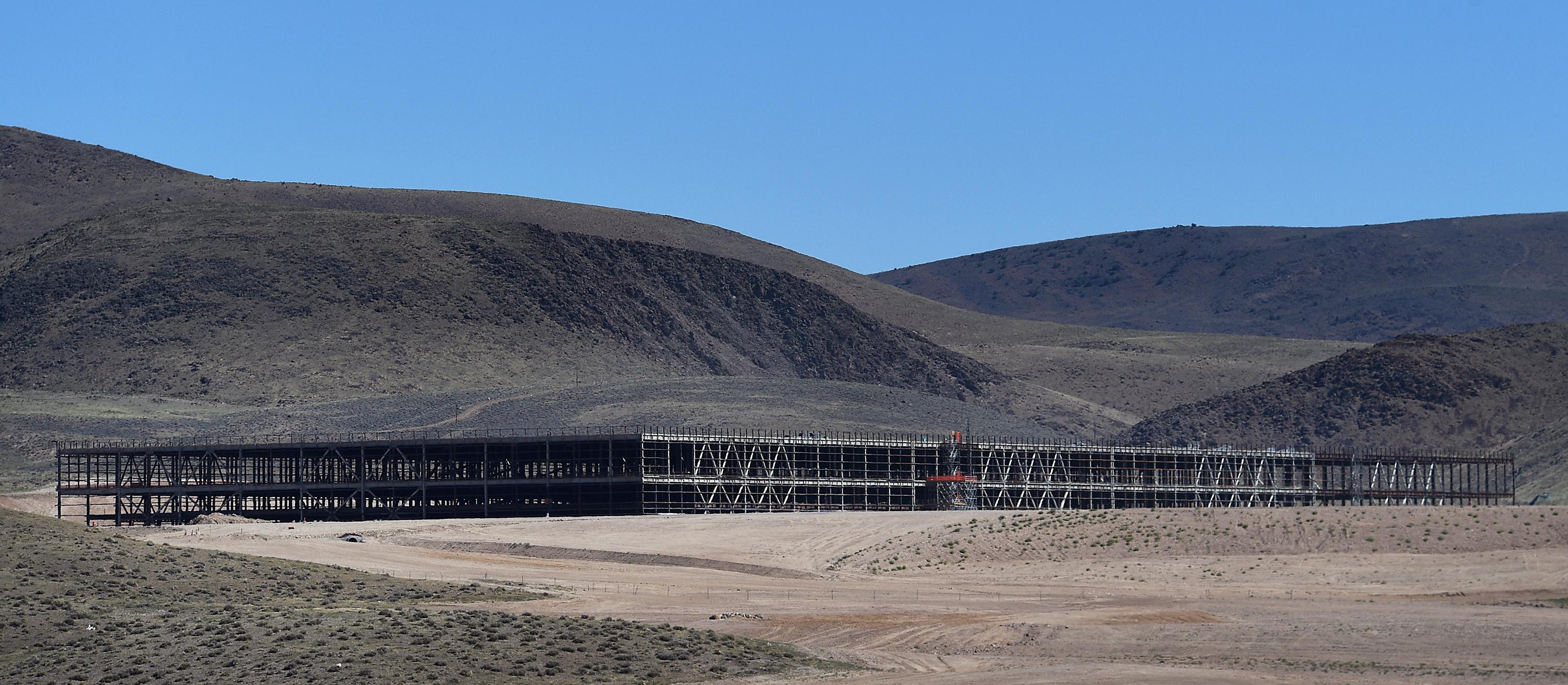 rig
rigJul 30, 2015
tinm I'm a tiny investor in Western Lithium too, but I kinda dread it because their revenue mainly comes from nasty chemical sales to fracking companies.�
Jul 30, 2015
AlMc I agree. I am holding my nose as their main product is Hectatore (sp) but I am hoping that as fracking dies they will resort to lithium mining only for the GF.�
Jul 30, 2015
ohmman For this reason, I'm trying to find a better angle on the investment. I haven't fully formulated it yet, but will share once I have. I've considered physical commercial real estate investment local to the factory as a potential upside, but the entry there is pretty steep unless someone creates a destination specific REIT.�
Jul 30, 2015
hobbes Great idea to give them a call and resolve that ambiguity, thanks!�
Aug 3, 2015
jhm Gigafactory investment reaches $183 million as Tesla, NV finalize incentive deal
Lots of good details here. Total spending on Gigafactory hits $183M in Q2, up 28% from the prior quarter.�
Aug 3, 2015
ohmman I've looked into this some more. A huge chunk of the ETF is reflected in ALB, FMC, PCRFY (Panasonic), and LGCLF. The first two, sadly, trade in the petrochemical trade pretty heavily, and FMC in particular produces lots of pesticides and other petro by-products. PCRFY might be a decent play because they're involved directly in the Gigafactory. Anyone have thoughts on this? Market cap seems attractive. LGCLF is very thinly traded OTC, so from a liquidity standpoint that looks like a risky move.�
Aug 4, 2015
hobbes
Nice article, also like the timeline at the top.
Not only Tesla ups spending in Q2, also Panasonic which is an even better sign IMHO:
�
Aug 4, 2015
MonroeSS I don't mean to make this seem negative. The 28% growth number was referring cumulative spending for end of Q2 vs end of Q1. Spending in Q2 alone was ~$40M compared to ~$80M in Q1.�
Aug 4, 2015
MitchJi Why is that important? Panasonic is fulfilling their contract with Tesla. Not a surprise.�

Không có nhận xét nào:
Đăng nhận xét