May 31, 2014
Matias Maybe this has already been here. Very interesting article about gigafactory.
http://www.businessinsider.com/elon-musk-bet-on-the-gigafactory-2014-5�
Jun 1, 2014
Madartist With the first gigafactory supposedly to break ground this month, what's best guess on its location (state)? I still think NV is the logical choice. However, who knows how the various state incentives will change the equation.�
Jun 1, 2014
MikeC These posts: If you knew the exact location of Tesla's new 1100 acre Gigafactory? - Page 2 suggest that one location will be in Reno.�
Jun 1, 2014
Zzzz... Claim that most cost of battery is coming from raw material is a plain wrong. Lithium itself contribute less than 5%. More like 2-3%. Anode usually made of carbon. There are plenty of new chemistries where cathode made of carbon or simply of metallic lithium. Electrolyte is an organic solvents with lithium salt. Current collectors are made of aluminum and copper.
But Argonne Lab have a valid point: most cost of li-ion cells comes from materials. Only difference - it is very high tech materials like cathode material and anode material... That is how battery production usually works, battery producers buy electrolyte chemicals, cathode-anode materials, separator from suppliers. And those cost a lot, as Argonne Lab rightfully pointed.�
Jun 2, 2014
chickensevil Even JB said that the raw materials are rather expensive. They are getting them for cheaper though because they are putting in such a large order and cutting out the middle man. Instead of having to go through, say, a nickel exchange or a cobalt exchange to get those materials, they are going directly to the mines and ordering the entire mine's supply.
Note on the Gigafactory chart where they show the level of li-ion batteries currently being made in the world... now consider what ELSE people are ordering nickel for... so if you are even, say, Panasonic, who would be making about 20% of the batteries, that is only a smaller fraction of the total nickel usage in the world... in 2011 nickel production was around 1,590,000 tonnes. Considering 58% (as of 2008) of nickel is used in Stainless steel (which is in... like... everything), "Chemicals" (which is what batteries fall under) is only 8% of the usage of nickel (against of a 2008). So if I am Panasonic, running about 20% of the world battery supply, and I am only using 20% of 8% of the world nickel usage presently, what kind of power or control do I have to influence the cost of nickel on the market? Not a bit...
Now, Tesla/Panasonic are looking to take the entire li-ion battery market's supply and double it... effectively making their request for nickel up from around 25,440 (20% of 8%) tonnes up to 152,640 (127200 - 8% of the market - plus 25,440 Panasonic's current load) which bumps them from 1.6% global consumption to 9.6% global consumption. If you don't think that would give you significant buying power on the market, I don't know what would.
And this is just stats for nickel, which on the exchange runs at $19,310 per tonne. If they can break those prices to be lower than the going exchange rate, then that is going to be a cheaper battery. Controlling almost 10% of the supply would likely give you that power to not go through the exchange.
Bottom line, Argonne Lab was talking about base materials, but they weren't thinking big enough... which is why they don't see how Tesla can break the cost barrier on Nickel.
Sources:
http://www.nickelinstitute.org/~/media/Files/MediaCenter/NiInSociety/NiInSoc-EN.ashx#Page=1 -> Nickel Usages from 2008
All about nickel supply and demand from FastMarkets -> Nickel production levels in 2011
I could easily do this for other elements, but JB has said before that Nickel is their highest element in both volume and cost, so it is likely to be the metal to watch out for as far as getting that 30% reduction.
- - - Updated - - -
Let's put this another way... They have already said they are going through Canada to get some of their metals... since we don't really have Nickel in the US, and Canada is the number 3 producer, it only makes sense that they would go there for Nickel.
In 2008 Canada was producing 177,000 tonnes of nickel... if my back of the napkin math is even close to correct, they are about to eat all of Canada's Nickel supply in one giant purchase order. That is the kind of volume they are going for on this. That is going to mean new mines, and a huge required increase in the supply chains on the mining front.
- - - Updated - - -
PS: I would look for some Canadian Nickel Mining companies if you want to try to bet on this giant increase in production and demand. Or even just trade in Nickel Futures since everyone still riding on the exchange is likely to see a supply drop, and therefore an increase in Nickel price.�
Jun 2, 2014
Zzzz... Yes, nickel and cobalt responsible for substantial cost percentage of the cell. I would say for more than 5% of total cost of the cell. Lots of room for potential savings.
But that is not what I tried to point out. Journalist-reporter claimed that cost of RAW MATERIALS exceeds 75% of the total costs of the li-ion cell. Chart in the article shows 76%!!! Do you, chickensevil, understand difference between raw material and high tech one?
For example, speaking of anode, almost all commercially produced li-ion cells anode materials are basically carbon. You really think we got severe carbon dioxide shortage in this world? If not, then with you and that "journalist" logic anodes for li-ion cells should be essentially free, right? And forget about nickel and cobalt, there are chemistries that are based on carbon only for cathode, and they outperform nickel cobalt based ones. Should I point to the price of carbon once again? Well, those chemistries are more expensive, way more expensive, but not because price of raw material, the carbon dioxide is too high.�
Jun 2, 2014
chickensevil First off, sorry if it came across that I was fighting against what you were saying... I wasn't. I was just making sure that you were giving enough credit to the overall cost of the raw materials themselves, since that seems pretty core even to the Argonne report. It has also been pretty core to what Tesla has been saying all along. Carbon is more expensive than I think you give it credit for, specifically for Graphite... Given that it is synthetic graphite that Panasonic is using the prices I am seeing listed is 20,000$/MT which makes it just as expensive as Nickel is. If they switch to spherical graphite made from natural flake it could be had for 6,000 to 10,000.
Just for kicks, I went and found the actual Argonne National Laboratory report. It is pretty thorough about all of it's data. Here is the PDF:
http://www.ipd.anl.gov/anlpubs/2011/10/71302.pdf
I direct your attention to this chart... not sure where Business Insider got their chart from, since the percentages are way off. this is on Page 70
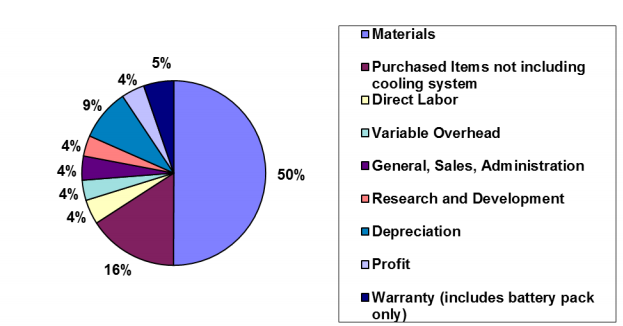
Now, if you go to page 45, they actually break down the pricings associated with at least the Positive Electrode, and it does appear that in this instance they are pulling this as if you are buying the whole unit as opposed to making your own. But, they do some calculations to figure out how much you are actually spending in core material costs and come out to $6/kg for Li2CO3, $5.5/kg for NiSO4, $32/kg for CoSO4, and $1/kg for MnSO4. They have a chart there with a breakout of their costs for each of the cathode types, but I believe even those are estimations based on their formula they have posted on page 47.
I think there is substantial cost savings to be had on both fronts. In the raw materials and in the actual component assembly.
- - - Updated - - -
Oh, and the quality isn't the greatest on the video that was uploaded, but here is a capture from the symposium that JB was at, which shows all their core battery materials.
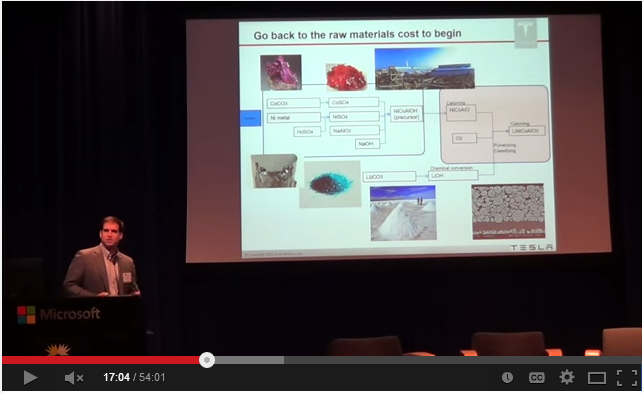
The reason they care about this is to ensure they get the best price possible, since avoiding the open exchange and buying in large enough bulk can save them a lot of money.�
Jun 2, 2014
Johan Great post chicken! Good sources. To get that 30% reduction in cost it has to be 1% here and 2% there etc. Raw marerials will be important too, as you point out. Being a big buyer has its perks.
But I'm strongly opposed to Tesla doing mining themselves, except in co-op with SpaceX on an asteroid. Elon is good friends with the CEO of Planetary Resources (Planetary Resources ) Eric Anderson. Asteroid mining will be a reality sooner than many think.�
Jun 2, 2014
chickensevil It's not that I would expect them to mine anything themselves... That would be a lot of capital costs to buy up land and the go exploring for materials... All they are doing is buying direct from the supplier and making their own contract deal rather than going through and exchange. Look at it this way, I as a miner can choose to sell my stuff on the, say, Nickel exchange. I will get 19,000 per tonne and go on my way. The exchange will turn around and sell it for, say 19500, so they flip a profit to stay in business for being the host. Problem is, it is an open market, and someone has to be willing to buy my Nickel before it will be considered sold. This could be quick, and it could be slow. I am going to try to figure out how much to extract each month, based on how fast the open market can sell it since I don't want to waste production on product nobody wants. I have no guarantee that anyone will buy it, and it could take a while to get it for a price I am happy with.
If however a large company comes along and says, hey, your whole mining output, how much could you give me at full production? Oh, 20,000 tonnes per year? And what is your current production level? Oh only 15,000 per year? I will buy all 20k of that from you per contract for 18500 per tonne.
This overly simple example means that tesla not only is picking up that cost lower than the current sell rate but that the miner is benefitting because they have a guaranteed sell source to take all of their supply from.�
Jun 3, 2014
ggr Maybe three gigafactory sites! (from shareholder's meeting)�
Jun 3, 2014
kenliles 'likely' 3 starts I think he finally settled on. And would name the '1st' one to be completed by end of year. I'm paraphrasing from memory, but that was the jest of it.�
Jun 4, 2014
Matias Very hard to believe, that it would be completed by end of the year.�
Jun 4, 2014
JRP3 I think what he means is that the first factory site that will eventually be completed will be chosen by the end of the year.�
Jun 4, 2014
Cosmacelf He said he hoped that the concrete foundation/slab would be poured by end of year and they would have approved building plans in place. Sounded to me that they would just back burner the sites/ states that were going to go slow in terms of permitting, and these sites would end up eventually being gigafactory #2 and #3. This would allow Tesla to reap tax breaks from three states, and have a jump on dominating battery supply for the entire EV market, not just their own use.
If he is talking to mines directly, that can only mean contracting to purchase a set amount of material up front, since that is effectively what the metal exchanges do for the mines (they need to have a guaranteed price to raise money to open mines). Actually, there is another thing Tesla can do for mines, and that is help financing new mine construction. Either way, or both, Tesla will end up buying raw materials significantly cheaper, but from a business perspective, it means they MUST build a lot of battery cells, or else they will sitting on thousands of tons of nickel.
I think that is why Elon is talking about giga 2 and 3. He needs to build them to use the raw materials he is going to contract to buy. I think Toyota has something to do with this too - he implied they were willing to buy lots and lots of battery packs from Tesla, but Tesla just doesn't have the batteries to sell them. Tesla is setting itself up to be the sole supplier of battery packs to lots of car companies.
Bottom line, Elon is thinking big(ger) again...�
Jun 4, 2014
kenliles that's the way I read his statements as well. Add to that his lead guy JB probably wants one of them soley for stationery storage and the conversations get even bigger�
Jun 4, 2014
jstoneman Yeah, I agree. I've been reading between the lines for some time on this gigafactory. Mr Musk was quoted recently as saying that the world will need "hundreds" of factories to meet demand. Tesla isn't about to build and permit three separate building sites just to abandon them. They'll be factories 1, 2, 3. If one of them takes a little bit longer, that's fine, see you in 2018 when we start work on our trucks. If the third one takes a couple extra years, that's fine, see you when we start doing mass market batteries for solar city installs in 2019. Musk is playing chess and he's 5 moves in front of everybody. Amazing.�
Jun 5, 2014
Lump California not giving up.
California to mount aggressive bid for Tesla battery plantLos Angeles Times
California Lawmakers Push Regulatory Changes for Tesla - Bloomberg�
Jun 5, 2014
CalDreamin A battery factory is a chemical plant, and California is hostile to chemical plants. I'm skeptical that California could make all the changes necessary to make this work. What would the state do to prevent the typical push back and lawsuits from private citizens and organizations that drag out environmental impact and permitting reviews for years, exacting high and sometimes insurmountable costs for compliance? Though I'd love to see these jobs in California, I don't want Tesla to go bankrupt trying to overcome these hurdles.�
Jun 5, 2014
Jackl1956 Computer chip plants are essentially chemical plants. California is chock full of 'em.�
Jun 5, 2014
Cosmacelf Huh? Since when? 1980? Almost all actual chip making plants have long, long left California. CA environmental regulations are no joke, and chip making plants use lots of very toxic chemicals that run afoul of the CA EPA.�
Jun 6, 2014
ggr I was involved with setting up and running a chip plant in San Jose. Yes, it's tough. But the chemicals are toxic no matter where they are, and have to be handled the same everywhere (at least in the US...).�
Jun 6, 2014
Chickenlittle Hard to separate politics but republican governor candidate attacking brown on jobs. Real incentive for brown to negotiate with tesla. Can't fault Elton's luck. Ukraine when he wants air force contract and now this�
Jun 6, 2014
Cosmacelf Brown has absolutely nothing to worry about from any Republican challenger, so I doubt it'll force him to do anything he wouldn't otherwise do.�
Jun 6, 2014
jhm Rumor sounds credible. Will Tesla roll the dice in Reno? http://www.rgj.com/story/money/business/2014/06/06/tesla-factory-rumor-heats-just-smidge/10078933/�
Jun 6, 2014
FrozenCanuck Anyone care to read this (brief) post and comment?
Gigafactories, batteries, and the economies of scale | duncanpredicts
The post raises a good point about the economies of scale in battery production. We're clearly already at massive scale in battery production so can a GigaFactory really make a difference? Yet I also feel this post misses the bigger picture (thinking outside of the box) where Elon and team are planning to bring the entire supply chain under one roof. This minimizes all sorts of transportation costs and you'd think it should improve production efficiency too.
Is there anyone who can make a very strong case for or against the likelihood of a 30% cost reduction on assembled packs?�
Jun 6, 2014
JRP3 Quite simply three years of continued progress in the historical 5-8% yearly range could give around 20% or so of cost reduction so GF only needs to get another 10% or so. Contrary to what he suggests I don't consider 20 years of production to be a "mature" technology with all economies of scale already achieved. Putting the equivalent of the current world production in a single factory and dealing directly with material suppliers will certainly increase cost savings and efficiency. Plus his quoted battery expert is quite wrong about the potential for future advances in lithium chemistry, there is more to be had before we get to lithium air.�
Jun 6, 2014
aronth5 I am fascinating by the apparent difference between states like Nevada who want to fast track large industrial developments vs. a state like my home state of Massachusetts when it comes to permitting a large plant like the gigafactory. To even contemplate checking on town/city permits submitted by Tesla in Mass without public meetings and local media coverage first is unthinkable here. To image a development the size of the gigafactory breaking ground essentially without everyone knowing about it first doesn't seem remotely possible. Is it really possible that Tesla could break ground in any of the four states without significant advance notice? The thought Tesla could break ground within a month without anyone knowing just doesn't see plausible. What am I missing? And please be kind to Massachusetts:smile:�
Jun 8, 2014
Robert.Boston You're thinking in the world of "zoning" instead of "private property." There are indeed many parts of this country where, if you own land, you can do pretty much anything you want to with it, without asking permission.
In the two rumored sites in Nevada, in particular, they appear to already be located in industrial zones. Even here in New England, if all you're doing is building a conforming structure, you just need to pull permits; no meetings or votes required.�
Jun 8, 2014
jhm Ok, I'm developing a pet peeve for journalists who call the gigafactory a "mega-factory". I know it's small thing. Maybe I should chant OM three times and get over it.�
Jun 8, 2014
AlMc Yes, As long as zoning allows certain 'uses', and many local planning boards/land use departments use the 'UDC', you just need building permits. However, different locales have different 'hoops' to jump through
as part of the permitting process. As someone who has fought over development in my county it is amazing how much local citizens can accomplish if they let it be known that even when a project is proposed for a properly zoned site how if you know the right people to call you can have a plan scrutinized in all the land use departments and hold things up for years.
I would think the biggest issue would be dealing with the environmental impact divisions of the land use departments. That is why I suspect California may eventually get the 'third' factory with Nevada and Texas getting number 1 and 2 respectively. I see those states as having the smallest restrictions environmentally and Cali having the most stringent. I suspect we will see lots of court challenges from environmental groups in Cali.
Obviously, this is all opinion/speculation on my part.�
Jun 8, 2014
RobStark My pet peeve is when journalist call it "so called Giga Factory."
As if there is some dispute. That it will not be able to produce more than a gigawatt of batteries?�
Jun 8, 2014
jhm Indeed. Actually, I'd like to see GWH become the basic unit of production, as opposed to number of cars. I think this year will be about 3 GWH, while nameplate capacity for the gigafactory will be 50 GWH. That would be pretty remarkable growth in 6 or 7 years.�
Jun 10, 2014
techmaven Maybe site work has started in Reno?
David vs. Goliath: NV, Texas square off for Tesla�
Jun 10, 2014
uselesslogin Portofino Dr - Google Maps
Technically it is in Sparks, NV. Seems an appropriate place for a massive battery factory.�
Jun 11, 2014
Auzie Rick Perry drives Tesla, cool
Rick Perry drove Tesla Model S to California with the message that he wants to win new battery factory.
Jerry Brown declined to comment on Perry's brash foray into California.
This is becoming more and more entertaining, almost like a presidential race. Maybe Elon can organize a round of governors debates, which state can do more for gigafactory :biggrin:
I am wondering, if Perry drives Tesla, is he on TMC? Anyone spotted him?�
Jun 11, 2014
Adm I am pretty sure that this car was borrowed / rented for the occasion.�
Jun 11, 2014
Auzie What makes you think that? I would be surprised if he borrowed it, why not buy it.�
Jun 11, 2014
dalalsid What kind of message would that send in Texas where you can't buy the car?�
Jun 11, 2014
uselesslogin Even if you could drive from Texas to California on the supercharger network I'm sure he would still fly and rent/borrow a car in California. We are currently on our own little supercharger island in Texas.�
Jun 11, 2014
JRP3 Seriously, how can Perry expect Tesla to put a factory in his state that doesn't allow the cars to be sold? "Made in Texas, but Not Sold There"?�
Jun 11, 2014
Auzie If he were serious about his bid, I would expect a bit more effort, like buying a car. To me his effort now looks half baked if he used a hired car. If there are no superchargers, I am sure there are ways of getting Tesla car from A to B anywhere in US.�
Jun 11, 2014
jhm Musk to Perry: Rick, I really like your state and all, but that driving out to Sacramento thing and a rented Model S, you're starting to creep me out.�
Jun 16, 2014
CapitalistOppressor Also, keep in mind that all of the investor prospecti, conference calls, etc are using 2020 as the reference date for when all of these metrics will be valid. So 35GWh of cell production in 2020 might mean only 27GWh of production in 2017 with all the same machining, processes, etc.
So when we model costs to set up the factory we need to perform the same translation from current costs, so if Tesla was hypothetically putting this factory online tomorrow it would need enough CapEx to produce ~22GWh of batteries, and then natural improvements in chemistry or whatnot would "ramp" up the capacity of the factory to the promised levels in 2020.
Focus Should Be At Cell Level Economics
Because of how these changes in capability occur over time, the better way to model all of this is to focus on the individual cells. The basic manufacturing costs haven't changed in some time, and the materials costs vary only depending on the specific chemistry.
For some time now those costs have averaged out to ~$1.70/cell +/- some modest amount. In fact, the manufacturing costs of a 2.2Ah cell is virtually the same as the 3.0Ah cells right now, which neatly illustrates this rule of thumb in real time. There is every reason to suspect that cell costs in 2020 will still be somewhere close to $1.70/cell, with minor reductions due to scale.
Mob Economics 101
Anyways, when Elon promises a ~30%+ reduction in per kWh pack costs by 2020, my assumption is that the real improvement at the cell level is greater than that, and the balance is the Vigorish that Tesla is paying Panasonic to entice them into a huge investment.
When Panasonic counters that they're not sure they can make a 30% reduction, this is just the public face of a negotiation where Panasonic is demanding a greater profit.
Plus, if you read the Panasonic quotes closely you see that they are offering to "help" Tesla with development of
Note that the article also states that
When you factor in the likelihood that most of the commentary in the press about achieving production "efficiencies" is actually just the public face of a Panasonic shakedown, it becomes much more comprehensible. There are clearly efficiencies to be had, but the natural increase in energy density predicted by 2020 totally dominates when you are talking about super-mature cylindrical cell production processes.
The real story is, and always has been, what it will take to get Panasonic to take a huge risk on Tesla. The simple answer is, and has been, money. Gobs and gobs of money. A 30% "decrease" in cost per kWh in 2020 implies a major increase in profit margins over what Panasonic is making right now, once you factor in the possibility that the batteries are likely to be 40%+ better.
That story makes sense when you consider the bargaining power of the participants. Panasonic wanting to "help" with power electronics is exactly like Samsung wanting to "help" with touchscreen technology during the failed negotiations for the 2 billion cell contract for the S Platform.
Essentially they are trying to use their leverage in the battery negotiations in order to capture a larger percentage of Tesla's business, up to and including discussion of power electronics, an area where Tesla likely has greater expertise than Panasonic does. This would allow Panasonic to grow their parts business with Tesla beyond the cell level and into the drivetrain which is Tesla's core area of expertise and value.
The vanilla interpretations of public announcements that are floating around fail to properly characterize the relative bargaining power dynamics of the negotiation, as well as the very well studied rates of improvement in Li-Ion tech likely to be realized by 2020.�
Jun 17, 2014
FluxCap Thanks for the post and good to see you around, CapOp!�
Jun 17, 2014
techmaven I do wonder how much of the 30% is reduction in cell production costs vs. other costs. For example, I wonder how much is just shipping costs. It might be that obtaining raw materials is cheaper in the U.S. Even though cell production costs are roughly the same between like kinds of cell production processes, obviously the cell producer would like to make a bigger profit on the newest technology. I am assuming that Panasonic is willing to forgo a higher profit because they are unwilling to bankroll a gigafactory by themselves at this point. It will be interesting to see as Tesla blazes this trail if others are willing to approach Panasonic and work out the same kind of arrangement.
CapOp, do you have details on the BMW i3 cells? I think they are Samsung SDI's NCM in a prismatic form factor. I would love to know if anyone has production details on that cell.�
Jun 17, 2014
RobStark I have seen 30% reduction by 2017 and 40% by 2020 was GF is fully operational.�
Jun 17, 2014
Johan Elon on CNBC just now Re Gigafactory: "We're not setting up states against each other, our goal is to have the factory ready when we start producing the mass market car". "Moving forward with at least 2, maybe 3, locations"�
Jun 18, 2014
tigerade Man lures Tesla with promise of free land | KRQE News 13
Hey, got to give him an E for effort. I'm sure that free land by itself likely won't be enough to lure Tesla, but it's a nice gesture.�
Jun 19, 2014
ecarfan Hmmm...real estate agent offers free land to attract a business that will employee hundreds of people who will need to buy...houses, and the gigafactory will boost real estate values.
I suspect finding land is not the big challenge for Tesla. The challenge is regulatory hurdles that must be surmounted and being near a railroad rote.�
Jun 19, 2014
chickensevil Well he did say that it was in the Albuquerque Metro area with close access to rail, so I would assume it is already near populated land. But yeah, I agree it seems fishy...�
Jun 19, 2014
evme Not fishy at all, he specializes in real estate. Giving out so much land for free is not that expensive in return, his real estate will increase in value exponentially. Especially since he will own all the closest properties next to it.
Overall though, there is not enough land for Tesla. He only has 400 acres of land to offer, Tesla needs 500 acres. His suspicion is that Tesla doesn't need that much due to solar/wind but being powered fully by renewable energy is kind of the point.�
Jun 19, 2014
ItsNotAboutTheMoney Close access to rail can just mean an old depot next to a rail yard. Not uncommon that such land would be cheap so a major real estate developer would come in and try and turn it over. The problem for developers is that they pay taxes on the land they own, so with a site that's tough to sell, giving it away can mean tax savings and indirect benefits on the value of nearby land.�
Jun 20, 2014
maoing only 10 days left in June. Is 1st Gagafactory groundbreaking still on track? What would be the short term impact if it'll be delayed?�
Jun 23, 2014
Curt Renz June 23 - "Nevada Could Lure Tesla with Discounted Electricity" - Arizona Daily Star: http://azstarnet.com/business/local/nevada-could-lure-tesla-with-discounted-electricity/article_72806e22-865a-5b17-8eba-d4576f5fbcf9.html�
Jun 23, 2014
techmaven While electricity price is important, I thought Tesla is looking to put in a lot of their own renewables for the plant which makes the grid electricity pricing not as important.�
Jun 23, 2014
Curt Renz That's discussed in the article.�
Jun 23, 2014
techmaven Yeah, it was mentioned. But if Tesla was looking to install a substantial amount of renewables, it should push down on the priority list for grid electricity price. The carbon footprint aspect was not really discussed. What is more interesting is if a particular location already has a substantial renewable portfolio on the grid or is willing to JV the renewables.
For example, Arizona's electricity production is split between nuclear (29%), coal (40%), and natural gas (22%). Nevada is mostly natural gas. The carbon footprint of the nighttime energy sources was not really discussed. It could be that Arizona has a leg up just based on the nuclear component... nighttime could be mostly nuclear and wind, and daytime is with solar/wind/natural gas, some of which is Tesla installed.�
Jun 23, 2014
Cattledog I think San Antonio's angle is that our utility is municipally owned, so it can be creative in what it packages for rates, has a high % of renewables that are part of its generation mix, and it can actually be a customer for fixed storage. This would help Tesla prove the concept for renewable-heavy utilities that are looking to overcome the time of day generation issues with some renewables, and for any utility to offset peak loads by using fixed storage rather than 'Peakers'.�
Jun 23, 2014
AudubonB I'm curious as to how municipal ownership enhances the ability of a utility to be rate-creative, or allowing it to offer the other advantages you mention over that of a privately-operated firm.
In all fairness, that curiosity, while genuine, also is coming from someone who views the entire concept of any grid-intertied electrical producer or distributor claiming that "you get to choose from what kind of source your electrons come" as being snake oil hooey of the worst sort.�
Jun 23, 2014
Cattledog I'm no expert, but here is an idea. A privately owned utility has investors to answer to it, and economic development of their city or region probably doesn't come into play. A municipally owned utility is part of the same organization (city) who typically is looking for opportunities to enhance economic development for their city. So it would make sense for San Antonio's Economic Development Council to work with our Mayor and City Council and our utility (CPS) to structure a package that would attract businesses beneficial to San Antonio. They do this because they are all a related entity. They do some version of this all the time, it's simply that the Tesla GigaFactory is 3-4 times larger than any other thing they have ever lured (Toyota Factory 20 years ago).
As to renewable mix, I realize they are not directing electrons, but San Antonio does have a very high mix of solar and wind in it's portfolio. They also have 400MW production/purchase agreement with OCI and perhaps some of that might literally be channeled to roof/land at or near the GigaFactory. Guesses on my part on this.�
Jun 23, 2014
evme How about this, from my understanding. Battery cells need to be cycled 10-25 times for QC reasons. Can't the factory produce battery cells during the day on sun power. Then charge the cells up during the day, and then discharge the battery cells at night? Effectively use the charge/discharge QC test to act as a base load for the factory. Would this not work?
Because if you can do this, Tesla won't even need external power other than for backup purposes.�
Jun 23, 2014
austinEV that makes sense. I have had the thought that they would need large banks of batteries swapping power with each other for testing. easy to tweak and draw off power at night.�
Jun 23, 2014
AudubonB I think that's a very prescient insight. It effectively also would turn the gigafactory into a "breeder reactor" for batteries - using batteries to make batteries.
Jocular thought #2: QC mo betta be good....else the factory shuts down!�
Jun 23, 2014
austinEV you might keep banks of known good batteries, though that would consume them over time.
eventually you would accumulate cells or lots that fail spec but are otherwise OK. they could be used for a long time. even with heavy use they still keep capacity for a long time. and you accumulate them all the time. that is the clever way to handle rejects... build sophisticated stationary packs that accommodate cells of various ages and capabilities. they also flag dead cells and some intern goes around and collects them. only then do they get truly recycled for materials.�
Jun 23, 2014
techmaven Of course, charging isn't 100% efficient. Neither is discharging. I can see it being done to charge one batch with another + ~20% more juice. Either way, the factory will have to be grid connected for nighttime ops.�
Jun 23, 2014
evme If the factory is going to make 35gwh of production a year. We a are talking about 100mwh of batteries made per day. On top of that you still have wind power which is more abundant at night. If a few battery cells don't make it, that won't matter in the scheme of things.
Well yes, charging isn't 100% efficient, neither is discharging. But it way over 80% efficient.
According to here:
Charging Lithium-Ion Batteries – Battery University
Lithium ion batteries have 97-99% charge efficiency
I also wonder since solar panels produce DC power, would they even need inverters? Or can they charge the batteries straight with DC.
But regardless, they would be grid connected anyways as they would want to sell power back to the grid.
One can even argue that more important then cost of electricity would be the rate the local utilities buy electricity. Having discount electricity might create complications there.�
Jun 23, 2014
austinEV You have many more batteries than you plan to test. Like 100x. Certainly you have to be grid tied for a while, but there is no reason they couldn't cache power for nighttime eventually, using factory-second batteries. Unless their yield is near perfect they will accumulate these anyway. And it is far better to use them than to just scrap and recycle them. People have widely speculated on TMC that car packs sent back for "recycling" could in fact be reused for stationary storage instead, and the same principle applies for factory rejects, and the factory itself would be the logical first customer of stationary storage.�
Jun 23, 2014
techmaven Ah, yes, I forgot, it can be DC to DC with no inverter. Still, there will be some additional loss because you need a DC to DC step up (even if that is accomplished with using a higher number of batteries to source the energy).�
Jun 24, 2014
Auzie That's an interesting thought. Efficiency can be gained if we get both dc and ac wiring in our homes, as we can get rid of all the wall transformers and plug directly into low voltage outlet, if available.�
Jun 24, 2014
JRP3 There will still need to be power conversion devices between DC sources, you need to be able to regulate current flow. I expect a full pack dumping unchecked into an empty one would be a high current event.�
Jun 24, 2014
Robert.Boston In most states, municipal utilities are self-regulating (on the theory that the owners and the customers are one and the same). Hence, unlike investor-owned utilities, they don't have to go through elaborate rate proceedings at the state's public utility commission to establish a new rate structure or other special purpose contract.�
Jun 24, 2014
Cosmacelf The fact that they almost always undercut the PUC pricing by a lot helps too.�
Jun 24, 2014
tander If I remember correctly the original gigafactory presentation basically said that the plan was to be totally off grid (except maybe to sell energy back) which seems pretty possible if you've got a giant roof in a desert, tons of batteries, and maybe throw in some wind and other renewable options. This is part of how they intend to decrease the price of batteries...a factory that has no external electric bill regardless of output has a profound competitive advantage in any high volume industry right now, in ten years it will probably be a standard (and essential) practice for any commodity manufacturer.�
Jun 28, 2014
Benz The announcement of the first chosen site for the Gigafactory was going to be made in June 2014. It looks like they have delayed the announcement to July 2014.�
Jun 29, 2014
brian45011 OCI not OCE? Wind perhaps, but solar? "Today, natural gas comprises 42 percent of our generation capacity, followed by coal at almost 28 percent. Nuclear energy makes up nearly 14 percent, while wind farms produce 13.5%. Energy efficiency programs, solar and landfill-generated methane gas, account for the remaining 3 percent. "�
Jun 29, 2014
ItsNotAboutTheMoney That raises a question: how is self-generated solar accounted? If a utility has an RPS and self-generated electricity isn't accounted for, it makes hitting the RPS harder. They mention energy efficinecy programs, so maybe they can report identifiable drops in demand under energy efficiency.�
Jun 29, 2014
Robert.Boston As I understand it, if you have two meters (one for your energy use and the second for your solar generation), then they can count the solar. But if you just have a single meter, I'm not so sure.
Efficiency programs count by using estimates. If they replace a piece of equipment with one that is twice as efficient, they do some math and attribute the delta as a savings.
Demand response programs develop a baseline usage pattern for a customer and then credits the customer for on-demand reductions from that baseline. Very error prone; a consultant here in Maine got hit with enormous fines for helping a client manipulate the baseline high to get credit for "reductions" that were really just normal usage.�
Jun 29, 2014
Cattledog OCI is correct. I think they have a 20% renewables target in a few years (2020?), so wind + solar + other. They do still have aggressive incentives for residential and commercial solar. OCI's deal, at the time, was one of the largest in the world. Wouldn't surprise me if they were planning the next big deal (in addition to Gigafactory).�
Jun 29, 2014
dhrivnak Not all solar is accounted for. If for one have one meter, it can run backwards if I generate more than I am using and it can run forward if I am using more than I make and it keeps track every 15 minute period. In my first 10 months I generated 8.6 MWh but only "sold" back 5.2 MWh. The 3.4 MWh is electricity I produced and used at the same time. There is no record of that production save my own records. The power company only sees 5.2 MWh of production.�
Jul 1, 2014
Jackl1956 June comes and goes
June comes and goes with no word on Tesla | Albuquerque Journal News�
Jul 1, 2014
Cattledog Guess it's not just the 8 people on this thread paying attention to what's been said...�
Jul 1, 2014
JRP3 Probably not.�
Jul 1, 2014
chickensevil As a whole number, maybe that is all they see, but they are also not seeing the 3.4MWh of power used either. As in... power that they would have had to produce themselves in order for you to power your house. So their chart would not just see the 5.2MWh produced but also a slight (ever so slight) drop in their overall power generation requirements since you were self supplying.�
Jul 2, 2014
Curt Renz In response to a question during the May 7th conference call about groundbreaking for a Gigafactory, Elon answered in a less than firm tone,��probably next month.� I did not look upon that as a June 30th deadline set in stone, but some people took it that way. He then said that a second groundbreaking would follow a month or two later, and there may even be a third. The announcement regarding which would be the first site to move into a full construction phase will be made later this year.
The company has been negotiating for concessions from several states hoping to contain a Gigafactory. Such gamesmanship does not follow precise schedules. I would have been surprised if groundbreaking began during this holiday shortened week. But the market may be getting impatient, and that could account for today�s pullback. However, I would not be surprised if a groundbreaking commences shortly after the upcoming holiday weekend. That could inspire an upward jolt to the share price.�
Jul 7, 2014
JRP3 Is this the first public confirmation of Panasonic's involvement? http://ajw.asahi.com/article/business/AJ201407040063
�
Jul 7, 2014
Matias I don't see any confirmation in that article.�
Jul 7, 2014
techmaven The problem with articles like that one is that the writer did not specify the source of the information, not even in vague terms. As a result, it's gossip or rumor only at this point.�
Jul 7, 2014
chickensevil Hmmm maybe someone can write to the author asking for their source of this information?
- - - Updated - - -
On second thought, I sent them an inquiry (through their website) about the article, in which I stated:
I will happily let you know if/when I get I response.�
Jul 7, 2014
EldestOyster Isn't it customary to select a site (and buy it) before breaking ground?�
Jul 7, 2014
dhanson865 In really big deals the land can be given for free, leased for free or some insanely low cost like $1 per year, leased for a higher cost, bought.
If the options are cheap enough Tesla could obtain rights on 10 different sites and only break ground on some of them. If that is the case any discussion of which sites they bought, leased, or didn't is useless.�
Jul 10, 2014
GreggThurman First post on this forum.
Just for background on where I'm coming from.
I am enthusiastic about the prospects for a Tesla Gigafactory. I believe it is Elon's intent to transition Tesla from being a EV manufacturer, to being the battery supplier to all EV manufacturers and other users of LI batteries.
The limiting factor to widespread EV manufacturing is the cost and availability of Lithium. I think the Wyoming deposits eliminates those constraints.
Giving away Tesla's battery technology is a strategy to encourage more EV players (future customers for Gigafactory output).
Then you have UC Riverside's announcement that they have developed anode tech that can extend Li battery life (between charges) by 3X. All this points (to me anyway) focus on battery sales as the primary revenue source for Tesla in the near future.
i'm going to go back a few days to read comments.�
Jul 10, 2014
ev-enthusiast Dallas County keeping its �fingers crossed� as it works with NCTCOG to lure Tesla�s battery factory here, from the The Dallas Morning News website:
Dallas County keeping its s battery factory here | Dallas Morning News�
Jul 10, 2014
JRP3 That's not true. Lithium is cheap, abundant, and only makes up about 4% or less of a lithium ion cell by weight. Lithium is no limitation at all.�
Jul 10, 2014
DaveT The problem with battery sales is that it's low margin. Tesla's business model is to add value and to charge healthy margins for that value. That's why they'll be selling cars as their primary revenue source for many years to come.�
Jul 10, 2014
GreggThurman My understanding is that Li is a rare earth material, with majority of known reserves (prior to Wy find) in China.
If Li is 'abundant' then why the need for a factory the size Tesla wants to construct? and the excitement about the Wy find?
Is the Gigafactory strictly a cost containment strategy (eliminate middle man)? I'm no longer seeing the strategy behind Gigafactory.�
Jul 10, 2014
ecarfan The term "rare earth" does not mean the material is unobtainable. See Rare earth element - Wikipedia, the free encyclopedia
Quote: "Despite their name, rare earth elements (with the exception of the radioactive promethium) are relatively plentiful in the Earth's crust, with cerium being the 25th most abundant element at 68 parts per million (similar to copper). However, because of their geochemical properties, rare earth elements are typically dispersed and not often found concentrated as rare earth minerals in economically exploitable ore deposits.[3] It was the very scarcity of these minerals (previously called "earths") that led to the term "rare earth"."
Also see Lithium - Wikipedia, the free encyclopedia
Quote:"According to the Handbook of Lithium and Natural Calcium, "Lithium is a comparatively rare element, although it is found in many rocks and some brines, but always in very low concentrations. There are a fairly large number of both lithium mineral and brine deposits but only comparatively few of them are of actual or potential commercial value. Many are very small, others are too low in grade.""
So yes, lithium is not as common as iron and copper but it is one of the more plentiful elements. And as JRP3 posted, lithium ion batteries use only a very small amount per cell.
The size of Tesla's planned factory is due to the need for large numbers of batteries for future production, numbers greater than what is currently available.�
Jul 10, 2014
AudubonB Yikes. Nowhere near correct.
*Li is NOT a rare earth element (lanthanide or otherwise). By the way, "rare earth" does NOT indicate rarity; its terminology is confusing, however.
* Its most abundant sites are in the salars of the high Andes - Chile, Bolivia and lesser amounts in Argentina and Peru. Australia and US have significant deposits, too.
* Current global production of Li is, as one should expect, closely matched to current demand. There is, however, very, very easy upgrading of production to match just about any future demand, which is one reason I have cautioned about investing heavily in Li projects. All that said, we DO have a very small position in the (highly, highly speculative!) NW Nevada project, Western Lithium (WLCDF), as well as a trading position in the world's largest...and swing...producer, Soquimich (Chilean; SQM on the NYSE).
On edit: Sorry, ecar - that response was to Gregg's post; yours came in before mine.�
Jul 10, 2014
ggies07 I always thought the area around the Fort Worth Alliance Airport would be the best area for North Texas. Tons of open space.�
Jul 10, 2014
pz1975 The main point to remember is that despite being called lithium ion batteries, the battery itself is only 3-4% lithium by weight. There will not be any problems with lithium shortages for Tesla.�
Jul 10, 2014
ItsNotAboutTheMoney Well, lithium is a light metal (half the density of water), 1/15th density of nickel. This makes lihium production and use look smaller than it really is. But anyway, as with some other metals, lithium production is at its current level because it wasn't used much, not because it's rare.�
Jul 10, 2014
ecarfan No worries, I've done the same thing: didn't quote the post I was responding to because I assumed my post would come up immediately after it and then post and discover that someone else beat me to it! ;-)�
Jul 10, 2014
Jackl1956 The Devil is in the Details. Elon has mentioned on a number of occasions sourcing materials from North America. In addition, there will be tremendous influence placed on the environmental aspects of mining and production.
Vendor and source selections will involve far more than the abundance of materials.�
Jul 10, 2014
Lump New California tax credit would benefit Tesla gigafactory - San Jose Mercury News
Fne print not available.�
Jul 11, 2014
Jackl1956 Wouldn't right about now be a great time for the Texas legislature to pass a bill legalizing the sales of Tesla EVs.�
Jul 11, 2014
AlMc I am really hopeful that a battery factory gets built in California but I still contend that other states that are being mentioned are more 'business friendly' despite this bill. I have attached the link to Shannon Grove's letter to Elon considering this bill and the fact she still feels that California is not business friendly enough. I certainly can be wrong in my thinking but Nevada and Texas seem to be the states where the first factory will be completed/operational.
http://arc.asm.ca.gov/member/AD34/?p=article&sid=424&id=258437�
Jul 11, 2014
Benz The first operational Gigafactory should be in California. And a year or two after that, the second operational Gigafactory should be in Nevada (not too far from Reno).�
Jul 11, 2014
Cobos Also keep in mind everyone that keeps on harping on the price of Li, that there is an estimated 230 BILLION tonns of it in the worlds oceans. So if mining gets too expensive you can desalinate saltwater, preferably somewhere you can also sell the fresh water and get a nice source of Li and Na.
Cobos�
Jul 11, 2014
Curt Renz It would not surprise me if Elon has now determined that it would be most effective to break ground simultaneously at two or three potential Gigafactory sites. That way no state would appear to be the frontrunner, thus encouraging increased competition regarding concessions to the company.
In response to a question at the May 7 conference call regarding the groundbreaking of the first Gigafactory, Elon answered, "...probably next month." He then said one or two more other sites could have ground broken a month or two later. The announcement of which site was to enter full scale construction would be made later this year. He noted that the cost of extra groundbreaking would be far less than the cost of delay in completion of the first Gigafactory.
My conjecture today is that perhaps those two or three groundbreakings could occur simultaneously. That may explain why no ground was broken in June.�
Jul 11, 2014
Jackl1956 Republican Shannon Grove pens an obstructionist viewpoint to a Democratic-led initiative. I am confident Elon will see this for what it is. At the end of the day, he will use it to negotiate the best terms possible from the state of California.
Shannon Grove has consistently worked against California's "Global Warming Solutions Act" AB 32.
AB 32 is the legislation which has driven California to a leadership position in solar power, driving the growth of SolarCity.�
Jul 11, 2014
ckessel She's supposed to represent California and she pens a letter telling Elon how horrible it is in California. She must really hate her state and her people.�
Jul 11, 2014
Jackl1956 California's "Global Warming Solutions Act" AB 32 is directly responsible for the growth in the state's solar industry. Shannon Grove has directly and actively opposed AB 32. Successful business models and renewable energy are no mutually exclusive. Consider how competitive California will be when 33% of its power is generated from renewable energy. When this is coupled with California's energy storage legislation it will create an amazing efficiency paradigm.
Shannon Grove opposes this.
To me, it is a spot on match for Elon's "Solar Electric Economy".
Solar Industry Data | SEIA
In 2013 California installed 5 times more solar than the next closest state.�
Jul 11, 2014
Ampster Techically she represents a district in the Calfornia legislature. That district includes Bakersfield which includes some oil interests. Frankly given her constituency, I am surprised she complimented Tesla.�
Jul 11, 2014
GreggThurman Thanks for helping my with the Rare Earth definition. In other words, Lithium is everywhere, but that doesn't mean its in concentrations that are commercially economical.
So my point should be that where Lithium is found in commercially economical deposits, is the limiting factor in wider use. That still takes me to what I have read, that being that China has most of the world's "commercially" exploitable deposits. I've been doing a lot of reading about the Wyoming deposits, and not only are they large (by any definition), but that they are of much higher quality, meaning that exploiting these deposits will be less expensive than those found elsewhere.
To achieve Gigafactory's intended potential (double current worldwide production), it is going to require a great deal more Lithium than is currently being economically mined worldwide. Enter Wyoming deposits. They are larger than any other economically viable deposits, are of higher quality, easily transported to where needed, and under US control.�
Jul 11, 2014
chickensevil The only thing to keep in mind is not to be too focused on the Lithium (Nevada has plenty too), but to keep in mind all required chemicals. As has been stated Lithium is a considerably small part of the battery. Based on their current chemical build of the batteries (and I don't think they have let on any plans to change this any time soon-ish) these are the chemicals they are using:
Nickel
Lithium
Cobalt
Graphite
There are some other chemicals in there, but I would say these are by and far the largest concentrations. Outside of Nickel, everything can be obtained here in the US. And the Nickel is very likely to come from Canada. So if you were looking for other stocks to spread around to, I would look at those 4 chemicals.�
Jul 11, 2014
JRP3 http://large.stanford.edu/courses/2010/ph240/eason2/�
Jul 11, 2014
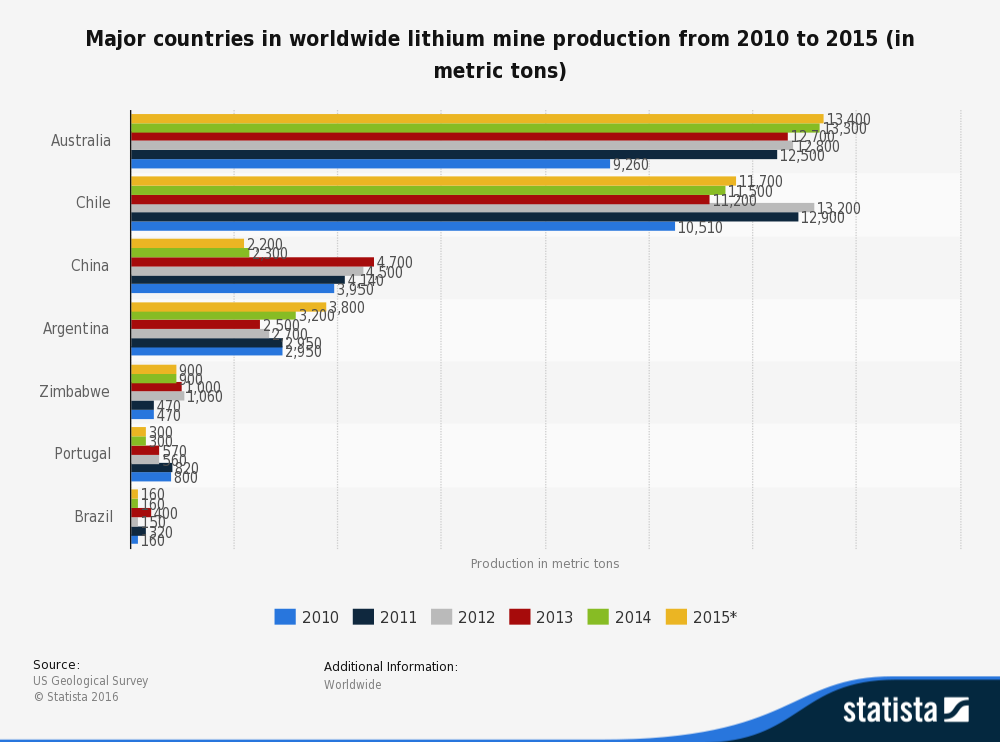
evme We get a lot of lithium through other means and most of the lithium is thrown out. The reason is that it is not used much. And as for China having the most lithium is simply not true by any standard. The mistake a lot of press makes is poor understanding. They play the game of telephone until things get distorted beyond recognition. The mistake people make is they think hybrids and EVs use the same batteries. Hybrids use NiMH batteries, which contain rare earth commonly found in China. This is where a lot of people get the impression that battery materials are mined in China and the confusion people get that Lithium is a rare earth.
Here is what Lithium Production looks like, China is a decent player, but falls behind Chile and Australia by a fairly big margin:
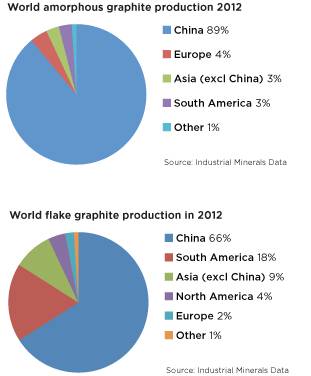
But there is one thing China does have going for it, that is Graphite production. (Though Tesla does not use Graphite from China)
 �
�
Jul 12, 2014
Jackl1956 David vs. Goliath: NV, Texas square off for Tesla�
Jul 12, 2014
redi Tesla eyeing 700 acres in southern Dallas for $5B gigafactory - Dallas Business Journal�
Jul 12, 2014
RubberToe California providing possibly massive tax break for Giga-Factory:
Tesla tax break for building battery factory buried in aerospace billLos Angeles Times
Say what you want about Jerry Brown, he most certainly does not lack vision...
Go Jerry Go !
RT�
Jul 12, 2014
Cosmacelf Hate to burst your bubble, but renewable energy costs more to produce than does conventional energy. California will have higher consumer energy prices when we hit 33% renewable energy. There may be good reasons for going renewable, but cost isn't one of them.�

Không có nhận xét nào:
Đăng nhận xét