1/1/2015
guest It seems like people forget that the model s is pretty much the best car in it's class, and it's fair to expect the model 3 to be as well. So unless there is a major economic meltdown and car sales start going down on a national or international level, or gas prices go to .01 a gallon, demand is really not something to worry about. These are products that basically need no advertising after all.�
1/1/2015
guest From the transcript,
"Elon Reeve Musk - Chairman & Chief Executive Officer
Yeah, actually � one point worth mentioning is that we're fairly worried about what would happen with the Model 3 announcement. Would it cause some big drop in, say, Model S sales? It seems to have had the opposite effect. It seems as though S demand has increased. It has...
Jason Wheeler - Chief Financial Officer
It has increased.
Elon Reeve Musk - Chairman & Chief Executive Officer
It has increased.
Jason Wheeler - Chief Financial Officer
Yeah. I think you saw the estimated number in the first quarter is 45% up year-over-year and that demand continues."�
1/1/2015
guest If it is the 60k+ fully optioned Mode 3 taking away the 71.5k base Model S sales, that would be great. As options are where the most profits are made.�
1/1/2015
guest A small point but maybe worth mentioning is that the transcript is a little off -- it should read:
Yeah, actually � an important point worth mentioning is that we were fairly worried about what would happen with the Model 3 announcement. Would it cause some big drop in, say, Model S sales? It seems to have had the opposite effect. It seems as though S demand has increased. It has...
The relevant bit starts at 51:02 of the earnings call. http://edge.media-server.com/m/p/c67hnavs�
1/1/2015
guest Finally, an upside to Tesla's tardy car releases. "It will take Tesla years to release the model 3, I'll just buy the model S"�
1/1/2015
guest Oh, stop it now. Accept that you're wrong on the topic and move on to putting a negative twist on something else instead of trying to move the goalposts. It's getting really tiresome and you'd think the dislikes you get from thread to thread on all sorts of Tesla topics would clue you in; we're not buying the garbage you're peddling.�
1/1/2015
guest Dang, I forgot that in my calculations. Makes sense now!
Actually I would think they should move them down market. The price difference between the Model 3 and the S/X is already larger than the spread for any other car maker. For most of the cars I was looking at before Tesla, the spread from their compact sedan to their full sized sedan was less than $20K. I didn't look at premium brands like BMW where it might be a bit more, but I don't think anyone has a spread like Tesla does.
The S would be about $80K fully optioned if it was a Lincoln or Cadillac. They would have to add an awful lot of stuff in the cabin to be as cushy as a BMW or Mercedes. The price of used Model Ss will likely drop when the Model 3 is introduced. People who are looking at used 70s today will be going for the Model 3. For most people, the size of the Model S is kind of a turnoff. In the US there are places where a large car is difficult to maneuver, but it's even worse in Europe. There are some people who like a big car, but they are rare. Most people who want a big vehicle are buying trucks.
Between the cheaper batteries when the GF is in production and possible cost savings from sourcing materials in larger quantities (the 3 and the S/X won't share many body parts, but they will share small components like motor parts, battery pack parts, etc.), Tesla could afford to drop the prices on the S/X and still make as much money. That's probably the only way they keep selling as many of them as they do. If they go up market they end up under utilizing two production lines to build two cars that will be selling in smaller numbers.
It would tick off existing customers that the cars are cheaper, but whining here on the Forum when Tesla does something is common.�
1/1/2015
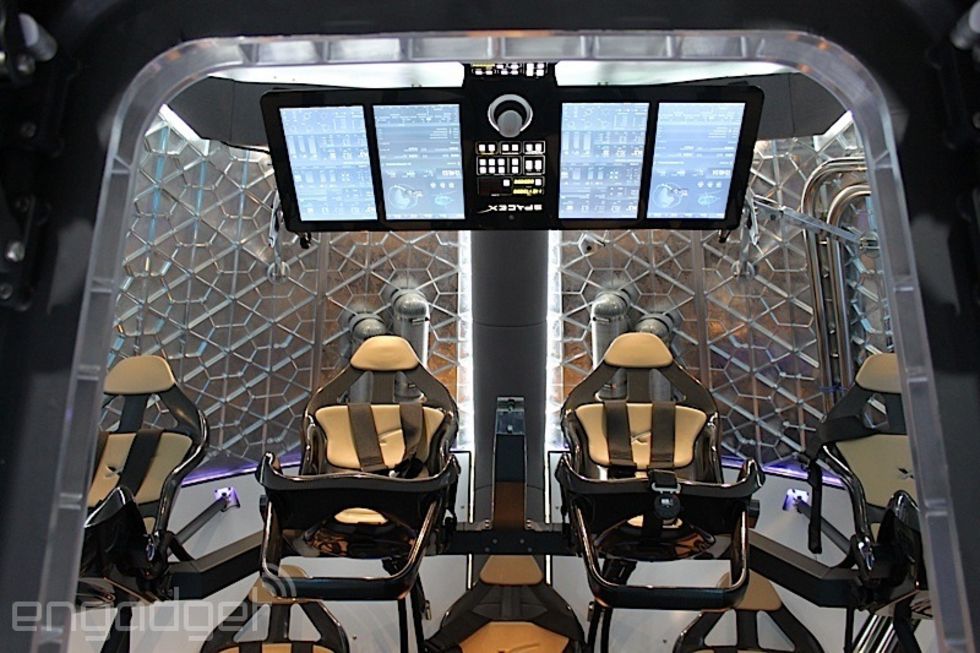
guest The model 3 looks to have a HUD that will show autopilot information, a fancy-pants steering wheel with a lot of buttons, and the 15 inch touch screen they have shown.
Is the S/X going to go all space ship like the model 3, or stay closer to the current design?
A year ago I would have said that the model 3 would offer a subset of S/X technology and options. Now I am not so sure.�
1/1/2015
guest Maybe SX goes Dragon
 �
�
1/1/2015
guest BMW 3 series starts at $33K, the 7 series starts at $81K Build Your Own BMW - BMW North America�
1/1/2015
guest All opinions are welcome on TMC. Especially in a thread like this where the bulls outnumber the bears.
It's obvious that Model 3 will cannibalize a few Model S sales. That doesn't mean there's a demand problem. Model S sales will probably continue to increase as the company and general knowledge of EVs continues to improve. That's one of the reasons Model 3 reveal contributed to more S/X sales. You can't deny the fact that a lot of people bought Model S because it was the only compelling EV on the market. Many of those buyers would have preferred something different such as a smaller or less expensive car like the 3, but there wasn't one available, and still isn't.
There is no demand problem and there never has been. Tesla's biggest headwind, by far, is being able to ramp up fast enough. It's extremely difficult to hire staff and grow infrastructure at 30 - 60% a year, every year for 15 consecutive years (to 2020 and beyond). Whether or not there's any S/X cannibalization is irrelevant. It won't change the overall exponential growth curve. Tesla's biggest problem is not demand. It never has been and won't be for at least several years. Their biggest problem is growing pains.�
1/1/2015
guest Let me correct your implication of me. I welcome opposing opinions regardless of a bull vs bear ratio. What I object to is someone who is clearly and purposely twisting information from thread to thread, and I don't care which side of the fence they stand on. I seek the truth, not opinions for the sake of opinions.�
1/1/2015
guest Tesla did not build only 50K vehicles last year due to lack of production capability. They built only 50K vehicles last year due to limited demand for the model S. If Q1 2015 had been strong they could have ramped up to 60-70K MS for 2015.
I have three Tesla showrooms within 20 miles of my home because Tesla is spending money to stimulate demand.
One of the reasons Tesla is surging Model 3 production is the concern that they may have killed model S demand growth, especially next year. This situation will likely become more obvious at the second model 3 reveal. The model 3 is likely more fabulous for the typical Tesla tech buyer compared to the current S/X.
Tesla is likely not positioning the model 3 as a typical car company would position a mid-level product. This apparent strategy looks great long term to me, but could produce some quarterly ugliness.
The way to counter the interest shift to the model 3 would be to release an upgraded dash/UI for the S/X. That may have been the ideal plan, but Tesla may not have the capacity for that change in the next 12 months.�
1/1/2015
guest Anyone see a problem there? �
�
1/1/2015
guest No. Demand is often about trends in opposition. Sales of a particular product is always the net of favorable and unfavorable forces.�
1/1/2015
guest Nonsense.
There is no typical "Tesla tech buyer". It's well known that Tesla buyers come from many different segments, from environmentally conscious Prius owners to luxury performance oriented Mercedes owners, and every possible combination thereof. We are still in the "innovator" phase of the adoption curve for EV's, demand is only going to go up for all Tesla vehicles.
![[?IMG]](https://lh3.googleusercontent.com/blogger_img_proxy/AEn0k_sSxFiZlR9sHW-_BajV6dlwiRG7x0_31Lak7m2CHPc_PGRg44deOdthLT2wEVx6W87rdy6rfgknj3FjXnBH0Q3QHdoYW3hxXxq14ljxSukhvpsZCaYURFjw_RCkmN3v1Ese7D7eUinpI1wnpOtuDvYpMrj8a4_S7oEZoQxyww=s0-d) �
�
1/1/2015
guest The use of the word cannibalize was overly dramatic, we could argue hyperbole, when considered in the context of the poster trying to minimize the message - a (reduction of a) FEW model S sales.
No doubt the reveal of the Model 3 did or will pull a group of people from a Model S purchase. It's already been discussed at length who might fall in that category of people. At the same time the reveal of the Model 3 did or will push another, different group of people to purchase a Model S.
The net result to date is an increase in Model S interest/demand/purchases, not cannibalization of said model. (That's not directed at you. I know you know what's going on. But some of us here are having a real hard time grasping reality.)�
1/1/2015
guest Perhaps you would face less vehement opposition if you labeled your opinions as such, rather than stating them as facts.�
1/1/2015
guest He could also just avoid posting an opinion that is in clear contradiction of what's been publically stated by the company. That would probably help immensely.�
1/1/2015
guest Maybe. But the last EC shows that real Tesla is not sure what the Model 3 does to Model S sales. You and cartoon Tesla are certain about demand.
All car fan sites have proponents that have certainty about their preferred cars and car companies. I prefer examining probabilities when discussing real companies.�
1/1/2015
guest In your opinion?�
1/1/2015
guest Moderator Note:
Slightly more than half of the prior two pages of posts absolutely deserve to be snipped - let's end it right now.
As a strongly worded suggestion, however: do consider your wording if you write something you know will be controversial - whether bearish, bullish or piggish - and it's ALWAYS a good idea to preface such statements with the recognition that you're presenting opinion.
�
1/1/2015
guest Offering a suggestion is different than making a statement of fact or opinion. Sorry Aud, will let it lie now.�
1/1/2015
guest As do I. The probability of the leading manufacturer in a growing industry which is still in the "Innovators" stage being demand limited for any of their products is quite low.�
1/1/2015
guest Over the long term, I suspect Tesla may do what other car makers do and introduce most new technologies on their higher end cars and only trickle them down to the mainstream cars when they have been proven and some of the wow factor has worn off. Back in the 60s power windows and door locks were only available on premium cars, but are now standard on most cars. Back up cameras will be on all car soon because US law will demand it, but it was a luxury car feature a few years ago.
This keeps up demand for the high end cars, and it allows car companies to do the final debugging of new technologies on more limited release cars before releasing it to the masses.
However, I do agree that the Model 3 could hurt Model S sales at least initially. I've been watching the used and inventory markets for a while and Tesla has had a lot of inventory Ss for sale the last 4-5 months. It's more now than ever and a number of them only have a few miles on the odometer. I suspect they built a few more inventory cars the last quarter because demand has been a bit soft. They are now pitching them as the last of the classic look cars now that the facelift is out there, but i don't see the inventory going down much. In some regions like Florida they have started discounting the inventory cars.
Back when I first started looking in July last year, there were only a few inventory cars advertised on the CPO part of the site and those all had 2K-4K miles on them. There were many more used Teslas than new.
Tesla has said that since the Model 3 reveal Model S sales have gone up and the refresh probably helped that. A lot of people would prefer the refresh if the cost is essentially the same, but with prices on the inventory cars dropping, some people are opting for the inventory cars. One thing I am concerned about for Tesla's resale is if a number of those people who are buying Ss now plan to dump them when the Model 3 comes out and there will be a glut of used Ss around.�
1/1/2015
guest How come this gentleman is repeatedly yet forcefully applying his wooden cane to this equine specimen which appears deceased?�
1/1/2015
guest In my opinion, a used S will still be better than many (most?) cars that are $35k and up. So if you are saying that the Model 3 is so appealing that it absorbs all the demand for cars 35k and up (used S being one), you are essentially saying that very few buyers in that segment would be choosing anything from competitors either. That isn't a problem, so not really anything to worry about, in my opinion.�
1/1/2015
guest Tesla seems to have manufactured some model S for CPO inventory. This keeps their numbers up, and lets them hide discounting.
Very long lead time on Model 3 could increase demand for lower priced CPO model S.�
1/1/2015
guest I'm bearish on Tesla because well, I just sold all my shares and im here to troll, hoping to scare the bejezzuz out of everyone. This may effectively cause a cascade of stop loss orders which can potentially drive prices down even lower so I can buy back in. I want to milk this method as much as possible before M3 launch because the strategy, IMO is working, especially with members here. I mean c'mon, this thread is filled with non-educated, misinformed investors who clearly has no data to back up their opinions. Am I fooling anyone yet?�
1/1/2015
guest There aren't going to be that many M3 buyers who go for the $35K base car. Elon has said the average is going to be around $42K. If someone is comparing a well equipped M3 at $50K to a fairly bare bones CPO MS with rear wheel drive and no AP, I think most are going to go for the M3.
My point is they have had many more new inventory cars over the last few months than they had when I first started looking last summer. The CPO/Inventory car website last summer was 95% CPO and 5% Inventory and all the inventory cars had a couple of thousand miles on them. Now the site has 0 CPOs for the entire US and 370 inventory cars. Around 50 of those cars have less than 100 miles. Around 150 have less than 1000 miles.
Tesla Inventory Search
http://ev-cpo.com/
The third party sites are easier to search than the Tesla site. I've seen Tesla's site just drop cars from the list mysteriously when you change parameters. For example you search for 90D only and a car that was on the list when showing all disappears.�
1/1/2015
guest They just updated Midel S, hence all inventory is out of date and must go.�
1/1/2015
guest Apparently they did list about 100 CPO cars on the site within the last couple of hours. So the used ones are coming back. Apparently a lot of leases from 2013 are expiring.�
1/1/2015
guest What do you base that remark on ? I am not aware of any factual information to points to that. Au contraire.
I am not so sure what to think of the last line in that quote...
Are you seriously implying that Tesla is 'dumping' newly build cars in the CPO stock to sell at a lower price ?? This instead of delivering to their world-wide customers eagerly awaiting delivery of their ordered full-price Model-S. (Or is this a language barrier at work and do I not understand what you say correctly ?)�
1/1/2015
guest You need to call. Tesla doesn't expose their inventory to the public.�
1/1/2015
guest There's something called showroom car, and there's something called loaner car.�
1/1/2015
guest And test drive car.�
1/1/2015
guest Apparently those test drive cars need to be replaced after a couple hundred miles.�
1/1/2015
guest They need to be replaced when a new Model S design is introduced. Exactly like they did when they introduced the dual motor / autopilot variants.
How does something this obvious not make sense to you?�
1/1/2015
guest Apparently showroom cars only have a couple hundred miles on them.�
1/1/2015
guest Than why do they have a link for it on their website?
Pre-Owned Model S | Tesla Motors�
1/1/2015
guest Their whole inventory.
As far as I have read, no one has any idea of why a particular vehicle may of may not appear in CPO inventory online.�
1/1/2015
guest That's true, from reading the CPO thread it sounds like you need to contact your local CPO specialist if you are seriously looking.�
1/1/2015
guest I wrote an article about the 2 reasons I think Tesla will dominate.
The 2 reasons Tesla will be Number 1�
1/1/2015
guest You made an error here:
At the cell level they are around 250Wh/kg, (probably closer to 260Wh/kg with the new 90 cells), but at the pack level they are probably closer to 150-160Wh/kg.�
1/1/2015
guest So I don't know how many use valuation metrics other than p/e, but I think the Price to Book Value is much more relevant for long term-investing and generally deciding how over/under priced a company is. Tesla has usually had a very high p/b especially for a non internet company, at one point I think it was over 100 and for a while it seems to hover over 50. As of late it's been about 30 which is still pretty high. But with this capital raise as of yesterday, an interesting thing happened in which it over halved the P/B. Not bad for one day of work so to speak.�
1/1/2015
guest The major problem with price/book is that book value tends to get understated over time, due to a consistent (and understandable) bias in the accounting conventions. So for example, Tesla's book value currently values Tesla's brand, copyrights, patents, trademarks, trade secrets, designs, know-how, and so on at $0.
The minor problem with price/book is that book value can get *overstated* -- this happens when assets turn worthless, or turn into liabilities (as happened in the case of asbestos miners and manufacturers). So the book value of the coal mining companies is much higher than their actual value right now; their coal assets are listed on their books as being worth money, when they're actually a liability.
However, Tesla is a business with a large amount of tangible assets which *do* go onto the books at something roughly approximating their value: factories, machinery, service centers, etc. This means that book value is a lot more meaningful for Tesla than it is for (for instance) Microsoft.�
1/1/2015
guest I continue to play around with long-term valuations for TSLA. I am not an accountant so I wanted to do a reality check against making a mistake guesstimating COGS, OpEx, CapEx, P/E, etc. So I decided to benchmark my analysis using some of the basic assumptions adopted by Goldman. They presumably know how to crunch numbers, and despite the recent upgrade traditionally have had a relatively lukewarm outlook on Tesla ("hold" with the occasional "buy").
In the summary below from 2014 (courtesy of @vgrinshpun's post in the short-term thread -- thank you!), Goldman lays out a number of scenarios for valuing Tesla, depending on how its business grows. (They seem to follow a similar approach in their most recent valuation but some of the details are obscured.)
Goldman refers to one set of assumptions as the "Elon as Henry Ford" scenario. In this scenario, they propose that Tesla will sell 3.3M vehicles in 2025 at a gross margin of 16%, with an implied share price of about $1835 in 2025.
This may sound ambitious, but Tesla's recent projections call for selling about 1,000,000 vehicles in 2020. This implies a greater than 80% growth rate (by unit) from 2015 to 2020. Projecting a substantially reduced 50% growth rate from 2020-2025 would result in sales of approximately 7.6M vehicles in 2025 -- far greater than the 3.3M units Goldman projects, which implies less than a 25% growth rate after 2020 if Tesla hits its 2020 target.
It is worth noting that selling 7.6M vehicles in 2025 is hardly "Henry Ford" territory. Tesla would still likely be only the fourth largest car manufacturer by unit, behind Toyota, Volkswagen and General Motors, all of whom are already producing more vehicles than that. Automotive industry - Wikipedia, the free encyclopedia.
For purposes of this calculation, I accept Goldman's assumptions regarding ASP, GM, PE, etc., but assume a different "base case" -- i.e., that Tesla meets its goal of 1,000,000 vehicles in 2020, plus achieves 50% growth (by unit) through 2025.
This implies a stock price of $4226 in 2025 -- $1835*(7.6M/3.3M).
It is important to note that this number attributes zero value to the Tesla Energy business, which some have predicted could be as valuable as the vehicle business. It also fails to account for the true "upside" to the "Elon Musk as Henry Ford" scenario, where growth continues at above 50% rates well past 2020.
Many people may discount the likelihood that Tesla will meet its goals. Presumably, they are in the majority or the stock price would be higher.
But I believe it is a reasonable assumption that Tesla will meet or exceed its stated goals. If it does, based on Goldman's analysis the stock should increase about 20X between now and 2025. More than 20X if Tesla exceeds its goals (or the TE business takes off), less than 20X if it doesn't.
![[?IMG]](https://teslamotorsclub.com/tmc/attachments/snap1-png.173883/) �
�
1/1/2015
guest EinSV, while I think no one should overlook TE, i like that you were attempting to be conservative. However, I generally think it is very unlikely that we arrive at our destination with the current share / debt structure. At some point we are more or less guaranteed to raise additional capital through bonds or another raise. My guess is likely a debt raise at a higher share price. Again these raises are necessary to fund growth, so they are a good thing, but the current number of shares can not be extrapolated into a share price in a simple way.
Disclaimer: Also, not an accountant. Things may in fact be easy to calculate, just not for me.�
1/1/2015
guest Thanks for the input, Tenable.
I assume Goldman's models, which they present on a $ per share basis, factor in dilution since this is fairly standard. I do agree, however, that it would be reasonable to assume that additional capital or debt above and beyond what Goldman has built into its model would be required to grow 2.5 times faster than they project in their "Elon as Henry Ford" scenario. But I don't think this changes the overall analysis materially for at least two reasons.
First, any additional dilution and/or debt/interest payments should be more than made up for by the TE valuation that I discounted entirely to illustrate how undervalued I believe Tesla is at its current price point.
Second, if Tesla succeeds in launching the Model 3 anywhere near according to plan, the share price is likely to gap up between now and 2020. A higher share price allows a fixed amount of capital to be raised with less dilution on a per share basis. For example, if Tesla is priced at $430/share after a successful Model 3 launch, it can raise twice as much capital as it can at today's $215 price with the same dilution on a per share basis.�
1/1/2015
guest
Tesla Model S & X To Launch In South Korea in 2017 - Model 3 In 2018�
1/1/2015
guest Finally. South Korea has the potential to replicate Hong Kong's success. Hyundai may pose some obstacles though.
I read somewhere that you can buy a Model 3 around $15k USD after all the incentives in Korea. Pretty crazy. Haven't taken the effort to verify it though.�
1/1/2015
guest Great idea in that article that kt may convert idle telephone booths into ev charging stations. Other cities should look into this idea!�
1/1/2015
guest Those are good points, which I should have included. I do think P/B is pretty useful if you can take those caveats into account though, another example like the coal companies is RIMM/Blackberry just after iPhone sales started taking off. One way to get a more useful number is to use tangible book value to cancel out IP and goodwill. But even then you still after be careful, particularly with tech companies where the leading product can become almost obsolete in a very short period of time.�
1/1/2015
guest Though Korean auto workers would rather have a Tesla than the cars they build:
Employees at Korean automakers pick Tesla over their own brand�
1/1/2015
guest The two errors in the Goldman analysis from 2014 are interesting:
(1) What the hell is up with their discount rates? The discount rate is supposed to be based more or less on what investors can get in an alternative investment. What alternative investments are routinely earning anywhere near 15% - 20%? I guess this is supposed to be a cost-of-equity rate assuming that Tesla will be engaging in very massive dilution, but it seems absurdly high compared to Tesla's historical cost of equity.
(2) They assume that BEVs will account for a miniscule percentage of all light vehicles in 2025, when they will account for the majority.
Apart from that, it's quite a good analysis.�
1/1/2015
guest As you say, I have no idea where you can find an alternative investment that will return 15-20% right now, particularly in a zero percent interest rate environment where almost all asset classes are highly valued (many would say overvalued). Having said that, although the discount rates Goldman uses are very high, from what I can tell they are not completely out of line with rates that are sometimes used for high-Beta stocks that are perceived to have a lot of risk.
Where I think Goldman's analysis goes awry is by combining the high discount rate with very pessimistic growth targets, which drives the valuation down dramatically.
For example, in the recent valuation, for their base case, Archambault/Goldman predicted global EV sales would be only 2M vehicles by 2025, which as you note is way too low. The summary table for the recent valuation (copied below) doesn't report a Tesla-specific sales volume prediction for 2025, but assuming Goldman estimates that Tesla captures 50% of the EV sales, that translates to only 1M Tesla sales by 2025. They attribute 45% of their valuation weighting to this very pessimistic scenario, and another 20% to an even more pessimistic scenario where worldwide EV sales total only 1.6M in 2025, and presumably Tesla sales are well under 1M.
So the current valuation (like their 2014 valuation) is heavily weighted (65%) to two scenarios where Tesla produces 1M vehicles or less in 2025, which I think is extremely pessimistic given Tesla's target of producing that many vehicles in 2020, five years earlier. Then, as you note, they apply a high discount rate to get to the $250 valuation. If you use what I believe are more realistic projections for 2025 (even well below the 7.6M figure I used), you get a much higher current valuation, even using Goldman's generous discount rate.
![[?IMG]](https://lh3.googleusercontent.com/blogger_img_proxy/AEn0k_vAxqIM22h1o0sPFBXZDuVjFUMZOsaPxAOYq_51EiB4ut_zUbaD4lrWMru9V5VwqUe7RRtrztCpQJBgYT2BCePw4QN2V4OPdqLQVpZ9R5K6fB_A9HO3hCfgI2sAX_kbaHnuo3z6X3uZN2jjF1jMhhrwvW0bzAVY21Ib4aVPdmUQjNht=s0-d) �
�
1/1/2015
guest At today's Tesla shareholder's meeting, Elon was asked about his thoughts on the revenue mix between cars and Tesla Energy products. He said it was highly uncertain at this point, but his best guess was 50/50 mix.
What would be the impact of Tesla evolving into a company that builds 500k vehicles/year, plus an equivalent revenue of stationary storage packs?
Very rough calculations:
100k Model S/X @ ASP of 100k/unit = 10B
400k Model 3 @ ASP of 42.5k/unit = 17B
27B in automotive revenue, + 27B in stationary storage = 54B in potential annual revenue from Fremont and Gigafactory 1. That's INSANE.
For context, Intel Corp. is in the 55-60B annual revenue range.�
1/1/2015
guest ....yeah, that seems plausible, but Tesla's margins on stationary storage are gonna be a lot lower than Intel's margins on CPU chips, just to put a mild check on your optimism. Still gonna be a huge and highly profitable company.�
1/1/2015
guest Why? Mind you we're talking in the next say 5-7 years and not many years in to the future.�
1/1/2015
guest Because CPUs are an item with high cachet, brand value, unique intellectual material in every single design, etc.
And batteries, even particularly good designs of battery, are a commodity. They're much more comparable to RAM than to CPUs. The price competition in the market is much harsher; people will desert you if the competition is 10 cents cheaper. Tesla may well have the lowest production costs and best margins in the battery business, but it's not going to have the same character as the CPU business... or the luxury car business, for that matter.�
1/1/2015
guest Respectfully disagree, for the following reasons:
1. Tesla Energy won't sell battery cells but stationary storage solutions. Complete solutions are levels higher in the complexity hierarchy and will give room for much better margins.
2. Customers can't go to the competition of there isn't a lot of competition.
3. And even if they're will be more and more competition they won't have the first mover advantage and economics (low cost) that Tesla will have.
All in all I wouldn't be surprised if they can achieve over 30% gross margin for many many years on Tesla Energy products. In fact for the first few years it might be much higher. Recent retail pricing they have for PowerPacks certainly suggests this.�
1/1/2015
guest No, they're not much higher in complexity. I could assemble cells into a "complete solution" right this minute; it's *easy*.
Also, they're not selling complete solutions! They're currently not selling their own inverter, which is a key component to a "complete solution".
(If Tesla suddenly produces their own super-inverter, that would obviously change the picture. I wouldn't put it past them!)
True, but there's *already* significant competition. This isn't like the car industry where the other automakers deliberately crushed their electric cars and then introduced "compliance cars" and tried not to sell them. There's serious effort being made here in the battery sector.
I seriously doubt that. They'll be able to get very high margins for a year or two as the most desperate early-adopters buy batteries, but probably not much longer than that.�
1/1/2015
guest @neroden: I think we're talking about different things. I'm talking about huge volumes of complete energy storage solutions. You're talking about something else that anyone can easily build, source cells for at competitive prices in huge volumes and where there's already a mature market with a lot of established competition.�
1/1/2015
guest OK. In that case, my point is that Tesla isn't selling complete energy storage solutions at all yet, and *doesn't even intend to*.
Tesla is selling battery packs with a certain amount of management to *third parties* like SolarCity who build the rest of the "complete energy storage solution". Or at utility scale, the utility does most of the design work, except for the batteries themselves.�
1/1/2015
guest @Johan : I don't think Neroden is arguing the revenue potential of Tesla Energy. He's arguing the possibility of Intel gross margins which have been in the 55-65% range for Intel for multiple years. Even you are agreeing with him that Tesla Energy is unlikely to see gross margins like Intel has been reaching.�
1/1/2015
guest Right, correct, that's what I'm saying. Apologies for the confusion.
I think the revenues from Tesla Energy will be humungous, just being cautious about the margins!�
1/1/2015
guest He said 10% GM. I said I believe we'll see better than automotive, ball park 30%. And I think >50% gross margin could be possible at least in the time frame from say 2020-2025, just because you know Gigafactory, and I'm not seeing competing initiatives popping up.�
1/1/2015
guest I've only talked about margins, no confusion on my end.�
1/1/2015
guest (a) I don't see how they get a better margin by selling raw batteries than by putting a car with a fancy marque on top of them. If they did, people would buy the car and strip the batteries!
(b) I am seeing competing initiatives to build out mass production of lithium-ion batteries. Particularly in China.�
1/1/2015
guest (a) they will sell Power Walls, Power Packs and probably lots of different varieties, not "raw batteries" (what gave you that idea???)
(b) anywhere near Gigafactory ambitions with regard to volume, quality and price reductions? Please share more info, very interesting.�
1/1/2015
guest I would think Tesla Energy will have pretty good margins at the start as they have very little competition and there is a massive potential market. Unlike Tesla cars, the tech in the stationary storage isn't that complex. I'm sure Tesla is leveraging their expertise in battery charging from the cars which will make their stationary batteries last longer and probably a bit more efficient, but overall the tech isn't all that complex and I expect battery companies will be jumping into that market as soon as Tesla pioneers it. In a couple of years we will likely see Samsung and LG powerwalls. The various Chinese battery companies will likely see it as a gateway into the US market and we will see some brands we haven't seen much in the west too.
Tesla will probably be the Cadillac of stationary storage like HP was with printers in the 1990s. There were a lot of brands of printers, but HPs carried a premium because they really were better.
The upside is stationary storage is mostly an appliance selling business. Tesla doesn't need an extensive service network and they will likely just work with little attention for years. Once up and running the TE side will probably help expand the car side of the business.�
1/1/2015
guest There's a lot of competition for Tesla in stationary storage, including from Panasonic.�
1/1/2015
guest Queue the Tesla Energy killers.�
1/1/2015
guest Apparently Neroden is seeing several emerging from China and I'm patiently waiting with a high level of interest to find out more about these.�
1/1/2015
guest Yes, I gathered that from his post/s. Maybe Elon, J.B. and Co. got it wrong this time? They aren't onto something unique, better, more attractive and of increased value/dollar than what anyone else is currently offering, can offer in the same time frame, or will offer in the future. They aren't seeing a bigger picture or ahead of the curve. And they'll lose money on every unit. But I'm not betting on it.
I'm waiting for the - because I know it's coming - 'there's no way that Tesla can come up with a better, more efficient car factory/car manufacturing (battery factory?!) set up than what all other OEM's are doing and have been doing for a century. It's not possible. It's hogwash. Talking out their butts. Etc... Not betting on that either.
Let there be no confusion. As humans they are not perfect but quite fallible as they've proven, but they are so ahead of 'everyone' and their intentions are always for 'our' benefit, that you have to be a fool or an arrogant twit (take your pick) to not believe in what they are capable of and not get behind them.�
1/1/2015
guest "Tesla Inside"
??�
1/1/2015
guest Geez, guys. I'm bullish. I think they'll sell huge volumes at *decent* profit margins (10% - 25%) for years to come. I just don't think they've got the ability to retain super-high profit margins on a commodity business which is already seeing lots of competition.
China�s Lithium-Ion Battery Production Tripled In 2015
I agree with everything wdolson says:
�
1/1/2015
guest This is where Elon's vision of a newer production model will be validated.
TE/TA allows Tesla to remain profitable by allowing them to shift resources to whichever segment is doing well and where-ever the demand is (gosh darn I said it). If the factory(s) have hyper efficient (or even reasonably efficient based on Elon's thesis) production capability then maybe it would also allow for greater flexibility in product manufacture.
I couldn't help notice during the meeting Elon pausing over the electric airplane bit at the beginning. If the factory(s) can be made to be flexible and efficient, then once the competition thinks they caught up, Tesla would just be able to develop new products and technology to maintain its edge and push sustainability.�
1/1/2015
guest LG is suposed to have the cheapest high quality battery packs available and they are selling packs to GM for $225 per kWh. GM is buying a big volume to get that price. Tesla's costs will be under ~$125 per kWh by 2017. How is that competition?�
1/1/2015
guest In addition there has been a lot of discussion and analysis that strongly suggests that LG (I assume that what you meant to write - damn you auto correct) labelling their price for the battery at $225 to GM on a slide that perhaps was never meant to be public may or may not be solid price information, seeing how LG is supplying a full solution to GM (drive train, battery, much of the vehicle technology) and not just batteries. So it becomes more of a theoretical price than an actual price, since it's baked in to a bigger solution. In addition it could be inferred that one of the reasons why LG might sell batteries to GM with relaitvely low margins could be that GM is effectively financing LG's development of a future LG car (EV) platform.�
1/1/2015
guest GM: Chevrolet Bolt Arrives In 2016, $145/kWh Cell Cost, Volt Margin Improves $3,500
Yes, I know this is cell-price and you said pack-price. But would the pack-price be so much higher then the cell-price?�
1/1/2015
guest The $225 per kWh price is an estimate by GM's head of Volt production. So it was an extremely well informed estimate.�
1/1/2015
guest First, you're oversimplifying this in some significant ways. No you can't assemble a pack on your lap, it's not going into an RC model. Thermal runaway is real and has to be dealt with, which Tesla spent a lot of R&D for (and probably still does). You have to carefully match charge/discharge parameters in the BMS programming with the specific makeup of the battery and targeted usage pattern to hold up your warranty. You have to construct the pack to physically hold everything together and be cost-effective (imagine a fridge sized stack of cylindrical cells -- it's not that simple).
Second, "the machine that makes the machine" is a point of differentiation. Sure Panasonic has the part that cooks up individual cells (to Tesla's spec), but my understanding is that the rest of the pipeline from raw materials to finished packs is, to a substantial degree, designed by Tesla. And that is where they claim the "secret sauce" actually is that allows them to lower the production cost vs. the others.
Can someone rival them? Sure, in theory. Do they have a substantial edge over competition? That looks to be the case but we'll have to wait and see.�
1/1/2015
guest When the battery storage market is taking off, the Chinese will not hesitate to sell below cost to stake out their share of the market.�
1/1/2015
guest So? They can have the part of the market that is so price sensitive that they don't care it's a lower quality product that doesn't stand up and will have to be repurchased. It's not like it doesn't already happen in other sectors and it's not like we're unfamiliar with loss leaders.�
1/1/2015
guest At
Tesla's Battery Pack Costs Are Cheaper Than You Think -- The Motley Fool
I was not surprised by the $190 per kWh figure because I had already determined based on Elon's and JB's comments that I was absolutely sure that their maximum possible was $190 but I also concluded that $170 is much more likely. Coupled with the recent news of the GF production increases I think that Tesla's costs will be under $100 per kWh by the time the M3 launches.�
1/1/2015
guest There's an "apples to apples" question too. What's the lowest realistic C rate on the Bolt? Is the 0-60 mostly pack or motor limited?
I assume Tesla ten year plan is not to produce the lowest price 200 mile EV, at least with the model 3 cell/pack technology.�
1/1/2015
guest How has the Chinese government policy of subsidized dumping of Chinese solar panels worked out for them?
Are Chinese solar panel makers now making oligopolistic profits?�
1/1/2015
guest Just for the record: Are you still talking about pack cost? I have no problem with an estimate of under $100/kWh for the cell cost, but think it may be a bit low for the pack cost. But nothing would be better then if it gets that low...�
1/1/2015
guest Yes. I believe that ny the time the M3 launches (end of 2017) that the pack cost will be under about $100,per kWh.
When they announced the GF they said, conservatively that the GF related cost reductions would be 30% by end of 2017, and 50% by the end of 2020.
Elon also said "moderate, not big or small" improvements due to cell chemistry. Over 18 months 5% in definitely moderate. That total is over 35%.
So if we use $185 per kWh as the current price (Tesla said under $190), and use 45% for the GF plus cell chemistry discount we get $101.75.
That's an extra 10%, but we have three places to make that up.
1. The initial 30% figure was conservative.
2. We know that that is too low because of the production at the GF is about 3x their original expectations.
3. We know that 5% over 18 months for the cells is probably too low.�
1/1/2015
guest When they announced GF in 2014, their pack cost is $185/kWh? If so, they haven't improved one bit in two years. If not, you need to recalculate your number.�
1/1/2015
guest There's that and also from what I recall in one of the recent interviews it was stated there's a possibility of 3x volume but they also might not take it that far.
Personally I think it's not feasible to make cost estimates with any precision since we just don't have enough base information on what's going on.�
1/1/2015
guest Tesla called in and stated in a phone call in April 2016 that their pack costs are under $190 per kWh. That obviously has nothing to do with GF related cost reductions.
Here we go again. When I used Elon's statements plus understanding of basic cell chemistry to demonstrate that their pack costs were between $170-$190 per kWh you argued against that based on your feelings! You posted that ridiculous FUD and got some likes. Now that my figures have been confirmed by the phone call I mentioned you have learned nothing from your past foolishness.
I believe that my figure is pretty close to the upper bound.�
1/1/2015
guest Their current below $190/kWh pack cost obviously has little to do with GF because they haven't started to produce packs for cars there yet. But you are using this number today as a base, and applying the 30% they said in 2014. There is definitely a discrepancy between their cost in 2014 and today. And the 30% lower cost should be applied to the number they had in 2014, which we have no reason to believe was below $190/kWh.
Edit:
OK I see your reasons behind this. 30% is the sole effect of vertical integration at GF, no matter what the base cost is. This makes sense.�
1/1/2015
guest Battery Supplier Deals Are Key to Lower EV Prices�
1/1/2015
guest Exactly. I apologize for being a jerk.
Thank you for your understanding!�
1/1/2015
guest As in the infamous flaming hoverboards this last Christmas?�
1/1/2015
guest That's true but I'm not sure how useful that is. From the smug faces of Elon and JB when they talk about it I think they're thinking WAY lower. For example, the fact that they now have figured out how to essentially save over 50% on the GF building itself, how does that affect the cost? Does that also mean they figured out more automation and will save on on-going labor costs?
Do I remember right a figure of $60/kWh for raw materials (using who knows what chemistry)? That would bracket the price nicely but then again we don't know how much they're going to be able to squeeze raw materials price with their ridiculous volume. Also with capacity improvements both raw materials and manufacturing cost per kWh decreases proportionally so even materials cost is a moving target.�
1/1/2015
guest That is beautiful stuff right there. A bromance in the making?�
1/1/2015
guest We don't know LG's profit margins, now, do we?
Also, even if Tesla somehow has a *much much cheaper production method*, it's going to be hard to keep all their advantages secret, and reasonably straightforward to copy it. I would not expect that level of advantage to last more than, say, 5 years. (Even if they patent the method, because China will ignore the patent.) Chinese battery companies are *hungry, eager, and fast-moving*, unlike the remarkably complacent Western automakers.�
1/1/2015
guest More to the point, is anyone *else* making oligopolistic profits? No. The Chinese competition has prevented that. Likewise, it will prevent Tesla from making monopolistic levels of profits on the stationary storage market. Tesla will still make *decent* profit margins.�
1/1/2015
guest LG doesn't make cars. I doubt they will be able to beat Tesla in the price of their batteries. So LG makes a 20% profit margin like Tesla, and GM, who has to buy the batteries from LG at a 20% markup, can't make any money on its EVs and compete with Tesla.�
1/1/2015
guest I seem to remember Elon saying that raw materials should be around $80/kWh.�
1/1/2015
guest Absoutely, but we were talking about the *stationary storage* market.
In the car market, Tesla is *still* not facing anything resembling competition.�
1/1/2015
guest You are assuming that the Chinese government makes its policy decision on rational economic grounds only. Not so. They will keep doing it for every big name strategic sector. See steel for the latest round of this. And being able to announce headline grabbing renewable projects with a goal of replacing coal plants gives additional political backing. When battery storage takes off, it will be exactly such a sector that the Chinese want to 'own'. In fact, they already put $400M in last year and Chinese lithium ion battery output tripled as a consequence. And that's peanuts compared to what will happen when they really get going.�
1/1/2015
guest At that time it was talked about $180/kWh cell cost. So even $190/kWh pack cost today is a significant improvement.�
1/1/2015
guest �
1/1/2015
guest That figure is directly affected by energy density. Greater energy density means less materials per kWh. Energy density also impacts the pack related costs because if you increase the energy density you decrease the number of of cells per kWh by the same percentage. In other words the main reason that improved battery chemistries reduce the cost is the increased energy density.
The pack prices we are discussing are for cars. The TE packs cost more per kWh, primarily due to their lower energy density. Of course TSLA also has a big cost advantage for TE packs.
I think it's obvious that TSLA will have a huge cost advantage for quite some time. We are talking about over a 100% advantage in costs, plus a big advantage in quality. Thundersag batteries might available for about the same price but so what? TSLA has huge advantages in price, quality and costs to scale production. Their GF related technology is going to be almost like printing money at commodity scale for both cars and TE.�
1/1/2015
guest Grumble, can not edit my post.
I agree that their prices are probably much lower. I agree that the additional ten percent discount that I used for the increase in the factory capacity is probably conservative. And of course as the capacity of the cells increases the cost of raw materials decreases proportionally, along with everything else. I'm believe the five percent discount that I used to account for that is probably low.
My personal opinion is that their cost will be under $93.50 ($170 - .45), based on the fact that in my original analysis I thought that $170 was more likely to be the correct upper bound than $190. I'm attempting to hit a conservative enough upper bound figure that most of us can agree with.
But I believe that a,figure of close to $100 kWh is very important for investors to understand. It is under half of GM's cost for the Bolt, that GM is bragging about so it's a huge cost advantage for Tesla compared to the rest of the industry.
And the $100 per kWh number is a commonly accepted number for the point at which building a BEV costs less than building an ICE.�
1/1/2015
guest Yes, unless the increased energy density is from more highly engineered, i.e. costly, materials and/or production techniques.�
1/1/2015
guest
There is still no evidence that Tesla/Panasonic has an advantage in cell production price/cost. Although I have no doubt that Tesla will have the lowest pack production cost.
If Panasonic has invented a new generation of cell producing machines, why would they pass that savings to Tesla?�
1/1/2015
guest He did say that. He also said that the point they needed to get to for the pack was $100 as that made the battery equivalent to the cost of an IC engine. He also gave an approximate timetable for reaching that, but I forget. Seems to me, though, that they might be ahead of that curve.�
1/1/2015
guest JB said that the primary way that improved batteries reduce costs is due to increased energy density.
Production techniques are similar for all current lithium ion cells There is no direct connection between energy density and cost of materials, except for avoiding expensive materials.
By no connection I mean just because a material costs more or less does not mean it's use will lead to increased energy density.�
1/1/2015
guest My understanding is that at this point, Panasonic is more of a contract manufacturer for Tesla. Tesla owns the battery design and is even getting involved in the manufacturing process. Panasonic will be able to apply the Tesla innovations to non-Tesla battery production which is where Panasonic is getting their value.�
1/1/2015
guest This latest news on Tesla's plans for the Gigafactory seem very in line with recent claims they will seek to greatly improve the "machine that builds the machines".
Like others who have posted, I wonder about the cost impact of Tesla being able to use this existing GF to produce enough battery packs for nearly 1.5 million cars in next few years? Obviously means the battery cost per Kwh is likely to fall even faster than they have previously predicted. The huge capital expense of the gigafactory can now be spread over 3 times as many packs. I expect the cost of the factory must be a major part of battery and pack production Kwh cost. Seems one more indicator that instead of easing up, Tesla keeps coming up with new ways to continue pull away ever faster from any/all competitors.�
1/1/2015
guest The full 2016 shareholder meeting:
�
1/1/2015
guest I don't have exact numbers but from memory the cost of the building itself is not that great. There are other economies of course.�
1/1/2015
guest When I say the Gigafactory cost, I meant the cost, not only of the building, but also all the equipment and everything else needed for it to produce cells and packs.�
1/1/2015
guest That is why I commented on that part of your post. I haven't seen any references that equipment cost got lower, just that they can stuff more of it into the same building. So the cost reduction is in the structure not tooling.�
1/1/2015
guest I think that's partially true. But OTOH Elon and JB have said that one of the primary ways that the GF will reduce costs is the custom cell manufacturing equipment. Two of the ways to customize the equipment are to scale it and to integrate it. This will probably cost more on an absolute basis, but probably less on a kWh per dollar basis.�

Không có nhận xét nào:
Đăng nhận xét