Mar 4, 2014
SFOTurtle If you want a psychological boost by seeing a slightly higher number, switch your settings to range mode and you should see 2 or 3 additional rated miles at 90% SOC and probably the same at 100%. I'm at 14,500 miles, and my numbers are basically identical to yours.�
Mar 4, 2014
Kipernicus My battery's about the same as hans and SFOTurtle. 4 mile gain from all that range charging hardly seems worth it. I'll use it when I need it, and hopefully the degradation/out-of-balance will slow down in coming years. At least there continue to be more superchargers coming out!�
Mar 4, 2014
dennis 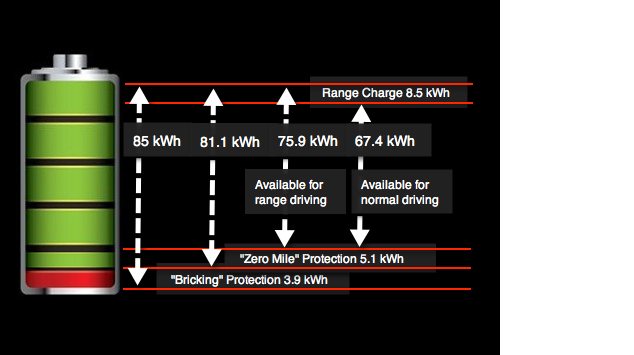
According to this graphic there are 75.9 kWh available for range driving. This weekend I did a range charge and immediately drove to where there were 7 miles left and 69.2kWh used. 7 miles equals approximately 2 kWh, so my usable capacity is now 71.2 kWh, representing lost capacity of 4.7 kWh, or approximately 16 miles of range. My current range charge shows 245 miles of rated range. So the "algorithm problem" appears to understate my battery capacity by 4 miles (265-16=249).
The real question is whether the lost 4.7kWh is recoverable by improved pack balancing with some future software release (as opposed to better range estimation).
'A' battery, 11,000 miles in 16 months. Normally charge 40%->80%, approximately 10 range charges total.�
Mar 4, 2014
Kipernicus I wonder what this chart looks like for a 60. Would the protections at the bottom be a similar %, or a fixed # of kWh?�
Mar 4, 2014
Gear I'm wondering the same.
- - - Updated - - -
I wonder how accurate this chart is when the total of the 4 segments shown is actually 84.9kWh. Do we know where this chart originated from exactly?�
Mar 4, 2014
ckessel Oh, I have an A pack, if we're tracking degradation by pack type.�
Mar 4, 2014
gaswalla my observation is that the less frequent one does a range charge, the larger the "degradation" appears when the range charge is finally done. In my opinion, this leads more credibility to the fact that the range loss is from balancing issues, and can be recoverable by repeated range charges.�
Mar 4, 2014
yobigd20 AFAIK not from Tesla. somebody made it up and it's complete speculation.�
Mar 4, 2014
apacheguy Maybe, but at any rate it is NOT healthy for the pack to be imbalanced. Reason is that some cells will be cycled to lower SOC than others which can be detrimental. So we shouldn't just say, "Oh well, my pack is out of balance so it's not a big deal. I'll recoup those miles when I range charge next time."�
Mar 4, 2014
wycolo > Did my first range charge in quite a long while and got 250. I'm at 14 months and 18,000 miles. A bit disappointing. I was at 272 when I got the car, so very close to 10% loss in a little over 1 year. [ckessel]
So you got 272 @14 months ago under (ancient) firmware, and 250 today under latest firmware. Due to the firmware differences your best today might be around 255, based on what others have concluded, I believe.
In the next few weeks if you can do a couple of range charges for long trips down to ~20 miles remaining each time, you might see that number improve somewhat.
--
--�
Mar 4, 2014
Thumper My experience is identical to wycolo. A pack battery, 11K miles, first max charge for months, 250 miles. Is the loss real? It is hard for me to think that with all the other sophistication that Tesla has put in our packs, that they don't balance cells automatically. I will not be undertaking any max charge regimens unless directed by Tesla.�
Mar 4, 2014
Denarius I don't believe this is true. As I understand it, the high and low of the pack is determined by the most out of balance cell. That is why your capacity is reduced.�
Mar 4, 2014
apacheguy Yes, that's true, but not what I was saying. I was merely arguing that it is detrimental to battery health to run an out of balance pack due to the fact that some cells will inherently be cycling to lower SOCs (bad) than other cells. This is why Tesla really ought to do the best they can to have the BMS continuously balance the pack, not just when charging to 100%.�
Mar 5, 2014
stopcrazypp I believe the range buffer on the bottom (both the "reserve" range after "0" miles left is shown and also the buffer that prevents battery bricking) prevents that from happening, however, you are correct that in general it raises the risk of a over-discharge. The Roadster does continuously balance the pack, but Tesla appears to have disabled or greatly reduced that for the Model S.
I suspect two factors for why Tesla did this: 1) Elon once mentioned they worked hard to get the charging efficiency numbers higher for the Model S in order to have good EPA numbers (and balancing is detrimental to this as you are essentially throwing energy away). 2) Vampire drain has been a big issue for the Model S and continuous balancing will only make it noticeably worse.�
Mar 5, 2014
rlang59 I also wonder how much of the balancing got screwed up when they implemented the charge slider.�
Mar 5, 2014
Gear Maybe I'm missing something, but how would it affect vampire drain if they just balanced at the end of each charge?�
Mar 5, 2014
Jeff Miller I have no idea if this information is correct, and I apologize if it has been posted before, but over at the teslamotors site
Range degradation remedy? | Forums | Tesla Motors
a poster is claiming that Tesla sent him the following email, which basically claims that the reason one might see a higher rated range after a full charge is that doing a full charge lets the car measure the battery's energy capacity more accurately than it can be estimated from their algorithm when the battery is not fully charged and that it doesn't have to do with balancing the pack:
"As far as your question about �pack balancing�, it is not really necessary. Fully charging your battery to the maximum several times may increase the estimated range that is displayed on your dash, but not necessarily because your battery packs need balancing. The algorithms used for estimating range are based on determining how much energy is stored in your battery. However, the only accurate way to measure the amount of energy a battery can store is to fully charge the battery, then completely discharge the battery to zero, then measure the amount of energy that was released. While this would give an accurate measurement, it would not be good for the battery. So the Model S uses algorithms to estimate the amount of energy a battery can store.
When a battery is fully charged, the algorithm is able �learn� the �upper limit� for the battery. But since you don�t fully charge your battery often (which is a good thing), the algorithm for your vehicle may no longer have an accurate value for the �upper limit�, causing your Estimated Range calculation to be slightly off. By fully charging your battery several times, your algorithm may relearn the �upper limit� of your battery, so it may start to show a different/higher number for your Estimated Range. It is important to understand, however, that fully charging your battery several times, is not going to actually help your battery. In fact, frequent full charging of your battery can actually accelerate battery degradation."�
Mar 5, 2014
hans
This description is consistent with the "Current integration method" and "Kalman Filtering" methods of estimating State of Charge (see State of charge - Wikipedia, the free encyclopedia ).
�
Mar 5, 2014
Kipernicus Catch-22. damned if you do, damned if you don't�
Mar 5, 2014
brianman Which do you mean?
(1) algorithmically (bug/design change)
(2) due to users picking values other than 90% (max Daily) and 100% (max Trip)
(3) the switch from 92-93% (Standard) to 90% (max Daily)�
Mar 5, 2014
ckessel That explanation is great and all, but I still don't know what it means in the real world. If my pack says 250 rated miles on a full charge, how far can I really drive (assuming EPA rated usage)?
It doesn't matter if degradation is real or hidden in an imbalance if the end result is I can only go 250 miles either way. If the reality is 250 is really 260-ish when I'm actually driving due to a misinformed algorithm, that's different.�
Mar 5, 2014
gaswalla it does matter if it's degradation vs imbalancing b/c imbalancing can be corrected (but we don't have an official method from Tesla yet) vs degradation means it's a permanent loss of range�
Mar 5, 2014
gg_got_a_tesla With my 60, when topping off to 90% at 12A/16A at 110V, or 30A at 208V, I was consistently maxing out at 173 miles and very rarely 174.
However, for the past couple of weeks, I've been topping off to 90% at 40A at 200-ishV from new HPWCs installed at work.
With this, I've been hitting 175 miles with some regularity:
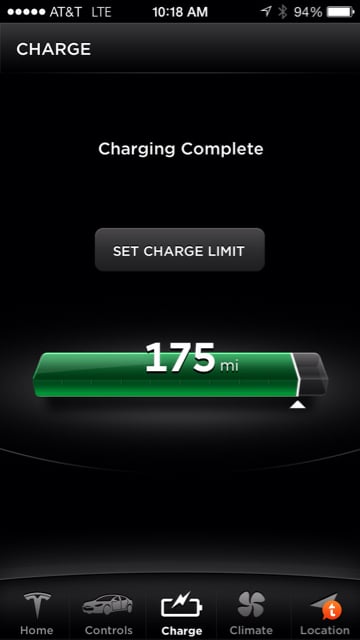
Not sure what to make of it... I did move up to 5.8.10 last week fwiw.�
Mar 5, 2014
apacheguy Yeah, up to a certain point. Have you seen islandbayy's video on degradation? He explicitly states why your pack will incur degradation through imbalance. It's fundamentally not good to run on an imbalanced pack. Here's a nice way to think about it:
I have a battery with 10 cells. 9 cells are at 4.1 volts, 1 cell is at 3.9 volts. I discharge all cells until the 9 cells are at 3.3 V, but that one cell is now at 3.1 V. Cycling that single cell down to lower voltages will result in permanent damage in the long run. You can't just think, oh well it'll pop back up the next time I balance the pack because it won't (It'll be degraded permanently). Furthermore, you're ultimately limited by the weakest cell in the pack so from a long-term battery health perspective the BMS really needs to keep all cells balanced.�
Mar 5, 2014
drees The amount of imbalance here is sooo small it's not going to affect anything unless you are regularly driving it down to zero miles. It's a non issue.
Yeah, the lower voltage module will be stressed a bit more when you get down to zero miles. But anywhere above that in your typical SOC range, there's nothing to worry about.
"100%" SOC will always be determined by the module with the highest voltage and "0%" SOC will always be determined by the module with the lowest voltage.�
Mar 5, 2014
ACDriveMotor @apache But I've read on this same thread that TM discharges based on the lowest cell voltage. If that is true then your scenario is avoided, at the cost of reduced range (because some cells remaining capacity goes unused). Would love to see us come to a consistent conclusion about whether imbalance is an annoying problem (less usable range) vs. a real problem (battery health due to excessive discharge).
I would also love to hear that TM has a service alert should a pack become dangerously imbalanced (however they would define that). Seems like a reasonably simple thing to do, define an imbalance threshold and throw a message.
For now I am avoiding both deep discharge and full charges on my vehicle until we get better clarity on this topic. I don't need a ton of daily range and so I don't care about loss of range due to imbalance as long as it is correctable and not causing permanent issues. I do worry about some here in TMC that are doing multiple full charges to try to achieve an arbitrary Rated range target. Full charges are not good for Li batteries. Am I the only one that sees the irony/catch-22 in doing full charges to increase reported capacity and as a result causing a permanent reduction in capacity?�
Mar 5, 2014
rlang59 Combination of 1 and 2.�
Mar 5, 2014
AmpedRealtor To be fair, there is no information to support your assertion other than hearsay from other owners and self proclaimed experts. Do you know, for a fact, that the Model S BMS doesn't individually monitor each cell in the pack? It would seem foolish not to do so, especially when an individual cell could overheat, leak, explode, etc. if not managed properly. I'm pretty sure that Tesla has to manage each cell individually or risk a conflagration, and as such, the balancing issues are nothing more than software estimation error that happens over time.
Max charging to recover a handful of miles on your display is not good for your battery. It never was. Any apparent benefit is psychological at best and is gained at the risk of reducing the long term life and range of the pack.�
Mar 5, 2014
qwk Sigh, There is plenty of information that Tesla doesn't monitor every single cell in the pack. Take a look at the BMS diagnostic menu. The cells are wired is such a way that makes monitoring each individual cell very difficult and would add more failure points. That's why each cell has a ultrasonically welded "wire fuse", to prevent cell runaway.�
Mar 5, 2014
AmpedRealtor Islandbayy does not work for Tesla and has stated that he has no knowledge of how Tesla's BMS system works. While his opinions are interesting given his previous experience with batteries, I certainly would not take his recommendations as gospel given the fact that he doesn't really know how Tesla's battery and BMS systems work and interact with each other. His recommendations are nothing more than educated guesses. Tesla's battery warranty does not cover degradation due to use (that covers almost every situation), and as such, I would be very, very careful in experimenting with a $50,000 replacement part. Wouldn't it suck to be doing all of these max charges to recover 3 miles of range on the display only to discover, in two years, that you've lost 30% of your battery capacity which will not be covered by Tesla? It's possible, so why risk it?
Let's wait for an official solution from Tesla. So far, nobody that I know who has done the max charging has recovered more than 5-7 miles at the most. Hardly worth the effort or the risk, in my opinion. I max charged recently (and for the first time) to 301 ideal miles, then drove 10-15 miles at 75 MPH on the freeway without the range display budging from 301 miles. If anything, this proves to me that the algorithm has problems because it didn't know that it had another 10-15 miles of energy stored up. How else could I drive 10-15 miles and not have the range display budge a single mile? This was on flats and with the regen limited due to high battery state of charge.�
Mar 5, 2014
qwk While max charging(unless you need it)is probably not that great of an idea, it can get you your range back if you need it. The people that are only getting back 5-7 miles are either not doing it correctly, or don't have that much to gain back. Please read post #98 in the link provided.
Model s at 40,000 Miles - Page 10�
Mar 5, 2014
AmpedRealtor Well that's disappointing.
- - - Updated - - -
What concerns me is that in order to gain back those 33 miles, he has had to 100% charge every day since November 2013. He posted in February 2014. OMG!�
Mar 5, 2014
ecarfan And that is very sound advice. Obsessing about a few miles of range and doing multiple 100% charges to try to "get it back" makes no sense to me.
I plug my S in every night and charge it to 85%. I only do a 100% charge if I am going to need the range when I get up in the morning and drive it. Beyond that I don't worry about it.�
Mar 5, 2014
apacheguy @AmpedRealtor - I never explicitly stated that Tesla's BMS does not balance the pack. There are indications, however, that balancing only occurs on a 100% charge, but I agree that we do not know for certain what is occurring when the mobile app reads "1 minute remaining."
My recent posts were simply to make an argument for balancing the pack, but most certainly did not argue that the Tesla BMS does not do that already. I was responding to folks who were saying it's no big deal to operate an imbalanced pack. I'm of the camp that believes a pack should always be balanced, but that's just my view. Furthermore, let it be noted that I am NOT doing successive range charges. I average about 1 per month.
I second your motion for further info from Tesla on this issue. The email that has been floating around on the forums doesn't clearly address the balancing issue, IMO.�
Mar 5, 2014
AmpedRealtor To apacheguy and others, please don't misunderstand my posts as criticism in any way. I am as confused as the next person and also looking for answers regarding best practices for our batteries. I concur and agree that Tesla should communicate better regarding this issue and let us know what's going on. I am just sounding a word of caution to those out there who may be reading this for the first time that there are pros and cons to deeply cycling your battery. Since it is arguably the most expensive single component in the car, caution is advised before undertaking any regimen that is not officially endorsed by Tesla.�
Mar 5, 2014
qwk Yeah, not something I would want to do to my pack, but I guess if one needs the range....�
Mar 5, 2014
drees Why? Tesla would have to stick a coulomb counter on every single cell to be able to monitor the health of each cell. And even then, it would not get them anything since hundreds (or whatever the number of cells is in parallel) of cells are hard-wired in parallel. There is no point to monitoring at the cell level, only at the sheet level. Never mind that doing so would add a ton of cost to manufacturing.
Similarly, look at a LEAF's pack - the LEAF has 192 cells and 48 modules. Each module is in a 2P-2S configuration. Each paralleled cell-pair is monitored, but not individual cells.�
Mar 5, 2014
stopcrazypp We already know there are 96 series cell groups (for 85kWh pack, 16 modules*6 per module) from the Model S diagnostic screen. It's those groups that need balancing. The cells in parallel will essentially self-balance (as they are all held in the same voltage and charge can move from the stronger cells to weaker cells).
In general, the drift for the Model S should not be that bad given Tesla buys these cells in huge batches from Panasonic and can have relatively good control over consistency. Obviously Tesla themselves decided it was not necessary to continuously have the pack balance itself rigorously all the time.�
Mar 6, 2014
wycolo > then completely discharge the battery to zero, [from TM email]
No one should read this as ZERO MILES, as I'm guessing TM means ZERO SOC. In other words driving down to '0 miles' then immediately charging back to a normal SOC is not particularly stressful to battery, but driving down to ZERO SOC is the thing that 'would not be good for the battery'.
--�
Mar 6, 2014
techmaven I spoke at some length with my Tesla Server Advisor about the battery balancing - I insisted that his old information about pack balancing was incorrect. He looked around at some things on his computer and came back with this answer:
1) Pack balancing only happens during a range charge
2) CAC recalculation only occurs with a deep cycle
Which means that you have to charge all the way up and let it sit long enough to balance... then discharge pretty much all the way down, and then possibly repeat once or twice and after a full range charge then, you should have a reading on capacity.
Now, there are still a questions about how fast to charge to avoid imbalance and how far to discharge to get an good CAC recalculation.�
Mar 6, 2014
apacheguy Ok, so our theory now appears to have to some credibility. I think it is unfortunate that Tesla does not balance after every charge. Over time, cells will become out of balance and this will accelerate permanent degradation.�
Mar 7, 2014
techmaven Why would an out of balance state accelerate permanent degradation given that most of us cycle on a very small part of total capacity? I would have assumed that the BMS would not allow the cells in an unbalanced pack to get too high or too low - hence the reduced usable range. Why would that accelerate permanent degradation in a measurable way? How far out of balance must it go before this kind of effect is an issue?
Instead, I think they need to allow for pack balancing at any arbitrary charge level. After all, a range charge isn't a 100% charge anyways, so it's already an arbitrary charge level.�
Mar 7, 2014
apacheguy Just because the BMS is programmed to prevent "bricking" of a specific cell does not shield it from permanent degradation. Granted, the cell must have a meaningfully lower voltage than other cells in the pack, but I see that as a significant possibly if one were never to range charge the car.
Yes, Tesla should allow balancing at any charge limit SOC and is something for which I have expressed support for quite some time.�
Mar 7, 2014
bluetinc The best way to think about this is to remember that the SOC shown is the average of all the sheets. That means that as they drift apart some will drift higher and some will be lower. Without a BMS that preforms balancing, while you might use only the SOC of 55-45% some cell sheets would eventually be cycled 90-100% and 0-10%. Now a better management system would reduce the available capacity in that case to only 10% to not allow the system to over or undercharge those cells. This MAY be what some are seeing. Because this type of reduction means that some cell sheets are being held at higher and lower points, they will see accelerated wear. The amount of acceleration depends on exact Voltage levels of the sheet, and the temperature. Generally there is a cubic factor in this type of degradation. The best SOC thread has some good papers on those calculations.
I agree that they need to add back low SOC balancing, as it use to be there!
�
Mar 7, 2014
djp Incorrect. On the Roadster the displayed SOC is based on the lowest brick, and charging stops when the highest brick reaches the target SOC. This is why range is reduced by an out of balance pack.
I don't buy the argument that an out of balance pack leads to faster degradation since the SOC is always constrained by the highest and lowest brick. If anything the rest of the pack is being run through more shallow cycles, which should help battery life.�
Mar 7, 2014
Benjamin Brooks That makes a lot more sense...�
Mar 7, 2014
smartypnz Almost 23,000 miles - we range charge 1 to 3 times a week. (This week 3 times - all at home - 40 amps. 2 stops at SC's but only to add - most there was to 210, short stints).
Anyway our range charges have been 250 to 255 for as long as we remember. Varies in that area and I always schedule it so that I can see it on completion, so there was no Vamp drain before I checked. Other times we charge to about 190 - 210 all at home.
If there has been degradation, we haven't noticed (other than the software reason)
'A' Battery vintage late April '13 on the sunny slopes.�
Mar 7, 2014
djp Also keep in mind that there are two effects at play here:
1. Pack balancing
2. Algorithm to estimate capacity (CAC)
It's possible that the range loss that people are seeing is mostly related to the capacity estimate algorithm, not pack balancing.
On the Roadster, CAC is recalculated when you do a single drive (single key turn) from above 85% SOC (Standard charge) to below 25%, then recharge back to 85%.
We know the Model S does a similar capacity estimate, but not what the exact triggers are. It's not a bad assumption to use the Roadster levels as a best guess. For those who aren't seeing an improvement from balancing, try doing a long drive on a single key turn from >90% to <25% then recharge to 90%.
This might also explain why owners who exercise the full range of their battery have little to no range loss. The losses could have nothing to do with balancing, and only be an effect of the CAC algorithm losing track of the battery's capacity when doing shallow charges.�
Mar 8, 2014
AmpedRealtor While this makes sense, I believe apacheguy is saying that individual cells within each "brick" can be out of balance even though each brick is being properly managed. The bricks are as granular as the BMS is able to get, as it does not manage individual cells within each brick. This is confusing enough to give me a headache, so I just charge to what I need and trust that Tesla knows what it's doing.�
Mar 8, 2014
djp The cells within the brick are wired in parallel so it's not possible for them to be out of balance. Any excess voltage on one cell would bleed over to the other cells. The BMS only needs to balance at the brick level, since those are the groups that are wired in series, and can't automatically balance relative to each other.�
Mar 8, 2014
jerry33 Is that actually true? In the Prius, measuring individual cells in a module shows different levels and the group is degraded when one cell in the module is below a certain threashold (and it appears to always be once cell that's the cause of a degraded module). That's why it's possible to recondition a Prius battery with just a few cells. Now the cells are much larger in the Prius than in the Model S which allows for a greater variation and, of course, the chemistry is entirely different. I'd suspect that the smaller the cells in a module, the less variation there will be between them.�
Mar 8, 2014
djp Cells wired in parallel will act as a single cell. One individual cell that is degraded will bring down the capacity of the brick, so yes it's possible to restore the brick's capacity by replacing that cell, but that's different than balancing. All the cells in a brick are guaranteed to be at the same voltage because they're wired in parallel.�
Mar 9, 2014
qwk To add further to this, for the roadster packs, Tesla used a special one of a kind machine to test and match individual cells so that they would potentially avoid having mismatched cell problems(for the cells wired in parallel).�
Mar 9, 2014
wycolo As a confirmation of the excellent points made here, I just did a full range charge on the Roadster, 237 miles, for a trip to The City (180 miles roundtrip) which I try to do on this car every 5 weeks on average. Came back with 20 miles remaining due to full winter conditions. Under better weather I stop the range charge at 220 miles. The car just turned 10k miles but these numbers are the same as when I bought it @3k miles, i.e. if I ever got a slightly higher full range charge it would quickly drop down after sitting for 10 minutes or so (phantom charge).
--�
Mar 9, 2014
mdh Wondering. I did a full range charge. First one in a long time. Rated range was 256. I have 17k miles and I got the car in Dec 2012. So, what does this tell me? How much has my battery degraded? Any guesses? Latest SW. Thanks.�
Mar 9, 2014
apacheguy You're doing fairly well. Judging by your VIN I'd wager a guess that you have a B pack. Also interesting is that you had not performed a range charge in quite some time. This suggests that the pack was most likely slightly out of balance, and yet you zoomed right up to 256 on the first try. I've repeatedly clocked in at 244-245 miles with between 22-25 K on the odo. Mine still has an A...�
Mar 9, 2014
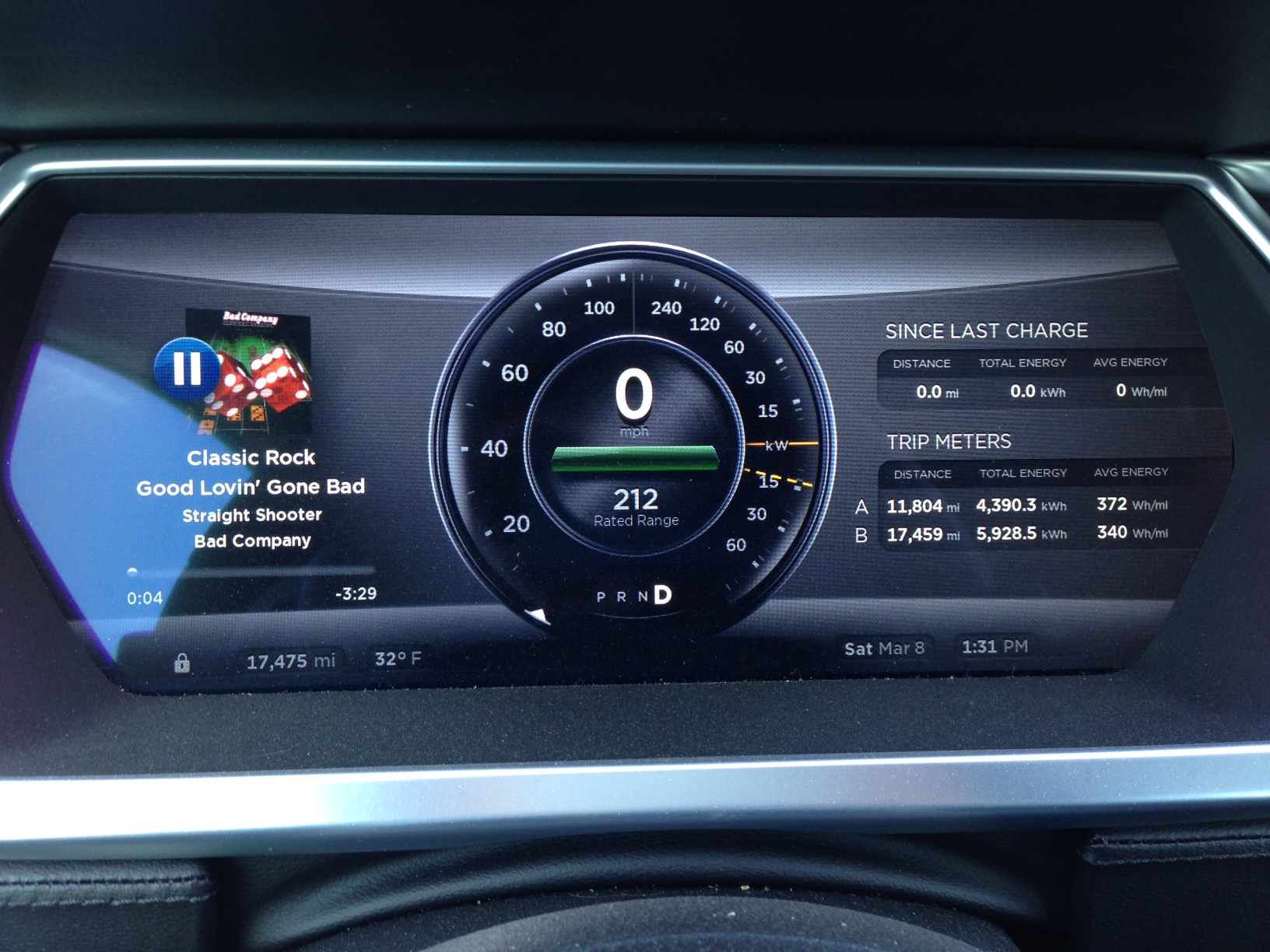
glhs272 Decreasing rated range? Nope. @17,475miles I can still reach 209 rated miles on a range charge, same as new. I refuse to baby my pack. I charge to 90% daily and am not shy about range charging.
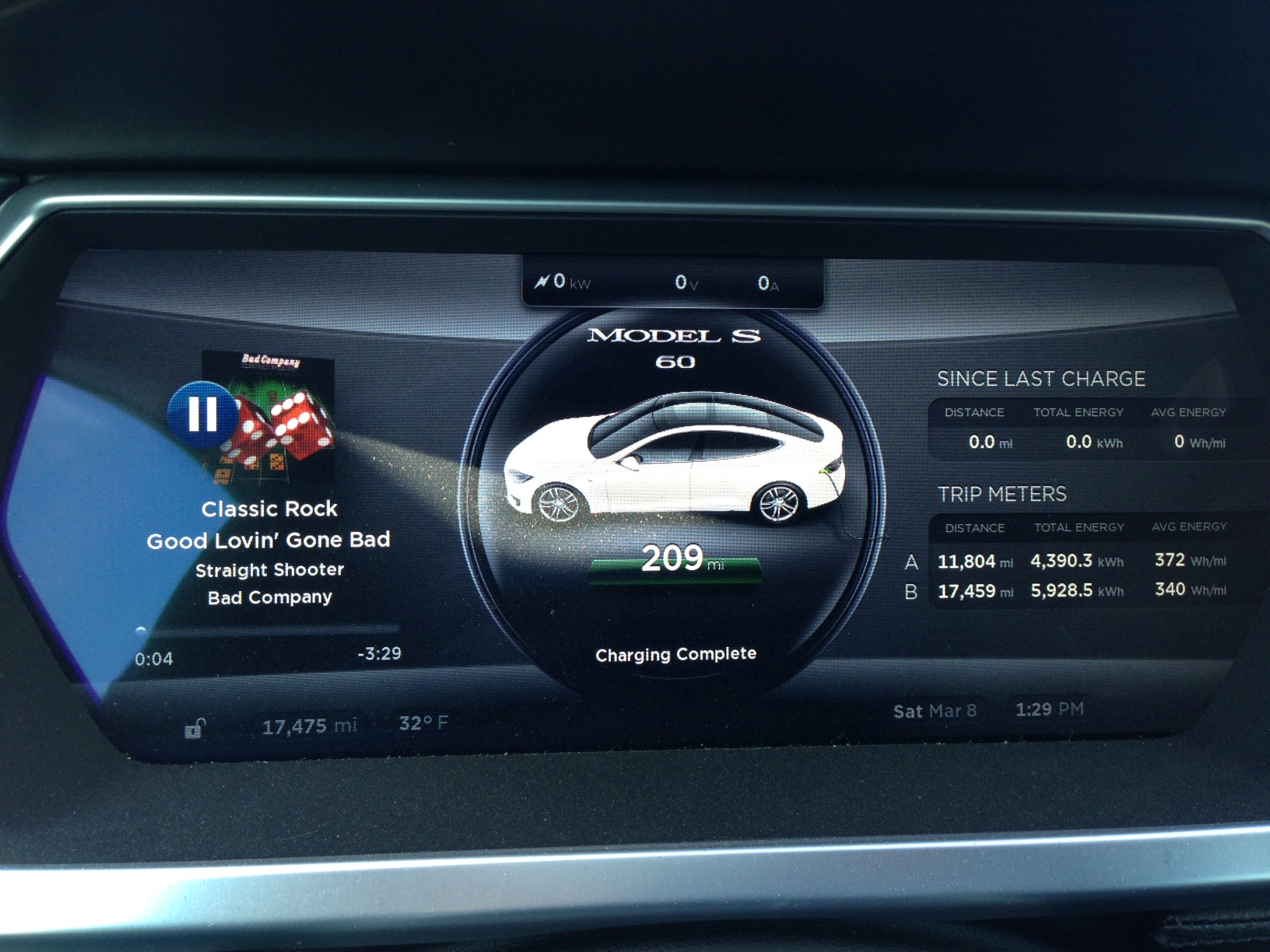
When I did this range charge it stayed at 209 for a while. When it finally finished, as soon as I pulled the plug, got back in and put it in drive the rated range jumped to 212
 �
�
Mar 9, 2014
hans I am curious what 209 rated miles range looks like in ideal miles. Just trying to prove/disprove a theory I have.�
Mar 9, 2014
gg_got_a_tesla Whoa, glhs272, those are remarkable numbers for a 60 kWh car at those many miles! Looks like you consume a lot of power too looking at your Wh/mile numbers.
I guess the key takeaway from your stats is the bit about "not being shy about range charging". That must be the trick. While everyone and their mother recommend not doing so often to preserve long term battery life, it's probably the only way to consistently get full rated range.�
Mar 9, 2014
glhs272 Forgot to check. I have heard that this number is more reliable indicator of battery capacity, but is otherwise useless. I did achieve these numbers after a seemingly effective balancing session the previous night (left the car all night at 100% charge). This was with a warm battery from a drive from my house to the Mauston supercharger.�
Mar 9, 2014
hans If you wouldn't mind checking next time you do a full charge I would appreciate it.�
Mar 9, 2014
glhs272 Ok. I actually have no idea what it was when new.�
Mar 9, 2014
mdh I do have a B pack. I likely have not done a range change since July.�
Mar 10, 2014
rlang59 So out of curiosity, what is your theory?�
Mar 10, 2014
hans That degradation will be less for ideal miles because rated miles really does depend on driver history.�
Mar 11, 2014
markb My drop in ideal miles has tracked my drop in rated miles fairly precisely. Haven't kept a detailed history, though, so can't give you more information.�
Mar 11, 2014
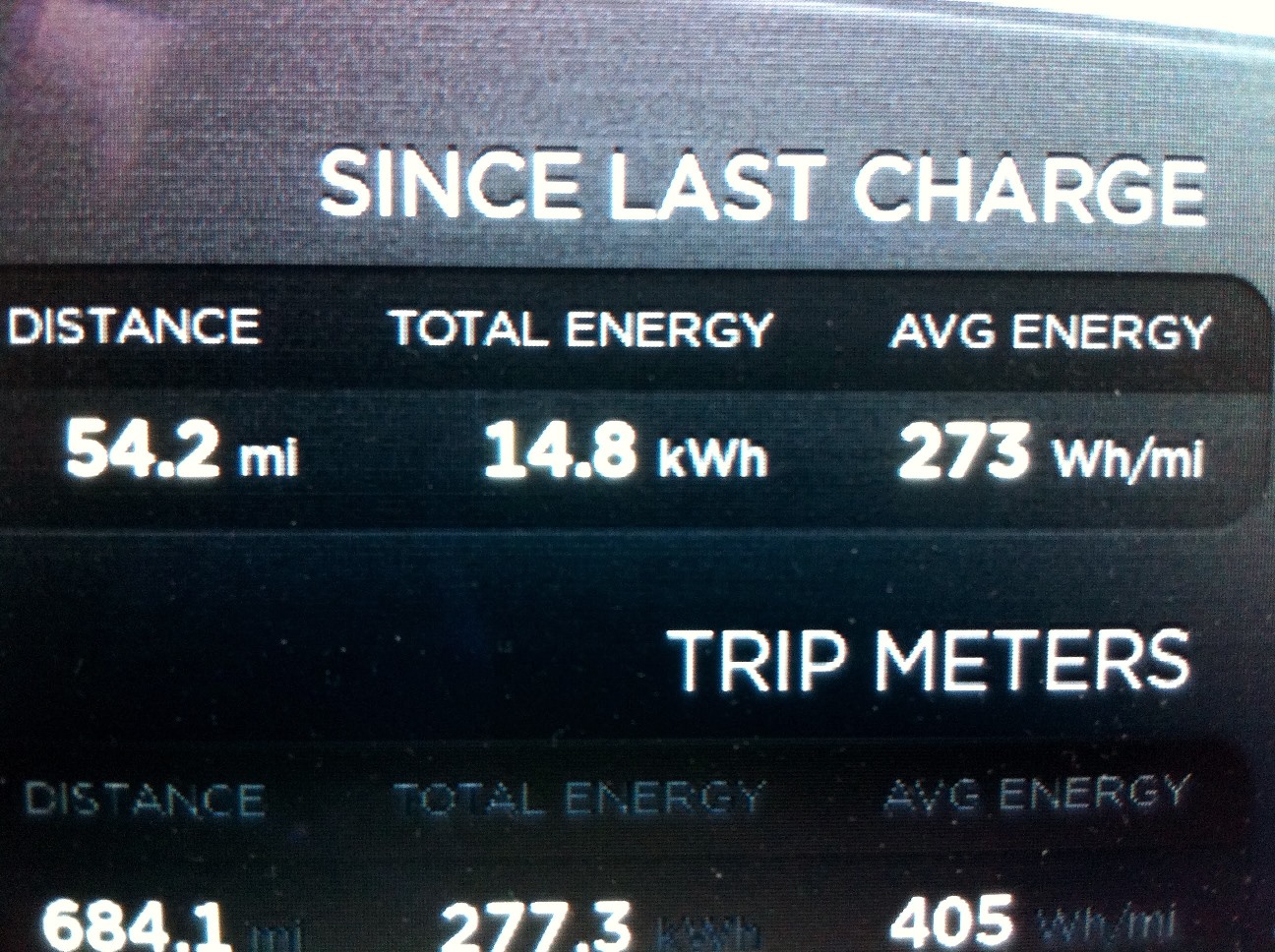
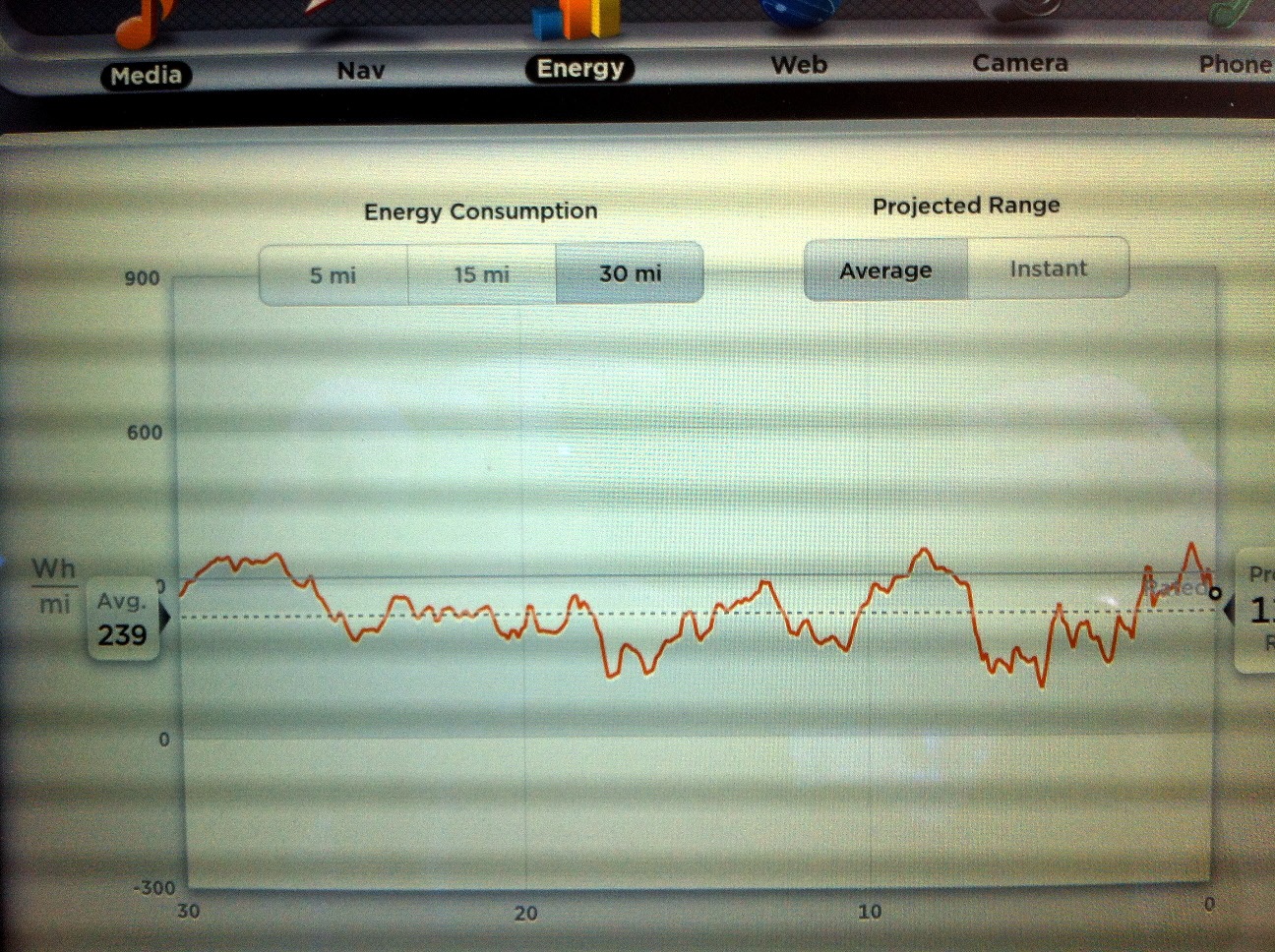
mknox I'm one of those who has noticed a drop in Rated Range, but I'm wondering if this is being "made up for" on the other end with better than expected efficiency. I've been seeing efficiency numbers almost too good to be true. For example, yesterday on my 54 mile return commute, I was driving uncharacteristicly fast (75 - 85 MPH) in temperatures around 45 F and was still seeing 273 Wh/mi (239 Wh/mi on the last 30 miles). And this is on winter tires. The route is pretty much flat with about 75% freeway and the rest city streets. I had the heat on, the car was not in Range Mode and I did not pre-heat the car before leaving:
 �
�
Mar 11, 2014
Gear That wouldn't really make sense though when he's averaging 340wH/mi in a 60 though, would it?�
Mar 11, 2014
wycolo @mknox: Unknown tailwinds? Newfangled firmware?
--�
Mar 11, 2014
mknox I don't think so. I've been getting consistently "good" efficiency numbers for a while now. I drove about 125 miles to a rental property I own in horrible conditions. Temperatures around 5 F, snowsqualls and snow-packed roads most of the way. Hilly terrain. Even with generous use of the heat, I got around 330 Wh/mi on that trip. That's less than 10% above "Rated" in some pretty bad conditions. The only other factor could be my winter tires. Usually, winter tires aren't as efficient, but maybe the Nokian Hakka R2s are even better than my 19" summer tires???
This thread just got me wondering if the same algorithm that seems to be knocking down my Rated Range numbers might be making up for it on the back end somehow. In other words my lower rated number + my higher efficiency numbers means I really am still getting the promised range.�
Mar 11, 2014
AmpedRealtor I only charge to 50% most of the time, usually drive in the 40%-70% SOC range. I max charged one and only time after six months of ownership and 6,000 miles. My first and only max charge registered at 301 miles of ideal range. I was able to drive 15 miles at 75 MPH in 80 degree temps on flat grade before the range display dropped to 300. So does my battery go to 315 miles even though the display shows 301? Weird.
- - - Updated - - -
By charging to 100% and driving to below 20%, you are teaching the car where the actual endpoints are for your battery. That helps the algorithm better estimate your range based on SOC. If you never charge to 100% and don't stretch your battery's legs fully, the algorithm can only estimate where those endpoints are. That estimate, by all accounts, drifts more and more out of sync the longer you drive using a narrow range of your battery's charge. This would explain why I was able to drive 15 miles but use only 1 ideal mile after charging to 100%. I'd never charged to 100% before, so even though my display showed 301 ideal miles, I actually got 315 ideal miles because I could drive 15 miles while the range display dropped by only 1 mile. This points to the algorithm being unable to properly estimate my full charge since I had never done it until that one time.
However, the fact remains that max charging frequently and driving to low states of charge will have a negative impact on your battery's long term life. It's my belief that owners are drawing a false conclusion that max charging is recovering range. It's not. It is simply telling the car where the maximum and minimum states of charge exist, which is why people who use the full range of their battery regularly are seeing higher range estimates. Max charging just to make the display show you a higher number - if you don't need the range - is negatively impacting the long term life of your pack. Tesla does not warrant range loss due to battery pack usage, so please be careful when doing anything to your battery that Tesla specifically warns against (i.e., max charging).�
Mar 11, 2014
FlasherZ I was surprised the other day when my wife came home with a 253 Wh/mi average from a trip (unheard of near us given the small-town-every-5-miles-along-the-2-lane-highway rural area we live in), because my car's lifetime is 362 Wh/mi over 20,000 miles. I made some changes (19" wheels instead of 21" in October), and the service center found my louvers weren't operating correctly when my battery pack was replaced and they were repaired.
There are a lot of variables but I intend to see where the spring and summer takes us in terms of efficiency.�
Mar 11, 2014
Andrew Our car is in for our first annual service today. I asked my service manager about the decreasing rated range. He said our battery checked out just fine, but to restore the rated range, here are the EXACT steps we should follow. I walked through the steps with him on the phone twice to confirm. This is directly from my service manager at the Santa Monica service center:
1. Charge to 100%. Let charging cycle complete.
2. Unplug.
3. Let the car sit for 20-30 minutes, up to a few hours.
4. Drive the car down to 20% SOC. This doesn't have to be immediately, it can be over a few days of use.
5. Once 20% SOC is reached, let the car sit for at least 20-30 minutes.
6. Plug back in and charge to 90% (or 100% if you need the range).
7. Repeat every few months, unless you charge to 100% regularly otherwise.
That's it! Done and done.�
Mar 11, 2014
lloyds Excellent explanation and duly noted.�
Mar 14, 2014
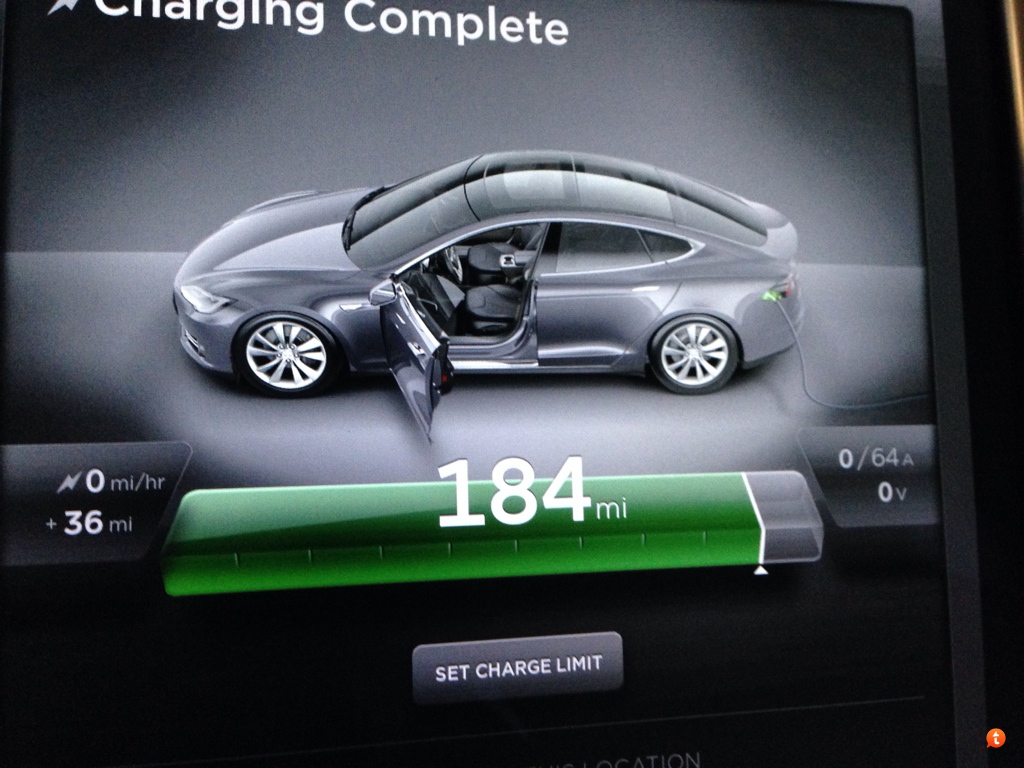
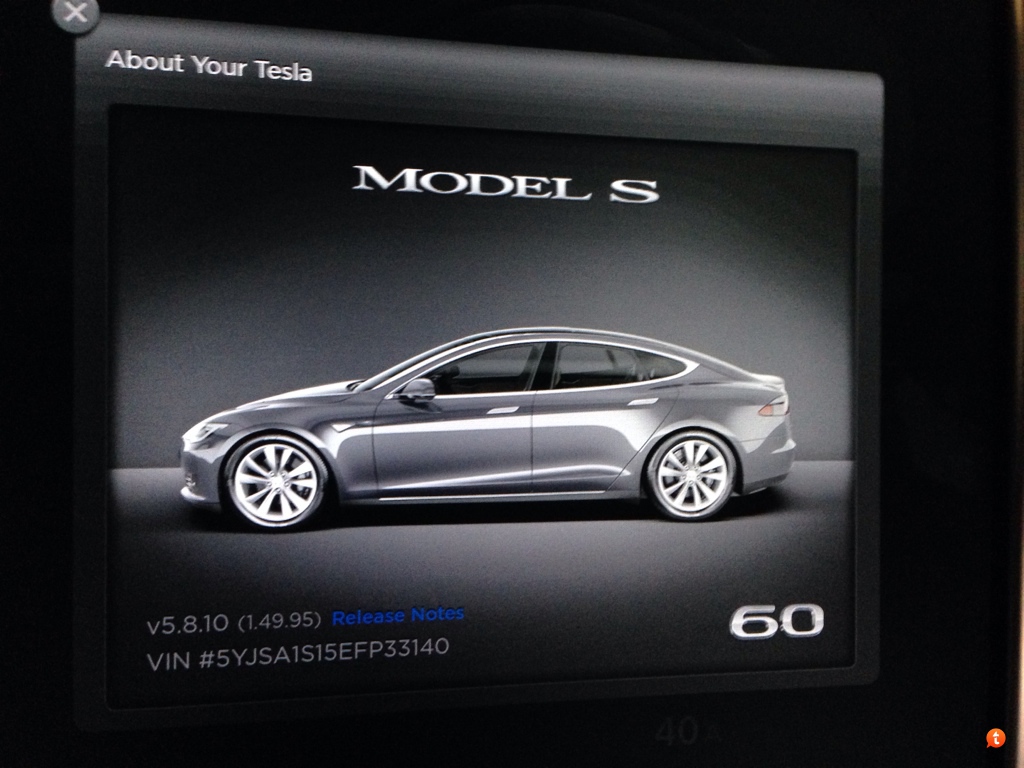
gg_got_a_tesla Got a brand new S60 (VIN 33140, less than 500 miles) as a loaner today; just charged to 184 miles at 90%:
 �
�
Mar 14, 2014
Doug_G Funny thing... 90% isn't 90%. When I charge to 90% I get 350 km rated. When I charge to 100%, I get 400 km rated. (This is 100% repeatable.)
It's seems 90% is really 87.5%, tic marks notwithstanding.
Also of note: The reported 100% Range of my vehicle dropped from 424 km to 400 km during the first year of operation. However, I have not seen any further decline in reported range throughout this winter. I've heard that the chemistry being used tends to drop a bit at first then level off for a long time. So far that is looking to be confirmed.�
Mar 14, 2014
rlang59 What was Ideal?�
Mar 14, 2014
gg_got_a_tesla 204.
What do you guys think? Should I subject this brand new car to a max charge just to see where it nets out?�
Mar 14, 2014
MikeC Do it.�
Mar 14, 2014
rlang59 Yup but make sure you get the ideal and rated numbers.�
Mar 14, 2014
Discoducky Yes! I'm at 193 with 20K miles after 14 months�
Mar 14, 2014
gaswalla of course.. it's not even your battery, plus it looks like it's actually good for the battery (once in a while)�
Mar 14, 2014
SFOTurtle Any bets on max number on brand new 60? What would be the over/under 208? 209?�
Mar 14, 2014
gg_got_a_tesla Cool. I have it for the weekend as Tesla had to keep my car from a service visit - they were missing a door panel part for a persistent rattle. Will update soon.�
Mar 14, 2014
mknox That is almost to the km the change I have seen over 1 year as well.�
Mar 14, 2014
Ceilidh Been a while since I chimed in on anything so nice to see you all alive and kicking on here.
Just recently I noticed a drop in full charge that seems fairly significant. When I got my 60 MS the rated range was 208. About 15 months later and just over 10K miles on it, a full range charge gets me 182 miles. Pretty significant difference. I asked Tesla about this and after 4 or 5 emails it was pretty much a clown show. The ultimate answer I got consisted of instructions on how to switch from Rated to Ideal range display, which had nothing to do with my question.
I will have to try the supposed rebalancing techniques and see what happens.
Cheers
PS-Ever since the slider was available I have tried to charge to more like 60-75% for daily use. If this indeed promotes better long term battery life at the expense of short term range reduction due to poor cell balance then I should be a good test case for this theory and should see a significant improvement in trip charge max range as a result. I don't have long trips coming up soon but next time I do I will go through the recommended procedure and report back.
Cheers�
Mar 14, 2014
islandbayy Just want to chime in on another update on my 60kW pack. With my "abuse" (using the crap out of my car), at 25,000 miles, my pack shows between 206 and 208 Rated on a 100% charge. Hard to get a accurate reading here in Wisconsin due to the cold skewing the numbers, so I can only measure after supercharging, otherwise my pack has cooled too much before charging complete, and the car adjusts range for cold pack temps. I have not been doing many Range charges lately since my return from Niagara Falls, and it does not appear that running my car to exhausted requiring a tow to a supercharger after car sitting at 5-10 degrees F overnight has caused any issues.
EDIT: Summary: 60kW pack, 8 Months 3 weeks Ownership, 25k Miles, 206-208 Rated at 100% on Warm Pack. Stone cold pack = 189-192 at 100%�
Mar 15, 2014
SFOTurtle Your numbers are, I think, the lowest for those of us with 60s posting on the forum. It sounds like your pack has never balanced since you too delivery of it, especially if you're keeping it charged to no more than 60-70% SOC max. I assume you've done few if any range charges since taking delivery.�
Mar 16, 2014
rlang59 My rated stops at 174 and my Ideal is 204. I'm even more convinced that the rated got screwed up after the 5.6 update (not 4.5 where standard dropped from 93% to 90% where 10 miles rated disappeared. Had that not happened I would have been 184 and 204 about the same as the loaner you had.�
Mar 16, 2014
SFOTurtle At 90% SOC, correct?�
Mar 16, 2014
glhs272 I am sure with time and patience, your pack rebalanced will get 206 to 208 rated miles just fine.�
Mar 16, 2014
rlang59 Correct.�
Mar 16, 2014
tomas 90% is not 90%. On other thread, someone did the math and demonstrated the 90% tick on slider is actually 87.5%. All of which happened in a software release, so it is not apples and apples to compare "90%" charge today to "normal" charge back before the slider.
Rlang, your numbers do not seem disturbing. To me, anyway.�
Mar 16, 2014
Klaus 87.5% ?�
Mar 16, 2014
tomas Yes thx. I need a proofreader. Edited post.�
Mar 16, 2014
Benjamin Brooks Doubt it. VisibleTesla and other Tesla REST API tools report a 90% battery SOC when a 90% standard charge is selected on the slider.
Now whether the 90% SOC algorithm is very accurate or not, including or excluding battery reserves, that's another question...�
Mar 16, 2014
tomas well, yep. I show 250 rated @ range charge on A battery w/15 months and 13000 mi. When I do charge at any tick on slider, be it 90%, 80, 70, 60 I get less than that % of 250. Far less. That's why I can't buy balancing as the whole problem, algorithm is what I suspect has largest impact.�
Mar 16, 2014
Benjamin Brooks Well, that phenomenon is because the battery curve is non-linear. You are charging to % coulombs of charge that the battery can store, not % of maximum rated miles you can drive.
The lower the battery charge the fewer miles per coulomb (for same watt power, battery current goes up at lower voltage, current -> dQ/dt goes up, i.e stored electrons get used up faster)�
Mar 16, 2014
rlang59 Me either and I wasn't trying to convey otherwise. I am just pointing out how far off the rated range is and how inaccurate I believe it to be. In my case I get an ideal of 231 at a 100% charge which tells me no degradation, but the rated is 197-200 would tell me I have some. People are getting all worked up about losing range, out of balance, etc and they are all using the rated number, (except for AmpedRealtor) they should be using the ideal number if they really want to track this.
Also back before the slider it was ~93% according to REST data, today it is 90% also according to REST.�
Mar 17, 2014
tomas Awesome, I try to learn something new every day, and today you obliged.�
Mar 17, 2014
gg_got_a_tesla So sorry guys, never got to finish the max charge on the loaner at work today. Tesla Burlingame just valeted my car to my office and picked up the loaner while it still had a couple of hours of charging to go...�
Mar 17, 2014
hans Coincidence?�
Mar 18, 2014
scaesare Just as another data point.... I did my first range charge to completion in quite some time on Sunday. For my S85 just shy of 10 months and about 20.5K miles, I got a rated range of 253 miles.�
Mar 18, 2014
gg_got_a_tesla Ha ha, let the conspiracy theories begin! Nah, it was just a matter of timing. Had too much driving and fun with the loaner over the weekend and didn't plug in at home.�
Mar 18, 2014
lloyds That's about the same as mine. I'm assuming you haven't made any attempts to balance the pack yet?�
Mar 18, 2014
huntjo I've had my in laws, then my parents, then my brother's family in town and have done range charges to pick them up at the airport and drive them to snowy sites around here etc. The rated range display for my 100% charge has increased from 251 to 257 over the last couple of weeks. Of course I didn't range charge every day and I didn't run it to zero ever, so I may still have some pack imbalance left, but not to a disconcerting degree.
I have like 12,500 miles on my original battery.�
Mar 18, 2014
scaesare Nope... the previous couple of range charges (spread several weeks apart) I didn't even let finish...
I assume there may be some "imbalance" there... but I'm not inclined to needlessly range charge (much less let it sit at 100% SoC) and then attempt to deplete down to zero miles just for the sake of seeing what amounts to a few miles on the dash.�
Mar 19, 2014
huntjo This�
Mar 19, 2014
Kraken I have a new theory on this subject. As of Sunday, I was getting 220/219 for a 90% charge. On Monday, boom, 213. I thought "meh, one time thing." On Tuesday, same... 213. I had only seen 213 after a "90% charge" once before. It was sometime last week, maybe Thursday. We had barely driven the car the previous day. Then we had it plugged in at about 213, and in the morning, even though it was set to 90%, which had been 220, it was still at 213. So I thought "either the car thought 'well, close enough, why bother charging?', or the minimal time it took to charge had meant vampire loss had kicked in and brought it right back down". I had seen similar "Since I'm pretty much at that charge state already, I don't feel I need to charge" behavior from the car in the past, so it didn't surprise me to see something similar again.
now, after I've seen it randomly drop off those 6 miles overnight, I'm thinking that when we plug it in and it doesn't have much to charge, it starts to learn that as the "new 90% (or whatever % you charge to)". This would affect people who barely drive their cars more than it would those who drive more.
or maybe, but less likely, when you hop in and vampire drain has been reducing it since it stopped charging, it is learning that as the new "set percentage".
While I highly doubt what we are seeing as degradation (which is why I'm not worried in the long run), especially as some of the heaviest drivers are seeing the least "loss", this is a serious issue that tesla does need to address. Since I am not going to take the chance and drive it below zero, even if the car is just miscalculating the amount of energy it had, this turns into real loss of range (even if it isn't real loss of battery capacity). Losing 30 miles of range is over a 10% loss. That isn't minimal. I can justify that most drives it's fine and it really is similar to other factors (like wind), but at some point this needs to be addressed and fixed. I'm not as stressed about it as it probably isn't actual battery degradation, but it does require acknowledgement and addressing from Tesla.
a month ago, I was getting home from my daily commute with 25-30 miles of range to spare. Now I get home with 16-19. Soon it will be 0. While I could slow down below the speed of traffic to help alleviate the getting home with 0 range initially, that shouldn't be necessary if it wasn't necessary when I started doing this commute.�
Mar 23, 2014
dave This is an update to my previous post where I reported range charging to 248 but getting 10 miles of "free" range after driving. I've since done two more range charges, and was expecting to get 258 or so ( thinking I had successfully "balanced" the pack ), however I am now only getting 247 miles on both charges, with no "free" miles afterwards at all.
Balancing attempts have failed, and I'm pack to being disappointed with my maximum rated range.�

Mar 23, 2014
rlcordeiro After reading this thread I ran the battery down to 11mi rated and range charged at 12 amps. The range charge went up from 240 to 245 but I noticed that my wh/mile went up from 320 to 360. The ideal mi went up from 277 to 288. The car has 25k mi on it. I used to get 242 rated on a standard charge before they changed to the slider. 12 ideal mile loss on a 15 month old A type battery seems ok but the algorithm changes are driving me crazy.�
Mar 24, 2014
tomas Amen re algorithm. But shouldn't get hung up comparing "standard" charges before and after slider because prior "standard" would be nigh impossible to duplicate on slider without REST.
I think recent posts reinforce that we've had too much obsession with balancing and it is not a cure all.�
Mar 24, 2014
tomas New news� here are some posted release notes for 5.9, another tweak to algorithm for range, should bring comfort to people who were concerned about "disappearing" range, but more fuel for the "how the heck do you ever really know what you've got" crowd.
http://www.tff-forum.de/download/file.php?id=2910&sid=035447736bb902522c3a83f9498161b3�
Mar 24, 2014
markb Thanks for posting this, but where does it come from?�
Mar 24, 2014
tomas See new 5.9 thread. Now verified, full release notes shown. Impact of this change yet to be commented on.�
Mar 24, 2014
apacheguy Perhaps they either changed the way the pack balances or reduced the size of the below 0 mile buffer. I'd be interested to see what the max charge is for a new vehicle running 5.9.�
Mar 24, 2014
AmpedRealtor It doesn't come from anywhere because it's always been there the whole time. The algorithm has been underreporting range, especially to those who don't use the full range of the battery's charge on a regular basis. The number on the screen is the result of a calculation that has now been changed to better show the true state of charge. So the estimate shows more miles now than it did before. They've always been there.
I've always considered these battery balancing theories and protocols to be essentially nonsense. It's always been the algorithm and now we have confirmation. I do feel bad for those who have been range charging, running their batteries down close to zero, then range charging again hoping to recover range that was never lost to begin with. What those owners have done is put their battery through unnecessarily stressful deep cycles and possibly lowered the pack's long term life. Of course that won't be apparent for a few years, so time will tell.�
Mar 24, 2014
FlasherZ Max charge appears to be the same as 5.8 in my experience.�
Mar 24, 2014
markb Tomas understood my question, you didn't. I didn't expect him to know where the extra range comes from; nor do I expect you to know where the extra range comes from. You may have your theories, but unless you work on Tesla's software, you don't and you can't know. I am not sure what "confirmation" you are referring to, unless you are referring to release notes, which as far as I am concerned, don't provide a confirmation of the underlying cause of anything.�
Mar 24, 2014
AmpedRealtor I'm so terribly sorry. I won't make that same mistake again.�

Không có nhận xét nào:
Đăng nhận xét