May 27, 2015
3mp_kwh I wonder if maybe your car is cooling the AC/DC inverter, which could have its own heat rate from an outlet?�
May 27, 2015
AmpedRealtor I really don't know. When I first plug in, it's quiet. Then as time goes on, after a couple of hours, I can hear a very faint fan noise. This gets louder as charging continues, but never as loud as it is at the Superchargers. This doesn't happen in the winter time, only in the spring and summer when ambient temps are above 90.�
May 27, 2015
Cottonwood Variable noise levels are perfectly normal. The heat pump/air conditioner in the Model S has variable speed fans and a variable speed compressor to be efficient. Everything gets louder the more heat needs to be pumped out of the car. A nicely warmed battery and max speed Supercharging at high temps can go beyond what the heat pump can handle. There have been a few reports in the SW Desert on a hot summer day of folks getting a reduced charge rate while the heat pump runs flat out. To avoid overheating the battery, the charge rate is reduced.�
May 28, 2015
David99 I believe that the Model S circulates the coolant not only to heat or cool the battery but to keep all cells at the same temperature all the time. Even when the car is not charging at all, the coolant pump starts to run here and there for a little. I think that is one of the key things to keep the battery happy and healthy over the years, making sure there are not differences in temperature between the cells. Differences in temperature would make them age and behave differently.�
May 28, 2015
mknox The on board chargers are liquid cooled. I will usually hear a soft noise when charging at home which I assume to be a circulating pump. This same noise may be present when I supercharge, but the outdoor ambient noise is likely drowning it out. I have yet to hear louder sounds at a Supercharger, but can definitely hear the a/c if I've turned it on with my mobile app when it's parked outside at work.�
Jun 24, 2015
mknox Recently, it's been suggested that comparing Ideal Miles might be a better gauge since, apparently, firmware updates have been tweaking the Rated Miles calculation over time.
For some reason or other I "lost" a couple of Rated Miles after a road trip and they haven't "come back" as of yet. At 90% SOC I am seeing 216 Rated Miles and 244 Ideal Miles. Prior to my road trip I was seeing about 218 Rated Miles, but even that is down significantly since my car was new.
I have really not looked at Ideal Miles over the years, because it does not provide much practical value in day-to-day use. If I do a linear extrapolation, 241 Ideal Miles at 90% would equal 271 Ideal Miles at 100%. I'm not sure, but I thought the S85 was supposed to get 300 Ideal Miles when new.�
Jun 24, 2015
Khatsalano Just did a range charge this morning. New, the car had 270 Rated Miles on a full charge. At 12,000 miles, I got 260 Rated Miles.
- K�
Jun 24, 2015
jerry33 Correct, Ideal doesn't provide much practical value. However, I've found that extrapolating Rated to Ideal never matches, sometimes it's close and sometimes it's somewhere overseas.�
Jun 24, 2015
mknox I rarely do 100% charges, but will note both Rated and Ideal next time I do, but what I was trying to do was extrapolate 90% Ideal to 100% Ideal. I just don't know if the relationship between SOC and Ideal Miles is linear.�
Jun 25, 2015
AmpedRealtor I've recently completed several long distance drives and cycled the battery from 100% down to zero once, and from 100% down to 4 miles once, and a third time from 100% down to 8 miles. I have not regained a single rated or ideal mile by exercising the full range of the battery as some have suggested. I have a B battery that just doesn't seem to care! lol�
Jun 25, 2015
David99 Must be user error then! LOL
What is the miage on your car and what's your 100% range?�
Jun 25, 2015
Gear Yeah, I didn't regain anything during my road trip to Minnesota during Thanksgiving last year either, and with my 60, charging to 100% and discharging down to 0% was pretty common.�
Jun 26, 2015
AmpedRealtor Mileage is about 27,400 miles and 100% charge w/ Range Mode off is 255 miles, with Range Mode on it is 257 miles. Ideal miles are 295 w/ Range Mode off, 297 miles with Range Mode on. Car was kept at 50% nominal charge for most of its first year before I switched to 90%.�
Jun 26, 2015
tomas Sounds pretty normal for that age/mileage. Mine is a tad older but a tad fewer miles, and my 100% also 255. I've seen a lot less variation in rated miles at various charge levels. I think theyve improved algorithm so calibration is not so impactful as it used to be.�
Jun 26, 2015
Benjamin Brooks May I suggest tracking your decreasing range data here to get a better idea of the statistical spread among owners?
Tesla Battery Survey (old name MaxRange) - Google Sheets�
Jun 28, 2015
Ugliest1 @BB I'll check the survey, thanks for the link.
From Firmware 6.2 thread yesterday:
My experience yesterday with Rated Miles and battery degradation after 18 months and 45,400km (28,375mi): Charged to 100%, Remote S showing "0%" for about 30 minutes and 405RKm. We then decided to go so there may still have been some battery balancing going on, not sure. When I got into the car, the RKm showed 402, Ideal: 468 (about 4% loss from new, 425Rkm)
But wait!!! Inexplicably, after driving about 1km I happened to notice the RKm jump to 409. Then it stayed at 409 for the next 7km (I watched). So if you do the rose-coloured-glasses math, that would indicate a "more accurate" 100% RKm as 416, or, a 2% loss.
My range happiness measure has now fully moved to "does the car have enough range and are there suitably-spaced superchargers to handle my daily and long-distance travel driving needs?", and I will be ignoring the nit of the actual completed charge numerical total. They'll change it in 7.+ anyway!!
Re our (what ended up to be) 380km trip with four people no luggage, I "semi-hypermiled" meaning I put the car in range mode and kept the energy meter under 40 usually and under 80 on red light starts etc (still left everyone in the dust). And that's about all I changed: left the A/C on to continue being comfortable on a 28-35C day, set the cruise control for about +5 speed limit, usually 95km/hr (actual speed: +2km/hr over limit, since my speedometer measures about 3km/hr under consistently, according to those auto-display traffic speed notifiers). I passed 50% of the cars, and used the odd burst for fun (to the delight of a BMW 5-series convertible driver, giving me a thumbs up); the other 50% regularly went by me estimated +15-20kph. 50km rated remained once back home.
Happy camper. No anxiety.�
Sep 29, 2015
Notacarguy Nov 2014 picked up car with 185 at 90%. 5000 miles on the car. Now car shows 167 at 90% and 188 at 100%. Avg wh/m is 309. 21k on the odemeter. I charge to 90% each night. Getting concerned about the range drop.�
Sep 29, 2015
AmpedRealtor That's a 10% drop in less than a year. If you keep your car charged to 90% most of the time, you likely wont' have much calibration error. Can you report your ideal mile rating, and would you know how that compared when new?�
Sep 29, 2015
apacheguy I would also wonder whether the range loss has been consistent month to month or did it happen all of a sudden?�
Sep 29, 2015
Pilot_51 That seems consistent with my experience. I normally charge to 80%, or 90% in the winter. At my car's 1 year anniversary in June, it had 169 miles at 90%, or 150 at 80%. Now it's getting 137 at 80%. Last winter, after charging at 90% for a while, it regained about 7 miles to 174. I've never charged to 100% and expect most of the gains will happen when I take a ~3600 mile road trip next year with lots of high and low SOCs to help calibration.�
Oct 25, 2015
Stealth Battery Degradation or Calibration Issue
I have a P85 delivered in May 2014 with 35,000 miles. With Range Mode On (to maximum the displayed miles), when I charge to 100% I get 247 rated miles and 286 ideal miles. Then when I take off and drive, the rated miles on the battery gauge does not begin to drop until I drive 14 miles. What is going on here? So in actuality I figure my 100% charge should say 260 (since the rated miles dropped to 246 after traveling 14 miles so 246+14 = 260). By the way, I have done this several times with the same results. See photos and let me know why you think this is happening. Notice the batter line on the graph remains at 100% until I drive 14 miles. Do you think my battery has degraded significantly like 6.7% (265-247)/265 or is it a calibration issue.

 �
�
Oct 25, 2015
walla2 I took a slight hit in range with the 7 upgrade recently. At 12K miles, my now nearly 3 year old 2012 P85 Sig is now at 234-5 at the 90% rated range with range mode off.�
Oct 26, 2015
Pilot_51 Just did my first ever 100% charge overnight at wk057's suggestion because my pack is apparently horribly unbalanced.I got a rated range of 174 miles at 100%.�
Oct 26, 2015
tomas One 100% charge won't fix estimate. You need regular 90% charging for a couple of weeks, and at some point to run it down to <20% so algorithm can recalibrate.�
Oct 26, 2015
Pilot_51 Right. I already increased it from 80% to 90% for the winter about a week ago and was seeing about 0.3 miles/day increase. I had it set to 90% for a few months last winter and also saw a notable increase, but not significant. It is evident that much of the issue is the lack of going to a low SoC, as I don't often go below 40% and only went below 20% a handful of times. As wk057 suggested, I plan to drive it down below 10% over the course of 3 days commute for the best results.�
Oct 26, 2015
wk057 Basically there are a couple of things at work causing the low range display on some cars.
1) Energy usage calibration.
This is probably the biggest offender. The car will keep track of energy usage and cell voltage, along with estimating losses due to internal resistance, wiring, etc. Eventually this will get thrown off if you never/rarely allow the pack to charge in the constant-voltage (100%) charge area and/or you never/rarely drain the pack close to 0%. So the solution is to give the algorithm new data by charging to 100% and draining as low as comfortable, but somewhere near 10% or lower is best. It won't hurt anything as long as you charge immediately.
2) Cell balancing
There are 96 cell groups in the Model S 85/90 kWh packs, and 84 in the 60/70 packs. Eventually due to slight variations these cell groups will end up at slightly different voltages. However, the Model S uses the highest voltage out of all 96 to determine when to cut the charge. So, even if 95 of the cell groups are at say, 97% if one of them is at 100% it can't safely charge anymore.
So the BMS system has balancing bleeder circuits. Once the BMS is aware of which cell groups are higher than the rest it activates a low power load specific to that cell group to drain the excess capacity they have and bring them back in line with the other cells. However, the BMS does not appear to activate any balancers until it gets a voltage reading during the constant-voltage phase of a charge, which is > ~93% SoC. So, charging to 100% also has the benefit of getting the BMS to activate the balancing circuits. These will stay active for hours/days/weeks until they bleed off sufficient power from the affected cell groups, and will happen continuously in the background even after driving and all and even if the pack is not at 100% since it knows how long it will need to bleed for based on the voltage difference during the 100% charge.
While the cells balance, as you charge over the coming days the cells will be able to charge more fully.
So essentially you want to get the car as much data about the pack as possible. This way it has more information to go by and thus have a more optimistic range prediction.�
Oct 26, 2015
apacheguy Nice! IIRC, you posted significantly worse numbers for your refurb A pack. Did Tesla get around to doing something about it?
Ill be darned. I thought the balancing circuits were always active. So is it recommended to range charge once a month? Not sure how this explains folks who always charge to 90 seeing the best range. According to you, they are still below the trigger voltage for balancing.�
Oct 26, 2015
scaesare Indeed... as this very thread has discussed previously some time ago...�
Oct 26, 2015
apacheguy Yes, but AFAIK, it has never been known that the pack does not balance below 93%. This is huge, IMO.�
Oct 26, 2015
Matias Where is that info?�
Oct 26, 2015
apacheguy Referencing wk057 who has extensive experience with Tesla battery packs and management software:
�
Oct 26, 2015
scaesare Agreed.
That tempts me to set mine at 93% for a week just for grins and giggles. It's only seen above 90% twice last week on a road trip for the first time in 6-8 months...�
Oct 26, 2015
wk057 Once the balancers have a set point they run all the time until they're done. However they don't seem to get that set point until the CV stage of a charge (~92-93%).
The out of balance portion of the disparity is most likely only a fraction of the calibration issue. But the balancing disparity is range actually unavailable, vs range that isn't known to be available.
Based on my torture testing of the Model S cell (data write up coming in the next couple of months) range charging isn't too bad on the pack if it's in a cool place (<60F), and the pack is immediately utilized and brought below 92-93%. So if your pack seems to be out of calibration, I personally wouldn't do a range change outside of those conditions. At the very least make sure you just don't leave it sit > 92% for an extended period.
Once per month is probably overkill. You should probably let your pack go from 90% to ~10% for calibration more often then you'd need to get the bleeder circuits running for sure. I could see that being fine once per month or so. But if you don't need a 100% charge I'd probably continue to limit that to a few times per year.�
Oct 26, 2015
Matias Thank you!
- - - Updated - - -
wk057, what do you think, why BMS needs the charge to be at least 93% to start balancing?�
Oct 26, 2015
tomas I'm not answering for WK... but I do suspect that may be OLD information. In early releases of the MS firmware, a "normal" charge was 93%, and a "range" charge was 100%. That was all there was. No slider to select other charge levels. When the slider was introduced, 90% became the top of "normal" range. I guess some people suspect that the trigger for balancing was never changed, and remained at 93%. I personally believe it balances at least SOME at 90% because I've had long periods of charging to 60 or 70% and resulting degradation of projected range, after which a week of charging to 90% restored projected range.�
Oct 26, 2015
walla2 They came to my house and did a manual patch of some kind. I thought it was a trick but the range has held up in real life and through several updates.
They definitely didn't do a battery swap in my garage but some reset of firmware fixed my significant drop.�
Oct 26, 2015
wk057 Around 93% is the transition from constant current to constant voltage charging. Any cells out of balance will be instantly recognized by the BMS at this point because there will be some that won't be at the CV set point yet and others that will be.
This is likely not due to balancing, though.
To clarify, there is definitely some terminology mix-up around here between "out of balance" and "needing capacity measurement calibration". The latter is generally the cause of the majority of missing range for people who rarely discharge their packs significantly and who do not charge to ~90% or more regularly. Being out of balance is a different beast, and it's pretty unlikely that your cells will be significantly out of balance and cause appreciable range loss unless you literally only drive a short distance every day and mostly charge to SoC below ~85% or so. The short cycles can throw things off a little, but they do throw the calibration factor off by more than actual out of balance issues.
In any case, hitting the CV portion of the charge curve (~92-93%), in my testing, is needed for actually engaging the bleed circuits to correct an actual balance issue, but is *not* needed to correct a calibration issue. This is why charging to 90% slowly fixes range loss a lot of the time because it's not actually missing, it's just miscalculated.�
Oct 26, 2015
kort677 I guess my 2014, with 21k miles rated range down to 255 is in line�
Oct 26, 2015
Denarius In my case I've never charged my P85D over 90%. I just broke 20k miles and I've dropped to 222 miles at a 90% charge. Last night I did a 5%-90% with no change in range. Would you suggest I charge to 93% (or higher?) and see what if any impact that has on my rated range?�
Oct 26, 2015
wk057 223 is where I'm at with 90% on the P85D and 247 at 100% yesterday. I 100% charge and drop to near 0% at least once per month. ~17k miles now. I'd bet this is actual degradation, but one 100% charge won't hurt anything. The key is just getting on the road as quickly as possible once the charge is done so it doesn't linger there for days.�
Oct 26, 2015
drees To be fair, 93% will vary depending on how fast the pack is being charged. Supercharging will reach CV much sooner than 120V charging, for example.�
Oct 26, 2015
David99 Here is a graph from a recent 100% charge tracked with VisibleTesla
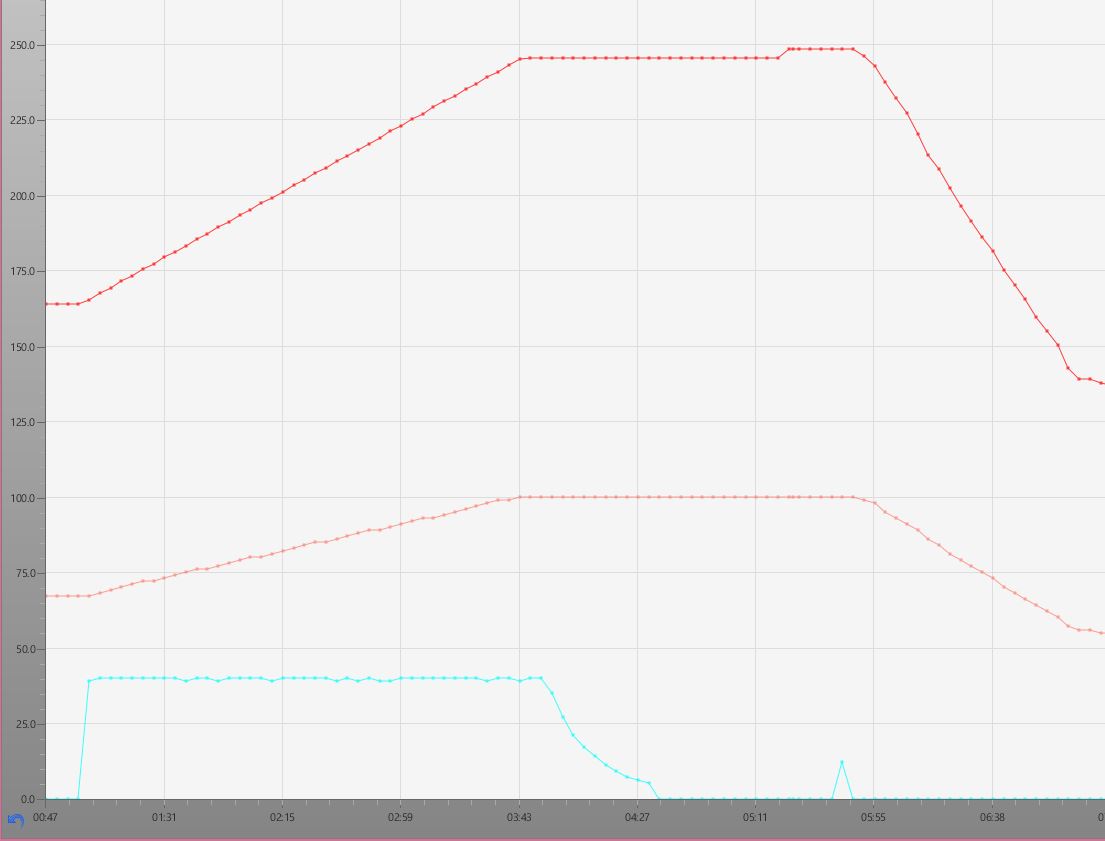
You can see when it reaches 100% (the middle red line). The blue line at the bottom is the charging Ampere. The battery reaches 100% and only a little later does the current drop which is the sign of changing from constant current to constant voltage charge. I have tracked many 100% charges and the current never started dropping before the battery reached 100%. In most cases the current actually stayed constant for a while after reaching 100%.
It's just a little surprising because that's not the way a Lithium battery is charged. It is charged at constant current until it reaches it's final voltage (at that point it's not 100% charged though), then the charger switches to constant voltage charging. The current continues to drop while the voltage stays the same. This is the way the last few percent are carefully added. What I see when tracking the Model S charger doesn't line up. It continues to do constant current even when it says it's at 100% and only after a few minutes after reaching 100% it switches to what looks like constant voltage charging. Neither the battery percentage goes up nor the rated miles after that, though. Yet after the battery level reached 100% the charging process continues to add about 3.5 kWh into the battery. Just odd. Anyone care to explain? wk057?�
Oct 26, 2015
drees Do you have battery pack voltage to go along with SOC and charge current?
At 40A it's quite possible that the car doesn't get to constant voltage until it reaches "100%" - quoting "100%" because it's simply what the BMS is calling 100%, not what the cells can actually be charged up to.�
Oct 26, 2015
David99 The actual battery voltage isn't available while charging from AC. It only shows on a DC charger.
I highly doubt the BMS would be confused about what 100% state of charge is, but I agree, what the Model S shows to the user as 100% is probably not the true 100% of the cells. But then, I can see it pumping in 3.5 kWh more which would be the equivalent of about 10 extra miles. The 'rated range' doesn't go up, though. Maybe it's adding these extra 10 miles as a buffer to the bottom. I really don't know. Just guessing.�
Oct 27, 2015
wk057 The constant voltage mode is reached during AC charging, even at 20kW, before the amperage actually needs to drop off since the current is relatively low. Keep in mind that even 20kW charging is only a 1/4C charge rate, and these cells will happily accept > 1C charge at most points. So looking at an amperage curve during AC charging isn't going to tell the whole story.
Also, believe it or not, Tesla's 100% on the dash is in fact pretty darn close to actual 100% for the cells. I'd estimate within 1% of what you'd charge them too with a 4.2V CV stage. Calibration issues could cause 100% to not quite be 100% on the dash, but generally it's pretty close.
As for that specific graph, I'm guessing that you hadn't 100% charged for a while? The fact that the taper doesn't happen until after 100% points to a calibration issue. The dash readout takes into account energy in/out as a factor as well as voltage, so it's often off by a bit if you never hit 0% or 100% often.
For supercharging, the taper curve isn't CC/CV like normal lithium ion charging. It's a temperature focused curve. Tesla knows how much heat they'll be able to sap away from the pack under charge and how they need to slow the charge current to stay below a threshold. There is actually room for improvement there, since the temperature thresholds are different when the cells are already partially charged, but Tesla seems to just map the same curve regardless. There may be reasons for that which I'm unaware, but I think there could be some improved charging speed near the higher half of the SoC range if you arrived with a cool (not recently under supercharge thermal load) pack at a supercharger with say, 50% SoC, the cells can handle a little over 1C charging at this point before they heat up like they would earlier in the supercharge curve.
Back on topic, though, the CV portion of a supercharge doesn't happen until nearly the end of a charge (99-100%) since the amperage just appears to be a curve mapping plus loads in the car. I haven't checked with CHAdeMO, but I assume that's probably the same although limited by the charger amperage.�
Oct 27, 2015
apacheguy Interesting. Do you see any benefit to introducing a chill mode to cool the battery before SpC and increase the thermal buffer thus allowing the pack to sustain higher rates later into the charge curve?
Supercharging: Chill Mode�
Oct 27, 2015
wk057 Technically it would work. There are some lower limits to what would be effective so it probably wouldn't be a significant enough gain to be useful and/or noticeable. I think they'd be better off just doing multiple supercharge curves for various starting SoC rather than just sticking with the one they're using.
Edit: I can confirm that the cells much more readily accept high charge rates when they're cold... but I think this may have it's own set of degradation drawbacks.�
Oct 27, 2015
David99 That makes sense. I have a single charger so the charge rate is only 1/10 C (or something around that). And yes, I haven't done a 100% charge for a while before the one I graphed.
Also good to know that what Tesla shows us as 100% is actually true 100%. I always wondered if Tesla had set the 100% point slightly below the cells true 100% for longevity reasons.
That was my idea. Go to a CHADeMO charger and use it to charge to 100% and watch the voltage (on a DC charger the pack voltage is shown). Although I think they are designed to cut off as soon as the car reports 100%. They don't want EVs to sit at these stations for longer than necessary.
Sometimes I really wish Tesla would have a 'geek mode' for those owners who want to look into the technical details.
- - - Updated - - -
That's interesting! I would have guessed cells would charge better at a higher temperature in the same way as they perform better at a higher temperature when discharged. I learn something new every day.
On that topic, not sure pre-cooling would be that helpful. It would just allow slightly quicker charging for the first minutes and then the battery heats up while Supercharging. A more aggressive cooling would help faster charging throughout the entire charging session.�
Oct 27, 2015
apacheguy Geek mode = read-only diag screen coming in 7.1. Nah, just kidding, but it would be cool.�
Oct 27, 2015
wk057 As mentioned in another thread, I would *pay* for such an option. If they had an on screen enter your credit card number and be charged $500 to unlock a read only diagnostic screen (with cell voltages and stuff like that) I would be the first to do it.�
Oct 27, 2015
mknox You know, I probably would too. In the past, I have always purchased the shop manuals for my cars from the manufacturer. (The last set for my Cadillac CTS came in a set of 6 volumes each the size of a NYC phone book!).�
Oct 27, 2015
AmpedRealtor Two days ago I charged to 100% in anticipation of a longer drive, but my plans got canceled. I let the car sit overnight at 100%. Guess what? Several hours after charging - I'm thinking 3-4 hours - my range went from 252 miles to 254 miles. My 90% charge is now back to 228 and where it was several weeks ago before I charged to only 70% for a week. This is the 2nd time now that I've seen a range bump after letting the car sit for a few hours after charging to 100%.�
Oct 27, 2015
Super Gizmo AR, I thought it was bad for the battery to sit after a full range charge.�
Oct 27, 2015
kort677 it is bad if you charge to 100% on a regular basis, if you rarely do it it shouldn't cause problems�
Oct 28, 2015
AmpedRealtor In my case it recovered miles so I'm not complaining, but I don't normally let the car sit at 100%.�
Oct 28, 2015
kort677 I've noticed that I had my preconditioning on, that ate up about 2-5 miles of range, vampire like. since I really don't need to precondition daily I've shut it off and see less vampire draw�
Oct 28, 2015
glhs272 Still getting 182 to 183 rated miles at 90% state of charge on my 60kwh pack. 60K miles on the odometer.�
Oct 28, 2015
ZBB Nice!
I reported mine one here last week... I bottomed out at 167 about 2 weeks ago (it fell all summer -- even with 90% charging and only 1 road trip with supercharging (and 2 100% charges, although not at Superchargers). Its bee creeping back up, now at 171.
But its been quite a while since I've seen over 180 for a 90% charge... Highest in the last year was 178...�
Oct 28, 2015
wk057 Yep, balancers kicking in and doing their work. 2 rated miles is ~600Wh. If one cell group was out of balance that means it only needs to bleed 6.25Wh from it to recover 2 out of balance rated miles. The bleeders are ~100mA, so it'd take ~12-14 hours to bleed this much. I'd guess it wasn't quite off by 2 rated miles and the rest was being rounded down previously or part of a larger calibration error.�
Oct 28, 2015
Super Gizmo I have a 2012 P85 with under 36K miles. For the first couple of years until early 2014 the only option was to charge the car to 90% Daily or 100% Range charge. When I used to charge the car to 90% I had a Rated range of about 245 for Daily and 265-267 for 100%. When the software update gave us the option to charge at a lower SOC I started charging to about 180 Rated Daily range. After a while when the car had about 14K - 15K miles the Rated Daily dropped dramatically to 213 - 214 miles and 100% dropped down to about 245-246. After reading the forums since the middle of last year I have been charging to 90% and if I drive only 20- 30 miles in a day I wait until the Rated range is down to 130 -150 miles and then plug it in to charge to 90%. After a few months my Rated Daily went up to about 226 miles but in the last couple of months it has gradually dropped down to 222 miles. Maybe I need to do a full Range charge like Amped to regain some of the loss?�
Oct 28, 2015
fluxemag 2013 S40 with 31k miles, 130mi rated on a "full" charge. I'm not sure the rated range really means anything though.�
Oct 28, 2015
Todd Burch Wk057, I'm fascinated by your post suggesting that balancing is triggered when SOC exceeds about 93% SOC, the BMS determines the voltage difference between the modules, remembers that difference, and begins slowly bleeding the appropriate modules by an amount to bring them to a closer SOC to each other, even if the car is not sitting with a full range charge. That makes a lot of sense, and is fairly consistent with evidence we've seen. To confirm, you're fairly certain that this slow bleeding continues for awhile once triggered, even if the pack is brought to lower SOCs due to use?�
Oct 28, 2015
David99 I see those random jumps in 'rated range' often. Sometimes when I drive, the trip graph magically jumps up one percent, or when the car is done charging but just sitting there. Sometimes it does the opposite, it just jumps down. Happens rarely, though. One thing I also noticed when I charge to 100% 1 out of 3 times, I can drive for 5-9 miles before the rate range or percentage goes down. So there is some extra that just doesn't show up in the initial rate range estimate. Having experienced all these things I always try to remind people that looking at the rate range display is not a good way to measure battery degradation.
Here the car is done charging for an hour and then the rate range jumps up by 4 miles (while percentage is always at 100). (top line is rated range, middle line is percent)
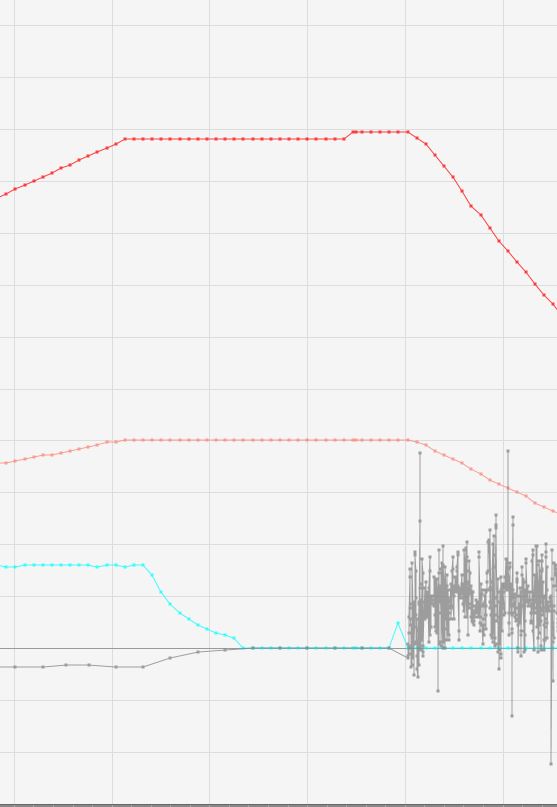
Here an example where a smililar jump happens while I was driving
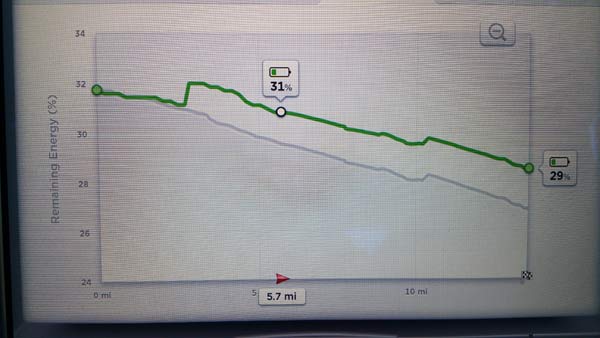
If that's due to balancing, there is proof that it happens at any given time. PS: this jump in the energy graph was not caused by regen.�
Oct 29, 2015
travwill These batteries and algorithms to estimate range are always surprising. I'm traveling a lot lately and don't drive much even when home so just charge to 50% always on my 70D. The range at 50% was 122 when new, then for a while now it has dropped most of the time to showing 117, maybe 118. But out of the blue it is back up to 120 now so seems like give or take 5 or so miles is normal even at 50%. Have to remember batteries are not an exact thing, they are a chemical/chemistry thus just require estimation.�
Oct 29, 2015
wk057 I've confirmed this, yes.�
Oct 31, 2015
andrewket 12/2014 P85D 14,900 miles, 100% 246 rated this morning. �
�
Oct 31, 2015
wk057 Surprisingly did a little better. Just under 18,000 miles now, 247 rated miles a few days ago at 100%.�
Nov 1, 2015
jimtelsa CPO 2013 85 when using supercharging for first time, rated range was 231, just let the car set it self.
Last night did a trip charging with my 240v 13 amp Volt converted charging set up and got 258. was hoping for the 265 range
Not sure after reading many posts if thats correct or if thats on low side, I have a B battery pack.�
Nov 1, 2015
xhawk101 60 kwh @ 42k miles 100pct chg at 196 miles. Zero degradation in past 20k miles.�
Nov 1, 2015
andrewket My HOA complained about the window AC unit I installed this summer in my garage. I was hoping it would slow the degradation. I had to take it down. I also left my car parked at the airport between 70-85% for several days per week. Always covered, but still in the 90's.�
Nov 2, 2015
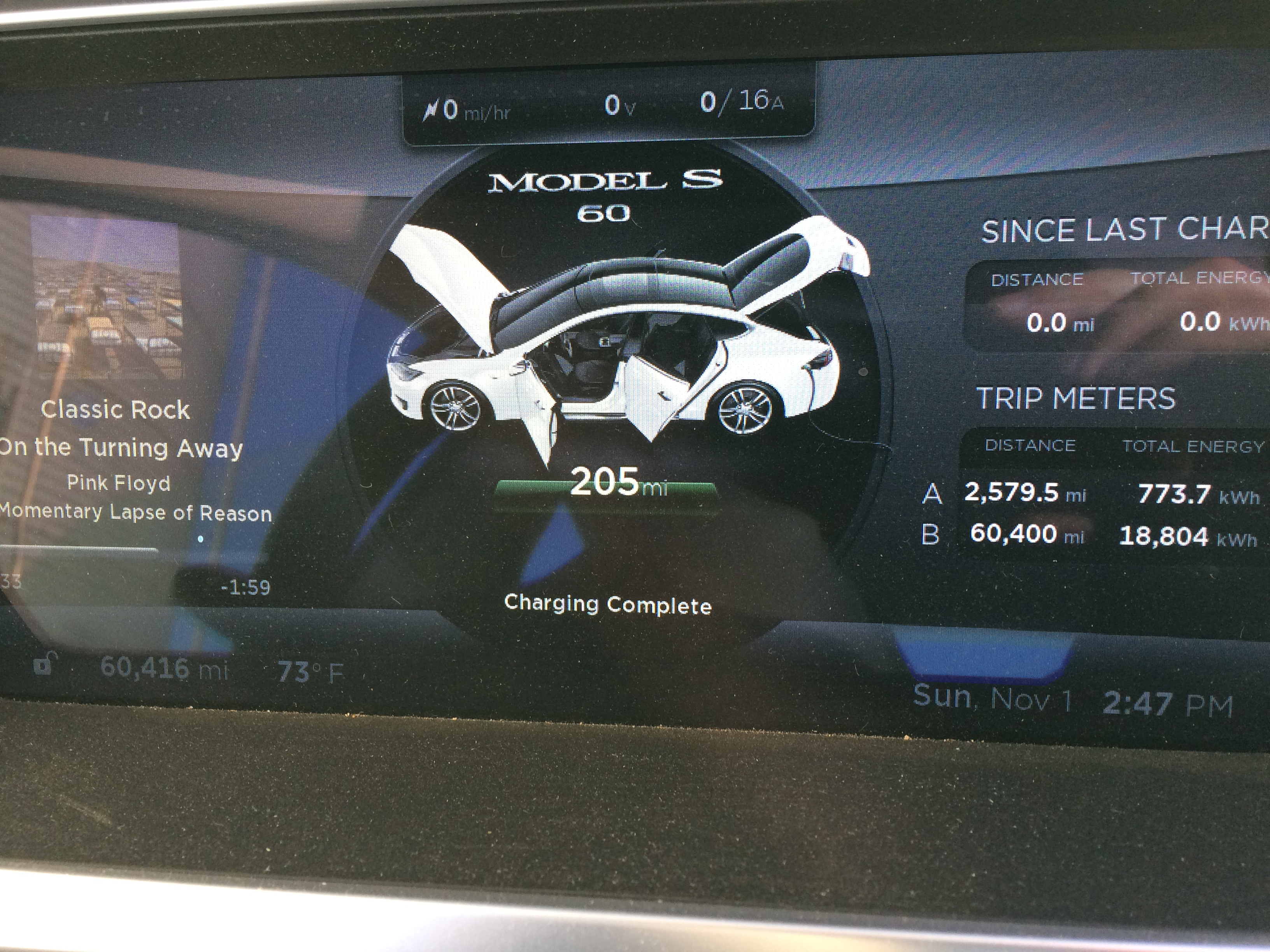
glhs272 205 rated @100% 60K miles
 �
�
Nov 2, 2015
Klaus 200 mi rated @100% for about 2 years now. 198 or 199 if I haven't charged 100% for a while. I think I got 203 when it was new.�
Nov 2, 2015
AZbba I have a 2014 85 with 39k miles. My 90% charge has been sitting right around 224 miles. This seems on the low side. Is this low enough to bring it up to Tesla about a warranty repair due to rather quick loss? I see most others with 224 range have 2012 cars...�
Nov 2, 2015
Benjamin Brooks Not unusual, right at the average actually. See Tesla Battery Survey (old name MaxRange) - Google Sheets (and add your data�
Nov 2, 2015
Pilot_51 Added my car. It's kind of looking like something may be wrong with my battery. It's too early to tell if the 100% charge followed by discharge to 11% (18 miles) helped much; still getting 156 miles at 90% (give or take 0.4 mile according to VT). I'll have service take a look if it doesn't improve satisfactorily after a month or two. I'll need the range for my Yellowstone trip next year.�
Nov 3, 2015
glhs272 If you haven't tried this already, you might just charge it to 100% everyday for a couple of weeks. You might be surprised at the results...�
Nov 3, 2015
wk057 While it may help kick the calibration algo in the butt a little, definitely not good for the battery and probably not worth the actual degradation that comes with doing so.�
Nov 3, 2015
glhs272 It may be helpful to find out if the battery is just out of balance/calibration (recoverable) or if there is really a problem with the battery, such as a weak module (not recoverable). Is it worth it? Well, if the battery is getting 150 miles of range @90% where it should be 175 to 180 miles, that is effectively 12% of degradation. "Battery level degradation" if you will. But, if running the battery at 100% for a couple of weeks recovers the battery back to 180 at the expense of 0.001% cell level degradation, that would be an acceptable trade-off to me anyway. You can time the charge so it doesn't sit at 100% too long.
<soap box>
Anyway, I think people are making too big of a deal about the occasional range charge. I do it all the time. And guess what, my car has the least amount of battery level degradation on any car I have seen with it's relative amount of miles. My car lives at 90% almost all the time unless it's being driven or I am range charging it. How long would it have to be at 100% to have any measurable degradation? Weeks? Months?
In my view people are "stepping over dollars to pick up pennies" with their charging habits. Folks are charging to 60 to 70% every day allowing their batteries to go out of balance, thinking they are saving their batteries (which at the cell level they might be slightly correct) but suffer horrible range loss very quickly and then complain about it demanding Tesla replace their batteries. The difference in cell level degradation 90% versus say 60% is miniscule. Why suffer?
<steps off the soap box>�
Nov 3, 2015
qwk What you wrote will definately work, although if one complains loud enough, the SC will reset the battery info manually, and you will get the same results without the range charges.�
Nov 3, 2015
apacheguy According to new evidence only a single range charge is required to activate the balancing circuits. Multiple range charges are superfluous.�
Nov 3, 2015
glhs272 From a range calculation standpoint, resetting the battery info will fix the "calculation related" range loss indicated. But, if the battery were in fact significantly out of balance, then maybe not.
Wk057 stated earlier up thread that the balancing circuits don't kick in unless you charge to >93%. Guessing that the reason for that is it needs to be at a high state of charge to accurately calculate the differences in capacity/voltage at the group level. I don't know if that is true, but if it is then the only way to "fix" the battery is to range charge it. I don't see any other way around that, short of disassembling the battery and manually balancing it.
Of course if the battery had a weak module or group of cells then nothing will ever get that range back, short of replacing the module. It sure would be nice to have access to the diagnostic screens so we wouldn't be so much in the dark about what's going on inside the battery.�
Nov 3, 2015
qwk With the latest FW, a single range charge doesn't do much.
- - - Updated - - -
I'm not sure what the latest FW does, but I'm 100% sure that balancing occured at 90% on the older FW versions(pre 6.0). You are right though, if the battery is out of balance, a reset will not help much.�
Nov 3, 2015
apacheguy Can you explain what you mean. 7.0 range charges behave differently somehow?
How do you know this? Pretty sure wk057 will beg to differ based on empirical data he has collected.�
Nov 3, 2015
rlang59 A piece of data that would be needed is the FW version the car that the batteries were removed from was running. The 93% number is interesting given that pre slider the "daily" charge level was ~93%.�
Nov 3, 2015
David99 According to wk057 the charge level needs to exceed 93% to initiate balancing. But it then continues regardless of state of charge or driving or standing. The 93% seems to trigger it, but then it runs on it's own for however long it needs.�
Nov 3, 2015
qwk Diagnosic screens do not lie....�
Nov 3, 2015
glhs272 wk057, can you confirm that once balancing is initiated that it only needs that one balancing cycle in order to achieve a perfectly balanced pack, thus only one range charge needed? >93% triggers it, and it runs on it's own regardless of pack SOC at that point (driving or parked). But that still doesn't necessarily confirm that it gets everything done in one session. But that's what your seeing... regardless of the level of imbalance, it only takes one session to bring everything back into balance?�
Nov 3, 2015
qwk This is definitely not the case. Complete balancing can take a very long time(dozens of charge cycles), unless you set the slider to 100% and leave it there for a while.�
Nov 3, 2015
apacheguy Did you somehow have access to these diag screens yourself? I know that the BMS screen shows cell voltages in sets of 74 cells, but how did you know it was actively balancing?
Not sure I understand this either. While balancing is hardly an instantaneous process, once the BMS recognizes which cells are imbalanced and by how much, it should only need to run the balancing program once.�
Nov 3, 2015
wk057 I think you might be confusing actual imbalance with the capacity estimating algorithm. The latter is more likely the culprit in most cases. It either needs to be calibrated with a charge to 100% and a discharge as low as possible, or reset by Tesla.
As for actual cell balancing, the vehicle and pack I experimented with was running some version of 6.2, but I doubt the behavior has changed. The balancing circuits would enable at the CV stage of the charge and stay on regardless of what SoC changes happened due to driving/charging/etc. One of the things I did was pick a random cell group in the fully balanced pack, at ~50% SoC or so I dumped 5Ah extra into a cell group and monitored the balance circuit, which would require 50 hours of balancing to fix this particular imbalance. Car behaved normally, balance circuit wasn't enabled even at 90% SoC, even though there was a pretty decent imbalance. During charging the balance circuit enabled immediately when the CV stage was reached. The balance circuit stayed enabled for over two days regardless of pack usage, which I thought was pretty cool.
Unfortunately the details of that particular project overall are not mine to share, I was only helping out and doing some experiments to try and reverse engineer some of the battery related items while I had the opportunity.�
Nov 3, 2015
Sacrament055 2014 S40 44K ish miles I'm seeing 131 to 133 at full charge. Typically it stays at that number for a couple/few miles.�
Nov 3, 2015
AmpedRealtor I did not recover any range after a single max charge, however after three consecutive max charges I recovered about 5 miles.�
Nov 3, 2015
msnow Did you run it down to <20 each time or just three 100% charges regardless of how much was used?�
Nov 3, 2015
apacheguy Seems that the range you "recovered" by range charging was just forcing the algo to readjust given what we now know.�
Nov 3, 2015
qwk No confusion here. The pre 6.0 FW balanced the packs at the daily slider, which is ~90%, when in range driving mode. Unless one has access to Tesla's diagnostic screens, it's very difficult to know whether the lower range displayed is pack imbalance or estimation drift. The Roadster also exhibits similar behavior, although it's not exactly the same. Tesla makes so many FW changes with each revision , that it's impossible to say for sure if things are the same now. Tesla also had a battery capacity measurement in the earlier firmwares that made degradation easy to see if the pack was balanced, and a bleed test done, but the latest FW has it buried somewhere where it's not easy to find.�
Nov 3, 2015
apacheguy Bleed test on the pack? What does this mean exactly? I assume this is/was a diag screen function?
under this previous FW, did the pack balance below 90%?�
Nov 3, 2015
AmpedRealtor I did not run it below 50% in this scenario.�
Nov 3, 2015
msnow Whatever works. I assume you got 5 more miles both at 100 and 90.�
Nov 3, 2015
AmpedRealtor I did not drive the car below 50% during these three max charges. I simply charged to 100% for three days in a row and drove whatever miles I drove those days. My bet is on balancing.
- - - Updated - - -
Yes, range went from 223 to 228 at 90% and from 248 to 253 at 100%.�
Nov 3, 2015
qwk No balancing below 90%.�
Nov 3, 2015
msnow Sweet. It gives me hope because I lost 7 miles at both 90 and 100 on a new 90D in 6 weeks.
wk057 mentioned something upthread about Tesla being able to do the same thing (reset) which I took to mean they do something at the SC that we can't at home. Is my understanding correct?�
Nov 3, 2015
AmpedRealtor Take this for what it's worth because not everything the service advisors say is actually true, but their intentions are good. I was told by my service advisor that there is a battery "reset" only available to service that will reset the range counter. He said they do this on their loaners after I asked why their loaners, with higher mileage, seem to show no degradation. I asked if they could reset my car in the same fashion, to which he said no.
This is the only time I had heard of anything like this, so take it with a grain of salt.�
Nov 3, 2015
msnow Understood.�
Nov 3, 2015
Todd Burch I tested some of this the last few days.
I've been 90% charging to 234mi rated for awhile now (2014 P85, ~20k miles).
A few days ago I range charged to ~97% to trigger a balance cycle, then over the course of a few days drove all the way down to 14mi remaining. Today I charged back up to 90% and the charge stopped at a smidge above 234...it dropped to 233 right after I left my driveway. So not an improvement, but actually slightly worse than it's been. Might try a few consecutive 100% charges later, just out of curiosity.�
Nov 3, 2015
apacheguy This is very confusing.
1. Why, if the pack was able to balance at 90% on previous firmware, did Tesla opt to change this feature to only be effective during constant voltage charging? Especially when they recommend 90% charging, they should not incentive folks to range charge in order to balance.
2. Why, if the pack can indeed balance at 90%, does it not balance at 80, 70, etc.?
3. Repeated 100% charges should accomplish nothing. Given what we know, balancing only needs one go to get it right. It should not take any more than 1 range charge.
If someone at Tesla is reading this and feels like writing up a blog post addressing these points I think all owners who have ever spent time wondering about range numbers would be enormously appreciative - and there are quite a few, especially with the new 90 kWh customers who are wondering about this.�
Nov 4, 2015
msnow Agree. I think an easily understood explanation from TM would indeed be helpful. Right now people are uncertain whether it's an issue of a changed or inaccurate algorithm or a battery issue.�
Nov 4, 2015
tomas First range charge in ages 257 this AM. Range mode on. 2012 A pack w 30k mi. Lost ~5% in first year and has been very steady since.�
Nov 4, 2015
qwk This is not confusing at all. Tesla introduced the % slider only to avoid averaging the max EPA charge # with the standard EPA charge #. This would have forced them to advertise the lower EPA range sort of like the RAV 4 EV did. Since Tesla top balances the pack, it has to be at higher charge levels to be effective. This is why charging to anything below 90% used to get folks to see a lower rated range over time. I'm not doubting what Wk stated, because I have no concrete info on the newer firmwares, but it makes little sense that Tesla change the charging algo so much. It certainly is possible, as engineering has been making a ton bad decisions lately.
When a pack gets out of balance and is still being used, the weaker modules/cells get stressed more that the others, which causes them to degrade faster. Only Tesla knows how much though, and it could be too little to worry about.�
Nov 4, 2015
AmpedRealtor +1!�
Nov 6, 2015
msnow AR, are you still holding your increased range?�
Nov 7, 2015
AmpedRealtor Yes, in fact it's increasing further. Two days ago I ran the car down to 4 miles of remaining range (that was fun), charging back up to 90% yielded 229 miles.�
Nov 7, 2015
msnow That is great! I tried a slight variation from your triple max charge method. I did a double max then discharged to 70% (that's all I had time for). Day one I picked up 3 rated miles to 254, day two lost one to 253, today is day three and it's still 253. Still need a few more days to call this a success but so far so good.�
Nov 7, 2015
TexasEV Y'all are just treating yourselves. I doubt you're doing the battery any good. If a few miles difference in estimated range, even if it's real and not a measurement artifact (which I doubt), is really that important to you then I would submit that you're cutting your trips too close between charging stops.�
Nov 7, 2015
tomas Yes AND. Max range only really important for first leg of a trip when you can leave fully charged. If you are doing supercharging, best to hit every charger and keep filling up from 10 or 20% to max 75% or the taper kills you.�
Nov 8, 2015
jerry33 It's mostly important at the trip's destination when there are no easy charging options. An additional twenty miles can make the difference between being able to get back the previous SC (on the going home side) and having to spend a few hours charging to get there. While you're on the SC route there's currently no problem (although there might be in a few years--I'm hoping few becomes many)�
Nov 8, 2015
AmpedRealtor I babied my battery for the first year, never charging above 60%-70% because I never needed more. So I don't see any harm in doing a few 100% charge cycles and running it down a few times. I also ran it down to 4 miles intentionally, and planned for it.�
Nov 8, 2015
efusco Just a data point. I just passed through 60k miles a few days ago at 2 years and 11 months since taking delivery.
90% charge is 228 miles (242 originally) = 6% loss
100% charge is 253 miles (272 originally) = 7% loss�
Nov 8, 2015
wk057 While I only have minimal evidence to support this theory, I'm reasonably certain that the miles shown above 265 or so at 100% near the beginning of life are also a calibration artifact.�
Nov 8, 2015
Shabbir I have just purchased a 70D. Did a 100% charge and the meter is showing a rated range of 225 miles. I thought it should be 240 miles? Can anyone explain this? what is the solution to increase this to 240 miles?�
Nov 8, 2015
SteveS0353 Another data point...
I just had occasion to range charge and deplete a couple of times to support a road trip. This charge / discharge sequence has not changed the rated range, so I believe the rated range algorithm is calibrated and my pack is balanced.
18.8k miles in 16 months, 85kWh 'D' pack
90% charge is currently 231, originally 240
100% charge is currently 257, originally 267
Both of these results represent a 3.75% loss of rated range and is likely real degradation in the battery capacity.�

Không có nhận xét nào:
Đăng nhận xét