Jul 21, 2013
akula ok, definitely something weird is going on, I'm down to 227 on a standard charge. This is happened just over the last few days. Anyone have any ideas? Should I call Tesla about this?�
Jul 21, 2013
Owner From my survey data so far, your number is consistent with several other people, so I wouldn't worry about it. Please fill out my survey if you have not yet already done so.
Rated Range and Average Energy Tesla Model S Survey
Maybe with enough pressure on Tesla we can get a real answer to this question. And also what I would really like is a xx kWh readout.�
Jul 21, 2013
brianman 1. Go for a joy ride of 100+ miles with the AC on full comfort (i.e. no venting, etc. to save juice).
2. Return home and park in your garage.
3. Plug in.
4. Wait 90 minutes.
5. In the car, reduce your amperage to 5A (if you're on 208+V) or 10A (if you're on 110V).
6. Let it finish charging.
7. Check every 7 minutes on your phone or in car until it says "Charge complete".
Sounds like a PITA, but I bet you'll see 230+ after doing this.�
Jul 21, 2013
qwk Yes.
And, if you keep on charging using a 120V outlet(or 240V @ 6A), your battery will keep balancing itself better.�
Jul 21, 2013
Vger Bear in mind that the SOC display is an estimate, not a definitive measurement. SOC is actually quite difficult to measure. As I understand it (don't have inside knowledge of Tesla's algorithm), SOC is estimated in part by the response of the battery to charging. So the voltage and current supplied to the charger definitely matter. Temperature matters. There may be other variables. I have seen this with my Roadster. Sometimes the number is exactly the same charge after charge; sometimes it goes down; sometimes it goes up.
Also, bear in mind that true maximum capacity, and the point at which charging stops, are not the same thing. I suspect that Tesla messed with the latter under the covers when the new variable slider came out with 4.5. I do not just mean that the old Standard charge is not the same as the "detent" in the slider, but the details of the algorithm that tells the charger to shut down may have changed.
Like everyone else here, I sure wish JB would publish an updated blog on this, with clear details and unambiguous user guidance. I suspect Tesla is getting more protective about this stuff though, now that they know the majors are paying attention to the competitive threat they now represent.
In the end though, Tom Saxton's work has borne out Elon's repeated assurances that people will be pleasantly surprised at the longevity of the batteries in the long term.�
Jul 21, 2013
Apoclyps Interesting. When I first got my car (april of this year), I did a Max Range charge on my car at 208V/30a for a PS trip. It got to 211 rated miles (SW v4.1). The trip back i did a Max charge on 110V/12A and got 211. This past Friday night, I did a Max charge on 240V/40amp (SW v 4.5) and it went to 208. I also noted a change in the standard charge, going from 190 (v4.1) down to 187 (v.4.5) to 185.�
Jul 21, 2013
akula Ok looking forward to trying this tomorrow once I get the available range down a bit. Thanks for your help hopefully this will do the trick.
Overall though this is very odd behavior, it dropped very fast about 16 full miles now from what I'm used to getting in about a week I'd say. I've been gone for 10 days or so and the car was just standing. The milage started disappearing after I came back. Feels like it's all related somehow
�
Jul 21, 2013
Doug_G A small variation like that does not imply that your battery capacity has actually dropped; it can vary significantly due to pack balance. The lowest string limits how far you can discharge the whole pack, and the strongest string limits how much you can charge the whole pack. Your pack tends to slowly get out of balance, and your battery management system is constantly trying to rebalance it.
Also, as Vger pointed out, the measurement of pack capacity is an estimate, and a lot of complexity goes into making that estimate. Having a highly accurate range estimate is part of Tesla's "secret sauce". But it isn't perfectly accurate, so "mileage may vary".�
Jul 22, 2013
aaron.s qwk -
Are you sure your first charge on 4.5 was actually 90% and not more? Pre 4.5 my "standard mode" charge - which is actually 92-93% (not 90%) yielded 239 rated miles (242 rated miles pre 4.4 - they changed something there!!)...
I now keep the slider at the 90% tick mark and consistently get 232-233 miles at the end of the charge...
Aaron�
Jul 22, 2013
qwk Yes. 100% sure. When setting the sliding bar, it easily falls into place at the 90% daily setting. It doesn't do that at any other interval(so it's harder to get right on a certain percentage, except 50 and 100% of course). I knew I should have taken a pic. Next time...�
Jul 22, 2013
akula What if I'm using HPWC? How should I attempt this?
�
Jul 22, 2013
rlang59 On the charging screen in the car lower the current to 6A.�
Jul 22, 2013
akula ok, will do tonight, I should be able to get the available range down to around 130 miles.
�
Jul 23, 2013
akula Ok. The car just finished charging on my HPWC at 6amps. It took the whole night plus most of the afternoon today. However, my available range when fully charged now says 224! I'm now a full 20 miles down from what it used to display on a standard charge 10 days ago. Not sure what to do from here.�
Jul 23, 2013
qwk Something is not adding up here. If you really were at 130 rated miles, and plugged it in last night(240V @ 6A) you wouldn't be done charging yet.�
Jul 23, 2013
akula correct, I started with 113 in the "tank". Started charging at 60amps, then when there was about 1hr and 30mins left, i went and switched the display to 6amps.
�
Jul 23, 2013
gaswalla Akula, what was the soc while your car sat idle for 10 days? Also, have you called tesla for their input?�
Jul 23, 2013
rlang59 From my understanding for it to make any difference you need to charge at 6 amps the entire time. You can't charge at 60 then drop it down for the last part of the charge.�
Jul 23, 2013
akula The car was not plugged in while I was away but when I came back it still had over 150miles of available range showing. I have not called Tesla yet.
- - - Updated - - -
So I should drive it again, get it down to 130 or so and then plug it in for a few days essentially?
�
Jul 24, 2013
rlang59 I think that is what people are saying. I myself have not tried it so maybe someone that has can comment.
�
Jul 31, 2013
bhuwan Bens numbers seem to fall outside of that!�
Jul 31, 2013
Lloyd Which member name is ben? What were his full range charge numbers? Battery capacity? Total miles? Delivery date?
If he is outside of that, then he may have a developing issue that he needs to watch.�
Jul 31, 2013
aviators99 Of course they take 265 as the start when they figure out percentage, even though I started at 273. But my 254 is still more than 3% loss. But I don't know what "the first year" means.�
Jul 31, 2013
qwk Oh sorry, I forgot to post my mileage. It's 7k miles. My energy average for all of those miles is 314.
Rated range can't have anything to do with driving style(doesn't change the outcome of my charges if I drive it like I stole it).�
Jul 31, 2013
Lloyd From the graph I reviewed, 'one year" was the time from when the battery first started cycling power.
I got 272 from the start on my car, and finished at 268 after 6 months and 8000 miles before it was sold. It will be at my house tomorrow for a range charge after ~ 3000 more miles on it. I will report the new range charge.
I have to believe that total energy delivered has to have some effect on battery longevity as well.�
Jul 31, 2013
cinergi That's me. Full rated range is now 251. 90% is 219. 85 kWh pack. 14,000 miles. Delivered 10/11/12.
One or two other people here mentioned a sudden drop to 219 as well.�
Jul 31, 2013
Lloyd That seems to be more than 'normal' . If it continues to drop at that rate, I would think that Tesla would step in and repair or replace.
Tesla seem to have stood behind battery issues to date. I would be watchfully concerned.�
Jul 31, 2013
aviators99 Yes, but a key component in degradation is number of cycles, which is nearly linearly related to miles driven. So the graph must assume a certain number of cycles (miles) per year. I'm sort of arguing against my own case to get my battery fixed with that statement, but not everyone is seeing degradation like I have been seeing.�
Aug 1, 2013
Owner So turning that into numbers...
265*.9 = 238.5
.97*265*.9 = 231
"First year is that 10K, 12K or 15K miles?"
Taking out the 5 questionable datapoints (203,265,273,275,277) the survey number average is 234 for a 90% charge, which is inline with these numbers. Perhaps a hair low.
I still am confused why they range ranges so much...
�
Aug 1, 2013
bluetinc Once you remove the extraneous data, I think your numbers start make some good sense. You should note that you did not ask users for their true mileage which I think would create a more clear trend line from ~235 to ~220 against miles, rather you asked them for their longest trip tick distance. Some users have kept this to be their total mileage, many have not.
Also, because you are charging to 90% SOC NOT 90% of 265 miles your numbers below are a bit off. Assuming for a second that their is an 80 kWh useable battery:
90% SOC -> 72kWh -> ~5.3kWh (Reserve) + 66.7 kWh (drivable above 0 and displayed)
66.7 kWh displayed = 66.7 kWh/0.287 kWh/mi = 232 miles displayed on the dash in "rated range" mode.
My car came with ~84kWh drivable energy, which would show about 244 at 90% (275 at 100%).
Now it's about ~78kWh drivable energy, which would show about 227 at 90% (255 at 100%).
This seems inline with your data and other cars.
Peter
�
Aug 1, 2013
Owner My survey was trying to see if there was a relationship between driving style and rated range, as I had been told that emphatically by Tesla service personnel, so the survey was trying to see if there was that relationship. From the survey, I think that relationship is clearly debunked unless there is some short term thing, but there isn't any evidence out there on that either.
I did note that the mileage was perhaps related to total car mileage in the long report. I suspect there is some relationship in my data but definitely not certain. I think perhaps a different survey on battery degradation could be done at some point but I think we are too early for that. And plug in america has been doing those well, so I am going to assume they will be doing similar Model S surveys on that in the future.
�
Aug 1, 2013
bluetinc Plug In America already is running a survey.
Plug In America
I encourage all to participate.
I also have heard the same for rated miles from Tesla employees. I agree that it's hogwash, but I believe that stems from the fact that different cars have different "rated miles" both at full charge and as an energy line displayed on their graphs. I believe that the energy line is set at the factory and does not change due to driving.
Peter
�
Aug 1, 2013
gregincal Which I think is absolutely fair. I had over 270 the day I drove home from the factory, but the very next time I range charged at about 2000 miles it was 265. It really seems like the batteries have a little extra capacity that degrades quickly (it doesn't seem to for some people, but they should just count themselves lucky for that). Since they only promise 265 it shouldn't matter that you get a bit extra when the car is brand new. In my opinion you can only really start to talk about degradation once the battery drops below the promised 265 and calculate the percentage from that.�
Aug 2, 2013
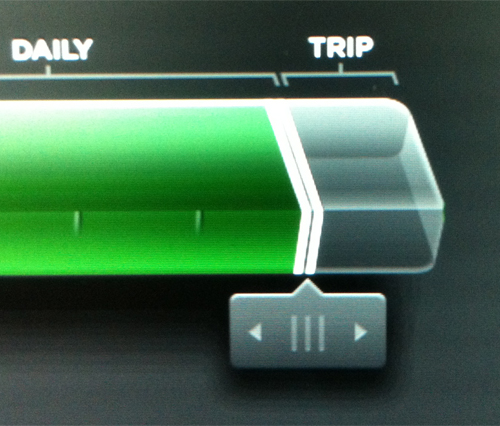
Owner I was finally get around to input my data by delaying the charge till a time when I was actually awake since my car normally charges in the middle of the night. But I could not get a full "daily charge" or non-range mode charge. The charge wants to stop just a hair before. Tried it a few times. It is 5 miles below my typical range number.
Any thoughts?
�
Aug 2, 2013
bluetinc Hi Lloyd,
Could you point me at one of the battery curves that shows only 3% loss in the first year?
Charge termination at a particular partial SOC is very hard to do consistently, especially with various charging currents. It also seems to be an area that Tesla has been trying to refine throughout the software loads. I have given up using anything except for full, 100% range charges to track my degradation, and to compare against others cars.
Peter
�
Aug 2, 2013
Lloyd 'First Year' refers to a calendar function and has nothing to do with 'Miles'�
Aug 2, 2013
brianman This is kind of odd, no? I thought one of the things we interpreted from prior data was that usage/cycles has a more significant impact than age except for the most extreme of "garage queens" (i.e. sub-1000 miles, 10+ years old).
Perhaps I'm misunderstanding.�
Aug 2, 2013
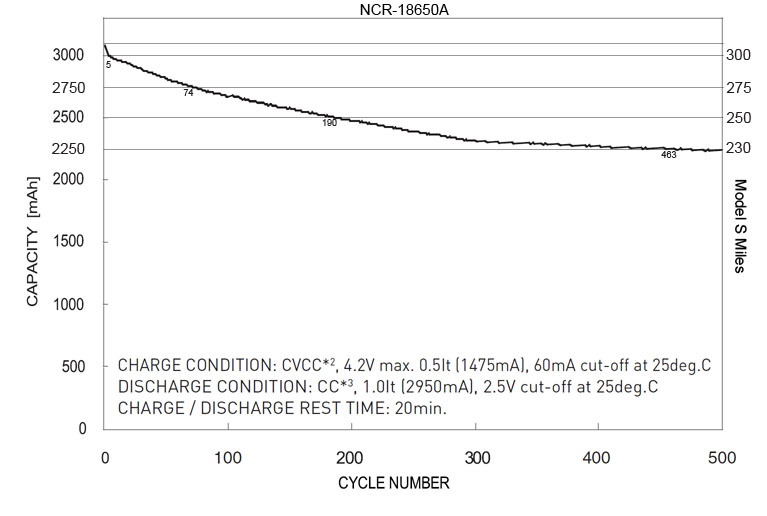
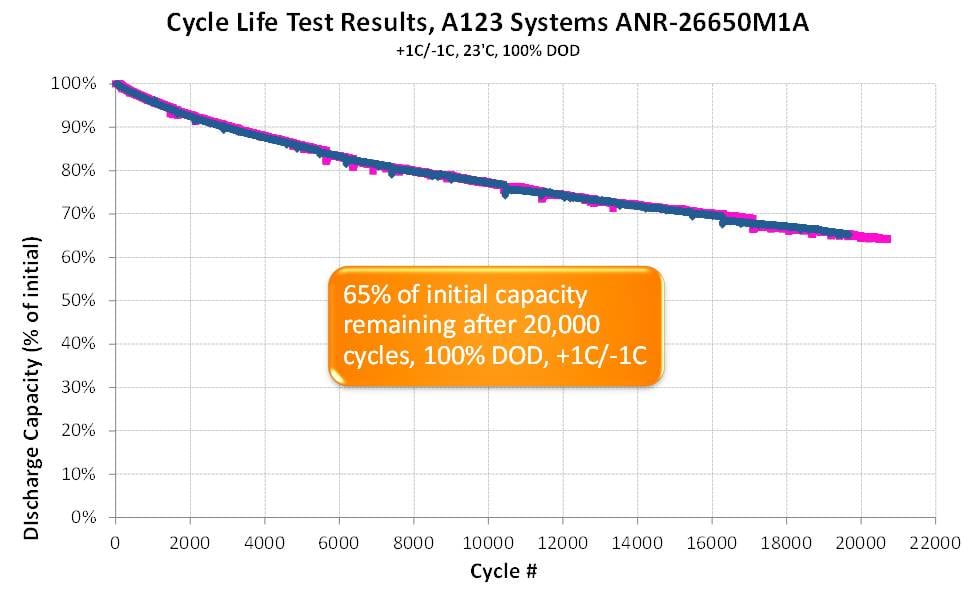
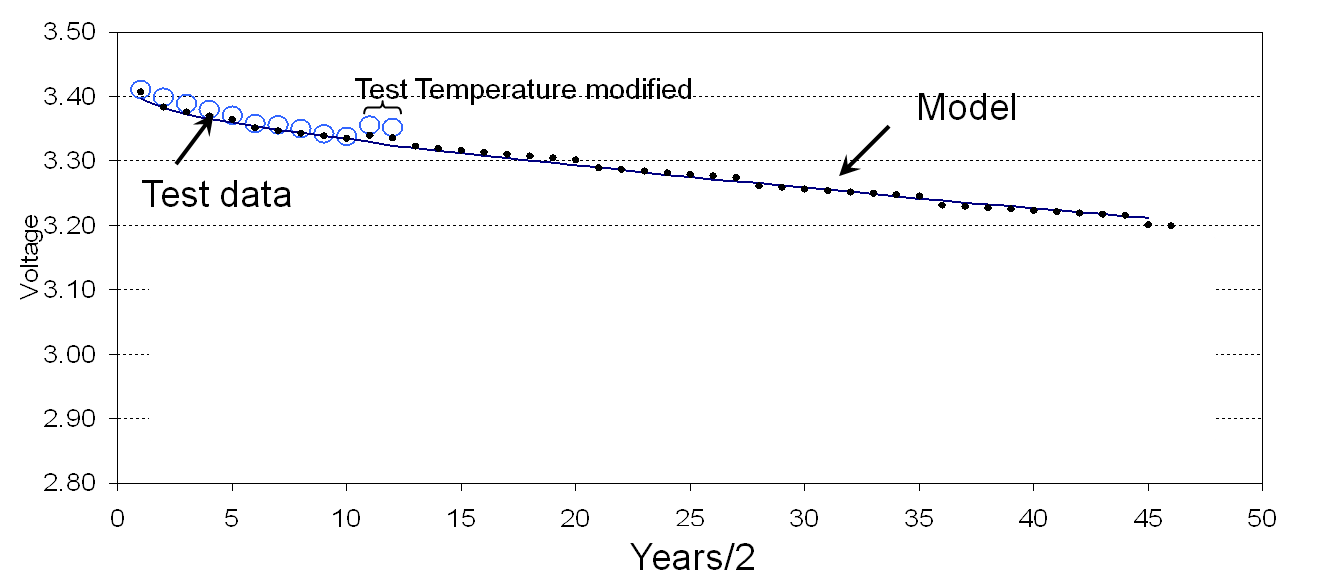
Lloyd Here are some graphs that I pulled from other sections of the forum, there are more.
Below is Model S form battery. Note higher initial drop in capacity.
Below is testing from an A123 format battery. Note the flatter and more linear curve.
Tesla battery for extended use (projected)
 �
�
Aug 2, 2013
Owner Well then it is actually good that I get this kind of strange not-full graph as it is sort of indicating "imperfection" in the data.
�
Aug 2, 2013
Lloyd That was my point in the very beginning. We only have one static charge point to track degradation, as you say at 100% (full range charge)�
Aug 3, 2013
islandbayy I did a range charge today on my S60. It lingered at 209 miles for about 20 minutes and was still charging. Most likely it was balancing the pack. I had to unplug before it was complete to get to work. I drove at a uncompleted range charge, showing 209 miles. I went 4 Miles before it dropped to 208 and used exactly 1kw to go the 4 miles. 209 has always been my maximum rated range for a range charge, so this was just a bit astonishing. I have now just a hair under 6,000 miles on my MS60.�
Aug 3, 2013
SFOTurtle Wow, that's great for you. Looks like you've had no loss at all after 6,000 miles. I'm probably a good 5 rated miles less than you with another 1300 miles on the car.�
Aug 15, 2013
bigsmooth125 I did another range charge today, my third ever, and got 257 miles. My conclusions thus far: 1) the calculated rated miles at various partial charges are clearly not linear; 2) I'm not as concerned about degradation of my battery as I was before.�
Aug 19, 2013
qwk Just as a reference point, my loaner charges to 241 miles on a 90% standard charge (FW 4.5). Car has 240 miles.�
Aug 19, 2013
mdh Interesting... my car has 10k miles... i get about 232 at 90%. Very slight degradation.�
Aug 19, 2013
qwk It might not be degradation. From the info we have so far, pack balance and percentage pack calculations are somewhat of a factor when looking at the different rated range values.�
Aug 20, 2013
xray also for reference, on 4.5, just passed 11136 miles, I'm getting 233-234 rated miles at 90% and 265 miles for a recent max range charge. 265 has been my max for a range charge since the beginning (I think I might have gotten 267 early on, once).�
Aug 20, 2013
johndoe74 Another reference, on 4.5 firmware, 7900 miles in 6 months of ownership. I did a max range charge last night and got 254 miles. I live in Phoenix so the degradation may be higher than normal.�
Aug 20, 2013
gaswalla It does appear that the only way to compare batteries fairly is based on a range charge that has completed (battery balancing has finished also)�
Aug 24, 2013
rlawson4 I am at 19930 miles. Version is 4.5. Standard charge is 232. Opinions how I am doing?�
Aug 24, 2013
bhuwan Sounds excellent to me.�
Aug 24, 2013
aviators99 Much better than I. But let us know what you get at the very end of a range charge for a more useful comparison, especially before 5.0 if you can.�
Aug 24, 2013
mdh I am exactly the same as you.. with 10K miles�
Aug 24, 2013
Eeyago I have an interesting situation with mine, maybe someone can shed some light on. In my 40, with only about 4k miles and the latest 4.5 firmware, I've been charging full to around 140-142 each night. Recently went on vacation and set the car to charge at 15a while gone. When I came back after a week, the car will only charge now to about 136-138. It's not a huge difference, but perplexing as to why the change. Any ideas??�
Aug 24, 2013
strengthcoach4
It appears that several owners, myself included have lost about 4 miles of range after the latest 4.5 update ending in .61. I also noticed this after coming home from a week vacation.�
Aug 24, 2013
texex91 This is very disappointing to hear about all of these losses. What happens over time you lose 50 miles or more? Is this covered under battery warranty? Anyone taken to SC and asked them??�
Aug 24, 2013
djp Battery degradation is to be expected with Li-Ion batteries, the good news is the Roadster is doing better than initial estimates.
Green Car Congress: Plug In America study projects Tesla Roadster packs will retain 80-85% capacity after 100K miles
I think most of the changes seen on this thread are noise in the measurements, calibration or balancing and not true degradation - the Model S is too new to see capacity loss yet.
On my three year old Roadster the Standard charge range dropped to 294km a few months back and then slowly recovered to 301km. The range estimates aren't an exact science.�
Aug 24, 2013
Zextraterrestrial I haven't done a full charge on 5.0 yet but my S shows 225 mi at 90% where in 4.5 it was at ~232 on the last version
I think Tesla is adding a bigger lower end buffer maybe and the software is getting better w/ the matching of the shown rated and what is actually used when driving @ rated on the energy screen.�
Aug 24, 2013
Odenator Yup same here. I get 225 rated miles on a standard 90% charge with v5.0�
Aug 24, 2013
cinergi What's interesting (may or may not be related to my measly 220 at 90 and 250 at 100) is that I have to drive 290 Wh/mi in order to achieve rated range. I won't get [email�protected] if I'm averaging ~312 (matching the energy graph bar for rated range).�
Aug 24, 2013
ckessel 11k miles, 8 months, 260 on max charge. Used to reach ~270.�
Aug 25, 2013
Eeyago Thanks strengthcoach for the confirmation!�
Aug 25, 2013
bluetinc When you say over time, I take it that you mean over a period of years. A generally accepted number seems to be about 80% at 100k miles. This would mean that for the 85kWh battery, one would loose 53 miles of range (80% of 265miles = 212 miles). We should all expect this type of degradation.
DJP, did you get your roadster new? I think that we definitely are seeing degradation on the packs. On top of that degradation is noise created from issues in measurements, and balancing issues. The real question that is open to still be answered is; what trend line of degradation is expected so that we know our cars are preforming as expected (give or take a little).
Ben, this is true in all cars. I've verified it in mine. There is an entire thread about it over on TM site.
Sign into My Tesla | Tesla Motors
Would you mind providing one extra bit of data, the rated miles and ideal miles displayed (at any SOC). I'm trying to verify an idea I have and your car may have a higher "Rated Mile" energy unit than mine.
Thanks!
Peter�
Aug 25, 2013
djp When I bought my Roadster it was one year old, but it had 400 miles on it and the battery was kept in Storage mode, so it effectively was a new car. I've seen no battery degradation since then. Range numbers have varied over the months but are now back to where they were when I bought the car.
If you take the Roadster study as base line at 80% after 100,000 miles, that's about 2% loss per year. Most Model S's have less than 10,000 miles on them, which would be less than 5 miles of capacity loss. It would be tough to see this considering the noise from measurement, balancing and firmware changes.
The Plug In America study has preliminary Model S data - so far it's a flat line but it'll be interesting to see how it tracks over time as more owners submit their numbers.�
Aug 25, 2013
brianman After seeing 232 rated as the cap for daily (90%) charge for a few weeks now, this popped up today:
236 @ 90%?�
Aug 26, 2013
bluetinc (All numbers used below are approximate and may vary from car to car. Capacity and 306.5 Wh/mi "Rated Range" numbers are from my car )
From just about everything I've seen, the Model S losses about 4% in the first 5-10 charge cycles. This takes that battery from a drivable capacity of ~84kWh (275 "rated miles") down to a drivable ~81kWh (265 "rated miles"). The Roadster study is missing any good data for the first few thousand miles so this type of significant initial loss would not be shown. What we are seeing is many owners put far greater miles on our cars far faster than the Roadster had happen. Many posting about concerns on these threads have far in excess of 10k miles; I personally am now over 20k and a number of owners are over 30k. Will yearly mileages of 20k-40k a year, (personally over 30k year) statements such as "about 2% loss per year" by the community, when we personally see loss from 275 down to 254 (8%) in 8 months, cause great concern.
Compounding the general complexities of battery capacity estimations, changing software, and incorrect, misleading, a complete lack of hard documentation relating to "rated range" coming from Tesla, and general FUD about how to verify how much actual battery degradation.
Personally I have spent a great deal of time studying battery degradation, studying how the S runs it's battery, and predicting that I am roughly following an expected amount of degradation from my own predictions, but the amount of time I've spent is ridiculous, considering Tesla should have a trend line the shows expected degradation. Personally I think they have been holding this back because they know that most people don't understand that 80% of a 85kWh battery is 212 miles max range, and would like to get the main Superchargers infrastructure installed prior to having that conversation with the public.
My data is up on Plug In America's study. I hope all owners add their data.
Peter
�
Aug 26, 2013
deonb Something I find weird.
After 7000 miles my range charge rating is down from 266 to 262... however, when I start driving, the reading will stay at 262 for 4 to 5 miles (even though it shows a > 400wh/m usage rating) before it starts to decline.
It declines in pace with driving, it doesn't suddenly jump to 258 either.
So it's as if the rated range is still 266, but the car no longer measures the top of the charge state accurately.
Is anybody else experiencing this?�
Aug 26, 2013
Zextraterrestrial I don't see how you can say that there has been such losses because when you compare battery charge #'s after each software revision there is a difference. 5.0 has an even bigger difference than the change from v 3.9 to 4.0,4.1,4.3,4.4,4.5
12/1 242-4 mi 92% 277-280 100% v 3.9
12/24 242mi 90% 268 99% v 4.1
3/24 242 mi 92% 267mi 99% v 4.3
5/27 242 mi 92% 265mi 99% v 4.4
6/15 60% 142mi 80% 202mi 234 mi 90% 262mi 99% v 4.5
8/14 60% 145mi 80% 195mi 225 mi 90% 250 mi 97% v 5.0 ? not sure since I didn't fully charge yet, might do a road trip to the Bay Area tomorrow though
If you notice the scaling is different between 4.5 and 5.0 also. between each 10% SOC there is also a little different amount of kW used to charge. not necessarily ~8kW per bar ..interesting changes�
Aug 26, 2013
FlasherZ With the 5.0 calculation changes, my max 100% charge lists 260.33 miles. 90% charge nets 228 miles.
11k miles, 9 months since delivery (today, actually!)�
Aug 26, 2013
djp I think this initial loss is due to the calibration settling in after the first few cycles and not actual battery degradation.
On the Roadster the Calculated Amp hour Capacity (CAC) is only updated when you do a long drive from a full charge (Standard or higher) down to <20% SOC on a single key turn, then charge back up to Standard. The Model S probably does the same - I wouldn't trust the range estimates until you do this a couple of times.
I'd treat the 275 reading as an outlier before the system had a chance to calibrate. If you take the EPA rated range of 265 miles as the starting point than the loss is a lot less than 8%.�
Aug 26, 2013
strengthcoach4 I'm experiencing the same. If I max charge, my range won't change until I drive 3-6 miles.�
Aug 26, 2013
bluetinc No, my 275 numbers are 100% accurate.
When I picked up my car I took a cross country trip in which I used most of the battery, driving it down to or near a displayed 1 "rated mile" left. This along with the energy used and voltage on the pack at the low condition confirm that the number was accurate and not a calibration issue. Furthermore this rapid initial degradation matches ALL high capacity Li-Ion cell degradation curves.
Further I have also confirmed that new loaners with less than 1000 miles also still all charge up to the expected ~275 miles of range mode and follow the same expected degradation curve even with the current-ish 4.4. -.61 software version.
My current useable battery capacity is quite definitely 8% less than it was when I purchased the car. The amount of energy used when driving the car from a full range charge until range shows ~1-5 range miles, verified by the fact that the full pack voltage is identical in both cases, is now 8% less.
I don't quite understand why you are so set against believing that this is possible as you have a large number of people whom all see similar numbers, and this matches all known high capacity battery degradation curves.
Peter
- - - Updated - - -
I have seen this happen also. I found that if I leave the car for 6 hours, the displayed range is updated.
Peter
�
Aug 26, 2013
brianman Typo? I'm impressed you found a way to charge to 90% last December.�
Aug 26, 2013
djp Sure, I believe people are seeing an initial drop, but I don't think it's a big deal or indicative of long term degradation trends. Tesla claims 265 as rated range, which is reasonable once the battery burns in and capacity estimate is calibrated. The degradation rate should slow down after that initial drop.�
Aug 26, 2013
bluetinc Would it be possible for you to add odometer numbers and your average energy consumption numbers to this data?
- - - Updated - - -
But, if we estimate that the initial drop from 275 to 255 over the first 20k miles, and then it slows down to match exactly match the Roadster study, that means in my case I should expect to have a max range of 230 at the end of next year. Again, because of the mileage that is being placed on these cars, what is talked about as slow in the case of Roadsters is very noticeable in the S's.�
Aug 26, 2013
qwk It just isn't this simple. There are too many variables to create assumptions from rated range>battery degradation. The rated range is an estimation, that's it. While being much better than guess-o-meters on other EV's, it's still not a set in stone value.
My car blows your theory right out of the water. With about 5k miles on the clock(much more than 5-10 charge cycles), it charged to 272 rated miles in max range mode(this value was obtained a good 2 hours after charge stopped, in cold weather)so who knows what it was right after it stopped charging. Now with about 7.6k miles on the clock, it still charges to 239 rated in 90% daily mode. That comes out to be little to no degradation in 6 months and 7.6k miles.�
Aug 26, 2013
djp No disagreement there. My estimate of 2% per year was based on 10,000 miles per year combined with the Roadster study of 20% loss over 100,000 miles. Higher mileage will see more degradation.�
Aug 26, 2013
bluetinc A), That's great that your car is doing so well.
B), You simply can not compare your single point "rated mile" number against mine. To really even attempt do that you need to do a number of things:
1. Define what energy unit a "rated mile" is in your car. Cars can, and do, have different "rated mile" energy units.
2. Have capacity numbers from when your car was new. You could simply have a car that started off with a couple of percent greater capacity than mine.
3. Stay away from using any number that is not a 100% balanced range charge. Calculating capacity from partial SOC's is very very hard, and comes with a great deal of error. We have seen Tesla repeatedly correct the termination of partial SOC charges to try to smooth this out.
4. Correct your odometer mileage to a battery virtual mileage to account for the amount of average energy you use per mile, and the extra unaccounted for "mile" due to vampire draw.
Peter
�
Aug 26, 2013
qwk 1) This is an always moving target, which BTW doesn't jive between the two screens.
2)Car started off pretty low @237 rated range on standard charge(FM 4.2). I have only done one complete range charge(simply don't use that much range in one trip), so that's all the info I have.
3)That's all some people can go by, as max charges when you don't need them are just stupid. From my experience and the experience of others here, the standard and max charges do correlate(you won't get a crappy standard charge and an outstanding range charge, or vice versa).
4) The vampire drain varies so much, this is pretty much impossible, unless you meter all of the energy put into the car via a meter.�
Aug 26, 2013
bluetinc If you don't have good data, you can't argue about my results. While you have a number of reasons below that you didn't and won't collect good data, which is fine, please don't use your bad data to invalidate mine.
1) It is a set energy unit, which changes per car. It does take some work and some calculating to acquire and verify it.
2) My point stands, you either need this data, or you have to accept that you don't know what it started at. Perhaps you started at 278. Who knows.
3) Again, if you don't have good data, then how can you use bad data to try to argue about validity of a theory? Just because it's harder to get doesn't make adding highly error prone data to the argument any more valid.
4) It seems that my vampire drain is actually very constant at about 8-10 miles a day. For 9 months this would be ~2500 miles. Do you have any good data to show that it is not constant?
Peter
�
Aug 26, 2013
ElSupreme I find the opposite. I range charged 259 rated miles. And lost 11 in my first 3 miles of driving (~400 Wh/mi at that point) I then drove another 230 miles. I ended up at almost exactly rated range. But was steadily gaining on rated range, except for parking for ~2-3 hours where I lost about 6 miles in about 2 right after getting in the car.
I'll post some pictures of my screens.�
Aug 26, 2013
SFOTurtle I don't know if this is good data or bad data, or no data at all, but my vampire was about 5 rated miles/day when I was on vacation last week. A colleague of mine went on vacation for 10 days earlier this month, and his vampire was also 5 rated miles/day. Last night, from 7:15 p.m. until 8:45 a.m. this morning, my vampire loss was 1 rated mile. We are both in SF Bay Area and park our cars inside. In the middle of winter, my vampire drain was closer to 8-10 rated miles/day.�
Aug 26, 2013
phat78boy I'm pretty sure the "vampire drain" is based on your ambient temperature. That might be why some are seeing less "drain" and some are seeing more.�
Aug 26, 2013
qwk See my replies above. You can stick your head in the sand, and cherry pick data to suit your needs, but since Tesla doesn't let anyone see the CAC value, we are all guessing here, some more than others.�
Aug 26, 2013
cinergi 200 rated was 230 ideal today.�
Aug 28, 2013
mdh So, my car has about 10k miles.. I routinely get about 232 rated miles when I charge to the standard charge (approx 90%~). This appears to be consistent with people that I know here in the Bay Area. A person that I know just had his battery pack replaced due to some type of fault (root cause remains a mystery). He also had about the same mileage and version of software, as me. The new battery pack is coming up with 245 miles. I think this illustrates some mild degradation for me. Just fyi.�
Aug 31, 2013
islandbayy Did a range charge over last night, as I had a longer drive today. Range charge right to 209. I was just a hundred miles short of 9000.
I hope noone minds me updating every thousand, as it seems that I'm a thousand more every other week or sooner^_^
�
Sep 16, 2013
qwk Ok, so right after my car was upgraded from Firmware 4.5(.59) to 4.5(.61) the standard 90% rated miles went from 239 to 230. It happened instantly, so that tells us Tesla must be calculating rated range differently.�
Sep 16, 2013
mdh TM should really be more open about these topics.�
Sep 16, 2013
qwk Definitely. Getting people worked up about losing quite a bit of rated battery range, especially when it's just a software tweak, is not the best business practice.
If I were to grade Tesla on communication, it would be a big F-.�
Sep 16, 2013
steve841 IAhhhh... The good old days when GeorgeB would drop by to chastise us or set the record straight....�
Sep 16, 2013
mdh We also expend too much energy talking/speculating about battery degradation. TM should be more transparent. BTW, Nissan does the name thing with the Leaf.�
Sep 17, 2013
bluetinc Or, it means that the charge termination cycle or balancing algorithm was modified so when charging to 90% SOC, the amount of energy added to the battery is now a little different. I think you are jumping to conclusions of what they changed. Does your 100%SOC charge still charge to the same mileage just before and after the software upgrade?
Peter
�
Sep 17, 2013
qwk You could be right. My main point is that there was a software change, so it's not battery degradation. Even though a range charge will not tell us much more than standard charge will(as a range charge is most likely not an absolute 100% charge), I will be doing a range charge this coming Monday, and will report back.�
Sep 17, 2013
mdh After my 10K miles, I believe I am seeing clear degradation. Nothing that rocks my world. I can tell by when I do a max/range charge. A co-worker of mine had his battery replaced after 12K miles due to a problem. He is now getting rated miles associated with new cars. Is this hard evidence no... but, I am seeing enough from the community to say that I am around 4-5% degradation. It also provides a baseline based on current sw releases.�
Sep 17, 2013
islandbayy Well, I just hit 10,000 Miles Sunday. I might finally have my first drop in range. I am going to do a Range charge to try and balance the battery pack tonight and tomorrow, however, I may have just lost 3 miles.
This was from range charge on Sunday, which makes it 3 Months, 3 Weeks, and 3 Days since Delivery.
I will attempt to balance the pack and see what my result is. If I did lose 3 miles (Went from 209 down to 206), that would mean I lost 3 miles in 1 and 1/2 weeks. Though, that was 1,000 miles in that 1 1/2 weeks, and I drained the car down fairly low 3 times in the last week due to insane schedule change.�
Sep 17, 2013
bluetinc Totally agreed that these type of changes do not point in any way to battery degradation. (It's also why I advocate trying as much as possible to only compare 100% full range charges.)
You are correct that the 100% SOC charge is not the battery manufacturers stated 100% SOC. (Tesla's 100% SOC is actually about 95% of the manufacturers.)
There are a few reasons that there is so much trouble charging with precision and accuracy to mid range SOC states. Primarily: the amount of energy in a Li-Ion battery is not linear. Both near the top and bottom of the battery, you will see large swings in voltage while using or adding very little energy to the battery. This means that that if you know that you are at say, 4.15V +/- .005V you are at ~95% SOC +/- 0.5%. If instead you are only charging to 50% SOC, your voltage would be about 3.70V +/- .005V but your same accuracy of SOC would be 50% +/- 2.0%. This, in addition to the higher charge currents when charging before tapering begins, and the effects of voltage settling after you turn off your charge current all combine to make precise (note not even necessarily accurate) termination of charging at a particular SOC much harder at mid-range SOCs.
Peter�
Sep 17, 2013
qwk What firmware version is he on?
- - - Updated - - -
Yes, although comparing partial charges can still be beneficial if there is a wide discrepancy in rated range. Ideally, a max range charge is best, but very few people do these on a regular basis, so some information is better than no information.�
Sep 17, 2013
mdh Wondering why TM can't be more open on battery balancing (how and when it works). People on the forum do all kinds of things to enhance balancing including 120v charging, etc.�
Sep 17, 2013
DaveVa One thing I noticed is that power is no longer limited at 30+ miles of remaining range. I now see the yellow limit line at approximately 17 miles. I think that with the newer batteries Tesla was getting more than 265 rated range (saw much higher on a loaner). I believe the extra miles may have been pushed to give a buffer once 0 miles range is reached.�
Sep 17, 2013
qwk This could very well be the explanation.�
Sep 17, 2013
cinergi The power limit also doesn't show at a fixed # of miles left -- it depends on temperature (and possibly other factors), too.�
Sep 17, 2013
deonb 239 is not a normal / usual rating at 90%. (It was a normal rating for the old "Standard charge", but that was more than 90%.)�
Sep 17, 2013
brianman 93%�
Sep 17, 2013
qwk It was normal for my car. Every battery is different.�
Sep 25, 2013
dave Here are my numbers:
224 @ 90%
255 @ 100%
8677 Miles
343 Average kWh
P85, 21's, VIN 3236
FW 4.5.61
Daily Charge - 75%
I am disappointed with the range loss, and my relatively high average kWh. Not only does it seem that my range is lower than most people's, I can never seem to get rated range on road trips. Very disappointing, since this is where I thought I'd be in several years, not in the first year of ownership. I already can't make 240 mile round trips to adjacent cities (Indianapolis) that I was counting on being able to make when I decided to go for the 85kw battery.�
Sep 25, 2013
FredTMC
My lifetime avg Wh/mi is 342. So, we are nearly identical. I live in SoCal and I'm on the freeway a lot going over 70 mph.
This is the main reason why my Wh/mi is very high. I find that I can absolutely get rated range if I slow down. for example, in rush hour traffic, I can easily get under 300 Wh/mi. Sometimes it's 265 Wh/mi in slow traffic.�
Sep 25, 2013
dave Hey Fred, thanks for the feedback. Yes I can get under 300 Wh/mi as well if I drive slow enough. I can't quite get there going 65 MPH though, which is what I need to do on road trips. This compounds with my decreasing range to leave me slightly irritated... What is your rated range at 90% charge? I know mine is not horrendous or anything, but it's lower than I thought it would be at this point.�
Sep 25, 2013
FredTMC I'm only a 60, not an 85. Sorry, nothing comparable. I have ~13k mi on odo and I get ~ 176mi at 90%. I haven't done a 100% "range charge" recently.�
Sep 25, 2013
dave Seems that 60's have lower Wh/mileage in general. Possibly due to lower weight?�
Sep 25, 2013
islandbayy I just hit 11,000 miles at 4 months and 6 days of ownership. I now have CONFIRMED loss of 4 miles on a range charge. 204 miles on Range instead of 209 new. That means I am at 97.6% of original capacity. My Standard charge now ranges from 177 to 183.
My Charge slider now does not show full when range charged. Before, when full, the green battery charge state would be all the way, now, their is a small potion of white space, which may mean that is my lost capacity.
Even with my mileage, I was not expecting such a sudden drop. I was charging to 209 miles up to 9,000 on the odo, the drop came SUDDEN. Saw a 3 mile drop right at a range charge at 10k, and now 4 miles at 11k. I have done balance charges, this has worked in the past, but no effect this time. I would love to get the passcode to get in the service mode on the center console. It has a menu that shows each battery bank in the pack and wat state of charge they are in, but noone will give me the code�
Sep 25, 2013
yobigd20 None of you are seeing real range loss. It's simply how the battery packs are balanced (or rather slight imbalance). Once the first cell reaches charge level, all cells within that pack stop charging. This "looks" like range loss but it is in fact NOT. Over time, the MS's sophisticated battery pack management system will "rebalance" these cells. So you'll come out and suddenly see the opposite of what you're calling range loss, aka "range gain" lol. This is easier for the battery management system to do at lower charge rates (implying that the worst thing you could do is supercharge everyday bc it can't balance itself as well). I've heard that some MS's that do nothing but charge at 110v for over 6 months straight have over 300 rated range due to this. I don't know if that statement is true or not (that was from a lead service tech manager...I doubt he's "lie" about that).�
Sep 25, 2013
bluetinc You don't mean this as everyone posting in this thread, do you?
The service manager might well have been telling the strait truth, speaking in ideal numbers, and considering that someone who charges with nothing but 110V for 6 months likely doesn't have the significant mileage that others of us have.
Peter�
Sep 25, 2013
ckessel At 12k, I'm seeing about 2% loss. I suppose that's within the 20-30% loss expected over 10 years/100k.�
Sep 25, 2013
Benjamin Brooks I'm at 12K too, seeing 231-232 consistently at 90%, haven't done a range charge in a long while... but if I temporarily switch to range mode while charging under 90% it seems to extrapolate the charge remaining time to hitting ~262 @ 100%�
Sep 25, 2013
cinergi I wouldn't call 242 -> 219 a slight imbalance ...
(those are my numbers, and yes, adjusted for firmware differences)�
Sep 25, 2013
telsa_baddz Has anyone noticed that while charging on a level2 30A charger, the rated range will say "X", but as soon as you unplug, the rated range drops by 3 miles? So for example if you charge up to 233, but when you unplug, it'll immediately drop to 230 before you even start moving.�
Sep 26, 2013
mnx Yes I've seen that frequently after unplugging my UMC, in my case it's 3km I believe. I've also seen the inverse, after plugging the car in range instantly jumps by a few km.�
Sep 26, 2013
dave I don't see how you can possibly know that, or make such a blanket statement. Please qualify what your source of knowledge is. My biggest problem with researching battery care and maintenance is sweeping statements and assumptions posted by people without references. Many times they are just personal opinion or conclusions they have made based on external studies or things they have "heard" from other people.
For what it's worth, I have tried doing a range charge at 110V (starting at about 50%) and it didn't change my numbers one bit.�
Sep 26, 2013
yobigd20 a Tesla service manager�

Không có nhận xét nào:
Đăng nhận xét