Nov 14, 2012
NigelM I thought that wiper speed was a "deal-breaker" for you?:
Or the cold weather package?:
Or lack of cup-holders?
Are you certain you want this car? :wink:�
Nov 14, 2012
dsm363 Can't you turn the car 'off' if you're going to be parked at the airport for a really long time? To me though, if you any any reasonable distance from the airport and really are going to be gone a long time, it's usually cheaper to take a taxi to the airport and leave your car plugged in at home. This may not work out for everyone of course (live too far away, shorter trip so payback doesn't work...etc).�
Nov 14, 2012
strider This is what I meant - well said �
�
Nov 14, 2012
dsm363 These are hopefully things they are looking at in Model S 2.0 or whatever the next version will be called. We may not get everything we want (if the hardware isn't there now) but it looks like they will try to get people the option to reduce the drain even if that means things don't wake up as fast.�
Nov 14, 2012
Andrew Wolfe Confirmed. I drove 10.9 miles after a standard charge to the airport last week. Parked 6 days and 8 hours. Lost 60 ideal miles. Quickly dropped another 6 once I started driving.�
Nov 14, 2012
dsm363 That is a lot so this software update will be important.�
Nov 14, 2012
FlasherZ Cost-wise, it's a wash between paying for round-trip shuttle service 65 miles each way vs. fuel + parking at the airport, considering I live in a very rural area where there is near-zero economy of scale (and roughly 80 miles of the round trip are spent with no other passengers). Convenience-wise, it's a BIG hit to take a shuttle because I have to wait for them, deal with other drop-offs. Car service / taxi is at least 2x the price.�
Nov 14, 2012
dsm363 It makes sense for you to drive I think. I live only a few miles from the airport so any trip longer than a weekend it is cheaper to take a taxi.
Are there no EV charge spots to negate this drain until the software update comes out for you or maybe they can find you a 110V in a parking deck?
I've never turned the Model S off but would this fix the problem until the update comes out?�
Nov 14, 2012
JRP3 That actually made me LOL :biggrin: However, the standby energy use of this car is ridiculous. You can't claim to build an efficient vehicle and have it burn this much energy when parked.�
Nov 14, 2012
Andrew Wolfe If I did the math right - the car is burning 125W at idle. By comparison, that would kill a standard car battery in 5-8 hours. Regular car batteries have no problem going 5-8 months so most cars must be closer to 5W at idle.�
Nov 14, 2012
Cottonwood I think that your math is a little off. A typical car 12V battery is 50 A-h. Lets say it will last 30 weeks at 168 hr/week. That is 5,040 hours, let's call that 5,000 hours. 50A-h / 5,000hr = 10 mA, which is pretty typical. 10mA * 12V = 120mW
The Prius is notorious for killing batteries in 4 weeks or so. That is because the 12V battery in a Prius is the size of a motor cycle battery (let's say 12A-h) and the "off" current draw is much higher than a regular car. Most Prius owners plan to start (actually put in ready state) their car every 3-4 weeks or put the 12V battery on a maintainer.�
Nov 14, 2012
vfx Priceless!�
Nov 14, 2012
NigelM I have no idea if your math is correct, but I'm wondering if there isn't anywhere we can see the actual amp draw in real time? On the Roadster you can see it on the dash and it's easy enough to turn a/c etc on and off to see some of the system impacts.�
Nov 14, 2012
ElSupreme That is a little less than a PC on and idling. Seems to be about right considering the 'instant on' Elon requirement going around. Even for low power ARM chips.�
Nov 14, 2012
dsm363 How many kWh is this a day then with the 'instant on' feature enabled (as it is now)? It seems like it would only be a few cents a day but still better to not waste energy if you don't need to.�
Nov 14, 2012
Cottonwood The Roadster has a bar graph for current with a numerical value. The Model S has the kW swinging, "analog" gauge, but no numerical value. When big loads like the heat are kicking in, I have noticed little burbles, but its really hard to be quantitative with the limited resolution of the "analog" gauge. A little number somewhere near the "analog" gauge would be very nice.�
Nov 14, 2012
FlasherZ I got good news today from the manager at the main parking company - they just finished a project, installing 5 J1772 chargers free-of-use in the intermediate lot (rather costly though for long stays). Another off-airport lot offers me my choice of NEMA 5-15's which will work just fine.�
Nov 15, 2012
mnx 125W is a little ridiculous... My PC's use ~80W when idle (not including monitors).
�
Nov 15, 2012
ElSupreme Remember that the Tesla is probably running at least 3 ARM chips all the time (drive system, 17" display, and dash display). And I would suspect the Tegra3 they chose to run the screen was probably the fastest/hottest version. Add on to that all the sensors they have to monitor the battery health I don't think it is really that far fetched.
In reality they should be able to drop it to 20W or so. Keep a single CPU core running, and monitoring sensors at a reduced rate.
And if they are running a coolant pump for any reason the 125W starts to look quite small to me.�
Nov 15, 2012
MikeK My Mac Mini, which is a quad-core 2.6GHz i7, uses around 11-14W when idle, and maxes out at 85W at full bore. 125W would really be pretty far over the top for the Tesla just to keep the computers running. Perhaps there are other draws related to thermal management of the pack or something.
I'm more distressed to hear a report that the car is not using "shore power" when left plugged in for several days. I would expect the car to charge to 90% when I plug it in, and to be at 90% the following morning. I would expect it to still be at 90% a week later if it's still plugged in. And I would not expect it to need more power than my SubZero refrigerator to accomplish this maintenance!�
Dec 20, 2012
jerry33 I've never had a problem on either of my Prius, but it's one of the most frequent topics in the Prius groups.�
Dec 20, 2012
elecblue The Vampire load on my new Model S is a lot more than I thought. After sitting idle in the garage for 2-1/2 days, it went from 176 miles left on the charge to 138. This is a fair amount - 6% or more per day! That doesn't bode well. I do note that winter is setting in, and the night lows are about 30F with highs about 40F. It's starting to get colder now, so that might require more energy (I'm assuming most of the load is due to keeping the batteries warm).
Does anyone know if the update to software 4.0 will improve this?�
Dec 20, 2012
Todd Burch It improves it dramatically. After the update losses are around 2 mi/day.�
Dec 20, 2012
gg_got_a_tesla Right, but, how do we deal with the kind of post-4.0 vampire load that MikeK experienced with parking his car out in the cold?!
How can Tesla claim that the Model S can be left at say, the airport long term parking lot for say, 2-3 weeks without plugging in?! Tesla's post-roadster-bricking-hoax blog post doesn't hold up?!
Plug It In | Blog | Tesla Motors�
Dec 21, 2012
dennis Just a note from the OP of this thread that 4.0 STILL has not downloaded to my Model S. I spoke with the service manager in Menlo Park a couple of days ago and he was checking with HQ on why I had not received it yet. So I continue to lose 10 miles/day or more now that night time temperatures are around 35 F.�
Dec 21, 2012
eledille My Think City does not suffer from 12 V battery failures. I'm still using the original 26 Ah battery, it's about 12 years old now.
It continually monitors the voltage of the auxiliary battery and fires up the DC-DC to charge it whenever it's low. Its single problem related to the auxiliary battery is that it terminates charging a little early, before the 12 V is completely charged. This causes it to run the DC-DC too often in cold weather, which can waste up to a kWh or two per day when it's really cold. I'm guessing the engineers didn't want to push the entire 12 V system up to 14.2 V. If Model S has a separate output for 12 V charging, it should not suffer from this.�
Dec 27, 2012
tezco Although I don't know the 12V failure rates for the automobiles mentioned above, it seems from reading the forums that the Model S's may have the highest 12V battery failure rates of all, particulary considering the number of failures suffered by S owners with very new cars. The Leaf may have the least (but I'm guessing, based solely on the "testimonials" reported in the forums).�
Dec 27, 2012
strider The question will be how many cars that were delivered w/ 4.0+ software have 12V problems. If the number drops then the speculation that the vampire load from early builds trashed the early 12V batteries and newer cars (and early cars w/ 12V batteries after 4.0) won't have the problem. Early days....�
Jan 8, 2013
dailydriver Confirmed typical vampire load of 10-11 miles per day
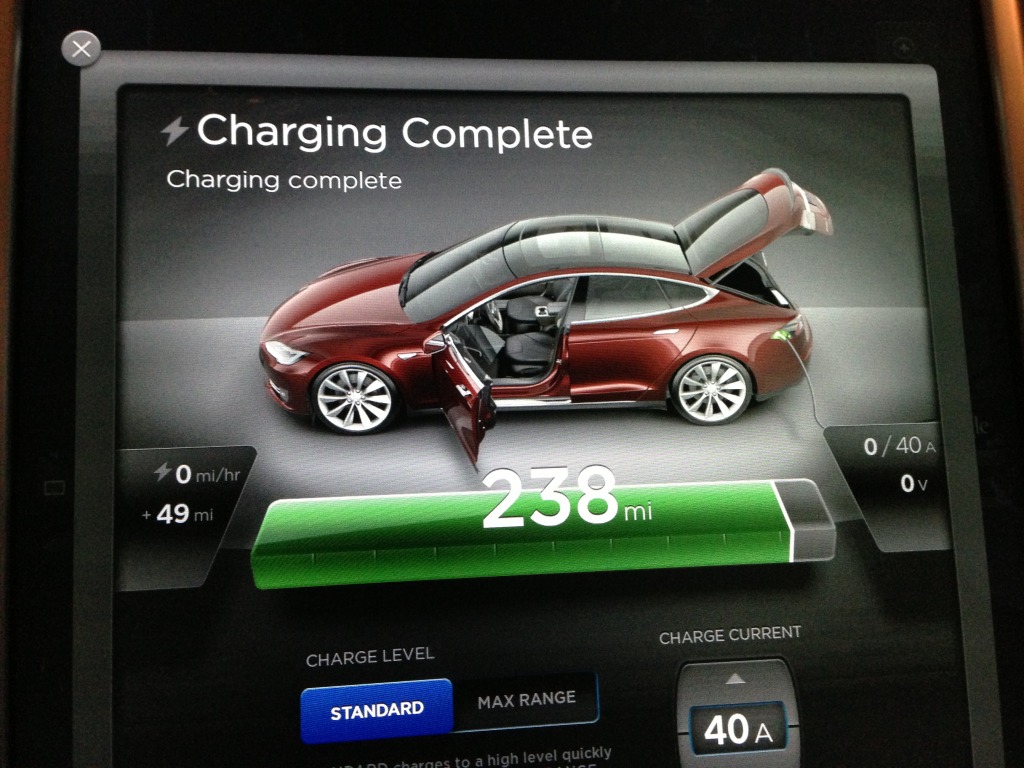
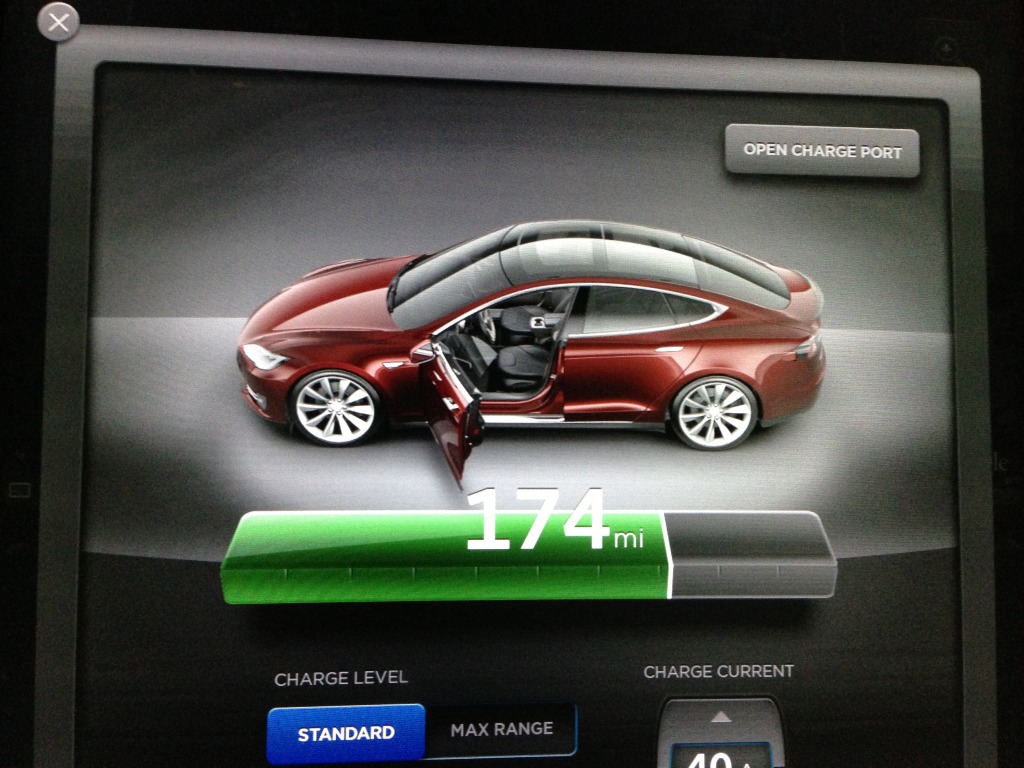
I was just on vacation and decided to leave my Model S unplugged for the duration to confirm how much battery loss there would be (I don't have v4.0 software yet). The car had 238 miles of range the day before we left after completing a standard charge. The car had 174 miles yesterday (6 days later). Both readings were taken the same time of day (within about 15 minutes). The car was parked in our insulated garage (unheated) and the outside temps probably averaged just under 30 degrees.
64 miles of range consumed in 6 days = 10.66 miles/day
January 1st:
January 7th:
 �
�
Jan 8, 2013
JRP3 That's a lot better than the 20 miles per day some were reporting.�
Jan 18, 2013
Brad Vampire Battery Drain/Discharge
The User's Guide states that a Model S should have 1% battery drain a day (presumably from battery decay and powering the onboard systems used when not driving). I've read many different views on what ACTUAL loss rates are. Has anyone figured out what your actual discharge rate is? This can be estimated for your car many ways, but very simply by:
(1) Unplugging and not using the car for 24 hours, noting both the "Mile Range" numbers that appear on the dashboard before unplugging and at the end of the 24 hour period
(2) Subtracting the "Mile Range" number showing at the end of the 24 hour periood from the "Mile Range" number showing before unplugging, then
(3) Dividing the result of step (2) by the "Mile Range" number before unplugging.
I am doing this now on my new Model S and am interested in what others are seeing.�
Jan 18, 2013
dsm363 I believe a lot of it has to do with what the ambient temperature is and how hard the Model S has to work to keep the battery in the safe range but that's useful information to find out.�
Jan 18, 2013
Brad Thanks. Trying to get a view on likely experiences with percent lost numbers in this post. Not the reasons or diagnostics which have been exhaustiley (believe me, I've been reading!!) reported elsewhere. Having said that, any replies with whether people have installed the latest firmware (or what firmware they have) would be good to see too. The latest firmware (4.0 I believe) corrected some drain in the past.�
Jan 18, 2013
dsm363 No problem. It did but they then took out the 'let displays go to sleep' function in V4.2 due to issues. It should come back though. People were seeing about 8 miles of range a day without the sleep mode due to the drain.�
Jan 18, 2013
Brad Thanks - you seem familiar with these issues. Seen one guy with 15 miles a day loss on version 4.0. That's why i'm checking. Do you think that would be highly unusual for a new car?�
Jan 18, 2013
jerry33 Depends on the ambient temperature. If it's very cold, then that wouldn't be unusual at all. I don't think new car has much to do with it (new in terms of miles). New in terms of model newness is another matter. Basically, all this will get straightened out as future updates are pushed--I'd guess within a year.�
Jan 18, 2013
Zextraterrestrial It depend on your SOC a bunch in addition to the temperature. I will post some #'s soon. my data is getting big enough that it might be useful. I just got my 3rd factory tour today!! wohoo the place is f-ing kicking A...�
Jan 18, 2013
aronth5 Would you mind sharing the differences in the factory from your last tour? What makes it "f-ing kicking a..."�
Jan 18, 2013
Zextraterrestrial haha.. Well, I had the first tour last year in Oct. Second tour Dec 1st last year when I picked up my car (AWESOME!!!) Last tour today while I had my 'temperamental' drivers door handle replaced (functioning but retracting sensor thought it was 'in' when it hadn't gone in yet) and tires rotated + 'my tesla' image changed to show the 21" wheels.
Today there seemed to be a lot more of the boxes of parts for cars in the massive storage area - think 'The Lost Ark' warehouse of boxes stacked tall, much more than there was in December. Tons of cars finished in the Shipping area as well as near the service area (1000-2000?) There are many more areas for paint inspection than we saw before and new areas of the factory that are being used that looked like they were barely touched < 2 months ago. It was mentioned that they are at 10 minutes per station but pushing to 7 or less which would let workers have shorter shifts (I think that was in final assy).
many-many sub assemblies ready to go and it looks like they are using 4 parallel stations for panel sanding(specifically hood panels this afternoon) and final prepping before welding assembly
No cars were being 'burned in' the last time we were there. They do the 27 miles on a 4 wheel Dyno of sorts. Pretty neat.
White floors are getting scuffed up a bit.
Saw a few painted bodies come out of the paint area getting ready to go on the auto-dollies
Tires on the 21" greys look like they are pilot sports now?
220 miles down to 212 in ~9 hrs at ~40F last night�
Jan 18, 2013
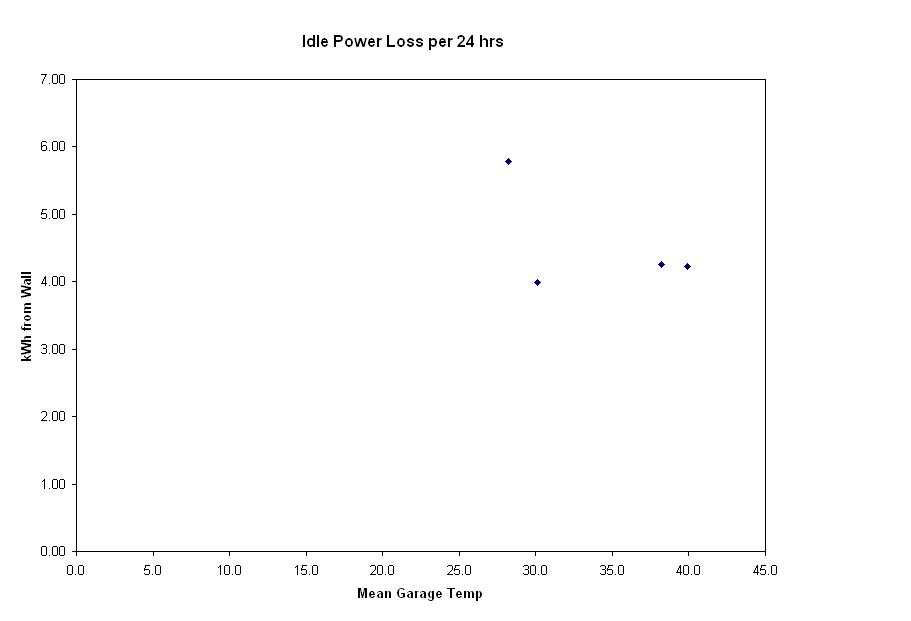
tezco I have logged a few data points (see http://www.teslamotorsclub.com/showthread.php/12706-Measuring-the-Total-Energy-Consumption-of-Your-EV/page2?p=256023#post256023
 �
�
Jan 18, 2013
mcornwell Mods, we already have a few 'vampire' threads, you may want to merge this one with another, such as:
Vampire Load?�
Jan 21, 2013
tezco Mods, perhaps we need to change the name of this (the "Vampire Load?" thread) since there are so many alternate threads developing covering idle power losses....�
Jan 21, 2013
ChadS This has been suggested before, but I'd like to add another data point to the idea that not all of the "lost" miles are lost. (Some are, just not all of them).
A few days ago I left the car overnight in Mojave CA. When I parked it, it had 150 rated miles left. It got below freezing that night; it was only 30 degrees when we left in the morning. The car had dropped to 126 miles. Wow, 24 miles lost overnight! (This is on old firmware, 1.14.15).
But then when we got to Tejon Ranch, I noticed that we had driven 70 miles and only used 52 miles of rated range. It's true that there's a serious elevation drop, but that shouldn't have added more than 10 miles. We were averaging 60mph in cold weather; our usage under those conditions is usually ~20% more than rated miles. So I figure almost 20 of those missing 24 miles must have "come back" as the pack warmed up.�
Feb 5, 2013
mnx So I've got a vacation planned in late March. Hoping to leave my Model S at the Buffalo Airport. It's 132km (82 mi) from my house to the airport. I'll be gone 8 days.
I've already e-mailed the hotel that I'll have my car parked at and they have no 120V outlets that I could use.
What charge level am I likely to have after 8 days? I don't need to be able to drive all the way home, but I do need at least 50km (30mi) left so I can make it to a 70A j1772 to top up on the way home.
Are vampire losses greater than 16km/day sustained over an 8 day period? Will I be able to make this trip, or should I take the easy way out and take the gasser?�
Feb 5, 2013
Andrew Wolfe I did an 8-day airport layover and lost about 70 miles of rated range. Should be no problem. If you do a range charge, you should even be able to make it back home without recharging.�
Feb 5, 2013
mnx So a loss of 14km/day. What was the outdoor temp when you had your car parked for 8 days? I imagine it will be colder in Buffalo in late March...�
Feb 5, 2013
znino So I observe the same thing. Car is plugged in and fully charged but then starts to lose range, even though it is still plugged in. I have not checked if it tops up after 24 hours as some has reported but certainly not in the 12 hours I was testing it. It was losing about 1.3Km per hour over the 12 hour period. This was in a fully room temperature heated garage. Kind of sucks to unplug from the wall and leave the house with less than the full charge, simply because you had it plugged in the night before and it reached full charge quickly.
some people have said they use various ways to try and 'time' the charging to end when they will need the car but that's crazy. First of all most people cannot be bothered to even try to calculate this and secondly, it is affected by so many factors (temperature, non-linear charging etc). You cannot expect people to have to start thinking about charging the car. You should be able to plug it in and go whenever you want with it is fully charged. You should not be penalized just because you 'go' 12 hours after it has attained full charge. When you plug in your laptop before going to bed it probably finishes charging in less than 2 hours. When you unplug it to leave in the morning you are expecting a 100% charged battery, not a 90% charged battery. Same with a cell phone. If I leave my iPhone off the charger just in idle mode, it does lose battery. Normal. I accept it. Probably about 5% an hour. But if it is at 100% and on the charger, it stays there until I remove it from the charger. My Roadster is pretty damn close to this as well. Never noticed much drainage while plugged in.
If there is a top up every 24 hours (some have claimed) then that's a but better but I think for most people who will likely use there cars starting at 7 or 8am, a setting to have the car charge up for a certain time should be a minimum here if for some reason it is bad for the battery to top up every 2 or 3 hours. Maybe the user could have a preferred departure time in the settings and the car should charge at max rate till you get to 90% and then figure out how slowly to charge to get the last 10% in by this preset time.�
Feb 5, 2013
strider znino, I believe the charge timer and fixing the sleep mode bugs will solve this. The RAV4-EV (Tesla powertrain) allows you to tell the car what time to be ready and it will start charging at the right time to be ready when you want to leave. This will minimize idle losses. And of course they're working on adding the sleep feature back in - they were just having too many issues where the car wouldn't wake back up properly. All software stuff - fixes coming to a cell tower near you.�
Feb 5, 2013
Lloyd I was observing my car plugged in and not driven the last several days. It will charge to 242 rated miles, and loose about 10 miles per 24 hours in my 65 degree garage. When the charge drops below 230, it tops off again to 242.�
Feb 6, 2013
cdabel What is the longest time that the car can be left unused? We take a 4-6 week vacation every summer, and I�m wondering what effect this would have on the battery. If we left the car in my garage at work (conveniently located next to airport bus terminal) it would have to be be unplugged, and if we leave it at home it could potentially get unplugged unbeknowst to us while we were gone. Would we return to a dead battery?�
Feb 6, 2013
Johan Official word from Tesla is: "The Model S battery will not lose a significant amount of charge when parked for long periods of time. For example, Model S owners can park at the airport without plugging in." However, on the same page it says: "If you go on vacation, plug in your Model S before you leave.". I guess it boils down to what "long periods of time" is. Real-life experience suggests temperature has a big effect also. The generel opinion here on the forum is that you loose charge faster initially and as time goes by/charge decreases the pace of charge loss slows, and the theory is that if you get really low the car will go in to a kind of sleeping state with very low charge loss over time. I don't think anyone has left their car sitting for 6 weeks yet though.�
Feb 6, 2013
cwerdna It's because the 12 volt battery on a Prius is a tiny AGM battery that lasts typically 4-6 years. Since the Prius has no dedicated starter motor and its ICE isn't started by the 12 volt, there are no symptoms of a weak/dead 12 volt that one would normally see in a conventional ICEV (starter slow to turn, starter unable to turn the engine, etc.) And, there's a VERY LARGE installed base of Priuses on their original 12 volt that have hit the above age. (The Prius really started taking off w/the debut of the Gen 2 aka NHW20 aka the iconic hatchback design that spanned the 04 to 09 model year.)
Instead, usually weird stuff happens and some dealers are good at running useless tests on the 12 volt giving false "no problem" reports when it's actually a problem. Sometimes people discover their 12 volt is down to 10 volts or less, if they actually measure it or view the values via a hidden menu on the MFD (multifunction display).
FWIW, Milestone Accomplished: Toyota sells one million Prius hybrids in U.S. was hit in 2011. Toyota | Toyota Hits Four Million Unit Global Sales Milestone for Hybrids was hit in 2012.�
Feb 6, 2013
mcornwell If I were leaving for that long, I would check the state of charge using the smart phone app every 10 days or so, and contact a neighbor or friend who could investigate if the state of charge dropped below 100 miles (160 km).�
Feb 6, 2013
mzquenee �
Feb 6, 2013
aaron.s Lloyd
Mine is parked outside... Loosing more like 14 miles overnight (12-16 hours - temp in the 20s) and is usually at 222 or so in the morning and is *not* topping off at all automatically. Only when I preheat the cabin in the morning is it initiating charging again. I have the latest 4.2 firmware too...
I'm also not seeing a delay in the rated miles go down as I start driving (I.e. getting some of those "lost" miles "back") either it seems, although I am letting the pack warm up and charge reinitiates when I let the cabin preheat for 30-45 minutes... So I'm losing a fair amount of charged kWh's each day which is a bit disappointing.
Still love her though!
Aaron�
Feb 6, 2013
Lloyd Additional drain is likely due to your low temperatures. My garage is stable about 65 degrees. It does seem to top off every 24 hours or so not driven though.�
Feb 6, 2013
cdabel Not really an ideal solution since we lock up the garage. We also try to liberate ourselves from the digital/electronic grid on vacation, and this wold totally defeat the purpose (digitally baby sitting a car is in fact precisely the kind of thing we try and escape at our rustic get-away). Can this car seriously not sit unattended while we are on a 4-6 week vacation? That could be a problem in Norway, since pretty much everybody takes four weeks away in the summer.�
Feb 6, 2013
brianman I left my S for 3 weeks over the holidays. Other than for novelty purposes, I wouldn't have checked on it during the holidays via the mobile app.
Scenario A
Leave the vehicle plugged in for 6 weeks unattended. Power goes out in your neighborhood for 6 weeks. Tesla has said this is ok, just not recommended to do often.
Scenario B
Leave the vehicle plugged in for 6 weeks unattended. Vehicle or cable misbehaves so it doesn't top itself periodically and the situation is similar to Scenario A.
In both these cases, if the vehicle bricks in the scenario and you're within the 8 yr battery warranty then I find it highly unlikely that Tesla will argue with "making it right" on their dime. That's assuming Tesla survives, which I believe it will.
Scenario C
Leave the vehicle plugged in for 6 weeks unattended. Lightning strikes your house and the car doesn't protect itself properly.
In this case, either technical issues with the car or (hopefully) insurance should cover you in case the car bricks or becomes melted refuse.
Scenario D
Leave the vehicle unplugged for 6 weeks unattended (after a standard charge, i.e. 90%). Tesla has said this is ok. (My recollection is they said months.)
I wouldn't tempt fate with this choice, because for cases A B and C it's clear you did something totally reasonable, and in fact manufacturer recommended.
Just one opinion.�
Feb 7, 2013
JRP3 That seems to be normal, for now.�
Feb 7, 2013
shokunin Same here, although my drop seems larger, more like 12-15 miles a day. This definitely skews any charging efficiency numbers since the data on the trip meters don't account for vampire losses if you're trying to calculate wall to battery efficiency.�
Feb 7, 2013
strider By the time you get your car this will be a non-issue. Tesla is having software problems with putting the car to sleep and waking it up so they have temporarily removed that feature. They are planning to reinstate it as soon as they can make it do so reliably. Once sleep mode is available it will be no problem to fully charge your car and leave it for 4-6 weeks.�
Feb 9, 2013
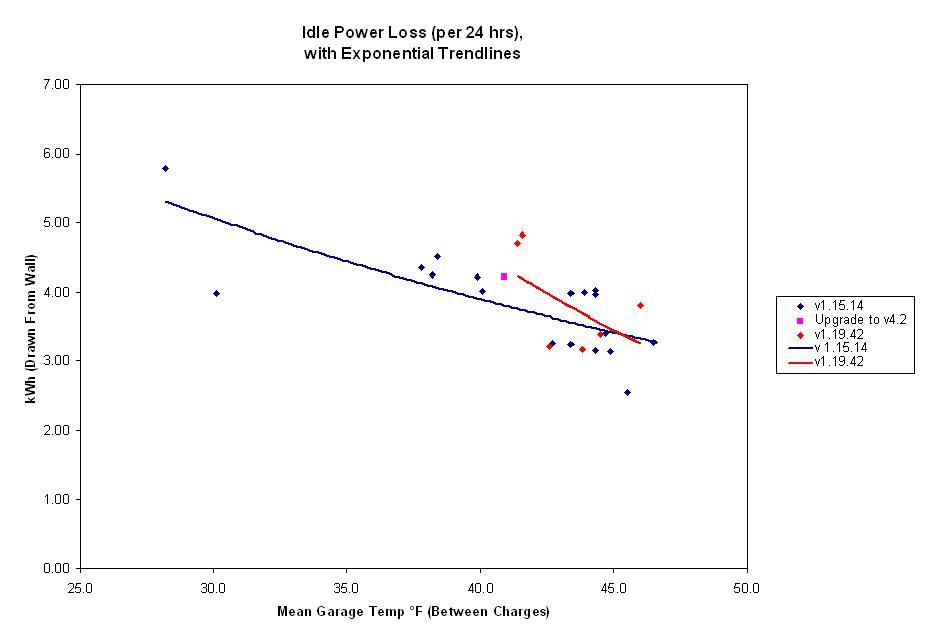
tezco I've been measuring my idle power losses for a couple of months. Although I don't have many data points for 1.19.42, so far it appears as if the idle power losses are even higher with the latest software.
 �
�
Feb 10, 2013
eelton I also lose about 12 miles per day, with the car in a 55-degree garage. It's frustrating that the owner's manual says 1% (i.e., 3 miles or so) per day.�
Feb 10, 2013
jerry33 Eventually, the manual will be correct. This is one of those pioneer arrows.�
Feb 10, 2013
stinnett_P813 That's a better loss than me. I am losing 18 miles per day in 60 degree garage. I wish I could downgrade to the previous software to destroy these damn vampires roaming my garage.�
Feb 11, 2013
JRP3 Hang some garlic around your charge port.�
Feb 11, 2013
znino Im in the same situation as you. 16-18 miles per day in a heated garage.�
Feb 11, 2013
EarlyAdopter Ok, I'm sticking with v4.1. I'm only seeing a loss of 3 miles a day from vampire drain with sleep mode on.�
Feb 11, 2013
gg_got_a_tesla Not that this prevents the power drain but, if you want to leave home with the true "full tank" rather than a post drain one, throttling down your charging amps so that the car finishes charging just before you leave is an option. I'm doing this most of the time at home by dialing down from 40 A to as low as 5 A from my 14-50 outlet so that the car trickle-charges all night long.�
Feb 12, 2013
JRP3 gg, do you use so much of the charge each day that you can't afford the overnight loss?�
Feb 12, 2013
gg_got_a_tesla Actually, no. I barely use about a third of the available range on an average week day. The overnight loss if not charging is about 8 miles. I still like to see 190 rated miles available each morning though.�
Feb 12, 2013
JRP3 The battery might last longer if it spent more time at a lower SOC if you don't really need the range.�
Feb 12, 2013
Hans (Amsterdam) I suppose that removing fuses #49 and #51 will bring the instrument panel and touchscreen in a very deep sleep ?�
Feb 13, 2013
gray As a prospective buyer of a 40kwh Model S located in Chicago, I find this quite disturbing. The implication is that I may not be able to leave the car unplugged for more than a week (e.g. to go on vacation or a conference) during the winter(on top of the fact that keeping the battery at 40-70% SOC will likely maximize the life of the battery). I'd happily put up with even 5 minute startup times if I could fully disconnect the battery.�
Feb 13, 2013
dsm363 You could if you found a place to plug in while gone. Once the sleep mode is enabled things will be better but I'd still want to plug my car in while gone. Would still strongly consider the 60 kWh version though maybe with Supercharger access.�
Feb 13, 2013
gray I suppose the primary issue in my case is the fact that I live in an apartment with no charge access (and there is no way to construct this). We are planning for the car to be used around town most of the time - our 98% use case is 40 total mile trips (a Leaf could meet our needs, but we'd strongly prefer a car that isn't an econobox with a big battery tacked on). I'm really hoping that the quoted poster's experience simply reflects a possible need to do some re-mapping of the battery capacity (50 miles is ~17% charge for a 85kWh battery, but more than 30% for a 40kWh) since I expect that the losses might have a nonlinear relationship with the battery SOC.
I should also add that I'm hesitant to supercharge a battery even though the capability might exist based on (admittedly shallow) observations about the characteristics of Li-Ion batteries, in particular (semi)recent imaging research that showed the physical changes in the micro-structure of battery materials that occur with charge/discarge cycles *. I have also observed that laptop batteries charged with lower-power (in Watts) AC supplies tend to last longer (although their charge takes longer). However, my area of science is not in materials so my experience might simply be coincidental.
* Wang CM, W Xu, J Liu, J Zhang, LV Saraf, BW Arey, D Choi, Z Yang, J Xiao, S Thevuthasan, and DR Baer. 2011. "In Situ Transmission Electron Microscopy Observation of Microstructure and Phase Evolution in a SnO[SUB]2[/SUB] Nanowire during Lithium Intercalation." Nano Letters 11(5):1874-1880.�
Feb 13, 2013
dsm363 I think you'll find living with an EV and no place to plug in at night not ideal. People do it but having at least something to top the battery off and warm it up in the winter would be nice. Maybe there is someway you could get a 110V outlet installed (maybe you would have to pay for it and offer to offset energy usage with a monthly fee) but sounds like that isn't possible either.
The car will lose about 8 miles a day in good conditions and it sounds like more in winter (without sleep mode).�
Feb 13, 2013
patp The thing I see often with Tesla employees is that they do not acknowledge issues or are not aware of them. They also have contradicting messages. I'm sure this will improve over time but this is a reality.�
Feb 13, 2013
JRP3 I didn't read the paper but I'm not sure the behavior of SnO2 nanowires have anything to do with the charge process of batteries that don't contain them. The "Superchargers" are not charging at an especially high C rate for the battery and with the active cooling should provide minimal stress. That said I wouldn't use one every day.�
Feb 13, 2013
tezco I have the Leaf and the S, and like both. The Leaf doesn't feel or drive like an econobox (probably due to the weight of the battery, and the increased seat height), and you can leave it unplugged for weeks with little battery loss. Not so with the S (at least currently). I take the Leaf to work and the shopping malls since those are locations with a high ding index. Take the S on longer trips, and when I want to arrive in style....�
Feb 13, 2013
shokunin How/where are you planning on charging the battery then?�
Feb 14, 2013
gray Parked at work. The prospect of leaving the car at work while I find other transportation home is kind of a non-starter though (I might as well not have a car at all in that case). My parents will probably have it during the summer when driving to work isn't a necessity. Since they don't have a garage, we figured we'd just figure out a way to run electricity to the car (or build a small carport). In the end, we'd rather the car not be an all-consuming responsibility. I'm sure it'll be sorted out by the time we take delivery.�
Feb 14, 2013
dsm363 That won't be as bad then. If you had to go find a public charge station every now and then to charge, that would get old fast but if you can charge at work, that'll make it easier.
Is there no way for you to even get a 110V outlet to trickle charge the car at night and heat the pack up in the morning? I know you said it probably wasn't possible but maybe talking with the apartment complex and offering to pay for it and a monthly energy fee ($25 or something) would talk them into it.�
Feb 14, 2013
GSP Is there a business or parking garage near your apartment that would rent a space with a 120v plug?
GSP�
Feb 15, 2013
Lcaudle24 Confused on Failure of MS to Stay "Topped Off" While Plugged In
I know I am late to the party on this point, but I find myself using the iPhone app to switch the charge (in my plugged-in S) to "Max Range" for a few minutes to trick the car into charging and after a few minutes, I switch the mode back to "Standard." This essentially tops off the battery to the maximum "Standard" charge (239-241 Mi.). I wonder if this is bad for the battery to be doing this - it surely helps to keep a topped off battery; especially a day or so before I return from a business trip.
Does anyone have any thoughts on whether this is a bad practice - I assume it is if no other reason that Tesla apparently has programmed the car NOT to stay in a topped-off condition when continually plugged into to a power source?:cursing:�
Feb 15, 2013
brianman @Lcaudle24 - When you don't do this, how much rated range do you have in the morning? And how does this compare to the amount of range you need for a typical day (round-trip)?�
Feb 15, 2013
Lcaudle24 I am losing about 8 mi/day and I am not seeing that loss reduce as the battery wears down - the 8 mi/day loss seems to be straight-line. Others have stated that their chargers "kick back on" once the rated miles reduces down to around 230, but I am not seeing that. Admittedly, I have not conducted any test to see if and when my chargers "kick back on" but I am sure mine has gone below 230 miles after being fully charged (in standard mode). NOTE: I have had my car for only 11 days so not much experience or data to provide. As to your "commute" question: Only 11 miles roundtrip to and from work so there is certainly no need for me to be manually (through the iPhone app) topping off - I suppose I am just overly obsessive about having a max charge. Many times, I return from a business trip on Fridays and my desire to top off the charge is more driven by wanting the car to maximum standard range for a Saturday excursion. Thanks for your quick reply.�
Feb 15, 2013
brianman Heh, you kind of anticipated my reply.
I see 232 greet me in the morning, and I don't mess with anything. My commute is around 20 round-trip, so it's not worth bothering over.�
Feb 15, 2013
Lcaudle24 You're probably right!�
Feb 15, 2013
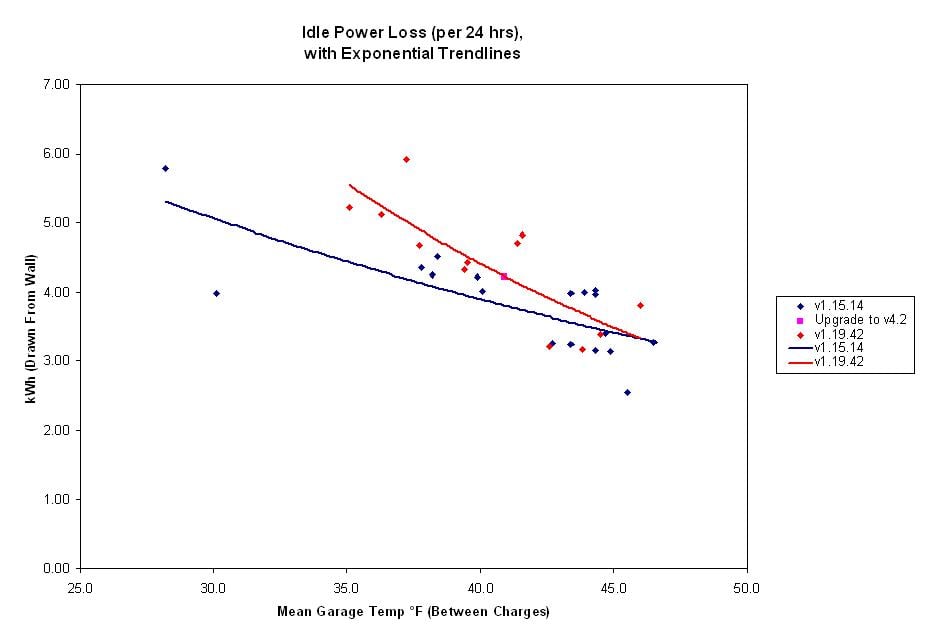
tezco When my car is parked in the garage it tops off about once every 24 hours, all by itself. The idle power losses appear to be greater with v4.2 (1.19.42) than with my previous v4.0 firmware. Here are the latest data points for my idle power losses, which are measured at the wall.
 �
�
Feb 15, 2013
ElSupreme
Looking at your graph it looks like, in my 45-60F garage, my car is pulling about 150W continuously! Damn about as much as my Server. Really hope Tesla can get it down to 50W or so.�
Feb 15, 2013
tezco That's probably not too far off, considering a charging efficiency of 90%. Of course, the means that the 12V is discharging at over 10 amps, and then being periodically topped off at a much higher amperage. Sounds like that might generate a lot of heat, but I looked at internal resistance values for lead acid batteries, and they are quite low. However, I wonder what all that current going in and out does to the electrolyte level over the long term.�
Feb 15, 2013
mcornwell With my car unplugged in my 55-60� (San Diego) garage, I'm losing 15 miles per day. :-(�
Feb 16, 2013
JRP3 What makes you think the 12V battery is the carrying all the load? As I know it there are two circuits in the DC/DC converter, one keep the 12V battery charged up and the other runs the 12V accessory loads. Also, the battery is a sealed AGM so should not lose any electrolyte.�
Feb 16, 2013
mknox I drove my company's Volt for a week a while back and monitored it's energy use at the wall. I found, when fully charged, the car would draw between 3 and 166 watts (at 120 volts). Periodically (when the load was closer to 166 than 3) I could hear pumps and fans running. Just a data point for comparison...�
Feb 16, 2013
tezco Does the DC/DC converter run 24/7? Just assumed that the 12V would carry the loads while the car was parked and the DC/DC would top it off from time to time. I think even AGM's can vent if charged too rapidly or to excess, resulting in a loss of electrolyte.�
Feb 16, 2013
JRP3 I would assume the DC/DC is always on. It's more efficient to run the car from the main pack and DC/DC than constantly discharging and charging the 12V battery.
One circuit of the DC/DC keeps the 12V up, and the other circuit handles the vampire and operating loads. At least that's my understanding. Sleep mode probably shuts down the main DC/DC circuit and all vampire loads but keeps the12V battery charged to allow booting the system back up.�
Feb 16, 2013
tezco It may depend on the design loads when parked vs when driving. According to my Leaf manual, it's DC/DC only turns on to charge the 12V once a week if the car is parked.�
Feb 17, 2013
JRP3 I think the LEAF has a larger 12V battery than the S, and the S has larger idle loads since the LEAF has no active battery management, so the LEAF design makes sense for the LEAF, but not the S.�
Feb 17, 2013
jerry33 And based on the forums, the Leaf appears to have 12V battery issues as well.�
Feb 17, 2013
JRP3 Seems as if the 12V lead acid battery is not the proper technology for this application. Lithium titanate, (Altairnano, Toshiba Scib), would probably be perfect, though somewhat costly. Maybe the new A123 EXT nano phosphate as well. High cycle life, low self discharge, no need for temperature management, and lighter than lead acid.�
Feb 17, 2013
tezco Or perhaps the S wasn't designed to have as large an idle load as it does. It could be that the design was to have most of the electronics sleep like the Leaf's, but so far Tesla hasn't gotten that process to work well. I think the Leaf has some sort of active management since there is a current measuring clamp on one of the cables. Maybe it is used to adjust the output of the DC/DC converter such that the 12V isn't discharging when the car is powered up (or maybe it measures recharge current when idle so that it can warn of a failing 12V)?�
Feb 17, 2013
JRP3 By active management I'm talking about temperature management. The LEAF has none. As for the S I do hope they lower the idle loads, but when temperatures get extreme the load will be higher.�
Feb 17, 2013
tezco Actually the Leaf has a 300 W battery heater that turns on at -14 F, just to keep the cells from freezing, but that apparently can drain the battery in as little as a week. Unfortunately, there is no active cooling (apparently prototype packs had an eqalizing fan, but this was left out of the production packs). Recently this is appearing to be problematic in the desert Southwest. Do we have any authenticated data from Tesla or other sources regarding at what setpoints thermal management of the Tesla battery turns on when the car is idle?
Updated: (See post #270)�
Feb 17, 2013
TonyWilliams Virtually all USA delivered LEAFs for 2011 model year do NOT have this. Also, the activation temperature of the battery heater for LEAFs so equipped is -4F, and continues heating until 14F (-20C to -10C).�
Feb 18, 2013
JRP3 I forgot about the updated LEAF heating in cold weather. Do we know if that goes through the DC/DC and uses 12V or is it pack voltage?�
Feb 18, 2013
Hans (Amsterdam) Owners Manual page 25:
Even when you�re not driving Model S, the Battery discharges very slowly to power the onboard electronics.
On average, the Battery discharges at a rate of 1% per day.
Situations can arise in which you must leave Model S unplugged for an extended period of time (for example, at an airport when travelling).
In these situations, keep the 1% in mind to ensure that you leave the Battery with a sufficient charge level.
For example, over a twoweek period (14 days), the Battery discharges by approximately 14%.
February 24, 2012Plug It In
By Tesla Motors
Full article: http://www.teslamotors.com/blog/plug-it
Model S and Model X will have batteries that can sit unplugged for over a year when parked with only a 50 percent charge. And when that year is up, all you need to do is plug it in.
Now I am getting a bit confused. Why plug it in all the time when discharge is on average only 1% per day (SOC > 50%) or 4% per month (SOC < 50% ) ????
�
Feb 18, 2013
donauker Because those numbers are really only wishful thinking!
My actual numbers show that while parked at the airport for 12 days in moderate temperatures I will loose 145 miles of charge and when parked there for only 5 days in colder conditions I will loose 95 miles.�
Feb 18, 2013
Hans (Amsterdam)
So basically the product is not according the specifications that were promised to you. Did you send in a complaint about this to Tesla Motors ?
Did Tesla Motors inform you in any way about this problem and the way they are going to deal with it ?�
Feb 18, 2013
tezco Fortunately those weren't originally sold in the colder climates. You were correct about the setpoints -- grabbed my info (including the 300 watt figure) out of a blog, at least some of which was incorrect. Here is the text from my Leaf Owner's Manual: The Li-ion battery heater helps to prevent the Liion battery from freezing and helps to prevent significant reductions in the Li-ion battery output when the temperature is cold. The Li-ion battery heater automatically turns on when the Li-ion battery temperature is approximately -4�F (-20�C) or colder. The Li-ion battery heater automatically turns off when the Li-ion battery temperture is approximately 14�F (-10�C) or higher. The Li-ion battery heater uses electrical power from an external source when a charger is connected to the vehicle. The Li-ion battery heater uses electrical power from the Li-ion battery when the charger is not connected to the vehicle.
�
Feb 19, 2013
Cyberwelly Just another datapoint: my car is parked at the airport. The temperature is ranging from 50 at night to approx 73 during the day. It is in a covered parking structure. In the last 24 hours since I left it there it has gone from 197 to 184 rated miles. So approx 13 miles lost. I'll be picking it up in 3 days. I really want sleep mode back!�
Feb 19, 2013
strider It is because they disabled sleep mode in v4.2 of software. They had trouble with some systems not waking up properly so they turned it off. The intention is to re-enable this feature once they get the bugs worked out and deliver the advertised . They did inform owners that 4.2 had disabled sleep mode but no ETA has been given on when it will be restored.�
Feb 19, 2013
Hans (Amsterdam) I hope they do manage to get sleep mode working since here in the city of Amsterdam we only have public chargers available. I simply cannot plug in all the time and obstruct the charger for other EV's.
Besides the nearest chargers are 300 meters from my home, so I do not want to go there everyday.�
Feb 19, 2013
toto_48313 I figure out that at 10 F, the car loose about 3 miles of rated range / hours, and the first 5 miles are very hard on the baterry as it's not warm enough.�
Feb 20, 2013
contaygious I parked my car in a garage in la and lost over 20 miles in 2 nights. Pretty crazy drain considering how slow the charging stations are.�
Feb 20, 2013
WarpedOne 310Wh/mile * 20 miles = 6.2kWh
6.2kWh/48h = ~130W idle power
Yeah, it is much. Situation will improve when they re-enable Deep Sleep in future FW.�
Feb 20, 2013
donauker Actually the case I cited where the loss was 95 miles in 5 days was with v4.1 firmware with sleep mode active�
Feb 20, 2013
Trnsl8r I'd like to make the point that even though I don't need anywhere near the 232 rated miles that are left after a night of vampire load, that lost energy will at some point have to get recharged. Off my electricity. That I pay for. I don't mind paying for electricity that I use to drive to places, but replenish 10 miles that vanish into thin air every night is getting annoying.
That said, yes I know they are working on bringing sleep mode back. I also believe that the first miles vanish quicker off the battery than the later on, once the battery hits 50% or so. Little comfort, I know...�
Feb 21, 2013
Cyberwelly Left my car at the airport for 3.5 days (87 hours to be precise) and the rated miles went from 197 to 153: a loss of 44 miles in a covered parking structure in temp 73 during the day and 50 at night. Need sleep mode back.�
Feb 21, 2013
brianman We should probably start using a rate unit for such reports.
"12.57mi rated per day" or "22% over 3.5 days"�

Không có nhận xét nào:
Đăng nhận xét