Mar 18, 2015
SteveS0353 Apologies, I believe you are correct. I just interrogated my car with VisibleTesla and found this entry...
 �
�
Mar 18, 2015
wk057 The superchargers definitely have network connections of their own. The ones in South Hill VA actually have the smaller 3G antennas replaced with larger whip antennas.
The car also definitely authenticates with the charger over the CAN data link it makes before allowing supercharging. (See the thread where the protocol was being disected). The VIN is one of the things sent over that line. I won't get into further details that were not discussed publicly, but I assure you there is more authentication involved than just the car-side enabling.
Edit: I remembered to snap a pic of the antennas at South Hill.
 �
�
Mar 18, 2015
sorka I have a 260 mile round trip commute I do once a week. I'd be doing a partial charge twice a week both there and back. I drive from Merced to Phoenix 6 times a year. That's almost 50 charges right there alone. My delivery date for my P85D is on 3/30. Both my sales rep and DS don't seem to think this will be an issue.�
Mar 18, 2015
Lloyd I said if every car delivered charged weekly. IIRC, I used .10 for electrons�
Mar 18, 2015
FlasherZ And I charge about 6 times a year or so, some of you are using up my other 46 times. �
�
Mar 18, 2015
Depeche Mode What do you not understand to be more precise?�
Mar 18, 2015
Lloyd I think we should be concentrating with Firmware 2.2.176 or greater.�
Mar 18, 2015
islandbayy Agreed. On a single 24hour round trip from Milwaukee to Detroit and back, I supercharged 11 times alone. Thats in a single 24hr stretch. I supercharge to get to a destination and back every weekend during the winter as with the cold, my 60 pack comes up about 25 miles short, during the summer, my 60 has about 100 mile surplus... (I refuse to freeze. 80k car, I'm driving comfortable and will spend the extra 15 minutes to charge up). So thats 2x/weekend for about 20 weeks out of the year. so 40 more times. (I Don't know how the heck I did it before we got the superchargers! I know that a certain chargepoint's meter was spinning like heck with me haha). Then the assorted other drives and trip I do. I have 49,000 miles on my 60kW, 1 and 1/2 years ownership.
I'd say, I'm up to about ~120 Supercharges/year (Granted, not every charge is to full or 90%. Most are adding enough to get to destination, unless no higher speed destination charging is available, as in 6kW chargepoint etc... and then add a bit extra buffer that varies depending on temps and road conditions). I'm also up to about 150x100% charges/year. My new pack has finally leveled off and is staying at 201 rated/100% charge with 15,000 on it. My original pack at 34,000 miles was wareing even better then my new pack! So supercharging doesnt appear to be causing any issues. And no, I don't leave my car sit at 100% either.�
Mar 18, 2015
Larry Chanin Good point.
Would all those who have reported charging reductions with low states of charge please report their complete firmware version number.
Thanks.
Larry�
Mar 18, 2015
scaesare While the VIN was definitely seen passing over the data link to the supercharger, and the car is "authenticated" to the charger, was there ever validation that said VIN was was then passed back to the mother ship for authorization to charge?
I've not followed all of that stiff since it went non-public. However for at least one poster here sometime back, it appeared that it was the in-car metadata that had to be toggled to enable supercharging... not anything back at the mothership.�
Mar 18, 2015
deonb Did you reply to the wrong post?�
Mar 18, 2015
wk057 Keep in mind that the tool that is used to do the toggling on the car can not do so without a link to Tesla. (I ask a lot of questions... lol)�
Mar 18, 2015
dirkhh Yes! I actually had supercharging enabled on my 60 after buying it (stupid me, wasted 500 bucks) and when I talked to Tesla while trying to figure out if I wanted to do that they explicitly told me NOT to do it while I'm on the road trip as there are a few superchargers with bad / no reception and that they can't enable it unless my car has signal. And they pointed out that it can take up to 30 minutes for the change to "take".�
Mar 19, 2015
rpo I live in Seattle, but have been to both the Folsom and Roseville superchargers (most recently in December). I did not note exactly what the charge rates peaked at, but I can confirm it was really slow at both. I'm talking 1.5 hours got me from 15% to 90%. It was really pathetic.�
Mar 19, 2015
mhan00 I wonder if it might have something to do with Musk's announcement tomorrow? Maybe, in addition to the range prediction navigation software that makes the most sense to me, Tesla will be partnering with a store/restaurant with a large number of locations nation/worldwide to install lower capacity superchargers? Unlike the higher capacity superchargers which are placed to enable long distance travel, these lower capacity types would be to ease consumer fears of being stranded?�
Mar 19, 2015
deonb Tesla's biggest obstacle with SuperChargers so far seems to be getting available real estate (for free) from local businesses in order to install the SuperChargers. If they have to go through all of that negotiations anyway to do that, why not just install a full SuperCharger?
It would be nice for Tesla to be able to get blanket space to be able to just install SuperChargers, without having to negotiate with local businesses all the time. But I don't think there is any restaurant corp or franchise out there that have the power to give access to each of their parking lots without negotiation with individual local establishments.
What you need is something like a Sears. They own a large percentage of their real estate, and NOBODY uses their parking lots...�
Mar 19, 2015
dirkhh There aren't enough Sears in the world for that to make sense. No one ever thought that someone would say THAT, right?
But I think this is why people (including me) are speculating that if it is an agreement with another company it's going to be an energy company like Exxon or BP. They have an amazing number of locations, usually in places where people would like to extend the "range" of their cars. And they have the ability to monetize it since even if the charge ends up free, they have their mini-marts where they make money of the people waiting to charge. Win-win�
Mar 19, 2015
scaesare This I know. There's also a rolling access code...
But folks here are suggesting that the supercharger authenticates the VIN at the mothership before allowing charging. I've not seen evidence that's the case.�
Mar 19, 2015
apacheguy Any mention of this issue in the press release?�
Mar 19, 2015
deonb No, the closest is this:
"Also figures out how long to charge in each location, messages you when it's time to go"
It seems that Tesla want you to leave the Supercharger as soon as you can get to the next destination.�
Mar 19, 2015
ecarfan No, that's not it, this new software will simply inform you automatically when the car has charged enough to reach the next charging destination. That is very convenient. It is not forcing you to disconnect from the charger. But it is a good thing to notify people when they can unplug as that will increase the likelihood that someone waiting for charging will get to start charging sooner.�
Mar 19, 2015
rlang59 Remember it is only going to inform you if you have the iPhone app.
Trip Planner will notify you via the iPhone app when you�ve charged enough to continue on your trip. Android app users can monitor charging needed for the trip via the Charging screen.�
Mar 19, 2015
FlasherZ ...or that Tesla would like to enable you to leave the Supercharger as soon as you can... I think the value is more with the consumer than Tesla.
Perhaps I'm the glass-half-full guy, but I know of many people who sit at the Superchargers far longer than they should, only because they don't know how much they need -- are there hills? is there crazy wind? what's the average Wh/m needed to achieve the distance? etc...
Now, it's going to be interesting to see how Tesla handles it. When I go to the Wisconsin Dells, I normally stop in Normal, IL, then charge all the way while having dinner, which enables me to skip Rockford, IL and charge in Madison, WI. My question is whether the software takes into account that use case, or whether it will want me to maintain a lower SOC for quicker stops at EVERY SpC. I'm guessing it will start with the latter (although I'll happily ignore its wishes...�
Mar 19, 2015
yobigd20 i need a full 260 miles to go 160 actual miles though. it better not rate limit on the upper end.�
Mar 19, 2015
scaesare I tend to agree this is the more likely reason.
As you say, the "lower" you are on the SOC/charge taper, the more power the pack can accept, thus more "bang for the buck" the driver gets for his time spent at a charger.
If you watch the cross-country EV record trip the Tesla team did, you'll notice that's what they did: ride the bottom of the SOC curve as much as they could (albeit with hopefully less margin for error than the new FW will provide...) when going from charger to charger...�
Mar 19, 2015
smac I wonder if it will alter the stall sharing algorithm
Instead of it being the first car to arrive get's priority up until taper, the first car get's priority up until taper or sufficient journey range.. Whichever is the sooner.�
Mar 19, 2015
Benjamin Brooks Time for Tesla to build in the car auto-eject feature from the SC stalls when they get enough charge to make it to the next SC location�
Mar 19, 2015
JohnQ Yeah, there are locations that I definitely want to skip depending on time of day. Cranberry, PA, for example, where traffic around the mall can be horrible. Or Macedonia, OH where it's a jaunt off the turnpike. Unfortunately, usually can't skip both!�
Mar 19, 2015
apacheguy Right, the trouble I'm having though is that SpC throttling appears to have nothing to do with 6.2. And yet we have reports of confirmed, intentional throttling. And a statement was expected on this issue. So what's the deal here?�
Mar 19, 2015
spentan Until an official announcement is made, I'd recommend reporting every instance of this to Tesla supercharger support.
I've done some charging in the last few days, ~40 miles away from home and haven't had an issue charging solid over 110kW.
Also my service advisor yesterday advised that they may be singling out abusers of the supercharger network but he hasn't heard of it happening before.�
Mar 19, 2015
Depeche Mode Abusers? OK guys, actually let me be clear: I (and so did you) paid my car 127 820$ + taxes (CDN$) while being said that it would include lifetime charging and blah blah blah/other things...
Excuse me but this is FREAKING good money for them... yep I know that the hardware and technology cost them a lot but I'm in finance and I can tell you that they're in money right now (except for the China problem...)... I calculated it recently and even if I go SC once a week for a total average of 50 kW, the equivalent is 221$ of electricity for them annually... worst case scenario twice a week, 442$ even if that would last 6 years (which I would be surprised...) it would only comes back to a meagre total of 2500$ for the whole ownership time (2% of the total car selling price tag)...
My girlfriend is working at 100 meters of the Tesla Service Center and likes to sometime be picked up (and I like to ride my Tesla!) so why not combining business with pleasure?!?
As I said earlier, I always glad and ready to give my place if someone is coming and no stall is available... I did it twice (one for iKhalid which is on this Forum, even helped him because one of the stall was broken...) it's all just common sense...
But throttling just doesn't have its place in this new reality that is the EV world (we all know that some tried in the past and failed but Tesla won't, Tesla has to demonstrate that EV is an easy going thing)... I know also Musk is cheap (a way of thinking I like as a shareholder BUT not as an owner... :S) by paying his peoples lower than they are really worth but I really think that working for Tesla is really exciting and challenging... I think it's part of a �always� lower the cost in every ways...
Although, I really think that Tesla should concentrate on bigger issues like the ICE'ing problem at SC which is more a problem than the �local chargers�
If throttling is done on a regular basis, well I'll be a STRONG opposition of that...
Hope for them it was just an experiment period and nothing more...�
Mar 19, 2015
Archer No, it's the algorithm letting you know that you "can" leave if your only intent is to have enough charge to get your destination. Not every destination is an end point with charging access.�
Mar 19, 2015
FlasherZ I don't believe we can say "intentional" at this point. No one has confirmed it is intentional; we have merely an uncorroborated service center employee who said there would be an announcement this week. Other service centers immediately denied that they were notified of anything of the sort. No pattern has emerged yet as to the specific versions and supercharger setups.
It's all still speculation.�
Mar 19, 2015
dirkhh Sounds like you may be a bit sensitive on this issue...
But let's take a deep breath. No one defined what is an abuser. No one said that your behavior (or what you describe here) would be considered abusing the system.
What about (hypothetical case) the guy who figures out how to transfer electricity between battery packs (there's a portable CHAdeMO thingy that can do that). And who drives to the supercharger N times a day, charges from 0-100%, drives to his office around the corner, transfers the electricity and drives back, repeat.
Realistic? No. Abusive? Definitely. I'd call that theft.�
Mar 19, 2015
LetsGoFast Can someone explain in small words how throttling the transfer rate helps Tesla in some way. It seems like it would lead to more congestion at the chargers. Is the theory that a throttled rate would drive people to stop using the local superchargers? I don't see that. There is a guy in my town who does all his charging at the supercharger because he lives in a condo and can't install his own. Even at 60kW, the supercharger is still going to be better for him than a L2 charger.�
Mar 19, 2015
Depeche Mode Not sensitive at all... just someone that thinks that too much people are taking this issue too lightly when we paid the big bucks for our toy...
You know, corporates starts with this kind of thing and if we just shut our mouth and do nothing over THEIR corporate decisions, well, it will give them more power in the future to lower what was promised to us from the beginning...
At the end of the day, we, Tesla owners, are on the same boat...�
Mar 19, 2015
FlasherZ I keep seeing people claim this is a definitive policy decision made by Tesla. And that's simply not known (yet).
As far as we know right now, it's a bug that doesn't have a discernible pattern. So when you see 60 kW charging, call the Supercharger number and file a ticket with your service center.�
Mar 19, 2015
sorka You mean person. Who except Obsoletion is saying that this is a formal new policy?
So far all other Tesla SCs, DSs, and sales reps have denied hearing anything about this. Why would one lone service writer come out and say this is the truth and we'll all hear about it shortly if all other Tesla employees are denying it.
Furthermore, the invoice doesn't actually hint that this is a policy decision even if the diagnosis was lousy.
Still waiting clarification from Obsoletion who was going to contact his service writer and have this issue clarified and rephrased.�
Mar 19, 2015
redi I reported my 60kW problem this weekend on Sunday then called the supercharger number, contacted service by email, and from the web site asking help in pulling the logs, etc. I have still not received a call back from Tesla or contacted in any way.
As noted earlier in this thread: running 2.2.115, rarely supercharge (probably 5 times in 1.5 years, kW rate normal), 100 miles from home, new 135kW charger (#3), 30% battery [insufficient to get home without charging], alone on the charger, two others during a similar period had normal (high) kW rates. Moved to chagnge chargers (to #1) mid charge (50%) and saw no improvment. As a fluke I happened to have vt on on my office - normally never run it.
Had no idea about this issue until one of the other drivers I was talking to noted my issue and mentioned it.
 �
�
Mar 19, 2015
Larry Chanin What version of the firmware are you on?
Larry�
Mar 19, 2015
AmpedRealtor I think you'd have to throttle locals a lot more to discourage them, but apartment dwellers with no charging options at home will accept anything they can get. So in that respect, throttling would increase the wait time at some Superchargers. Here is an example that happened to me the other day that caused me to use the Supercharger 2 miles from my house. I had run my car down to 100 miles of range. After I got home, my spouse informed me that we would be visiting our friends 60 miles away because they just had a baby. I didn't have enough range for the round trip, I had to leave in 10 minutes and my HPWC wouldn't have delivered the needed charge. So I zipped down to the Supercharger, plugged it in, grabbed a burger and I got 50 extra miles in no time flat. I think that was a legitimate use of a Supercharger and where throttling a local (me) would have been bad policy.�
Mar 19, 2015
smac
Tesla definitely aren't "in money" right now. They are making a loss, a big one, and aren't expecting profitability for years. OK we can think it's China, we can think it's Germany, we can think it's xxx, but it's a statement of fact unfortunately.
However Tesla were planning on MAKING money on Superchargers. And this is where there is a small problem....
I've trawled their SEC filings*, and two "forum facts" are actually "forum fantasy".
Forum Fact 1) $2k per car goes toward Supercharging Electricity bills.
FALSE! $500 per car goes toward Supercharging.
Forum Fact 2) For the purpose of "Supercharging for life", "Life" is assumed to be 8 years
FALSE! Calculating deferred revenue draw down rates. In Tesla's accountants eyes "life" is 20 years!
This means $500 over 20 years i.e. $25 of Supercharging per year per car was expected, and for every car since Jan 13 this has been put aside. (Irrespective of EU/US/Asia market, or model, so even non SpC 60's)
Why such a low set aside for electricity? Because they weren't expecting such heavy use of the network. They set the figure years ago, when very few cars were on the road. Back then the assumption was probably 95% of charging would be done at home. Unfortunately as more Superchargers have appeared nearer and nearer peoples homes, and the customer base has shifted from the early adopter tech types to the cost sensitive commuter (and dare I say savvy Uber driver), this model has broken down.
The last Supercharger dashboard was showing cars on average pulling 500kWh per year from the network. Worst still this average is going up
This means if Tesla are paying any more the $0.05/kWh they are, at least on paper, losing money (as far as strict accounting practices go)
To stop this I see 4 choices:
- Tesla can either set aside more per car (hurting gross unit margins, and increasing balance sheet liability items)
- Charge a fee (and signal to the market this free for life model won't work for the Model 3)
- Reduce Electricity Costs (Solar, battery bank smoothing etc. with massive CAPEX to make a meaningful impact)
- Attempt to tackle SuperCharger usage.
All are a rock and a hard place. But the last one is probably the most palatable
How might you do it?
- Push more on to L2 sites. (Yep, definitely a secondary "network" of L2s coming on stream)
- Reduce average time on an SpC. (Hopefully 6.2 helps)
- Discourage local usage for those with home chargers ? (Throttling / Caps etc ?)
- Ban / charge commercial users ?
* Source of figures:
"As of December 31, 2013, we had deferred $10.3 million related to access to our Supercharger network"
"As of December 31, 2014, we had deferred $25.6 million related to access to our Supercharger network"
Based on 20,600 Cars sold in 2013, 31,665 Cars Sold in 2014. Gives $500 per car, based on a 20 year draw down i.e.
20,600 * $500 = $10.3m
((20,600/20 *19) + 31,665) * $500 = $25.6m�
Mar 19, 2015
breser McDonalds owns the property the restaurants sit on in most cases. Most people don't realize that McDonalds is largely just a real estate company that franchises the right to run the restaurants on the property they own. There are of course exceptions to this but they're relatively rare.
McDonald's Real Estate - HowStuffWorks�
Mar 19, 2015
deonb What is this average that is displayed?
Average over the entire Model S line?
Average over cars which have Supercharging enabled?
Average over cars which use the Superchargers?
This is obviously over the entire product line. So to make this an accurate apples to apples comparison, the average at the top also has to be over the entire product line. Is it?
Source?�
Mar 19, 2015
redi 2.2.115�
Mar 19, 2015
smac Yes
Yes.
Inferred by the draw down rate of deferred earnings form year 1 into year 2. Hence:
20,600 * 20/20 in year 1,
20,600 * 19/20 + 31,665 * 20/20 in year 2
20,600 * 18/20 + 31,665 * 19/20 + xxxx 20/20 in year 3
......
I admit there is an element of uncertainty with only 2 data points to draw from, but the figures balance to 1 s.d.p.
The key fact remains $2k isn't earmarked for Supercharging from new car revenue. It's $500 for every vehicle in the fleet, and even if you think life = 10 years, that's still only $50 a year to play with as an average over the entire fleet. With Limo's charging multiple times per day.... well�
Mar 19, 2015
deonb Ok, your math looks sounds. I also think $25/year is off. That's not in line with 500kWh per vehicle/year. Of course, there is an interest effect of the up-front money, but this will be offset with energy rate increases.
This is still not an unworkable business model - another $75/vehicle/year will fix it, but they will need to up that reserve. But Tesla should punish the shareholders on this one, not the owners. Otherwise they'll end up having a class action on their doorstop, which will punish both anyway - even if the lawsuit is unsuccessful.
Heck, they'll end up losing more money that this even if they just lose 50 sales/year due to the restriction.�
Mar 19, 2015
David99 Superchargers are an important element that sells the car. It's a key advantage that no one else has. You could almost consider it marketing cost. Since Tesla doesn't spend much on marketing (no ads), they spend it on functionality that sells the product. Elon even said that in an interview. The Supercharger network has an immense value to the company. You can't reduce it to a small equation of cost over time. While the math is correct, it is fundamentally flawed because it's missing the whole point of the Superchargers. I know the analogy isn't the best, but think of printers. They make zero on them. Printers sell ink, that's where they make a huge profit.�
Mar 19, 2015
dirkhh That's your opinion and I respect that. I don't see either side of what you are describing actually happening, but I guess that's then my opinion, different from yours.
I see no indication that Tesla is breaking any promises that it made. I see a few instances where people weren't able to charge at the rates they expected. And I see wild and pretty unfounded speculation - with many counter examples to those hypotheses.
And I see a LOT of loud complaining over even the slightest perceived injustice.
But hey, potaito, potahto.�
Mar 20, 2015
smac Yep I didn't want to complicate it too much. There's interest, inflation, "write-off" rates etc.
Yes an upfront payment for electricity over 10+ years isn't unworkable, if the upfront is enough.
I think we all agree, 20 years seems too long, so of the cars out on the road, there will be a natural drop off due to accidents/out of warranty failures/etc. etc.
8 years is too short to set the remaining cars to 0 though (they'll all be in warranty for the most expensive bits), even at 10-12 years many will still be on the road (probably with aftermarket door handles though
The real point of my post is to dispel some myths that fly around, and suggest reducing load somehow is the best way (for both shareholders and owners, if load can be shifted onto L2 stations at convenient locations with sufficient dwell time). From an environmental standpoint it also helps to shift load onto overnight base load generation
I also agree that (maybe) it is small fry to the sales they would lose. Ultimately the accounts only show one side of the equation
What is interesting to me, is how they've gone about provisioning this into their accounts. They had two options.
1) A Deferred Income. 2) An Accrued Liability
1) Suggests a successful business model where they are correctly stating some of the revenue they have received hasn't been "earned" yet.
2) Suggests a loss leader model, where you are expecting future costs to come in with nothing to cover them off.
From an accountancy POV at least, it provides a glimpse behind the curtain of secrecy, and shows how Tesla thought this would work out. Whether or not it is going to plan, is still up for debate, but I'd suggest the model was too "ambitious" on the % of home charging vs Supercharging. But hey no-one has ever accused Elon of not being ambitious
If the reality is Supercharging is turning from a profit center into loss leader, then it would go some way to explain why the other manufacturers aren't beating Tesla's door down to come on board too.
My suspicion is we can expect to see fair usage policies being brought in for future cars, the horse has already bolted on the existing fleet. (Mild throttling is possible exception as it was at least caveat-ed with terms like *subject to supply constraints, but that is pure speculation. It would be a PR disaster, but wouldn't IMO lead to a winnable class action, but who knows?)�
Mar 20, 2015
smac I completely onside with the marketing advantage, and the ultimate net worth of the Supercharger network.
I have no doubt Superchargers ARE winning market share. Are they winning the right market share though? Using fuel savings to justify the high purchase price, and there's lots of anecdotal evidence to support this, will inevitably lead to high usage.
The problem in my mind is the completely open ended and perpetual contract that goes with it.
Like you I always assumed Tesla would go the Printer/Ink route. Or more likely the iPod/iTunes i.e. expensive premium device, but still with strong profitability on the recurring revenues. For this to happen the recurring revenue bit has to kick in. Monthly subscriptions / top up cards / etc.
Playing devil's advocate for a second. If the 3 comes out and and it needs a monthly subscription, but you can get a 2 year old Model S60 for similar money with it's "grand father rights" of free charging for life which would you buy?
I also think it would be incredibly difficult to offer a two tier package. "PAYG" and "Free For Life". The effect would just be to distill all the high users into Free For Life, and the low users into PAYG. Without the low users "subsidizing" the "high users", the upfront would be enormous.
Here's my scenario:
I have an S60. I live 70 miles from the nearest SpC. I drive 10k miles per year, max 170 miles per day 99.9% of the year (and still have an ICE as a weekend toy, which I can use for days longer than that if need be). I haven't paid for Supercharging yet, it makes no sense over the 3 years I plan on having the car (i'm not on finance, so the time period is completely flexible). I'd seriously consider PAYG usage, even if it was $50 a go. I'd save maybe a couple of trips in the ICE. This would be profitable for Telsa, and I'd be happy. Everyone wins.
However Tesla in the UK are lining up a deal with "Sainsbury's" a UK supermarket chain.
The nearest store is <1 mile from my office, and I go there at least once a week to buy lunch and get away from my desk. If a Supercharger appears there the numbers swing immediately in my favor, there is zero inconvenience to me, and I'm saving money. So now I've paid for Supercharging, I'd use it at every opportunity.
As an added benefit my car would be worth stronger money used. Many local taxi firm doing airport runs, would consider it, as even an S60 has plenty of range for that application + it has a higher weight capacity over an 85 for luggage!
(*OK I have to pay more for retrospective fitment, but I can account for that differently than if it were bought with the car under UK tax rules, so can claim more tax back
I'm not trying to be negative. Just casting a cold hard monetary look on what is often clouded by emotional subjectivity.�
Mar 20, 2015
NuclearPowered No problems in buckeye this morning. 105 kw at 31%�
Mar 20, 2015
redi Since the 60kW problem seems to be the exception rather than the rule, it might be more useful of folks would report only the exceptions rather than the vast majority (i.e. normal charge rates).�
Mar 20, 2015
qwk This post is spot on. Free supercharging for the life of the car was not the best idea. Even a small cost to charge would deter much of the cheap skate locals. Unfortunately, this ship has sailed long ago for the cars already on the road.
Another thing to point out, is the fact that quite a few sales of the Model S are from people that are the thrifty type, who usually don't spend this much for a car. This will probably add much more burden on Tesla, as they buy their vehicles instead if lease, and keep them for a very long time. I would bet that most uncrashed cars will have 20+ years of FREE use of the supercharger network. Pretty scary to think about if you are Tesla, because as energy costs go up, the prospect of wasting time at a supercharger for a free charge starts looking better and better. I have a feeling that this is not going to end well.�
Mar 20, 2015
scaesare I'm 97.34% sure this is an unintended anomaly.
If not, I'll drink another beer. (I know, I know....way to put myself on the line!)
�
Mar 20, 2015
FlasherZ How about the #1 land owner in the world, the Catholic Church? One order from the pope, and *boom* lots of charging in a lot of places(*).
(*) Some countries and governments excluded.
- - - Updated - - -
The reason you see working, normal charge rates is because it helps to prove/disprove data. For example, we just saw a point from you that has disproven another theory - that 60 kW was limited to cars with the newest firmware only. You have .115, which is an older firmware, and experienced it.�
Mar 20, 2015
apacheguy If that were true, then I would've expected a high priority update to be pushed out to all affected cars. Kind of like when they eliminated low suspension mode and everyone got it over the course of a few days. We have seen no evidence of this.
The other possibility is equally concerning. They don't know what causes it. I don't see how this could be though. A simple inspection of the logs should've provided them with some lead.�
Mar 20, 2015
FlasherZ It could be that it's a bug in supercharger code, not car's code, and only they needed to be updated (and perhaps some of them have been), considering we haven't determined any sort of a pattern.�
Mar 20, 2015
hiroshiy Next Monday Supercharger boss Curt is visiting Tokyo for the third (!! sigh) supercharger opening event. I was invited so I'll try to ask him politely about this.�
Mar 20, 2015
David99 If anything the prices for electricity will drop. You can produce your own electricity cheaper than the utilities sell them, especially Tesla. Tesla can use their own grid storage batteries (recycled Model S batteries they get for free) to harvest dirt cheap off-peak electricity. I don't think energy cost is an issue.
We can see now that a relatively small SC network can easily support the entire Model S fleet. So we won't have any issues for the near future. Only once the Model 3 is actually on the road in large numbers, the SC network needs to grow quite a bit. I think it will happen in the form of other businesses who want to attract customers.
As for locals hogging the SC. I live in Supercharger heaven. I have 7 or 8 within a 100 mile radius. I pass them almost every day. I can't be bothered to charge there unless I need to. Why would I waste time sitting there when I can be in my home with my family? To save $2.50 on electricity?�
Mar 20, 2015
FlasherZ Some "extreme coupon" practitioners spend nearly 40 hours a week collecting and organizing coupons and an additional 4 hours beyond "normal" dealing with checkout limitations in the store, all to save about $300 a week. We're not talking about putting food on the table, we're talking about people who buy 140 tubes of toothpaste and store them in the garage, despite the fact they'll simply never use that many in decades! There's something about "free" that drives irrational behavior.�
Mar 20, 2015
wk057 On a few occasions I've kind of abused being local to a supercharger for some free juice in Hamilton, NJ last year when I was living in NJ. I drove around for a couple of days without plugging in at home knowing I'd be near the supercharger sometime later that week, then topped off while grabbing lunch there while I was in the area. No one there when I was there anyway (middle of the day on a week day), so wasn't hogging a spot for a traveler. For lunch I stopped at Chick-fil-A on the way into the shopping center where the charger is, and I ate in my car at the charger... so I'd have moved if somehow six other Model S showed up in the ~30 minute window I was there eating and going through emails.
I've also hit up a local supercharger on a day I had a lot of local driving to do, where my HPWC wouldn't have gotten me back on the road fast enough. I actually wish Tesla would sell a mini-supercharger for home or business installs. I personally will have 76kW of grid power unused (after EV continuous load calcs) once I get my solar setup going, and I wouldn't mind a 60kW home charger for the times when I could use it (couple times a year) and for anyone else who would like to stop in.
Personally, I have no problem with locals using the superchargers. I'd have a problem if they wouldn't move for someone on a trip, though, if there were no spots available. Fortunately, I haven't run into this on the east coast yet. I've only ever waited for a stall once, in Newark, DE (only 4 stalls)... for ~5 minutes, and before both Hamilton, NJ and Woodbridge, VA were online. I've never seen more than 1 other car there since those came online.
Overall, I think Tesla is going to expand where expansion is needed, regardless of if it is supporting locals or travelers.�
Mar 20, 2015
redox Are you using this definition of free?�
Mar 20, 2015
dirkhh No, I think the definition qwk uses is the one where if I drive up to a supercharger there is no charge (hehe... this will get me landed in the bad puns thread...)�
Mar 20, 2015
smac Unfortunately that definition makes it worse.
I may or may not pay for Supercharging, because I just won't use it enough to justify the $2500. (3 x in ownership given my last 10 years driving history)
If one cropped up at my local Supermarket, where I go once a week minimum, I'd buy it because I'd be close to break even by not using my home charger... Does that make me a hogger, and a bad person?�
Mar 20, 2015
qwk It definitely makes it worse. It's just like going to the all you can eat buffet. Most people will try to get their money's worth. You cannot fight human nature.�
Mar 20, 2015
Larry Chanin Thanks.
It should be noted that I have reported two occasions with owners living close to Superchargers with version 6.1 (2.2.115) not reporting any throttling while redi, with the same version, reporting throttling.
This tells us that this issue is not confined to just the most recent versions of the car's firmware.
Since this is a new 135 kW Supercharger perhaps it has something to do with the version of the firmware associated with the Supercharger Station.
Larry�
Mar 20, 2015
Archer Whenever I charge up at Oxnard, most people (including me) aren't just sitting in their cars but grabbing a meal, grocery shopping, etc. They build charging into their routine or add to their routine. Either way, the result is them spending their money on supporting the local economy. Don't see anything wrong with that - especially since it shows demand for growing the SC network and is an important selling point to businesses to allow TM to build SC at their location.�
Mar 20, 2015
Larry Chanin Yes, with regard to version 6.1 (2.2.115) of the firmware we can be fairly certain that that version of the car's firmware is not to blame since we have recorded occurances of cars with that version both being throttled and not being throttled.
So, that points to something to do with the individual Supercharger Stations being the variable. It could be a bug in the Supercharger firmware or deliberate based on the most current version of the Supercharger firmware.
As you correctly point out nothing has been confirmed that this is deliberate on the part of Tesla.
Larry�
Mar 20, 2015
cpa I am planning a road trip from California to Milwaukee and back in early May. I am just now in the route planning stage for our overnight stays and driving distances per day. I also want to take different routes going and coming. After this thread appeared, I decided to send an email to Tesla concerning this phenomenon. I stated that I had a pretty good idea of Supercharging times from a few previous trips that I have made, and was using my historical data to approximate charging times which ultimately would factor into my destination each day. I asked if I should be concerned with this lower charging rate and factor in longer charge times thereby reducing the miles traveled each day.
I sent off the email on Monday the 16th. Still no response.�
Mar 20, 2015
redox I guess I'm not sure what's bothering you about this. Someone prepays for a service, then decides to use it to get the best return on his/her investment.
It doesn't bother me, but unless s/he doesn't have a way to charge at home, I question how much s/he values his/her time... but then again, who am I to judge?
Statistically speaking, I doubt this is an issue for the SpC P&L, and I speak as a heavy contributor to the P! :wink:�
Mar 20, 2015
Merrill Ok, I feel kind of stupid but with everyone complaining of being local and only getting 60kW when supercharging I plugged in today at the local SC and looked on my iPhone Tesla app for the kW which showed on another posters app to the left at the bottom and what I have from left to right is miles per hour, voltage and amps. Where do I find the kW?�
Mar 20, 2015
Larry Chanin Go to Controls>Settings>Units & Format>Energy & Charging and select Energy.
Larry
- - - Updated - - -
Here are the results of our third club member. He lives 10 miles from the Brandon Supercharger Station
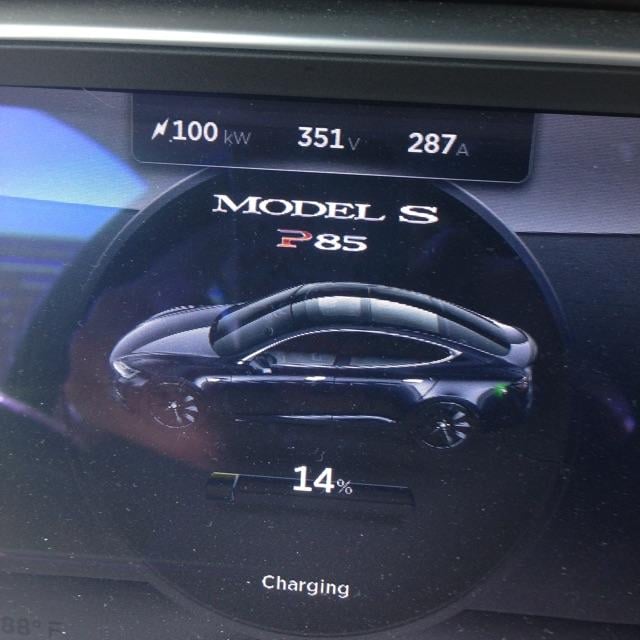
So we are three for three with still no throttling when living nearby Superchargers.
He is also on v6.1(2.2.115) of the firmware.
Larry�
Mar 20, 2015
Merrill Thanks Larry, never changed that setting. Now I will check the kW on the next visit to the SC.�
Mar 20, 2015
qwk It doesn't bother me a bit. Just stating my observations....�
Mar 20, 2015
paulkva In addition to changing the setting, you can also simply multiply: Volts x Amps = Watts. Then divide by 1000 to get kW.
I think someone else mentioned this as a possibility upthread, but I have to wonder if Tesla is simply testing throttled supercharging at a select few locations. Even taking the posted service paperwork at face value, where it states the throttling is intentional, it does not explicitly state WHY the throttling happened. Maybe they're playing with some parameters (e.g. in a beta version of supercharger firmware) that determine when to throttle, and a few people here have simply been caught up in the experiment. While it's possible distance from home is one parameter, there could be any number of others, including temperature, peak demand, other internal diagnostics...
Intentionally throttling someone's supercharging rate just because they're local doesn't make sense to me from any perspective - business/finance (despite the hard numbers), managing congestion, or (most of all) publicity. While nobody has ruled it out yet (nor have we ruled out anything as far as I can tell), I expect the probability of that being the reason is quite low.
I say this as someone who (similar to AmpedRealtor) has needed local supercharging at least once; in fact I might need it again in a couple months to drive from DC up to Gettysburg, back home just long enough to unload/load the car, and then down to Charlottesville.�
Mar 21, 2015
hiroshiy Another data point. 13 celcius, SOC 70%, power was only 53kW at Grand Hyatt Tokyo. I forgot whether this is normal or not... Is there a Supercharger kW table to see how much kW to expect in a certain SOC?�
Mar 21, 2015
scaesare Yeah, that's about right.... if you search for "supercharger taper curve", or similar, you'll see some graphs posted...�
Mar 21, 2015
Cottonwood If you like watching miles, you can still get kW from the Volts and Amps without changing modes. Watts = Volts * Amps, so kW = V*A/1000.
To get kW charging power, just take Volts times Amps and divide by 1,000.�
Mar 21, 2015
techMology What's the typical kW rate for a car at 40%? (as typical as it can get - I realize there are multiple factors)
Prompted by this thread, I went to my local SuperCharger (Toronto). I'm 5 miles away. I plugged into two different stalls and saw no higher than 50kW (42kW would be the average, I'd say). Only one other person charging at the time. I wasn't plugged into his paired charger.
It makes little sense to limit, unless it's to discourage use by locals. In my industry (wireless), you want people to use the resource as quickly as possible so it's free for others to consume. It's a balance between getting the consumer to pay for the faster data rate and freeing up the network. I don't understand why Tesla would want to slow things down for any other reason than to prolong the life of the battery, or because of some electrical fault.�
Mar 21, 2015
deonb Based on this video at the 1:46 mark (40%), you should be getting about 90kW on a 85.
https://www.youtube.com/watch?v=S00RG6uqpPo�
Mar 21, 2015
apacheguy For your VIN and model, 90-100 kW is normal at 40%. We're environmental factors an issue (I.e., cold soaked)?�
Mar 21, 2015
hiroshiy Thanks! I was too paranoid about this...�
Mar 21, 2015
hiroshiy Bookmarked this video!�
Mar 21, 2015
techMology Thanks for the info. So, not a positive experiment for me.
And Nope. Not cold soaked. Outside temperature was about 4 degrees Celsius. Power and regen weren't being limited. I had been driving for about 30 minutes prior to plugging in too.�
Mar 21, 2015
redi Please report it to Tesla, Service, and Supercharger hotline. That's what I did and so far its been completely ignored by Tesla (another interesting data point).�
Mar 21, 2015
Cottonwood I agree completely. When you notice problems, call Tesla and report them.
I have had great support and info from calling Roadside Assistance, 866-998-3752, the number posted on most Supercharger pedestals. At Grand Junction, last week, I noticed that my charging power suddenly dropped to 36 kW when I was at 60% SoC and had been charging normally for about 15 minutes at 3A; I was the only Tesla at the site. I tried unplugging and plugging back in, with no luck. I then moved over to 1B, and the charging returned to normal at 70 kW. I called Roadside Assistance, they pulled my car's logs and the Supercharger logs while we talked, confirmed what happened, then told me that Supercharger 3 had already been flagged at 71% health and was to be checked out on the next maintenance visit.
The good news is they were on top of it. The bad news is that I did not know about the slow down in charging until I checked the App, and Tesla had done nothing to inform me ahead of time that Supercharger 3 was weak; I'm guessing that it was a cooling problem because it worked fine for 15 minutes. Hopefully, 6.2 or future versions will help with situations like this, and would recommend to use a 1x or 2x stall and not a 3x stall.�
Mar 21, 2015
apacheguy FWIW, I plugged into SJC earlier this afternoon at 54% SOC and saw a max of 56 kW which quickly dropped from there. So not an ideal test by any means, but I can definitely say it was performing very crappy for one reason or another given my previous data (of which I have lots).
Details:
Stall 4A, unpaired
Loaner A pack
70 F ambient
3:30 pm
2.2.179�
Mar 21, 2015
David99 I agree, but in all three cases where I had experienced the 60 kW limit and called they couldn't find anything in my car nor the SC logs and had basically no idea why. Each time they said they would look into it and call me back but didn't. A SC that needs service is fine. That's expected. But random limitations to 60 kW reported by many people now and Tesla has no clue and there is no word from them makes me a little nervous for my upcoming 4k mile road trip. :/ When I get my service I will ask them about it.�
Mar 22, 2015
Larry Chanin What version of the firmware are you using?
Larry�
Mar 22, 2015
Getinring I live less than a mile from Rancho Cucamonga SC, in month February I was at 60 for 3 or 4 charges always at around 30 percent SOC. I was just about to call service when this thread started. However since this thread has grown, I've been at 100kw the last 3 times in March always with 30 to 40%�
Mar 23, 2015
techMology Will do.
Another data point for everyone, I have only SuperCharged once before, back in October or September if memory serves correctly, and that was just a top-up for 10 minutes while I was on my way somewhere and forgot to plug in at home. Same location.
So as far as limiting people who frequent local SuperChargers, I don't fit that profile.�
Mar 23, 2015
hiroshiy Today Tokyo's third Supercharger station opened at Palace Hotel Tokyo. Two units, and valet operated (no self charging). There was an opening party with 20 or so owners and Tesla employees, including Mr. Kelty, who is the director of battery technology.
So I asked the question about 60kW rumor - and to my surprise, he said he wasn't aware of anything like power limitations for local users with Superchargers. I gave him the URL for this thread
If I get further email responses back from him I'll share.�
Mar 23, 2015
gregincal Is it my imagination or has this stopped? I've scanned back over most of the pages of this thread and it seems like the thread starts with a lot of people confirming the behavior, then some people saying they aren't seeing this and then some people posting they have returned to full speed charging at chargers where they were previously limited. This seems to have been ignored and is followed by pages and pages of speculation over the last week or so with no reports of the 60kW limiting actually happening.�
Mar 23, 2015
FlasherZ One of my FB friends ran into it just prior to the weekend. It's still happening occasionally. EDIT: I take that back, I checked and found that he was over 60% SOC (the display showed cut-off numbers and I had assumed he had 65 miles remaining, not % SOC), so it appears that this was normal curve.�
Mar 23, 2015
gregincal Yeah, one thing to be careful about is that it definitely appears that when this was happening it wasn't just a slightly unexpected charge, but it was almost exactly 60kW when you should be getting something like 100kW or more.�
Mar 23, 2015
trils0n Today I was limited at Gilroy. Stall 2B. Rolled in with 5% battery, temp was around 70deg F. Switched to stall 3A. (3A is unpaired -- it has its own cabinet) and received full charge rate.
According to someone I can neither confirm or deny speaking to, the issue might be an incorrectly installed/changed/removed splitter that is causing the limiting (the cabinet isn't being split properly to each of its two pedestals).
If there was a Supercharger tech performing an unrelated repair at the SC when I was charging he might have said something like the above if I would have mentioned seeing a limited charge at perfect conditions.
There are only a few supercharger techs, and over 400 supercharger locations, so they are working pretty hard.�
Mar 23, 2015
Andyw2100 If there was a Supercharger tech performing an unrelated repair at the SC when you were charging that might have said something about an incorrectly installed/changed/removed splitter that is causing the limiting, do you think he might have said anything about that being a recent and widespread problem or do you think he might have just been talking about the one causing the limiting at the location you were charging at?�
Mar 23, 2015
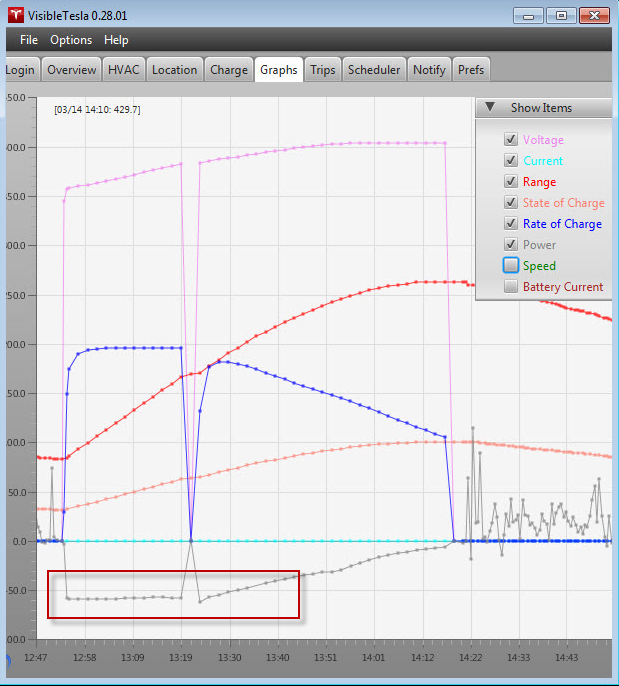
redi 60kW almost exactly was my experience - and it remained flat until the taper.
 �
�
Mar 23, 2015
trils0n He might have said he earlier changed the one for the stall I was using so it was good the issue was noticed so quickly. (I had used the same stall a week before and got 100+kW). He also might have indicated he'd be checking the TMC forums to look for more info and might be escalating the issue if needed.�
Mar 23, 2015
Cosmacelf Well, we've heard at least two different types of fault conditions at SCs here. Coolant can be low (or, I imagine, refrigerant) which will cause the SC to limit current. And the electronics could be misconfigured or have a fault in it. So ... If you are 60 KW limited and your SoC is less than 60%, call Tesla and let them know. It may very well be a SC problem.�
Mar 24, 2015
Cottonwood Highlighting mine...
The charging modules used in the Model S and the Supercharger Cabinets are liquid (coolant) cooled.
In the MS, the air conditioner/chiller can chill the coolant loop below outside air temperature. This air conditioner/chiller is there mostly to maintain battery temps at a reasonable level in hot weather.
The Supercharger Cabinets do not contain any batteries and appear to only use a liquid coolant loop to a radiator with an electric fan, and do not have an air conditioner/chiller.�
Mar 24, 2015
Matias I've tracked you! You wear actually charging in Langley, Virginia�
Mar 24, 2015
Cerie I think the thread stopped bc tesla isn't doing anything about the problem so there aren't fixes or any real updates to give. As of this Sunday, I am still limited at Darien north charger with well under 60% soc and I'll be trying east Greenwich, ri today again with under 60% as well. I was also limited there two weeks ago so seeing if anything has changed. But nope, problem is still there and the service center keeps telling me lots are normal. Just no point to keep posting about it unless someone gets an actual fix.
im just curious if there's any kind of legal foot to stand on if they can't fix this issue with my car as far as either lemon law or false advertising. If they had said that it would take an hour to charge half my battery at a supercharger, it definitely would have affected my decision to buy the car and I don't think it's fair for me to take a huge hit on depreciation if I decide to switch back to an ice because double the supercharging time is not acceptable to me.�
Mar 24, 2015
FlasherZ Do you have documentation that guarantees the ability to charge the car at a certain rate at Superchargers? If not, the answer is no. With relationship to Supercharging, Tesla has always said "up to" or "about" with charging rates.
But I'm confident that if you keep calling the Supercharger number each time it charges at a slow rate, and you file appropriate tickets with your service center, that the matter will be addressed; escalate (KINDLY) to your service manager, explain that you're not getting the rates that others are getting, and ask them to dig in with engineering.
I can guarantee this thread did not stop because there is no update. The "A" pack thread @ 90 kW still lives on, 2 years after it was determined and explained. There are owners still very much upset. I can guarantee that if many were seeing 60 kW limitations we'd see post after post here of each experience.
Jumping right to legal threats will put Tesla in a defensive position with regard to you and everything will operate based on the letter of contracts. That's never a good thing for either side. Tesla has proven that unless you're acting like a complete ass and being unrealistic (I can think of one particular person in Wisconsin, among others), they are willing to work with you.�
Mar 24, 2015
yobigd20 For anyone that's experienced the 60kW limit, has anyone been able to observe yourself unplugging and then another car pull into the same spot and plug into the same exact charger and NOT be limited? this would rule out any SC fault....�
Mar 24, 2015
FlasherZ Unless it were a combination SC + car bug. I think there were some posts upthread that exhibited that behavior (or the other way, where higher rate car pulled out and then the charge was limited).�
Mar 24, 2015
HankLloydRight The "coolant" in the SC cabinets is ironically motor oil.
I was at the Greenwich CT SC when a tech was there literally doing an "oil change".�
Mar 24, 2015
scaesare Given that they are identical to the chargers in the cars which we know use standard automotive coolant, that would be interesting.�
Mar 24, 2015
Cottonwood Are you sure that it was oil? Glycol/water mixtures can look a lot like oil, but have much better heat carrying capabilities.�
Mar 24, 2015
gregincal So just to be clear, you are seeing 60kW charge rates until taper?�
Mar 24, 2015
Cerie Yes but actually there isn't even much tapering until maybe the last 10 miles or so. It stays at 60 kW regardless of the soc but I'm not a frequent supercharger user so I've only ever experienced it 2 times in the last month.�
Mar 24, 2015
apacheguy I bet it's ethylene glycol. That's what they use for the on board chargers at any rate.�
Mar 24, 2015
bollar Yes. There are examples up thread. Here's one: My car won't charge faster than 60kW - Page 14
Redi tried at least two of the chargers with the same result. The other two cars at this location charged without a problem.�
Mar 24, 2015
jerry33 Which implies:
1. All the chargers he tried were B (and the other folks were on the A side, although it doesn't appear that's the case based on Redi's post).
2. There is a problem with his car or the software in his car.
3. It's just barely possible that the pilot wire wasn't connecting properly, didn't have enough voltage, etc. Enough to allow charging but only at the minimal level. This could be a contamination problem. (
3a. Is there any geographical correlation. For example: Is it more prevalent in dusty areas?�
Mar 24, 2015
brianman Interesting. On the trailing end of the taper, you seem to be getting better than the A packs.
More specifically, for all the samples in that chart in the >= 70% SOC the taper is below 60KW. That maps to the last 79.5 miles, which is quite a bit better than the "last 10 miles" you call out for the taper you're seeing.�
Mar 24, 2015
smac
4. Something going on which we don't know about.
My posts earlier in this thread strongly suggest Tesla are making a book loss on Supercharging (and I'd go as far as to say one they weren't expecting). It's not at all unreasonable to also assume they are exploring options to stem this.
The language has changed, the 6.2 announcement Elon was VERY clear in stating the long distance enabling purpose nature of Supercharging, and the website has changed to reflect this too. I believe this is the early phase of the social acceptability piece.
Personally I think capping cars at 60kW charge rates won't help, but maybe they are just probing the effects ?
After all they know exactly where your car is all the time, how often you use an SpC, at what time, and what remaining range you had, as well as if you had used your home charger, at what time, for how long and if you had enough dwell time, but were choose to schedule charge, etc. etc.
They probably have a fair handle on the use of SpC's to save a few bucks on home charging. By statistically sampling capped rates they could start seeing how certain policies would play out across the fleet.
Randomly throwing in different models of capping, and measuring the owners propensity to subsequently Supercharge when they don't need to will add to their knowledge of solving the issue.
I don't think any of us should have a problem with this BTW, Tesla are a business after all. IF Supercharging isn't the profit center it was intended to be it is in owners interest for them to be turned around to become such for the long term position of Tesla.�
Mar 24, 2015
brianman To my recollection, supercharging was never considered a "profit center" inside or outside Tesla. An advertising/marketing medium sure. A customer acquisition and satisfaction provider, also sure. A profit center? I've never heard it described as such.�
Mar 24, 2015
Nigel16494 I just happened to be at Gilroy for another reason on Sun. 67% charge, 59Kw 386V 154A . maybe one free stall. I will head to Fremont at the weekend on another test mission when there should be no one at all and charge level will be below 20%�
Mar 24, 2015
techMology Well, charging at 90kW right now in Toronto. Battery was power limited at the 160kW mark, and just before I plugged in, I got the "if your battery gets any colder" warning. I was at 10% SOC.
I saw the charge go briefly above 100kW to 102kW, but it has since settled down to 88kW.
Again, I'm a local. 5 miles away. Last time I was only getting 50kW when I should have been getting 100kW.
Go figure.�

Không có nhận xét nào:
Đăng nhận xét