Jan 2, 2015
maoing Didn't norway delivery start from mid-2013? I think it's unfair to compare a full year 2014 delivery to half year 2013 delivery.
�
Jan 3, 2015
Right_Said_Fred Or maybe the big investment in SC's and SuC's is necessary for future growth. That is why you should not let investors (who often have a short term vision) make decisions, but visionairies like Elon.
So far loyal Tesla-investors cannot complain about the ROI Elon gave them.�
Jan 3, 2015
Adm Austria 24 for december, 136 for 2014
http://www.statistik.at/web_de/statistiken/verkehr/strasse/kraftfahrzeuge_-_neuzulassungen/index.html�
Jan 3, 2015
RobStark
It is entirely fair because in the 2013 Tesla was working on a 4 year backlog.�
Jan 3, 2015
jhm I agree. The earliest of early adopters are willing to buy before any infrastructure is in place. But most of the opportunity comes later and holds back until sufficient infrastructure comes online. My guess is that each well placed supercharger station adds about 100 to 200 in annual demand for Tesla cars. This is why it is so critical to roll out one or two every day.�
Jan 3, 2015
maoing Thanks for the update. The number is not impressive though. The Q4 delivery guidance 11K account for 1/3 of annual guidance 33K. So anything short of 33% annual number is not impressive IMO.
�
Jan 4, 2015
Krugerrand That would be assuming equal distribution to all markets for the quarter. Not the way it works at Tesla.�
Jan 5, 2015
Ingenieur Belgium December 130 Cars, 2014 Total of 521. December Tesla outsold Jaguar and Lexus combined.
Spain 1 car
Total sofar for December: 930 with UK,Germany, Denmark and Switzerland still to be reported as major markets, most likey more then 2000 cars, more then Last Quarters ca. 1850.�
Jan 5, 2015
schonelucht How do you get to that number? This would imply a current yearly demand between 12300 and 24600 in Europe based on Tesla's reported 123 stations.�
Jan 5, 2015
jhm Isn't that the range we need for 2015? For building demand, installations are needed in advance of orders.�
Jan 5, 2015
Adm You appear to have more results than I was able to find...
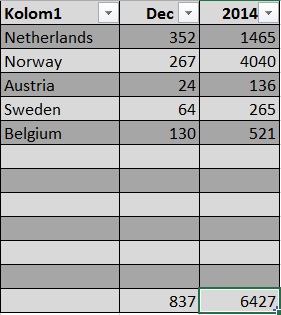
Netherlands: http://raivereniging.nl/artikel/marktinformatie/actuele-verkoopcijfers/verkoopstatistieken.html
Germany: http://www.kba.de/DE/Statistik/Fahrzeuge/Neuzulassungen/MonatlicheNeuzulassungen/monatl_neuzulassungen_node.html
UK: http://www.smmt.co.uk/category/news-registration-cars/
France: http://www.ccfa.fr/Immatriculations
Finland: http://www.aut.fi/tilastot/ensirekisteroinnit/kuukausittain/2014
Sweden: http://www.bilsweden.se/statistik/nyregistreringar_per_manad_1/nyregistreringar-2014�
Jan 5, 2015
schonelucht Need for what? To reach 60 000+ vehicles like some are predicting then probably yes. The more realistic guidance of 50 000 cars is probably attainable with just 9k units in Europe, especially if the US market remains strong and China takes off after the recent management shake-up.. The two countries most obviously lacking in supercharger infrastructure are Spain and Italy. Both would need at least 10 additional stations each for complete cover, but I have a hard time seeing demand picking up there substantially to a rate of 1000-2000 cars on a yearly basis.�
Jan 5, 2015
jhm Do you think Europe could ever get to 20k annual deliveries without at least 200 Supercharger stations? And how long would that take? So eventually that many and more are needed and the sooner, the faster sales can ramp up. Adding ten to Spain and Italy would not only build demand in those countries, but everywhere else where potential buyers might imagine themselves taking trips into those countries. I've heard that many Europeans like to take holidays around the Mediterranean. So all those destinations need coverage to and around so that potential buyers can fantasize about completely worry free holidays.
A friend of mine in Georgia recently took a trip out to Arizona, about 4 or five days driving one way. And he recently visited a Tesla store for the first time. He was pretty impressed, but left feeling like the car was not quite adequate for long trips. He had looked at the map of Superchargers and evaluated it on the basis of his recent trip. For that trip it truly is not adequate. I was surprised that someone in Georgia would be concerned about whether there we SCs Oklahoma. It seems to me too far away to worry about, but for this friend the lack left a definite negative impression. So the demand in Georgia depends to some degree on far out places like Oklahoma. Even if the specific market in Oklahoma is not that great, it matters to all potential buyers who might envision themselves driving to or through that state.�
Jan 5, 2015
Robert.Boston Spain and Italy are very popular destinations, so even if there were no Tesla vehicles in those countries, Tesla still has strong incentives to build out the Supercharger network there. In the new Supercharger map Tesla's 2015 plan is showing 13 planned locations in Spain, plus 2 in Portugal, and 14 or so in Italy. All in all, it looks like Europe is getting a much denser Supercharger network than is current planned in North America.�
Jan 5, 2015
schonelucht Yes, easily. By far the most important variable that influences Tesla commercial success is fiscal policy. See Norway/the Netherlands versus France/Germany for example. If these latter countries start providing the same kind of heavy incentives Dutch buyers have (saving about 10% of new car value in tax every single year), we could see a 20k sales rate tomorrow. Should the Netherlands withdraw this tax benefit (it may very well do so for 2016 but much is still up in the air), then sales would plummet even if you blanket Europe with superchargers every 20km. Range is not nearly the issue here as it is in the US. We travel a lot closer by.
- - - Updated - - -
Absolutely. The question is : would it generate additional demand of 100 to 200 cars per new station? I am highly skeptical about it.�
Jan 5, 2015
jhm Demand is the quantity purchased at a given price. Subsidies do not really increase demand; they just change the price that buyers pay. So of course if you lower the price more will be sold, but that is not an increase in demand.
Superchargers, however, do not change the price, they only make the cars more desirable to buy at a given price. So enhancing the SC network truly increases demand. Perhaps an increase of 100 annual cars per incremental station is high for the European market. Perhaps 50 or 20. What would you recommend?
One consideration, however, is that if the demand sensitivity to incremental stations is too low, like 10, then Tesla has no economic motivation for installing them. Suppose a station costs 100k EUR, but it only motivates 10 incremental sales per year. Over say 5 years that's 50 sales for a cost of 2000 EUR per sale. This is not a really good marketing return, not even considering the costs of power and maintenace. On the other hand, if the sensitivity is 100 cars per year, then in 5 years you get 500 sales for a cost of 200 EUR per sale. This is a much more attractive marketing spend and very much worth doing. So one way to approach estimating such a sensitivity is to operationalize it. How many marginal sales per year must Tesla assume to justify installing a marginal station? If the marginal sales for prospective location is deemed to low, then Tesla won't build it. My suspicion is that this operational threshold needs to be around 100. At this point in time however there is probably so much low hanging fruit, that Tesla is not too worried about justifying some ROI for each location. So I am not overly concreed about being precise about this, which is why I use a nominal range of 100 to 200. If it were much lower, Tesla would have to be much more careful and move more slowly.�
Jan 5, 2015
schonelucht In the context of discussing the performance of Tesla, the only demand I consider relevant here is the demand at the price Tesla is willing to sell for. In that effect, subsidies do change demand by changing the price a customer has to pay to meet the cost Tesla asks.
Honestly, I don't really know and that's why I asked you how you came to an estimate of 100-200 cars per station. Looking at the operational costs of a charger station as you suggest is a reasonable approach to determine how many cars Tesla expects to sell.�
Jan 5, 2015
Robert.Boston @jhm is making an important distinction. In the jargon of economics, a subsidy reduces the net price to the consumer and therefore increases the quantity demanded. Superchargers shift the demand curve? for Model Ss. While the net effect is the same--more Model Ss sold--it's a worthwhile distinction to understand the underlying mechanisms.�
Jan 5, 2015
bonaire For me to use a Tesla well in my overall driving needs, I need superchargers in about 4 more distinct locations within 200 miles of my house. I could handle CHAdeMO charging as well but there is very little of that here on the east coast. It's out there but iffy and the primary provider of stations would be Nissan dealerships and iffy companies like Car Charging (blink). The prevalence of superchargers will be really key to expanding growth efforts. If one SC location drives 100 local sales, that is only a composite $200K income if the contained fee is $2k per car. But if stations can be done with lower costs such as a 2-head supercharger without a lot of digging and trenching (like the one in Bethesda, MD in a parking garage) then they could be spread out further and faster.
Until then, buying new is out of the question and buying used is also not really a good idea which could be a purchase at 50-60% of original price. The infrastructure is the solution to selling the Model 3 when it finally comes out. Using a lot of funding now to build-out superchargers seems like it is critical. In fact, I think using some or even all of the money from the GF to build more superchargers seems practical.
Here's a thought. To lower costs for a Model 3, with enough DC fast charging out there - you don't need onboard inverters. With enough infrastructure of SuperChargers and CHAdeMO out there, then cost input for a "DC only" option could lower the input costs by what, $1K to 1.5K? Down the road, it may make sense for the EV industry to lean toward a DC heavy infrastructure. L2 J-1772 isn't going to drive BEV demand that much in the public charging segment unless it is 40A or higher (and higher means two on-board charger/inverters).�
Jan 5, 2015
jhm Bonaire, you may be onto something with the DC only cars. When you're trying to make a $35k car, whacking off $1k or so for an onboard charger makes sense.
Another note about Supercharges is that I think they will be key to the urban charging problem. This is in distinction to the original intention of Tesla just to use Superchargers to fascilitate intercity travel. Within dense urban areas parking infrastructure is expensive and many people do not have garages for convenient at home charging. Solutions in this space must use parking resources efficiently so allocation dozens of stalls to trickle charging won't cut it. In midtown Atlanta, there is a new 12 stall Supercharger station at Atlantic Station, a very large, upscale shopping center. Many people within the vicinity live in high rise condos, and at home charging is often hard to come by. But at Atlantic Station people can charge their Model S for a week in the time it takes to buy some groceries, go to the gym or do a little routine shopping. People have to pay for parking, so it is not ideal for someone who is just cruising through Atlanta. But if this is where you do regular shopping and you don't have at home charging, it may well be your best option as a Tesla owner. It is key that Supercharging is so fast. 80A charging might not be fast enough for this lifestyle.
So this is the kind of urban charging solution I would expect to see more of. It's got to be fast, convenient to weekly activities, and close to urban population centers. The thought that such urban dwellers may use 2 - 4 MWh of "free" electricity per year does not bother me. Sure that could be more than $2000 over 10 years, but that is a tiny discount on a Model S. People will only use Suoercharging that heavily if they really have no better options, and so it becomes a basic requirement for some to be able to make the purchase at all. So while we might imagine that 300 Superchargers may be all the "coverage" Europe may ever need for distance traveling, it may well be tha Europe needs more 3000 urban Superchargers to be able some day to support say 350k new cars per year and a total Tesla fleet of 4 million cars. I know this scale might be hard to imagine at this point, but really we are talking about Tesla when it has about a 2% marketshare globally. 4 million cars sharing 3300 stations weekly is about 1200 cars per station, 175 charges per day per station.
Another point regarding government subsidization of charging infrastructure is that it may be more prudent to create per kWh distributed incentives than to just pay for equipment. It is vital that the infrastructure that is developed actually be well utilized. Paying for companies just to put up charging where no one wants to use it, using equipment that charges too slowly, or charging fees per kWh that no one wants to pay is just a waste of public funds. If incentives are based on kWh actually dispensed to EVs, then developers will take care that it is well utilized and public funds might actually translate into electric miles driven. This is very much like the subsidization problem with solar. Just paying someone to install solar equipment does very little to spur good investments in solar, but feed in tariffs do a better job of incentivizing productive investments in solar. If governments are willing to subsidize per kWh EV charging, then this would work quite nicely with Teslas Supercharging infrastructure. They do a good job of actually putting energy in cars. With all this talk about standards for charging, it should be pefectly clear that 1 kWh is already a standard unit of energy and the goal should be to get this into cars in the most convenient and cost effective way possible. So incentivize kWh dispensed, not charging hardware.�
Jan 5, 2015
Raffy.Roma Agree 100% �
�
Jan 6, 2015
Ingenieur Denmark 115 in Dec
@Jdm, other numbers i mentioned were my assumptions, not actual numbers�
Jan 6, 2015
Adm Do you have a link to those numbers?�
Jan 6, 2015
Ingenieur De Danske Bilimport�rer�
Jan 6, 2015
chickensevil Don't agree with pulling from GF funding, simply because they don't need to. It has been stated previously that they are pretty much building out the SC network as fast as they reasonably can. I have stated it elsewhere but will state it here that a lot of the issue stems from getting through all the red tape to be able to install. Getting governments and property owners to come together to support Tesla is a lot of work it isn't really something that you can just throw money at to fix your problems.
About the lack of inverters I think eventually it will not be needed to go to 80A but 40A for overnight charging is perfectly fine and will last. It may be that eventually they make it an option to get an inverter entirely, but I don't think it would ever fully go away unless charging at home hits such a point that you install a "supercharger" at your house. Then maybe. What I will say is that public charging certainly has it all wrong (outside of Tesla). The problems are multi-faceted.
First, most are installed in terrible locations... Walgreens? who stays at Walgreens for more than 30 minutes? Even grocery stores are not really the best option because you are not really going to spend that long shopping... at least not to justify sticking a 30A/240 L2 Blink/Chargepoint/etc type charger there. Even a full blown 80A charger would be wasted at those places. If you want to stick to "slow" L2 charging it needs to be somewhere you anticipate staying for around 8 hours. Work, Home, and Hotels are primary points that come to mind. Entertainment places like theaters (at least you will be there for a good 3 hours...) theme parks and other type events would also likely be acceptable.
Second, Speed. I sorta hit this with the first point, but L2 should really be 80A by default. Canada has that one right with their installation of the chargers. Anything higher than 20kW would likely need to just go DC at that point. People are still in the "short BEV range" mindset and need to get into the 200+ mile range mindset. That won't happen until market forces drive it... which leads to...
Finally, long range BEVs. This is contributing to the terrible thought process and mindset. Slow chargers are put in because no one is thinking about 50kWh or larger batteries... they are thinking about the sub 10kWh batteries... Bad locations are picked because people think you are likely to run out of range going to someplace like Walgreens because you only have 50-100 miles of BEV range.
Anyway... that is the problem with charging. Will the future be DC charging only? Who knows... but for now... AC charging will stay simply because you are going to charge at home when possible.�
Jan 7, 2015
Ingenieur Rest of EU is in (Via Realist)
Switzerland 103
Germany 165
Finland 12
UK 150-200.
Total for EU is 2200-2300 depending on UK where we only have Other non UK Number that includes brands like Ferrari and Lamborghini as well as other rare cars like TATA.�
Jan 8, 2015
Adm 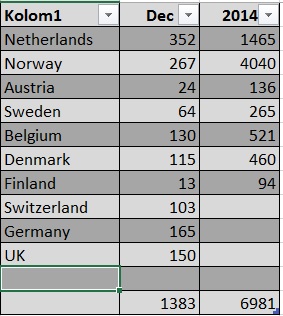
I am not sure where you think those 2200 deliveries took place. France, Spain and Italy are missing in this list, but I doubt they will tip the scale over 2000.�
Jan 8, 2015
LST If the 103 number for Dec.14 for Switzerland is correct, this would imply a sum of 493 MS sold in Switzerland in 2014.�
Jan 8, 2015
Ingenieur For Q4 not just Dec�
Jan 8, 2015
Gerasimental One country after another coming in with Q4 deliveries well under the 33% of the 2014 total deliveries that, as Maoing pointed out, are required to get us to Q4 guidance of 11k vehicles.
Is there a supply related reason for this or are we really seeing demand drop off in the high-volume countries (NL, NO) and less-than-expected demand in the large economies (DE, UK)?�
Jan 8, 2015
Adm 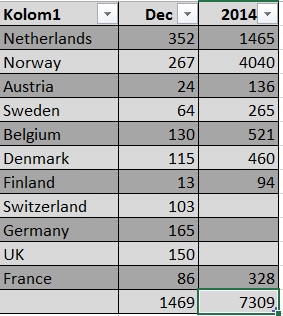
I've verified the numbers which also have 2014 deliveries, but some countries haven't specified smaller companies.�
Jan 8, 2015
jhm Very exciting Supercharger maps are being discussed in the Supercharger growth thread. Supercharger growth - Page 16
Note there is substantial expansion into Eastern Europe, Spain, Portugal, and Ireland planned for this year and even further eastern expansion into Russia, the Baltics and Greece in 2016.�
Jan 8, 2015
techmaven As always, it comes down to the U.S. and China. We don't need a particularly high Europe number to make the overall numbers, especially if the U.S. is strong. The estimates from GoodCarBadCar are 4,650 for U.S. and from InsideEVs, is 6,000 for the U.S. We know that Tesla pushed the P85D's in December which was mostly U.S. and some Canada deliveries with 0 going outside of North America. Therefore, in the neighborhood of 2,300 for Europe is not bad. Last quarter, it was 1,656 with a similar U.S. focus.
Australia is also a new ramping up territory, and Japan was 137 in December. As usual, we don't have Hong Kong numbers which are also critical. I think we have less than a 1,000 car miss, possibly less than 500 cars, at which point the increased ASP could be all the difference. It is also unclear how many cars Tesla was able to "ship" direct in the U.S. (not going through a Service Center for delivery) as it became crunch time in late December and therefore was able to count in Q4 2014.�
Jan 8, 2015
chickensevil yeah, 6,000 US and 2300 EU means only 2,700 need to come from the Pacific region to hit 11,000 (which should match the revised guidance of 33k). Assuming both the 6,000 and 2,300 numbers are correct (there are certainly unknowns here) I feel pretty confident that we had the remaining 2,700 in the Pacific region.�
Jan 9, 2015
Newb Regarding the December `14 registrations in Germany it's noteworthy that this was the first month ever in Germany in which more Model S were "sold" than models of the BMW 7 series, BMW 6 series, Audi A8/S8 or Porsche Panameras (!). And that happened in GERMANY, folks. Here's the cut from the original list:
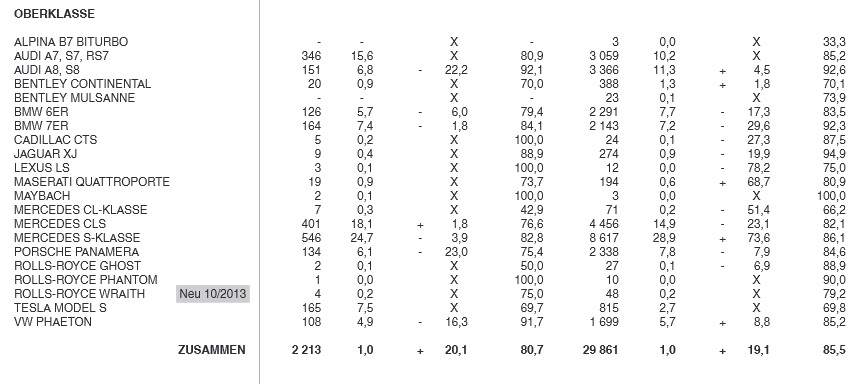
The first column with numbers are the registrations of brand new cars in December 2014.�
Jan 9, 2015
jhm So it sounds like the 30 Superchargers in Germany are starting to make a difference.�
Jan 9, 2015
Newb I hope so. It could well be that in the months ahead we'll see similar monthly registration numbers in the range of 100-200 cars. Positive catalysts:
- as you mentioned, relatively large supercharger network
- AWD option available
- 250 km/h top speed available
- sales expansion to fleet customers (so far Tesla Germany was not really successful to get into the fleet market in Germany)
- increasing visibility of Tesla Motors in German media
- potentially government incentives for EV purchases�
Jan 9, 2015
jhm This is all good. I think it is an excellent exercise for Tesla to figure out what it will take to win over German motorists. We hear much of "supply constrained" apologetics, but it is also vital that Tesla learns precisely how to grow demand in demanding and competitive markets. At this point, I think it comes down to getting a lot of little things right so that the entire package is flawless and quite compelling.�
Jan 9, 2015
RobStark What is Tesla learning? How is it adjusting to the German market?
When auto companies enter a new market they must learn about relationships with local distribution channels. Tesla sells direct in Germany and so far has not agreed to terms with a large leasing company AFAIK.
Auto companies in foreign markets must learn how to use paid advertisements. Tesla does not do that.
Auto companies must learn what proportion of incentive money must be used for the buyer in terms of discounts and what percentage to use for salespeople in terms of commissions/prizes,kickbacks. Tesla does not do that.
Auto companies must learn how to customize product to local taste. An American Camry,for example, is wider than a Japanese Camry with much bigger cup holders. Tesla made a mild "autobahn" tuning almost at release and has done nothing since.
Tesla did not just figure out that more Superchargers means more business. Nor did they just figure out that autobahn speeds deplete the battery quicker requiring Superchargers to be built closer together.
No auto market in the world is more competitive that the US market. The fact that BMWs,MBs,and Audis are cheaper in the US than Germany even after adjusting for VAT is proof of that.
The fact is Germany is going to be the toughest market to crack for Tesla after Japan and S Korea because it is home to the three largest premium priced car Auto companies. And Germany has the highest speed limits in the world, which makes it particularly difficult for premium priced BEVs to directly compete with premium priced ICEv.
And Japan and S Korea are going to be the toughest markets to crack because of non-Tariff trade barriers( S Korea does not allow BEVs on highways/freeways) and much stronger bias for domestic brands than Western markets.�
Jan 13, 2015
chickensevil I'm sorry... what? That is the stupidest thing I have ever heard. It must be because they thought of "BEV" as those little golf carts that only go 20 MPH... so they made a law that said no BEVs on the highway (like how we say no bicycles and farm equipment on the freeways)... this seriously needs to change. But is quite funny... and sad... at the same time.�
Jan 13, 2015
schonelucht From http://money.cnn.com/2015/01/13/autos/elon-musk-china-sales-charging/index.html?source=yahoo_quote (warning video autoplays)
What are we missing here? Europe registrations are not knocking it out of the ball park as far as we can see. Is this a statement about sales going forward in '15 Q1? About D or X model uptake? Or rather how they expected a drop in Europe with the rise of the dollar and the surprise is how well sales are holding up? All in all, good news about Europe (certainly better than I would have predicted) and looking forward how this plays out over the next months.�
Jan 14, 2015
uselesslogin I think it is a statement on booked orders in Q4 and therefore they would be reflected in Q1 deliveries and registrations.�
Jan 14, 2015
bh1783 Well they also ban motorcycles from highways in Korea (not that anyone follows it). They actually have signs on the highway that ban electric vehicles.
 �
�
Jan 14, 2015
Ingenieur European sales were ca. 9500 in 2014.
1800-1900- Q3, ca. 2300 in Q4, so H2 is down more then 20%, mostly due to Norway though. I see 2015 same level of ca. 10k with growth in other markets making up for Norway decrease. Ok but nothing to write home about�
Jan 14, 2015
smac
477 have been registered in the UK as at end of September (474 left on the road). Complete 2014 figures will probably be out next month, but are only broken down by quarter)
TESLA MODEL S - How Many Left?
I was a reservation holder and got my car in Q3 for the purpose of the stats.�
Jan 15, 2015
jhm Given that the Swiss franc is no longer pegged to the euro, do we see any issues for Tesla? Specifically with the decline of the euro against the US dollar, I am wondering if Tesla will have raise euro denominated prices. It seems Tesla could maybe get away with not raising prices for a while, but now with the Swiss franc gaining substantially on the euro, it seems this exposes Tesla to arbitrage. One could buy a Model S in euros in a neighboring country, export to Switzerland and pocket the difference between francs and euros. Is this much of a concern?�
Jan 15, 2015
chillong Well, first of all its not very easy to just buy a car in Germany and then sell it in Switzerland, especially not a brand like Tesla where buyers expect hassle free service etc. Second, Tesla will get more from their CHF sales (not that they are that many) so probably they will adjust the CHF prices at some point and this arbitrage is no more.�
Jan 15, 2015
Auzie I have concerns about macroeconomic outlook in Eu zone. The sales of Tesla cars, being high-end market, are sensitive to prevailing economic climate. It is not clear yet how Eurozone developments will unfold, but signs are not encouraging.�
Jan 15, 2015
maoing I echo that. With strong US dollar, demand uncertainty from Europe and China, I hardly imagine Elon will give bold 2015 guidance.
�
Jan 15, 2015
Auzie The situation in Eurozone could go either way. Central Bank will start buying bonds, that may help if they pull it right. Low oil prices certainly help. Even potential Greece's exit from Eurozone may turn out for the good.
My expectation for Tesla's sales in both European markets and China markets is an increase in sales, simply on the back of increasing awareness of car superior technology.
It is difficult (perhaps impossible) for anyone, including Elon, to predict the future demand. He may be able to comment on the current order rate being higher than the current production rate.�
Jan 15, 2015
maoing I have no objection of sales increase. The uncertainty is if the increase will be 50% or more?
�
Jan 15, 2015
Auzie Welcome to the guessing game of investing :smile:
�
Jan 15, 2015
jhm It's not really predicting demand. It's about creating demand. New features like D and Autopilot build demand. Better charging infrastructure like adding supercharges and destination charging build demand. Expanding into new markets builds demand. Marketing new products like the Model X builds demand. Better sales experiences like shortening the wait time for delivery builds demand. Always doing right by the customer builds demand. Tesla is actually very good at building demand. Where they are most challenged is in scaling up production fast enough. It will be an awful long time before Tesla runs out of huge opportunities to create new demand. They've got a $2 trillion auto market to address and have only tapped about $3.3 billion. Moreover, their core technology have many other nonautomtive markets to address like commercial trucking, construction equipment, aviation, and stationary energy storage. If you're worried about whether you can make accurate demand predictions, you're thinking way too small. Look to the opportunities to address and create new demand.�
Jan 15, 2015
Auzie jhm, I think we agree, you call it building demand by adding features etc, I call it selling on the back of superior car technology�
Jan 15, 2015
jhm Absolutely. Moreover, this technology will also drive down cost over time to the point where Tesla has an absolute cost advantage over any ICE technology. So in strictly economic terms EVs will come to dominate the auto market and likewise battery packs in the other markets I mentioned. So in the near term Tesla competes on superior technology and in the longterm on lower cost if necessary.�
Jan 16, 2015
Alfred Correct, but there are also limitations. In much of Europe, particularly in the South, markets for large cars are limited. Sales have to be made by winning market share in a relatively small slice of the total market and this will slow penetration.
I just watched a few days ago someone giving up trying to park a Range Rover in a Zurich parking and a driver damaging his Mercedes E when hitting border stones in the same place. Most private and public parkings were just not built for cars wider than about 1.8m without mirrors. Only a few public parkings built recently are comfortably negotiable with large cars in Zurich. When talking to prospective owners, this is the most frequently raised issue.�
Jan 16, 2015
schonelucht I think whatever increase in lending supply and consumer spending the bond buyback program will have, is largely offset by the fall of the EUR on the short term with regards to sales of Tesla cars. Therefore I expect lackluster numbers in continental Europa for 2015. Two exceptions : UK and obviously Switzerland since of yesterday. On the other hand, Elon's remark about Europe holding up surprisingly well is a counterpoint to my view.
For the medium term (2016 and beyond) policy on incentives may be key. I expect the Netherlands to have a less generous offering by then and Germany possibly to introduce some incentives as soon as the large German car makers have a better portofolio of full electric cars.�
Jan 16, 2015
Ingenieur
The problem with new German EV law is that it basicly defines EV as everything with plug (correct me if am wrong but that is my impression), so a 15 Miles S-Class with Plug gets treated same as BEV.
There will be tons of PHEV whose plugs will remain virgin im afraid�
Jan 16, 2015
Auzie I agree about the size of model S not being a fit for some market segments. That is certainly a deal breaker for me. Model 3 may be a better fit, 20% smaller, but we have to see it first.�
Jan 17, 2015
VolkerP Economic woes in EU don't seem to pan out as expected. Germany achieved 1.5% growth and a balanced budget, first time since 1961 (i.e. Kennedy).
Whereever Model S sales numbers go from the current 800 per year, it doesn't make a big dent in Tesla's balance sheet.
Model 3 will be very appealing to the European market. But as soon as BEV technology is cheaper than ICE technology, it will be a race for the cheapest source of battery cell in large numbers. It will compare to the race of DRAM memory chip producers: You will have a short period to reap your investment, before competition builds an even larger factory and lowers production cost further.
Tesla is one giga factory in the lead.�
Jan 17, 2015
Robert.Boston While low-cost batteries will be a competitive edge, cost isn't the only thing that distinguishes one car from another. PC clones? That was a price game, mostly. Not so with cars.
Unfortunately, Tesla is working at a disadvantage in the EU relative to the local companies. It's got shipping costs, import tariffs, fx risk/cost, and the "not made here" issue. So its BEV lead--both power train and batteries--is the core strategic asset, one that other OEMs will try to close.�
Jan 17, 2015
hobbes That is definitely true now - but by the time Model 3 comes, from what Elon has been saying there should be a factory in the EU alleviating some of this.�
Jan 17, 2015
jhm While I believe there will be a race for cheaper battery I don't think it will be nearly as swift as DRAM. I see two reason. One is that batteries compete with ICE on the basis of two radically architectures. In the DRAM race the architecture was pretty much the same and one could plug competitng chips into the same architecture. But you can't simply plug the cheapest battery into an ICE architecture. Even modifying an ICE body to recieve an EV drivetrain does not deliver optimal results. So the auto industry will need to invest in developing suitable EV architecture before they can even enter this race. Two is that Tesla keeps its cost of batteries secret for a good reason. As long as Tesla keeps its prices high enough, competitors can and will continue to compete with Tesla by selling ICE vehicles, regardless how cheap their internal cost of batteries may be. So Teslanshould be able to enjoy high margins that come from a low cost of batteries for many years. Only two things can change this: either demand is not so strong and Tesla has to cut prices to continue to sell more cars or competitors enter the market with compelling cars and compete on price. I don't see either driver likely to happen on a short time frame. Even if compelling EV hit the market, their makers will want to enjoy the higher margins their technology affords and will not want to seriously cannibalize other profitable ICE lines while their EV capacity/supply is limited. So for these reason competitors will not jump right into a price war on EVs. Until EVs dominate the market and have ample supply, the competitive price of cars will be set by ICE cars. EVs will simply enjoy higher margins until they are forced to compete with each other for market share.
This also sheds some light on when Tesla can "safely" post a profit. From a competitive.point of view, it is fine for competitors to think that Tesla is unprofitable. Plowing cash into Gigafactories and Superchargers perpetuates Teslas lead without revealing how attractive their business model is.�
Jan 17, 2015
smac Technically speaking Supercharger and Gigafactories are balance sheet items, not P+L ones. They don't effective profitability, only asset make-up, effectively converting cash and long term liabilities into fixed asset. (Running these projects does need teams of employees whose wages will impact profitability, but it's probably small to the capital spend)
Ultimately they are taking out big loans on the back of their very high market cap as security to fund potential future profitability. It's quite a gamble, but if it pays off they will have the worlds best EV charging network from which to recoup big future revenues from non-Tesla users / Model 3 drivers (if "Free for life" doesn't apply), and a factory from which to start turning round their profitability problems by reducing the unit cost of each car (hopefully maintaining the same revenue levels)
What I'd really like to know, and it's impossible to tell, is how much ZEV credit is included in the profitability figure of each car, the SEC filings are very vague, but does state that each car's profitability includes ZEV credit sales. (Elon's last filing even stated changes in the ZEV credit system is a big concern for the company... Unfortunately the numbers don't quantify this. So investors don't know quite how much of a problem this would be
Anyway we are way off Europe prospects, and into bigger questions about Tesla.�
Jan 18, 2015
Robert.Boston Just a quick note before we return to the topic: Tesla Motors carries relatively reasonable levels of debt. Tesla has raised $2.3 billion in equity, and carries $2.4 billion in senior notes. Tesla is paying $29 MM in interest expense quarterly. It's hard to work through other automotive OEM, but a 50/50 leverage ratio is fairly conservative.�
Jan 18, 2015
Ingenieur Hello Robert,
that statement is not correct unfortunetly.
The Equity is just 245 Million, the Bonds outstanding are 3,12 Billion.
What Tesla did was quite aggressive, they recorded debt of 713 Million of Debt as Equity by accounting debt at net carrying value of 2,39 Billion.
So what they did is, "we assume at least some of the bonds will be converted so we record them as equity".
The conversion did not take place, so its just an assumption.
Now i dont have very deep knowledge about GAAP (Europe uses IFRS), but the underlying risk could be that a major decline in share price would cause mandatory revision of these projections.
Writing down of the difference is actually a big part of the NON-GAAP adjustment as they write down part of these 713 Million (as of Q3) each quarter.�
Jan 18, 2015
jhm Over the next 6 years, till 2020, Tesla will definitely be plowing a lot of cash into longterm investments like the Supercharger Network and the Gigafactory. In terms of profitability, there will be a lot of operating expense and depreciation and this may be out of scale in advance of revenue growth. In terms of cash flow, the Superchargers are paid for upfront from current sales and the bonds for the Gigafactory come due in 2019 and 2021. So however you look at it, that's a lot of cash over the next 6 or so years. Both profitability and free cash flow will be quite challenges will Tesla attempts to scale up at a phenomenal rate.�
Jan 21, 2015
jhm Crown Princess Victoria, Prince Daniel and Princess Estelle of Sweden tour Tesla's Fremont factory.
Pacific%20states - Nordstjernan�
Jan 24, 2015
Matias Euro prices have been raised by 4% today. There was also rise by approximately same amount few weeks ago. I guess this will have some effect to sales.�
Jan 24, 2015
Ingenieur � lost 17-18%, prices were increased by 7-8%, any explainations?
Selling the car 10% cheaper will impact margins.
There are probobly 5% of of components sourced in Euro (many components are from German companies but sourced in USD as delivered by US Production sites though), so that is an additional 1% to Gross margin which assuming sales to �/�-Pegged countries are 20% will compensate for ca. 5% of their Margin decrease, still 5% of Margin decrease, some may be compensated by lower operation costs for local Stores and service centers�
Jan 24, 2015
matbl Prices wasn't exactly on par earlier either.
Price comparison chart between countries
time for an update of the tables maybe...
besides, Tesla probably as most other companies have currency contracts in place so the increases might lag the actual euro-drop and we might see more price increases in the future when new contracts expire.�
Jan 24, 2015
jhm Do we know when the last price adjustment was made? We would want to look at the change in exchage rates from the last adjustment to this recent adjustment. But let's go ahead and assume the Euro priced cars are 10% cheaper as of this most recent adjustment.
So if Euro priced cars represent 20% of revenue, this takes 2% from GM. If 5% of compents are euro sourced and GM is 27%, then this adds 0.66% = .73* 0.05 * 0.18 to GM. The net impact is -1.34%.
Consider also tha Dollar is up about 16% on the Yen and perhaps 33% of the cost of the car comes from Japan, specifically cells. This adds 3.32% = .73 * 0.33 *( 1 - 1/1.16 ) to GM. What fraction sales are from Japan? Could it be as high as 5%? Let's suppose so and that Tesla has not adjusted prices in Yen. So this subtracts 0.69% = 0.05*( 1 - 1/1.16 ) from GM. So the net impact from the Yen is +2.51%.
The Yuan has dropped about 2.7% on the dollar. So with about 25% revenue from China, that's a 0.68% hit to GM. Does Tesla source anything from China? Even so, it's probably not significant. 5% sourced from China would add only 0.10% to GM. So let's just say the net impact from the Yuan is -0.65%.
Combining the impact from both the Euro, the Yen and the Yuan, I get 0.52% added to GM. There may be other currencies to consider, but the Yen is where the big boost comes from. So it looks like the strong dollar might actually improve GM slightly. So it is quite possible that Tesla just backed into a Euro price increase tha that nuetralizes the strong dollar impact on GM. Obviously Tesla's finance team would be able to do a pretty precise job on that.
If I am correct that Tesla backed into a minimal price increase in Euros needed to stabilize GM, then this is suggesting a departure from their fair pricing policy. Under that approach the Euro prices should be built up from the dollar price based on exchange rates. There is no provision for how parts imported from local currency to Fremont would allow Tesla to make a less severe price adjustment. So under fairness, the Euro price should be much higher. But stabilizing the GM also makes sense too.
The way to apply both fairness and stabilize GM is to start all the way back at the cost of the Model S, which has been made smaller thanks to a strong dollar. Then build up a new US price based on a target GM. And finally adjust all foreign prices based on the new price. So the US cost has fallen by 4% thanks to a strong dollar. So under fairness pricing the US price should be adjusted down 4%! But US customers are not getting this FX windfall, rather prices in Europe and elsewhere are being kept as low as possible. Is this fair? I'm not sure what fairness really means in this kind of situation. I do think it is pragmatic to keep prices low in weaker markets. Demand is high in the US. We enjoy price stability with respect to exchange rates and shorter wait times for delivery. These are advantages that can't be extended to other continents. So I'm happy a modest price adjustment in Europe.
If Tesla wants continue a fairness pricing doctrine, they may do well to consider purchase power parity (PPP) retes in stead of exchange rates. The PPP approach would hold Teslas prices closer to local prices and reduce harsh exposure to exchange rates. It would also tend to equalize the affordability across countries. Tax and incentive differences aside, Germany has a PPP ratio of 1.0 while Norway is at 1.5. Thus, using simple exchange rates to import into both countries, ignoring, taxes, incentives and shipping cost differences, it would take 50% more purchasing power for a German to buy the car than Norwegian. I suspect this helps explain some of the differnce in uptake between these two countries. If Tesla does not get PPP right, they may find it much harder to expand into countries with low PPP ratios. Check out the list below.
Price level ratio of PPP conversion factor (GDP) to market exchange rate | Data | Table�
Jan 24, 2015
Auzie In the same manner that Tesla adjusted its pricing due to Fx movement, it is safe to assume that Tesla suppliers may adjust their pricing at any time. We do not have sufficient information on Tesla supply contracts to assume what the pricing is at any point in time.
In such (likely) scenario, offsetting of revenue gains/losses with corresponding losses/gains realized when purchasing imported parts is unlikely to work.�
Jan 24, 2015
Larken Excellent and enlightening post jhm. Another macro economic parameter that I think will positively impact GM is the fall of oil price, making the whole supply chain/logistics cheaper.�
Jan 25, 2015
Newb from November, 12th, 2014�
Jan 25, 2015
Gerasimental So, Syriza is almost certainly about to win a landslide victory in Greece. This will completely reshape the European economic and political situation for the next few years. I have a feeling the market will hate this uncertainty.�
Jan 25, 2015
smac And if it were purely exchange range movement, then they'd all have gone up the same.
It's just Tesla pushing people up the range to higher margin cars, without hurting their "altruistic everyman's EV" image. It's the biggest thing I dislike about Tesla TBH.�
Jan 25, 2015
RobStark Syriza getting 36%-38% and maybe a majority and maybe not will not reshape European politics.
I don't think Merkel is bluffing.
She will let the Greeks default and exit the EU.
If anything this will crack the whip on the Italians,Spaniards, and Portuguese.�
Jan 25, 2015
sundaymorning Greece has always been uncertain and on shaky grounds. Their GDP contribution is about $250 billion to the Eurozone's $14 trillion, less than 2% and insignificant. The difference between the the last Greece threat of exiting the EU vs the present, is that currently, Germany and the EU monetary policies are adequate to support a Greece exit without disrupting Italy or Spain, which are also doing much better than the 2012 crisis. The recent $1 trillion European QE is 4x the GDP of Greece, for the health of the EU, Greece should exit..�
Jan 25, 2015
Auzie Greece and Eu resemble a very bad marriage of incompatible partners. Such union requires an enormous amount of effort to make it work and it still does not work. Greece may also be better off outside of the union, to get a chance to self-reflect, loose external blame point and develop its own strengths.�
Jan 25, 2015
smac TBH I watched some of the live footage from the 2012 riots, when Merkel was last being hard-line over Greek debt.
It's all monopoly money in the end, and watching buildings being burnt to the ground in some geo-political game of RISK, was actually quite disturbing.


Oh well we can carry on paying $500 for Obeche trim, and mock the lazy Greek/Spanish/Italians.
Grexit v2 ain't gonna happen. If one exits they can all exit. Power decentralizes back to member states, and plenty of small bit players in their home countries would love to rise to power and become mini Kim Jong -Ils.�
Jan 25, 2015
Auzie I thought that was the founding Eu idea, anyone is free to exit if they wish.
It is not a very compelling union if it takes away power from its constituents and centralizes it. My understanding of that union is that it is about opening markets and opportunities for its constituents, not about taking power away from them.�
Jan 25, 2015
smac That was the "sell side".
Entry was easy (and oiled nicely with enticements to those in power at the time allegedly)... Exit is much harder, especially if you have released control of your national currency. It was the one thing the UK and Swedish Govts. got right.
Don't get me wrong, I'm not a raving Occupy sort of guy, but I'm not one for needless layers of government either.
Open markets = good
Harmonized Product Standards = good
Remote Multinational parliaments = bad
Shared Currency = v. bad�
Jan 25, 2015
sundaymorning I agree, some things just aren't meant to be, the economic impact of Greece joining the EU didn't pan out as planned, leaving other countries to constantly shoulder extra weight. When things don't work out after a second and third try, one has to wonder what the other side might look like.�
Jan 25, 2015
Auzie Agree with your points on European layers of bureaucracy, it seems so wasteful and ineffective, there is no excuse for getting it so wrong.
Shared currency obviously does not work as constituents are incompatible regarding their fiscal behaviour. I am not seeing why they so desperately cling to it.�
Jan 25, 2015
smac Speculatively, my guess is non EU banks with significant EUR holdings would be screwed on a balance sheet solvency basis if their reporting currency was non EUR and it tanked.
Any bank that had PIIG debt would also be screwed.
Any bank that held debt on another bank that held debt on PIIG would be ...
The ECB would be screwed if left holding all the PIIG debt...
IOW all the same reasons Grexit didn't happen last time.�
Jan 25, 2015
drinkerofkoolaid Four of Greece's Biggest Problems :
1) Most of the people with the education and experience necessary to fix Greece and create a functional economy have left the country. (Many students in Greece have been in college for 10+ years because they don't have the qualifications to get hired in another country and because college is free and housing is heavily subsidized as long as you're a student)
2) Large companies in Greece don't pay taxes and bleed many areas of Greece dry. (such as companies engaged in Fracking/coal mining/etc.)
3) Most of the political parties are very new and don't have a coherent platform or plan. (Rioting and burning down the town hall is not a plan!)
4) The underground economy in Greece is very large.�
Jan 25, 2015
NigelM I agree Grexit isn't going to happen but the various banks (incl national banks and ECB) that have Greek debt on their books are going to be feeling very nervous anyway this week. If the Greeks arbitrarily impose new terms on repayments or they decide to default entirely that sets a precedent for Italy, Spain and others to follow. I think the Germans and others could survive a Greek default (albeit with a fair amount of pain) but not a complete PIIG default. All that nervousness will cause plenty of market jitters this week.�
Jan 25, 2015
drinkerofkoolaid I have a feeling most banks and large investors with exposure to Greek debt have had plenty of time to hedge a Grexit. Also, very few Greeks keep their money in Greek banks.�
Jan 25, 2015
Auzie That is my view as well, from afar.
Maintaining status quo is not sustainable and something has to give. My bet is on a Greece default, that would not be so surprising considering the past and present situation.
I hope that Eu leaders, whoever they are, develop some creative responses.�
Jan 25, 2015
dmunjal This is good analysis. I feel like Greece is like subprime housing. It's just the tip of the iceberg. If it defaults, it's sets off a chain reaction as debt derivatives are unwound.
No one realizes how our monetary system is so vulnerable to a default of this size. This is why global QE continues even 6 years after the financial crisis.�
Jan 25, 2015
sundaymorning I think bailing out banks would make more sense than Greece. If Greece exits, I'm sure the transition should be made somewhat smoothly, as to not create panic and chaos. It's never a good idea for any government to completely default and not repay, some form of payment should be expected, otherwise, it'll be mighty hard for that nation to finance future projects. Greece and Portugal are the two weakest link, earnings per capita is about $21k compared to $29-$35k for Spain and Italy respectively. I would argue Portugal is in better shape than Greece, at least many global conglomerates are in Portugal.�
Jan 25, 2015
Auzie QE is unlikely to be as effective in Europe as it was in US
Markets welcomed the news of ECB decision to implement QE by a rally in Europe.
On the other side, sceptical views abound on the likely effectiveness of ECB QE programme in Europe.
Business Insider published a graph that demonstrates major differences between US and European QE effects.
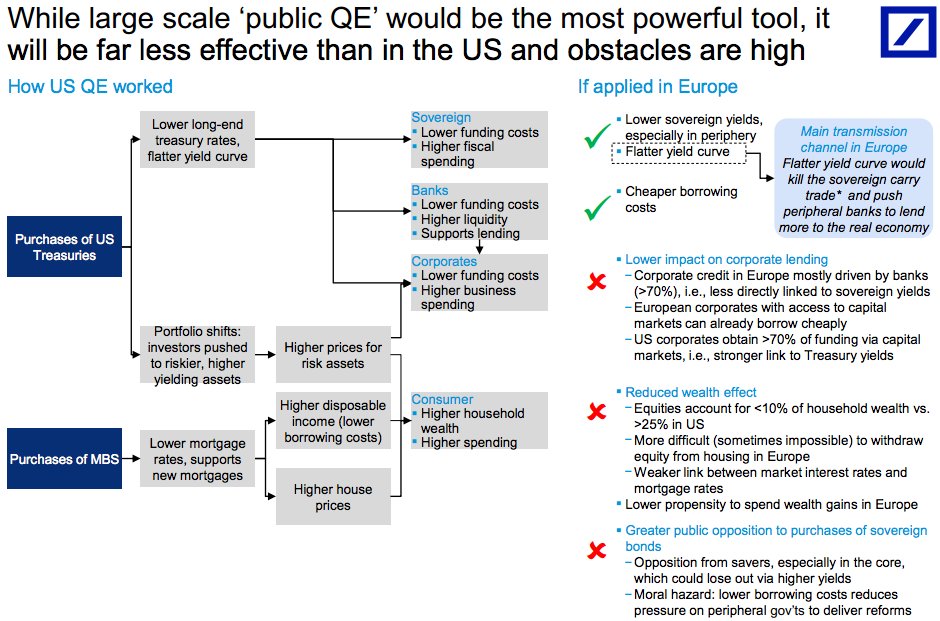
Some expected hurdles to QE in Europe:
1. Bonds purchases will be subject to risk sharing arrangements. ECB has to buy proportionally from 19 fragmented markets. Such proportional buying is unlikely to spur economic activity in peripheral markets, where the risk of buying is far greater. The European set up unfairly redistributes the risk amongst constituents.
2. Unfair redistribution of risk causes political opposition, making it harder to execute QE to the sufficient degree.
3. QE does not address Euro imposed dysfunctions. Peripheral countries still have relatively high wages that will deter business investments. Common currency prevents fast adequate wages deflation in these regions.
4. Unlike US, driving down bond interest rates does not flow directly into the economy in Europe. European companies get most of their credits from banks, not from bonds. The effect is diluted.
5. In US, low mortgage rates led to increased home equities. Homeowners tapped into equities by refinancing or borrowing. That spurred the economy. In Europe, more conservative banking practices prevent people from tapping into their home equity.
6. Fiscal policies in Europe are pulling in the opposite direction to QE. Austerity policies undercut QE.�
Jan 26, 2015
schonelucht Pictures being worth many words, I charted the sales of Tesla in Europe for 2013 and 2014 Model S. Since we know the company steers production around quarterly delivery numbers, I took the same approach. The chart below includes European countries as reported in this thread. The other category contains all countries which didn't have a month with at least 10 sales. Also note that the UK numbers are extrapolated and therefore less accurate.
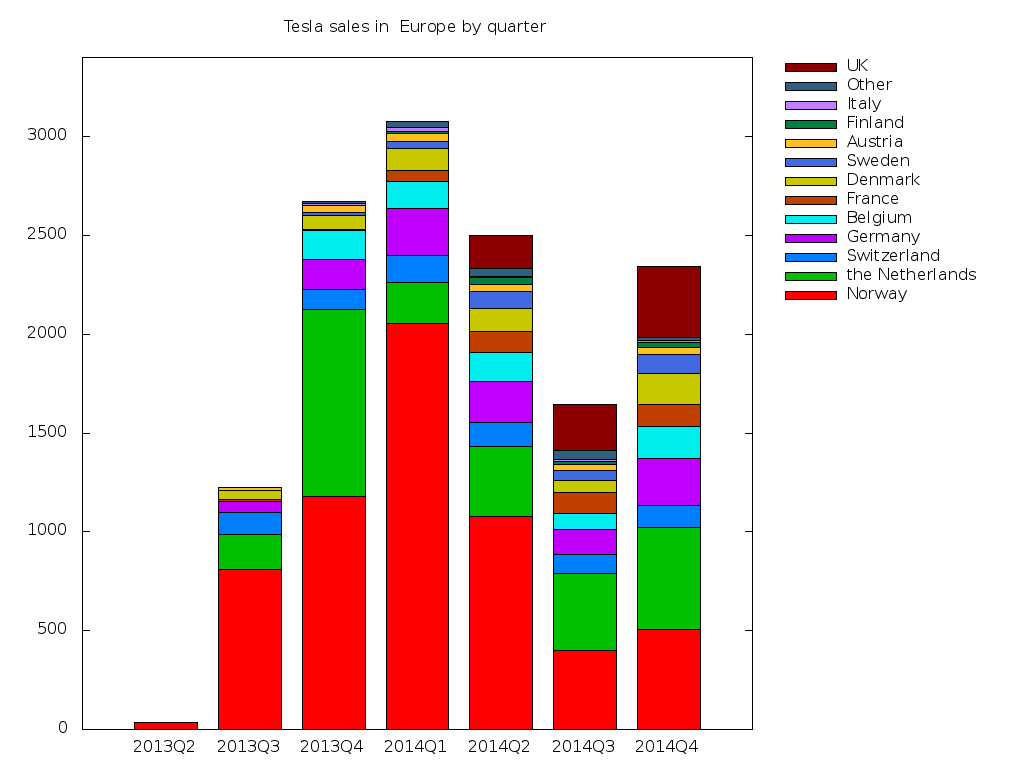
I still think these numbers show that Tesla has reached a steady state of deliveries in Europe where market demand more or less fits the production supply Tesla is willing to allocate to this region. Disregarding 2014Q3, the second and last quarter look fairly similar. The biggest difference is a slightly depressed number in Norway for the last quarter. It's reasonable to speculate this is due to customers switching over to the AWD model. Even rolling over this demand to the next quarter, it may still fail to reach the numbers of the same quarter in 2014.
In the interest of transparency, I would encourage everyone to look at my input numbers in my pastebin ( http://pastebin.com/Ru0a2cSr ) because I expect there to be some mistakes.�
Jan 26, 2015
NigelM Bailing out anyone will leave taxpayers on the hook if there's no repayment plan. Just as parts of Europe are seeing light at the end of the tunnel it would be a major setback to have to cut spending or increase taxes in those parts that are starting to do better. (IIRC Greece owes something approaching $300bn of debt!) Also letting Greece off the hook at all risks more instability in other parts of Europe.
Grexit would mean chaos no matter what, there's no smooth way out of the Euro. The average European has German Euros, French Euros, Italian Euros etc in his/her pocket...they also have Greek Euros, it's all mixed in and 1 Euro is worth 1 Euro wherever you are. What is going to happen if you're in a store and you get told "Nope, we're not accepting those Greek ones anymore...."? Would you still accept Greek Euros in change when you buy something for cash? On a very simplistic level there's potential for chaos, it doesn't get any easier at the macro level.�
Jan 26, 2015
SwedishAdvocate I have Swedish Crowns
But is that really a problem? How much of all Euros exist as physical money? I would guess: Not that much...
Couldn't you just let people exchange them into some other (non-greek) physical money. Or just leave the greek euros in there and instead regulate it digitally?�
Jan 26, 2015
drinkerofkoolaid Has there been any discussion about how in many parts of Europe, gas stations are far less convenient to get to and use than in the United States?�
Jan 26, 2015
Auzie I think the idea is that with the exit from Euro, Greece go back to drahma. That would give them control of their currency, something they do not have now.�
Jan 26, 2015
smac Not sure where you got the UK numbers from. According to the official government figures: 2014Q2 was 192 , 2014Q3 was 282. 2014Q4 figures are not yet released.
You can download a data dump straight from the UK government, or see this site for a quick (and accurate summary, I checked the two were correlated).
TESLA MODEL S - How Many Left?
The Q3 figure included a lot of pre-orders. The car officially released in June (Q2) but the bulk of pre-orders went out in July after the first service centre opened (Q3). It will be interesting to see how the official Q4 figure shapes up, and see what "baseline demand" there is after the initial rush.�
Jan 26, 2015
hobbes Very well made plot, thanks! I would refrain from interpreting too much into the ups and downs - there is always a pattern across the calender year and for the 2013 numbers there is the initial ramp-up; 2014 I think the shut-down for bringing up the new line probably had a big impact.
�
Jan 26, 2015
techmaven Yeah, I estimate by using the SMMT data for "other" and removing 65 per month since the "other" category has more than just Tesla's. That method means 267 in Q4 with a total of 741 for 2014.�
Jan 26, 2015
RobStark If Greece defaults and exits the EU/Euro then the Greek economy implodes without access to credit.
Italy,Spain and Portugal will not go rushing to follow Syriza's example.
As noted before Greece is 2% of the EU economy. Its weight is not earth moving.�
Jan 26, 2015
schonelucht Correct. I used SMMT data for 2014, substracting 2013+10% to cover non-Model S imports because I wasn't aware about the other link. I just redid the graph with the actual numbers for the UK but it's barely different so I don't think it is worthwhile to post again for now, but I certainly intend to revisit this exercise after 2015Q1.�
Jan 26, 2015
Familial Rhino Who knows, it might be, if they default but emerge stronger in a few years by bootstrapping themselves out of the hole they're in. Controlling their own currency would allow them to do things that are impossible under the current bondage-and-discipline approach to macroeconomics imposed by their creditors.
I'm of two minds about this. On the one hand, an agreement is an agreement, as the Germans put it. On the other hand, you should be able to break a contract if you are willing to face the music. For all the talk about moral hazard that is used to justify EU's approach to heavily indebted Greece, I hear no talk about the moral hazard of creditors who were happy to give risky loans because they figured they'd always be made whole.
I think the impact of Grexit on financial markets and the economy will almost certainly be disproportionately higher than their contribution to the European GDP would lead you to believe.�
Jan 26, 2015
NigelM Not necessarily; other countries have done this before and survived. Exiting the Euro obviously means reintroducing the Drachma BUT it could then be devalued with the positive consequences regarding debt reduction and a haircut for the lenders.
If Syriza successfully finds a way to get debts written off (i.e. lessen the Greek pain) there's plenty of incentive for other countries to follow suit.
The percentage of EU economy is not material, the absolute debt level held by a relatively narrow field of banks is. Ask the German taxpayers how they feel about writing off say half the money they loaned Greece....whether it's even politically palatable to ask is dubious. Political uncertainty leads to market jitters, although I think there's a relative calmness so far while everyone digests the news and waits to see what happens next.�
Jan 26, 2015
Auzie Agree with you that Greece, if left to its own resources, is likely to recover.
On the other side, my impression is that Greek, Italian, Portugese and all other Eu citizens would much rather stay in the Union that leave it. That Union does not make much sense, yet the political will keeps it alive. Other countries may be much less willing than Greece to trade off the prized union membership for bankruptcy.�
Jan 26, 2015
NigelM I have been to Greece many times and still have very good friends there. FWIW my view is that the Greeks want to stay in the EU but have an over-riding desire for better economic conditions right now. If they defaulted and/or withdrew from the Euro they wouldn't necessarily have to leave the EU and I think it's unlikely that the remaining markets would ever insist on throwing Greece out.�
Jan 26, 2015
sundaymorning There are no easy routes with Greece. If they remain in the EU, they will eventually need a bailout, that money is going to come from somewhere regardless if they stay or leave. Hence, taxes will be levied either way, but at least if Greece leaves, they can still make good on repayment, albeit it may take a bit longer for them to repay as that country reorganizes itself.
This is where politics and economic maneuvers come into play, perhaps lowering Greece's interest rate further may help. I assume both sides involved in this transaction understands the outcome of a Grexit and the implication of what's at stake. Hence, diplomatic negotiations need to be ironed out before an exit could occur; otherwise, chaos will ensue and no one wants that, not even a Greece that is eager to exit. That debt must be paid back and I assume Greece will honor their obligation, as long as this occurs, perception of a "smooth" exit can be maintained.
So far, It appears that markets across Asia to Europe are calm amid Grexit negotiations, that's because conditions today is very different than 2009 & 2012 when the rest of Europe was in panic mode. It's due to this calm atmosphere resinating in global markets that gives me the impression that a smooth exit can be achieved. IMO what goes behind closed doors during negotiations may be chaotic, but a grexit, if one occurs, will be done smoothly.�
Jan 27, 2015
schonelucht Desperately trying to get this thread back to at least a little bit related to Tesla in the EU market instead of general EU economics : Hertz is now offering two Model S's for rental at Schiphol airport (Amsterdam) at 250 EUR/day. I know about LA and SFO but I believe this is a first for Europe.�
Jan 27, 2015
SwedishAdvocate But was it the German taxpayers that loaned that money to Greece?
Wasn�t it privately owned banks?
But then of course (!), the privately owned banks were �allowed� to just �move� those financial claims on Greece over to the taxpayers within the �-zone.
I wonder who owned/owns those private banks�
It�s the same old socialize losses � but of course � privatize profit.
But yes, it will be interesting to see what the German taxpayers feel about this whole cluster [self-censorship].�
Jan 27, 2015
RobStark How would anyone around the world feel about having to work an extra 2-3 years before you can retire?�
Jan 27, 2015
SwedishAdvocate My line of thinking: Will there be any political consequences?�
Jan 27, 2015
hobbes Cool, they must have seen the taxi fleet there and might also share infrastructure (chargers)... There are several small rental places and individuals with MSs in Germany though, but still looking for a place to rent a Model S closer to Aachen.
�
Jan 27, 2015
VolkerP The BBC has a nice illustration:

The 60% labelled "Eurozone" is money from the ESM (European Stability Mechanism), which is funded by EU governments (i.e. tax payer's money) and heavily leveraged to �500bn. The national contributions to the ESM are distributed in proportion to EBT, so Germany has the biggest share. German taxpayers are in with �16bn.
If Greece defaults, the leverage would collapse, and taxpayers would have to refund the missing sum to ESM debitors.�
Jan 27, 2015
SwedishAdvocate This might not be the best source � I'll see if I can find something better � but in the mean time...
�
Jan 27, 2015
Auzie Crikey...
Plenty of takers in abundant rivers of money, but the bankers seem to be so skilful...in transferring taxpayers money into banks...�
Jan 27, 2015
Familial Rhino Yeah. Sadly, the type of skill the bankers demonstrate is the same as the one employed by any (other) hostage takers: "If we go down, everyone else goes down with us".�
Jan 28, 2015
30seconds "unless you pay us one billion dollars"
only industry I know that can go bankrupt and continue to pay jack@$$ salary + bonus at the same time to a whole series of mid level management�
Jan 28, 2015
Panu A Finnish guy rented a Tesla from Caro for less than 100� / day in Munich last November. He got a P85 and was very happy. However it looks like Tesla is not listed in Caro's vehicle list and you have to request it:
The Tesla Model S - Book now at CARO! - CARO Car Rental
Here is the story in Finnish:
Teslalla Saksaan! | Tuomas Sauliala�
Jan 28, 2015
ev-enthusiast Yes, just gave them a call and confirmed 100� per day. That is a very good deal for a very good car
Thanks for the hint!�

Không có nhận xét nào:
Đăng nhận xét