Dec 5, 2015
PaulusdB That's a long story, A.
To start with: (company) car's, car mobility and energy use in general are heavily taxed.
Then these taxes are lessened or nilled for specific companies and civilians. E.g. flower growers are way less taxed for their natural gas use than households.
There is a special Dutch tax on cars (BPM) ranging up to � 20K on cars comparable to a Model S (BMW, Mercedes, Audi), depending on CO2 emmission at the exhaust. For Model S this tax is zero.
There is special Dutch tax on using a company car. This tax adds 7%, 14%, 20% or 25% of the RSP to your yearly income. (i.e. 7% for a PHEV, 25% for a normal gas guzzler). For Model S this tax is 0% when purchased before 2014, 4% after that that.
Then there is road tax roughly � 1K / year for comparable cars. Model S zero.
Finally there is fiscal stimulation for company purchases (MIA) in environmentally friendly stuff. For Model S this is another � 2K.
Our tax department's slogan is: We can not make it more fun. Just easier.
Now that's a bold statement, isn't it?�
Dec 5, 2015
Auzie Quite informative and interesting, thanks. I find it amazing how different countries approach similar problems in very different ways.
That Dutch tax on using company car is the most difficult to understand. Maybe I do not understand it properly. Your bold statement - do employees get taxed stated percentages or do they get paid extra money, equivalent to stated %?
If employees get taxed on having access to a business car, why would they agree to such arrangement that is to their disadvantage. I am inclined to think that there are some missing pieces of the puzzle that would make such arrangement work for employees. Who bears the cost of a car lease, employee or employer? The arrangement could make sense if employer bears the cost of a car lease, not the employee.
Here in Australia employees get a small personal tax relief when getting their car through various business lease arrangements. Employees bear the cost of the car lease, by sacrificing part of their pay, which is then used by the employer to lease the car for employee use. Such arrangement is advantageous to employees, neutral or at a small cost to a business (administration costs) and at a loss to Australian Taxation Office. There are various arrangements, but the one I outlined is the most common.�
Dec 6, 2015
Benz PaulusdB: "There is special Dutch tax on using a company car. This tax adds 7%, 14%, 20% or 25% of the RSP to your yearly income."
He did not mean to say that one will get a higher salary. So, one does not get any extra money from the employer. That is not the case.
People who get to drive a company car which they can use in their private time as well (for a few years) are considered to be richer than people who do not get to drive a company car which they can use in their private time. Because they do not need to buy an extra car, and that saves them money (that they do not need to spend to buy a private car), and that makes them richer. That's the clue.
By the way, there are a few people who do have a company car at their disposal, but they have decided not to use it in their private time, so they do not have to pay this "Company Car Tax" at all. They are allowed to drive with it from their house address to their company address and back again. They have to keep an administration of all the distances that they have driven in their company car. This is really silly. But some choose this option.
But then there is the Dutch government. They say: "You got a company car from your employer, and you can use it in your private time as well. So you have an advantage that others (people without a company car) do not have. That's a kind of a salary as well. Therefore, you have to pay tax!!!"
How do they calculate this "Company Car Tax"? That depends on the CO2-emission level of the car, and secondly on ones salary.
Many years ago, all company cars were taxed with the same 25%. Then they decided that people who will choose to drive a car that has a lower level of CO2-emission should get a discount on their "Company Car Tax" (resulting in less money going from ones pocket to the tax office). Therefore they had introduced different catagories with each catagorie having it's own % attached to it.
Before 2014 all Plug-Ins were taxed with 0% Company Car Tax, because the CO2-emission level was considered to be below 50 grams per km. So almost everybody wanted to have their Plug-In delivered and registered before 2014. We saw that in Q4 2013 there were 1,195 deliveries of the Tesla Model S. And all the production of the Mitsubishi Outlander PHEV went straight from Japan to The Netherlands, this resulted in 8,730 deliveries of the Mitsubishi Outlander PHEV (this number includes a few non-PHEVs as well though), and the number of Mitsubishi Outlander PHEV deliveries went from 55 in September to 415 in Oktober to 2,766 in November to 4,988 in December. People who got their Mitsubishi Outlander PHEV before 2014 enjoy not having to pay any money for Company Car Tax for being able to drive their company car in their private time for a period of mostly 4 or 5 years.
Other popular cars were the Volvo V60 and the Opel Ampera.
Currently (2015), cars with 0 grams/km CO2-emission (BEV) are in the 4% catagory. And cars with more than 0 grams/km CO2-emission but not more than 50 grams/km CO2-emission are in the 7% catagory. And cars with more than 50 grams/km CO2-emission but not more than 82 grams/km CO-emission are in the 14% catagory. And cars with more than 82 grams/km CO2-emission but not more than 110 grams/km CO-emission are in the 20% catagory. And cars with more than 110 grams/km CO2-emission are in the 25% catagory.
2015:
4% = 0 grams/km CO2-emission
7% = 1 - 50
14% = 51 - 82
20% = 83 - 110
25% = 111 or more
Next year (2016) the catagories will look like this:
4% = 0 grams/km CO2-emission
15% = 1 - 50
21% = 51 - 106
25% = 107 or more
And in 2017 it will be a bit different again, and this will continue in the next few years.
2017:
4% = 0 grams/km CO2-emission
17% = 1 - 50
22% = 51 or more
2018:
4% = 0 grams/km CO2-emission
19% = 1 - 50
22% = 51 or more
2019:
4% = 0 grams/km CO2-emission
22% = 1 or more
2020:
4% = 0 grams/km CO2-emission
22% = 1 or more
Now, how do you calculate what you have to pay for Company Car Tax?
To keep it simple, let's assume that you have enough annual salary to be in the highest income tax catagory, which is 52% (I think that is the case for the majority of the people who enjoy the benefit of a company car).
And let's make the calculation for someone who chooses to drive a Tesla Model S as his company car and chooses to drive it in his private time as well. Let's keep it simple and set the price of the Tesla Model S at 100,000 Euro (options included).
Calculation:
100,000 Euro x 4% = 4,000 Euro
4,000 Euro x 52% = 2,080 Euro
That's the annual total of Company Car Tax for a Tesla Model S with a price tag of 100,000 Euro.
People pay per month though.
2,080 Euro / 12 = 173.33 Euro per month
Now let's see how much it is for a 100,000 Euro car with lots of CO2-emission:
100,000 Euro x 25% = 25,000 Euro
25,000 Euro x 52% = 13,000 Euro
13,000 Euro / 12 = 1,083.33 Euro per month
We can make a lot of calculations for a lot of different cars. But that's pretty much how it's calculated here in The Netherlands.
Any more questions, then just ask.
Cheers
By the way, though it's not officially yet fully decided (but it almost actually is), the Dutch government wants to continue with the 4% catagory (0 gram/km CO2-emission, BEV, Hydrogen) for the next 5 years. I have read though that as from 2019 they want to put a maximum amount of 50,000 Euro to the price of the car. So, if the price of the car is 90,000 Euro, than the first 50,000 Euro will be taxed at 4%, and the remaining amount will be taxed at 22%. But that's not totally official yet!!!�
Dec 6, 2015
Auzie Thanks Benz. I am glad that some governments are incentivizing zero/low emissions cars through taxation.
My expectation is that similar government incentives all over the world will be quite helpful for ev adoption. It is difficult to understand Danish government tax increases on Tesla next year.�
Dec 6, 2015
Benz Besides the monthly amount for the "Company Car Tax" that an empoyee has to pay to the tax office for the private use of a company car, the employer has to pay a lot of money (monthly) as well. Because the company car is leased via a Lease Company. This monthly amount includes BPM tax, Road tax, VAT tax. So the Tax Office is receiving money from all sides!!! They make sure that "The House Always Wins"!!!�
Dec 6, 2015
PaulusdB Thx, B. For explaining the inexplicable.
�
Dec 6, 2015
Benz Always glad if I can be of any help.
By the way, I did not mean to be unpolite, because I am sure that you or any of our Dutch friends could have explained it here in this thread.�
Dec 6, 2015
SebastianR Alright, the Denmark data is out:
According to this, there are "only" 465 Model S for November. Granted, that's massive but sadly also far away from the 2000 cars until year end. Let's see how December goes...
PS: If my math is not off, then the Model S is the 4th most sold car for November in DK. Also, the publisher cautions that the final data from the tax authorities is not in so the data might shift slightly.�
Dec 6, 2015
smac @benz it's very similar in the UK too.
It's classed here as "Benefit in Kind". In other words you benefit through your job by use of a car for personal use, even though it's not a cash payment.
Very similar banding structure.
Worth noting there are two aspects here. 1) the personal taxation but 2) employers tax liability.
1) works similarly. Say you pay 40% income tax (sort of level if you have a co. car), you pay 40% of the value of the car multiplied by the CO2 rating.
2) The business pays 11.2% (Employers NI Contributions) x car value x CO2 banding in addition to the tax levied against the employee.
@auzzie
We also have the salary sacrifice type scheme.
In some ways this works out better, because if your employer offers it, they reduce your salary and therefore don't have to pay the 11.2% contributions.
_but_ only the largest employers can afford to run such schemes in house, and 99% of the time it's through a captive "Salary Sacrifice Provider" who inevitably make a margin on the deal so it's not necessarily clear cut. (Lots of issues of ownership, and residual liability if the employee leaves, etc. )�
Dec 7, 2015
hobbes I think December number will be even higher. But 465 is already the third highest Model S sales number in all of Europe this year, so not bad at all. It is only topped by Norway in March and June. And how things can go over a quarter is demonstrated by Norway in Q1: Jan 71, Feb 321, Mar 1140.
Also interesting is this excerpt from a Credit Suisse note of today posted in the short term thread:
�
Dec 7, 2015
schonelucht I agree, Hobbes, we could see up to 1500 deliveries in Denmark. Remember that the changing incentives were announced relatively late. The next catalyst for Tesla sales in Europe should then be the model X introduction, in my opinion at the earliest Q2 but more likely in larger numbers Q3 next year.�
Dec 7, 2015
SebastianR Agree - that's the growth we will need to see. Though to be honest, I was more hoping for a 600/700 + 1300/1400 distribution. In short to get to the +2000 cars from the announcement of the changes to the end of the year, a lot will need to happen in December. I know theoretically it is possible, but I was hoping for a bit of a higher push in November...�
Dec 8, 2015
Benz Confirmation that so far in 2015 there have been a total of 8 Tesla Model S deliveries in Slovenia, and exactly 0 in November 2015.
Link: http://bestsellingcarsblog.com/2015/12/slovenia-november-2015-renault-clio-hits-12-5-share-in-market-up-21/�
Dec 9, 2015
Gerasimental Surpsrised by this. I saw 3 in Ljubljana in 2 days. And that was in 2014.�
Dec 9, 2015
Benz I don't know how many Tesla Model S deliveries there had been in 2014.�
Dec 9, 2015
Gerasimental My bad. Read that as 8 all-time sales in Slovenia. Still find it a little surprising that it's in single figures for the whole year.�
Dec 9, 2015
AustinPowers Germany: 136 in November 2015 (up 139% vs. November 2014), for a total of 1,348 in 2015 (up 107% vs. November 2014 ytd).�
Dec 9, 2015
Benz Slovenia 2014:
12 Tesla Model S deliveries in Slovenia in 2014.�
Dec 9, 2015
hobbes Thought I would post the link to our wiki/google table again, for people who don�t have the link saved.
Only Switzerland and UK missing for Nov out of the top 14 YTD. Denmark jumped to third place YTD after Norway and Netherlands - my guess is it will be 2nd for Jan-Dec. Total for November standing at 1191, compares to 546 in Feb, 1028 in May, and 1099 in Aug (the 2nd months of each quarter).�
Dec 10, 2015
Gerardf Switzerland Nov = 94.
Okt 1 269
Nov 1.363
Source : https://www.auto-schweiz.ch/fileadmin/3_Statistiken/Autoverkaeufe_nach_Modellen/ModellePW2015.xlsx�
Dec 10, 2015
Troy UK YTD numbers at the end of Q3 have been finally published today after 70 days delay. This data is from table 0160 HERE.
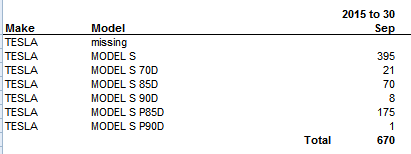
Q2 YTD was 349. That means Q3 sales are 670-349= 321. Monthly average for Jul, Aug, Sep is 321/3= 107. We can use the same number as estimates for Oct, Nov, Dec, Jan, Feb, Mar until the actual numbers are published on 14 April 2016. This date for the next update is shown in the excel files.�
Dec 10, 2015
vgrinshpun It is interesting to compare the European monthly totals in Q4 vs Q2 - the last quarter when Tesla still followed front-loading production in a given quarter disproportionately with cars to be shipped overseas, and then, in the second half of the quarter prioritizing production for NA cars, to maximize quantity of cars that are produced AND delivered within the same quarter.
The increase in October vs. April and November vs. May is almost the same - 34% and 35% respectively. Since Tesla stated their goal to deliver approximately 2,000 more cars that is going to be produced in Q4, it is reasonable to expect that December deliveries will be at least 35% more than deliveries made in June (2096). So if above holds, the total Q4 deliveries might be 1046 + 1392 + 1.35 x 2096 = 5268. Let's see if this speculation can turn out to be true...�
Dec 10, 2015
HansWurst Did someone get the news that France will introduce a 10,000� (I believe the current level is 7,000�) subsidy for the purchase of EVs (of any brand), if a Diesel built prior to 2001 (prior to 2006, starting in 2016) will be salvaged?
Found this German article about it. Diesel: Frankreich geht gegen den Diesel-Boom an |�*ZEIT ONLINE
At the same time they want to introduce a malus system for ICEs. The penalty reaches from cars with emissions higher than 131g/km (150�) to a whooping 8000� for cars with emissions higher than 201g/km.
I think this system is brilliant, because it incentives EVs and de-incentivices ICEs at the same time. Have you guys heard about this before? It is completely new to me and sounds like a huge opportunity.
--Hans
EDIT
To be clear, the article states that the subsidy for the purchase of a car with less than 20g/km CO2 emissions is 6,300�. The bonus for salvaging the old Diesel will be 3,700�. So 10,000� in total.�
Dec 11, 2015
Benz Yes, I had read about the 10,000� subsidy. Which is good, of course.
The price of diesel will be increased by 3.5 cents. And the price of petrol will be increased by 2 cents. That's too little to make any substantial difference, I think.�
Dec 11, 2015
HansWurst It is true that the tax increase on fuel is not substantial, but I think the penalty of buying an ICE car with more than 201g/km CO2 emission of 8,000� is imho. The Mercedes GLS 400 4MATIC (petrol) for example would be subject to the maximum payment. That would increase the base price of the car by ca. 11% (from ca. 75,000� to ca. 83,000�).
If the requirements would be toughened just a little bit, such that the highest penalty starts from 199g/km instead of 201g/km even all petrol variants of the Mercedes GLE will be affected.
EDIT.
BMW M3 and higher is also affected. So are the X5 and X6 petrol variants (apart from the smallest petrol X5)
Diesel engines are a different matter, they have lower CO2 emissions. Kind of ironic that a regulatory framework, intended to reduce Diesel cars, will make them more attractive vs. petrol engines.�
Dec 11, 2015
Benz If they really would want to do something that would be strategically in favour of EVs, then they should think about a substantial charging network that would offer free charging to all Plug-In models on the whole continent of Europe. Of course one would have to buy some sort of a card in order to have access to that charging network, but the price for such a card should not be too high though. So, it actually would not be free, but I meant that there would be no payment every time you would charge your car. That would be really convenient, and people will appreciate that. The investment for such a continental charging network would be enormous but the results will be substantial too, I think.�
Dec 13, 2015
hobbes Update from MrBacardi: 123 registrations in Norway for Dec 1-12: (Nesten) 1500 nye Model S registrert i Mars!
Compares to 65 for Nov 1-14... (Nesten) 1500 nye Model S registrert i Mars!
�
Dec 13, 2015
hobbes Found an interesting statistics thread on the UK SpeakEV forum: UK Model S Build and Delivery Dates (was: How Many UK Model S) | Speak EV - Electric Car Forums
This graph featured there shows accelerating orders:
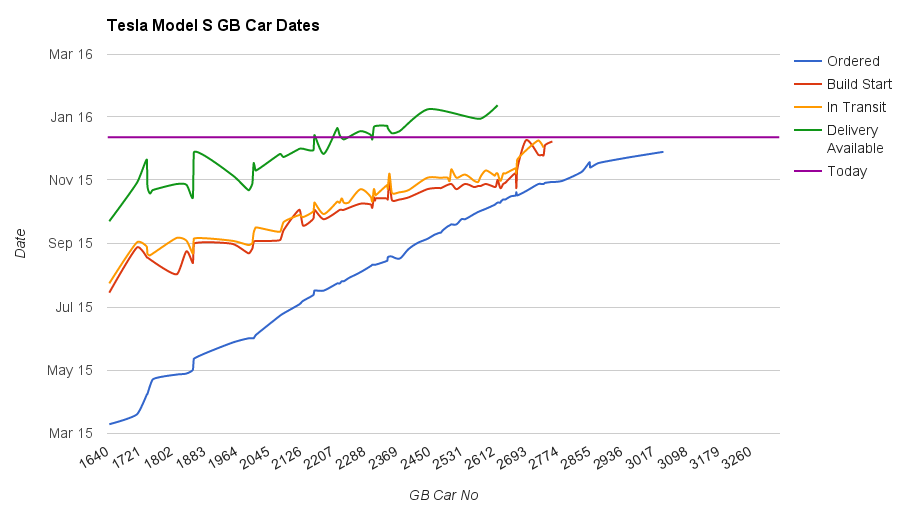
Seems like the british customers get a GB car number which they post there - anyone got an idea where that comes from and what it means exactly? Is it actually cumulative total number of cars?? Cannot imagine that because it has reached 3000 lately while our count is only at 884 for 2015.�
Dec 13, 2015
Lessmog Wild guess: Maybe the last figures in VIN for RHD cars? One character designates left- or right hand drive I think, so the VINs don't necessarily have to be consecutive but might follow different cumulations? 3000 being WW total in that series. Repeating: Just a wild guess.�
Dec 13, 2015
Brunel We seem to get consecutive numbering when we go to our 4 year service pack choice. Mine was around 1400 and I ordered in Jan and collected in Sept. So it does ring true. Been so many new Model S with recent number plates (post September). SupChargers getting busy too!�
Dec 13, 2015
hobbes Wow - am I getting this right? The GB customers have a consecutive service pack number only for GB (not all right-hand-drive as lessmog suggested)?! That means that way you can actually count GB orders/deliveries?! Looking at the graph the "today" line cuts the graph where the X-axis says something like 2200 cars. Subtracting 1400 assuming Brunel�s car was ordered in the beginning of January (when was it ordered exactly, Brunel?) we are left with 800 while the wiki says 884. That matches pretty well for the given uncertainties! Thanks for the feedback.
The official table for the UK only gives 718 cars for 2014 though and none before that (should be around 1400). Where does that offset come from?
---Updated---
Made a mistake in the last paragraph - 1400 was number in January for orders, which is obviously ahead of what was delivered at that time. So everything does make sense!
�
Dec 13, 2015
Lessmog Love the taste of data feedback! Morning, noon and night.
Thx brunel.�
Dec 13, 2015
Brunel I wrote the number down somewhere, but who knows where. Think it was a high number perhaps 1460 ish and I confirmed around Jan 25th. Since the service pack is a UK specific offering it makes sense that the numbering is geographically tied to UK. Not foolproof though.�
Dec 13, 2015
hobbes Great, thanks! No need to figure out the number more exactly than that.
One last question: I guess that not everybody gets the service pack, right? That would mean there are even more cars than service pack numbers...�
Dec 13, 2015
Brunel Wishful thinking, but it clearly identifies the car number not amount of service packs! I did not choose the prepaid servicing and the option has disappeared, but no one will have got my car number.�
Dec 13, 2015
hobbes Probably I misunderstood your first quote, seems like a contradiction though - can you clarify? Thanks.�
Dec 13, 2015
Brunel @hobbes in mytesla there is a button to review and select the prepaid service, click through and it tells you the price in a document format like most Tesla letterhead paperwork. At the bottom it says the car number. One can proceed or not, hence the service "choice". The button disappears after a while so I cannot check the exact wording. Sounds like this process continues for new orders and this data is where the speakev tracking comes from. Seems the most accurate and helpful since our official stats are so delayed. In other good news, there is the expected massive push for end of year, with many Xmas eve and New Years Eve deliveries.�
Dec 13, 2015
smac
It's not VIN related, it is an order / car number before VIN assignment. One of the speakEV guys noticed it on some communication, and it appears to be a window into some back-office system UK are running. IOW it could be that it's total orders (i.e. including post delivery options, like service / CHAdeMO adapters / etc. etc.) coming out of their Sales Order Processing systems. I have an invoice number slap bang in the data set with the right sort of date vs number (for a non pre paid service). So leaving sales orders "open" until the pre-paid service window option has expired, and the mytesla piece updating a secondary line on that order would explain the "sticky" sequence numbers.
I'm sure they've had good numbers since the D cars came on stream (we had a big delay here remember, so pent up a lot of pent up deliveries) but I'd be slightly skeptical of those sort of numbers all turning into 2015 cars.
As for a big push to pick up the car on New Years Eve, personally I'd much rather pick it up on new years day and have a 2016 registered car! So they can push but there may not be the pull.
Unfortunately we will have to wait for the UK Govt to release the whole year figures to be 100% certain.�
Dec 14, 2015
Lessmog Thanks for your data-rich input and clarification!�
Dec 14, 2015
hobbes Troy found out the official Denmark number was updated - it now stands at 525!
De Danske Bilimport�rer - Statistik
- - - Updated - - -
@brunel and smac: Thanks for clarification. This seems to be a very good source for us to estimate GB sales in between the official quarterly updates.�
Dec 16, 2015
SebastianR Yes, this means Tesla is number 4 in terms of newly registered cars for November. Not 4th best in the segment or 4th best electrical car. 4th best of all cars. Well done!�
Dec 16, 2015
Troy Actually it wasn't me who found out. Forum member egononzel from Denmark had mentioned that to me. I wouldn't have noticed it otherwise. I guess there are lots of Tesla fans interested in this topic.
By the way, in case others haven't noticed, recently we added a new column for Tesla market share. This graph is about that. You can see the exact percentages on the WIKI table. The numbers will auto update each time there is a new entry.
![[?IMG]](https://docs.google.com/spreadsheets/d/1Vobg29R1t3FphlWjb8dwG4nkAWqyc_qMwkCjUT8SUno/pubchart?oid=1275812263&format=image) �
�
Dec 17, 2015
Auzie Great graph, thanks
Tesla is such a tiny adorable baby...�
Dec 17, 2015
WarpedOne Tiny when you look at the numbers by themselves.
But not so tiny when compared to some other well-known automakers.�
Dec 17, 2015
Auzie Maybe it is not the tiniest but it is the addddorablest�
Dec 17, 2015
Yggdrasill The Model S/X won't "double" in price in Denmark, after all! The tax incentive price ceiling was ruled to be unfair subsidies of cheap EVs by the EU. Google Translate
For a high spec car, the increase in price should be closer to 16% than 60%, so Tesla should still be able to sell some cars.�
Dec 17, 2015
Spidy So would a 7500 tax credit like in the US also be illegal in Europe?�
Dec 17, 2015
schonelucht Obviously good news for TSLA, but this must hurt a lot of Danish people who bought a second hand Model S this quarter under the pressure of an imminent tax increase. Due to the exceptional demand, prices were really inflated for second hand models all over Europe. For example, one Dutch owner was able to sell his Model S over(!) list price. Others consistently got 10-15k more through 'grey' 3th party importers into Denmark compared with the regular price Tesla pays for turn-ins.�
Dec 17, 2015
RobStark So the in power party is the Liberal Party which has 34 of 179 seats in the Danish Parliament.
The Liberals have support of the People's Party with 37 members, the Liberal Alliance with 13 members, and the Conservative People's Party with 6 members for a total of 90 for a 1 MP majority.
It seems everyone is ok or resigned with the decision of the European Commission except the People's Party. Hmmm.�
Dec 17, 2015
Gerardf Great news for Denmark & TSLA.
That would be interesting for the Netherlands as well, as a price cap on incentives was discussed here as well.
Could be good news for my future soon-to-be-reserved full optioned Model-3 �
�
Dec 17, 2015
Auzie Thanks for the link. The original proposal to heavily tax Tesla made no sense, now this modification seems to get us a bit closer to some sanity.
I had trouble understanding the details from the article. I need to work on polishing my Danish language skills.
My understanding is that the Eu Commissioner of Taxation ruled the new Danish tax on Tesla (luxury ev) unfair due to providing a form of aid to cars priced under the luxury ceiling, as these cheaper cars were not hit by a new tax. So Danish parliament removed the ceiling? This ceiling removal might help Tesla by maintaining price differential and making all ev cars more exspensive with a new tax? They also delayed the ceiling? Not sure that I understand these bits.
Anyone has some more clarity on the obscure details?�
Dec 18, 2015
SebastianR Alright, let me try to get some structure to this (Fair warning: I'm not a native Dane, so I might miss a nuance).
The way I understand the situation is:
Previously the situation was:
a) For EVs below DKK 800.000: As of 1st of January the tax increase for all EVs - they will need to pay 20% of the "up to 180% registration tax" for 2016, that will increase by 20% to the full "100% of the 180% in 2020" - essentially a step-wise introduction
b) For EVs above DKK 800.000 (i.e. for Teslas only - there are not other EVs that would fall into this braket): There is not step-wise introduction and the full 180% tax applies as of January 1st 2016.
The situation as of now is:
a) remains in place
b) is removed - also expensive Teslas get the step-wise introduction of the full tax burden until 2020 - so a) applies for cars >800k DKK, too.
This will still make the Model S significantly more expensive as of next year.
So it still made sense to import used cars from all over Europe and it still made sense to buy a Tesla this year. It is just a relief of taxes on the 85D and above.�
Dec 18, 2015
Drax7 not comprehensible language, an algorithm translated into natural language, and Bernie sanders wants us to be like Denmark?�
Dec 18, 2015
schonelucht Maybe I am missing the sarcasm, but you seriously think it is warranted to start ragging on a non-native speaker who comes in trying to clear up some confusion on the Danish tax incentives? Information which is very helpful for investors in TSLA? How comprehensible is your Danish?�
Dec 18, 2015
Drax7
I am am sure your translation is fine, it's the Danish authorities that made it incomprehensible .
I am certain even the Danes cannot comprehend that in Danish.�
Dec 18, 2015
ggr Have you actually read any US legislation recently? That's a model of clarity and simplicity.�
Dec 18, 2015
AudubonB Mild-mannered moderating: stick to investment commentary and leave out political posturing - thank you.�
Dec 18, 2015
SebastianR Sorry, I was in a rush when I posted. Any specific points I can clear up? The problem is, that the situation is a bit complex. Sorry for that. The tax on new cars is not straight-up 180% but depends on a number of factors. Until today, BEVs were exempted from this tax entirely. In 2020 all BEVs will need to pay the full amount - up to the mythical 180% - whatever the amount is. So over the coming 5 years, every year 20% more of that "whatever the amount is" is due until we reach "100% of the up to 180%"�
Dec 18, 2015
Julian Cox This example of political corruption brought to you by the Oil, Industrial Gas and ICE Auto industry. Collectively, the Fuel Cell Lobby:
H2 LOGIC Welcomes Danish Extension of Fuel Cell Electric Vehicle Tax Exemption | FuelCellsWorks
H2 LOGIC Welcomes Danish Extension of Fuel Cell Electric Vehicle Tax Exemption
author Added by FuelCellsWorks, November 06, 2015
The Danish Government has announced a political agreement on extending the present tax exemption of FCEV�s for an additional three years throughout 2018. In addition the Government will gradually introduce taxes on BEV�s based on vehicle efficiency and price, thus mainly taxing high-end BEV�s with long driving range. The Danish tax regime pioneers a relevant political targeting of battery and fuel cell technologies to address different vehicle market segments.
In Denmark up to 180% registration tax and 25% VAT is normally applied on the base vehicle price meaning that a �17.000 gasoline vehicle reaches a total consumer price of more than �50.000. The FCEV tax exemption therefore provides a substantial indirect price-subsidy that makes the technology almost price competitive with gasoline today in Denmark.
In addition H2 Logic in collaboration with oil and gas companies are active on establishing a countrywide network of hydrogen fueling stations across Denmark. Today seven hydrogen fueling stations are in operation in Denmark, and with additional four planned onwards 2016 more than 50% of the population will be within convenient reach of hydrogen fueling.
The Danish tax exemption for BEV�s and FCEV�s has been in place since 2012 and was set to expire by end of 2015. The political negotiations on a possible extension was complicated by the massive sale in Denmark of high-end BEV�s with long range, that due to high battery cost and thus vehicle price indirectly caused a substantial loss of tax revenues.
The new decided Danish tax regime for BEV�s and FCEV�s is pioneering an alignment with the technology approach of the major car manufacturers. Batteries are targeted for use in smaller vehicles where short range and long charging time is accepted, whereas fuel cells are targeted for larger vehicles where range and fueling time are to match that of gasoline.
From 2016 BEV�s in Denmark will be taxed depending on the vehicle efficiency and size, thus incentivizing use of batteries in smaller vehicles where shorter range helps to lower the price and thus the loss of tax revenues. The continued exemption of FCEV�s will instead incentivize use of fuel cells for larger vehicles with long range, where cost reduction potential is greater as the high cost and thus loss of tax revenue from a long-range battery is avoided.
Jacob Krogsgaard, CEO of H2 Logic states:
�H2 Logic welcomes the continued Danish tax exemption for FCEV�s. This will ensure Denmark as one of the countries in the world with the best FCEV incentives. For H2 Logic the hydrogen fueling station network in Denmark will continue to be a strong showcase and platform for export of our technology to other countries. The pioneering Danish tax differentiation between BEV�s and FCEV�s will also incentivize that the technologies are targeted for their relevant vehicle market segments.��
Dec 18, 2015
hobbes I had no trouble understanding your post - thanks for the concise summary.�
Dec 18, 2015
ev-enthusiast Same here, looks like foreign speakers understand foreign English better than native speakers
Thank's for the great summary.
BTW crazy move by the H2/crude lobby, really scary. I am sure there is more dirty things to come when they need to fight even harder�
Dec 18, 2015
Quant Thanks! And me too, no trouble understanding your post !�
Dec 18, 2015
Auzie Thanks Sebastian your post carifies the recent changes to the coming taxation changes.
Julian's post further explains these taxes applicable to new cars by providing comprehensive political context, thanks Julian
The way I understand all of these, Danish people import all cars (corrections?), hence as per Julian's post, all cars are/will be exorbitantly expensive in Denmark except FCEV cars, which get extended relief.
No wonder bike adoption is so high in Denmark.�
Dec 18, 2015
vgrinshpun There seems to be an interesting similarity in the cadence of Model S deliveries in Q1 in Norway and Q4 in Denmark. The reason I picked Q1 for the Norway is that deliveries were very heavily back-loaded within the quarter, with Norway being #1 market in Europe in Q1. Similarly, Q4 deliveries are heavily back-loaded, and Denmark shapes to be #1 market for Tesla in Europe during the Q4.
As seen from the table below the ratio of cars delivered in February to March in Norway is very close to the ratio of cars delivered in November to October in Denmark. Assuming there will be also similar ratio of Mar/Feb in Norway and Dec/Nov in Denmark yields 1864 cars delivered in Dec, with the total of 2502 in Q4 in Denmark.
It would be interesting to see if the ratios will turn out to be similar indeed...
Jan
Feb
Mar
Q1
Oct
Nov
Dec
Q4
Ratios
Norway
71
321
1140
1532
Feb/Jan=4.52; Mar/Feb=3.55
Denmark
113
525
1864
2502
Nov/Oct=4.65; Dec/Nov=3.55
�
Dec 19, 2015
hobbes Troy got an interesting link from another user here, forget his name - anyway, the site seems to have all cars registered in Denmark with all the info - model, colors, city, even license plate and VIN: Nrpla.de - Find nummerplade uden alle tegn - Avanceret bilsøgning
There is already a plot including Dec with a count of 433 - but this has never changed for the last few days. So not sure how up to date it is. Otherwise, I agree that Denmark will top all other European countries and also will climb to #2 over 2015 total. But 1800? Would be cool, but if I should guess I would go for 1200. I guess there will be an update from MrBarcardi later today, then we will know more as to who will be #1.�
Dec 19, 2015
vgrinshpun 1800 deliveries in Denmark is optimistic speculation to be sure, however if we are to believe that Tesla will deliver 17,000 cars in Q4, where all these deliveries will come from? After all, Tesla seem to be saying (to Credit Suisse) that they are on track to meet the guidance.
If we are to assume Q4 US/EU+/Asia deliveries split of 55/35/10%, then US could see 9350 deliveries, EU+ - 5950, and Asia - 1700. Given that EU+ Q4 deliveries are at 2500 in October and November, there need to be 3450 deliveries in December. Even with assumed 1800 Danish deliveries in December, there need to be 3450-1800=1650 European deliveries excluding Denmark. Given that all European deliveries in November excluding Denmark, were 929 cars, there would be a required 77% increase in all European deliveries with the exclusion of Denmark in December.
If we are to believe that Tesla meets their Q4 guidance and try estimating how it can be done, it is becoming clear that without some drastic across the board delivery increases in December, meeting guidance is just not possible.�
Dec 19, 2015
Quant Or, for 4 Q it could be a 60-30-10 split. Looking at 1Q 2015 for Europe, this is doable with about 1,350 cars delivered in Denmark in Dec.
As for NA, this would imply at least 10,500 for NA in 4 Q ( and about 10.3 K being Model S ) vs about 6000 for NA in 3 Q. Maybe that's why they prioritized NA so much in late NOV and DEC. What we don't know is total NA demand and demand stimulation response and of course , we don't know the true ramp up in production capacity ( other than guidance ) in Freemont and how the lines were optimized given known delays in ramp up of Model X production in Oct and Nov.
There's just a heck of a lot, we on the outside, don't know this quarter, because it's very, very different from the rest of 2015.�
Dec 19, 2015
vgrinshpun I think that 60-30-10 split is unlikely as it would require 10,500-3,200-1,900=5,400 NA deliveries in December (see InsideEv Monthly Plug-in Sales Scorecard). Given Tesla's indication to Credit Suisse that current production rate is 1200 car/week this would require that all 100% of the production capacity be dedicated to NA for 4.5 weeks straight, which IMO is an unlikely scenario. With the assumed split of 55-35-10, the required December NA deliveries would be 17,000x.55-1,900-3,200=4,250. This could be achieved on average with about 88% of the production being allocated for building NA cars for 4 weeks.
The 55-35-10 split is the latest we heard from Tesla, in the beginning of this year, if I recall correctly.
Regarding the prioritization of NA, the reason is that Tesla guided to deliver in Q4 about 2,000 cars more than to be produced. This is not possible without working for NA deliveries almost exclusively mid-November through mid-December.
----Update-----
I think that main takeaway from this kind-of-joggling-of-numbers speculation is that in case Tesla meets the guidance, as they seem to have indicated to Credit Suisse, there will be seriously eye-popping record deliveries in December in both NA and Europe.�
Dec 19, 2015
hobbes Norway has 227 registrations in December as of today: (Nesten) 1500 nye Model S registrert i Mars!
So the win for Denmark seems quite certain.
- - - Updated - - -
I think one 'dark horse' may be Great Britain. According to the british forum thread I posted earlier here, it seems possible (if the data is correct and I read the plot correctly) they will deliver something like 600+ cars there in Q4 up from 321 last quarter (with a very strong end of quarter push - note the almost flat line for delivery estimates):
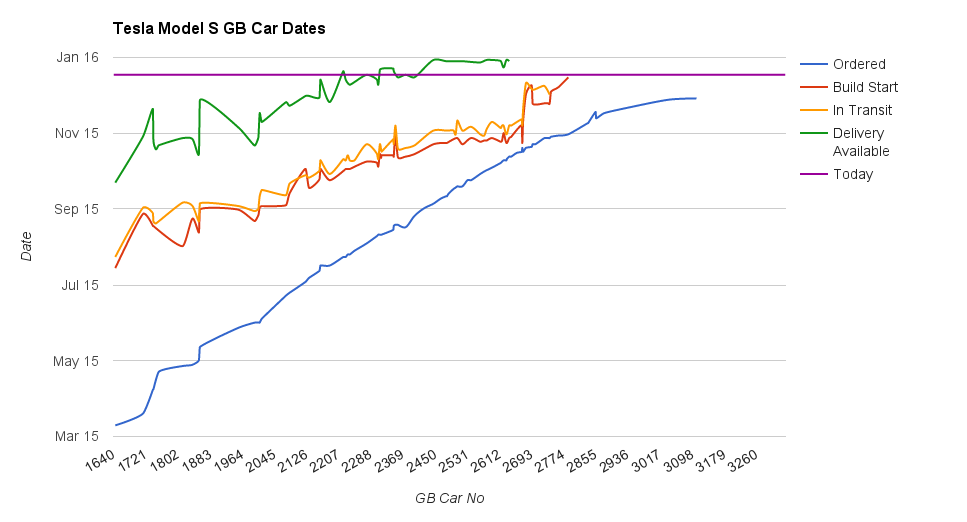
UK Model S Build and Delivery Dates (was: How Many UK Model S) | Speak EV - Electric Car Forums�
Dec 19, 2015
RobStark Didn't Tesla guide to deliver 2k more vehicles than they produce? Thereby emptying the supply chain and test drive stock ? Maybe in preparation of an upgrade/refresh?�
Dec 19, 2015
SebastianR I'm not too concerned about that legislation right now. At least not for DK. If you search on http://nrpla.de/soeg for hydrogen ("brint") and currently registered cars ("Registreret") you come to a total of 54 cars for all of DK today while there are more than 9500 electric cars in DK.
I think this is the only relevant part: I don't know anybody who is realistically thinking that DK will have a significant amount of FCVs in the coming years. But there is a Danish company that makes Hydrogen Stations and wants to continue to sell them. In short, I believe this is more marketing for a small Danish company than a serious political move (let's also not forget that one key element in abolishing the tax advantage for EVs was pure jealousy: people in Denmark hate "rich people get things for free" and the Tesla is seen as a "rich person's car". So the moment there will be any uptick in FCV registrations, that rebate will be gone. And FCVs are at least at Tesla levels of cost so I'm not at all worried. And no, I'm not interested in discussing the political culture of DK/why Tesla is a "rich man's car" etc. further ;-) )
- - - Updated - - -
I think that makes a lot of sense (also the wait times for the Model S):
Step 1: Deliver everything to meet guidance
Step 2: Focus on the production of the Model X - and thus create a "gap in delivery times"
Step 3: Introduce a (moderately) refreshed/facelifted Model S - the "gap" means there is less of a "if only I took delivery 1 day later" sentiment�
Dec 19, 2015
blakegallagher I love this line of thought, makes great sense! *speculation* all cars sold after 1/1/2016 will come with rocket boosters!�
Dec 19, 2015
Auzie I agree with you. There is only the upside in emptying the pipeline and selling inventory at the end of the year. At least, I fail to see the downside. Therefore such strategy makes sense, without the need to speculate on upgrade/refresh.
Update: downside is lower margins. Speedy sales likely come with a discount.�
Dec 20, 2015
Quant Well, it will just feel that way .....cause of what y'all smoke down there in South Texas !�
Dec 20, 2015
hobbes The count on Nrpla.de - Find nummerplade uden alle tegn - Avanceret bilsøgning for Denmark in Dec jumped to 959.�
Dec 21, 2015
SebastianR That's really amazing! (even if the actual number is 959 - but 10 difference doesn't count). Given this, I guess it is possible to achieve a 1200 to 1400 cars delivered for DEC by the end of the year.�
Dec 21, 2015
vgrinshpun If the record months in Norway any indication, the deliveries toward the end of month will be accelerating, not progressing along the straight line. So I think that 1800+ delivered in Q4 is possible. :smile:�
Dec 21, 2015
SebastianR According to the site, it includes registration data up until and including 19-DEC-2015. So the data is quite current. I assume that we can ignore the 24th (most likely) and the 25th/26th (nothing is open in DK the 25th/26th) and I wouldn't count on too much happening un the 31st. I would LOVE to see 1800+ but given the current numbers and given the holidays, I very very much doubt it. And I certainly wouldn't trade any TSLA on the belief that 1800 is feasible. But then again, YMMV�
Dec 26, 2015
hobbes 312 registrations in Norway this month as of 12/26, according to MrBacardi.
For comparison, Oct was 198 and Nov 225.�
Dec 26, 2015
Cattledog So if I'm reading the chart correctly, Denmark went from just under 700 deliveries in 2014 to just over 2,600 in 2015 to date, of which about 1600 have come in the last quarter (all rough because it's unclear if data points are end of month or another date). Impressive.�
Dec 26, 2015
SebastianR Well, it is since the EV tax incentives will start to end this year: next year all EVs are no longer tax exempt but need to pay 20% of the regular car taxes. So everybody who was on the fence bought a Tesla this year. I suspect very little sales in the first three months of next year.
After that, however, I still do expect a few sales: The Model S will still be cheaper next year than a comparable ICE car and as we all know Teslas are sold not by prospectus or website but by getting people exposed to them. Since there will be a lot of Teslas in DK, I suspect quite a few people would want one after having experienced one...�
Dec 26, 2015
Julian Cox Sebastian. Best not to underestimate the Oil Gas and Auto industry. It does not matter that nobody cares about FCVs including the companies that make them. What matters is the (proven) ability of fuel cell lobby groups to corrupt politicians resulting in divided policies and destructive anti-environmental legislation. In that regard the FCV represents a tool of deception (a sock puppet of the fossil fuel industry that provides a false alternative to EVs). This is ability to point to a useless alternative to EVs while giving corrupt politicians plausible deniability for deliberate environmental destruction is extremely powerful.�
Dec 27, 2015
hobbes Another update for Denmark: 1119 cars registered according to (inofficial) site Nrpla.de - Find nummerplade uden alle tegn - Avanceret bilsøgning !�
Dec 28, 2015
Gerardf The regular update by MrBacardi on the Norwegian Elbil forum states 312 so far in Norway (Dec 26th).
http://elbilforum.no/forum/index.php/topic,13524.150.html
He also mentions a year total of 3988 and that in December the 10.000th Model-S was delivered in Norway !
And that in a country with a population of just over 5 million !�
Dec 28, 2015
chickensevil Well that bodes well for us. Hopefully we get one last surge at the end of the month and break 1300�
Dec 28, 2015
SebastianR You beat me to it�
Dec 30, 2015
Troy
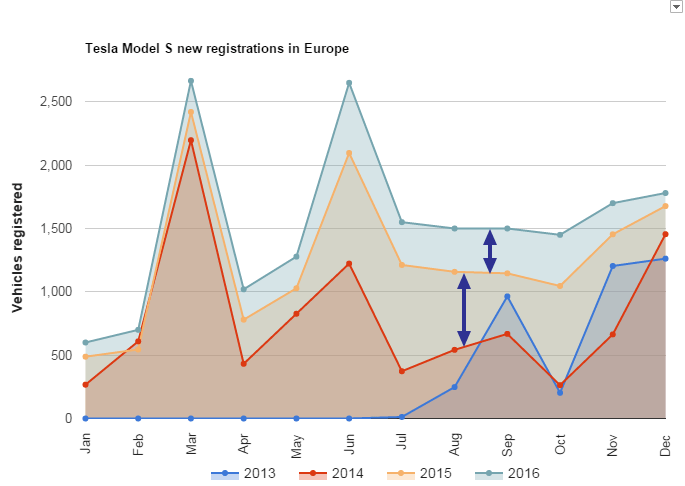
Hi everybody. Hobbes and I have been working on improving the Europe 2015 Model S sales WIKI. We just added this new graph. I found this interesting because you can see how the pattern is similar in 2014 and 2015. The highest peak is in March, then there is a lower peak in June, then it continues to drop but rises again in December. I guess we will see something similar in 2016. These graphs will auto update each time there is a new entry. December data will soon start coming in. If you want to contribute, you can submit data using the form linked in the wiki.
Without 2013 and 2014 monthly data this graph wouldn't have been possible. Thanks to hummingbird for starting the work on monthly tables for 2013 HERE and thanks to forum member 32no for creating the 2013 table HERE and a year later the 2014 table HERE. Those were very helpful. I used an online tool to covert the images to a table. Your efforts have not been wasted. We have now monthly sales data for all countries in Europe since Model S started selling there. Links to 2013 and 2014 tables have been added to the wiki.�
Dec 30, 2015
hobbes Pretty cool to see how the end-of-quarter-pushes repeat, except for 2015Q3 - like Elon announce earlier this year they were going to try to do deliveries more constantly, but it looks after Model X was delayed they had to push hard again to make 2015 guidance. I guess next year with all the X reservations to build and lines for both cars running smoothly, we might see less of a bump again. Good work, Troy!�
Dec 30, 2015
chickensevil Wow, I love how you can see the shift in demand in the EU to be overall higher. This points toward what Elon had said regarding the EU market getting stronger this year. Starting in June Y/Y we are seeing around a 100% increase in the overall market. IIRC they said the EU was actually getting more of a percentage at one point than the NA market was of their overall production. Of course with what they did in Q4, I wouldn't be surprised if we see that drop off a bit.
Thanks everyone who have continued to get these numbers as this is really great data!�
Jan 2, 2016
Auzie Smoggy Naples catches up with Italian urban car bans
Milan, Rome and Naples imposed emergency restrictions on road traffic within certain hours, in a bid to limit air pollution.
 �
�
Jan 3, 2016
bonaire I don't know that the demand shifts. Rather I think it indicates the months of delivery batching. Keep in mind orders come in consistently and the deliveries are based on sending cars in production groups out. For instance, many cars destined for Europe began production in December and some will go through Tillburg and others direct so Feb/Mar will look busy but not January.
Regarding cars in cities and pollution - I wonder if cities can use forms of incentives to help this process using car-pooling. It should be a form of safe and effective multi-use of cars to help both with congestion and pollution overall. Single drivers converting to EV is one way to help pollution but not congestion. Both are important to work on. Congestion causes more pollution for those not yet in EVs. Car-pooling and mass transit are really good things to try to get the citizens to use more of.�
Jan 3, 2016
Troy I think chickensevil was talking about April and later months in 2015 compared to 2014. The graph follows a similar shape but the numbers after April have shifted up about 700 units on average. If the same happens in 2016, we might see something like the graph below. The arrows show demand increase. At the end of this year it will be interesting to come back and see if the actual 2016 graph is anything similar to this.
Update: This chart is fictional (Dec 2015 and all 2016 months are made up). Check out the wiki HERE for current charts.
 �
�
Jan 3, 2016
Benz 278 Tesla Model S deliveries in December 2015 in The Netherlands.�
Jan 3, 2016
hobbes Where's the 2015 Dec number in your plot coming from? Wiki has only NL so far.
- - - Updated - - -
373 registrations in Norway this month as of 12/26, according to MrBacardi
Denmark Dec num on nrpla.de never changed since update a week ago.�
Jan 3, 2016
SebastianR Tesla deliveries for Denmark are 1249 for December (according to Nrpla.de)�
Jan 4, 2016
Benz That could be about half of the total European Tesla Model S deliveries, I think.�
Jan 4, 2016
SebastianR Looks like my "conservative" estimate was not totally off in the end. However, it was still a bit too optimistic. Lessons learned for estimates going forward.
- - - Updated - - -
Could well be - I guess it also created a lot of demand for the rest of Europe. All used cars seem to have ended up here in DK. Aside from weather I feel like I'm in CA these days there are Model S everywhere here...�
Jan 4, 2016
Benz The total number of European Tesla Model S deliveries in Q4 2015 will be about 5,000 (I think).�
Jan 4, 2016
Kim.T I don't think 1249 is the final number of Tesla delivered in December in Denmark. November has just been adjusted to 529 - initial number was 465 in early december, and 525 until a few days ago. And they have been extremely busy up to New year.
But Tesla model S was the most sold car in Denmark in December ! The first time an EV is on the top. More that 50% of the EV sold in Denmark in 2015 are Tesla's�
Jan 4, 2016
SebastianR Let's see. 1249 is already 1 more than the official statement over at De Danske Bilimport�rer - Presse - Pressemeddelelser vedr. bilsalget�
Jan 4, 2016
matbl Sweden:
December 2015: 172 (43rd most sold car if I count correctly).
Total 2015: 996 (Not on top 75)
Link: Nyregistreringar december 2015 prel�
Jan 5, 2016
chickensevil It was projected numbers including all of 2016 pointing out what the numbers could look like if the trends hold from what we saw in 2014 and 2015.
That's Troy for getting what I was suggesting. It will be great if Europe shapes up anything like that.�
Jan 6, 2016
Benz Current total for Q4 2015 in the wiki: 4,820
Well, that wasn't that far off: 96.4% accurate.
Oops
The numbers from a few countries still have to be added (Germany, Switzerland, France, ...).
So, at least a few hundred more to be added to the current total of 4,820 Tesla Model S deliveries in Europe in Q4 2015.�
Jan 8, 2016
vgrinshpun Germany - 234 cars in December. Model S sales sales took third place, beating Audi A7/S7/RS7, Audi A8/S8, BMW 6, Porsche Panamera. Not a bad showing.
http://www.kba.de/SharedDocs/Publikationen/DE/Statistik/Fahrzeuge/FZ/2015_monatlich/FZ11/fz11_2015_12_pdf.pdf;jsessionid=B0A2D800C1D58D3B6D2741D82A25E9AF.live1042?__blob=publicationFile&v=2
MB CLS/S 807 BMW 7 352 Tesla Model S 234 Audi A7/S7/RS7 217 Audi A8, S8 164 BMW 6 120 Porsche Panamera 78 �
Jan 8, 2016
SebastianR Very nice indeed! The total over the year places Tesla as the most sold "non-German" car in the "Oberklasse" segment of KBA and even beats the Phaeton of VW. It is (year over year) also the car with the highest growth numbers in that segment. Really well done for an "outsider" in Germany!�
Jan 8, 2016
vgrinshpun I would love to see the reaction to these sales data and hear words spoken in the Porsche boardroom.:smile:�
Jan 8, 2016
Spidy Coming from Other German manufacturers: 12
Von welcher Marke kommt ihr? Freunde�
Jan 9, 2016
SebastianR Watch out of the Model X to fully hit the market. Granted, the Panamera - as closest Porsche competitor to the Model S - was never a truly smashing success (i.e. as iconic as 911, as much talked about as the Boxter or as successful as the Cayenne). But Porsche started to sell the Cayenne to get from about 20k cars a year to being +100k cars a year. Once the Model X starts to eat into Cayenne sales, we will see a reaction from Porsche. Und should there be a Model 3 and potentially a Model 3 SUV (which at this point is pure speculation, I know) I predict massive troubles for the Macan (and then for Porsche as a brand).
In other words, I think that the Panamera has no future in its current form and will silently disappear / be marginalised. The big fight with Porsche will be the Model X.�
Jan 9, 2016
smac I agree the Panamera will be marginalised (if it isn't already, with heavy discounting required to shift the Diesels here)
If the X does well in translation from US to EU (well UK) tastes is hard to know right now.
Personally I'd prefer a non FWD option, as would my Q7 driving wife. It's a bit too brash if I'm honest.
The other real headwind for the UK market will be the interior. The go to choice of Range Rover in the �100k segment, really is rather special inside, and my 2014 Model S certainly isn't as well screwed together as my wife's Q7
When you compare a Model S to other performance luxury saloons, it so demolishes them in performance terms you can make allowances for the interior.
When you compare a luxury SUV, then I can't help but think the purchasing choices place performance further down the list. (Even some US sig owners were upset in having to pay for P option)
Will certainly be interesting to see.�
Jan 10, 2016
SebastianR I hear you well. However, according to this article here (sorry in German) Dr�xlmaier is doing part of the interior of the Model X. They are otherwise doing Mercedes, BMW and Audi interiors. So I have hope that this part of the product will improve as well... But as you say: we will see.�
Jan 10, 2016
smac Interesting article which even my poor German skills gets the gist of
My view for what it's worth is that Tesla are "weight budget" constrained, rather than price or quality constrained.
Quite frankly given the weight penalty the S is carrying in batteries it's amazing how close it is to kerb weight of say something like a Panamera. Hats off to the engineers for achieving this, but there are limits. It's silly things like grab handles, door bins, lighting in the vanity mirrors, using a clip instead of a screw, having the bare minimum of fixings and using the minimum of padding in the seats. All of which individually weigh nothing, but all add up on the scales. You can see all the same tricks in my other car (a Lotus) and no doubt Tesla learnt a thing or two during their partnership.
The rolling chassis of say something akin to a Range Rover on the other hand has weight budget to spare given the energy density of liquid fuels. They can then squander this budget on every toy known to man, use stacks of NVH damping, big bulky seats etc. etc.
I look forward to seeing an X in a European showroom to see how close they have got, and hopefully what to look forward to in a future S (I'm out on the X the doors are simply not for me)�
Jan 10, 2016
chickensevil Most were upset because with the Sig S the performance was an option and they took that away on the X. I don't know that it had so much to do with people caring less about performance in an SUV so much as a deviation of what they offered when they sold the S.�
Jan 10, 2016
smac You are right it was a sweeping generalization based on my interpretation of a number of posts, comments about cancellation reasons, and general TMC "vibe".
Maybe you are right and I am wrong.
What is not wrong is here the sporty versions (the Cayenne Turbos, the RR v8 Supercharged, the X5M, GL AMG's) are wildly outsold by far less performance orientated machines. This is after all the EU outlook forum.
,�
Jan 10, 2016
RobStark All the silly things in the Universe don't add up to a 200 lbs glass roof.
I will take grab handles,garment hooks and a Double Gulp sized beverage holder with the massive weight penalty.�
Jan 10, 2016
smac And the range penalty that goes with that?�
Jan 10, 2016
RobStark .0001 Miles? Yeah.
These weigh only a couple of pounds
My GF is a bout a 2 mile range penalty.
I will take her too.
Weight mostly adds an acceleration penalty.
Steady state speed weight is a very secondary issue to aerodynamics.
When I am hypermiling between superchargers weight is not the issue.
For daily use around town range is irrelevant.�
Jan 10, 2016
smac You are obviously right Rob and the huge lengths manufacturers are going to to reduce weight is a pointless exercise.
Tesla chose aluminium because it's cheap and easy to work with, and BMW invested 100's of millions in developing new CF technologies just for shitz and giggles
Like it or not weight is a key design parameter in car design. Weight hurts everywhere, acceleration, handling, efficiency (range), ride. so weight budgets are fought tooth and nail between the varying design groups, all tracked at fine detail of every component, which in turn is constrained in material choice by cost. Quite simply the easiest way to reduce cost is to leave stuff out,
I guess the alternative view as to why Tesla's don't have such simple things as grab handles, door bins and lights in the mirrors (which even my first ever car back in the 90's which was already 10 years old had) is they are penny pinching on the interior.�
Jan 10, 2016
RobStark
Going to aluminum or CFRP to save 500-700 lbs makes a difference.
Two or three pounds on features many customers want make no difference.
To show how important weight is Tesla saved ~700 lbs going aluminum then added 200 lbs with a glass roof.
Instead of using 15 lbs forged aluminum wheels Tesla went with 34 lbs cast aluminum wheels. And unsprung weight is the most critical weight mass in the performance of a car.
Elon got the pano roof for his personal car and insist on doing so for journalist to review vehicles.
Tesla chose to exclude many options because Elon does not think they are very important.
It did not fit is minimalist design aesthetic.
He noted he did not include a rear light because he thinks nobody reads actual books these days, they read e-books.
One of his sons said Model S was the dumbest car ever.
Back it went.
There are many great things about the Model S being the singular vision of Elon Musk and not a car made by committee.
The lack of these basics is not one of them.
Subsequently Tesla has added bigger lighted vanity mirrors when customers complained enough.�
Jan 10, 2016
chickensevil Sorry, I wasn't implying that you were wrong about the non-performance being a larger group than the performance group. Just stating that was my impression when reading through the complaints. People wanted to be able to buy a signature vehicle sans performance. They expected it to be an option when they put their deposit down because it was something they did for the S. But I don't know that I would base the Signature owners on the general trends of everyone else. We will have to wait and see how the general production trends end up to determine what kind of buyers are getting the X. I wouldn't imagine the performance version of the other Luxury brands are the highest number of cars, yet on the Tesla that is exactly the case (or at least it used to be, as was evidenced by the rather large ASP). It could be that the performance version is what draws most people to the MS, especially in lieu of going with another brand that has more "creature comforts" in it. Only recently has Tesla even started to get up to speed in that category. The X takes that one step further with door pockets and lighted vanity mirrors and lots of cup holders.
Maybe the ASP on the X will show that the Performance version trends higher, maybe we won't, it's unclear at this point. But one thing is clear, Tesla buyers are not your average consumer in that car class.�
Jan 11, 2016
smac And then subsequently used the base car with solid roof and zero features for all the EPA testing�

Không có nhận xét nào:
Đăng nhận xét