Nov 20, 2014
AmpedRealtor Well, my 90% charge that has been holding steady at 132 rated miles dropped yesterday to 129 after driving about 120 miles yesterday at an average consumption of 283 Wh/mi. Temps are in the 70s.
EDIT - make that 232 and 229 miles, oops!�
Nov 20, 2014
islandbayy Want to double check that? You mean 232 and 229?�
Nov 20, 2014
AmpedRealtor YES! OMG! Corrected.
- - - Updated - - -
And when I drove 20 miles today and charged back up, I was back up to 232 miles. This algorithm needs help!�
Nov 20, 2014
islandbayy Not sure if I mentioned it in the past anywhere, but so far, to date, the absolute BEST MOST ACCURATE algorithem that projected the best rated range estimate was what my car was delivered with, I believe Firmware 4.1......�
Nov 20, 2014
Benjamin Brooks I think really it wasn't the algorithm in the older firmware was more accurate back then, just simply less aggregated battery pack measurement errors at mile 0... For example the initial conditions may have been accurately calculated at the factory, but over time without a recalibration the algorithm has less & less precise data to work from.�
Nov 20, 2014
walla2 So my range has stayed up after my most recent service as previously discussed. My rated range at near full charge today was 263 (99%) and my 90% charge is 246.
I plan on asking my sc exactly what changed the range this weekend and post their response here very soon.
Havin now lost less than 1% of my range from 2012 is incredible. I hope again this lasts and is able to be replicated for others.�
Nov 20, 2014
Benjamin Brooks Awesome!�
Nov 20, 2014
mknox Right. Did a refresh and it says 1.67.43�
Nov 21, 2014
apacheguy @walla - Please do post here once you know more. My car was in for annual service earlier this week and while it did have a temporary boost in range (likely due to FW update), this quickly disappeared and reverted to the old numbers.�
Nov 21, 2014
scaesare 176 this morning @ 70% charge. Highest I've seen at that SOC since I started paying attention. Up about 4-5 miles in the last couple of months�
Nov 21, 2014
SteveS0353 I'd like to understand what the SC did for you. I have a 3 month old P85+ with 5,500 miles on it. For a few months, I was charging to 70% daily charge as I'd read somewhere that was best for the longevity of the pack, but my rated range was slowly sinking (see this post). On advice in this thread that it's a firmware calibration and balancing issue, I started to standard charge to 90%. But after 30 days of doing that, my rated ranges have only improved slightly. My standard (90%) charge is now 231, and 100% range charge pegs at 257. That's more range degradation than others are reporting after more miles on their vehicle. I suspect that there is a firmware variable which drifts over time with some packs and may need a manual calibration to correct the drift. Anyway, please post what you find out. I am planning to make a SC appointment.�
Nov 23, 2014
Pilot_51 I was holding steady at 147.44 rated miles (according to VisibleTesla) at 80%. I always charge to 80% and the lowest I've brought the rated miles is to the mid-70's, until yesterday when I drove it down to 37 (20%). After charging back up to 80%, VT shows an increase of 0.7 to 148.14. As expected, a low SoC is as important for calibration as a high SoC.�
Nov 23, 2014
scaesare And my 90% charge is now giving me 226 miles. That's up form 221-222 a couple months ago.�
Nov 23, 2014
Madartist I have been charging at 60-70% daily for the past year in order to preserve the battery life. Since my daily commute is relatively short (~25 mi), I'm usually charging the car daily at ~50% SOC. Like many others, I have seen drops in the rated range using this charging strategy. While I understand that the battery life/range is unchanged and the calculated range is simply inaccurate due to lack of pack balance, etc., it is neverless disheartening to see the range drop on the car over time. This range drop also has real life implications when taking long trips, especially if the range charge reading is 20-30 miles short of 265. In reviewing this thread and others, it appears that many owners have had good success at charging daily at 90%.
Given these facts, I think 2 charging strategies seem reasonable in order to maintain accurate range calculation and still preserve long term battery life:
- Charge at 90% daily and plug in every night. (This strategy would have the benefit of maintaining accurate range calculations on the battery pack and see the least drop in range. However, I still wonder if maintaining 90% SOC over the long term can still degrade the overall battery life, especially in warmer climates like Florida.)
- Charge at 90%, but allow the battery to run down to about ~50% before charging back up to 90%. (This would keep the battery in the 50-90% range most of the time, which may(?) improve the overall battery life. However, one may see more range drop over time compared to charging at 90% daily.)
Any opinions?�
Nov 23, 2014
FireLT I have been talking to the SC about my decreased rated range and they sent the logs to the engineers. The reply I got was "its the calculations in the firmware and should be corrected with next firmware update."
Right now I have about 17K miles on it, 1 year old and at 80% of daily charging, I get 202 miles. I will give the 90% method a shot and see what happens. Should I range charge now, or after a few weeks of charging to 90%?
Thanks�
Nov 23, 2014
tomas you should really not sweat. Your 80% is completely in normal territory for 17k miles. IMHO this thread causes a lot of undue concern and unnecessary charging routines. You should only range charge when you need it and will drive immediately on completion.�
Nov 23, 2014
David99 You have been doing the right thing. It is a fact (not rumors or speculations) that Lithium batteries will age slower when they are kept at a lower state of charge. So you have done the right thing to keep them healthy.
Seeing the range drop is a separate issue. It's annoying and a little frustrating, but of course Tesla wants to be on the safe side when it comes to predicting range. I had 270 on a range charge when I got my car, now I get about 10 miles less and the range drops about 3 miles almost right away when I start driving. Do I really have 5-6% less capacity on my battery than when it was new? I don't know for sure. I really wish there was a 'battery calibration cycle' or something similar to get the calculation current. There are all kinds of speculations on how to balance and recalibrate but truth is, we don't know. I have been tracking my battery with Visible Tesla to do a rates rage over battery percentage and it clearly shows a constant and linear drop over time. There is no indication that doing a full cycle to recalibrate would help regain range. I do remember Tesla saying that towards the end of the battery capacity the calculated range is based on current battery data rather than the calculation. IOW, they have a good idea based on that what is left in the battery. I think the mistake here in this discussion is that we charge and then look at the rated range which is a number mostly based on the algorithm.
The proper way to measure the capacity of a battery is to charge it to a specific voltage, then discharge it to a specific voltage and measure the amount of energy that was taken out. That's the only way to get an accurate measurement.�
Nov 23, 2014
Madartist I understand your point. Since what you propose is not achievable by the owners, we are still left with our best guesses on the optimal way to preserve battery life while allowing the car software to calculate the most accurate range. As I stated above, I don't really think that my battery has lost as much range as the car displays. Nevertheless, it is still frustrating, particularly when it comes to long distance driving. I still adhere to the general principle that 0 means ZERO miles, which means that I would not count on any additional range than what the car displays. Although my current charging regimen preserves long term battery life, it has come at the cost of a progressively inaccurate range reading. I'm not sure it's a good trade off. Therefore, I will again propose two charging strategies for the community to consider:
- Charge at 90% daily and plug in every night. (This strategy would have the benefit of maintaining accurate range calculations on the battery pack and see the least drop in range. However, I still wonder if maintaining 90% SOC over the long term can still degrade the overall battery life, especially in warmer climates like Florida.)
- Charge at 90%, but allow the battery to run down to about ~50% before charging back up to 90%. (This would keep the battery in the 50-90% range most of the time, which may(?) improve the overall battery life. However, one may see more range drop over time compared to charging at 90% daily.)
Any opinions or suggestions?�
Nov 23, 2014
David99 It is. You charge the car 100%, you drive it to the end and look at the trip meter's energy consumption.�
Nov 23, 2014
Madartist Perhaps. But I'm not willing to risk being stranded simply to get the number. It's certainly inconvenient at best. I would much rather tackle the issue via a sensible charging strategy. That is the reason why I posed the question.�
Nov 23, 2014
tomas No, in most cases it is not. It would only work if you charged to 100%, immediately set off, drove til exactly empty (to avoid distortion from vampire loss) and timed your zero to happen in safe proximity to charger. A lot of trouble to get just another data point that will probably not prove or change anything!
there have been a few real incidents posted of true rated range aberrations, but most of us are in a very narrow 5% +/-2 range. We must be sweating bullets because we like to, I guess.�
Nov 23, 2014
scaesare There are 3 things in play when it comes to range:
1) Actual range loss due to battery degradation- This is to be expected as per Tesla. It's understood to be most significant early on in battery life and then taper more gradually over the remaining life of the cells.
2) Temporary range loss due to pack imbalance- This is a known issue with series style battery packs such as Tesla's. The loss is real in that the total pack range is diminished until the pack can be rebalanced. It's understood that the Model S can re-balance the pack, but when and under what circumstances is not completely known. Once the pack is in balance the range is restored.
3) Apparent range loss due to algorithm inaccuracy- This is simply visual inaccuracy due to the fact that "at rest" estimates of battery capacity are calculations, with a number of variables (temp, cell age, etc...). The greater the extremes of charge and discharge, and thus the larger sampling extent, the more accurate the algorithm may be. The converse is that shallower charge cycles result in less accuracy.
As I've written before regarding issue #3, because of the evidence supporting the concept of shallower charge cycles being better for the pack, I don't believe it's worth attempting to charge or discharge to greater levels than necessary just to see a different number on the dash is worth it.
With issue #2, the range loss can impact a person if they really need it, even if for a single long trip where you are really pushing your range limits. If you really are down to counting a few extra miles to make your journey it may be worth-while to try and force a pack rebalance. Anecdotal evidence suggests this happens at the tail end of range-charges (where the last percentage point of charge can take an hour or more). As range charges are harder on the battery, I recommend this only if you have no other alternative. It's uknown to what extent the Model S attempts to balance at <100% charges
For issue #1, it's a fact of life with Li-ion cells. However, given that deeper carge cycles, time at 100% charge state, and high temps are all hard on the battery, I make the above recommendations with the aim of minimizing this real degradation.�
Nov 23, 2014
Madartist Thanks for the excellent summary of the factors affecting range degradation. It is what I've learned as well from reading through the various threads about this subject. Based on what you've said, it sounds like you are in favor of setting the charge limit at 90% and charging every night. Is that your personal practice as well?�
Nov 23, 2014
scaesare You are certainly welcome.
I actually only charge to 60-70% (depending on how cold the weather is) during weekdays as that's sufficient for my work commute and any evening driving I typically do. On weekends I charge to 90% as my needs are more varied, and I like to have the range for impromptu trips.
With Superchargers now being within a couple of hours of me on major routes out of town, I haven't range-charged in quite a while...
VisibleTesla makes all this a snap to set up to have happen automatically...�
Nov 23, 2014
hans Does the trip meter energy consumption figure include vampire drain, HVAC, battery heating, and other misc consumption not related to driving?�
Nov 23, 2014
tomas Lotsa people going to answer like they know. But unless tesla engineers hiding in here, we do not know.�
Nov 23, 2014
islandbayy My update;
43,000 miles on my car, 9,000 on replacement battery pack. Rated Range is 200. And that is charging from Charge Now to 100%.
Comparison: Original pack had 202-203 Rated at 34,000 miles when it kicked the bucket. Tesla insists nothing is wrong with the new pack.�
Nov 23, 2014
scaesare Assuming that you were at 34K miles when the replacement occurred, with over 26% additional miles on the replacement pack, what makes you feel that a 1-1.5% variance is indicative of a problem?�
Nov 23, 2014
FredTMC Ive used this method to get an accurate assessment of my battery's total KWH output. This method is the best "true" method (IMO)
actually, it's not required to drive all the way to Zero miles left in order to get a good assessment. It's perfectly okay to end the excerise with a few miles left. For example, if the car is showing 6 miles of rated range left, then you can simply assume that you have an additional 2 KWH of remaining energy until you reach zero rated range. Simply add this final 2 KWH to the KWH expended on the trip meter.�
Nov 23, 2014
David99 Agreed. The best thing we can do is avoid things that we know cause faster battery aging. Everything else is something Tesla will optimize and improve.
- - - Updated - - -
As long as you drive, everything is included. Once you park your car or it's just sitting there running the AC or heater going, it's not added. You will see the rated range go down of course, but it is not included in the trip meter energy consumption.�
Nov 23, 2014
islandbayy not sure I'm following you. at 34,000 miles on it, my original pack had 96.65% of it's original range. With only 9,000 miles on my current pack, the replacement, it has 94.78% of it's original range. My problem isn't the range per say. my problem is the rate at which the range is declining.
Original pack rated range declined at a rate of approx .2 miles per 1000 miles driven. in comparison, my current replacement battery is loosing range at a rate of approx 1.2 miles per 1000 driven. that is where my problem lies.
My math is not the best. if I screwed it up please correct me.�
Nov 24, 2014
tomas evidence is pretty conclusive that a) packs decline ~5% early in lifetime, b) then they stabilize and decline at very low rate, c) each pack is slightly different. You seem worried that new pack is slightly different from old and projecting linear decline. seems to me too early to be worried about too small a difference.�
Nov 24, 2014
bhuwan Is your pack really a new pack, or a refurbished pack?�
Nov 24, 2014
scaesare This doesn't seem to be the case at least initially after charging. If I trigger the car to "power up", by either starting HVAC preconditioning, opening the doors to put some stuff in the car, etc... the car counts the energy usage while it was there idle in my garage against the total energy usage on the trip meter. This is easy to see initially because the average after the first tenth of a mile is something ridiculous like 1,400 Wh/mi, os it's easy to see.
Of course as you build more milse up on your trip, that initial energy usage is averaged over the longer distance, so you don't see that spike as prominently, but I'm not sure that if I park again later in the trip and use a lot of energy while idle it's not represented... it just may be harder to see.�
Nov 24, 2014
liuping Just to throw another data point out there.
Tomorrow my car will be 1 year old, and I hit 20000 on the way to work this morning.
I also did a range charge last night (first in quite a while) as a data point. I got a pleasantly surprising 262 miles.
Most days I charge to 80% and drive to about 60%. I've done 10 Range charges total.
The very first range charge I ever did was 272 miles (one month after pickup @ 1732 miles), but the next one was 266 (2.5 months @ 5040 miles).�
Nov 24, 2014
scaesare OK, I see.. the concern is the rate of decline... is the rate of decline lessening at all after 9K miles?
My assumption is that this is a refurbished pack. And from those here who have had such pack replacements I believe that the stance Tesla takes is that you will receive a pack of comparable health/capacity.
Thus, I expect that the cells in the pack you got would have also already had ~34K miles worth of "wear" on them. Thus an additional couple of mile of degradation in nearly 10K wouldn't seem to be that out of the norm.
I also suspect that a refurb pack may present the car with an initial "learning curve" where the algorithm SOC estimate may need some time to acquire enough charge cycle sampling points to determine the actual capacity. This would make it appear the pack was rapidly losing capacity initially, whereas it may have been initial estimate error.�
Nov 26, 2014
walla2 My pack boost experience is sadly over now. My range stayed up for 3 weeks but after three range trips seems to be back to about a 10% degradation at 10k miles. My real world trip revealed I have 66.8 kwh in my pack down from the original 74 or so available in the 85 kwh pack. The 66.8 / 74 is a 10% loss equivalent to the 10% rated range drop.
One confounder was that I was upgraded to .180 after my third range charge and that's when the range went back down so I can't say what really reset things. What I do see is that my pack is showing some real world degradation if it only has 66.8 kwh left in it.�
Nov 26, 2014
apacheguy Sorry to hear, walla2. It did seem odd to me that your MS regained so much range immediately after the tech visited. 67 kWh from full to empty is a bit concerning. Have you pressed that issue with Tesla? Rated range is based on calculation, but kWh used is based on measurement.�
Nov 26, 2014
walla2 I haven't pressed the issue for now. Tesla has said the pack is healthy and that it is not something wrong with the pack. I will await their proposed fix (software) before asking for further evaluation.�
Nov 26, 2014
mknox I'm interested to know what Tesla does to determine pack health. Even if I had to pay for it, I think some sort of report directly from Tesla would be extremely useful. For example, it may be very beneficial to someone looking to purchase a used Model S.�
Nov 26, 2014
JohnQ And such a report would be a welcome output from an annual service.�
Nov 26, 2014
apacheguy Roaster owners have the ability to access internal logs and diagnostics that provide info on the battery pack. Does the MS log the same info? Absolutely and probably more. Are we allowed to see them? No, I've tried asking.
Providing owners with simple diagnostic info seems like a no brainer to me especially since Tesla has already demonstrated a willingness to do so with Roadster owners.�
Nov 27, 2014
qwk Tesla has changed the firmware so much, that comparing numbers is very difficult. My car charges to 258 rated at 100%, and 233 rated at 90% consistently. Yesterday I took a trip from a max charge to 11 rated miles and the car showed right at 70kwh used, and 208 miles traveled. If a new car range charges to 265 rated, but can use 74kwh, something is way off in some my displayed numbers above.�
Nov 27, 2014
tomas Absolutely true that firmware changes negate validity of many comparisons. Your numbers do not seem that far off. If 265 mi and 74 kWh capacity is correct for a "new car" full charge, -- you used 70 kWh and had, say, 3 left for the remaining 11 miles, for total of 73 kWh... then your rated at 100% should have been ~261.5 vs. 258 you showed. That's actually about a 1% difference. Pretty darned accurate!
If your issue is that you only got 208 + 11 miles, then maybe the problem is you exceeded 283 wh/mi average during your trip, which would be rated per mile "par" for a battery with 73 kWh capacity and 258 rated range!�
Nov 27, 2014
kevincwelch So, I max charged to 252 miles this morning. I have 8500 miles on the odometer. Other than battery error, manner in which the firmware calculates rated miles (per previous few discussions), and possibly temperature (it's 34 degrees in my garage), what could be an explanation for this decrease in max range? The last time I charged fully was in September, and I got 263 miles. The car is 2/2013 vintage. VIN 4xxx.�
Nov 27, 2014
tomas 1) There's nothing to indicate temp is in algorithm directly, tho temp could affect the BMS perception of battery capacity when cold. So, in that way it could be a factor.
2) Battery degradation over first year is typically about 5%, after which it levels off. You are right at that, so could be factor.
3) You didn't note your charging and discharging habits. If you don't regularly charge to 90, and occasionally discharge to some low number, the BMS loses track of the endpoints... and possibly does not effectively balance pack.�
Nov 27, 2014
qwk Well the issue is that a new car charges to 265 rated, and can use 74kwh. There is no way that 11 rated plus 7(the difference between 265 and my 258) is equal to 4kwh, because I was at 67 kwh used with around 72 rated remaining. Things just dont scale. In my opinion, Tesla is somehow compensating for battery degredation in the older cars with the newer firmwares.�
Nov 27, 2014
tomas Probably about 100 or more on this thread... unfortunately nobody has compiled into database, and thread is becoming unwieldy, so could take some browsing/searching.�
Nov 27, 2014
qwk In my experience, if one doesn't charge to at least 90% on the slider, range drops, possibly due to the module groups varying max voltage, and rated range drops. This is very hard or maybe impossible to get back into whack. All of my drops are a result of many consecutive partial charges without a chance to balance.�
Nov 27, 2014
tomas Agree your intermediate point sounds odd. Maybe I'm not qwk enough, but not clear to me how you jump from your data to that conclusion without a lot more data points from new and old cars.�
Nov 27, 2014
scaesare Wow.... only 8500 miles in 21 months of ownership? That's only about 276 miles a month. Was your last range charge September of 2014, or 2013, and hopw many of those miles were since that last range charge?
The difference is ~4% of capacity, and you may still be in the "steep" part of the battery degradation curve with that few miles on the car. That having been said, I also wonder if there's more than average error as well, as it would seem likely that the frequency and/or depth of charge cycle are probably much less than average as well...�
Nov 27, 2014
qwk I do have many other data points to compare to, but most of them are with older firmware. It just seems like there is either less energy available for use now, or the pack really has some degredation/is out of balance, but doesn't show it in the rated range numbers. I'm not even sure if the kwh used display hasn't changed to some degree. So many questions, with few to no answers.�
Nov 27, 2014
kevincwelch I regularly charge to 80% and typically put on 20 miles or leas per day. I used to charge to 90% but changed to 80% maybe 6 months ago.
My last range charge was sept of 2014.
I wonder if I should keep it at 90% and not charge as frequently. This seems to go against what Tesla recommends - keeping it plugged at all times when possible.
My main problem is at work: unplugged for 12-14 hours per day, and in the winter around 20-30F. Loses quite a bit of range....�
Nov 27, 2014
qwk The battery degredation difference between charging to 80% or 90% is going to be pretty small, while the rated range shown difference is going to get bigger. This we know. What we don't know with absolute certainty, is whether one can get this range back with either new software or different charging methods. In my opinion, it is going to be very difficult if not impossible to get ALL of it back.�
Nov 27, 2014
rlawson4 50000 Mile Report. B Pack (as a Sig not sure why because never replaced). 90% charge is 223-225. 100% is 249-250. The car will be two years old December 2nd. I am very pleased with the slight degradation. My secret has been to charge to 90% every day. However I set the current to the lowest it will allow to be ready in the morning. I rarely have to change past 25 amps to get the job done. most nights its 15. My theory (and keep in mind I know nothing about batteries) is that a slower charge is better because it keeps the battery cool.�
Nov 27, 2014
Madartist What did you get on your last range charge?�
Nov 28, 2014
WarpedOne But still it is 100% guaranteed that this "estimated range loss" has 0 (zero, none, nada, zilch) effect on actual range you can get out of the car i.e. distance driven before shut down.
Stop obsessing about numbers. DRIVE!�
Nov 28, 2014
kevincwelch I'm pretty sure my last range charge in Sept 2014 was around 263.�
Nov 28, 2014
David99 And you know this how? "100% guaranteed"? Battery degradation is real and a fact. You have no clue how much is lost in actual range and how much is just calculation inaccuracy.�
Nov 29, 2014
WarpedOne Read again what I have written.�
Nov 30, 2014
islandbayy I would not say slightly different. Having less range after 9000 miles then my old pack did after 34,000 miles is astronomically different. It continues to drop. coming up to 10,000 miles on the replacement, and it's now hovering between 198 and 200.
- - - Updated - - -
Rate of decline has not changed. Almost at 10,000 miles, and now hovering between 198 and 200 miles. Must be a referb pack.
As for it already having ~34,000 miles of ware on it already when I got it, considering i have one of the highest mileage 60 cars, it would seem unlikely. Maybe a few thousand. Especially considering its a B pack, so manufactured quite a while after my 60 A pack was, gives it even less time to have mileage put on.
Learning curve, maybe, but after almost 10,000 miles, no sign of the range drop slowing or stopping. I even had a almost shutdown in terms of how low the pack got (got home with 2 miles left, and was unloading, didnt shut my drivers door all the way and heat and seat heaters stayed on. Didnt notice until a while later the pack was wayyyy low), and charged it from almost shutdown level to 100% as I had a lot of driving this holiday weekend. Weather was Abnormally warm, and charged at a high amperage. That gave a perfect time for it to measure power going back into the pack. It replenished ~54 kW roughly. In comparison, When this pack was new, a 100% charge from charge now would consume about 63kW.�
Nov 30, 2014
scaesare Almost assuredly unless you were specifically told otherwise. Tesla has stated that the will provide replacements that are refurb's of approximately equivalent capacity. Again, I don't believe your characterizing your replacement pack as only having "10,000" miles of wear is directly comparable to a new pack with 10K miles of wear. The replacement pack will have already had diminished capacity, although it may have taken a while for that to be manifested.
We have no idea what goes into to refurbishing a pack. For all we know, they could swap in battery modules/cells from other failed packs. Or they could be cells/modules that had less miles on them but demonstrated similar wear due to temperature extremes, charging extremes, etc...
In addition to the obvious issue of a 60kWh pack drawing more than 60kWh of energy, there's the issue of the understood "buffer" that prevents the pack form "bricking". Thus it would seem that your 63kWh charge must have some additional energy draw somewhere. I suspect the two charge sessions are not directly comparable. If anything I'd suspect the 54 kWh session to be closer to real-world capacity for a 60kWh pack�
Nov 30, 2014
islandbayy You make some good points.
The drawing of more then 60kW of energy comes from the charging inefficiency. Had the same experience with my original pack.
Well see. Again, I'm not complaining about the range it self (yet). It's the rate in which the range is dropping.�
Dec 4, 2014
themacs 8,100 miles and 238 miles showing at 80%�
Dec 4, 2014
qwk Can some of you guys with newer cars, on FW 6.0 post your IDEAL max charge numbers? Mine is 299, which is surprising since new is supposed to be 300.�
Dec 4, 2014
tomas no way. It's either not 80% or not rated miles.�
Dec 5, 2014
taurusking I bought an inventory car in Oct 2014. First few charges during warm weather showed 240miles at 90%.
Had the car for month and half now. Odometer reading is close to 10,000 miles
90% charge every day yields 230 miles +... ( I say plus because I get 2-3 miles initially when I am driving before the rated miles drop ...so I am assuming 233 miles).�
Dec 13, 2014
markb Some observations from the owner (ex-owner, really) of a late, great 40 that was totaled by a falling tree a couple of weeks ago. (Need an extra charging cable, anybody?)
For those new to the game, Tesla originally marketed and took deposits on cars with three battery sizes (40, 60 and 85), but then decided not to manufacture 40's. Those who had ordered 40's received 60 kWh battery packs, limited by software to charge at a maximum of 72%.
Most, if not all, 40 owners saw their maximum rated (in conjunction with ideal) charge drop significantly over the first year of ownership. In my case, from the spec'ed 140 rated miles to approximately 116 rated miles. After a major software release which was, I believe, in the spring of this year, rated (and ideal) miles increased dramatically, in my case back up to 139 miles. That software release also dropped my maximum allowable charge % to 68.
So my battery was never charged above 72%, and for the last 6 months of its life was never charged above 68%.
Since that software update, my maximum rated range generally hovered between 137 and 139, with an occasional 140 and one 144. There was no discernible reason for the differing max rated ranges I was able to charge to. Shortly prior to its untimely death, my car was charging between 135 and 137, probably due to the drop in overnight temperatures here in the northeast. I had come to ignore max charge discrepancies of 2-3 miles, and believe they are essentially meaningless.
I am taking possession of a demo 60 in a couple of weeks. Once you go Tesla, you can never go back.
Anyway, take this for what its worth.�
Dec 13, 2014
glhs272 Sorry to hear about the untimely death of your S40. Thanks for posting your latest range updates with it. I remember you were having issues with it for a while.�
Dec 13, 2014
aaron0k
I've had the same experience with my 40. Down to 116, then the SW upgrade; now tops to 136 always. I thought when I changed from the 19" Goodyear's to the Michelin Primacy I might gain something; however I got no increase.
I wonder if any other 40 owners have opted to uncap/upgrade? Tesla still wants $11,000 - they don't seem to want to pro-rate it either. I suspect it might be better math to sell the 40 and buy a used 60?�
Dec 13, 2014
Gear Are you saying you expected it to charge to a higher number than 136 when you put new tires on? Or did you just not see an improvement in Wh/mi?�
Dec 14, 2014
markb Also, my car always dropped the charge down to 30 amps when at home, where I charged 99% of the time. (When I charged at other locations, it charged at 40 amps.)
Thanks. Yeah, the issues all had to do with decreasing range.
Its loss was a pretty distressing experience. From a purely financial perspective, however, considering the tax credits on both the old and new cars, the excellent price of the demo I am getting, and the unexpectedly high valuation put on my totaled car, it actually worked out pretty well.�
Dec 14, 2014
jerry33 If it drops down to 30 amps all the time, get your electrician to check out the wiring to the 14-50. It could be that the breaker is bad or the connections are no longer tight. If it only drops down occasionally, it could be the utility power in your area.�
Dec 15, 2014
markb Thanks, but just noticed that Tesla's latest installation guide for the nema 14-50 outlet specifies 6 awg wire for "installations under 100 feet". I am pretty sure that was not there when we did the installation, which uses 6 awg wire, but runs close to 200' from the breaker box. It runs cool, and charging at 21 mph at 30 amp was never a problem for us, so I think we'll leave well enough alone. The electrician, whom I trust, did double-check all of the connections once we saw the drop from 40 to 30 amps.�
Dec 16, 2014
dalamchops Recently went on a short trip, and I range charged it once before leaving. Rated Range on 90% dropped from 179 usually to now 176. Started at 184 new, and now at 10k miles. (MS60)�
Dec 16, 2014
scaesare I guess I really should start a thread that's entitled "Increasing rated range"...
My 70% charge hit 177 miles this morning. It's gradually been rising from the 172-173 it was a few months ago.�
Dec 16, 2014
mknox I noticed my drop when I was charging to 70% and ending my day at 30%. When I did a 90% or Full Charge, I was shocked to see how much I had lost. When the car was new(er) I'd get about 239 Rated Miles at 90% but after my summer of 70 to 30% noticed I was only getting 218 Rated Miles at 90%.
Mine did creep back up over several months charging daily to 90%, but the best I can get is 221 Rated Miles (at 90%) and 245 (at 100%) now.�
Dec 16, 2014
David99 My rate range at 100% charge went down 6% after 7 months / 30k miles. Though when I compared a full discharge (from a full charge to empty) when the car was new to now, the capacity loss is only 2.5%. In other words, don't get fooled by the 'rated range' number thinking it would tell you how much the battery aged.�
Dec 16, 2014
JohnQ You're right where I am with 20 months and 26,000 miles. 223 miles at 90% and 245 at 100%
I've seen a similar reduction in available energy from the pack during a 100% to near 0% discharge but it's been a while since I've done that.�
Dec 23, 2014
ken830 Over the last couple of months, I've switched from 80% to 90% nightly charge and my range has decreased dramatically. I'm only getting 180ish miles of rated range now at 90%. Did a 100% charge and it's at 209 miles! Did my 85kWh turn into a 60kWh?!?�
Dec 23, 2014
tdiggity That seems bad. You should take it to the service center!�
Dec 23, 2014
apacheguy @ken - Perhaps your pack has a bad module?
This raises an interesting question. The pack warranty does not cover degradation, but does it cover failed cell modules even though the overall pack continues to function?�
Dec 23, 2014
islandbayy take it to service immediately! please do not wait! if you have failing modules, you're running the risk of getting stranded somewhere.�
Dec 23, 2014
ken830 I've been complaining about decreasing range all summer, but they insist that everything is normal. And I actually got the car back from a service visit with 265 miles of range over the summer. They said my 80% charge was good, but will show decreased range. So that's why I started charging to 90%. I've already contacted service. But I'm actually on a road trip now and it feels like driving a really slow-charging 60kWh car because I have an A pack and can't charge past 90kW. So frustrating.�
Dec 23, 2014
Super Gizmo I had the same problem. After taking the car into SC a few times they finally found the fix - a new master charger.�
Dec 30, 2014
Super Gizmo Worked for a few day at 40 amps and now it is back to 30. My 90% charge had dropped to 220 from 238 because I was charging daily in the middle of daily charge. Now it has gone up to 226 after 2 months of charging at 90% whenever I charge. Hopefully it will go up further although I doubt it. I have a 2012 P85 with about 26K miles.�
Jan 4, 2015
mlaureti This is a very large thread, 193 pages! I decided to create a google doc excel type page that everybody can edit even without a google account.
Would you all care to share your information? I put mine in:32500 miles with 243 rated range at 100%You have the choice to put it in miles or km. You guessed right, I am a Canadian
?
https://docs.google.com/spreadsheets/d/1tOzNFv7iVdLBAFP9ygqiULNXOdJsfXUzJ89J7MTF8hA/edit?usp=sharing�

Jan 13, 2015
apacheguy Just a few months ago I wrote about a sudden loss of range that occurred over a weekend trip:
Sudden Loss of Range
It seems now after my recent trip I have regained all of those miles (and possibly more) after several deep pack cycles. The odd thing is my W/mi for the trip certainly weren't any better this time than last so I can't figure out why I wouldn't have pulled the same kWh from the pack. And yet something must have been different this time.
So anyway perhaps those of you that have seen gradually decreasing range should consider a trip with several deep discharge cycles. Curious if anyone has had a similar experience?�
Jan 13, 2015
Klaus Exactly my experience. Last week's trip to the SoCal desert after one range charge at home, and about 8 Supercharges, two to 95+%, others to 90%. Several discharges into the mid 20s mi, others to 40-50s mi. My typical 90% range on UMC before the trip was 179 mi, now it's 184, this morning even 185. This is higher than when new. It's all an estimate, though�
Jan 13, 2015
ken830 Well, here's an update to my last post in this thread.... I have an A-battery and decreased range after one of the earlier firmware updates. The service center insists everything is healthy with the battery. And last summer, they even returned the car back to me with 265 rated miles. That went down fairly rapidly because we charge to 80% nightly. It's gotten a bit worse lately, so I decided to charge to 90%. Well, we couldn't get more than 180 mile or so at 90% and it kept dropping. By the time of our road trip to SoCal in December, 100% charges were only yielding 209 rated miles. Contacted Palo Alto service center and they agreed to look at it when I returned and refused to work with a local service center to have the car serviced while in SoCal. On my return trip home, I stopped at my first Supercharger and the car simply refused to start charging. Every time I plugged-in, it would say, "charge complete". So I had to drive it to the LA service center and drive a loaner home. They put a loaner B pack in, and I have literally never seen such amazing range on my car. 245 miles at 90%!! I couldn't even get that at 100% on my A pack. I wish I could keep this battery.�
Jan 13, 2015
tomas For the last few software updates, my A battery has had around 245 rated miles @ 90% right after the upgrade. Then, it has migrated down to reality (around 229 @ 90). They hypothesis on this forum (now confirmed by service manager at service center) is that software updates "factory reset" the algorithm. Then, over several charges, it "finds" the right values given condition of the specific battery. So, in short, the B battery range may not be real! Hope they fix your A or replace!�
Jan 13, 2015
David99 The real world difference between an A-pack limited to 90 kW and a newer battery only shows in the first 10 min and only if you arrive pretty empty and only if no one else is charging on the shared SC. The average charge rate at a Supercharger is 70 kW. Even in ideal conditions it's 2-3 min of a difference.�
Jan 13, 2015
tomas Exactly what is your experiential basis for this statement?�
Jan 13, 2015
David99 Several sources.
I kept track of the average charge rate when I go to Superchargers. I have done many road trips I would estimate about half of my 32k miles are done with Superchargers. The average is around 70 kW from real world usage.
Here is some data in a chart that shows very similar numbers P85D trip SF-Portland: detailed data on range and charging
Someone here in the forum did a side by side Supercharger test with an A pack and a newer pack. He put together a graph showing the charge speed. The difference was pretty small and after a certain time both are identical. And again, that was starting from a low state of charge and not sharing a Supercharger. In the real world it isn't that way all the time. If you do a search here in the forum, you'll find the thread.
Here is one graph: Older Teslas limited to 90kW Supercharging - Page 129
still trying to find the other where it's actually a real side by side.
PS: For the past few months I have never been able to charge at more than 105 kW, no matter where or what state of charge. Not sure why, my car used to charge at 120 kW when it was low. So it looks like getting the full 120 is not a given all the time.�
Jan 13, 2015
apacheguy @ken830 - How many miles were on your A pack? Based on your description I'd say you had a failed module. Please advise us on the outcome.
For me the equilibration period after a firmware update is usually on the order of a few hours and does not require charging.�
Jan 13, 2015
tomas Yes, I lived through that whole thread and all of the various tests, and over the last couple of years have tried to put away any vitriol on the topic, but it does come out now and then. That's why I questioned your very confidently stated assertion.
True, differences in charging speed (between A batteries and all later batteries) vary depending upon starting/ending SOC and actual level the SC is able to pump out. But I believe all of the tests (and even Tesla's unproven "4 minute difference between 20 and 80%" assertion) have shown something significantly greater than "2-3 minutes" difference for a near-full charge.
When you post something like that, just keep in mind there are a whole bunch of us "A" battery owners whose blood pressure goes up when someone with a later battery tries to trivialize this issue. My question to you, if you think it's no big deal: you wanna come over to my house and do a battery swap?�
Jan 13, 2015
mknox Yes, it's particularly irksome for me. My March 2013 car came with an "A" battery while pretty much everyone else I know who got their cars from about January 2013 on got "B" packs.�
Jan 13, 2015
aviators99 "You can have your B-battery back...when you pry it from my cold, etc., etc."�
Jan 13, 2015
David99 How is referring to real world experience and numbers from side by side test 'trivializing'? I do understand your point of view, but I think a 4 min difference, only in the worst case scenario, isn't a big deal. In average real world use it's even less. Time moves on and Tesla is always improving things. They added folding mirrors at some point. They cut the price of the HPWC in half, they added auto pilot hardware which my car doesn't have. Just a few months after I got my car. I will never have auto pilot or any of the added safety features that other got for free. It will continue to happen.
To answer your question about swapping my battery with yours? How much is it worth it to you? If you convince Tesla to do it and make me a reasonable offer, I will trade you my battery for yours.�
Jan 14, 2015
ken830 I always charged to "standard" until the charge slider was introduced, then set it to 80%. The range kept dropping slowly until this incident. It was just over 37,000 miles when it refused to charge, but the range began to drop dramatically before 35,000 miles. I'll keep you guys posted.
I feel exactly the same way. My April 2013 car has an "A" Battery pack when earlier cars got "B". But what adds an extra layer of frustration for me is that I had a February 2013 car and I was certain that car had a "B" pack. Too bad Tesla bought that car back because of the rear-facing seat fiasco. Also, my first car had fog lights and this one doesn't, and I don't "qualify" for the foglight retrofit like others because they felt like they already did me a "favor" for buying the first car back -- but I never asked for it! Oh, and don't get me started about the lack of springy fingers in the cup holders or the chrome trunk inserts that my first car had. I think the March-April lot of 85kWh cars is the worst batch of all... None of the freebie extras of the early cars, none of the new features, and got old batteries to boot.
I can only hope.
I don't feel the same way about parking sensors, or the new seats, or the auto-pilot hardware, or the high-res dash screen, or the Primacy tires, or folding mirrors, or any of those hundreds of improvements precisely because of the fact that they are always improving things. But I am bothered because there were early cars with "A" batteries, then newer cars with "B" batteries, then my car comes along with an "A" battery (WTF?), then they go back to "B" and "D" and etc....�
Jan 14, 2015
AmpedRealtor So many changes to the car in the last 2 years, batterygate is not even on that radar. At the time, of course, it felt like the end of the world to those folks. Maybe it still does, I don't know. The battery has seen at least five revisions in the last couple of years and 99% of owners don't know what version they have and don't care. I visited several superchargers along my recent 1,500 mile roadtrip and I didn't even pay attention to how many kW the car was pulling down. I grabbed some snacks, used the restroom, and the car was charged and ready by the time I returned.
- - - Updated - - -
How many times has this been an issue for you at the superchargers, and how long did having an A battery delay you from getting to your destination?�
Jan 14, 2015
tomas Tesla will not entertain this type of swap. Your response is telling, because you want me to pay you to swap my A for your whatever - implying my A is somehow lesser value.
We all know and appreciate that continuous improvement is a good thing. Those of us with A batteries have - for the most part - accepted what we got, and are hopeful that Tesla will follow through on their promise of a battery upgrade program. What sets me (and others) off is posts like yours and @ampedrealtor's from people who have later batteries that trivialize the issue and say it is not a big problem. I planned a Chicago - Arizona trip requiring 10+ charges. The difference in charge rates made it a 3 day vs. 2 day trip. Not an extra day's worth of waiting, but just tipped things over beyond what I'm comfortable driving in a day.
I have a close friend who really wavered on getting his MS because he wanted adaptive cruise. He took delivery about 1 month before the hardware change. Me? I could care less about ACC. But it was meaningful for him. If he was upset about it (which he isn't), I would not say "don't know why you are upset, it's no big deal", I'd say "I know that's important to you, sorry it happened that way, hope you overall enjoy the car enough that it becomes minor in the scheme of things."�
Jan 14, 2015
qwk I don't mean to pour more fuel on the fire, but I charged at the Folsom superchargers(with a D-pack car) quite a few times back when two were only 90kw. When the battery was less than about 50%, the 90kw units were noticeably slower, and the 120kw units were lightning fast in comparison at that lower state of charge level. This was while sitting in the car waiting, so it was probably more noticeable. Having said that, unless one supercharges super often, this isn't going to be a big deal(at least to me it wouldn't be).�
Jan 14, 2015
AmpedRealtor @ Tomas - Nobody is trying to tell you how to feel, I'm just reiterating that continual improvements behind the scenes are also part of the process. Knowing that the car is continually being improved on a level that we don't see or necessarily know about is a good thing, and that might help temper some of the feelings about the batterygate thing.
Apparently there is now a seatgate going on in another thread. Tesla sold next-gen front and rear seats to folks who only received next-gen front seats and the regular back seats. Tesla apparently no longer is offering next-gen rear seats due to negative feedback. Except, well, everyone who ordered and was expecting to also get next-gen rear seats are now not getting them, yet still paying the $3,500 price.�
Jan 14, 2015
apacheguy This discussion is a can of worms that I don't feel like getting into right now. Let me just say this: we can spend all the time in the world arguing over whether it's a 2 min or 15 minute difference. It really just comes down to the SOC range you are looking at. But that is all beside the point.
The point is that Tesla needs to communicate which features are and are not supported. We all paid for cars that receive software updates and Tesla set the expectation that our cars would improve with time. At the time the SpC announcement was made, 100% of us expected that a software upgrade to the SpC rate was to affect all of us. Alas, this was not the case.
Same thing with the next gen seats. Tesla needs to be clearer when setting expectations to avoid misunderstandings.
Side note: Tesla did promise action on this issue here:
Upgrade for 90 limited : Official answer from Jerome Guillen, VP WWSS TM
And a well respected member of TMC had this to say as a response:
2015 is here and no upgrades in sight. Just saying.�
Jan 14, 2015
tomas @apacheguy, you are correct it is a can of worms, and it is a can of worms that does not belong in this thread, so I'm going to put a lid on it from my end anyway. Can't resist last shot though - I do not think this is a Tesla communications issue as much as a general marketing issue. If they over-communicate prior to adding features, they'll cannibalize sales in anticipation of new features. What they need to do is take the time to develop specific transition/marketing/pricing tactics every time they announce (or otherwise introduce) upgraded functionality. When they announced 120kW charging, they should have immediately contacted the 90kW limited owners with an offer for an "at cost" battery upgrade when Tesla makes such a program available. Then there would have been no commotion. When they began making cars with sensors, they should have provided a program to offer some level of reduced cost retrofit (maybe mobile eye only) to narrow-miss customers. When they determined they could not deliver ordered rear seats and heated steering wheels, the cars should have been delivered with a clear chit for the products when they become available, or a refund if they will not. Shouldn't be up to the customers to figure out if they have the right seats or not. It is more than just communications, it is anticipation of very predictable human behavior, plus specific customer service initiatives, plus communication. I want to see them break the model year paradigm and accelerate delivery of value... but they're going to have to work smarter to do it and be fair to existing customers.�
Jan 14, 2015
ken830 I understand this whole "continuing improvement" thing. But our March/April cars getting "A" batteries while January/February cars got "B" batteries a few months earlier is not an improvement. How is that an improvement?
In the past six months, I have driven from the Bay Area to Southern California and back a total of four times. I arrive at each Supercharger with anywhere between 2 and 40 rated-miles. And I sit and wait in the car, literally watching it charge until I have 150% rated-miles to get to my charger. So, I will say that it has probably delayed me 5-10 minutes each time. I usually make four charging stops, so that's 20-40 minutes total. Double that to account for the return trip. Adds about an extra hour of travel time for each trip. Multiply by four trips, and I get like maybe 4 hours of wasted time in the last six months.�
Jan 15, 2015
AEdennis So, in November 8, 2014... I wrote:
Big drop in my range from 20,000 to 29,000 miles... I wrote a post in my blog.
D Battery Pack, 29,000 miles. Range charge down to 251, it used to be around 260 about 9,000 miles ago. and 257-258 two months ago. I'm in Southern California and it hasn't really been that cold.
14 miles is around 5% of Rated miles. I'd just like to have some guidelines on how much to save for a replacement pack after it drops all the way down to unusable, if not request that Tesla publish guidelines or a warranty.�
Jan 15, 2015
dalamchops
At what value do you deem the battery unusable?? I mean you'll probably never see the battery dip below 200mi on a full charge.�
Jan 15, 2015
AEdennis If the SCs along my way are every 100 miles, I could be fine... Just take a heck of a long time to get from point A to point B... 200 miles might be ok... I'm just asking for guidelines on how much to save.
I think with the addition of Rancho Cucamonga and Primm for the drive to Vegas from LA and the addition of more SCs on the route for the Bay Area from LA, I can be pretty well served... However, I'd like guidance and a warranty. The competition have an 80% of capacity in 8 years thing... So, 20% loss for 300 Ideal miles IS 260 Ideal miles or if my original rated is 265 miles, 20% loss would be 212 miles....�
Jan 16, 2015
David99 First of all, those numbers don't even add up. The maximum time difference in a case where the difference between A and D pack is most seen is 4-5 min, not 5-10 min. Second, you don't know how fast a D pack would have charged. You can't just assume ideal numbers. I have a D pack and for the past 3 months I have never had full 120 kW at any SC. It seems to always start with 100-105 kW at the most and then goes down quick. So don't assume D packs are perfect.
I understand the frustration to a degree, but I don't understand when numbers are made up to make the problem appear bigger than it is.�
Jan 16, 2015
tomas Most thorough published test here corroborates Ken's numbers and also maybe explains David's. Biggest variation will be at low SOC, and Ken is starting "between 2 and 40 rated miles", so will have => the 6 minute difference shown in the charge-off. 6+ is between 5 and 10 minutes per charge, so Ken's numbers are not inflated. Test also shows that if you start charging with 100 miles or more, the 120 kW capable cars will only draw a max of around 100 kW because of the taper curve. So, if David is starting out with >100 miles that may explain why he doesn't draw 120 kW. So can we please have PEACE here? There is a difference, it's not huge, and it is Ken's prerogative to be upset about it - and Tesla's prerogative to eventually provide an accommodation.�
Jan 16, 2015
rdrcrmatt 51,000 miles, 100% range charge this morning. Took ownership on 7/25/2013
291 idea
249 rated�
Jan 16, 2015
jerry33 38,000 miles !00% range charge yesterday. In service Mar 2, 2013.
297 Ideal
257 rated. Note that the rated stayed 257 for several miles (didn't think to check ideal).�
Jan 16, 2015
AEdennis What packs do you have rdrcmatt and jerry33?�
Jan 17, 2015
jerry33 B pack.�
Jan 19, 2015
mknox Okay, somebody help me understand this:
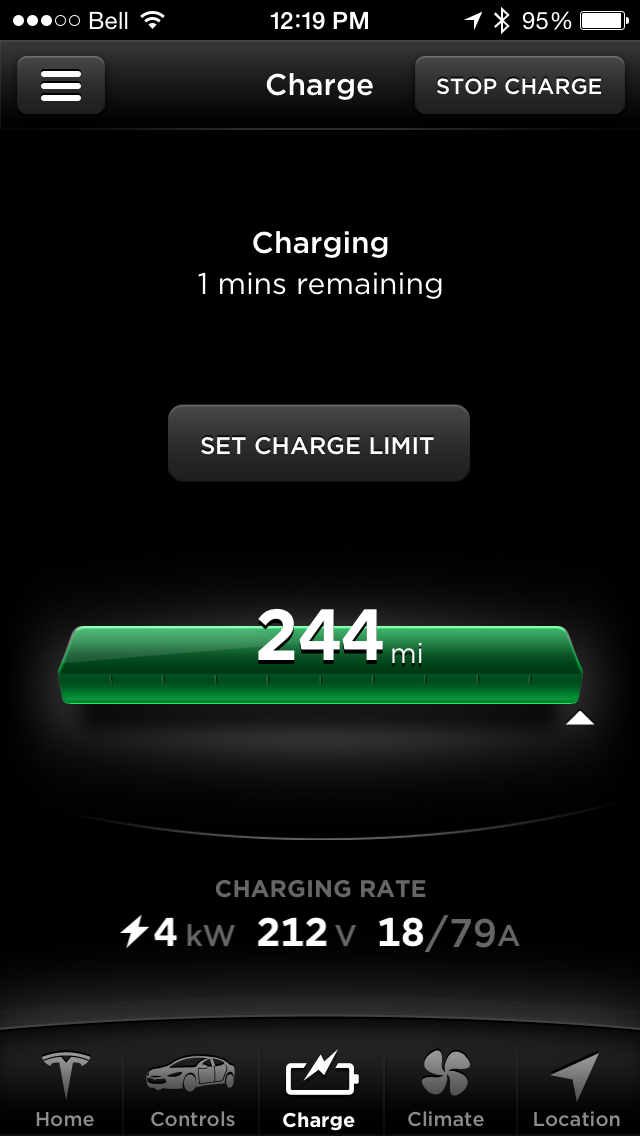
My car seemed to be "stuck" here for more than an hour. Could have been closer to 2 hours. You can see the charge rate had tapered to 18 amps, but the Rated Miles were not moving. To be honest, I started getting worried about over-charging and unplugged before it actually completed. Should I have let it sit for who knows how much longer to complete?�
Jan 19, 2015
tomas @mknox normal phenomena. Some think this is when it balances. Unplug if you need to go. You won't get any more miles.�
Jan 19, 2015
mknox Thanks. I was at work (needed the range for an after work excursion) but didn't need to shut charging off when I did. I was worried about it just sitting there, apparently "full" but still cranking 4 kW at it.�
Jan 19, 2015
qwk Your battery is pretty out of balance if it sits like that for that long.�

Không có nhận xét nào:
Đăng nhận xét