Feb 4, 2016
apacheguy The 85 kWh A pack used different cells with slightly different chemistry. There is now some reason to believe that A packs had greater capacity given bluetinc's data. This is a reasonable inference.�
Feb 4, 2016
supratachophobia I don't necesarily think I have a problem with that route. And yes, it can hit 265 miles of range as advertised. But Tesla doesn't need to fib or stretch the truth to make their car successful. It's real world performance sells the car on it's own merits, not what it can do on paper.�
Feb 4, 2016
apacheguy I suggest we follow up on the lead from bluetinc. The A packs seemed to have true 85 kWh capacity. That's the most reasonable suggestion thus far as to how Tesla derived 85 kWh. It used to be when the model was first introduced just not any longer. And, believe me folks, be happy you don't have an A pack.�
Feb 4, 2016
Bangor Bob Even if A packs had 85kWh of capacity (which personally I don't believe), when the A pack was discontinued the specifications should have been updated. When ICE manufacturers bump up the compression on an engine between model years, the displacement specs (and power output specs) are updated. When they change the size of the fuel tank, that gets updated and the EPA range gets updated. Technical specifications are not marketing material. (Gaming the specs for marketing advantage has a long tradition, however).
This is a very disappointing situation. Their CTO and chief counsel should have strongly argued (and hopefully have, and kept records of it) for disclosing the proper spec. To not do so is a risk to the business. Risks to public companies are to be disclosed to shareholders. Shareholders should be PISSED, the trustworthiness of brand is being damaged (and not for the first time via misreported specs).�
Feb 4, 2016
apacheguy @Bangor - Not disagreeing that Tesla should have updated the specs, just saying that the A pack explanation is the most compelling argument as to how Tesla came up with 85 kWh. There is solid evidence that available energy was > 77 kWh. Unless Tesla doubled the footprint of the bricking buffer, which I doubt.�
Feb 4, 2016
Bangor Bob It appears there may be a couple applicable SAE standards, I'm not a member so don't have access to the actual documents.
Following the accepted industry standards tends to keep you clear of troubles such as this. There's one for motor power as well...�
Feb 4, 2016
Andyw2100 It seems to me you are giving quite a lot of weight to one report from one user of one A-pack. While I'm sure the source is credible and means well, I really think jumping to the conclusion that the A-pack actually had more kWh available than the current packs, based solely on this, is premature. There are a number of possibilities that could account for this. I am by no means an expert, but off the top of my head, here are a few:
--Tesla could have made changes in the software, and how trip energy usage is displayed.
--The car in question could have been malfunctioning, and not recording everything properly
--Tesla could may have been doing something funky with respect to working regen figures back into total kWh usage back then
--Tesla could have been displaying the anti-bricking reserve in energy used once energy used exceeded some figure, or displaying some portion of it every x kWh, such that by the time the figures shown were displayed, the entire anti-bricking reserve was being displayed
Sure, I'm pulling some of these out of thin-air, but not any more than others are pulling other theories out of other places. I'm sure TMC members more expert in this stuff can come up with other more reasonable possibilities for why bluetinc's data may appear as it does, but why that may not mean that the A-packs actually were higher capacity than current packs.�
Feb 4, 2016
LargeHamCollider Ahhh but have you tried charging to 4.35v and then discharging at a cell temp of 45 degrees Celsius at C/10 with 2 hour breaks at every 10% of soc discharged? I suspect that there is a way that one could get the 11.9Wh out of these cells but perhaps not, really this is just marketing, and unfortunately this is completely normal for marketing departments, they drive me nuts. My first rule of buying something is never ever ever ever ever trust a salesman.
Also NCR18650b is a family of cells with widely varying characteristics, there is no one cell that has THE properties of an NCR18650b.�
Feb 4, 2016
schonelucht It could also explain why Tesla insists on keeping A-pack drivers on an A-pack : because if they switched all wholesale there might be a risk that someone notices the range reduction which would have exposed the 'little' secret that >=B-packs have a lower capacity. I like this theory the best of all. Smoking gun would be to find the reason why they couldn't continue with the A-pack cells.�
Feb 4, 2016
Mike K Generally there's a motive behind questionable marketing though. With KWH ratings the numbers means absolutely zip to 99% of the buying public. You could have called the cars 120kwh and it would have made no difference because that's not a term in the average person's vernacular. The juice isn't worth the squeeze. Tesla wouldn't intentionally mislead on a metric that basically nobody used to determine whether or not they were going to buy a Model S. If there's no reasonable reason to lie about something like this, and there isn't, then I tend to look at explanations that are more likely.
I floated the idea earlier that Tesla initially thought to go with an 85kwh pack and then eventually ended up with an 81kwh pack and several people have attempted to discredit that theory by saying that the battery has always had the same capacity. To be clear, I'm not suggesting that the pack has changed capacity during production. What I am suggesting is that way back in the early design phase Tesla set a mileage goal and determined that to reach their mileage goal they would need an 85kwh battery pack. In between rolling out the prototypes, naming the different models (40, 60 and 85) and then actually designing the car and it's electrical system, it was determined that they didn't need 85kwh to reach that mileage goal. Maybe they took some weight out of the car or the heavier pack didn't have as much as a drag on efficiency as they thought it might. Whatever the case may be, before the car went into production they determined that they didn't need a full 85kwh pack and instead went with what they needed to reach their goal. Were this the case, it would totally make sense for them not to rename the car. It would just muddy the waters and add needless confusion. Also people would suddenly perceive that they're getting less, despite the fact that the delivered product would perform exactly as advertised. I think this is what happened.
Now with all that out of the way, where I do take issue is in the optional upgrade to the 90kwh pack. In that upgrade literature they specifically refer to an 85kwh pack and a 90kwh pack and if neither is actually that size and they're not explaining this, then that's a problem that's tough to explain simply because now people are making a purchase decision based on kwh and not advertised range as the 90 doesn't have advertised range.�
Feb 4, 2016
stopcrazypp
That one is a WIP (work in progress) so completely worthless at the moment for industry use and definitely not an "accepted" standard. The SAE electric motor power standard is also a WIP. It needs to at least be a published first edition before it can be used and relied on (after that there will also be continued revisions, but at least you have something basic first). As always, SAE is too late with their standards (just like with J1772 AC and DC/CCS).�
Feb 4, 2016
wk057 Skimmed the thread up to here from when I was last browsing. Lots of activity!
I'll note again that I did test cells from an A-pack as well as B and D packs. They're all the same.
There are ways to get the "Since Last Charge" meter to show pretty funky results. For example, if you reboot your 17" screen while going down a mountain your kWh used will be artificially higher since it wouldn't have subtracted the regen while it was rebooting. Lots of other ways to boost that, too. There's also a few ways to charge without that meter resetting, which actually can happen due to bugs in older firmwares too. If I were to guess, this is probably what happened with the pic up-thread showing ~79 kWh used.
Tesla's response to the news article is amusing. It would be nice if Tesla would release some actual data on the cells to try and prove me wrong vs just implying that I must have not tested them right. lol. I mean, if it's actually an 85 kWh pack and somehow all of the data points we have are wrong (seems unlikely, but hey, anything's possible right?) then it should be pretty simple for them to clear that up, right?�
Feb 5, 2016
stopcrazypp If for example someone on the internet said Nissan got their kWh rating wrong on their pack after doing their own tests, does anyone expect Nissan PR to respond any different (or any car company's PR department)? I'm not sure where the expectation comes that Tesla should do a point by point rebuttal (which would involve one of their engineers looking at the post).
I think the closest is for example claims about MPG not being matched. The response by company PR is always on the order of YMMV depending on conditions.
And the point made is a fair point: measured capacity does vary significantly (way more than the 5% claimed here) based on discharge rate and temperature as well as other many other factors not mentioned by the PR person (charge rate, current/voltage cut-off, calendar degradation, cycle degradation).�
Feb 5, 2016
Fallenone Sorry I didn't read everything in this thread as it became so HUGE in such a short time.
But if the A B D packs are all the same, then my theory of increased mi/kWh over the years led to smaller battery pack sizes later is debunked.
�
Feb 5, 2016
wk057 I would go with that if every test didn't yield virtually the same result. I would also go with it if Tesla's own battery management system didn't report the pack as ~81 kWh +/- 0.5% in CAN logs from over a dozen vehicles from around the world that have been shared with or captured by me.
When every bit of evidence yields the same conclusion, at some point you just have to accept the fact that it's not an 85 kWh pack.�
Feb 5, 2016
stopcrazypp Did you control for cycle/calendar life degradation? Given you are using salvaged packs (and not taking brand new packs or cells from the factory) this will likely mean significant variance in the amount of miles and age of the cells you tested. This is further complicated by degradation being non-linear (rapid at the start and slows down later).
One way to account for this as best as possible is to cycle the newer cells so that they match the older ones before doing tests. This is still flawed (given original cycling conditions are unknown and degradation rate may not be the same between cells, which can introduce significant error), but a lot closer to a control.
Under the theory raised by others (A pack having more capacity than subsequent versions), it would match a result where a degraded A pack measures close to a newer B pack when tested at the same time. Otherwise in the case where both are came out of the factory with the same exact capacity, the older A pack should measure lower capacity based on degradation.�
Feb 5, 2016
Auzie I think Andy's response up thread, quoted below, with few mods in blue, is quite fitting answer to the above
Darn, these engineers better focus on stuff that really matters
 �
�
Feb 5, 2016
stopcrazypp Are the dozen vehicles you got CAN logs from brand new vehicles? How much variance is there in age? I find it unlikely there be only a +/-0.5% variance in capacity simply based on aging. At least 1-2% loss should easily happen within one year (15k miles) at least from the PIA survey results.
If the CAN report is anything like the CAC in the roadster, it is not a true measure of battery capacity, but rather a rough estimate (and that one does change with conditions and software updates).�
Feb 5, 2016
tezzla lol, and then again, some will never agree Tesla that isn't telling the truth!�
Feb 5, 2016
JRP3 I think this may be key. As I said, if when you drive your 85 off the lot the cells are capable of delivering close to 85kWh then it's a moot point. If it's 81-82 right off the lot then that's a bit more of an issue, though again if the car delivers range as advertised it could be argued that Tesla delivered you a more efficient vehicle.�
Feb 5, 2016
Johan ... Which should then have been labeled the Model S 300 [miles at 55 mph] or Model S 265 [EPA miles] which is true, but not Model S 85 [kWh battery].�
Feb 5, 2016
sandpiper Perhaps. Although nobody ever said that the model number has to correlate to some technical spec. The model number is just a label. They could have called it the Model S 31416 - which makes every bit as much sense as some of the model numbers out there.�
Feb 5, 2016
Johan Tesla's 85 kWh rating needs an asterisk (up to 81 kWh, with up to ~77 kWh usa...
Fair enough. In that case read my post like this: the number 85, referring to kWh capacity of the battery pack should never have been used if the battery pack cannot deliver 85.000 VA of energy from being fully charged to completely discharged.
KWh is a unit and has a very specific and unambiguous meaning. 85000 kWhs is exactly defined, there's no margin for error or interpretation. It's an absolutely unambiguous amount of energy.�
Feb 5, 2016
faughtz Don't forget it's not just the model number, look at the battery placard. �
�
Feb 5, 2016
scaesare We need a test of a brand-new Tesla 18650 that's never been cycled once, and is as fresh off the line as possible to reduce calendar-life degradation[1].
If that test reveals a number that logically rounds up to 85KWh (or at least nearer it than 80), then, I don't think there's an issue.
If Panasonic's own rating of the cells logically rounds up to 85KWh, then I don't think there's an issue.
In either case, I think the specification (if not the model # designation) needs to be accurate.
[1] Car that falls off the auto carrier and thus totaled? Although with test drives even "brand new" cars have miles and I suspect a charge cycle on them,,,�
Feb 5, 2016
apacheguy We have it from Jerome Guillien that the A packs do indeed use different cells. I think you just meant they each hold the same capacity?�
Feb 5, 2016
scaesare If you are speaking of drivetrain efficiency (i.e. using 260wh/mi rather than 280), then that makes no difference in the amount of energy stored in the pack.
What that means if that you could go farther than previously on 81KWh with efficiency gains, then you should be able to go even farther still on 85KWh with those same gains.
- - - Updated - - -
Hmm... I had recalled that the PACK was indeed different (hence the lower supercharger rates it could withstand) but not sure that it had quantified as differences in cells, cooling, etc...�
Feb 5, 2016
No2DinosaurFuel I would like to see the internal report tesla from the tesla engineer. It might very well be the smoking gun needed by some lawyer for the class action. But until then we will not know. Again i highly doubt tesla will release such document. And i am sure they have all the engineers sign some nondisclosure to protect against such. The only way to get it is someone to sue and have a judge force them to release the document.
Anyways a side note if i rememeber correctly hyundai was force to correct their mpg on their elantra because no one was able to replicate their mpg. Not sure if they sued.�
Feb 5, 2016
bmah Aw come on. Engineers will find any excuse to get out of a meeting.
(So that at least part of this post is on-topic, let me say that I appreciate the work of wk057 and others related to discovering the Tesla Model S internals. The technical discussion on this thread is fascinating.)�
Feb 5, 2016
Andyw2100 Tesla didn't need to include a point by point rebuttal to the Elektrek article. But assuming the packs ever --DO-- have 85 kWh power when delivered, how hard would it have been for Tesla to say that, or something like that? That omission was both glaring, and in my opinion, telling.
I vehemently disagree with this.
We didn't buy our cars from Panasonic. We bought them from Tesla. Tesla has a responsibility to us, their customers. Panasonic has a responsibility to Tesla and their other customers. If Panasonic got something wrong, Tesla can be upset with Panasonic, but we can rightfully be upset with Tesla.�
Feb 5, 2016
scaesare Sweet, a vehement disagreement!
I'm assuming Panasonic used "industry accepted" methods to rate the cells (in other words, the same way every other cell you get from Panasonic, LG, etc... or the rating used on all your rechargeable tools, laptop battries, etc... that OEM such cells), then why not?
Note that this is very likely a lab-based rating that will never be reached in the real world after a cycle or two. But if you accept it with your Dell laptop and you DeWalt drill, why not your Tesla car?�
Feb 5, 2016
JRP3
Some are trying to claim that over time Tesla has lowered the actual capacity of the pack because over time they found they needed fewer kWh's to get the same range. IF that were true then the cars should reflect that increased efficiency. I don't believe that is the case.�
Feb 5, 2016
Andyw2100 Just for a moment there I thought you were going to actually agree with me.
Your attempt to impugn wk057's work using my words, though, falls flat. My point was that we had seen only one example that was outside the data being presented by wk057, while there are many examples that support the data he has presented. Additionally there were probably explanations for how that one outlying example got there. As it turns out, some of my suggested possibilities are pretty close to some more realistic ones that wk057 proposed later.
There is a great deal of data that supports what wk057 has documented. I'm open to the possibility that somehow his conclusion is incorrect, as I expect is he, but it will take good, hard data to convince me of that. For now, wk057 has presented enough evidence that I believe what he has said is correct.�
Feb 5, 2016
scaesare Gotcha.�
Feb 5, 2016
sandpiper Oh man... we should just go over to the P85D HP debate. With a few carefully selected text search/replaces we can witness the next 100 pages of posts TODAY and save everybody a lot of typing.Maybe we should start a pool to count-down the number of posts before somebody uses the word "lawyer".
�
Feb 5, 2016
Fallenone But they do have 85kWh battery specification everywhere.
�
Feb 5, 2016
bonnie Too late. Tesla's 85 kWh rating needs an asterisk (up to 81 kWh, with up to ~77 kWh usable) - Page 4�
Feb 5, 2016
wk057 As a matter of fact two of them were Tesla-owned demo cars with < 50 miles on them. One didn't even have the shipping protections removed yet. (No, this wasn't local, so no one go and try to get my local service center folks hanged or anything. And no, I'm not going to mention who/how/when/why/where/etc on this to protect the mostly-innocent.)
And I'm quite certain the capacity values reported by the BMS are very accurate (except in the case of a calibration issue from short cycling over an extended period). Additionally, the "60" BMS also correctly reports the capacity that matches external testing.
Yeah, this seems to be a recurring theme for some reason. There really is no getting out of this one. I wouldn't have posted the info if I wasn't certain it was correct. Reasoning behind why they marketed it as an 85 isn't particularly my concern. It's an ~81 kWh pack, it's marketed as an 85. This is false, end of story. There's no real way around that fact. Get over it, do something about it if you must, but don't deny it.
Interesting. I'd be curious to the source of that info from Jerome, personally. I have four A-pack cells in two of my custom cell torture devices still, and their characteristics match exactly (literally something like a 0.2% margin) of newer cells. I could even pretty likely accurately determine their cycle count by fitting their data with the newer cell data.
Calendar life degradation is virtually non-existent with these cells when stored properly (40-60% SoC, room temp or lower), which is impressive. Cycle count has a measurable effect on capacity, and seems pretty predictable for various condition sets.�
Feb 5, 2016
Electricfan I just want to make sure I understand you. You're saying Tesla planned to use an 85 kwh pack, then changed their plan and knowingly reduced the capacity to 81 kwh, and its ok to put a sticker on the pack underneath the car that reads "85 kwh" when they know it only has 81 kwh in it?
Do I have that right?
So its ok with you that this sticker says 85 kwh, when Tesla knows it is really 81 kwh?
 �
�
Feb 5, 2016
stopcrazypp Hyundai was forced to do that because the EPA audited them and found out they did not follow proper procedures for the EPA test cycle. It was not because an internet commenter claimed their MPG couldn't be matched (putting aside for the moment that there is no such standardized test procedure for battery capacity claims).�
Feb 5, 2016
sandpiper Shoulda known. :crying:�
Feb 5, 2016
AWDtsla Here's an idea, how about labeling things so they are non-controversial? Maybe no thread should exist on this subject because no one wants to post anything.
How many more things are there that aren't as claimed... If things turn south it's nobody's fault except Tesla's, definitely not "an internet commenter"�
Feb 5, 2016
Max* :secret: It's not really an electric vehicle.�
Feb 5, 2016
JRP3 That certainly takes care of the age and cycle question.�
Feb 5, 2016
Electricfan It that turns out to be the case, I'm really going to be upset. Wonder where the exhaust is going??�
Feb 5, 2016
stopcrazypp This is why I'm asking about the delta in age and cycles between the vehicles. Unless Tesla has some magic cells with close to no degradation, there should be a much larger variance simply from degradation than just +/-0.5% if you took a random sample of vehicles.
I'll give a concrete example: I would suspect the oldest car in your sample will be more than 1 year old already. Compared to the new cars in question how much variance in CAN reported kWh was there? You are saying essentially the lowest capacity (oldest?) car had a CAN log of 80.6 kWh and the highest (newest?) had 81.4kWh.
Or is your 81 kWh claim cycle/age adjusted?
And I expect you collected the numbers this winter? If the Roadster CAC is any indication, it will vary based on seasonal conditions (big change would be average temperature). When I get home I will figure out the capacity differences vs temperature from the Panasonic datasheets of a couple cells, just to have some ball park figures.
Approximation works well for cycle degradation in some areas (where locally it will work), but there are a couple of knee points where the rate changes at least according to Panasonic datasheets.�
Feb 5, 2016
wk057 I've already pointing out that calendar life has very little effect on these cells. It's almost nothing. Like literally, it would be fine to pretty much round it down to nothing. Unless the cells weren't stored at 4.2V+ inside an active volcano or something, there's not much to measure there.
The highest I've seen reported by the BMS was in fact 81.4 kWh (77.4 kWh usable, 4 kWh brick protection). The lowest, a 2013 car with ~40k miles was 80.4 kWh, and this car's BMS likely suffers from the calibration issue a bit since the owner regularly charges to 80% so it's potentially a bit higher. My ~81 kWh claim is based on my own testing, which also happens to match within a tight margin of Tesla's own software reporting.
Additionally, my "car-like" cell torture tests (heavy loads to simulate acceleration (sometimes pretty heavy acceleration), some regen when the simulated car is stopping, varying low C discharge to simulate normal driving and driving with hills and such at various speeds, HPWC charging speeds 80%, 20% supercharging, some idle time occasionally to simulate parking while not charging, etc etc etc) have yielded very promising results, actually, and show significantly less degradation per cycle than just my continuous cycle tests. Not 100% sure the technical reasoning behind this, but seems to be true based on quite a bit of data.
Overall, the numbers work out so that for one, calendar life has little to no effect. For two, every cell I've tested (both 60 and 85 pack cells, multiple revisions) is the same type of cell (same capacity, same IR at the same temperatures, same cycle degradation in the same conditions, etc etc).
Again, I've been collecting data on these cells since not long after the very first pack I tore down, and more recently collecting data from others via CAN logging. The cells I have in testing are connected using solid copper cylinders roughly the diameter of the positive cap and are clamped in place to prevent any possible wiring losses (basically wired for 400A). These are connected directly to the PCB that does the testing, which surrounds the cell on three sides of its 2D plane. This is then able to be put inside a thermal controlled enclosure, if desired, along with direct contact thermal control possible (which I use for supercharging type testing). The device, unfortunately, is not entirely my design, so I do not have the rights to disclose and share full details on. Suffice it to say it's been certified to work for this purpose to within an incredible margin of error of something like 0.01%, enough to accurately determine degradation nearly with each cycle. People much smarter than I have had their hands in on this one and are working towards a salable industrial product. The great thing about the design is that it's inexpensive... so blowing up a cell during testing isn't a huge loss. I've um... destroyed a few of these when pressing the limits.
Anyway, you can keep trying to find some caveat or "aha" piece of information that absolves Tesla or otherwise would make the "85" number not a lie... and I welcome that. But you're not going to accomplish that by trying to nit pick my data. You're welcome to test your own cells in whatever conditions you think will get the result you want. I highly doubt you'll get better results, but hey, what do I know?
- - - Updated - - -
These aren't any cell that there is a public Panasonic datasheet for, so anything gleaned from public datasheets is just a guess.�
Feb 5, 2016
techmaven I don't doubt wk057's data at all. I'm sure he's exactly right with his BMS readings and his cell tests.
I'm saying that Tesla's 85 kWh is like a 1 TB hard drive. Tesla bought 11.84 watt cells from Panasonic, put 7104 together and sold them to us. The spec says 84.1 kWh, and Tesla rounded to 85 kWh. To use a computer analogy, Dell buys a 1 TB drive from, say, Seagate. That's actually 930 or so gigabytes since computers actually use 1024 instead of 1000 per kb. Then, Dell should know that you are formatting down to something useable with NTFS or FAT, so the actual usable space left is under 900 GB or so depending on the filesystem. So Dell should know that the Seagate 1TB drive is under 900 GB, right? Should they sell them at 1TB or 875 GB? Whether Dell calls these 950 GB or 1TB drives, it doesn't change the fact that you are likely to see something under 900 GB of usable disk space.
So the 77.4 kWh of useable pack is what we've had all this time and we've known that. Or actually, 77.4 kWh optimally, depending on temperature and current draw, we're probably anywhere from 74-77 kWh. That's still 265 miles of EPA range. You still bought 7104 x 3200 mAh cells as marked by Panasonic.
I am curious how other manufacturers have chosen to mark their packs. Use LG/Samsung/SKI/Panasonic ratings which is business as usual, or do they do a more "realistic" rating? I do think that they should mark on the sticker, as part of the EPA range the actual battery capacity available to attain that EPA range. That would then be a clear comparison with everyone. As it stands, the EPA kWh/100 miles includes charging efficiency which obfuscates the battery pack capacity.
I'm actually amazed that we're allowed to use about 95% of the pack's capacity (instead of 91%) and we still have this kind of cycle life. These Panasonic NCA cells are pretty amazing.�
Feb 5, 2016
nwdiver Apologies if this was already discussed... but what should that 85kWh rating be based on? Wk057 didn't test new cells did he? What's the capacity of a new cell charged to 100%? I think there's a sweet spot where capacity actually rises a bit after a couple cycles... should it be based on that? Temperature has an effect too... 10C, 20C? What's the discharge rate? That has a big effect too. ANY battery capacity comes with a lot of (*)s....
 �
�
Feb 5, 2016
stopcrazypp Okay we can ignore calendar life, but from your result, you are saying a close to new pack has 81.4kWh. A 40k mile car has 80.4kWh (potentially higher). So 1.2% degradation over roughly 200 cycles. That is pretty incredible.
How does your car-like and continuous cycle tests compare to the above degradation rate (roughly 0.006% per cycle)?
I would not be as strict if the deviation was as extreme as 20% for example (don't want to bring it up again, but see the 691 hp discussion; i did not question REST API results as a way of comparing). We are instead discussing a 5% deviation, where test conditions matter a lot.
I asked for a sanity check before on the NCR18650B with you test methods and there was a 1.5% deviation from other test results and 2.4% deviation on manufacturer nameplate. Compared to the 5% claimed this is a very big chunk.�
Feb 5, 2016
wk057 It is incredible. Don't get me wrong, these cells are awesome and are performing extremely well in my testing as far as degradation goes. My point is that they just are not 11.965Wh cells in any test under any condition that I've been able to try.
I want to hold off on releasing a bunch of data from my tests until I can publicly release info on the devices I'm using, along with summaries of the mountains of data I'm generating. But, I'll answer your question. This particular test is showing incredibly low degradation. My car-like test has been running for about 6 months now and the equivalent of about 10,000 miles per month of wear (my fake driver must only sleep while the fake car charges hehe). Admittedly, I estimated the anti-brick buffer at 3.5 kWh back when I started the testing, so I even discharge them a little more at times than Tesla would when my function allows the car to be fully drained (few times per month). If these cells were in a car they would only have lost roughly 2.2% range after ~60,000 miles. Again, the cells are awesome cells and are perfect for their application. They just don't meet the advertised capacity spec.
Makes sense. Keep in mind that the Panasonic datasheets generally don't include Wh, only Ah. I think Wh is the more important number, personally.�
Feb 5, 2016
AWDtsla Was 50 Celsius one of the conditions?�
Feb 5, 2016
wk057 No, but 60C was.�
Feb 5, 2016
smac Quick question for the age / degradation theorists...
How do you explain my 60kWh battery having more than 60kWh after 20 months and 12k miles?
All this theorising of how Tesla got to the 85 figure is fine, but doesn't explain how they were accurate on the 60.
For me the range / performance / specs are fine if consistent across the board. This is yet another case of stretching the gap between models via differing measurement standards. Clearly aimed at boosting ASP. I had thought Tesla were beyond these sorts of used car dealer tactics, but clearly they are not.
Fine while they have no competition, but I've personally lost trust to the point I'd consider an alternative manufacturer for my replacement car.�
Feb 5, 2016
CO2CLEAN I understand your concern, but you can compare the advertised range between different battery packs and base your purchase on that. The range is correct, since it is tested under lab conditions by an independent organisation (EPA). I think most (if not all) buyers will only look at the advertised range and not so much to the advertised capacity.
To come back to a question earlier in this thread about how other manufacturers advertise their batteries: Volvo only advertises the total battery capacity (11.2 kWh for V60 PIH), no number whatsoever about the useable kWh (around 8 kWh). Some legislation about how to advertise battery capacity would be helpful, although I do not really care about the actual number as long as the advertised range (and conditions) is correct.
By the way: wk057, many thanks to your amazing work on these batteries! Very interesting and facinating to find out what it really is all about. Keep up the great work.�
Feb 5, 2016
apacheguy Yes, cells were different. But the energy density is claimed to be the same so the point is moot.
�
Feb 5, 2016
wk057 I'm still curious as to the source of the "the cells are different" claim... (I know you said Jerome, but where did Jerome say this?) I'm guessing he or someone might have just gotten that confused or was misinformed. As far as I know the reason the original "A" packs can't supercharge at 120kW is because the cable in the spine is a slightly thinner gauge that would heat up too rapidly at sustained high amperage charge/discharge. The one in the newer packs isn't much larger, but takes longer to heat. So the taper ends up happening before it's a problem.�
Feb 5, 2016
apacheguy @wk - source was later confirmed to be Jerome Guillen
If that were true I have no doubt Tesla would have offered an upgrade route. Replacing the spine would have required just about the same hours of labor as the contactor retrofits.�
Feb 5, 2016
wk057 Yikes. Not likely. Replacing the spine would require disconnecting every module, and removing the front two, at a minimum, which would require purging the cooling loop too. The spine is also embedded in rubber potting material that's injected and cures during assembly, too, making it a bitch to remove. Took me several hours of picking and pulling to remove it on the first pack I tore completely down to the metal. I didn't bother on the subsequent one since it wasn't worth it for 6' of 2/0 cable.�
Feb 5, 2016
JRP3 As previously stated Tesla probably designed the 85kWh pack first, using the numbers from Panasonic. When they then started designing the 60 they realized that the cells didn't quite make the specs from Panasonic in the real world. My guess is originally they fully intended the 60 pack to be a 65 pack.�
Feb 5, 2016
Bangor Bob Well... Except the 60 is closer to 65 than the 85 is to 85.�
Feb 5, 2016
NuclearPowered Any clarity using your info into why the rated range for many owners indicates loss significantly greater than 2.2% after fewer miles?�
Feb 5, 2016
wk057 Because the BMS is bad at capacity estimates if you short cycle a lot. For example, charging to 80% to 65% and recharging to 80% regularly is a surefire way to throw the BMS all out of whack. Eventually I guess Tesla might fix this, and some people will magically get some range back.
Then again, there are a lot of factors that could cause real degradation, like always charging to 100%, or leaving the car at high SoC in the heat and such. Even with thermal management it's not going to mitigate 100% of the accelerated degradation these things cause.�
Feb 5, 2016
dhanson865 I wish people would stop saying this. EPA doesn't test range on cars, and they don't test efficiency on most cars.
Download the test data from Test Car List Data Files | Cars and Light Trucks | US EPA and pay attention to the field called "Test Originator" and note how 99% of them say "MFR" and a few say "EPA". As in the EPA didn't test most of those cars and they have never tested Tesla cars. For example on the 2016 spreadsheet only 14 of 75 Toyota Prius configurations say "EPA" and the other 61 say "MFR". In the case of Tesla that is 12 "MFR" and 0 "EPA". I personally didn't download 2012-2015 and check them all manually so if you want to go through the trouble and tell us if I'm wrong I'll be happy to go back and download additional data files to confirm but only if you do the labor first and tell me which year the EPA bothered to test a Tesla vehicle if any at all.
I'm not sure why you assume or believe that the EPA tests these vehicles that they aren't testing. I can tell you most of the time they didn't.
I'll leave you with this blurb from Emission and Fuel Economy Test Data | Cars and Light Trucks | US EPA
�
Feb 5, 2016
stopcrazypp I understand you will have concerns about releasing data given the special equipment you are using. I will wait until you get the permission to do your data dump (along with releasing test conditions) before commenting further. Doing this discussion in a Q&A format (rather than just looking at data with laid out test conditions, like for example in a datasheet) makes it seem very nit-picky, so I don't want to give that impression. Thank you for taking the time to address the questions raised.
- - - Updated - - -
I have a simple non-malicious theory to explain the whole 60kWh vs 85kWh deal, but it keeps getting buried. It is slightly different than JRP3's. They announced capacities first, designed later (in a 85kWh -> 60kWh -> 40kWh progression rather than all at once), but ran into degradation/discharge/charge rate constrains in terms of choosing the number of cells to blank out (they ended up blanking out 10 cells per group, when they could have blanked out 14 to match same ratio as 85kWh).
Way back then my original theory was that 60kWh pack would either use different cells (slightly more power optimized) or would be the same exact modules but with fewer. Turns out neither was true: they instead chose to blank out cells per module (with two fewer modules). This has all the signs of a last minute design (that came well after they announced capacities).
�
Feb 5, 2016
DavidB In your opinion, wk, is there any harm to almost always only charging to 65%, other than the estimating software getting out of wack?�
Feb 5, 2016
Dbitter1 So I just have to ask... is anyone taking bets on what a 70 or 90 battery pack really is?�
Feb 5, 2016
Quantum` Nothing in the owner's manual says anything anywhere about 90%.
The three things that shorten a LIon's life are
- Heat
- Repeated excessive discharge
- Number of charge/discharge cycles.
Unless the pack's BMS is so poorly-designed as to allow excessive heat buildup on full-charge trickle, there is no harm in charging to 100%.
I realize that this is unheard-of heresy, but it's also established fact.�
Feb 5, 2016
dhanson865 Unheard of? It's the daily existence for Nissan Leaf owners in the southern US.
A pack with no active cooling and a BMS that allows it to bake itself while charging, check and check.
The only silver lining is leaf owners don't care about charge cycles or miles on the odometer because heat degradation swamps that variable into non relevance.�
Feb 5, 2016
Beltsbear the fourth item you left out is being in high and low states of charge. Over 90% and under 10% shorten life too.�
Feb 5, 2016
stopcrazypp Sitting at 100% SOC is a sure way to kill a battery quickly. Cycling to 100% and using it up quickly however is a lot better.�
Feb 5, 2016
smac A small point of technical trivia EV manufacturers have an exception in the rules for independent testing. IOW Tesla just submit their own numbers.
In fact the official EPA submission by Tesla for the 70, understates range with a little * and a footnote saying as much.�
Feb 5, 2016
AntronX According to Prof. Jeff Dahn of Dalhousie University, the biggest factor that shortens lithium battery life is time spent at high voltage. Here is an excerpt from his presentation. That entire presentation is worth watching for the depth of technical detail alone.�
Feb 6, 2016
jpet And my car is a good example of the BMS freaking out for exactly this reason. I have registered ALL of my range charges in the MaxRange Tesla Battery Survey sheet (look up jpet) and now I can compare my "Tesla estimated" max range with 224 other cars.
I cycle between 30 and 70% because I know this is better to get more cycles out of the cells. I only charge above 70% when I need the range (and that is not often). The result of doing things a little differently than the majority is that I have an estimated range that is probably the worst from the group (see the purple dots).

So what am I going to do about it? Nothing! The range displayed in the car is nothing more than a best estimate and unless you torture the cells a lot, this estimate is going to be off by quite some margin. The majority will KISS and that's fine but at the end of the day (make that a significant number of years) degradation and cycle life will not be equal.�
Feb 6, 2016
OddB Interesting !
Here are a recent survey among the norwegian owners. Only one data point pr car.
The apparent large differences can probably be explained by inaccurate readings, bad BMS estimates AND (not mentioned in this thread (?)) unbalanced cells.
As I understand BMS estimate errors doesnt hinder you in utilize the full capacity but bad balancing will ?
 �
�
Feb 6, 2016
Pajda At first I must say great thank you to wk057 for doing this tests and presenting results. But this discussion starts to be strange. So again I ask the fundamental question:
Till now I don`t have lucky to get some Tesla cells for my own tests, but from my experiences with many other industrial grade 18650 cells I have no reason to believe that wk057 results are wrong.�
Feb 6, 2016
jpet BMS estimate errors will indeed not hinder using the full capacity and that's probably why some people like to take the risk driving below the 0 range point.
When the pack is not fully balanced the cells with the lowest voltage will probably make the BMS shut the whole system down to protect them.
But that is not a concern I have since I cycle between 30 and 70% which leaves plenty of room for the cells to be unbalanced.
When I need to have the full capacity / range available, I first do a range charge which triggers the balancing so that things happen naturally.
You don't really have to think about the battery. It manages itself pretty well. If you like, you can adopt a charge habit that optimizes cell life but with an 8 year warranty there's no need to worry for most owners.�
Feb 6, 2016
CO2CLEAN I stand corrected, I did not know that the EPA does not test the cars itself (except for a few, as you mentioned above). I am from Europe, and the NEDC test (European EPA-like test) is done by an independent organisation, that is why I incorrectly assumed that the EPA did all tests themselves.�
Feb 6, 2016
jpet wk057 has more than deserved our respect and gratitude for sharing his research and findings with the community.
So without further ado, I would like to officially nominate him for the title of "The leader of the pack". :tongue:
�
Feb 6, 2016
Andyw2100 Careful! With the kind of research and findings he's been coming up with, you don't want to give Tesla any ideas. (They do have OTA access to his brakes!)�
Feb 6, 2016
jpet He has that covered. Tesla has to ask permission if they want to ssh his car remotely.�
Feb 6, 2016
apacheguy I charge to 80% regularly and my apparent loss of rated range is greater than 3% with 10,000 miles. My last road trip in which I cycled the pack < 10% -> 100% 3 times in succession resulting in losing an additional mile. Not sure how to explain this.�
Feb 6, 2016
Quantum` Thank you, excellent lecture, but have a look here. Notice a couple of things; first off, he's referring specifically to the type of battery which Tesla uses. Second, there is absolutely no rollover at 4.25v. Do you think that Tesla has 100% charge set to -above- this level? Certainly not.
So we deduce:
- It is not harmful to charge to 100%, as long as the pack doesn't overheat, and there are protections against that. (coolant loop, heat pump, overtemp protection)
- In hot climates it's more difficult to get max life out of the pack, but again with protections there shouldn't be significant impact.
- It is better to -not- charge every day, as that is adding charge/discharge cycles to the pack, which directly affects lifetime. Run the pack down to whatever you're comfortable with, whether it's 40%, 10%, or 0% and then charge it up. Always charge up before a storm though.
I realize that 90% charge has been Gospel around here for a long time, but who are you going to believe, the Owner';s Manual, or your own lying eyes?�
Feb 6, 2016
wk057 This is false. 1 cycle is one cycle, whether or not it is a partial cycle or not makes little to no difference. 1 cycle is equal to draining the full capacity out of the cell and replenishing full capacity. So if yoy drive from 90% to 80% and charge to 90% thats 0.1 cycles worth of wear. Same with regen, which contributes towards this total also.
The best resting state is 50% +/- 10% at 50 to 60F or so. But resting at 80 or 90% is not much different as long as thr pack temp is kept reasonable.�
Feb 6, 2016
stopcrazypp You are talking about something different. He is talking about charging to 100% SOC (4.2V cell voltage for Model S) and letting the car sit there (potentially at high temperatures too). Every single battery expert will say that is one of the worst things you can do for battery longevity. We are not talking about simply charging to 100% SOC (and then using it up almost immediately).�
Feb 6, 2016
jpet DoD is a key factor in degradation so it is definitely better to charge your car whenever you can.
"A connected Model S is a happy Model S."
Here's some research material you might want to read on the subject:
http://repository.osakafu-u.ac.jp/dspace/bitstream/10466/14150/1/2014900048.pdf�
Feb 6, 2016
Quantum` He is talking about charging a battery up to given voltage points and then discharging it, as the point of his work was to exercise the battery. But nothing about this says that storing it for a reasonable time (say, 2 weeks) at 100% will impair longevity. Tesla has enough sense to not set 100% to a level which will impact life of the pack. (der)
(Must I also say that of course the pack won't stay at 100%, due to Ri, not to mention draws from the car? Hopefully we all know better)
Yes it's best to long-term store LIon batteries at 60% or so charge. (and to never let it freeze discharged) But most ppl drive their car almost every day, so energy transfer is taking place. But this doesn't mean that you should only ever charge your car to max 60%.
Believe it, or not. Idc. And I am not here to bicker with wk057 as he always wants.�
Feb 6, 2016
stopcrazypp I thought Tesla set 100% at a lower voltage too (as they did with the Roadster), but found out long ago this is not the case. The Model S charging peaks at 402-403V. With 96 in series, that is 4.2V. So the Model S does charge to "true" 100%.
Although Tesla cells are not the same, for the similar NCR18650B, storing at 4.2V at 25C means you lose 1.6% of your capacity a month. At 50C you lose 20% in a month.
http://batterybro.com/blogs/18650-wholesale-battery-reviews/77975750-how-to-store-18650-batteries-safely
Edit: dug for irrecoverable losses:
3-4% loss over 18 months stored at 100%SOC at 23C (Eagle-Picher cells).
http://ntrs.nasa.gov/archive/nasa/casi.ntrs.nasa.gov/20030112621.pdf
More NASA data at 50% SOC storage (SAFT cells):

https://batteryworkshop.msfc.nasa.gov/presentations/Stor_Char_LiIon_Batt_KBugga.pdf
Compare this to the 5% we are wringing our hands over in this thread.
I would say that is significant.�
Feb 6, 2016
JRP3 I'm fairly sure that full charge for an NCA cell is higher than 4.2V.�
Feb 6, 2016
wk057 Time spent at 100% charge definitely matters. And 100% on the Model S is in fact 100% charged. 4.2V with about a 75mA cut off in the CV stage. This is pretty much filled to the brim for these cells. 0% USoC is really about 5% SoC due to the anti-brick/DoD safety buffer.
lol?
- - - Updated - - -
You can charge them higher, but the return is basically nothing at the expense of instantly damaging the cell. The capacity difference betwen a 4.2V/75mA cut and 4.35V/75mA cut is something like 0.08Wh at best (off the top of my head, don't hold me to that). And occasionally the cells explode when doing this, so, that's a drawback to longevity. If it does survive, capacity is immediately degraded by almost as much as the extra capacity that was initially packed in. So, I wouldn't consider anything above 4.2V as safe or usable.�
Feb 6, 2016
techmaven This paper, written by Panasonic employees, presents lifecycle information on NCA cells:
Development of High Power and Long Life Lithium Secondary Batteries
They are cycling between 3.6 volts and 4.05 volts. I leave it to you all to sort out what that means for the Tesla packs. Of course, these aren't exactly Tesla's cells.�
Feb 6, 2016
wk057 That's cycling between roughly 50% and ~85-90%... the cells should basically last forever in that use case if thermal controlled and charge/discharge rate is reasonable.�
Feb 6, 2016
techmaven Yeah, you can see that at 3,000 charge cycles, the degradation at 2C charge! and discharge is just over 10%. Even at 150 miles a charge cycle conservatively, that's 450,000 miles. Of course, our cars actually discharge at 3-5C, and never charge at 2C. I don't know the effects of the DC-IR increase, I'm assuming that is dropping the available power in pack or increasing it? I don't know which direction, it isn't clear.�
Feb 6, 2016
JRP3 I wasn't thinking of anything above 4.3. Just looking at some NCA discharge curves made me think 4.25-.430 might be a true 100%, but as you say not much to be gained up there. Examples comparing NCA to modified NCA:

 �
�
Feb 6, 2016
wk057 The Model S averages well under 1C discharge in normal driving. IR will increase with the life of the battery, which limits the peak power available.
But yeah, I expect these battery packs to last for a very long time in the Model S with very little degradation, especially following the basics for longevity. No sitting for extended periods at > 90% or < 10%, no sitting for extended periods at high temperatures, etc.�
Feb 6, 2016
Quantum` stop and JRP, please understand: The Panasonic 18650 cell's nominal voltage, that is its fully-charged voltage, is 3.6v. When ppl talk about 4.2v and above, that is actually charging voltage. When charging is removed, 4.2v is no longer applied. (Do I have to acknowledge that Tesla's cells aren't quite Panasonic's?)
Better LIon battery chargers always have sophisticated charging algos toward the end of a cycle to trickle the pack, of course Tesla being no exception. These algos are specifically intended to top off and allow balancing of the pack with the clear intent of maximizing its lifetime of use. If you do not charge to 100% at least occasionally, you may not be triggering the balancing logic. I say 'may not' because I think it's likely but I haven't absolutely confirmed that.
I should also observe, if you watch the lecture in its entirety it could cast serious doubt on the longevity of the 90kWh pack.�
Feb 6, 2016
wk057 *shrugs* In my testing basically anything above 4.2V causes immediate and measurable degradation that far outweighs the value of the one-time minor capacity gain. Do this a few times and you'll have degraded the cell literally 10-20x faster than charging to 4.2V.�
Feb 6, 2016
techmaven Well... without a few full charge cycles, it is unlikely your pack is balanced enough and the BMS is calibrated correctly to know your actual degradation. That means discharging below, say, 20 miles of range, and then doing a full range charge. Supercharging might not help in this process, possibly doing it at a lower amperage works better. And possibly more than once. Then you get both a balanced pack and a BMS that is calibrated correctly.
Now, is it worth doing that to see the display say 252 or 255 instead of 248? Probably not.�
Feb 6, 2016
wk057 You're going to gave to stop with the misinformation at some point. Not sure what you base this claim on, but sharged to 4.2V, with a low cut amperage (normal), the cell will remain at or near 4.2V once charging is done. They don't reach 3.6V until around 50% SoC. Nominal is just the average voltage over the entire SoC range, which happens to work out to ~50% SoC. The cells don't just drop to 3.6V when you're done charging them.�
Feb 6, 2016
supratachophobia Based on that battery lecture I was watched, wasn't the best storage method 50%-ish at 30 degrees F?
Edit: 1:08:00, batteries stored at 20% charge (estimated 3.5v) in 1999, and then tested in 2013, had no degradation. Now he didn't mention at what temp they were stored.
Also, it should be noted that I think Tesla hired that guy. So he probably does know what he is talking about.�
Feb 6, 2016
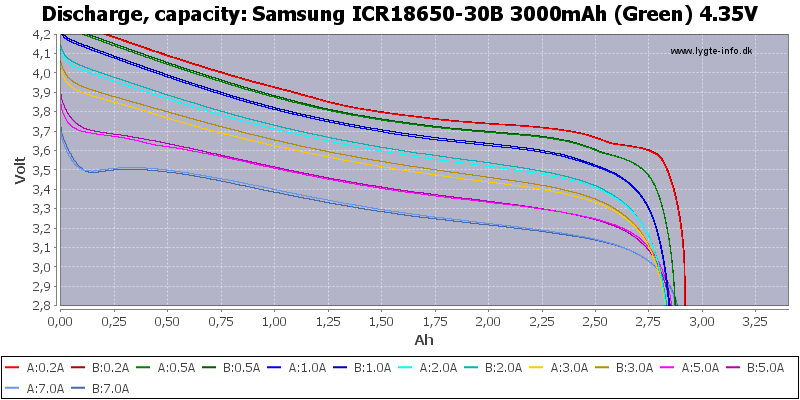
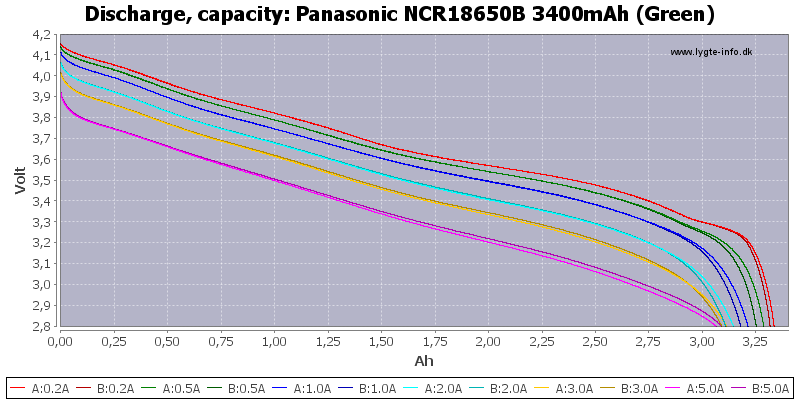
stopcrazypp That is not how lithium ion battery charging works. Look at a CC-CV curve of a 4.35V cell and a 4.2V cell for example (note where the voltage stops):
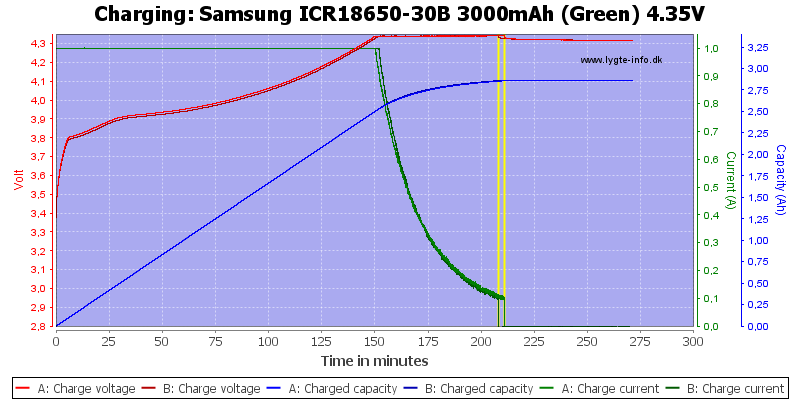
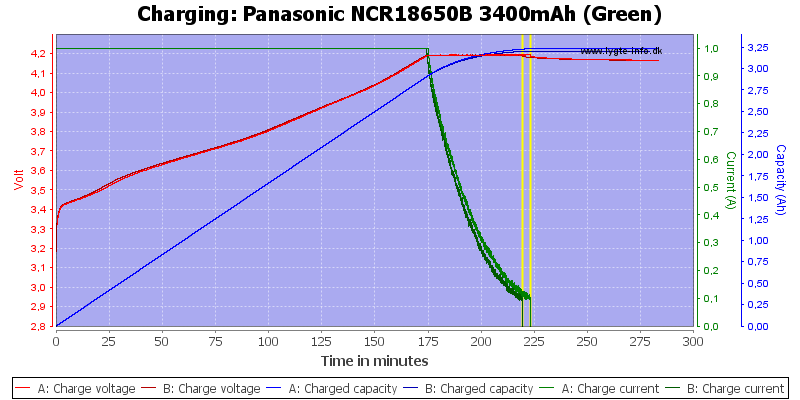
Then look at discharge curves (note where the voltage starts):
 �
�
Feb 6, 2016
kennybobby The charging voltage may be held at or slightly above 4.2 in order for current to flow, but i doubt tesla would allow any cells to remain at 4.2 very long.
There is a chart of brick voltages after a 100% charge by LolaChampCar in his CAN-Logging thread.�
Feb 6, 2016
Johan Quantum: dude, if you don't know that "nominal voltage" is a mathematical construct, a sort of average voltage during a full discharge cycle that can be used to calculate energy storage capacity of a battery cell, you really shouldn't be arguing with wk057, jpet, JRP3, stopcrazyppl and other people with intimate knowledge and understanding of Tesla/Panasonic cells.
Let's get this perfectly clear: yes, in order to charge a battery one must apply a voltage delta, to make current flow in to the battery. At 100% SOC that charging current will be slightly above 4.2V. Keep increasing it and the cell starts degrading rapidly with a real risk of exploding (this is how Panasonic has defined 100% SOC). As you disconnect the charger and start drawing current you are definitely going to see 4.2V from the battery cell (unless you start drawing heavily in which case you'll experience voltage sag, which is another phenomenon).�
Feb 7, 2016
snooper77 @wk57: How about you summarize your key findings so far in a few bullet points in your first post?
That way people will be less likely to miss your key findings (and thus won't re-iterate claims that you have already debuked), and you'll also find it easier to rebut if they still do by simply referring them to the bullet list.�
Feb 7, 2016
lolachampcar attachment.php
Hopefully the animation part works when linked. This should help with the battery voltage dropping BS which JRP has pointed out.
If not, its mid way down the page here
Chassis CAN Logging To ASCII Text Plus Graphing - Page 5�
Feb 7, 2016
CO2CLEAN Works like a charm! Great animation that clearly shows what is happening.�
Feb 7, 2016
brec Off-topic and thus I hope not worthy of public replies, but I don't know where else to post this to make it useful:
The number of posts per page varies by user from 5 to 500 depending on Settings::General Settings::Thread Display Options::Number of Posts to Show Per Page. It is unfortunate that page titles (as displayed in links such as the one quoted) include the page number. If the link is to a specific post, no harm; but if it's indeed to a page of posts it may be less useful than intended.�
Feb 7, 2016
dsm363 mod note: the posts were being reviewed, not ignored so making accusations of being ignored by volunteer moderators not helpful. moved to
snippiness�
Feb 7, 2016
OddB Fair enough. .. But you should have left wk057 's comment about why he had left his own thread....
And why not remove Quantum's comments that are clearly pure trolling ?�
Feb 7, 2016
dsm363 Some people leave threads often but come back. A lot of posts were swept up in it. He also quotes Quantum`which contains language that was complained about so that post was moved as well.�
Feb 7, 2016
lolachampcar sorry brec.... didn't know that.
I really need to learn how to reference a specific post instead of referencing a page.�
Feb 7, 2016
dsm363 Click on the number of the post. For example your post above is post 391
Tesla's 85 kWh rating needs an asterisk (up to 81 kWh, with up to ~77 kWh usable) - Page 40
you click on the number and then copy and paste the URL from your browser.
- - - Updated - - -
Was the post you were talking about #48?
Chassis CAN Logging To ASCII Text Plus Graphing - Page 5�
Feb 7, 2016
wk057 Thanks.
To set the record straight (since this post kind of reads like I was being unfair to the volunteers here, since context is lost) within 10 minutes of me reporting the post in question I received a PM from a moderator about it. The PM was about how they thought it was interesting that I'm reporting rude posts here on TMC, but that I've left certain things up on the little mini-forum that I started back when I was banned from TMC (and for the record, had essentially closed to registrations soon after and haven't touched since... it was quite dead). Fair point I suppose, but I hadn't gotten around to officially killing off the dead forum yet. So, my report was certainly seen by a moderator, and instead the moderator took the time to write me a PM about something someone posted on my dead forum months ago vs simply dealing with the post I reported. Knowing the report was seen, but not acted upon over 12 hours later, and given the PM I received, I made the assumption that my report was being ignored.
Since I was mistaken (post in question needed more moderator peer review), my apologies. Additionally, I've gone ahead and removed my entire little mini-forum. Instead skie.net will just have links to and info about my projects, my important threads here, etc. Hopefully there will be no more contention about the site now.�
Feb 7, 2016
lolachampcar Yes
Perfect. Thanks DSM.�
Feb 7, 2016
supratachophobia I have a question for wk and others that have been involved in these battery tests. What does the optimum life of a Tesla battery look like? Basically daily charging/discharging threshold? Going by Tesla's suggestion, daily charging to between 50 and 90% is as much as they will say. And they give no mention to the effects of running a battery down to a certain percent.
I understand their motivation. They don't want owners to worry about it and most likely the effects on the battery are a matter of only single digit percentages. They seem to have built fairly robust technology and systems into the car to make that a reality. But assuming that the owner is willing to assume a minor amount of inconvenience (both by worrying about how much to charge and how much to use of that charge), what is the absolute best practice on how to treat your Tesla battery?�
Feb 7, 2016
smac In short there is none.
The 100% best source for a guidance would be Tesla, and they offer none explicitly other than keep it under 90%.
FWIW I charge mine to 80% in general, but then I fully intend handing it back and getting another.
One thing I will say is I set mine to a full 100% trip, and I forgot to unset it there once, next day I went out to my car and found it sat fully charged. At that point I had a minor moment of "regret" for the pack. But hey it will be going back to them long before range degradation is my problem....
... besides I don't feel too bad, it's their choice if they wont make it clear what the optimum is and leave charging to some customer determined slider, and won't force it to reset after a "trip button", just to avoid range averaging on the spec sheet like the Leaf�
Feb 7, 2016
jpet Personally I do not believe the effects to be single digit percentages but it depends on your time horizon and milage. In any case, I use the research that's available on Li-Ion cell degradation and I apply the conclusions to my daily charging / discharging habits. It is very easy if you only need around 30 to 40% of the pack capacity per day.
I have posted a link to a quite interesting research paper on the effect of DoD on the degradation of Panasonic Li-Ion cells in this thread a couple of days ago.
Here's another link to a Battery University page you might want to read very carefully:
How to Prolong Lithium-based Batteries - Battery University
Note that the Tesla battery is kept in a better shape since it is temperature controlled by the BMS but I do not believe Tesla has created some sort of "Super Cells" that are much better than anything else out there. Tesla cells will degrade and die like any other Li-Ion cells.
I'm trying to find out at what SoC % the cells resting voltage is 3.92V. I am without my car since December 21st because I was rear-ended. As soon as I have my car back, I will use a CAN bus logger to find out the best SoC to charge the car to. I'm currently using 70%.
Why 3.92V? "Charging to 3.92V/cell appears to provide the best compromise in terms of maximum longevity, but this reduces the capacity to only about 60 percent."�
Feb 7, 2016
supratachophobia Do you think lower discharge levels adversely affect the battery? In other words, charge to 80% knowing you'll use it down to 30% or charge to 60% knowing you'll use it down to 10%.�
Feb 7, 2016
jpet You can find the answer on page 94 of the research document I posted a link to in this thread a couple of days ago. There is almost no difference between cycling between 80 -> 30 vs 60 -> 10. But, since your car will have better performance when cycling at higher voltages + you will have a greater buffer available in case you need some extra range at the end of the day, I would cycle in the 80 -> 30 region.
Here's the chart from the research:
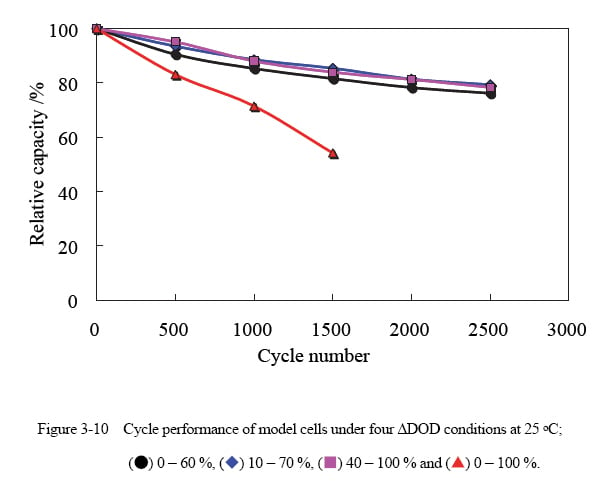
Note that DoD is the inverse of SoC so 10 to 70 DoD = 90 to 30 Soc and 40 to 100 DoD = 60 to 0 SoC.
By the way, in your example you have another option available and that is to cycle between 70% and 20%. That's the option I would personally choose since 70% will be closer to the optimum of 3.92V and you will also stay closer to the mid-point of the 3.6V nominal voltage of the cell.�
Feb 7, 2016
apacheguy @jpet - If you deeply cycle your pack a few times to give the range algo more data, does your rated range go up? I've found that it does not and that it possibly goes down. We have similar charge habits. I see you charge to 70%. I regularly charge to 80%.�

Không có nhận xét nào:
Đăng nhận xét