Dec 11, 2015
dmunjal I think the market is throwing a tantrum in the hope that the Fed might rethink its decision.�
Dec 11, 2015
FluxCap You are precisely correct, I think. I cashed out my QQQ puts and bought the FANGs today once Uncle Carl Icahn showed up on CNBC talking doom. I think he literally called the intraday market bottom.�
Dec 11, 2015
dmunjal Too early to call a bottom. The worst is still ahead of us during the next few days.�
Dec 11, 2015
jesselivenomore Market is down because high yield funds are down sharply. High yield funds are down sharply because oil is at new lows. High yield funds are affected by oil due to their exposure to energy and material bonds. The market cares because some hedge funds have exposure to high yield funds.
The big "macro" question is does a further deterioration of the situation have systemic risk? The answer to that is do banks have significant exposure to high yield like they did in 2008 with subprime? I believe the answer is no. So any resulting decline from this is a market correction as opposed to a market top.�
Dec 11, 2015
FluxCap I agree, and Carl coming on to talk his book on the great 2015 junk bond short was LITERALLY the bottom tick of the day so far.
And as my good friend techmaven said, we have yet to see the US consumer put "savings at the gas pump" to use in force, but when they do where does it go? I think a decent chunk of it goes to AMZN and NFLX which are companies I love. Mom and Pop on main street generally don't care if some hedge funds lose $ on trying to call the bottom in oil, as well.�
Dec 11, 2015
FluxCap Some more meat to chew on regarding today's junk bond fit and the Third Avenue fund closure:
http://driehauscapitalmanagement.com/pdf/funds/Our-Thoughts-on-the-Third-Avenue-Focused-Credit-Fund-Closure.pdf
 �
�
Dec 11, 2015
Causalien Today's bigger market moves are very artificial and have been worrying me for a while. Most of the time, artificial pushes like these never go well and will reverse with a vengence, but the two entities that pushes for this are the fed with its artificial low rate and the Saudis with their artificial low oil.
Trillion dollar funds that pushes in a direction is amazing. Loke Japan's lost decade now in the process of turning into lost century.
For small Canada, we managed to put off this reversal by 7 years and the rooster is coming home this year. How long can USA last? (hopefully till dec 15) How long can Saudi Arabia last with their recent push? (Maybe 5 years)
It is not a coincidence that a rush of bad news happened now, on the weekend before fed rate hike (as has happened so many times before to convince the fed to NOT hike). My point of view is, that the sooner we can get back to non-artificially manipulated market, the sooner we can get back to a healthy market where normal prediction works.
Crazy things such as doubling of house prices in Vancouver with 5% down mortgage will disappear and huge gyrations in billion dollar companies will stop happening becauseof how easy it is to go on margin.�
Dec 15, 2015
ev-enthusiast Anybody careful before a potential rate hike later this week?
Update:
Just a thought on that oil battle.
Could that multi year low have been a great target price for short sellers?
Personally I am curious if we see the oil price dropping significantly below that multi year low.�
Dec 15, 2015
FluxCap I am, quite honestly, feeling about the market in the last few days like the hero in so many Western films before a giant gunfight -- "it's too damn quiet, that's what bothers me."
Is this price movement:
1) Valid, bullish recovery that signals a trend
2) Pumped-up higher price setup for the algos to crash us tomorrow with selling, or
3) Just another random day with no meaning?
I find myself questioning my portfolio weightings going into tomorrow, and naturally opinions are all over the map. My old boss Larry Summers didn't dismiss the possibility of a Fed-induced recession in his WaPo article today, which bothers me more than a bit. If this scenario plays out, it obviously won't happen in a day, but that's obviously the worst-case scenario for stocks:
The Fed is in uncharted waters here, and has a hell of a tough job given that the complete dysfunction in Congress negates the possibility of much more effective fiscal stimulus. They have signaled a raise and HAVE to hike tomorrow to avoid losing all credibility, but I have no idea what effect the rest of their guidance will have on the market.
It still feels like investing in an individual stock is buying the Fed's decision more than the individual company, which is certainly frustrating for investors and rate "normalization" is a good thing in that context. But when the rest of the planet's central banks are all easing, and there is significant risk of flight to the dollar in emerging markets, is it really the time to tighten?
I've moved to an 80% cash and 20% stock balance ahead of tomorrow, and am seriously considering whether to cash out the remaining 20% and re-buy after the hike announcement dust settles.
I'm not sure there are any other people on here who manage other people's money, but if so, please feel free to chime in with your portfolio weightings going into the first rate hike in the aftermath of the Great Recession.
Edit: I have also hedged slightly using OTM QQQ puts.
Edit 2:
Interesting counterpoint on "upside risk" from another macro trader:
 �
�
Dec 16, 2015
FluxCap No comments on my post at all? How are you guys positioned into this event?�
Dec 16, 2015
Johan Overweight cash seems a prudent position.
That said my own personal investments are so undiversified and single-stock specific (I'm young still) and these are stocks where I'm staying long for years and not trying to trim or scalp shorter term movements, so for me it's just watching from the side lines.
For me personally too, seeing as the NOK/USD relationship has been extremely in my favor investment wise in the last year (at least +25% fir me on forex alone) it's hard for me to justify investing more inUSD right now (the NOK is very weak vs. all currencies at the moment, history taken in to account this will correct. But one never knows - Norway isn't as vulnerable to the end of the oil age as Saudi Arabia, but not too far from it).�
Dec 16, 2015
Jonathan Hewitt It might be super ignorant but I haven't done anything different. It seems a lot of people are sitting on cash. If people are already sitting on cash where is the selling going to come from? This is a very simplistic view but you asked for it �
�
Dec 16, 2015
FluxCap No that's a very valid thesis and one I have considered heavily.�
Dec 16, 2015
Gerasimental I think the market just wants clarity. A clear, unambiguous line from the Fed. Whether they finally raise rates or not I think will be less important than the forward-looking language used. Clear, optimistic language on the economy and strategy of the Fed is more important than whether or not rates are raised this meeting or the next.
Positioned no differently since long-term investor.
FWIW my unsophisticated view is that this event has a bigger possible upside than downside, as markets will react to anything non-positive with the usual 'meh, wait and see what they do next time' reaction that usually results from opaque, ambiguous language.�
Dec 16, 2015
FluxCap  �
�
Dec 16, 2015
austinEV Fear of missing out rules me...�
Dec 16, 2015
palmer_md funny photo. I guess cash and shorting qqq was not the best move for me either, but its all good. Certainly was an interesting day to watch.�
Dec 16, 2015
austinEV So what is our conclusion? The expected thing happened and the market had a small relief rally?�
Dec 16, 2015
FluxCap Yup. It was a "dovish raise" seems to be the consensus.
I'm pretty sure I would have been better off if the solar ITC extension wasn't announced last night which made me miss out on serious gains, but as is I'm still pleased that I de-risked for this event. Will be watching to see if the market "fades the rally" tomorrow, or if it continues.
As for the actual economy, I think we are perhaps the best of the worst, but not great. Deciding what stocks and securities make sense to own in that environment is my next (neverending) project.�
Dec 17, 2015
FluxCap Just to close the loop on above, after de-risking before the event, I'm now sufficiently pleased by the reaction to the Fed and economic outlook for 2016 that I'm back significantly into a select basket of US equities for at least a medium-term hold. I am heavily TSLA-weighted as there are few more high-quality growth companies in the market to own.
So if you are a Flux contrarian, that's the top, we're in a bear market, short everything.�
Dec 18, 2015
palmer_md I was still not so sure about the market direction on Wednesday so I held onto my short position, and the last two days have been pretty good to that holding. I probably should have got out of it at the end of the day today, but I was not near my computer, so I'm still holding on to it. I will have to pay close attention on Monday morning to see if I should get out, and hopefully the market does not have a big gap up on the open to erase all my gains.�
Jan 7, 2016
FluxCap It seems I should have taken my own advice and held cash for an extra week. Hindsight Capital 100% perfect returns. FluxCap Capital not so much.
I think this is overdone though, and am summoning the courage to buy spoos and hold against the backdrop of a bunch of traders freaking out about the nascent Chinese mahjong-parlor-like market. I hear they removed the circuit breaker today though. If that thing tanks 20%, tomorrow could be vicious.�
Jan 7, 2016
maoing Nasdaq 100 FUT up 50 points. Sell off drama is over. We'll see a big green tomorrow. Personally I loaded a lot of TQQQ today while TSLA is resilient most of the day.�
Jan 7, 2016
Papafox Maoing, thanks for passing this along�
Jan 7, 2016
FluxCap Indeed, "spoos" (E-Mini S&P 500 Futures) are ripping higher as we speak, as the Shanghai composite rebounds. I held strong today, even dipped into some names a bit more. It was not easy.
Here's a good read about China, I think. What do you think about Xi's management of markets, maoing?
I see more capital flight from China to be bullish for US stocks, actually.�
Jan 7, 2016
Causalien Cheap oil should be good for company bottom line come earnings season in Feb.�
Jan 7, 2016
FluxCap
Yes indeed.�
Jan 7, 2016
maoing Fluxcap, I think China economy is doing well compared to rest of the world. People get worried about China is because growth slowed down, but even 5-6% growth is still very good number. The 2008 collapse won't happen in China at all, if it could, then it should had been occurred multiple times already, but there is NONE. Part of the reason is China government has very strong control over the finance and banking system. Neverthless, China stock market has little to do with the economy, it's a CASINO, a place for gambling. So I don't interpret stock market crash as a sign of economy melt down and thus severely affect rest of the world. US market was overacted to external factors on Monday (China), Wednesday(North Korea) and Thursday (China again), plus the OIL price got manipulated to ridiculous low. All those are just the repeat of Greece crisis, PIGS debt and latest 08/24 crash. Today I personally feel similar "fear" on 08/24 and I believe fear are all over the place. With China and Asian market stablized tonight, OIL rebounce. Most likely we'll see a well rebounce last into early next week at least. Just IMHO.�
Jan 7, 2016
FluxCap Great analysis and thank you maoing.
Here's a graphic on the recent changes in the education levels of new (2015) Chinese stock market participants -- I see what you mean by a place for gambling. Really a different situation than US markets:
 �
�
Jan 8, 2016
AudubonB The biggest recent news in the world of energy has been the announcement out of Saudi Arabia that the kingdom is contemplating floating to the public Aramco.
First, the immensity of that organization, plus its immediate effects within its business sector of Energy Producers, staggers the imagination and beggars all comparisons.
For those of you who aren't familiar, Aramco owns all Saudi oil production, refining and marketing. If you're interested in learning details, it's best to go to more complete references but I'll write a few below.
* Aramco's oil reserves are something like 260 billion barrels - far greater than the combined reserves of Exxon, Chevron, Rosneft and Petrochina. Greater than every US producer combined. Its oil fields also are the lowest cost to produce on the planet.
* Its refining capacity is about 4.1mm bpd - twice Petrochina's, thrice Rosneft's, two-thirds that of Exxon's - but I didn't look into how much of Exxon's capacity is under its control versus that fraction that it owns (the latter is of course a lower number).
* Its yearly revenue is around $360 billion.
* A first estimate of its market capitalization is $2.5 trillion. That would make it four times as large as current champ, Apple.
Okay, so numbingly immense numbers all around. What does it mean?
My take on this is that the Saudis are conceding exactly what the alternative energy crowd - to which most on this forum belong - has been expostulating. The assets of Aramco are likely to become stranded - unusable - and the means to convert them into usable wealth will not be to develop and sell them over time, but rather to monetize them now. Selling shares would give the House of Saud some fraction of that $2.5 trillion (it's doubtful they would release 100% of the shares). Jam today rather than perhaps jam tomorrow.
Further support for this thesis is the timing. As we all know, crude prices are presently about $100/bbl less than they were at their recent peak and at the lowest in twelve years. Absolutely not the time to sell off....unless one's long-term view is similar to the stranded-assets thesis.�
Jan 8, 2016
FluxCap This is a particularly eloquent take on something that has been brewing in my mind for quite some time -- that the Saudi intent in these oil price wars is not simply to attempt to dislodge debt-fueled American frackers and shale oil producers temporarily, but to get rid of them and dump as much product as they can before the end of automotive petroleum usage over the coming 10-20 years.
Clearly they have access to the Model S, and my theory is that after spending a moderate amount of time with a Model S, anyone with means and intelligence realizes that there is a very small chance that petrochemical ground transportation has more than a decade or so left to live. How do you protect your wealth for your heirs in that scenario, knowing that it's unlikely that you can figure out how to dominate the EV industry when Tesla has a decade head start? You get desperate and you do things like spend your capital to bankrupt competition, and consider floating Aramco on the open market so you can dump it before the suckers realize what's in store for them.
If I was the House of Saud, I would instead be covering the entire desert with photovoltaics, building massive transmission lines, and funding high-capacity, high-reliability battery development. I.E. offering to build a Saudi Gigafactory to make Tesla PowerPacks, for example.
The human race cannot survive without abandoning fossil fuel combustion, and they are not stupid. They know this. How fast they can extract as much wealth as possible from the existing system before dumping it is the question I'm sure they wrestle with in the halls of oil power.�
Jan 8, 2016
austinEV I agree with all of this and struggle to figure out how I feel about it. The best thing for all of us is policies that leave as much fossil fuels in the ground. Given that shale oil is the dirtiest, most carbon intensive of all, we might owe a big thank you to the Saudis for attempting to strangle the shale baby in the crib. Better to deny the industry a real start, burn off saudi oil until we can make the renewable point of no return. Then shale oil will stay underground forever. Low oil prices also hurt renewable, but my gut feel is not as much as fracking.�
Jan 8, 2016
dmunjal Economically, this strategy makes sense but maybe not politically.
Saudi oil finances a lot of terror which ends up costing a lot in terms of military expenditures to prevent.�
Jan 8, 2016
maoing Don't be scared by this market. It's similar drop as end of Sept. before upcoming (good) ER season. By end of Jan., we'll see at least 5% higher from today for SPX.�
Jan 8, 2016
FluxCap I agree. Doesn't make it easy to hold strong / buy more, but this could be where some real $ is made.�
Jan 8, 2016
Drax7 Agree with you, though people's nerves are shattered , they get blind sided so frequently.
I still Remember when Brezhnev died, the market took a hit.�
Jan 8, 2016
Ohms Andwatts
Brezhnev died?�
Jan 8, 2016
AudubonB I'm pretty sure he's referring to another leader who kicked the bucket and dropped off.�
Jan 8, 2016
Drax7 Yeah. its an inside joke I guess, I've been trading investing since 1980 at least.
Ive seen hundreds of nonsensical breaks , including the irrelevant one based on brezhnev death.�
Jan 8, 2016
palmer_md DOW UP 10.21 IN A STRONG RALLY - NYTimes.com�
Jan 8, 2016
Johan Excellent post Palmer!
I remember that day too. I was 2 years old and had just mastered eating with a fork.�
Jan 8, 2016
Auzie You were not the only baby then
Lookie lookie who was also a baby then

This baby grows erratically
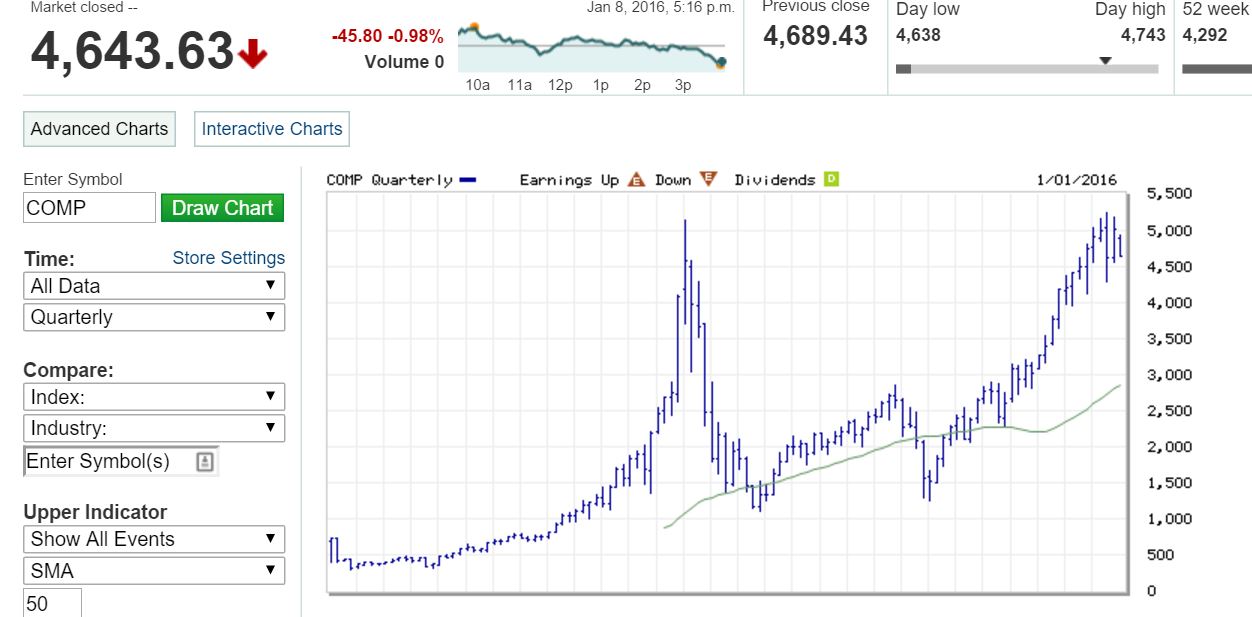
Keep the fingers crossed* that red and blue lines do not cross soon
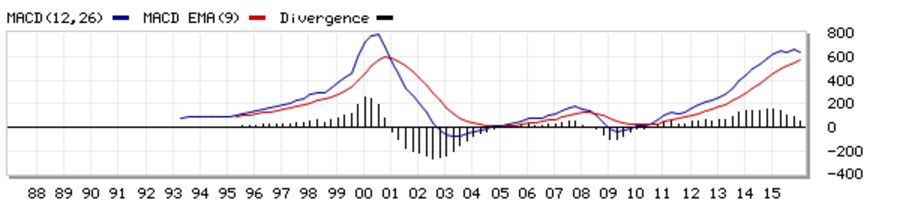
*When all else fails we can always revert back to superstition�
Jan 9, 2016
Drax7 too funny�
Jan 9, 2016
Lump CHina's devaluation & movements in their Yuan should be monitored more closely then the fluctuations in their equity markets, this past Wed. Rich Ross had a segment on CNBC that showed interesting correlations between the Yawn & the S&P 500, crude oil & the Transports, he provides pretty good TA on the S&P 500 as well.
http://video.cnbc.com/gallery/?video=3000474795
Some predict People's Bank of China will devalue the Yuan as much as 15%.�
Jan 9, 2016
Auzie
Poetic justice
Market forces are forcing the hand of People's Bank of China�
Jan 9, 2016
jhm Yes, I think the Saudis are recognizing the end of demand for oil, but I think other more immediate factors are coming into play. First Saudia Arabia is running a deficit that could bankrupt the kingdom in about 5 years unless the price.of oil recovers. So an Aramco IPO capitalizes oil assets. The second thing is that the royal family may even be contemplating an end to its rule. Whatever the motives, it could be cool to see how the market actually values Aramco.�
Jan 9, 2016
Causalien Something tells me that the Saudi's financials are in more dire situation than that. People always accuse China of falsifying their numbers yet trust the Saudis absolutely when it comes to their financial report. When in reality, it is in Saudi's best interest to falsify their foreign reserve numbers and also their cost to produce oil.
The one suspicion that led me down this road is the fact that they have to start borrowing money this year when the reserve still have 5 years to go. Why is it floating Aramco now instead of in 3 years. If you look at a comparable economy like Norway, the behaviors are completely different. Perhaps Saudis using some type of forward FX transactions to hide the extend.
For China, everyone expect them to be fudging their number, so the most likely conclusion on that is they are not. Or it has been discounted so much that it doesn't matter anymore. That is a reason why it is suffering from a huge sell off from a less than 10% gdp growth, we are discounting probably 7% of GDP number as false growth.
It would be interesting to start exploring the house of card that might be the Saudis financials. Maybe it is the next great big short.�
Jan 10, 2016
Johan How would you go about shorting it though, as long as Aramco isn't taken public?�
Jan 10, 2016
Causalien They have a stock market that represent the other 45% of gdp. The best bet is most likey from shorting the Ryiad.
And just as I thought. There are no financials nor proof if reserve reports from geologists I can find. I wonder if they'll retract the idea of going public as that will open their finances for the whole world to see.�
Jan 10, 2016
Johan Remember that within OPEC it's been a long tradition to over report or over estimate one's reserves (or at least withhold any doubts as to how large they actually are) since over the years the countries in OPEC have on the one hand agreed to throttle production to uphold prices yet they all individually have wanted to sell as much as possible while prices are high. They've made agreements saying basically "we'll all produce x billion barrels this year, which is y % of all the oil we have collectively in the ground, so every producer can go ahead and extract y % of their reserves". In this scenario it makes sense that most would exaggerate their reserves.�
Jan 12, 2016
Curt Renz Many stock market advisers and investors have moved into full bearish mode. That�s not what normally happens when still so near long-term tops in the popular market averages. Those averages have actually been in rolling corrections for over a year. That�s a hidden form of a bear market in which the correction is more in time than price. Hence the growth in bearish feelings without technically being in a bear market.
A high level of bearish opinions usually presents buying opportunities to those who are alert. In the meantime there has been money to be made by those on the right sides of the seesaws. Those have mainly been the big institutions and especially hedge funds who prefer to take advantage of high volatility rather than slow boring rides upward. They�re better at manipulating the former rather than the latter. Now some of their analysts have been advising the public to get out and not buy back on dips. Guess who�s likely accumulating positions bought from those who have been scared. Meanwhile, the financial media have been loving such appeals to fear as they improve ratings. The time may be soon upon us for the cool headed to look for bargains such as shares of Tesla Motors among others.�
Jan 12, 2016
Julian Cox Saudi's contemplating cashing out of oil. Fascinating. Thank you for this, had not seen it elsewhere.�
Jan 12, 2016
larmor agree... wow...�
Jan 15, 2016
theschnell Ok folks, in the Short-term thread there has been some talk of possible recession. I just don't see it at all, but would like input from others as to the risks they are seeing that I am missing. The reason I see a recession as a low risk at this point is that things are still positive for the average american. For examples, 1) Low oil prices put a significant amount of gas money back into people's pockets so they can spend on other things. 2) Still low interest rates and still expanding credit put more money in people's pocket to keep spending. I am just not seeing where a recession would come from in America as long as those two things continue, even if the rest of the world is still on the edge of deflation. I think a decently strong american economy pulls everyone else (except China in the short-term perhaps) from the edge of the deflationary cliff.
What risks am I overlooking?�
Jan 15, 2016
dmunjal I believe we are in a recession right now. All indicators are pointing to a slowdown. The question is how deep and how long. I don't think it's as bad as 2008 unless we start seeing big defaults that cause margin calls and credit compression.
We've had a credit expansion cycle and that is reversing. Will the Fed step in with more QE or NIRP is another variable.
Edit: I want to add that lower gas prices and lower interest rates don't matter as much as you think. The reason is that other things like healthcare, education, and rent are increasing faster than gas is going down. They are also much bigger in total dollars. As for interest rates, it doesn't matter how low they are if you can't qualify or you don't want to take on more debt. Unfortunately, many are in that situation right now.�
Jan 15, 2016
ggr I disagree. It's a very localized data point, but I live in a not-terribly-affluent neighborhood, and just since last november have seen lots and lots of renovations and landscaping action suddenly pop up. People around here are spending like crazy.�
Jan 15, 2016
dmunjal I live in Silicon Valley so I see that, too. But I have to remind myself that the rest of the country is not like this.
Please see my edit on my previous response, too.�
Jan 15, 2016
theschnell
1) Such as? Not disagreeing with you, I'm just unaware.
2) Again, not disagreeing with you, but would like some data.
3) Good point here.�
Jan 15, 2016
jesselivenomore 1) Manufacturing is already in a recession. The risk is manufacturing and oil and gas industry drags the rest of the economy into recession.
Empire State weakens to recession-era lows - MarketWatch
2) What data? The fed plans to tighten 4 times this year after years of QE. That is the definition of credit expansion reversing.�
Jan 15, 2016
dha We are absolutely not in a recession, based on the most common definition, which is two consecutive quarters of GDP decline.
The US economy is still growing and fundamentally sound with a few areas that could use improvement.
We may or may not be entering a bear market, which is a separate issue.�
Jan 15, 2016
dmunjal We didn't know we were in a recession in 2008 until six months after the fact.�
Jan 15, 2016
jesselivenomore No one is saying we are in a recession. The question is whether we will enter one. That is up for debate. By the time you get two quarters of negative GDP and it is official, it will be the time to BUY.�
Jan 15, 2016
dmunjal Jesselivenomore covered it but I would also add holiday sales and the service sector (ISM) seeing declines last quarter.�
Jan 15, 2016
jesselivenomore And 50% off the highs.�
Jan 15, 2016
theschnell 1) Interesting, I didn't realize manufacturing had been hit so hard.
2) Plans of Fed tightening does not automatically indicate the reversal of credit expansion. People and businesses will still borrow if they see a good economy to expand into. On the other hand, demand and supply for debt drops significantly when the future income picture begins to look less positive.�
Jan 15, 2016
jesselivenomore Right. It's more accurate to say loose credit is reversing. Which isn't a problem, and indeed necessary, if the economy is accelerating. Problem is, signs are pointing to the opposite. Which is exacerbated in a tightening credit environment. This is what leads to credit expansion reversing.�
Jan 15, 2016
dha Just saying we should be more careful with the language we throw around.�
Jan 15, 2016
jesselivenomore Okay. *I didn't say we are in a recession.
But to dmunjal's point, by the time the official data confirms it, it will be after the fact. (And to my point, way too late to act on it)�
Jan 15, 2016
dmunjal Another data point I didn't like was the inventory to sales ratio. It peaks when businesses think sales will continue to ramp up but suddenly decline. We saw that in Q4. Businesses build up inventory in this anticipation but then have stockpile the following quarter which hits GDP growth.
The big number to watch is Q4 GDP which I think comes out on the 27th I believe.�
Jan 15, 2016
FluxCap People are renovating in DC because existing home prices are so inflated, supply is so limited, and it costs less in transfer taxes to just blow up your own house and do it again. It's a very good time to be a contractor, not so great to be house shopping.
Jesse is correct that manufacturing moved past the technical definition of recession recently. It's just one indicator but it's one I'm watching closely.�
Jan 15, 2016
dmunjal Atlanta Fed lowers Q4 GDP growth forecast to 0.6%. The news came out after the close today.
https://www.frbatlanta.org/cqer/research/gdpnow.aspx?panel=1
The Atlanta Fed has been the most accurate forecaster of GDP growth.�
Jan 15, 2016
Lump Thanks for posting dmunjal, back on Nov. 1 their Q4 forecast was 2.6%, today it stands at .6%.�
Jan 18, 2016
dmunjal US recession probability highest since 2011: Survey
http://www.cnbc.com/id/103308151�
Jan 18, 2016
Lump Art Cashin has been on the NTSE floor for over 50 years, «It is very similar to what you get before you slip into a crisis» | International Selection | Finanz und Wirtschaft�
Jan 18, 2016
Familial Rhino Thanks for that link. Sobering read.�
Jan 18, 2016
dmunjal The Fed is not out of bullets. Right now, the market is pricing in 2-3 rate rises this year. They could postpone all of those and even reverse the last hike and do another round of QE. It might not be the right thing to do but very plausible in an election year.�
Jan 20, 2016
sundaymorning All this noise about oil just needs to go away. Last time I was at the pump I had a grin due to falling oil prices. Falling oil is good for consumers like me and puts extra cash in our pockets for spending. The fracking industry needs to go belly up, they've invested in the wrong business model, alternative is where it's at.�
Jan 21, 2016
Turing Let's say we do enter a business cycle downturn - mild recession in 2016 or 2017. How does this effect Tesla and its stock price? I'm assuming Tesla keeps marching along with it's goals, as it has been, more or less. But does a mild recession noticeably hurt sales? Does it make raising needed capital harder, thus slowing down company growth rates and pushing back deadlines on the model 3? Or could Tesla buck the market downward trend as it continues to gain momentum and model 3 makes the coming paradigm change more obvious.�
Jan 21, 2016
MitchJi
The question here is not if Tesla will be able successfully launch the M3 etc., but what will happen to the SP. Will it hold up in the short-term and is it a good time to buy for the long-term?
�
Jan 21, 2016
pGo This Time, Cheaper Oil Does Little for the U.S. Economy
Log In
Lower price of oil traditionally was considered stimulus for economy, but not so much this time around. Small businesses and Walmart kind of chains are not seeing the quick benefits, but instead the consumers learnt lessons in 2008 and are lowering debt instead of putting that money back in the economy.�
Jan 21, 2016
AudubonB I think the salient sentence from pGo's referenced article is the following:
And I utterly refute that statement, and would do so by challenging Professor Levin, SF Fed Bank president Willliams or any other fine notable mentioned in that article to defend the following as the logical conclusion to the above statement.
* Revitalize the sputtering US economy by emplacing, � la Richard Nixon, a price floor on domestically-produced and imported crude of, let's say, $80/bbl. If their arguments hold water, then Happy Days Are Here Again.
<Fail, of course...>�
Jan 21, 2016
dc_h Agree AudubonB.
Perhaps they should be noting that the price change is causing investment dislocation in the energy sector and impacting high risk debt portfolios. The change is also causing investments to be reallocated from the fossil fuel industry to other industries supporting consumers. Auto sales were ~18mm for 2015. Consumers have increased savings and spent money for other consumer products. The loser is stands out and is very obvious, but the winners are spread out across many sectors, which does not seem to be understood and articulated yet.
It may also be true that energy prices below a threshold like crude at $40 a barrel, create some market instabilities, much like crude over $140 barrel. Does the consumer benefit wane after a certain point, or lag, if consumers think the price reduction is temporary.
�
Jan 21, 2016
sundaymorning Oil is up 4% while the Nekkei bounced over 900 points!�
Jan 23, 2016
30seconds A nice piece on corrections with some data analysis
Corrections, Bear Markets, Recessions and Crashes - Bloomberg View�
Jan 28, 2016
sundaymorning Japan adopts negative interest rate. Nekkei and China market up!!
http://www.cnbc.com/2016/01/28/asia-stocks-look-higher-after-three-day-win-streak-for-oil-on-russia-saudi-arabia-talks.html�
Feb 2, 2016
theschnell Anybody read any good analysis of our current macro outlook? I just came across these two, but I know nothing of the author or his inherent biases etc.
Jesse Felder's Tumblr — Don't Dismiss The Systemic Risk Of A Corporate...
Why Recession Is More Likely Than You Think | The Felder Report
I know Carl Icahn was making the case a while back that the corporate debt bubble bursting was going to cause a recession similar to the Great Recession and he predicted it would pop pretty soon. What do you guys think?�
Feb 5, 2016
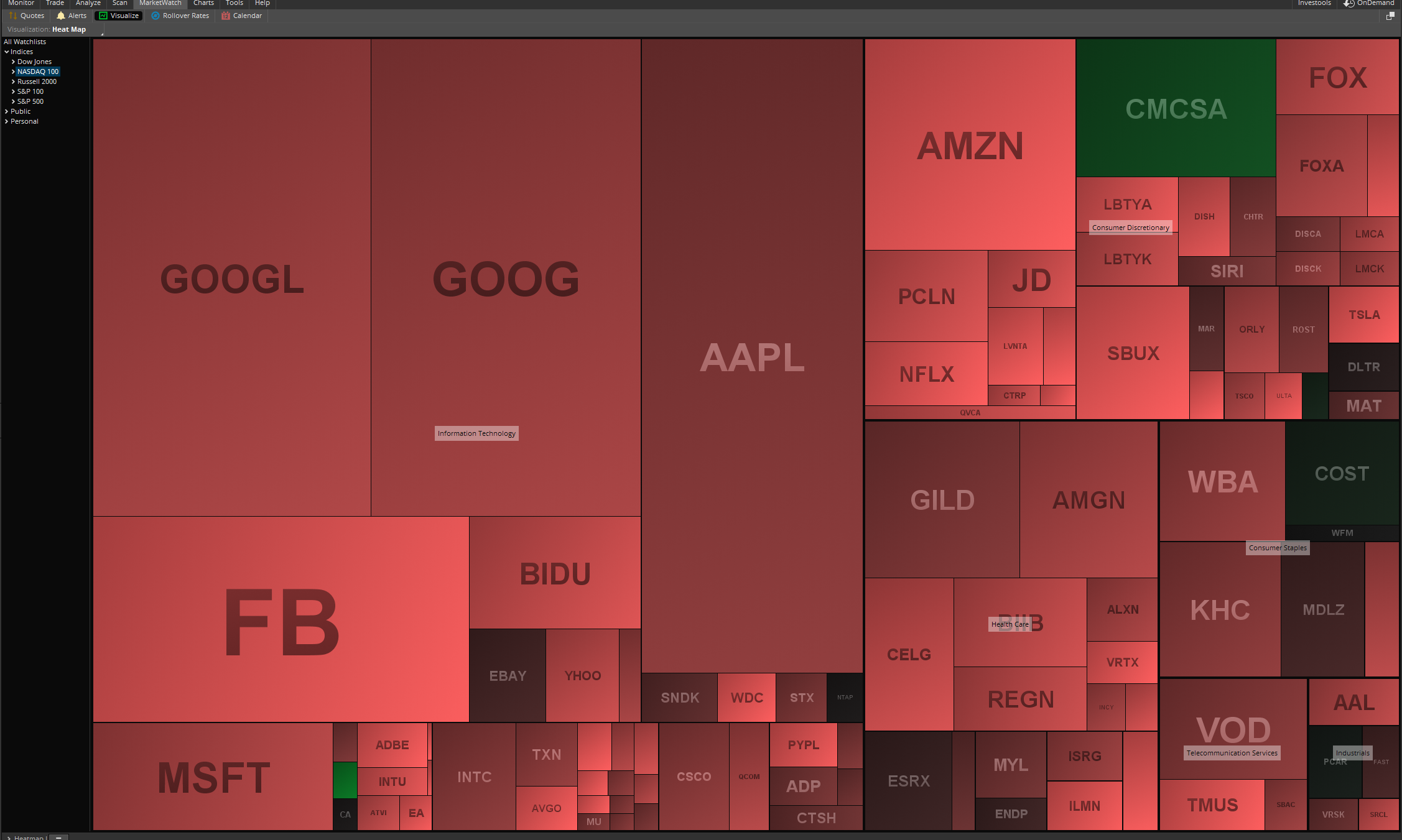
FluxCap Bloodbath today. This has not been a fun week.
 �
�
Feb 5, 2016
tlo Nice visualization. What app is that?�
Feb 5, 2016
FluxCap Thinkorswim desktop client.�
Feb 7, 2016
Lump Came across an investor adviser that puts out a newsletter & has a radio show, this weeks letter might help those who are anxious & cautious in todays markets Real Investment Report�
Feb 8, 2016
FluxCap In the toilet once again we go. This is unpleasant.�
Feb 8, 2016
bhuwan What's your investment strategy for the long-term& short-term? Any thoughts on an ER play?�
Feb 8, 2016
FluxCap I honestly am gyrating back and forth on my prognostications for the market and TSLA, but as for my portfolio, I am almost all cash right now. Not short, not long, just static. 2016 has been an unwinding of risk on a scale not seen in a long time, and I'm not sure when it ends. However, I don't see a massive risk-on/buying spree/FOMO coming back anytime soon that will magically erase losses in high beta stocks like this one.
As for TSLA ER, I would think being short into it is very risky after such a steep drop, being long less so. But I have no clue how to play it and may just stay away completely.
I think the world has to figure out what it means to no longer depend on expensive oil as a surefire investment, what it means when every nation competes to devalue its currency indefinitely, and what it means when there is a statistically significant chance that the US may elect a socialist or near-fascist president in November.�
Feb 8, 2016
dmunjal I don't believe the macro conditions are related just to oil. Yes, oversupply due to Saudi actions and fracking has caused an issue but why now? I believe it is the dollar going up and the fear of it continuing to go up in the face of the Fed raising rates. If the Fed continues to raise rates, all the investments that depended on a cheap dollar (carry trade) have to unwind. Until the Fed gives in and says they will stop raising rates or even add more QE, this will continue.�
Feb 8, 2016
Johan With the election coming up, what is y'all's thoughts on whether the market would prefer Trump over Sanders for president- purely hypothetical question of course?�
Feb 8, 2016
dmunjal Good question. I think Trump or Sanders are perceived bad for the market as they change the status quo. The market would actually prefer establishment candidates like Clinton and Bush.
Edit: Trump saying we are in a bubble on CNBC just now is not helping.�
Feb 8, 2016
Johan Maybe Trumps entire campaign is just a huge play to upset and scare the US equities market? As in he doesn't really want to be president, he just went short everything in early 2015 and is planning to cash out come summer 2016.
As much as it hurt to say it the best thing for the US right now would be Hilary.�
Feb 8, 2016
FluxCap This isn't a political thread so I hesitate to opine on that, but I think it's clear that the wealthy barons of Wall St would very much like their champion Hillary to win, and post-Iowa, have begun to be fearful that this may not in fact happen. Also, what is best for the capital holders/wealthy/market makers does not necessarily equate to what is best for the US economy. Even CNN has an interesting take:
Under Sanders, income and jobs would soar, economist says - Feb. 8, 2016�
Feb 8, 2016
Intl Professor Transition to next post
My political expertise is in foreign policy, not domestic politics, though teaching at a public university for 46+ years, half of my teaching was government 1.
It's awfully early for polls to be indicative and, of course, later we will have other inputs from primaries to refine guidance. As it stands now, some polls matching the two Democratic candidates conclude Hillary might lose in a close race to Ted Cruz, whereas Sanders would win handily. I don't know of any poll against Trump.
Personally, I think Hillary will win the Democratic nomination. If that is contested at the convention, and a strong public support for Sanders is trumped (small t) by super delegates, that would dampen public (and my) enthusiasm. Normally this should be a Democratic year. Despite a lot of antipathy by tea party strength in the old confederacy, and fear of it elsewhere in the Republican Party, Obama has not been a bad president. Polls do show that almost a 70% share of voters prefer expansion of social security, increase in the minimum wage, infrastructure investment, greater penalties for bankers, etc., the mainstream which is a hopeful sign. I believe such changes would give a strong boost for the economy if implemented, mostly because people I admire greatly such as Mohammad El-Arian believe the one-game in town of Fed stimulus should have been augmented fiscally. I haven't read his recent book, but I remember interviews where he implied such for the future.
Wall Street's reaction to a Sanders win would be negative, but from the shareholders perspective breaking up the big banks would be a plus. I don't remember, although I am near 80, but when the utility trusts were broken up by Roosevelt, in five years or so the stocks of the smaller companies rose 1,000%! Recent commentaries argue the economies of scale for banks do not improve once assets reach $100 billion or so, and the current top banks are orders of magnitude higher.
I will post a later thought on the foreign environment and what is happening to markets today.�
Feb 8, 2016
Intl Professor I must apologize for misspelling Mohamed A. El-Erian�s name in my earlier post. A bit more about politics which seem to compound the markets these days.
On the foreign environment, we have not as a nation been served well by the Iraq war and we are also as a nation very uninformed (like the leading Republican candidates) about what to do about its consequences. Nefarious as was the division of boundaries by the British and French in the Middle East, we will long rue the collapse of the dictatorships which inevitably rose to preserve either military rule or the privileges of one minority group over another. Further, the refusal of Dick Cheney to permit the State Department's planning for the future (a purely bureaucratic conflict) set the stage for the disastrous occupation in Iraq after hostilities. The contrast with the careful planning for the occupation of Germany after World War II (about which I am an expert) clearly shows Roosevelt was so much more visionary. Ryan C. Crocker, a well-regarded diplomat and formerly U.S. Ambassador to Afghanistan and Iraq, was interviewed on Vice about the ISIS threat. He said, in effect, conditions in Iraq are much worse for the people now than under Sadam. A stunning comment which only a retired diplomat of his standing can concede. Our policy was not improved by another notch when Obama failed to honor the popular vote which failed to support Maliki�s re-election. So mistakes were made on all sides proving our leaders� amateur status.
Of a different category, but still almost impossible to deal with was the temptation by policy-makers to support the Arab spring after one of the dictators had been removed by Bush. You now have a Middle East and Northern Africa totally fractured. Added to this were naive attempts under Secretary Clinton�s stewardship to take advantage of popular uprising in Ukraine and whiff of talk Ukraine might move toward membership in the EU. Obviously this was enough to justify Putin�s awakening from hibernation.
We need a much more realistic assessment of the world than the illusion of superpower resulting from the aftermath of World War II. To paraphrase Lincoln, we cannot control events abroad, they have returned to control our markets today.
Others have rightly identified an earth-wrenching change we are going through, the shift from fossil fuels to conservation and alternative energy sources. Alone that is enough to explain the uncertainty of our future. It is often said, �business does not like uncertainty.� While we often want change, no one really likes uncertainty, although the world is surely boring for those who have it; hence the oft quoted Chinese curse about crisis.
My teachers of U.S. diplomatic history said, the U.S. had almost a perfect record in diplomacy when it was a relatively weak country. To illustrate: the scholar, William Appleton Williams began The Tragedy of American Diplomacy with the Open Door Notes and our foreign adventures.
Our founders knew we had to be smart when dealing with the Big Boys. They knew then, as we must learn now, the Big Boys get into trouble when their ambition exceeds their reach. They took advantage of Britain�s ignorance. ISIS is the direct result of our fumbling hubris.
The even bigger news in the Middle East is the shakiness of the Saudi regime. The conflict between that country and Iran may eventually make today�s oil price concern seem timid, indeed. The Saudis� support for Wahhabism when translated into Salafism, their failure to diversify the economy, and the tribal orientation of the oil producing areas (Shia) of the country, combined with the regional flirtation with populism, portends eventual collapse. The two Muslim Big Boys in the Middle East need to bury the hatchet as the U.S. and Russia seemed to have. It would be neat if Israel would play middle-man in this truce, but under Netanyahu that is exceedingly unlikely. He�s not driven to seek a sure-fire Nobel Peace Prize.
How do these politics play into the market? Just as they usually do before a war. Thank God the Iranians have been estopped about the bomb for a few years, unless the Republicans take the White House and follow through on electioneering promises. Though off the thread, its time to take politics much more seriously, more than ever after Hiroshima.�
Feb 8, 2016
techmaven Thank you for posting your thoughts.
The ignorance level of American voters, combined with their entrenched ideological views pretty much inoculates them from any productive and enlightened conversation about the U.S. and its role in the world, does it not? Of course, this isn't a new problem and one can argue that we have more access to data than ever before, but our ability to understand it has not kept pace. Most of us have other things to do and do not have the background, inclination, or energy to follow much of what is going on with our government. With our current mass media, is it not easier for a few talented tongues to twist the narratives to their advantage, especially if those narratives stroke our collective egos?�
Feb 8, 2016
yesla deleted�
Feb 8, 2016
AudubonB Moderator Notes
First, one post removed for the most unimportant but ever-annoying reason:
To all: DO NOT COPY POSTS when you are responding to them, other than the merest, most trenchant portions to which you are referring. It may be the single most-clamored request from members to the moderators. And when an extremely long post, such as the one in the excised post, is copied, it sends off forehead slaps throughout this community.
To all: Thank you very much for the diligence so far shown in the past 36 or so hours to have walked, successfully, the razor-blade tightrope of having a discussion concerning politics without violating forum rules against politicizing posts. But you need to regard this Note as first warning.
To our (fairly) new member, Int'l Prof.: Thank you very much for your considered insight and well-written posts.�
Feb 8, 2016
Intl Professor At 79 I appreciate the compliment, "fairly new." And the real compliments above.�
Feb 24, 2016
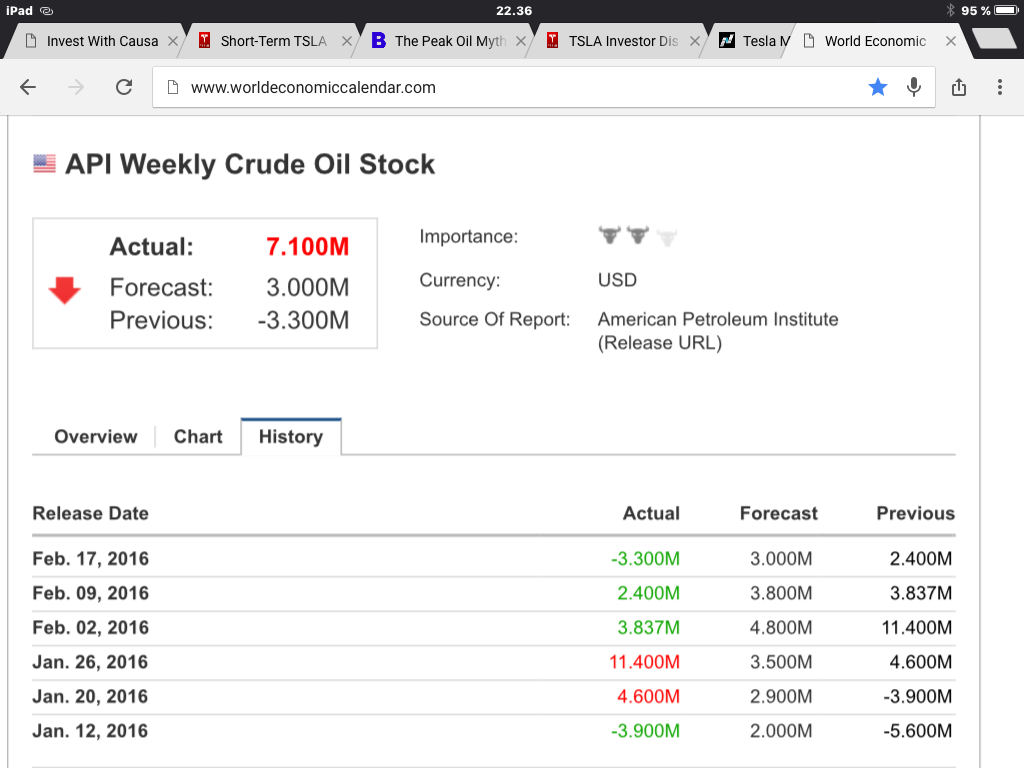
Wenche I see the impact of oil price on TSLA, and the rest of the market, espesially the growt stocks, but there is a lot I don't understand. How come one one statistic show a big increase in oli storage one day, and the next day another measurement show close to no change. Anyone that has insight to the differences here? I really want to understand.
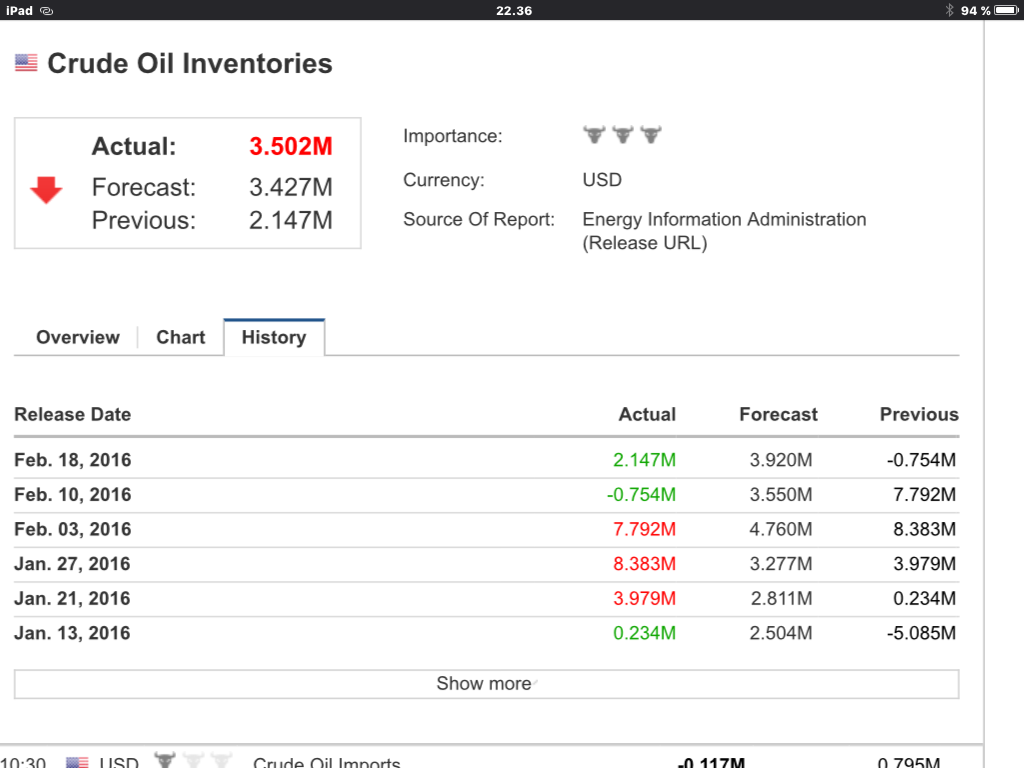
Thanks!
Wenche�
Feb 24, 2016
AudubonB That's a great question. I'm pawing my way through the EIA's database and cannot determine, yet, what the difference is between crude STOCKS and crude INVENTORIES. As far as the English language is concerned, those words should be effectively synonymous but, inasmuch as the data show that one is almost exactly twice the other, that obviously is not the case....�
Feb 24, 2016
GoTslaGo Maybe more to do with source of information, API vs. EIA?
Don't know, but I'm just trying to figure out why there is such a lock-step of commodities (esp oil) and the market.
Shouldn't low gas prices mean a big bounce for many industries, especially in a consumer economy? Or is it that our top market indicators (Dow and S&P) are dominated by oil/gas? Oil prices as an indicator for recession I've heard of.
Or is it that we've become too quant/technical or computer driven in trading? Maybe too easy to follow commodity market prices if you think of how someone may have programmed some trading algorithms.
So that's how I stumbled here. Don't mind me, I'm still learning. Trying to understand what makes oil/gas such a driver of the market.
PS--Thanks to Intl Professor for an interesting and broad look at what is going on in the world today and in the past. Looking forward to more, if any are coming... Any thoughts about the current isolationist trends in the US, more or less than the past? Abdication of US global leadership, bowing to the inevitable or just retrenchment, licking wounds and such? How these may contribute to overall market instability...�
Feb 25, 2016
Intl Professor I've saved your last paragraph and will try to respond soon. But first, I'm about half through El-Erian's book and want to finish and briefly summarize the main points for this thread and the long term thread. Thanks for the appreciation of recent posts.
Best.�
Feb 25, 2016
Auzie My take on the current lock-step is that the current macro market moves are dominated by China slow down.
With the China's economy slowdown there is a corresponding slump in demand for commodities. China was simply gobbling commodities during its rapid growth phase.
The drop in commodities demand is felt acutely in commodities exporters (Australia, Canada) and some emerging economies.
US seems to be going in the opposite direction to the rest of the world (monetary policy, economic growth rate) but it is quite hard to go against the prevailing economic climate and hence US economy is feeling a drag of China slowdown.
Oil price drop is caused by different developments (oversupply, US record inventories in crude)�
Feb 25, 2016
dmunjal You've got all the symptoms correct but you missed the cause. The reason all of the above (China, oil, commodities) is happening is because of the strong dollar. Which is directly related to Fed monetary policy of raising rates four times this year. If they don't raise rates or even go to ZIRP/NIRP, then you'll see a reversal of this trend.�
Feb 25, 2016
Auzie
My view on macro cause / effect is slightly different.
My view is that the primary driver of USD strength is FED's monetary policy, raising rates. That policy (and the previous one of QE) seems to be effectively steering US economy, despite being in direct diversion with the rest of the world. Consequently, USD appreciates against most currencies.
The secondary reason for USD appreciation is that USD strength reflects underlying US economy. The US economy is so far outperforming most, if not all, other economies.
The third reason is that USD is becoming safe currency in the current macro environment. Capital flows into the US and out of other economies, especially China, due to a loss of confidence in local governance/economy.
My view on China's economic slowdown is that the primary cause is the capital misallocation coupled with central planning with little regard for market forces. Hence, we have real estate bubble, share market bubble, ghost towns and underutilized factories. The weaknesses in China are internal, growing and maturing pains. The strong USD and weakened Chinese economy are likely coincidental, not causal.
That said, hiccups are expected in a low maturity market economy of China. Imho Chinese leaders deserve a lot of credit for effectively steering billions of people out of poverty and improving their quality of life. It is a big ask and unrealistic to expect more of them (faster improvements).�
Feb 25, 2016
GoTslaGo My understanding is that the Chinese govt is trying to rebalance the economy to encourage more domestic consumption. Based on that assumption we would expect to see an economic slowdown, drop in commodities and a fall in stock prices (since most growth was driven by the export economy, like Japan was in the past). Has there been a commensurate increase in domestic spending? And as an outsider how would we know?
In the US, we have large consumption driven corporations listed and traded and tracked on the exchanges. Companies that are heavily dependent on the US economy, not international. Does China have similar companies on their exchanges? Do they have domestic corporations (meaning that they mainly trade within china and not internationally) that are listed? If they do, how are they doing relative to the general market over there (in a rational market one would assume exporters would drop, but domestic companies would rise...)? I'm wondering how we can get insight into whether the govt's attempt to restructure the economy is working.
That being said, I'm glad to see that investors are at least uncoupling the US from China markets. Whether it is the strong dollar, interest rates, safety or whatever. Yes China is a big potential economy, but it's far from mature. Thought it was kinda crazy that folks dumped like they did at the beginning of the year, although I have to admit I did take advantage of it...:wink:�
Feb 25, 2016
Auzie I'd like to think that China will recover regardless, or despite, government effective/not so effective interventions. Some social forces are unstoppable. The culture of hard work and appreciation of education are likely to drive further progress.�
Feb 25, 2016
GoTslaGo Yes. I recall listening to a podcast from a correspondent in Shanghai (for NPR in the states) who basically said the domestic economy is solid. Folks are feeding/clothing/entertaining themselves despite the downturn in the export economy.
Part of US strength and weakness in the domestic consumer economy is borrowing for consumption. Which I do not foresee happening anytime soon in China (thousands of years opposes this). Yet if this can happen in China a tremendous domestic expansion conceivably could occur (obviously better sources of borrowing etc. would have to exist).
That's why I keep wondering how the govt can get their goal of re-balancing the economy to work. I'll have to go find my back copies of The Economist to see if they have encouraged banks to lend more to consumers. If US consumers were not buying on credit I doubt they would contribute any more than 30-40% to the economy at best, instead of the current 60-70%.
Auzie--Thanks for the greater insight!�
Feb 26, 2016
Intl Professor Another source of volatility, of course, are the upcoming elections. Here is an interesting but wrong conclusion about Trump and my most humble clarifications.
Shared from Google News.
http://www.theguardian.com/commentisfree/2016/feb/25/barack-obama-donald-trump-us-election-american-politics
This is an interesting but wrong observation. Obama also gave us Bernie Sanders, not just Trump. This caused by Republican and Democratic party failures to really deliver on the promise of Obama. Except for Robert Reich, normally astute pundits are unwittingly throwing this election, as is Clinton, by ignoring fundamental sociological truths. The people like what Sanders' goals are by those willing (or able) to listen, and Clinton is more and more being tainted by her moneyed connections which she cannot abandon and won't return the money. What if she gets the nomination and then as an "October surprise" transcripts of her Goldman Sachs speeches are released by Republican operatives? (Of course not by the Trump campaign.)
Anything is possible this year, more so than ever for speculation about the political outcome. The denoument is fraught with volatility, like the markets, until November and perhaps beyond.
What if, just for fun, Sanders backs Elizabeth Warren for vice-president and Clinton pays back the speech money to Goldman Sachs with an apology and then endorses Warren for V.P. as well? That would make the Democratic convention almost as exciting as the Republican promises to be for very different outcomes. Of course if Clinton wins with Warren, the Republicans will argue that would be two women on the ticket! Then the Republicans lose the entire election when someone realizes two males are the norm. But you know the scenario.
Then watch the volatility of the markets if Trump, Sanders or Clinton win. I have no insight for alternative Republican candidates except this:
Michele Bachmann for Republican V.P. anyone? She is, after all, the ultimate anti-Obama with her intimation we might have to exercise our Second Amendment options.
I realize this is rich and political, but still....
- - - Updated - - -
Another thought. Suppose there is some collective brain among Wall Street types. Surely someone has at least as crazed speculation as mine, and they fear losing control of the election (if Sanders is right). Of course they would be confused as to what to do about investing now, and that would lead to volatility as well.
Maybe I should stop now. To paraphrase a figure of speech, "retired minds do the work of the devil."�
Mar 1, 2016
sundaymorning I'm glad to see the Asian markets are in recovery mode. Both Nekkei and Shanghai up 4%, looks like the market misinterpreted data and sold on the oil fiasco. Is it safe to say we're gravitating back to a bull market? We'll have to wait and see.
http://www.cnbc.com/2016/03/01/asia-stocks-markets-to-focus-on-us-equities-gains-higher-oil-prices-and-china.html�
Mar 1, 2016
GoTslaGo Good news. But here's my question.
Why should Asian markets fall with oil? With lower oil prices Asia (with almost no endogenous sources of oil) should benefit. I know people use oil as a proxy for recession or the argument that oil = USD. But I'm just trying to figure out why our current market is in such synchrony with oil. Most economies would benefit from lower oil prices, especially in Asia, and especially the big economies (China, Japan, etc...).
I wonder if another argument about oil driving the markets is this: could be that oil is a proxy for world trade in general? That with less demand and trade for oil (kind of like Salt in ancient history), that the overall world markets are becoming more autarkic? Less dependent on international trade and cooperation. Could this be an underlying argument for oil prices driving the markets? Don't know.�
Mar 1, 2016
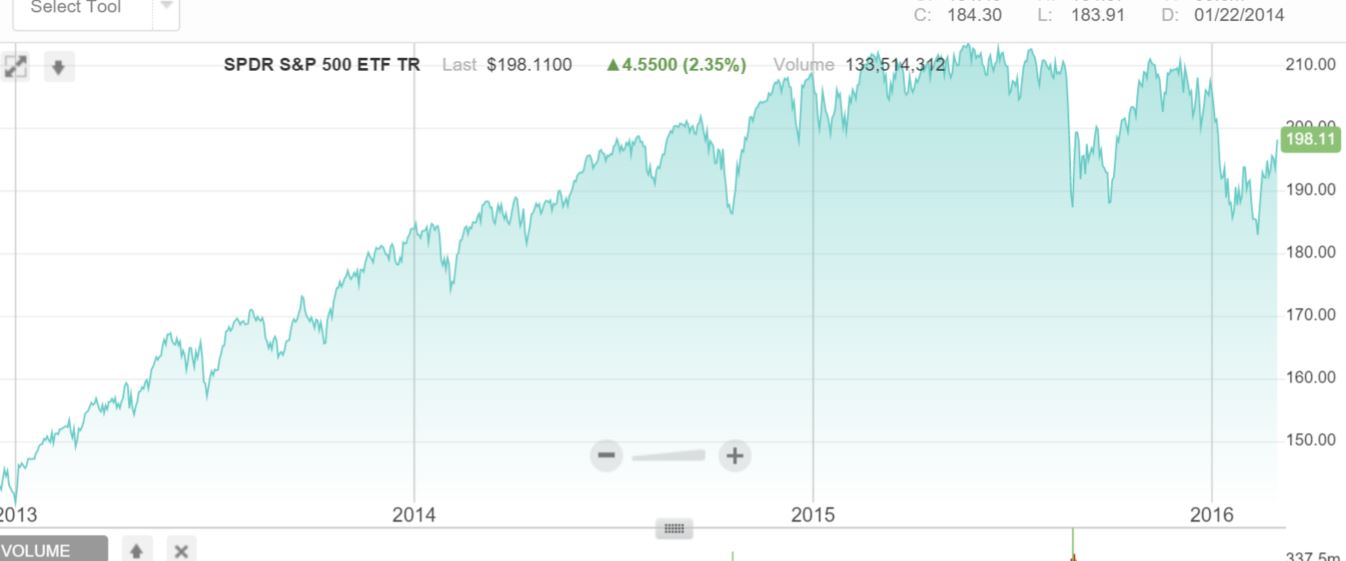
Auzie GoTslaGo, I wonder where you see synchrony.
This is last 3 years SPY (reflection of or proxy for US market)
This is Crude, same period
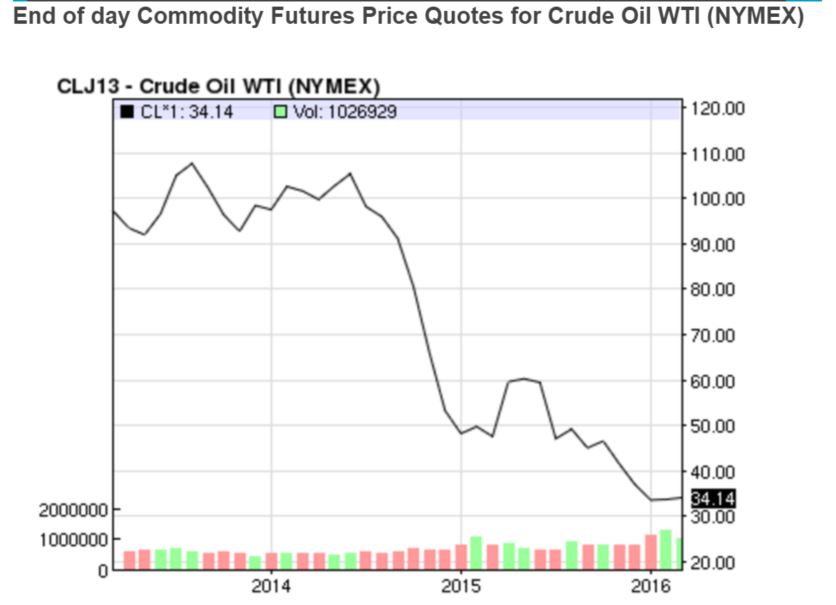
It does not look like a lock step to me.�
Mar 2, 2016
GoTslaGo Thanks again Auzie for showing me the light. I feel better about the rationality of the markets. Think I've been reading too much doom and gloom from CNBC!�
Mar 16, 2016
Intl Professor I just posted the following on the Short Term Tread.
I�ve finally finished Mohamed A. El-Erian�s, The Only Game in Town: Central Banks, Instability, and Avoiding the Next Collapse. New York: Random House, 2016, just in time to hear Janet Yellen�s press conference.
This is more a recommendation than a review. There are some of you much more capable than I at a more formal review. In any case, I cannot recommend this highly enough.
Many of you may know of El-Erian as a commentator with a remarkably low key demeanor on PBS or Bloomberg. He has impeccable credentials for writing such a book from a first-rate educational background to vast experience with the IMF and Pimco where he was responsible for the idea of �the new normal.� He has not served, so far as I can tell, as a central banker. That is an advantage.
His thesis is we are approaching a decision point within two to three years where we either do not meet the challenge of our times, and suffer dreadful consequences for decades, or prepare for a profound shift in our approach if we want continued growth in the economy. Instead of the familiar bell curve we are in a bimodal distribution (like a graph shaped in the form of a two-hump camel).
He combines a wealth of research from a variety of sources and personal anecdote to buttress his case implicit in the title. He praises central bankers� efforts to transition through the Great Recession, as some have called it, but they are hampered because they have limited means compared to other institutions. He doesn�t use these terms but I interpret him to mean we have dealt with the money economy and not the real economy. Central bankers have tried to improve the economy in some ways through untested means which he applauds but they are insufficient, inappropriate, and might contribute eventually to the collapse. Certainly, alone without fiscal stimulus investing appropriately for the future, and changes in structure which only governments can achieve, they are stymied.
He�s realistic about the changes we need and makes suggestions on overcoming bias in facing the challenges. A sheer focus on avoiding fiscal measures and structural changes to the personal, national, and international institutions because of their cost is not the thing to do. Among several direct experiences and lessons he shares with us include Pimco�s anticipation of the Lehman collapse through �scenario analysis.� They predicted there would be no collapse, but they also prepared for what they would have to do if it occurred and so quickly protected its customers. They were so successful many competitors thought Pimco had predicted what would happen.
He does not reference the work of Ilya Prigogine on complex adaptive systems far from equilibrium. To tease you: what the T intersection El-Erian talks about is what complex adaptive systems theorists label a bifurcation point. There�s some heavy-duty mathematics worthy of his Nobel Prize, but Prigogine easily admits as does El-Erian, predicting when it can occur is problematical.
He has many other examples, say, the importance of diversity by not only challenging ideas but tapping different peoples� perspectives on the decision at hand. My example is we were tasked to hire a Middle East specialist in my department. We received an applicant whose entire resume referenced publications in Arabic. None of us could read it so we should have decided to have an outside group advise us which would be possible. But we didn�t and so the poor guy never had a chance.
You may not think his work applies to you, but he says it should because we as individuals, whether investors or not, should listen and change our behavior in the directions he recommends. The idea is to be liquid, adaptable, open to change, and ready for surprises, some of which may be better managed by preparing for them. (I�m reminded of Machiavelli�s admonitions on fortuna.)
I think you�ll enjoy the read. I know you will profit from heeding his advice concerning decision-making on the personal level or at a key position in any institution.�

Không có nhận xét nào:
Đăng nhận xét