Jun 16, 2014
tslas Thanks, I contacted Tesla and Service center is pulling the Logs and looking at it.
I verified that the charge limit was set to 90%.
Hopefully, it is just that the Scheduled charging didn't start.
Otherwise Range Loss and Vampire Drain will make it a larger problem.�
Jun 16, 2014
djp That hasn't been my experience with the Roadster - it still charges to the same level today as when the battery was fresh out of the factory four years ago.
The Model S has gone through several changes in firmware which makes it tough to compare capacity over time. Tom Saxton is gathering data for a Model S battery study which should shed some light on it. So far the results aren't showing an initial drop.
Plug In America
Battery Study Updates | Plug In America�
Jun 16, 2014
David99 How can this study be useful if, as you say, the firmware versions change the reading?�
Jun 16, 2014
tdiggity 85kw battery
18,000 miles.
90% = 220 miles
100% = 242 miles
Not much of a change since my last posting. I'm going to start charging to 90% to see if that changes anything. One thing to note is that the miles drop off quickly @ 90%. Which means that after driving 1 actual mile, I see 2 or 3 rated mile drop. After a 10 mile trip, I've usually used about 15 rated miles @ 290 kw/mile. It gets accurate after the driving 10 miles or so.�
Jun 16, 2014
Gear I'd say that likely it either didn't start the charge at all or it just charged a small amount, due to being so close to the selected charge limit already.�
Jun 16, 2014
qwk The Model S study will just be a mess, since there has been quite a few firmware changes coupled with both A and B packs, which tend to have different readings. I really cannot see how an accurate conclusion could be made.
After 15 months and 21k miles, my B pack gets 228 rated to 90%, and 262 to max range(still on FW 5.8).�
Jun 16, 2014
djp I'm sure the data will still be useful to some degree. Tom will have an update for the TMC Connect conference, we'll see what he's able to do with it.�
Jun 16, 2014
islandbayy Just reporting back. I've had to range charge to 100% every day last week due to extensive driving and draining of my 60kW pack. Now, like I had mentioned, I was getting 199 to 203 (if lucky) with 5.11, literally a overnight change from 5.9. Now, this morning, I magically hit 205 and it was still charging at 8 amps (1 minute remaining.........) I had to hit the road, I timed it so it should have been done about a hour to 1 1/2 hours before leaving, so something caused it to keep er goin. I was pleasantly suprised. I was at just a hair under 31,000 miles on my 60 pack, 1 year 2 week-ish of ownership. So the software seems to be re-calculating my range again, though, it took MANY (about 16) 100% charges then it used to to recalculate. In the past, would (seem to) recalculate after 2-3 100% charges. And I did drain it relitively low last week a number of times. So we will see what happens. I have decided, by request from my viewers for my growing youtube channel, that I will report 100% range every approx 1,000 miles from this point on, as I have a "fairly" high mileage 60 pack compared to most.�
Jun 17, 2014
tslas Reporting Back, I had restarted both Consoles and reset the charge limit again to 90% before plugging the car back in yesterday evening.
This morning, It was charged correctly to 240 miles.
So, I guess, it didn't start the charge yesterday or the charge limit was somehow changed (I have 6 yr old son and he likes to play with the center console)
Everything is well with the car and battery.�
Jun 17, 2014
Gear You were only 10 miles below 90% when you plugged in. If it's already really close, it usually won't bother charging. Also, if you're really close, you usually don't get the same charge level. I assume it's because the pack never gets warmed up. For instance, my 80% is usually 160-162 miles. If I plug in with, say, 145 miles remaining, a lot of times I only have 156-158 miles after it tops up to 80%. The next time I charge the usual 60 or so miles, it ends up back in the 160-162 range.�
Jun 17, 2014
tslas I guess, that's also possible. I didn't know, it worked like this.�
Jun 19, 2014
Kraken I can second this as I've seen similar in my car. I find that within 10 miles, it for sure doesn't charge. I also wonder if this tricks the calculation to believing 90%/100% is lower than it was before and helps speed up the "degradation/miscalculation" issue.�
Jun 19, 2014
hans What about if you unplug and re-insert the charge cable? I swear I have filled up to 90%, got a few miles of vampire loss, and recharged back to 90% again (after an unplug/replug cycle).
I thought that unplugging the charge cable reset the "Charge Complete" state that prevents the charger to re-engaging when close to charge complete.�
Jun 20, 2014
mknox I have found that I can accomplish this by setting the charge percentage to 100% on the mobile app then, after the charge cycle begins, I put it back to 90% or wherever it was before.�
Jun 21, 2014
Kraken I'm pretty sure I've seen it not charge even after driving a few miles and plugging back in.�
Aug 10, 2014
glhs272 Another range update from this weekend's road trip. My car now has over 29,000 miles on the original battery and 1 year of ownership. My range charge still yields 209 rated miles (238 Ideal).
After one year of ownership, I am still floored at how fantastic this car is.
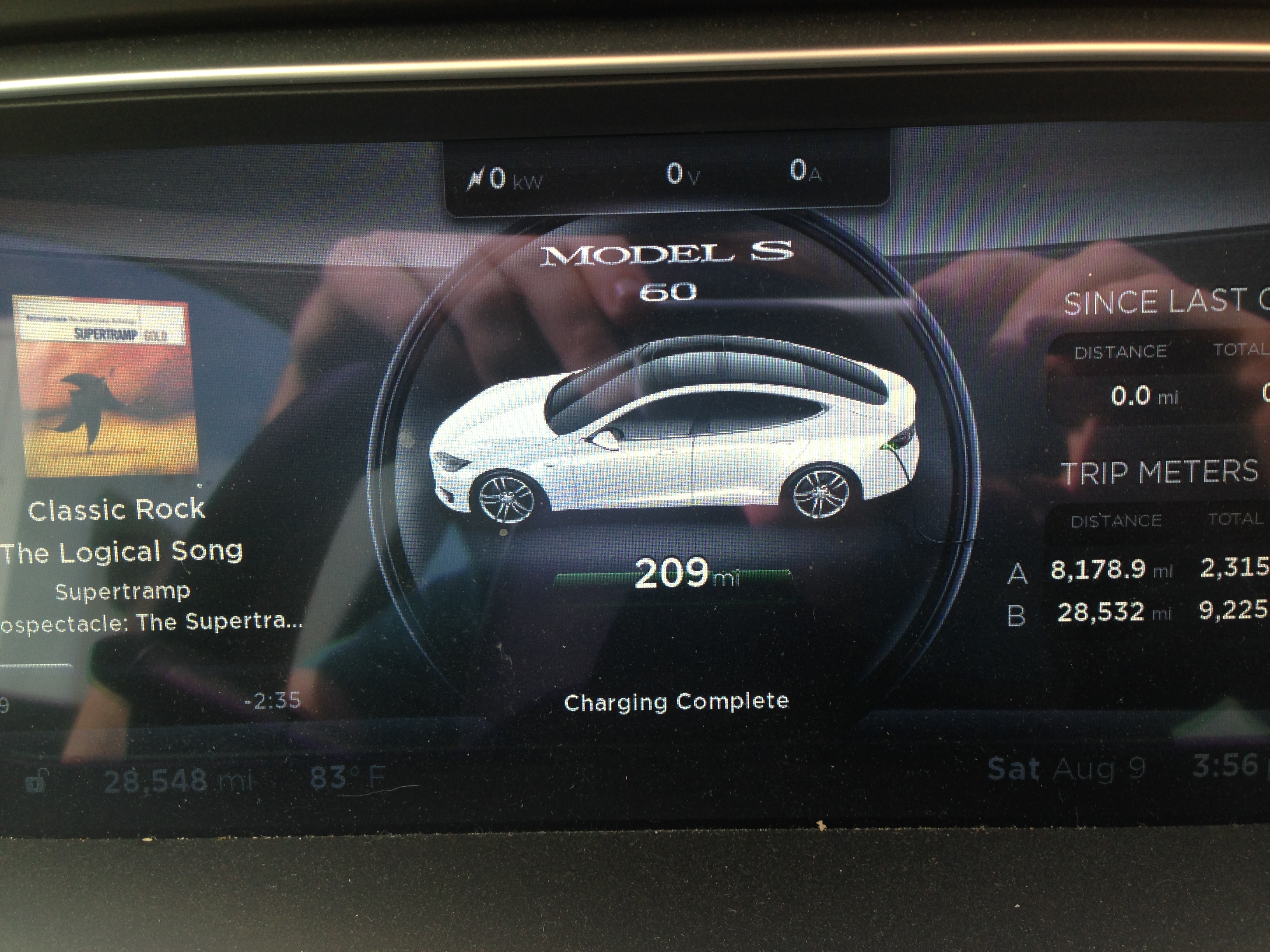
Edit: I guess it's due for a dash cleaning.�
Aug 10, 2014
ACDriveMotor Good news on battery, and good tunes!�
Aug 10, 2014
FredTMC That's is insanely good. Congrats. My 60 only got 208 when brand new.
I have 35k miles and I get 198 on a full range charge.
What's your secret?�
Aug 10, 2014
gg_got_a_tesla ^ lots of deep cycling?�
Aug 10, 2014
Gear I'm getting 200-201 on full charges after 18k miles in my 60.�
Aug 10, 2014
dirkhh Funny, that's pretty much exactly the same here. 18k miles (in 12.5 months) and 202 on my last range charge (during my trip to TMC Connect).�
Aug 10, 2014
FredTMC Good news for you both is you should only see a reduction of 2-3 miles by the time you get to 36k miles.�
Aug 10, 2014
glhs272 Actually, no. I do most miles with lots of shallow cycling. My daily commute 75-100 miles, but I usually charge both at home and work, so typically 35 to 50 miles per cycle twice a day. However, I do deep cycle from full range charge to near empty at least once every month or two months. Did a lot of traveling and range charges during July. During the summer months I have started setting the charge slider down to about 80% most of the time (winter always 90%). After doing this for a while it will bring the max rated range down to about 205ish. I have long ago found I can restore some range buy letting the battery spend a cool night on a range charge. If I do that a couple of times it will bring the range back up to at least 208. If I range charge to completion on a supercharger, it's really effective at restoring range. It's not just temporary either, I did more range charges on a cold battery from a 90% charge and it still went right up 209 rated miles using the umc. (see pic below)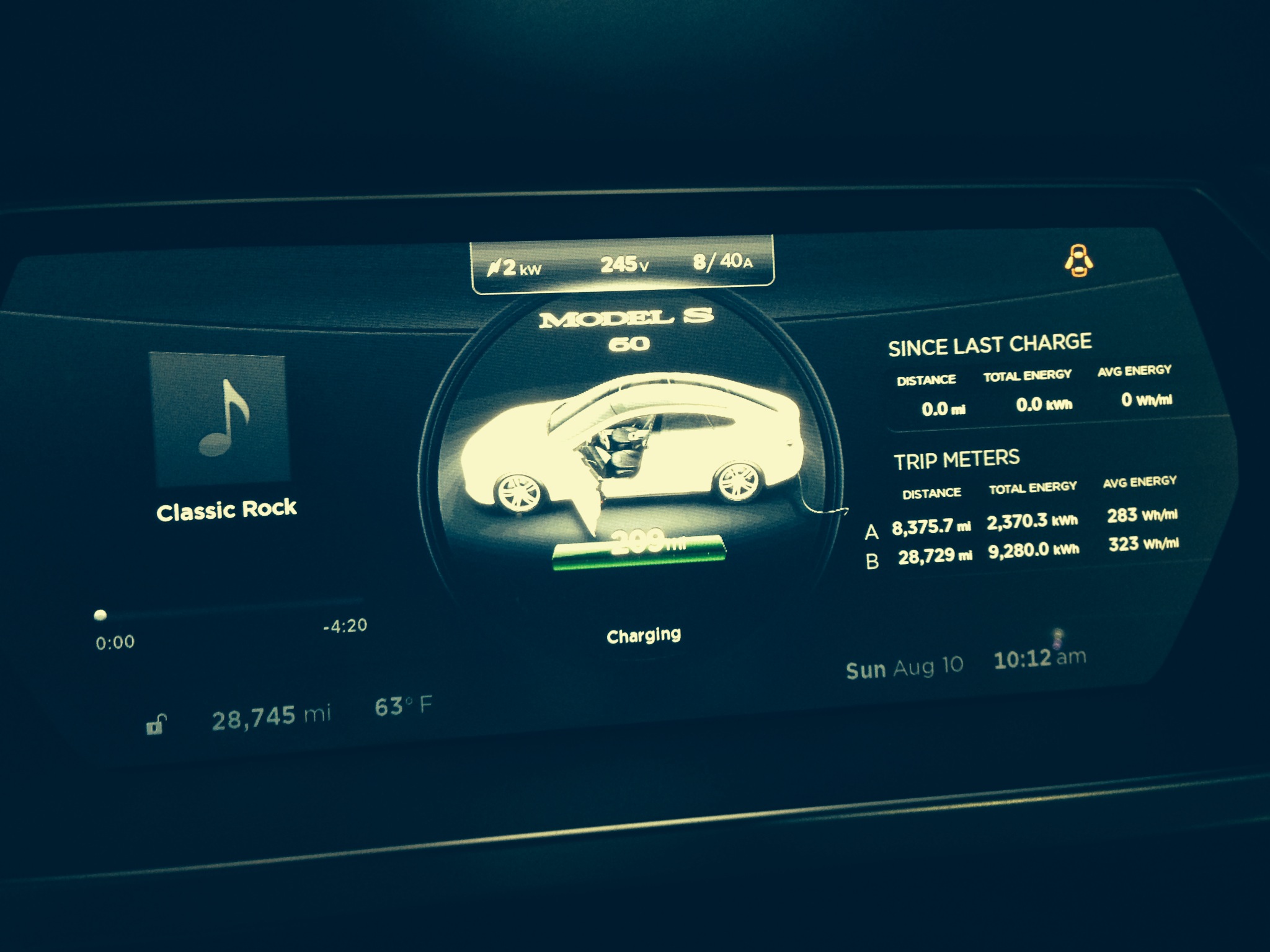 �
�
Aug 10, 2014
FredTMC thx for summary!�
Aug 10, 2014
glhs272 If you frequently charge below 90%, then I suspect you still have lots of hidden capacity in your pack that could be recovered if you felt so inclined.�
Aug 22, 2014
mark3446 I have 11,550 miles on my 60 Kwh Model S. Purchased in Feb 2014. The rated range charge in miles has decreased from 209 to 184. The biggest drop (206-194) came after the 5.9 firmware update. Tesla service cannot explain.�
Aug 22, 2014
efusco After a year of never seeing more than 262 miles rated after a Range Charge, I was charged at the Service Center last week and the car showed 272 Rated when I picked it up...go figure.�
Aug 22, 2014
Denarius Wow, ow, how many miles are on your car?�
Aug 22, 2014
gaswalla that is amazing... seems like there's a story behind that change considering it happened at the service center... any ideas?�
Aug 22, 2014
Denarius I wonder if there is a manual balance they can kick off.�
Aug 22, 2014
mknox How is that even possible? I though 265 miles was the top Rated miles for a Range Charge.
When mine was new, I could get 263 to 265 Rated miles, but now I'm at about 240 if I'm lucky (32,000 miles / 15 months).�
Aug 22, 2014
Denarius My first few range charges hit 272, within a month it dropped to 265.�
Aug 22, 2014
ckessel I'm at 25k and 18 months and I think it was 252 last time I range charged. I suppose that about within expectation if I should expect 80% capacity after 100,000 miles.�
Aug 22, 2014
Gear Wow, that's not cool... Have they tried to do anything?�
Aug 22, 2014
tomas This synchs with my 90% charge experiences. My 90% had dropped to 225 or so, 100% to 252. Now (since 5.11 I believe) my 90% is now 235. I have not done 100%, but that extrapolates to 262. Big jump, I'm presuming either from algorithm change or from better balancing implementation in BMS.�
Aug 22, 2014
fluxemag I'm at 17k miles and 15 months. My full charge is 136 miles, sometimes 135. It's been very consistent since the firmware correction earlier this year that bumped it back up from the low 120's. Whether I can actually get 136 miles at 300 Wh/mi is another story, but it's close. When I first got the car I think it read 145 fully charged. They did some decent work to get a more realistic number displayed there, and the prior versions of firmware were probably misreporting.�
Aug 23, 2014
capt601 Have you ever checked to see where the slider is for the charge level? Someone may have moved it, or a change with an update.�
Aug 24, 2014
magnet Leaving you pack overnight with a range charge is a very bad idea. Never do this. When you need to range charge time it so the charge finishes when you leave. About the worst thing you can do to a pack is leave it fully charged.�
Aug 25, 2014
glhs272 I am certainly aware of the cell degradation curve with respect to cell voltage. Being at 100% charge or a 0% charge gives the most cell degradation with respect to time, so yes you are correct in that you don't want to leave your battery like this for any longer than you need to. The times when you need to do this is when you need the range and when you want to balance the battery to maximize potential range. I wish I could fully balance the battery without having to do the 100% charge, but its what it is. I have had success doing "short" balances, just going to 100% then quickly bring it back down. But in my experience the most effective balancing was done as an "overnight" or at least an hours long session at 100%. Especially if the battery is way out of balance. Also keep in mind 100% charge is probably only around 4.1 Volts to 4.15 volts at the cell. I believe Tesla doesn't ever go to a true 100% 4.2 volts during charging (it may get that high during regen after doing a range charge). The only other thing I will say is I have been doing many range charges and long balancing sessions. I have over 30K miles on my original battery. I still get 209 miles rated range.
Edit: I will also mention that high temperature + high cell voltage is extra bad. So when I do the "overnight range charge" session I make sure I do it on a cold battery. My car in my garage sits at a stable 63 F (garage is built into the basement of the house), so this helps.�
Aug 25, 2014
apacheguy Yeah, I used to do range charges so that they would finish or just be finishing at the time I leave. Not any more. If I'm leaving in the morning I don't even give it a second thought and just let it charge up the night before. The advantages outweigh the costs as it is the only way to get Tesla's BMS to balance apparently.�
Aug 25, 2014
magnet I wonder if Tesla is changing the reserve capacity over time? They wouldn't do that would not do that would they? Like sell you a bigger pack but only give you access to some of it? What if 0 miles means 10 kWh on a new pack but they next year it means 9kWH. To the user they would see "no degradation"
NCA cells degrade to 75% after a few years and then take another 20 years to get to 70%. Now what if we only ever had access to 85% of the pack? Shoot after 8 years I might still be at 90% of my original range....We know a range charge is a military charge at 4.15v per cell but do we really know what 0 miles means?�
Sep 1, 2014
ACDriveMotor My first thought is that I would applaud extra hidden capacity to minimize (or eliminate) my observable degradation.�
Sep 1, 2014
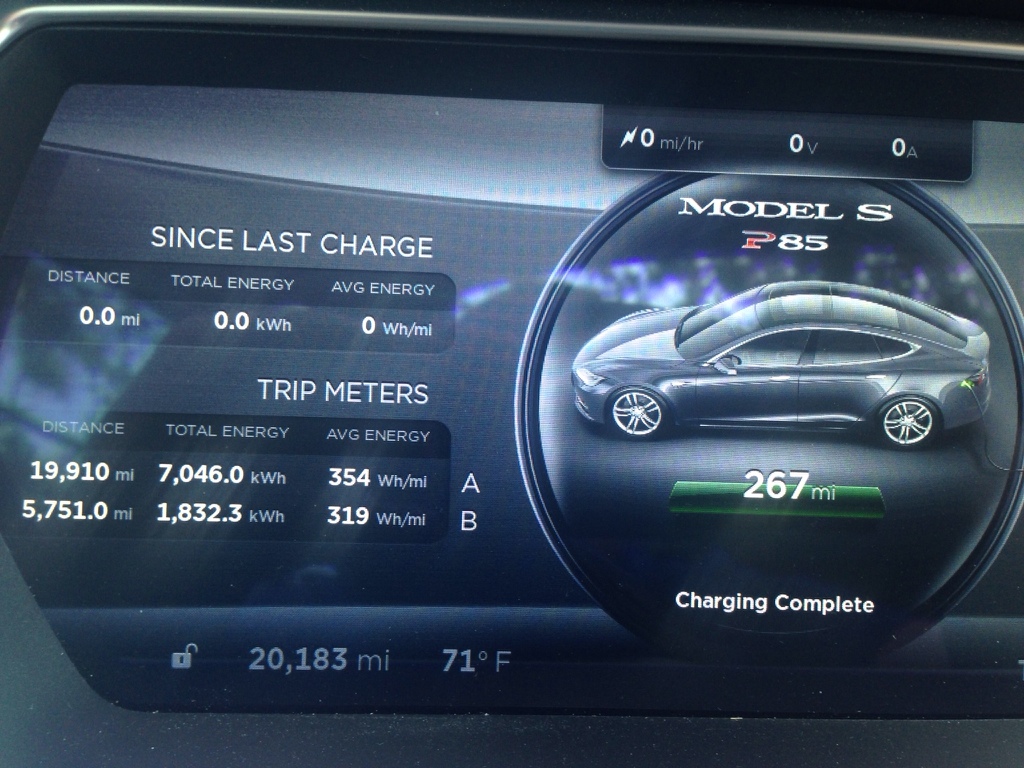
Theshadows 20k miles.
267 rated miles at a supercharger. (I had 268 two days before at our house when we charged for our trip)
9 months of ownership
Software 5.11
D battery pack
 �
�
Sep 1, 2014
johnmodels I'm with you guys. I have 31,000 miles, latest firmware, max range charge is about 250 miles. I haven't balanced the pack ever. A pack.
Thoughts on this anyone???
John
�
Sep 1, 2014
apacheguy Has anyone with any mileage on a D battery seen less than 250 on a range charge? My guess is not, but I would love to be proved wrong.
250 rated. 36,000 miles. A pack.�
Sep 5, 2014
Super Gizmo A pack. Until about 14K miles I used to get around 245 miles for max Daily and around 265 for max Range and then it dropped to 213-214 for max Daily and 245 max Range. After a firmware upgrade the max Daily went up to 225 and max Range to 250 but recently the maxDaily has dropped back down to 220. I haven't done a Range charge in a while. I usually charge in the middle of the Daily range. this is very disappointing because Tesla tells me this is normal. The car now has about 23K miles. How can it be normal when some people get 265 miles with the sam number of miles on their car while others get 245 - 250.�
Sep 7, 2014
glhs272 My guess is the variability of a max range charge from one car to another is due to usage conditions and possibly battery version (A vs. D packs). I am guessing the Rev D packs might have slightly better chemistry and/or BMS that keeps the range higher for longer. Also, the cars that see more frequent range charges and complete battery draw downs end up having their batteries better balanced. This means they will likely see higher rated range when they do a max charge. However I suspect these same cars will likely see real degradation faster than the cars doing shallow charge cycles and less frequent range charges. These cars are most likely showing steep degradation only due to battery imbalance. But in order to see a true long term difference between these usage cases we need to see a lot of cars with over 100,000 miles.
In my case I am combining semi-frequent range charges and deep charge cycles (monthly road trips) with mostly shallow depth of charge and an 80% charge setpoint (daily driving). This seems to work well for showing a high rated range for a long time with lots of miles on my car.
You could prove me wrong by doing some battery balancing and seeing no benefit. But if you haven't been doing any balancing and doing a lot of sub 90% charging, then your range issue will likely see improvement with balancing.�
Sep 7, 2014
Theshadows I usually do at least one range charge per week, sometimes two or three because of how far I have to drive per day. Our car is never set below 90%.
I almost always get back with at least 50-70 miles left. I'm thinking about not doing a range charge for one of my long days this week so I run the pack down to the sub 30's. The last time our car was below 30 miles of range was early February.�
Sep 7, 2014
Denarius I just broke 30,000 miles and my last range charge was 254. B Pack.�
Sep 7, 2014
dirkhh 21k miles. 204 mikes on a range charge this morning (obviously a 60)�
Sep 7, 2014
qwk When you guys report these range charge numbers, is the car in range or standard mode? FYI, there is a 2-3 rated mile difference.�
Sep 7, 2014
David99 Just a reminder that you can't use the number of miles shown to determine battery degradation or capacity. I had situations where I, after finished charging, drove for 5 miles (not downhill) before the number started dropping at all. I had situation where I started driving after charging and it dropped 4 miles right away. These numbers are based on a mathematical model that tries to consider a lot of factors. It is not an actual gauge for how much energy can be stored in the battery.
A better, even though not perfect method, is to charge the car to 100%, then drive it down to 0 and look at the trip meter to see how much energy has been used. On my almost new S85 I got 76.5 kWh. Which is, interestingly enough, exactly 90% of the total capacity. The car will allow you to keep driving to go down another 5% then shuts down and keeps the last 5% as 'brick protection'.
This method doesn't work if you drive it like crazy, though. The discharge rate is important for the total capacity. The faster you discharge, the more losses inside the battery which gives you a lower total energy output.�
Sep 7, 2014
DriverOne Fantastic. I've got 18K miles and I doubt I'd reach 200.�
Sep 7, 2014
mknox FWIW, I am now getting 214 miles @ 90% (85 kWh A pack) with about 32,000 miles.�
Sep 8, 2014
donv My S85 still shows 232 when charged to 90%, with 15,000 miles (delivered end of June, 2013).�
Sep 8, 2014
AmpedRealtor In March, at about 8,000 miles my ideal range at 100% charge was 301 miles. Today, at about 13,000 miles my ideal range at 100% charge is 289 miles. Service advised that this variation is normal and not representative of any change in the battery's condition. I am one of those who rarely goes to the extremes and typically use my battery in the 30%-70% range.
Oh well.�
Sep 8, 2014
FlasherZ Roughly 15,000 miles on my replacement/refurb rev. D pack (previous mileage prior to refurb unknown). Car charges to 266 trip mode, 239 at the 90% "divot" in the charge bar.�
Sep 8, 2014
ckessel Man, I'm really started to feel earlier buyers got shafted on degradation....�
Sep 8, 2014
AmpedRealtor I don't think this is necessarily true. For instance, there is no way that I experienced 4% degradation 5 months and 7,000 miles after doing my first 100% charge in March. I have a B pack. When I max charged a few days ago, the display showed 289 miles but the car continued charging for a good 30-40 minutes after it hit 100%. That current went into the pack even though the miles didn't increase beyond 289, so there is more charged capacity than the display is showing. The first time I max charged in March, I could drive 11 freeway miles before the display dropped by 1 mile. After max charging a few days ago, I immediately lost range as soon as I started driving.
The algorithm seems to be pretty wonky and unreliable when it comes to determining actual pack capacity.�
Sep 8, 2014
Cottonwood At 24,000 miles and 2 years, on the original A pack, I get 255 range miles on a 100% charge. If I do a few 100% charge, more than 50% discharge cycles on a trip, I can occasionally see 256 range miles.�
Sep 8, 2014
tomas You need to watch number of kW during charging. That final 40 min on range charge is balancing and it is charging at very, very low rate. Algorithm has clearly changed over firmware releases but is not wonky!
- - - Updated - - -
This is consistent for me. 18 k mi, A pack, 100% charge is 250 to 260 EPA rated. Not far off the original 265.�
Sep 8, 2014
Mnlevin My MS 60 has 32k miles on it. We just drove it to Western Mass from Ft Lauderdale Fla using the Superchargers all the way. I know that some of what I am going to say has to do with it being summer and warmer and wondering how it will effect the return trip early Oct. However I found that traveling highway speeds 65-73 mph I got within 5% of the rated range but I noticed that my Kwh/mi was lower as I drove north and was in more hilly terrain. (?) But I still get 200 miles on a full charge and 180 on a 90% charge. Over the 16 months we have had the car we have charged it to 90% almost every night and I do about 2 full charges per month, but when I do, I top it off in the morning and start my drive right after it gets full. I was told not to let the battery ever sit at 100%. Currently I left the car at the Albany airport. When I left last Tuesday it had 144 miles, but in checking my phone app, it is losing about 4 miles per day. Not worried I will be back there Wed night and have over 110 miles left to do a 55 mile trip. The Superchargers worked perfectly, in some places I was able to charge to 110% of what I needed to get to the next SC in less than 15 minutes. Got a full charge in 45 min at Savannah. All in all it it has been great.:biggrin:�
Sep 8, 2014
mknox So I'm trying to figure out what this all means. I'm now getting 214 Rated Miles at 90%. I used to get about 245 at 90% when the car was new(er). I usually charge to 70% and end the day at 30 or 40% and have maybe done 3 full Range Charges in 1 1/2 years. So maybe my pack is "out of balance" or maybe it's a firmware thing. But does all this mean my car still has the range (or most of it) that it did when new? How does this work? If I drive to 0 Rated, will the car continue on for 20 or so extra miles? Will my Wh/mi start to get lower (better) and I'll get my range back that way? It hasn't become a "problem" for me, but I am just curious as to what to expect if my range still is there, but just isn't showing on the battery screen.�
Sep 8, 2014
gaswalla
I used to charge to 70% also and had ranges like you mention. My service center said balancing only occurs at 90+ percent and asked me to charge to 90 for 6 weeks. My range at 90% went from 212 to 228 over a month. Try it out.
To answer your question. Your battery is out of balance, and when it goes to zero, you'll be stuck.�
Sep 8, 2014
AmpedRealtor This is just my pet theory... In a perfect world, the range algorithm would be 100% correct. Assuming a perfect battery, that means 265 miles of rated range and the car stops moving when you hit zero. This reflects a perfect range calculation from 100% to zero. The range algorithm only knows the endpoints of the battery by charging to 100% and then driving the car until it is completely discharged and stops moving. At that moment, the algorithm will be very accurate because it knows where the real zero is and where the real 100% is. But nobody drives that way.
If the algorithm knows where the top is, but doesn't know where the bottom is, it makes sense that zero is not really zero. When my algorithm drifts out of balance and shows 289 miles instead of 301 miles, I'm pretty sure that what's missing will magically appear as being able to drive 12 miles past zero. Again, just my pet theory, but Tesla has said nowhere publicly or in writing that there is any reserve range past zero. In fact, if you ask Tesla, they tell you that zero is zero and to not count on any buffer capacity. I think the perception of a reserve past zero is nothing more than a symptom of an inaccurate range calculation where whatever appears to be lost is still in the battery and can be driven past zero.�
Sep 8, 2014
Klaus Agree 100%!
All that agonizing about the (generally) few single-digit mile discrepancies at the top end of range assumes that the algorithm is much more perfect than it can possibly be. Tesla has done a marvelous job with range estimation, but it's an estimate. Just as others have reported, I've seen days when I start driving and my range doesn't drop for several miles. Other days it drops right away. This is in California, with pretty consistent summer temperatures in the morning. What happened to my battery between those days? I'm pretty sure nothing, just the estimation algorithm thinks differentThe charge stop point anywhere below a full charge also has to be an estimate.
mknox's range drop may be another issue, but I'd like to know how far he can really drive with his diminished range estimate. Might be worth checking into a detailed battery health diagnostic to make sure one of his modules isn't acting abnormally.�
Sep 8, 2014
badgerlake After reading this thread, I decided to do a 90% charge (normally do 60% each day and only drive 30 miles/day) and see what I would get. I am an early VIN (1776) but only 12k miles and have a P85. Not sure I like my results and not sure this can all be explained by algorithms and balancing, but I only have 204.7 rated miles at 90% (monitored closely via VisibleTesla).�
Sep 8, 2014
apacheguy Not doubting that there is inherent uncertainty in the range calculation. But if it is so uncertain, then why don't we have any D packs reporting less than 250 miles on a range charge? If it is as simple as you make it out to be then there shouldn't be discrepancies between the various revisions of the batteries. The same uncertainty should exist in the measurement of all packs.
Seems low to me. My 80% = 200 rated.�
Sep 8, 2014
Klaus I'm not making anything out to be simple ;-) I'm saying it's more complicated than relying on a single number that we don't know how it is being derived.
One possible explanation is that that the range estimation is derived from the cell or pack voltage and the newer pack design may retain a slightly higher voltage after charging is finished. Or I may be completely off the mark with that guess ...
What I'm certain of is that measuring available energy stored in the battery is extremely complicated, and even integrating voltage * current over time during charging wouldn't necessarily give an accurate result because of the chemistry involved as well as inherent losses in the storage process. Personally, I am extremely satisfied with the way Tesla provides a reasonably accurate and reproducible estimate, such as it is. For reference, we also drive a Leaf with the extreme opposite in range estimate accuracy ...�
Sep 8, 2014
Gear Because they're newer?�
Sep 8, 2014
apacheguy Well, yes, of course but that would imply degradation or cell imbalance is the cause. Klaus was saying there is uncertainty introduced in the measurement of pack voltage and capacity. I said, ok, but if that true, then by extension we should see some (not all or most, but some) D packs getting 250 or less. Alas, this is not the case.
I have no doubt that uncertainty exists in the way rated range is computed, but I still think we are seeing other effects at play.�
Sep 8, 2014
Klaus You keep (slightly) misunderstanding and/or misquoting me. I didn't say that there is uncertainty in the measurement of pack voltage. I am saying that available pack capacity (energy) is difficult to determine and that the range display is an estimate for that available energy. Not being a battery expert by any means, but knowing physics and chemistry to some degree, I'm convinced that the least significant digit (i.e. the individual miles of estimated range) is of doubtful accuracy. Many of us have experienced that with a firmware update where all the sudden the estimated range was different than before, while the battery remained precisely the same and its state of charge mostly the same, save some vampire draw.
Regarding the D packs, it could be that they have better cells, better battery management systems, or whatever. The fact that these newer packs tend to give higher range estimates may reflect that the range is actually better, or is better preserved compared to older generation packs, but it could also be that the estimate ends up being more optimistic. The only way to know with reasonable accuracy would be to run down each pack to the low cut-off voltage and measure the energy extracted. Even that depends on the rate of discharge, i.e. hypermiling or lead foot.
I didn't read all the relevant posts, but most of the time owners seem to be reporting the high end (i.e. 90% and "100%") range estimates, and not the actual range.
Again, with all that complexity, I'm very impressed that Tesla manages to give is such a reliable range gauge. A lot of R&D must have gone into that estimation algorithm.�
Sep 9, 2014
Gear Firstly, of course the D packs are going to be an improvement. That's how progress works. Secondly, my point was that they're newer, not that they're a redesign. The average D pack would obviously have fewer miles than the average A pack, and therefor less chance to become imbalanced. Finally, there are enough people who are doing deep cycles on their A packs and still have high rated range numbers that I think you and a few others are worrying about nothing. Stop worrying so much and just enjoy the car.�
Sep 9, 2014
tomas This is not about averages, it's about clear trend in reporting that many A packs seem to report lower range @ 100% and few or no D or later packs do. Age is no longer relevant, as there are D packs with many more miles and roughly same chrono age as A packs. As for me, my A pack was showing low miles @ 100% after almost a year of 70% charges, which supposedly do not balance. After firmware updates (currently 5.11) and return to frequent 90% charges to balance, I'm back to high 250s @ 100%. Beginning to suspect it's less that A packs degrade, more that they imbalance easily.
suggest A owners charge at 90%. Not once, not twice, but for a month. Then see what you've got.�
Sep 9, 2014
rlang59 I can confirm seeing the same thing with respect to charging below 90% then going back.�
Sep 9, 2014
Darth Fedor But after charging to 90% for a month do you go back to what you were previously charging it at? When I first got my MS60 July 3rd it was placed at 90%. I left it there until roughly 2 weeks ago, where now I charge to 80%.
Should I go back to 90% at all times or keep it at 80%? What's the right % people?!?!?!?!�
Sep 9, 2014
WarpedOne Imbalance does no damage to the battery.
Always charging to the 90% does more damage than always charging to 80%.
When you see drastic drop in estimated range (more then 5% total range i.e more than 15 miles) you do few consecutive range chargers. And then return to 80% or even a bit less depending and usual range demands.
Range estimation is range ESTIMATION, that must always err on the safe side i.e. report less than the real number.�
Sep 9, 2014
tomas Who knows but suggest 90% at least once a week and more if range seems to ebb.�
Sep 9, 2014
rlang59 You are going to get all kinds of opinions on this and many of them will be based on assumptions. The only real answer is charge to what you need.�
Sep 9, 2014
ckessel As I noted before, I have 26k miles on my A pack and my range charge is 253 and my 90% is 226. I've range charged a few times over the last year. At one point, I was charging to about 70% or 80% (don't recall) to "be good to the battery" and only did that for maybe a month because I found it annoying. However, it did seem like my estimated range dropped decently even after I went back to always charging to 90% and range charging a few times.
To me, it really doesn't matter if the loss is real or just estimated because either way it's range I can't use. If I leave the house with 200 estimated miles, I have to believe it's really 200 and plan accordingly. It of no value to me if it's secretly 220 due to estimation errors.
At this point, I'm on pace for 20% loss in 100,000 miles. I guess that's ok since it's more or less what Tesla originally was guessing. It's unsettling though to see later packs, ones with as many or more miles, showing substantially better max charge.�
Sep 9, 2014
AmpedRealtor When the Model S first shipped, the charging screen gave two choices: standard and max. Standard was approximately 90% and max was 100%. At some point, Tesla changed the software to allow for a variable charging slider. Did this software change coincide with a change in the battery packs? I wonder if A and B batteries do better when kept at 90%, while later batteries do better on the sliding scale? I wonder if the timing of the software change coincides in any way with a a cutoff between A and B, B and C, etc.
I have not seen any evidence of balancing taking place at 90% charge. At 100%, the car balances as evidenced by it continuing to draw a charge after the battery reaches 100% and gradually reducing charge current. I've never seen that behavior at 90%.�
Sep 9, 2014
apacheguy Oh, I'm not worrying about it yet. I'm fine with 250 rated as I seems to be a fairly common range value. You just came in the middle of our conversation without understanding the context and thought I was just so upset and I was bashing Tesla. Well, that's simply not true. I'm not worrying, I was simply remarking on another post.
@Klaus and @Gear - Y'all are misunderstanding my point as well. I think it is a combination of a lot of factors that include normal degradation, cell imbalance, and uncertainties in the range calculation. I was just remarking that it is not entirely based uncertainties in the calculation, which I thought was Klaus's point (maybe I misunderstood that). Moreover, I do think that D packs are better and I'm not disputing improvement (which Gear thought I was, but I wasn't) and that perhaps can explain their better range numbers.�
Sep 9, 2014
FredTMC Thx for this info.
Balancing only occurs at the end of a range charge... Or so we thought...
Has anyone else heard that balancing occurs at less than 100% of a charge? (i.e. Above 90%). This is news to me�
Sep 9, 2014
apacheguy News to me as well. I have watched a number of 90% charges complete and immediately finish without going into balancing. Anyone feel like doing a 91% charge to see if they can reproduce this balancing theory?�
Sep 9, 2014
mknox I seem to recall someone saying that the old "Standard" charge (before the slider) was 93%. Anyone know for sure?�
Sep 9, 2014
tomas My main sources of information are a) this forum, and b) experience. I don't assume anything posted here is fact unless I can reproduce it.
I agree that 90% charge does not APPEAR to do the lingering, low draw balancing that a range charge does. But there have been numerous posts going back 6 months or more reporting that 90+% charges do in fact balance.
The reason I believe this assertion is my experience. A pack. Charged a year at 70% or so predominately once the slider was introduced, and my 100% range eventually crept down into 230s. A few months ago, started charging @ 90% predominately, and range crept back up to high 250s. Not with one charge, but over period of many.
I guess I'm with the crowd that says the estimate matters. It may or may not reflect actual battery capacity, but it is what drives my behavior (i.e., how far I plan to drive on a trip before charge, how I plan out my stops).
I do find the various conflicting assertions regarding battery health consternating. Some say with fervor that I'm doing a disservice by charging to 90%, and I should seek to have battery average 50% SOC for long term health. Others assert that if cells get too imbalanced, some of the imbalance may not be possible to recover. Nobody really knows what the BMS is doing or capable of.
Only word from Tesla Motors is 90% is fine for daily charge... but you gotta wonder why they introduced the slider!?!?!?�
Sep 9, 2014
rlang59 Not sure if what I saw was "balancing" or not since it would just stop once the charge hit 90%, however after doing it for a week or so the range did creep back up. Now I didn't start charging to 90% to try this, it was just and interesting side effect.
- - - Updated - - -
Isn't the rumor that this had to do with the new EPA rules?�
Sep 9, 2014
FredTMC my guess is that the "range estimator" is more accurate if you do recent 90% charges because the algorithm sees how much energy your car actually uses from the battery over a wide SOC and can more easily accurately measure and estimate your total capacity of the battery and therefore the rated range
- - - Updated - - -
thx for explanation!�
Sep 9, 2014
rlang59 I don't think that is correct, my daily commute didn't change when I stopped charging at 70% and went to charging to 90%. So I was still driving the same range of SOC just with an upper bound of 90% instead, it would have been the same amount of energy being used.�
Sep 9, 2014
glhs272 I think it is worth mentioning that "balancing" is accomplished via BMS and does not necessarily need to be charging. It does seem however that the battery needs to be above 90% SOC in order to balance. But it seems many here are assuming balancing is only occurring when charging to 100% at the very end of charging (when the charge gets tapered very low near 100%).
My understanding (and experience) is that balancing happens even well after charging is complete. The BMS is shuttling charge between rows of cells and maybe even bleeding off excess charge off of entire bricks. The thread on "pics/info: inside of battery pack" has a lot of information on this.�
Sep 9, 2014
scaesare Unfortunately, while that claim was made in that thread by one poster, there was no authority behind it that I can discern. However the starter of that thread (wk057), who is actually inspecting his dismantled pack, has seen evidence of bleed resistors but nothing else he's posted thus far... so I'm not sure if the "charge shuttling" theory.
Unless you have specific authoritative source, I'd avoid posting that as fact... rumors get started that way.�
Sep 9, 2014
glhs272 Ok fair enough. I try to pepper my post with qualifiers such as "My understanding" and "in my experience" in an effort to avoid stating anything as actual fact. I have no inside knowledge of Tesla's engineering other than owning the car, so really anything I say is not a fact or can be regarded simply as an opinion.
When it comes to balancing, it has been my experience that the car will improve range more effectively when sitting for a longer period of time above 90% versus just waiting for it to reach charge complete and then immediately drawing it back down. That is why I was stating that it seems the car will "balance" even when it is not charging.
It may be that it is active balancing "charge shuttling" or passive balancing by drawing down the higher cells through resistors, I am not sure. Or, it could be a combination of both. Just referencing what was being discussed on that other thread.�
Sep 9, 2014
mknox Are the "smarts" for this range calculation in the battery or in the car's electronics somewhere. In other words, if I were to drop my 18 month / 33,000 mile A-pack off and replace with a brand new D-pack, would the range estimate on my dash reflect my car's history with the old pack or would it show (presumably) 265 Rated Miles on a full charge for the new pack?. This pack change is purely hypothetical, of course.�
Sep 9, 2014
hans Yes it was 93% and the slider bar feature came out after the transition from A packs to the newer packs.�
Sep 9, 2014
apacheguy When battery swapping is introduced I'll be only too happy to give you an answer. My guess is that it will.
FWIW, folks who have had their packs swapped at service centers do notice a range boost most of the time.�
Sep 9, 2014
islandbayy I can say to you with 100% certainty, the car will report the state of charge and range with the new pack, not the old one.�
Sep 9, 2014
scaesare Out of curiosity, how much variation do you see after sitting a while, and how long is that?�
Sep 9, 2014
glhs272 As an example, during the last round of "balancing", I did a range charge to 100% at work where it sat 100% for maybe a half hour at most, the car reported 205 rated miles. I then drove home and did another range charge which completed at 206 rated miles, and left it at 100% overnight. I started out that morning on a road trip and stopped at a supercharger, then did a range charge at the supercharger. The supercharger range charge yielded 209 rate miles. I continued my road trip then did another range charge at my destination which yielded 209 rated miles when the charge completed. So, it seemed to me that when I left it overnight I recovered the most miles on the next charge. I understand there may be other factors involved such as the range charge at the supercharger, battery capacity calculations and such. I don't have every picture of all the completed charges with miles and time stamps to prove everything (other than keeping the picture of the best range charge yield). But I started doing the "overnight" range charges after I forgot to reset the charge slider one night and the car charged fully by accident. After that I noticed a large jump in range.�
Sep 9, 2014
andrewket I asked this question awhile back. If there is no difference to the longevity of the battery charging at 70% vs 90%, why introduce the slider? One answer that was suggested was that it impacted the calculation for EPA fuel economy numbers. When it was a toggle, regular vs range, the EPA would use the regular (93%) values. With a slider 50-100%, the EPA used 100%. It seems like a plausible answer.�
Sep 9, 2014
gaswalla Yes, the epa is the reason for the slider.. Nissan decided to only allow 100% charging on the leaf in response to the epa... Tesla seems to have chosen the better approach�
Sep 9, 2014
iKhalid I wouldn't do what you did. I would be feeling guilty for awhile.�
Sep 10, 2014
glhs272 Only blissful guilt free Tesla grins here.�
Sep 10, 2014
scaesare Ah, so you aren't necessarily seeing the range increase after the sitting, but rather after the next full ("range") charge?
I'm not sure if that can be attributed to active balancing by charge-shuttling. I suspect that it has more to do with balancing happening at the end of a 100%, along with the algorithm having a chance to sample the battery state at 100% multiple times. Add in things like temperature fluctuation, etc... and I can easily see a few miles of variance being accounted for.�
Sep 10, 2014
Denarius I know that charging to 80% for a couple of months dropped my range by about 10 miles. Charging to 90% for a couple of weeks brought my range back up. I believe balancing is happening at 90%.�
Sep 10, 2014
Super Gizmo I used to get 245 or so for a full Daily charge and about 265 for a Range charge until Tesla changed it to incremental Daily charge. I started charging in the middle or so of Daily range and my Daily and full range have dropped ever since. So, maybe there is something to charging to a full Daily charge to get back the range. By the way I have an A pack.�
Sep 10, 2014
AmpedRealtor Is it better for the algorithm to drive the car through the full SOC before recharging again, or to keep it charged to 90% even after driving 50 miles? I'm curious because I'm currently at 40% SOC and don't know if I should go back up to 90% or if I should drive it to the lower limits and then recharge. I'm thinking the latter will help the algorithm gain greater accuracy, but I'd also be pushing the pack into a low SOC of about 10%-20%.
Any suggestions?�
Sep 10, 2014
glhs272 Correct, the indicated rated range on the car does not increase after the car is done charging (vampires down just like after any charge). It is the next charge cycle that indicates the improved range.�
Sep 10, 2014
Super Gizmo That is the question no one has a clear answer to. There are so many differing opinions on various forums and from Tesla employees. I wish Tesla would give us clear guidance as to the answer. After all the health of the battery pack is very important and it is probably the most expensive component of an EV.�
Sep 10, 2014
AmpedRealtor Thanks for the help. I've pampered this battery to no end, so I'm going to just drive it down to about 20 miles and then give it a 90% charge. Let's see what happens.�
Sep 10, 2014
BrandonF My MS60 was delivered at the end of June with 204 rated miles. For the first time last weekend I did a full range charge that gave me only 198 rated miles. I charge to around 80% every night (usually 155ish rated range). Should I be worried about the 198 max rated miles on a range charge? It seems like most people are getting 204-210 from what I am reading.�
Sep 10, 2014
rlang59 I wouldn't be, try charging to 90% for a few weeks and you should see the range creep back up. That has been the case for a few of us here.�
Sep 10, 2014
magnet The longest life would come from from charging the pack to 51% and then discharging down to 49% and then recharging back to 51%. Never driver more than a few miles before recharging. Hahaha just kidding
In the real world...if possible...you should shoot to use only about 60% of your pack capacity. Charge to 85% and and discharge to 25% before recharging again. If you need more range don't be afraid to use more capacity. Long-term calendar life may be more tied to temperature (how hard the battery was used) than how deep you discharged and how many times you discharged (although calendar life is tied to SOC and never keep it fully charged for longer than you have to)
Don't worry about improving the accuracy of the SOC by playing tricks with deep discharge or try to leave on range charge for a few days. You will be accelerating degradation while at the same time trying to improve the range by "increasing the accuracy" of the algorithm, doesn't make any sense. You will be doing more harm than good. At the end of the day actual cell degradation is all that matters.�
Sep 10, 2014
Klaus This is exactly what I'm seeing. I usually charge to 80 or 85%. On a recent trip from the S.F. Bay Area to LA and back I had to do a couple of trip/range charges and was back up to 202 on the return leg.
This is with 16k+ miles, and I never got the commonly cited 206+ miles early on, more like 202-203.�
Sep 10, 2014
dennis I have been following this advice for several months (I used to charge @80%). I am now consistently getting 228 @ 90% and 255 @ 100%. A pack, 23 months, 17,000 miles.�
Sep 11, 2014
BrandonF I bumped up from my usual 80% charge to 90% last night (the highest selection that isn't in the "trip" bar) and woke up with 173 rated miles. Maybe I am overreacting a bit but 173 seems low for 90%. FYI I have 6,700 miles on it and took delivery with 2,900.�
Sep 11, 2014
glhs272 173 is a bit low as I usually get 184, however don't panic yet. You won't see an increase in range after the initial charge. It will take subsequent charges to see improvement. Curious, you say your car was delivered new, and would only get 204 rated miles on a max charge? How long did you drive the car before doing your first max charge and were you charging to less than 90% right away? My car would charge to 211 rated miles the first time and 209 rated miles or so every time after. I did my first range charge within a couple weeks of receiving the car.
Edit: oops, I miss read your post, you received your car with 2,900 miles. Ok, so I wouldn't panic, just start charging at 90% for a while and see if things improve.�
Sep 11, 2014
islandbayy I will second your recommendations. My pack was flawless with only a mile or so range loss at 34,000, and it was great until my main contactor went requiring a pack swap.
I do 100% Charges 3-5 times/week, and have done so since my car was new. Now at 38,000 miles. 4,000 on my new pack, though, my new pack is not holding up nearly as well as my original was, but thats a different story.�
Sep 11, 2014
scaesare I think it's worth highlighting that there are two separate (but related) issues:
- What allows the algorithm to be most accurate
- What's best for the battery pack longevity
First- The algorithm:
It must estimate overall capacity of the pack based on some direct measurements (overall min/max voltages, module min/max voltages, charge energy delivered, temp, etc...), as well as some things that can't be measured at rest state, but must be observed as the pack depletes: amount of current delivered, voltage drop over time, etc...
Some of those items (specifically voltage limits) can only be truly measured if the pack is as close to possible to 0% and 100% respectively. It is also at the upper limit of pack charge that it has a chance to most effectively balance the modules, which also eliminates any capacity loss due to a module not having a chance to balance up.
Thus, for the algorithm, full range charges and driving till shutdown, however impractical, would allow for the greatest accuracy and least range loss due to imbalance.
Secondly- The pack:
The health of the pack is best with fewer "full-equivalent" charge cycles, fewer max charges, less excursion in to low charge states, and cool temps. In other words, operate it "shallowly" in the middle of it's range as much as possible.
Although this can lead to pack imbalance, that's not harmful to the battery, just inconvenient to us. The battery management system uses the lower limits of the lowest brick, and the upper limits of the highest, to determine what to set the upper and lower discharge and charge limits, so the pack is always protected.
As can be seen, the two operational schemes are at odds with one another: Pushing the pack to it's high and low limits often is best for the algorithm accuracy and slightly improves capacity due to balancing. It's also the hardest on the pack health. This is a bit frustrating for owners (and likely gives Tesla headaches in trying to tune the display behavior).
For me: the pack health is a priority. I'm not gonna sweat a few miles of variance. My daily driving requires only a fraction of my capacity, so I normally charge to 60-70% and drive it down to about 30-35% on weekdays. On weekends I charge to 90% and may drive it down only to 70-80% at some times, or all the way down in to the 20's at others. For the occasional road trip I'll range charge, but that's becoming rarer with more superchargers sprouting up.
I likely have some inaccuracy in my range displays. I may also have some imbalance. I'm OK with that if it means my (expensive) pack is happier. My 60% charge is right at 147 rated miles. I can often drive a couple of miles before losing any estimated range, so I'm pretty close to 25 miles per 10% of range charge. (my 90% charges are at about 221, so again close). That would put me at just shy of 250 miles for a range charge (which I haven't done in months).
I'd guess that if I did a series of range charges and deep discharges, I'd gain several miles back due to balancing.. and also some due to accuracy as the algorithm learned from the greater sampling extremes... but I don't need it and if my trips are that "close to the edge", I'd probably plan alternate charging stops anyway. The number on the dash isn't enough to get worked up over...�
Sep 11, 2014
djp @scaesare +++1
Great summary!�
Sep 11, 2014
mknox Yes, very useful. I have been charging to 70% and ending the day at 30 to 40% thinking I was doing my pack a favor by playing in the middle of it's range (which I guess I am). I have also been experiencing very noticeable drops in my Rated Range numbers. Even my 70% number has dropped from 217 to around 201 miles now. The reduced rated range hasn't been a "problem" as such, but is a "concern".�

Không có nhận xét nào:
Đăng nhận xét