Mar 7, 2012
Yggdrasill Assuming a weight of 20 kg, that's about 50 Watts to keep it going at 55 mph. That reduces the range of the 85 kWh battery by about 1 mile, and will cost around 200 kWh over 300k km.
That's not as bad as I would have thought, actually. It may be that the AC charger is worth dragging along in the long term.�
Mar 7, 2012
Eberhard wrong calculation. because the 3-phase 22kW charger weights less then the 30kg twin charger, you will even gain range.�
Mar 7, 2012
dsm363 This thread is so long now but what exactly did Tesla say they'll deliver with 3 phase charging and is it what you were hoping for?�
Mar 7, 2012
Eberhard the info was published via twitter. i think, tesla managed to add a third charger not a new development.�
Mar 7, 2012
Yggdrasill I would think it's more likely that Tesla stuffs in another 15 kg charger, meaning you have to drag around 30 kg extra on top of the single charger, and leading to a range reduction of around 1.5 miles.
But I was thinking in more general terms - whether it would be very beneficial to get rid of a 20 kg AC charger and use DC charging exclusively. It's apparently not very beneficial.�
Mar 7, 2012
Eberhard if DC would be available everywhere - no problem. Then we could also talk about inductive charging. It will take a few years. But AC 3-phase is already there, several hundreds of 16A 3-phase with 11kW or higher are installed by Park&charge in Switzerland, Austria and Germany.�
Mar 9, 2012
GeorgeB Hello from Amsterdam... I had a great few days at the Geneva Motor Show, then on to the Netherlands for a few meetings.
Just a quick note to say thanks to Widodh for the package he put together. It was nicely presented.
I know Model S 3-phase charging has been an important issue to many of you, and I'm very happy that Elon made it official on Tuesday. I have no further details to share at this point on the subject. We will give more details when they are finalized.
Thanks Widodh.
Have a great weekend! GeorgeB�
Mar 9, 2012
dpeilow Yes big thanks to Wido and the many others who worked behing the scenes to make this happen - you know who you are ;-)�
Mar 10, 2012
widodh Thanks!
Great to hear this from you! No thank you is needed, it was no problem at all to make the package, I'm just really happy with this announcement! I also don't think I was the only one sending letters to Tesla
We'll wait for the further details, I think now that the word has come out people will calm down around this.
In my mailbox I have two e-mails of people who e-mailed me telling me they made a reservation after the announcement was made. It was a real dealbreaker for people. But that's history now!�
Mar 10, 2012
dsm363 Widodh 2012!
Nice work. Also great to know Tesla listens when there is sufficient demand and a strong argument for a feature such as three phase charging.�
Mar 10, 2012
eledille Check out what Renault is doing with the Zoe charger. They actually did exactly what I've been arguing should be done for years, they have integrated the charger into the motor controller to reduce cost and weight. Zoe has an extremely attractive price and an extremely powerful AC charger. That would be very difficult to achieve without such integration. Shared cooling systems alone would reduce both weight and cost by quite a bit.
I don't think there is any weight penalty at all, remember that you can drop the single phase charger that would otherwise be required.�
Mar 10, 2012
hcsharp It's debatable whether integrating the two is more efficient and cheaper, or better. Both systems have different requirements for cooling. Both systems are handling different ranges of voltage levels and power. Separating the two systems allows you to optimize each for it's own highest efficiency instead of compromising to allow multiple purposes from the same components. The maintenance is probably also cheaper. If a charger breaks it will be much easier to replace than a more expensive integrated unit. Of course Renault's approach has benefits as well. I'm not convinced it's as simple as it looks.�
Mar 11, 2012
Eberhard I agree, if you have the inverter attached direct to the windings of the ac-motor, you have no space for a contactor or one, thats can do 1200A with nearly no contact resistance.�
Mar 13, 2012
eledille hcsharp, Eberhard: The fact that Renault can offer Zoe for GBP 18000 including integrated 43 kW charger proves that this can be done.
Cooling requirements would be essentially the same, both contain the same type of electronics and will require the same operating temperature, so they can be connected to the same coolant loop. I don't think there would be any efficiency loss, regen and charging happens at comparable voltages, frequencies and power. If there is any efficiency loss, then that must be balanced against cost - we could have extremely efficient electric drives if we used superconductors, but it's too expensive.�
Mar 13, 2012
Eberhard The ZOE has a detached Ac-Motor/Inverter combination. The power is with 65kW relative low. This cannot be done with Model S attached motor/inverter of 300kW and 1200A�
Mar 13, 2012
Norbert We don't know if the Zoe is sold with profit (and if so, with how much profit). Last I heard about the Nissan Leaf it appeared to be sold below cost. (As for the Volt.)�
Mar 13, 2012
dpeilow They're planning to sell 150000 a year. I doubt they're doing it for charity...�
Mar 13, 2012
Yggdrasill They might just be carving out a niche for themselves for the future. Toyota sold the first generation Prius at a loss to develop the hybrid market for themselves. That was about 2-300 000 cars. They've been profiting on their investment for a decade now.�
Mar 14, 2012
stopcrazypp That's with battery lease and a huge volume target (so any development/parts costs are more easily amortized).
Assuming this is still talking about the applicability to the Model S, I doubt the cost will be the same for Tesla to do the same approach. Based on the fact that there is little to no demand for 3-phase in the US, I doubt Tesla will go for an integrated solution. The modular solution lets them easily provide both upgradable chargers AND 3-phase support for the markets that want it.�
Mar 14, 2012
eledille Please tell me why.
The Model S motor and inverter are separate components, they are just mounted close together. There is no reason why a contactor could not be added, a 1200 A, 500-ish volt contactor is a fairly low-power component after all. This is a big contactor :biggrin: (failing to immediately break one of the phases). The contactor required in this application is particularly simple because it does not have to break any current. The motor is obviously not getting any power when you're about to charge the battery, so the contactor only has to conduct and isolate well, there will be no arcing to worry about. I'm not even sure contactor is the right word for it. The motor is not involved in charging at all.
I like the way they have mounted the motor and inverter in Model S, but if there is not enough room for an integrated charger/inverter then they will have to find a way to make room. As I've said many times, I don't see why a charger/inverter would take up much more space than a plain inverter anyway, the whole point is that one is almost a superset of the other.
I'm not arguing that they should change the first generation Model S to do this. I'm saying that they need to start working on this now. Renault has a lead of a couple of years here and Tesla didn't even think seriously about three phase until a few months ago. This is clearly the future, Renault has demonstrated that they can do it at high power in an extremely attractively priced EV, and if Tesla can't do it too then they're in trouble.�
Mar 14, 2012
GSP That was a BIG contactor!
Thanks for sharing.
GSP�
Mar 14, 2012
eledille GSP: My pleasure. Digressing a bit here, but see this one too. The arcing is due to the helicopter acting as a capacitor. Electricity is awesome stuff �
�
Mar 14, 2012
Robert.Boston @eledille: this sounds like a great item to put on the "to do" list for Tesla's EEs. I'd be very surprised if we see it on the EU Model Ss, because of timing, but it would be a very cost-efficient way to handle 3-phase charging in later iterations.�
Mar 14, 2012
rabar10 Something else to keep in mind -- the Model S already has contactors to allow for dual-mode charging (either AC or DC) on the same charge port conductors.
(somewhat off-topic) I would be interested to see the wire paths in the Model S between the charge port, one or more chargers under the rear seats, and the battery pack. Where do these DC-fast-charge contactors reside? Are contactors also necessary on the input side of the AC chargers? How are the dual chargers "wired up" to the charge port and battery pack? etc...�
Mar 14, 2012
Eberhard These contactors are on the charge lines, with max. 200A and they don't disturb the maximum ac-motor current up to 1200A.�
Mar 14, 2012
stopcrazypp In terms of the "integrated" charger. I think Tesla has used this before in the Roadster. I assume we are talking about the charger in page 18 of this presentation:
http://vppc2010.univ-lille1.fr/uploads/PDF/VPPC-10-Pres-Keynote-Perrin.pdf
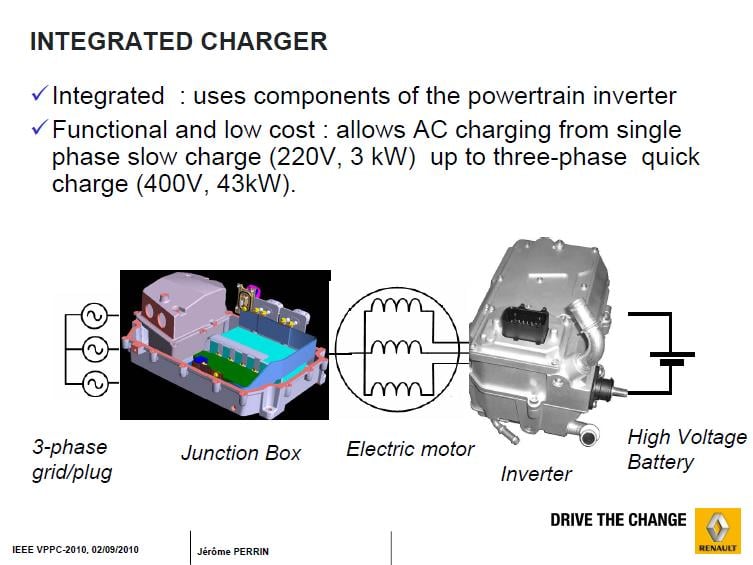
The Renault charger sounds exactly same as the "reductive" charger technology from AC Propulsion described below, which Tesla used to license and use, but ditched later on for a separate charger (because the separate charger was actually cheaper, supposedly).
http://www.acpropulsion.com/products-reductive.html
Therefore I think even Nissan/Renault will have to license from ACP if they decide to use the same system in the US.
And anyways, it looks like the Max single phase power is 3kW for the Renault, which is pretty much the slowest you can get in the US for level 2 charging. Tesla is offering 10kW and 20kW right now, so that charger will have to be beefed up.�
Mar 14, 2012
eledille Yes, I should have written "as soon as possible" instead of "now". I have no illusions that this will be ready for the launch.�
Mar 14, 2012
dpeilow I don't see that. I read it as the MIN single phase power is 3kW.�
Mar 14, 2012
eledille Yes, and another one by RWE that shows the same components arranged somewhat differently. I don't understand that diagram, the motor's neutral seems to be connected to the junction box, but the three phase input is going nowhere. I think the RWE diagram had the junction box positioned between 3-p supply, motor and inverter.
Yes and no. AC Propulsion's "reductive charger" uses the motor windings for smoothing the output of a single phase rectifier (ok, ok, inverter) and operates on single phase. Both reuse motor drive IGBTs. The idea is the same, but the reductive charger has a more difficult and somewhat different job because of the single phase input.
Quite possible, I don't know. If ACP's patents are about motor windings, single phase and smoothing, maybe not. If they managed to patent the reuse of motor drive IGBTs for charging, then probably. On the other hand, Renault supposedly has 60 patents on its charger.
It doesn't say that max single phase power is 3 kW, that is only one endpoint of a range. It might be that it supports for instance 32 A single, but probably not 63 A. But I thought you guys were uninterested in three phase - I imagined this would be for Europe and Tesla would install the current chargers for NA.�
Mar 14, 2012
Kevin Sharpe agreed... I was told at the Geneva show by Renault that it was a "minimum of 32A and possibly 63A"�
Mar 14, 2012
dpeilow The minimum maximum�
Mar 14, 2012
stopcrazypp Here's the supported charging modes in the ZOE described in another site:
http://www.greencarsite.co.uk/electric-cars/renault-zoe-with-Plug-in-electric-car-grant.htm�
Mar 14, 2012
stopcrazypp I'm just commenting on the likelihood of it. I certainly know the European market will likely have a different charger (it's going to be the same way for J1772 vs Mennekes), but I see the modular approach more likely (given Tesla has ditched the integrated approach once before and it's easier to swap out a modular charger). The integrated approach will mean licensing issues for Tesla which might end up costing more money anyways (if Renault has patents, which I assume is in Europe, that means Tesla will have to pay both ACP in the US and Renault in Europe).�
Mar 14, 2012
dpeilow No, it says those are charge times, not supported charge modes. Given that it says 'any power level', those could just be examples.�
Mar 14, 2012
Eberhard you have to include the fact, that all of the DC charger with 50kW or quick charger with 90kW will be feed from the 277V/480V 3-phase grid. That would enable any electric car to charger with 22kW or 43kW from the AC-3phase grid as well without the need of an expensive external DC-charger.�
Mar 15, 2012
eledille My comment about American disinterest in three phase was a bit tongue-in-cheek. Sorry. To me, three phase is obviously desirable in NA too, and personally I'm sure that will become more and more evident. The lack of plug and standards support is a challenge, of course.
If the integrated charger supports everything then there is no need to swap it unless it breaks. Breakage is more likely to happen with two components than one. From my own experience, it seems that water intrusion and condensation is the most common cause of electronic component failure in EVs.
The list of charge times are just examples. It will obviously support 16 A, 400 V, this will be the most common circuit size for home charging in three-phase-land. That is not listed, but not supporting it would be completely lunatic. I'm quite sure it will support all the amperages that the standard can communicate between EVSE and vehicle, probably well below 16 A and up to the maximum (63 A).
Single phase maximum is not listed, but I would assume that it can handle 32 A, as it can do 63 A three phase. Kevin wrote that Renault had said 32 A, possibly 63 A, and that makes sense. Supporting 63 A single phase will probably mean higher parts cost, though.
If the alternative is USD 3000 for two extra chargers to get three phase (number off the top of my head, may be wrong), and then at only half the power of a small, inexpensive car, then perhaps they should consider licensing. But patents can often be worked around, you just have to find a sufficiently different way to do the same thing. Maybe that is possible, maybe not. Tesla needs to develop its own IP in this field as soon as possible, if at all possible.
This is really, really important. It enables powerful, inexpensive charging anywhere in Europe and (ignoring incompatible plugs and standards) many places in NA for those that have the technology and the patents. Those that don't will have to pay for access to it or their cars will have to haul more heavy, expensive gear around.�
Mar 15, 2012
stopcrazypp None of the three-phase sockets you guys are talking about are readily accessible to the public. Plus when you are drawing at that rate, the owners of that socket will likely want to charge you for it (esp. given there are little to no 3-phase sockets used in residential settings). And given J1772 has no support for 3-phase whatsoever, unlike the Mennekes connector standard Europe will use, there would be no existing level 2 stations (which have the payment system built in) that would support 3 phase charging. 3-phase will have virtually NO role in the US for that reason. That's why there's not even one automaker planning to offer 3-phase in the US (even the European ones, like BMW with the Active-E). Therefore, Tesla has absolutely no incentive to support 3-phase in the US. Any built in 3-phase support will just cost them extra money in the US and will not play any significant role in helping sales in the US.
Again, I'm not sure if you missed my other comment, but the car you are pointing out not only doesn't include the cost of the battery, it also will be made in about 10x as much volume as the Model S. Plus Renault doesn't have to pay any licensing fees presumably (like Tesla did before). It's just not going to cost the same for Tesla to make it. And keep in mind my point above about the significance of 3-phase in the US.�
Mar 15, 2012
Eberhard I think you don't want to understand what i want to make understandable. If there are several EV are to be charged in one street in the neighborhood , the grid need to be updated to handle the high load. Best way do to it is with the introduction of the 3-phase grid. If a CHAdeMO or 90kW quickcharger can be installed, then also a much simpler and more inexpensive (few hundreds instead of ten thousands of dollars) charging station can be installed too. No special socket needed.�
Mar 15, 2012
Mark Petersen but is still may be interesting, as if you have a 3-phase 32A charger you can use it as a 1-phase 96A, but a 1-phase charger can not be used at 3-phase
it is just like the 2x10Kw charger from tesla uses 1-phase, they use the same phase, but you could technical connect them to 2 different outlet each cable of only 10Kw
the only different will be that 3-phase will be in sync and not at a shifted phase�
Mar 15, 2012
emq Tesla does not pay licence to ACP since Roadster 500, because they used Tesla technology with an isolated charger to accus. ACP reductive charger has grid potential at the accus that is a protection issue. So Tesla should never go back to reductive charger.
Renault Zoe is the first car i know, witch applies 3ph 400V for an integrated charger, 400V x ?2 > 560V DC, Batterie Voltage is 400V DC, There must be a DC/DC Converter in between, so it is different to ACP, no license.
Zoe Charger supports definitly 43kW charging.�
Mar 15, 2012
rabar10 see: recursive loop�
Mar 15, 2012
stopcrazypp How do you propose to connect that 3-phase source to the car's on-board charger without a special socket? None of the J1772 cars can support a 3-phase connection. J1772 makes up pretty much all of the EVs and plug-ins that will be sold in the US, except for the Model S, which will support it with an adapter. Neither can the Model S socket (nor the Roadster socket) for that matter.
And I almost forgot that many of the DC chargers will likely be directly wired to the input (no socket at all), like the level-2 chargers currently are. And to make it clear, unlike the DC charging situation, J1772 is definitely already "defacto" for level-2 charging here in North America (and in Japan too). I just don't see 3-phase happening in the US anytime soon (and there is no indication anyone is even attempting to move in that direction).�
Mar 16, 2012
widodh I'm not going to go into this discussion that much, but the facts are simple:
USA: 1-phase high amps (100A?)
EU: 3-phase medium amps per phase (32A)
At the end of the day it both sums up to somewhere around 20kW.
Don't try to move the world here. Yes, the US power-grid is a 3-phase grid, but the end distribution is NOT done like in the EU, they balance phases by connecting blocks or houses to different phases. We can debate over and over if that's a good or bad thing. But be realistic, it won't change over night and certainly not in the coming 5 years (I'd even say 10, if it changes at all).
So Tesla made a good move, it took some nagging and bugging them, but in the US people can charge with 20kW AC and in the EU we can do the same, isn't that great?
3-phase power in the US is only available on request and will probably be very expensive to install?
I really don't get the point of this whole discussion.�
Mar 16, 2012
dpeilow hear, hear.�
Mar 16, 2012
VolkerP OK, in order to give this thread some new stuff to fret about, I have two questions:
1) For 3 phase mobile charging, what changes must be done to the Model S UMC? CEE plug and redesigned vehicle plug? new integrated EVSE?
2) Will there be a HPC 2.0 (or call it 2.5) for EU residential installation that feeds from a 3 phase grid connection? What vehicle plug will it come with?�
Mar 16, 2012
jcstp Model S Design Studio at Menlo Park
Is this 3 phases and one earth?
If yes, adapting it with a european 3 phase plug is going to be easy!�
Mar 16, 2012
doug Instead of more fretting, I'd be happier if this thread just got quiet until there was some actual new information. Clearly all that stuff will have to be changed to support 3-phase, particularly the vehicle plug. Right now Tesla has to focus on a successful North American launch and I suspect they be running down to the wire just to reach that.�
Mar 16, 2012
VolkerP  �
�
Mar 18, 2012
eledille Not quite that simple. CHAdeMO requires 3-phase, just like the Chameleon charger. The Chameleon charger converts all DC chargers that are not significantly more powerful than 43 kW into expensive do-nothing devices.
Absolutely!
Large buildings in the US also have 3-phase. Every CHAdeMO charger requires a 3-phase connection. If three phase was not widely available in the US, no-one would even be thinking of CHAdeMO there.�
Mar 18, 2012
jkirkebo At Model S voltage levels, a CHAdeMO charger will be 25-30% more powerful than a 43kW AC charger. So a 30 minute charge on CHAdeMO turns into a nearly 40 minute charge on 43kW AC. Not a huge difference, but definately worth something to me.
Of course, I'd love a network of 90kW Superchargers around the country. About 50 should do for a start�
Mar 18, 2012
Eberhard i checked the flap door for Model S in Geneva. It's big enough to host the Mennekes socket. This means, no UMC or similar device is needed, only a simple Mennekes cable is needed.�
Mar 18, 2012
widodh I'm talking about residential areas. For home charging with 20kW in the US you'll be forced to use single-phase.�
Mar 18, 2012
Eberhard Any CHAdeMO charger or 90kW quickcharger could host 3 sockets for AC single-phase charger with up to 120A�
Mar 27, 2012
jcstp
Model S checking what is 3-phase�
Mar 27, 2012
widodh Hehe, indeed.
That's the one from the Geneva Motor Show btw.
I have been told that it doesn't have a battery in it. I also saw it outside the show and it has been running on a external 12V power supply�
Mar 27, 2012
jcstp Fast charging from 120V
could this be the start for a DIY 3-phase to 1-phase charger (in this thread it's 2-phase to 1-phase)�
Mar 27, 2012
donauker Not really. Our 120 volt circuits are split phase so this is just an approach to find two opposite 120 volt halves and combining them into a single phase 240 volt supply.�
Mar 27, 2012
hcsharp No. But last fall I went to an EV event where a guy was selling a device he made that hooked up to a Prius's battery and produced 120V up to 20A. To show off, he wanted to charge my Roadster with it. I didn't think it would work, but agreed to try it. Sure enough, I charged for quite a while at 16A 120v no problem! The whole thing was about the size of a desktop computer, and weighed about the same. I drove home wondering what would be required to get 32A output and simply rectify 3 phases to supply the input. Wouldn't be surprised if it would fit in the Roadster trunk.�
Apr 10, 2012
ElectricVehicle The Renault Zoe will have the 43kW AC 3 phase charging with the charger on board the vehicle. When you say "All the forthcoming Nissan chargers will have 43kW 3 phase as well." What is your source? On which vehicles?
Tesla, which has the least expensive prices for on board chargers, charges $1500 for another 10 kW of charging power. Scaling that up to an on board 43 kW charger would be roughly 4 x 10 kW units at $1500 each for a total of $6,000. In the context of the Nissan LEAF, I doubt they are going to add $6,000 or maybe they do it a bit cheaper - $4,000 to each LEAF for 43 kw charging! $4,000 for 43 kW of power is a little under $0.10/watt, and that's a very, very, possibly too low cost for power electronics. For comparison, one of the cheapest CHAdeMO quick chargers is the Nissan QC, about to come out, that is $10,000 for 50 kW.
So I believe SELECT, high end or special application cars will have 43 kW AC charging, but not entry level and mainstream EVs. Though I also think every EV should have at least a 10kW onboard charger ($1500 included) and an option to go up to at least 20kW ($1500 option) just like the Model S!�
Apr 10, 2012
Kevin Sharpe I've heard similar off the record comments at various Nissan and Renault events that I've attended. Renault have said that the Fluence and Kangoo were designed for specific customers and as they move towards mass market vehicles they are free to implement more useful fast charging (which IMO is 43kW 3 Phase in Europe today).�
Apr 10, 2012
ElectricVehicle 3 phase makes much more sense in the European markets where 3 phase distribtution is much more pervasive. In the US, the high voltage local feeders to suburban residential areas tend to be single phase, so three phase is not as available. Larger commercial areas and larger multi-tenant dwellings are likely to have 3 phase in the US.
With a high power charger, you get to choose if you want the weight and expense on the vehicle or as part of the charging infrastructure.
I think we'll need both for some time to come... I'm very interested in following the 43 kW AC fast charging worldwide and the US. I certainly see good application for it in the US, even though it probably won't be as ubiquitous as J1772 or a lower power wireless in the future.
When cars vastly outnumber charging spots, it becomes more economical to have the charger offboard. But that also assumes that the charging host isn't overly cost sensitive and is willing to install a DC fast charger. So having the charger on car, means the install costs less for the host if 3 phase is already available, but the host still has to be willing to go to the time and expense of getting permits and doing some facilities work to install a 43 kW AC fast charger.
I'm thinking we need some 43 kW AC fast chargers with the charger on the vehicle for delivery trucks, taxis, etc. where there are many destinations relative to the number of vehicles and the stop time at each destination is 5 minutes to an hour.
For passenger cars, a couple 20 kW AC fast charge in many places (malls, restaurants, etc.) and 43 kW AC or 50 kW DC fast charge in some places (highways, major destinations) would be nice. 3 kW (12 Miles Per Hour of Charging, MPHC) or 6 kW (25 MPHC) isn't fast enough when you're waiting for the charge. 20 kW (70 MPHC) as an on board charger is pretty nice and can be done single phase if need be. The 43 kW AC should be onboard for some types of vehicles and maybe an option for entry and mid level EVs, maybe standard for performance EVs and those with 300+ mile range.
43 kW AC for the US maket will be YANEVCCS - Yet Another EV Charging Connector Standard! J1772 is single phase and goes up to 19 kW, so it can't be mechanically adopted without additional pins.
There's also the wireless charging, though that seems a few more years out to wide commercial adoption and currenlty mostly under 10 kW from what I've seen. Doesn't seem like there are any wireless options for 20 or 50 kW fast charge.
Certainly exciting times in terms of working all of this out!�
Apr 12, 2012
widodh Please continue the discussion in this topic: Future Charging for Model S 1-phase or 3-phase? (Part 2))�

Không có nhận xét nào:
Đăng nhận xét