Jan 13, 2016
sandstruck I took delivery of my new P90D last weekend (trading in my model 85 from 2013) and downloaded Firmware 7.1 two days ago. I had used autopilot for a few days with Firmware 7.0 and found it wonderful (astounding). Today was the first day I tried it using 7.0.
At about 8:30 AM this morning on I90 (road conditions perfect, visibility good), I was doing about 60 MPH and switched on Autopilot. I initiated a lane change with my turn signal and the car switched lanes seamlessly. My car automatically modulated my speed (with a two car distance) with the car in front of me, and I was cruising along happily when the car in front of me changed lanes and my car caught up to the car in front of him. After following this new car for a few minutes, the traffic began to slow.
My car slowed as well. But when the car in front of me came to a complete stop (not a sudden emergency stop, but rather a gradual stop), I expected my car to do the same (as it had been doing previously). It didn't. I slammed on the brakes in that dreadful instance before I realized my car wouldn't stop in time, but I still hit the car in front of me (while going maybe 5-10 MPH). I'd like to mention that I consider myself a very safe driver and have never been involved in any accident before (I'm 52). I damaged that car's rear bumper and cracked the plastic cover on my new Tesla (see attached photo).
After the police came (the other driver insisted we file an accident report) and I received a $120 ticket, I called Tesla's technical assistance. The gentleman I spoke with told me that the Autopilot function is "flawless" and that it was my responsibility, as the driver, to avoid any collision. I asked to speak with his supervisor who told me that this was the first time anything like this has ever happened, and found it "very strange." They were clearly intimating that I did something wrong.�
Jan 13, 2016
andrewket Sorry to hear about your accident. I would have Tesla pull all the logs in your car immediately (if they haven't already).�
Jan 13, 2016
sandstruck I took delivery of my new car last weekend (trading in my model 85 from 2013) and downloaded Firmware 7.1 two days ago. I had used autopilot for a few days with Firmware 7.0 and found it wonderful (astounding). Today was the first day I tried it using 7.0.
At about 8:30 AM this morning on I90 (road conditions perfect, visibility good), I was doing about 60 MPH and switched on Autopilot. I initiated a lane change with my turn signal and the car switched lanes seamlessly. My car automatically modulated my speed (with a two car distance) with the car in front of me, and I was cruising along happily when the car in front of me changed lanes and my car caught up to the car in front of him. After following this new car for a few minutes, the traffic began to slow.
My car slowed as well. When the car in front of me came to a stop (not a sudden emergency stop, but rather a gradual stop), I expected my car to do the same (as it had been doing previously). It didn't. When I realized my car wouldn't stop in time, I hit the brakes, but it was too late, and I hit him going maybe 5-10 MPH. I'd like to mention that I consider myself a very safe driver and have never been involved in any accident before (I'm 52). I damaged that car's rear bumper and cracked the plastic cover on my new Tesla (see attached photo). ?
After the police came (the other driver insisted we file an accident report) and I received a $120 ticket, I called Tesla's technical assistance. The gentleman I spoke with told me that the accident was my responsibility. I told him that I'm not that concerned about paying for the damage to the two cars: as a first adapter for AP I know I am legally liable. But as I go over the accident in my mind, there was absolutely nothing I could have done differently. You have to trust that your car will stop or you can't use the AP.
They guy at Tesla said they will remotely run the logs from my car to see what happened. I hope Tesla will be transparent and not try to cover up anything. Tesla brethren, please be very careful with AP.?
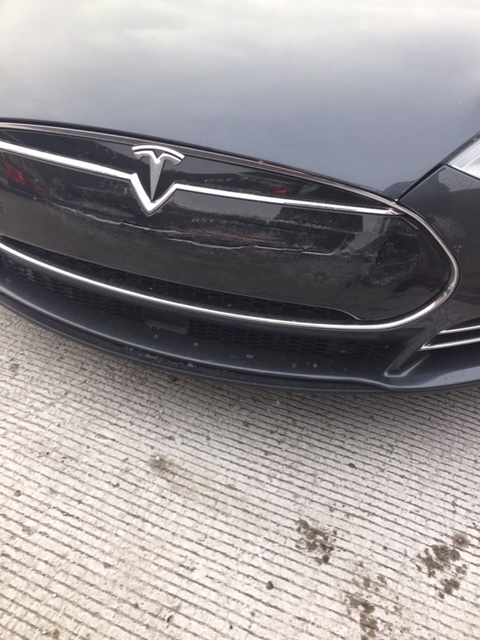 �
�
Jan 13, 2016
jeffro01 ANOTHER thread about this??? Why???
Jeff�
Jan 13, 2016
Max* 3's a charm?�
Jan 13, 2016
scottf200 That sucks. Sorry.
Are you saying above that the car was slowing down by itself but did not do it in time?
Have you used TACC a lot and if you used more than "two car dist" did you find other cars were coming between you and the car ahead?
�
Jan 13, 2016
JenniferQ If it sounds implausible, it probably is. This means TACC failed. Not AP. And that is very unlikely to happen.�
Jan 13, 2016
Max* As I stated in the previous thread, why didn't Automatic Emergency Braking kick in?�
Jan 13, 2016
AmpedRealtor If you had responded to the situation as any driver would have, you should have stopped on time. You trusted AP until it was too late, and that is a mistaken judgment call on your part. You should not have to trust AP. If you feel like you need to start braking in a given situation, then do it. Don't wait for AP to do it. You are NEVER supposed to trust AP, that is just wrong. You are supposed to be in control of the vehicle at all times, which means you DO NOT trust AP. Ever.�
Jan 13, 2016
cgiGuy So, are you saying we shouldn't trust AP?�
Jan 13, 2016
Max* That's a lot of distrust towards AP.�
Jan 13, 2016
green1 Ok, this is now in at least 3 different threads...
Short answer: I'm sorry you got in a collision, but nobody has ever claimed that Autopilot can drive for you, it's still your responsibility to maintain complete control of the vehicle at all times. You should have braked sooner.�
Jan 13, 2016
supratachophobia
Please don't admit fault in writing on here.�
Jan 13, 2016
green1 He rear ended someone, that's almost guaranteed fault right there, I know they say "never admit fault" but the police already thought it was his fault, and we all know his insurance will, and it's pretty much impossible that it isn't his fault.
When you run in to a stationary vehicle, it is almost never someone else's fault.�
Jan 13, 2016
supratachophobia It's called discretion, and the more cars that are around you on the road (thicker the traffic), the more discretion you should have. Keep in mind that there is no point in which you should have no discretion towards auto-pilot, even if you are the only one on the road for miles.�
Jan 13, 2016
sandstruck Green1, I am certainly not trying to shirk responsibility. I accept it. But I wonder if you have used the AP feature yet. If you don't trust it, you can't use it at all. The car brakes for you (mine was set at a two car distance so other cars don't come into my lane). It had been working flawlessly until that point.�
Jan 13, 2016
green1 I use it frequently, every time I'm behind the wheel pretty much.
If you don't feel you had enough time to stop, I suggest you adjust the following distance to a larger number.
I trust it, but I also supervise it. The car doesn't drive itself, it's driver assistance, not self driving.�
Jan 13, 2016
bhzmark Are you 100% sure the car tacc/AP was tracking didn't change lanes and go around the stopped car that you hit?�
Jan 13, 2016
sandstruck As I stated in the previous thread, why didn't Automatic Emergency Braking kick in?
I am wondering the same thing. Also, I'm not trying to shirk responsibility, but if the car stops at a two car distance twenty times in a row, and on the twenty-first time it doesn't, you won't have enough time to stop. You either trust AP or you can't use it.�
Jan 13, 2016
green1 WRONG. If you don't have enough room to stop, then one of 2 things is happening:
1) you aren't paying enough attention to what it's doing, and failed to intervene early enough
2) you have it set to follow too close and need to back it off so that you have enough time to react.
As autopilot is currently only a driving aid, and not self driving, there is currently only one possible way for AP to cause a collision, and that's by failing to relinquish control to the driver when requested. As you haven't suggested that the car did this, then you must take FULL responsibility, not just the type of responsibility where you say "it's me but I couldn't have prevented it"�
Jan 14, 2016
wk057 Wow... um.... wow. So yeah, as suspected, did not RT*M.
I'll keep an eye out for your car on the salvage market when you inevitably total it. Good luck blaming it on Tesla lol. *archives this post* (grabbed it with the Way Back Machine just to make sure the evidence is here for a future accident investigation: WARNING: I rear-ended someone today while using Auto Pilot in my brand new P90D! - Page 18 )
- - - Updated - - -
Conversation at scene of accident:
Officer: So, what happened?
Electricfan: Well, I was reading a book, and...
Officer: You have the right to remain silent...�
Jan 14, 2016
green1 How is it, that despite everything Elon has said, everything Tesla has said, all the warnings in the manual, and the release notes, and the warning you have to acknowledge before enabling autopilot in the menus, and the pop-up message that appears every single time you engage it. Some people still think that the car drives itself????
This is just a mind-boggling phenomenon, I simply don't understand how anyone could come even remotely close to that idea.
Everyone who has posted anything referring to the car as self-driving, or referring to autonomous vehicles, past, present, or future, stop it!!! There is no autonomy involved in this situation.
As I've said before, there is only one possible way for Autopilot to EVER be responsible for a collision in it's current form, and I've never once heard anyone even hint at it having happened in any collision or close call, and that would be if the autopilot somehow prevented the driver from taking over. As that didn't happen, the autopilot has zero responsibility.
for the person suggesting that if you have to pay attention and be ready to take over there's no point, fine. don't use AP then. To the one saying you'd have to always use the brakes at the same time as AP, not at all, you just have to have your following distance set to something safe that allows you time to take over if the AP doesn't get to it first.�
Jan 14, 2016
Auzie Thanks for sharing, it is beneficial to all to share their experiences on Autopilot. Sharing promotes and speeds up learning.
As few people pointed out, even if autopilot failed the driver is fully responsible for the car operation. Only car failure such as failure to steer or brake could be attributed to Tesla, but that did not happen in your accident.
For that reason, some people, including myself, might object to the phrasing of this thread title. The title is attention grabbing, it implies autopilot failure caused the accident and could easily be exploited to hurt Tesla.
If a thread title aspires to grab attention, like your does, then it must be semantically accurate. If the title is attention grabbing and inaccurate, then it is quite unfair and potentially damaging someone's reputation (undeservedly). That is how I see it.
More accurate thread title would be something along the lines of:
WARNING: What not to do whilst on autopilot: I just rear-ended someone's car because my attention dropped whilst driving on autopilot and I failed to stomp on brake in time
Or similar.
Some people might argue that I am being semantic here, but in this case, the devil is in the detail (thread title).
If anyone posted attention grabbing thread title that inaccurately implied my responsibility for the accident they caused, I would consider that poster to be hostile towards me.�
Jan 14, 2016
Scotty Thanks to the OP, for the initial post, and the followups on this thread. While it's not always comfortable dealing with reality, and being objective in describing negative events, it's always for the greater good. Basing replies on subjective or biased information doesn't really promote knowledge and understanding.
Several thoughts and comments popped out to me while reading all of the posts, but I waited until finishing the latest post before responding.
The worst drivers, that I have experienced, for following too close were those on the freeways in Michigan. My cousin, who is a resident there, said I needed to follow closer, or ALL of the drivers would shoe-horn in, in front of me. I would be traveling between 65 and 70 mph, with TACC on 4, in the slow lane, and it was scary. I generally run TACC at 4 or 5, although slow traffic might be set as low as 2, and fast, aggressive traffic merits a 6 or 7. I stay out of the way, if possible.
My indications, with a stopwatch, showed my TACC settings equate to 1/2 second increments from where I am, to the point where the current vehicle being tracked is at.
My MS is in the Fremont SC right now (2nd drive train replacement in ~15 months and 55,000 miles), and the front passenger proximity sensor being reseated or replaced. I drive quite a few miles, and Autosteer and TACC are helpful, but the driver still needs to be the 'Command Driver. 7.1 will be installed before I get my MS back, and I look forward to seeing what it entails.
We hear about situations that appear on the news, or in internet postings, but are not always in context, are biased, or smack of sensationalism. When a few MS have caught fire, it makes national or international news. And, it's apparent that news and media report it as a major problem with electric cars. The recent news concerned the MS that flambe'd while charging in Norway. Even the firefighters included their comments about lithium content of the battery pack. However, what was not talked about was any hazmat fire, or the dangers of flamable plastics, etc. There are numerous vehicle fires in the US every day; they are not as newsworthy unless the vehicle is a Ferrari, Lamborghini, or AMG. A fire involving a common ICE vehicle is generally reported in Traffic Reports as just a vehicle fire, much like a car broken down, impacting traffic.
My MS, with 7.0, autosteered much better in Arizona, than in California. I attribute it to the very good lane markings. I also noted that the swerving to take an exit in California was due to the total lack of markings across the exit lane; Arizona has many smaller segmented lane marking, that Autosteer would recognize, and not try to take the exit. I didn't initially like the new dash diplay with 7.0, but it's very nice to be able to see if the lane markings are being recognized and displayed so as to tell if a problem could be imminent.
I believe that Tesla should increase the visual and audible indicators that denote Autosteer and TACC turning off. Like others, including the OP, it would be interesting if it was disabled prior to the collision.
I am not happy that a few screwy drivers decided to post stupid video's of Autosteer / TACC on Youtube. Clearly, if Darwinism doesn't weed them out, law enforcement will. Unfortunately, EM stepped in, instead.
Technology is improving and appears to be decreasing accidents. Even with safety systems such as antilock brakes, supplemental restraint system, better tires, etc, there are still accidents every day, all over the world. If I am in an accident, no matter where the fault lies, I am happy that I'm in a very safe Tesla. Doesn't preclude the accident, not does it eliminate possible injury or death, but it decreases the odds of injury and death. When I received driver training (more than 40 years ago), we were instructed that there were ways to mitigate injury, but not necessarily to eliminate it. They varies from worst scenario (high speed head on between 2 vehicles), and then moving to different scenarios to improve your odds of survival. These went from 2 cars head on, 1 car info a stationary object or vehicle (yes, whiplash is a consideration), glancing blow, to low speed bumper to bumper. But, in my head, I want to survive, and not negatively affect any others involved. If my car is totaled, that's of little concern to me. Vehicles can be replaced. Life and limb, not so easy.
I am awaiting 7.1, as well as other future upgrades. I remain aware of the limitations of technology. I cringe at the reference to Autopilot. I retired from the FAA, and in aircraft autopilot implementations, as in pretty much any critical system, there is redundancy. When a system (or engine) fails, redundancy usually will prevent a negative outcome. Multiple systems, integrated and designed for the scope of flying, work very well. There's still accidents, but redundant monitor and control leads to pretty reliable air travel. Critical FAA systems on the ground, like Instrument Landing Systems, radio equipment, power sources, are all similarly implemented. Now, Tesla is not really equipped for Autopilot operation. Assistance, yes, but the driver is still in control and legally responsible.
An interesting note was the death of golfer Payne Stewart, when the jet he was flying in suffered depressurization, leading to oxygen deprivation, and yet it continued at the assigned altitude and heading, until running out of fuel. TCAS (Traffic Collision Avoidance System) might have reacted if a situation occurred, but in this case, there was no conscious pilot to handle the situation. The point is, a pilot, even with redundant flight systems, is still the pilot in command, and is ultimately responsible. I think it is important to be planning for the best, but be prepared for the worst. Remember, your MS does not know what you know, and might not arrive at the same conclusions you would.
Drive safe!
Scotty
Any comments about FAA systems are based on published reports.
- - - Updated - - -
There's a few systems, such as Autosteer / TACC , Collision Alert / Blind Spot Indication, AEB, etc, but it's Not AutoPilot!
Scotty�
Jan 14, 2016
donv Just FYI, some airplanes do that, some do not. The airplane I fly now makes no sound, and the only indication that the autopilot is not engaged is an annunciator light.
�
Jan 14, 2016
theslimshadyist Christ, so much B$ rhetoric throughout this entire thread. All the OP intended to do was to share his interpretation of the situation he experienced and nothing more. He admitted he was at fault, provided what I feel is factual information sprinkled with his view of assumptions around an unknown result until Tesla can provide more information or evidence with regards to what happened. Instead, a bunch of useless attacks and a complete waste of energy around blame, irresponsibility, and disrespectful comments are being conveyed against a very unselfish individual who was trying to come here for some advice and to find out if others had experienced a similar result. I believe he was simply just trying to spread awareness and gain input from others who may have experienced a similar outcome.
To be completely candid, Is all of this rhetoric useful, constructive, and supportive to someone who has just had an incredibly terrible week? Where's the human compassion from others around this unfortunate mishap? Aren't we all here to garner advice, share experiences, seek knowledge, and build comradery with other individuals who have similar vested interests? I personally feel very humbled and fortunate that I have the resources to acquire an expensive luxury vehicle but disappointed to see all of the harsh criticism towards a Tesla brethren.
Peace! �
�
Jan 14, 2016
ecarfan That is my understanding as well. It's like the car's audio volume control which goes from 1 to 11. Those values have no units, they are just intervals over a range.
So the TACC setting numbers have no inherent meaning. Select a number based on your judgement as to how much distance you need to stop your car safely if the car ahead of you slams on its brakes. My recommendation is that at freeway speeds a setting of 6 or 7 is reasonably safe. Anything less is too risky for me. In stop and go freeway traffic a lower setting is reasonable.�
Jan 14, 2016
green1 I disagree, Autopilot is a very apt analogy, Autopilot systems don't generally do their own routing, or their own traffic avoidance, that's left to the pilot, Autopilot systems are designed to be monitored at all times by the pilot who remains in full control of the aircraft. That's remarkably like Tesla's autopilot. Nobody ever wants to see the pilot of their airliner in the back with the passengers while the flight deck is empty.
Generally I feel that anyone who thinks Autopilot implies more autonomy than Tesla provides, probably doesn't realize how little autonomy most aviation autopilot systems really provide.�
Jan 14, 2016
disillusioned Man, I avoided wading into this when you posted about your biblioventures last time around, but into the fray!
The level of cognitive dissonance you're willfully demonstrating is, and I'm not being dramatic here: ****ing terrifying. Your "feeling" is that Tesla advertised that the car would drive itself, and that definitions are meaningless. That's cognitive dissonance strike #1: this isn't the King James Version of the Bible. It's not a matter of interpretation where you decide to read it differently than other people. You state "They advertise the car will drive SAFELY on a divided highway and stay in its lane in full control of the brakes, accelerator and steering wheel. I'm trusting them to do that."
They literally advertise the car as being entirely your responsibility at all times. In fact, they state it explicity:
You say right in your post "the car must slow if traffic ahead slows. 100% of the time. If it doesn't we need to know it."
LISTEN TO ME VERY CAREFULLY: YOU KNOW IT NOW. IT DOES NOT SLOW 100% OF THE TIME. PLEASE STOP ENDANGERING OTHER PEOPLE BY WILLFULLY NEGLECTING THE VERY CLEAR WARNINGS IN THE MANUAL AND CAR UI THAT EXPLICITLY TELL YOU THESE FACTS YOU REFUSE TO ACKNOWLEDGE.
It feels more like you have buyer's remorse because you were very excited at being sold on a future that isn't (in your estimation) quite accurately portrayed, but instead of being upset at Tesla for misrepresenting the capabilities of their vehicle, you're just determined to drive like an idiot until it proves you wrong in the stupidest way possible. I just pray that someone in another vehicle isn't hurt by your neglect to follow every instruction provided to you, because you once swallowed a brochure.�
Jan 15, 2016
ElectricTundra A car crash is NOT an accident. Close to 99% are due to stupidity on the part of one or more people operating 4000 lb deadly weapons in an irresponsible way.
Each year in the U.S. nearly 5,000 people who are on foot are killed by people driving cars. 92% of these are completely the fault of the driver. Over 700 people riding bicycles are killed by people driving cars each year in the U.S. (about 55% are the fault of the driver, 20% the fault of the bicycle rider, and 25% no fault determined).
Today in the U.S. about 12 people will be killed by people driving cars. Should these drivers not beat themselves up over killing someone? Are we so callous that killing someone or their mother or their child is nothing to be concerned about? These are not accidents.�
Jan 15, 2016
msnow Chill out, you know he didn't KILL anyone so there's no reason to repeat that a dozen times. It was an unintended, unexpected 3 mph fender bender. No one got hurt. That is the definition of an accident. So to your question; should he not beat himself up over killing someone? Since we are only talking about this case the answer is an emphatic NO because he didn't kill or even injure anyone.�
Jan 15, 2016
ElectricTundra Keep in mind that there is a vast difference in brake failure and TACC failure. Brakes are fairly simple from an operational/expectation standpoint � you press the pedal and they then increase drag on the rotation of the wheels and assuming good tires and dry pavement will slow the car. There is effectively one use case for brakes � pressing the brake pedal.
TACC is very different, massively more complicated, and must cover thousands or perhaps tens of thousands of use cases. How can Tesla or anyone know when they have covered EVERY potential instance? At what point can Tesla say that they've covered enough scenarios that drivers can 100% (or 99.999999%?) rely on TACC to slow/stop the car effectively in every instance, including the OP's, when it should?�
Jan 15, 2016
supratachophobia I feel like I've just been run over by a car-load of statistics....
But seriously, I think we do need to take this as a reminder to be ever-vigilant when it comes to AP. And exponentially so, the more cars that are on the road with us at the same time. If it's just you, the car, and a fresh set of dashed lines doing 70mph all alone, I would take the chance that AP is 99.999999% accurate; more so even then you would be.�
Jan 15, 2016
Shawn Snider Why do people write their name below their post? Where and Why is this a thing? Your name/account is CLEARLY indicated in the box to the left of the Post Window......
Shawn....................................................�
Jan 15, 2016
taoh2 AP is not very dependable, it happen to me several time already in situation that accident could happen
at one time, with my AP enable, the car in front of me slow down at traffic light, my car still accelatering, then it start beeping but not braking hard, I have to step in.
yesterday, with 7.1 update, AP enable, I signal lane change to the left, there is a car at left upper corner, his car back at about my car front with some overlaping. however, my car still try to make the change which almost hit his car. I quickly step in.
when I in CES last week, I saw the Nvidia auto pilot demo, they mention it use 6 camera, like two wide angle and one narrow angle camera at the front alone�
Jan 15, 2016
msnow It doesn't bother me at all. Not everyone's username is the same as their real name like yours so it's not redundant.
Mike [emoji3]�
Jan 15, 2016
scott jones There are a bunch of self righteous drivers here.
Everone else's tips ARE great, but when "some" belittle the guy like he's a child it gets a bit much.
TAKE THE OP's POST AS ITS MEANT.
The TACC in his case didn't work and it didn't emergency stop!!.. HEADS UP, it happened to him and it could happen to you.
Geez�
Jan 15, 2016
dsm363 That is helpful. I always thought it was Ms. Now=)
Dave�
Jan 15, 2016
sandstruck Still waiting for the information from Tesla concerning the "accident" (and I do consider it an "accident" because I certainly didn't hit the poor schmuck ahead of me on purpose). But please permit me to add a little color commentary to the unfortunate event:
A typical commute to Chicago on I90, visibility good, road conditions optimal. As I described previously (and again, memory is fickle), AP seemed to be functioning perfectly. For whatever reason--a dopamine response perhaps--the sensation of the car driving itself, was bringing me significant pleasure.
I remember that the car I was following switched lanes, and apparently my car picked up the scent of the unfortunate victim. His car gradually slowed, and I gradually slowed, until we were traveling at around 10 MPH. I remember his car stopped, my car slowed but didn't stop, I slammed on the brakes and hit him. He pulled over on the left shoulder of the highway. I tried to motion him to the right shoulder but to no avail.
I got out of my car, looking incredibly handsome and debonair (well, maybe not so much). He got out of his car.
"I'm so sorry," I said. "Are you alright? Totally my fault."
Surveying the damage to his rear bumper, visibly annoyed, he said, "You were texting or something?"
"No, absolutely not. Actually...and you're probably not going to believe this, but it was the car's fault! This is a brand, new car, and I was using this Auto Pilot feature, and it was working perfectly fine, but then it just stopped working."
He looked at me blankly, and seemed to be mulling a response.
"Don't worry," I said. "I take full responsibility and I'll cover all your expenses. I'm so sorry about this."
"I'm calling my cousin," he said, getting back into his car to escape the cold.
"I'm going to warn people about this problem," I muttered to him, a lame defense.
I waited outside his car for a few minutes until he cracked his window. "I'm calling the cops," he said.
I sulked back to my vehicle, trying not to look at the faces of the drivers gaping at the new Tesla that had rammed into an innocent victim. But I couldn't help it, and locked eyes with a guy who looked downright gleeful, the sight of my misfortune apparently triggering a dopamine response of his own.�
Jan 15, 2016
msnow [emoji1] Maybe we should make it a "thing".�
Jan 15, 2016
schonelucht Maybe for now but not for much longer. In fact there is already the summoning functionality where the driver is not behind the wheel anymore. There will be time, and it is going to be really sooner rather than later where we can't reasonable continue to say that the car's behavior is the full responsibility of the driver.�
Jan 15, 2016
Max*
I don't understand...
-Max
- - - Updated - - -
I can't stand people who enjoy others misery.
Sorry back on topic. Umn... umn... I got nothing else to add.
- - - Updated - - -
Did he want to call his cousin Jinny to come and break some kneecaps?�
Jan 15, 2016
edwolb An "accident" simply means its unintentional. Most accidents are preventable, but it doesn't make them not accidents.�
Jan 15, 2016
Just a Reader Right. I certainly admire the saint-like patience and self-control of the OP in his responses to these posts.
Anyway, after reading this thread if I were a regulator I would consider banning these assistance systems. As the driver has to monitor the traffic as if he were driving himself these systems apparently only add another layer of distraction, as he has to monitor their operation as well. Then he is required to take over all of a sudden in a difficult situation.
Whatever Tesla may write in its instructions, real life doesn't work like that. Once people are familiar with the system and sufficiently confident that it works they will start to do other things: read books, yak on the phone, apply make up, rummage in some bag, whatever. Do I have to point out those pilots who both fell asleep on the flight deck during the flight?
Additionally, we may start to see drivers being less and less able to take over from the automatic systems. I've read about concerns that even commercial pilots are increasingly lacking confidence to fly an airliner manually. Think about those pilots who managed to crash an airworthy plane after the auto-pilot disengaged, e.g. the Air France flight from Brazil to Paris.�
Jan 15, 2016
Max* I completely and wholeheartedly disagree.
AP will save lives. People do stupid things while driving anyways -- ever seen people shaving? reading a newspaper across the steering wheel? putting on makeup? texting? turning around to pick up things for their kids? etc. etc. etc.
What do you think is safer in those situation? No AP or yes AP? Obviously if the person is doing those things anyways, AP is much safer. Major win for AP.
Now, lets look at the regular situation. A person gets complacent due to trusting AP too much. AP works 99.999% of the time, so in these cases if the person doesn't react fast enough he'll get into an accident. Minor loss for AP, because if AP didn't exist that person wouldn't have been complacent.
I'll take a major win over a minor loss everyday of the week and twice on Sunday. AP will never be perfect. Neither will autonomous driving. But AP will be better than most drivers. And autonomous driving will be better than AP. With each iteration approaching full autonomy, the number of accidents will decrease.
So yeah, I'll take a few additional potential accidents with AP, in order to save a lot of potential accidents with drivers doing stupid things without AP.�
Jan 15, 2016
scott jones . My bet is, people are NOT "already doing these things anyway." Or at least to a much lesser extent.
with AP, TACC and lets just throw in radar and scuba for fun, more WILL start doing things while driving in the car they haven't done before or to the same extent.
have a good weekend!�
Jan 15, 2016
MorrisonHiker Same here! I always read it as Ms. Now until he signed his post Mike...so then I figured it was Mike Snow.�
Jan 15, 2016
jeffro01 You couldn't possibly be more wrong and I couldn't possibly disagree more than I do. I ride a motorcycle a lot in the summertime and in CA lane splitting is legal (riding between the cards down the lane markers) and the behavior I see on a daily basis would shock most people. I could go on and on but suffice to say there are a lot of drivers doing a lot of other stuff having nothing to do with paying attention to the road. Autonomous driving is the answer to this, the thousands and thousands of lives it'll save is more than worth a few hiccups along the way.
Driving a car is much easier technologically, than flying a plane. Since you brought it up, I would like to point out that modern avionics systems are more than capable of flying a plane from gate to gate without any human intervention whatsoever. Now, that's not the case for a number of reasons mostly due to politics and passenger comfort but to argue that flying is made less safe because of these systems is ludicrous. There will come a day where pilots no longer exist in the cockpit on commercial flights, it's simply much safer than a tired\impaired pilot.
Humans are flawed universally, machines are only as flawed as their software which can be adapted, changed, improved over time.
Jeff�
Jan 15, 2016
bhzmark Op. It sounds like tacc was disengaged somehow but you didn't know it. You might have bumped the brake or something. Good story telling and good humor also.�
Jan 15, 2016
jeffro01 Why do you care? I have been posting online for a loooonnngggg time and since day one, well before there were forums like this, I have been signing my posts "Jeff". I do this everywhere and without exception unless I simply forget which is few and far between. Why? None of your business but since you decided to act like a complete ******* I'll answer, I have serious OCD and it's just a habit I have that I do and it just is a reflex.
What a completely useless and stupid post.
Jeff�
Jan 15, 2016
Max* You're joking, right?
Maybe not in Indiana, but everything I listed I have seen within the last few months in the DC area. Texting while driving I see EVERY day. Makeup is at least once a week. Shaving and newspaper reading are rare, but those weren't one time things.�
Jan 15, 2016
jeffro01 When I tell people what I see and experience riding my motorcycle in traffic their jaws drop... I have seen so many things that it's hard to say what's the worse, all of which I haven't only seen once, or twice... They occur regularly...
Jeff�
Jan 15, 2016
stevezzzz After reading (or at least skimming) every single post in this thread, I would like to suggest that the OP only share the information he gets back from TM Engineering concerning the performance of his driver assistance systems to those who agree not to comment on his ?performance.
It could work, right? :wink:�
Jan 15, 2016
ecarfan It's not as simple as people are already doing crazy things like shaving and applying makeup while talking on their cell and eating, which of course many drivers do regularly. More importantly, people are also subject to frequent mental distractions that take their focus off the road. I long ago lost track of how many times I thought I had made eye contact with another driver at an intersection only to discover a moment later that they clearly had not seen me because of what they proceeded to do. And of course I have also many times lost my focus on the road because I got distracted with my own thoughts. Of course that doesn't happen with software.
Overall AP and AEB seems very likely to decrease accidents.�
Jan 15, 2016
CHGolferJim Very useful thread, excuse me while I dash out to the garage to crank up my TACC setting and double-check that the 7.1 download didn't change any others.�
Jan 15, 2016
woof This is an interested point. In my i3, which has ACC (also by Mobileye), when the car in front moves to the right lane, it keeps tracking the right lane car and takes it's sweet time in switching back to cars in the correct lane. I see this every day when traveling in the right lane and the car in front moves to the right to exit. The i3 will slow, matching the speed of the exiting car. It's so predictable I just know to override with the accelerator.
I speculate that your car "gradually slowed" NOT because the car in front of you slowed, but because the car that was previously in front of you, but now on the right, slowed.�
Jan 15, 2016
Just a Reader You are at liberty to disagree with me all you like, that doesn't make me wrong. Aircraft may be complex to operate, but they operate in a highly controlled environment. They don't share their airspace with all sorts of other craft of varying sizes and speed that operate in their direct vicinity, cross their paths or may even approach at high velocity travelling in the opposite direction, plus animals and stationary objects like trees etc. etc.
Sorry, anyone can drive a car down a California highway. The challenge of doing so is basically nil.
Yet, what do you believe is a bigger challenge for automation; flying an unmanned plane from e.g. L.A. to Chicago or to give an unmanned vehicle the task to cross e.g. Paris at normal speed, across the Place de la Concorde, with speeding drivers, unmarked lanes, pedestrians, motorcycles, police cars squeezing past, stationary vehicles blocking parts of the road, rain, short term traffic deviations, tunnels, wet cobblestones etc. etc.? Given the chaotic environment human drivers are operating in, they make surprisingly few mistakes.�
Jan 15, 2016
supratachophobia Correction, driver assistance will save lives. Blind spot, auto-braking, collision warning, those are the things that will save us. Autopilot, I have my doubts.�
Jan 15, 2016
Max* Correction, I meant what I said.�
Jan 15, 2016
jeffro01 It's easily flying an unmanned plane from LA to Chicago, it's not even close. While they may fly in an somewhat controlled environment, highly controlled is a stretch, the challenges they face are far greater than ground based transportation, specifically during takeoff and landing. Regarding the scenario you mention, in an autonomous world, all the cars are communicating with each other leaving the only real wild card to be pedestrians and while that wildcard is not to be overlooked, it is addressable. Again, this is software we're talking about. The simple fact that you admit that humans "make surprisingly few mistakes" pretty much validates the entire point around autonomous driving. Machines don't make mistakes, the software is their limiting factor and it can be improved upon and corrected quickly and easily.
And yes you are wrong, whether you understand or agree with my conclusion matters not. Luckily for us you aren't responsible for making policy decisions. Humans are deeply flawed and deeply inconsistent from one human to the next. Machines are not. Granted their software is their limiting factor but that shouldn't be seen as a negative as software is binary and fixable. Humans aren't.
Jeff�
Jan 15, 2016
Max* I lol'ed at the last 3 words. Wait, you were serious?�
Jan 15, 2016
jeffro01 Absolutely, why would you think otherwise? Do you have some reason why you would find that to be funny? Using Tesla as a benchmark for your expectations is the only reason I can think of, but they are the exception to this, not the norm.
Jeff�
Jan 15, 2016
Max* Tesla aside.
From previous software development experience it's almost never "quick and easy".
Couple that with previous algorithm development, training and retesting it's definitely not quick nor easy, and can easily take months for a patch that will fix item Z to be deployed in the field, because you have to make sure your patch didn't break items A-Y.�
Jan 15, 2016
jeffro01 Understood completely, perhaps I should have qualified what I meant by "quick and easy". The quick is in the rate the patch can be deployed, and the easy is in reference to comparing how difficult it is to teach a human a new thing or a new habit.
My lack of explanation for my word usage is on me, I can certainly see how quick and easy could be taken as fast and simple.
Jeff�
Jan 15, 2016
Max*
Ah, yes, in that case it can be quick and easy, but it will not be fast and simple. Glad we agree�
Jan 15, 2016
msnow So glad that two of the people I respect have come together. [emoji3][emoji3]�
Jan 15, 2016
California Roll OP: - please remember to update us on what Tesla will report on the incident after analyzing its logs. My concern is this may get lost in the thread - it appears the thread now has a life of its own, and it took a turn toward discussions of a more ..... philosophic nature .�
Jan 15, 2016
Max*
Welcome to TMC!�
Jan 15, 2016
jeffro01 My bad...
Jeff�
Jan 15, 2016
Just a Reader Right. I'm sure that the deer that leaps out of the park onto the road will also be incredibly connected. I don't believe that you have any idea how much opposition this "autonomous" world of your utopia is going to meet.
BTW, it would be quite funny to see how many of these Teslas "summoned" to drive from L.A. to NYC on their own would e.g. get bogged down in some field in the Midwest because they couldn't handle some deviation with confusing signage.�
Jan 15, 2016
msnow ^^ fear, uncertainty, doubt? Also not a Tesla owner I presume.�
Jan 15, 2016
SherSlick FWIW I too have had to "catch" my car before it rear-ended the person in front of me. A few times. With the newer AP display that shows more than one car, the times I have had to intervene the display showed that it didn't detect any cars ahead of me or in the nearby lanes. All the while autosteer+TACC are doing their job.
I took it in after once or twice (pre-autosteer days) and service said everything checked out. Meanwhile I am seeing occasional times where the radar or whatever is causing the display to show the vehicle in front of my jumping forward and backward wildly.
Whether a software or hardware issue, both TACC and Autosteer are only 80% reliable in my book.�
Jan 15, 2016
Max* Umn... yes.
[many] Years ago I read about BMW introducing an infrared camera in their cars that can detect an animal on the side of the road. Add a little code to that to detect and identify it as an animal, then you can track it. Once you can track it, the computer will be able to both see and react faster than a human being to correcting for the animal.�
Jan 15, 2016
jeffro01 Your post made me laugh out loud, literally... Look, the only people who would oppose this are people who are unreasonably fearful or can't seem to understand that a machine is far more reliable and consistent then they are. Clearly you fall into that category, that's on you, not me. In the end you will lose and progress will continue on, thousands of lives will be saved, and humanity will be better because of it...
Jeff
- - - Updated - - -
Very interesting indeed, I have yet to observe this behavior in my car. I can appreciate how such behavior would affect your perception of reliability, no doubt, it would me as well if I had the same experiences.
Jeff�
Jan 15, 2016
Max* must.resist.correcting.grammar
No, I'm weak. You snooze you lose, a moose is loose.�
Jan 15, 2016
jeffro01 LOL Indeed... Autocorrect strikes again...
Jeff�
Jan 15, 2016
Beryl When they "checked [it] out", did they recalibrate your camera and sensors?
As mentioned up-thread, I had a similar problem. Service couldn't find anything until I did a bug report. See the service ticket I posted for the resolution.�
Jan 15, 2016
sandstruck Log Results
The service manager at Tesla informed me that the engineers who analyzed the logs from my car found no anomaly: the TACC performed as designed. The system triggered the emergency alarm when the collision was imminent, and the driver (me) applied the brakes after approximately one second (so much for my catlike reflexes). At the time of the accident TACC was fully functioning: no faulty camera or sensor.
I asked why the car didn't stop on its own--why was I required to slam on the brakes in the first place? The service manager told me that I bore all responsibility. I told him I accepted all responsibility. But the emergency alarm sounded only one second before the time of the collision, I explained, rendering it essentially useless. He repeated that the accident was the driver's responsibility and that he wasn't in the car to witness what happened.
I told him that I didn't remember going that fast at the time of impact (it was a fender-bender after all), and that it seemed like the car should have stopped. It wasn't at all like an emergency braking situation (until the very last second). He told me the accident was my responsibility. I may have sworn at him.
I asked about my speed at the point the emergency alarm went off and he promised to ask the engineers. "We can't know if you were going downhill, if there was ice on the pavement. We can't know any of this," he said. I apologized for being so rude.
I've had time to reflect on this minor accident and I've read all the posts in this string and my conclusion is the following: the accident was entirely my fault. I don't blame the car one iota. I wasn't careful enough and I had unrealistic expectations for the technology. After talking to Tesla, I drove home with my broken nose cone, set the distance to seven, and engaged the AP (my hands hovering above the steering wheel, my foot covering the brake). It worked beautifully.�
Jan 15, 2016
JenniferQ You may find it more comfortable to actually hold the steering wheel. I find hovering very uncomfortable. It will also allow you to react that much more quickly in case of an emergency. I had some funny lane-seeking movements today on a route I drive daily while using Autosteer and am not sure it's as solid as 7.0. Maybe it needs to calibrate again. Will see after more tests this weekend.�
Jan 15, 2016
msnow I wasn't expecting that answer from them. I thought either you inadvertently disengaged TACC or some break in the system. I wonder how they would respond if you asked for a copy of your own logs.�
Jan 15, 2016
KJD Thank you for your honesty. It must have been painful to write that post. Hopefully others can learn something from your experience.�
Jan 15, 2016
Cosmacelf Yeah, I drive with the steering wheel slipping through my fingers in my lap - I find that I can apply a little bit of torque here and there just to let the car know I'm here.
Sounds like a lawyer got to the Tesla guy before talking to you. It would be nice to know why the TACC didn't brake in time. But I guess their answer is that TACC won't brake in time in all cases. Nice to know.�
Jan 15, 2016
Discoducky If I could ask you a few questions about the time right before the incident it would be helpful in understanding why the system didn't mitigate all the crash energy or stop prior to impact.
My suspicion is that your manual input to the brake right before impact may just have not been enough force. Do you think you could have put more force on the brake pedal? Or do you think more force to the brake pedal would have stopped the car faster?
Also, was the car in front of you that you hit completely in your lane? And were the lines on the road bright and clearly visible? Was the segment of road straight or was it curved? Were you on a slope at all or was the road slope flat?�
Jan 15, 2016
theslimshadyist Gosh, such a callus response from the Tesla rep but due to the circumstances, he was in full legal defense mode from the very beginning. I'd make a poker play and "raise him", ask for the logs so you have a copy of them. If he won't release then tell him that your attorney will obtain via subpoena! You can bet your sweet A$$ that either Elon or one of his executive team members will be giving you a call to provide you with more courteous details.
Sit back, relax, and grab the popcorn!�
Jan 15, 2016
jeffro01 For what purpose? The issue seems pretty cut and dry so why try to take it further than it needs to go?
Jeff�
Jan 15, 2016
theslimshadyist Well, that's a good question but let's just "assume" that Tesla was at fault and something in the system failed, do you think they would be so easily forthcoming with the information? In today's world, I'm not simply satisfied with that sort of reply unless someone can point out or show me the data to support the conclusion.
So, if you took your vehicle, any vehicle for that matter in for maintenance and the service adviser said, "All of your tires are worn out and need to be replaced". Are you going to believe him at his word or will you personally look at the tread patterns yourself before you authorize the work?�
Jan 15, 2016
Max* Sigh, why do you think Tesla is hiding something? Autopilot is a driver's aid, everyone agrees the OP is responsible.
As a side note, if you believe Tesla is hiding something, don't you think they'd fudge the logs?
- - - Updated - - -
The only thing I'd like to understand is why AEB didn't kick on. That's it. Was it a limitation of AEB? Malfunction? Etc.?
It wouldn't shift the blame, but I don't get why it didn't work... If OP was decelerating does that counter AEB?�
Jan 15, 2016
theslimshadyist I dunno if they are or not, none of us actually know only Tesla knows this!�
Jan 15, 2016
drsaab That is strange. I would have thought they would have said tacc disengaged because you hit the brake but saying tacc was active and you didn't brake in time makes me feel the system is at fault. I have driven 20k on tacc and i would expect it to brake in this situation on its own. The only time I would not is if the car in front changed lanes. The tesla tracked that car and then did not engage lock on the car actually in front of you in time. I have seen this happen multiple times in mb distronic (which I drove 30k miles on), and tacc from tesla. But it's always getting better with the updates in locking on the correct car quicker. If it was locked on the correct car, it should have stopped and to me that is a tesla failure.�
Jan 15, 2016
theslimshadyist I don't know, the OP doesn't have the logs in order to validate. Didn't I read somewhere that VW is going through a "fudging" issue themselves?�
Jan 15, 2016
ElectricTundra Does the forward facing camera do any image recording? Can techs or engineers access this? What does it show about the crash?
Was this a new use case that they need to account for � TACC is slowing for car A (in front of Tesla) that is slowing, car A moves over a lane, TACC doesn't find the car B in front of car A in time for TACC to react? What is the solution?�
Jan 15, 2016
Canuck Volkswagen set out to deceive. That's different than a cover-up (not that Tesla is engaged in a cover-up, that makes no sense to me).
To the OP, sandstruck, you're a honest and forthright person, from reading of your posts. I have a lot of respect for you. You have a right to be concerned and thank you for sharing your experience. I plan to own a AP car in the not too distant future, and this gives me more reason to wait for 2.0. You deserved to be treated better by Tesla, especially because you took full responsibility and just wanted some answers.�
Jan 15, 2016
Electricfan Well, I wonder why this has never happened to me? I drive with AP every single day, in rush hour traffic on weekdays, and Houston traffic is always thick even on weekends. I'm glad it was just a fender bender, and again, I can't thank you enough for sharing the experience. I suspect you didn't get the whole story from the service manager, but then I didn't think you would. I just can't picture them telling you "Yes, the car glitched, we're sorry." There isn't a business in existence that's as honest as that. Of course, maybe AP just didn't have time, since it was set to following at "2". But car companies are a little worse than average on the honesty front (GM ignition debacle, etc). Maybe its because their liability is so great. Its sad Tesla is no better than the rest. Two pieces of advice, for what its worth - keep your distance setting on 7, and get a dashcam with high quality video. I have one on most of the time, although since its not wired into the car I forget to turn it on sometimes.
Good luck, and thanks again.�
Jan 15, 2016
James Chan Maybe he lightly tapped the brake by accident to cancel AP? I think i've done that once before...(or i assumed..)�
Jan 15, 2016
ecarfan @sandstruck, thank you for posting what Tesla had to say. I appreciate your candor and your accepting responsibility.
To me the lesson here is that all the aspects of AP, including TACC, are driver aids only and are not substitutes for good driver judgement. Just because TACC lets you follow a car closely doesn't mean that it will always be capable of preventing an accident no matter what the surrounding vehicles do.
Tesla AP is in its infancy. It will improve dramatically in the near future, I am sure. But we are years away from highly reliable autonomous driving.�
Jan 15, 2016
vgrinshpun I want to second posts by many who thank Sandstruck for sharing his unfortunate experience, while persevering through many unkind to him posts to inform our community in the most objective manner.
I own an older MS, without the AP, and have a question that was prompted by Tesla's representative's statement that TACC performed as designed. From what I've read in this thread any driver input, including applying the brakes cancels the TACC. The question though, does applying the brakes by driver cancels the AEB system as well? I hope that it does not, because if it does, such design would almost eliminate the benefit of the AEB system. If the driver applies brakes to stop the car before an impending collision, but does it with less force that would have been applied by AEB system, while cancelling the AEB, it could lead to an accident in situation when, if not cancelled, AEB system could help to avoid it by applying more braking force than a driver. Based on this it seems that AEB system should not be cancelled by applying the brakes, so that it could provide more braking force if necessary.
I think that situation could be different with TACC and it could have been indeed cancelled by application of the brakes.
So a follow up question to Tesla would be whether the TACC was cancelled once the brakes were applied by the driver, and, additionally, whether the the AEB system operated as designed, and whether it was cancelled or not when brakes due to application of brakes by driver.
May I also suggest communicating with Tesla over e-mail, rather than telephone - in my experience it might be a more productive way of communication/resolving the problems.�
Jan 15, 2016
Discoducky AEB braking function is still on in that scenario. It is cancelled however, if the accelerator or brake is manually pressed (aka manually override takes precedence)�
Jan 15, 2016
Andyw2100 No. (See below.)
That's incorrect.
Here is what the manual has to say:
--
Automatic Emergency Braking does not apply the brakes, or stops applying the brakes, in situations where you are taking action to avoid a potential collision. For example:
� You turn the steering wheel sharply.
� You press the accelerator pedal.
� You press and release the brake pedal.
� A vehicle, motorcycle, bicycle, or pedestrian, is no longer detected ahead.
--
Note the "Press and release the brake pedal." So clearly simply pressing the brake pedal is a different situation, and one that does not cause AEB to not apply the brakes or to stop applying the brakes.
- - - Updated - - -
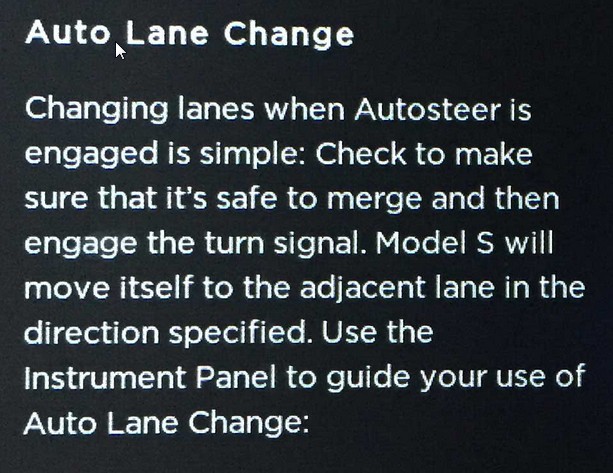
I am surprised that no one has pointed this out yet. The above was 100% user error. It is the driver's responsibility to make certain that the lane you are planning to change into is clear --BEFORE-- engaging the turn signal. Once you engage the turn signal, you are telling the car to change lanes.
From the release notes:
 �
�
Jan 15, 2016
Discoducky Didn't realize it said in the manual was a brake press and release that overrides AEB. Wonder if it is actually implemented that way in the current software? That could be easily verified...�
Jan 16, 2016
NoMoGas Well for starters 2 doesn't mean 2 car distance. At 7 it means you will occupy the space the vehicle in front of you is in 3.5 seconds. Having this set so low "so people won't cut in front" makes that response time less and less, in your case 1 second. No way should you beset to 2 on a 65mph freeway. Two things to consider, 1) any chance your foot was resting on gas overiding AP? 2) Remember the instant you hit the brakes you disengage AP.
My settings: 6, 15,000 AP miles in 26 states from NY to LA. Does a car cut in front once in a while? yes. If i get too upset I just hit the go pedal and drive one pedal but truth is it sets me back all of a few car lengths a day who cares? Being overly concerned about people getting in front of me isnt worth the stress, or insurance rates.�
Jan 16, 2016
Beryl GMTA. 6 on highways, and 4 on any road under 50mph for TACC. I don't care who gets in front of me. I know that I can (and often do) overtake them when necessary.
Kudos to the OP for sharing so much about his unfortunate event and the Tesla reply. I'm still glad that I didn't wait for AP 2.0 but this thread has helped confirm my resolve to cautiously engage AP features.�
Jan 16, 2016
bhzmark Its not acceptable to say, as Tesla apparently did, that TACC operated as designed as it drove into the car in front of you. They need describe the details of in what way this was some rare edge case that TACC couldn't deal with as we would expect it to -- namely, to stop.
What were the special facts that led TACC to drive into the car in front of you? Rather that stop behind the car, as it does for me dozens of time each day?�
Jan 16, 2016
thegruf @OP - I can just imagine your frustration at trying to discuss the logs with Tesla.
Maybe you could ask to discuss this with an Engineer at Tesla directly and perhaps get a more informed conversation.
It very much sounds as though AEB failed to operate for you, and as a safety assistance device it is entirely reasonable for you to request information as to why it failed.
I would really expect Tesla to be crawling over all the components of the system, performing tests of it, and potentially be making component replacements eg of radar to ensure you car is operting correctly.
Assistance mode or not, it is not good PR for Tesla.
The lesson to us all (which a few here seem to find difficult to comprehend) is that Driver Assistance functionality is just that. Assistance (driver responsbile) and not mandatory core (car responsible) functionality.
The sad part is that your incident shows that in all truth these assistance functions are really a long way from being dependable.
As such they are simply fun features that can indeed on balance improve safety and the driving experience but simply cannot be relied on in any circumstance.
In turn of course the less we can trust them, the less value they have.
Really we must keep in mind we are very much in first generation of this tech.�
Jan 16, 2016
ElectricTundra I don't recall ever seeing this defined so specifically. Can you tell me where this came from.�
Jan 16, 2016
Todd Burch Dude, the OP owned the car for just a couple days. Do you really think it's more likely that the system failed, or that a new owner just had a simple accident misinterpreting the situation or misunderstanding the capabilities of the system?
Not everything is a conspiracy.�
Jan 16, 2016
sillydriver While I cringe at the thought of diving into a divisive argument, I've changed my mind from the first post above: I am arguing that he does not have legal responsibility for his accident, Tesla does. I will assume the OP is reporting all the facts correctly. The situation was one where the car ahead was being followed by TACC, which began to slow when that car slowed. This is a situation of the kind where TACC is advertised to be usable. And now the service manager said that 'TACC performed as designed', meaning it was functioning, not impaired by a sensor problem, and not inadvertently disengaged thanks to driver error. If 'TACC performed as designed' and that led to a crash, then almost by definition there is a design error.
Here is where I need input from a tort lawyer. I am not a lawyer but listened to a series of lectures on tort law some time ago, and my recollection is -- and this is my key point -- that when a product is put out for use by the public, and is used correctly, and fails due to a design or manufacturing defect, which results a loss or injury, it does not matter how many times the company, its product manual, or its representatives say 'use at your own risk' or 'the accident is the driver's responsibility', because if that sufficed to shield companies against liability then companies could just say those things and sell shoddy products without fear. And under the doctrine of 'strict liability' in torts it also doesn't matter that the company was not negligent its efforts to design the product: the existence of the defect itself is what matters. Thus pleading it was an early-stage product does not get the manufacturer off the hook.
I am not advising the OP to do any particular thing. But I would advise Elon and company to be nice to the OP and quietly make him happy and make him whole for his loss.�
Jan 16, 2016
JST So, after reading this thread, I will admit that I still don't know the answer to a basic question:
Is there a system on the newer Teslas that is designed to automatically stop the car instead of letting the car hit something?
It sounds like no (given what happened to the OP), but if that's right, what is Automatic Emergency Braking? And how does TACC work? It matches speed until a certain low threshold, and then just lets the car run into something in front if it goes slower than that?�
Jan 16, 2016
AMPUP I have the same question, personally I don't care if it's TACC or AP, I thought there was a basic safety package on the newer sensor S's that would prevent this. I am sure I heard that that car surrounds Itself with a bubble. You see a ton of commercials for other manufacturers showing cars reversing out of driveways and auto stopping for hazards that come into its path, so why did the S allow itself to hit another car, it surely sensed something in its way, if it didn't then something wasn't working correctly imho.�
Jan 16, 2016
dsm363
How fast were you going before your car started to slow? How fast were you going before you applied the breaks yourself? Trying to determine if your car started to slow with the car ahead of you just didn't recognize it was stopped and didn't slow fast enough.�
Jan 16, 2016
sillydriver Visibility good, but were you driving east into low-angle morning sun? That could confuse it.�
Jan 16, 2016
sandstruck the biggest frustration i had with Tesla's service manager, besides his repeating over-and-over that i bore all responsibility for the accident (i never once claimed otherwise and at one point i asked him not to keep saying it), was his unwillingness to speculate why,
in theory, the car wouldn't stop. "Sir, i wasn't there so i can't answer that" he kept responding.
During the discussion i asked him numerous times if the logs would show if i'd inadvertantly switched off the TACC and he affirmed that it would (At one point i asked him what TACC stood for and he had to ask someone else). I proposed that perhaps the radar (or camera) temporarily lost the car in front of me, or maybe it was still tracking another car that had switched lanes and i didn't realize it until it was too late. He said those scenarios were plausible.
So my conclusion is that i must not have realized i wasn't tracking the car in front of me. The alarm that went off right before impact advised me that the car was in over its head and required me to intervene. The dilemma for me, is that cars coming into or leaving my lane have a bigger chance of confusing the system, but to minimize encroaching, i must set the time/distance lag at an unsafe interval.�
Jan 16, 2016
JST
This discussion is now a little overtaken by events, because taking Tesla at their word there was no defect in AP here.
That said, the hypothetical case where a defect in the AP leads to an accident is an interesting one. Let's say for the sake of argument that there is a clear and unequivocal defect in Autosteer, and that this defect causes the car to steer itself into oncoming traffic. The driver fails to notice in time, and doesn't take corrective action.
Is Tesla liable? Under the doctrine of strict product liability, I'm going to guess yes, regardless of the driver's negligence.
Consider a couple of analogous cases: a) Driver gets drunk, proceeds to speed in her Honda Accord. Runs into wall. Takata airbag deploys, but kills driver. Is the driver negligent? Yes. Was the accident the fault of the driver? Yes. Was the proximate cause of the injury a defect in the vehicle? Again, yes. As a result, there is liability for the defect, regardless of the driver's negligence.
b) Driver again gets drunk. Gets into GMC Jimmy. Doesn't buckle belt. Loses control of the car, the car rolls. A defect in the door latch allows the door to come open. The driver is ejected and killed. Is the driver negligent? Yes. Was the accident the fault of the driver? Yes. Was the proximate cause of the injury a defect in the vehicle? Again, yes--but for the defective latch, the driver would not have been ejected. As a result, there is liability for the defect, regardless of the driver's negligence.
Strict liability is a concept that can chafe at times, because it seems intuitively wrong to award damages to someone whose own negligence contributed to the injury. But as a policy matter it makes sense to identify and penalize product defects, in order to give manufacturers the incentive to correct the defects (or take steps not to introduce the defects in the first place).
The caveat to all of this is that it's been a long time since I went to law school, and product liability isn't my thing. If I've gotten any of the details wrong, feel free to correct.�
Jan 16, 2016
dsm363 If the driver in your second example wasn't belted then it wouldn't matter about the door latch. Could be ejected through the windshield anyway.�
Jan 16, 2016
JST
That's the thing about proximate cause in a case like this. Even if there are a lot of other possible ways someone *could* be injured, the relevant question is how someone *was* injured--and if the defect caused a reasonably foreseeable injury, it's irrelevant that the person in question might have been injured in some other way if things had played out differently.�
Jan 16, 2016
dsm363 I think this is understandable. Anything he speculates could be used against Tesla by someone and could very well be wrong speculation. If he were wrong then that might get the person in the accident even more upset.�
Jan 16, 2016
ecarfan Please describe how you calculated that time and provide a source from Tesla supporting your calculation.
Here is what the 7.1 Model S user manual says about the TACC settings, quote:
"To adjust the distance you want to maintain between Model S and a vehicle traveling ahead of you, rotate the cruise control lever to choose a setting from 1 (the closest following distance) to 7 (the longest following distance). Each setting corresponds to a time-based distance that represents how long it takes for Model S, from its current location, to reach the location of the rear bumper of the vehicle ahead."
So the settings are a "time-based distance" but no formula is provided for calculating the time.
When I have used TACC I select a number that provides a following distance that I judge to be a safe distance based on what I was taught when I learned to drive and based on my experience driving. That means a setting of 6 or 7 at freeway speeds. I only use TACC on divided highways with no cross traffic, as per Tesla's recommendations. I do not use TACC on any other type of roads.�
Jan 16, 2016
green1 Yes, the driver is supposed to stop the car instead of letting the car hit something, same as every car ever produced.
The car has a system called automatic emergency braking that is designed to reduce the force of an already unavoidable impact, but not to prevent the car from hitting something. It does not engage until it believes a collision to be completely unavoidable, and then it will apply the brakes to reduce speed by a maximum of 25mph and down to a minimum of 5mph before disengaging. It will also disengage if the driver takes over and does something to try to avoid the collision themselves.
TACC attempts to match the speed of a car in front, including slowing right to a stop, however it can't see all cars in all situations, and it is the driver's responsibility to take over if needed. To make certain that the driver knows this, it has been repeated over and over and over and over and over and over and over and over and over and over and over and over and over and over and over and over and over and over and over and over and over and over and over and over and over and over and over and over and over and over and over and over and over and over and over and over and over and over and over and over and over and over and over and over and over and over and over and over and over and over and over and over and over and over and over and over and over and over and over and over and over and over and over and over and over and over and over and over and over and over and over and over and over
To even know how to engage autosteer you need to look in the release notes which explain fully that the driver remains in control of the vehicle at all times, and that they must at all times be ready to take over control instantly. You can not physically engage Autosteer the first time without going in to the settings menu and turning it on, to do this a dialog box pops up and explains that you must remain in full control of the vehicle at all times, you have to agree to this dialog box or you will never get to use Autosteer. Even after you do that, the car wants to make certain that you really do understand this, so every single time you engage Autosteer a popup appears on the driver's display telling you this.
Driving with Autosteer engaged, and used according to the directions in the manual, the release notes, the confirmation dialog, and the popup that appears every time you engage it, will ALWAYS result in a safer driving experience than not using it. The problem is the people who ignore those instructions and sit idly by while their car drives in to something.
This is absolutely no different than setting cruise control in your 1980s car and driving in to a brick wall. The ONLY difference is that somehow this case garners sympathy for the person who did it, whereas the 1980s car we shake our heads and wonder what the driver was thinking.�
Jan 16, 2016
islandbayy +1000�
Jan 16, 2016
wk057 Going to have to echo green1's post and reference my other again.
First, the airbag is designed to do what an airbag does, which is deploy in the event of a collision. Did it do this in your example? Sounds like it, so it worked as designed. Now since the airbag is a safety thing, and is supposed to know when to deploy etc etc, if it deploys when it isn't supposed to then, well, someone has some explaining to do.
Next, the door latch is supposed to hold the door closed. Plain and simple, no caveats around that. If on a new vehicle this fails, then I could see there being an issue. If on some old rust bucket it failed, well... I think you're going to have a tough time with that one.
Again, none of these situations are comparable to autopilot where no where does it claim it's supposed to prevent an accident or supposed to slow down the vehicle in all cases. It was never designed for this, nor has it been advertised to do this. At least that's one thing Tesla has actually advertised correctly. So while door latches, airbags, brakes, etc all have a purpose that has little to no caveats on their operation nor ambiguity on liability when they fail to perform, I think the matter with TACC/autosteer is very different. I'm pretty sure someone would have a heck of a time taking Tesla to court over something like this.�
Jan 16, 2016
gimmi80 Did the pull the log yet?�

Không có nhận xét nào:
Đăng nhận xét