Jan 16, 2016
vgrinshpun Thank you for pointing out relevant wording from the Manual.
I have to say, though, that I interpret it differently. The quote essentially says that AEB does not take any action (whether initiating or cancelling the process of automatic braking) in situations where driver is taking action to avoid a potential collision. The list given in the Manual is labeled "for example" which means that it is not exhaustive; so the fact that applying the brake as opposed to applying and releasing it is not listed as an example does not mean that it is not considered an indication of driver taking action to avoid collision.
So to answer my own question, it appears that application of brakes by the driver *before* EAB initiated would indeed prevent it's initiation, but if sequence of events was such that EAB initiated *first*, applying brake by the driver after that will not cause EAB to stop applying the brakes.�
Jan 16, 2016
bhuwan I've been following this thread since day one and it is appalling that people continue to attack the OP.
Also, I hate to say it but even if there was an anomaly with TACC/AP, Tesla isn't going to come out and admit it.
You may consider filing a report with NHTSA if you truly believe that there was a fault.
Disclaimer before anyone attack a me: I have an S, am an investor in TSLA (2012), enthusiast, and have an X reservation.�
Jan 16, 2016
Pollux Who owns the data stream flowing back from OP's vehicle?
OP looks like a reasonable guy to me, still struggling to understand exactly what happened in a complicated human/machine interaction, and the service manager's response (per OP's report) seems quite unsatisfying. Forget legal responsibility, moral responsibility, reams of documented disclaimers -- I'll stipulate that OP has 100% responsibility.
However, as an (ex) engineer, current P85+ owner, and likely future owner of a P90DL+AP descendant (depending on what's available this coming fall), I'd like to know how a vehicle equipped with TACC rolls into a vehicle in front of it in a situation that sounds an awful lot like one where TACC should be able to come to a stop (and which per other reports routinely DOES). Which of the exceptions that Tesla Engineering already knows about applies to this situation, so that the system is still supposedly performing as designed? Locked onto the wrong car? Speed lower than some limit? Speed higher than some limit? System disengaged? I can build a system with documented exclusions for how it is to be operated -- OK, realistically, I can ask someone else to build it for me-- but then, when I'm looking at a behavior in this deployed product, I (or my engineering representative) should be able to explain how that behavior happened and why it accords with the system's design parameters.
The service manager claims the system is performing as designed. Fine. Then someone, somewhere at Tesla should be able to explain, in adequate detail, so that another engineer can follow the explanation and reach the same conclusion.
Alan�
Jan 16, 2016
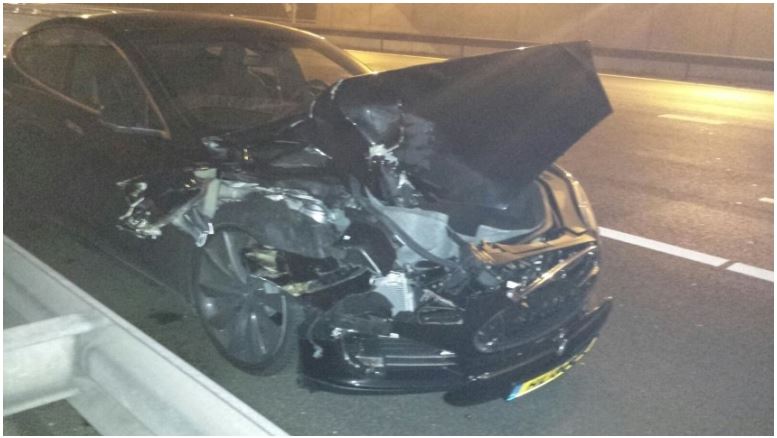
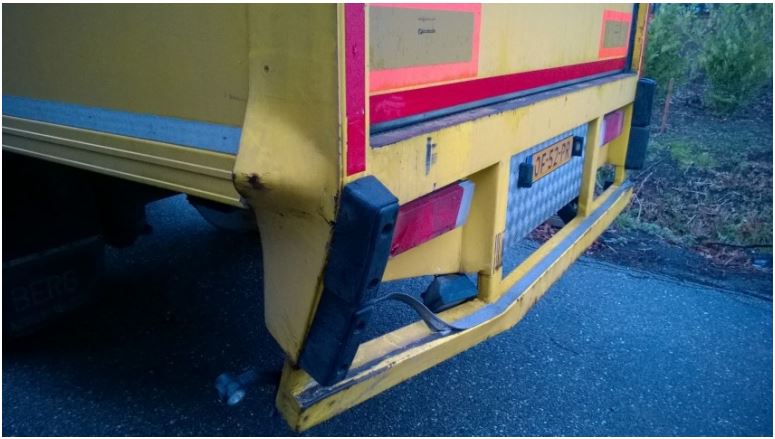
K5ING I'm glad this post will be buried far back in the thread, but to the OP, it seems that you're not alone. Here's a Dutch article about a Tesla that slammed into the back of a truck at 80kph while supposedly on Autopilot. The details are scant, and it's written in Dutch so as always, something is lost in the (Google) translation, but it's the first report of a serious accident while on autopilot that I've seen.
 �
�
Jan 16, 2016
bhzmark Why didn't TACC stop the car -- as it otherwise does a million times a day in similar situations.
What was unique in this case?
When Tesla figures that out they can then further improve the software to better handle those situations (as they have already done with exits and curves and jersey walls etc.). Meanwhile, if we know what those circumstances are, we can be more alert and prepared to take over in those situations.
What was unique about this situation?�
Jan 16, 2016
JST I agree that establishing a defect in AP would be more difficult than establishing one in a door latch. I don't think it's impossible; off the top of my head, if the AP failed to disengage, eg, that would be a pretty clear defect.
My only point was that the question of liability for a defect (assuming you could show one) is separate from the question of the driver's negligence.�
Jan 16, 2016
JST See? This is what I mean. Up thread green1 jumped all over me for asking if the car stops itself, saying of course it doesn't. Yet this post seems to suggest that it does.
I don't have AP in my car, but I am curious about why there's such confusion about what seems like a pretty basic question.�
Jan 16, 2016
sillydriver I don't want to pry or be too weird about this, but at 8:30 am CT 1/13 in Chicago the sun's altitude was 10 degrees and azimuth 132. You were on I90, the Kennedy Expressway, presumably driving into town with the rush, where you would have heading 135 degrees (SE) most of the trip and the sun would have been almost exactly dead ahead. Chicago reported as 'partly cloudy' at 8:30. If AP was looking into the sun, that might be the explanation.�
Jan 16, 2016
Andyw2100 I can understand your interpretation. It could be the right one.
On the other hand, for the list of examples given, why would Tesla have included the "and release" with respect to the brake pedal, if just pressing it was enough?
I would like to think that the system is sophisticated enough that if it senses that you are braking, but not braking enough, that it will brake more, and that the "brake and release" exception is in place for a situation where a driver may have decided to brake, but then, for some reason has determined braking isn't the best course of action, so is trying something else.
I think either one of us could be correct. I expect the only way to find out the real answer will be to have Tesla tell us, but depending on who at Tesla answers the question, I don't know how much stock we'll be able to put into the answer.
I'm wondering how you think we could go about easily verifying this. Since AEB is only supposed to kick in when a frontal collision is unavoidable, I don't see this as something that we could easily test.�
Jan 16, 2016
msnow Based on your work in the hacking thread do you know what the logs that Tesla pulls from the OP's car would show? Is there enough detail that they would know what happened? I'm curios if they can make correlations from the various data inputs to actually help out here.�
Jan 16, 2016
wk057 Going to have to unsubscribe from this thread...�
Jan 16, 2016
dsm363 Why? And why announce it? If there was a violation report it.�
Jan 16, 2016
thegruf I would expect AEB to use the radar not the camera. So no, I wouldn't expect the position of the sun to affect this. Constructive line of thinking though�
Jan 16, 2016
Andyw2100 This wasn't an AEB failure. TACC was in use. TACC, if it was operating properly and if t was locked on the car that was rear-ended as the target car, should, theoretically, have stopped the OP's car.
AEB is only supposed to kick in when a frontal collision is unavoidable, and then only to reduce the impact of the collision, not to completely prevent it.�
Jan 16, 2016
vgrinshpun I think that the intent of the write-up in the Manual was to indicate that AEB action (whatever it might be) is prevented in situations when driver is taking action to avoid a potential collision. The sample list of such actions includes breaking and *releasing* the brake because this could be interpreted as driver *not* taking action to avoid collision, while according to the Tesla AEB algorithm it *is* considered a sign of such action, so to eliminate ambiguity they listed such "press and release" action by driver explicitly. It seems that driver pressing and holding brake pedal, on another hand, unambiguously means that he is taking action to avoid collision, so it was not included in the list of examples.
- - - Updated - - -
I also think that AEB was not engaged during this incident. If EAB system would have been engaged the car would have had "emergency Braking in Progress" warning displayed on the dash, which OP did not mention in his description of the incident.�
Jan 16, 2016
sillydriver Andy, do you know whether TACC is radar-only? If so, my sun-in-the-eye theory is out the window.�
Jan 16, 2016
S3XY I'm guessing because he's spending too much time here reading it and it's taking away from his hacking time.�
Jan 16, 2016
Andyw2100 I'm sorry, I don't.
I do know that there has been discussion that some of the "Driver Assistance Unavailable" messages that impact TACC and other features may at times be caused by condensation in front of the camera, but I don't know if that has ever been conclusively proven as a cause for the error, and even if it has been, that error message applies more broadly than to just TACC.�
Jan 16, 2016
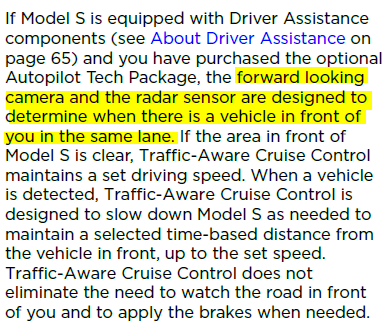
vgrinshpun The Manual says that TACC relies on input from both the camera and the radar:
 �
�
Jan 16, 2016
jeffro01 The last sentence says it all... I'll simply stop there...
Jeff�
Jan 16, 2016
Andyw2100 The OP has taken responsibility.
Almost without exception, everyone commenting in this thread is in agreement that we must be diligent when using the driver assistance features.
But sillydriver makes some excellent points in this post:
The OP deserves some sort of an explanation as to what actually happened. The TACC is not designed to allow the Model S to collide with the car it is tracking. Sure, Tesla explains we are still responsible, and we all get that. But I agree with sillydriver that the OP should be able to find out in more detail exactly what happened. Was TACC actually tracking a different car? Did the car in front slow down faster than TACC could slow the OP's car? (From the OP's report, this was definitely not the case, but I'm using it as an example of how TACC could function properly, theoretically, but still result in an accident.)
I think the OP deserves better answers from Tesla. Frankly I am interested in better answers. I want to know what really happened.�
Jan 16, 2016
bhzmark +1 above.
chatter about responsibility, RTFM, blah blah is all boring -- we all know all that from a hundred other posts making the same well-worn point.
What would be helpful and interesting are the specific facts and circumstances that led a TACC active Tesla to rear-end the car that it was apparently tracking.
OP, did the Tesla rep say anything about that? Can you ask them again for any details from the log?
Can you remember anything from your situation? Was the car in front changing lanes? in or out of your lane? were the lanes painted on the road screwed up? was it a construction zone? was the sun shining in the camera? Did a bird dive bomb the radar sensor? etc?
Anything that explains why the TACC did what it did?�
Jan 16, 2016
ecarfan Obviously TACC is "not designed to allow the Model S to collide with the car it is tracking", but the use of TACC does not guarantee that forward collisions will not occur. TACC is not perfect, nor does Tesla claim it is. All AP functions are an assist to the driver, not a replacement for the driver paying attention to the road and other vehicles.
I do not agree that the OP "deserves" a detailed explanation from Tesla as to exactly why his car hit the car in front of him beyond something like "In this case the driver failed to apply the brakes early enough to prevent a collision". That is the explanation. Assuming that TACC and AEB will always prevent forward collisions is a mistake. Tesla makes no such claim, only that those features can in most cases maintain a following distance and reduce the chance of a collision or the severity of a collision.
Too many people are putting to much reliance on AP features like TACC and AEB. In part I blame Tesla for this, as I think Tesla personnel have not adequately explained AP and cautioned Tesla drivers not to overly rely on it. In part I blame some Tesla drivers for not reading the owner's manual carefully enough.�
Jan 16, 2016
JST I generally agree with Andyw2100's post, above. If TACC is designed to stop the car, why didn't it stop the car?
If it's not designed to stop the car...why isn't it designed to stop the car?
I mean, a driver assistance feature that slows the car down but doesn't stop it might be the least useful thing I can think of. It's like a car with stability control that disengages in sharp corners.�
Jan 16, 2016
jeffro01 What better answer would you like them to give? They said systems behaved as they should, the documentation provided over and over again in this thread, backs Tesla's findings up. Lastly, the ONLY person here that actually knows exactly what happened is the OP.
Why is it that you, and others, automatically take the OP at face value? There are three sides to every story, in this case there is the OP, Tesla, and the truth. No one here knows for sure whether or not the OP's story is 100% factual, there could be very important details left out intentionally or unintentionally, the point is we don't know.
Call me jaded if you will but something about the story doesn't fit, especially when you combine it with Tesla's supposed reply. Again, you're only getting ONE side of the story here, even Tesla's "side" is filtered through the OP.
Some of the replies in this thread are boarder line irrational, like the post from someone (can't remember who) who commented that this incident may cause them to delay ordering an AP car (or something like that, I am very generally paraphrasing). Really???
At some point you just have to take a step back and breathe...
Jeff�
Jan 16, 2016
woof As I said above, my i3 will continue to track the original car that moved to the right rather than the car that has become directly in front quite predictably. So most likely the situation was NOT one where the car ahead was being followed by TACC, but the car that previously was ahead is being followed instead.
Mine as well.
I doubt the logs would show that. Everyone who uses TACC/Autopilot should get a dash cam if they want visible proof of what's going on. Or just accept the shortcomings and enjoy the ride.�
Jan 16, 2016
Andyw2100 I'd like Tesla to provide information along the lines of:
--our logs show TACC was functioning until 2.4 seconds before impact, at which time the driver disengaged it by stepping on the brake. (This would indicate TACC had been disengaged.)
or
--or logs show TACC was tracking a car that wound up in the adjacent lane at time of impact. (This would indicate TACC was tracking a different car.)
or
--our logs show that the car was decelerating and started accelerating again .7 seconds before the driver began braking. (This would indicate TACC was tracking a different car.)
or
--our logs show TACC was not tracking any car at the time of the accident. (This would indicate that TACC had been tracking a different car, but had not yet picked up as a target car the car that the OP rear-ended.)
or
--our logs show that TACC engaged maximum braking for 1.2 seconds, slowing the car from 25 MPH to 6 MPH, but was still unable to prevent impact. (This would indicate the OP was not accurately describing the situation at all, and that the car in front had come to more of an emergency stop that TACC could not match in time.)
I am not in any way suggesting that Tesla has done anything wrong, or that TACC failed. I'm also not in any way absolving the OP of any responsibility. All I'm saying is that something was different about this. Something took place that allowed the accident to happen when we know that normally TACC would not function this way. Tesla has stated that TACC was functioning at the time of the accident. I had made two guesses initially. One was that the driver had inadvertently disabled TACC, but if the information he received from the service manager is correct, then that is not the case. The other was that the TACC was tracking another car. It sounds like the service manager left that possibility open.
I think we could all benefit from knowing what really happened.�
Jan 16, 2016
jeffro01 Understood, but I think you have to realize that you're never going to know what really happened. Your only window into this situation is through the OP, and because of that, you're simply never going to know for sure. Look at it this way, who's to say Tesla didn't tell the OP exactly what you want to know but that wasn't relayed to this thread? To be clear, I'm not accusing the OP of intentionally withholding information or providing false information, I'm merely pointing out the reality that is your only reading one side...
From what I've seen of TACC in my car to date, and I said this early on in the thread I believe, something just doesn't quite jive here.
Jeff�
Jan 16, 2016
bhzmark A description of the relevant specifics of the situation that explain why it didn't stop.
Then I can better predict when TACC will stop the car and when it won't -- such as in the case where the tracked car changes lanes out of my lane revealing an already stopped car in front of me -- TACC is now much better, but still not perfect, so i am extra alert for that situation. What other situation should I also be extra alert for?
I'm not content to just say "TACC is inconsistent magic quantum indeterminacy -- sometimes it stops and occasionally it doesn't -- be prepared to take over!"�
Jan 16, 2016
dsm363 It's not designed to completely stop the car as I understand it because if there was a false positive would you want your car slamming the breaks on the highway?�
Jan 16, 2016
Andyw2100 I understand what you are saying about never being able to know for certain, since we can't know that the OP is being 100% truthful.
That being said, based on what the OP wrote initially, everything he has written since, the responsibility he has taken, and his general attitude, I am inclined to believe that he is attempting to be as truthful as he can be, within the limitations of his own memory of the situation. On the other hand, it just doesn't seem like we have all the information that it might be possible to obtain from Tesla.�
Jan 16, 2016
AWDtsla This must be some sort of joke, or clearly you haven't thought about the problem set hard enough.
The first airplane autopilot was developed in 1912. It took another 100+ years to get a commercial automobile to drive itself.
- - - Updated - - -
If a team of lawyers could make autopilot work, you'd have a point.�
Jan 16, 2016
theslimshadyist The all new 2016 Toyota Prius can even perform this task.
2016 Toyota Prius with Toyota Safety Sense Systems - YouTube�
Jan 16, 2016
sandstruck
i do want to reiterate how frustating it was to speak to TM service manager. There was no curiosity on his part as to what may have gone wrong. To be honest, he was kind of a prick. He kept referring to "our car," as in "our car" performed like it was supposed to. I reminded him the car belonged to me.
I did ask if MY car was tracking the car it collided with and he told me the logs couldn't give that information. He told me the logs "simply give a series of data points." He explained that the emergency stop alarm emplyed as it should and i hit the brakes a second later.
Again, my intention in posting this to begin with (and to continue to post) is to try to warn people to not be complacent and to figure out what went wrong (besides not being careful enough and relying too much on the system). I could really care less if i'm criticized. I truly can"t remember if (or when) a car may have come into my lane or switched out of my lane preceeding the collision (sorry).
Finally, i'm as suscetible to a conspiracy theory as the next person, but i feel Tesla isn't hiding anything. I think once the engineers determined the sensors and cameras were operating normally, the case was closed. It was my fault, they determined. Case closed�
Jan 16, 2016
Ivo-G Lots of people in this thread need to get of their "Holier than thou" preaching stool and check themselves.
1. Elon Musk himself has demonstrated driving a vehicle hands-free, foot-free, and it coming to a full stop while on AP/TACC. Tesla Test Drive: Model P85D, Autopilot, Zero to 60 - YouTube at the 2:00 mark he explains how it works, and even points out after the car coming to a full stop that he had nothing to do with that himself as a driver at the 2:30 mark.
If even the CEO and biggest marketeer/salesperson for the car and it's features "sells" you this as a feature, why is it that when said feature doesn't seem to have worked properly, people immediately condemn the user of said sold feature for using it in the same manners demonstrated by the CEO himself?
2. If the feature works different than "sold" by the CEO in this video for instance, then Tesla needs to address that, by telling current and future owners of AP/TACC enabled cars how it actually does work then, if at all, unequivocally, and should stop advertising it in such ways that make it sound better than they've managed to make it. Everybody is making guesses now as to how they THINK the systems work, but none of those have to be the actual fact.
3. What if there IS a problem with the AEB (note that I'm not referring to AP or TACC here), how many accidents and possibly lives would it take to convince Tesla of an issue? We had 1 person in NL reporting a seat belt issue, and they checked ALL their cars. Why won't they provide the OP with a solid fact-based answer other than "It wasn't me"? I mean, if the facts are there to back it up, why not say exactly what went down from the black box point of view?
4. People keep confusing and mixing AP, AS, TACC, and AEB. Autosteer and Traffice Aware Cruise Control are parts of the Auto-pilot family of features. Automatic Emergency Braking is a safety feature, much like ABS, airbags, etc. In my opinion, and that's based on what the manual says, the safety features (and AEB specifically) are independent from AutoPilot, as was recently shown in a picture of a hidden app to toggle the autopilot and safety features on or off. In my understanding and opinion, AEB should have tried to stop the car.
5. Tesla told the driver that the systems did detect an imminent collision, and that he tried to fix it himself 1 second later. But what I'm missing here is: was the system going to act, only to be interrupted by the driver in an ultimately insufficient manner? In other words, should the driver have done nothing and allow AEB to handle things? If on the other hand the AEB is merely a warning, a loud beep telling you there's going to be a loud crash, then THAT'S what the manual and Elon should be saying an demoing.
We all need to know whether we should let the car handle the crash prevention attempts, or need to distrust Elon and Tesla in their advertising of the AEB safety feature and keep driving the world's most sophisticated cars like it's 1972.
6. Before throwing the stone, ascertain yourself of your own innocence first. I think you'll come to see that it could've happened to anyone, even if you keep distance setting at 7, or even weren't on AP or TACC. A car or other obstacle could very easily appear all of a sudden in your lane, despite your distance-keeping, speed-limit-keeping, both-hands-on-wheel-driving by the driver. The AEB system is advertised as being able to help mitigate such forward collisions, and that's what most buyers expect. Many times I have touted the AEB as described and demoed by Elon as one of the Model S' strongest safety features (by showing this video for instance), but I guess from now on I'll have to take it with a grain of salt.
7.What if the first Model S' to catch fire were simply condemned by so many as being the driver's fault, and Tesla saying "works as designed"? Instead Tesla rose to the occasion and redesigned parts, to prevent potential issues down the road. In this case, I feel they need to publicly disclose and discuss what happened here, with data and facts, to either refute there was a technical failure and educate us, and / or to claim responsibility for fixing or improving this going forward (not for the actual accident per se).
Sandstruck, I wish you lots of strength and courage, but please do pursue the understanding of the facts and the truth, for you, for me, and for every other person who might be involved in a similar situation in the future, as the driver or the 'victim'.�
Jan 16, 2016
AWDtsla It's only advertised as reducing crash velocity, not preventing crashes. For good technical reason I think, otherwise false positives would activate AEB often.
TACC on the other hand should not let you crash.�
Jan 16, 2016
jeffro01 I'll simply say that I respect your decision to disagree with me, your welcome to do so but I stand by what I said and am not going to explain myself any further.
Jeff
- - - Updated - - -
Sounds like you weren't exactly the friendliest customer on the phone either... You reminded him the car belonged to you??? Why? It's clear from the conversation he was speaking in general terms and not in possessive terms. Then to come here and call the guy a name? Why???
Jeff�
Jan 16, 2016
JST I don't get this; if the car is going to slow way down anyway, why not just stop if it sees a stopped car in front of it? It's that initial deceleration that's going to cause a potential problem for the cars behind.�
Jan 16, 2016
ecarfan It is not as simple issue as you seem to expect. TACC and AEB have to analyze multiple inputs and use complex algorithms that attempt to analyze a rapidly changing environment around the car and then make decisions in fractions of a second. AP will attempt to avoid collisions or mitigate the force of a collision. Tesla makes no guarantee that AP will always prevent a collision, and specifically states that it is a driver assist tool that does not replace the driver's judgement and experience.
interesting that you conclude from a video of a single instance of a Prius stopping before hitting an obstacle that there all Priuses with that feature will achieve the same result over many thousands of times in varying environments.
There have been many TMC posts about Tesla drivers using TACC where it has significantly slowed without hitting a car in front of it. In the incident the OP described it did not. TACC is not yet "perfect" nor does Tesla claim it to be. No surprise there. The driver is responsible for the safe operation of the car and should always be prepared to take over.
--------------------
Some participants in this thread appear to want Tesla to provide a detailed timeline of this incident, practically by the millisecond, of what every relevant system on the car was doing and what actions the driver took.
Tesla is not going to do that. It would set a precedent for people to demand the public release of such information for every accident a Tesla was involved in.
According to the OP, Tesla informed him that a review of the logs determined that the car's systems performed nominally (to borrow a word from the world of rocketry), and that he applied the brakes too late to prevent impacting the car in front of him. I believe that is all that Tesla is going to say publicly about this incident. And in this litigious world that is all I would expect them to say.�
Jan 16, 2016
jeffro01 I think you should take your own advice.
Strength and courage??? Really??? That's quite the statement, you act as if OP has done something noble... You are never going to get the "facts and the truth" when your getting your information from one side of the story.
Jeff�
Jan 16, 2016
Ivo-G The shoe must've fit...
Yes really, strength and courage to withstand relentless criticism and to get the other side of the story, or to get Tesla to give the other side of the story for all of us to hear. And I wish him that not because it's a noble act, but because I believe we all stand to benefit from his pursuit, even those who are hell-bent on criticizing him from wanting to know what happened and how to deal with situations like this in Tesla made cars in the future.�
Jan 16, 2016
JST Now that you mention it, if I were the other driver, I might be interested in seeing the logs. Not maybe in this accident, where no one was injured. But in an accident where there was a claim of whiplash? If you were the person who got hit, you might be interested in knowing whether it was the driver or the car that was at fault.
There are, of course, ways to demand the release of this information in litigation. I'm not suggesting Tesla should do that here (I agree that they probably shouldn't), merely observing that if the data exists someone may have a right to look at it at some point. It's something I hadn't thought about before.
As for my quote, above, I don't necessarily expect the system to work flawlessly. My question, given what some others have said, is whether the system is *intended* to stop the car, or just to slow it down.
Green1 and others have asserted that it is not intended to do so. Some others in the thread have said that it is, though it may not always do so.
I guess I still don't know the answer to my question, though that video with Elon in the car certainly suggests that the car *is* intended to be able to stop itself.
Anyway. Not sure I have anything more productive to offer, beyond scratching my head about why anyone would use this system at all.�
Jan 16, 2016
jeffro01 Dramatic much? Jeeze... I use the system all the time and it's worked every time. Have I had to slam on the breaks occasionally? Yes, but that's only been when I'm tracking a car and it changes lanes due to stopped, or severely slowed, traffic which the system is not designed to handle.
Jeff�
Jan 16, 2016
JST Works every time, until it randomly doesn't. Sounds great.�
Jan 16, 2016
AWDtsla AEB is about reducing crash velocity. Think about it as a virtual crumplezone.
They guy behind you is probably in for a bad time regardless.�
Jan 16, 2016
jeffro01 Oh please... What a stupid thing to say. It doesn't randomly not work, your making stuff up in your head.
Jeff�
Jan 16, 2016
JST Ok, it doesn't "randomly" not work. It doesn't work based on a series of variables that are unknown and unknowable to the consumer, such as to present the appearance of randomness. Or is there some other way of interpreting OP's experience?
I will speak only for myself, but it's not a system I'd use.�
Jan 16, 2016
Andyw2100 This is a pretty easy question to answer. The TACC is most definitely intended to be able to stop the car when the target car in front of it is slowing and stopping. There may be exceptions where it won't be able to, hence the disclaimers, but the intention is for the Model S to be able to maintain a safe distance behind the target car.
As proof of this fact one must only look at the language in the manual about TACC bringing the car to a stop, and then resuming:
--
When following a vehicle, Traffic-Aware CruiseControl remains active at low speeds, even if Model S comes to a standstill while following a vehicle. When traffic is moving again, Traffic Aware Cruise Control resumes operating at your currently set speed. However, if a pedestrian or object is detected in front of Model S, Traffic-Aware Cruise Control goes into a HOLD state and the instrument panel displays a message indicating that you need to resume cruise control. To resume, press the accelerator pedal or pull the cruise control lever toward you (see Canceling and Resuming on page 69).
--
If TACC was not intended to be able to completely stop the car, the language above about the HOLD state and the need to resume cruise control would not be necessary. There also wouldn't be the wording about the Model S coming to a standstill.�
Jan 16, 2016
Auzie In the absence of accident video record, it might be a fruitless exercise to speculate on endless possibilities of what could have caused it. I fully agree with Jeff that we have heard only one side of the story. Further, witnesses to any accident are not as reliable as a video camera, especially if such witnesses are right in the centre of the accident. Nothing personal in the preceding statement, just reflection on human traits that we all share.
The most interesting aspect of this thread to me is that it highlights the issue of car logs ownership, and the car owners ability to access that information.
I am not aware of any legislation that regulates this emerging area. Any corrections are appreciated.
My understanding is that Tesla sells cars, but not the data it collects on sold cars. That makes Tesla the sole owner of the collected data as they are doing collecting and storing.
If the above assumption is correct, Tesla is free to store collected data for any period of time they choose and to share it (within privacy restrictions) or not share it as per their respective business policies (doubt they have them yet).
Some businesses are willing to provide limited personal data on request, and may charge to cover the administrative costs of the process. Some businesses only provide data under court order.
There are many downsides but also upsides to giving people access to their car logs. One obvious downside is that someone has to spend their time to extract the data, clean it up and put it in a format that can be easily understood by anyone. Likely, explanatory write-up might be required. This might be quite time-consuming = costly to Tesla.
I am curious about people's views on this issue.�
Jan 16, 2016
Andyw2100 There are a number of ways to log at least some of the information available from the cars. Some of those might have provided some insight into what happened had they been in use.
As an example, I recently started using TeslaLog. It's still a free service. (Thread here: TeslaLog.com - Your hosted Tesla Data Logger - Announcement / Support threads)
If the OP had been using that service at the time of the accident, it --MIGHT-- have been possible to have more insight into what happened. For example, if his speed log showed that he was slowing down, and then briefly showed that he was accelerating, just before slowing down again before impact, that would be pretty strong evidence that the TACC had been tracking a different car, and had started to accelerate when the other car left the lane. (Correct TACC operation.)
These services don't provide direct access to what the safety systems are doing, but depending on the situation, at times things may be able to be inferred from the data that is being recorded.�
Jan 16, 2016
Krugerrand My thought is: BIG OLE CAN OF WORMS!
Separate thread on the topic might be good.�
Jan 16, 2016
SmartElectric You never claimed otherwise to whom? Tesla or to others? There is at least one time...as per below.
Good fortune on repairing your car. Safe travels.�
Jan 16, 2016
Auzie Thanks for the link Andy.
My comment refers to customers' requests directed to Tesla staff to provide additional data to what is already available. My impression from reading some posts is that some customers have expectations that Tesla will provide data related to their car, on request.
But these are soooo delicious, it's worth opening it
 �
�
Jan 16, 2016
Norbert That's also how I interpreted it the first time I read it. In the sense of: the automatic functions will remain disengaged even if the brakes are released again. This would be something worth finding out if there are doubts. I'd guess that may also be what the engineers were trying to convey from the log: that applying the brakes disengaged the automatic functions. At least that's what I get from reading this thread so far.�
Jan 16, 2016
Scotty I thought about the Tesla rep stating the Tesla engineers perused and analyzed the 'logs', and this started me thinking about EDR's. Quick points include 96% of new cars have them, and while they are not mandated to be installed in cars, if they are, they must record certain data. The data is also OWNED by the owner of the car, although data retrieval can be difficult and/or expensive. Most EDR's are accessed by the retrieval system made by Bosch. I very much doubt that Tesla adheres to this system. Might be interesting in talking to one of the nationally/internationally recognized EDR data analysis companies.
Why am I looking into this, when the OP says he accepts responsibility for the accident? Because everyone, including the OP, Tesla, and most of the commenters are saying its his responsibility too. However, just for a second, consider one other possibility that I don't recall seeing brought up.
Since this is a new vehicle, with only a few days use on it, COULD this have been a case where a hardware malfunction exacerbated the situation? There certainly could be the possibility that there was/is a hardware problem in this new Tesla? If you think this is far-reaching, please keep in mind there have been more than one instance where a pilot has turned off the fuel feed to a failed engine, and it has turned off the fuel to the remaining running engine.
Another comment. I love my Tesla, and stand up to criticism from those who would rant and rave against one, while not owning one. Most posters on TMC appear to be owners, and I support the theory that if you have some 'skin' in the game, you are entitled to your opinions, and have the right to post those opinions. I also appreciate comments and criticisms that informed and objective people make. I also believe, as wk057, and others have stated, that the legal owner not only owns the Tesla, but they also own the data, and have the right to monitor operational data that the system generates.
Finally, Tesla is certainly pressing forward with advancing technology in the automotive world. I believe that Tesla follows this forum, and that it is not in their best interests to either state directly, or via an owners post, that their product experienced a malfunction. Nor am I aware of anyone who is able to refute the 'conclusions' and statements of the Tesla rep.
Do we all think that Tesla will broadcast negative information? I don't believe that we should just assume that Tesla has the individual's and the general populations bests interests in mind, over their own, including their stock, investors and shareholders. I do think that if there was a failure in hardware or software, there's a bit of midnight oil burning trying to 'fix' the problem.
I do think that insurance companies might be interested in EDR data, as well as Tesla logs, this, if not in this situation, that there will be additional instances in the future. That, of course, is 'nother can o' worms.�
Jan 16, 2016
green1 That's easy to answer. Nope.
The worst it could possibly be is a case of the hardware not making the situation better. It certainly didn't make it worse.�
Jan 16, 2016
SABoyce At least one appreciative lurker confirmed. I started reading through the TMC forum last Oct. when I added the MS to my Potential Next Vehicle list. I've always loved joining online automotive communities like this one because of the sharing of knowledge and passion for a particular car as well as the camaraderie born from it. That said, I figured I'd make my first post a "thank you" to sandstruck for sharing his experience and adding to the massive amount of great information on the forum. I'm glad the damage was minimal and no one was injured.
Great advice for any car with driver assistance features. I practice the same in my current vehicle, a 2013 Chrysler 300 SRT8 with Adaptive Cruise Control and Forward Collision Warning System. I use ACC almost every day during my 25 mile commute to/from the office. While it works great, on more than one occasion it's gotten confused when a car in front of me performed a lane-change, resulting in hard braking or following more closely than I'm comfortable with.
The FCWS fires off frequently. While mostly due to my "spirited" driving style (it doesn't know I'll switch lanes before plowing into the a**hole doing 15 under in the hammer lane), it also seems to pick up the occasional reflective sign or marker. Unlike the Forward Collision Warning system in the MS, there is no setting to adjust sensitivity/timing of the notification. Any chance that setting would affect AEB?
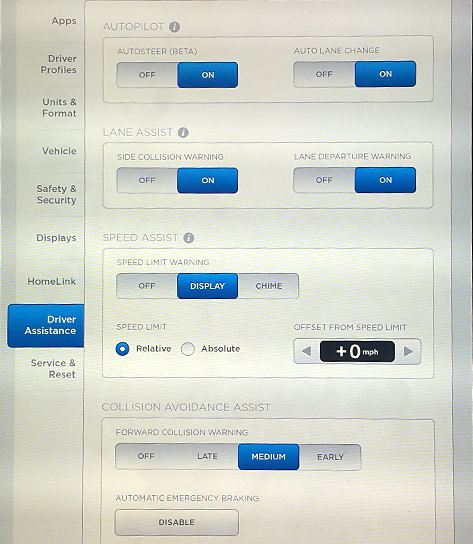
(This may be an outdated screenshot - my apologies, if so.)
Don't let the trolls get to you. Your original post was simply you sharing concerns over a potential issue. At a minimum, you've helped others set more realistic expectations for AP. Thank you again for sharing.�
Jan 16, 2016
green1 That setting only affects the warning, which is completely separate from AEB�
Jan 16, 2016
Scotty If I'm being too blunt, I apologize, but I'd love to hear about the technical information that supports your singular answer.
I hope that it wasn't, but then again, hardware failures occur, and it would possibly be comforting to know (but obviously not from a litigation perspective).�
Jan 16, 2016
dhanson865 You are the most dramitic person in this thread. Maybe you should just take a few days off and let the rest of the world have an opinion.�
Jan 16, 2016
AWDtsla I've had FCW go off _many_ times even when set to late, I have never had AEB go off. I still contend that AEB will not prevent a collision, only reduce it's severity and thus will only activate when collision is imminent.�
Jan 16, 2016
green1 If the hardware failed 100%, then NOTHING CHANGES AS TO DRIVER RESPONSIBILITY.
If the hardware prevents a collision, great, it managed to help prevent the driver from making a mistake, and improved the situation. If the hardware does not manage to prevent a collision, then the worst possible case is that the driver does exactly what they would have done without the hardware in place. Either way, the hardware didn't make anything worse, it only failed to make it better.
There's no technical information needed. The only way the AP could have any fault whatsoever is if it actively prevented the driver from doing what they should have done. Nobody has ever implied this to be the case.
Imagine you came up with a way to prevent 95% of traffic collisions with a fancy new device, should you install it in as many cars as you can to get that huge life saving advantage? or should you not do it because those 5% of people who weren't saved will blame you for not saving them, even though they're no worse off than they were before your device? This isn't fanciful thinking, this is basically the exact situation we're dealing with here. People want Tesla to take some responsibility, even though they've been very clear about what the system can and can't do, and even though the driver of a vehicle equipped with the system can not, by definition, be any worse off than if they didn't have the system at all.�
Jan 16, 2016
SABoyce I suspected not. Now that I think about, it doesn't make much sense to have a user-adjustment for AEB.�
Jan 16, 2016
BozieBeMe2 Seems the new 7.1 Owners Manual is explicit in stating Tesla's view point.
Warning: Traffic-Aware Cruise Control is designed for your driving comfort and convenience and is not a collision warning or avoidance system. It is your responsibility to stay alert, drive safely, and be in control of the vehicle at all times. Never depend on Traffic-Aware Cruise Control to adequately slow down Model S. Always watch the road in front of you and be prepared to take corrective action at all times. Failure to do so can result in serious injury or death.�
Jan 17, 2016
TSLA Pilot Written by lawyers for Tesla's protection in far out, corner cases, and it's self-contradictory.
If the OP is reporting accurately, this was NOT a far out, corner case.
While I've only read the first and last few dozens of posts, I have an educational background in Human Factors Engineering, and also the viewpoint of having both "Classic" and an AP Model S's in the garage.
The OP is to be highly commended for pointing out what happened, and should not have been subject to the remarkable vitriol from many posters here, some of whom appear to not even be driving AP MS's. Here's a tip, especially for them: You're not in a position to understand the HF changes that occur in using AP, ESPECIALLY over time. Tesla cannot introduce an AP system that works 99.9% of the time. Or even 99.99% of the time. We need better than six sigma reliability here.
Random thoughts:
1. Of great concern, if the AP failed--which appears to be the case based on OP's comments--the system needs to have more aggressive/robust system monitoring and failure alerting.
2. Given the OP's and car's inexperience with AP, a more cautious approach would have had the distance set to far more than "2," and the guidance from the DS to set it at "2" wasn't good advice. Having said that, it is a legitimate setting and the OP was well within norms to use that setting.
3. The idea of AP is enhance the driving experience. If it works 999 times in a row, bringing the car to a safe stop, but then fails to do so on the 1,000th stop, this is a MAJOR problem for Tesla, notwithstanding the legal disclaimers. To have to intensely monitor AP to catch that "1 in a 1,000" time it won't stop the car is an absurd proposition.
4. Tesla should give the OP a P90D loaner, impound the accident car, have Tesla engineers carefully review logs and measure equipment mounting and connectivity, and then remove all the applicable AP components and bench test them until it finds out what went wrong.
Trust me when I tell you this as it's based on personal experiences that I need not get into in such a public forum (and were from events in 2013, dozens of SW revisions ago): Tesla is far from perfect; best to find errors early and quickly.�
Jan 17, 2016
davidc18 The driver is 100% responsible for the car. End of story.
What the automation did or did not do is a secondary discussion.
Personally I find that TACC/AutoPilot to be the best and defining feature of the car. I use it every day. Perhaps those of us who had TACC alone for months prior to AutoPilot being released had an advantage in getting used to how it (TACC) worked. There was a learning curve. Even today, I find that I often and frequently over ride TACC and manually brake to stay within my comfort zone. I also use setting 7 for TACC, always. Its my comfort zone and my responsibility to monitor the automation.
I fully support the OP in trying to understand what happened in his case. We need to know, so we can all become better users of the technology in the Tesla.�
Jan 17, 2016
defmonk 1. The two-car follow distance is way too close at highway speeds, TACC or no TACC. It simply doesn't leave enough time to react.
2. I have my collision warning set to "early," which has worked to perfection in giving me an early warning in the few circumstances when the TACC is a bit aggressive in braking distance.�
Jan 17, 2016
ChadFeldheimer SPECULATION: If AEB is designed to reduce the severity of an unavoidable collision, perhaps there is a speed threshold below which it will not activate. For example, if you are about to hit an object at 55mph, it will activate such that you only collide at 25mph. On the other hand, if it calculates you will hit at 5mph, it does nothing.
Rationale is that a 5mph impact is not particularly hazardous to the health of the occupants of the car.
I could imagine that a system like AEB is designed to err on the side of less intrusiveness. Otherwise, it could induce more collisions than it avoids.
PERSONAL ANECDOTES:
I have used AP in Chicago expressway congestion (Eisenhower) regularly for the last 2+ months. I always have the unitless following distance set to "1" (above ~30mph, I turn off autopilot or monitor closely). Prior to this thread, I have been pretty trusting of AP - sometimes getting distracted enough with my phone to leave the car entirely to its own devices (in congestion, under ~30mph).
I appreciate OP's sharing of his experience. Since this thread, I've made a concerted effort to be less distracted =).
AP has continued to be quite reliable for me in my usage. The only "chink in the armor" that I have detected is that like many in this thread, I have also observed that it is slow to transition to tracking the "correct" car when lane changes occur in front. It is by good fortune that I have yet to incur any collisions from this behavior.�
Jan 17, 2016
msnow That's exactly what it does. It does not work below 5 mph. This is from the Owners Manual:
"When Automatic Emergency Braking has reduced the driving speed by 25 mph (40 km/h), the brakes are released. For example, if Automatic Emergency Braking applies braking when driving at 56 mph (90 km/h), it releases the brakes when the speed has been reduced to 31 mph (50 km/h).
Automatic Emergency Braking operates only when driving between 5 mph (8 km/h) and 85 mph (140 km/h).
Automatic Emergency Braking does not apply the brakes, or stops applying the brakes, in situations where you are taking action to avoid a potential collision. For example:
� You turn the steering wheel sharply.
� You press the accelerator pedal.
� You press and release the brake pedal.
� A vehicle, motorcycle, bicycle, or pedestrian, is no longer detected ahead."�
Jan 17, 2016
bhzmark Aeb isnt the issue. Why didnt tacc stop the car?�
Jan 17, 2016
green1 Because everyone knows that TACC is not 100% reliable, which is why Tesla has told people never to ever rely on it to stop the vehicle.
The much bigger question is why didn't the driver stop the car?�
Jan 17, 2016
msnow That's one question yes. But many of us would like to know if there's something in the system (primary software) that could have made this less likely. If there is and it can improved then that would be great. The lack of transparency is what's causing concern.�
Jan 17, 2016
LetsGoFast In situations as the OP where the car is following another car that slows at a normal rate, I've had TACC stop the car reliably thousands of times. Undoubtedly, OP was not monitoring the car closely enough to realize that TACC was about to fail and intervene, which he has acknowledged. That is no question at all. The question is obviously why did TACC fail in this particular situation and it appears we will not get that answer from Tesla. One would assume that an accident that took place in any autopilot situation would be of great interest to Tesla and one is left to wonder if they don't know more than they are telling the OP (perhaps in order to prevent any question of liability).
Beating the the drum for the case that OP should have detected and prevented the crash is a waste of time. Personally, I appreciate the heads-up from the OP and am monitoring TACC very closely now, like I did in the early days. One hopes that behind the scenes Tesla has taken note of the TACC failure and is attempting to prevent it from happening again. We all know about the challenges when a car pulls into our lane or when approaching stopped traffic at a high rate of speed, but I personally have never experienced anything close to the scenario described by the OP.�
Jan 17, 2016
sandstruck i want to reiterate here that i tried my damndest to stop the car. As i've repeated numerous times on this thread (and you can choose to believe me or not) the system had been working flawlessly, and according to TM i didn't disconnect AP or TACC inadvertantly. When i saw a collison was imminent, my (perhaps too slow?) reflexes took over and i slammed on the brakes. The alarm that went off was immaterial to the collision-it didn't help me or hurt me. I remember clearly the sickening feeling immediately preceeding the collision.
At the time, i felt like the system failed me. I was pissed at my car. It was only after reflecting on things that i concluded that i was entirely at fault for being complacent, for assuming the car was essentially driving itself. I was inexperienced (and i guess stupid) about the possibility the car might not stop.
i admit to feeling embarassed that this happened to me (and seemingly no one else). If nothing else, perhaps this thread will alert people to be more careful and on-guard.
Finally, as i watched yesterday's NFL playoff games (crazy), it seemed like there was a flood of commercials touting "emergency braking." I felt they were somehow mocking me. So my conclusion is that my MS does not have this feature? On the commercials for BMW it seemed like this feature stops their cars on a dime. What's different with the MS?�
Jan 17, 2016
BozieBeMe2 +++1
�
Jan 17, 2016
stevej119 The OP himself stated that he wasn't certain that another car hadn't passed between his car and the car he hit, which would cause TACC to temporarily lose the car he hit. I think many of us are forgetting that when we first started driving with AP/TACC there was a bit of a learning curve.�
Jan 17, 2016
ecarfan Yes, that point has been made by many people, and the OP has acknowledged he was at fault. I commend him for taking responsibility, though by his own admission his first reaction when speaking to the other driver involved was to disavow responsibility.
The point has also been made repeatedly that Tesla is not going to publicly provide a detailed analysis of the accident based on the data stream recorded by the car. Some people think they should, I disagree and see no reason why Tesla would do that for reasons I posted above. Of course internally Tesla will analyze the data but we will not learn the results of that analysis.�
Jan 17, 2016
msnow This is true and the only remedy left to get closure is a legal one which doesn't make financial sense for a fender bender like this.�
Jan 17, 2016
JST
I will make the casual observation that a lot of the folks in this thread that are jumping up and down about driver responsibility might find themselves in a very similar situation. I have real questions about how long it takes anyone to evaluate sensory inputs and make the decision to take over control from the automatic system. That's especially true in a circumstance where the vehicle performs properly 999 times out of 1000. That's one of the reasons why, even if my vehicle had this system, I don't think I would use it. I prefer to *know* that I am in control, rather than wonder whether the machine is going to fail.
I know everyone (including myself) tends to think of themselves as an above average driver. Statistically, of course, that's nonsense, and the few times I've driven competitively have been humbling in that regard.
TL; DR? We are all living in glass houses, driver-talent-wise. We should be careful about the stones we throw.�
Jan 17, 2016
Yonki This is the most infuriating thread. The driver didn't stop the car because he thought AP/TACC/SOMETHING in this amazing car was going to stop the car automatically like it had 500 times before. OK? Can we stop pretending that is a question?
At the same time, the driver has accepted full responsibility for the accident. So can we stop acting as if he didn't?
All he wants to know (and all the clear-headed people on this thread want to know) is: what happened? Did he accidently turn TACC off? Did a sensor fail? Is there a corner case where the algorithm fails - what might that corner be? You'd think Tesla would want to know, because it would help them make a car where this would be less likely to happen (whether it was the driver's fault or the car's).
Maybe I can break it down another way: LEGALLY, it's the drivers fault. Done, end of story. SCIENTIFICALLY, we don't know what happened and would like to find out, because all of us rooting for Tesla to become more and more successful want to see this happening less and less in the future, regardless of the drivers' competence.
All the posters smugly saying "it's the driver's fault, end of story" are the worst kind of blind "you're holding it wrong" fanboys - not only are you not helping the company you're such a fan of get better, you're making forward progress that much more difficult.
So can we please have a New Years Miracle and let the rest of the posts in this thread be about why the crash happened and not about who's fault it was? Because the latter question has been answered 50 times by the OP himself.�
Jan 17, 2016
Electricfan I agree with the whole post, but I like point 3 the best. Absolutely couldn't be said better.�
Jan 17, 2016
Norbert Maybe there has been so much talk about autonomously driving cars that some think they already have a right to expect that from a shipping product, or that it is time for them to participate in product development. Sorry, not there yet.�
Jan 17, 2016
bhzmark Yonki, +999
Thank you for writing all that so well. I pray others will comprehend the obvious (to me) sense in that and make this thread more productive and useful.
What are the candidate reasons for why TACC didn't stop the car before rearending the car in front of it?
I think it is likely to do with TACC projecting that the Tesla would drive around the car in front of it rather than into it. Either because thought the other car was in an adjacent lane and its own lane was clear, or the other car quickly moved into the Tesla lane. But eager to hear others ideas of what might have happened in this situation to explain what TACC did and didn't do.�
Jan 17, 2016
Andyw2100 That's not really how TACC works.
The most likely reason, which I think is that you are trying to get at, is that TACC had not yet recognized the car the OP collided with at all, because it had been tracking a different car as a target car. If that target car changed lanes, TACC would have momentarily and temporarily thought the lane the OP was driving in was clear. TACC would behave as if the lane was clear until picking up another target car in that lane.
TACC does not see a car in your lane, but assume that you will be driving around it. TACC also would not have been tracking the car that was ran into if it had been in the adjacent lane.�
Jan 17, 2016
jeffro01 Right... Or not. I'm not dramatic, I'm using this thing called logic. You know, the logic to not automatically take everything I read on the internet as fact. Good lord...
Jeff
- - - Updated - - -
Yes because commercials are always 100% truthful and factual and don't exist in highly controlled environments with specifically desired results shot who knows how many times until they got it just right...
Your Model S has the same functionality, it's been repeated here more times than I care to count. The difference is none of this technology is perfect at the present time.
Your experience sounds like one that I encounter every so often on the freeways I drive on. TACC is tracking the car in front of me, say we're both going 60mph, car changes lanes due to much slower traffic that I (nor the car) can see. Car changes lanes and TACC takes a split second to pick up on the new car in front of me going much, much slower (sometimes even stopped). I instinctively slam on the breaks, car beeps furiously, etc... Collision avoided. Now as for me, I keep my TACC at 2 when the pavement is dry and 4 when the pavement is wet. I'd likely have a less harrowing experience if I didn't have TACC following the car in front of me so close, but that's more of a function of the freeways I drive on and just accept it as an "it is what it is"...
In normal stop and go traffic, I've never had TACC not fully stop\start the car with the flow of traffic. The remaining loop to close, and I'm not sure how you'd close it, is the sudden stoppage of traffic that the car can't see until the car it can see changes lanes.
Jeff
- - - Updated - - -
Wow... Just wow... I'm being accused of overreacting and this post gets support??? Good lord...
So many things to comment on here of which your so far off base it's staggering...
For starters, stop taking the OPs story as 100% fact, I can't imagine you believe everything you read on the internet, so why would you start now? Furthermore, stop trying to give the OP an award for speaking out or whatever you think the OP is doing. I have said this over and over, you are only getting ONE side of the story here... Yet you're acting like you have all of the facts, you aren't even close to that.
AP didn't fail, stop with that right there. I don't get where you come to that conclusion. As it's been explained over, and over, and over, and over again here, the system functioned as it should per the documentation Tesla provides.
Point number #3 is ridiculous as well, Tesla does NOT have a major problem here. I mean seriously, this is first generation technology, your expectations are absurd. This goes to what Elon has said over and over again, there is zero redundancy in the system, the software is still being developed, things will get better. Calm down...
Point #4 is so completely over the top that I don't even know where to start. Obviously Tesla doesn't feel that such an action is warranted so why would you? Because your convinced something nefarious has occurred and you won't stop until full internet justice is achieved?
I was accused of being overly dramatic yet a post like this is "fine" and even supported by subsequent replies...???
I'll keep saying it, don't believe everything you read on the internet...
Jeff�
Jan 17, 2016
green1 You are correct here. I want Tesla to improve as much as anyone else, but I can't stop bringing this up, because some people are still putting blame and responsibility on equipment that was not designed to do what was expected, and has never been portrayed as doing so by Tesla.
I'm starting to actually wish people would sue Tesla so we can point to the outcome to show people how ridiculous they're being here.
Trying to figure out why the system didn't do what was expected is one thing, saying that it should have done so and that the collision is in some way the car's fault because it didn't is something completely different, and something that many of us here will not sit by and listen to.�
Jan 17, 2016
garygid I have used TACC often during the past 10 months, all on setting 7.
Occasionally, TACC failed to see a car ahead and zoomed up to it,
failing to begin the hoped-for slowing and stopping.
Over the past 9 months or so, TACC has improved a lot, getting
smoother with both acceleration and deacceleration.
Now, newly on 7.1 (2.9.154), at least once in the last few days,
AP rather aggressively accelerated toward cars not too far ahead,
and one time failed to do the expected slowing for an almost
stopped car ahead, requiring me to hit the brakes because it
did not seem like it was going to stop in time.
From my experience, I am willing to believe that there is still some
"feature" that needs improving, or correcting. I caution folks to use
setting 7 until they are very familiar with the TACC, and be very cautious
when using it. Also, it does seem to take a moment to re-examine the
lane ahead when the vehicle ahead leaves the lane.
There is also the possibility that something turned the TACC/AP Off
just before the OP's accident.�
Jan 17, 2016
msnow Agree. It's about what, if anything, actually happened backed up with empirical data and if it did fix it.�
Jan 17, 2016
Andyw2100 Not according to what the OP was told by the Tesla service manager.
Or, rephrasing, so jeffro01 won't take issue with it...
Not according to what the OP told us he was told by the Tesla service manager.�
Jan 17, 2016
Discoducky Competitors AEB systems will bring the car to a stop, but might not do so above speeds of 25kph (15.5mph). At higher speeds, or less than optimal conditions, speed may not be reduced as much and vehicle might not come to a complete stop. You'll find this info in most owner manuals of vehicles equipped with AEB.
Also, very much appreciate you explaining your experience in more detail as it will greatly improve how others both use and interpret the use of these features.
It sounds like Auto-steer was engaged and when it detected the target car getting closer too quickly then FCW (Forward Collision Warning) goes off and then AEB will start to apply brake pressure to slow the car down and reduce crash energy. It sounds like you reacted before the FCW warning sound went off? Is that correct? If you grabbed the steering wheel (providing enough torque to cancel Auto-steer) you may have turned off AEB inadvertently. But if you applied 100% brake (essentially what AEB does) then there just wasn't enough distance to stop.�
Jan 17, 2016
wizputer I've had experiences just yesterday with TACC that disagree.
On the IC, when a vehicle is halfway in/out of a lane, and there's another vehicle ahead, it will ghost both.
It reacts to the slower ghost (even if it's mostly out of your lane)�
Jan 17, 2016
Andyw2100 I'm not sure what you mean by "ghost", but the TACC locks onto one car as a target car. If you are saying that the ghost car in your lane was the target car, and that TACC reacts to the slower ghost, even if it is mostly out of your lane, that is not inconsistent in any way with what I said. In that case TACC was still treating the car leaving your lane as the target car, even as it was mostly out of your lane. The potential problem occurs once TACC decides that car --IS-- completely out of your lane. The time lag, if any, between when that happens and when TACC picks up a new target, in your lane, is perhaps where the issues arise.�
Jan 17, 2016
wizputer Sorry, I call them ghosts, since the toy cars go from black to silver.
Which seems to correspond when TACC starts tracking them.
Couple examples:
- Target car notices slowing traffic in our lane, so they exit the lane without any deacelleration since adjacent lane is clear. As they starting exiting the lane, it reveals another vehicle ahead, which pops up as a black toy car. When the exiting target car is approximately halfway out of the lane, the new car ahead turns silver and the Tesla began deaccelerating.
- Same as above, but reverse. Car coming into my lane is traveling slower than the current target car, the Tesla began deaccelerating when the new car is about halfway into my lane, same time the toy car changes colors. The original target car stays silver until it disappears.�
Jan 17, 2016
bhzmark
AP most def sees other cars in other lanes. And it has to determine whch lane it thinks the car is in. The display indicates that it is trying to do that. But the point, I think we agree, is that Tesla shld say what exactly happened. And it wld also be good to design out the other reported speeding up to a stopped car ahead.
Green thinks AP working is a binary concept, but it really is just gradual design improvement and tweaking. It is after all beta right?�
Jan 17, 2016
Andyw2100 That's not the issue, though.
Yes, the driver assistance systems are aware of multiple cars. But the TACC system only has one car as a target car at any given time. That is the car it is tracking, and basing the Model S' speed on. That is the car that it is trying to avoid rear-ending. That is the car that once out of the Model S' lane, will allow TACC to speed up again, until TACC locks onto another target car.* (See edit.)
There is absolutely no indication that TACC can have more than one target car at a time. Everything in the manual indicates that TACC locks onto one target car at a time. Following is an example, but reading the entire TACC section, you won't find anything that makes reference to multiple target cars:
--
If Model S is equipped with Driver Assistance components (see About Driver Assistance on page 63) and you have purchased the optional Autopilot Tech Package, the forward looking camera and the radar sensor are designed to determine when there is a vehicle in front of you in the same lane. If the area in front of Model S is clear, Traffic-Aware Cruise Control maintains a set driving speed. When a vehicle is detected, Traffic-Aware Cruise Control is designed to slow down Model S as needed to maintain a selected time-based distance from the vehicle in front, up to the set speed. Traffic-Aware Cruise Control does not eliminate the need to watch the road in front of you and to apply the brakes when needed.
--
I think the most likely scenario for what happened in the OP's situation was that TACC had just lost the target car, because it had changed lanes, and TACC had not yet picked up a new target car--the car the OP rear-ended. (Or that by the time TACC did pick up the new target car, it was too late to come to a complete stop.) The reason TACC had not picked up the new target car instantaneously could have been sun, it could have been that the new target car was stationary or moving very slowly, it could have been that it just hadn't had time to do so yet because there is always a gap of x milliseconds, etc.
I wouldn't view any of the above as TACC "failures." It would be interesting, though, for us to know if one of these was the reason the OP's car did not slow down enough, on its own, to not rear-end the car. I imagine as ecarfan has suggested, Tesla won't be forthcoming with this information, because they don't have to be, and because they fear it would be misunderstood. For the many of us who understand what TACC is supposed to do, it would just confirm that TACC was working as it was designed to work.
*Edit: I added that asterisk at the end of my second paragraph above. If I recall correctly, in the earliest iteration of TACC, when a tracked car left the lane you were travelling in, your car would often momentarily speed up if you were travelling below your set speed, even if there was another slow-moving car directly in front of the car that had left your lane. TACC was doing this in the short amount of time when it did not have a target car acquired. More recent improvements to TACC tweaked this behavior, such that TACC does not immediately accelerate when a target car clears your lane, but pauses for at least a short time, to make sure that the lane really is clear. I think this is pretty solid evidence that there is at least some amount of time between when a target car is given up and a new target locked onto. The system does not have a target car, and a secondary target, and is not capable of making the secondary target the target the moment the target has left the lane. It takes a bit of time to acquire a new target.�
Jan 17, 2016
msnow Andy, that is the most plausible and logical explanation I've heard so far and it does explain why Tesla said what they said (although not very elegantly).�
Jan 17, 2016
brec OP:
�
Jan 17, 2016
ecarfan Only Tesla has the empirical data for that accident and they are not going to release it to the public or to the OP unless they are legally required to do so.
Everyone is of course free to speculate...�
Jan 17, 2016
Andyw2100 Responding to brec, who a couple of posts above this in post number 377 is apparently (based on the bolding) trying to suggest that what I'm proposing is not possible, by using a quote from the OP's original post:
That post was the OP's first post in this thread. Since that time the OP has acknowledged that it is possible that he was mistaken, and that the car he wound up rear-ending was not the car he had been following for some time, and that there had been a car that had left his lane. He is not certain of this, he does not think this is what happened, but he is allowing for the possibility.�
Jan 17, 2016
msnow That's exactly right and what I said (almost word for word) upthread. The caveat is that it's cost prohibitive in this case.�
Jan 17, 2016
brec In another thread, Reported autopilot accident :
In this thread, the only evidence I can find of the OP's doubt as to which car TACC was following:
N.B. I am not accusing anyone of anything. All I'm interested in is what actually happened, as best we may be able to ascertain.�
Jan 17, 2016
dhanson865 No what you are using is this thing call quantity over quality. You just keep being overbearing and rude to other posters as often as you can hoping to beat them into submission.�
Jan 17, 2016
sandstruck Sorry, but at this stage i can't even begin to remember how soon before the accident any car (s) swiched lanes in front of me. At this stage it would be fruitless to speculate on anything based on my recollections of the event.
I have asked the Service Manager for any data from the logs that might shed more light on what happened, including how fast i was going immediately before the alarm went off, and how soon before the alarm went off did the system begin tracking a car (though i'm not sure if the logs show such a thing). If the logs show i began tracking a car seconds before the alarm, then i essentially know that the system may have been tracking a different car than i thought it was, and once it picked up the correct car there wasn't enough time for it to stop the car.�
Jan 17, 2016
Andyw2100
Below are two others, both from yesterday. I stopped looking after finding those two so quickly. I know there were more, from before yesterday.
�
Jan 17, 2016
Jeff65 While I love this feature, I always set the distance to 6 or 7 car lengths.�
Jan 17, 2016
SmartElectric The technology is still young. I wish I had it on my classic Model S, but can wait a few more years to see how things evolve.
Related:
 �
�
Jan 17, 2016
LetsGoFast I feel that in order to satisfy my natural curiosity about such matters, everyone should immediately purchase and install a camera. Thanks for your prompt attention to this matter.�
Jan 17, 2016
CuriousG I had an incident yesterday where the auto emergency braking kicked in. I was on a slight curve in the fast lane with autopilot on. When looking at the instrument cluster an adjacent car slightly ahead looks like it's coming into your lane even though that is not what's happening. I was surprised when I felt the brakes kick in momentarily.�
Jan 17, 2016
JenniferQ Had the same thing happen several times. It never happened for me in 7.0. This needs a fix soon.�
Jan 17, 2016
Andyw2100 What makes you say Automatic Emergency Braking kicked in? Did you hear an alarm / chime? Did you see this alert?

If you can't answer "Yes" to both those questions, I think what you experienced was probably TACC slowing your car down, not AEB.�
Jan 17, 2016
msnow Ditto, happened to me yesterday. I didn't know what was happening. It was on a neighborhood street and TACC wasn't on.�
Jan 17, 2016
Andyw2100 So you were driving along, with TACC off, and the car just sounded an alert, braked, and displayed this for no apparent reason?

If that's what any or all of you are saying, I think that this is a discussion that warrants its own thread.�
Jan 17, 2016
msnow To be honest I don't remember seeing that message but I wasn't looking at the IC. It was sudden and very hard braking. What I saw in front of me was the car directly in front moving into another lane. My speed was about 25-30 mph (guessing) and I couldn't understand what triggered it because that hadn't ever happened before.�
Jan 17, 2016
Andyw2100 Do you have Forward Collision Warning enabled? If so, did it alert? (Loud sound, image below.)
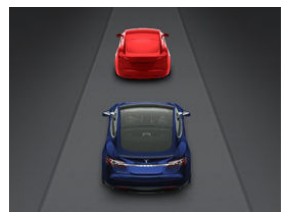
You could not miss the sound of the Forward Collision Warning alerting!�
Jan 17, 2016
NoMoGas Based on what? AEB is NOT designed to avoid a collision. It is designed to LESSEN THE IMPACT of an unavoidable collision, (I think this is dumb but hey, I didn't write the manual) which based on the minor damage looks to be exactly what happened.
WAY to many assumptions on this thread.�
Jan 18, 2016
bhzmark It cld be they tried design aeb to prevent collisions, but it may not be perfect so lets just say to lessons the impact.
But aeb isnt relevant to this incident.
Andy, accepting your vocabulary: ok, tacc only tracks one target car at a time. But ap/tacc also tracks other cars too. See the display. At some point it has to decide if a non-target car is now the new target car. It cld have gotten that wrong.
Also I think tacc does sometimes see car in your lane and thimk you will drive around it. See th3 blue prius video. Where tracked car changes lanes to go into a turning lane revealing a stopped car in front of it. The tacc has to decide will the tesla follow the tracked car thus going around the stopped car? Or will it stay in this lane and thus need to stopbehind the stopped car? When the driver who is still steering and tacc make different decisions that can be a probelm. But with autosteer doing the steering, it should coordinate with tacc to either steer and follow the tracked car, or stay in the same lane and stop behind the new car.�
Jan 18, 2016
msnow Yes it did and I always have FC on. My wife reminded me of a similar situation the day after I updated to 7.1 but this time TACC was enabled. The car I was following and tracking slowed down to make a left turn and after it was in the left turn lane and I was about to pass it my car brakes hard even though no one was in front of me. I don't think there was any sound from the car. At the time I thought it was odd that TACC kept tracking the wrong car but brushed it off and forgot about until now.�
Jan 18, 2016
jeffro01 Overbearing and rude? Interesting accusation. So you would prefer I simply just nod along with the rest of the sheep, believe everything I read on the internet as fact, and demand Tesla right this egregious wrong? Yeah... No... I can think for myself and will continue to do so. If you don't like it you have a few options, you could put me on ignore, stop reading my posts, stop replying to them, otherwise I'm sorry to say that I'm not going to stop posting because you seem to have issues with my posting style.
Given you've added nothing to this thread, nothing but insults towards me, perhaps you should go either provide something of substance or opt not to reply.
Jeff�
Jan 18, 2016
green1 Maybe we can stop discussing who should, and should not, be allowed to talk in this thread, and move on to the subject of the thread itself...�
Jan 18, 2016
Andyw2100 My point is that it just takes a little time to pick up a new target, and in this situation something could have caused it to take even longer than the standard amount of time.
TACC just doesn't work that way. TACC never assumes you are going to change lanes. In the video you are talking about TACC did not pick up the new target car that was stopped in the lane the Model S was travelling in, as the old target car was turning.
Hard to say, but this sounds like a situation where TACC thought the target car was still at least partially in your lane, so braked to avoid contact with it.�

Không có nhận xét nào:
Đăng nhận xét