Sep 4, 2016
S'toon
Full article at:
10 Words You Need to Stop Misspelling - The Oatmeal�
![[?IMG]](https://s3.amazonaws.com/theoatmeal-img/comics/misspelling/lose.png)
Sep 4, 2016
Canuck Good point on the idle charge. Okay, I'm convinced.�
Sep 4, 2016
RogerHScott This is what I call a "therapist's eye view" of the world. The universal gold standard for private transportation is the ICE vehicle.
It is the only relevant standard of comparison. It is pointless to talk about a "less inconvenient" EV. If it is less convenient than an ICE,
it loses. Period. If any aspect of driving an EV is demonstrably more expensive per mile than operating an ICE vehicle the anti-EV
forces will have a field day.�
Sep 4, 2016
RogerHScott Use of such chargers is at most a minor footnote in the great How and Where to Charge Your Tesla story. That story is really about
home charging and SpCs.�
Sep 4, 2016
henderrj What would be, I wonder, the profit margin on a replacement battery pack? If greater than that of a new vehicle then lifetime SC access may create a new profit center for Tesla starting in about 7 years, would it not? And, as a bonus to early adopters and the CPO department, would keep the value of the older, SC for life, cars up. Thoughts?�
Sep 4, 2016
whitex Ok, you made me think how and where I charge my Tesla. In the more than 3 years of driving a Model S I charged at the SC twice, and at L2 chargers about 10 times. Out of those 10, 3 or 4 I paid approximately $0.50 per KWh (and one had to walk about 20mins in the rain too as the charger at the hotel I was staying was not available and I had to find another one). The rest of my charging happened daily at home, for at about $0.10 per KWh.
Bottom line is this. If Tesla charges same rates as charging at home, almost everyone who can do math would never pay $2,000 for lifetime option. At $0.10, that's 20MWHr, or roughly 60,000 rated miles. For those who take a loan or lease, add to that interest on $2000, so the break even is at 61,000 SC miles or so? Now, if you charge at SC 10% of the time (which is more than me, but some do), you'll break even when the car reaches 610,000 miles. If you can afford a Tesla today, you're not keeping the car passed 610,000 miles, unless it is for sentimental reasons.�
Sep 4, 2016
Canuck You've completely missed the point, probably because of this:
I charged twice at superchargers in the first week of owning my car, and almost every weekend since, as I travel a lot in my car (mostly to/from my cabin on weekends), and that's what superchargers are for. Superchargers are not to take place of home charging, or the cost of home charging!
I could drive to Florida from BC tomorrow for free! Well, I paid for it in the cost of my car, and I would have to buy food on the way. My family of 5 can go from BC to Las Vegas, Disneyland, the Grand Canyon, etc. -- all for free!* This is the where the attraction to superchargers lies -- free long distance travel. If you stay at home a lot, and don't travel by vehicle, then certainly it's not for you.
(*For long distance travel only - and technically not free since it was paid for with price of the vehicle. Food/beverages excluded.)�
Sep 5, 2016
whitex Ok, what percentage of your mileage do you use SC for? Say you are one of few people who uses SC for 50% of their driving, then your break even at $0.1/KWh is 122,000 miles. Are you really planning to own this car past 200,000 km?�
Sep 5, 2016
David_Cary You can do napkin calc at $.10 a kwh but that is a huge assumption. $.30 is closer to my prediction. Sure more than gas for a Prius but not a similar car.
And the uptake at $2000 should be pretty low. I wouldn't have done it. But I think I am a less than average SCer. Probably 5% of miles.
But - that $2000 should have a decent bump at resale - especially if the alternative is $2500. I leased so that wasn't a big issue - and given the depreciation on options, $2000 would never be worth it on a lease�
Sep 5, 2016
WannabeOwner If there would be demand for it I guess Tesla could offer some variations e.g.:
10 years $2,000
5 years $1,250
15 years $3,500
Here in UK Ecotricity have pay-for chargers (Chademo and L2 [I think]). You need an APP to use them, and in some places mobile signal is poor so they are adding a WiFi hotspot to the charger (restricted to their APP). If the internet connection to the "pump" is down, then the pump becomes free-to-use. Seems like a reasonable solution to me ...
... over here Ecotricity change GBP 6 / US$ 8 for 30 minutes (I think max power is 42kW)�
Sep 5, 2016
bob_p Model S and X cars are sold with free long distance travel.
We've reserved a Model 3 - which will be my wife's "commuter" car. We'll continue to use our Model S for road trips. I could see us saving $2K on the Model 3 and not ordering supercharger support (or at least buying a very small number of credits).
The Model S and X are sold with "free long distance travel" - and have the supercharger costs embedded in the car purchase cost today (in the early days, it was an added cost option). For Model S and X owners that are using the superchargers frequently for local driving (instead of having an overnight charger), it's possible Tesla will also ask them to purchase credits.�
Sep 5, 2016
Footer However they do it, they need to charge per kwh, not a lump sump cost. Then I won't be quite so annoyed when I'm Ubered.�
Sep 5, 2016
Az_Rael Yeah, it stinks. Tesla does list some options that are on the car, but not all. Things folks may want like power folding mirrors or parking sensors are a bit of a gamble. That's why Hank set up that great service EV-CPO so those of us shopping can get a better guess at what we might be buying.
I do think they will strip the lifetime supercharging from all the CPOs for sale when this comes out. Why not - it is more money in their pockets.�
Sep 5, 2016
brkaus If they strip lifetime supercharging as part of CPO they will be able to sell the cars for less.�
Sep 5, 2016
ohmman My guess as well, but I see it more being in line with a new "lifetime per owner" policy. The one that I'm probably wrong about.�
Sep 5, 2016
RogerHScott Note I was talking about the story, not the reality. I'm talking about Tesla's image and marketing, not the actual experience of owners.
Do you contest that the "party line" from Tesla strongly emphasizes home charging and SpCs?
Note also that I'm not saying the PPU cost of SpCs has to be equal to home charging -- just that it can't exceed the cost of the same trip
in an ICE vehicle.�
Sep 5, 2016
Panu I agree you will be wrong about that.
I've always said they will charge new supercharger fee when you buy a new battery (embedded in the price of new battery of course). Current battery prices with the fact that you have to give them your current battery almost for free support this.�
Sep 5, 2016
ohmman Not fair to whom? If it's the global policy, resale values shouldn't be affected (since comparable cars have the same rule set). If a buyer paid for supercharger access outright and knew the policy, then their expectation was that they'd own the car more than 6 months. That's a buyer issue, not a fairness issue.�
Sep 5, 2016
AmpedRealtor I'd gladly waive my "supercharging for life" if Tesla would give me a pro-rated refund. I don't road trip much and would rather buy credits on those rare times that I do.�
Sep 5, 2016
Panu To say it in other words if Tesla does this it will charge many times for the same thing - a good reason to dislike Tesla.�
Sep 5, 2016
Lloyd If Tesla's rate is close to what I pay for a three phase 800 amp connection, my average rate (usage averaged over average rate) with PG&E is .24 per Kwh. They should charge more than what they are paying for the electricity alone.�
Sep 5, 2016
RogerHScott Well, no, not the "same" thing. They have to buy your unused capacity just like any other buyer would. Then they own it. They can
then sell it, but the "it" is the capacity they bought from the previous owner, not the original (which they haven't owned since they
originally sold the car to that owner).�
Sep 5, 2016
Canuck Wait, you convinced me on the lifetime per owner thing. You can't hedge your bets or back out of it now.
So Tesla gets a CPO car and removes supercharging for life and I'm suppose to dislike Tesla? That makes me like them more since that car won't be locally supercharging as I come by on my travels looking for a charge and it adversely affects no one -- the owner traded it in and the new buyer doesn't pay for lifetime free.
And do we like Tesla more when they change a 60 to a 75, or add 4 more years warranty? It has no effect on me but good for the new CPO purchaser (although they do pay for these things -- it's just a way for Tesla to better compete with trade-in values and still make a profit).�
Sep 5, 2016
McRat The way it sits today, for those with Teslas that have SC for life, your initial SC fee (outright or hidden) becomes worth more and more each year as the grid expands, not less and less. You will be able to go more places, faster, and that has value.
So the rapid expansion of SC network should be encouraged by the existing owners as it increases the value of their car. The more money pumped into the SC network, the faster it grows.�
Sep 5, 2016
Panu For CPO this model works because they get less money for the car when they sell it without supercharging. But when you sell it it's you who gets less money. Basicly $3000 or whatever the lifetime fee is disappears immediately from car value when you buy it.�
Sep 5, 2016
ohmman My intent was to convince you that it was possible and not terribly onerous. And yes, I'm being weaselly about it. How about this - I'm absolutely confident that it's a possibility.�
Sep 5, 2016
TaoJones Adding friction to a frictionless system is counterproductive. Especially when that system is 97% underutilized and less than 50% complete.
That won't stop the fearmongering, clearly.
Decoupling is one thing. Taking away one-time payment for charging (poorly phrased as lifetime charging) is unnecessary for the S and X. It's arguably not even necessary for the Model 3 except as a giveback for the majority of owners who rarely use SCs in the first place.
The benefit of then adding prepaid is for those owners who change their minds and who don't want to get stuck for $3,000 for an after-build activation.
Still fine - but taking away one-time is just a bad idea. Although it'll certainly help values for existing used cars.�
Sep 5, 2016
cpa Ok here is my two cents after following this dialogue for the past several days:
We really do not know the motivation behind this change, so I will toss my line into the water to see if I get any nibbles.
Since we ordered our S85 in April 2014, I have noticed that Tesla continually tweaks options and bundling. We paid $250 for the parcel shelf, and a few weeks later it was standard. They bundle A with B and C today and then tomorrow bundle A with D and B and C alone. Sales reps are unable to add options a la carte or delete an unwanted option that is bundled with one the customer wants and reduce the purchase price.
I think that it is certainly plausible that Tesla has lost a number of sales of the S/X because the prospective customer did not want Supercharging, or wanted pay-per-use in exchange for a couple of thousand dollars off the purchase price. (Why pay an extra $2,000 -- or whatever-- for something I will use only 6 times per year?) Perhaps there has been feedback from sales representatives and maybe even service centers relating this fact.
So, maybe Tesla is doing some data gathering now with the S/X buyers to see how much demand there is for Supercharging for those vehicles. We are probably about 9-12 months away before Tesla releases its configurations and pricing. That should be enough time to glean an understanding of the popularity of purchasing "unlimited Supercharging" or PPU or whatever.
I concede that the customer base for the S/X is different from the Model 3. However, I think that there will be some valuable information collected which will allow Tesla to try to price and configure the Model 3 to maximize orders and minimize cancellations, while balancing out the completion of the Supercharger network.�
Sep 5, 2016
Canuck You keep repeating this. Remember when you said this:
https://teslamotorsclub.com/tmc/posts/1352826/
Do you still think it: "is a ludicrous non-starter of an idea and simply will never happen"?
�
Sep 5, 2016
landis Expanding the SpC network also increases the usefulness of the M3 I reserved.
Therefore if given the option, I will definitely choose to contribute 2K for SpC network expansion to pay it forward as an 'investment' in a bit of self motivation to take a few epic road trips while I still can. And maybe with AP, even after I can't ;-)
Yes, I know this doesn't make any sense from a selfish cost of my capital.
It is a little bit I can do to accelerate the future, just like I've been opting to pay a little more for 100% renewable electricity in PA.
This is the car I expect to be driving when I retire in 6 years or so after about 120k miles just commuting (while charging at home of course.)
I don't (yet) plan on ever buying another car, though I suspect I may be in the market for a 'Y' once my spouse learns firsthand why I have been obsessed with a M3.
Even though I could theoretically afford a MS, other 'priorities' prevent that. A base M3 would be significantly more than I have spent on any car in 40 years. I've never before purchased a car before running the previous one into the ground. I've never once worried about trade in values.�
Sep 5, 2016
dss33 As an S owner, I'm perfectly happy sort of subsidizing the build-out of the supercharger network with the $2,500 payment up front, even though I know I'll never get anywhere near that much use out of the network during the three-year lease. That said, that's just looking at it from a price/kwh perspective and doesn't take into account the convenience or necessity of superchargers, which is critical for relatively hassle-free and optimized (to some extent) long-distance travel.
For our Model 3, we'll very likely take the pay-as-you-go option rather than the upfront charge, simply because we don't use superchargers a ton. It's a smart move, as others have noted, 1) because it opens the network up to other brands and improves the chances of it becoming some sort of standard and 2) because it further lowers the cost of entry for both the S/X and more importantly, the Model 3.�
Sep 5, 2016
schonelucht One thing a PPU may end up doing is making peak use of SpC worse. Currently the book value of the supercharger network is about $180M for 136k cars (that's in their quarterly filings). That's $1300/car just for the infrastructure. A good industry wide guideline for yearly maintenance is 10% of book value. That's another $130/car/year. Those that will buy credits to use the supercharger will only pay a very tiny fraction of that amount (unless prices are $1/kWh or something outrageous like that). Yet they will likely exactly want to use the network on peak days (holiday weekends, etc). It's a tricky balance to get right for sure.�
Sep 5, 2016
landis The credit system is genius, and not a complete surprise if you've heard Elon explain the essence of his intended PayPal business model.
It seems to me this is one aspect for the no brainer of Tesla as a next generation energy company.
For example, my future PV credits are most likely in the same account obviating the need for overhead of conventional financial transactions, while putting scraps of capital to work advancing the future of sustainable energy.
This is another reason this isn't a 'pay per use' model though it does enable 'pay proportional to use'.�
Sep 5, 2016
FlatSix911 Looks like Tao will be having some humble pie ...
�
Sep 5, 2016
TaoJones I hear they're hiring for spinmeisters lately - don't miss out.
That said... Hardly. Enabling simple prepayment keeps the payment process (far) away from the pedestal which is almost the entire point.
Further, despite the populist insistence upon "either or", and despite the baseless speculation, I see this as an "and".
Specifically, in deference to those complaining about being charged for SCing even though they claim that they won't use it, Tesla has deployed an Iacocca (reference to base model Mustang debuting without a radio so as to be most accessible to families as an affordable car - this being back in 1964).
What's completely jumped the shark, however, is the notion that all of a sudden there will be no one-time option - either for the S/X or 3, and that makes less than no sense.
What does make sense is giving entry-level buyers a lower price point *and* the option of either upgrading later (one-time fee plus a post-build premium - see AP or the high-amperage charger as examples) *or* continuing with their prepaid balance. Either way there's no slowdown at the pedestal.
From a practical standpoint, let's say it's 2 years from now, at one of the few SCs considered "busy". Since this example wouldn't work at the 97% of the network that's underutilized which is to say empty much of the time. So at, say, a Los Angeles SC in the Fall of 2018, there are 4 Model S and 4 Model 3. By *not* using poo-poo (pay per use at the charger), you wouldn't be able to tell who was one-time (lifetime) and who wasn't. In, out, and on their way much like today *except* with the added benefit of extra incentivation to not idle - at least for the Model 3s that chose the prepaid option, that is. It's a start.
So none of that is a bad thing *as long as poo-poo is replaced by pre-paid*, which is what appears to be happening. Yes, there may be a few clueless first-timers who try to pre-pay at the pedestal, but that's not much different from today - not a month goes by that a new Leaf owner doesn't try to use an SC (Nissan has a new 2-year Charge Anywhere program that isn't quite accurate).
You may keep yer pie�
Sep 5, 2016
electracity I don't believe there can be a one time option for the model 3 unless "supercharger for travel only" can be enforced. SInce "for travel only" probably can't be enforced, IMO the model 3 will not have a one time fee option.
Tesla can't enforce complicated policies. If an owner is doing 90% of their charging 20 miles from home is that use considered "travel"? How about 30 miles, or 50?
A geofencing solution will simply be gamed. e.g. Registering the car at moms and but charging near home.
Tesla is going to need to build a lot of city superchargers for apartment dwellers. Revenue neutral city chargers are easiest with per kwh pricing.�
Sep 5, 2016
FlatSix911  �
�
Sep 5, 2016
Chuq That's been my argument as well.
Personally, I live 300 km drive plus a 9 hour ferry trip away from my nearly supercharger. I live on an island of 500,000 people, chances are there won't be a SC here for a while. So the logical thing for me to do is to not buy SC access. On the chance that I take the car on that ferry/road trip, it would be logical for me to pay per use for the SCs. However for the sake of the growth of the *network* as a while, I'd rather pay a fixed amount up front. This also sends Tesla the message "Hey, there are people in Tasmania paying for SC access... maybe build one or two there?"�
Sep 5, 2016
Festerfeet It will be interesting to see how the pricing is implemented in Europe where industrial rates for electricity range from 4 cents to 20 cents in different countries.
I am guessing that the charge will either be cost neutral or potentially a profit centre for Tesla and may even be spun off as a separate company in the future which could help Tesla raise cash for future expansion plans.�
Sep 5, 2016
ohmman So one mechanism, which is viewed as evil but is proven effective, is congestion pricing. Not sure how that would be done if Tesla has a preset kWh credit model. But having some sort of accounting would make it possible if that's a direction Tesla wanted to go. And yes, I realize everyone here probably hates the idea.�
Sep 5, 2016
Footer Tesla deserves to make a profit on their superchargers just like a gas station. They should charge more if it costs them more for the power. If the EV market takes off as expected this will be a big source of revenue and they have to price it accurately. Not really looking forward to seeing posted power prices though, but it may come down to that. Actually, I'm sure the price will show up on our screen. At least it's only one price, no extra charge for premium�
Sep 5, 2016
TaoJones *twitch*
We're going to need a bigger shark.�
Sep 5, 2016
ohmman Speaking of spinmeisters.. "almost the entire point" may be true, but it wasn't your point, was it?
This one makes your position pretty clear:
And in case there was some question, there's this:
To be clear, I have no issue with anyone making an incorrect prediction, even if they're breathtakingly adamant about it. But to play spinmeister, and then accuse other people of being a spinmeister.. I could keep quoting your old posts if you'd like.
Or you can take the pie back.�
Sep 5, 2016
ohmman It's easy, man. "I got that one wrong. It'll be interesting to see how this plays out."
But attack me all you want. I'll keep "failing" (?) with pride.�
Sep 5, 2016
SageBrush The SC cost is amortized over it's lifetime.�
Sep 5, 2016
Garlan Garner Good question in the first sentence.�
Sep 5, 2016
SageBrush Of one thing I am very, very sure:
If I take a Tesla on a trip that includes a SC stop that does not work, my wife will remind me of it. For the rest of my days.
I suspect that Tao shares my anxiety.�
Sep 5, 2016
RogerHScott The devil is in the details�
Sep 5, 2016
FlatSix911 I only purchase premium electrons ... and have this special decal on my HPWC to remind me...
Regular is fine for Tao...
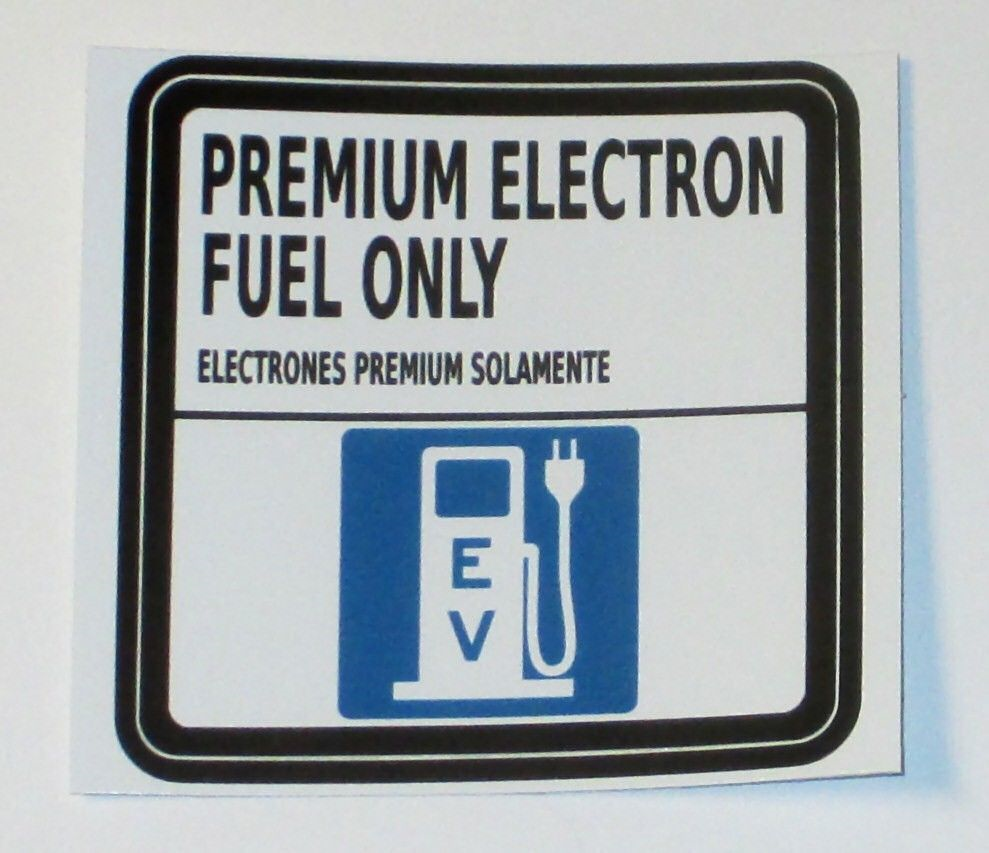 �
�
Sep 5, 2016
pkulak Man, if Tesla releases an SAE adapter and opens up the network to anyone who pays by the kWh, the Bolt would become a serious competitor for me. Right now, no way just because non-Tesla charging is a nightmare.�
Sep 5, 2016
stopcrazypp Correct me if I'm wrong, but neither you nor Red Sage, ever brought up that you were talking only about pedestal based pay per use, before recent news about the payment page leak. Rather, you were arguing there would be no pay per use at all. This new qualifier about pedestals seems to be goal post moving. Personally, I always assumed that Tesla would do pay per use online/in-car and not with a pedestal. I'm pretty sure most people on the "PPU" prediction side also thought/predicted the same and very few (if any) predicted/suggested using a pedestal.
Just to back up what I am saying about payment for payment for pay per use, here's my prediction three months ago:
I also browsed that thread a bit and didn't see anyone bring up adding a pedestal to supercharger stations to take credit cards / payment. Everyone was talking about Tesla billing a credit card on file.�
Sep 6, 2016
Footer I would be surprised if the superchargers look anything different than they do today. Between the car's computer and the supercharger's connectivity to Tesla, billing can be figured out as the system exists now. Why add anything?�
Sep 6, 2016
bob_p What might make sense...
Lower priced Tesla vehicles - Model 3 and the lowest price Model S/X would have SC as an option, to allow owners not planning to do much long distance driving the ability to save around $2K off their purchase price by omitting SC. This is what Tesla did originally with the Model S.
Higher priced Tesla vehicles - for most Model S and X vehicles, they would likely continue to bundle the "free long distance" SC package, since with the higher priced cars, the $2K savings isn't as important.
And, for anyone using the SC's more frequently for local charging, they will likely start getting charged for local charging, since Tesla intended the SC network to be for long distance driving - not as an alternative to an overnight local charger.�
Sep 6, 2016
ecarfan @bob_p in general I agree with your position but think that Tesla should make some kind of pay-per-use system available with every Tesla model.
There will always be many prospective buyers who will not envision using their Tesla much for long distance driving, whether it is an 3, S, or X, and if they can save $2K by not having "free for life" Supercharging they may like that. As Tesla drives down the price of the base Model S, that $2K will make a difference for some people, particularly as people come to understand that the cost of a Supercharge session on a PPU model can be less than $10, perhaps (we don't know yet what it will be). So if they think they will only make a few long trips a year, not paying the $2K upfront can sound attractive.
I think Tesla will be able to implement a PPU system in a manner that makes it simple to use and the Tesla owner will not have to do anything when they arrive at a Supercharger except plug in and charge. Of course they will have to make sure, in advance of their trip, that they have a reasonable amount of kWh's in their account. Some people will forget or they will have difficulty translating kWh's into miles of range. All that means is that at the Supercharger they may have to "top up" their account through the center display interface or the smartphone app. As long as there is a cell signal that should be easy to do.
If their is no cell signal then they will be in trouble if they don't have enough charge to make it to their next destination whether it be a Supercharger or their planned stopping point. Cell service is not everywhere nor does it work 100% of the time, so Tesla owners will have to keep that in mind if they are on the PPU Supercharger plan. Or perhaps Tesla can design the PPU system in such a way that it will allow for a certain amount of "overdraft" protection so that it allows charging even when the owner's kWh balance is negative and then when the car is back on cell service the owner will receive an alert on the center screen informing them that their account has been charged and "topped up".
This issue is a solvable one and I'm sure that people much smarter than I, with experience in designing online payment systems, can figure it out. I am also sure that Tesla has already thought it through.�
Sep 6, 2016
SageBrush Perhaps because I kinda sorta side with Tao, I took his 'pedestal' comment to mean any system that introduces possible authorization complications at the SC.
I think the key point here is that SChargers do not have an attendant and are widely spaced. It *really* behooves Tesla to not do anything that will cause a problem -- however uncommon -- at the charger. The fee is at best a tertiary concern.�
Sep 6, 2016
Topher This is probably a bit high, given that a lot of Superchargers are for coverage, rather than for usage. Coverage SC will not need to be replicated with mere increases in cars.
Tesla will speed up the process of converting Superchargers to Solar. They might even need to merge with a solar company.
No, it's not. A used car with life-time supercharging will cost them more to buy, than one without. Selling them all as non-lifetime charging mean that they lose that difference. Might be worth it, but it isn't free money.
Probably makes the most sense to charge the average the cost of power over the whole country. High cost areas then get increased priority on solar conversion. Win for Tesla, win for customers.
There is already authorization complications at the SC. Unless you are claiming that one could make a simple converter and charge one's Leaf at a SC. If a company can't do a simple encrypted handshake, I certainly won't trust them to make an autonomous car.
Thank you kindly.�
Sep 6, 2016
brkaus How realistic is solar for most supercharger locations? If one assumes perfect efficiency storage, and panels that generate 250w for 12 hours a day, it would take 26 panels to charge 80kW into a single car. Assume one car per hour for 24 hours, then up to 640 panels at a location to support 24 charges.
Maybe for seriously remote locations that have space and not many teslas to charge.�
Sep 6, 2016
Az_Rael Ah, but if they make the "lifetime" charging option tied to the user, NOT the car, then no used Tesla's would have lifetime supercharging anymore. (I am assuming no grandfathering of VINs here) Therefore, they can now charge every person who buys a used Tesla and wants to supercharge the fee/credits/etc.�
Sep 6, 2016
brkaus Too many corner cases to have lifetime charging tied to user. It just won't happen.
Do they refund unused portion if sold? If wrecked/salvaged? Allow to transfer to users next tesla auto?
They need to simplify not make this more complex.�
Sep 6, 2016
Canuck Also, they would have to retrofit all the superchargers to take a RFID card or something similar since now it authenticates the car only.�
Sep 6, 2016
Topher Most superchargers are in HUGE parking lots. They have tons of space to put up solar panels. Remote locations might be the hard part.
Thank you kindly.�
Sep 6, 2016
Az_Rael Or they could update the code in the car to turn its own authentication on or off. Supercharger still sees "yes" or "no", but car keeps track of authorization.�
Sep 6, 2016
Topher That is likely to bring up legal issues best avoided. What *exactly* did Tesla say you were buying? What *exactly* did their advertising say? Litigating is probably more expensive than just taking the loss.
Thank you kindly.�
Sep 6, 2016
SageBrush They could charge the ICE'ers for shade.�
Sep 6, 2016
Az_Rael Ahh, but no one has any supercharging terms language in any of their purchase contracts. It's only listed as an option on the car. All we know is the advertising that says long distance travel for life. That does not specify how that is to be implemented.
I am going to go to my favorite example of Tesla changing the rules mid-stream: Ranger service being $100 flat rate, unlimited miles. The only folks who got to keep that policy were the ones who had it in writing in the service plan contract. Everyone else was forced to the new per mileage charge despite what had been advertised when they bought the car.�
Sep 6, 2016
RogerHScott The former in no way implies the latter. They aren't Tesla's huge parking lots -- they're someone else's huge parking lots.�
Sep 6, 2016
Gears I wish I could have the $2000 back...I don't see us using the SC much except for trips. Lower priced model S's mean more sales.�
Sep 6, 2016
RogerHScott I keep seeing this claim made, but given how many MS owners hardly blinked to add $15k or more worth of options onto
their orders it is hard to imagine that $2k is really going to be the deciding factor for many people. For a $30k car, sure.
But for a $75-100k car?�
Sep 6, 2016
Canuck "Except for trips" ? That's not an exception, that's the purpose.�
Sep 6, 2016
mhan00 Pretty much this. It's actually pretty surprising to see the number of people who come up with solutions that assume Tesla has the right to do whatever they want for the super chargers. Tesla has to negotiate with the actual property owners at most of these locations, and not all of them will be amenable to Tesla taking up more room.
Plus, solar panels (and batteries to store power to offset demand) is an IMMENSE expense to cover for super chargers. As others have pointed out, super charging just one Tesla from zero to full would be several times what the average single family home uses in electricity in one day, and that's over the course of, ideally, less than one hour. The average single family home uses 911 kwh per month, which is a little over than 30 per day. That's only a little over half of the battery capacity of even the smallest Tesla battery (since the 60 has capacity reserved to keep it from bricking).
It might be doable at less popular SC locations, but then it would still be an expensive up front cost and wouldn't be defraying much expense. If Tesla tries to do it at the more popular SC locations in CA, the space requirements would be insane, not to mention the expense, and, perhaps most importantly, the time and resources and labor that would have to be redirected, all for a goal that would take years to pay off.�
Sep 6, 2016
SageBrush Net metering could be one solution, but I tend to think that Tesla will choose it's own batteries anyway to mitigate demand charges and to bump up charging rates to the next level for ~ 15 minutes per charge.�
Sep 6, 2016
Gears I see a lot of people using it in Socal while they shop since they "prepaid" for the service (Fountain Valley, CA). I think have the option to pay per use or in bulk on initial purchase works for everyone.�
Sep 6, 2016
SageBrush I was just mulling over the possibility of Tesla offering build-out of PV around superchargers as a community solar option, excised through use of chargers or some other compensation�
Sep 6, 2016
Bimbels I wouldn't assume they were moochers though. They might have planned their charging stop around the shopping trip - or they might have stopped to charge and then decided to shop while they were waiting. We are not required to stay in the car - but we are expected to move when we have enough to continue.
I drive 185 miles home for my commute and have a SC 20 miles from my house. The navigation sometimes routes me home via that supercharger, but since I prefer to take back roads home, I ignore that stop and just get more of a charge the supercharger before that one. However, sometimes I want to stop at my "local" supercharger on my way home because there is a nice grocery store there and maybe I need food for dinner. So I charge less at the charger before.
I am local, but I am not abusing it. I am following the navigation and the superchargers plotted on my route. I only need about 10 minutes there to get home and that's all I charge. However, someone could pull in and see my "local" tag and assume I am an abuser. And since they don't know where I'm going or where I've been, that would be an unfair assumption.�
Sep 6, 2016
Chopr147 I disagree. Look how many model 3 reservers decided to purchase an S once the 60kwh came out. I am one of those. $58,500 after tax credit "advertising" sounds pretty good. Of course I then started adding options�
Sep 6, 2016
SageBrush People change behavior, and even act irrationally, for a lot less than $2000. SC abuse is a pretty good example.�
Sep 7, 2016
bob_p No matter what Tesla does about the SC policy, there will be some who will not be satisfied with the changes. But if they are going to make changes, they should do it before the Model 3 is produced - and they ramp up to selling 500,000 cars per year...
We plan to buy another Model S if/when a 100D with AP 2.0 comes out - and we'll want "free long distance" SC for that car - it will be our road trip car.
We also have a Model 3 reserved, which will be the replacement for our classic 75K mile P85, and because we'll likely use that as my wife's commuter, we would probably save $$ and not order the SC support. Though we would want the SC hardware onboard, with the option of using the SC network, if our plans changed after we get the car.�
Sep 7, 2016
Topher Who cares? I suspect that Tesla didn't buy the land for most of the Superchargers, just leases it. Why invent silly objections? Businesses exchange goods and services all the time, it isn't tricky. Tesla leases the air space over those huge parking lots, at a low price since there isn't any other way for the owner to monetize that space, plus the cars parking in the lot get shade, making that lot more desirable.
***
There is an amazing amount of goalpost shifting going on here. It starts (for me) with an objection concerning the possibility of electricity rates going up. I respond with the obvious (I thought) idea that in that case, Tesla makes good on their plan of solarizing the Superchargers (since solar PV is dropping in price at an amazing rate). Then the objection becomes there isn't enough space to put PV near the superchargers (not that you would have to do that). When I respond that most Supercharger are surrounded by vast parking lots, it is no longer a space issue, but rather that Tesla doesn't *own* the space. I am sure some other objection will be made to the idea that they could lease the space. Apparently some people like problems more than they like solutions.
Thank you kindly.�
Sep 7, 2016
RogerHScott You've got to be kidding. Think of the practical issues with constructing a solar canopy over a parking lot. That canopy has to be held up by something and those supports would need to withstand being run into be careless drivers (who don't expect to encounter solar
canopy supports in their grocery store parking lot), which makes them expensive. Sure, what you suggest is physically possible but
it also sounds grossly impractical. Just because you didn't anticipate a problem doesn't make the problem silly.�
Sep 7, 2016
ohmman Tesla has panels over the Barstow Supercharger. Here's what the meter looks like. They do not appear to be interconnected.
�
Sep 7, 2016
Topher I don't have to, competent civil engineers have done it for me. Google images "solar over parking lots" to see literally hundreds of pictures of EXISTING installations. Better yet, do it BEFORE you ridicule the idea next time.
Thank you kindly.�
Sep 7, 2016
RogerHScott I didn't say it wasn't impossible -- in fact, I explicitly said it was. I said it was expensive (i.e., impractical in this context).
You have not refuted that claim.�
Sep 7, 2016
SageBrush Lucky for your argument, I don't own a big parking lot. If I did, I would pay Tesla to install PV canopies.
Snow removal would be more complicated but offering shaded parking is a huge draw for customers. Just look at the pricing at pay-per-park lots if you want shade. My cursory googling found a 25-33% surcharge.
Addendum: This WashPo article is pretty good. If businesses could install PV canopies cheaply, they are a no-brainer. It also says that ~ 15-20% of city space is parking lot. Wow�
Sep 7, 2016
u00mem9 Topher- All the solutions seem very simple when you don't address (or comprehend) the details. You could probably spur more meaningful discussion by making some quick calculations of the area required for PV and demonstrating feasibility rather than just saying "use solar. done!" The SC network is behind build-out schedule BECAUSE it is capital intensive. Adding PV to the plan just increases that 10x. But by all means, show me I'm wrong with some numbers.
Concerning the rest of the thread, discussion seems divided based on whether the comment is from the perspective of the customer or from the perspective of Tesla's best interest. Long-term, they are essentially the same, but in the short term, maybe not.
As demonstrated by the comment "I would just pay for supercharging for trips" (duh), many posts are thinking from their own perspective as potential customers that don't want to carry the real cost of the system. That is why IMHO Tesla's long term interests are best served by keeping it standard and growing the network as we prepare for M3. I'm sure Tesla can't meet the $35k price target with some planning cost for SC network (if they can meet it at all)...but for MS/MX?�
Sep 7, 2016
SageBrush Follow your own advice and convince me of your "10x" cost increase number.�
Sep 7, 2016
u00mem9 Fair enough, I'll see what I can do. I think a previous post had SC usage volumes...�
Sep 7, 2016
Topher You haven't supported that claim. I showed you how to find hundreds of examples that it IS practical. Existing examples. Places that actually paid the money to do the job. What have you shown? Nothing.
Thank you kindly.�
Sep 7, 2016
Topher Feel free to search this forum for the posts where I did post the calculations and the numbers.
Thank you kindly.�
Sep 7, 2016
scaesare I've not been able to find it again, but I recall Elon stating during a presentation that the actual "real" significant solar power generation to offset supercharger use didn't need to be at the site, but simply on the grid.
So while there may be some local solar canopies to provide limited power and aesthetics, there would likely be a solar farm they could set up feeding the grid so they could net zero (or even positive) in terms of providing power to the cars...�
Sep 7, 2016
ohmman Right, this seems to be the much more reasonable solution, and mirrors what they're going to be doing at the Gigafactory. They'll have solar on the roof, which will be helpful, but they still need to bring in a lot more from external sources.�
Sep 7, 2016
SageBrush My recollection is that he said something along the lines of 'local grid,' which makes fine sense to me.�
Sep 7, 2016
u00mem9 Building from Troy�s calculation: (feel free to disagree)
Station cost without PV: $270,000
Average station has 6 stalls and each stall serves 132,652/4009 = 33 vehicle�so the average station serves 198 vehicles
Average station performs 27 x 198 = 5346 supercharging sessions per year
Each SC session uses 55 kWh x 5346 = 294,030 kWh / year or 806 kWh per day
Note: that is average, and in most markets larger capacity to take advantage of peak conditions would be required to offset low output days.
Assuming average 6 hours of PV energy production per day (seems like an interweb rule of thumb that accounts for tapering at beginning and end of day)
806 / 6 = 134kW of PV. Residential PV seems to be about $2 /watt, so with SolarCity producing their own products they should be able to get the cost up to $8 /watt�I jest, I jest
But seriously, if we assume Tesla is able to install PV at an average of $1.50 /watt, that gives us a PV cost of $201,000
Lots of assumptions here, but it looks like a rough estimate of 2x the cost is closer than my initial swag of 10x.
BTW, for a 320W LG panel the area was 1.64 m^2, so 134kW would require 687 m^2 �might increase the station cost considerably, but would vary greatly by region. I have only been to 2 SC stations, and they both appeared to be leased corners of existing shopping centers.
I may have made some huge error here, because I'm out of my depth, but I would like to plan out a PV system for my home, so I'm going to begin learning shortly. If anyone makes these estimates for a living, please correct these where needed.�
Sep 7, 2016
SageBrush Playing with numbers for a moment, to gauge the cost of PV to offset SC consumption:
Works out to $266 for each car, so perhaps 1/8th the cost of the SC itself if the retail price per lifetime use about pays for installation.
- 15,000 miles a year per car
- 10% of miles from SC use
- 3 miles per kWh
- 1.5 kWh per watt*year production
- $2 a watt installation cost
- 2.5 car lifetimes per PV lifetime
Addendum: long life of the array included�
Sep 7, 2016
SageBrush This
makes no sense because a large fraction of the SCs were placed for geographic coverage and future proofing.�
Sep 7, 2016
u00mem9 True, but the usage is also averaged, so they will potentially offset...I'm open to suggestions?�
Sep 7, 2016
SageBrush You do not have to go far.�
Sep 7, 2016
u00mem9 Missed that...
BTW, The difference in our estimates comes down to the estimate of SC usage. You assume 1500 mi / yr. Troy assumed ~5200. Without any sources cited, so I have no idea which is closer to correct.
Maybe Tesla is actually failing to meet the 2016 SC plan because they want to build only PV-equipped stations from now on and are waiting on the SolarCity merger / products.
Maybe, but I still suggest it has more to do with the direction to conserve cash wherever possible... Remember that funny moment in the Q1 call, where Jason Wheeler said something like "Elon has made it very clear to me that cash is king this year"...I don't think he was supposed to say that out loud�
Sep 7, 2016
SageBrush Tesla has said that something under 10% of miles are SC.�
Sep 7, 2016
u00mem9 That is a couple years old, so it could be quite different now. The 2014 network was much smaller:
![[?IMG]](https://lh3.googleusercontent.com/blogger_img_proxy/AEn0k_uOV7D5FI2-oyYDtMevol5TA2ZJeY0RnWLGSalrAYhaZiZhbIYNgBkOvKcW4J2kXeg5d110dG0_aUxAACnxSi415vyUHeZxv3rPSaTNqHl3VOJ_xPvUo90Cy8vml5xr1kCSDU9hHhYsfGAnkKNIzDH0QGTa=s0-d) �
�
Sep 7, 2016
Garlan Garner I hope its decoupled from the M3 also.
If so.... I'm going to set up a $500 payment every 6 months to Super Charging. My bank has auto-pay. I'm going to check the balance every 3 months or so to see if I'm ok. That way I will never have to worry about balances.�
Sep 7, 2016
ohmman I feel quite certain that the PPU/credit program for Supercharging will be tied to a credit card, and you'll be able to "recharge" your credits remotely on demand. It's very possible they'll even give you an option to have it "refill" your credits once you dip below a certain value. My toll tag in California works exactly this way, and I never have to touch the account.�
Sep 7, 2016
SageBrush That is one difference, but Troy is assuming immediate, full utilization of every SC from the day it is built, which is clearly far, far from the truth. Much better in my opinion is to simply cost out a PV mile. My main uncertainty lies in estimating canopy PV installation cost. I used $2/watt but it could be double. In case you were not keeping track, our estimates of additional cost to solarize SC use are:
- Your initial estimate: 10x
- Your revised estimate: 3x
- My estimate: 0.125x
�
Sep 7, 2016
Garlan Garner I agree with your estimates so far.�
Sep 7, 2016
u00mem9 that last addition to your calculation is losing the plot. The question was how much more does a PV powered SC station cost to install vs one without.
You have added time in to show that over a longer period, it becomes less of an impact. True, but missing the point.
Tesla is in a cash crunch.
That is limiting the network build-out critical to support M3 volume.
Someone suggested adding PV
That makes the cash situation worse and would further complicate the problem.�
Sep 7, 2016
ecarfan Yes, I am as certain as I can be that the Supercharger PPU program will automatically "top up" the kWh's when it gets low, or you will be able to top up via the Tesla web site or the smartphone app.
I think the PPU program will be very simple to use, and will be very popular.�
Sep 7, 2016
SageBrush Correct.
I make no comment about cash flow�
Sep 7, 2016
Garlan Garner Tesla is indeed in a cash crunch. I wonder why though. They are still building SC's then. I wonder if they can allocate the money coming in that supports the SC network to building the M3. Let me correct myself. I'm sure they can as long as their investors and the SEC understands.�
Sep 7, 2016
RogerHScott The line between ethical and legal here is really blurry. It is, IMO, pretty clearly unethical to take $2k/car from people for, among other
things, the promised build out of the SpC network and then spend it on something more convenient to the company but possibly of
no interest or value to the original customer. Whether there's any legal issue with that is far less clear.�
Sep 7, 2016
SageBrush Save this post for when Tesla stops building SuperChargers.�
Sep 7, 2016
Canuck Can you provide a source for this alleged promise? Just because I give a company for something doesn't mean the company is obligated to use the money I provided it for the items I bought. It's very common to use money for other purposes. There's nothing unethical about that.
But I do agree if Tesla has said something to the effect of "We use the $2k you spend for supercharging to build out the supercharging network" then it's not ethical to use it for another purpose. I don't recall hearing them say that, but I might have missed it.
It also seems to me that Tesla has paid more on the supercharger network, including research, development, software, hardware, rent, power, construction, maintenance, etc. then they have the collected in supercharging payments on vehicles sold to date. I could be wrong, but it seems to me even if they promised to use the money for supercharging, they have to have a lot more sales until they even break even.�
Sep 7, 2016
ohmman To continue this line of reasoning, business works this way across the board. You make more on one thing and sometimes even lose money on other things. If you put every option into a silo, the business would be very likely to fail.
Charities do this very frequently. They use funds raised from high profile media events to satisfy the needs that aren't getting the immediate attention of donors. Is that unethical?
I agree - if Tesla says "this $2k is slated for Supercharger buildout and nothing more," they shouldn't use it elsewhere. But that's not the case. It's an option with a margin and that margin goes into funding whatever needs funding. That's just business.�
Sep 7, 2016
KublaConn It is also a very plausible use case where someone who purchases one of the more expensive models wouldn't want to pay up front for lifetime SpC use because the more expensive models have increased range. Is it not true that it's the shorter range models that will have more instances where a SpC stop is required? Owning a model with 300+ miles of range will mean that there will be an increase of instances where you don't have to worry about a SpC at all, no? That 140 mile trip to the lake where there's no convenient L2 charger? No worries, you own a 100D and can easily make it there and back on a full range charge. It seems to me that there would be many cases where the "free lifetime supercharging" would be more attractive to someone buying a 60D, who would also have more head room in their wallet due to the lower start price, than someone that's already stretching to purchase a 90D or 100D.�
Sep 7, 2016
Topher So got any evidence for that allegation?
Tesla has 698 superstations @ $270,000 apiece, divided by 137,000 cars is $1375 per car just to build the stations. Owners still get a lifetimes supply of charging for their $2,000 plus monitoring, upkeep, repair. The owners should have no complaints.
Thank you kindly.�
Sep 7, 2016
SageBrush JB talks some about this in a Nov 2015 presentation. Any other informative links ?�
Sep 7, 2016
FlatSix911 Love the way that Ar-can-saw was an island in the SC network ...
�
Sep 7, 2016
KublaConn Was? I think you mean "is". It's two years later and AR is still a SpC desert.�
Sep 7, 2016
ohmman It was brought up during the Gigafactory presentation during the Q&A. Took me a bit of searching, but here it is (skip forward to 2:10)
�
Sep 7, 2016
SageBrush Thanks!
Elon mentions importing wind power, I wonder from where. Perhaps the upper Midwest or Idaho. I vaguely remember reading of a plan to mine Lithium from Montana and bring it to the GF by rail. Tesla thinks on such big scales that I will not be surprised if they build their own high power transmission line along the rail-road tracks.�
Sep 7, 2016
RogerHScott To clarify, I wasn't accusing Tesla of any unethical actions. I was stating a hypothetical. Now you're free to disagree with either or both
of the premise or conclusion of that hypothetical, but only hypothetically
That said, are some of you folks saying that if your cellular provider decided tomorrow to stop putting any money into building or
maintaining cell towers you'd be fine with that 'cause you can't produce a written promise from them to spend your payments on
providing the service you value?�
Sep 7, 2016
SageBrush Maintenance: no
Expansion: yes
Now, put your goalposts back where they were.�

Không có nhận xét nào:
Đăng nhận xét