Jun 13, 2013
stopcrazypp Bingo. That's what most of the swap naysayers are missing. The goal is not to make a profit on this network but for the network to make the car that much more attractive.
Once Tesla demonstrates swapping as a way to refuel faster than a gas vehicle, that addresses the last weak point of the EV.�
Jun 13, 2013
CapitalistOppressor You should work harder on that.�
Jun 13, 2013
ShortSlaver The car is already so unbelievably attractive though. The only hurdle now is to make a mass production vehicle - the Gen 3.�
Jun 13, 2013
CapitalistOppressor It's retarded to consider the current SuperCharger to be a 20 minute charge. The equivalent charge you can deliver with a SuperSwapper is a fully charged 85kWh pack. Good luck doing that in 20 minutes.
- - - Updated - - -
This cost is required for SuperChargers as well. Yet you think that concept is peachy.�
Jun 13, 2013
brianstorms +1 I like this!�
Jun 13, 2013
austinEV Well, I am convinced now from evidence that june 20 is battery swapping. The 2012 stockholder comments dovetailing into the recent EM comments is compelling.
I think the division on this thread (and lets face it, its a minor division between fanboys ) is between these groups:
group 1) The announcemnt is battery swapping. hooray. Elon will show an elegant clever way to do it that everyone will love (after perhaps a day or two to absorb it.
group 2) The announcement is battery swapping. oh boy. its just so *inelegant*. There are a thousand ways to really foul up battery swapping for the business, and like 1 way to get it right maybe.
Count me in the second group. By the way, there is a distinction between the value of battery swapping for a CAR OWNER and a STOCK OWNER. The swapping could be a terrific deal for a car owner and be lousy for a stock owner and vice versa. This is an investors forum so commenting on the (possibly dumb) market reaction is perfectly in bounds.�
Jun 13, 2013
DaveT Tesla doesn't need to make money from Supercharging stations, battery swap or service.
They'll make enough gross margin off the cars they sell.
Supercharging, battery swap, service... it's all to make the experience of owning an EV better than owning a ICE car. The last hurdle is making it more convenient than a gas station to recharge. This was the only complaint from the Consumer Reports review of the Model S.
It's also interesting to note that Elon's initial tweet about There's a way to recharge the Model S faster than filling a gas tank... was a reply to Consumer Reports. He tweeted that right after the Consumer Reports review came out. And then he tweeted that it was the 5th announcement (or hinted at it). In other words, battery swap IMO is about defeating the last hurdle to make EVs even more convenient than gas cars and gas stations.
Elon also mentioned twice that he wonders if Consumer Reports would have given them a 100/100 if they could have showed them they could recharge faster than filling a gas tank (ie., 5th announcement).
Battery swap is about upping the antee... and making the Model S a 100/100 car that's better than the ICE car in every way. If battery swap makes the Model S a 100/100 Consumer Reports car, then that'll be good for demand and investors will like it (at least eventually). If battery swap doesn't do anything to the attractiveness of the Model S and doesn't increase demand, then investors won't like it.
I'm in the camp where I think it's a big announcement (huge event at night with customers and media) and I think this is what Elon wanted to show Consumer Reports to get a perfect score.
- - - Updated - - -
TD1, awesome drawing. The idea is really smart as well. Well done.�
Jun 13, 2013
Andrew Can we please not use the word "retarded" in the pejorative sense? Thanks.�
Jun 13, 2013
Palpatine Most people are not going to find this option to be more attractive. I find the concept to be hugely risky and a big negative overall for the company. I purchased a $10,000 product from a company that later went out of business. It sucks to have no support. If Tesla is spending any significant CAPEX on a bunch of battery swap stations, then Tesla Motors will likely need to have a "going concern" warning added by the auditors to their next SEC filings. Potential customers don't want to get stuck with a product where the company is going out of business.
After Better Place, the burden of proof will be on Tesla Motors to prove this won't take the company under. As if Tesla Motors needs to give others more ammunition about EVs. Adding a huge battery swap business expense to the balance sheet just a few weeks after Better Place went under, that would be monumentally retarded of the brain trust at Tesla. That is why I don't think there is any chance of a battery swap network being announced June 20th. I think at best Tesla might demo a battery swap. Then they might announce one location they are going to run a trial test at to see if customers use it. If there is no customer interest in the concept, they will let the idea die as it deserves to die.�
Jun 13, 2013
brianman I was wondering how many posts it would take for that to pop up.
(I agree with you.)
- - - Updated - - -
I think you've found a reason for many folks on TMC (especially this sub-forum) to applaud battery swapping: Buying opportunity while the market FUDs itself.�
Jun 13, 2013
Yggdrasill You probably wouldn't circulate the packs. You'd probably just stuff in a (more or less) off-the-shelf storage system (Vertical Lift Module) to place the batteries in X number of bays. Then the battery is hooked up, and the charging circuitry flags each pack as good to go when it is full. When a customer then arrives, the pack that has been flagged as good to go the longest is removed and installed into the customers car.�
Jun 13, 2013
aznt1217 Tesla Vehicle Engineering - Part 3 - YouTube
34 second mark. I think that's pretty much the answer from the departed Peter Rawlinson.�
Jun 13, 2013
CapitalistOppressor I don't think it does become obsolete. At the moment Tesla has a single form factor for their battery. They will have a second form factor when they release Gen III. I don't see the need for more than a third form factor (for compact cars). And once batteries increase in density enough (say 2025) you only really need to have a single form factor, and you just load that cartridge into an adapter for one of the previous generation batteries, and then swap the adapter/battery combo into the car.
You can even get away with having say 140kWh in all of the swap batteries because that is sufficient to support any vehicle type (so you would get a 300 mile range in your Model S, vs 600 miles in your Model "Camry"). Once you standardize on a form factor and some kind of use fee it probably doesn't matter that one car gets more range than another with the cartridge.
That said, I expect it more likely that in the medium term there will just be 3 form factors, with 3 capacities, and a typical swap station will support all 3 into the indefinite future. It doesn't drastically increase costs to do that.�
Jun 13, 2013
brianman What aznt1217 is referring to:
�
Jun 13, 2013
CapitalistOppressor Better Place had many problems, the biggest probably being the lack of support from manufacturers. But one huge problem was that it was not easily scalable. Better Place cars had a tiny range and could not recharge at home, which would have required 10's of thousands of swapping stations to support in a country like the U.S.
Each BP station would have had a CapEx comparable to what Tesla will have to pay. Except Tesla doesn't require swap stations in cities at all. Only in a few hundred highways locations to enable long distance travel. There simply is no point to comparing Tesla's battery swap with that of BP. The BP concept was stupid, while Tesla's is relatively inexpensive and solves real problems with a pure SuperCharging concept.�
Jun 13, 2013
c041v If I'm honest, your threads and articles have been getting a lot of my attention lately. I thought long and hard back on page 4 or so about how Gen III+ would make use of a swappable battery. It didn't take long for me to realize that a universal form factor and adaptable battery is the only thing that makes sense. I suppose this would eventually mean that there is potential for the Performance of the Model S to actually increase over time. Now that's more like Elon.
I understand a lot of people are attached to their batteries, so I'm curious to see what sort of plan Tesla has in store as far as upgrades are concerned. Will they just offer the option to buy the latest in battery technology after the warranty is up? Could you get a 140 kwh+ car for the price of the battery?
I guess the next question is, in the distant future, what is Tesla going to do with Million's of depleted battery packs? CES comes to mind, but I wonder how recyclable these things are, or at least how easy is it to dissassemble, change the batteries to the latest and greatest and have a refurbished pack ready.
I think I need to buy a few more shares...�
Jun 13, 2013
CapitalistOppressor This possibility is the only one that I modeled that makes sense besides just swapping batteries. Though for simplicity, I would circulate the stock coolant, but have it be super-cooled. This dramatically simplifies the system.
You still need to pay for the same amount of grid storage as you do for any of these systems, but you simplify the logistics a ton. The only down side is that I don't know if it would work without burning out the batteries. But in every other way it would be a win.
- - - Updated - - -
The system you describe doesn't "refuel" you in 10 minutes. It gives you only ~40kWh of fuel, and it does so in more time than it takes to go to a gas station.�
Jun 13, 2013
Adm Not true... BP cars could charge at home or at any other charging station, but only 3.7kW max.
The BP car, the Renault Fluence, was just another boring car with a block of concrete (battery) in the trunk giving it horrible handling unless you drive it like a granny.
The battery in the trunk also meant there is very little storage room left.
My conclusion: BP and Renault rushed to a very small market with a limited use EV conversion. Never had a chance...�
Jun 13, 2013
CapitalistOppressor The lease agreement that I looked at (I think it was in Great Britain) said that you couldn't recharge at home. Though if they did end up allowing that, it doesn't change the requirements as much.
Better Place was going to have to build these every 25 miles or so, while Tesla can get away with every 150. And the number required is not linear, but based instead on the inverse square rule, so with small coverage areas you need a tremendous number of BP swap stations, and they all have basically the same cost as what Tesla will need to pay.�
Jun 13, 2013
30seconds I still mainly struggle with the utility of routine swapping if I have a 350 or 400 mile pack (like in 3-5 years). There are a lot of good points for the swap concept, but seriously how often do you drive 400miles and will need swap capability to save the extra 30mins to hour needed for supercharging (assuming 85 pack and 120kwh charging)?�
Jun 13, 2013
Palpatine The reality is that most Tesla owners will rarely use any of this.
With a 200-300 mile range and most people driving less than 30 miles per day, then the number of times per year is likely less than 10 that you use either a Supercharger or Battery Swap.
So if it is a system that we rarely use, which option is a customer likely to pick during a road trip? Free or Pay for use?
I live in Seattle. The 3 Superchargers near me are:
1) Centralia WA (85 miles south) if I am heading to Portland
2) Burlington WA (65 miles north) if I am heading to San Juan Islands or Vancouver BC
3) Ellensburg WA (107 miles west) if I am heading for Spokane WA or towards Boise Idaho.
The number of times I am likely to use any of those is likely 2 or 3 trips per year maximum. 99% of the time I will be recharging at home and never using any of the recharging provided by any 3rd party.
20 minutes for a recharge to get back to 80% is perfect on a trip to anywhere around me. I don't anticipate any business case at all where it would make sense to pay anything for a battery swap.
I don't even anticipate that I will ever pay $0.50 or $1.00 for one of those silly Blink chargers or any of the other level 2 chargers around here.
Why on earth would we need it when I have a 85 kwh battery pack? I never needed those when I had a Roadster with a 200 mile range (Standard mode).
Even if a battery swap was entirely free, I consider that the less desirable solution due to the risk of the battery swap turning my car into a brick due to an error in the system.
It is not something that I would pay in advance for, nor is it something that I would pay per use, especially if there is a Supercharger in exactly the same location for free.
Is anyone trying to make the argument that a Battery Swap location won't also have a free Supercharger placed in the same location?
When faced with the options of:
a) Battery swap for a fee
b) Supercharger for free
Which would you choose in that scenario? I am a fairly wealthy guy. But I am going to pick the Supercharger every time in that scenario. No question about it.
I think a lot of people would make exactly the same choice. So if this June 20th announcement is really battery swap, then that plan has to be competitive with the Supercharger.
All Superchargers are already free for 85 kwh owners. And I think many 60 kwh owners also paid the $2,000 fee for the access.
If there is another charge for a battery swap option, I expect very few owners to purchase it. Tesla will be paying for that network on their own. And I expect very little utilization of it.
The most I would expect for June 20th, if it is battery swap news, is that they are doing a test battery swap station to see if customers are interested.�
Jun 13, 2013
stopcrazypp I don't know why you keep equating battery swap with the company going out of business. Tesla is setting out $25 million for 100 supercharger stations. Tesla can spend the same amount to build 25-50 swap stations assuming $500k-$1 million each (they don't need to be as dense since you can get ~230 miles of range per swap compared to ~130 miles in 20 minutes for the newer 120kW superchargers). Tesla is targeting $350 million in profits per year just for the Model S line. This is not going to bankrupt the company (if it is then Tesla has more serious problems than anything to do with either possible networks).
Fisker went bankrupt, and plenty of other plug-in/EV companies went bankrupt but that does not necessarily mean Tesla will go bankrupt. And those are examples that actually are relevant. Better Place was an infrastructure company, not a car company. They went under because they build infrastructure (not just swap, but also charging networks) when there were no cars. Tesla is different: Tesla is building cars and the network is a just a marketing expense. At worse it leads to a temporary drop in the stock price, but in the long run a battery swap is going to help address mass consumer appeal (esp. for Gen III) and that will help those with long positions.
I also don't think it'll be a swap network announcement (as in one that is in progress already) since there's no evidence Tesla is in the process of building one right now. At best it'll be an announcement they might start building one. But I say the chance of a demo of a battery swap is pretty big.�
Jun 13, 2013
Palpatine Gen III customers are even less likely than Model S customers to pay extra for a battery swap subscription, or option, or however Tesla plans to bill for this.
Those customers are more cost sensitive than Model S owners.�
Jun 13, 2013
Yggdrasill Like I mentioned before, I think the battery swap system is superior when it comes to power-hungry usage. If you cruise down the autobahn at 100 mph with five people and a bunch of luggage in he car, running the AC, you'll be lucky if the Model S lasts 100 miles/1 hour. And a Model X towing a boat or something will also probably not go much further than 100 miles. I see the battery swapping as supplementing the superchargers, not replacing them. On usual trips, even long trips, SC will be sufficient. But there are circumstances where it is less than ideal. For the autobahn example - people don't want to stop to charge for 20 minutes every 30 minutes, and they don't want to slow down either.�
Jun 13, 2013
CapitalistOppressor This is absolutely true. For my models I tend to use these systems 9 times per year, and that is generous. Only 2.5% of vehicle daily trips are greater than 50 miles, so even using 9 is assuming that all of these trips require a recharge(or swap). The truth is that the average number of day trips using these systems is probably closer to 4-6.
(an interesting note is that while folks on average only spend ~9 days driving more than 50 miles, the total miles driven on those days accounts for something like 20% of total miles)
- - - Updated - - -
Yes, this is true, but at the same time, Model S customers are going to be able to build a lot of the basic infrastructure. The marginal cost over the basic infrastructure (especially in the case of swapping) is the extra battery storage required. The Gen III battery will cost under $10k, so the marginal cost for the highway infrastructure is ~$500 per car, which is only ~1.25% of the likely $40k entry level cost of Gen III (and less for more expensive versions).�
Jun 13, 2013
eAdopter @Palpatine +2
I don't know what the announcement will be, but I think the battery swap idea is a non-starter for the current generation of cars. I can't think of a single justification that trumps a fast charge.
My guess is an announcement regarding faster charging for the reasons Palpatine stated, plus many more.
Who needs the risks and expense of a battery swap if a 15-minute charge is available? I think Elon is smarter than that.�
Jun 13, 2013
Johan I really don't get how some of you all of a sudden think that a super-supercharge all of a sudden is going to be available, just because you feel that swapping has a poor business case? Look, even if supercharging could scale up to 240kW (with added/different connector) or even more than that (480kW?) there is no way that kind of charging rate can be tolerated all the way to 100% SOC! We know that the upgrade from 90-120kW also means that they are tapering of later, but there have been no suggestions at all that tapering off towards the end of the charge is something we can all of a sudden do away with.
Remeber, the wording from Tesla has been pretty clear: A full battery in less time than it takes to fill a tank of gas. I know that the time to fill a tank of gas is debatable. The full battery however is not. It means full. And the way I see it only swapping your battery to another battery, which has been pre-charged, can accomplish that at this point in time.�
Jun 13, 2013
gameon agree with you on this. I don't think tesla can develop super super charger all of a sudden. It has to be battery swap and that's not big news because people don't take 300 to 500 miles trip every month (maybe 2 or 3 times). I am not counting road warriors who travel a lot (also you won't tesla taxi anytime...hehehe)�
Jun 13, 2013
CapitalistOppressor Charging this fast with the existing connecters is probably impossible even on the 60kWh car, even assuming you are willing to risk substantial degradation to the battery. It requires 240kW of throughput, and assumes no tapering to charge the 60kWh car to full that quickly, and the connecters just don't seem able to support that load. And of course the 85kWh car would take longer, and its equally improbable.
Charging faster than 240kW is even worse from a feasibility standpoint.
Maybe in a few years 240kWh might be possible, but regardless of how you want to implement it you need large scale grid storage.
A typical house uses something like ~50kWh per day, or about 1kWh per half hour on average. So just one car charging on this futuristic 240kW SuperCharger will take up the average consumption of ~240 residential homes. Thinking that you can scale that in any reasonable way (or even 120kW SuperChargers), with millions of cars on the road, just doesn't work unless you have large scale power generation right on site.
That means large grid storage placed on site to store the necessary power. Given that cost, the marginal cost of swapping vs SuperCharging is quite small. And even 240kW SuperCharging is a LOT slower than swapping, and not possible for current batteries. Swapping makes a lot of sense and will scale nicely (and inexpensively) into the next decade when maybe 480kW (or faster) charging becomes possible. Regardless, with effective swapping you are not dependent on speculative battery innovations.
You can move forward with existing Li-Ion technology and get better speed and economics than you can get with ICE. Right now.�
Jun 13, 2013
c041v That last line made me wonder, is their a future commercial application that would perhaps builds a stronger business case for swapping? Somebody commented a few pages back that this may just be a marketing opportunity for Tesla to quell the range anxiety arguement for road trips but, if there are plans for a pick up truck or perhaps light commercial version of the Gen III platform in the not so distant future, this is perhaps an arguement for the swapping vs. free supercharger debate, especially if the swapping mechanism is franchised.
A possible scenario could be a construction site where pick ups see little down time, and there is a tremendous costs to keeping them fuelled. I once worked on a project where we built our own fuel farm just to keep the fleet of trucks close to cheaper, bulk fuel supply. This was in a large city, the project collectively had several hundred pick ups and the company has many thousands in North America.
It's out there, but I am having trouble seeing how swapping alone could be the biggest announcement given some of palpatine's arguements and the proposed coverage of the supercharger network.
edit: part of what got me thinking that there's a commercial aspect that being overlooked is that the Ford has a special colour for this company that is applied right at the factory. There's something to be said about building a business case for customers that buy vehicles by the thousand.�
Jun 14, 2013
WarpedOne Now go and say it out loud that 50 swapstations add more value to EV owners than 100 supercharger locations do.
Which option enables more people for long distance travel?
Problem lies in availability of fast-charging and not in its exact speed. GO into another thread where people are bitching about Chademo stations that are everywhere but they cannot use them.
Yes, swapping offers a bit faster "charging" but it is available to much less drivers for the same money spent.
There is just no way that SS could be cheaper than SC, that is why building a nationwide SS network is very poor use of money.
Is this really that hard to grasp?
Relying on Elon having some grasp on financials, I bet there won't be such a network. SS will be rare and far between. Similar to service centers.
Fleets are other story altogether. For them SS makes much more sense than SC. Buy 100 Tesla vehicles and Tesla offers you a managed SS at your location.�
Jun 14, 2013
deonb -and-
Not quite. Only 2.5% of trip count is over 50 miles, and 1% over 100 miles. But 15% of trip distance is over 100 miles:
http://www.fhwa.dot.gov/policyinformation/pubs/pl08021/fig4_5.cfm
These are your SuperCharger-eligible trips.
We also know the average driving distance per year for men is 16'550:
http://www.fhwa.dot.gov/ohim/onh00/bar8.htm
So 15% of 16550 is 2482 average supercharger miles per year. You get on average 120 miles between superchargers, so that makes it closer to 20 SuperCharger stops per year.
Sometimes you're going to have less than 120 before you get to a SuperCharger (the ones close to your home & destination), but sometimes you'll also skip them.
Can you provide a quote or any other evidence of that?
And by a full battery do you mean range charged? How would you be providing that even in a battery swapping scenario at a location in Nevada? Big air conditioners keeping the batteries at range charge 100% per year in case someone stops by?�
Jun 14, 2013
cb32000 If you swap the battery in the Model S what happens to the coolant and how do you prevent coolant leaks on an automated system?�
Jun 14, 2013
TeslaRumors Treating whole battery pack as smaller individual battery packs
This may be far-fetched, but here goes....
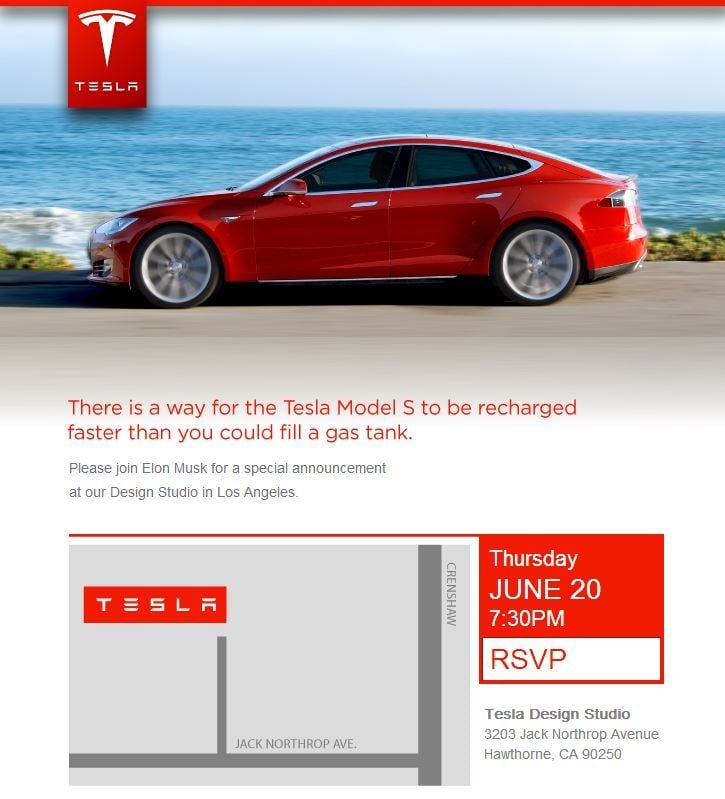
The invitation and Elon's twitter comment says: "There's a way for a Model S to be recharged faster than you could fill a tank of gas"
Clearly it has nothing to do with any car, Gen X or Tesla X. It specifically is referring to the amount of time it takes to charge, that is, relative to the amount of time it takes to fill an ICE tank with gasoline. So I came up with this concept/theory.
What if an 85kwh was treated as multiple individual batteries instead of just 1 large one? For example, If I were to go to a supercharger location that had 10 superchargers, and split my battery up into 10 parts and gave each individual supercharger that task of supercharging each 8.5kwh battery component (85kwh/10=8.5kwh), then my battery would be charged 10 times faster, because 10 different superchargers are handling the job.
Elon also said that there was something "right under our nose". What if in the electronics of the Model S, there already exists technology that treats the entire 85kwh or 60kwh battery as individual smaller components and delivers a simultaneous individual charge to each to expedite the charge?
I'm not an electrical engineer so this is purely hypothetical and could not make sense to someone who is in fact an electrical engineer. However, I suppose if a single Supercharger, could act like 10 superchargers and deliver enough power to each battery subset, then it would be possible to supercharge the entire 85kwh battery pack in 2 minutes instead of 20 minutes.�
Jun 14, 2013
Yggdrasill Everything we know about current li-ion cells suggest they can't be charged substantially faster than 120 kW on a 85 kWh pack. You might be able to increase the speed for the first half of the charge cycle by some amount, but current cells will not achieve 100% in 10 minutes. For that you need a different chemistry, like the lithium-titanate SCiB.
This is fairly easy. You merely keep the batteries at as low a percentage as possible while still being able to fully charge a battery before the battery of the customer's car is removed and ready to receive it's battery.
So, if you have 10 batteries in a battery swap station, it takes 10 minutes to swap a battery, you can charge each battery at 20 kW above 50% SOC and 120 kW below 50% SOC, and it takes 5 minutes from the battery swap procedure is initiated to the car being ready to receive it's new battery, you have:
- One battery at 98% SOC. The remaining 2% is charged in the five minutes before the battery needs to be removed from it's bay.
- One battery at 94% SOC. By the time the battery swap is completed, this battery has been charged to 98% and is ready for the next customer.
- One battery at 90% SOC. By the time the battery swap is completed, this battery has been charged to 94%.
- One battery at 86% SOC. By the time the battery swap is completed, this battery has been charged to 90%.
- One battery at 82% SOC. By the time the battery swap is completed, this battery has been charged to 86%.
- One battery at 78% SOC. By the time the battery swap is completed, this battery has been charged to 82%.
- One battery at 74% SOC. By the time the battery swap is completed, this battery has been charged to 78%.
- One battery at 70% SOC. By the time the battery swap is completed, this battery has been charged to 74%.
- One battery at 66% SOC. By the time the battery swap is completed, this battery has been charged to 70%.
- One battery at 62% SOC. By the time the battery swap is completed, this battery has been charged to 66%.
It becomes a bit more complicated if you need to take into account customer-owned batteries vs Tesla-owned batteries. Then, as the battery swap station receives customer-owned batteries, the swap station has fewer Tesla-owned batteries to work with, and it could run out of Tesla-owned batteries, which would mean it would need to close down and wait for a resupply. At the same time I would assume the customer-owned batteries would be removed and transported to a storage facility.
- - - Updated - - -
It doesn't matter if you are charging a single cell or 7000 cells. It will take approximately as long to do so.
The limitation isn't in the supercharger, the limitation is in the chemistry of the NCA li-ion cells.�
Jun 14, 2013
deonb Ok. Let's go further and break up the battery into 7200 individual batteries. (It already is today). And take the biggest charger in the world and connect it to one of those. Ok, so the battery explodes and now I'm covered in lithium and cobalt. New battery... ok, so let's make the charger a little bit smaller this time and look at how much the battery can handle.
Turns out that a Panasonic NCR18650A, which is what Tesla uses, has a maximum charge rate of 1C (3.1 Amps at 3.7V). It stores 3.1 Amp/Hours - or 0.011 kW/h. So at the factory rating, the individual cell will be overdriven if you charge it faster than 1 hour. Ok, so let's put in some active liquid cooling and have a complicated charge protocol to monitor it, and we also only charge the battery halfway up. Then we charge it at 1.5 times the factory specification and we do it in 20 minutes. That is what Tesla does today and it's an absolutely amazing feat of engineering as is.
To charge it in 2 minutes would require charging a NCR18650A at 15C, or 15 times the factory maximum specification (and 50 times the recommended specification). If you do this in 5 minutes instead, you're talking about 6C. That's a bit closer and you may be able to get away with that in a lab setting by cooling the battery with liquid nitrogen while you're charging it.
Super-cooled charging with an external coolant has actually been proposed earlier on this thread. As far as charge theories are concerned, it's one of the most realistic ones. But not simple by any means.
[Edit: My numbers originally on this was off by a factor of 2]
- - - Updated - - -
I know. I meant evidence to support the following statement - and specifically the 'full battery' part. (I've not seen wording from anybody that said 'full battery').
And then:
You can't store a battery at 98% SOC in 120 degree weather. Worst possible thing for the battery. Either have to store it at 80 to 90% SOC (which would refute Johan's "full battery" claim), or very actively cool it down.�
Jun 14, 2013
Yggdrasill Tesla does not charge at 3C, they charge at around 1.5C (50% in 20 minutes). This is pushing it relative to the specifications, but I'm sure they've done a lot of testing to ensure the battery doesn't take too much damage from it. You are correct it is very impressive.�
Jun 14, 2013
deonb Doh. Of course. Full charge in 40 minutes. (Theoretical, but can't actually do that).
I edited the post and divided everything by 2. But still can't charge at 15 C.
�
Jun 14, 2013
Yggdrasill I assume each battery in the battery swap station will have the coolant lines connected to an AC unit. The battery can be kept fairly cool, and of course you are probably not talking about many hours between each swap, so you're only talking about an hour or two that the battery is kept at over 90% SOC. The degredation on each battery should be fairly equal, as the batteries are cycled through the different battery swap stations.
Furthermore, as we are probably not talking about free swapping, any extra degredation due to harsh treatment will merely be rolled into the price.�
Jun 14, 2013
deonb See my post (#250) on:
http://www.teslamotorsclub.com/showthread.php/16730-Swapping-is-Coming-Discuss-how-it-will-be-accomplished/page25?p=362836#post362836
We're already talking about $6000 per vehicle that needs to be recovered for swapping. At some point it just starts being too many things to roll into the price.
There will actually be many hours between swapping. If you make swap stations too dense (too many cars / swap station) you won't have enough power to feed them. A swap station (and SuperCharger for that matter) needs to run at an average of 6 swaps per day to be energy neutral with 200 solar panels.�
Jun 14, 2013
Yggdrasill Too many unknows.
I can't say I care about this very much. The SC here won't have solar panels, instead they hook them up to the 11 or 22 kV grid, with a ~1 MW transformer. A transformer of that size costs maybe $100k and then you pay maybe $0.04/kWh in grid connection fees.
I don't know the specifics of the US, but I'm fairly sure it would be cheaper to hook the SS/SC up to the grid than to cover the entire usage through solar panels.�
Jun 14, 2013
WarpedOne Well, you are correct in principle but details are much more involved than that. Charging rate of 1C just means the battery will be full in one hour.
Now, what is a full battery?
This isn't a bottle with a well defined volume but more like a spring - when is a spring fully stretched?
Definition of "full" is a trade off between desired life and capacity. Also there is nothing magical in one hour charging, it is an arbitrary classification that is easy to comprehend and is not affected by capacity, just chemistry.
Also, charging power is never constant. At low SOC levels, internal resistance rises roughly linearly with time, at higher SOC levels it rises super-linearly.
To charge with a constant current, charger must constantly increase the voltage to some predefined max voltage (again determined from desired life and capacity).
Internal resistance causes heating that effect resistance etc.
It is black art and rocket science. It is easy to charge a battery slowly with low currents. It takes a lot of knowledge and statistics to really determine where is the optimum.
Elon already spilled some interesting beens: SC doesn't effect the battery life enough to matter, high SOC does the damage.
Battery must already output up to 400kW or more than 5C. Granted, those are peaks, average output is much lower, under 1C and charging is a constant burden.
Do we know if MS85 charges faster than MS60?
MS85 should see 40% faster charging if charging was indeed limited by what cells can absorb.
If MS85 and MS60 get similar charging speeds (in mph) than cells in MS60 already see much higher C-rated charging than cells in MS85 and there is space for 40% faster charing for MS85.�
Jun 14, 2013
deonb Fair enough, but the cost basis used on the other thread is that SuperChargers are energy neutral (solar), and thus you don't charge for them. Hence, you don't need to charge for energy for swappers either, since a user will at any point either be a (free) SuperCharger user or a Swapper user, but it won't be both.
If you instead draw power from the grid, it's not a wash and you need to pass this on to users (which adds $10 to the per-charge/per-swap rate).
The SC math actually works out fine with solar over here. The $2000 per car more than covers what would be needed to build the SC network. At $300k/SC it means 150 cars is enough to pay for a single SC. And at 6 charges per day, you can cycle each car through every 25 days, or ~15 times per year without needing to even rely on the economics of grid storage.�
Jun 14, 2013
Yggdrasill The calculations should work quite well without solar as well.
Here, the average driver will need maybe 10 supercharges per year. And each car will probably be driven for an average of 15 years. That works out to around 150 supercharges per car.
Each supercharge will probably replenish in the area of 60 kWh, so that works out to around 9000 kWh over the life of the car.
Each kwh including grid connection fees costs around $0.14, so that works out to around $1260. Here you need to pay about $2100 for supercharger access, so that leaves about $900/car after electricity.
If Tesla sells 2000 cars heare each year, that means that Tesla has $1.8 million per year to spend on superchargers. Considering that Norway only needs around 15 SC locations to be quite well covered, the economics should work out just fine.
I haven't looked at the figures for the US, but I'm sure it's better to have solar than to not have it. Even so, I'm also fairly sure that connecting to the grid isn't disasterous for the economics.�
Jun 14, 2013
deonb I think it's about even. When SolarCity installs panels on their lease basis, they would only do that in areas that charge more than 11c per kWh for grid connections. Below that the grid becomes cheaper than what SolarCity can provide, even amortized over lifetime.
So solar really just brings the cost of charge down to 11c per kWh, which you can get in some places anyway. What it DOES do however is to create hundreds upon hundreds (or thousands) of big advertising boards that stares people in the face who still want to still use the long chimney argument against Tesla.
I would think that is less of a concern in Norway since you don't constantly have to battle Fox news and the GOP over there just to even start to have a factual debate.�
Jun 14, 2013
Yggdrasill I wish we could have a factual debate here, but it's not very easy. I'm constantly running into the argument that any power we consume could have been exported to replace coal somewhere else. So, even though the power we actually use is 95% hydropower, there are people saying electric cars run on coal power (not even grid-mix!).
I agree that it's good to combat the long tail pipe argument - but it shouldn't be combated at any cost. You said in the other thread that 12,000 SC locations would be needed for 2 million cars. That would be a ridiculous waste of money. Each station would be woefully under-utilized.
12,000 stations with 10 spots each would be 120,000 SC spaces. Each SC space should on average per day be able to serve at least 10 cars for 20 minutes. If each SC-capable car needs 10 supercharges per year, 12 000 SC stations should be able to serve in the area of 44 million cars. So basically we disagree by a factor of about 20.
Given the figures in the other thread, you basically think that each SC spot should on average serve around 0.5 cars per day for 20 minutes...�
Jun 14, 2013
deonb It's not me saying that, it's Elon... The SC's during the week is expected to be "empty". And on weekends they'll be "sized for peak usage" for Friday's and Sundays (i.e. you would never have to wait for a spot even on those days). So even with your 10 cars for 20 minutes per spot hypothesis (replace 'spot' with 'charger' and I'm with you), it would only be for 2 days per week.
We also know they're meant to be solar positive using 300W max cells. So we don't really have to guess much further than that.
12 parking spots can host 200 solar panels. 200x 300W solar panels can deliver 10x 35kWh charges per day (at most), which is 70 per week. Meaning you have 35 charges on Friday and 35 on Sunday. With 12 parking spots (meaning 3 chargers using the new 4-1 ratio) it means you shouldn't have to wait, but it's actually right on the cusp - not terribly oversized. (Even you used the number of 10 per spot. This is just 10-per-charger. The extra spots are mostly there to support the Solar panels, and for the convenience of not having to "idle" behind someone that's currently charging at a low rate or ran off shopping).
But you can actually only have 10% of the days quota arriving within the same 20 minute window before a wait / slow charge experience will happen.
So whether or not it's a good idea to do things this way vs. cheaper & smaller but as a result having queues on peak times and drawing power from the grid is left up to you to decide (for your own company
I wish the battery swapping had numbers this cut-and-dry.�
Jun 14, 2013
JRP3 The point about storing a swap pack at full SOC is another reason I don't see dedicated swapping stations loaded with fully charged packs waiting to go. It would make sense for a call ahead reservation setup as I've suggested, though I would still assume a "full" pack would be at standard charge not range charge, or maybe somewhere in between. I just don't see a good case to have a bunch of fully range charged packs sitting around degrading faster than they need to.
Regarding increasing charge speeds, as I've posted elsewhere I believe pulse charging could substantially increase charge rates but still not faster than filling up with gas.�
Jun 14, 2013
arg Swapping vs Supercharging
One point I haven't seen in these analyses is the question of how much charge people actually take on (or want to take on) at an SC site.
Packs coming out of swapping will obviously be 'full' (or some fixed level like 90% that''s part of the definition of what the service offers). This is both a benefit and a disadvantage:
It is hard to say how much charge people typically want from a Supercharger. For a site in the middle of nowhere, your pack is by definition fairly depleted when you get there, and you need a fair amount of charge to get to anywhere when you leave. But as the network gets built out, quite a lot of the sites are not as remote as that: a lot of the demand will be from people doing trips that are only slightly beyond their available range (or would be in range but they want a bit of comfort margin). These people are adequately served by a few minutes of supercharging and likely wouldn't use the swapper. Likewise, at present a lot of people need to leave the supercharger with close to maximum charge because the next one (or their destination) is a long way away, but as the network builds out then that is less of an issue and more trips can be made without going outside the 10%-75% state of charge where supercharging is most effective.
- With supercharger, filling the last 20% is time-consuming, so the swapper offers an increased advantage if that is what you need to do.
- Swapping has a fixed time penalty, and we are guessing a monetary cost, regardless of how full the pack that you are giving up is. So if your pack was already fairly full, or if you don't need it full when you leave, then the swap option isn't a great advantage over 5 or 10 mins of supercharging.
I'm not sure how to model this demand, but possibly it says that swapping only makes sense in the most remote locations, or perhaps on a few strategic routes.
Maybe in Europe you just need swap stations in Germany where people empty their packs in an hour of flat-out driving?:wink:
Alternative models
All of this assumes that swapping is indeed an alternative to supercharging, (ie. swap regularly for continued high speed driving). There seems to have been less analysis on this thread of the other possible interpretation - that swapping is something done only occasionally to swap in some different kind of pack. Various possibilities here:
I don't know which model is more likely - on the one hand, my suggestions for the 'occasional swap' model don't sound very compelling, but on the other hand it feels to me more like there's scope for a single 'aha' moment where you come up with a combination that does make sense. In comparison, the straightforward swapping-to-charge model seems to need incremental improvement on a lot of fronts and offer less scope for a single stroke of innovation.
- Swapping 85 packs into 60 cars. This would be a calculated risk on cannibalizing 85 sales: do you gain more sales from people who previously thought they needed an 85 but couldn't afford it and now buy a 60 rather than nothing at all, compared to those who downgrade from 85 to 60. This wouldn't kill 85 sales altogether, since having an 85 all the time is much more convenient than having to go to a swap station to get one: those that can afford to just say 'fully loaded' without worrying will still do so, and there are some people who genuinely need an 85 for their daily driving.
- An even higher capacity pack. Possibly one can be built from cells that won't have enough lifetime to make them economic to sell with the car, but to rent one for a couple of weeks could make sense.
- Similarly, a pack supporting faster/deeper charging so that you can make more efficient use of Superchargers on a trip. Could even be simply one of the current packs that software permits you to 'thrash', against a payment that covers refurbishing them regularly.
�
Jun 14, 2013
deonb ^^^ this. (But I don't know how.)
If we go back to fundamentals, (aka Twitter), we are focusing over and over on the following aspect and debating every possible point of it ad nauseam:
"Elon: There is a way for the Tesla Model S to be recharged throughout the country faster than you could fill a gas tank."
But what if we're asking the wrong question? What if the real question, and the issue that swapping truly means to address, is this?
"Elon: There is a way for the Tesla Model S to be recharged throughout the country faster than you could fill a gas tank."
That is the one thing that is the most lacking in Supercharging. The charge rate as it is actually fine. Incremental improvement and getting it to 10 minutes over 5 years and it's not even a big issue anymore (just double the battery size and you've got your 150 mile charge in 10 minutes). But what it does not and will not ever do is to provide service throughout the country.
I think we're not even touching this aspect is because we're taking it for granted that battery swapping is more expensive and more difficult to deploy than superchargers.
But what if its not?�
Jun 14, 2013
Yggdrasill It may be that Elon wants to achieve fully solar-powered superchargers long term, but in the next few years I think it is unrealistic.
Tesla currently has 8 stations, and some 37 SC spots. With 0.5 charges per spot per day and 10 charges per car per year, that works out to a capacity of 675 cars. So, currently the SC network can serve about 6.75% of the Teslas made. That's assuming all of the SC stations are powered by sunlight, which they are not.�
Jun 14, 2013
deonb It is known (from the SuperCharger announcement) that the solar installation will lag the charger installation by at least 18 months, with grid storage 6 month after that. Until then it will use grid power. (I'm missing the point of the question?)
We also know that the current system is already over-utilized. (Elon: "Avoid Gilroy"). There is already waiting, and there shouldn't be. And the SC network only covers around 40% of owners as is, and for those owners probably less than 50% of intended routes.�
Jun 14, 2013
TD1 Thats actually a good point.
For example Elon stated that each super charger uses 12 Converter (the same converter that are build in the Model S) afaik these Converter are quite expensive and there isn't much room to cut the price on those.
So the additional cost vs. SC wouldn't be that much higher.�
Jun 14, 2013
Palpatine If they have a way to do that which we have not considered, great. A full battery really quick sounds wonderful.
However if this solution is battery swap, that brings a huge group of negatives to the table. Battery swap had better be free or most people would pass and just plug into the free supercharger.
Even if Battery Swap is free, I would be hesitant to risk an error in the system leaving me stranded. I would rather just recharge for free while I use the bathroom, stretch my legs and grab some food for the next leg of the trip.�
Jun 14, 2013
deonb From a practical perspective I agree. I don't see the big deal in adding a 20 minute stop halfway through a 4 hour drive.
HOWEVER, it makes it much much easier to sell the car. People don't internalize what it would be like to own an EV and "never have to go to the gas station", and they instead focus on the "it's much slower to charge than a gas station" part.
If you can point at a thing and say: "No way, it's actually faster", you're over a significant sales hurdle.
I have very smart people who work around me. But still, virtually everybody that don't own an EV gets tripped up by that initially.�
Jun 14, 2013
joefee For a 1000mi trip a swap makes sense durning a leg when you can also swap drivers and keep on going with no need for eating, etc. Pick up your charged pack in the same manner on the return trip. A great option IMO:smile:�
Jun 14, 2013
stopcrazypp This is what I've been trying to say too. Battery swapping, like supercharging, is in the marketing budget precisely to address the general public's concerns about charging speed. You can argue until you are blue in the face that the speed of supercharging is "good enough" (which works for people already convinced about the viability of EVs) but you can never say it's faster than filling up a gas tank. And addressing this sticking point opens up a much larger market than any other move Tesla can make.�
Jun 14, 2013
tdiggity Just dreaming things up:
Tesla Supercharger stations area also hyperloop stations. You don't get in a train or a pod or anything like that. You just use your Model S/X or Gen III and the hyperloop takes you to the next station..�
Jun 14, 2013
kenliles on the other side of that trade, it openly admits 'you can never say charging is faster than filling up the gas tank' - and that admission means battery swapping had damn well better suffice, otherwise we share your range anxiety. It's a dangerous marketing game to play and reeks of some desperation that charging will never be the universal answer.�
Jun 14, 2013
roblab I was reading of the Indy Pit Stop Competitions where they fuel a car, AND replace tires, AND wipe the window, AND give the driver refreshment.
The record is something like 8.6 SECONDS.
Since we are comparing apples to kiwi fruit, the fastest charge to the fastest gas fill up, I don't think EVs can compete. Yet. Even Battery Swap can't be done in less than 10 seconds. Or, maybe June 20 will be REALLY world breaking news.�
Jun 14, 2013
nursebee Right below your nose? Has not been answered yet.
Word of mouth program. Perhaps like that asian guy suggested at the shareholders meeting.�
Jun 14, 2013
DaveT Under the nose of the car is probably where the battery swapper connects with the car to swap its battery.�
Jun 14, 2013
JRP3 Under your nose is figurative, not literal.�
Jun 14, 2013
deonb I'll bite. Then figuratively explain 'under your nose' in the context of battery swapping? ('under your nose' figuratively always implies 'in plain sight').�
Jun 15, 2013
JRP3 I'd say it means you're sitting on top of a swappable pack, and that the swap capability has always been built into the car.�
Jun 16, 2013
Larry Chanin Hi Aaron,
Here's some thoughts I had on the subject that I posted in another thread.
Larry�
Jun 16, 2013
FredTMC Yep, If the demo is batt swap (instead of air metal frunk extender batt), then I certainly hope it's a demo of a 100+ KWH batt.
I'd LOVE to rent a huge batt for long trips. In addition to longer range, it saves cycles on my poor little 60 kwh batt.�
Jun 16, 2013
DrTaras A Tesla the Hun! is excited to attend this event and has not paid attention to the speculation on WHAT its about, just that there will be a red carpet for him to roll down on!
He's already practicing feigning to tell the Paparazzi to stop taking pictures. It's going to go something like this: "Stop! ... Don't! ... Stop! ... DON'T STOP!!!"
 �
�
Jun 17, 2013
teddyg Hi guys, Has the June 20th announcement been "officially" confirmed by Tesla yet? Haven't seen anything on the website about an upcoming announcement that they usually do in the investors section.
Looking at June 23rd options...don't want to be caught out if Elon decides to delay this announcement like the previous ones.
Cheers�
Jun 17, 2013
Andrew It's definitely happening. They emailed an invite to local owners (I received one; sadly I can't go), and I know one TMC member was just at Hawthorne and caught a glimpse of them setting everything up.�
Jun 17, 2013
anticitizen13.7 Fast swapping would be interesting, but Supercharging at 120 kW is convenient enough that I can't see myself using a swap.
30-40 minutes to get +150 miles of range is a lot of time if you need to stop more than once each day. 20 minutes on the other hand is not that bad.�
Jun 17, 2013
dmckinstry 30 minutes is no problem at all for me. By the time we walk the dogs, go to the rest room and have a snack, 30 minutes is practically over.�
Jun 18, 2013
Zorba @elonmusk: Live pack swap demo on Thurs night at 8pm California time at our design studio in Hawthorne. Seeing is believing.�
Jun 18, 2013
Johan 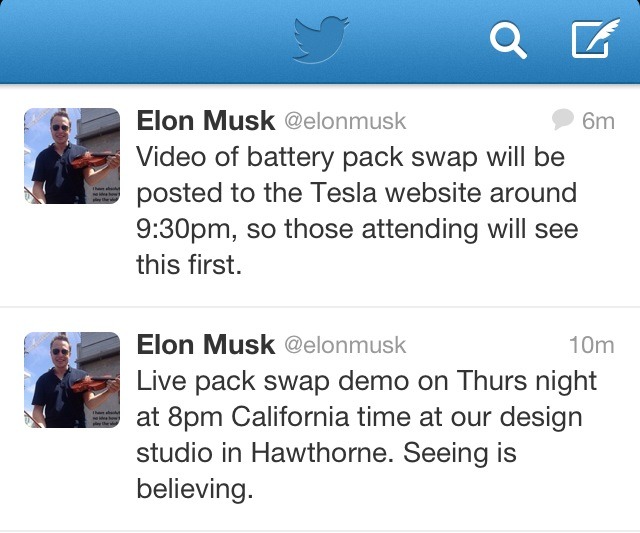 �
�
Jun 18, 2013
spleen Well, that seems to confirm it. Though I feel oddly disappointed about this - just don't think that battery swapping is conceptually the right way to go.�
Jun 18, 2013
Laumb It burns, right?�
Jun 18, 2013
Johan Don't rub it in�
Jun 18, 2013
Laumb I know, but the "I can say for certain" part had me put on my rubbing kit.�
Jun 18, 2013
Yggdrasill Battery swapping has been a 99% given since the accident (or is that "accident"?) with the photo.
The (new) interesting information will come at the event. It will be very interesting to see how they've solved the issue. This must be an automated system for swapping the battery, as four guys with a pallet truck and a screwdriver wouldn't make for much of a demo. I would also supect the system to be fairly mobile, so that a team can show up at a supercharger site, drop of a couple of containers, hook them up and everything is good to go. A solution where you need to dig up half the site would be unpractical.�
Jun 18, 2013
Norse I have a feeling alot of taxies will be tesla in the future, atleast in Norway. For them, this is very good news. Norwegian taxis drive usually cars that are expensive as tesla.�
Jun 18, 2013
drinkerofkoolaid Did Tesla buy Better Place battery swapping patents/machines? Will Tesla High Priced Electric Cars be Selling in Israel? | Green Prophet
Two groups eyeing purchase of Better Place: American Jews and Canadian investors - Business - Israel News | Haaretz Daily Newspaper
"The two bidding groups join Israel Electric Corporation and the French power company EDF, both of which have expressed interest mainly in Better Place�s nationwide network of vehicle-recharging stations. They want to buy not only the recharging devices themselves, but the computer network that operates them and keeps drivers posted about their energy needs.
But they are not interested in the battery-changing stations, which are another critical part of the Better Place network."�
Jun 18, 2013
ItsNotAboutTheMoney Oh well. Musk has said he's not a fan of swapping, but it's nice to have a back-up plan. If it's all automated, asnit had better be,maybe JPP's observation about factory battery installation indicates the humans are there for QA or they're now ready with an automated process.
Now I'll have to wait for announcements on improvements to the vampire issues and other software goodies in futue software updates.
I hope people there can ask for the numbers on it.�
Jun 18, 2013
vgrinshpun Mobile battery swapping station.
Less than elegant idea Elon could not clear from his mind since the days of shopping for Russian ICBMs :wink:
 �
�
Jun 18, 2013
Rla It's confirmed battery swapping, now we can divide up the speculation on why.
The how is pretty much explained in this video, around the 1:00:00 mark. It is even funny, knowing what we know now, and interesting as indeed the whole battery swapping demo now revolves around the economics of it all.
http://www.teslamotorsclub.com/showthread.php/16730-Swapping-is-Coming-Discuss-how-it-will-be-accomplished
ps: for those repeating BetterPlace: their model has failed as they had no consumers for their stations. Tesla has the Model S, and its drivers ready to start using any station they will put up.�
Jun 18, 2013
NigelM I disagree. The concept only works well if the batteries/cars are leased and I challenge any TMC-er who owns their car to say they would be with following realistic scenario:
I drop off my 2-year old battery with 40,000 miles and umpteen ranges charges off, and pick up a new battery as a swap. You come in the next day with your 6-month old, nurtured battery that has 3,000 miles and never a range charge and swap it out for my old one.�
Jun 18, 2013
Yggdrasill I would expect Tesla to go for the model where you still own the battery that you dropped off, and then you can either pick it up on the return trip, or have it shipped to any service center or battery swap station you would prefer.
This adds some complexity to the logistics, but on the other side, they will at least get some customers. (To lessen the complexity of the logistics, one might get the option of letting other people rent ones battery. In return one would get free battery swapping until the battery is returned.)�
Jun 18, 2013
NigelM The least cost effective element in most businesses is storage space. Tesla would need lots of mini warehouses to store customers batteries and keep them all charged. Swapping the battery on a Model S is easy compared to the logistics/cost involved below the line.�
Jun 18, 2013
Tempus as they say - the devil is in the details. I'm having a hard time seeing a business case where swapping + supercharging is significantly better for tesla than just supercharging. Is it REALLY going to bring in that many additional customers?
Personally, I think the supercharger network by itself was a fantastic response to range anxiety (and i have a 60!). I don't see any way that swapping doesn't add significant cost/complexity to the equation, and i'm just not sure what the additional payoff is. It's not like Tesla is struggling to sell cars (see all the other threads about loaners and demo cars flying off the shelves).�
Jun 18, 2013
nygiants242 Completely agree on both fronts. Well-summarized.�
Jun 18, 2013
FredTMC I would absolutely do a "rental swap" for long trips.
AND
I don't think the the logistics is hard. These battery packs go into deep sleep (no drain) when just sitting on a storage shelf.
You can store a lot of them in a small space. And only a small fractional percent of owners are renting batteries at any one given time.�
Jun 18, 2013
theganjaguru Your concern is exactly why I believe TSLA started marketing their faultless battery warranty. Another way for TSLA to mitigate your concern would be to set standards for a battery to be swappable, so if it isn't able to charge to at least X% of original capacity then it becomes a backup battery for the Super Charger network or its tagged for reconditioning/rebuild. This would also allow for TSLA to automate their battery warranty program. - and I think this is just brilliant.
I think the problem is the fact that as Americans we can sometimes put too much emphases on the word ownership. - It seems like you will have more of a quasi "owned" lease and may receive the benefits of living in both worlds.
If you'd prefer to live in the traditional realm of "ownership" then you might just be confined to the supercharger and not use the swap station. As battery tech matures you might not need to swap batteries as much or at all, but by then TSLA will have deployed a solar battery backup grid that could theoretically make TSLA not just an automaker, but an energy provider.
Aside from from not constantly charging in range mode and not leaving your Model S fully discharged and unplugged, it doesn't appear to me that the end user nurtures the battery anyways. It looks to me that taking care of the battery is TSLAs and your Model Ss department. - and it sounds like it could be quite convenient!�
Jun 18, 2013
mitch672 Although Elon has announced a battery pack swapping demo, he's said nothing about it's intended use.
It could be initially just for large Model S fleet users, such as limo or taxi company's, those vehicles get many hours/day of usage, and a swapping scheme is needed for that market.
We still know nothing about its purpose, just going to have to wait another few days.�
Jun 18, 2013
Norse I second that. Tesla knows they have sold massive in Norway, and the taxi drivers here will be all over this. GREAT NEWS IMO. Not for the private owner, but for taxies and investors.�
Jun 18, 2013
ShortSlaver If I could get picked up in a Model S, that would be awesome. Instead, I have to wait for my smelly NYC taxi.�
Jun 18, 2013
emupilot The whole reason for battery swapping is its speed, but how long will it take you to drive to the place where they do the swap? If the swapping stations were at a density to justify their existence, the up-front cost and logistics would be prohibitive. The service obviously wouldn't be free, and there would be the issue of differing quality between the swapped batteries. I can't see how this would be better than supercharging.�
Jun 18, 2013
mitch672 Makes perfect sense if all of the cars are located in a central hub, like a limo or taxi company.
The batteries are all owned by the same company, they don't car which Model S in particular they are in.
No one has said this is intended for the public, yet. Don't make assumptions.�
Jun 18, 2013
deonb Well, 2 things:
1) Elon: There is a way for the Tesla Model S to be recharged throughout the country faster than you could fill a gas tank.
A private hub model (taxi/limo) is not 'throughout the country'. It's not even in the same usage model.
-and-
2) Elon talked about this in the context of getting the extra Consumer Reports mark. Consumer Reports don't review products that are targeted towards businesses.�
Jun 18, 2013
mitch672 deonb, initially it could just be for fleets, it needs to be "tested" and proven. Also, Elon hasn't put a time frame or promised when this would be availble. I'm guessing this is a technology / capability demo for now, and likely a very limited initial deployment. Thursday night is only a few days from now, lets see what the man has to say.�
Jun 18, 2013
ppl I am confused about timing of tweet. Great secret kept then ? Poor file naming. Web site corrected days ago. Why tweet last night? No great clamor for pre anouncement. There is something more to this�
Jun 18, 2013
vfx Reminds me of Disney's 7 year re-release cycle.
Before DVDs came along for decades Disney would re-release their animation properties (Snow White, The Aristocats, etc.) every 7 years to the next generation of kids. Then Micheal came along and sold them direct to customers for a quick profit. (for him since he had sharing) They have since figured out a million other way to re-release films (Now in Quad, 3-D, 4K, etc) but they still sort of follow the 7 year "next generation cycle"
I suppose the same can be said for drivers being "all new" every seven years. We have a thread about how this group does not even care about driving.�
Jun 18, 2013
Larry Chanin Good point.
I believe this demonstration has more to do with substantiating a marketing claim, "Recharges faster than you can fill a gas tank.", than announcing a major expansion of a new battery swapping business. Perhaps they will announce that select service centers will offer this as an experiment to guage interest. Storage requirements would be minimal for such a pilot.
Ultimately swapping for road trips is merely an interim approach that is virtually guaranteed to be phased out due to continued advancements in battery and charging technology, the expansion of quickcharging infrastructure (Supercharging and SAE combos), and overnight charging at hotels.
With regard to limo or taxi company's have swapping facilities, I doubt it. For the most part they are commuting vehicles and don't require a battery swap to avoid getting stranded between destinations. The vision of continually swapping out 1000+ pound battery packs in a taxi garage makes me wince. Insurers would too. I think it would be more likely that Tesla would work a deal to sell, or give them Superchargers if the company buys a certain number of Model S or Xs.
In the future there will be a permanent and major business that will to a degree involve swapping batteries, but not fast swapping. That is grid storage. I don't foresee an automated process whereby battery packs are yanked out of passenger vehicles and swapped into a grid storage facility. I see aging battery packs going to service centers where they are swapped with new battery packs. Then the old battery packs are sent to a facility where the cells are removed and recycled, or they are used to build grid storage battery packs in a new form factor. This form factor would be more compact and easier to transport and install by hand and it would be suitable for installation in racks within electric cabinets at Supercharger stations. So as the Supercharger expansion rolls out, pad-mounted grid storage would provide a revenue producing place to store "recyled" batteries.
With the success of Tesla and other manufacturers using Tesla powertrains, or licensed technology, I expect Tesla to continue to partner with utilities to expand Supercharger stations with grid storage beyond just strategic highway routes, but into parking areas throughout the country. At this point, if there ever was a business case for fast battery swapping facilities for a small niche market it would cease to be viable.
Larry�
Jun 18, 2013
deonb Sure, but he would have to explain that tweet. Unless he wants to lose all twitter credibility and give up his ability to whip the shorts at a whim.
I agree.�
Jun 18, 2013
JRod0802 I agree too. Since this is a speculation thread, and everyone else is speculating, I figure I might as well throw my guess in as well. When the new service strategy was announced on 4/26/2013, during the Q&A one person asked if in the future you could swap out your 300-mile battery for a 400-mile battery, to which Elon replied "400? Why not 500?". So, since this is a battery swap announcement, and it seems like there's more to it than just battery swap, I'm going to guess Elon will announce a larger battery that can be swapped to. Possibly a 500 mile battery.�
Jun 18, 2013
ShortSlaver At the very least it shows the battery isn't tied to the car. When you buy a Tesla, you can buy a better battery down the road. If new battery tech comes out in 3 years, you can sell your used battery back to Tesla and get the new one, extending the life of the car.
It also makes the used Tesla market amazing now. Tesla will control a large portion of the used market and will be able to more easily sell used Model S vehicles as buyers will know it's easy to swap the battery out if something happens or it begins to run out of life.
I don't see this as something that is used day to day by people - that's super charging. This enhances the used market Tesla will control, gives buyers assurance they can get a better battery one day and possibly special cases, such as taxi's, will be abel to take advantage of this day to day.�
Jun 18, 2013
jeff_adams If the swaps were going to be done at service centers, why demo at a supercharger location?�
Jun 18, 2013
Curt Renz Here's a tweet that Elon added at 07:57 PDT to this morning's twitter thread in response to a comment about Shai Agassi of Better Place: "Shai actually got the idea from a visit to Tesla. The idea is obvious (many things allow battery swap), but the technology is not."�
Jun 18, 2013
EV2BFREE With the Super Chargers being built I do not think that it would make sense for Tesla to also build a network of battery swapping stations. Expensive up front and I doubt they would be used much considering the average Model S owner would only use a Super Charger a couple times a year if they go on a trip or perhaps once every couple of months for shopping at large malls.
What does make sense would be these battery swapping stations to be available at service centers. If Tesla puts out a 500 mile battery pack, the owner would have the option of paying for an upgrade to that new battery pack and it could be done within a few minutes. Also, I believe that Elon Musk mentioned being able to swap a battery for a used one on long trips and then pick up your old battery on the way home. Service centers would allow for the storage space and perhaps a rental fee without building more infrastructure/swap stations.
Say I was planning a trip from Philadelphia to Richmond,Virginia. I could make an appointment at the Service Center in Washington to swap my battery out for a 500-mile battery pack. I get to the Service Center and it takes 3 minutes to get the new pack in and continue to drive to Richmond. That new pack will last long enough for all of the driving around I do in Richmond and for the driving back to the Washington Service Center. I tell Tesla I am returning in 2 days and I make another appointment to pick up my old battery pack and drive home, back to Philadelphia. I only have to stop that one time for a couple of minutes which is just like stopping for gas. That could give me 600-700miles for only stopping once. Even if I decided to drive more miles then that, I would be able to take advantage of the local Super Charger. The only thing I have not figured out is a rental cost for the battery. Would that be something that is tacked on to the car cost like the $2000 Super Charger access? The batteries could work like the loaner cars, if I want to keep that new 500-mile battery pack I would just have to pay the cost difference.
Just trying to look at this from a business standpoint because like I stated previously, a new network of battery swapping stations would be expensive. The way I proposed would only need the battery swapping station inside the Service Center.�
Jun 18, 2013
mulder1231 Don't you think ingress into the Model S back seats can be a little challenging for some people for it to be the taxi of choice?
Model X would make an awesome taxi though...�
Jun 18, 2013
markb1 It can accommodate an audience? They've done a number of other events there, as well, including the Model X introduction and the Get Amped test drive event. Service centers are far too busy and crowded to accommodate events.�
Jun 18, 2013
deonb The address given is actually shared between the SuperCharger and design center. So you can't really tell.�
Jun 18, 2013
Curt Renz "All Things Digital" published an article at 10:55 PDT regarding the battery swap demonstration: Tesla to Demo On-the-Road Battery Swapping - John Paczkowski - News - AllThingsD�
Jun 18, 2013
NigelM Mod Note: Personal provocations went to snippiness. As usual, apologies to any innocents who got caught up in the spat.�
Jun 18, 2013
markb1 Well, yes. When those events that I mentioned occurred, there wasn't even a supercharger there.�
Jun 18, 2013
Soundart But what if you could ALWAYS swap out your battery, though?.... So if you thought you got a "bad" battery in a swap, you knew you could just swap it out again a month or two later, or whatever?... That not only mitigates that worry (of trading a good battery for a bad one), but then it makes swapping about even MORE than just swapping out a battery for range. Because being able to swap batteries is effectively like getting a lifetime warranty on your car's battery.... Isn't another "concern" about the car its battery life?... Don't all the naysayers speculate that if you need to replace your battery when it dies, it will cost you a fortune?... Well, if you can always just go do a battery swap, then you never have to worry about that. Of course, we're all just speculating on the specifics of the battery swap deal, and I'm not a Tesla owner (yet), but if I Tesla is allowing people to swap out a battery for range, then by default, aren't they thereby allowing me to swap out ANY battery, effectively giving me a lifetime guarantee on my current battery (i.e. if it goes bad, I'll just drive to a swap out center and swap it out).�
Jun 18, 2013
Larry Chanin I expressed a similar thought in posting #346 speculating on a slightly larger 103 kWh battery upgrade.
However, for a 500 mile battery that would require a break-through in battery technology to increase the energy density by more than 90% to permit fitting the battery cells in the same battery pack container. That major development would of course overshadow any mere battery swapping demonstration. :wink:
Larry�
Jun 18, 2013
ShortSlaver Is Li-Ion even the best battery tech for a swap-based battery scheme?�
Jun 18, 2013
Palpatine but but but... you can't do that. It actually costs money to produce battery packs. Tesla is not going to give you a new one every time you have a "feeling". If there is hard data that you got a bad battery pack, it is covered. But this is not a charity. Battery packs cost real money and any battery swap scheme is going to cost you.
And Tesla is going to give that to you for free also? When is this company ever supposed to make a profit?�
Jun 18, 2013
mitch672 Larry, you mean like a combination lithium ion/metal air battery in the same enclosure? Hmm, nope, haven't heard any rumors of that possibility�
Jun 18, 2013
Larry Chanin Hi Mitch,
So is that your prediction for June 20th? That instead of a simple battery swapping demonstration, Elon is going to overshadow that with an announcement of the adoption of a new ground-breaking battery chemistry? :wink:
Larry�
Jun 18, 2013
Soundart Relax, dude. I'm not sitting here advocating Tesla give away anything for free. Or advocating ANYTHING specific, for that matter. (If I said "give", I meant it more euphemistically). All I'm throwing out there is the idea that IF there is some kind of swap -- whether it be free or for a fee or for a monthly stipend or whatever -- then what precludes people from swapping anytime they want (i.e. when their battery gets old)?... Obviously the devil is in the details, and I'm sure there will be some details forthcoming.�

Không có nhận xét nào:
Đăng nhận xét