Aug 26, 2013
sleepyhead I did buy some weekly Aug30 $160 puts when the stock was around $171. This was more of a bet that the stock will turnaround quickly; I had a feeling it would. I sold about half my TSLA over the past 2 days.
Buying puts (while holding stock) is not really a good hedge. Selling covered calls is a little bit better, although I have never done that before.
Now I buy LEAPS and hedge by creating a bull call spread, hopefully a delayed construct spread. When I hold stock, I just buy and sell whenever and not worry about tax consequences. It is easier to do so in IRA or 401(k), but in my taxable accounts I don't take tax implications into decision making either.�
Aug 26, 2013
viperboy where did you get the $2000 number from? 170-140 is 30 *100 is 3000. right? What am I missing here? (Thanks!)�
Aug 26, 2013
mershaw2001 I'm going to agree with sleepyhead here. Every time I've held a spread looking for time decay and having a nice margin, that margin disappears in a flash in one or two days. I am now of the opinion once the spread has gone into the money it's best to close it for about 75% of the max value if you can get that. I have gotten bitten ALMOST EVERY time. It must be the law of regression to the mean- it rises up quickly (as I predicted because i opened the spread) but then comes down just as fast. For things like today, instead of closing my long term spreads, I entered into a margin call when tesla was 172 by selling a bunch of 180/195 weekly credit spreads. The 1500 dollar requirement blew through the little remaining margin buying power I had left and left me with a 10k house margin call. The plan is that the options will expire before the margin call needs to be resolved, or I'll close it tomorrow.
------
actually i might end up being more and more a fan of this as I think about it more and more, it's essentially legging into a condor and takes advantage of the major time decay of the options.
Open long spread 145/165 september options for 7.87-2.63 = 5.24 back when the price was ~138. My max profit is 2000-524=$1476 When the price is now near the top end of the spread (when it was at 172) I then sold 180/195 for 2.47-.49=1.98 weeklies.
I think it might not be a good idea because these momentum stocks have a way of running up super fast and I could lose all my profits if it runs to 185 or 190 by the end of the week.�
Aug 27, 2013
Gtoffo Well guys I still haven't sold... I've still got 5$ of upside (33%) vs. a possible loss of 15$ (100%).... I'm taking the risk since it's one of my more speculative trades. I don't see great odds but I'm betting that only the worst case scenario would push TSLA below 140$ come september. We'll see what happens in the next few days.
EDIT: and thank you all for the advice!�
Aug 28, 2013
smorgasbord No, you're right. I had played with some different strikes and didn't catch all the places. I'll update the post, thanks.�
Aug 28, 2013
TD1 I want to get really deep into Options, what should I read?
Are there any good Online courses? (which ones)
What would be the best way to get into Options?
Im willing to spent 30-40h/week
(Im asking it here and not in the Newbies Thread, because I expect a better response from Advanced Options Trader)�
Aug 28, 2013
Theshadows I asked the same question few months ago. Here is the response. They have all been great reads.�
Aug 28, 2013
sub Can someone explain to me if this is a dumb idea or not....If I write a covered call on my current shares that I plan to keep for many years, and TSLA rises to the strike price where my shares could be called away (which I don't want), I could replace those shares at the strike price with my margin account until either my shares are called away or the option closed out. I see my risk being that the price falls back below the strike and I lose a little bit on share's I bought if i'm not able to sell quickly enough?�
Aug 28, 2013
mitch672 The idea is not "dumb", but you can get caught in the execution and gapping up of the stock.
First, you can't necessarily replace your covered shares at the strike price, what if they rise significantly above it? You would have to pay carefull attention, and buy them before the strike price was reached... Why do it then?
This is the situation I am in now... Sold covered calls (Jan14 $165's) for $20 last week, when the stock was around $158.. It has since gapped up on several days, even hitting $171-172 once. When that happens, your covered calls are now worth more than you sold them for, so to close out the position, you have to pay more to buy them back, not really what you are hoping for. You can also wait it out, and hope it drops a bit, so you close it out near break even, or just let the shares be called away at expiration, you'll get the strike price plus whatever you sold the option for. Selling covered calls is an ok strategy in a stable stock, or a sideways market, or if you think it might drop a bit (allowing you to rebuy your sold call for less money, making a small profit). Ideally you want them to expire worthless though. I used this strategy a month ago, and the stock dropped $10, I was able to rebuy my calls for less, and made $2500, but there's no guarantee you'll be able to do that... If the stock rises, so does the price of the call.�
Aug 28, 2013
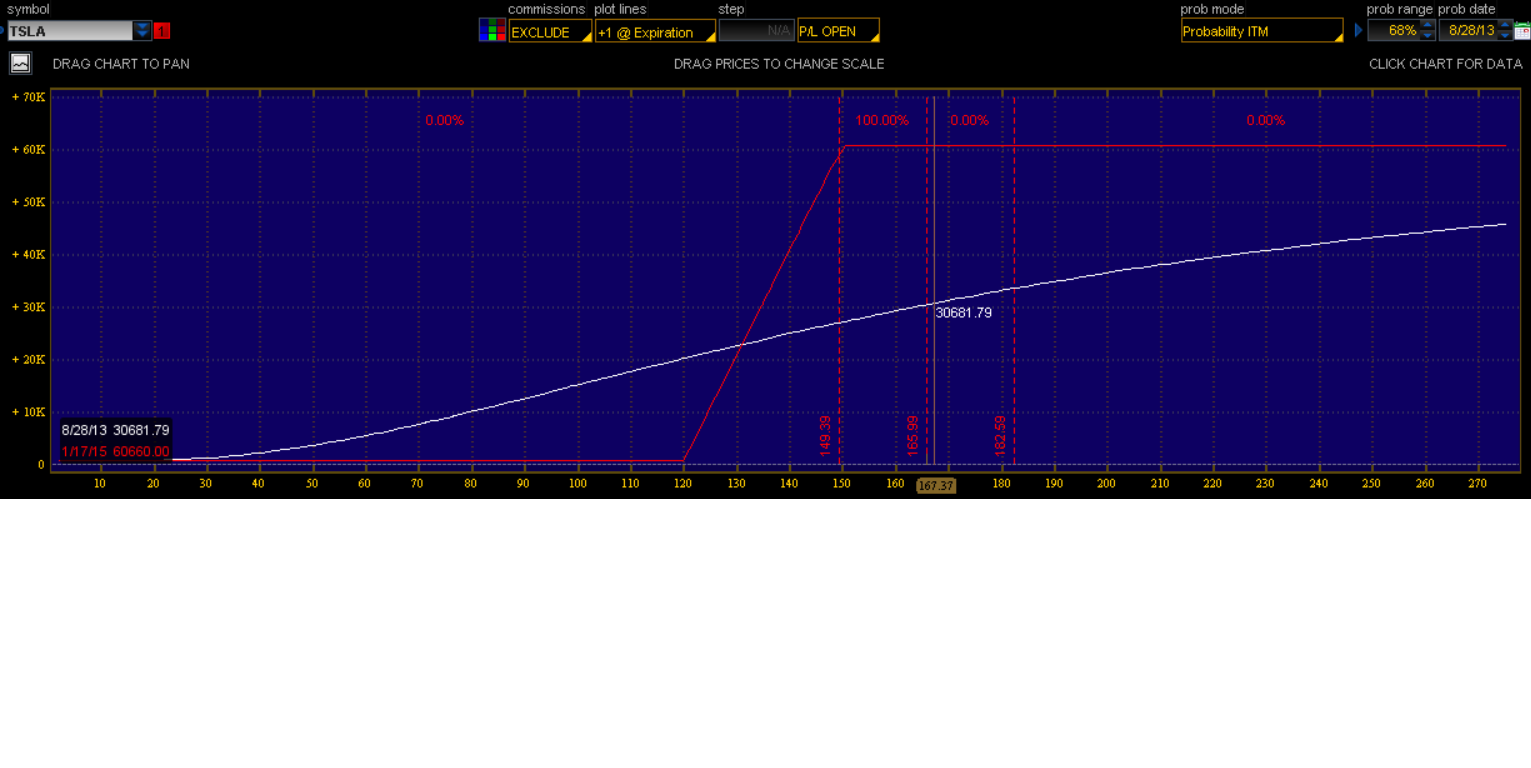
Causalien My suggestion for covered call is. Use an equivalent call options as your stock. Do not use your core stock holding as the "cover" for covered call.
Then do this strategy with half of the cover first. If you are expecting levitation (a la pre earnings movement). The other half should be sold once the total premium of the cover sold is equivalent to the total price of call bought. This way, your vertical call option strategy cost nothing. Only execute this on volatile stock and when you know with confidence that the price will be either frozen or up in the next few weeks.
A properly constructed option strategy should look like this. Where you have no red lines below $0.
 �
�
Aug 28, 2013
sub Yeah thanks, I realized it was actually an illogical strategy after posting the question and thinking about it for a minute. I know covered calls, as far as risk, is a good play if you don't mind selling your shares for the premium your getting. I feel the risk of losing my shares for the long run out weigh the small premium I can collect if they expire worthless. I'm learning options now so occasionally I have a stupid question like this and the answer comes to me shortly after asking it.
The other strategy I've been trying to work out is leaps vs shares. For example, if I were to buy the 110 Jan 15 leap that has a .82 delta, would 5 leaps be equivelant to 400 shares moving forward as far as capturing the gains? Is rolling the leaps over, say 6 months from now if they are in the green a good idea or just let them run? I know there is some cost to rolling them over. The upside to this is I can free up some funds to place else where while not giving up my leverage on the upside. The downside is time, but if I roll them before time starts becoming a factor I can limit that risk?�
Aug 28, 2013
DaveT Check out this book, Options as a Strategic Investment: Lawrence G. McMillan: 9780735204652: Amazon.com: Books . It's very good and thorough. I'm currently going through it myself.�
Aug 28, 2013
sleepyhead
Is that the book SNIPUS was recommending?�
Aug 28, 2013
DaveT Yeah, I heard about it from the AAPL pdf from Ongba. It's a big, fat book but well-written. There's a chapter on taxes I read the other day and it was helpful.�
Aug 30, 2013
keithz I have 22 March $200 Calls. Anybody else think that's a reasonable bet right now?�
Aug 30, 2013
Causalien Just realized what what has been hampering my TSLA trades. My brokers only give 5% margin for TSLA options. Which is a lot less than even the worst I've seen before, which is 25%. At this point, I might contemplate taking a tax hit and convert this to cash so I can maneuver better. Are any others seeing the same thing?�
Aug 30, 2013
Johann Koeber I am split between 170 and 200. So I got them both.
We will have 2 earnings reports by then. Even if TSLA cannot keep up the pace it has shown in the past 6 months, I do see potential to go to 200 and beyond in that time frame.
60 percent chance.
O % chance that I am right. Do your own research.�
Aug 30, 2013
Jonathan Hewitt As far as march goes, right now I have two $150s, three $175-225 bull call spreads, and two $200s. The bull call spread breakeven point is $185, with a 400% return if TSLA ends at $225 or higher.�
Aug 30, 2013
mershaw2001 OK I've got a problem and I could use some advanced help. I have a $15,000 margin call due tuesday, which is about 15% of the account value. As part of my portfolio, I own 4 deep in the money september calls with a strike price of 60, worth 109 dollars each. However, fidelity doesn't consider options marginable to my knowledge. I could sell other securities (don't want to) or move money to the account (don't have money). So instead, I want to exercise those options. Theoretically, the value of the stock is 400*169=$67600 and the stock has a 40% margin requirement, so that should by my calculation require 0.40*67600=27,040 and free up 4*109=$43600 that was being held in the calls, the difference being 16000 and settling my margin call.
Fidelity says I can sell the options and then buy the stock in the manner above, to settle the call. However, they will not let me exercise the options, which should be theoretically exactly the same play, citing that I don't have enough margin buying ability because I'm in a margin call. But my argument is that this should take me out of the call! I feel like I'm stuck here, because I don't want to sell the options and buy the common stock because I'll get stuck with short term capital gains that I wouldn't have if i exercised the calls. Can anyone see their point of view? The margin buying power shouldn't be an issue if the action takes me out of the call, in my opinion. But then again, my opinion matters not. I think they are arguing that I need $6000 per contract to exercise, and I think they are missing the fact that it brings in a security that only requires 40% margin requirements.�
Aug 31, 2013
DonPedro You are right in practice, they are right in principle. Your cash requirement comes ahead of the arrival of the shares by three days (I think it is). There is some (highly theoretical) risk there - the stock could tank, or there could be some problem with the counterparty.
Any service-oriented organization would let you do it. They won't. I'd give it up.
Can you transfer some funds to stay in the account during the exercise? Leverage a credit card?�
Aug 31, 2013
mershaw2001 Ok thanks for the answer. I forgot to add that they said the same thing about a 3 day window of risk. I'll just sell off other shares, non tesla. Thanks for the help.�
Sep 1, 2013
Causalien Sell one and use the margin to exercise the 3 others�
Oct 8, 2013
smorgasbord Sold a couple Jan '14 $160 Puts for $16.50 today.
I'm buying stock at $143.50 or making more than 35% annualized.
Seems like a no-brainer to me.�
Oct 8, 2013
sub Probably a good move. The potential "losses" on that type of trade scares me away however.�
Oct 8, 2013
smorgasbord Establishing any position that can make you money also has risk. The worst thing that happens in this case is that I end up buying a couple hundred shares of TSLA at $143.50. Even if TSLA tanks to $90, I can simply sit on my shares as I believe that medium term TSLA will be well above $143.50. So, I believe I can't lose money on this trade - I might just not be able to make as much if I waited for the stock to drop well below $143.50 before buying. However, that might never happen, so this gets me some pocket change.
Buying calls is another way to play these dips. I might do that next time, just for some variety.
What's ironic here is that the "Newbie" thread seems to have more advanced strategies than is typically discussed here.�
Oct 15, 2013
justdoit I'm actually considering selling deep ITM puts as a way to buy shares in a few months when I do have cash on hand. I don't have cash on hand now to buy what I want (mainly solar right now), so am thinking of selling some Dec/Jan ITM puts and hoping the stock prices stay below (ideally only slightly below) that level by the time the options expire that way I can have the option exercised and buy the shares.
Pros - I can buy shares of XYZ stock at todays price in the future when I do have cash. Also, even if the stock rises above the strike, then I'll have pocketed the premium.
Cons - Stock tanks and I have to buy the stock at todays price even if the stock is well below.
I'm only planning on doing this with stocks I'd like to buy and hold, so that's why the "Con" scenario mentioned above isn't that big a deal for me.
Any risks I'm missing? Has anyone else tried this strategy?�
Oct 15, 2013
Mario Kadastik The only downside I think is that you'll have a maintenance margin that you have to keep and at least for me it looks to be about 2x the market value of the options. If your net liquidation drops below that, then you might get a margin call and have to eliminate something before you'd like it... Also, if you go very deep ITM, then you'll just get the cash from price diff while you go only slightly ITM, then you get a time premium as well and therefore actually lower the price at what you buy it.
I tried this strategy throughout 2012 and part of 2013, but gave up finally as it never expired ITM�
Oct 15, 2013
Chickenlittle have done this. Calls expensive and these are not. Picked nov exp strike 200 sold a large number about a month ago but not on margin. Have tied up a couple of million cash thinking I would buy the stock for about 168 considering the cash I got for selling the puts. I thought 200 would be in the money but found if I had not, I could have bought the stock close to this price, except cash was backing the puts and worse if the puts end up out of the money I can miss a short squeeze and not have the stock. So I guess the only "wrong" is the inability to take advantage of opportunities that arise. Yes I could have bought the puts back but when temporary decrease in price they get pricey to but back.�
Oct 15, 2013
smorgasbord How do you decide what calls to buy? I use some guidelines for selling Puts (I posted upthread here), but don't know how to choose from among the variety of Calls to buy.�
Oct 15, 2013
Mario Kadastik Well I guess it's somewhat related to gut feeling
What I also do is delayed constructs so that if the stock moves up real fast for what ever reason (good news, upgrade, what not), then I hedge part or all of the position locking in the possible future profit, but making it close to or fully risk free.
For a longer term play I'd go with OTM calls, but those one has to know are risky because if the stock doesn't follow the time decay will start eating your lunch
- - - Updated - - -
Oh and if you want to play LEAPs to get most of the options benefits with stock stability (almost) and lower cost, then I'd recommend buying ITM LEAPs so that you're not paying too big a time premium.�
Oct 15, 2013
gym7rjm
I'm far from a pro, but since no one answered your previous post, I'll share with you what things I consider when buying calls.
First, I usually set a price target for what I think the stock can reach before the option expires. Option prices will generally move in the same direction as the underlying, but the second the market sees that an option will not expire in the money, the premium will drop and be worth next to nothing.
Next, when I have my price target set, I look at different strike prices below that target and settle on one rather than several strikes. I also consider the strike that has the better liquidity because that makes it easier to go in and out and the bid/ask spread is usually narrower. So for example, I bought mostly Nov. 200's during the dip for my q3 play. Rather than have a bunch of strikes all over the place, I only have to focus on those if I need to act fast. Nov. 200's also have the most volume traded compared to the strikes around that price.
Another thing to consider is the IV, when the stock was trading flat in the 160's it was a really good time to buy. But IV isn't always king because buying on dips is an excellent time to buy if you think the stock will recover, even though IV will usually be higher. I was able to buy a bunch of Nov. 200's at $5.90 and they are at $11.60 today, so you can't always wait for IV to be where you want it to be.
The more you follow prices and see how they react to different price actions of the underlying you will get a better handle of what to expect. If you don't have enough time to invest in following option prices then its better to look into leaps.
I don't trade based on a strict set of rules because there are too many scenarios and factors to consider. I think Sleepyhead stated it before, that option trading is sort of an art and it develops over time. Unlike Sleepyhead though, I keep a log of all my option trades so I can reference my previous trades and see what I did wrong or right.
- - - Updated - - -
Happy to say that today I finally made my first zero cost delayed construct bull call spread!�
Oct 16, 2013
kenliles This is a very similar strategy I deploy, but applied to LEAPS. Because of the long time frame though, I'll usually choose 2 strikes- one conservatively where I think the stock would get to in half the LEAP time and the other where it would be at expiration. This creates a natural roll up spread as the stock moves higher (roll lower side of spread to upper side) taking some profit. I've used this approach using a time spread too when available (J15 expiration lower and J16 expiration upper for example)�
Oct 17, 2013
ckessel I've been reading up on implied volatility and multiple articles mention the best time to buy options is right after an earnings. Of course, you miss out on the earnings movement, but the gist of most of the articles is the IV kills most any chance of profit if you're buying right before earnings. However, I know kevin99 talked about buying everything he possibly could shortly before the Q2 earnings, so I'm guessing that's a case where the surprise Q2 results outweighed the IV?
I'd thought about buying some small number of options for the week after the Q3 earnings, but Tesla's IV is already crazy high at something like 72%. I think most of us here expect Tesla to beat expectations handily, but given where the stock is at already and the already high IV, maybe it's a better bet to wait until the IV drop after earnings to buy longer term options?
Any short term option is obviously a high risk gamble and I was fine with that, but I want to make a gamble where I'm looking at positive EV (expected value, a poker term, best I can come up with as an analogy).�
Oct 17, 2013
emupilot I've noticed a couple ways to work with the IV crash after earnings. One way that has worked for me is to sell within the first hour of opening the morning after earnings. I also get DITM options with little premium so there isn't much to lose when the IV drops.�
Oct 17, 2013
ckessel I'm curious, does that mean you think Q3 earnings is going to be a non-factor this time around? Q1 and Q2 were big movers on the stock, but does a Q3 that beats expectations significantly not move the stock much since it's already been driven up so high?�
Oct 17, 2013
sleepyhead If you bought options prior to Q1, you could have had 100 baggers. Prior to Q2 you could have had 5 - 10 baggers.
Going into Q3 you might get a 5-10 bagger, or you might only get a double or triple even if ER is really good.
Wall St. is slowly figuring out where to get up to date info on TSLA and the shock might not be as big if they do have a blowout quarter. Also, that stock can't continue going up at the same pace.
When you look at the linear chart it looks like it is going up at a constant pace and that it might jump back into the "channel". But when you look at the log chart you can see that TSLA is slowing down and cannot return the same % gains.
The log charts are the ones that matter because that is what will determine your portfolio return and not the linear charts.�
Oct 18, 2013
NStar
Another thing I think we can do to reduce the effect of high IV is playing with bull call spread or bull ladder spread. It could work out better than simply buying expensive calls if you have a strong opinion about the likely price range after ER.
For example I know the Q3 ER will be very good, but probably the price won�t go up exponentially like what happened after previous ERs. So I feel it�s more likely in the $200-220 range, but unlikely to be above $240 one week after ER.
Approach 1: I can buy 1 Nov16th $200 Call at ~$8. I need it to be at least $208 to break even. If it�s at $220 before expiration, it will be 150% gain. Or If it actually gets to $240, it will be 400% gain. Assume I invest $1000 in this trade, my max. loss will be $1000, and my gain will be $1500, or $4000, if the price gets to $220 or $240, respectively.
Approach 2: I can buy 1 Nov16th $205-$220 bull call spread at $3. I also need $208 to break even. If it�s at $220 before expiration, it will be 400% gain. it does not go up more if the price is higher, but 400% gain is not bad since I don�t think it can actually go higher than $240 one week after ER. So for the $1000 I invest, the max loss is still $1000, and the max. gain is now limited at $4000, but it comes at a lower price $220 compared to the previous case.
Approach 3: I still buy 1 Nov16th $205-$220 bull call spread at $3, but I also sell another Nov16th $240 Call at $1.5 because I feel so strongly that it won�t be above $240 within 1 week after ER. I only need $206.5 to break even now. If the price is at $220 before expiration, it will be 900% gain. It does not go up more either if the price goes further higher. For the $1000 I invest, my max. gain is limited at $9000 which is achieved between $220 and $240. The loss comes at $253.5 and it can be unlimited now. Another catch is that I do need large margin to be able to sell the 2[SUP]nd[/SUP] call, but it�s not something extremely large since it�s a so far out of the money call.
I suspect in approach 3 the high IV will not be an issue any more, and maybe even almost works in my favor since there I sell 2 calls but just buy 1. But it will tie up a lot of margin and has unlimited potential loss (and even with approach 1& 2 I can lose 100% of what I invest). Most of my fund are in TSLA shares in my 401K (too bad I cannot even sell covered call there) so I�m ok to take some risk with the small money I have in IB account. I�m thinking about taking approach 2 and probably also 3 to a smaller degree. It sounds a better strategy than simply buying calls, but I just thought about this and have never tried it before. I�d like to hear other people�s comments.�
Oct 18, 2013
DonPedro Due to IV crash, I like the thought of selling NTM puts before the earnings call. Since it is unclear how much of a beat is priced in, this might be the safest way of harvesting the knowledge that they certainly are not underperforming.
Thoughts on that? Vanilla November expiry best?�
Oct 18, 2013
NStar I agree with you. Do you happen to know how the margin requirement is calculated for selling NTM puts? I suspect it'll be very large so much so that you cannot sell many. So compared to the fund it needs to tie up the percentage of the gain might not be very big. but it seems a very quick way to make some money�
Oct 18, 2013
DonPedro I have very good funding of my account, so margin requirements will be OK for me. But I am thinking Nov 15th may be a bit too early expiry - not sure whether the volatility will be over by then. On the other hand, wk3 and wk4 puts have minimal liquidity, so I'll be paying the market maker in both ends there. And December is a little late... Decisions, decisions...�
Oct 18, 2013
Mario Kadastik Yes, usually the best way to extract profit from IV crash is to sell options. As in this case we're all fairly sure that TSLA is going to beat one could indeed consider as part of a strategy the selling of ATM or NTM puts. If you want to expose yourself to a bit more risk and reward, then also possibly slightly ITM, but probably the highest combination of time value, IV and total value of put is on the ATM puts. If you want some security and still benefit from the IV crash you can sell slightly OTM puts as those will still be priced fairly highly due to the exploding IV just before earnings.
I personally would probably use the Nov 8th options as those will have very fast time decay immediately after the IV crash as well requiring the stock to drop hard. You can estimate what kind of movement is priced in by taking the combined value of call and put for the ATM strike. Let's say TSLA is at $190 and the call and put together are worth $25 then you can expect that the market is pricing in a move of $25 in either direction (otherwise you could just buy the straddle). I'd not do it for TSLA, but for some companies reporting earnings I've sold the straddle assuming that the move itself will not be as large as the expectation and it has worked in about 2/3 cases. For the case where you miss you can try to time the next days volatility to reduce the loss or just close the wrong leg at market open.
All of those plays mostly work to benefit from the imminent collapse of IV the day after earnings. Of course one cannot make it fully secure, but you either make a prediction on the direction of the move or the magnitude. If you hit you win if you miss you may get out fast enough with close to no loss thanks to the IV collapse. If the miss is hard, well then you risk a significant loss (if you sell $185 put and the stock drops to $150 in AH trade, then you're looking at a $3500 per contract drop that is probably far above the premium you got). Of course none of us expect a drop at all�
Oct 24, 2013
Theshadows So I feel like I graduated to the advanced thread today.
Yesterday I had no cash left for trading. However with the big pullback of tsla I wanted to do a short term call. So I created a delayed bull call spread with some deep itm dec calls I have with csiq to get some cash.
I used 90% of the cash to buy weekly $165 tsla calls for 2.80, once they got filled I created a GTC order to close 1/2 of them for 5.90 to get all my money back.
That filled this am then I bought back my spread on csiq for a 7% loss.
I then created a GTC close on the remaining weeklies for 6.60. Those filled and netted me a 220% gain on the tsla. So now I have another nice chunk of cash to redeploy.
I could have been more aggressive with the final closing (I almost planed on 9.80 for the last half) but I didn't want to get too greedy and risk a pullback tomorrow and have the remainder expire worthless and leave me roughly break even.�
Oct 24, 2013
DonPedro So in anticipation of the earnings I decided to load up ahead of the run up. I wanted to get in before the street does its research and realizes that another blowout quarter is upcoming. This was Friday afternoon, then Monday morning I got slammed by the interim volatility.
My takeaway is that the next time I want to trade on earnings expectations in Tesla, I will do a calendar spread to take out the random volatility.�
Oct 24, 2013
Gtoffo Congrats. When you wrote about your play on the other thread I liked it straight away. Ballsy....risky....but I think you had good odds. Definitely an all or nothing kind of trade.
And nice job closing the trade today. That takes discipline only some have. I've learned that lesson the hard way: sell as early as possible when the price spikes, and don't look back. You had a defined strategy since the start and that was the key of your success. Nice job.�
Oct 24, 2013
Theshadows It was risky but the money from the original spread was just over 2% of what I had in the account. Csiq looked like it had taken a breather and the spread was less than half that call position and 6 strikes higher.
I have had my lessons with short term calls that ended up worthless. (I hope I don't have any more) I'm glad I didn't go for my aggressive plan, lots of lost value on those calls tomorrow if the stock doesn't go up anymore.�
Oct 24, 2013
Jonathan Hewitt Congrats! I thought about doing something like that but would've had to use margin. I don't like making bets like that when I know it's money I would have to pay back... I did buy some November 150s yesterday and sold today for 22% profit. I figured it was very low chance the stock would be below 150 post ER so if the stock kept going down today I'd be able to recover the calls in November. It also was relatively high delta so I'd be able to catch a lot of the rebound today if there was one (there was). The profit raised my portfolio value just over 1%, haha. I sold when TSLA was around $170, if I had gotten it closer to $174 I would've done much better.�
Nov 14, 2013
Gtoffo Hey guys,
I think it's time to revive this thread. Is anyone implementing some defensive strategies regarding TSLA? I'm still very long with both stock and leaps and so far I've had no protection. However I'm near the point at which I'll be forced to sell if the stock goes down significantly, so I'm devising a contingency plan if the stock does down from here. Any ideas/suggestions?�
Nov 14, 2013
ZenMan I don't see many options.
1). Sell out of the money calls 1 month out. If this is truly the bottom and we rally somewhat, then your shares could be called away.
2). Buy PUTS. Expensive insurance.
What other options are you considering?�
Nov 14, 2013
kenliles my only defensive strategy for these kinds of moves is to roll out further in LEAPS both time and strike (delta tracking reduction)�
Nov 14, 2013
Gtoffo How about bear put spreads to lower the cost of the insurance? I've never tried a similar strategy but it looks good on paper....�
Nov 14, 2013
ZenMan How about hedging using the expected range bound price action? You might miss out on a large upswing, but you can reduce your basis and would protect somewhat against further downside. Wait for a tesla bounce to the mid 140s, and then sell one month out 155 or 160 calls. At one month out I'd think you could get $5-7 per contract. After you sell the calls, watch for another downswing and then buy the calls back after the call price drops 50%. Then repeat if Tesla swings up again. To do this you have to set your targets and maintain them. I got greedy last week and was waiting for $147 price and missed out on the upswing entirely.�
Nov 14, 2013
Gtoffo Sounds like a lot of work and a lot of good timing required.... I'm not very disciplined so I need to choose strategies which are "fire and forget" as much as possible. That's why I like spreads usually. I'm not worried about tesla long term but I need to make sure I can through the hump of the next few months (before Q4).
I'm thinking of setting up a cheap put spread for some low strikes that would kick in if we fall significantly offsetting my losses if we go that low (at least partially). I wouldn't do it if I could afford it....but if TSLA drops some more I would be forced to cut my losses.�
Nov 14, 2013
ZenMan You don't have to actively buy / sell the calls. Wait for a bounce, sell the 155 or 160 call and forget until expiration. You'll either sell the stock at $160 plus option premium (price looks good right now), or you'll pocket $500 for each contract you sold. $5/share isn't a minuscule amount of downside protection.�
Nov 14, 2013
kenliles or buy some LEAPS and go to SLEEPS�
Nov 15, 2013
ZenMan I wanted to make sure I gave credit to Kevin99 for the above idea. He discusses this strategy on his investnaire site.�
Nov 15, 2013
Gtoffo Doesn't look worth it to me at all. I want to protect myself against the possibility of a deep drop....not kill my upside potential to profit 5 bucks (which won't cover at all the losses as 5$ is barely more than 3% of movement!).... especially since I think a rebound is more likely than a big drop.
All risk, no gain.
So far I'm still sitting on my long position....I'll wait to see what happens today... It's hard to find the strength to bet against Tesla....even though it's just a hedge....�
Jan 26, 2014
smorgasbord Thought I'd resurrect the thread - as 20/20 hindsight proves yet again that selling calls on a racehorse stock like Tesla is not a good idea - unless you're convinced that the stock is completely overvalued and has no-where to go but down. But, in that case, you should probably just sell the stock.
Stock price insurance comes from buying Puts, not selling Calls. And yes, buying Puts is expensive because of the still-massive short interest, so it's just not worth it unless you actually want to short Tesla.�
Jan 26, 2014
Mario Kadastik Selling calls is to enhance your position once the stock has run up a lot. I sood and bought back calls multiple times after TSLA broke 170. Just a few weeks out 180 calls. Due to the massive runup the premiums were high and rhey were covered with calls. Once TSLA corrected back down even intra day I bought them back for profit. This basically playing the short corrections with worst case being that you have to give your hedged spread away at this profit level. Not a bad choice.�
Jan 28, 2014
smorgasbord I respectfully disagree. All selling covered calls does in that case is limit your upside. You can try to play the game where you sell calls, then buy them back cheaper, but if the stock runs away from you, you're either buying them back at a higher price, or selling Tesla stock at a lower price. Not a good choice.�
Jan 28, 2014
sleepyhead And I respectfully disagree with your opinion. I have been selling dozens of calls against my TSLA positions from when it crossed $140 in December and I have enhanced my returns because of it.
The secret is choosing the correct expiration date and strike price. I have had some issues with a couple of calls going deep ITM, but those can be rolled forward until the stock eventually corrects.
It is a lot easier to make money selling calls than buying them.�
Jan 28, 2014
uselesslogin Rolling forward is something I hadn't even thought of. Do you have any general explanation of your choice of expiration/strike price? I had sold long term calls back in August and that helped me hold on to my TSLA stock in November. But maybe it would have made more sense to roll forward monthly during the run up.�
Jan 28, 2014
sleepyhead If you wait for a nice run up, start selling 10% OTM weekly calls when things are looking very rosy and IV is high. Chances are that they will expire worthless and you will keep the hefty high IV premium. You can also sell 20%-30% OTM 1-2 month out options, or 50% OTM options 3 months out. You will not make a ton of money, but you participate in all of the upside 99% of the time and will most likely outperform the person who rides naked stock or options.
- - - Updated - - -
I had extensive training when I worked on Wall St. and one guy (used be a traded for a big French Investment bank) who was training us showed charts that he backtested to prove the covered call strategies (on indexes) outperform a simple uncovered long index strategy:
He showed that the covered call strategy does about exactly the same on the upside, but significantly outperforms on the downside (obviously). In the long run, you will significantly outperform doing a perpetual cover called strategy with a lot less portfolio volatility as well.
Sleep better at night and make more money.�
Jan 28, 2014
ckessel Thanks, I'd been looking at selling calls, but needed a starting point for figuring out which call to sell.
Given the unknowns going into the Q4 ER call, would you still be selling TSLA calls at this particular point in time? Tesla deferred in Q3, not wanting to talk about 2014 guidance or the giga factory until the Q4 call, so I'm reticent to sell a call into that level of unknown.�
Jan 28, 2014
Mario Kadastik I am planning to go to ER with mostly naked calls. If there is a runup and IV spikes I might sell some covered calls far OTM, but not against the full options portfolio I have. I would expect really good results from Tesla this ER as most of the uncertainty is out of it (Q4 deliveries), but it will depend on what TSLA does pre-ER. If it remains at about current levels I won't sell calls. If it drops I will buy more calls and if it goes up over 185 I might hedge some calls with OTM calls.�
Jan 28, 2014
sleepyhead Pretty much this.
I will wait till ER week and if the stock price is really high I might sell some OTM calls. But if the price is low, I will be buying instead.�
Jan 28, 2014
kenliles great tips guys - thanks so much;
I've never played the sell of covered calls (just been long on LEAPS and an occasional ER call or put hedge). nubee ?- does a LEAP generally qualify to cover the call-sell or does it have to be stock?�
Jan 28, 2014
sleepyhead I have never done a covered call on stock. I do them on options exclusively.�
Jan 28, 2014
kenliles prefect thanks sleepy- think I'll give it a try on or after ER run-up- I'll go small at first to get the feel of ;
thanks for the tips - you as well mario�
Jan 28, 2014
smorgasbord The phrase "covered call" is typically used to mean covering stock ownership with sold calls. And, what you're doing is playing the game of riding a volatile stock up and down. It's not for everyone, it's not even for most.
OK, folks, answer real fast: Today Tesla is up almost $9 to $178. Did/do you sell covered calls, and if so, what strike and expiration. Let's get this down right away so we can see how it plays out long term.�
Jan 28, 2014
sleepyhead
You can write "covered calls" against stock, futures, LEAPS, or even options if you should so desire. Writing calls against LEAPs is not necessarily risky, in fact it doesn't really differ much from writing calls against stock; but it can have its advantages:
Using LEAPS In A Covered Call Write
And I did write some covered calls at the end of the day. I wrote a bunch of Feb. 28's $225 for $1.83.�
Jan 28, 2014
Johann Koeber OK here we go:
I sold March21 calls at strikes 200 and 210, for about 1/3 of my long position
Normally I don't talk about trades, but now I am accountable. My plan it to
a) let them expire
or (preferably)
b) buy them back some time when IV is down or time value is down�
Jan 28, 2014
Theshadows I didn't sell any yet, I have only ever done the delayed bull construct spread.
I was looking after hours if we open where we close at feb 14 195 for $1.50. That would be the 10% and a little over one week. Would anyone else consider selling those? Since I have never done anything like this I would just do 1 contract.�
Jan 28, 2014
sleepyhead I also sold some weekly $185 and $182.5.�
Jan 28, 2014
ckessel Did you sell those before or after today's runup? Curious whether you were selling something relatively near the money at the end of the day or if those were from earlier when the mid 180's was farther away.�
Jan 28, 2014
Norse Man, I bought those!�
Jan 28, 2014
772 Me too... I bought these on 1/27! :tongue:�
Jan 28, 2014
smorgasbord That's just another Bull Call Spread variant, not a Covered Call.�
Jan 28, 2014
Mario Kadastik Well it's likely we'll gap up today so those who sold too close strikes might get to roll them or buy them back at a loss. Rolling right now might not be a good idea as earnings is coming up. Johann, aren't you worried that Tesla will be above $200 post-earnings or is that 1/3 your hedge against a bad result? Because you know I actually bought those over the past few days as an earnings play�
Jan 28, 2014
kenliles smorg, if a covered call is written on a margin account that is fully invested in LEAPS, does the write use the LEAP position to collateral the call-sell? Or would it not be allowed without margin use (or equivalent margin able stock position?).
Seems like that answer (which I admittly don't know) would categorize the play terminology. Otherwise guess you're right, just another bull hedge spread. If I remember, You prefer writing DITM put positions for stocks like TSLA to augment long positions right? I know you've really expressed a dislike for the risk of covered calls. I'm interested in the merits of each for augmenting long hold of LEAPS and stock. The only thing I've really done succesfully is an occasional put to hedge on downturn balancing some of the long loss�
Jan 28, 2014
Mario Kadastik If I have a $180 LEAP and I sell a $180 (or above) call closer in time as a covered call, then there is no margin requirement. It's covered by the LEAP or any other call option that is at least as long out and at or lower strike. And while it might technically be considered call spread or calendar spread or what not you ARE selling a covered call (i.e. it has some backing and doesn't require margin hence the term covered).
Writing DITM puts requires margin and has nothing covered about it making it relatively expensive to augment the position as you need to fork up a lot of the money to open that position. A covered call is a "free" instrument that at worst will limit your upside partially (remember, LEAP at the same strike has a bigger delta so you only really limit your upside partially).�
Jan 29, 2014
gym7rjm So I have a lot of Jan 15 $200 LEAPs. Half are covered to make delayed construct spreads, the other half are open. Since its less than a year till they expire, what would the benefit be to covering these calls, as described, at higher strikes as opposed to just selling and rebuying the same strike calls? I assume the benefit, if they were further than a year out , would be long term capital gains. Another benefit might be that you don't have to try to time the tops and bottoms as the shorter term covered call will hopefully just expire. Any other reasons?�
Jan 29, 2014
Johann Koeber You are right Mario.
Full disclosure:
I bought the shares a few days ago at $170.36 on margin. I maxed out my account with IB. As we know they want cash for TSLA but they gave me some margin on my other holdings.
Then yesterday I sold the calls against these.
Therefore, if I loose the shares, I will have made circa 20 % on OPM (other people's money). Not too bad in my world.
Now if IB would give me margin on TSLA and some of my solar holdings ....
Instead I keep getting reminders by email from IB that my account, while still being margin compliant, is under 5 %.... and that they do not issue margin calls. I would not be confident going out on the limb any bit more.
This is what they write:
ALERT: Your account, while currently margin compliant, maintains qualifying equity (i.e., Equity with Loan Value) at a level only 5% above that which is required. Please note that IB does not issue margin calls and should this cushion erode and your account no longer remain margin compliant, it will be subject to forced position liquidations. To ensure continued compliance, please consider depositing additional funds to increase equity and/or closing or hedging positions to lessen margin exposure. Further note that funds in transit or subject to a credit hold are not considered when liquidating positions.�
Jan 29, 2014
Mario Kadastik Well you have a valid case where it's kind of win-win
Basically when TSLA ran from 140 to 172 in short order I sold Jan 31st $180 calls against my positions. My logic was that if TSLA keeps going up the delta increase of my lower strike calls is that much bigger that I still gain money albeit slower. If TSLA goes sideways my DITM LEAPs will not lose much, but the sold calls will lose time value and if TSLA goes down I get some hedging effect buffering the correction (which I assumed would come). Once the stock did correct (I kept selling them on the way up all the way to 182) and I thought it was a semblance of bottom I bought the calls back netting a nice 50-70% gain on them basically considering it a win no matter if the stock goes down more or up. When it went up again I re-sold those calls effectively riding this elevator multiple times. Had it gone more down or kept sideways I'd have booked profits and still been better off than just keeping going naked long.
Right now I'm 100% naked calls. I did liquidate some yesterday during the runup that I had purchased at the bottom ($165) to reduce the position size and keep a lower cost average.�
Jan 29, 2014
sleepyhead Dude you seriously need to stop debating semantics because it is a fruitless exercise. A Bull Call Spread, aka, debit spread, aka vertical spread is commonly understood to be a spread with options of the exact same expiration date:
http://www.optionseducation.org/strategies_advanced_concepts/strategies/bull_call_spread.html
You can sell "covered calls" against LEAPS or Futures, because you are selling a call that is "covered" by either the underlying or a derivative of the underlying.
Anyway, this discussion is pointless and I am done debating semantics. Selling calls against LEAPS is as much a bull call spread variant as it is a covered call. You can't argue that the strategy is a BCS variant but not a covered call. As far as semantics go you can't say that the strategy is one but not the other.
- - - Updated - - -
I sold the 185 when TSLA was around 174, and the 182.5 when it was at 176.
But the reason why I do things depend on overall market conditions and I have no fast rule why I choose a certain strike or expiration date. It all depends on market conditions and what I have in my portfolio. Even though I sold the calls, I would love to see them expire ITM.
- - - Updated - - -
Yes, the write does use the LEAPS position to collateral the call-sell. Absolutely no maintanence margin required.
- - - Updated - - -
Are you sure about that?�
Jan 29, 2014
sleepyhead I ended up covering a quarter of my position in these for $1.52 this morning for a quick 17% gain.�
Jan 29, 2014
ckessel Any particular reason you bailed out of those so quickly? Felt the money was better used elsewhere or that it was no longer a good bet?�
Jan 29, 2014
sleepyhead It actually cost me money to cover, so it is not about using money elsewhere.
I just thought that TSLA will not go down much lower, so I sold a little and put in some lower limits incase TSLA went down even further. I only covered 25% of the calls I sold yesterday.
The reason why I covered the short call today is because in less than 30 minutes (in market trading time) I made 17% or 1/6 of maximum gain, i.e. 100%. There is still 4.5 weeks left till expiration, so when you get 1/6th of maximum reward in 30 minutes, you have to take the gain.
I sold a weekly 185 to get some cash back.�
Jan 29, 2014
pz1975 Aren't you worried with the FRB announcement at 2:00 EST that the market (and thus TSLA) could jump quickly either way? I am avoiding selling calls or puts for now because I don't want to be left holding the bag if the stock jumps purely due to macroeconomic (and unpredictable at this time) reasons. I personally think the news will be positive but that is just a gut feeling and I am not willing to place any bets based on that. I bought some weekly puts before close yesterday and sold them for a nice (25%) profit after opening today. I could have held longer but like you always say, taking profit is never a bad idea!�
Jan 29, 2014
kenliles Mario - sleepy
got it- thanks very much- I'll give this a toe-in-the-water on the next run up; looks like a lower risk way to capture/hedge on run-ups without reducing long term positions;�
Jan 29, 2014
sleepyhead If TSLA goes up I win, if it goes down I get to keep the premium and win this bet. The only way I lose is if TSLA goes up a lot in a very short period; and I just bought some weekly $190s just in case for a very short term trade.
My prediction is that the Fed will either reduce taper to $5b or hold steady at $75b. Initial reaction will be market up followed by a sell-off one minue later, followed by panic buying for the rest of the day.
But everyone thinks that the Fed will taper another $10b, and if that happens I don't know what will happen in the market. A lot of volatility for sure.�
Jan 29, 2014
Mario Kadastik It's as everyone expected. They taper $10B more.�
Jan 29, 2014
kenliles yep- market generally moving down some on the news;
TSLA holding up nicely though- relative�
Jan 29, 2014
772 S&P and dow are at the lows but TSLA is holding on for now..�
Jan 29, 2014
smorgasbord No, you need to be clearer about what you're saying. When you say "Covered Call" everyone reading rightfully assumes you're buying/holding stock and writing calls against it.
Sorry it annoyed you to have to explain what you're really doing. We don't all have the time to day trade.�
Jan 30, 2014
sleepyhead And now you are making stuff up. How about you actually read what I wrote, before you accuse me?
The first time I referred to selling calls against options as a "covered call" is in this post in response to kenliles question about selling covered calls against LEAPS:
Advanced TSLA Options Trading - Page 35
There is absolutely no ambiguity here, except for what you created. What I wrote is pretty straightforward and clear.
The problem lies with you. You are wasting everyone's (and especially my) time on TMC playing these games with semantics.
- - - Updated - - -
I spent a good chunk of this morning uncovering some of my weekly covered calls just in case Elon drops a bomb on us in Munich. Looks like I made a good decision so far, but I might be selling those calls for more later in the day to generate some income if TSLA gets too rosy.�
Jan 30, 2014
smorgasbord You waste your own time.
You had used the correct phrase earlier. Now you're just spinning this into snippiness. Enjoy the time-out.�
Jan 30, 2014
mershaw2001 hey sleepyhead, i ended up selling the 192.5's for tomorrow for just a little bit of cash, like 35 cents per contract (all of my shares are covered with contracts in the 220 range for march and june, these are just naked sold options). I think that the chance of a pop of 10 dollars on any announcement for tomorrow is too much. I would have gone a week farther out but I have a margin call to settle tomorrow so i have to buy these back within 24 hours. I think you made the right move buying the contracts back and then selling them after the pop into the forward week.�
Feb 4, 2014
Mitthrawnuruodo I haven't heard much chatter on selling puts for capturing all the premium built into TSLA options. Part of my portfolio is really supposed to be for that house down payment, meaning I should look for ways to grow it with little risk. Let's say I have $18,000 towards a downpayment, I can sell cash-secured puts, today, for strike price $180, Jan 15 Expiry for around $41.45. Assuming the price of TSLA is above $180, I make 23% (about 24% Annual equivalent let's say). Between $140 and $180, I can buy back the puts and still gain from a lot to a little.
I view the likelihood of TSLA being above $140 by January as close to 100%. And honestly if the price of tesla is under $140 in 2015 I would sell all my possessions and buy stock, if not options, anyway. Does anyone see a flaw in my logic or have a better suggestion, maybe one that takes less capital and still involves Tesla? I view this as a passive strategy too, which is nice, since I work accounting hours and April is right around the corner. I have done this once before with September puts when the price was in the $130's and I made 2/3rds of the premium back in a couple weeks (having option premium on your side is an amazing phenomena, haha). If anyone see's a more short term expiry as more viable, or not selling puts at all, but some other passive strategy, your thoughts would be very well received
Actually, I looked at prices and getting that put price looks untenable. Lets go with the 165s Jan15s for 31.72. Still a 20% annual return.�
Feb 4, 2014
Mario Kadastik I kind of missed out on the TSLA run-up partially last year because I was trying to buy the stock by selling puts. I sold them since April 2012 basically 1 strike OTM and raked in about 70% of the stock purchase price by the time I abandoned it in a year or so and start to buy calls because the stock was moving up way too fast to benefit from puts (I sold puts many times a month buying back the prior ones for peanuts during the run-up). I always sold the next months puts as weeklies weren't available until I think TSLA crossed to $100(?).
So this strategy does work indeed, your risk basically is that if TSLA crashes for whatever reason you are obliged to buy it at the strike (i.e. if there is a catastrophic event), but that's not too much different from owning stock though stock you might be able to trade out during pre-market or after-hours while holding short options you're stuck.�
Feb 4, 2014
ckessel Yea, I sold some Jan16 puts for similar reasons. It eats heavily into your margin allotment (though it's not a margin balance, so no interest), but otherwise it seems like a good way to generate cash up front if you really think there's little chance that TSLA will crash and burn.�
Feb 4, 2014
Mitthrawnuruodo
I already have small amounts of OTM calls that should cover those types of gains if the stock shoots up. What cinches it here is that if the stock stays exactly the same price for the whole year I make 20%. My account is usually 2/3rds cash and I have been looking for somewhere to stash some of it away to forget about yet still beat the market. It's hard to explain why I don't want to simply buy shares, maybe it's because I had 200 shares at 28$ cost average and sold them at 77. I haven't seemed to be able to buy and sell shares since in any logical manner. I see this strategy as providing as much return as shares, possibly more, with literally zero downside risk (in my mind). Hopefully any upside is captured by my OTM calls.�
Feb 4, 2014
mershaw2001 I was selling puts for a while but stopped for 2 reasons.
1) there wasn't enough liquidity for my taste, and i need to move money in and out of tesla relatively frequently and rapidly (even though tesla has really good option liquidity)
2) tesla has a nasty habit of gapping up and gapping down, which make selling short term (under 2 months) a horrible strategy. If it gaps up 20 dollars, you made a fraction of the profit you would have made holding calls or shares. If it gaps down, you lose big whereas your loss would be limited with calls.�
Feb 4, 2014
ckessel Yea, you definitely need to pick a put that's way out, enough that TSLA's volatility becomes irrelevant.�
Feb 4, 2014
dha I think #2 only really applies if you intend to buy to close. But if you are willing to accept assignment of the shares, I think selling puts could be a very good accumulation strategy. In the case of a big downward movement, whatever: if you wanted to hold shares anyway, you are just reducing your cost basis. On high volatility, you could turn right around and sell covered calls too, further reducing your cost basis.�
Feb 4, 2014
mershaw2001 Dha, absolutely agree, but I've been moving in and out of tesla daily and weekly, so I don't ever really hold till they are assigned. For everyone here who is going long term, it makes sense to sell the OTM put that is 10 above the strike and let it go a year. If i had that luxury, I would take it.�
Feb 4, 2014
MikeC So tell me if this is right. Right now the bid is 43.95 for Jan 15 $190 puts. Say I sell 100 common shares for $17,800 and add $1200 to cover selling one $190 put (no margin). Next January, there are two possibilities:
1) The share price is below 190 and so I buy the shares back for $19,000 - $4,400 contract premium = $146/share.
2) The share price is above 190, so I keep my $17,800 and pocket $4,400 premium = $22,200 or enough to buy back my 100 shares at $222/share.
It seems to me that, relative to holding 100 shares of common stock, if the share price is between $146 and $222 in January 2015 then it is a good trade, otherwise it is a bad trade. Is this correct?�
Feb 4, 2014
dha
Yes, this is right. At $146 you break even on your put trade, and you're better off than holding the stock by $32 / share.
At $222, the received premium would be equal to the opportunity cost of just holding your 100 shares. For this reason, I don't think selling long-dated puts makes much sense if you're long-term bullish. Although there are some exceptions. For example, if you are on margin, selling puts will give you cash up-front and reduce your margin debt (and interest), while buying shares (or calls) requires up-front capital.
On short or medium time scales and during periods of high volatility, I like selling puts because it lets you harness the power of IV and theta decay to hedge your cost basis (assuming assignment of shares is an acceptable outcome).�
Feb 4, 2014
Robert.Boston Check to make sure that, when you sell puts, you don't have to put aside all the cash needed in case the put is exercised against you. If you do have this "cash cover" requirement, selling puts ties up a huge amount of capital.�
Feb 5, 2014
Causalien I recommend having the cash to cover the exercise event. Selling puts over your ability to cover the exercise with cash is the the strategy that broke the most amount of trader in my experience.
This is why that whenever I do this, I always buy another leg about 20% out in case I am wrong.�
Feb 5, 2014
Mitthrawnuruodo
This is my thinking. What I do is consciously keep the cash to the side in case the 100 shares per contract are assigned at my stock price, and I use the cash generated by the sale towards this amount, if that makes sense.
I didn't quite understand your 2nd sentence regarding "another leg". I am slowly learning different option trade possibilities but I can't quite figure out what your 2nd leg entails.�
Feb 5, 2014
Causalien My bad. I mean to say. Buy a OTM put whose strike is 20% out from the strike you sold. In cases like TSLA where volatility premium dwarfs time premium, I'd buy a 2 month otm put while selling 1 month itm put (twice here, once per month).�
Feb 25, 2014
DaveT In my search to improve my options skills/knowledge, I ran across John Carter from simpleroptions.com. I previously linked to a video where he did a million dollar day trade on TSLA on the day of the Detroit auto show 6900 pre-announcement (How to Trade Earnings Pre Announcments). What struck me was that he entered his trade after the 6900 announcement and rode it all the way, exiting just at the right point.
Anyway, he's got a free webinar he's hosting tonight 8pm EST (5pm PST) on catching the big trade. It should be pretty good. Here's the link:
Free Webinar: How To Architect The Trade
Also, on the bottom of that page there's a recorded 90-minute webinar from before taking about catching the big trade. Tonight's seminar is part II on the big trade.
(If you're interested in some paid courses, i had an idea of creating a mini private library with a few other folks. pm me if interested.)
�
Feb 28, 2014
DaveT Just opened an iron condor expiring today.
Bull put spread 245/242.5
Bear call spread 255/257.5
Max profit if stock closes today between 245 and 255 is $0.45. Max pain is $2.05.
I'll update later on how I exited my previous positions on MS upgrade day and how it turned out.
Edit: corrected and made things more clear.�
Feb 28, 2014
FluxCap I think you meant 245/255 there, bossman�
Feb 28, 2014
DaveT That's right. I'm still getting used to the 200s. And writing on my iPhone in bed doesn't help.�
Feb 28, 2014
NuclearPowered When will you look to close the bull put spread to mitigate any potential loss? I am holding an identical 242.5 237.5 position. Watching my margin erode...�
Feb 28, 2014
DaveT I just exited my bull put spread but kept my bear call spread. But I wouldn't advise following me in any trades as this is experimental.�
Feb 28, 2014
NuclearPowered Not following. I put this trade on yesterday. I was just wondering if you have developed any rules of thumb yet.�
Feb 28, 2014
DaveT I don't have any rules as of yet. But when the trade breaks down far beyond my expectations and I'm at risk of max loss if I don't do anything, then I'll consider closing positions.�
Feb 28, 2014
DaveT I closed out the bear call spread as well so the trade is done. Risk/reward was no longer appealing. Since I exited the bull put spread at under $246, I incurred a loss of $0.50 ($0.20 credit, $0.70 debit when closed). On the bear call spread side (I exited at slightly above $249) I gained $0.12 ($0.25 credit, $0.13 debit to close). Total loss on trade $0.52.�

Không có nhận xét nào:
Đăng nhận xét