Oct 22, 2011
Eberhard Maybe we should build our own charger. Here i got a link to build the most advanced 3-phase vienna charger.
Free Reports: Power Electronics Simulation and Application�
Oct 22, 2011
Eberhard A very detailed description of a Three-Phase PFC Rectifier can be found here:
http://www.pes.ee.ethz.ch/uploads/tx_ethpublications/Kolar_Essence_PFC_INTELEC_2011.pdf
All this shows, that was Tesla is doing with mono phase charging may be simple and cheap but not efficient.�
Oct 22, 2011
widodh Let's wait how Tesla is going to respond on my letter together with all the endorsements! �
�
Nov 7, 2011
neroden Given the state of electrical supply to homes in Europe, it's clear that A < D*E. If we're talking about a *relatively low power* 3-phase charging solution for home use (so that Europeans can get at least the same rate of home charging which Americans get from a NEMA 14-50). It may not be worth it for them to develop something bigger, as it may be cheaper for them to simply build a fast DC charging network.�
Nov 7, 2011
neroden DC-to-DC adapters are a triviality. Given that Tesla is supporting DC charging, they're going to make them.�
Nov 7, 2011
neroden I'm thinking hard about this. I'm wondering (a) how cheap Tesla's HPC2.0 is going to be, (b) whether it can be safely installed outside, and (c) whether it's considered legal for municipal (rather than residential) installation. Because what may make sense for visitors is to arrange to get one installed somewhere in downtown rather than home.
Makes more sense than installing J1772 charging stations which are slower than a NEMA 14-50.�
Nov 8, 2011
widodh Any idea how many 3-phase connections there are in Europe?
Also, a 3-phase charger is not expensive at all, most of the time it is even cheaper then a 1-phase charger with the same capacity.
"Simply" build a DC network? No way, that is not going to happen in a short period of time. DC chargers will never be able to cover ALL of Europe, while 3-phase is already doing that.�
Nov 8, 2011
tomsax Instead of installing a Tesla HPC 2.0 that only Model S owners can use, it makes much more sense to install 70A or higher J1772 stations for public charging. The J1772 standard allows for charging at up to 240V and 80A, more than the current HPC allows. Most stations being installed now are limited to 30A because the federal grants that are funding them impose that limit. It's too bad those federal grants are flooding the landscape with puny 30A charging stations and thus slowing the deployment of full-speed Level 2 units.
Clipper Creek offers the CS-100, a J1772 station that supports 75A charging which is basically the same box that Tesla sells as an HPC but with a J1772 connector. Siemens has announced the VersaCharge that supports 70A charging, including optional support for metering, with availability late this year and early next year. Both are rated for outdoor use. Eaton has announced they will support 70+ amp charging and a wide variety of billing models.
For more options as they become available, check out Plug In America's EVSE list sorted by maximum amperage.�
Nov 8, 2011
robaross I know there are no stupid questions, only stupid people. With the standard 10kW charger I understand I will need only a NEMA 14-50 since the HPC 2.0 would be useless. But for highway charging, will a quick charge be only half as fast, or is this apples and oranges (is this AC vs. DC)?�
Nov 8, 2011
Lloyd Eaton does not yet produce this 70 amp unit. From my calls today "We do not intend to produce this product until there are sufficient vehicles on the road that can utilize this potential." They have no time line on when that might be. "You can try checking back in six months."�
Nov 8, 2011
widodh The 10kW charger is for AC only.
Quickcharging (90kW) is done with DC and in that process the internal car charger is by-passed so does not pose a limit to the charging current.
If you don't take the second AC charger (10kW) you'll not be limited with DC charging.�
Nov 8, 2011
Larry Chanin Hi Rob,
As I understand it DC fast charging bypasses the on-board charger. For AC charging you would be limited to the the capacity of the on-board charger.
Larry�
Nov 8, 2011
tomsax The DC Quick Charger, aka the Supercharger, goes directly to the battery pack and doesn't use the on-board charger, so you get the same charging speed whether you have the 10 kW or 20 kW charger on-board.
However, if you end up doing any traveling where there aren't any DC Quick Chargers but there are full Level 2 charging stations, then having the 20 kW charger on board will make a difference. It doesn't matter for overnight charging, the 10 kW charger will do that nicely, but it does matter if you need to stop mid-trip and wait to get enough charge to finish your drive.�
Oct 2, 2012
rolosrevenge I honestly think Tesla is doing it exactly the right way. They've got the best connector out there but their communication protocol is the same that J1772 uses. That means even the J1772 DC charger can be used with a mere plug adapter, like their J1772 AC adapter. If Tesla has a superior connector while using the standard protocols, then it just becomes a question of who sells more EVs in the next 5 years. If Tesla becomes the major EV player, others will want to copy them, especially if more Tesla 20 kW chargers start going up. The big thing really is that all of the little commuter EVs need to charge around town with the 6.6 kW J1772's to be practical. A Model S will almost never need that sort of topping off during the day, but just in case, you've got a slick little adapter that comes with the car.�
Oct 3, 2012
Kevin Sharpe Remember that the vast majority of vehicles around the globe will NOT use the Tesla proprietary connector. I suspect that Tesla owners will end up carrying lots of adapters (just like the Roadster) while other manufacturers vehicles can simply plug in.�
Oct 3, 2012
JRP3 Wouldn't that be just one adapter? Hardly a burden. As MPT said in the last Transportation Evolved, I'd rather use a better plug most of the time when I plug in at home and use an adapter on occasion.�
Oct 3, 2012
Kevin Sharpe Type 1 ("J1772"), Type 2 ("mennekes"), CHAdeMO, and all the new DC connectors will require adapters. In the wild you will find a tiny percentage of Charging Stations with Native Tesla connectors (just like today).�
Oct 3, 2012
JRP3 So how can other manufacturer's vehicles "simply plug in" when you've just listed 4 different types of connecters? No matter what Tesla owners will have to carry only one more adapter than anyone else, while having a sleeker plug to use 99% of the time.�
Oct 3, 2012
Robert.Boston Alternatively, if Tesla were to freely share its plug specs, then it could become the industry standard. It wouldn't be the first time that a design-by-committee was overtaken by a superior design developed by someone with commercial skin in the game.
Also, given the Tesla's range, the vast majority of charging will either be at home (no need for "grazing" while shopping) or at SC sites (as relatively few charging stations are being located to support inter-city travel).
I agree that Tesla drivers will be investing in some connectors. I disagree with your assertion, Kevin, that everyone else will not. There is no single standard around the globe, or even within a country. SAE? CHAdeMO? Mennekes? Unless the car has multiple plug points, every car will need some adapters to use the full range of available plugs. (Right, what @JRP just said.)�
Oct 3, 2012
Kevin Sharpe No, you are wrong... Type 2 ("mennekes") supports 43kW AC and 70kW DC with the same physical connector (and 140kW DC with the addition of 2 pins);
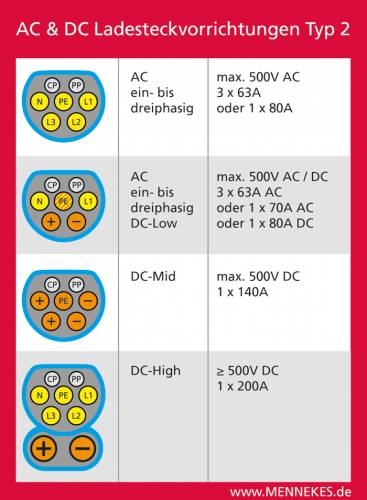
Vehicle inlets and connectors type 2 for AC and DC charging
- - - Updated - - -
By supporting two connectors today (J1772 and CHAdeMO) the car could have used existing infrastructure with no adapters.
However, selecting the Type 2 ("mennekes") connector from the beginning would have supported a global connector standard that is widely deployed... no need for a proprietary connector at all.�
Oct 3, 2012
4sevens.com No not just the adaptor.... The TM plug handles a variety of voltages and current as well as being able to handle DC and AC. It's a smart plug and reconfigures and adapts. I'm sure there is software and protocol communicating between car and plug to ensure they see "eye to eye" before an ounce of energy is sent. Not just a hardware adaptor.�
Oct 3, 2012
vfx Anyone care to speculate what Tesla will have to do plug-wise in EU? Adapter wise?
I guess the question is. will an American MS be the exact same plug and power as a EU version?
Franz said the entire car had to be built for worldwide specs.�
Oct 3, 2012
Kevin Sharpe If Tesla want a future in Europe they must support Type 2 ("mennekes") on the car.... putting barriers in the way of consumers is suicide especially as the competition grows from established European Car brands.�
Oct 3, 2012
dsm363 I have no problem using the new, small J1772 adapter that Tesla includes in the car the once or twice a year I need it. The new Tesla connector and cable are a big improvement over the old and anything else out there in the US at least.�
Oct 3, 2012
TEG By "widely deployed" I think you mean mostly in Europe. I don't think Mennekes has been used much in North America or Asia for instance.
I suppose Tesla could have chosen to "go their own way" by championing Mennekes in North America but then they would probably get criticism from SAE, and also end up with a larger, less elegant connector than what they devised on their own.
They agreed that European Model S will have 3 phase charging options, right? So, do we have any idea what connector they will use for that? The current Model S plug/socket is only for single phase AC or direct DC, but not 3 phase. They must have something different in mind for European Model S that need 3 phase charging. Maybe they will put Mennekes on those, or perhaps some variant of the new Tesla Plug/socket with a Mennekes adapter? Tesla seems OK with providing small adapters, such as they are doing with the J1772 right now. (Although people need to be careful not to leave their adapter at the charging station when they go.)�
Oct 3, 2012
Jeff N I rented a LEAF on a trip to Portland, Oregon in late November last year. On my one experience with the Takasago brand CHAdeMO charger there I took a short video of its display screen shortly after starting the charge. It showed the car was drawing 382V at 95A (36kW) with a charge status at 35%. My memory is that during the charge the voltage slowly ramped higher and the amperage slowly dropped but I did not keep careful records of the charging rampdown towards the end. The ambient outside temperature where the LEAF had been stored and driven was in the 30's but the charging location was the underground parking garage of a downtown office building. Perhaps the charging rate might have been faster if the pack started off warmer.�
Oct 3, 2012
Kevin Sharpe Yes, I'm talking about the 700+ million consumers in Europe.
That's a matter of opinion... I personally think the Type 2 ("mennekes") connector is a perfect size and much more robust than the Tesla design.
Thats what they said...
IEC 61851 does not allow adaptors in Europe.�
Oct 3, 2012
sublimaze1 You are all on the wrong page of the manual. The solution is already out there:
http://www.youtube.com/watch?v=AIOqOxI0K_I�
Oct 3, 2012
bonnie As with all standards, there is some wiggle room. (Not saying it's easy, only that it's not quite as clearcut as you state.) RE IEC 61851:
�
Oct 3, 2012
Kevin Sharpe Sorry but that's incorrect;
IEC 61851-1 Edition 2.0 2010-11 6.3.3 "Adaptors shall not be used to connect a vehicle connector to a vehicle inlet"�
Oct 3, 2012
EV_de after the Roadster Plug "disaster" a non "Mennekes" vehicle inlet wouldn't be accepted in EU ...�
Oct 3, 2012
TEG Nice!
- - - Updated - - -
What is the definition of "vehicle connector"? Can the "vehicle connector" include the equivalent of a "built-in adaptor?"
For instance, can they make a cable that has Mennekes on one side, and some sort of Model S proprietary plug on the other side?
In the USA, we are used to having a cable and plug hang off the EVSE, but I gather in Europe is is more common for the EVSE to just have a socket, and the "customer" brings along their own interface cable...�
Oct 3, 2012
Norbert However it requires the Mennekes+DC Frankenplug, not just a type 2.�
Oct 3, 2012
Kevin Sharpe IEC 61851-1 Edition 2.0 2010-11 3.15.1 "vehicle connector - part of a vehicle coupler integral with, or intended to be attached to, the flexible cable connected to the a.c. supply network (mains)"
Yes, so long as the proprietary plug meets all the other standards referenced in IEC 61851-1 then a cable assembly can be used to connect two different connectors (that's how we connect Type 1 "J1772" to Type 2 "mennekes" Charging Stations).
The main point to understand is that Tesla's current approach of 'adaptors' between the cable connector (J1772 for example) and the car (Model S for example) is expressly forbidden. Given that our new IET wiring code of practice (NEC equivalent) mandates BS EN 61851 compliance it's only a matter of time before this becomes a legal requirement across the EU.
We have both models in use... most homes will have fixed cables and most commercial locations just sockets.
- - - Updated - - -
No, Type 2 supports 70kW DC without extra pins (see diagram above).�
Oct 3, 2012
Robert.Boston There are three "standards areas" currently: Europe (500 million, btw, not 700 million) (Type 2), the US/Canada (Type 1), and Japan (CHAdeMO). Tesla quite reasonably is not worried about meeting EU regulations in making it convenient for their North American customers to charge. The Model S port is compatible with SAE signalling standards, and use of an adapter is perfectly legal here.
The SC network is a North American announcement, not an EU announcement. What TM hasn't announced, and the one that I think you care about, Kevin, is how Tesla will set up the Model S for sale in the EU. We don't know the answer yet, so I don't think it's fair to go bashing Tesla about it yet.�
Oct 3, 2012
Kevin Sharpe Sorry but that's incorrect: Figures for the population of Europe vary according to which definition of European boundaries is used. The population within the standard physical geographical boundaries was 731 million in 2005 according to the United Nations
I think it's important to understand in the context of this discussion that Tesla could have (IMO should have) supported an existing charging connector standard and helped the deployment of EV's worldwide.�
Oct 3, 2012
dpeilow That's the population if you include European Russia, but for the purposes of this discussion we should probably define Europe as the countries that are members of CENELEC.
Nevertheless, the IEC 62196-1 standard includes North America by virtue of having Type 1 in the standard. In fact that's where the term Type 1 came from, as it was given that tag by the IEC to distinguish it from Types 2 and 3, the two alternate European plugs.
As far as I can see in the standard, the vehicle side adapter is not allowed and there are no country exceptions.�
Oct 3, 2012
TEG How about this: they keep the existing Tesla proprietary port on the left for single phase AC + Supercharging, and then provide a standard Mennekes port on the right tail-light flap for 3-phase AC charging?
Providing all forms of AC input seems prudent, but what about high current DC? If they only offer Supercharging, and deploy some European superchargers in key locations is that enough, or are people going to get up in arms if they don't offer "Frankenplug" Mennekes DC charging too?
How many DC chargers using Mennekes are already installed in Europe so far? More than CHAdeMO?�
Oct 3, 2012
dpeilow Agreed.
I'd want them to offer CHAdeMO, but I just don't believe they can safely and perhaps legally provide this on a pigtail adapter.
None. There are plenty of CHAdeMOs popping up though.�
Oct 3, 2012
Kevin Sharpe I think many people would happily accept multiple connectors... I never hear anyone complain about the Leaf in this regard.
I think it will be extremely difficult for Tesla to build a European wide proprietary DC network... they need CHAdeMO IMO and then whatever standard gains traction with the volume EV manufacturers.
lots of rumours about a mass produced car supporting Type 2 70kW DC but nothing concrete in the ground today.�
Oct 3, 2012
doug Practically speaking, that Mennekes Type-2 port would have to be used for single phase AC as well. Leaving the Model S (TSL02) connector only for Supercharging in that scenario.�
Oct 3, 2012
JRP3 Ridiculous. You want Tesla to support a lower powered connector, that does not exist in their home continent, where the majority of their early cars are going? There is no barrier for European customers since, if as you say an adapter is not allowed, Tesla will probably use the Mennekes connector. Or maybe they'll cover Europe with their own supercharger network.�
Oct 3, 2012
Kevin Sharpe In your dreams.... if Tesla try and go it alone in Europe with a proprietary standard they will fail.�
Oct 3, 2012
JRP3 Well they would have already failed using the non existent Mennekes in the US.�
Oct 3, 2012
stopcrazypp If they can cover the entire US with about 100 stations, I don't see why they can't do the same for a smaller geographic area (Europe). The biggest difficulty will be the red tape, not the actual tech or the cost.�
Oct 3, 2012
Kevin Sharpe We are a very long way from a US deployment that meets the needs of drivers... remember that Tesla had ambitions for a European wide HPC network and most of the locations that exist today are the result of owner effort not Tesla delivering on that ambition.
What you need to understand is that the proprietary route makes everything more difficult for people deploying infrastructure. While I might be able to persuade host sites to take CHAdeMO or Type 2 based on the number of cars on the road I doubt that will ever happen with the limited number of Tesla's on the road.�
Oct 3, 2012
dpeilow You guys have it easy compared to the multitude of organisations they'd have to deal with here. Honestly, it'll be red tape and then some.�
Oct 3, 2012
Kevin Sharpe yep, they have no idea :wink:�
Oct 3, 2012
stopcrazypp Well Tesla only sold less than 1000 roadsters in Europe and roughly twice that much in the US over a couple of years. There wasn't much ambition for a nationwide HPC network even in the US back then (probably because it's level 2 anyways).
This time Tesla is planning 20k Model S a year, and using the same ratio as the Roadster, there would be about 6-7k sales in Europe, annually bringing about $420mil-$490mil in revenue and $105-$123mil in margins (using a 25% margin). An investment of $20-30 million into infrastructure that can be used for many years and for many upcoming models makes sense.
BTW, on the whole discussion about the connector in Europe, if an adapter is not allowed, I suspect they will go with Mennekes-DC there (hopefully the spec is ready by the European launch!) and maybe like TEG's idea (having two ports). Tesla already said they would support three phase in Europe so the current US-spec Tesla port won't be the one on the European Model S anyways (again, unless they use two ports).�
Oct 3, 2012
dsm363 And if they do come up with a CHAdeMO adapter then they have their own network and the CHAdeMO network to fall back on.�
Oct 3, 2012
Kevin Sharpe yep and a 1000lb mega-$ CHAdeMO 'adapter' to lug around�
Oct 3, 2012
Doug_G IIRC the rule is that third-party adapters are not allowed, but it's okay if the vehicle manufacturer provides them.�
Oct 3, 2012
dsm363 Whatever adapter it is would easily fit in the extra space below the floor in the trunk. I would carry it around all the time if it were that useful to me. Don't know of a CHAdeMO charger within 200 miles of me though.�
Oct 3, 2012
Kevin Sharpe I hope you are right...
- - - Updated - - -
Sorry that incorrect... NO adapters at the car end of the cable.... please read IEC 61851-1
|Here's an extract What charge port connector? - Page 48
- - - Updated - - -
Yeh, very 21st Century... isn't this getting a little ridiculous? Just stick a CHAdeMO connector under the hood and everyone is happy�
Oct 3, 2012
dsm363 That's assuming CHAdeMO wins out in the US at least. Many other companies are backing the still not finalized J11772 version coming out. I don't mind using an adapter for the less than 1% of the time I'm charging and not using the Tesla Supercharging network. True 21st century I guess would be one connector to rule them all but I don't see everyone in the world coming around one standard, do you?�
Oct 3, 2012
Kevin Sharpe Assuming Nissan join their partners Renault and adopt Type 2 ("mennekes") across the range in Europe then I do think we have the beginnings of a standard that will be deployed in high volume. Given that most government financed infrastructure in Europe will also be Type 2 that only reinforces that connector.
I accept that some of the features of Type 2 are not useful to the consumer in the US (3 phase for example) but wish Tesla had adopted that connector rather than developing a proprietary solution. Type 2 can deliver everything that the Tesla connector can (and more).�
Oct 3, 2012
dsm363 If Tesla can use their plug design in the US and adapt a different version for Europe that meets the 3-phase need and simple connection to Type 2 that keeps everyone happy then that should work. I wouldn't mind a separate hidden charge port along the right side of the car for Type 2 doing away with the need for an adapter in Europe if that solved the problem.�
Oct 3, 2012
Robert.Boston To restate my earlier point, what Tesla has chosen to do in the North American market doesn't preclude it from adopting a Type 2 inlet in the EU. So, let's see what Tesla does. You make a strong case, Kevin, that Tesla would benefit from adopting Type 2 for its EU deliveries.�
Oct 3, 2012
vfx Elon has said they plan to cover the world.�
Oct 3, 2012
TEG When aliens land do they just go after one continent? :wink:�
Oct 3, 2012
jkirkebo This only works for Mennekes charging stations up to 22kW. Those just have a socket you can plug your own cable into. The 44kW charging stations does however come with cable & Mennekes plug already connected, since the separate cables stop at 32A.
And I do want 44kW Mennekes three-phase charging on my Model S (even if it tops out at 30kW, which I hope it doesn't). So the solution then is either a Mennekes socket on the car or an adapter.
And a CHAdeMO socket in the frunk is a good idea. I have at least 20 CHAdeMO stations within range of my Leaf, for the Model S next year there should be 50+. Since I'll never have to fast charge more than once a day, 44-50kW is good enough.�
Oct 3, 2012
Kevin Sharpe Sorry, that's incorrect... we have plenty of Charging Stations with 43kW sockets (I also have several 43kW cables).�
Oct 3, 2012
stopcrazypp I find Type 2 to be highly unlikely to be adopted in the US. From the Combined Charging System announcement, the "international" standard is to have J1772-DC in the North America and IEC 62196-3 (I'm referring to the Mennekes plug with the two extra DC pins) in Europe. The two standards are "harmonized" by having the port opening be the same size. There are absolutely no plans to use Type 2 in the US. It would require switching out the thousands, maybe tens of thousands, of J1772 stations already install to make such a port useful (and almost all of those stations don't have 3 phase in the first place).
Tesla couldn't have adopted IEC 62196-3 anyways since like J1772-DC, it's still in development (it's likely using the same PLC technology and the same signalling; looks like CHAdeMO and China is trying to get their own connector standards accepted into the proposal). IEC 62196-3 is scheduled for functional release in December 2013, so it looks like it may not be ready for use even when Tesla launches in Europe.
The regular Mennekes supports up to 70kW of DC charging (500VDC/140A), but in practical use, it's closer to 55-60kW given the lower charging voltages in batteries today (just like how CHAdeMO supports 62.5kW @ 500VDC/125A, but in practical use the limit is 50kW because the charging voltage of the Leaf and iMIEV is not that high). So like CHAdeMO, it has the same problem: not enough power.�
Oct 3, 2012
Kevin Sharpe Agreed but that's not the point... Tesla could have adopted the Type 2 connector rather than developing their proprietary solution... they would have required J1772 adaptors in the US but given that's allowed who cares.
So, they could have deployed proprietary signalling while they wait for (or influence) the standards.
Sorry I don't agree... we've run some serious current through Type 2 and I suspect it will support 70kW. You also have the option to support 140kW with extra pins.�
Oct 3, 2012
dpeilow Except
�
Oct 3, 2012
Kevin Sharpe So Tesla say "we love your connector but need the extra pins and heres' some $ because we don't want to reinvent the wheel"�
Oct 3, 2012
RDoc With all the US manufacturers supporting SAE, I think the SAE combo plug is likely to be the dominant player in the US if only for political reasons. Because of that, I expect a lot of government supported, and for profit, DC charging stations in the US will be both CHAdeMO and SAE in the near future with almost all the rest being J1772. For example, the California NRG DC stations will be converted to support SAE. www.cpuc.ca.gov
With the German manufacturers supporting SAE, it seem quite possible that it will be the adopted as the preferred standard in the EU as well.
At least in the US, I think the market for medium range (< 100 mi) cars is very limited, so am doubtful that the charging network, if built, will be optimized for them. The existing CHAdeMO chargers in the US are mostly medium power(30 kw). Even at the max CHAdeMO power (50 kw), these won't be very useful if the Tesla model of high kwh cars becomes more widespread. For plug in hybrids with short ranges, J1772 (6.5 - 16.8 kw) seems fine, but longer range cars really need rates in the 100 kw range for "fast" charging IMHO.
Existing CHAdeMO stations can service medium power charging, but not high power, whereas SAE can do both. Plus, a car with an SAE plug can use J1772 for top-ups as well.
Bottom line is my crystal ball says that if the market for all electric vehicles does develop, the standard will converge on SAE but the process won't be pretty.�
Oct 3, 2012
jkirkebo Ok, I had wrong info then. The single 44kW station we have here in Norway does however have a cable on it, and I read somewhere that they would all have that because the 3x63A cable was too heavy to lug around yourself.�
Oct 3, 2012
Norbert 70 kW is not enough for the Model S, and Tesla intends to go up to 120 kW, in the future, with the same connector (as it sounds).
With the extra DC pins, the Mennekes+DC is about the same size as the j1772+DC Frankenplug (according to drawings describing the combined format with J1772).
The Tesla connector is much smaller, surely lighter, with fewer flaps, and more convenient.
For Europe and 3-phase, Tesla still has all options open, and I'm simply confident they'll do what is best, as I think they've done the best for the US.
If they officially announce a Tesla Supercharger network in Europe, as they appear to intend, they'll probably do it only after already having built a few (and therefore knowing what it takes), as they did here in the US.
- - - Updated - - -
How heavy then will be a 120 kW cable?�
Oct 3, 2012
dpeilow Well given that the SAE (J1772) is a subset of IEC, it's more like the other way around...
Here's the Mennekes franken-plug
 �
�
Oct 3, 2012
Kevin Sharpe Renault and Nissan will disagree and will undoubtedly have large volumes of cars on the road so I don't think the German influence is clear cut.
Don't forget that CHAdeMO supports 100kW with proposals to scale to 200kW... Tesla are not the first to implement high power DC.
- - - Updated - - -
They are heavy and I don't intend to lug one around :smile:�
Oct 3, 2012
RDoc I was talking about the SAE combo plug that has already been agreed to by the German manufacturers, or do you mean something else?�
Oct 3, 2012
dsm363 Did all these companies adopt the SAE combo plug for the US only?
U.S., German automakers will demo fast-charging system at EVS26�
Oct 3, 2012
RDoc Not that I'm aware of, do you have any reason to think they might do something like that?
AFAIK, SAE combo is what they'll be putting on their cars that support DC charging. At least in the next few years, I expect the main market for BEV's will be in the EU, so that probably will drive what they use.�
Oct 3, 2012
dsm363 In the article, they say
so I'm trying to figure out if this is the same standard the SAE is working on. I think it is.
This says they play to support it in the US and Europe. Looks like Mercedes didn't join them.
Global Automakers to Demo EV Fast Charging at EVS26�
Oct 3, 2012
dpeilow It's called the IEC 62196 combined charging system. In North America it has the type 1 AC pins and in Europe the type 2 AC pins.
IEC 62196 - Wikipedia, the free encyclopedia
SAE is just a proxy for this in the US.�
Oct 3, 2012
stopcrazypp Except Type 2 doesn't have enough power (even assuming 70kW). So it doesn't accomplish their goal for supercharging, even though it's a better option than CHAdeMO.
They could have done the same with J1772-DC, but they didn't, likely because they (or specifically Elon) think that the connector is clunky. If Tesla had planned to adopt a standard that wasn't ready, they would likely have picked J1772-DC instead as that is going to be the "official" standard in the US (plus there is no need for a J1772 adapter).
The spec itself says 500VDC and 140A. The limiting factor is the current (this has proven to be the case for CHAdeMO with 500VDC and 125A limit). I doubt any charger will allow more current than the connector is rated for, as that is a huge safety issue (overheating the connector/cable and possibly starting a fire). Like TEG pointed out in another thread, nominal voltage of the Leaf is ~350V, charging voltage is probably about 400V, 400V*125A = 50kW practical limit. The Model S pack has a bit higher nominal voltage (~380V from a diagnostic screen shot I saw), so let's say the charging voltage is 430V. 430V*140A = 60kW for a Model S charging via Type 2 connector.
Again, the proposal with extra pins is not ready yet (much like J1772-DC).�
Oct 3, 2012
doug I think that's just how the Europeans choose to label it. I wouldn't call the SAE plug as proxy. As far as I can tell the protocols were developed by SAE and IEEE, which the IEC chose to adopt. Of course the IEC has their own way of labeling things.
Took forever for Europe to actually agree on the German Mennekes Type-2 while the French and Italians held out on Type-3. (Have the finally actually agreed??) And it seems the UK has plenty of Japanese Type-1 (which is what the Europeans call the SAE/Yazaki developed J1772 connector).�
Oct 3, 2012
Norbert In theory, on paper (perhaps prototypes).
Tesla is the first to implement working high power DC with production cars that can use it. (Except maybe some airport support vehicles and such).�
Oct 3, 2012
stopcrazypp This should be a sticky somewhere. I think most people find it confusing that the system is called the "Combined Charging System" when in fact it encompasses two different connectors.
- - - Updated - - -
There's no CHAdeMO charger in existence that exceeds 60kW:
http://www.chademo.com/02_CHAdeMO_Chargers.html
The vehicle inlet is only certified to 120A:
http://charge.yazaki-group.com/english/product/quick_inlet.html
The highest rated connector is certified to 150A (for the Japanese version):
http://charge.yazaki-group.com/english/product/quick_outlet_jp.html
The newest "next gen" version is limited to 125A:
http://charge.yazaki-group.com/english/product/quick_outlet_neo.html
You need at least 200A to push 90kW (assuming a high 450VDC charging voltage, you need even more than 200A if your charging voltage is lower).�
Oct 3, 2012
Robert.Boston So, at the risk of being excommunicated, I'll say what I think:
Industry standards committees are worthless. Dozens of nattering nabobs from companies that have little commercial interest in actually delivering electric vehicles, endlessly debating details that quickly fall behind the commercial and engineering realities of the market. SAE and IEC can spend the next decade working to agree on a standard, while the market moves along at an exponential pace, making their discussions as irrelevant as the wind scattering leaves on an autumn morning.
Leave'm behind.
Tesla has developed a charging system that meets the needs of its customers. It has committed to meet those needs by developing a charging network. Tesla has challenged the EV industry to wake up and to live in the commercial world. Standards committees may continue their endless debates, but Tesla will move ahead and produce cars and chargers for those cars.
My money is with Tesla. You can make your own decision.�
Oct 3, 2012
doug I am curious to see what Tesla ends up doing in the European market. They always seem to be last minute with this sort of thing. Perhaps they're waiting to see how things shake out.
One thing is clear, though. If Tesla plans to actually follow through on 3-phase charging, they can't do it with their current (TSL02) Model S connector.
I suppose they could have an external charger for the home that connects to 3 phase service and uses the existing Model S connector for DC (like a 30kW Supercharger-lite), but that would be kind of lame.�
Oct 3, 2012
qwk Yep. Tesla has gotten their connector VERY right.
No other existing connector is as consumer friendly design or provides even close to the rate of 90kw let alone 120kw. There shouldnt even be a debate.�
Oct 3, 2012
dsm363 Agree. Tesla has easily created the best connector out at this point. Elegant and functional and crushes the J1772 standard. If they are able to alter it for three phase systems for Europe then that makes it even better.�
Oct 3, 2012
doug Yet somehow they have been a bit tone deaf to the needs of European customers, and got bad advice from RWE (of all places) thinking they could get aways with only single phase. This is after years of experience with Swiss owners stuck charging their Roadsters at 16A.
With the Model S, they really did have the chance to make a single world connector, that would have truly led the way. But for whatever reason they missed that opportunity and will either have to design yet another connector for Europe or use one of the (just about, almost but not quite) existing standards, most likely the Type-2 Combo plug.�
Oct 3, 2012
dsm363 That baffles the mind as well. They could do whatever they wanted to without interference from some committee and they didn't think ahead to a world Tesla standard. Maybe they'll just slightly alter their current design for Europe and keep it roughly the same size if that's possible.�
Oct 3, 2012
Doug_G Certainly standards are a double-edged sword. They make interoperability possible - if done properly - yet also freeze you at a certain technology level. Making a good standard is truly a fine art, and unfortunately these committees are often very blunt instruments.�
Oct 3, 2012
doug Well, I still kinda like this idea as way to at least be self compatible:

I've been told that that the existing charge port opening isn't being enough for the Mennekes Type-2 connector (even without the extra high power DC pins). Maybe along with the amber rear turn signals (required in Europe), they'll make the opening larger in the tail light.�
Oct 3, 2012
TEG Yep, lame as in overly expensive as the biggest downside.�
Oct 3, 2012
donauker Why not only one extra pin and downsized considerably because it only needs to be sized for 63 amp not 250?�
Oct 3, 2012
RDoc Daimler is Mercedes.�
Oct 3, 2012
dsm363 Thank you. I glossed over that but you're right. An impressive collection of companies so looks like that will win out for their vehicles at least. You'd think they could have come up with something better.�
Oct 3, 2012
doug Maybe. Depends whether or not they can use the delta configuration versus the wye (400V versus 230V). That pic was just some guy's idea for a charge port that supports 3-phase and would also be compatible with the existing Model S connector.�
Oct 3, 2012
Norbert Yes, the third/fourth pins could be smaller (also for cost reasons), while the first two need the same size as they will be used with DC (3-phase AC into the car isn't likely to be practical for high power rates, so AC -> DC conversion for those will happen outside the car).
Also for cost reasons, it wouldn't be effective to use a 3-phase capable connector in the US. Those pins/connectors need to be high quality. So I think the whole excitement about the US connectors not being 3-phase capable is an unwarranted storm in the teacup.
- - - Updated - - -
+1�
Oct 4, 2012
Kevin Sharpe Sorry but that's untrue... we are working with a Formula E development team on a road car... we have lots of exotic charging including a 200A Yazaki connector derivative. The CHAdeMO charging hardware that's deployed today is not indicative of what's possible.
- - - Updated - - -
I discussed this at a recent SMMT roundtable with a French Government delegation. They told me that they are installing 1 Million Type 2 Charging Stations in France.
Many UK homes deploy Type 1 ("J1772") because that's what's on their current car. However, all commercial locations must install Type 2 ("mennekes"). This all works because you use a Type 2 to Type 1 cable when away from home.
The great thing about Type 2 is that it supports 1 & 3 Phase up to 43kW AC with very low cost hardware (�500 / $800) and will literally be deployed everywhere across Europe.
- - - Updated - - -
You are mistaken if you think these standards are not real today. By the time the Model S is sold to customers in the UK I believe we will have as many as 10,000 public Type 2 Charging Stations and 100 CHAdeMO chargers. Furthermore, France could lead the world with 250,000 Type 2 Charging Stations (1 million within 5 years), and The Netherlands hundreds of CHAdeMO.
In the UK today we have 9 public Tesla 16kW HPC Charging Stations. If Tesla introduce another proprietary solution here they will completely miss out on the wave of infrastructure deployments that accompany high volume cars like the Renault ZOE. Tesla need to engage with the people who are deploying infrastructure and create a mass market for EV's. Deploying a proprietary charging standard will hurt Tesla here.
Let me give you an example of the difference in dealing with Tesla and Renault with regards to EV charging infrastructure. I rang Tesla today and they can neither tell me when I can purchase a Model S in the UK nor what charging the car will support (nothing surprising there). Renault told me in 2010 what charging would be available on the first 4 EV's they deliver AND they've had a Charging Station compatibility programme (Z.E. Ready) for testing hardware in place from early 2011.�
Oct 4, 2012
jkirkebo Yeah, the best approach seems to modify the chargers to accept 400V and include a smaller centre pin. This way the external dimensions of the connector could be identical. Also this would make 400V single phase charging possible, opening up the same possibilities as using the Quick220 in the US (using two hots on opposing phases from different sockets).�
Oct 4, 2012
dpeilow I believe that this was Tesla's original thinking too, but this is what we all fought hard against. 3 phase will be particularly useful at the 22 and 43kW public charging stations. The last thing needed is an expensive and still sizeable charging box sitting around on the pavement.�
Oct 4, 2012
widodh Let's hope that is all behind us.
Not to spoil the fun here, but isn't the whole connector thing something that has been discussed over and over? The US gets a 1-phase high Amp connector, Europe gets a 3-phase medium-Amp (per phase) connector.
This way the goal is: In both Europe and the US we can charge at roughly 20kW at home or abroad if the EVSE supports it.
In the US it would mean 80A on a single-phase and in the rest of the world it would be 32A 3-phase.
Isn't this what has been discussed over and over on this forum? (Even in this topic)�
Oct 4, 2012
dpeilow People have short memories.�
Oct 4, 2012
jkirkebo Except I want 44kW 3-phase charging
I'll be willing to pay quite a bit extra for going from 22kW to 44kW too.�
Oct 4, 2012
doug Yeah it's a total rehash. It came up because Kevin derailed the Supercharger thread to talk about Mennekes. I moved these posts from there to this more appropriate existing thread (which I should probably split off at this point). I suppose as Tesla reveals their Supercharger plans but have yet to show what connector they'll use in Europe, there is some renewed interest in the topic.�
Oct 5, 2012
Kevin Sharpe It's not that simple in the UK where we need 80A single-phase AND 32A three-phase because many sites have one or the other (and sometimes both) :smile:
So long as Tesla support Type 2 Charging Stations then it's irrelevant what's at the car end so long as it does not need adaptors (which will be unlawful).
- - - Updated - - -
While you may think this is all settled I'm not at all convinced because of what's being said in both official and unofficial Tesla channels.... clearly Tesla made a mistake historically with regards to European charging requirements (and IMO the new connector) and it's important to remind our US colleagues about the realities on the ground here.
- - - Updated - - -
Don't underestimate the power of the infrastructure deployment companies in the UK.... they are banding together and will speak with one voice in the future. Tesla need to make this easy for these companies or go it alone in Europe.
Let me give you a trivial example... Renault launched the Twizy with a 13A UK plug that does not fit into existing Charging Stations. The infrastructure companies decided as a group that they would not change their Charging Stations and Renault will now modify the car.
- - - Updated - - -
I agree but think this is a step too far for Tesla unfortunately.
- - - Updated - - -
To be fair, there is so much ignorance about European charging on your side of the pond that we have to rehash this from time to time. You may not give a damn about drivers outside of the US but IMO Tesla will not have a long term future if they remain a US centric car company.�
Oct 5, 2012
doug To be fair, as an American, I've supported having a world standard from the start. Supported Mennekes type-2 when I first saw it. Complained about adopting J1772 type-1 compared to the superior type-2 in the US (until that ship had sailed), and supported 3-phase charging for the Model S. So you should watch who you paint with that brush.
All we really ask on this forum is that people be polite and to stay on topic. You seem to have trouble with both.�
Oct 5, 2012
Eberhard If Renault is offering his ZOE, an sub compact car with an only 22kWh batterie, with 3-phase 43kW charging for free (standard, no upgrade) what will Tesla do?
Renault will also introduce his chameleon charger in any of the cars beginning next year.
This will start the race of quick charging, no need for expensive CHAdeMO or Teslas Supercharger�
Oct 5, 2012
stopcrazypp That may be possible in future, but none of the chargers TODAY support it. The point was there is no CHAdeMO certified charger that is above 60kW (so certainly none in public use). Reading the CHAdeMO website, the goal from the start was chargers ~50kW (their FAQ mentions why they didn't set a target for 100kW or 200kW, they wanted to strike a balance between needs and cost). Maybe there are prototypes of such higher power chargers, but Tesla already has a 120kW capable charger which they put to public use and have run at 90kW.
As for higher power connector derivatives, correct me if I'm wrong, but I think the issue with the CHAdeMO design is that the power pins themselves are too small to support the extra current (I have read somewhere that a Tesla engineer mentioned this), so a derivative would have to add extra pins or use bigger pins, which would affect compatibility with existing stations (defeating the purpose of using the standard in the first place).
But CHAdeMO is a side point. Tesla is unlikely to choose CHAdeMO in the US in the first place since practically all of the non-Japanese automakers backs CCS, plus Tesla has worked with SAE before on J1772 L2 so they would heavily favor J1772-DC. I think the adapter route is a okay solution for now while the two standards battle it out (unless CHAdeMO gets accepted into IEC 62196-3, the adapter can also be used in Europe). J1772-DC will be ready for commercial launch late this year, so we should see results very soon.
As for the whole debate on what will be used in Europe, we are all just guessing. In reality, those of us on the North American side will have little to no effect on what is used in Europe (and vice versa), as it appears the international "standard" is to have the two sides use completely different connectors. Tesla will do what makes sense in Europe for the European market Model S and what makes sense here for the North American market Model S. It's fine that they are not the same (the only real effect is on people who intend to import cars from different markets).�
Oct 5, 2012
VolkerP Not quite. I expect the global rollout of the supercharger network to stick with the current Tesla02 plug. An EU specific charge port would not be compatible with the supercharger hardware. Any 3 phase AC charge port in Europe should be a separate charging port IMO.
They already missed the opportunity to make a global plug. Excuse me but my confidence in Tesla's wits to do the best thing in Europe is a bit shaken.�
Oct 6, 2012
jcstp So for Chademo you have Nissan Leaf & Mitsubishi I-Miev
For Mennekes you have Renault Zo� (to come)
for j1772 toyota rav4ev, prius pip and volt/ ampera Leaf & I-miev
And for Tesla the old and new Plug
So saying one or other standard is winning is just too early
Only thing that is winning and is standard on all is the electricity�
Oct 6, 2012
faheus in my opion is the Tesla Connector the nicest one, Small, and not to ugly and bulky.
would be nice if they could install it on ALL cars�
Oct 6, 2012
Kevin Sharpe How many Tesla Superchargers are live today and how many vehicles are using it? How does that compare to CHAdeMO?
Future enhancements to CHAdeMO can be deployed quickly but most cars today probably don't need it TODAY.
Nope, it's compatible with existing CHAdeMO deployments... do you really think the CHAdeMO members are sat on their hands or that everything is in the public domain? They have been deploying DC chargers for a long time and know a thing or two about it... lets see what the reality is of Tesla's design before we declare CHAdeMO dead.�
Oct 6, 2012
Kevin Sharpe fully agree... I've seen a prototype 43kW AC charger for a Leaf from a third party... that really would transform the prospects for DC in Europe :smile:�
Oct 6, 2012
dpeilow I don't follow. I presume you mean transform the prospects downwards. Is this prototype 43kW charger something that goes inside the car, an external portable box or a static installation?�
Oct 6, 2012
Kevin Sharpe The good news is that in Europe all of the AC requirements can be met by Type 2 Charging Stations with the appropriate cable - ZOE, Leaf, I-Miev, Rav4, PiP, Roadster, Model S, etc., etc. :smile:
Today the only DC system deployed in Europe is CHAdeMO and that's the real battle ground going forward IMO.�
Oct 6, 2012
dsm363 Just be because one standard got the rollout first or had major backing doesn't mean it will win. Look at HD DVD vs Bluray. It definitely is helpful to be out first and build up a lead though.�
Oct 6, 2012
stopcrazypp Actually if IEC 62196-3 is finalized in time for the supercharger rollout in Europe, it can be made to be compatible. After all, the Tesla02 plug is electrically compatible with J1772 and J1772-DC. The Mennekes version will use the same signaling for DC, so all three should be compatible given the correct connector on the charger. The only sticking point right now is IEC's apparent ban on adapters (otherwise Tesla is almost guaranteed to go the adapter route, maybe with a revised version of the Tesla02 plug to support three phase).
That is regrettable, but it seems they are only taking a page from the SAE and IEC book (absolutely no three phase support in North American/Japanese market).�
Oct 7, 2012
VolkerP Thanks for your thoughtful response. The ban of adapters now appears to be the biggest obstacle in the way to globally interoperating charging infrastructure. I have a feeling that our grand kids will study these hassles, shaking their heads with disbelief -- in a way like we look back in European history when Germany was divided into dozens of kingdoms.�
Oct 7, 2012
Robert.Boston The simple answer is for governments to decline to ban adapters. IEC cannot dictate a nation's regulations. The rational decision for regulators would be to require *safe* adapters that have been tested appropriately.�
Oct 7, 2012
dpeilow I have to wonder how closely Tesla were paying attention to this and whether they could have had a representative on the committee to lobby to have adapters included. Then we wouldn't be having this discussion.�
Oct 7, 2012
jcstp maybe the committee where all but electric car producers�
Oct 7, 2012
Kevin Sharpe In the car... something like the product that Ingineer is developing (except that it's using a connector in the DC wiring harness).
 �
�
Oct 7, 2012
Kevin Sharpe I think we've missed that opportunity... in the UK the IET Code of Practice for Electric Vehicle Charging Equipment Installation mandates BS EN 61851-1 and that will eventually become part of our wiring regulations.�

Không có nhận xét nào:
Đăng nhận xét