May 25, 2014
Robert.Boston ?Moderator's Note: I've renamed the thread to make clear that this thread discusses competing technologies whilst the other thread discusses competing vehicles. Again, please remember that this is in the Investor's subforum, and so discussions should link back to the value of TSLA.�
May 25, 2014
rcc I've got 25 years of experience as a software engineer in an industry that's all about technology and business model disruptions. I have personally been at companies and been part of developing technologies that disrupted the industry and I've been at companies that were themselves disrupted or were about to be disrupted when I left them. The history of the high-tech is littered with companies that rose because they disrupted old-line companies, became industry leaders and then were themselves disrupted.
Believe me when I say that they don't get it.
Who knows why. You're right ... they should get it. The data's there. They're really smart people. But they don't. It could be that they're too used to seeing the world in certain ways or are too close to the problem. Who knows? But believe me, they don't.
The Innovator's Dilemma (as it is now called) is now a well-known issue so the best tech companies watch out for that. Some are even successful at riding out a wave or two of disruption. But there comes a time when the change is too radical and the company just can't change enough. When that happens, they convince themselves the problem isn't there.
Been there, done that, got the scars.�
May 25, 2014
Tedkidd I agree. It may not be totally inability to see, might be more hope that not changing may sustain long as they need it to. Let the next guy deal with fallout.
I think success may breed a complacency that makes change look more hard than interesting. Didn't Jeff Bezos talk about this? It's a catch 22 he wants to stay in front of.�
May 26, 2014
Julian Cox
I think that is a useful directional steer.
The value of TSLA is of course based to a large extent on the thesis that in X many years time a large percentage of all new cars produced (half according to Elon Musk) will be EVs and that it is easy to deduce that Tesla has a significant first mover advantage in what will be the new landscape of automotive.
Nobody, (not even the big auto manufacturers) is arguing that Internal Combustion Engine vehicles will provide effective competition to current or future Tesla sales growth. Instead the traditional countervailing bear argument has been that big auto will leverage relatively huge resources to rapidly close the R&D gap with Tesla and commence producing EVs that will swamp the future market for Tesla with efficiencies of scale that Tesla will be unable to match.
Any student of market disruption can calculate that this scenario is both unlikely and lacking in evidence on the ground. As Elon Musk has commented, auto manufacturers do not seem inclined to take that path unless forced by regulation or competitive pressure. Of the two options, big auto has an advanced ability to lobby governments for lenient regulation.
The new bear thesis is that EVs are not the future at all, FCVs are. They are just EVs with longer range and quicker charging times. Now there is plenty of evidence being manufactured to back such a thesis and the promo for it spans government policy and public infrastructure investment and the combined efforts of big auto to rush FCVs to market.�
May 26, 2014
Student_Forever Let's assume for a moment that FCVs have succeeded. From the consumer's point there is really not that much difference from the ICEs in the sense that you still have to go through the hassle of buying the car from the auto-dealers and then cash-draining yourself for maintenance costs (which grow every year), etc.
In contrast, if you have an EV like a Model S that doesn't require regular oil change, belt change, and so on, wouldn't the preferred choice be obvious?..
The analogy here is that with most of other consumer goods we don't spend much time, money, and efforts on maintaining them. For example once we bought a cell. phone or even a refrigerator, we don't replace parts and do other extensive maintenance. So why wouldn't consumers realize such a difference between ICEs and EVs? Wouldn't the market naturally correct itself for the survival of the fittest?..�
May 26, 2014
EarlyAdopter The biggest advantage I see to BEVs is that most people can fill them up at home. No matter what, ICE and FCV will never have that.
It's decentralized vs. centralized.
No surprise the companies that profit from that centralization will back a new model that remains inherently centralized (hydrogen delivery).�
May 26, 2014
Pollux This would be much appreciated. My wife runs Environmental Tax Reform-Massachusetts (ETR-MA), and is heavily involved in the Climate Change League (CCL) as well as related endeavors. These organizations are focused on implementing carbon pricing, typically via a mechanism that collects carbon fees at production points and rebates all the money collected back to the taxpayers -- revenue neutral from the standpoint of government. She regularly engages with staff, Representatives and Senators in the Massachusetts State House... and the ETR and CCL web spreads out across many states. Following the math will not be the strong suit of most of these folks. But I'd like to be able to distribute something to her teams as well as others I encounter. So something short, tuned to the activist masses, and perhaps backed up with an appendix that details your calculations would be MOST WELCOME.
THANK YOU!
Alan�
May 26, 2014
ItsNotAboutTheMoney The difference between an HFCV and a BEV is that the HFCV has an HFC, hydrogen tanks and fueling system and a small battery instead of a large battery and the charger hardware. The drivetrain is electric so the HFCV would remove a lot of the complexity and maintenance that BEVs remove.
So if HFCVs were to succeed there would be massive manufacturing of full traction motors and inverters and increased automotive battery capacity manufacturing. Manufacturers would be primed to sell BEVs as well.�
May 26, 2014
Robert.Boston The great thing about a properly designed carbon tax? It would end the need for other supports for things like FCVs. With a carbon tax (on all carbon-based fuels), the high carbon emissions associated with stripping H2 from methane would be imbedded in the price of H2, showing the lie for what it is. More importantly, it would provide private investors the incentive to seek out the best low-carbon technologies to replace the current high-carbon technologies, so there would be no logical rationale for governments playing favorites with one tech over another.�
May 26, 2014
kenliles But you first have to admit carbon emissions are the problem. And to do that you have admit not needing their political contributions. I haven't heard much of that from anybody in a position to excerpt a carbon tax on anybody
In the meantime
Carbon Dioxide Levels Topped 400 PPM Throughout Northern Hemisphere In April, WMO Says
Carbon Dioxide Levels Topped 400 PPM Throughout Northern Hemisphere In April, WMO Says�
May 26, 2014
Student_Forever ItsNotAboutTheMoney, thank you for the explanation!�
May 27, 2014
ItsNotAboutTheMoney Well, if it's literally a tax on carbon and not a carbon dioxide tax then it would encourage coal gasification over regular coal power and coal gasification increases carbon dioxide levels.�
May 27, 2014
Pollux Hi, @ItsNotAboutTheMoney,
Could you please explain further? I had thought that a carbon pricing mechanism would capture all coal-related activity.
Thanks,
Alan
�
May 27, 2014
ItsNotAboutTheMoney I'm only being half serious. A "carbon tax" could literally be measure of the use of carbon or it could be a "carbon dioxide tax" under a shorter name.
Coal gasification plants grind up the coal and gasify it and then burn the gas. These are more efficient and cleaner than conventional coal plants, but produce more carbon dioxide per kWh output. This is where additional carbon capture could come in.�
May 27, 2014
renim carbon pricing is not a technology so should go to another thread.
Having said that, 2 metals very important to Tesla (Aluminium and Nickel) tend to be sourced from high or low carbon intensive suppliers with not much in the middle. So an actual carbon price could push the global price of all Nickel up, if it were to reduce the supply of just the high carbon suppliers. Nickel price is very volatile to supply/demand, more so than any other non ferrous metal traded on the LME. Historical Nickel Prices and Price Chart - InvestmentMine
�
May 27, 2014
stopcrazypp Do you have a source for this claim and an explanation of the chemistry (I think I asked about this in another thread too)?
Wikipedia has this:
3C (i.e., coal) + O2 + H2O ? H2 + 3CO
CO + H2O ? CO2 + H2
Coal gasification - Wikipedia, the free encyclopedia
It seems to indicate the carbon source is from the coal (no additional carbon sources added), so I'm not seeing how it's possible for coal gasification to be both more efficient than coal plants, but at the same time producing more carbon dioxide per kWh.
Wikipedia also seems to indicate coal gasification (GEE is General Electric Energy, CoP is ConocoPhillips, Shell is Shell) even without carbon capture has lower CO2/kWh than conventional pulverized coal (PC) combustion, although it's not better than NGCC (Natural Gas Combined Cycle, far right).
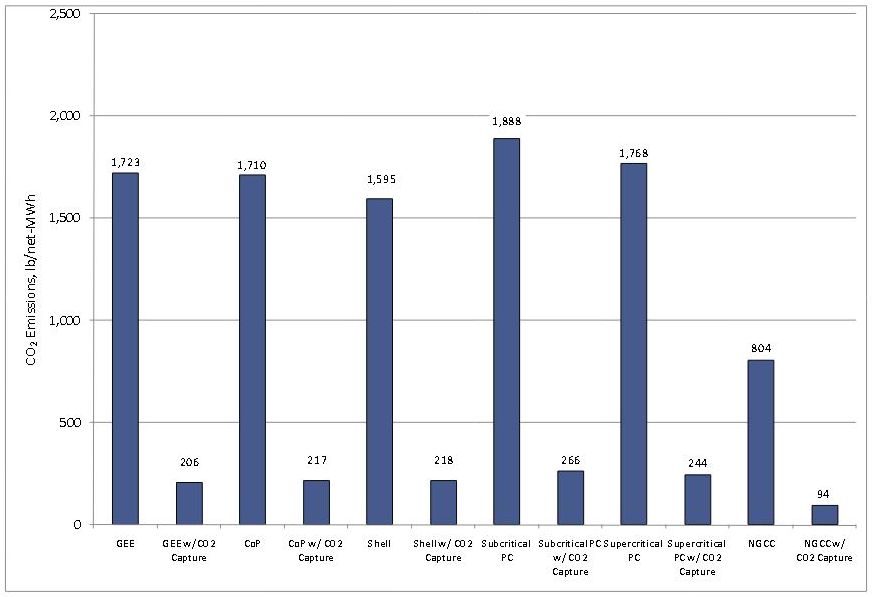
http://en.wikipedia.org/wiki/Coal_gasification#Environmental_impact_of_modern_coal_gasification�
May 27, 2014
Johan I agree with your basic math but I guess the claim is that every kg of coal that goes in to the plant is more fully burnt when first gassified = more efficient. However it does not make sense to say more CO2 per kWh but but rather more CO2 (and also more kWh) per kg of raw coal.�
May 27, 2014
stopcrazypp What you say makes sense, but ItsNotAboutTheMoney is saying more CO2 per kWh (not per kg of raw coal), which does not makes sense to me unless the gasification process has additional carbon added to it (not from the coal).�
May 27, 2014
ItsNotAboutTheMoney Ignore me, I re-checked and my info was wrong.�
May 27, 2014
Dan5 If that graph is correct, even if you adjust for transmission losses
just a rough eyeball of 220 lbs per MWH yield an equivalent emissions of 260 mpg car.
Even if you use a plain old regular coal plant the emissions are equivalent to a 35 mpg car.
Well, considering the Tesla is a sports car and its category (large luxury sedan), even 35 mpg equivalent emissions is great; the best case coal scenario is just plain amazing.�
May 28, 2014
pz1975 Tesla Motors Inc vs. BMWs i-brand: Tech vs. Weight
Joke of an article from Barclay's claiming that BMW poses a threat to Tesla for EV sales in the near and medium term. They fail to mention (other than in their chart) that the i3 has crap performance and the i8 is a grossly overpriced hybrid. They also state that demand for the Model S has plateaued in the US and Norway (wow!).
The comments below the article are way more factually correct and compelling to read than the article by these so-called 'experts'.�
May 28, 2014
PonoBill I wonder if the coal gasification numbers include the full cycle (ie--CO2 from the gasification process) or just the generation. And as always, there numbers rarely include all the other CO2 generation associated with extraction, transportation, construction, life cycle. The justification is that they are all similar so don't matter, but they probably aren't.�
May 28, 2014
Auzie The better fitting title to the article might be: "Tesla leaves BMW in the dust":wink:�
Jun 1, 2014
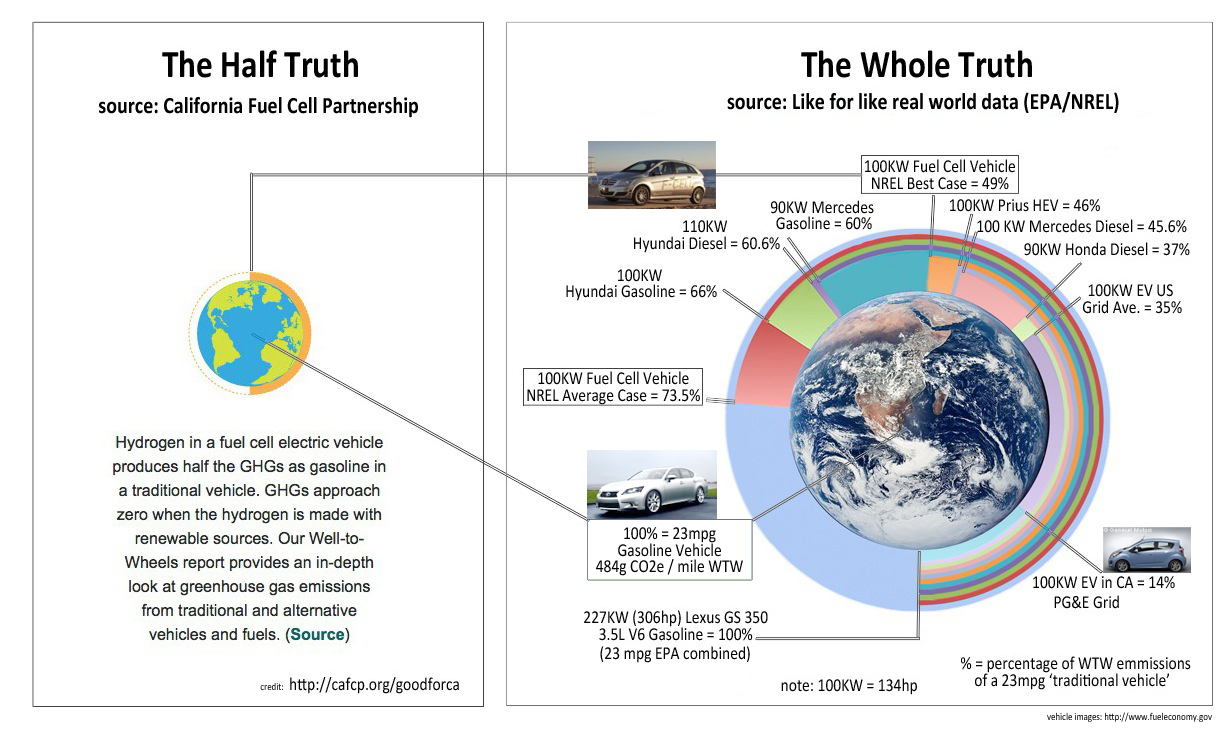
Julian Cox Updated Hydrogen Blog Post.
Alan
I have updated the blog with something I hope will be much more useful. Auto Industry Playing Dirty With Hydrogen, Time to Come Clean - Blogs - Tesla Motors Club - Enthusiasts & Owners Forum
 �
�
Jun 2, 2014
Pollux Sweet! Thanks!
�
Jun 7, 2014
Auzie Hybrids marching into the future
The Subaru XV Crosstrek Hybrid won't save much green
The EPA rates the standard model's fuel economy average at 28 mpg.
This hybrid gets 31 mpg, test driving results in 27 mpg.
Gas only Crosstrek power is 148 hp, hybrid ups that to 160 hp.
There is very little to differentiate this hybrid from gas only version.
Points of difference:
$3,000 extra in price
300 lb extra in weight
12 hp extra power
My thoughts: Why bother? �
�
Jun 10, 2014
Auzie Competition searching for best strategy
The billion $ bet of the auto industry
Very interesting article in a German newspaper, about the German car makers. I used Google translate so there may be incomplete or incorrect understandings. Here are few relevant tid bits:
European Commission imposes drastic carbon dioxide emissions reductions on European car makers fleets.
Car makers are aware that it means going away from gasoline. The chosen strategy of car makers such as Volkswagen (Audi parent), BMW and Daimler is expected to cost billions of $, and it is important to choose the correct strategy.
BMW is seeing poor sales of their i3. German gov wants 1 mill of electric cars by 2020. Last year, there were 6300 electric cars registered in Germany.
Audi is betting on plug in hybrids.
Daimler made some electric cars but only for Chinese market, with BYD.
The car makers dilemma is simple: make money with ice cars or make cars for the future. "The companies have to invest billions and explain to their shareholders why this is worth it all. Somehow, the old world of big petrol engines is easier."�
Jun 11, 2014
evme Just looking at fuel cell car costs and according to here:
Toyota to go hydrogen in December | The Japan Times
Toyota will charge 80k per car when it comes out and plans to lower to 30-50k some time in the 2020s. So yeah, a non-luxury branded car for 80k?
It is going to be a hard sell competing against the Tesla Model (T)E.�
Jun 11, 2014
jerry33 I don't think they are really trying for large sales numbers, they are just trying to put something out that will keep people purchasing their gas cars. It's a losing strategy in the long run but it will likely work in the short term.�
Jun 12, 2014
Mario Kadastik Well today I was at a sustainable future and Estonian startups event talking about Tesla and the gigafactory and there was present the CEO of SkeletonTech (Skeleton Technologies | Skeleton Technologies homepage). They make supercapacitors and are building up the manufacturing. Their current generation cells (3rd gen) were launched in May and they pack twice the energy density as compared to current market leaders. They also supply the cells to European Space Agency as well as big name car manufacturers like BMW etc. However the cells being top of the line right now pack 10Wh/kg.
During the discussions with the CEO he mentioned that Tesla did indeed contact them and asked when they could have 200Wh/kg cells, they answered likely never. And they are using carbon nanostructure materials that are developed and engineered in Estonian universities with loads of patents etc and do have the highest density (they can fit the same energy in a 4-5x smaller volume and mass than the current market leaders).
So from this I'd say that pure capacitor based cars are very very far off. Marriage of capacitors + LiIon batteries though can deliver a lot of kW power in an instant even from a small pack so smaller pack cars could have capacitor buffers.�
Jun 12, 2014
kenliles excellent review- thanks Mario; good to see Tesla is on top of that tech- not surprising given Elon's work there too�
Jun 24, 2014
Auzie Car that outsmarts speed cameras
The Genesis, a luxury Hyundai sedan designed to be a cut price alternative to models sold by BMW andMercedes-Benz, features a suite of high-tech driver aids that include an active cruise control system that will apply the brakes to maintain a safe distance to the car in front.
The car is capable of outsmarting speed cameras with a combination of GPS and braking technology.
It knows there is a speed camera there, it knows where the speed camera is and it will adopt the correct speed.
It will beep 800 metres before a camera and show the legal speed, and it will beep at you if your speed is over that.
Great, all cars need to have these smart systems.
�
Jun 25, 2014
green1 Won't work here... our speed cameras are in mobile vehicles that park in different places every day...�
Jun 25, 2014
TEG In case you (somehow) didn't know, Steve Jurvetson, Model S owner #1, and Tesla board member has strong ties to Estonia...
Video: Learning in Silicon Valley – Estonian experience - Estonian World
Event - innovative Estonia the Skype Phenomenon Silicon Vikings�
Jun 26, 2014
Auzie Well you are lucky. If you only have mobile ones than you have very few of them.
We have them everywhere, often integrated with traffic lights.
The worst ones are the fixed cameras which are strategically placed to trap people. These traps are when speed limit changes for no obvious reason, on a straight stretch of the road. Drivers go with the flow and they get caught by the camera, unless they are familiar with the specific location.
The other easy trap are school zones. These zones have different speed limits for different hours and on different week days, so drivers must be conscious of the time of day. I was caught few times on a stretch of the road that I drive on every day but early in the morning. On my day off I drove the same stretch during school hours. My driving habits take over and hence cameras got me.
The smart system that knows the position of speed cameras and adjusts the car speed accordingly would be very popular in cities, with large number of speed cameras. It would be a hot seller as it easily pays off for itself.�
Jun 26, 2014
green1 oh trust me, they know where to park, same types of places you describe, but they also get construction zones (even ones with no signs of construction... grrrrrrr) there's a small fleet of them, it gets to the point that any time you see any vehicle of any form parked on the side of a major road (could just be a normal stall or break down) everyone slams on the brakes, they're a hazard!
They have actually just added a few at intersections too though (we have about 40 red light cameras now that double as speed cameras)�
Jun 26, 2014
FluxCap Adam Jonas slams the door on FCV as the diversionary tactic that our friend Julian has written so well about here:
Short-Term TSLA Price Movements - 2014 - Page 523�
Jun 26, 2014
scaesare
If Waze can report accidents and police activity in real time, then mobile speed cameras are no problem...�
Jun 26, 2014
Robert.Boston ?Moderator's Note - Let's not wander too far off into the world of speed traps here, please.�
Jun 26, 2014
pGo Any idea if 2015 Hyundai Tucson FC solution without using compressed air for oxygen intake is an incremental solution or a game changer? Check FAQ for the details.
2015 Hyundai Tucson Fuel Cell | Hydrogen-Powered Vehicle | Hyundai
The lease of Tucson is impressive. However, not sure the actual cost and general availability. Does any know the cost of the core FC technology in vehicles? I read this morning the MS note, but I just don't want to be sleeping with that in mind.�
Jun 27, 2014
geturchiru Engadget quotes an article about a breakthrough in Hydrogen production.
Quote from the articles
�
Jun 27, 2014
ItsNotAboutTheMoney Of course, if you go to that page and read the acceleration line, you might not be so impressed:
Acceleration (0 to 62mph): 12.5s.
I wouldn't care personally, but I consider that a large part of the potential of PEV derives from its performance.�
Jun 27, 2014
kenliles "While our process is not yet optimized, we estimate that an ammonia decomposition reactor no bigger than a two-liter bottle will provide enough hydrogen to run a mid-range family car."
now there's a marketing projection for you- 'reactor' and 'family car' all in the same sentence. Tesla fires x 1000.
GM, Toyota... recall mavens, now marketing a move from fireball ICE fuels to 'reactors' of explosive ones.
Maybe they should just skip a step and go straight to- 'Top Fuel got nothin on us'-
Investor Marketing: 'automatically sends every accident straight to the moon, removing all evidence and recall requirements'
This is really going to be fun to watch�
Jun 27, 2014
Tedkidd Robert, Can you move those to a new thread? Good topic.
I just drove 2200 miles and was wishing for active cruise control that I could tell to always set my speed at 105% of the speed limit...�
Jun 27, 2014
Auzie Yes that is a hot topic, speeding and getting away with it. It is like having your cake and eating it.:wink:
My car has some attempt of speed warning signaling, but it only accepts fixed speed limit setting. That has very limited value as it is useful on some roads only.�
Jul 6, 2014
Auzie Electric buses and motorcycles
Electric bus builder Proterra raised more than $180 in a series of funding rounds.
Poterra buses are priced at $900k, vs $500k for conventional buses. The annual fuel savings are $50k.
Buses drive short fixed routes, with battery packs of 54kWh to 72kWh.
Harley Davidson released a prototype powered by a lithium ion battery. Range 53 miles, recharge time 3.5 hrs, 74hp, top speed 92mph.
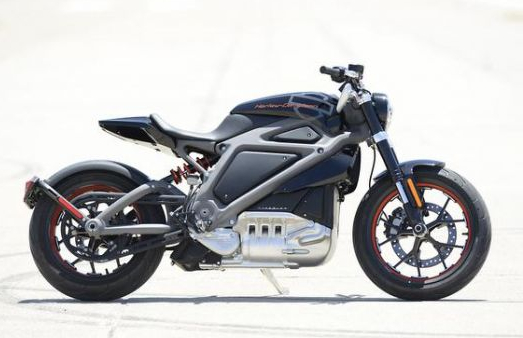
Buses and motorcycles are not in the same market as Tesla. Electric powered buses and motorcycles are positive development on many levels. They may easily become gigafactory customers.�
Jul 6, 2014
ZsoZso So 8 years to break even, 18 years to pay for itself, not bad. I would have invested even $200 in this myself if they asked me :wink:
[SUB]I think you left out a word after the figure...[/SUB]�
Jul 6, 2014
Auzie My fingers seek independence from eye control. Not ready yet.:biggrin:
I think local councils could help with ev buses adoption by either regulation or subsidies. I would not mind paying higher rates to contribute towards getting smelly noisy buses out of my neighbourhood. In cities, noise is significant pollutant.�
Jul 8, 2014
Auzie Fuel cells vs bev, automakers choice
Interesting article on Seeking Alpha, Tesla's fuell cell threat, by Randy Carlson.
The author presents interesting dynamics of fcv vs bev technology, from car makers perspective. Some highlights:
Fuel cells could be a less costly way for automakers to build clean long range cars. The savings are in the lighter weight of fcv car. Weight comparison:
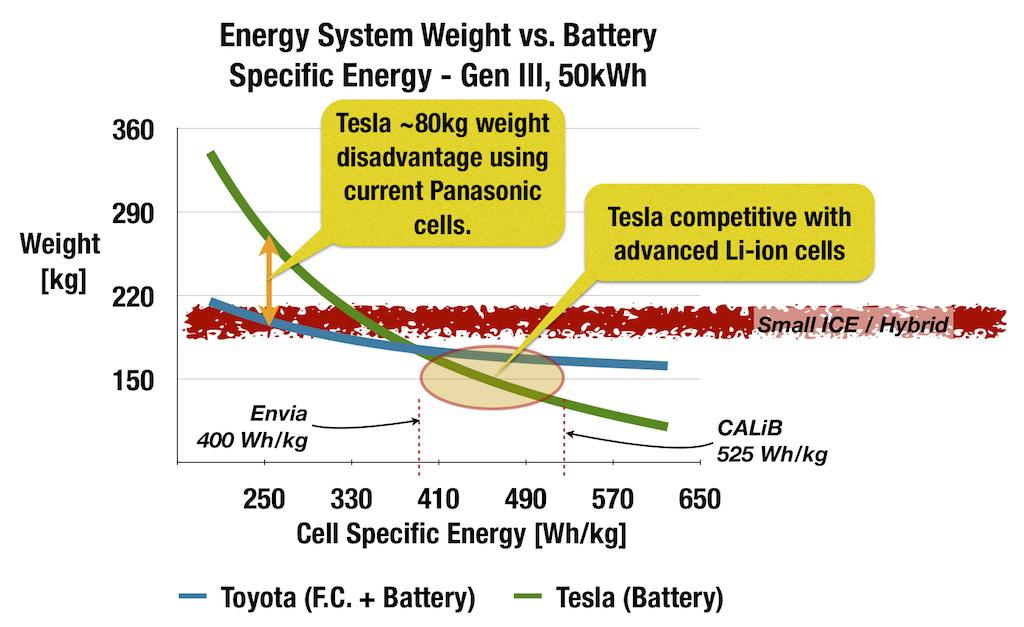
Making fuel cells may allow car makers to make more money than by making bev cars. That factor may prevail in the decision making process when deciding on green technology.
Complexity of fuel cells and their inferior technology are not the deciding metrics. Nor is the problem of making and distributing hydrogen. Oil companies have sufficient motivations to do whatever it takes to defend the gas station model for fuelling cars. Oil companies have money to put behind rolling out hydrogen fuelling infrastructure.
This dynamics might change if battery technology improves and makes bev weight comparable to fcv weight.
The relevant missing force in the article and analysis it presents are consumers. Car weight does not matter to drivers that much, it is not a deciding metrics. The consumers and their choices may well be the prevailing force in the battle of technologies.�
Jul 8, 2014
ZsoZso So the point is that lighter cars are cheaper to make. Well, I do not completely agree, because the cost depends on more than just the amount of raw material (which correlates with weight), the complexity is also a significant factor in the production cost and BEV wins in that over FCV.
Furthermore, apart from the production cost it is also important to be able to sell the vehicles at competitive prices. That's where FCVs will have a much bigger hurdle. Who wants to buy a car that is more expensive to fuel & maintain but has far less carrying capacity and performance than the alternatives, while also being much more dangerous (10,000 psi "bomb" under the seat) and very inconvenient to find fueling stations ?�
Jul 8, 2014
adiggs With this article, Randy Carlson has added himself into my Petersen bucket; these are the authors writing about TSLA that I no longer click through to see what they have to say.
This particular article I found no evidence that Randy has any particular understanding of the paradigm shift associated with EVs - that's an important part of my investment thesis, whether somebody is long or short the company. More specifically to this article, he sets up an argument that weight of the car is the primary determinant of expense and what car makers are most interested in. It's interesting that Ford hasn't replaced all that steel with aluminum in the F150 before now in that case.
He also manages to hint that Tesla is locked into their current battery chemistry, thus Tesla is somehow the worst of all worlds - an interesting way to view today's current reality.
The idea could be an interesting one to pursue - if somebody else pursues it, then I'm likely to read and learn more.�
Jul 8, 2014
stopcrazypp This is the thing that allows you to dismiss that chart completely. I have never seen a person not buy a car because it's too heavy, esp. for something like a 200 lb difference (about the weight of 1-2 people). Most people don't even know what their car weighs nor do they research it when buying.
The volume matters more because that determines your cargo and passenger capacity, and in this regard FCVs have no advantage (may be even worse in some cases).�
Jul 8, 2014
Robert.Boston And what's the acceleration on that hypothetical Toyota FCV?�
Jul 8, 2014
SteveG3 probably a rhetorical question, but pretty sure I've read 0-60 in 12 seconds. ~article I read today said the car can only seat 4.�
Jul 8, 2014
stopcrazypp 12 seconds is the Hyundai Tucson Fuel Cell. Toyota has indicated the FCV will be similar to the Prius, so expect around 10 seconds.�
Jul 8, 2014
hiroshiy In CES 2014 Toyota said it's "about 10 seconds". So your number is spot on.�
Jul 8, 2014
yobigd20 10 seconds to 60mph? Christ just shoot me. I've never driven a car that slow.�
Jul 9, 2014
RobStark 2014 Toyota FCV Concept | car review @ Top Speed
0-60 11 seconds est
Top speed 100 mph est�
Jul 9, 2014
qwk This is 100% BS. Anyone with a brain knows that the 18650 factor is the cell size, and has nothing to do with battery chemistry. Anyone can put whatever chemistry they want into the 18650 cell(as Tesla has done with the custom Model S cell).
I really don't understand why cell size even matters. It's like arguing about the shape of an ICE vehicle tank. Stupid.�
Jul 9, 2014
qwk Yeah, slow and expensive. They should just look at the sales of the Cadillac ELR.�
Jul 9, 2014
adiggs True qwk. But if none of us know anything, then arguing about cell size sure sounds impressive.�
Jul 10, 2014
Cobos Isn't it refreshing to know that if a theif steals a Toyota FCV he can also do as the theif in LA just did and hit a light pole in 100mph. Always fun together with a tank full of high pressure gas.
Cobos�
Jul 10, 2014
Auzie No car thief with self respect will go for that car.
Car thiefs only go for the best, why bother with something not worth a steal and fun ride�
Jul 10, 2014
Zapped I didn't know oil companies produce hydrogen gas.
What would it take to revamp a gas station or just build more ?
How much time does it take to fill up a hydrogen car and how big of a tank does one need to go 300 miles ?
Personally I like the heavier car. Always seems to be the survivor in an accident�
Jul 10, 2014
flashflood The other awful thing about hydrogen, even if you could magically solve everything else, is hydrogen embrittlement. The tiniest leak, and all the high-strength steel parts of your car slowly and silently turn to glass (metaphorically speaking). No thanks. This isn't just theoretical, BTW -- major structures like the Bay Bridge have had failures due to HE.�
Jul 11, 2014
Auzie Oil companies are in fuel supply business. They are natural fit to take over hydrogen supply business, in fcv world. Here is an extract from Wired archive, How Hydrogen Can Save America
Relevant extracts:
"Like the car companies, oil producers have already taken steps toward an oil-free future. Over the past 15 years, corporations like Shell and Exxon have ceded their leadership in oil production to a dozen state-owned enterprises in countries such as Venezuela, Brazil, and Norway. Instead they've focused on adding value farther down the supply chain by refining crude into gasoline and distributing and selling it through filling stations. They know they could play the same role in a hydrogen economy, which is why Shell and BP have invested hundreds of millions of dollars in hydrogen storage and production technology. Indeed, BP, formerly British Petroleum, has rebranded itself Beyond Petroleum.
The major oil companies are already extracting hydrogen from gasoline for industrial uses at nine refinery complexes throughout the United States. With a little push, these plants could serve as hubs for a nascent hydrogen-distribution network.
Converting filling stations is bound to cost billions of dollars over several decades. But it should cost relatively little to retrofit clusters of stations in proximity to both a hydrogen-producing refinery and a population center where fuel cell vehicles are sold. Oil companies could meet initial demand by trucking hydrogen from refineries to these stations. As the number of fuel cell vehicles on the road rises, stations that aren't served by refinery hubs could install processors, called reformers, that use electricity to extract hydrogen from gasoline or water. The White House should ask for $5 billion - roughly $30,000 for each of the nation's 176,000 filling stations - to get the ball rolling.
In the long run, a pipeline piggybacking on existing natural gas pipelines might deliver most of the fuel, either from high-volume plants or more widely distributed facilities. The administration should set aside $10 billion for incentives like interest-free loans to encourage oil companies to construct a national hydrogen pipeline. It might also grant five-to-ten-year monopoly rights to pipeline builders."
�
Jul 12, 2014
Mitthrawnuruodo Hey Julian, obviously amazing work. I have skimmed this thread repeatedly but recently was in a debate over Tesla vs fuel cells. I have zero background in the sciences so I read all your available work to get up to speed. I did so with as critical an approach as possible as I am sure you would agree lends a hand to building my own strongest possible argument. This might just be me, but the weak part in your illustration for someone in accounting and IT like myself is understanding how fuel cells are actually not clean. When I searched this I mostly came up with articles stating verbatim "hydrogen fuel cells release zero emissions". I ended up finding the following excerpt from Hydrogen vehicle - Wikipedia, the free encyclopedia and am going to use it as a starting point, but I am sure there is much stronger evidence elsewhere
"Volkswagen's Rudolf Krebs said in 2013 that "no matter how excellent you make the cars themselves, the laws of physics hinder their overall efficiency. The most efficient way to convert energy to mobility is electricity." He elaborated: "Hydrogen mobility only makes sense if you use green energy", but ... you need to convert it first into hydrogen "with low efficiencies" where "you lose about 40 percent of the initial energy". You then must compress the hydrogen and store it under high pressure in tanks, which uses more energy. "And then you have to convert the hydrogen back to electricity in a fuel cell with another efficiency loss". Krebs continued: "in the end, from your original 100 percent of electric energy, you end up with 30 to 40 percent."[SUP][99][/SUP] In 2013, Volkswagen signed a $60 million to $100 million engineering services deal with Ballard for the development of fuel cells to move ahead faster with new power transportation technologies.[SUP][100][/SUP] The Business Insider commented:Pure hydrogen can be industrially derived, but it takes energy. If that energy does not come from renewable sources, then fuel-cell cars are not as clean as they seem. ... Another challenge is the lack of infrastructure. Gas stations need to invest in the ability to refuel hydrogen tanks before FCEVs become practical, and it's unlikely many will do that while there are so few customers on the road today. ... Compounding the lack of infrastructure is the high cost of the technology. Fuel cells are "still very, very expensive".[SUP][101]"
Hopefully this is just my own failure to catch on to your own logic. Nevertheless, my goal of demonstrating Tesla as the path of least resistance to an alternatively powered vehicle fleet has been greatly aided by your efforts. Thanks Again!
[/SUP]
?�
Jul 12, 2014
ZsoZso Your quote is focusing on the theoretical argument behind hydrogen as green fuel, whereas it is supposedly produced from water by electrolysis using green electricity -- in that scenario the efficiency is very low so not competitive with BEV.
However, in the real life, what hydrogen is available at those few pumping stations is all made from fossil fuels (oil and natural gas) in a chemical process which produces CO2 as a byproduct. Julian has calculated that the amount of CO2 per mile traveled in an FCV is comparable to an ICE vehicle CO2 emission. That's the main point where it is not a clean fuel source.
Oh, BTW, producing H2 from fossil fuels is much more economical than splitting water -- that is why such calculations are only theoretical, while what hydrogen is produced by the industry and available for use in commercial vehicles is all originating from fossil fuels at the cost of lots of CO2 emissions.�
Jul 12, 2014
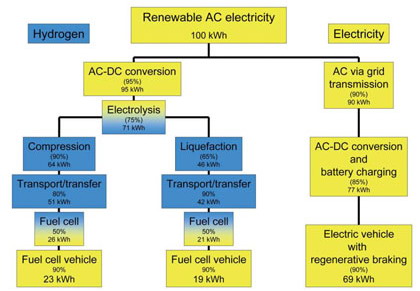
evme The cheapest way to make hydrogen is through fossil fuels, and that is how it will be made, using water is what they want to sell people on but it is not going to happen. Even when made with renewable energy, hydrogen is not competitive:
 �
�
Jul 12, 2014
Auzie Great presentation, thanks.
Further bev efficiencies can be derived from skipping grid transmission losses and ac/dc conversion loss by wiring solar directly into battery storage.�
Jul 12, 2014
William13 @evme, I love your diagram. However the concerns are always with the efficiencies. Obviously to us BEV is better. Wiki says there is a 95% efficient electrolysis.�
Jul 12, 2014
evme
You know what I hate? When wiki articles make a claim and when you go down to the source link the information is behind a pay wall. I hunted down the study and it can be found here:
A comprehensive review on PEM water electrolysis - ResearchGate
Doing a quick skim, I see nothing that suggests 95% efficiency. (you can check yourself by clicking the view button)�
Jul 13, 2014
William13 I read the article. No mention of efficiency. Reference 203 would have efficiency but I cannot access.�
Jul 13, 2014
igotzzoom I'd feel more comfortable buying a Tesla than buying a VW, a company that's been in business for decades. Probably a BMW too, for that matter. I've seen too many issues with German cars to believe in their myth of invincibility.�
Jul 13, 2014
evme It is there, it says 67-82% efficiency. Again, not sure where the wiki got 95% efficiency. My guess is it was put in by a pro-fuel cell person and since the source is behind a paywall no one would question it. But once you look up the source it is clear the numbers are wrong.�
Jul 14, 2014
hiroshiy Just FYI (don't beat me!)
商用��水素ステーション開設 岩谷産業�燃料電池車�� - スマホ版 - 47NEWS(よん��ニュース)
Iwatani, LP gas and industrial gas provider in Japan, launched the first commercial H2 fueling station for FCVs in Hyogo Japan. The cost is said to be $5M.�
Jul 14, 2014
VolkerP that number made my eyes pop out. $5m buys enough superchargers to cover all of France, or Spain + Portugal.�
Jul 14, 2014
hiroshiy Yeah and that cost is enough for just one pump.�
Jul 14, 2014
Auzie Hi hiroshiy
Thank you for bringing the news from the land of the rising sun, great to have you here:smile:
Liquified hydrogen is very expensive trouble, here is MSDS for it.
Extracts from technifab:
"Liquid Hydrogen (H2) typically has to be stored at -423�F (-253�C or 20 K). The temperature requirements for liquid hydrogen storage necessitate expending a great deal of energy to compress and chill the hydrogen into its liquid state. The cooling and compressing process requires energy, resulting in a net loss of about 30% of the energy that the liquid hydrogen is storing. The storage tanks are insulated to maintain temperature. Liquid Hydrogen is often stored at higher pressure so significant reinforcement is used.
The margin of safety concerning liquid hydrogen storage is a function of maintaining tank integrity and preserving the temperatures that liquid hydrogen requires. Combine the cost or energy required for the process to get hydrogen into its liquid state and the cost of tanks required to sustain the storage pressure and temperature, and liquid hydrogen storage becomes very expensive compared to other methods."
Pressure vessels are likely to have limited life and are subject to regulations in most countries. That adds to running costs of these stations.
I am curious about the unlucky neighbours, whose property value could plummet due to unfortunate location.�
Jul 15, 2014
hiroshiy Japan plans to import LH from Australia, where a lot of brown coal is mined. Kawasaki Heavy Industries is developing LH tankers for this purpose. Generate hydrogen from brown coal, liquidify it to LH on site, then transfer it to Japan. They plan to collect CO2 and fill the underwater cave from LNG mining with it.
So FCV or move from LNG to LH or high pressure H2 seems to be an energy security related issue for Japan.
I agree that hydrogen filling station would negatively affect property values nearby.�
Jul 15, 2014
renim won't happen from brown coal, they can't even sell pellets of brown coal / iron ore blend (a sensible product)
liquid hydrogen from Australia, no, its less risk to just sell the coal or LNG
China, they might sell Japan and Korea liquid hydrogen. and use Australian/Indonesian coal / gas to do so.�
Jul 15, 2014
hiroshiy Thanks, @renim for the info. I'm no expert here, so appreciate your insights. What I heard is that since brown coal is unstable they plan to place the factory directly at the mining location so that mined coal can be spent as soon as mined.�
Jul 18, 2014
SBenson Does anyone have any thoughts on this
nanoFLOWCELL-powered Quant e-Limo approved for german road trials | Fox News�
Jul 18, 2014
Zzzz... Love the video: QUANT e-Sportlimousine by nanoFLOWCELL AG
As for flow battery, those are essentially a rechargeable batteries, not a fuel cells. Well one could theoretically refill the liquids, but in absolute majority of cases recharging is an option.�
Jul 18, 2014
flashflood I hope it all scales. Battery technology aside, it's a gorgeous car.�
Jul 18, 2014
pGo "A flow-cell of equivalent weight to a lithium-ion battery has five times greater performance.
With a 120 kilowatt-hour flow-cell, Quant claims a range of 372 miles or more. That seems par for the course when compared to the EPA-rated 265 miles of an 85 kWh Tesla Model S, but one assumes the e-Sportlimousine is a great deal lighter thanks to those flow cells, which are presumably smaller than the Tesla's batteries."
Looks super promising if it works!�
Jul 18, 2014
Zapped Wow, fantastical
For a second there I thought it was going to morph into a TESLA, LOL�
Jul 18, 2014
Zzzz... Feels like too good to be true. In most battery breakthrough cases there is a fine print if one bother to look closely enough. Some chemistries operate at 70[SUP]o[/SUP]C, and got trouble to operate at room temperature, never mind freezing one. Some have got high self discharge rate, some got very low power density. Some waste energy, for example one need to put 4 kWh for every 3 kWh battery would be capable to discharge. And to many just degrade too fast. In case of this one there absolutely zero real information, and too much marketing. "Cold burning" <-- this marketing gem is even more impressive than the video.
But flow battery idea is an interesting one. For example it should be possible to keep liquids at low level, making car lighter and faster for everyday use and add more range when it needed. And ease of repairing - change electrolyte liquids OR keep them but replace cell part...�
Jul 19, 2014
Zzzz... Well Benz comment probably worth reading. After researching this nanoflow thing a little bit more I fell into same conclusion. flowcell power maybe the next generation power source........�
Jul 30, 2014
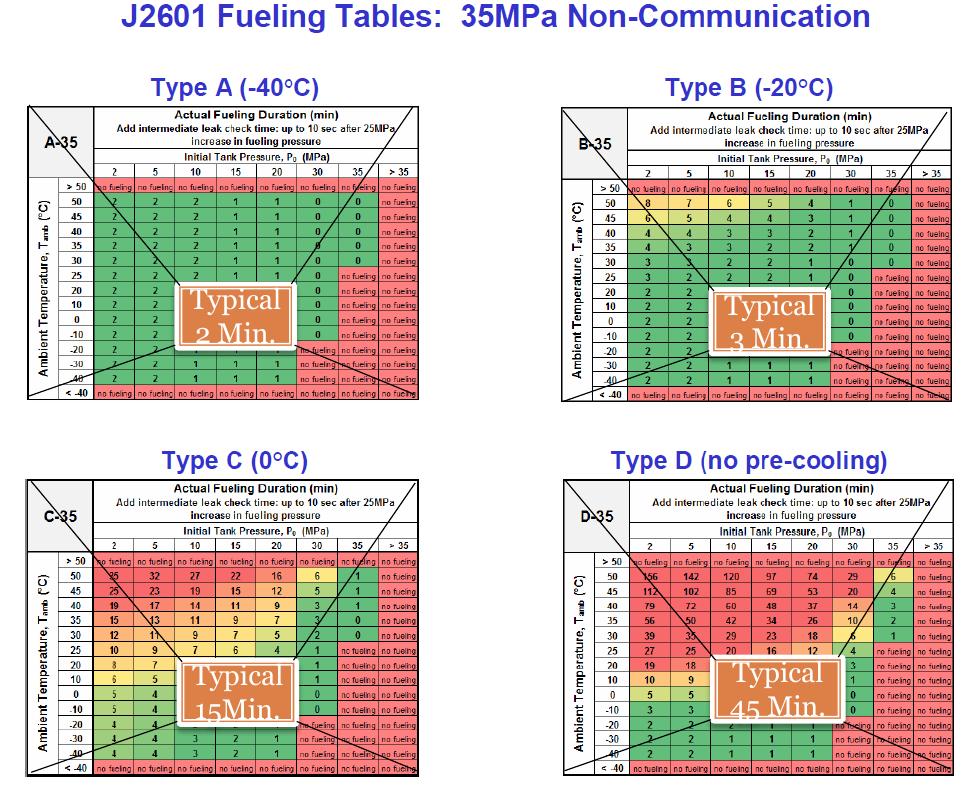
renim 35 MPA refuelling times
70 MPA refuelling times
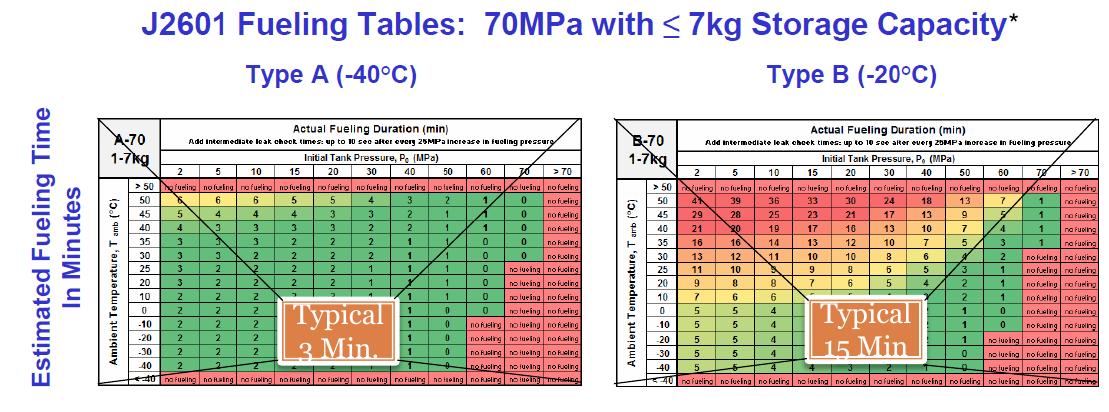
There is a direct relation between pre-cooling and fueling speed.
Type �A�-Dispenser has -40Cpre-cooling (70&35MPa)
Type �B�-Dispenser has -20Cpre-cooling (70&35MPa)
Type �C�-Dispenser has 0Cpre-cooling (35MPa only)
Type �D�-Dispenser has no pre-cooling (35MPa only)
One of the reasons for the hydrogen's high infrastructure costs is the need for pre-cooling of H2 if it is to be used for 70 MPa tanks. The heat of compression would take the tank temperature into dangerous temperatures (remember, these tanks they have a polymer matrix, never to exceed temperatures of 85c))
Japan is targeting 100 H2 stations at about $4.8 million each, before heavy subsidies, and loosening regulations regarding materials and locations. Even if they get 30% off after the first 100 stations, at $3million per bowser, that is not economically sustainable.
Liquidfied H2 is already pre-chilled, but you can just sense the costs of handling this stuff is serious.
�
Aug 3, 2014
renim apart from the obvious cost of infrastructure, this also affects vehicle cost
the tanks need to be validated for -40c to +85c rapid cycling, remember the H2 tanks are fibre composite + have a liner
fibre composite doesn't like 85c temps,
liners have different co-efficient of expansion to fibre composites.
technically, it is possible, but it adds more cost.
since batteries contain more miles per volume than H2 tanks, it just adds to the question, why bother with Hydrogen�
Aug 4, 2014
Auzie Interesting information renim, thanks for posting.
FCV do not make sense on so many levels.
For reasons that are hard to see or understand, Toyota leaders have decided to launch FC car next year. They most likely expect to realize some economic benefit to Toyota with this move, in ways that may be hard to understand from the outside.
Here is Toyota vision, from their website:
Through improvements of conventional technology, as well as pioneering efforts in the application of new technologies, Toyota is taking
great steps to develop eco-cars which will help us become a low carbon society.
It is interesting that the vision starts with conventional technology improvements. Pioneering efforts in the application of new technologies come second. Toyota seem to want to stick to what they do best and what they make money on. That is easy to understand. I am just not sure how going into FCV works for them. I would be very surprised if Toyota leaders ventured into something that did not make economic sense for their business.
For comparison, here is Tesla Motors mission statement:
To accelerate the advent of sustainable transport by bringing compelling mass market electric cars to market as soon as possible.
Very different visions drive different business decisions.�
Aug 4, 2014
hiroshiy Japan has no natural resources thus relying on importing them 100%. Not like the States Japan can't just "not rely on imported oil". That's one of the big reasons to push for H2 infrastructure. We eventually import more LNG and maybe a lot of liquified H2 from non-middle eastern countries.
At least, that's the reason Japanese government tries to push H2 infrastructure in the long term, as a backup to oil and LNG.
That still doesn't justify Japanese global car manufacturers' direction to FCVs though. Maybe big oil as many of you mentioned.�
Aug 4, 2014
Matias But you can easily burn natural gas in ICE.
Natural gas vehicle - Wikipedia, the free encyclopedia
Why refine NG to H2, when you can use NG directly.�
Aug 4, 2014
glhs272 I still don't get it. H2 is just an energy storage medium (and a poor one at that). You can't drill for H2. The energy has to come from somewhere (imported oil, natural gas, etc.).�
Aug 4, 2014
ItsNotAboutTheMoney But then you'll still have ICEs.
One of the understated effects of FCV would be a move to an electric drivetrain. It's why I consider the idea that HFCV is a big fossil fuel conspiracy to be complete bunk. Successful FCV would make it easy for manufacturers to vary the BEV:FCV ratio according to the state of technologies and supporting infrastructure and that ratio would naturally improve over time because home refueling is both cheaper and more convenient.�
Aug 4, 2014
hiroshiy @Matias: LNG also should be imported and same as gas. H2 advantage is less CO2 at least in Japan, which I personally think is a very selfish idea
Glhs272: Japan wants somebody to burn coal or something to generate electricity, crack water to generate H2, hide CO2 in somewhere else, liquify H2 and send them over to Japan. Some government officials seems to think about using brown coals, which still can be used to generate electricity but hard to move/export.�
Aug 4, 2014
nwdiver IMO any fuel source should have to demonstrate cost effectiveness (<$0.10/mile Well2wheels) from a carbon neutral source to qualify for CARB. In other words... until the cost of electrolysis is brought down, FCVs should not receive any credit.�
Aug 4, 2014
ItsNotAboutTheMoney That is illogical. The whole point of the ZEV credit system is to force manufacturers to invest in new technologies. But according to your rule, they wouldn't be able to invest in technologies until they're cheap.
Besides, even at $200/kWh, Tesla could be producing batteries that end up costing consumers more than $0.10/mile. Expensive technology with cheap fuel doesn't help.�
Aug 4, 2014
Yggdrasill CO2 is a global problem, not a local problem, so it's completely pointless to shift it around from one place to another.
Electric cars could help Japan become self sufficient with energy, while this is a lot more difficult with hydrogen. Assuming the energy comes from solar and wind, you need 2-3 times as much energy per kilometer going the hydrogen route. That means you need 2-3 times the amount of solar panels and wind turbines. Plus all the infrastructure, of course.
- - - Updated - - -
I sort of agree with nwdiver. Expensive technology with cheap fuel has potential, expensive technology with expensive fuel doesn't.�
Aug 4, 2014
renim Brown coal is similar to peat, so similar that sometimes peat is called brown coal, its basically old wood with lots of water in it, perhaps 50% water, that�s a waste to transport, and it reduces thermal efficiency in powerplants, so it a low grade fuel, but since H2 production requires water then brown coal is an appropriate source for H2. Brown coal has a far lower ash content than black coal, in that regard brown coal could be called a clean fuel.
speaking of coal, earlier hydrogen powered vehicles did exist, it was called 'Town Gas' Rolling [Gasified] Coal: Gas Bag Vehicles | The Truth About Cars
China is major user of town gas (modern Synthetic gas is about 60%H2, 40%CO) my guess is that a network of 350bar H2 station would probably cost about 1/10 the price of its equivalent in a developed country with 700bar H2 stations. China already does similar using H2 as a chemical feedstock.�
Aug 5, 2014
Auzie That is true, Japan does need to import energy and Japanese gov might want to push H2 infrastructure.
Toyota might be happy with making FCV for domestic market only and selling ice to global market. In that way they can have their cake and eat it too - it seems to me that Toyota just wants to keep making ice, however they have to present some sort of effort towards green cars. Not to present such effort might be too embarrassing and confronting.�
Aug 5, 2014
renim Regarding energy density Li-ion cell vs H2 tank
current 18650 Li ion about 680 wh/l, at Honda Fit EV nominal EPA efficiency (82miles from a 20kWh battery) thats is
2.78 miles/litre (model - today's Tesla/Panasonic Li ion if a Honda Fit EV)
current H2 tank, Honda Clarity Hydrogen Fuel Cell Vehicle, interior water volume is given 170 litres, volume for shell is assumed as 20% for 350 bar tank, so that is 204litres
231miles/204 litre is 1.132miles/litre
So todays 350bar H2 tanks have less than half the energy density (expressed in miles - ie after fuel cell conversion efficiency) as todays Li ion tanks
lets model a 700bar H2 tanks, ie double the H2 (and range) but larger shell to hold the same water volume
interior water volume is given 170 litres, volume for shell is assumed as 40% for 700 bar tank, so that is 238litres
462miles/238 litre is 1.941miles/litre
that is, 700bar H2 tanks carry less miles per unit volume than today's Li-ion
and these calculations are conservative, they ignore the space taken up but the necessary secondary storage of a battery or capacitor in a hydrogen vehicle.
this has several implications, one is,
to swap part of battery for H2 storage would reduce, not increase the range of a EV (opposite of common view)
H2 storage would need to be in addition to battery storage, for it to increase the range of a vehicle (obvious, just like adding more battery increases the range of an EV)
there is more to comment, from a costing perspective the carbon in both li ion and H2 tanks can be compared as the fuel tank cost, if the cost of the carbon is higher per mile stored, then its very difficult to have a H2 fuel cell vehicle being cheaper than a BEV in regards to range.......�
Aug 5, 2014
Johan Thanks for very interesting calculations. I guess if you did the same calculations for weight, not volume, you'd come up with basically the same result.�
Aug 5, 2014
hiroshiy Hmm, isn't it 170 liter tank inside, not the shell? I thought 70MPa 170l tank would have 119K liter of H2 nominal...??�
Aug 5, 2014
stopcrazypp Not for weight. 5kg of hydrogen is enough for around the same range as the 85kWh Model S. Of course given the batteries deliver electricity directly, for the fuel cell system you have to include the air intake, fuel cell, tanks, exhaust, etc to be fair, but even then you still end up with lower weight for the hydrogen system.
That's why hydrogen might be a good fit for applications where weight matters more than volume (like long haul trucking for example). However, for passenger cars the volume is limited, which is why hydrogen cars do not have drastically more range than the Model S (when measured apples to apples).�
Aug 5, 2014
renim weight wise, H2 tanks are significantly superior to Li ion for miles, (though not for acceleration)�
Aug 5, 2014
renim It is a hydrogen storage volume of 171 litres.
The outside shell is extra
alternatively Hydrogen tank capacity is 171 litres. Honda Worldwide | FCX Clarity
so the outside shell is extra
If the calculations are done in reverse, starting with a Tesla, making a Tesla in a Hydrogen configuration would reduce range.
I suspect Hyundai's pricing is more realistic than Toyota's and Hyundai prices their HFCV in Korea at about US $145k (before a $60k Korean Government subsidy)
Korea's government subsidy makes Japan's Hydrogen subsidy look paltry.
back to the costing approximation, the H2 tank/Li ion anode both supply the 'fuel' for the cathode/fuel cell
if the li ion anode is cheaper than the H2 tank and looks set to remain that way forever (no crossover)
and if the li ion cathode is cheaper than the platinum fuel cell and looks set to remain that way at desirable power levels forever (no crossover)
then the only way for HFCV to be cost competitive is for H2 to be cheaper than electricity to the extent it can subsidise the H2 Fuel Cell and tank. Which is highly unlikely. forever
there is a trend for hydrogen fuel cells to get cheaper, but the end price point is still more expensive than Li ion BEV.
There is also one more key aspect.
Markets are not democracy.
Democracy - one man - one vote. The people without their own parking may expect 'their' subsidy to go to a technology that appears to continue filling up away from home.
The Market, the new car market, the more expensive the car, the greater the occurrence the owner has their own parking.
The market growth will continue to favour BEVs, Hydrogen vehicles will attract massive government subsidy in many jurisdictions, but disappoint in demand.
In a way both hydrogen and brown coal are similar, that is they are low grade fuels compared to their counterparts (H2 vs CH4 and brown coal vs black coal)
- - - Updated - - -
perhaps I misunderstood you.
for volume
the inside an 18650 battery is called a jellyroll (named after a similar looking piece of food). The jellyroll can be compared to the inside volume of a H2 tank.
The outside of a 18650 battery is what is comparable to the outside of a H2 tank.
yes 70MPa 170l tank would have 119K litre H2 atmospheric, but what is modelled is how many miles can a comparable vehicle run per unit of car space taken up by the 'fuel tank'.�
Aug 6, 2014
Ampster In the case of the Tesla you might have to consider the volume of cooling that might add 10% volume to battery pack. Does the shape of th H2 tank have to be round or cylindrical? If so that can present some space challenges compared to the flexible shape of a Tesla battery pack.�
Aug 6, 2014
geturchiru These tanks have to be cylindrical as that is the most stable form for storage.�
Aug 6, 2014
eepic Saw this article dated yesterday regarding Tesla vs Toyota in FCVs, good read. Even cites the cleantechnica article by Julian Cox
https://thinkprogress.org/climate/2014/08/05/3467115/tesla-toyota-hydrogen-cars-batteries/�
Aug 6, 2014
hiroshiy @renim: thanks, I now understood. You were talking about miles per volume.�
Aug 7, 2014
renim Hiroshiy
A lookback at Japan's Hydrogen and Fuel Cell demonstration project's vehicles
http://www.jari.or.jp/portals/0/jhfc/data/pdf/fcv.pdf
Toyota - anti EVs, strong support for Hydrogen
Nissan - used the HFCV motor etc for 2010-2012 Nissan LEAF (ie commercialized BEV instead) circa 2017 will have double range Infiniti EV perhaps LEAF 2 also, fuel cell stack provider for Daimler and Ford for 2017. Ie happy for both EVs and HFCVs
Honda - less certain about HFCVs or BEVs, was key HFCV initiator, reused Clarity's motor in Fit EV
Daimler - has a HFCV program and a parallel program for Tesla powered B-class + program for other Smart EV. Outsourced Fuel Cell stack production to Nissan, Ie happy for both EVs and HFCVs
GM - Voltec is now, will have hydrogen for appearance.
Different companies have different ideas about BEV/HFCV but the success of Tesla EVs and Mitsubishi PHEVs has altered the outlook.�
Aug 7, 2014
CHGolferJim Any chance of separating the HFC discussions into a separate thread? I'm interested only in the other kinds, LOL.�
Aug 7, 2014
Robert.Boston I hope you'll understand that I'm reluctant to sort through 400 posts to try to create such a thread.�
Aug 7, 2014
renim Of the 4 main asian car makers Toyota, Nissan, Hyundai, Honda who are the natural candidates for battery centric vehicles, only Nissan is willing to sell an EV that has their DNA.
Toyota uses Tesla tech and plans to discontinue as soon as they can, for the arrival of hydrogen fuel cells
Hyundai lets Kia sell the EV, Hyundai is hydrogen fuel cell vehicle brand
Honda leases a Fit EV (no sales, lease to crush) not even Chademo for USA
Nissan - 3 battery factories globally, more than 3 EV factories, etc etc etc, installs Chademo etc etc serious corporate expectation that the future is battery electric, and the future has started now
The industry has noticed how Mitsubishi has success with their Outlander PHEV, and those learnings are assimilated. Tesla competition will be PHEVs (or EREV in marketing speak)
unless a future EPA 150mile range Nissan/Infiniti is the definition of competition, there is no BEV competition for Tesla.
Hyundai/Toyota/Honda seem to authentically consider hydrogen as their response to long range EVs. good for Tesla shareholders, but bad for getting off internal combustion vehicles�
Aug 8, 2014
Auzie Nissan's cutting edge manufacturing technology
Some nice pics from Nissan's UK plant in Sunderland, UK.
Highly trained workers paired with finely tuned robots manufacture up to 113 cars per hour.
The Qashqai, Juke, Note and the Leaf are all produced in the plant. The models are built alongside each other.
1 of 88
�
Aug 8, 2014
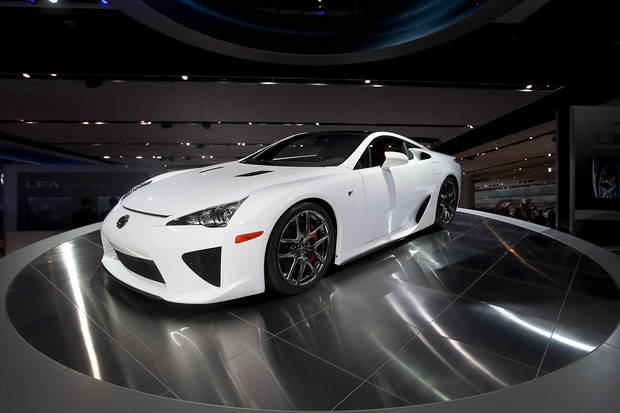
Auzie Toyota announces possible attempts to upscale its brand with new expensive Lexus
Toyota's VP Mark Templin told reporters that Toyota may build successor to Lexus LFA, which had a run of 500 cars in 2 years, at a price of $375K.
LFA was a long term project that motivated Lexus engineers and improved the brand reputation.
The long term plan for a successor model has Toyota's president's backing.
A second LFA isn't imminent, and another generation could be about 30 years in the future.
To me Toyota attempts to upscale its brand by making expensive cars do not seem that effective. Once brand image takes hold in consumers consciousness, it takes a lot of effort to shift that image, especially upwards. Going down the scale seems to be much easier.
 �
�
Aug 8, 2014
pGo That reminds me the Chris Porritt move made me think that Tesla would soon work on a super car. Now is that where the r&d going ?�
Aug 8, 2014
Auzie Not a competition to Tesla, but great achievement in Oz land
Engineering students at the University of New South Wales, Sydney, built a Sunswift eVe hybrid solar car. The car travelled over 500km at an average speed of more than 100km/hr on a single battery charge.
The eVe seats two people, has a carbon fiber body (661lb), and solar panels. Vehicle claimed range is 800 km on a single charge, top speed 140km/h.
Specifications:
- Exterior: TeXtreme Carbon fibre constructed by Core Builders.
- Solar Panels: C60 Sunpower silicon solar cells. High efficiency (22.7%) and lightweight.
- Encapsulation: Solbian high performance encapsulation.
- Motor: 2 Maran in-hub motors developed by the CSIRO. Low power high efficiency by electric car standards.
- Battery: Panasonic NCR 18650 A and B.
- Suspension: Front Bilstein Ohlins. Rear TTX25 spring damper.
- Wheels: Front: GH Craft carbon front wheels. Rear: 7075 Aluminium wheels.
- Tyres: Michelin Radial X tyres specifically designed for solar cars.
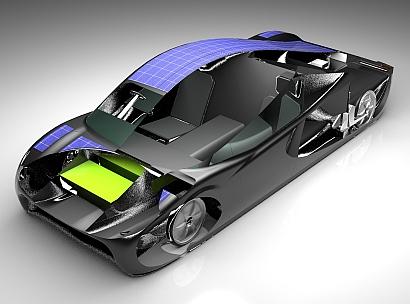
![[?IMG]](https://lh3.googleusercontent.com/blogger_img_proxy/AEn0k_txyfcFVMjGx7J2Ta_Ql_yhhAJS-zdhl8rUEpRbuGYsMGTumELnRcxP5eO0-_9FlHKfgHGxF6JEdr1P8nRIt2Y3cw=s0-d) �
�

Không có nhận xét nào:
Đăng nhận xét