Jun 12, 2016
22522 Sometimes incentives are abused, or gamed, which does not seem right. Is manufacturing and delivering as many cars as possible inside the credit window abusive?
The $7500 EV tax credit is there to create low cost production capacity of EVs, with the goal of competitive pricing after the incentive goes away. The behavior most consistent with that goal is to build a factory that can satisfy the entire demand inside the full rebate window. This maximizes production capability and efficiency, and is the best path to a "when we are all done" price that is as low as the credit incentivized price, say $26,000 dollars.
The goal of the program is a Model 3 that is profitably sold for $26,000 without incentives. Tesla is not supposed to just close up shop when the incentives expire. Manufacturing efficiencies are supposed to have improved to where $26,000 is the market price - cars move at that price without government help.
Tesla should be planning price reductions to match the incentive phase out schedule.
With that in mind, it is in Tesla's and the public's best interest to deliver as many cars as possible in the 2 quarter window of the $35,000 price point. They make $9K more per car than they do after they honor the price reductions implicit in the bill.
This says they produce 400,000 cars in 6 months. Then lower the price. It sounds like Henry Ford.
Does this sound right to you?�
Jun 12, 2016
Tiberius Keep dreaming.�
Jun 12, 2016
Woosie No, Tesla (I expect) to keep prices on the Model 3 to stay the same but add features as time goes on.
Tesla would never disclose actual procurement, design, manufacturing and sustainment costs as these costs are variable and are necessarily less than purchase prices by consumers.�
Jun 12, 2016
msnow Ain't gonna happen.�
Jun 12, 2016
kort677 no�
Jun 12, 2016
FirstSea The S didn't drop in price, sure the batteries are getting cheaper and so is production, but that's that.
The 3 won't drop in price, but battery upgrades will be cheaper.
The 3 will fund a $25k Tesla just as the S and X funded the 3.�
Jun 12, 2016
22522 To make demand high, Henry Ford had a pattern that worked: Price the car at a point where people can afford to pay.
The 3 with a tax credit is $26K.
When the tax credit is gone the 3 should be $26K.
A 3 at $26K will deliver the kind of demand that Tesla is looking for.
This seems obvious to me. You have a good design. Make it.
What am I missing?�
Jun 12, 2016
msnow What you are missing is that at $35k the demand far exceeded expectations. That seems to be the right price point with or without the tax incentive.�
Jun 12, 2016
Tiberius You're missing that it's pretty stupid to sell a car for $26k when people will gladly pay $35k+ for it. Tesla is a great company with honorable ambitions but at the end of the day, a company's job is to make money.
When UNICEF starts making cars we'll let you know.�
Jun 12, 2016
22522 Run a credit check on the 400,000.
They can't pay without the $7,500 credit.
They mean well, and they are rooting for Tesla.
The observed demand is at $26,000 for a 3. [It is a "with the tax credit" demand]
Don't kid yourselves. The price needs to be $26K to keep the factory running.�
Jun 12, 2016
EinSV As @FirstSea said, Tesla will be introducing a less expensive car that some refer to as the Model 4. Elon Musk says Tesla�s next car will be even cheaper than the Model 3
It has been Tesla's plan from the beginning to keep making less expensive cars as soon as economically feasible. The Secret Tesla Motors Master Plan (just between you and me)
I believe the Model 4 will be introduced in 2020-2022. Given how aggressively Tesla has been moving and how much its battery costs are dropping it is very unlikely to be later than that in my opinion.
There is no reason to reduce the price of the Model 3. It will be better than the competition at the same price point (my opinion, but I believe many, many car buyers share it, judging by the number of preorders).
If you search around the forum you will find several threads on the Model 4 with different opinions on timing, pricing, etc.�
Jun 12, 2016
msnow Respectfully I disagree. The tax credit for Tesla was for 200,000 cars and they will likely reach that with the MS and MX close to the availability of the M3. Maybe the first cars will get it but certainly not all. Not even close.�
Jun 12, 2016
ZBB How is $35k less a $7.5k tax credit $26k?
Tesla has said the price will be $35k before incentives. Keep in mind that Tesla does not receive that incentive -- the buyer of the car does (or the lessor...). Tesla is aiming to make the model 3 profitable at $35k base -- but I suspect a base car will be minimally profitable, since tesla will make most of the profit on options (especially since some of the options are just enabling a software flag, those are nearly 100% margin.,,). So you are asking Tesla to give up nearly $7.5k in profit (or $9k at your math)? That won't help Tesla here.
Additionally, the Model 3 target competition is cars like tha BMW 3 series, Audi A4 and Mercedes C class. A lot of people want it to compare to a Honda Accord or Toyota Camry -- but it's pretty clear it's intended to be one price level up and compare with those sports sedans...�
Jun 12, 2016
Tiberius Yeah ok, sure. You're assuming the tax credit is the deciding factor for everyone. Plenty of people would be buying model 3s even if there was no tax credit. Plus there will be enough demand for current and future models to keep prices as is.
Why did you even ask if you're not going to listen to objective reasoning?
EDIT: also, the Ford Model T came out over 100 years ago so your comparison (like your premise in general) carries almost no weight.�
Jun 12, 2016
deonb You DO realize that there are countries in the world other than the U.S. right? And that said countries don't have that $7500 tax credit.
The longest lines before launch were actually outside the U.S.
So even if they don't sell a single Model 3 in the U.S. they'll have more than enough demand to keep the factory running.�
Jun 12, 2016
AZ Desert Driver I'm one of those 400,000. My credit check would let me buy with or without the tax rebate. It is the perceived quality/value that has me in line. The tax credit is nice, and I want my piece of it, but this played only a minor part in me deciding on a Tesla. Further, once I started looking at a Tesla M3, and then started adding features from the MS, I'm now looking at the new M60. Perceived quality/value - not tax. A blanket statement that 400,000 people are bouncing along the bottom of the financial ladder is rather presumptive , don't you think?�
Jun 12, 2016
Skotty For Tesla, the price reductions come from new models, not the same model. The 3 is the price reduction from the S. If Tesla had tried to sell the 3 several years ago, it would have been a lot more than $35K. Many of the technologies have already been refined through the S program.
Also, Tesla is not going to base their prices on government incentives. They are not going to raise prices because the government offers an incentive, nor are they going to lower prices because an incentive goes away. The incentives have an effect, but there is no direct link between the two.�
Jun 12, 2016
22522 These are really good points. For 2015 in the US, BMW sold 95,000 3 series, Mercedes sold 86,000 C-Class, Audi sold 29,000 A4s.
That is just 210,000 cars.The IS brings it to about 250,000.
I do not know anything about the size of foreign markets, right now.
What factory run rate do you consider is needed "to keep the factory running?"�
Jun 12, 2016
182RG You know this how? I'm betting there are a significant number of the "400,000" who don't care about, or need the tax credit. Frankly, $7,500 making or breaking your ability to purchase a new car, means you probably shouldn't be buying a new car. Seriously, no one should be living that close to the financial edge when there are plenty of other good choices available, including used.
So, no, it doesn't sound right. Tesla is a public company. They have a duty to investors to maximize their profits, up to a point that the market will bear. "Public's best interest" and Capitalism are in direct conflict.
This car needs to stand on its own, and it appears that it will do so.�
Jun 12, 2016
Chopr147 I didn't even know about the tax credit when I reserved! Now NY is also giving $2000. Hell, I pay enough in taxes, i'll take whatever I can get and it may even be an incentive to add options.I am on Long Island NY and there are so many BMW's, MB's, Audi's etc.....I am always amazed and how much people are willing to spend on a car. 35k is cheap for the M3. I priced a 535i and I was over 60k easy. IK it's comparable to the 3 series but I wanted bigger. I will sacrifice size for the M3. My point is the money is there and before delivery it's likely the reservations will be over 500,000. Hopefully I will at least get the half credit. $7500 will be long gone before most of the M3's are out.
�
Jun 12, 2016
Tiberius You mean production rate?
Boy you sure like stats. You should understand basic supply and demand before trying to tackle manufacturing engineering territory.�
Jun 12, 2016
22522 Good point on depth of the financial ladder.
The sales of 3 series class cars might define market size.
With some introspection, I only placed my order after hearing that the team would try to get the incentive for as many as possible. I would like a Model 3. With the incentive I can afford it. Without the incentive I cannot - will opt for a used car priced around $16K. SO that says I will pay $10K more than otherwise to support the Tesla objectives.�
Jun 12, 2016
ChadS I see the OP's point that fewer people will buy without the tax credit, and agree that is true to some extent - though we don't have the data to say just how much.
However, I have a few other issues:
1. I don't believe the presumptive "intent" of the tax credit is correct. While hoped-for competitive pricing after the tax credit expires was definitely a factor in justifying passing the tax credit, if you look at the number and the amount it is clear that was not the intent. The number is not large enough for a full run of a mass-market car below costs, and the $7,500 amount was very specifically chosen as an NPV offset of the $12k in subsidies that the GAO estimated (at Bush's request in 2008 for this purpose) the average gas car got over their lifetime. It was to level the subsidy market to make prices more comparable; not to get them to drop after the subsidy is removed. There are indeed linked effects between the two, but the difference in intent is large enough to change the conclusions.
2. Hybrid prices did not drop when their subsidies were removed. I have read studies on this, and in fact the presumption in the studies was that this was a good result. Prices dropping would have meant that the company was just pocketing profit at the government's expense with no extra sales of the desired technology. The feds do not expect EV makers to drop prices by $7500 when the tax credits expire. The purpose is not to get on-the-edge buyers to be able to afford one either. It's to drive buying behavior of a technology that pays off for the US in economic and strategic terms - the expectation is that the vast majority of new car (especially new tech) buyers can afford it with or without the tax credit, but the incentive nudges them towards a car that most would otherwise avoid in the early days because of standard new-tech fears. After the cars have been around for a while, people are willing to pay more for that no-longer-scary tech, which is why (in general terms; the details are very complicated) automakers can keep selling at the same price despite the tax credit going away.
3. As pointed out by others, different countries have different incentives. So do different states. EV makers aren't adjusting their prices as these other incentives come and go. The feds don't expect it in this case.
4. Automakers don't just set a random price for a car. It has to be above their per-car costs, in fact enough higher that all fixed development costs ($1B per car is a typical industry number; this is why volume is so important to automakers) will be paid for over the car's run. It is a complicated profit-maximization calculation; higher prices mean greater margins but fewer cars sold, so there is some variation but not a lot - especially when competitors are doing something similar which greatly increases price elasticity. Ford was able to greatly undercut other cars at the time not just by fiat, but by greatly reducing production costs (which was no mean feat; it took him more than one try to be able to pull it off).
5. Given #4, prices can't dramatically change mid-stream of a product. They often do go down slightly as the car ages and becomes less competitive, or as per-car costs drop (which may be the case with batteries). Although adding content is another method that Tesla seems to favor.
In sum, I agree with Skotty - the tax credit does help drive down the price of EVs, but automakers won't be able to (and are not expected to) just drop prices when it goes away. Instead, they will be able to sell more cars in the early days when most people might otherwise buy a "safer" gas car; and then use the profits and price reductions (from volume, institutional knowledge, revs of new tech, etc) from the larger-than-otherwise run of an early car to be able to produce another, cheaper line of cars in the future.�
Jun 12, 2016
kort677 I hate to rain your parade but if your budget is around $16k there is no way that even the cheapest tesla is in your grasp. you should realize that the $7500 tax credit is taken against taxable income, if your income is not in a high enough range you might not be able to take that credit.�
Jun 12, 2016
S'toon What makes you think that Tesla's cost is $26K? What makes you think that Tesla should make cars for no profit?
Also, your calculations are very Americancentric. The US has a tax credit of $7.5K, + 2.5K in CA. My country and province have no incentives to buy EVs whatsoever.�
Jun 12, 2016
alseTrick The world may never know.
I do agree, though, that some current reservation holders won't be able to afford it without the full tax credit. But if someone isn't able to afford the Model 3, then that's just how it is. I'm not able to afford the Model S, but I'm not telling Tesla to sell it cheaper for me just because I want something I can't afford.�
Jun 12, 2016
Dwdnjck What current $35000 car is comparable to model 3? I can't think of one...�
Jun 12, 2016
ModelNforNerd
really? all 400,000 of us can't pay for the car without the tax credit?
Even if I have well over $45K in "ready liquidity" (cash) and an 810 credit score?
Everyone I was in line with in MA either already had at least one Tesla, or was in a high paying job.
I met a surgeon and at least 3 software developers.
Your blanket statement is wrong.�
Jun 12, 2016
ModelNforNerd
if your financial situation is such that you actually NEED the incentive to afford the vehicle....
maybe you should buy a lower cost vehicle and have a rainy day fund. you can revisit your Model 3 dream when there are some CPOs on the market. you won't get the tax credit, but depreciation may put the vehicle down in your range.�
Jun 12, 2016
22522 I agree with almost everything said here. Our of respect for the world (and at risk of further revealing my ignorance), here is some shaky math:
I have to use 'after tax' money (that is the only kind of money in my checking account) to pay taxes. Money out of my checking account started as $7,500* 25%, or $9375 income.
So the coupon has the same buying power as $9375 in income. So it is worth more than a check for $7500.
This is really shaky.
Will stick with $26K for a Model 3 quality vehicle as a price point that will fill the factory.�
Jun 12, 2016
ModelNforNerd
VERY shaky.
You should be looking at used cars, and having a trusted adviser look over the paperwork before you sign.�
Jun 12, 2016
22522 Can we say the presumptive intent is to have factories running full tilt delivering clean vehicles?
I think a Model 3 at $26K is the price.
I also think the Tesla team can do that profitably.�
Jun 12, 2016
deonb You don't use 'after tax' money to pay taxes...
To be eligible for a $7500 tax credit, you need to be already paying more than that today in Federal Taxes (Not just FICA). You can't just have that money in the bank.
That means you have to be earning at least $61'000 as single, or $77'000 if married, in that year in order to be eligible for the full $7500 tax credit. And you need to earn even more if you're already using itemized deduction e.g. for a mortgage. So for most people this means over $80k to take the full credit.
And in the year you take the credit, instead of taking home e.g. $50'000, you get to take home $57'500.
So, no, there is no "after tax" $9375 effect here.�
Jun 12, 2016
S'toon OP still hasn't explained why Tesla should make cars at a not for profit basis, especially since they need profits to pay off the debt they've accumulated over the years.�
Jun 12, 2016
msnow For a lot of us it's not a question of being able to afford the M3. The tax credit would further incentivize us to be an early adopter. Without the incentive it's 50/50 for me. I'm hoping I'm high enough on the list to squeeze in there (I think I am).�
Jun 12, 2016
ucmndd Hogwash. The *average* transaction price of a new vehicle in the US is $31k. Why would Tesla need to come in $5k below that to sell cars?
I expect the model 3 will have a very respectable reservation to delivery conversion rate. I expect losing cars on the inability to obtain financing to be a tiny fraction of those that don't ultimately purchase.
For that matter, if you're depending on a tax credit to get financing, you're Doing it Wrong(tm), as you'll need to finance the entire purchase price regardless - the tax credit comes up to a year later. Then there's the matter of being able to utilize the full non-refundable credit in the first place (certainly not a given if you can't qualify for financing on a $35k car).�
Jun 12, 2016
JeffK The OP's entire post is misguided from the very first sentence.
The tax credit is not for manufacturers at all but for consumers as an incentive to adopt EVs... The manufacturers do not get that money.
Tesla does not and will not price according to tax incentives, they've already publically stated that. Now unless you want the price in the US to be $35k+7.5k until it runs out then it drops to 35k after that, then that's your business, but that's not how Tesla does things.
In order to "honor the intent of the tax credit" people (consumers) need to buy more EVs and reduce dependence on oil... it's that simple.�
Jun 12, 2016
22522 Actually, my math?, says they make more profit at $26K.
The factory capitalization gets smeared out over 2 to 3 to 4 times as many vehicles.�
Jun 12, 2016
Tiberius Repeat yourself all you want but its not going to happen.
![[?IMG]](https://s-media-cache-ak0.pinimg.com/736x/65/e8/fc/65e8fca26a3b6817e966628647868aad.jpg) �
�
Jun 12, 2016
deonb Seeing that Tesla is going for 15% margin on the base Model 3 (which they won't immediately achieve), it makes the manufacturing cost $29'750.
Contrary to what you may have heard, you can't make a loss on each item and make it up in volume.�
Jun 12, 2016
S'toon I think the car you want isn't the Model 3. It's the lower cost econocar that's coming down the road about 10 years from now, that Musk mentioned.
I think the car you envision now is the Smart ED.�
Jun 12, 2016
22522 The Model 3 is a small car (as small as many would want to buy). The average price for a Honda Accord is $23,800. A lot of what pulls up the vehicle average is trucks and SUVs more capable than the 3.�
Jun 12, 2016
melindav The model 3 is not a small car. It will be a midsize. And it is not competing, nor should be compared to, a Honda.
"As small as many would want" is your opinion. I would have rather seen the model 3 a bit smaller footprint than it is. Many Europeans have said the same. I will happily make it work for me, but would have been happier if it had been a little smaller. Not everyone thinks they need the largest thing that can roll down the road.�
Jun 12, 2016
ucmndd The MSRP for the lowest-priced version of the Accord (LX) is $23,800. Not a chance that the average transaction price for all Accords sold is $23,800.
An Accord with performance and feature parity (or at least as close as it gets to feature parity) of a base Model 3, a V6 Touring model, retails for... wait for it... $35,500.�
Jun 12, 2016
22522 See what true says in your zip code
Honda Accord Sedan
In summary:
1) Tesla has designed the right car to fill up their factory (compact SUVs have frontal area and Cd problems that drive battery cost for acceptable range).
2) To fill up the factory with that car, the transaction price needs to be ~$26,000.
3) Tesla can do this and still be profitable.�
Jun 12, 2016
ucmndd It tells me the average paid for a "Sport CVT" Accord (one trim level above the base LX) is $23,900. This is an arbitrarily chosen model on the base end of the configuration scale. It doesn't take into account production mix or the average transaction price for any of the higher trim levels.�
Jun 12, 2016
22522 I just typed in accord average transaction price and this was returned.�
Jun 12, 2016
deonb So if you want a Honda Accord, buy a Honda Accord. And if you want it to be an EV, go tell make Honda to go make an Accord EV.
But don't tell Tesla to make a Honda.�
Jun 12, 2016
Troy916 That is counter to what was stated in the 2016 Share holder Meeting where they stated they aim for a 20-25% profit.
Not very far leap to believe the $35k is only a 20% profit, and the options will have at least 25% profit.
Which means the cost of the Model 3 is $28k.
Also don't forgot the delivery charge, and sales tax.�
Jun 12, 2016
EaglesPDX Nope. $35,000 (the current average new car prices) sounds right, maybe higher. As for the rest, Tesla is exactly what we want from the $7,500 incentive. EV manufacturing in the US with car the public wants.
There are also other reasons for the incentive as oil using vehicles have huge costs in pollution (climate change), imports (trade deficit) and national security (oil wars, $17T oil war debt, terrorism).�
Jun 12, 2016
22522 All good points. I hope their chassis engineers are better than Honda's (as far as eliminating resonant modes).
There are a lot of good things about Tesla's distribution model. One bad thing is demand elasticity is brittle to price. Dealers can soften a mis-priced product with negotiation, without hurting the brand (short term).
Tesla needs to keep the reference price high and the transaction price low to protect the brand and still fill the factory. One way would be to cover the tax credit - even after it expires. Who could complain?
That probably makes the most sense.�
Jun 12, 2016
deonb I doubt it's even that low. We know Elon is targeting an average price of the Model 3 at $42k. So there are $7k worth of general options. However, those options generally carry much higher margin than the base options. Options carry anywhere from 50% to 500% margin.
So let's say the $42k model carry a 20% profit (either 20% markup or 25% markdown), that would make it $8400 in profit on the $42k model..
However, the options itself carry a 50% profit, which is $3'500 of that, leaving $4900 profit on the base model - about 16%, or a production price of ~$30'100.
Now lets set aside another $1500 for warranty service. (Tesla currently sets aside $3000, Ford sets aside $734 - so I think $1500 is nicely in between). That means the base cost of the vehicle is $31'600. THEN only do you get to start adding amortized design cost on top of that...
So $26k is ludicrous, and not the good kind.�
Jun 12, 2016
Tiberius Oh, I don't know..... shareholders maybe?
The Model 3 has been compared mostly to the BMW 3 series so why would you even look at the Accord in the first place? Quite trying to fudge the numbers so they work for your budget... outside of your imagination it will never happen.�
Jun 12, 2016
melindav nobody likes the idea of the MSRP not being the actual price and NEEDING to haggle for the expected price. that is ridiculous. We know what the price is and if you don't like it, find something else.�
Jun 12, 2016
ModelNforNerd
well....since it's YOUR math....ummm....
no. still going to be a $35K car.
Mods....can we pull the plug on this one already? it has the potential to escalate quickly.�
Jun 12, 2016
Tiberius Is censorship really the answer? We can disagree with his ridiculous premise without it degenerating in to unprofessional behavior.
Wtf... This isn't just wishful thinking. You're seriously out of touch if you feel so strongly that this will happen.�
Jun 12, 2016
182RG Shareholders would complain via lawsuits.
You keep talking about "filling the factory". It suggests your knowledge of manufacturing capacity, operating leverage, and S & OP planning is weak, as it relates to profitability.�
Jun 12, 2016
ModelNforNerd
I am a shareholder as well as a reservation holder, and BOTH sides of me are perfectly fine with a $35,000 base price.
but as a shareholder, I am fairly certain Tesla would be at, or close to a loss on every car sold at $26,000, especially considering all the capital needed to get the production ramped up, and that cost has not yet been recouped. That's why "highly optioned" ie higher profit margin cars are rolling out first.
we're in a capitalist, free market society.
there are opportunities to negotiate pricing with a manufacturer/vendor, but thanks to supply and demand i can guarantee you Tesla won't be giving you a ~25% discount on the most eagerly anticipated vehicle in 50 years...because YOU think $26K is a fair price. That's not really how it works.�
Jun 12, 2016
cpa The $7,500 federal income tax credit that phases out after 200,000 vehicles are delivered to US residents (as was stated earlier) was to place PHEVs and BEVs on a more even status with the indirect incentives that ICE cars receive. To me, this incentive is to jump start the mass adoption of BEVs. The putative "gamed" amount of the credit will be immaterial to the annual budget of the federal government. And this so-called gaming of the system could have other effects, viz., the taxpayers who benefit from it will likely reintroduce that money into society and not pay down debt or sock it away into a savings/retirement account. So, perhaps, the federal government will get some of that $7,500 back from increased taxes from other business through additional products and services purchased.
Finally, if I may introduce a straw man to your question: Congress has gamed the system since at least 1939. The alternative minimum tax hits ordinary middle-class taxpayers because they happen to live in a high-tax state like California or New York. Itemized deductions for taxpayers with AGI over certain thresholds are subject to a 3% haircut. The medical deduction floor recently increased from 7 1/2% of AGI to 10%. "Miscellaneous Itemized Deductions" are subject not only to AMT but also a 2% of AGI floor. Phaseouts abound for deductions like student loan interest paid and credits for educational expenses. Three years ago the dread Net Investment Income Tax and the Additional Medicare Tax were tacked onto our returns.
So, I would say unequivocally, "no." But that is just my bias.�
Jun 12, 2016
ucmndd Ok. But if you're using that number to make an argument, you should probably understand it and make sure it's accurate/relevant.�
Jun 12, 2016
S'toon Not that much smaller than the S.
![[?IMG]](https://lh3.googleusercontent.com/blogger_img_proxy/AEn0k_u6zHiIqMWZLwdeQ0U8Tyvf0ZaM7znHXQsFx5VFAFv4q9xwx78MkYNcAhsBEu7H9IUHvYz713PKvEAsEL9AC-lgGJZGBAilZ64wAx5L2mPtFVk1wm_zyW_YkrY2Bw=s0-d) �
�
Jun 12, 2016
22522 Thank you. About a foot. That is a useful visual study. Cd benefits from the wide spoiler and vertical crease on the rear corner, and fewer parasitics up front. Wonder if the gap between the glass on the roof is enough to trip and get golf ball dimple effects.
This is the one you want to make a million of.�
Jun 12, 2016
22522 From a velocity perspective at one car every 30 seconds, 6 days, 2 ten hour shifts is 750,000 cars a year. Camary sold 429K
The 10 Best-Selling Cars of�2015
Average 2014 transaction price from Wards snapshot was < $21K
Average Transaction Price a Stretch for Many Consumers
Absolutely a 3 is worth more. But it is not a truck or SUV. Look at the automotive volume excluding light trucks.
750,000 car velocity happens at $26K.
I know nothing about global markets except that Elon wants to serve them with local factories. So take global demand off the table.
The base price 3 at $26K is commanding a 20% premium over the Toyota Camary average transaction. And you need to sell almost twice as many.
I am not running the 3 down. I think it is great. What I am trying to do is make sure we don't have a situation where everything goes according to plan, and we lose. The factory does not work. And Tesla is a boutique car manufacturer.
To win, the plan needs to be to sell the high quality Model 3 at $26K before options. If the math does not support that, adjust something.
What has to happen to support that?
Make that happen. Then Tesla wins.�
Jun 12, 2016
Troy916 370,000+ people seemed happy with a $35k price. If you want to wait for a $26k feel free to wait for Model 3 CPO's or the next generation model.�
Jun 12, 2016
S'toon I say again, the car you want is the one Musk mentioned coming up years from now, the economical model, not the Model 3.
In the meantime there are shorter range EVs that cost less. The Smart ED for example.�
Jun 12, 2016
zenmaster The difference in area between the S and the 3 is basically the same difference as between the BMW 5 series and 3 series. For a car, this is substantial difference - approx. 36in^2/232cm^2.�
Jun 12, 2016
zenmaster Yes, the 3 is targeting entry-luxury sports sedans. If Tesla wants to tap into what's popular in the world market, they need a slightly shorter (~12"-18"/30cm-45cm) version of the 3 as a hatchback as we see with the A3. That should be possible for the $26K price point.�
Jun 12, 2016
22522 I think you are right. I had better wait for the $26K price point.�
Jun 12, 2016
EinSV Best of luck to you. FWIW, I don't think Elon will wait too long after the dust settles on the Model 3 and Model Y launches to get busy with a car that is less expensive.�
Jun 12, 2016
stopcrazypp Your assumptions are completely wrong, so it's no surprise your conclusion is completely wrong also. Tesla targets up to 400k annual Model 3 volume *worldwide* (not US only) in the long term (~500k total volume including Model S/X).
Tesla Model 3 targets: 100K in 2017, 400K in 2018, say skeptical suppliers
The target market is the 3 series, and guess what: it is a car that starts at $33k and sells 500k per year.
BMW 3 Series - Wikipedia, the free encyclopedia�
Jun 12, 2016
deonb Three things:
a) That Camry will cost you $75 per month in gas to operate. The Model 3 will cost $25. For that $50 difference you can up your loan and car price by about $3500.
b) People don't always buy the maximum car they can afford if they don't see value in it. This was clearly shown by the Model S on this forum over the last 2 years where a LOT of (I dare say most) buyers came from $35k cars before. They just never saw the point in buying a $100k Mercedes, even though they could afford one. I suspect the same effect will happen with a Model 3, pulling up a lot of buyers from the previous $25k market who were just not excited about what a $35k car offered.
Same thing happened to phones as well. Nobody saw the point in having a $600 phone. Until suddenly everybody had one.
c) Let's have this discussion again when Tesla produces a single Model 3 that is waiting on the line that they can't sell. Since the Model 3 has been the most successful and lucrative pre-launch in the world... ever... for any product, they seem to know so far what they're doing.
Finally... is this really about you being sour because you missed out on getting a reservation in time?�
Jun 12, 2016
Tiberius It's going to be a loooooong wait. You'll probably die angry.
![[?IMG]](https://lh3.googleusercontent.com/blogger_img_proxy/AEn0k_uyXCr7RoC_MY1aP3mZ2Jjz81iJ4ZkZX1IijemqrVuEgivJR4cMqLZdXn8LN7m0brKP_5J8mMKfDImaG8cGw0A6kGCaxtLDeP5K2L-n2FHl-6Qj1mvDzFTCs6C30QtpMk3BqAf0DQjivXyab4f9bcbwOl1I4PSNHmXT5jXmlUGlx1QcXBGT6pTBhlT87p-k6yi5isaXpLyD0CWslYd5QNz_xMyA9wn2v0-z7eUFNbzwP4_vRcQ8S1A2kNTr0Q_gCw=s0-d) �
�
Jun 12, 2016
SanCarlos Does no one on this thread think that the OP is a troll? He/she is doing a great job of getting a rise out of a lot of people.�
Jun 12, 2016
22522 This is great. I just want the team to be successful with the factory. I don't see a lot of cost in the 3. It is well done. Frontal area and Cd are close to impossible to beat. That translates directly into battery cost for range. It is a good shape. Make a lot of those. Anything else will lose range/market or add cost.
The Model 3 is the competitive tool Tesla has. It is a good one. Use it.�
Jun 12, 2016
22522 There is something to that. I do think people are more likely to be successful if they are less complacent.
I want Tesla Motors and Elon to be successful.
A lot of good people doing a lot of good work.
I just think they are moving too slow in the production ramp.
Build the factory for 750K per year and try to run it flat out from day -120. Don't put anything in that won't intrinsically support that rate.�
Jun 12, 2016
zenmaster It's working because there is so much fundamental, outspoken confusion going on here: you've got a smorgasbord of faulty premises, business naivet�, bad analysis, etc. It's like a magnet for attempts at correction and helpful guidance.�
Jun 12, 2016
azred If Tesla was artificially increasing the list price by $7500 to capture the federal tax credit, that would arguably be contrary to the "legislative intent." I experienced that very situation in 2001 when I purchased a new bifuel Chevy Cavalier that was sold for list price only, when any gasoline-only Chevy Cavalier's price would have been significantly reduced with a little dickering. But in 2001 Arizona had generous alt fuels tax credits and Chevrolet wanted to capture as much of them as possible. So the original poster has it 180 degrees backwards - or is a bored troll. I am trusting that Tesla needs $35,000 out of every car irrespective of tax credits, and if so, prices should not be reduced by one cent after the tax credits expire, unless, of course, they can't sell the cars without discounting them.�
Jun 12, 2016
alseTrick *The average price of a midsize car is $25,000
*The average price of a hybrid/alternate energy car is $26,000
Kelley Blue Book Press Releases
You don't seem to understand the difference between revenue and profit.�
Jun 12, 2016
22522 Most of it comes from here:
https://www.amazon.com/Today-Tomorrow-Special-Fords-Classic/dp/0915299364�
Jun 12, 2016
22522 Thank you.
What does this mean?
*Kelley Blue Book Average Transaction Prices do not include applied consumer incentives.�
Jun 12, 2016
alseTrick I don't know.
But AGAIN, just because that is the average doesn't mean that's what Tesla can sell the car at and still wind up profitable.�
Jun 12, 2016
EaglesPDX But the average price of a new car in 2015 is $33,500. The $35,000 price of the Tesla 3 was not an accident. The Tesla was priced around the average car even though the Tesla is no average car.
That makes no sense in the context of a discussion about the $7,500 tax credit for EV's. We provide the tax credit because it provides an incentive that the free market does not provide for things that are good and necessary, the conversion of cars to EV to stop global warming, to build US economy for 21st century, to eliminate the $300B oil trade deficit tax on US economy, to end the national security threat of oil dependence, oil debt, military debt, oil terrorism.
The tax credit should be increased and extended until US has converted to EV cars and hydrogen powered trucks and planes.�
Jun 12, 2016
S'toon Point of order. Hydrogen is not a clean form of energy storage. 95% is made from natural gas, which yes, produces carbon. Plus the electricity which is used to do that conversion, which isn't necessarily clean. Then there's the lack of infrastructure which will need to be built to refuel planes, and trucks. Etc.�
Jun 13, 2016
22522 Also the tanks are a packaging nightmare that limit the options on vehicle design.�
Jun 13, 2016
22522 When the incentives end should you shutter the factory?
The best way to have an economic and socially productive factory after the incentives end is to get as far down the experience curve as possible before the incentive ends.
1) "Sell 750,000, or more, cars with the full incentive in place. A million if you can."
2) "Use global demand to avoid crossing the 250K trigger until the factory can run full speed ( I wonder how leases are treated? Could you lease the early production to keep it local and still avoid triggering until the factory was up to speed?)"
3) "Use a car design you have. That would be the Model 3, and it is a good one."
So the best way to honor the intent of the tax credit is to sell as many cars as possible with the credit still in place. If Tesla can build and deliver half a million after the trigger, it is a good thing for everyone:
A) 500,000 more Tesla customers feel like they got a ~$10,000 raise. That is good for the economy.
B) 500,000 more Tesla customers collectively benefit from $3.7 billion in additional public support. This helps Tesla, too.
C) I get a Model 3 for $26,000 and change.
A part of this is to make Elon seem more rational in his delivery expectations by painting him as in the center, but I really do think the world is better off, and Tesla employees are better off if the factory is designed for 750,000 and starts off at full speed. And does not get shuttered when the incentives end.
See above. And it is not gaming the intent of the incentives.�
Jun 13, 2016
JeffK First after 2009 the 250k trigger was changed to a 200k trigger,
Second, I take great offense to the comment of "$3.7 billion in additional public support" that's complete BS. You seem to misunderstand what a tax credit is. It isn't support from anyone but myself. I'd simply pay less in taxes and if I didn't make enough then I'd pay nothing in taxes. Not a single other taxpayer's money goes towards me or Tesla. This is only a refund if I've paid it in already. When you say "public support" you sound like the tools in the news who keep claiming taxpayers are supporting Tesla.
~$35,000 is the price of the average new car according to KBB. $36k is the average price of a new EV. The Tesla Model 3 is $35k regardless of a tax credit. A tax credit which you wouldn't even see until the following year and only if you paid it in already as income taxes.
I don't think it's wise for anyone to be relying on a tax credit to purchase the car, if that's what makes or breaks the purchase then you're buying more than you can afford.
The intent of the incentives is for EV adoption by consumers. It doesn't really have anything to do with manufacturers. It was part of the Energy Improvement and Extension Act of 2008. Tesla can produce a billion cars and it wouldn't matter, because if consumers don't purchase them in time then the consumers get no credit. To honor the intent on the tax credit you must buy an EV.
Tesla's current plans are going to be just fine for US consumers looking to immediately purchase an EV. If production is ramped up quickly then they can meet full US demand in time. No reason to produce more than they can sell.
If you really want to help, then lobby anyone you can to extend the tax credits...�
Jun 13, 2016
proven I think you are missing one major point. Tesla does not price it's cars based on the consumer tax incentive, they price their cars based on their gross margin targets. See this article here. One paragraph sums it up well:
"It's also worth noting that Tesla does not attempt to capture any of these incentives in the form of price increases. The company prices its products based on its gross margin target of 20% to 25%, which then helps cover operating expenses. Tesla vehicle prices are standardized worldwide (subject to foreign currency fluctuations), and the company does not increase the price in regions where incentives are present."With that in mind, Tesla will definitely not lower the cost after the incentives expire, nor should they.
?�
Jun 13, 2016
22522 Are you asserting that Telsa's costs will not be lower by the time the incentives expire?
If their costs will be lower, then the math (and the shared company assertions) say the price will also be lower.�
Jun 13, 2016
JeffK I can certainly assert that Tesla's costs will not be lower after the incentives expire, especially since the incentives have zero bearing on Tesla's costs nor the price they charge the customer.�
Jun 13, 2016
msnow There's probably an indirect relationship between incentives and Tesla selling cars. There's also an argument that their highest cost component, batteries, will become cheaper as the GF ramps up. Elon has stated as much recently. Using that argument will probably help Tesla with profits but not reduce the cost of the car.�
Jun 13, 2016
proven I didn't say anything about if there costs would be lower. The original post declared that Tesla should lower the price of the car when the incentives expire as if the two were related--yet all the evidence shows that the tax incentives are not related to how Tesla prices their cars.
Whether Tesla will lower their prices at some later date remains to be seen. It is certainly possible that the base Model 3 price could come down as their costs drop and their margins increase, or they'll just keep adding features as they've done with the Model S. Either way, it's not related to the tax incentives which was the point of my post.�
Jun 13, 2016
335eye imo.. There will be no price cutting so long as Tesla has a monopoly on 'luxury electric cars' regardless of tax incentive expiration. Once real competition creeps in all bets are off.�
Jun 13, 2016
CarlitoDoc Tesla should be planning price reductions to match the incentive phase out schedule.
LOL...you sound like a Sanders supporter.�
Jun 13, 2016
alseTrick No, that is the average price for all VEHICLES (trucks, SUVs, etc). The average price for midsize cars and EVs like the Model 3 is the $25,000-26,000, like I said.
Yes, it does. The poster I made that comment to (not you) said their "math" shows Tesla making a larger profit at $26,000 than the current stated price of $35,000. Tesla may sell a larger volume at that price point (ie, higher revenue), but it will not see higher profit if each of those additional sales is sold at a loss compared to the $35,000 option.
As to extending the credit, I'd be ok with extending it to something like 500,000 vehicles per manufacturer. But if you want to expand it anymore than that, you have to do what Germany recently did and ask the manufacturer's to pay for half of the credit while the US pays the other half. But I don't see that flying in the US. And I don't think the tax credit needs to be in place until the market place converts to electric. It simply has to catalyze enough of a movement towards electric to get the market seriously headed down that path.�
Jun 13, 2016
deonb Uhh... No. We can do math.�
Jun 13, 2016
22522 Are you sure?�
Jun 13, 2016
deonb Yes, we realize that income needs to exceed expenses...
I'm still waiting to hear your opinion on how to sell something that costs you $31k to make, for $26k.
Most of us realize the answer is: "Sell something different that doesn't cost you $31k", but your opinion so far is to sell the $31k thing for $26k.
I'm anxious to hear about that math.�
Jun 13, 2016
DrivingTheFuture Just a quick knee-jerk answer to your thread title : "Give to Caesar what is Caesar's "�
Jun 13, 2016
msnow Or more accurately..."Render therefore unto Caesar the things which are Caesar's; and unto God the things that are God's".�
Jun 13, 2016
proven What math are you talking about here? The fact that Tesla does not alter it's prices based on incentives and that they price their cars based on their margins means that the incentive phase-out is irrelevant.�
Jun 13, 2016
22522 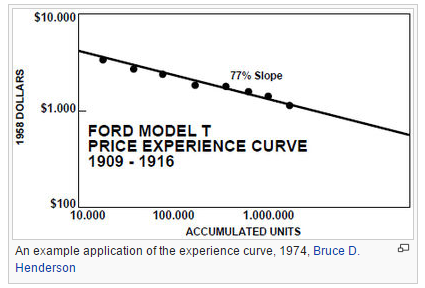 Sure, if you are actively working to improve costs, they will follow an experience curve. Here is one for the Model T. It is a log scale. It looks like the price halves from 10,000 units to 500,000 units, but I may need help with reading, too. (Always struggle with log scales if I don't actually draw lines with a triangle.)
The automobile industry is a lot more mature now, but Elon and his team should be able to do more than hold a candle to Ford and his teams. So maybe 1/4 rather than 1/2.
The market is at $26K.
Tesla talent and will, never underestimate will, can make the 3 profitable at market.
Thank you for asking again.
Back to work...�
Jun 13, 2016
deonb That there exist a value for x, where:
- y = (35000 - 31000) * z
- x = (26000 - 31000) * 4z
- z > 0
- x > y
�
Jun 13, 2016
deonb And if they DO somehow manage to make a Model 3 for $23'250 and sell them for $26'000 while there are hundreds of thousands of customers beating their door down that are willing to pay $35'000, I and every other shareholder will get together and sue Tesla to get that bazerk alien at the helm removed.�
Jun 13, 2016
proven That still has zero to do with tax incentives--which Tesla does not factor into their pricing, which is where this thread started.�
Jun 13, 2016
Max* We're on Page 6, the OP still can't explain how $35k - $7.5k = $26k.
Why are people still trying to explain something to the OP?�
Jun 13, 2016
Max* Can you share the math?
From my quick estimates (using 2016 tax brackets) I get ~$47k for single and ~$56k for married to be eligible for the full tax credit. I may have made an obvious mistake somewhere...�
Jun 13, 2016
Troy916 Don't think you can really look at the 2016 numbers yet, as the standard deduction and exemption numbers may change.
Looking at the 2015 tax table, for single it appears a little over $7500 of tax is owed at 47000-47050, backing out 1 exemption($4000), and the standard deduction ($6300) gives an income of at least $57,300.
For married $7500 of tax is owed at 56150-56200, backing out 2 exemptions ($8000, you and your spouse) and the married standard deduction ($12600) gives an income of least $76,750.�
Jun 13, 2016
ucmndd I believe he is talking about total earnings while you are talking about taxable earnings (after standard or itemized deductions, etc).�
Jun 13, 2016
Max* I knew I left out something obvious - the standard deductions and exemptions.�
Jun 13, 2016
proven I haven't done the math, but keep in mind that everyone's will be different since just looking at the tax brackets doesn't take into account all of your deductions and other credits you may have. The EV credit is non-refundable which means it only applies to any actual tax liability you have that year. Even if you made $100,000 but had some other big tax credits/deductions you still may not take advantage of the entire $7,500.�
Jun 13, 2016
Max* I'm not worried about me, I'm just looking at it from the bare minimum salary someone needs to qualify for the $7,500. The bare minimum is not dependent on their deductions/etc.�
Jun 13, 2016
deonb At those numbers you didn't yet subtract either standard deductions or exemptions.
I used 2 exemptions below, but even with 1 it doesn't make a huge difference (can't actually have just 1 in the second case):
Single:
Estimated Tax Analysis
Gross income$61,000
Qualified plan contributions-$0
Adjusted gross income=$61,000
Standard/Itemized deductions-$6,300
Personal exemptions-$8,100
Taxable income=$46,600
Tax liability before credits$7,421
Child tax credits-$0
Estimated tax liability=$7,421
Married:
Estimated Tax Analysis
Gross income$77,000
Qualified plan contributions-$0
Adjusted gross income=$77,000
Standard/Itemized deductions-$12,600
Personal exemptions-$8,100
Taxable income=$56,300
Tax liability before credits$7,518
Child tax credits-$0
Estimated tax liability=$7,518
�
Jun 13, 2016
deonb It is. You get 1 exemption no matter what (2 if you're married), and you get a standard deduction no matter what. See my reply just before this one.�
Jun 13, 2016
deonb Oh. Add standard disclaimer here that I'm not a tax lawyer and nobody should listen to me for official tax advice�
Jun 13, 2016
22522 I generally agree with this. Why the incentive trigger was reduced to 200,000, I don't know. Maybe I don't understand incentives. Thought they were there to incent demand for products whose costs were too high to support demand without the incentive. With the idea that eventually production economies would result in healthy demand at an incentive free price.
I expect, from here, that owning and driving a Tesla is sort of like work, that people earn their incentives by owning one. There is no public investment in the future, but the incentive is earned by the people who receive it. Kind of like wages.
Need to reflect on this a bit. Have actually learned something here, but maybe bistable knowledge.
Thank you.�
Jun 13, 2016
deonb Well the idea behind this incentive was to equalize EV's with the subsidies that gasoline vehicles get.
Read this:
Supporting Plug In America
"Plug In America was not successful in convincing GM to stop crushing EV-1s. But we (not me; I didn't join until 2009) did save hundreds of Toyota RAV4-EVs, and smaller numbers of cars from other automakers. Once that crisis was over, we set about talking to automakers, working to convince them that there really is a market for the cars. In 2008 the Bush administration proposed a $2,500 tax credit for electric vehicles; while we were unable to convince the administration to remove the $12k/vehicle petroleum subsidies, we did manage to help level the playing field by tying the credit to battery size, and increased the top end to $7,500."
Nothing has changed in the equation, so to keep achieving that you really have to extend EV subsidies indefinitely.
However, most of us (including Elon) are of the opinion that you should just stop petroleum subsidies in the first place. Then gas will be somewhere north of $5 per gallon, and it wouldn't matter that EV's are a bit more expensive for the same type of car.�
Jun 13, 2016
22522 Very helpful. Maybe there is some too big to fail mentality.�
Jun 13, 2016
EaglesPDX As with electricity, how you manufacture the hydrogen determines how clean a fuel it is. Solar powered electricity creating hydrogen creates a clean fuel. Hydrogen would be a better fuel for airplanes, long haul trucks.�
Jun 13, 2016
EaglesPDX We need to cut our oil use 50% to address the economic ($300B yearly trade deficit, $600B yearly military cost to secure oil), environmental (air, water pollution, global warming) and national security costs (oil terrorism, dependence on Middle East dictators, endless oil war).
Until US achieves those goals, EV credit should continue. We have 255 million passenger vehicles to go.�
Jun 13, 2016
JeffK Using hydrogen is basically wasting energy no matter how it's produced. It's also not energy dense compared to other fuels.�

Không có nhận xét nào:
Đăng nhận xét