Jan 12, 2015
cwood I used TACC on a ~370-mile journey this past weekend and it worked almost flawlessly. (The only "flaw" was when Speed Assist failed to read a speed limit sign in heavy rain.) I've never used an active cruise control system before so I have nothing to compare it to, but in absolute terms it was amazing. It will make highway driving SO much nicer--and safer.
Now if Tesla can just get the P85D's range up to the point where it feasible for highway driving... but that's another post.�
Jan 12, 2015
R�B Has anyone yet commented that the "Overtake" functionality can only seemed to be triggered by fully clicking the Left Turn Signal all the way. I usually do the half press of the turn signal (makes the blinker flash three times) and that doesn't seem to trigger the overtake functionality.�
Jan 12, 2015
ItsNotAboutTheMoney I think that's logical: for safety reasons you don't want accidental triggering of a lane change because the car can't see far enough to judge by itself. I'd expect a safe process to be: half press to indicate, pause, full press to make the car change lanes.�
Jan 12, 2015
drsaab In 4 to 5 segmented trips in a day. I get one segment with cruise not available. . Anyone else having such a high failure rate? Car is clean. Avg 35 degrees. Sunny.�
Jan 12, 2015
stevezzzz I think it's more than that: I've seen the dotted line appear at the new speed limit as I approach the speed limit sign, then it switches to solid as I pass the sign. But I've seen the dotted line appear at other times, too, so I'm still not sure what it's doing.�
Jan 12, 2015
commasign I used it a few times, works as advertised, but remember it will only speed you up to the speed limit (or the speed you set on your cruise control?). I.e. won't work if you're already at target speed. Meant to deal with a really slow car in front of you.�
Jan 12, 2015
cgiGuy Is this being reported as new in 6.1? Currently (6.0) this is not how my "dumb" cruise control works. Holding the stalk up/down while the speed is already set just moves it continuously in increments (about 3 miles -/+ per second). Doesn't match speed.�
Jan 12, 2015
R�B Incoming tip:
I was having trouble adjusting the TACC following distance knob and remembering which way to turn it to make the adjustment I wanted. I realized that if I turned the knob toward the car in front of me that would adjust the distance to bring me closer. The opposite is also true (turning the knob away from the car in front of me increased the distance). This is very intuitive when you think about it this way and since then I don't even need to fool around with it. Thought I'd share in case they're were others out with similar experiences.�
Jan 12, 2015
NOLA_Mike Good tip that I think I will get some use out of! Thanks.�
Jan 12, 2015
commasign Love it! Turn the knob away to push the car in front of you further away!Edit: nevermind, I have it backwards! lol Edit: ok, got it now. Turn knob towards the car in front to move your own car ahead a bit.
�
Jan 12, 2015
zzzzdoc Had a few weird situations with TACC today. The most interesting one, was after exiting to the right (with the TACC still engaged), I signaled a left turn, as the ramp bifurcates. The car rapidly started to speed up to highway speed, till I hit the brakes. It thought I was overtaking instead of getting ready to slow for a traffic light and a left turn.�
Jan 12, 2015
Todd Burch Here's how it works in 6.0:
If your current speed is within 5mph of the set speed, a full flick up will increase set speed by 5 mph. If you're going more than 5 mph above set speed (by pressing the accelerator), a full flick up will set CC to the current speed.�
Jan 12, 2015
stevezzzz I think you're ascribing capabilities to TACC that it doesn't yet have. When you left the thru lanes and the radar saw a clear exit lane ahead, the car started to accelerate to the tacc set speed. Your left turn signal likely had no effect on the current algorithm (which doesn't factor in stop signs or traffic lights), since its current function is limited to triggering passing acceleration and defeating the lane departure warning.�
Jan 12, 2015
tc4542 Yea, same thing happens on my Lexus LS430. It doesn't know the difference.�
Jan 12, 2015
zzzzdoc It most certainly wasn't a clear exit lane. It absolutely thought I was passing and accelerated.�
Jan 12, 2015
stevezzzz I misunderstood the situation, then. So there was a car in front of you on the off ramp and when you signaled your intended left turn the car accelerated, closing the distance between you and the car in front of you? I wonder how close the software will let you get if you don't pull out to the left to pass in that situation? I can't believe it would continue to close the distance until you collided.
I have noticed that when you signal left when following at a speed below the set point, the S accelerates even before you start moving to the left to pass. So the behavior you observed is consistent with that. Who's got the nerve to answer the question I raised in the previous paragraph?�
Jan 12, 2015
Andyw2100 I don't think you understood what stevezzz was trying to explain to you, or what the TACC is supposed to do. If the icon on your dash was grey, that indicated that the TACC was no longer tracking a car in front of you. At that point it is going to try to take you back to your set cruising speed. It doesn't know anything about exit ramps, stop lights or anything else. In simple terms, all it knows is following other cars without hitting them, and trying to maintain the speed you have set when it doesn't have a car to follow. What made you think it would have any idea that you wanted to slow down? If you were still tracking a car (so it was blue) and you signaled left, and it accelerated, it did exactly what it was supposed to do, provided you were not yet at the speed limit you had set.�
Jan 12, 2015
Saghost Did you enable that overtake option on the TACC?
I don't know much about it, but there was something in the release notes about a left turn signal causing the car to accelerate up to the set speed, reducing the closure distance to a car it is following. That might produce your exact experience, I think.
Walter�
Jan 12, 2015
stevezzzz I think it's worth reiterating the most surprising behavior I've encountered so far when tacc is engaged; that is, if a car in front of you in your lane is stopped at a signal, the tacc doesn't seem to register it as a target to be tracked and avoided unless it locks on before the car ahead comes to a complete stop. If that car is still creeping even a little bit, no problem: tacc acquires and reacts to it, even if it's a bit later than I would prefer.�
Jan 12, 2015
Andyw2100 I think what it boils down to is this:
As a supplement to your basic highway usage cruise control, TACC is excellent. It knocks it out of the park. I don't think we could ask for more.
As a "pseudo-auto-pilot", attempting to use it in situations where we never really would have used cruise control before, it works reasonably well, but not nearly as well as on the highway. In my mind, there are probably some things that Tesla could do to improve how it functions in non-highway settings, but if they are going to be giving us true auto-pilot soon, then perhaps those things aren't necessary.�
Jan 12, 2015
drsaab Yes. It seems to track and stop below 40mph to 45mph for a stopped car. Above that it does not stop for a stopped vehicle.
Another dangerous situation is where the car in front you are locked on decides to turn left and once it leaves your lane, Tacc may not lock on the new stopped car now in your lane and actually accelerate towards it vs slowing down.�
Jan 12, 2015
Burt Court I think R2B followed the old proverb: When all else fails, read the instructions. That was a great reminder, I've only used one half the potential of my new cruise control. Need to spend more time in my garage, reading.
old geezer�
Jan 13, 2015
wk057 So far TACC has been fun. I did some more driving with it on a ~5 lane road (two lanes on each side with a center turn lane).
Any time I was in the left lane following someone using the TACC, and they signaled left, changed to the center lane, and slowed down for their turn, the TACC would basically still have me following them and would slow me down to match until it got very close. Usually I would have to override it and accelerate if someone was behind me since my behavior would make no sense otherwise...�
Jan 13, 2015
randompersonx Another odd behavior I noticed. On the highway if a car in front of me changes out of my lane, and all of a sudden there is nobody in front of me, the car momentarily slows down before speeding up. This behavior is very unusual and certainly annoys people behind me.�
Jan 13, 2015
jerry33 They obviously programmed it to behave like real drivers. Generally when someone passes their first action is to press on the brake pedal (freeway driving here, not passing on a two lane road). Kind of makes you wonder why they bothered to pass.�
Jan 13, 2015
Saghost Is the car that was in front of you that changed lanes slowing down? If so, it might be the same thing wk057 is reporting - a tendency to think the car it's locked on to is still in front of you even though it has moved out of your path slightly.
Unless you cross-reference the radar to the lane lines, it'll be tough to separate cars that just moved out of your lane from curves that happen to your lane. Maybe Tesla hasn't hooked the two together in the computer's head yet (but they will have to do some of that when autopilot starts steering anyway, so I'd expect this tendency to improve in a future update.)
Walter�
Jan 13, 2015
randompersonx I've had this happen several times where the car in front of me is not slowing down, but just gets out of my way and maintains their speed in the lane to my right.
It doesn't happen if they change out of my lane and there is another car still in the range of the Radar in front of me.�
Jan 13, 2015
wk057 I think the car continues to track the car that was in front of you in this instance, same thing as my post above about the center turn lane.
I did some more driving tonight. First time my fiance has been in my car since I got the TACC update. Freaked her out a bit.
I will note that the TACC locking on to a stopped vehicle in front when it has not been locked on to anything for a bit (no cars immediately ahead) is hit or miss. A few times it locked on and started to slow and came to a stop, and a few times it definitely wasn't going to and I stopped manually. So, careful with that. Obviously always pay attention to what it's doing.�
Jan 13, 2015
randompersonx Interestingly, my wife commented on how other than my mentioning "this is not me ... this is all the car", she found it very difficult to tell when I was in TACC and when I was driving myself in MOST scenarios (though there were a few cases where the car was obviously misbehaving).�
Jan 13, 2015
wk057 She kept looking at my feet, then freaking out. lol. "Oh my God the brake pedal moved..."�
Jan 13, 2015
randompersonx The pedals move on their own? This is going to start a new stream of fascination.�
Jan 13, 2015
Todd Burch Based on steering wheel position, speed, and the position of the radar target, it should be pretty easy to determine if the car it's tracking is in your path or an adjacent lane. If the car is slowing down when the car is in the adjacent lane, then it sounds like TACC needs a little bit more work...but I'll take it in its current state for now!
We probably just need to be a little extra vigilant until it improves. (Should be vigilant anyway anytime some dumb computer is doing the driving for us�
Jan 13, 2015
EarlyAdopter Not to kill the excitement, because it is indeed cool, but my wife's two year old Volvo with TACC does the same (moves the pedals).
One thing from our experience with her car is these systems would be better called "active following systems" to emphasize the need to have a car in front of you to lock onto to function correctly.
Car in front of you that you've locked onto slows down and stops? No problem. The system will follow.
Car way out ahead of you, outside of radar lock range, already stopped? Problem. The system may or may not lock on in time to stop you.
Car in front of you moves a lane over and there's no other car within in range directly in front of you to acquire a new lock? Problem. The system may continue to follow the car now in the other lane because it wants to maintain a lock on something.�
Jan 14, 2015
wk057 Only the brake pedal, the accelerator doesn't move. It is an odd sensation when the car pulls the brake pedal from under my foot. (I've been at the ready during stops just in case.)�
Jan 14, 2015
Boeing777 This is an excellent observation, and one that I've already encountered as well. As you know, the system will go to HOLD after a few seconds requiring a light push on the pedal to re-engage. The only time the ACC will engage and accelerate after a complete stop (without driver intervention) is when the vehicle in front starts moving almost immediately after stopping. In that case, the ACC stays engaged, and does not have a chance to revert to the HOLD mode.�
Jan 14, 2015
evboost It may have been noted below as well, but another couple of observations I have to add:
- At this point I after running my commute with and without TACC in nearly identical conditions, I find its about a wash on efficiency.
- Seems to do OK on curves for me. Specifically freeway off/on ramps. I had the car in front of me switch to a different lane and TACC didn't send me to full speed.
- Things that can confuse the system: Big rig trucks, overpass shadows, lane merges where you have to "zipper". The first two seem to over stimulate the system a bit. The later one needs a human touch yet, though the collision avoidance really is happy to tell me about almost hitting something.
Cannot wait until lane holding arrives to continue the journey of autopilot.�
Jan 14, 2015
Cottonwood I would like for the 6 and 7 distances to be noticeably larger. When I am doing a long drive on wide open, empty highways, a few hundred meters more distance is desirable. The 7 setting at 70 mph should be towards the limits of the reliable radar range, but close enough that the radar tracking can still work well and distances greater than the desired trail distance can be measured.�
Jan 14, 2015
NOLA_Mike I also note that the distances are not the same for every speed. 1 or 2 follows much closer to the vehicle in front at 35 MPH than it does at 75 MPH. Makes sense since following too close at high speeds would be dangerous and not allow enough room for safe stopping in all situations.�
Jan 14, 2015
Cottonwood I agree that the distances are larger with speed, but at high speed and a "large" (7) distance setting, I want MORE distance. This is especially true if TACC becomes a part of the autopilot.�
Jan 14, 2015
Supercharged I wonder if this could be made retroactive to older Teslas.
A car this pricey should have had it when it came out two years ago.
Most cars have had it a few years now.�
Jan 14, 2015
ecarfan Tesla has been very clear that the new hardware (multiple ultrasonic sensors in the bumpers, forward radar and front camera) cannot be retrofitted to older cars. Period. They won't do it.
That has been discussed multiple times in multiple threads.�
Jan 14, 2015
drsaab I am Still getting a 20 to 25% failure rate of cruise not available. . Anyone else getting same? Service center is slow to respond.�
Jan 14, 2015
MarcG The only time I got the "Cruise control not available" message is when I already had TACC engaged but decided I wanted to take a layer off as it got warmer in the cabin, so as I took my seatbelt off the message popped up.
After clicking my seatbelt back in, I was able to resume TACC and never saw the message again.�
Jan 14, 2015
patp It happens to me sporadically also. No idea what could cause this.�
Jan 14, 2015
tezzla I think mine failed 1 time on day one, and I think I was trying to initiate it below 18 mph.�
Jan 14, 2015
randompersonx I have never received a "cruise not available" message. I am constantly using TACC since the software update.�
Jan 14, 2015
drsaab Omg. This forum is amazing. You are great.
Tacc doesn't work w/o seat belt. I think that was it. Some short segments it wasn't working. Reset car. Turn off car. No difference. Leave car and come back and it works. Must have been me changing seat belt off to on. If your driving and unbuckle the belt, Tacc shuts off.
Email to SC and them to engineers... All wasted someone's time. 99% sure this is it. Next few days will tell.�
Jan 14, 2015
EarlyAdopter I had a chance to try TACC today for the first time. When following a car to a stop I thought the system braked way late, even when set to the max following distance. It doesn't give you any time to react should it fail to slow down since it stops at the last minute.
Also, it tucks in way too close after coming to a complete stop. It consistently leaves less than half a car length between me and the car in front. Most frustratingly, increasing the following distance makes no difference to the final stop distance. I normally leave at least a full car length, so that in the event I get rear ended I won't get pushed into the car in front of me.�
Jan 14, 2015
MarcG Haha awesome! I thought the seatbelt thing was a long-shot but figured it wouldn't hurt to share my experience
Do keep me posted if that's what the issue ended up being.�
Jan 14, 2015
SR22pilot Yeah! Maybe this will decrease the number of people leaving large gaps at red lights thereby causing the turn lane to be blocked. I hate missing the turn light just because I can't get into the lane; all due to a few cars leaving large gaps instead of pulling up. It seems like I am often about 10' shy of being able to get into the turn lane.
�
Jan 14, 2015
LetsGoFast I agree with this, especially in circumstances where you are closing on a car that is traveling much more slowly than you. When you are already at the desired following distance, it seems to react appropriately.
I like the stopping distance.
I ran into an interesting situation today. On an ramp from one highway to another, the car was driving slowly behind a semi under TACC. This particular offramp has a turn off on the outside of the curve to a Department of Transportation location. When the semi reached the turnoff, the car somehow misinterpreted the road and decided the truck was no longer in my way (I guess it thought he turned right and I was going to veer off to the DoT site) and began to accelerate quickly. I stabbed the brakes before I could determine if it would recover. I drive this route every day, so when I'm no so surprised by it I'll do a better test.�
Jan 14, 2015
EarlyAdopter Hey man, whatever floats your boat or lifts your wings. To each their own. I'm just saying it should be a function of the distance control knob and user controlled. Set it to 1 and get up real close and personal every time you stop. Set it to 7 and keep enough space you could get hit from behind by a semi and still not end up the car in front of you's rear.�
Jan 15, 2015
SR22pilot Actually I want the 3 second rule i.e. three seconds spacing. I don't want to be three feet behind at 70 but at a stop that is fine. The LAST thing I want is to stop 5 car lengths behind someone and cause a backup be it others not being able to cross the intersection behind me or their being unable to get to a turn lane. Yeah this is a pet peeve of mine because I see it most days. People can't turn because people block turn lane access or you don't get across the intersection on the green because people don't pull up either of which means you have to wait through another long light cycle. I just want people to be considerate of others. In a similar vein I hate people cutting across double white lines to get into the exit of 285 onto 141 north when I'm sitting a mile back in the line waiting my turn. When I lived in a small town where rush minute was three cars at the four way stop this didn't bother me. In Atlanta it does.�
Jan 15, 2015
wk057 I think the distance it comes to a complete stop at is actually way further than normal, honestly, and thus fine in my book.
However it does slow down abruptly when coming to that stop, much more so than I would personally. I think part of this can be chalked up to it following the speed of the car in front, since most people seem to brake late anyway, combined with an algorithm that decreases the needed following distance based on the lower speed making the car think it can get closer and thus not yet need to slow down until that gap is closed, then play catch up once the car ahead continues to slow needing the use of the friction brakes.
I almost never use the friction brakes when driving in town aside from holding the car stopped. So, I'm probably going to stop using TACC for coming to stops like that until they can feather it out a bit. It's a cool toy, but not really enjoyable in this instance just yet. On the highway it's great, though.�
Jan 15, 2015
andrewket Likely because the radar can't distinguish between a car in front but a lane over vs a car in your lane but on a curve. The angle is the same. The safer response is what the car did- maintain speed. Otherwise the car might accelerate towards a car directly in front of you when it entered a curve but you're still tens to hundred feet from the entrance of the curve.�
Jan 15, 2015
Andyw2100
This is pretty much what I was getting at with a post I made the first day we were all using TACC when I suggested Tesla may want to tweak things by adding options to either maximize efficiency or maximize the proximity to the car being tracked. In the current mode, it is maximizing the proximity to the car being tracked, braking too hard and too late (for some of our tastes), and also accelerating too hard at times, in an attempt to stay close. Adding a "range optimizing TACC mode" would allow us to let the Model S drive more "normally", which would also be more efficiently, at the expense of "losing" the target car more frequently. People who love the TACC exactly as it is now would choose the proximity priority mode. People who think it is a little too aggressive would choose the range optimizing, more mellow TACC mode.
I think adding a mode like this would actually be relatively simple, as compared to all that has already gone into the development of the TACC, and would actually increase the usefulness of the TACC by quite a bit.�
Jan 15, 2015
EarlyAdopter The 3 second rule is great and all, but it accounts for a different concern - reaction time - which only applies when moving. Leaving an adequate buffer when stopped is for different reasons. Both are important precautions.
I'm not talking about giving the option to leave 6 car lengths, just simply the option of 1/2 to 2 car lengths based on the follow distance knob setting.
Man, you guys really do tuck in too close.
Just remember this - if you get rear ended, it's on their insurance. If you get rear ended and pushed into the car in front of you, that's on your insurance.�
Jan 15, 2015
LetsGoFast I can replicate this every time. It looks like the TACC thinks there are two lanes, mistaking the entrance to the DoT facility as a travel lane and it wants to surge. Once I pass the turn-off, it sees the car ahead again and pounds the brakes. It generates some adreneline and I was a half-second from stomping the brake myself. Despite being uncomfortably close by my estimation, it didn't set off the collision warning.
I love the TACC, but I really do wish it would brake more slowly and use more regen, especially when coming to a complete stop. Because it closes the gap at slower speeds, it really does kind of abruptly stop at the end. I like a relatively low number for the gap at high speeds and a much higher one at lower speeds. It really does seem quite futuristic.
Is there a detailed break down of the stalk functions in the manual? I'm still sometimes suprised by the difference in behavior between functions when you are below, at or above the current set speed.�
Jan 15, 2015
randompersonx It didn't maintain speed in this scenario, it reduced speed (I believe only using regen braking, not friction brakes). I agree that maintaining for a second or two is fine, but slowing down is not.
Also, as far as a turn goes ... The car knows the position of the steering wheel.�
Jan 15, 2015
mspohr Not according to Nolo:
Rear-End Accidents Involving Multiple Vehicles
In some situations, both you and the car *behind you will be stopped when a third car runs into the car behind you and pushes it into the rear of your car. In that sort of "chain reaction" crash, it is the driver of the third car who is at fault and against whose liability insurance you would file a claim.�
Jan 15, 2015
EarlyAdopter There's an important caveat left off there - only so long as you've left an appropriate distance to the car in front of you and don't get cited for "following too closely" (which does apply to stopping distances as well). What's that distance? Depends on the responding officer's judgement based on weather, slope, and speed limit on the road. No officer? Then your insurance will most definitely be involved.
Best to avoid it altogether if possible.
This is pretty telling (bolded for emphasis):
Multiple vehicles involved in a rear end collision
�
Jan 15, 2015
MarcG Actually, I believe that it can. I have tested multiple scenarios which confirmed this:
1. Following a car through a curve with no other cars in other lanes: TACC keeps tracking the car in front and slows down as appropriate
2. Going through a right curve with a car in the lane to my left: TACC does not track any car and keeps the cruise control speed previously set
3. Going through a left curve with a car in the lane to my right: same as #2
So I think TACC is using a combination of the radar and the camera to figure out which cars to track. The camera helps figure this out if it can read lane limits.�
Jan 15, 2015
Todd Burch It should be able to by looking at the angle of the steering wheel.�
Jan 15, 2015
NOLA_Mike I agree with this conclusion - it is absolutely using the radar AND image recognition from the camera to operate. As a matter of fact, if the camera view is obstructed it will refuse to operate, correct?
Mike�
Jan 15, 2015
wk057 I pay for insurance and have a front and rear dash cam for a reason.�
Jan 15, 2015
EarlyAdopter And if that front dash cam shows you were stopped too close when you get pushed into the car in front of you, you'll be paying more for that insurance.
Look, I really don't care how close you want to get to cars when you stop. That's your perogative. I just want a user selectable option for stopping distance so I can assert my perogative, same option as we have with follow distance. Does anyone disagree with that?�
Jan 15, 2015
wayner Where can I find documentation on how to use the new cruise control, other than the manual on the car itself? When I go onto MyTesla the Owner's Manual is 6.0. And MyTesla doesn't show 6.1 Release notes either, only 6.0.�
Jan 16, 2015
tezzla Documentation? We don't need no stinkin' Documentation!�
Jan 16, 2015
mspohr The manual on the car itself.
No dead trees allowed.�
Jan 16, 2015
wayner I don't care about dead trees but I would rather read this on my iPad or PC than in my car. Or even have it on your iPad while in the car so that you can use the screen for other purposes. When I go to MyTesla it still appears to be the 6.0 manual.�
Jan 16, 2015
andrewket An interesting test..�
Jan 16, 2015
NOLA_Mike I haven't tested this on the Tesla - I just know on previous vehicles with similar systems it would not work in fog or other conditions where the camera view was obstructed...
Mike�
Jan 16, 2015
LetsGoFast I'm about to drive somewhere. I'll block the camera with a post-it and see what happens.�
Jan 16, 2015
tezzla I believe Bjorn did that test in one of his videos.�
Jan 16, 2015
Todd Burch Our 2006 Toyota Avalon has ACC. It's able to distinguish between cars in adjacent lanes and has no camera.�
Jan 18, 2015
stevezzzz Following up on my earlier post, I tested the tacc behavior with creep ON, allowing it to stop the D behind another car at a traffic signal. When the car in front of me initiated a right turn and cleared the lane, the D did not creep forward but remained stopped and displayed the center console reminder to press the accelerator to resume.
I'd like to suggest that this is a missed opportunity: if the car is brought to a dead stop by tacc when creep is ON, and the driver's foot is not on the brake, then when the traffic in front of you starts to move the tacc should allow creep to function normally, with the car easing forward without driver intervention and maintaining a safe distance from the car in front, including braking automatically to a complete stop if the car in front stops again. You'll know that if the car in front turns out of your lane and you have to step on the brake to avoid creeping through the intersection, tacc will be disabled, just as it always is when you press the brake pedal. Conversely, if it's a case of traffic starting to move on a green light, tacc will still be locked on and would display the reminder to press the accelerator to resume.
In the same situation with creep OFF, presumably the tacc software knows that the car in front has cleared your traffic lane rather than just accelerated away from you in the lane, so maybe it would be better if it didn't launch toward the set speed as soon as you touch the throttle. That's a bit tricky and may confuse people as much or more than the current behavior, but it is much safer.�
Jan 18, 2015
meltoots How to we suggest improvements to Tesla?
I'd like to have an option for TACC to be either more performance or more efficiency.
I notice with TACC that if traffic slows and speeds up a lot, that the Tesla launches to get back up to the cruise set speed.
I actually would prefer on longer trips to have it gently get back up to speed more efficiently.
Anyone else feel the TACC is less efficient?�
Jan 18, 2015
ItsNotAboutTheMoney No. Way. Jo. Se.
Because of the increased likelihood of inattention after a stop, I think it's way too dangerous to have automatic resume.�
Jan 18, 2015
woof The way the BMW ACC works is after coming to a complete stop, if the car in front starts moving again within two or three seconds, ACC will stay active and automatically resume. After two or three seconds of a full stop, ACC turns off and requires re-activation with either accelerator pedal input or "resume" on the CC controls. There is a subtle indicator on the dash to show if it's active or not (green colored speed setting vs red colored).�
Jan 18, 2015
NoMoGas This isn't really true, at least in my experience, yours may be different. Ive had it happen twice, the first time was a fatal accident sadly. Both times my insurance went after the guy behind me. One way the insurance determines who started the accident (the person who will ALWAYS be found 51% or more responsible) is to ask the first driver how many impacts they felt. If it's one, the guy behind you is toast. Yes, lawyers may sue everyone but "let the chips fall where they may" is almost alway the same place, the person who started the accident is held responsible.
Im still waiting for 6.1 for my P85+ so I haven't seen first hand where it stops, but from videos I've seen posted you could see the tires of the car in front. That's always far enough. I like to leave enough room to exit the lane if I must (emergency vehicle training I suppose).�
Jan 18, 2015
stevezzzz I'm advocating creep (and only if creep is On), not full resume. I do see your point.
- - - Updated - - -
I have it from a reliable source that Tesla's autopilot team reads this thread regularly for the real-world experience and suggestions.�
Jan 18, 2015
drsaab The Tacc does that. It says cruise if it's going to resume speed on its own and will say hold if you need to press the accelerator to resume.�
Jan 18, 2015
drsaab So FYI. My Tacc not working was seat belt issue. Seems fine last 4 days after learning it does not work with seat belt off.�
Jan 18, 2015
MarcG Ha so my wild guess was correct! ;-)
Glad to hear it wasn't any other issue.
Thanks for the update!�
Jan 18, 2015
ecarfan Are you saying you were driving without your seatbelt connected and trying to get the TACC to engage and it would not? If so, glad to hear that Tesla made it work that way.�
Jan 18, 2015
MarcG I think that scenario is right. In my case I was already cruising with my seatbelt attached, but at some point took it off to remove a layer, and TACC disabled right away with the "cruise not available" message.�
Jan 18, 2015
Andyw2100 Yes, it's definitely less efficient.
I've posted about this a couple of times. I believe below is what I had written most recently:
�
Jan 19, 2015
MikeBur +1 here. TACC is great, and I look forward to the additional functionality coming.
I too wish the aggressiveness of the following algorithm could be decreased to being more conservative and thereby smoother.
Freeway exits appear to be the most noticeable. Although the minority of times for longer journeys, without an option to have regular cruise mode this will likely become frequent. From a human perspective, I know what I am merging onto. Using gps/freeway data for exit ramps, I suspect the car could have better heuristics, eg freeway to freeway could attempt to maintain speed, and freeway to streets ( with a high probability of significant speed reduction) could benefit from more regen and less friction braking, by increasing the distance to car in front.
Add freeway, street, congestion data and this could be even better.
All would need to be conservative and deal with human drivers diving in front of the car.�
Jan 25, 2015
TTT Whoa, just got 6.1 update last night and tested TACC today. Slowed down as expected as I approached slower traffic and the alarms sounded and showed a graphic of a crashing car as someone pulled right into my lane andcutting me off. Kudos to Tesla, love the new update.�
Jan 27, 2015
stevezzzz I've been surprised (not in a good way) by the modal behavior of the cruise control stalk when interacting with TACC. The 'pull stalk and hold' action does different things depending on context, and it annoys me. For instance, sometimes PaH causes the set speed to change to the system's 'speed limit plus offset' value (the gray line on the speedo, displayed when TACC has a value for the current speed limit). But if TACC isn't currently engaged, pull-and-hold does nothing until you release the stalk, at which point it performs the Resume function (i.e., accelerating/decelerating to the previous set speed as denoted by the gray triangle on the speedo). I find having TACC accelerate to the previous set speed instead of the current 'speed limit plus offset' both surprising and objectionable, especially when the former is faster than the latter.
Seems to me that the pull-and-hold action should always do the same thing: it should engage TACC with a target of the current 'speed limit plus offset' value. If the system has no current knowledge of the speed limit, then it should do nothing, and maybe beep to acknowledge the input and to inform the driver that it can't honor the request. A quick pull-and-release of the stalk should initiate a Resume.�
Jan 27, 2015
Todd Burch Here's my feedback to Tesla after using TACC for a few days:
1) WAY too much use of the brakes. Way too much. Lots of situations where I see hydraulic braking engage when I still have plenty of regen available. Since I'd like my pads to last the life of the car and I dislike wasting energy, I currently disengage TACC when I see traffic slowing ahead of me. That kinda defeats the purpose of TACC.
2) Deceleration is way too late and too aggressive. My sphincter tightens almost every time I rely on TACC to brake for the car in front of me. I prefer not to feel like I'm going to rear end the person in front of me every time the car slows (my following distance is set to 5). The radar can clearly track cars to a much greater distance ahead. It should use up to full regen to match the deceleration rate of the car in front, then resort to hydraulic braking only if no more regen is available. And only allow the following distance to close once the cars have reached a lower speed.
Moreover the late deceleration increases the probability that the car behind me (which is almost certainly following too close) will rear-end me.
3) Acceleration is too timid after the car in front of you turns to an adjacent road or otherwise leaves your forward path. If I wait to let TACC do it, I feel like the car behind me is going to honk because it takes so long to get back up to speed.
It's possible that (3) exists because Tesla wants to thoroughly test their systems before they allow a little more immediate, slightly more aggressive acceleration.�
Jan 27, 2015
NoMoGas #2 just happened to me as my son rear ended me with another Tesla. Truth is it was his fault but yes it brakes unnecessarily aggressively like the Disney Tram. I would think the bigger concern is that in the event of a failure there simply would not be enough time for the driver to react and stop the car.
Also i agree with #3. Not sure if I'm with you on #1.
This is system is amazing but people do need to know it needs to be watched. Huge improvement and I have no doubt more tweaking is coming.�
Jan 27, 2015
EarlyAdopter I agree with all of this (and posted much the same earlier up-thread).
It's as if there's too much latency in the system currently, from sensing to acting. Car in front starts slowing down? Lag... lag... lag... oh, TACC needs to brake! Car in front starts accelerating? Lag... lag... lag... oh, TACC needs to get going!�
Jan 28, 2015
wk057 So had my first actual problem with TACC today. Was cruising down a two lane ~45 MPH road using TACC. No cars in front of me. I've done this on this road several times since the update.
Out of no where the car decides its time to nearly slam the brakes and decel from ~50 to 25... fortunately no one was behind me...
There was nothing in the road nor anything I could think would have made it think it needed to stop quickly. Strange.�
Jan 28, 2015
Bet TSLA So did you use the "Note" voice command to let Tesla know about it?�
Jan 28, 2015
wk057 I called the Tesla HQ 877 # and reported it.�
Jan 28, 2015
gzerninplatz One nice little feature of using TACC in stop-and-go in town is that on a slight incline, not enough to engage Hill Hold, you won't have to ride the brake until light changes or traffic moves, the car stays put....I used to pull up the parking brake in my Z3, just didn't like having to lean on the brake...�
Jan 29, 2015
ReversePolarity Haven't tried this one to its entirety, I was actually a little curious and tried to "break" the system:
Set TACC distance to 1 to follow the car ahead of me (this 1 distance is pretty far away as others mentioned).... manually pressed the accelerator to increase speed... triggered the collision warning... but I don't remember the car intervening or if its even supposed to intervene in the case of "imminent" collisions? Other feedbacks mirror what has been mentioned, the system is rough on the edges and need a bit of tunning. Quite a bit of accel/decel jerking, a lot more than say, if the driver were to press the accelerator manually. Good first release though, hope the next update comes soon�
Jan 29, 2015
wk057 TACC seems to do nothing in terms of braking/slowing if you have your foot on the accelerator. This is pretty expected. I've been in the habit of overriding TACC when someone turns off the road or exits to another lane while the TACC is still tracking them (and usually slowing with them if I don't override) while no one is actually in front of me anymore.�
Jan 29, 2015
Andyw2100 The car is not yet supposed to intervene. For now it is just a collision warning system. At some point it is supposed to become a collision avoidance system, at which point the car will intervene.�
Jan 29, 2015
anxman I've been using TACC for about 600-700 miles so far with mostly good results but had a problem tonight. In general, I echo a lot of the other posts on the forum where I would prefer the braking to start much earlier. I'd like the braking to start as soon as anything breaks the set following distance in the forward lane or breaks a cone within 1/2-1/4 of a car length to the left and right lanes of the car.
Basically, I was driving home on 101N around 6:30PM in the second lane from the left (4 lane highway). My following distance was set to 3 and we were traveling at about 45mph. Heavy traffic all around. A taxi cab merged in front of me from the left lane and decelerated from about 45mph to 28mph very hard. I took control of the car to decelerate it manually by slamming on the brakes and I narrowly avoided a collision. I believe that the 250-300ms of delay in the TACC braking system would have caused a collision that was avoidable if I hadn't taken over.
So, this is a good reminder, TACC should be used under ideal conditions but keep an eye on it!�
Jan 30, 2015
Saghost 2-300 milliseconds is also typical human reaction time - after which you have to move your foot to the brake pedal and press it. If the system saw the event at the same time you did and reacts in 250-300 milliseconds, it would already be braking hard before you hit the pedal.�
Jan 30, 2015
anxman Drivers' Brake Reaction Times . It looks like mean human driver reaction times are as high as 900ms so your statement could certainly be accurate.�
Jan 30, 2015
anxman I think I found a possible answer to the scenario that I encountered above and maybe gives us some insight into how autopilot is going to be rolled out.
I was re-watching this video: Tesla S P85D Model - Worlds First Auto Pilot Car - YouTube
If you go to ~7:40 into the video, Elon Musk is talking about the 4-part autopilot system:
1) Forward long-range radar (in my experience with TACC, I'd estimate this to be as much as 150-200 feet)
2) Image recognition camera
3) 360 ultrasonic sonar at all speeds (0-155mph): Detects objects in blind spot detection, highway barriers, etc.
4) Navigation GPS and traffic data
So, in the 6.1 firmware, I am inferring that (1), (2), and (4) have been enabled but (3) has not been enabled because the vehicle has no active blindspot detection currently. Also, if the drawings in the video are roughly to scale, then I believe that the Model S did NOT detect my close encounter with the taxicab last night because the taxicab was almost completely outside of the cone of the radar and camera. TACC enabled with the 360 sonar could be especially reliable.
For the curious, there's good videos on the competing gold standard in active safety features from Mercedes. Here's one: PRE-SAFE and DISTRONIC PLUS Vehicle Safety Technology -- Mercedes-Benz 2013 ML-Class - YouTube�
Jan 30, 2015
stevezzzz I made my first road trip in the P85D today, and I have one major complaint with TACC: when the radar gets iced up it takes down the entire cruise control capability. Earlier VINs that don't include forward-looking radar still have standard cruise control: why can't mine?�
Jan 30, 2015
Andyw2100 It can do a lot more than just take out the cruise control. It can take out all the driver assistance features. (See my thread here for the details. Cruise Control unavailable, with a twist (loss of all driver assistance features too)) And if it does take out the driver assistance features, it might take quite some doing to get them back. It happened to me, and another poster in the thread I referenced, and engineering wanted both of us to bring our cars in for service to be re-calibrated when the systems wouldn't re-calibrate themselves. The other poster's car corrected itself faster than mine did. Mine took almost 24 hours and several restarts and about 80-100 miles after the radar unit was cleared of ice before the error message went away.�
Jan 30, 2015
Saghost If a driver thinks the car has adaptive cruise and the car is actually using a conventional blind cruise, accidents happen.
In principle Tesla could allow the conventional cruise with some sort of acknowledgement to hit on the center console and/or a big warning on the instrument cluster, but if the situation is rare and Tesla is planning to make it not happen they probably won't take the time to develop such a fallback plan.
Walter�
Jan 30, 2015
EarlyAdopter So true...
 �
�
Jan 30, 2015
Todd Burch When I'm following a car with TACC and a car merges into my lane in front of me (perhaps going the same speed as me or only slightly slower), I would prefer the car to coast (zero power, zero regen) in order to adjust and increase following distance again. Currently it uses regen (sometimes somewhat strong regen), which is inefficient and increases potential for me to be rear-ended from behind. So whenever the speed differential between the car in front and myself is small, coasting should be sufficient to fix things. Currently the system is in too much of a "hurry" to fix the distance, so abrupt regen is used.�
Jan 30, 2015
Andyw2100 Yes.
This could be a feature in the efficiency-priority TACC mode that Tesla will hopefully implement at some point. The first day TACC came out I pointed out the need for an efficiency-priority TACC mode and a proximity-priority TACC mode. What we have now is the latter. The car is trying too hard to stay too close to the target car. By that I mean the car tries too hard never to "lose" the target. In the hypothetical efficiency-priority TACC mode, minimizing energy usage would be the primary goal, and if target cars were lost, so be it. Another target car will come along. Coasting in the situation described above is a perfect example of something that would be added in the efficiency-priority TACC mode. And of course the user would decide which mode they would prefer to drive in.�
Jan 31, 2015
Saghost I like the picture.�
Jan 31, 2015
Todd Burch I posted this in the other TACC-related thread, but today--on two separate occasions--while driving through a tunnel the TACC abruptly shut off and displayed a "cruise not available" message. I was a long ways (maybe 150 ft) behind the car in front of me going about 60mph, and nothing happened that would have caused the system to stop. (No cars cut over, no debris crossed the car's path, etc.) it seemed to be related to driving in a tunnel. At any rate, I reported the incident using the car's bug reporting system.
I REALLY dislike the car going into full-on regen mode when the cruise shuts off.
Very unsafe. Aside from the embarrassment of the car abruptly slowing and the brake lights going on for no reason, had someone been tailgating me they could have rear-ended me.
Edit: for those curious, after the first incident I rebooted the driver's display and cruise functionality came back. The second time, I didn't reboot but tried a few minutes later and it was working again--so not sure what it really takes to restore cruise.
Also, I washed the car really well last night so the sensors were all clean...no inclement weather (sunny day).�
Jan 31, 2015
wk057 My biggest issue with the TACC being disabled is that it fully kills cruise control. Aside from that I can deal with whatever else it does that is silly.�
Mar 3, 2015
billarnett I have been wondering what TACC would do if the vehicle immediately in front is a motorcycle. Well, it turns out it works perfectly, just like it does with a car. The one I followed was a medium size street bike so it's still possible it might not work with a moped or a scooter. But I'm guessing it will.�
Mar 4, 2015
wayner The TACC sensor was designed by somehow who has never seen snow. Yesterday I was driving in snow and cleared it several times but it was obstructed again within five minutes. Tesla should do a retrofit on existing vehicles to put a convex lens (and they should change the design on new vehicles)- the current concave design is very poor thinking.
Is there an email address at Tesla to report issues like the poor design of the sensor and the uselessness of the wiper heater?�
Mar 4, 2015
andrewket I agree, a convex lens/design would make far more sense.�
Mar 4, 2015
Andyw2100 Please take a quick picture when your radar unit is obstructed before you clear it and then later post the picture in this thread: Pictures of radar unit obstructed: please post yours
Please keep the discussion of the issue to the thread referenced in the first post in that thread, as it would be best to keep that thread for pictures only.�
Mar 14, 2015
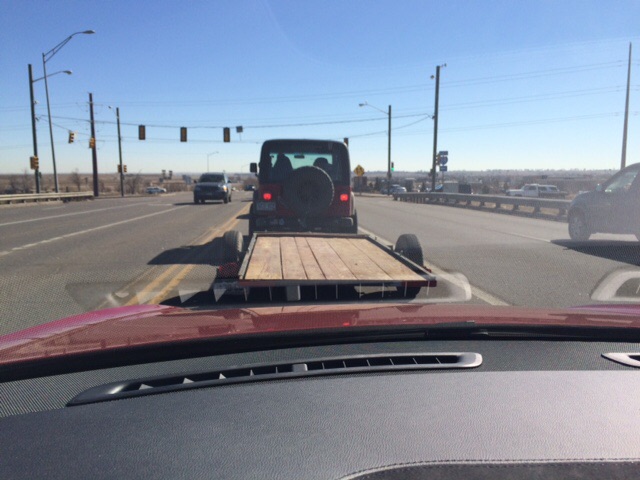
stevezzzz I was following a Jeep pulling a small flatbed trailer, with TACC on, when we arrived at a stop light. The car had no problem slowing as the Jeep slowed, but at the last moment I realized that the car had no knowledge of the trailer, and had to slam on the brakes to avoid a collision. The point I stopped was just outside the parking sensors' range; I crept a little closer and did get the parking sensor warnings.
Bottom line: TACC's not perfect. Anybody have a good email address to report this to Tesla? I think they should be able to change the algorithms to include this scenario.
 �
�
Mar 14, 2015
Saghost Huh. I would have thought the radar would have no problem seeing the trailer.�
Mar 14, 2015
wk057 I had a similar experience once, and I noted that the trailer's tail lights were not operational. The tail lights on the trailer in front of you do not appear to be functional in that image. Image recognition appears to be a huge part of the TACC/Autopilot setup. I'm surprised the radar didn't recognize the trailer, however, since it has for me on several similar occasions so far more often than not with even smaller trailers. I think the common element with the time it didn't would be the tail lights.�

Không có nhận xét nào:
Đăng nhận xét