Apr 1, 2015
TexasEV Reporting a reduced charging rate as being "throttled" makes the assumption that it was intentional rather than a defect. There is no evidence that was the case. Let's describe what happens in a neutral way rather than attributing purpose to it.�
Apr 1, 2015
apacheguy Next time you go please take some data. Some users are suggesting 6.2 has improved the algorithm.�
Apr 1, 2015
bxr140 Supercharged today at Fremont. Data is consistent with what I've posted previously, which is to say, still slower than non-local superchargers.
For those who dont wish to dig, of the 14 (I think) chargers I've visited, my two local chargers (Fremont and Gilroy) are consistently and clearly slower.�
Apr 1, 2015
Depeche Mode If by algorithm you mean the charging data, well, they are the same as they were when I first tried the Montr�al SC...
Nothing changed... for a definite SoC, it's still at the same voltage and amperage as it was before...
- - - Updated - - -
I'm still with you guys... as I said that the last 2 SuperCharging were fine BUT I'll keep an eye on it...�
Apr 1, 2015
mackgoo For my own info. Are you sharing a paired charger during these sessions?
Oh, by the way. Today I couldn't get more than 115kW/h. I'm getting ready to start a petition for a congressional inquiry as they must be taking advantage of me some how.�
Apr 3, 2015
David99 I had my car for annual service today. I mentioned the limit I experienced and they said it's definitely not an issue with the car. The rep said sometimes when the battery is stressed a lot, the car will reduce the charge current to protect the battery. The times I experienced it, the battery was definitely not strained a lot. I was actually driving pretty easy. There was no other expianation or speculation discussed.�
Apr 4, 2015
apacheguy Yeah, I don't believe that. I've been driving 80 mph in 105 F heat in the Central Valley and I've still hit over 80 kW when I connected. Granted, the cooling fans were running at full tilt.�
Apr 4, 2015
bxr140 I've had three clipping events due to pairing, which are very obviously no relation to the obvious slower local charging.�
Apr 4, 2015
Depeche Mode Don't believe that either...
I hope Tesla sales rep won't become like ICE sales rep...�
Apr 4, 2015
deonb The won't. ICE sales reps are kept up to date of things by their manufactures.�
Apr 4, 2015
scaesare Not in my experience. I have the documentation over two (expensive) botched warranty service issues to prove it.�
Apr 4, 2015
AmpedRealtor This thread needs to come to an end. Folks are posting links to this thread over at TM Forums as evidence that throttling is taking place when it very clearly isn't. UGH!�
Apr 4, 2015
CSFTN I'm sorry - was this sarcasm?
If traditional car salespersons are more up to date, which in my experience they're not, it would only be because changes to the car happen no more frequently than yearly (very rarely, 6 months).�
Apr 4, 2015
bxr140 Can you link to evidence/data to support your supposition?
There is data that very clearly shows some people experience occasional low charge rates, and some of that data shows consistency in location. To my knowledge, there is nothing that suggests one way or the other whether that those low rates are intentional 'throttling', so unless you can prove otherwise, you are doing a disservice to the community with your statement.�
Apr 4, 2015
Depeche Mode You're right, I also think that this thread should continue...
For my part, after experiencing throttling issues at the Montr�al SC for the whole february and march, I have to say that since the last week I've gone 3 times just to test any throttling and none of the 3 times I was throttled... kinda relieved that it has stopped...
People who still experience throttling should continue to state it in this thread... If Musk really pledges is �warranty� of �no more range anxiety�, well, it starts with avoiding any throttling for any SC as it does more harm than good for the company image and the EV industry in general...�
Apr 5, 2015
AmpedRealtor HUH?
You are saying that just because a handful of people experienced low charge rates in specific locations, the burden is on ME to prove that there is no throttling issue going on? I'm sorry, but that's not how things work. There is absolutely no conclusive evidence presented in this thread to prove that throttling is occurring as a result of policy. There are far more data points in this thread alone to disprove the position that Tesla is intentionally throttling anybody. Maybe you should go back and review the preceding 60 pages.
If anyone feels that Tesla is intentionally throttling, the onus is on them to prove the assertion because such an assertion runs contrary to the majority experience as well as Tesla's stated policies. So far, that burden has not been met. There is absolutely no evidence - none - that Tesla is intentionally throttling anyone. If there is, and since you are the one supporting that claim apparently, then the burden of proof is on the person making the claim that runs counter to the accepted reality. So please prove it.�
Apr 5, 2015
SW2Fiddler ^ ^ ^ THIS.
In the absence of any reasonable motive that Tesla would have to intentionally rate-limit a chosen few... calling whatever is happening "Throttling" implies intent, connotes retribution, thereby inflaming emotions...
Throttle is something controlled. On purpose.
Therefore the choice to use the "T-word" when contributing data points does a disservice to the community.
But, yeah, it makes for better click-bait.�
Apr 5, 2015
AmpedRealtor You received low charge rates in February and March, which were probably very cold months, and in the warmer month of April you've gone three times and have not experienced limited charge rates. Well, if you are saying that Tesla is throttling users then you just disproved your own point. This amounts to nothing more than issues with local superchargers, thermal, etc. That's it. If Tesla was intentionally throttling you, then why on earth did they decide to stop a week ago?
This thread might as well be about UFOs. There is nothing here. I love how people can build up a mountain of speculation based upon essentially nothing. It's turning into a mass hysteria without any supporting evidence. Even the evidence you provided was not consistent, yet you continue to push the notion that this is because of some policy?
I would love for people to use some logic here instead of defaulting to rampant speculation.
- - - Updated - - -
MODERATORS - Can you please change the title of this thread to "The Yeti Thread"?�
Apr 5, 2015
bxr140 Was I not clear? The burden that is on your shoulders is with respect to your statement there "clearly" isn't throttling. You presented that as fact, when it is obviously just your supposition. Feel free to retract your incorrect statement and re-present it as your opinion.
This is opinion as presented as supporting evidence for your false claim of fact. That's not how this works. Try again.
- - - Updated - - -
LOL. Feel free to propose some other semantic terminology to describe the low charge rates. I've attempted to avoid the term as much as possible and keep the discussion neutral (since there's no data to explain the low charge rates), but those flying the anti-throttling flag can't seem to get away from the term.�
Apr 5, 2015
Depeche Mode Actually, almost everyone that has a Tesla knows that a cold battery charges slower in cold winter... but thanks again to remind us...
Everytime I went to SC (feb-march) I made sure that my battery pack was warm (at least 45 minutes of driving)...�
Apr 5, 2015
TexasEV Actually almost everyone that has a Tesla does not know that, because most Tesla owners aren't on this forum and even those who are may not have read those threads. Now that Tesla is past the early adopters, most owners probably haven't even read the owners manual closely.�
Apr 5, 2015
jerry33 This is almost certain to be true given the thread where the owner didn't realize you need to take the UMC in order to use an RV park's 14-50. I don't blame Tesla for not putting this in the owner orientation dialogue because I wouldn't have thought it would have been necessary either.
I'll admit I read the manual once but not the revised manuals. On the other hand there's little in the manual that hasn't been discussed at TMC.
Back on topic: I had no reduced charging at the Corsicana SC yesterday.�
Apr 5, 2015
AmpedRealtor I don't have to prove anything. You're the one claiming there is throttling. What is your actual proof that throttling is taking place? In the absence of proof to support your claim - and it's your claim - then the opposite is true. Nobody who supports the claim that Tesla is throttling has met even the most rudimentary burden of proof. Anyone with a basic high school understanding of the word "hypothesis" knows that such hypothesis must be proven before it can be accepted as a theory. What you and others are promoting here is all hypothesis and no evidence. The evidence would have to be overwhelmingly in your favor for this to be true. And that is simply - and clearly - not the case.
Who is the one making the claim here? It's you making the claim that throttling is occurring, so you should prove it. I have not seen you present any evidence or proof to support your assertion. None. And those who were previously throttled are no longer throttled. So even that cannot be taken as evidence. So what else is there?
- - - Updated - - -
No, not every Tesla owner knows this. In fact, many do not. It doesn't hurt to make a statement that reminds people that temperatures do affect the rate at which Superchargers dispense electricity and the rate at which the vehicles consume that electricity. And temperature could very well be the issue between charging in February/March versus in April. But around here, we have to panic and assume something terrible is happening, we have to blather on for over 60 pages about a total non-issue, and then we must attack those who do not support our delusional thinking.�
Apr 5, 2015
SW2Fiddler LOL right along with ya.
Glad you're on Team Neutral. I don't have a catchy bisyllabic sound bite for "sub-optimal charge rate" or "un-super quickcharging" but those are objective, neutral. Much like the original post.
Sub60? Leaf-y? ~shrug~
'Low charge rates?' I think you pretty much nailed it right there.
The t-word brings to mind someone's hands around a neck, that just implies there's a victim and not just an anomaly.
For the victimizational camp, I think "I Been ChaDoMized!" would be even catchier and more lurid.�
Apr 5, 2015
bxr140 That's a total fabrication. Why would you make something like that up (let alone say it on a public forum) when my post history clearly shows its untrue?
Are you here to have a discussion on an enthusiast web forum, or are you just here to win the internet?�
Apr 6, 2015
sorka To add my own data point. Pulled into Fremont this morning with 35%. Plugged into 1A. Capped at 60KW. Sat there for about 5 minutes like that and then decided to move to 1B which is on the same stack. This went to 112KW immediately. I called the Tesla supercharger team and told them what was going on and they said they'd look into it. Interesting thing is this is on the same stack.�
Apr 6, 2015
Lloyd I noticed Friday, charging a Fox hills Mall, CA that there was a pause at 60 kw like it was looking for something. The charge rate then went to zero momentarily, then ramped back up to 60 kw, stopped there again momentarily, (5 seconds) then ramped up to 118 kw. Just another data point.�
Apr 6, 2015
trils0n Fits with my theory, backed by a conversation with a Supercharger tech, who indicated that the splitter wasn't working properly when I had a charge limited at 60kW. Seems pretty clear that it is a Supercharger problem/bug, not intentional throttling.�
Apr 6, 2015
scaesare It's been nearly 300 posts ago in this thread... so with the most recent data and experiences I'm going to go ahead and repeat what I said earlier:
�
Apr 6, 2015
wk057 A good percentage of the miles I've put on three different Model S have been supercharger powered miles. There are only two instances where I saw a supercharger give less power than expected vs. the normal full power taper curve: a) Paired stalls. If another Model S is on the other paired stall when I get there, I don't get full power until they're gone; and b) When the engineers were working on the supercharger in Hamilton NJ before it was actually fully energized and several days before it actually opened (limited to ~50kW IIRC).
I'm talking about over 100 supercharger uses in the past year and change, many of them after this thread was opened. None from three vehicles of my data supports any throttling whatsoever.
Take a step back and really think about this. I'll say it again, it makes zero sense from any point of view for Tesla to *ever* intentionally throttle production supercharger use. Not from a marketing perspective nor from a money savings perspective nor from a technical perspective. Literally, zero reasons to do this.
"But wk, locals are hogging the superchargers! Something must be done!" - Yeah well, keeping the locals on the chargers longer sounds like the worst possible solution imaginable. Next!
"But wk, Tesla will save a boat load on demand charges!" - I've never seen a rate plan where demand charges spanned a shorter time window than a week. So they would have to throttle *everyone* at that charger for at least a week to save on demand charges. Data opposes this. Next!
"But wk, that guy earlier in the thread posted an invoice where a service tech confessed!" - I've read that invoice. I don't subscribe to that interpretation... It's a stretch at best. The invoice simply said that they confirmed that the car wasn't getting full power from a local supercharger. It said nothing about this being normal nor a policy. A more likely cause would be some technical issue with the car or that supercharger. With hundreds (thousands now?) of supercharger cabinets and supercharger stalls around the world a small % of those are bound to be having some technical issue at any given time. This is a much more logical reason. Next!
"But wk, you're just defending Tesla. You're a fan boy." - lol. I like Tesla, but I'm not a fan boy. If you've read all of my posts that would be obvious. I don't automatically take Tesla's side. If the facts support Tesla, I'm with them. If they don't, they don't. Next!
"But wk, I have proof!" - Yeah? What proof? A photo of your dash showing your car charging < the normal taper curve? Output from VisibleTesla showing similar? That's not proof. First, your photo/output doesn't show the paired stall. (For sure at least a couple of these throttling claims in this thread were due to stall pairing.) That said, how do I know you're not just posting your shared stall charge rate just to fuel the fire here? Nope, the only proof will be either significantly more data points consistently supporting throttling is happening (highly unlikely) or an official announcement from Tesla (a service center rep saying yea or nay does not count... we all know how bad internal communication is at Tesla). More unique users need to report corroborating data... and they have not.
All of that said, I'd certainly vote that this topic be left alone aside from actual data points from more unique users on the topic (for or against the throttling claim). The same group of people yelling "throttling!" and the same other group of people yelling "no throttling!" isn't really getting anywhere. I'm definitely in the group yelling "no throttling!" because this is what the data/facts/logic currently supports.
*sigh*�
Apr 6, 2015
Larry Chanin Not quite.
Let me say at the outset that I believe we are likely dealing with a Supercharger software bug or periodic failures at the Supercharger splitters, and not a deliberate policy to save on demand charges.
With regard to your statement, this was discussed earlier. Demand charges vary greatly between countries. In the USA demand charges are averaged over a demand interval usually between 15 minutes and 30 minutes and they are compared with a monthly peak. In Japan demand is monitored against an annual peak. So in the USA my previous remarks relate to your statement quoted above.
Do I think this is what is being done? No, that is unlikely, but it is not necessary to constantly throttle everyone for a protracted duration to save on demand charges. By intelligently monitoring the Supercharger Station demand profile and only throttling at peak demand times demand charges could be minimized.
Larry�
Apr 6, 2015
wk057 So, if at any point in the month all cabinets are in use for > 15-30 minutes (sounds very likely for CA locations that have been noted here), then throttling would do nothing at all... unless all 4 to 12+ cars there at the time were limited to < 10kW or something (to fit the 60kW "throttling" nonsense) there would be no avoiding demand charges that month.... and I'm pretty sure hell would be raised if a full supercharger site was putting out 60kW spread across all vehicles.
I don't see how any "intelligent monitoring" could reduce demand costs without actually reducing demand over an entire month... something that would be super noticeable to users.�
Apr 7, 2015
David_Cary I certainly agree that demand charges would be noticeable. But has anyone been posting time of day data?
And the demand they would be limiting for would be 60xnumber of stalls not 60 total.
I'm going with the supercharger bug theory as that makes the most sense but demand charge avoidance should at least be adequately disposed of. The demand charges have to be significant for Tesla. There maybe batteries at play and it would make detective work more difficult. IE - throttling would happen when the batteries were depleted and it was a peak time. And it is possible in some markets to be tied to sun exposure. So the Peak could be different than the peak for typical residential use. A big storm at 5pm in the summer could be a super super peak.
In NC, using peak charges for solar residentia l(TOU-D the rate plan I have), I've thought the electric bill of a supercharger would be 90% demand based and 10% use based. That is powerful motivation and Tesla is in a unique position to experiment with rates from utility companies. Just consider the local option (not sure if you have it) to save $25 a year to put a throttling device on your hot water heater and a/c (intended to be used for less than 1 hour a few times a year)
So wow - this gets complicated. When 60 happens, we need temperature, time, day of week and wind and sun exposure. (and perhaps we also need prior 12 hour data for battery charging) Are you sure you want to absolutely exclude demand avoidance as a possibility?�
Apr 7, 2015
smac Here in the UK, there are real benefits for large consumers of grid electricity to attempt to slow down peak demand at times of heavy load on the rest of the grid. I have no idea if the US has similar schemes in play, but for reference:
Triads: Why three is the magic number | National Grid
So theoretically (and I'm suspicious of the exactness of the 60kW figure in this regard) Tesla could have notice of such a "Triad", and attempt to keep down electricity used in these key periods if it's looking like they will burst a threshold, which would make future electricity more expensive.
Not sure I buy this though. I suspect either a software glitch, or maybe a statistical sampling exercise.
(*I still believe Tesla are under some cost reduction pressures given my interpretation of their SEC filings, however I'm not sure how restricting a SpC to 60kW would help, unless it encourages people to move on as quickly as possible to get to their destination, rather than waiting for a full charge. Statistically this effect could have been investigated. v6.2 "move on" feature is obviously aimed at the same thing, and is much more likely to be effective in my view, but that's just a hunch.)�
Apr 7, 2015
jerry33 I believe that when there would be a real difference in price, Tesla will put in solar and/or batteries to minimize costs.�
Apr 8, 2015
AmpedRealtor I was responding to your previous post to me claiming that throttling exists. Are you now changing your position?�
Apr 8, 2015
CSFTN Ok .. I will be the conspiracy theorist today. Anyone else note in the new Tesla webpage, in the 70D section, that they've subtly changed the wording about the superchargers? It now says "free Supercharging for lifetime, for long distance travel" seeming to imply that yes they're going to limit local use of SCs?�
Apr 8, 2015
FlasherZ That was changed a few weeks ago. Noted upthread.�
Apr 9, 2015
huntjo I have not experienced any reduced charge rates from superchargers�
Apr 9, 2015
wk057 There would really be no reasonable way to "limit locals," IMO, especially when a top off at a local charger is needed to make it to another charger comfortably. Tesla has no real way to distinguish this use from "local" use until after the fact... and if I stopped at a local charger to top off to get on my way with a trip and was limited or unable to do so I wouldn't be a happy customer for sure.
Do I think locals should be using superchargers for a large percentage of their local miles... no, I don't. Do I think there is a good technical solution to prevent it? Nope. Are people going to do it anyway, yup. Unless they're completely locked out, as in the charger will not charge the car at a local supercharger at all, then other efforts are pointless. The people mooching off of a local supercharger are not going to care if it's full speed or 25% speed at the expense of hogging a stall needed for a long distance traveler.
Then there is the case of needing supercharging to effectively enable your daily drives for a long commute. If you have a 250 mile round trip commute (brutal... but I've done it), with a supercharger somewhere on that route, you're going to need to utilize it regularly most likely. So, even limiting or prohibiting frequent usage doesn't make sense either.
The only solution I can think of to somewhat solve the local usage problem would be a monetary one.... and that is for Tesla to charge actual electricity costs + some decent % premium fee for use of a supercharger that is within say 40% rated range of a home and/or regular work place (determined algorithmicly via GPS usage patterns over a rolling time-frame window to prevent change-of-address abuse). Perhaps even the closer to home, the higher the fee. Possibly as a bonus when an actual long distance trip is detected (where you use another charger outside of this ~40% range window immediately after the local one) then the usage on that local charger the stop before isn't billed since it was enabling long distance travel, same with when you return to it the next time.
Billing could be done post-pay without a credit check on something like a quarterly basis. Non-payment locks your vehicle out of the entire supercharger network, Tesla subsidized destination charging network, and perhaps even service center/warranty work/roadside assistance as well until the (likely very small) balance is paid.
I'm just making this up as I go along, since I know Tesla will likely never implement such a thing, but a monetary penalty for local usage is the only thing that will curb local usage. Power throttling will not, especially 60kW which is still 3x faster than an 80A/240V HPWC.�
Apr 10, 2015
hiroshiy The only issue I can see re "charge fee to local charging" is that Tesla seems to try to sell cars to apartment dwellers like myself in cities like Tokyo and Hong Kong, maybe some parts of China. I personally have 80A HPWC at the office so I regularly charge there, but some people here don't have home or office charging at all. Tesla still could charge fees for such uses, but that will significantly reduce the attractiveness of Model S.�
Apr 11, 2015
Nigel16494 Just a quick update, I just went on a long trip. I charged at Gilroy x2, Atescadero x2, Buellton x2 . I followed the new software level advice (charge here 30mins then carry on etc) and got no limits at any of them. Whatever was happening before isn't happening now. For me it is case closed. I saw an interview with Elon where he said people can go on a road trip and leave the wallet at home. He came good on his promise and then some.�
Apr 11, 2015
Larry Chanin Yes, Tesla is beginning to recognize the challenges that are frequently encountered by Tesla owners living in multi-unit dwellings.
While it is true that Tesla rolled out the Supercharger Network with a focus on long distance road trips, and it still devotes most of its attention to that objective, it is also a fact that they are beginning a foray into an area that they call "Urban Superchargers". Here's an excerpt from their Supercharger webpage.
Since they are beginnig to address the issues of "congested city centers", it is very unlikely that Tesla is ever going to do anything to penalize local charging. What has been reported in this thread has absolutely nothing to do with a deliberate policy on the part of Tesla to penalize local charging.
Larry�
Apr 11, 2015
sorka I've somewhat reversed my opinion on the whole issue and now think Tesla should do something to curtail local supercharging. I don't think it should be throttling, but should instead cut off repeat offenders from the supercharger that is near their residence if they keep using it day after day. It could come with a warning first.
Or rather than cut them off, it could be that it will only charge them enough to get home.
The problem with that is that those who are coming home and then need a quick charge to say head out to the city will be cut off.
What you really want to do is prevent abuse of the system by those who *ONLY* charge at superchargers near their house and do not charge at home.
This could be prevented by cutting off access to local superchargers for those that never charge at home or rarely charge at home. i.e. you should be charging overnight at your house every time you need to take the Tesla out the next day. If you don't but instead only charge at superchargers, Tesla could detect this use pattern and simply cut them off but only after sending them a warning first.�
Apr 11, 2015
wk057 Not sure why a fee would matter too much here.
Normally, you'd have home charging, which you would pay for. If not, you can supercharge... and pay for it.
I see no real distinction unless the cost is extremely high. It should be a bit higher for supercharging than the local residential rate to encourage users to home charge, for sure, but not so high as to make it impossible.�
Apr 12, 2015
Nigel16494 Hiroshiy is dealing with a different problem. My friends in China park as close as they can to the apartments (might be a mile). There is no concept of home charging since there is no garage or house. Tesla is struggling in the China market because of this. My friends cannot buy a Tesla because it cannot be charged where they are. The expansion of charging in China will help a lot. Supercharging for locals is going to make the car usable in China . It sounds like the same is true for all high density living places, Tokyo, Beijing, Hong Kong.�
Apr 12, 2015
jerry33 Without local quick DC charging any EV will be impractical (to a greater or lesser extent) for anyone living in an apartment or condo. This would be true on every continent.�
Apr 12, 2015
RDoc So this means that Tesla should prominently display a warning that anyone without access to home charging should not buy a car? There actually are people who live in cities who don't have access to any form of charging where they live.
I find it very difficult to believe that there are many people who have access to home charging who drive to a Supercharger and hang out there for half an hour or more to save a few dollars on electricity.�
Apr 12, 2015
wk057 I didn't say that locals shouldn't be able to use them. I just said that it shouldn't be free.
Why should I pay to charge at home when someone in an apartment doesn't have to when they use local superchargers? I have a supercharger close enough that I could cover my usage without home charging if I wanted... but that would be silly of me to waste that time. However there are people who do waste an hour+ to get their $10 worth of free local charging... not sure what these people do where they own a Model S and also think their time is worth < $10/hr but, I digress.
The Tesla website even estimates 10% supercharger usage over the life of the vehicle into its fuel savings estimator. Not 100%.
Edit: One of the big advantages of owning an EV is the whole leaving every morning with a full tank aspect. If you're not getting that key benefit from your purchase (net decrease in time wasted for fueling) I honestly would just suggest not buying an EV.�
Apr 12, 2015
TexasEV It must be a small minority of owners, but there have been several posts from people bragging on how much money they saved charging at their nearby supercharger instead of at home. I think mostly from California where electricity rates are much higher than the rest of the country.�
Apr 12, 2015
robby +1. Additionally, if people want to buy Teslas without any home charging infrastructure, and are willing to wait at Superchargers to make that possible, big props to them and I hope Tesla and Tesla owners are as supportive as possible. The long term answer to all of this is better EV infrastructure and an expanded Supercharger network. I'm glad to see Tesla going that route rather than trying to nickel and dime people in more difficult living situations.�
Apr 12, 2015
hiroshiy Sorry I'm getting off topic but
- free charging at Superchargers gives distinctive marketing pitch for Tesla
- People by nature try to search for free, or cheapest possible chargers
- Tesla wants to sell cars in some countries where home charging still have some difficulties
- which is good for Tesla, (a)ignore local abusers and build Superchargers in city centers and enter those urban markets, or (b) ask everyone to pay at Superchargers and lose some strong marketing impact
I would think that charging for public chargers is generally good and gives the balance of economy, but for Tesla specifically, it's not a good idea.
However I don't have a good alternative idea. In Japan Nissan made their charging card flat rate (all you can eat style), so many Leaf owners flock to Nissan dealers for charging. Mitsubishi on the other hand chose 'wk057' style and charge a small fee to dealer charging in addition to monthly fee. And you'll easily guess which customers are pissed off and complaining on the car forums?�
Apr 12, 2015
FlasherZ Hey mods: from this point, can we break out the hypothetical policy question ("should Tesla charge / limit local supercharging") from the functional problem ("my car can't charge more than 60 kW") in this thread? There's still an important question (although it seems to be going away) as to what creates the 60 kW limit - malfunction, etc.�
Apr 13, 2015
hiroshiy lets focus on (hypothetical?) functional problem.�
Apr 13, 2015
gregincal 60kW times the number of stalls is pretty much the hard limit for superchargers anyway, since they are paired. Limiting cars to 60kW would do almost nothing to reduce the peak load (perhaps reduce each pair from 130kW to 120kW). Since the limit we are talking about always pegged an individual car at exactly 60kW rather than reduce the load of paired stalls the demand charge theory has never made any sense to me (not to mention that most reports of 60kW charging we at fairly empty stations).�
Apr 13, 2015
sorka Yes.�
Apr 13, 2015
Nigel16494 For some people free supercharging was the deal maker in getting a Tesla. Tesla says supercharging is free so folks should just get over it. The only concern I have is the usage supply and demand gets out of balance. At the weekend I was more than 400 miles from home and I managed to get back hopping the superchargers. If I had a 30 min wait at each one + the charge time I would not take the Tesla on a road trip. I am sure tesla is working on the usage issue. The idea of some kind of charging etiquette on how far you are from home doesn't work. Some folks may have a valid reason for local supercharging. All I need is for my road trips to not get held up by them. As long as they don't hold me up and monopolize the stalls then I'm ok. The new level of software seems to optimize the amount of time you spend, down to the point of only stopping for 10 mins at a supercharger.
BTW, at all the distant superchargers all the folks I met were local. Very nice people all of them, not the devil incarnate folks that I have been lead to believe.�
Apr 15, 2015
sorka If enough folks in condos and apartments who can't charge at home buy Teslas, then long waits are exactly what's going to happen. This is why I believe the wording on their page has changed from "when difficult to charge at home" to "when on long trips". My first reaction to that was how dare they but now that it's had time to sink in and if this is part of a policy change coming, I suspect I'm going to agree with it provided they're not cutting off folks from charging at their local super charger when they need a quick charge before heading out for a long distance evening. They can prevent that buy making sure that you only get access to your local supercharger if you regularly charge at home too.�
Apr 15, 2015
apacheguy Nice thinking, but it ain't gonna happen. Especially with the China market and the way sales are going there. It's a perception issue�
Apr 15, 2015
rlang59 The policy changes could always be region dependent, but like anything not everyone is going to be happy no matter what.�
Apr 15, 2015
AmpedRealtor The only problem with your statement is that "abuse" is not possible. Therefore, there is nothing that needs to be done. Tesla makes Superchargers for use by all Model S owners regardless of where they live or how many times they charge. Any characterization of "abuse" is in the mind of the accuser and is based upon the opinions and values of the accuser. You want Tesla to formulate policy based upon what you think is or is not appropriate behavior. Except, it's Tesla who gets to define that.�
Apr 15, 2015
sorka The chinese market is not the US market.
What would be a disaster is for there to be long lines at SCs. That will change the perception in a very negative way and kill sales. The SC network is the backbone of Teslas strategy and if it is not viable due to congestion, that will be the end of it. It will be very hard for Tesla to recover from that even if they fix the problem.
- - - Updated - - -
Sure. Whatever you say. I for one am glad they changed their wording to "while on long trips". It's very akin to fed policy signaling before they change rates.�
Apr 15, 2015
AmpedRealtor I don't think a marketing blurb defines policy AFAIK.�
Apr 15, 2015
David99 While Superchargers help mostly on long trips and actually make road trips in an EV doable at all, they are definitely not only to be used that way. Tesla built many Superchargers in places where they serve both local and long distance travel. Their marketing wording isn't a usage policy.
The times I experienced the limited charging power was far away from my home and on Superchargers there are never ever busy. For several months I had no home charger and used Hawthorne many times which was closest to my home. It was before the expansion and it was a very busy Supercharger. No slow downs there. As mentioned before many times, a slower charge rate would not discourage "freeloaders" and locals. 60 kW is still much faster than any alternative, it is still free and it would result in Superchargers being used longer making the problem worse.�
Apr 15, 2015
Larry Chanin I've studied our local Florida DMV statistics and building occupancy rates. It is interesting to note that the counties that have the highest Model S sales (and plug in EVs in general) are also the same counties that have high incidence of multi-unit dwellings (MUDs). Behind California, Florida is has one of the highest sales of Teslas, certainly more than China. It would be very unwise for Tesla to implement a policy that penalized locals in MUDs from charging at Superchargers, particularly if they are not doing the same in China.
Larry�
Apr 16, 2015
rlang59 Which is exactly why I said not everyone is going to be happy no matter what they do.�
Apr 16, 2015
gregincal Supercharger maps like this don't make me thing Tesla is in the business of discouraging local charging. Why else would you so many supercharger sites in the San Francisco bay area (all within a hundred mile radius).
:
�
Apr 17, 2015
sorka There is only ONE supercharger in the Bay Area and it's the one at the Factory. There is one in Gilroy, many miles away, but I'm not sure if I would include that in the Bay Area. There's a new one in Petaluma, but that is way outside the bay area a hundred miles away.
HPWC are not superchargers.�
Apr 17, 2015
Cottonwood From my point of view from the Rockies, the "Bay Area" includes the areas around San Francisco Bay, San Pablo Bay, Suisun Bay, etc. Petaluma is only about 15 miles from San Pablo Bay. Also, Petaluma is on the Petaluma River, which appears to still be tidal at Petaluma. Petaluma counts as Bay Area to me...�
Apr 17, 2015
Benjamin Brooks Yep. If you watch local news coverage, all the meteorologists include Gilroy and Petaluma as in San Francisco Bay Area. And I would agree with them �
�
Apr 17, 2015
sorka 3 superchargers in the whole Bay Area plus the outlying areas is not a lot of superchargers. Your photo of that map makes it seem like there are dozens and it's not true. Gilroy and Fremont which are 52 miles apart and from Fremont to Petulma is another 70 miles. Gilroy and Fremont are almost always full. I've had to wait just about every single time. Add to that a disproportionate number of Teslas are in the Bay Area compared to other parts of the country and you can see we have a massive shortage of stalls and locations.
I suggest you shift your example to Southern California where it's closer to actually being true.�
Apr 17, 2015
Larry Chanin Yes, I believe we are in agreement.
If Tesla were to implement a policy that penalized locals they would be unhappy as well by the unintended consequences leading to the significant loss of sales to an important market that lives in multi-unit dwellings. Nationally 30% of the population lives in multi-unit dwellings in which installing charging infrastructure is usually problematic more times than not. This is a large segment of the potential market to write-off. Tesla is too smart to shoot themselves in the foot.
Larry�
Apr 17, 2015
gregincal That was not a map of HPWCs. That was the 2016 supercharger map that shows 4 new superchargers being built in the bay area in the next 2 years (btw, Petaluma is definitely part of the Bay Area, it practically borders the bay.
- - - Updated - - -
Perhaps I should have been clearer what I was showing. Tesla shows that by the end of next year those 3 superchargers will become 7 superchargers. That's a lot of build-up in a small area. LA is the same.�
Apr 17, 2015
sorka Not when you consider the per capita population of MSs here compared to everywhere else.�
Apr 17, 2015
AmpedRealtor If Superchargers were only intended for long distance travel, it sure is funny that there are going to be 7 of them in the bay area.�
Apr 18, 2015
sorka I think long distance travel could simply be a lot of driving even if it isn't geographically in a straight line. I'm fine with locals supercharging at local superchargers just as long as they first charge overnight at home or Tesla will have an unsustainable business model if they're paying for masses of apartment dwellers gasoline.�
Apr 18, 2015
Andyw2100 Apartment dwellers who drive Teslas get special models that take gasoline?�
Apr 19, 2015
mackgoo Please move the bulk of the end of this to "local haters".�
Apr 19, 2015
dennis Last week I took a road trip to LA and Orange County. I was staying in Newport Beach and went to have lunch with a friend in Temecula which is about 80 miles away. I stopped at San Juan Capistrano (about 20 miles along the route) on both legs of the trip. Both times I got the last of 7 stalls, and both times there were other Teslas waiting when I left because every stall was full. I spoke to half a dozen other owners and they were all local. One guy said he "wanted to get his money's worth". Another one, a retired accountant with a 60, said he lived 5 miles away. Both said they had charging at home when I asked them. So much for the theory that locals won't dominate suburban superchargers because their time is worth more than the cost of the electricity that they are saving.�
Apr 19, 2015
apacheguy Yeah, that's unfortunate. I'm local to SJC but have only charged there twice.�
Apr 19, 2015
dhanson865 I can't see how they put up with the traffic. I could see doing that at odd hours once a week when the stalls are empty but I wouldn't bother if it were inconvenient at all. I'd rather charge in my garage for convenience.
To be clear I'm not firmly in either camp. I'd be willing to drive to a "local" supercharger to fill er up occasionally, I just wouldn't do it exclusively nor would I bother if there was heavy traffic.�
Apr 19, 2015
JRP3 Makes me think Tesla should not enable "free" supercharging for the Model 3.�
Apr 19, 2015
apacheguy Maybe for the entry level model a pay per use fee would make sense. For larger battery sizes though I still think it makes sense to enable free for life. I don't even SpC that often and I probably take a loss by having it rolled in with the price of the car, but I prefer it that way. I also think it's great marketing to say free long distance travel for life.�
Apr 19, 2015
JRP3 Prepaying encourages people to "get their money's worth", and the volume of Model 3's coupled with the likely more cost conscious nature of the buyers could lead to a supercharger over load disaster. As a future Model 3 owner I'd like to see a pay per use model, with a cost premium to discourage non essential use.�
Apr 19, 2015
Candleflame there will be people who wont have easy access to charging, particularly in the UK and in china (and everyone living in a city) where most people dont have garages. Especially in china teslas success will depend on easy to access supercharging. Tesla likely makes money on the included cost of supercharging anyways. you'll get a lot of electricity for 2500 euros and tesla will probably pay very reduced rates for it... Pay per use goes directly against the philosophy of the supercharging.�
Apr 19, 2015
bxr140 I'm with you that there has to be an explanation as to why some people get slower charging rates at some chargers. I originally just chalked it up to "superchargers are not all alike", but that's as much supposition as everything people have said in this thread.
From a trending perspective, including last night at Fremont (where I still showed a slower rate typical with charging at Fremont), I have 431 individual data points over 35 charging events at 9 superchargers. These account for ~3300 miles out of ~25k total on my car. I'm sorry if some people feel this data set is insufficient to show that I'm getting slower charging at my local chargers, but if I charged anymore I'd get accused of hogging chargers by some people. You really can't win TMC sometimes.
To your points:
-In general, the chargers closest to me (Fremont = 25 miles, Gilroy = 40) charge ~10-25% slower across the entire taper than the other chargers I've visited (Harris is the next closest at 150mi or so). The one oddball is my only visit to Buellton, which trends with Fremont and Gilroy.
- I've SCed with 6.0, 6.1, and 6.2, with various .xxx's. My data shows no discernible difference between 6.0 and 6.1, and while I only have one data point on 6.2 (at Fremont), it is trending with the previous versions. I never intended my data to 'prove' anything, so I haven't been tracking version numbers--I suppose had I done so there could be identifiable changes, but I suspect they wouldn't be more than a fraction or three of a percent either way.
-My car is a 60 with a B pack. I can't do anything about that so its really not a variable. :wink: It would be interesting if someone had the same type and volume of data that I have to see if Fremont and Gilroy are just slower for everyone. One supposition that I had when I first compiled this data is that its simply more obvious to me because I have a pretty detailed set of data and a battery that charges slower than most at the superchargers.
-I (obviously) have no idea about the charger HW/FW, but if it matters I have charged at Fremont, Hawthorne, and (I think) Gilroy pre/post expansion. And, if it means anything, Tejon [with its old school open-the-door pedestals].
-Ambient and car/pack/soak temps haven't been a huge variable. California, and all... My data goes back to ~October 2014, so figure mid-40s through mid-70s. From a trending perspective I've definitely charged at those (ahem...) 'extremes' for both of my local chargers. Night and day. Its a freeway haul for me to get to either one, and also some of my data is coming back from long road trips so there's plenty of steady-state running before charging for those events (I live at 1500ft and sometimes have to splash at Gilroy or Fremont to make sure I have enough juice to make the climb).
-Starting (and instantaneous) SOC doesn't seem to be a variable in the trending. Clearly there's more deviation at lower SOCs, but once I get to ~40% (and definitely over 50%), the max deviations in charge rate are within +/-10% of the trend. I don't consider the lower SOC deviations as an issue in and of themselves as I suspect there are plenty of variables that can affect the first 5-10 min of charging, but its fair to note that the deviations still bounce around their respective local vs flyaway charger trends.
-Charger traffic doesn't seem to be a noticeable variable. Especially with my local chargers I've been there when they're full and when they're empty. I haven't been recording traffic so I can't directly correlate, but I do mentally note the charge rate vs number of cars charging and haven't noticed anything out of the ordinary. I can charge just as slow as when its empty as when its full... If hot vs cold superchargers is a possible variable, it doesn't seem to be with me.
-Clipping due to pairing obviously doesn't factor into the "my local chargers are slower" situation. I've experienced clipping three times now (twice at Fremont, once at Harris), and its an obvious notch in the power vs SOC graph. And on a related note, despite some suggesting this is all a conspiracy theory and that people like me are posting nefarious and/or misrepresented data, fear not. I'm not that smart.
Please stop pretending you lack basic reading comprehension.�
Apr 19, 2015
FlasherZ This thread is about whether Tesla is limiting local supercharging to a specific threshold (60 kW).
If visualized, you'd see a "flat top" charging curve at first that led into a taper as your SOC increased. It sounds from your description like you are not / no longer seeing this, is this correct? It sounds like you're saying that your charging rate is reduced at certain locations relative to other locations - now we need to find someone in your same area that sees the same thing.
There are plenty of reasons why one supercharger location might be slower than another - especially when you start talking about only 10% or so. Perhaps someone else has logged the data at the superchargers to determine if they, too, are seeing limitations.
For example, consider the sessions at the same SpC that I show here:
Supercharging Taper Curve for D+ Pack - Page 2
One case, 60% SOC was at 65.1 kW; a couple of weeks later, 60% SOC was 61.7 kW. And this was the same SpC.�
Apr 19, 2015
bxr140 At the risk of poking the bear, that's what the thread has become. That's not how it started.
My sessions don't start as a plateau. They almost all start dropping immediately.
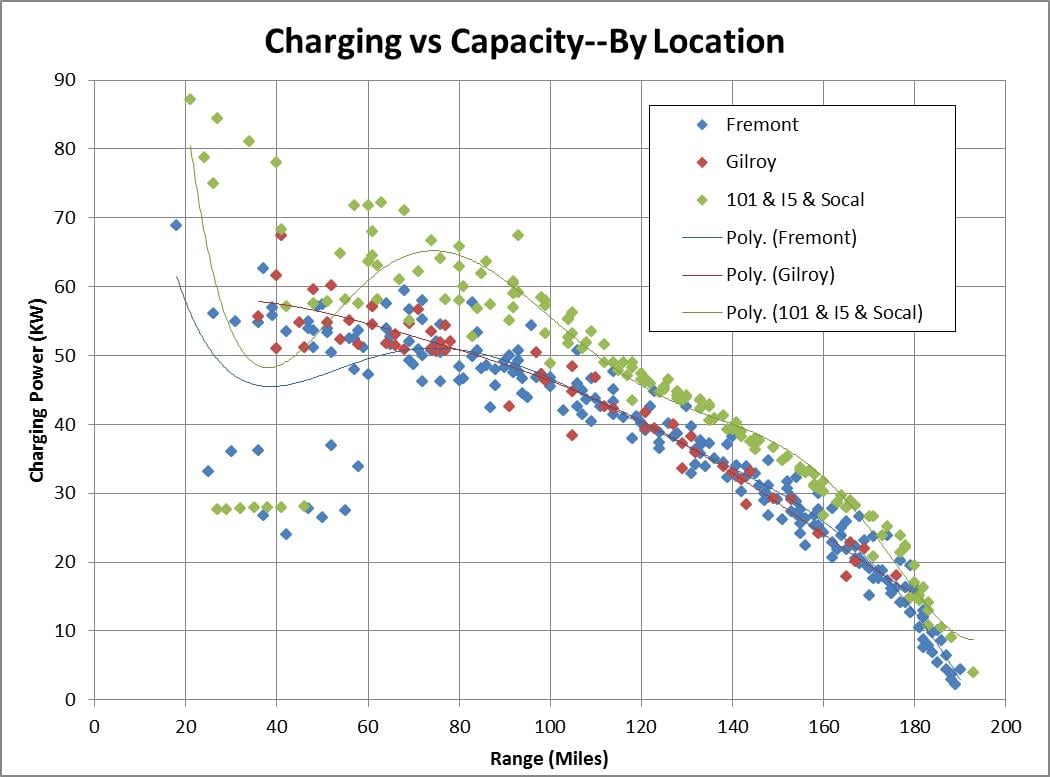 �
�
Apr 19, 2015
scaesare At the risk of derailing this thread: As I've mentioned elsewhere, while Tesla has not outright prohibited "local" supercharging (either via technical mean or policy), I don't believe that this is in the spirit of what Tesla was hoping to accomplish when they discussed Superchargers as removing a barrier to long-distance travel or road-trips.
(Mods: please feel free to relocate this post should a separate thread for "Local Supercharging Policy" get created)�
Apr 19, 2015
FlasherZ I definitely see what you're talking about. What would be interesting is to look at the power company that serves each of these. It could be internal standards on transformer configurations, or something else. I reach the same conclusion you do - that Gilroy and Fremont are "slower", but the reason for it is still not clear - and yes, avoiding the speculation that it's some policy based thing helps.
What's interesting is the wild variation you have in the green (101/I-5/SoCal) dots < 40% SOC. Any chance you can break that out by specific location to see if natural lines come out?
And I don't have enough experience with the 60 kWh battery pack to be able to draw any other conclusions.�
Apr 19, 2015
deonb On the other hand, I can't imagine that having 5 SuperChargers in downtown London (and a 6th under construction), is in the spirit of facilitating long-distance travel...
Everybody so far has been using anecdotal evidence akin to "I met a local at a SuperCharger once, therefore locals all over are SuperCharging, and it will mean the end of Supercharging, and the demise of TSLA! It is getting so bad, I almost had to wait in line to charge. Outrageous!"
But in reality, we don't know if this is even remotely a problem. Or if it is a problem, if it's up there with other problems. I've never met a local, but I have met a Tesla Employee at a SuperCharger once. So obviously we need to ban Employees from charging, post haste! SuperChargers are for customers.
Tesla is the only one with access to the information here. Let them resolve it like they see fit. Let's say there is indeed a 5% problem - it will likely be much easier for Tesla to just build 5% more SuperChargers, using a process they already have figured out, than trying to solve yet another issue.�
Apr 19, 2015
gregincal How can you say that. The original post was describing that when charging sometimes the OP started with a plateau of 60kW despite the state of charge. Other people confirmed exactly this behavior. Recently these people have said the behavior doesn't appear to occur any more. Everything else in the thread has been speculation and discussion.
As far as your data points you would need to show that people living elsewhere got different charge rates at the same locations to be meaningful. Otherwise you are just showing that some chargers are faster than others, and the two SF Bay Area chargers are a bit slower (the originally reported 60kW clipping did contain confirmation that other people at the same charger didn't experience the clipping for some reason).�
Apr 19, 2015
scaesare Actually I believe Elon subsequently discussed some urban-area Supercharger locations as a possible solution to adress those who live in apartments/condos/ etc.. where they have no real option for home charging.
But again. I maintain that using the superchargers some short distance from your place of residence where you have (or could have) home charging just in order to save a few dollars in not in line of Tesla's intent.
I didn't address whether or not it was currently a problem. I spoke to my belief regarding what Tesla's intent for them was.
The hyperbole doesn't help the discussion.�
Apr 19, 2015
jerry33 The problems here are a) prescience and b) lifestyle changes.
Example 1: I can go to the Corsicana or Waco SC and back without actually charging, but I'd have to do a range charge to be sure of making it--especially in inclement weather. I might also be going on to Austin or Huntsville (which I wouldn't have enough range to make it comfortably, and there are no SCs in Austin anyway so I'd be SOL when I got there. It's a day trip so destination charging doesn't apply).
Example 2: When Denton opens up, it's only 35 miles from my house, but what if I was going to where that 35 miles would mean the difference between making it and not making it or stopping at an RV park where they might charge me a full day's stay for a couple of hours of charging--some do. There's no way for Tesla to be able to tell if I was doing that or just being cheap. Even if it was 15 miles rather than 35 the same principle would apply.
Example 3: I now live in a house with charging. If I move to an apartment with no charging and I'm in for a world of hurt because Tesla has already registered my car for a house. Conversely, I moved from an apartment to a house and don't tell Tesla, now I can charge at SCs as much as I want. I really doubt that Tesla wants to play policeman.
In any event, limiting Supercharging goes against Tesla's goal of sustainable transportation by making it more inconvenient than filling up at a gas station. Sure, they'll be people who abuse the system, that happens in every system. Usually it's more costly--both financially and in terms of customer ill will--to prevent than just ignore the few abusers. Even with very tight controls and stiff penalties there will still be abusers (think income tax), so it's not like you'll get rid of the abusers.�
Apr 19, 2015
scaesare Using a supercharger as you describe in #'s 1 & 2 is consistent with enabling long distance travel. The supercharger doesn't have to be a long distance away. Very different from the scenario being discussed earlier.
As I mentioned above, Elon has referred to some urban area superchargers to accommodate those for whom home/ office charging is not an option.
Both are distinctly different than using a supercharger for the express purpose of avoiding home charging, and it's associated expense.
I'm not suggesting Tesla is, or will, attempt to enforce this as a policy. Nonetheless I maintain that local usage of Supercharging to avoid paying for home charging is not what they intend them to be used for. And quite frankly it doesn't scale well when we get several hundred thousand+ cars on the road.�
Apr 19, 2015
deonb Whao! Since you clearly have access to insider information to have been able to come to that conclusion, could you share:
1. What percentage of time are SuperChargers occupied by locals, for the sole purpose of saving money?
2. What is the total amount of kWh that are dispense to said locals per year?
3. What is the number of vehicles that had to wait in line, or had a slower charge, due to the effect of these locals?
4. What is the equivalent monetary negative effect on lost goodwill towards Model S owners and would be owners, because of SuperCharger stalls that are occupied by money-saving locals when needed?
5. What is the equivalent monetary positive effect on marketing and goodwill towards the on-site business of having SuperCharger stalls occupied at a higher rate? And how much easier does it make it to negotiate more parking spaces with the local establishment?
6. And finally, how many additional SuperCharger positions would have to be added in order to compensate for the effect?
Since you know all this, please do share!�
Apr 19, 2015
JRP3 Except that anyone currently with SC access who also lives far enough away from SC's that they charge at home, pay for their daily charging. Tesla certainly makes money on those people. However the people doing all of their charging with SC's will not only cost Tesla money for electricity they will also force Tesla to build many more SC's, costing even more money.�
Apr 19, 2015
dennis My anecdotal experience at San Juan Capistrano indicates that it IS a problem at that location. Most or all of 7 stalls occupied by locals and other owners waiting to charge. And unlike Hawthorne, it doesn't appear that there are easy expansion opportunities at SJC.
This pattern is repeated at the other California suburban Supercharger sites that I am familiar with - Fremont and Gilroy. In both cases dramatic (4->10 or 12) expansion was required, and they are still full many times. And no, I wasn't getting free local electrons in Fremont, I was visiting the Tesla Store at the factory!�
Apr 19, 2015
deonb Back of the napkin calculation tells me, over 150'000 miles, if ALL charging on a Vehicle is done on a SuperCharger, it will cost Tesla around $7200 in electrical costs (400wh/m, 12c kWh).
That vehicle will also occupy a SuperCharger stall for 1000 hours during that time (avg. 60 kW). Taken over 10 years, this is 0.00214% of the usable hours (16 hrs/day) of a 8-outlet Supercharging station. At $300'000 per station, this amortizes to $642. Let's round it up to $800.
So this SuperCharger-only user will cost Tesla $8000, on a car with a minimum gross profit of $18'750 (25% of 70D). Sure, it's not as much as they make out of other people, but this is a sale they would have otherwise not had. So it still adds to the bottom line. They're not losing money.�
Apr 19, 2015
mdemetri When they are supply constrained and have more customers than they can handle, they ARE losing money because they could have sold it to someone who would not supercharge for all charging. Also, if their margins were cut almost in half, as your numbers suggest, this would greatly hurt TSLA.
It makes poor business sense for TSLA to sell supercharger rights to someone for $2000 even though it will cost them $8,000. This only works currently because most of us who do not supercharge all the time are subsidizing someone who does. When those who use supercharging 100% of the time represent a sizable portion of sales (e.g. Model III), Tesla will have no choice but to either increase the upfront cost significantly or charge for access on a pay as you go basis.�
Apr 20, 2015
deonb Sure, but not on an individual car. They don't have a dire and immediate need to fix it unless it becomes a problem. They're not pricing themselves into bankruptcy, and can keep an eye on it to get more data.
For what it's worth, I do think that the SEC filing for the SuperCharger reserve is too conservative, based on the actual numbers they're encountering right now.
I've seen this argument used multiple times before. Sure the Model III is cheaper, but the scale of the savings is also less.
Keep in mind that Model III's will have a smaller battery, but will still charge for approximately the same amount of time to get to 200 miles (physics). So let's say a Model 3-55 can add 50 kWh of charge in 80 minutes. That will save you $5... for 80 minutes of effort. Go mow your neighbor's lawn instead for crying out loud! You'll make twice as much money in half the time, and get exercise in the process.
Supercharging is not a logical thing for people to do, on average, to save money. Not all people behave logically, but I don't think you need to build an entire business model around the premise that some customers will behave like idiots. It will most likely be noise, in the grand scheme of things.
Note that the clueless-freeloader situation is very different than people who live in apartments and SuperCharge because they have no other option. They can be saving $100's per month over the cost of fuel, and for them the time spent charging is absolutely worth it. But then again, this type of usage is obviously within the Tesla business model, by looking at the London placement. And so far nobody has been arguing that the apartment dweller is a problem, but rather that the clueless-freeloader is a (large-scale) problem that needs to be addressed by more than just a couple of extra SuperCharger slots. I just don't buy it. Not after the initial novelty wears off at least. It's too much of a burden for too little gain.
PS: If there is however concrete data (not just anecdotal) that proves that this is indeed a large-scale problem, I would be more than willing to reverse my position on this.�
Apr 20, 2015
FlasherZ About 18 months ago, I theorized that Tesla would freeze the Supercharger deployment at some point, when some energy distribution companies wake up and offer equivalent charging capabilities. Tesla would keep the Supercharger network free and as-is as a price-check balance against these energy companies, but would encourage the rapid growth of these chargers, much like the changeover from gasoline from car dealers to the oil companies.
I just don't see Tesla staying into superchargers and continuing to grow the free network; it's an enabler, and they'll do it as long as they need to, until the business opportunity comes along to create a pay-as-you-go base.�
Apr 20, 2015
WarpedOne Why do people have such an urge to demand pay-as-you-go pricing?
It is more expensive in time and money and has higher probability of failure, it demands extra steps in charging procedure etc.
And don't even mention credit or any other cards. Not all people have credit cards and there is already charging-card-hell out there, out of SC network.
There are many other alternative options for tesla to increase income if/when needed without painful (logistically and usability-wise) measures.
They can easily:
a) double the onetime down payment to say $4k
b) they can impose time limits i.e. you pay for one-week, one month, one-year of supercharging
c) they can impose charging time limits - i.e. you pay in-front for 10/100/1000 hours of supercharging
d) they can impose kWh limits - i.e. one pays in front for 100kWh, 1MWh, 10MWh of SCed energy
e) xyz
None of those are pay-as-you-go as any pay-as-you-go system will have ~1/2 of total price in the transaction costs.
Totally needles and stupid hassle.�
Apr 20, 2015
jerry33 Correct, but there is no real way to tell the difference. Even if it's used as local charging for ten times, that doesn't mean the eleventh won't be due to a trip. Bad press all around for insubstantial cost savings.�
Apr 20, 2015
JRP3 Since most SC charging will probably take place during the day I'd say higher pricing/kWh should be used.
No it doesn't. When you plug in to an SC Tesla has data on the car and owner, the charge session could be automatically billed to a credit card or deducted from a bank account. Anyone buying a Tesla will likely have both a credit card and a bank account, but certainly at least one or the other.�
Apr 20, 2015
scaesare I repeat: the hyperbole doesn't help the discussion.
No insider information. Drawing my own conclusions based on the evidence I can glean, just as everybody else is doing here.
Much of this was discussed before in the "Supercharge Every Day?" thread. I'll reiterate what I stated in that thread:
You may want to read that entire thread for some context.�
Apr 20, 2015
scaesare Which, of course, is why in that same post I also said: "I'm not suggesting Tesla is, or will, attempt to enforce this as a policy."�
Apr 20, 2015
SteveS0353 During all of the wild speculation before the range anxiety press conference, I speculated that one element of ending range anxiety could be expansion of the Superchager network, but not all by Tesla, and not all "free". I can imagine a future where Shell, BP, Exxon,... install a couple of Supercharger pedestals at their ubiquitous gas stations, and charge for the energy, and reap the benefit of drivers patronizing their convenience stores. Such partnerships could leverage Tesla's open-source patents on Supercharging as an enabler, with locations populated in the on-board nav database. Such a business case could make sense when the population of EVs (Tesla or compatible, or ChAdeMO) get to be significant. It could be a win-win-win - big oil wins with increased site traffic, drivers win with no range anxiety, and Tesla wins with EVs being considered mainstream.�
Apr 20, 2015
FlasherZ In line with Clayton Christensen (Innovator's Dilemma), I specifically believe it won't be the oil companies. It'll either be the existing energy companies (who own a distribution advantage already) or an entrant who can leapfrog with some other type of advantage (real estate, convenience stores). The oil companies will likely be the last to the party - trying to save themselves.
- - - Updated - - -
I think the credit card issue is a red herring. Most people today can buy rechargeable debit cards specifically for this purpose if required, and very few these days don't have credit/debit. Electronic pay is a way of life and will only continue to be.
Charging card hell is a problem, only because the existing companies insisted on using RFID "membership" cards linked to payment accounts rather than readers, and insisting upon membership. Think "pay at the pump".
There are two things we know: 1) it won't be free, if Tesla's not doing it; and 2) it will have to be large-scale (open to masses), where direct electronic payment makes sense. And keep in mind we have a few years yet to watch what happens to electronic pay if it's not generic credit card readers.
If you're one of the "I carry cash only" types, then you're likely either a) paranoid about the government and those computer things, in which case you're driving a '76 Vega because it doesn't use an ECM or have telemetry, and can easily be lined with foil; or b) don't have a credit history, in which case you still have reloadable credit or debit cards as an option, or electronic pay to checking/savings.
Even the existing model of "turn the {pump, electric} on" could be kept if it were an attended model - e.g., a restaurant chain or convenience store could have the same pre-pay cash model and could authorize the contactors to turn on.
Maybe you can be locked inside your car and forced to watch adverts for 20 minutes?�
Apr 20, 2015
SteveS0353 Perhaps 7-11 fits the model (large number of convenience store locations, some with gas pumps, even internationally). While I agree with you that we'll likely see a non-Tesla driven expansion of fast DC charging infrastructure at some point, I wouldn't count the oil companies out entirely. It will certainly be interesting to watch it play out.�
Apr 20, 2015
wk057 I'm still betting that supercharging will NOT be either the included or $2000 for life version when the Model 3 is released. It's going to have to be pay as you go to be sustainable. If it's announced that they're doing free, one time fee, or otherwise my stake in TSLA is getting 100% liquidated because the company will likely lose far too much money as a result.
While a large percentage of people affording the Model S/X likely won't waste time for $5 in power, people in the Model 3 certainly will if it's available. No doubt about it. If Model 3 is released with cheap/free/included supercharging I'll probably also have to sell my Model S because it will end up being useless for trips when I can't get a charging stall when I need it.
Long story short: Tesla most cerrainly will fail if their charging network is useless to those who actually need it.
Without the superchargers, free or not, I wouldn't own a Model S, let alone two. The fact that charging is free currently was not the selling point to me. The fact that the network was usable for realistic 10 hour drives was.
No supercharging access might have worked for some enthusiasts and early adopters... but it won't work for the masses.
Personally I have a 600 mile trip I make a half dozen times per year (1200 round trip) that I need to be able to do each way as a day trip. If I have to wait hours to get a stall to charge or otherwise significantly impact my travel time then I couldn't realisticly take the Model S when an ICE vehicle would be significantly quicker. It's already about 90 minutes longer each way in the Model S, which I deal with in exchange for no out of the way fuel stops day to day. Adding more to that delay would be unacceptable, however.�
Apr 20, 2015
davewill I consider that to be GREATLY in doubt. I find there to be very little difference in the propensity to obsess over a very small mount of money between wealthy and poor. Some of the wealthiest people I know can be the most anal about saving a buck. The difference will come from the higher volume of cars, not any significant difference in behavior.�
Apr 20, 2015
brianman I think you're making a leap here, dave. He wasn't talking about the customer. He was talking about the car. Model 3 vs. Model S, not wealthy vs poor buyer. Some might argue there's a correlation, but the post you're replying to didn't.�
Apr 20, 2015
wk057 I disagree.
Don't take this as a bash against low->middle class income folks. I wouldn't do that because I've been there and my family has been there and started there. When I was a teenager my parents both worked and brought in < $40k/yr combined. I've been quite fortunate in recent years to have pulled out of a nasty slump and I'm grateful that I can now help support my family better than I ever could previously. If I were where I was a decade ago, financially, when the Model 3 came out you can bet your ass I'd buy a base Model 3 + free/included/cheap supercharging and would be charging no where but the superchargers because it would be a huge savings. It would only make sense to do so. To charge at home (spend money) vs charging on Tesla's dime (not spending money) when money is tighter is a no brainer.
That wouldn't be "obsessing over a very small mount of money." It'd be perfectly logical. Let's say instead of the Model 3 you bought a Prius or a Volt and drive the average 12.5k miles per year. You'd be looking at ~$800/yr minimum in fuel per year. With a Model 3 and home-only charging where I lived in NJ would be about $800/yr. Payments on those vehicles are going to be pretty close to each other, except if the Model 3 had free charging available you could potentially save an additional $800+/yr. That's more than a whole car payment per year in fuel savings. Over the life of the vehicle you could potentially recover 1/3rd or more of the vehicle's cost this way and have no fuel costs....
Imagine if you could buy a Honda Civic with a $2000 option that would let you fill up for free whenever you wanted at Honda dealerships... I don't know about you, but no gas stations would be getting my money.... and Honda would go bankrupt.
On that side of the argument... To me (and probably a good majority of Model S owners), regularly spending 30+ minutes at a supercharger to save ~$5 is completely preposterous and a complete waste of time. My time is worth much more than $10/hr.
However, when we start looking at a vehicle priced at around the $30,000 mark, this can change. A sort of rule of thumb in car buying is that usually the most expensive vehicle you should buy shouldn't ever cost more than your annual income. Using that, $30,000/yr gross is < $15/hr full time 40 hours/wk. It is also very likely someone with less income than that metric and half decent credit would be able to secure such a vehicle loan for a Model 3. The prospect of essentially saving an additional $10/hr+ for supercharging (a low estimate... much more in a lot of areas, like parts of California, NJ, etc, approaching a savings of close to $20 per full supercharge at times) will be much more appealing to that crowd. When you make $15/hr and using a nearby supercharger is a savings of $15-$20/hr it becomes much much more appealing to do so since you're getting a value for your time on par or better than you normally would.
For example, there is a supercharger in Charlotte, NC now that is in the parking lot in front of a grocery store. Locals may very well just work into their schedule using that charger exclusively once per week or as needed while getting some grocery shopping done, never charging elsewhere. And if it's free/included... I couldn't blame them, I'd blame Tesla for being stupid and letting it happen. When I got there and found eight locally owned Model 3's parked there on a Friday evening while they get free 100% charges while grocery shopping.
Bottom line is that if the Model 3 includes some form of free/included/unlimited as an option (similar to the 60), people will abuse the heck out of it because it would make sense to do so. Tesla is likely already aware of this, or needs to be aware of this. Even if only the same percentage of Model S users who do this do so with the Model 3, with 10x+ more on the road this is a very bad situation.�
Apr 20, 2015
MichaelS Charged at the Fremont SC this morning with 43% on stall 4A with 4B empty.
Maximum charge rate stayed at 50 KW until the taper started kicking in.
I have a A pack.
Still much much better than 6 KW on 208.
It seems the Tesla plans trips with a maximum stay of 40 minutes at a supercharger. The time to charge display this morning was 40 minutes. Coincident?�
Apr 20, 2015
FlasherZ Did you try to change stalls to another unit? 43% should have given you about 90 kW.�
Apr 20, 2015
MichaelS No, I could not because there were too many other cars. 4A was the only slot where its mate was empty.
Typically I don't see 90 kW unless the SOC is below 30%. Even then it starts tapering almost immediately.�
Apr 20, 2015
wk057 Your signature says you have a 60kWh Model S, which is ~65kW at 43%.
I'm wondering if this is a case of the supercharger trying to not utilize all sets of chargers. As I mentioned before, I was told that the superchargers can switch the 10kW chargers on/off/between stalls in groups of 3, which makes sense since they're sitting on single phases of 3 phase input and this would keep things balanced.
So, two groups would be 60kW. If the charger figured you'd hit 60kW or less on the taper within a reasonable time margin vs a 90kW set running at partial capacity, perhaps it makes sense to just not switch a full group on in that case.
~43% would be ~65kW, ~47% would be ~60kW, and ~55% would be 50kW.
So lets say 50kW from 43->55%. That's ~7kWh, or just under 9 minutes at constant 50kW.
Now let's start at 65kW and linearly taper to 50kW between 43->55%. Average speed of 57.5kW, or just under 8 minutes.
I'm pretty sure saving you less than 90 seconds isn't worth wear and tear on a full group of chargers.
This seems pretty logical to me.
(Used this video as a reference for 60kWh supercharging)�
Apr 20, 2015
islandbayy From the standpoint of someone who has available to others public HPWC's, I agree with WK057. I do catch squatters. Even another business owner who HAS his own HPWC, 1 /2 mile from ours, I've caught charging up regularly at ours when he things we're not around. He will plug in, and walk to his business, then walk back after it's full..... And He's a Millionaire... Locally, there are a number of Leaf Owners, that "squat" the free J1772's, and not because they are trying to get further. A few have publicly admitted they charge up once/week for free at those stations.�
Apr 20, 2015
MichaelS What you say makes a lot of sense. But, this is unusual behavior at the Fremont location. I have hit 105 KW at low SOC levels. And usually I start charging at 70-80 KW when I am around 40%. But it tapers almost immediately. I have also seen where the car will charge at a lower rate then pop up to a higher rate after a bout 10 minutes.
�

Không có nhận xét nào:
Đăng nhận xét