Feb 19, 2014
Jeff Miller At mile 537 (and kwh reading of 193 on the car) on 4/4/13 I started keeping track of total energy using a wall meter.
The current reading is 2457 kwh.
Over the last 5071-537 = 4534 miles, the car reports 1696 - 193 = 1503 kwh used, and the wall meter gives
the actual usage of 2457. Or in terms of wh/mile the car reports 1000* 1503/4534 = 331 wh/mile and the wall gives
1000*2457/4534 = 541 wh/mile. If we figure charging loses of around 7.5% of the energy reported by the car,
that comes to .075 * 1503 = 113 kwh. So the total vampire drain is something like 2457 - 1503 - 113 = 841 kwh. Spread out over around 320 days, that comes to 841/320 ~= 2.6 kwh per day.
On 12/5/13 I got the 5.8 update which had the sleep function enabled. Mileage then was 4352, kwh car was 1354, kwh wall
was 1950, so repeating the above calculations for the period with sleep enabled I get, 1.075*(1696-1354) = 367 wh reported
by the car plus estimated charging losses, vs 2457 - 1950 = 507 wh. The difference is the vampire loss 507 - 367 = 140 kwh.
Spread over about 75 days, giving 140/75 = 1.9 kwh per day. This is 25% better than the total for the entire period (4/4/13->2/20/14)
but is still disappointingly high. I am scheduled to have my 12V battery replaced on Monday, so hopefully this will greatly reduce these losses
as others have noted above.�
Feb 19, 2014
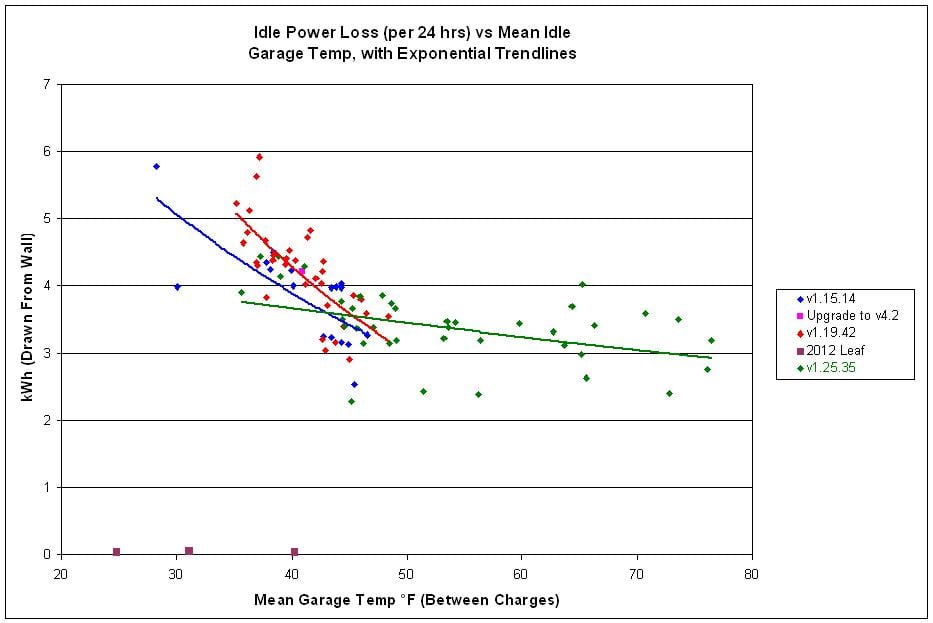
tezco @apacheguy: Although my charge time after approx 1.75 days idle was only 10 minutes at 30 A, my vampire loss over the period was 4.73 kWh/24 hr, as measured at the wall. That's no different from a year ago (red line on graph.) I also lost 4 rated miles. I guess one reason I thought things were better is that I switched from ideal to rated miles on the display, so the miles go down less quickly for the same loss. So much for sleep mode as it currently exists. I fear this is putting a tremendous strain on the 12V.
 �
�
Feb 19, 2014
jerry33 One reason is that there are various combinations of software versions and hardware versions. Another is that the car will wake up occasionally to top up the 12V battery. My guess is that both those account for most of the variability.�
Feb 19, 2014
apacheguy Just double checking here, so 4 rated miles lost corresponded to 4.73 kWh drawn from the wall? That's over a kw per mile, I must be misunderstanding something.
Guess it's time I start measuring vampire drain from the wall instead of simply looking at the telemetry.�
Feb 19, 2014
tezco Actually that was 4 rated miles lost in 1.75 days. Apples to Apples is 4.7 kWh/24 hrs and 2.3 rated miles/24 hrs. Since the time frame was so short, the standard deviation is high. There is quite a bit of scatter on the graph (see prior post), probably related to a multitude of factors which may include just how successfully the S can reach the same exact SOC on each top-off, as well the factors mentioned by Jerry.
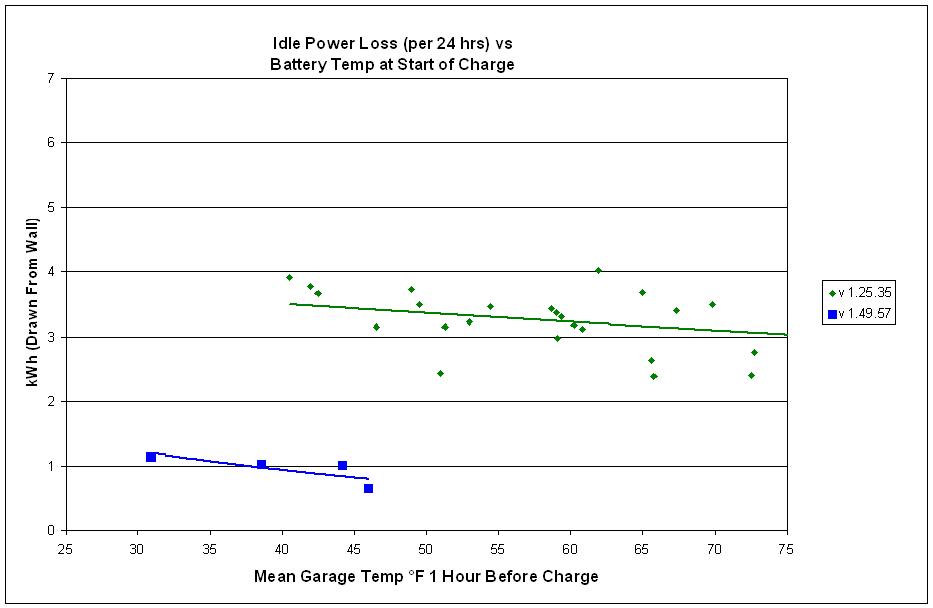
Edit: I looked back at my data for January (I was running Version 5.8.4 / v 1.49.57 back then) and it looks like sleep mode did reduce idle power losses. I suspect that the single data point I have so far on Version 5.8.7 / v 1.49.84 may be an outlier. The following graph is slightly different in that I have plotted idle power loss vs the garage temperature 1 hour prior to beginning to charge.
[Originally I plotted the mean garage temperature between successive top-off charges because I thought that operation of the battery heater might affect idle losses. I'm not sure we are absolutely certain when protective battery heating turns on when the car is idle, but I suspect that in my garage which is heated to 33� F it probably doesn't turn on. I began to think that in my situation the battery temperature at the start of a top-off charge might be more of a factor affecting the top-off charge (ie, if the battery cooling or heating system ran during the top-off), so I'm assuming the garage temp 1 hour prior to the start of charge somewhat reflects the battery temp at the start of charge.]
 �
�
Feb 21, 2014
Todd Burch Just had a pretty good sleep mode experience. Parked my car at the airport at 11am on Monday with 163 rated miles of range.
Came back to the car at 11:15am (almost exactly 96 hours) on Friday and had 154 rated miles of range left.
So 9 rated miles over 4 days = 2.25 rated miles per day.
That's significantly better than my last airport parking trip, which was a loss of 6 rated miles per day. VIN P01653 and I'm now on the 1.49.84 flavor.�
Feb 22, 2014
tezco I'm comfortable now leaving the car unplugged at 60% for a week or two now; however, there is still some room for improvement. I can leave the Leaf unplugged for weeks at a time with almost no loss.�
Feb 26, 2014
gg_got_a_tesla Got my original 12V battery replaced today.
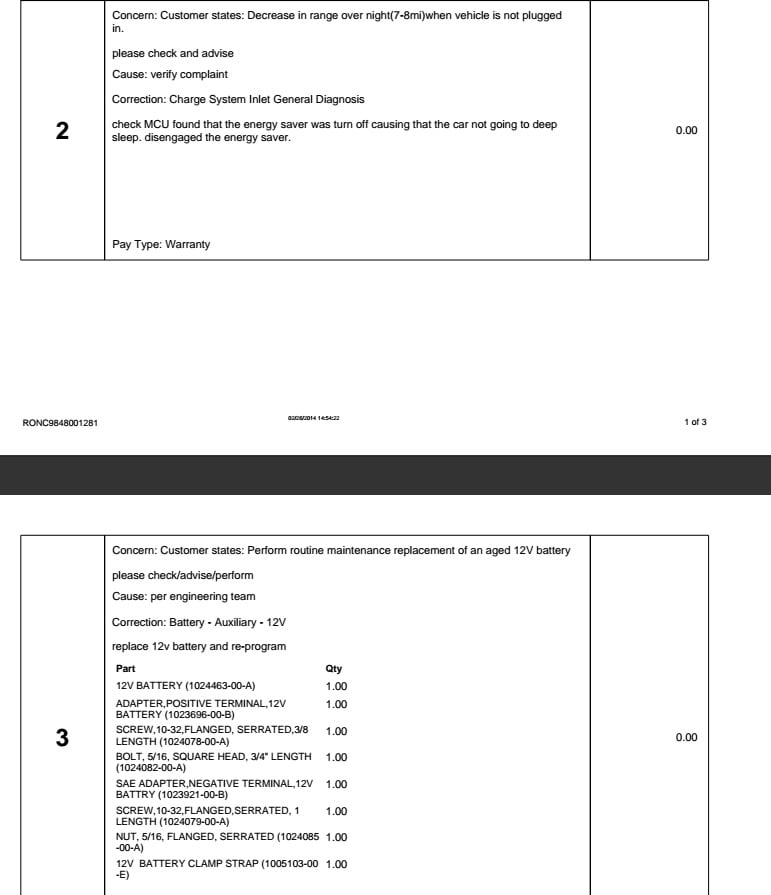
But, beyond this, the service center confirmed that the "MCU indicated that the energy saver was turned off internally preventing the car from going into deep sleep"!! This is despite the UI setting being set to ON!
So, in some firmware update, the sleep setting didn't stick internally despite whatever the UI selection was.
Let me see how it goes overnight.�
Feb 26, 2014
Jeff Miller I had my original 12V replaced today as well, but they didn't mention anything about the energy saver being turned off internally. Since the 5.8 update, the car definitely "sleeps" in the sense that it takes a couple of seconds to start up. I've still been losing a couple of kwh a day though, much more than some people are now reporting. I'll also have to see if this changes with the new battery.�
Feb 26, 2014
gg_got_a_tesla The car has been sleeping in my case as well thus far (I see the startup screen everytime) but, it apparently wasn't going into a "deeper" sleep state (much like its master most nights).
�
Feb 26, 2014
hans Did you ever notice the car waking when you entered? Any large Tesla logo on the dashboard and delay booting up. Seems like an odd explanation.�
Feb 26, 2014
gg_got_a_tesla Just confirmed that above, hans. Yes, I've been seeing the T every morning and the mobile app has been showing that the car's asleep - only to some degree, it appears.�
Feb 26, 2014
hans So basically there would be no way for you (or any other owner) to know that you had this weird sleep condition. Damn it this puzzle just gets harder and harder to figure out.�
Feb 26, 2014
qwk I think I have the same problem. Sometimes my car doesn't sleep(sleep mode is always on), and I lose up to 20 miles of rated range overnight. A reboot of the center screen fixes it for a while, but I still lose about 6-8 miles overnight.�
Feb 26, 2014
hans GG, can you post a picture or the wording on your service paperwork so we can see exactly how Tesla describes the problem?�
Feb 27, 2014
mnx My guess is that the car had to heat the battery before charging. A summer vs. winter comparison (especially this winter!) makes a big difference.
�
Feb 27, 2014
mknox I wondered about that, but have never actually seen a charge cycle delayed due to pack heating while it's been in my garage. I have seen this happen when the car was outdoors and very cold. Nonetheless, I wasn't there to observe, and it was very cold, so that could be it.�
Feb 27, 2014
mnx I saw it happen once this winter when my car sat in the garage for 24h without being driven. I told it to start charging and it took ~15mins before it started adding any range (said 0km/h charging rate). It's cold this winter!!!!!�
Feb 27, 2014
gg_got_a_tesla Here you go:
 �
�
Feb 27, 2014
gg_got_a_tesla Oh, still lost 5 miles last night btw...�
Feb 27, 2014
hans Dammit.�
Sep 21, 2014
kennybobby The balancing circuit on the BMBs can draw ~100 mA thru the 39R5 resistor array, which would be about 0.4 W, and there are 96 of them = 38 W, and over 24 hours could draw 910 Wh.
i don't know if this would be considered part of the idle or vamp load that you are trying to find...�
Sep 21, 2014
apacheguy I always wondered how much power the BMS used. But I'm not sure that's it. For one, isn't the BMS powered off of the traction battery? Vampire losses occur when the car wakes up and slowly discharges the traction battery to charge the 12 V. Also, the pack shouldn't be continuously balancing 24 hrs a day, right? Surely it will reach a point where all cells are balanced.
For my car, I estimate vampire power draw to be on the order of 1.2-1.5 kWh.�
Sep 21, 2014
JRP3 I would think most active balancing takes place when the car is plugged in and charging.�
Sep 22, 2014
tom66 Someone with a DC current clamp could measure the 12V battery current and see if there is significant drain.�
Sep 22, 2014
rabar10 There is also a very small amount of power pulled directly from each module, to power the isolated part of each BMS module monitoring/balancing circuit. This is the case even when all the balancing resistors are switched off. Also the case when the pack is removed from the car and even when the modules are removed from the pack (per the pack tear down thread). While the current amount is certainly very small, it is active 24x7 across each module. Unsure if's enough to really matter though w/r/t vampire drain estimates given here.�
Sep 22, 2014
tezco I think the vampire load is mostly the result of systems that continually run (fob sensor, cellular receiver, battery monitoring systems etc.). Can't put everything to sleep in our modern cars.�
Oct 3, 2014
Footer I was gone for a 26 day trip in September. When I left there were 242 miles. When I returned 192 miles. I checked on the car using the mobile app maybe 10 times and it did lose about 2 miles a day. Inside temperature was around 70� most of the time.�
Oct 3, 2014
apacheguy I have enough data with 6.0 to say my vampire drain is between 3-5 miles/day. Nothing seems to have change w/r/t sleep mode and power consumption compared to 5.x. If left alone, the car seems to wake twice a day for 2-3 hours each time. Rated miles decrease on the order of 2 miles per wake up cycle. Furthermore, if we assume that 1 rated mile = 308 watts, then it seems that the 12 V is charged at 200-250 watts.�
Oct 4, 2014
kennybobby This graph seems to show the cycling of the 12 V battery (drain and re-charge) over time that agrees with your finding.
12v battery issue explanation, sort of... - Page 8�
Oct 22, 2014
tomas Help! On 5.X, with display energy saving on, i was seeing vampire drain of about 2 miles overnight. My charging typically ends by 10pm or so, so that is reflecting period from 10pm to let's say 10am, or < .2 miles of loss per hour. Unfortunately, I do not have logs of this, since I seldom used VisibleTesla during that period.
Since installing (now 3 versions of) 6.0, I'm seeing loss of .4 miles per hour! Yes, I still have energy savings on. No, I did not check the "always connected" box. Yes, I've rebooted (multiple times).
Is it just me? For those of you using VisibleTesla, can you please let me know what your hourly vampire drain is? Was this a function of software update, or something else? Is it just me, or everybody?
I know from this wonderful forum, that 12v battery charging may be a cause. What else? I've got service visit in a few weeks, and I need enough data to convince Service Center this is an issue - or convince myself it is not!�
Oct 22, 2014
apacheguy Sounds like you'll need a new 12 V. See my post on the previous page for 6.0 vampire drain numbers. This is not normal behavior.�
Oct 23, 2014
Cal1 Are you saying there should be no vampiric loss? I get a notice every night that I'm charged to 230 miles and consistently see the range drop to 227 by the morning. Isn't there a way to make the car go completely into sleep mode and sacrifice some responsiveness?�
Jan 21, 2015
benjiejr I haven't seen anything discussed specifically about P85Ds regarding vampire drain on these threads, so I figured I would post what I'm experiencing to get an idea if it's normal...
My P85D on firmware 6.1 (2.2.113) seems to be losing about 1 rated mile every 4 hours. It's been this way since I got the car on firmware 6.0. For example, if my car finishes charging in the evening and I don't use it until the next morning (say 12 hours later), then I typically lose about 3-4 rated miles. Are other P85D owners experiencing this?�
Jan 21, 2015
vdiv Hi, a newbie here without a Model S (yet).
Would it be wise for Tesla to expose a voltage reading on the 12V battery on the screen and set some thresholds that would trigger a notice to check that battery? It seems that most EV makers try so hard to simplify the instrumentation on their cars to keep the general public from being overwhelmed by data that they intentionally do not include indicators that have been traditional in gasoline cars.�
Jan 21, 2015
apacheguy Do you have sleep mode enabled and always connected unchecked? FWIW, with sleep mode I lose 3-4 miles/24 hrs.�
Jan 21, 2015
benjiejr When I first got the car, I had sleep mode enabled and always connected unchecked, but I changed that to disable sleep mode because I was having problems with my 3G connection and checking the charging status at Superchargers. So maybe my drain isn't that abnormal considering I'm losing probably double what you are, but with sleep mode disabled. Thank you for your input.�
May 7, 2015
Cottonwood There does seem to have been a hardware improvement to reduce Vampire drain between my P85, Sig SN:00037 and my P85D built last 2014. I left them both connected to power while I went on a 1.5 week trip with energy saving on and always connected checked. The P85 Sig was running 6.2-101.36.2, and the P85D was running 6.2-2.4.153. I checked on them a couple of times in the 10 days, but did have charge alerts on so I could see when charging happened.
Both cars started charging when they needed 9 rated miles and replaced the 9 rated miles. The P85 Sig charged 9 rated miles every 1.68 days or 5.38 rated miles per day, and the P85D charged 9 rated miles every 2.43 days or 3.70 rated miles per day. Even with the P85D rated miles being 5% more than the P85 Sig rated miles the P85D has a much less thirsty Vampire.
Put another way, the P85 Sig Vampire drank 1.79 kWh per day, and the P85D Vampire drank 1.29 kWh per day with energy saving on and always connected checked. This is still a very thirsty Vampire, but at least Tesla seems to be slowly taming the Vampire's thirst.�
May 7, 2015
tezco I suppose the health of your 12V affects the vampire draw. Are the both near the same age? I only seem to get about 2 years out of one before it starts to lose enough capacity that it attracts Tesla's attention.
Do you have any idea how much extra drain is the result of always connected?�
May 7, 2015
rickgt I just leave it plugged in when I'm gone.�
May 7, 2015
Cottonwood The P85D was delivered new in 12/14 and the P85 Sig had its 12 V battery replaced in April. Both 12 V Batteries are relatively new.�
May 11, 2015
Lex K so I read this thread backwards (latest first) and it was late at night (teslomnia I think is what it's called lol) but could have sworn there were no PhD theses published on this post
And it seemed the 12V batt charging possibility just needed a new test bobble dodad thingie, but did I miss the answer ???
The "vampire drain" is probably just a fact of life for us, and perhaps an admittance of this may actually help with future firmware and apps, eg. battery warming at the right times if you are honest about how long you're leaving your baby in the cold :wink:
or is Sir Elon conducting protein folding on our mobile compute platforms and crediting his team ??? lol�
Jul 14, 2015
AustinPowers Meaning what? That you don't have charging losses or vampire drain? I don't think so.
I come back to this thread because a colleague asked me specifically about charging efficiency and vampire losses on the Model S and I could not give him a specific answer on either topic.
This thread caught my attention, because the OP seemed to indicate that losses in the range of 3 kWh per day without driving were normal. What is the current status? Because 3 kWh per day to me seems extreme.
When I calculate that at our electricity rates it would mean over 300 Euro per year even if the car wasn't moved a foot. And considering that I pay only about twice that amount for my average yearly Diesel consumption for around 8k kilometres, 300 Euros for nothing doesn't really correspond with a BEV supposedly having favorable running costs compared to an ICE.
Especially factoring in that the electricity I would have to use for 8k kilometres (taking the 70D as an example, with 442 km (according to the admittedly optimistic NEFZ cycle) per full charge) would come to another 380 Euros per year (8k km divided by 442 km, multiplied with 0.30 Euros per kWh multiplied with 70 kWh). And that calculation only works at 100% charging efficiency, which doesn't seem realistic either. So realistically, the cost would be even higher.
Or am I getting this all wrong?�
Jul 14, 2015
Matias IIRC idle power consumption (i.e. vampire load) is around 50W. So 1.2 kWh in 24h.�
Sep 24, 2015
Only Trons I normally plug in my MS every night in my enclosed garage. Charging set to 90% (225 RM for my car). In the morning, I will typically find the RM to be somewhere between 221 and 225. I know the MS will periodically enable charging to keep the battery charged to the requested level, so 221 - 225 didn't concern me. Lately I've come to the car in the morning and found RM to be 218 or 219. Hmmmm. So I decided to keep the car unplugged and measure the amount of vampire loss. I was surprised at the amount of my vampire loss --- it seems to be more than I recall from earlier observations.....now at 8 - 10 RM per day????
Details of my car and conditions:
- VIN XXXX08404
- Delivered April 2013
- Software version 6.2 (2.5.36)
- Energy saving ON
- Always connected NOT selected (e.g. off)
- Remote Access ON at first and then OFF (details below)
- Daily temperatures in garage between low 60's and upper 70's
- Key fobs both in RFI bags and stored greater than 50 feet away with garage wall and one interior wall separation
- Not using smart preconditioning
- Original 12V battery
- Not currently using Visible Tesla
First day was measured over 14 hours -- the car sat unplugged from 4 pm in the afternoon to 6 am the next morning. Loss of 5 RM overnight. This would equate to a loss of 8.5 RM in a 24 hour period (using a linear extrapolation).
Second day --- checked the car at 6 am the following morning. Loss of 8 RM overnight. TURNED OFF REMOTE ACCESS AT THIS POINT.
Third day --- checked the car at 6 am the following morning. Loss of only 4 RM overnight. Hmmmm...didn't expect this because I had not been remotely checking the car. However.....
Fourth day --- checked the car at 6 am the following morning. Lost 10 RM overnight !!!!!
As noted above, I have not used the mobile app during this time to connect to the car. I only access the car one time per day --- at the time I open the door and read the RM display on the IC. At the last reading, I did plug in a 12V battery charge tester into the 12V power socket ... it read 14.2V.....same as it usually does.
So a total of 27 RM loss over essentially 3.5 days --- average loss of 7.7 RM per day. I can't figure out why the loss was low on just the one day but similar on the other days.
I've read many of the other threads here on TMC about vampire loss. I know that vampire losses were supposed to be reduced with newer software builds and, of course, owner choices such as use of Remote Access or Always Connected. But my vampire losses now seem to be as high as they were in the earlier days.�
Sep 24, 2015
apacheguy Sounds like the 12 V might be going bad�
Sep 24, 2015
AmpedRealtor I'm almost certain it's your 12v battery nearing the end of its life. I also experienced higher vampire drain just before I received a service alert to replace the 12v battery. Often, when checking on the car using my app, I noticed the car wasn't sleeping. This is an indication that the 12v is waking up the car for a recharge more often than it should. My August 2013 Model S has already had its 12v battery replaced due to normal cycling. You're car is older, yet you are on your original 12v. That's where I would place my bets.�
Sep 25, 2015
SmartElectric I look at this from a different perspective:
Considering that the average diesel car pollutes significantly more than an EV, 300 Euros doesn't really correspond to any serious running costs compared to the environmental degradation caused by gas/diesel mining, pipelines, refining, transportation and eventual decommissioning of sites where these products were mined and consumed
Just because you don't pay directly for all the other costs of gas/diesel consumption doesn't mean those costs aren't born by others or the planet.
We're driving two EV's now, and never going back to gas.�

Không có nhận xét nào:
Đăng nhận xét