Mar 15, 2015
Larry Chanin Demand charges vary with utility. Mine measures demand over a 30 minute period.
In either case though throttling would limit demand charges. In one case the car could be pulling about 120 kW, in the other it is limited to just 60 kW. The demand is additive, if there are multiple cars charging at the same time overlapping the measuring interval.
Utilities measure the average demand over the demand interval. If a Model S arrives at a Supercharger with a very low state of charge there may be virtually no tappering of the charge rate during the demand measurement interval. Normally that could be at close to 120 kW and it could register very close to the full 120kW demand particularly in the case of a short measurement interval like 15 minutes. On the other hand if that same car were throttled to 60 kW you can see that Tesla would save about 60kW of demand charges if that happend to be the peak for the month.
Larry�
Mar 15, 2015
hiroshiy Demand charges are different from utility to utility, country to country. For example in Japan we have 30 minutes interval system but that effects for ONE YEAR. So if a SC station becomes full just once, you get highest demand charges and the rate won't change for a year. Throttling isn't effective at all in this case.�
Mar 15, 2015
Larry Chanin If throttling were in effect during that particular peak demand period for the year then it would have had a positive effect by lowering the peak demand.
To be clear, I'm not advocating that Tesla should implement such a program. I am merely pointing out that it can save them money at the expense of customer convenience.
Larry�
Mar 15, 2015
mkjayakumar for those that have said -1 and -infinity on my suggestion that locals should be charged for SC access, because it violates the contract, you have only two options (speculating):
- Insist that Tesla honor the contract of free charging for life, but be prepared to stay longer at the local SCs with slower charging, ironically sipping more coffee and spending more than what you would have paid on a reasonable per kWh rate.
- or, accept a new contract that states that you will charged for local SC access with no charging rate cap.
Tesla might provide these two options for new customers (or even to existing customers), either to take the "free" contract with the charging rate cap, or a contract that will cost you some money on the local SCs (perhaps not more than what it would have cost you at your house if you had a garage) but with no restrictions.
Face it, we all knew the free for life is sure to hit a wall sometime soon.�
Mar 15, 2015
apacheguy I'm not sure I agree. The SpC funds are directly proportional to sales of new cars. Thus, as long as everyone is contributing to the network, it should not "hit a wall sometime soon" as Tesla will be able to continually expand their resources.�
Mar 15, 2015
Klaus I'm ok having the theory rejected. But until you try it with your home location deleted you haven't disproven it either :wink:�
Mar 15, 2015
ecarfan After reading though this entire thread I am not convinced that any deliberate "throttling" by Tesla is taking place. Maybe, maybe not. There could be other explanations. We need more data.�
Mar 15, 2015
docrice My my, this thread got lengthy quite quickly. I'll add yet another data point:
Just got back from the Fremont SC again and at 45% SoC I was at 75 kW on stall 2B, so things seem back to normal. Roughly half the stalls occupied, ambient temp around 64 F. Maybe Tesla's been testing the waters randomly on various stalls or based on specific trigger conditions.
Something sketchy on the Tesla's official forum - this topic of potential throttling came up (http://my.teslamotors.com/forum/forums/superchargers-limited-heavy-users-60-kw) but it looks like the thread's been deleted. I haven't checked if it was moved, but it feels suspect.�
Mar 15, 2015
dirkhh Random data point. 90 miles from home at Centralia, a SC that I as a person have been to many times (maybe 20 times in the last year and a half), but this was the first visit for my new car... 120kW.�
Mar 16, 2015
LandShark I charged at Fremont yesterday (Sunday) at 15% SoC and got 89 KW. I have an A battery. The previous three Sundays at the same time in the morning I was limited to 58 KW. Hopefully Tesla has concluded this diabolical experiment!�
Mar 16, 2015
AmpedRealtor The solution, then, would be to set no destination in your nav or an alternate destination that is really far away. Problem solved.
- - - Updated - - -
My home address is in my car's navigation under Favorites. I'm 2 miles from the Buckeye Supercharger. I received 93 kW at 42% SOC.
- - - Updated - - -
And if that's the case, Tesla needs to immediately change their Supercharger web page because it is blatantly false advertising. I was promised free supercharging for life, and that I can charge to 170 miles in 30 minutes. I don't care about Tesla's demand charges - those are Tesla's problem and should have been considered before making commitments to owners and claims on their web site.
No, this can't be it.
- - - Updated - - -
Why would you penalize Model S owners who live in apartments and condominiums and who may not be allowed to set up a charger at their home by the management? They have as much right to use as any other owner. Treating apartment and condo dwellers as you describe is terrible policy. What do you think customers in China will think when word of this gets out, do you think that will make it easier or more difficult for Tesla in that market? Sorry, but this idea is a non-starter.
- - - Updated - - -
Unless Tesla needs to put money towards something else. Tesla has already stated in their latest 10K that Supercharger expansion may not meet expectations due to other financial obligations. So don't think that just because owners are paying for supercharger access that money is not going to be diverted towards other needs as Tesla deems necessary.�
Mar 16, 2015
SarahsDad Ok, now they're really playing with us.
Went back to the Charlotte SC today (about 30 miles away) where I was limited to <60kW last week (see post #82 My car won't charge faster than 60kW - Page 9).
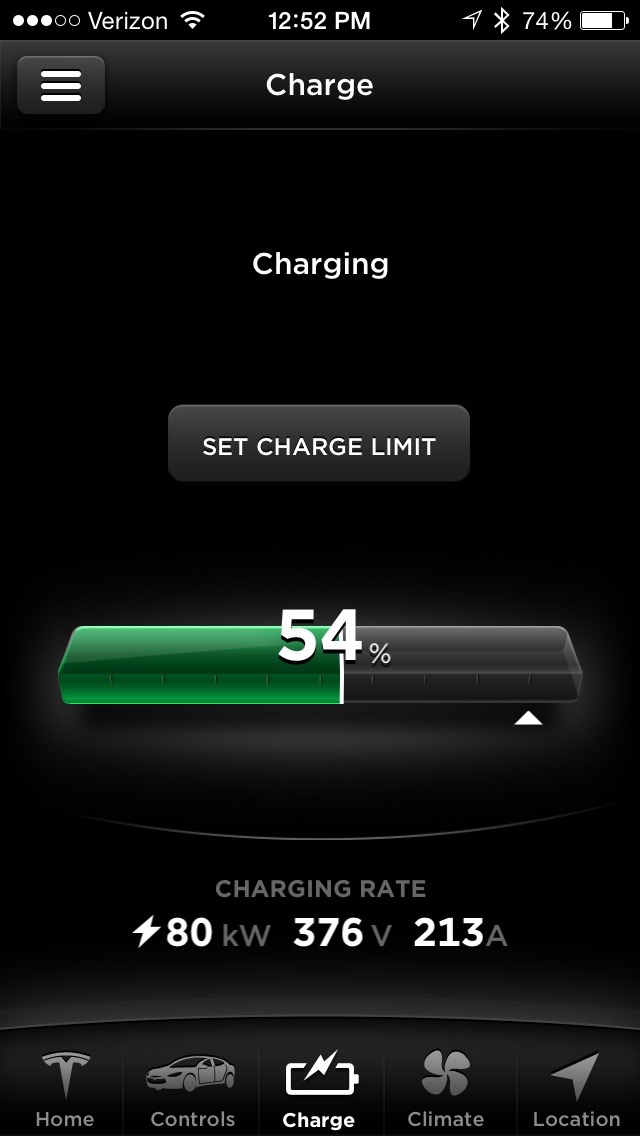
Same stall, no one else charging.
This time got 80kW at an even higher SOC - clearly no throttling. Didn't have any destination in the Nav (and didn't the first time either).
Not seeing a trend here.�
Mar 16, 2015
tga I'm sure someone will blow a gasket over this, but...
Maybe, just maybe, US buyers who can't charge at home or work shouldn't buy a Tesla (or any other electric car, for that matter)? I can't imaging buying an electric car without control over my own charging situation.
China (and London) are different altogether. Superchargers are being built there for the express purpose of supporting local residents. That's not happening here (yet).
Once the intercity supercharger network is (mostly) done, we can worry about the intracity network to support apartment and condo dwellers. Clearly Tesla is focusing on intercity first.�
Mar 16, 2015
sorka Maybe Tesla was trying something to gauge response or maybe there was a bug. It's interesting that the sibling thread in the My Tesla forum was deleted.�
Mar 16, 2015
Obsoletion 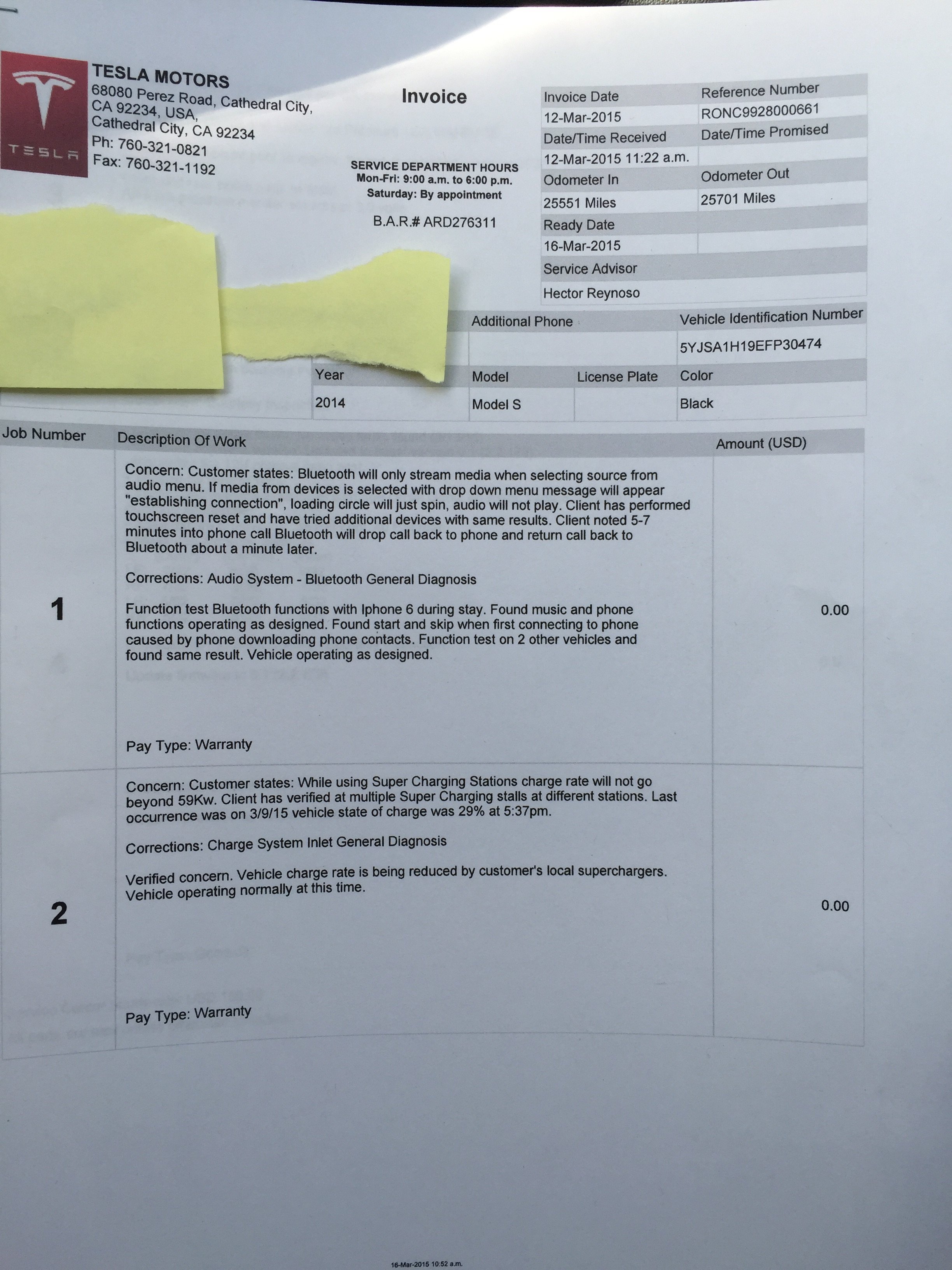
Just got it back. See item 2�
Mar 16, 2015
bollar That seems like more of an "I don't know what's up" than anything else.�
Mar 16, 2015
Obsoletion They verified and stated its operating normally. Ie. It's suppose to do that at local superchargers.
Whether or not you believe it, it's coming to your model S soon.�
Mar 16, 2015
redi So in my case my a "local supercharger" is 100 miles down the road. Very interesting interpretation.�
Mar 16, 2015
Obsoletion I don't really mind IF it's for the health of the battery. If it's for cost savings, then tesla is saying our time have a pretty low value. Either way, advance notice would have been appropriate�
Mar 16, 2015
markb1 My interpretation is that they are saying the car is acting normally. The service center is not responsible for diagnosing the superchargers. They are only responsible for diagnosing the car's side of supercharging system. It does not rule out the supercharger being broken.
Now that interpretation is really a stretch.�
Mar 16, 2015
Larry Chanin However, as you an I have demonstrated in our postings above, even when the destination is in the nav system and only 2 and 4 miles away from the Supercharger throttling did not occur. So proximity to the Supercharger is obviously not the cause in every case.
Larry�
Mar 16, 2015
Obsoletion What is it you guys need the paperwork to say before you will believe that tesla is telling me this is intentional? I will call them and have them reword it if it's the only way any of the naysayers will believe. This is real. It's happening to me and others and tesla is telling me and anyone who calls their service centers that this is intentional.�
Mar 16, 2015
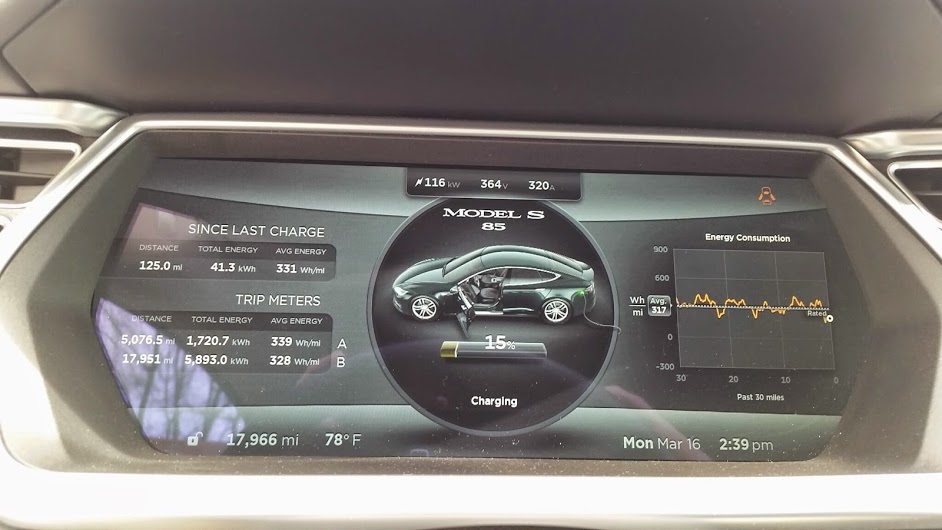
Zarwin Just charged in Burlington, NC, which is exactly 25 road miles from my house. Charge rate of 116kw initially, nothing unusual.
v6.1(2.2.115) No home setting, no NAV at all.
Edit: I am not a frequent "local" charger as this is only the third time I have plugged into this supercharger. I have, however, used superchargers about 30 times since getting the car(April '14) when travelling.
 �
�
Mar 16, 2015
mikeash I generally agree, but it's really up to the buyer. It seems like it would be incredibly inconvenient not to have home charging, but if someone thinks they can make it work, who are we to tell them no? If someone bought a Model S planning to use a nearby supercharger for regular charging needs, based on Tesla's advertised charging rates and availability, can we really say that they're somehow doing something wrong?
I don't think Tesla should go out of their way to enable such scenarios at the moment, and I agree that such buyers should really reconsider their options, but I very much don't like the idea of pulling the rug out from under them after the fact.�
Mar 16, 2015
Obsoletion I would also add the local sales and service centers were advised of this today according to my local center. Don't believe it... Call your service center and request service because you can't supercharger beyond 60kW. Let's see what they say today�
Mar 16, 2015
Larry Chanin I invite you to visit posting #237 and add your own logical reason(s) to explain the various observations.
None of the the reasons that I have suggested leave me with a good taste in my mouth. :biggrin:
Larry�
Mar 16, 2015
dhanson865 No one is going to believe it the way you do until there is a Press Release, modifications to the teslamotors website*, or Elon says it.
Nothing personal it's just too drastic of a change to take from one source that doesn't have a CEO or VP title next to his name.
*preferably all up and down Supercharger | Tesla Motors and Supercharging | Tesla Motors the latter which says
and so on, nothing supporting what you say is coming.
Though I and others will leave it open that the Press conference coming later this week (Thursday morning/afternoon depending on your time zone) might reveal what the service center is hinting to you.�
Mar 16, 2015
markb1 I think there's really nothing the service center could say to convince me that it is intentional. Service centers have demonstrated repeatedly that they are not in the know when it comes to corporate policies. (Not that I am ruling out that it is intentional, I'm just saying we need a better source than the service center.)
And even if we take the service center at their word, that invoice certainly does not say that it is intentional, just that the car is working as designed. They may have said otherwise verbally, but I'm just talking about what I see on the invoice.
My opinion is that it probably is intentional, but not related to how close you live to a supercharger, and that it is temporary.�
Mar 16, 2015
ecarfan What one person at a Service Center says is not a reliable indicator of a major corporate policy change.
Let's see what is announced on Thirsday.�
Mar 16, 2015
Obsoletion i agree. That's why I suggest calls to local centers and see if we can extract a unified statement�
Mar 16, 2015
sorka So the repair invoice doesn't really say anything. All it says is that the charge rate was reduced by the Super Charger which would happen if there was a technical problem there i.e burned out chargers in the stack, local supply issue with the utility.
The invoice does not say the customers charge rate was reduced due to a POLICY decision. If that's what they meant, then they should have clearly stated such.
The invoice should have stated the reason why the charge was reduced rather than the fact that it simply was reduced which was already known by the customer.�
Mar 16, 2015
Obsoletion It says Concerned VERIFIED...charging rate is being reduced by CUSTOMERS local superchargers. Vehicle operating normally�
Mar 16, 2015
markb1 Right. They verified that your car was indeed not charging above 60 kW at the local supercharger. The supercharger is responsible for the reduced rate, not the car. That's all that says. I don't see any statement about corporate policy.�
Mar 16, 2015
Obsoletion Superchargers (plural). And they drove it to two different ones to verify
And others at the same location have no issue. So the vehicle is working right and the supercharger is working right... 60kW as intended�
Mar 16, 2015
dirkhh So if this is a policy change, then why would they drive to the superchargers to verify? That makes no sense - you are contradicting your own statement.�
Mar 16, 2015
sorka Why don't you go ahead and call them and ask them *WHY* the charge was reduced. You state it's intentional but you didn't really provide a quote that indicates that's actually the case, so many of us are thinking what you were told, whatever it was, is open to interpretation. Call them back and ask them point blank is this intentional due to POLICY and not due to local / temporary technical issue. If POLICY, ask them to clarify what the policy is.�
Mar 16, 2015
Obsoletion You didnt see my original post. The thread I started was merged into this one. When i took it in for service they didn't know about this. They couldn't find an issue with the vehicle so they took it to the Indio supercharger and it charged at 120kW. Then took it to cabazon and it charged at 59kW then they took it to Rancho Cucamonga and it charged at 59kW. Verifying there was an issue they contacted tesla engineers and we told on froday that this is intended reduction at owners local
superchargers. They called me with this and i asked them why and why I wasn't notified before the change was made. He stated that the announcement was coming in the next week
- - - Updated - - -
i asked why and was told the engineers wouldn't state why and an announcement was coming�
Mar 16, 2015
sorka BTW, I'm going to play devils advocate. If this wasn't due to a policy decision, then something was wrong technically and the service center did a lousy unacceptable job diagnosing this issue. They should have simply stated that the car does not have a technical issue that would have prevented a full charge rate and the cause is unknown and then stated it would be investigated by the Super Charger deployment teams, or some such.
The diagnosis as written is unacceptable and Obsoletion should demand in writing clarification of why charged was reduced:
1) A new policy.
2) A technical issue.
3) Unknown at this time.�
Mar 16, 2015
Obsoletion
Agreed. Asking for this now�
Mar 16, 2015
strider My theory is that this is all about money in the form of utility demand charges. Is it possible they have some kind of data tie-in with the local utility and if they are going to be hit w/ a demand charge and throttle charging to keep the SC out of the demand charge range? Much of the desire to have battery packs at SC sites was to help smooth out demand and eliminate demand charges. Tesla could be getting killed on electricity costs and this is a way to get costs under control.�
Mar 16, 2015
Obsoletion Anyone willing to call their local service center contact and ask?�
Mar 16, 2015
sorka If they are intentionally throttling, then this is the best theory I've heard and makes the most sense.
- - - Updated - - -
I contacted both my DS and sales rep. I've asked them to provide me some sort of written statement, even through email, that Tesla is not throttling charge rates due to policy. If they can't provide me an answer even as simple as "Tesla does not have a policy to throttle Tesla charging", then I will be canceling my order which is scheduled to be picked up on Monday 3/30, two weeks from today.
In fact, because of this, I'm delaying the installation of the HWPC until I can get confirmation of this.
If Tesla was actually doing this, it would be a deal killer for me.
I have a 260 mile round trip commute to work and would be hitting a particular Super Charger up several times a week on my way to and from work.�
Mar 16, 2015
dirkhh Done already. The local lead tells me "I have not heard of this" (contradicting the statement that this was rolled out to service centers today) and promised to follow up with the factory and find out.�
Mar 16, 2015
Archer I needed to schedule my annual service today so instead of calling, I actually drove to my service center (Van Nuys) and spoke with 2 reps. They looked dumbfounded - this was the first they've heard about throttling. They both confirmed that there has been absolutely no communication from corporate today about throttling/limiting of local SCs. One rep said that such a change would be huge and very disruptive. Other rep said "stop reading the forums". Until there's an official announcement from TM or Elon don't believe everything you read on the forums.
Since you have your car back, head out to Culver City, Redondo or Hawthorne and test your theory there. I'll be charging up at Oxnard again this afternoon.�
Mar 16, 2015
dirkhh Wow, that's a gruesome commute. 20+h a week in the car, on top of the hours spent at work. Yikes.�
Mar 16, 2015
cpa It could easily be directly related to the spike charges imposed by the utilities. Demand charges (here in California) are determined each monthly billing cycle. I seem to recall that PG&E is around $25 per kilowatt, but do not quote me. Anyway, it is possible that Tesla has determined that each supercharger location will have a monthly cap in order to reduce costs. As the demand charges each month approach that cap, charging rate slows, not just for locals but for everybody. Tesla has mountains of data on its supercharger usage sitting at the Hawthorne lobby. Tesla knows peak charging times and rates and quantities delivered among other things. I know nothing about composing computer programs, but it would seem to me that it would be fairly easy to develop a program to scale down Supercharger rates based upon their historical data and attainment of X kilowatts delivered during the monthly billing period. Using Rancho Cucamonga as an example, if Tesla can reduce the spike charge each month by 200kW, those savings could add up across 170+ locations and twelve months.
What would be interesting to see if those who have been throttled at these locations if they were to charge at 0400 or some other hour where usage is non-existent. And at different times of month to see if it has to do with each billing cycle.�
Mar 16, 2015
sorka I drive it once a week, but it still it's still over 15K miles a year when you add up the driving I do while I'm at work as well. That plus multiple trips a year to Phoenix to visit my dad, you can see we plan to do most of our charging from Super Chargers and only a little bit at home.�
Mar 16, 2015
Zarwin This is probably NOT the reason, but, looking at just NC, there are three data points I see. SarahsDad (Charlotte supercharger local) posted twice and I (Burlington supercharger local) posted once. Of the three attempts, two were full rate and one was throttled (SarahsDad's first post). The demand peak/window for commercial use from Duke Energy is between 6AM and 10AM this month. Only the throttled attempt was within this window.
Attempts:
SarahsDad 9:40AM throttled
SarahsDad 12:52PM not throttled
Zarwin 2:39PM not throttled
This is pure correlation with a tiny sample size that likely has nothing to do with causation, but just wanted to note it.�
Mar 16, 2015
sorka Someone who's physically going in should bring a printout of Oboletion's invoice and ask them what does this mean. I emailed a copy to my DS and Sales advisor and asked them to get clarification on what it means.�
Mar 16, 2015
Obsoletion They could call my advisor too. His info is on there�
Mar 16, 2015
sorka I was going to suggest that but I didn't want to get you in hot water or something with your local Tesla service by having a bunch of people calling and saying so and so said.�
Mar 16, 2015
ecarfan Best advice so far.�
Mar 16, 2015
FlasherZ Same here. Called a buddy of mine at a remote (from me), unnamed service center somewhere in the US. "We would know of this months in advance. Nothing like this has come our way."�
Mar 16, 2015
eye.surgeon I wouldn't be sad if Tesla did institute some type of throttling for locals using a supercharger near their home to be honest. They're not designed for that and the system requires some degree of self-regulation which a small minority are not demonstrating. It hurts people in actual need of a charge rather than just saving a buck. Having said that I think it's very unlikely to happen, Tesla is too customer-service oriented to take the PR hit.�
Mar 16, 2015
sorka Well, either Obsoletion is just flat out lying, which I doubt, or this Hector Reynoso is totally wrong and Tesla Corporate needs to be notified. The actual way the repair diagnosis is worded doesn't prove intentional throttling, but that guy should be throttled if you bungled the communication so badly, along with a cryptic written diagnosis as to make a customer believe it's intentional.
It could also be that this guy has gotten a heads up sooner than others.
- - - Updated - - -
Except that it will just increase congestion and piss people off. If someone is charging at a local SC just so they can avoid paying a higher electric bill, throttling is not going to make them go away. It will just make them stay there longer.
In my case, the SC I'd most often use is 60 miles from my.�
Mar 16, 2015
Depeche Mode It's NOT OUR problem... it's theirs when we bought our car it was a BIG thing that:
1) Free charge for life
2) Half a charge in 20 minutes
3) 170 miles in 30 minutes
Very clear also on their internet site...
If they want to do a change on their current policy, well, they can do it but it would only apply WHEN the policy will be change (probably thursday) and THEN it will affect new owners POST-thursday...
Other than that they expose themselves for unwanted lawsuits... not good for them, not good for the image...�
Mar 16, 2015
jerry33 Good luck on that one. Many people have been rejected even after offering to pay for installation. Just trying to get the HVAC fixed in an apartment is a major undertaking--and it's supposed to work as part of your rent.�
Mar 16, 2015
Archer Wrong, they are designed to be used to charge up the battery. Nothing more, nothing less. "Why" someone uses it is not for us to impose our own lifestyle on theirs. Are there people who only supercharge to save a buck? Sure. Is it hurting others? Nothing more than anecdotal speculation at the SJC SC. Even though Tesla initially came up with the network to enable long distance travel, real world experience has demonstrated that it now goes beyond that. Otherwise, they would not be building a dense network of SC's in the SoCal area. There will be at least 7-8 SC all within 100 miles or so each other by 2016.�
Mar 16, 2015
apacheguy Huh, I would've thought demand peaks would correspond to those on my TOU plan. Meaning afternoon instead of morning. What happens between 6-10 AM? Factories starting up?
Has anyone experienced throttling on weekends?�
Mar 16, 2015
redi The "non-lowering-suspension"-gate had language about "lowering at speed"on the web site and it did not stop Tesla unilaterally changing every air car in the fleet permanently (even though the placebo button came back eventually). The air cars still do not lower as they used to.�
Mar 16, 2015
Zarwin
I actually missed a little info, but it doesn't change my previous post. We are still in "winter" rates until the end of this month. Here are the windows:
On-Peak Periods for Time-of-Use Rates:
Monday through Friday as follows:
November through March . . . . . . . . . . . . . . . . 6 to 10 a.m. / 6 to 10 p.m.
April through October . . . . . . . . . . . . . . . . . . . . . . . . . . . . . Noon to 9 p.m.
This info is from here:
https://www.duke-energy.com/pdfs/pe-rates-PEFcommercialrateinsert.pdf
I'll also say I have no idea if the Superchargers are being billed with TOU demand plans or not. I did see a TOU meter on the Supercharger in Santee, SC, but have no idea about any others.�
Mar 16, 2015
Depeche Mode No TOU in Montr�al (whole Province of Qu�bec where Hydro-Qu�bec is the only electric company)
Though in Ontario we have TOU (mainly Hydro-One)
The funny thing is that I'm not throttled at Cornwall SC (Ontario) and I'm throttled at Montr�al SC (Qu�bec)...�
Mar 16, 2015
tga Can we please stop theorizing that this is demand charge related? It's not. Throttling individual users does nothing to help demand charges. This thread has gone completely into the weeds.
On most US-based commercial electric rate plans I am aware of, commercial/industrial users are charged demand charges based on the peak usage anytime in that month. To limit demand charges at one supercharger site would mean you would need to cap the entire draw, for the entire month. This is simply not what is happening!
Individual users are being limited at a particular SC. Throttling cars A, B, and C to 60kW (or even 6kW) does nothing to limit demand charges, if the next car charges at 120kW. It's all about the peak usage (typ in a 15 min window) over the entire month.
The idea behind demand charges is that you need to build out the grid (and a user's connection to it) to handle their peak loads, even if they rarely hit it. If you use 100 kW for 15 min a month (25kWh), you still need a connection capable of delivering that level of power, which costs way more to provision than a connection delivering a constant 1 kW over the entire month (720kWh).
- - - Updated - - -
Also, please don't harass the service centers until after Elon's press conference. If this behavior has anything to do with Thursday's announcement (I bet it does), the service centers won't steal his thunder and tell you anything beforehand. And that assumes they know anything about it in advance, which I highly doubt.�
Mar 16, 2015
Larry Chanin Not exactly. Demand throttling would only have to be invoked if demand over the current demand interval was approaching the monthly peak. Only then would it be necessary to throttle demand. Yes, you would have to monitor demand for the entire month, but you would only have to invoke throttling at selected busy periods.
Larry�
Mar 16, 2015
JRP3 I'd also add to that: "Don't believe everything that someone at Tesla tells you". In between the "noise" the right answer has often been presented on the forums before anywhere else.�
Mar 16, 2015
apacheguy This is absolutely right. I've been given incorrect info from the SvC folks before. Found out what I had read on TMC was actually correct. Granted there's a lot of speculation because that's what forums are for, but the right answer is usually there. You just have to look for it.�
Mar 16, 2015
AmpedRealtor That's exactly why I'm advocating against instituting a penalty for those who charge locally. Doing so makes no sense for those who live in apartments and condos where they are not allowed to install chargers. The number of such owners is probably in the minority and doesn't make a meaningful impact to Tesla's financials.
- - - Updated - - -
While I generally agree that charging at home is a big part of the EV advantage for me, I find it difficult to impose my lifestyle on others. I have some understanding for those who cannot charge at home, but still want the EV experience and want to drive a Model S. I think they still deserve to buy this car even though they may live in an apartment. Such owners would not charging every day, but likely every few days, and would represent very little added burden on the Supercharger network because they are a tiny minority of customers.�
Mar 16, 2015
brianman Just to complete the data set...
In the future it would be useful to include the SOC% at the beginning of the charge session.
As an example, in the absence of other information I could hypothesize that the car was 70+% SOC when charging at the "near" ones in Ob's list but likely 60-% SOC for the "far" ones.�
Mar 16, 2015
Obsoletion Every charge i tested that came in at 59kW was at a SoC of 25-35%�
Mar 16, 2015
MikeC I can see no reason that Tesla would ever slow down Superchargers intentionally. For anyone that thinks it's related to Tesla trying to save money, this is from the 2014 10K released last month:
"As of December 31, 2014 and 2013 the net book value of our Supercharger network was $107.8 million and $25.6 million and currently includes 380 locations globally. We plan to continue investing in our Supercharger network for the foreseeable future, including in North America, Europe and Asia and expect such spending to be approximately 5% of total capital spending over the next 12 months. We allocate Supercharger related expenses to cost of revenues automotive sales and selling, general, and administrative expenses. These costs were immaterial for all periods presented. "
If there's one thing I know, TM is not pinching pennies, they have zero problems spending staggering amounts of money to build up the brand. I think it's either a bug or related to the announcement Thursday. I just can't conceive why it would ever be desirable to slow down a Supercharger, though.�
Mar 16, 2015
brianman Thanks for the data, Ob!�
Mar 16, 2015
apacheguy Right, Elon will have to give a damn good reason why slower SpC = less range anxiety. I do think the answer to this seemingly random 60 kW limit will become clear after the press conference.�
Mar 16, 2015
jotarou1 Folsom/Roseville, CA Superchargers limited to 58kW, anyone else see this before?
Hello All,
I wanted to know if anybody recently Supercharged at the Folsom or Roseville (Sacramento, CA area) stations. For this past month whenever we stop in and do a quick Supercharge, our Model S has been limited to 58kW max charging. This is regardless of the State of Charge, temperature outside, charging station, shared charging A/B, time of day, total cars at station. It hasn't been freezing and it hasn't been over 100 degrees in Sacramento this past month. I do know about not sharing the 1A/1B, 2A/2B ports, I know that the closer you are to full it tapers. I have tried charging it starting from a low of 8 miles and other times starting at 70+ miles, and it still goes up to 58kW and stays there until it begins to taper down after 150+ rated miles of charge.
The service center took a look at it and they could find no issues. Also on the same afternoon that I tried in Roseville and was limited to 58kW, I took it to Rocklin and it charged at the max 120kW without issues... Service center is stumped and just wondering if anybody else has seen a similar issue.
Let me know,
Thanks!
2013 85kW Model S�
Mar 16, 2015
FlasherZ Enjoy:
My car won't charge faster than 60kW
...all 40 pages of speculation.
Seriously, some people are seeing it with specific cars at specific SC's. No pattern has been established yet but there is a bunch of wild speculation that doesn't line up with the data, yet.
Your data points at the end of the other thread would probably help.�
Mar 16, 2015
jotarou1 Thanks Flasher, just saw that right after I posted...!! I did a search for 58kW and found a thread from last year.�
Mar 16, 2015
SFOTurtle How far does the OP live from the Folsom and Roseville Superchargers? I assume not far if they are routinely popping in to get a charge.�
Mar 16, 2015
hiroshiy Agree on demand charges not causing this situation. In the US it seems they need to keep the demand lower than the threshold for one month, but in Japan for one year. 15 minutes of two Osaka drivers charging at a Supercharger in Tokyo, you get highest demand charge for one year. To reduce demand charges Tesla needs to implement smart power control, which basically caps the total power draw of all SC units, not individual unit.�
Mar 16, 2015
SteveS0353 85kWh P85+ supercharged at Rancho Cucamonga today, 88 miles from home in San Diego, started charge at 49% SoC, and quickly hit 100kW peak power. It subsided over time, but certainly was not limited to 60kW peak power.�
Mar 17, 2015
yobigd20 2013 P85 charged at hamilton NJ SC and got 100kW at 36% SOC so doesn't seem like I'm rated limited here. Anyone get higher than 100kW anywhere or is that the new rate limit? lol
 �
�
Mar 17, 2015
yobigd20 You know, to add fuel to the fire, the supercharger page was just updated (per change detection) to add the words "during long distance travel" to the first paragraph description.�
Mar 17, 2015
Zarwin And removed the wording "where home charging is difficult"
http://www.changedetection.com/log/teslamotors/supercharger_log.html
EDIT
Specifically the following highlighted text was added:
Superchargers are free connectors that charge Model S in minutes instead of hours. Stations are strategically placed to minimize stops during long distance travel and are conveniently located near restaurants, shopping centers, and WiFi hot spots. Each station contains multiple Superchargers to help you get back on the road quickly.
And the following highlighted text was deleted:
We strategically place Superchargers along well-traveled highways and in congested city centers where home charging is difficult. In addition to Superchargers, we have a growing network of charging partners with dedicated Tesla Wall Connectors at their properties. These are primarily destinations where you�d stay for several hours at a time, such as ski resorts, restaurants, hotels and others, so that you return to your car with ample range for your return trip.�
Mar 17, 2015
yobigd20 Ouch. Perhaps this rate limiting is legitimate.�
Mar 17, 2015
Matias Smoking gun.�
Mar 17, 2015
Dennis87 Maybe Tesla has found out that charging over 60 kW does harm the battery if charged to often? So they limit the speed on the SC charger nearby that is used frequently.�
Mar 17, 2015
Matias That would be even worse explanation.�
Mar 17, 2015
SW2Fiddler Yes. That is promised. BIG deal if that changes.
No. Let's pull the actual quote: "Superchargers are capable of delivering up to 50% battery capacity in about 20 minutes" And they certainly are. That hasn't changed.
No. No more than a Destination Charging HPWC description "providing up to 80 Amps" means that you are promised 80A current at that partner's HPWC. I have certainly had 32A destination charge sessions.
The full quote is: "Tesla Superchargers provide 170 miles of range in as little as 30 minutes" - and they do.
Yes. Very clear. But as the SpaceX landing barge advises, "Just Read..."
I am not a lawyer, so please see one instead of taking my word for anything. I agree that it is clear, but it may not be what some are remembering. My mind works like that sometimes, too. When you want to step into legalities and contracts, you have to pull out the actual black and white verbiage. Sorry.�
Mar 17, 2015
scaesare Interesting... I was arguing this point HERE over a year ago...�
Mar 17, 2015
trils0n Nope, they removed "where home charging is difficult" because of China. They don't want anything to say or imply charging is difficult.�
Mar 17, 2015
apacheguy Hmm. 100 kW at 49% SOC? The only cars known to sustain that charge rate are the D models. Every other S85 P85 or P85+ crosses the 90 kW threshold slightly above 40% SOC. I'd love to see a taper curve from your car.�
Mar 17, 2015
Zarwin That would be interesting if the taper curve has changed for some. Yesterday I took a pic of the moment mine crossed the 100kw line and that was at 37% SOC, which falls perfectly in line with taper curves I've seen. Also I have a D pack.�
Mar 17, 2015
Obsoletion I also believe this is the case. And I am ok with it if that is what it really is. Just thinking it would have been good to announce in advance�
Mar 17, 2015
AmpedRealtor Why do you believe that supercharging above 60 kW rate is harmful to your battery?�
Mar 17, 2015
davewill I thought of that too, but this would be a silly way to go about it. Much better to have the car keep track of how often it's been supercharged and do the limiting on it's own. Even better to tell the owner so he can decide which supercharges he really needs. For that matter this is also a stupid way to address demand charges. The way to address the demand charges is to lower the rate for everyone when and only when the total draw of all the stations would go over the targeted threshold. It's the LOCATION that has to be kept below a certain usage rate, it does no good to limit a smattering of cars.�
Mar 17, 2015
sorka That makes no sense. The Chinese don't see the us based english written marketing pages.
I thin this is a smoking gun pushing very strongly in the direction that the charge reduction is not a conspiracy theory but rather an actual policy change.�
Mar 17, 2015
Larry Chanin Agreed, yes this would require smart power control to minimize customer inconvenience.
Tesla would have to monitor the demand during the current demand interval for the combined Supercharger Station and determine whether the current demand is approaching the previous recorded peak demand. In Japan that would be a yearly value, in the US that would be a monthly value. Then they could apply throttling to one or more individual Superchargers, or charging terminals to ensure that the current combined demand doesn't exceed the monthly or yearly peak billing demand. To minimize customer inconvenience this should be done only at busy times where the current peak demand was approaching the previous recorded peak demand. It is not necessary to impose constant throttling all the time at all charging terminals to limit demand charges at a Supercharger Station.
Again, I am not advocating any sort of throttling for whatever reason. I'm merely observing that throttling could reduce peak demand and therefore save Tesla money at the expense of customer convenience. How much customer inconvenience would depend on the method of thottling. Obviously throttling all Superchargers all the time would be a brute force method that would reduce demand charges, but as others have pointed out this would be just the opposite of what Tesla has previously been trying to do, maximize throughput through a Supercharger Station.
However, as Mike points out Tesla in their last earnings report pretty much said that Supercharger costs were de minimus in comparison to the bigger picture, so that seems to debunk the theory that Tesla is trying to save money on demand charges.
Regardless, this does return to the basic issue of Tesla communications. If it is a change in policy there is no excuse for not getting out in front of this situation by making an announcement. If it is a bug, Tesla can't be faulted for not informing us in advance, but an announcement after the fact would go a long way to shed light on the situation.
Larry�
Mar 17, 2015
gregincal But they didn't get limited at the Rocklin supercharger, which is practically next door to the Roseville supercharger.�
Mar 17, 2015
omarsultan Still not seeing any throttling - was at Fremont yesterday, afternoon, 3 stalls empty, about 70F ambient temp, 60% SoC, home address plugged into nav with about 100 miles to go, changing started at about 75kW, which is about right - this is on an S85 with a B Series pack.
I am still chalking this up to some SW bug in the SCs or the cars, because if its a policy change, its an awfully obtuse one.�
Mar 17, 2015
strider SC charges are minor *today* but as Tesla sells more and more cars and installs more and more SCs that can/will change. It's better to implement something like this now when there are only tens of thousands of cars on the road and most MS owners are early adopters/fans and more open to helping Tesla than when there are hundreds of thousands of cars being bought by non-fanatics. This is especially true since Tesla seems to have abandoned their original plan of having solar at every SC to feed back into the grid and try to reach net-zero for the SC. They are paying for every kWh that goes through an SC.�
Mar 17, 2015
JRP3 Except that Tesla has started installing solar panels on SC's and the fact that Tesla has talked about speeding up supercharging in the future. Slowing it down would be a drastic move in the opposite direction, and would force Tesla to build more superchargers to avoid longer lines.�
Mar 17, 2015
Larry Chanin
From a customer perspective the prefered manner to reduce demand charges is to install battery storage with solar panels. This could cut demand charges without inconveniencing Tesla owners. Obviously, this is a more expensive approach. I agree with JRP and the current plan to quickly install Supercharger and then retrofit them with battery storage and solar panels.
Clipping demand through the use of battery storage makes sense to me. Throttling charging rate does not because it is counter to the purpose of a Supercharger Station.
Larry�
Mar 17, 2015
yobigd20 I seriously doubt that tesla would move backwards, especially given Elon's tweet today that "supercharging is the future"
 �
�
Mar 17, 2015
smac Phew just got to the end of this thread... certainly a biggy!
The demand charges definitely seem to makes some sense. Sure more and more Superchargers is a great thing and investment will no doubt go there.
The key thing often overlooked by many in these sorts of debate is the operational losses, rather than cash burn into fixed asset capital. If the market gets spooked by much bigger operational losses, to a point where it will have a impact on TSLA stock, it will also in turn increases their borrowing rates for further capital investment.
One thing Tesla always seem to be hot on is minimizing OPEX, by limiting marketing, not employing staff until absolutely necessary etc.. Great as they can spend more on big CAPEX projects.
It's very likely there were some original financial models about usage of SpCs, and their running costs. If these were out and Tesla are spending far more money than had been expecting, this is obviously bad news, as it's pure OPEX.
If I understand correctly (Tesla's per car profitability is pretty hard to exactly get to from their filings) is based on deferral accounting of future SpC use against each vehicle, so if the electricity OPEX is way over, it would mean a new accounting model with a larger deferral required per vehicle, and effectively a worse GP per car... that would be very bad news for the markets.
Some how they need to get the projected FUTURE cost under control, so they can build a new financial models that please the markets and maintain high % margin per vehicle.
Elon has to juggle not just the customers view, but also the investors position. It's a big complicated set of plates that are being spun!
Finally adding a data point my car is throttled to 0kWh at every SpC �
�
Mar 17, 2015
omarsultan So, lets introduce a bit of math into all this. Recently, Tesla released an infographic that showed superchargers had delivered 25GWh of power

So, at $0.1013/kWh (average for the US per EIA--yes, I know Europe is probably higher, but you will see its not high enough to make a difference) that works out to to about $2.5M in electricity. For a company with $1.9B in the bank, not a huge expense, but look a it another way, they have delivered ~58,000 cars to date. If half of those cars have supercharging, that is a $58M reserve they have to support the build-out and operation of the SC network.
The take-rate for supercharging is an estimate, but I think they indicate whatever else might or might not be happening, I don't think its related to cost-cutting.
�
Mar 17, 2015
apacheguy It definitely costs them more than 10 cents/kWh at a SpC. 240 V residential is not equivalent to 480 V commercial.�
Mar 17, 2015
deonb Is there any way that virtually each one of the SuperChargers are NOT hit up for demand charges every month?
Let's say 3 simultaneous cars peak once per month per location, hit up for 300kW of demand charges will add another $3000 per month (PSE rates).
x400 SuperChargers, that's another $1.2M per year.
It's still not the end of the world, but it does bring it up by about 50%. Then add commercial instead of residential rates, and the overall cost is probably closer to $6M per year. Still, for 30'000 vehicles having paid $60M for the service in the first place, it will last a while.�
Mar 17, 2015
Lloyd I did a rough calculation that if every car delivered charged once per week at a supercharger for 80%, that the electricity would cost 12 million per year, not including demand charges. If you add the demand charges, thats 13.2 million per year.�
Mar 17, 2015
TurboFroggy Commercial power is typically less then residential in many areas. Here in Washington state for example, residential in the Seattle area is $0.089/kwh where commercial is $0.065/kwh.�
Mar 17, 2015
omarsultan Yup, per the EIA, average cost by industry segment:
- Commercial: $0.1034
- Industrial: $0.0665
- Transportation: $0.1025
Residential is actually the most expensive at $0.1215/kWh.
Source: EIA - Electricity Data�
Mar 17, 2015
mdemetri
I apologize in advance for the naive question, but why should residential rates be higher than commercial/industrial/transportation rates?�
Mar 17, 2015
omarsultan Always open to my math being wrong, but $12M/yr @ $0.10/kWh translates to 118GWh which is almost 5X what Tesla said they have dispensed over the lifetime of the SCs. Also, do we know Tesla is paying demand charges or is that a "forum fact"?�
Mar 17, 2015
apacheguy +1. I'd like to know too. Seems to me that commercial users are the ones that really stress the power grid (case in point, SpC) and should therefore pay more.�
Mar 17, 2015
FlasherZ Less sprawl in infrastructure; much higher density (kW / cable mile) in commercial power.�
Mar 17, 2015
omarsultan Perhaps part of it is also volume. I would also guess commercial use is pretty flat across most of the day (think a factory or an Starbucks, their usage is pretty consistent across their operational day), which is easier to plan for than lumpy residential usage.�
Mar 18, 2015
deonb I cannot imagine that people SuperCharge 52 times per year on average. It's probably a quarter of that at most.
However, my demand charge rate calculation was wrong. It's $1.2m per month, not per year. So it's more like $14.4m per year in demand charges.�
Mar 18, 2015
smac Bear in mind that $60M has to last those 30,000 cars at least 8 years, and I'm pretty certain it's not ring-fenced.
If the fee we paid for SpC USAGE was really $2000, GAAP would require that income to be pushed out overtime (as despite having the revenue Tesla haven't yet delivered the service)
So queue some clever words: SpC is "free" on 85kWh, great all that revenue can be put on the car and taken immediately. And as for the 60kWh cars you are paying an "Enablement Fee", not a "lifetime access fee" VERY important distinction, and for the same reasons.
So revenue side sorted let's turn to the cost side, and unfortunately facts get in the way, and no amount of weasel-words can obfuscate, the fact Tesla are on the hook for future electricity costs...
However it's a provisional cost not an actual, so you have to model it: Here is my simplistic model:
predicted avg. cost per charge X predicted total number of charges
I have a strong suspicion the prediction about number of charges was wrong. After all "All you can eat" restaurants never seem to be full of slim people�
Mar 18, 2015
Larry Chanin Here are the results of our second club member.
He lives 14 miles from the Ocala Supercharger.

As you can see we are zero for two. Despite living near two different Superchargers there was no throttling in either case.
He hadn't been to the Supercharger in about a month.
Temp was 85F and he�d driven about 25 miles in about 40 minutes just before charging.
He is on v6.1(2.2.115) of the firmware.
Larry�
Mar 18, 2015
scaesare So, I'm pretty sure that Superchargers also have firmware that is capable of being remotely upgraded. We know there's a link back to the mother ship for telemetry data gathering, troubleshooting, etc...
I'm beginning to suspect that there may be a subtle bug that's exposed by some combination of:
- Car H/W configuration (60 vs 85, B pack vs. D pack, etc...)
- Car firmware version
- Supercharger H/W configuration (120 vs 135KW, internal charger revision, etc...)
- Supercharger firmware version (perhaps some superchargers have recently gotten newer versions)
- Charge session conditions (outside temp, battery temp, SOC, etc...)
There are a number of permutations of the above, and depending on what the conditions when a person charges this may be a corner-case bug that's rarely manifested.
I'm hoping this is just an anomaly...�
Mar 18, 2015
SteveS0353 That is my thinking too. It's certainly true that Superchargers have a link to the mothership. There is a software component to supercharging; the charger handshakes with the car, communicates with the mother ship to see if that car is "allowed" to Supercharge, then turns on the juice. There are any number of points along that communication chain a corner case bug could manifest. At least I hope that's all this is and Tesla will identify it and correct it.�
Mar 18, 2015
wk057 I'll throw out there that on my latest trip and in the last week I've used 5 superchargers and saw between 115kW and 121kW peak each time. Closest was 45 miles from home. Another was 30-ish miles from my old address. 3 out of the 5 I used were recent installs. 2 of those recents were the new pedestals.�
Mar 18, 2015
apacheguy Pretty sure the setting is stored locally. Just like if you have an S or a P, dual chargers or not, etc. FWIW, I have SpC successfully at a location that had no 3G connection displayed on the MS touchscreen. I verified this by attempting to connect to the car via the app and wasn't able to get through.�

Không có nhận xét nào:
Đăng nhận xét