Mar 8, 2014
Super Gizmo I have a P85 VIN:1586 bought in 11/2012. I have close to 16K miles on the car. I live in the Bay Area where the temp today is approximately 70. Last night I did a range charge for only the 4th time since owning the car and I was shocked to see that the Rated Miles on a full charge are only 246. I never let the battery get down below 100- 140 miles. I only used the Superchargers on the way back from LA last year on I-5 because the ones on 101 were not active at the time. When I Supercharged on that trip, I only charged to 90% or less. My car is usually charged to 170-180 miles for daily use. My 90% Rated charge is down to 212. I have been doing all the right things espoused by Tesla - like leaving the car plugged in most of the time so I am very disappointed to see the loss in range. My life time Wh per mile is 316.
I feel this is unacceptable. I have taken care of the car and bought 8 year extended warranty and maintenance plans, had the car serviced on time. I don't hod rod or race the car because I have a bad back and have had neck surgery. I think it is time to get in touch with the higher ups in Tesla and find out what the hell is going on here. This is very upsetting to say the least.�
Mar 8, 2014
ckessel I was trying to figure out what to snip down rather than quote the whole thing, but...exactly, this. I have almost the identical profile for charging, usage, age of car, # of miles, etc. I'm slightly better at 250 for a range charge, but just slightly.
I've heard all sorts of mixed messages about whether to do a bunch of range charges to get back range or not to because that's bad and the battery isn't really degraded (though if I can't use the range, that's sort of an irrelevant distinction). I've no idea. I know my degradation after 14 months seems high and there hasn't been any consistent message from Tesla about what it means.
What I'm really afraid of is A packs might have worse degradation since they have less well protected batteries and we're just hosed as early buyers because degradation isn't covered under warranty. I just don't know though, so all I'm left with are assumptions of worst case scenarios.�
Mar 8, 2014
gaswalla your experience s consistent with many others that have not range charged frequently..looks like range charging intermittently may keep the battery balanced.�
Mar 8, 2014
kcveins I'm not sure; I fit the same above profile; took delivery in Feb 2013, have 18,500 miles, range charge a couple of times a month. Full range charge was 252 last week; 90% gives me 217-219 regularly. I was shocked when I got a loaner that the rated range was 274...�
Mar 8, 2014
altman Very similar to you; I posted on another thread at the end of last year when I'd gone down to 240 miles (Sig 1083, 11/2012 like you, type A pack). I'm now almost at 12k miles and my full charge was 237 miles �
�
Mar 8, 2014
ckessel I...wow...237.
Tesla absolutely need to make good on this somehow at some point. Now, they've got time and they've done well in the past, so I'm not going to yell at them for a few years. We're all the guinea pigs for long term degradation on temperature controlled automotive grade batteries. Plus, Tesla has a huge vested interest in showing batteries aren't a rapidly degrading asset, so if the problem is early batteries then I wouldn't be surprised to see them bulk replace A packs somewhere 3-4 years down the line.
In the meantime though, it'd be great if we could get some official studies/word on how degradation is going and how to manage the battery pack because there's a huge divergence in degradation (actual or inaccurate algorithms) amongst owners.
I'm maintaining the faith at this point, but it's worth acknowledging that for some folks early degradation levels aren't living up to the 70% after 8 years/100k that Tesla had projected.�
Mar 8, 2014
rlang59 I would not count on that at all.�
Mar 8, 2014
ckessel I didn't say I'd count on it, but that it wouldn't surprise me.
If A packs are degrading badly, currently on pace for over 50% in 5 years for some of us, then having Tesla replace 2000 packs to save Tesla's brand from devastating lawsuits and PR? Yea, I can see that happening.�
Mar 8, 2014
gg_got_a_tesla My "A 60 kWh" pack hasn't done too badly - 90% charge down from 187 (I think) in the early days to 175 and max down from 208 to 203 - but, I'm thinking (hoping) that everyone's degradation is going to taper off from the second year onwards. I've heard it reiterated many times that degradation is at its worst in the first year but, tapers off reasonably quickly after.
It may be true that Tesla may have improved the BMS over the past year and a half (and new cars may benefit from this from day one) but, it may also be a bit late to reclaim some of the lost range in the earliest packs. All speculation on my part though...�
Mar 8, 2014
stopcrazypp For the record, the baseline rated range is 265 (same as EPA). Some cars may come out of the factory higher than that (although I haven't seen 274, maybe that's not rated range?), but looking at the battery curve for similar cells, that doesn't last very long (there's a very rapid drop within the first few cycles).�
Mar 8, 2014
rlang59 It would be nice for Tesla to do that and would be great for those with A packs but it would be a big PR problem when people who have anything other than an A pack have degradation and don't get a new pack from Tesla. I think if it is done it would be on a case by case basis not a bulk replacement.
- - - Updated - - -
Don't forget that the "standard" charge was 93% back then.�
Mar 8, 2014
ckessel Apparently, based on all the posts in the thread about early 85kwh A packs being limited to 90kw supercharging, the 60kwh A packs are equivalent to the B 85kwh packs. Anyway, I have no idea if pack types have anything to do with degradation other than it's us earliest buyers that seem to have it worst. But then we're also the ones with packs with the most age and miles on them.
I truly hope the degradation issues either aren't linear as we go along or are confined to a few packs, otherwise Tesla will have a pretty crippling problem and that would really suck for us all.�
Mar 8, 2014
ModelS1079 Degradation more in the first year. 30 k miles and car still drives like a dream.�
Mar 8, 2014
ChadS I know it's disconcerting to see the numbers go down. But having owned a few EVs, I think some new owners are reading too much in to it. As has been said numerous times here, most of the range is not lost. It's just that since you can't really measure "miles" in a pack, they have to do a lot of tricky calculations that don't work right unless you occasionally visit near the top and bottom in a single trip. And without balancing every now and then, you will hit end voltage sooner and sooner. Doing a full cycle once, and/or balancing once, is not good enough due to the algorithms that measure over time. But you don't want to do them constantly, because they are not good for the battery. (They don't do much damage; doing it every now and then is fine. You just don't want to do it regularly. So my advice is to just do it when you need the range anyway, like for a trip).
My numbers kept dropping for a few months while we were only charging to 70%, and rarely using a significant amount of that. Then we took a road trip, and the numbers went up. Then we got back, now the numbers are going down again. So it goes - the numbers will go up again when I do another trip. Previous cars, including the Roadster and a RAV4 with NiMH batteries, did the same thing. We still have way more miles than we need for driving around on a daily basis, or to reach the next Supercharger, so I'm not worried about it. Of course some range is being lost; but with this chemistry, the greatest loss is at the very beginning, then it levels off. Roadsters look on track to have about 80% of their range after 100k miles, and I am confident the Model S will do at least that well.
Of course, it would help if Tesla would say more about it. But they won't. I sometimes think they like to see us muddling around, wondering how our cars are doing, and without sufficient information to know for sure. (Actually I think they are just afraid to say something in case they want to make changes in the future; then everybody would insist what they heard before was correct and wonder why the new behavior doesn't match it...).�
Mar 8, 2014
Super Gizmo I feel that it is truly shocking for Tesla to not address this problem head on and be forthright about it. After all many of us have spent over a hundred grand on these cars. If Tesla thinks we will just bitch & moan on these forums and then disappear they have a rude surprise awaiting. If my problem is not addressed by the Service Center when my car is taken in for this issue and I am not given a clear explanation in writing, I will leave no stone unturned to get this out in public through media, news releases or whatever means necessary and this is no idle threat. I have every right to do that because I feel I have been wronged. There are some serious problems with this car. After all the battery pack is the most important component of this car. I feel we the early buyers have been wronged here and may be entitled to damages and at the minimum this problem should be corrected. As for the people suggesting to range charge frequently to get the range back that is totally contrary to what Tesla has espoused. Should we believe you or the manufacturer. Tesla is riding high because most people don't know about some of these serious problems. I want Tesla to do well but not at my expense.�
Mar 9, 2014
Canuck I just got my car yesterday so I can't add much to this topic except to ask what other "serious problems" are you experiencing with this car other than the apparent loss of 18% of your battery for a range charge? I understand during your last range charge you got 246 and when new it was 300. You've had it since Nov 2012 so some decrease has to be expected. Perhaps balancing will bring some back, and from what I've read, most degradation happens in the first couple of years, so I don't think you expect to see 100%. I understand that you are upset, and I would be too with the 18% loss, but I'd like to know what would be an acceptable amount of loss to expect in the first 1 to 2 years? And when you say "there are some serious problems with this car" and "most people don't know about some of these serious problems" what are the other problems you are referring to, other than your complaint about battery degradation?�
Mar 9, 2014
andrewket Range charged this morning. 9113.9 miles on the odo, topped out at 247.8 rated miles. It was 272 when I first received the car in May, 2013. After various firmware updates, that went down to 255. The last time I range charged (~1.5 months ago) i got 249, and then after sitting for 30 minutes jumped back to 255. I assume this was rebalancing. I'm waiting to see if I get the same jump now, but it's been 30 minutes already since charge completion.�
Mar 9, 2014
qwk I can almost guarantee that the next memo to hit the SC's will be that every car gets range charged for the entire time Tesla has the car. Tesla already does this on demo cars.
Let the whining begin!�
Mar 9, 2014
ChadS I agree that tesla should address the issue, but I don't see a point to getting worked up about it if they don't. We all know that communication is not their strong point, that is a shame but after years of complaining on these forums they have not changed so I think our collective peace of mind will be better if we accept that.
No other manufacturer has ever addressed this issue either. It has never been a big deal on any past car. It is an annoyance that can be upsetting to people unfamiliar with it, but experienced owners have given tips on how to deal with it many times in this thread and others, so until Tesla gives formal guidance we can all follow those tips. Jerry33 gave a good summary.�
Mar 9, 2014
roblab Whoa! I have to say, lets find out what's going on here. If anyone used to get 300 miles and is now only getting 245, I have to ask, are you charging in ideal or EPA display? Many people used to display ideal miles and are now preferring to display the EPA range.
Winter driving also vastly changes the range calculation, because you are driving with heat, both to you and the battery, which uses lots of power, but gives you no range. Wait til summer to compare it to last summer's range.
It has already been stated that it is NORMAL for the batteries to drop for the first year, AND THEN it tapers off. You cannot extrapolate your first year's degradation into the next 4 or 5 years.
It has already been stated that the display is a calculation, WHICH HAS BEEN CHANGED.
It has already been stated that you cannot know your true range unless you drive the same course under the same conditions. There may be some here who do that, but most are just looking at a display of a calculation. Not necessarily reality.
With that in mind, I did a range charge on my car. I always display ideal miles. I used to have 300 miles of range displayed. Once I got 302. I can easily get over 300 miles on a charge, but that is driving style. I live up a mountain, which vastly affects my range calculation.
My charge this morning, after 18 months, with over 37,000 miles on my A battery, is 287. That is 5% degradation. I would expect another 5% in a few more years. Seems like this is expected. Of course, this is only one data point. I have driven down to zero a few times, and charged to full several times, but mostly it is charged to 80 - 90%. I have never done a "rebalance", and I suppose the software does that by itself.
If you are experiencing scary numbers, try doing your range charge in ideal mode. Your battery is guaranteed to give you 70% for the life of the guarantee, which in my case is 8 years, unlimited miles. If you truly have a bad battery, Tesla will replace it, but I am guessing that this is more a calculation problem.
Screaming about Tesla not fixing your problem does not fix the problem. Just remember, you will lose range, the range loss is guaranteed to not exceed 30%, so you're safe. Most of the problems are explainable, or Tesla will fix them. Again, You're safe.
Hope you find the problem.�
Mar 9, 2014
AmpedRealtor I keep a 40-50 mile range buffer on the low end, so I don't know the answer.
Others have probably chimed in by now, but no, Tesla does not have any 70% degradation standard. The written battery warranty excludes range loss due to usage. That exclusion covers practically every situation.
- - - Updated - - -
This is not true, not at all. Have you read your battery warranty? There is no published or stated 30% standard as you wrote above, and the written battery warranty specifically excludes range loss due to battery usage (that would cover every situation). Please, let's stop spreading this urban legend. It doesn't exist.�
Mar 9, 2014
ckessel Demo cars are driven pretty continuously with test drives, so they never stay at 100% for very long. And they get sold so fast, they don't stay demo cars very long.
I've had a loaner car 3 times, it's never been range charged when I picked it up.
- - - Updated - - -
Here is, unfortunately, a big part of the problem (not you Chad, but the way hidden loss works). It's going to be tremendously difficult to hit mass market if the range isn't considered trustworthy. Either not to degrade badly or to accurately display the range. If it says I've got 240 at max charge, I'm not leaving for a 240 mile trip saying "well, some miles are secretly hidden, so I'm fine" (all other factors assumed favorable for achieving the estimated range). Folks also aren't going to want to play some game of max charge, run it out, repeat for a week before a road trip so they have full range when they do leave. Or even as a "fix it once very 3 months" routine. That's simply not going to fly in the mass market.
A portion of the hyper aware and educated folks that visit this forum are a bit grumbly. Whether justified grumbles or not, that's going to be magnified 100x in mass market.
There needs to be some long term fix. Some way the charging software can rotate secretly emptying and filling some portion of the battery on overnight charges or some such. It must be a solvable problem behind the scenes at some point. After all, we're already discussing solutions here that, as a software guy, I would firmly call hacks�
Mar 9, 2014
Super Gizmo canuck - Good luck with your new car. One of the other serious problems I was referring to is "loud hum over 70mph". Tesla has had to replace several motors to correct the problem. I am taking in the car to have them look at my hum issue along with the battery. I would call these serious problems. I am not even bringing up numerous other issues like problems with doors popping open, tilt wheel making snapping sound, various doors, hatch etc being out of alignment etc. etc.
roblab - I have only used Rated miles. Going down from 265-267 on a new car to 246 in 16K miles is significant loss. So is Standard charge going down to 214 from about 245 under ideal weather conditions. It has been a mild 70 around here lately.
- - - Updated - - -
ckessel - I agree with your statement - "It's going to be tremendously difficult to hit mass market if the range isn't considered trustworthy. Either not to degrade badly or to accurately display the range."�
Mar 9, 2014
ChadS Agreed. This is one of MANY problems with trying to display "miles of range". That's simply not a measurable thing, and it will change due to unforeseeable future factors. There is no way to make people happy by displaying an optimistic estimate of the number of miles left, as somebody is going to try to use them all. (I know better; that's why I'm perfectly happy with my car. But a lot of new owners don't know better).�
Mar 9, 2014
dsm363 Maybe a simple percentage with 'estimated 200-225 miles' for example that would change based on weather , elevation , speed...etc would work.�
Mar 9, 2014
markb No, the problem is that Tesla won't provide an official definition of rated or projected miles, and different reps will give different definitions. And those computations have definitely changed over time. Is is easy to estimate the number of miles you can drive at any given point if you are provided with meaningful, consistent information, but impossible to do so if you aren't.
The original definitions I received of rated and projected miles were clear and simple, and seemed to be accurate, but I know that the definition of projected miles, at least, has changed.
- - - Updated - - -
I agree, but I will be truly shocked if you get any explanation in writing. Based on my experience and that of others, just don't think it is going to happen.�
Mar 9, 2014
Chris Naps Haha - this forums post went from a simple guy who was angry about his 40 KW battery not being able to recover because he cannot balance his car, to a large rant from people wanting answers, ohh boy.
I think it is safe to assume that Tesla as an entity is very new... I will define it, in human terms, in its early childhood stage. It was an infant in 2006-2008 range when they introduced their roadster. After fixing their mistakes and understanding what they did right from wrong, they began to produce the Model S. The Model S has come out and Tesla is only beginning to walk. They probably do not fully understand the battery technology, especially lithium Ion cells, to the fullest extent. That is why there has not been any specific standards that are unified throughout all tech centers. It is more or less people reiterating known standards and knowledge. The Model S owners currently are essentially the lab rats of tomorrows generation, the Gen III vehicle. After a few years of recorded data from all Model S's under all climate conditions and the data crunched, reviewed, and finalized only then can Tesla make statements that will turn into standards for the next generation of vehicle. And until there is well over a decade of information and multiple generation models, can Tesla mature as a fully grown company.
An example of what I meant by collecting data from all Model S's, is if a owner charges at 50% every day compared to his neighbor who decides to charge at 90%, who will have more of a degradation? Another is if each charge at 90%, but both drive different - how does driving style affect degradation? These are all questions that cannot be answers at the moment. It will take years of data to prove any theories right versus wrong.�
Mar 9, 2014
djp Agreed 100%. On the mass market Model E, Tesla should replace the range estimate with an analog gauge that floats from F to E in 1/8 increments to avoid this confusion. :smile:�
Mar 9, 2014
Super Gizmo Chris Naps - Are you insinuating that Tesla just sold $2 Billion worth of notes and is going to build a $4-$6 Billion battery factory without understanding the battery technology! You think they don't know what they are doing and yet their net worth is more than half that of GM and Ford. The battery is the KEY component of Model S. I am sure they know a lot more than they are letting on and certainly a lot more than any one on these forums. By the way if you had the same problem as some of us are having you would be ranting and raving too!�
Mar 9, 2014
Chris Naps Woohh... Calm down. Don't yell at me for a comment that is true. It seems as if you are insinuating that I do not like Tesla? I'll say this - I love the company and have a lot of wealth invested in its success, I also own the vehicle, but yes it is a new company. Number 2 Tesla is not building the factory alone, it has partners (Panasonic). Panasonic as has an interest in the company, as well as I do and everyone else who owns stock in the company or vehicle in their driveway.
If this statement is true, then I would consider it a royal slap in the face and you should too if you had the vehicle. The whole reason this thread was created was to address the problem of rated miles, then why wouldn't (if Tesla knows, as you said) make an open statement of the reason for the problem and a solution, rather than lead us to pretend as if we know the answer. If we keep bothering technicians day in and day out on questions such as these why wouldn't they just make a unified statement? I do not know how you can simply make a claim that the Model S isn't a lab rat's car.. There is information that they most likely cannot mention as fact because there is inconclusive data at the moment.. Ask any scientist if a controlled lab experiment is the same as an uncontrolled real world experiment, and the answer is no in most cases. I've heard that Tesla has a Model S that has well over 500,000 miles on it, and counting. Does that mean that ALL Model S's will last this long? No... Why? Because they are under real world conditions and cannot be controlled, only monitored. And that is what I was saying - Tesla at this point in time, most likely, cannot factually state a reason because there is inconclusive data to back their claims... Also Tesla does not make the batteries... They implement them in the cars - Panasonic is the battery company. If anything Panasonic might be the reason why Tesla cannot make claims for the moment.
Thanks for blowing my statements out of proportion
P.s.You cannot compare a company such as GM or Ford to Tesla.... There isn't a comparison. Both might be in the car industry, but both appeal to two completely different class of people (at this time). Also, even though this article is EXTREMELY bias, it is oddly true: http://www.greencarreports.com/news/1087199_is-tesla-motors-really-worth-almost-half-the-value-of-gm
Just taking a look at the financial reporting's GM profited 20.5B, Ford profited 25.52B, while Tesla profited 456.26M in 2013. So please do not try to compare apples to grapes.
Moreover Tesla is a great company and I, as well as you and most the people on this forums have a vested interest, but when a company sells a car and doesn't substitute a viable answer for a common problem, then I have a problem, especially after paying $124,246 MSRP. You said they have the answer, then if they do please tell us.�
Mar 9, 2014
qwk If you are going to compare numbers, at least compare apples with apples. The Standard charge went from 93% to 90%. 245 rated was the 93%.�
Mar 9, 2014
Super Gizmo Chris Naps - you have misunderstood me. I was responding to your statement stating that we who have problems with the range of our batteries were ranting unnecessarily. I think these forums are an ideal place to report what is going on with our cars. Of course most of us owners want Tesla to succeed that is why we have invested a lot of money in the company by buying these cars. However I do not agree with your statements stating that Tesla does not know what is going on with the batteries which are the main component of these cars. They have very smart engineers working on these cars since the days of the roadster. Tesla has also stated that they have improved the battery life of the Model S vis a vis The Roadster. They wouldn't put thousands of these cars on the road all over the world if they did not know enough about the batteries used in them.
qwk - The Standard Rated Charge in my car dropped from about 245 to 214 as of this morning in ideal weather conditions in Bay Area whereas the Rated Range Charge dropped yesterday from what used to be 265-267 to 246 in similar wonderful weather conditions. As others have also reported on this thread that is a significant loss in 16K miles. So, I don't know what comparing apples have to do with this. Have you had a similar loss in your car? If not then you have nothing to complain about.�
Mar 9, 2014
qwk No, I don't have a similar loss in my car. You know why? Because my pack is balanced. If the Model S truly did have a problem with degradation, everyone here would have similar losses. Because they don't tells us that some owners follow simple instructions, and some don't.�
Mar 9, 2014
Chris Naps Okay - I understand - I am sorry�
Mar 9, 2014
Bardlebee I've read this whole thread. And I have one question that maybe got answered but I missed it. I don't own the car yet, so bare with me.
Isn't the point of "Standard Mode" in the Tesla to charge up to 90 percent? At what point are you in "Range Mode"?
If the whole point of charging every day to 90%, which from my understanding is Tesla's official statement being "Just keep it plugged in at all times". Wouldn't I want to go off of Tesla's standard of keeping it plugged in, aka maxing out standard mode and thus doing more then the "babying" of 70%?
Where is the hard evidence that disproves Tesla's line of keep it plugged in? Where are the hard evidence points that show that babying the car at those percentage help? Are we all just part of a big foot fan club chasing down big foot with no evidence? Did someone make up this babying technique and now we are shouting it as gospel?
I guess I just don't see any facts around babying that Tesla hasn't already figured out with their programming and thus that is why they are confident in saying "Just leave it plugged in".... again, note I don't have the car yet and I have not read the manual, but obviously being a active member of this forum I know quite a bit. Or at least I think I do�
Mar 9, 2014
ecarfan Not all of us are in agreement with the "babying" approach. I charge my S85 at 80% to 90% every night and occasionally to 100% if needed (and then start driving within minutes after 100% charging is complete).
I have only had my car for 3 months and 3700 miles.�
Mar 9, 2014
djp @bardlebee, Tesla has eliminated the Standard charge and replaced it with a charge slider that ranges from 50% to 100%. You can plug in all the time, and choose a specific level to charge to.
The question of which level is "best" depends on your personal preference and typical driving range. There is evidence that keeping the slider below 75% helps long term battery life.
Why do Li-ion Batteries die? And how to improve the situation?
Ironically, doing shallow charge cycles also seems to confuse Tesla's battery capacity estimate algorithm, which reports lower range if you don't regularly exercise the full range of the pack. I expect Tesla will get this fixed in a future version of the firmware.�
Mar 9, 2014
Bardlebee This helps and is cool that Tesla did that. I wonder though if Tesla's technology in battery lifespan is more complicated then we give it credit for. i.e. It doesn't matter if its charged to 90 percent all day every day.
I certainly won't need it, but I think it would be great if we got an official wording from Tesla engineers stating "No, our battery technology and handling doesn't need your 'baby business'" or "Yes, due to lithium technology it is best to charge to 75% though Tesla cannot guarantee range (insert cover our ass for outliers here)"
I'm definitely on the clarity boat, especially as more and more drivers start driving a Tesla, it gets less of an early adopter car and more of a main stream vehicle. I would argue we are about out of the early adopter stage as the globe is now aware of Tesla. Items and concerns such as this need to be made crystal clear as legally as they can make it to stem the tide of frustration and pseudo science we are using from other sources.�
Mar 10, 2014
djp No question that Tesla has the most advanced BMS in the industry, but that can't get around the basic physics of Li-Ion batteries. Lower SOC is better for lifespan. When you have time watch the Dalhousie video, it's great overview of the science and technology behind the batteries.
The question is how much of an improvement in battery life you'll get from <75% compared to 90%, but we won't know that answer until we have real world stats in 10-15 years. Batteries charged to 90% will probably be good for 8-10 years while those charged <75% could last 20+ (based on Prof. Dahn's research).
I'm not surprised Tesla doesn't offer guidance on battery life, there are too many variables at play and they don't have the long term stats either. We may be out of the early adopter phase, but we're still lab rats in the battery longevity study.�
Mar 10, 2014
jerry33 I wouldn't say that. It's often the case when technical folks give an explanation to non-technical folks that the statement is misunderstood or used out of context and the results are not so good. This almost certain to be the case when there are powerful entities that don't want the company to succeed. Tesla is like doing the right thing by giving simple instructions ("plug it in whenever possible", avoid draining to zero", etc.).
- - - Updated - - -
Provided that the car is not driven hard when the battery is below 50%, which would heat up the batteries and shorten their life. Here's a real-world example of how a correct technical statement can be (possibly) interpreted incorrectly. In other words, charging to 90% could be just as good for the battery as charging to 75% depending upon the circumstances.�
Mar 10, 2014
Bardlebee I agree, we definitely don't have the hard numbers. I wonder if I will be able to keep up with my plan to have an excel spreadsheet and record various numbers each day (miles driven, total charged, etc.) to see how it tapers off.
Also is it an official Tesla statement that you should see your battery drop off the most dramatically the first year? I think it is, I am just confirming. I will have to sit down and read that research myself, thanks for the info and the links!�
Mar 10, 2014
djp Good idea to keep a log. Plug In America is doing a survey on the Model S batteries, I'd highly recommend all owners take time to fill it in, especially those with high mileage or early Signatures.
Plug In America
The PIA Roadster survey is the best data we have on battery longevity, and it looks promising with an expected loss of 15-20% over 100,000 miles (and with less advanced chemistry than Model S).
http://www.pluginamerica.org/surveys/batteries/tesla-roadster/PIA-Roadster-Battery-Study.pdf
Tesla hasn't made any official statements on battery degradation, the expectation of a drop first year then leveling out is based on Roadster experience and industry battery studies.�
Mar 10, 2014
markb Not exactly true. The "simple guy" OP (me) was not angry because he couldn't balance his battery. I was (and am) unhappy because I have experienced a 15% drop in range (yes, rated and ideal) in 9000 miles and that the primary response from Tesla I and others with similar complaints had received was "your battery is normal, nothing to see here, move along". I do not know, and have never assumed that I knew, the cause of this problem.
I was also told that a forthcoming firmware release (delayed multiple times) would increase the number of miles displayed, but was not given any indication of how many miles that would be or if that would be what I would consider to be a cosmetic change or result in an actual increase in the range of my car.
It seems to me there are three possibilities for the loss in range -
1. actual, permanent battery degradation,
2. temporary battery degradation to due balancing issues, or
3. poor estimation by software of battery soc.
I would like to believe the answer is not behind door number 1, but although I am absolutely and utterly convinced that Tesla engineers do know the correct answer, Tesla is unwilling to share this information with a bunch of very unhappy and frustrated owners. And although I have corresponded via email with J. Guillen, I have no more substantive information now than I did before I sent my initital email over 5 weeks ago.�
Mar 10, 2014
JohnQ I'm not sure what simple instructions you are referring to. I keep my car plugged in at all times. I charge to 80% every evening. I range charge and deplete to 40 miles rated remaining 2-4 times a month (what my travel schedule requires). My 100% rated charge was 272 when I received the car and is now at 245, a 10% drop in charge. Other than forum suggestions, there are no other instructions from Tesla than to plug the car in and not worry about it. Given I've had the car for 11 months and 14k miles, that may be a perfectly normal, expected reduction in rated range (assuming it's all a result of degradation, which we don't know).
This isn't a rant; my expectation (based on comments in the forum) has been about 8% degradation in the first year and that's close to what I've experienced. And maybe there are a few miles hidden there as a result of algorithm changes or balancing issues. But I can't pretend that I've been told anything other than "just plug the car in."�
Mar 10, 2014
Gizmotoy I was going to make essentially the same post as you. qwk here is scolding owners for not following simple instructions, but Tesla only has one battery-related suggestion: leave it plugged in all the time. Given that people are having serious early life degradation (indicated or real, it's too early to say) by following this simple instruction, I don't believe a scolding was in order.�
Mar 10, 2014
djp @JohnQ, when you range charge, do you drive it immediately after the charge finishes or let it sit for a couple of hours? Do you drive it down to 40 miles on a single key turn, or on several shorter segments?
Your pattern of use is one where we wouldn't expect to see range loss, if our guesses about balancing and calibration are right. It would be interesting to see if you're able to recover range by letting it sit longer at 100%, or by driving down to low SOC on a single drive.�
Mar 10, 2014
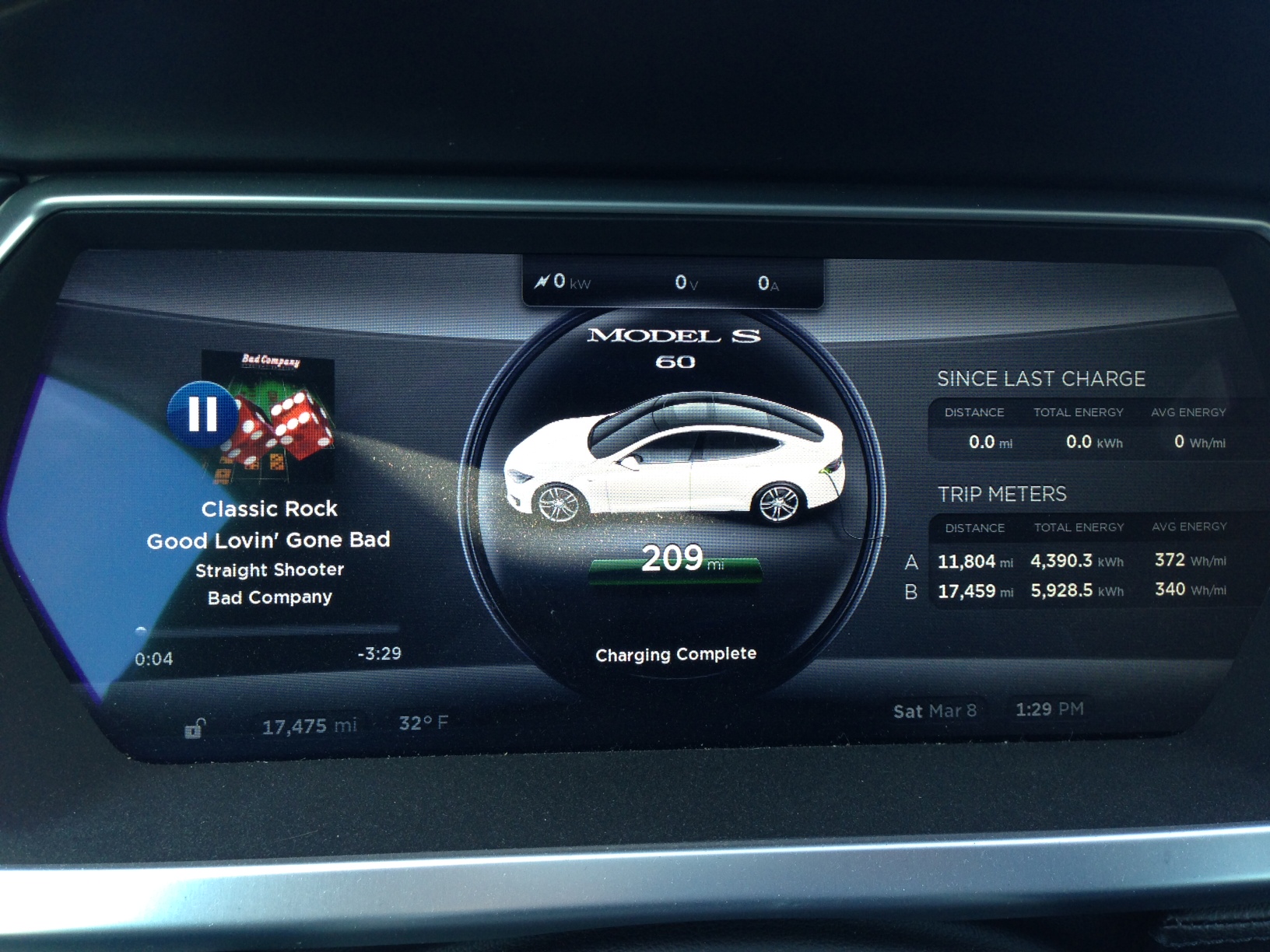
glhs272 As I have posted in other threads, my car charges to 209 rated miles when new and charges to 209 rated miles at 17,500. The key is liberal use of range charging. Any time you charge to less than 100%, your pack will go out of balance. The farther from 100% the faster and deeper it will go out of balance. The good news is a mildly out of balance pack does not appear to damage the pack. So it is just a psychological thing to see a large unchanging number.
 �
�
Mar 10, 2014
ElSupreme I have basically identical numbers to you. I have had similar 'loss' in my car.
I would get ~172 miles rated when my car was new on a 'range' charge.
I would get ~245 miles rated when my car was new on a 'standard' charge.
I now get ~255 miles rated on a '100%' charge.
I now get ~215 miles rated on a '90%' charge
If you paid attention to your range you would have noticed that 'standard' and 90% were not equivalent. 'standard' was really 93%. That change took a chunk out of your daily rated range. It isn't a true 'loss' of range.
My battery maintenance consists of always plugging in at home. Only starting charging at 11:15 pm. Charging at 40A. And always charging to 'standard' then '90%'.
Also they changed the way the car displays range in 5.X, where it shows generally less range. This would be another 'loss' even though it is just indicated loss.
I have had some indicated degradation. It is nothing that I am worried about.
I recently got a brand new loaner <2000 miles. It had a 274 mile full range charge, and it had 230 '90%' charge. So I am seeing ~7% apparent degradation over 24k miles, and ~14 months. I would imagine that I could balance my pack and get back 2-3% of that degradation.�
Mar 10, 2014
ChrisPDX I strongly suspect it's number 3. For awhile now when I range charged, I could only get my MS60 to about 195/196 (I have 12.5k miles). Yesterday I range charged but unplugged before it finished (was still putting about 2.5kW into the battery). The odd thing was the range never went above 196 for the previous 15 minutes (which it should have at +2.5kW charge rate). I then started driving and 10 miles in I was at 188 miles of range. Very strange since my usage was about 340-360Wh/m which is well above rated range usage. By the end of the day I drove 101 miles, averaged 301Wh/m and my battery meter showed the level just over the 50% mark. Assuming the battery meter is correct, this would imply that I still have well over 200 miles of range.
I personally think Tesla has really tweaked the rated range and gave it numerous factors that effect it. They really should start giving us more details on this as I think it would relieve some concerns about the battery degradation. But for now I'm not going to freak out over it as there are still signs that I have almost 100% of my original capacity still there. FYI, my daily charging is only to 60-75%, further showing a likelihood of a bug in range indication for those of us that don't do 90-100% on a regular basis.�
Mar 10, 2014
Andrew ^ THIS. Didn't the 5.x firmware change the "zero" calculation, so there are something like 10-15 miles of reserves? We got our car a year ago, and have about 10,600 miles on the odometer. I used to get ~245 rated miles on a "Standard" charge (before the slider), and then about 225 rated miles at 90% with the slider but before 5.x. Now I get 210 at 90%. Haven't those 15 miles have just moved below zero, so you can run on empty?
(I really do wish zero = zero... but that's separate from this topic.)�
Mar 10, 2014
dsm363 The old 'standard' charge was a 92 or 93% charge so that accounts for part of that but the firmware is also a part of it.�
Mar 10, 2014
Andrew Also, wasn't the old calculation for EPA-rated-range 308 wH/mile? And now in 5.6 (or was it 5.8?) it's changed to about 290wH/mi?
If that's true, doesn't that mean the EPA rated range should now be lower than 265? (gulp)�
Mar 10, 2014
dsm363 I thought one of those was rated and the lower number was ideal range.�
Mar 10, 2014
Andrew Hmm. I'm pretty sure that dashed line in the energy graph has moved below the 300-line (and I've always kept the car in Rated, not Ideal, mode) - but I don't have the car today so I can't go double-check. Anyone else able to take a look?�
Mar 10, 2014
JohnQ When I charge to 100% (at 40A) I try to time it so it's ready about 30 minutes before my departure time. This way any miscalculation on my part still results in a full charge when I'm ready to leave but hopefully with a warm battery. I drive the car 170 miles at a high rate of speed and am left with between about 35 and 50 rated remaining depending upon temperatures and speed (it's been about 0-10F lately on the drive so I'm usually closer to 35 remaining). I then charge at 30A at my destination for as long as possible (usually 11 hours) and drive home the same day. Obviously, I don't quite reach a range charge and usually discharge to about 20 miles on the return trip. I usually do this drive about twice a month ... doing it again tomorrow morning.�
Mar 10, 2014
Longhorn92 My 40 started in the 144-145 rated miles range, but now charges to 127-130 max rated miles (~7,000 mi on car). I have always assumed it was some combination of #1 and #3 above (i.e. part real battery degradation and part revised algorithms with firmware updates). However, after reading many pages here, I am now worried about the battery getting out of balance. Since we (the 40s) are not able to charge the battery above 72% SOC, how can we ever rebalance and get the balance-related losses back? Also, if the battery pack gets too out of balance, is it possible that you could have permanent losses associated with the balance issue?
Concerning the actual range, I have been waiting until things warm up around here (Chicago) so that I can test out actual ranges by duplicating some of my trips from last year (ones that are flat and where you can achieve consistent speeds). The cold weather really affects the Model S's range, so I feel that any comparisons while it is still cold would be somewhat useless and inconsistent.�
Mar 10, 2014
dsm363 There are experts here but I don't think from what I've read that an out of balance pack is permanent loss of range but it can take a long time to gain it back. Not sure if Tesla has a way for the 40s to do this with a max charge given t is a software limited 60kWh pack.�
Mar 10, 2014
ElSupreme
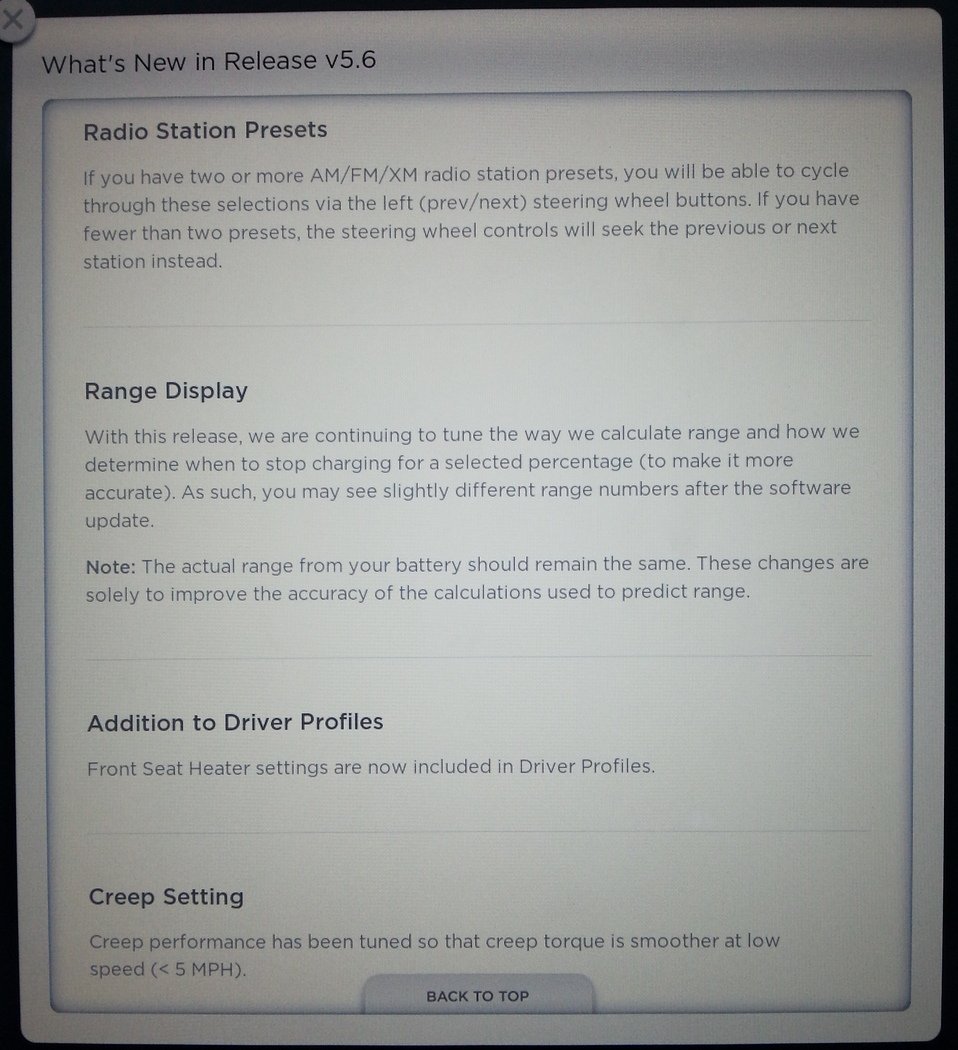
Yes 5.6 changed the way range is calculated. I noticed a ~10 mile drop in mine when it happened. I assume this is to 'zero miles' buffer.
Firmware 5.6
Has a picture of the update notes. I am sure if you read all the posts in that thread you will find reference to 'lost' range. It also says true range is unaffected, just displayed range.�
Mar 10, 2014
markb I am fairly certain that there is no way for 40's to be rebalanced unless they are unlocked or future firmware upgrades allow for balancing at any charge level. Unless one of these happens, I believe that the max. range of 40's will continue to diminish.
A 40 owner that I am in touch with brought his car into his service center, where they gave him a loaner, unlocked his 40, did a max charge, drove it to 0 and repeated. They then again limited his car to 40kwh. He gained 10 miles and went from 116 to 126. Also put 400 miles on his car and tires. Not really a viable solution even if all service centers were willing to do this.�
Mar 10, 2014
Zextraterrestrial this seems lame. there should be a way to cycle a battery without driving the car to discharge it.. 'bad' engineering for that part if that is the case.
if the Tesla outlet can pull >90kW there should be a way to discharge the same through the port I'd think?�
Mar 10, 2014
Andrew Right. So for everyone (except for 40KW owners) who is frustrated by that extra 10 or 15 miles of reduced range, this explains that it's purely software and not increased degradation. Why isn't this information putting the issue to rest?�
Mar 10, 2014
Gizmotoy Because the new algorithm isn't the whole story. Some of us took delivery after 5.6 and are also seeing a good amount of degradation (indicated or real, it's hard to tell). My 100% point is down 8 miles so far, and I only have 2300 miles on the car.
Fingers crossed it's a balance issue.�
Mar 10, 2014
Kipernicus But why do new cars still show 265 or greater miles at 100% even with the latest firmware? I don't understand how "new software" can make old cars have lower range (or hidden below zero, however you want to call it) but not new cars.�
Mar 10, 2014
wormhole I see, so you are saying all car owners are having the exact same experience irrespective of battery pack version, time built, etc, etc? There are plenty of people who have noted in these threads of battery issues and degradation.
Part of owning a Model S - I thought - in addition to its awesomeness is its simplicity. In fact, Tesla is so confident in its battery that they have a 'no fault warranty', so while you claim you've properly 'balanced' your battery, other than plugging it in, i'm not sure what you are referring to.
- - - Updated - - -
JohnQ, do you know if you have an A or B pack?�
Mar 10, 2014
Bardlebee All this talk about A and B packs. I am assuming the A is an older pack and there have been problems with them? So new cars are being shipped with the B pack?�
Mar 10, 2014
dsm363 New cars have D packs I think. I wouldn't worry about this pack issue with a new car since it wouldn't apply.�
Mar 10, 2014
Zextraterrestrial the A packs weren't going ever die so Tesla started changing firmware to show degradation and produced 'new' packs that will last for your warranty period.
then you can get another new one :tongue:
or not
my car seems fine for 20k mi of 'abuse'�
Mar 10, 2014
glhs272
Interesting. So you are confirming that the issues with 40 owners loosing range is mostly a balance and calculation problem. Balancing fixes the problem. Range charge is necessary. And I point out again, the non-40 owners who charge like they own a 40 by never charging over 80% will be seeing this problem too.
In my experience with balancing, it is simply time spent at max charge that is really doing the balancing. Meaning the whole drive to 0 miles part is probably unnecessary, other than to reset the range calculation which the owner could simply do themselves. They need to let it charge fully to 100% and let it sit there overnight. Maybe the next morning running the HVAC a little to bring the charge down a bit (to 90%) then re-charge 100% again. Leave it there for a while. Repeat if necessary. This would serve the purpose of balancing it with out driving it. On the last range charge, let the owner drive it down to below 25% to reset the calculation. So Tesla could simply allow you to do this all from home if they can over the air temporarily allow full range charging.�
Mar 10, 2014
JohnQ A pack.�
Mar 10, 2014
qwk The car will drift out of balance if you set the slider to anything less than 90%, or unplug it right away after a charge is finished(even if at 90%). There is nothing wrong with an out of balance pack, but getting it back into balance takes some effort and time. This is nothing new, and has been discussed many times in roadster threads.�
Mar 10, 2014
wormhole I see, and so your 'source' of this is the forums? Not directly from Tesla? I don't recall seeing anything in the owners manual about this that advises owners to 'balance' their batteries or anything at all about conditioning them. Do you have a source other than the forums? In fact, I've had Ownership Hotline tell me that its best to drive your car almost immediately after having charged the car, which is direct contrast to your first sentence...�
Mar 10, 2014
stopcrazypp Yep. Tesla uses "top-balancing" which means only the time spent at 100% SOC matters (in terms of showing the max range number). The driving to 0 miles part is only necessary to reset the miles calculation.
However, depending on how complex the BMS is, the driving to 0 miles part may be necessary to correct the voltage to SOC mapping (so that the numbers shown when you are below 100% SOC are also correct). The only exception is if Tesla has a software trigger that doesn't start a balance cycle until the battery has been through the whole 0 miles part (although that doesn't make much sense). This whole thing would be a whole lot easier if Tesla just added a "balance battery" mode, although that goes against the "keeping it simple" thing.�
Mar 10, 2014
glhs272 Actually a "Battery Balance" mode would be kinda cool. It would be like setting your oven to "clean". It will do a full range charge, hold there for a night, run HVAC down, recharge, repeat...�
Mar 10, 2014
qwk No, my source is years of experience and research. Obviously it has worked, since my range charge is 265+ after a year and 15k miles.�
Mar 10, 2014
djp Interesting. Your calibration should be fine since you're exercising the full range of the battery on a single key turn. It's possible that 30 min at full charge isn't enough time to balance. Try leaving it there for a few hours next time (not ideal for battery life or pre-heating, but would confirm that balancing is the issue as an experiment).�
Mar 10, 2014
bonnie It sounds an awfully lot like experience talking.
- - - Updated - - -
Moderator note: A post was banished to Snippiness for personal attacks. Keep it civil, folks.�
Mar 10, 2014
ckessel Since my previous post got banished, I'll try to ask politely.
First you said:
Now you've said:
Which leaves me wondering, is keeping in balance a matter of simple instructions or years of personal experience and research?�
Mar 10, 2014
qwk Since there seems to be a level of hate around the rated range issue, I thought that I would clarify a few things.
Does anyone here really think that Tesla would radically modify their proven Roadster technology when it comes to the BMS? Nobody here has to take my word for it. The roadster has been out for six years, and there is a ton of information on it both here and from Tesla. Unfortunately Tesla has just taken the plug it in and forget it stance with the Model S, which isn't helping much with regards to all of the different variables possible. Add in different firmware revisions which add even more confusion, and you have hundreds of owners freaking out.
There have been a few OCD roadster people try to outguess Tesla's battery software engineering, and strictly used storage mode for charging. Guess what happened? Range loss due to an out of balance pack.
BTW, ownership experience just reads from a script, how anyone can take their very vague answers as gospel is beyond me.
- - - Updated - - -
Both. If one keeps their car plugged in, and charges to at least 90%, they won't be posting about max rated range numbers below 260. Do you really think it's coincidence that both roadster and Model s owners that do the above have little to no range loss?�
Mar 10, 2014
ckessel I plug my car about every other night have always charged to either Standard (pre-slider) or the max daily line (90%) since the slider.
I have 250 max range at 14 months and 18,000 miles. This would seem to run counter to your description.�
Mar 10, 2014
NigelM ^This is me with both Roadster and MS. Plug-in both cars every night to standard charge level with very few exceptions, regardless of miles driven. Each car gets range charged about 3-4 times per year as and when I need the safety factor. No complaints from me about degradation.�
Mar 10, 2014
FlasherZ For what it's worth, prior to my battery pack going to the great recycler in the sky, I had 20,000 miles and a full range charge would only reach 257-258 miles after I followed rebalancing 3 times. I charged daily to 90% with the occasional range charge as necessary. The range charge would show only 252 miles until I followed rebalancing instructions and gained 6 back after 3 balancing cycles.
So yes, I kept my car plugged in, and I had < 260 miles. Now I'm back to 268 with a refurb pack after replacement.�
Mar 10, 2014
qwk "A" packs throw a monkey wrench into the equation, since they have different firmware and behave differently. Since you no longer have an "A" pack, you will have to let us know how your new pack behaves assuming the same charging regimen.�
Mar 10, 2014
dennis Given that charging to less than 90% causes the battery to become unbalanced, why did Tesla replace the 93% "daily" charge control with the slider that allows you to charge to less than 90%?�
Mar 11, 2014
Super Gizmo qwk & NigelM - Prior to the update bringing lower charge points and the capability to charge at a later time in the Standard Charge mode I always did what you have been doing and had a much batter range but what I can't understand is why Tesla encouraged people to charge at the lower charge points after that update. The update notes and comments by the Tesla people suggested that charging to a lower level than the full Standard charge was a better option than charging to the prior full Standard charge mode daily.
So, I and many other owners did exactly what we were encouraged to do and now have a much lower range. That is very disappointing. I know that the people at Tesla are busy with their expansion plans and higher production volume but they need to communicate to us the current owners exactly what is the right way to maintain and charge our batteries. There are too many conflicting suggestions on what to do and that is causing a lot of confusion and consternation.�
Mar 11, 2014
jerry33 One reason was so that there could be a storage level. The other, and probably main reason, was so that the EPA numbers would stay the same. If they kept the previous settings, the EPA would calculate the range as the average between standard and range charge. The slider eliminates government stupidity (or more likely political pressure to stem the tide of EV vehicles by doing everything possible to make them look bad).�
Mar 11, 2014
djp Mostly because owners were asking for it, and Tesla engineers knew that dropping the SOC would extend the long term life of the battery.
They probably expected owners to do enough long distance trips to keep the pack balanced, or they screwed up the balancing/calibration algorithm at low SOC and are still working to fix it. I'm guessing the latter.�
Mar 11, 2014
markb Exactly. But no matter how many times you or I or others make this point, that zombie theory refuses to stay dead.
Might be just semantics, but I am uncomfortable with you saying I am confirming anything. From my perspective, only Tesla can confirm any theory regarding range loss being related to battery balancing issues, and as far as I know, they have not said a word about that, or even anything at all in regard to balancing in the S. I don't view the wildly inconsistent information received from Ownership or service centers to be reliable regarding this issue.
I just reported one owner's experience, and expressed my opinions, which may or may not be worth anything.
Really? My understanding is that the epa fully charged an S, then drove it under varying road conditions, and determined how many miles they could drive. Had nothing whatsoever to do with Tesla's recommendations regarding charging.�
Mar 11, 2014
Gizmotoy This is one reason why the issue is immensely confusing to me. Tesla's official stance is leave it plugged in and charge in the daily range zone, but apparently that's only partially correct (90% is the only setting that's good). There's the SC's recommendation to extend battery life (battery is happiest when operating between 60-80% so charge somewhere in there), and there's forum user opinions.
On any random commuting day I use 30-35 miles at most. How should I be charging? If I charge to 75%, perhaps I unbalance the pack but extend the life of the battery? If I charge to 90% I keep my pack balanced but reduce battery life? As far as I can tell there's no consensus. If I can't charge every night (a true statement, in my case), what then?
Indeed, I also wonder why 90% is some kind of magic number. On the LiIon packs my company produced, charging to 100% balanced the cells. By all accounts, the same top balancing is true for the Tesla. So how does charging to 90% fit in? How can you top balance cells you're not charging to the top?�
Mar 11, 2014
stopcrazypp If you have two distinct charging modes, (say 90% and 100%) the EPA will average your two modes and have your range rating be that. That's what happened to the RAV4 EV (rated 103 even though it gets 113 with 100% charge) and 2013 Leaf (rated 75, even though it gets 84 with 100% charge)
So instead of 265 EPA miles, the Model S would have been rated 252 (95%). By doing a update to eliminate the "Standard" charging mode shortly after EPA announced this policy, Tesla avoided having to change the range number on their EPA sticker.
- - - Updated - - -
90% is not top balancing, it's closer to middle balancing (but not quite). It's still possible to do, but requires an accurate voltage to SOC mapping. But this point is kind of moot for the Model S as it appears NOT to balance at 90%. Only 100% has been confirmed to work. So charging to 90% does not really help the pack be in balance.
The Roadster on the other hand, DOES balance the pack even in Standard charging mode.�
Mar 11, 2014
Gizmotoy Yes, this is exactly what I meant, and you said it much better than I. Thanks.�
Mar 11, 2014
brianman Random observation:
This reminds me of Trim on SSDs. A lot.
- - - Updated - - -
Offering kWh and/or SOC % in the UI as a setting rather than "Rated" or "Imaginary" would be a significant improvement.
I've never have an issue with my ICE vehicles "deceiving" me about range remaining because 1/4 tank is never "off". Units like kWh and SOC % would avoid this problem quite well.
- - - Updated - - -
237 to 214 is a 9.7% drop. That's pretty significant, IMO.
- - - Updated - - -
(a) Wrong. You don't know if your pack is balanced. You also don't know if there's a causal relationship here. And, from a statistics standpoint, one data point is laughable.
(b) Wrong. Sometimes problems are the variability. My car had the 12V replaced preemptively. I never had a problem with it prior to that. Does that mean there was no 12V battery problem with the Model S?
(c) Wrong. On multiple levels. For now I'll just keep it simple and polite and focus on one here: at best you're being rude.
- - - Updated - - -
Terminology clarification:
"Early" Model S firmware:
Standard charge = 92-93% (REST data gave us the specifics, no official number was published AFAIK)
Range charge = 100%
"Later" Model S firmware:
Daily charge = 50-90%
Trip charge = 100%
Note that I use "Range charge" above instead of simply "Range" to avoid confusion with "Range (driving) mode". This confusion may be part of the reason why Tesla changed the name to "Trip". Also note that "full charge" is an often confusing term so I avoid using it.
- - - Updated - - -
There was a buffer below "0 rated miles" long before 5.6, or are you talking about something else?�
Mar 11, 2014
ElSupreme I am referring to the official change log notes from Tesla. I lost a good chunk of 'indicated range' with that update. I thought it was due to more 'zero mile' buffer than before. But I am unsure. I do remember having less indicated range after the update though. The note at the bottom heavily supports that 'indicated range' will be less, as it is trying to tell people they aren't actually losing any range.
Firmware 5.6
 �
�
Mar 11, 2014
brianman I don't interpret anything related to "buffer below zero" in that screenshot. When I read them initially (and now as well, I guess), I read it as "heuristic for measuring and doing math changed" not "moved a chunk of the measurement below the zero line".�
Mar 11, 2014
ElSupreme In both of my posts I state that I think it is due to more 'buffer below zero'. I never stated that Tesla said that. I did lose indicated range with the 5.6 update, it happened right before my road trip to SC. And my 100% charge went from ~265 to ~255 miles with the update. And my first leg was 250 miles exactly. It made me nervous to say the least.
And as for "heuristic for measuring and doing math changed" that statement is fully inline with your following one "moved a chunk of the measurement below the zero line".
Lets use an overly simple linear equation for demonstration.
Indicated Miles = y
Wh in pack = x
Start with this: y = 1/300 * x -2
Change to this: y / 1/300 * x - 10
This satisfies both of your statements above.
I did notice they changed the way distances are displayed during cold (sub 40F) temperatures. With 5.6, but I also noticed across the board loss in 'indicated range' that seemed consistent with changing the zero point. Either way it doesn't matter. Comparing range before 5.6 and after 5.6 is not really possible.�
Mar 11, 2014
brianman (a) Right. I wasn't suggesting otherwise, at least not intentionally.
(b) I wasn't saying they're inconsistent, just that I didn't read the latter into what they stated. "I flew a kite today" and "it was sunny today" are potentially consistent, but the former doesn't necessarily include or imply the latter -- especially if you're a tester.�
Mar 11, 2014
qwk This is 100% incorrect. Both the Roadster and Model S balance at 90%. No range charging is needed.�
Mar 11, 2014
Andrew [I just posted in this in the "Decreasing Rated Range" topic as well, but since I take this as official word from Tesla, I thought it was worth repeating. Mods, please don't slap me.]
Our car is in for our first annual service today. I asked my service manager about the decreasing rated range. He said our battery checked out just fine, but to restore the rated range, here are the EXACT steps we should follow. I walked through the steps with him on the phone twice to confirm. This is directly from my service manager at the Santa Monica service center:
1. Charge to 100%. Let charging cycle complete.
2. Unplug.
3. Let the car sit for 20-30 minutes, up to a few hours.
4. Drive the car down to 20% SOC. This doesn't have to be immediately, it can be over a few days of use.
5. Once 20% SOC is reached, let the car sit for at least 20-30 minutes.
6. Plug back in and charge to 90% (or 100% if you need the range).
7. Repeat every few months, unless you charge to 100% regularly otherwise.
That's it! Done and done.�
Mar 11, 2014
stopcrazypp Can you give a reference to a successful balance cycle initiated at 90% for the Model S? All the ones I have seen so far require charging to 100%, including instructions from service managers.
Charging to 90% seems to make little to no difference in the balance of the pack (to be clear, it might still do a little bit of balancing, but not enough to matter). There's still plenty of examples of people who charge to 90% regularly and still end up with lower range.�
Mar 11, 2014
MikeC I agree with this, it's consistent with the report from the field engineer that I've also posted in other threads:
The algorithm that evaluates the HV battery capacity is a feedback loop and it will take a few weeks to have it completely set to the customer's habit. I would recommend charging to 100% once a month and driving down to below 20% following the full charge. At 100%, the vehicle should seat, unplugged for 30 minutes and same thing at 20% prior to charging it. This is usually not necessary nor recommended but our algorithm needs improvements in evaluating of HV battery capacity which is directly related to range displayed. It currently under shoots the actual capacity when the customer doesn't charge to max or doesn't drive to below 50% (which is normally not the best for the life of the HV battery). Until we fix our algorithm, the customer should perform a deep cycle once in a while with rest periods at each end (30 minutes, not driving, not charging).�
Mar 11, 2014
qwk There is documentation from Tesla for the roadster, but for the Model S, Tesla has just stuck with "plug the car in whenever it's not in use".
If you watch the Model S charging near the end, you can see the balancing occurring. With an unlocked car, the charge port goes from blinking to solid green, and after about 5-15 minutes the charge port goes dark. The instrument cluster stays on, and the voltmeter(on dash) also pulses during this time. After the balancing is complete the dash goes dark. The entire process takes about 30 minutes, which is the amount of time that Tesla also recommends the roadster be left plugged in after charge completion.�
Mar 11, 2014
lloyds Did he say how often we should do this? Once a month, every 2-3 mos, etc.?�
Mar 11, 2014
stopcrazypp I'm well aware for the Roadster, as that is well documented (and owners have confirmed it being effective). I know it's undocumented for the Model S, so what I mean is simply an example of a Model S owner seeing balancing being effective while at 90% charge (best evidence would be the range numbers going up permanently after balancing).
Your description seems to match what is said here (an example of a successful balance with a measurable and permanent increase in indicated range), and I assume you mean that you only observe this happening at 90+% (cluster/dash does not stay on after charging and does not have voltmeter pulses below 90%).
http://www.teslamotorsclub.com/showthread.php/18915-Decreasing-rated-range/page6?p=386370#post386370
Any other owner able to confirm this occurring only at 90+% or having seen permanent higher range numbers after leaving the car plugged at 90%?�
Mar 11, 2014
Andrew Yep, see #7.�
Mar 11, 2014
darthvdr One thing I'm uncertain is if the battery goes off balance the range estimate is just that - an estimate. Does that mean that a P85+ with an off-balance pack will go just as far as the balanced pack?�
Mar 11, 2014
djp No, charging stops when the highest brick reaches the target SOC. If the pack is imbalanced there will be some bricks that aren't at full capacity and could be topped up higher. An imbalanced pack will have less range than a balanced pack where all bricks are at the same SOC.
If the pack is balanced but the capacity estimate is off (which is also possible) then yes it will go the same distance as a pack with the right estimate. The estimate can be recalibrated by exercising the full range of the battery (charging to >90%, driving to <20% and charging back up again). This is different than balancing, but both can have the same effect of reducing the displayed range.�
Mar 11, 2014
deonb
I can also confirm this works. I did this a few weeks ago and it went up to 257 (from before 254). Did it again over the weekend and got to 259. My original charge when I got it was 265, so it's getting up there.
13'800 miles, 1 year old.�
Mar 12, 2014
brianman Can you describe what you expect to see in the REST logs during the underlined period?
Below is what the charge cycle (and some vampire afterwards) looked like for my vehicle from last night. Any idea what's going on with the underlined entries?
Code:timestamp,soc,power,range,est_range 1394583169759,77,-17,179,107 1394583170258,78,-17,179,107 1394583224258,78,-17,180,107 1394583263258,78,-17,180,108 1394583279258,78,-17,181,108 1394583342258,78,-17,182,108 1394583344258,79,-17,182,108 1394583373258,79,-17,182,109 1394583405258,79,-17,183,109 1394583453258,79,-17,183,110 1394583461258,79,-17,184,110 1394583473193,79,-17,184,110 1394583518190,80,-17,184,110 1394583524440,80,-17,185,110 1394583556440,80,-17,185,111 1394583589440,80,-17,186,111 1394583645441,80,-17,187,111 1394583661440,80,-17,187,112 1394583693190,81,-17,187,112 1394583710440,81,-17,188,112 1394583766440,81,-17,189,113 1394583773635,81,-17,189,113 1394583832385,81,-17,190,113 1394583868135,82,-17,190,113 1394583873385,82,-17,190,114 1394583914385,82,-17,191,114 1394583971385,82,-17,192,115 1394584037385,82,-17,193,115 1394584043135,83,-17,193,115 1394584054385,83,-17,193,116 1394584074098,83,-17,193,116 1394584095347,83,-17,194,116 1394584154347,83,-17,195,116 1394584162347,83,-17,195,117 1394584219347,84,-17,195,117 1394584221347,84,-17,196,117 1394584263347,84,-17,196,118 1394584280347,84,-17,197,118 1394584339347,84,-17,198,118 1394584373347,84,-17,198,119 1394584374539,84,-17,198,119 1394584395289,85,-17,198,119 1394584398289,85,-17,199,119 1394584466289,85,-17,200,119 1394584475289,85,-17,200,120 1394584526289,85,-17,201,120 1394584646528,86,-17,203,121 1394584664278,86,-17,203,122 1394584784495,87,-17,205,123 1394584829245,87,-17,206,123 1394584872245,87,-17,206,124 1394584890245,87,-17,207,124 1394584929245,88,-17,207,124 1394584951245,88,-17,208,124 1394584978245,88,-17,208,125 1394585013245,88,-17,209,125 1394585075245,88,-17,210,125 1394585084245,88,-17,210,126 1394585084936,88,-17,210,126 1394585107185,89,-17,210,126 1394585155435,89,-17,211,126 1394585191435,89,-17,211,127 1394585218435,89,-17,212,127 1394585271435,89,-17,212,128 1394585280435,89,-17,213,128 1394585343435,89,-17,214,128 1394585376435,89,-5,214,128 1394585376685,89,-1,214,128 1394585376935,89,0,214,128 1394585377185,90,0,214,128 1394585388320,90,0,214,128 1394585508524,90,0,214,128 1394585633251,90,0,214,128 1394585753533,90,0,214,128 1394585873731,90,0,214,128 1394585993932,90,0,214,128 1394586114145,90,0,214,128 1394586234339,90,0,214,128 1394586354533,90,0,214,128 1394586474723,90,0,214,128 1394586594939,90,0,214,128 1394586715289,90,0,214,128 1394586835511,90,0,214,128 [U]1394586960130,90,0,214,135[/U] [U]1394586961130,90,0,214,134[/U] 1394586970130,90,0,214,129 1394587090328,90,0,214,129 1394587210541,90,0,214,129 1394587330750,90,0,214,129 1394587451120,90,0,214,129 1394587571384,90,0,214,129 1394587691693,90,0,214,129 1394587811897,90,0,214,129 1394587932188,90,0,214,129 1394588052405,90,0,214,129 1394588172603,90,0,214,129 1394588292945,90,0,214,129 1394588413141,90,0,214,129 1394588533352,90,0,214,129 1394588653577,90,0,214,129 [U]1394588778218,90,0,214,136[/U] 1394588784718,90,0,214,130 1394588793718,90,0,214,129 1394588913944,90,0,214,129 1394589034158,90,0,214,129 1394589154348,90,0,214,129 1394589274536,90,0,214,129 1394589394735,90,0,214,129 1394589514989,90,0,214,129 1394589635177,90,0,214,129 1394589774186,90,0,214,129 1394589923536,90,0,214,129 1394590043912,90,0,214,129 1394590164640,90,0,214,129 1394590284858,90,0,214,129 1394590405046,90,0,214,129 [U]1394590529407,90,0,214,135[/U] [U]1394590530657,90,0,214,133[/U] 1394590539657,90,0,214,129 1394590659852,90,0,214,129 1394590780045,90,0,214,129 1394590900294,90,0,214,129 1394591020497,90,0,214,129 1394591140870,90,0,214,129 1394591261062,90,0,214,129 1394591381261,90,0,214,129 1394591501461,90,0,214,129 1394591621663,90,0,214,129 1394591742291,90,0,214,129 1394591862618,90,0,214,129 1394591982827,90,0,214,129 1394592103038,90,0,214,129 1394592223249,90,0,214,129 [U]1394592347446,90,0,214,135[/U] 1394592353445,90,0,214,130 1394592362446,90,0,214,129 1394592482639,90,0,214,129 1394592602965,90,0,214,129 1394592723158,90,0,214,129 1394592843425,90,0,214,129 1394592963617,90,0,214,129 1394593083827,90,0,214,129 1394593204145,90,0,214,129 1394593324338,90,0,214,129 1394593444536,90,0,214,129 1394593564760,90,0,214,129 1394593685229,90,0,214,129 1394593805557,90,0,214,129 1394593925750,90,0,214,129 1394594045940,90,0,214,129 [U]1394594170273,90,0,214,135[/U] 1394594178770,90,0,214,129 1394594196770,90,0,214,128 1394594316964,90,0,214,128 1394594437159,90,0,214,128 1394594557345,90,0,214,128 1394594677535,90,0,214,128 1394594797932,90,0,214,128 1394594918150,90,0,214,128 1394595038343,90,0,214,128 1394595158536,90,0,214,128 1394595278732,90,0,214,128 [U]1394595395232,90,0,214,134[/U] [U]1394595396232,90,1,214,134[/U] [U]1394595396482,90,0,214,134[/U] 1394595403982,90,0,214,130 1394595413232,90,0,214,128 1394595533769,90,0,214,128 1394595654062,90,0,214,128 1394595774265,90,0,214,128 1394595894456,90,0,214,128 1394596017689,90,0,214,128 1394596137883,90,0,214,128 1394596258354,90,0,214,128 1394596378828,90,0,214,128 1394596499026,90,0,214,128 1394596619221,90,0,214,128 1394596739413,90,0,214,128 1394596859739,90,0,214,128 1394596979929,90,0,214,128 1394597100125,90,0,214,128 1394597220355,90,0,214,128 1394597340560,90,0,214,128 1394597460755,90,0,214,128 1394597580948,90,0,214,128 1394597688945,90,0,213,128 1394597812525,90,0,213,128 1394597932857,90,0,213,128 1394598053044,90,0,213,128 1394598173237,90,0,213,128 1394598293428,90,0,213,128 1394598413626,90,0,213,128 1394598533816,90,0,213,128 1394598654008,90,0,213,128 1394598774203,90,0,213,128 1394598894475,90,0,213,128 1394599014666,90,0,213,128 1394599134860,90,0,213,128 1394599255052,90,0,213,128 1394599375247,90,0,213,128 1394599495443,90,0,213,128 1394599618919,90,0,213,128 1394599739106,90,0,213,128 1394599859398,90,0,213,128 1394599979601,90,0,213,128 1394600100050,90,0,213,128 1394600220241,90,0,213,128 1394600340434,90,0,213,128 1394600460636,90,0,213,128 1394600580862,90,0,213,128 1394600701052,90,0,213,128 1394600821268,90,0,213,128 1394600941460,90,0,213,128 1394601061651,90,0,213,128 1394601181891,90,0,213,128 1394601305997,90,0,213,128 1394601426213,90,0,213,128 1394601546400,90,0,213,128 1394601666595,90,0,213,128 1394601739095,90,0,213,127 1394601859303,90,0,213,127 1394601868050,89,0,213,127 1394601988235,89,0,213,127 1394602108430,89,0,213,127 1394602228626,89,0,213,127 1394602348822,89,0,213,127 1394602469017,89,0,213,127 1394602513013,89,0,212,127 1394602633202,89,0,212,127 1394602753401,89,0,212,127 1394602873801,89,0,212,127 1394602993991,89,0,212,127 1394603117206,89,0,212,127 1394603237395,89,0,212,127 1394603357586,89,0,212,127 1394603477785,89,0,212,127 1394603597983,89,0,212,127 1394603718172,89,0,212,127 1394603838374,89,0,212,127 1394603958566,89,0,212,127 1394604078758,89,0,212,127 1394604198947,89,0,212,127 1394604319140,89,0,212,127 1394604439328,89,0,212,127 1394604559518,89,0,212,127 1394604679773,89,0,212,127 1394604799996,89,0,212,127 1394604922779,89,0,212,127 1394605042976,89,0,212,127 1394605163169,89,0,212,127 1394605283359,89,0,212,127 1394605403550,89,0,212,127 1394605523895,89,0,212,127 1394605644107,89,0,212,127 1394605767597,89,0,212,127 1394605887971,89,0,212,127 1394606008255,89,0,212,127 1394606128508,89,0,212,127 1394606249145,89,0,212,127 1394606369401,89,0,212,127 1394606489658,89,0,212,127 1394606609911,89,0,212,127�
Mar 12, 2014
AmpedRealtor All of the evidence points to a calibration issue with the algorithm. Charging to 100% or close to it, then discharging to 20%, provides the algorithm with more data regarding where the endpoints of your battery exist. It uses that data to estimate your range. This regimen calibrates the algorithm, it is not in itself indicative of any balancing issues.�
Mar 12, 2014
qwk I haven't followed any logs on my own car because there is no 3g within 50 miles of where I live, and the car doesn't connect to my wifi unless I park on the grass, next to the router.
Your logs do appear strange.
- - - Updated - - -
It could very well be a calibration issue for those that only use a small percentage of their pack, but quite a few people with low rated range numbers use most of their pack capacity on road trips.�
Mar 12, 2014
brianman Aside from the underlined oddities, do you see evidence of pack balancing in that data?
My car has been set to Standard93/Daily90 every time it's been plugged in since taking delivery. I don't have any anecdotal evidence of pack balancing, so I'm looking for ways to see evidence of it in my logs.
As one who plugs in every night and has driven it to and below "0 rated" at least 3 times, I would expect there would be some indication of pack balancing in the logs if it indeed occurs at 90% (rather than just 100%).�
Mar 12, 2014
lloyds Ah yes. Sorry..I speed read.�
Mar 12, 2014
qwk The values shown in the log have absolutely nothing to do with balancing. There is simply no way to tell from that information.�
Mar 12, 2014
Gizmotoy Sure there would. If your pack is unbalanced and it is being balanced, your estimated range will increase for a given SOC. If it's not obvious within a single charge (such as a pause where standard charging ends and balancing begins, or a decrease in the rate at which range is increasing), it'd be discernable when comparing the data from two charges.�
Mar 12, 2014
qwk What I meant was that the information contained in the log is no different from the dash display. In order to get more detailed info, you have to have the password.�
Mar 12, 2014
hans When I look at my logs I have never seen estimated range increase during balancing, even when the logs show current going into the pack. I have never seen current going into the pack at 90% SOC, only at 100% SOC. Brianman's logs show 0 amps going into the pack at 90%, hence no balancing.�
Mar 12, 2014
djp On the Roadster balancing is done by bleeding off the highest bricks, not topping up the lowest bricks, so it's possible to balance without drawing power. The current draw at 100% could be the tail end of a long ramp down, not balancing. It's hard to say what the Model S is actually doing without access to the diagnostics, or a technical blog from Tesla (I miss those!)�
Mar 12, 2014
Gizmotoy Useful information. I wonder if the estimated range increase is only seen, then, at the next charge after a balance. That would make sense.
The lack of balancing at 90% matches most people's observations (qwk excluded) as well. Perhaps balancing at 90% is an operation that only occurs once in awhile, rather than at every charge? That could explain both observations.
I'm going to see if I can get a better look at my logs as well. I use VisibleTesla and I can see all the raw data there, but it's not really in a form that's easy to get to (non-delimited text file).�
Mar 12, 2014
hans Sorry to be ambiguous. When I said I haven't seen estimated range increase I meant that I have seen the value of 'range' increase (rated 'range' being and estimated value). I did not mean to say that I haven't seen 'est_range' increase. This is a value only available through the REST API, as in brianman's logs, and it is weird and does go up and down in unexplained ways.�
Mar 12, 2014
brianman Huh? I think you're saying there is no user-discernable impact of pack balancing? I thought this was "the" way that people would see their range "returned" to their UI. Are you saying the REST logs lie, or that balancing doesn't have this effect, or something else?�
Mar 13, 2014
rlang59 I suspect he was getting at this:
For those owners unhappy with drop in maximum charged range - Page 24
That being the case you wouldn't see anything in REST or on the dash that tells you it is balancing.�

Không có nhận xét nào:
Đăng nhận xét