Jan 30, 2014
markb I have been extremely concerned for a while now about the very significant loss of maximum charging range in my 40kwh car. I am down from the initial 141 mile max rated range upon delivery to a 120 mile range, a decrease of approximately 15% after 9000 miles of driving.
I have been unable to get a meaningful response from Tesla regarding these concerns. I had been told that a new firmware upgrade will increase my maximum rated range by an unspecified amount, but after a couple of delays, I am rapidly losing patience.
Based on postings here and the official Tesla forum, I know that there are other 40, 60 and 85 owners who have similar concerns, although my impression is that 40's have seen more apparent or real degradation than 60's and 85's.
I will be sending a rather firm but polite email to Jerome Guillen in the next few days expressing my extreme disappointment in the performance of my car, as well as in Tesla's failure to address this issue. If anybody has any suggestions for others to contact, and is able to provide contact info, I would very much appreciate it.
I had initially intended to send an email signed by as many disgruntled owners as I could recruit, but that would require much more negotiation regarding content and tone than I currently have patience for. Instead, I would like to collect email addresses of those who are also not happy with the drop in maximum charged range they have experienced and cc them on my email in order to make the point that many others have an interest in this issue. I will make it very clear that the contents of my missive are mine and mine alone.
If you are interested, please post a response or pm me with your email address. I would also like to know if you have personally experienced unexpected range loss or your interest is more academic. If I only get a few responses, I may not cc anybody.
Thanks all.�
Jan 30, 2014
JakeP I really wish there was an option to display battery SOC in terms of kWh, rather than Rated Range. Only that would let us distinguish any actual degradation in battery capacity from changes in the Tesla formula used to dtermine Rated Range, which they have clearly tweaked during software updates over the past year.�
Jan 30, 2014
MassX1317 It's nearly impossible for you to have real degradation. Your battery would have to degrade from 60kwh to under 40kwh. It's a firmware thing. I've heard other people mention that 15 miles are "hidden" when you hit 0 miles remaining.�
Jan 30, 2014
bluetinc JakeP,
FYI Tesla Service does have the SOC in terms of kWh displayed on their car info web page they can bring up.
Markb,
When you say you have been unable to get a meaningful response from Tesla, would you mind sharing what you have tried already? Have you worked with a Service Center? Have you had a ticket into engineering to look at your cars logs? What answers have you received already? So far I have heard of a number of 40s complain but I haven't heard of any owner working with service/engineering to have the problem carefully looked at.
Peter�
Jan 30, 2014
JakeP Thanks Bluetinc. I mean that I would like to see it as in in-car display option, along with Rated, Estimated and Ideal miles. I wish Visible Tesla showed it as well!�
Jan 30, 2014
ausdma The latest version of Visible Tesla shows SOC under the Trips tab.�
Jan 30, 2014
deonb You may want to ask a technical question first to Tesla:
On the 60kW and 80kWh models, when we lose range it is generally due to the batteries being out of balance. Tesla has advised us to do a 100% charge and keep it there for a few days (in winter) in order to rebalance the pack. This has generally worked for some people.
However... how would you do that on a 40kWh pack?�
Jan 30, 2014
markb Peter, yes, I have worked with service/engineering, as have others. The response I and others have received after Fremont looked at whatever it is they look at, is that my battery is operating normally. As I stated, I was told that a new firmware release would restore some of the lost mileage. I did not get that from random forum members. I got that from my service mgr, responding to my multiple inquiries.
There are two other threads related to decreasing range and battery maintenance that I follow. Not trying to be obnoxious, but I would very much appreciate it if general suggestions, which I very much appreciate, were posted there, and this thread saved for its intended purpose.�
Jan 30, 2014
brianman Q: My car is charging at a max of 90 kW. How do I get it to charge at 120 kW like Elon said I'd be able to?
A: Buy a new car.
Q: ^
A: Pay for the upgrade to 60 kWh.�
Jan 30, 2014
techmaven Interesting. markb, I'd say that it is extremely unlikely that you've actually experienced any real range loss given what we know is the normal behavior of the Model S battery packs so far.
This part is the part that should make you feel better. Since your car is a 60, but firmware limited to 40, the chances that your pack is different is the same chance as any other randomly selected 60. Matter of fact, since you never charge above 2/3's and the fact that you never Supercharge, your pack's actual capacity loss curve is likely going to be far better than any other 60's that do those two things. Check out islandbayy's 60's capacity after how many Supercharges? However, it is likely that you cannot range charge and force a top balance. Therefore, the capacity loss that you see is either 1) BMS compensation for temperature 2) firmware bug 3) inability to balance 4) really, really bad degradation that Tesla is hiding from you.
I guess I'm interested in understanding your fear. I know the fear is real and I'm curious. Are you worried that at some point, if you elect to upgrade to 60 kWh, it won't be 60 kWh? Or are you worried that your 60 pack has degraded by 30+% already such that it is actually affecting your 40's range? Did Tesla talk to you about possibly doing a rough bottom balance? As in drive it down to near 0 and then slow charge on 110v to your 100% (which is really < 70%) and leave it at the 100% charging for a while?�
Jan 30, 2014
fluxemag +1 markb, I will PM you my email address. Bottom line is I can't drive as far as I could before by about 20 miles even with the same Wh/mi. That's getting close to Leaf territory after 7 months. I can get about 115 miles on a full charge at 300Wh/mi. The service center said my battery was "operating normally", and gave me an incorrect explanation about how rated range is based on driving habits, which it isn't. I know this because my avg Wh/mi has gone down significantly at the same time as my rated range is in a straight line free fall, plus the 5.8 immediate drop due to algo change.
Let me also add that I've tried the 110V slow charge at various amperages. I've tried running it down close to 0 a few times. I have used NEMA 14-50, J1772, HPWC and 14-30. I've tried multiple combinations of all of these with never an increase in rated range, it's always the same or ticking lower by a mile. And as much as I appreciate people chiming in with suggestions, I would rather hear exactly what is going on and how they intend to restore the lost real world driving range which is very excessive for the mileage on the car.�
Jan 30, 2014
deonb I think almost all 40's "100%" charge every day. I don't think it would help. Actually, charging to 70% every day is the fastest way to throw a larger battery out of balance, so I don't know what a 40kW owner is supposed to do about that.
However, I think Mark's original point, more than the technical issue, is that he's getting the typical Tesla communication runaround - which is endemic of most of the problems we've all experienced with them. That issue should well be taken up with Jerome.
I hope that at the next Teslive / TMC Connect, or shareholders meeting, someone brings up the Tesla communication issues in person with Elon as well.�
Jan 30, 2014
Sacrament055 MarkB,
You might want to post about this on the "teslamotors.com" forum as I recall there were a large number of the 40 owners over there. I've certainly seen the same issue with range loss. I received the car in May and would get around 145 rated miles at full charge now I typically get around 120 although I believe it will be a bit higher when the weather gets warmer. The troubling part for me is the actual range I'm getting has dropped below even the rated range (I do expect the rated range to achievable once the weather warms up)�
Jan 30, 2014
techmaven Well that really does suck. I wonder if they can temporarily "upgrade" you to a 60 and do a top balance. Has any of the Tesla service people given you a real read on the capacity?�
Jan 30, 2014
NigelM Mod Note: some posts went to snippiness. I appreciate that this can be an emotional subject, but let's all leave the edgy stuff out of it.�
Jan 30, 2014
brianman I'm fairly confident this is incorrect. I expect, statistically speaking, more 60 owners are in the sweet spot [20,80]% of their battery than 40 owners. I don't have any data to back it up, but that's my expectation. I expect 40 owners to reach below 20% a lot more than 60 owners.
If Tesla put the 40 charging in the [20,N+20] range instead of the [0,N] range, then what you're suggesting is likely.�
Jan 30, 2014
Iz The cold weather may be a factor as well. I "lost" about 30 miles on my round trip to work and home yesterday. Tempearture here was < 20 F for most of the day. I think our lithium powered devices would also deplete their charge faster if they were out in the cold. On the 60 kW I also have the "vampire drain", which to me is more of a problem than the cold weather drain.�
Jan 30, 2014
Brandonm I've also seen some decrease in range on my 40, from 144 when I first got it down to about 131 or so now. Last time I was at Bellevue SC they had engineering take a look and they said it was operating okay now but to keep an eye on it.�
Jan 30, 2014
markb It is not my fear, it is my reality. Soon after I got my car, I took a 120 mile trip and had 30 or 40 rated and 50 projected miles remaining. There is no way I would attempt that trip again, probably not even in the summer.
It is a 75 mile round trip to visit my son. When I start out with 116 or 118 rated miles in our NY winter, that is not a comfortable trip. My lost 20+ miles would provide an adequate cushion of comfort.
And it doesn't matter to me if it is a software or hardware problem. The miles ain't there anymore - that is all that is important.�
Jan 30, 2014
bluetinc Brianman,
But isn't your 20-80% numbers raw Li-Ion percents which are not the same as the cars range *20%-80%. Using my 85kWh as an example, 0 Range ~= 8% SOC, which, because of the protected lower end of about 5% is really about 13%. That means when talking 20%-80% you really are talking about Tesla SOC 13% - 85%, or in my car (248 max), 13-230 rated miles.
Peter
�
Jan 30, 2014
techmaven Definitely Tesla needs to respond to this. I'm definitely curious if the problem is that the BMS is defining 100% for you at lower and lower amounts (software bug). It would seem to me that if they do a centering calculation, the BMS should always define 100% capacity such that a 40 kWh owner never sees any degradation until the 60 kWh pack cannot hold 40 kWh anymore.
I do wonder how many issues the Tesla engineering team is fighting - with so many cars in so many new situations, they may be really stretched right now. It would seem to me that the easiest solution is to give you a temporary 60kWh upgrade until they can sort their software out. Or at the very least, bump a software rev that redefines the 40 kWh as say, 50 kWh for a bit and then later sort out the BMS.
:smile:�
Feb 1, 2014
hans I feel like the range on my 60 didn't really start "degrading" until I started to baby the pack by only charging to 67% each day. Basically I limited my 60 to the normal behavior of a 40 that charges to 100% and it appears I ended up with the same result because my 100% charge is now 191 rated miles instead of 207. I still believe that the range is not really gone and that the pack is just out of balance. However I am unable to get the pack back into balance and I have tried several ways to get that done. For example, running the battery low and then charging all the way back to 100%. I have tried trickle charging on 110VAC. I have tried charging to 90% every day for several days in row. I refuse to try to charge it to 100% and leave it there for a long period of time because that would not be good for the pack and the whole point of me "babying" it in the first place was to increase the longevity of my battery. Anyway, my car is in the service center and this "degradation" issue was one of the items I asked them to address. It will be another week before I get the car back because I am out of the country buy it will be interesting to see what they say. I do believe that they will be giving us some new firmware that does a better job of keeping the pack in balance and then all the range will be restored. Fortunately I don't need the last few missing miles at the moment but I can see how this would be a major inconvenience for anyone that does.�
Feb 1, 2014
stopcrazypp If you refuse to do this, your pack will never be balanced. The balancing cycle happens after your car is fully charged and sits plugged in at 100% (at least for a couple of hours). Trickle charging, charging to 100% and then unplugging, and charging to 90% does not balance the Model S pack. It might have worked on the Roadster pack, but it doesn't appear to work with the Model S (haven't seen any reports of people successfully balancing their pack without leaving the car plugged after a 100% charge).
Since it appears to worry you a lot, I suggest you do this once just to get confirmation it works.�
Feb 1, 2014
NeedToDrive markb,
How long have you had your car? This doesn't sound universal. Although I am concerned about a drop in charge, my 40kwh has dropped to 136 rated miles when I do a full charge -- which is very infrequent. Normally I have the slider set so it only charges to ~95 since my daily commute is ~10 miles. I have a little over 3000 miles and have had it almost one year (I think I was among the first to get one). In that time I've only been close to less than 15 rated miles two, maybe three times -- mostly I've been above 70 rated miles.
My concern really lies in how the software limits the battery to 40kwh. At one point I was told that 1/3 of the battery was cut off. I knew that couldn't be the case since my SW limitation actually happened with a new update (That's right I had the benefit of a 60kwh for a week). Later this was clarified that the computer calculates a maximum percent of the SOC. In any case, obviously SW is the key. If Tesla wanted to, when the slider is at max, they could just have the SW charge to a fixed rated range (say 140 miles).�
Feb 1, 2014
hans I do charge to 100% and let it go until 'Charge Complete'. The balancing is supposed to happen during the long period at 99-100% After that I drive. No reason to let it sit. If the car is not charging its not balancing correct?�
Feb 1, 2014
jerry33 Maybe. It could also be that the majority of the balancing is done at the 1 minute left mark but balancing continues as long as the LEDs are green. I don't know this for a fact, just suggesting that it's a possibility as some have reported seeing 1 amp at this time.�
Feb 1, 2014
dhrivnak Not true in a Roadster. Balancing takes time and you have to let the car sit at a high state of charge for the balancing to occur. It looks at the voltage of each brick and equalizes the pack and you do not need to be plugged in for this to happen. If you start driving the voltage will drop and the bricks never have time to equalize.�
Feb 1, 2014
stopcrazypp The balancing happens AFTER 100% charge. Here's the part describing a successful balance:
http://www.teslamotorsclub.com/showthread.php/18915-Decreasing-rated-range/page6?p=386370&viewfull=1#post386370
Basically it seems the car is charged until the charge port stops blinking (which usually indicates charging is finished). However, if you leave it plugged in, it keeps charging (over an hour) and this is when balancing happens. I'm not sure if the 99-100% period you are talking about coincides with this. He also did it with a 110V, but I think it only matters near the end (example used 240 volt up to standard charge and then 110V to range change).
Depends on what you describe as charging. The car might not indicate it is "charging," but it should still be pulling current from the charge port (unless there's active balancing where energy is moved from the strong cells to weak cells rather than bled off, or as dhrivnak says, it just equalizes the cells rather than getting all of them fully charged). The thing to note though is that it's been confirmed the Roadster can still balance the pack without being charged to 100%. I haven't seen any case where the Model S can balance without being charged to 100%.
Balancing in layman's terms is after reaching "100% SOC," you have to bleed off the energy in the strongest cells and continue to charge the weakest cells in the pack. Depending on how out of balance your pack is, it may take a while.
Regardless, letting the pack sit plugged in a couple hours at 100% just as a trial doesn't really hurt it much. You should see an increase in your range number (from your previous peak, which you indicate as 191 miles) as this is happening if the balancing is working.�
Feb 2, 2014
aaron0k Same issue and concern, you can add me. I'll PM you my email.
I went from 140 to 125 on my 40 kwh. Tesla rep told me the car has just been adjusting to my driving habits. I mentioned it only went lower with recent updates.�
Feb 2, 2014
markb If you have only 3000 miles on your car, that may be why you haven't seen much reduction in range. I have over 9000 miles - my first drop in range also brought me to around 136, as I recall. The fact that you are still at 136 and others below 120 kind of negates the theory that the reduction is due to software changes, a very popular theme on the official Tesla forums.
I put a deposit on my car in 2010 - I took delivery in May, also one of the first to do so.
- - - Updated - - -
That is interesting and really does imply that the loss is due to consistent, partial charging.�
Feb 2, 2014
hans I monitor my car very closely using the REST API and some logging programs. I do not believe I have ever seen the car draw shore power after entering 'charge complete' state except for HVAC. If the pack is balancing without pulling shore power then it shouldn't need to be plugged in, but it would need to sit unused. I know I have done a complete charge and let it sit an hour once, but only ever once. It wasn't enough to increase my estimated range but others have reported needing to do this several times to have a n effect�
Feb 2, 2014
qwk It's easier to leave your car unlocked(while charging), in order to understand this better. Monitoring with the app leaves a bunch of info out. When the car is charging(regardless of mode), the charge port pulses, and the dash is on. When the car finishes the charge, and is balancing, the charge port stops pulsing, but is still on, and so is the dash(voltmeter on dash pulses, meaning the battery is being balanced). When the balancing is done(takes 5-90 minutes), the car goes dark.�
Feb 2, 2014
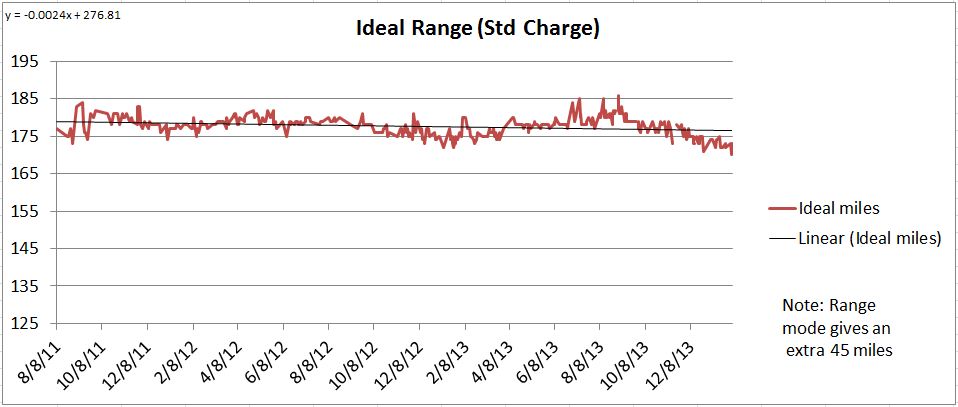
dhrivnak On the Roadster you do not need to be plugged in to balance but you do need to let the car sit at full charge. Also you may be seeing the "winter" effect. Below if a graph of ideal miles from my Roadster. Notice that my "range" drops to about 172 in the winter but is about 178 in the summer fall. I have seen this now for 3 seasons. So I would wait for summer before getting too worked up.
 �
�
Feb 2, 2014
NeedToDrive To be clear, I'm not suggesting that subsequent SW changes are the cause. It's the original implementation that I'm fingering. Recall that this had to be implemented very quickly and I don't think anyone had much time to really think it through. Reading about your experience does make me worry that something fundamental is going on. I wonder, can you plot your maximum achieved charge over time? Is it smooth or does it move around a lot (with a general decreasing value)? When do you look at the final number? Is it just after charging is complete or some time later (i.e. the next morning)? I have my car set to start charging at 2:00 AM and notice that there is a reduction by the time I get to the car in the morning (but nothing near 16 miles).
One of my worries is how the 40kwh algorithm tests when the charge is complete. If it is measuring the SOC and comparing to some fixed allowable (as one service person explained to me), then that measurement is key. I rather suspect that this measurement is hard to make and not perfectly accurate. In fact, it may be just the opposite - a somewhat noisy measurement. Though, again, your experience is too large a deviation to be explained by this.
Since this is happening to many folks I recommend that the SW for the 40kwh be updated to use the calculated rated range while charging and compare that to a fixed allowable of 136. This wouldn't be hard to implement and would certainly fix the problem. It would also have the effect of counteracting problems due to an inability to load balance (I didn't know that one needed to be at full charge for that to occur). Of course, it would also have the added benefit of hiding any degradation of the battery.�
Feb 2, 2014
Ocelot This thread makes me support batter swapping even more. While I seem to be in the deep minority here on TMC, i much rather not deal with any of this stuff. I want to buy the car and lease the battery. I do not want to baby it, worry about it or experience real or imagined issues. i do not want to spend hours planning a trip around superchargers, and buying multiple coffees until it is finished.
In the OP's first post a battery swap would mean, just leaving Tesla with the battery to balance...configure whatever, and him driving off happy after 2 minutes.�
Feb 2, 2014
markb No, can't plot my max charge over time - haven't been keeping those kind of records. It seems to drift down and then to plateau for a while - as I recall, my first plateau was at 136 or so. And I have been checking my range immediately after charging completes.�
Feb 2, 2014
eAdopter I've been reading about these concerns for a while, but wanted to gather data before posting.
My 40 began life June 3, 2013 with 144 Rated miles. In July the battery failed and was replaced. The new battery charged to 147 Rated miles.
I've been tracking Rated and Ideal miles since June. Both have been on a steady, almost linear decline.
Today, Rated is at 125. However, that doesn't tell the whole story. Drivable miles are worse than that:
In late August, the Rated miles were 142 and I tested the car. I drove it 141.5 miles - all the way to zero plus an extra half-mile to get home. This test demonstrated that the Rated calculations were very accurate for real-world driving. Note that the test was all highway driving at a near-steady 62 mph.
Today I tested the car again. The Rated 125 only provided 102 (!) miles, again driving all highway miles at a near-steady 62 mph. Same route as before.
I recognize these two tests are different. In August the A/C was on with Temp set to 68 (a hot day). Today the heater was on with Temp set to 74. I'm not sure which one (heat or A/C) uses more energy in my Model S, but in my ICE vehicle the A/C uses more. Also, I assume in summer that the battery requires some cooling. In winter, not as much. For now I'll assume conditions to be "similar" until I learn otherwise.
In summary, like markb, my 40 has experienced significant range reduction from 142 to 102 drivable miles. I'm concerned. However, I also recognize this is a very easy situation for TM to remedy due to the extra/unused capacity of a 40. My hope is that TM will make it right. We'll see.�
Feb 2, 2014
huntjo In your ICE car the heat uses less energy cuz it takes advantage of the waste heat from the IC engine. In Model S, cold weather affects range way more do to both the heater uses as well as battery pack warming to keep it in the "sweet spot" temperature for charging/ discharging.�
Feb 2, 2014
stopcrazypp You can't do a linear mapping of rated miles to miles you get because the miles under zero are not factored in. There was a long thread discussing the right formula to use. You also have to monitor your actual Wh/mi usage in order to get a decent estimate.
The heater uses more energy in an EV because there is little to no waste heat from the motor (unlike an ICE, which has plenty of waste heat). The battery doesn't need to be cooled in the winter, but it needs to be heated. Also a cold battery has less apparent capacity than a warm one. And depending on how cold the temp is, the resistive part to the heater might turn on (which is 3x less efficient in providing heat/cold air than the heat pump heater and general AC).
Air resistance and rolling resistance also increases in cold temperatures which will drop your car's efficiency even if you don't use the heater (and also if none of the above effects applied).�
Feb 2, 2014
markb @eadopter, have you found the calculation of projected range has changed? Before 5.8, my projected matched rated at approx. 305 wh/mile. Now, my wh/mile needs to drop to 280 for them to match. So while my rated and ideal range has dropped significantly, my projected range has dropped even faster and further�
Feb 2, 2014
eAdopter While I appreciate some of the comments above, I normally only report my observations.
I won't pretend, as others have above, to know things such as how miles are calculated, under what conditions the battery requires heating or cooling, if A/C uses more/less energy than heating, if battery heat is recovered to heat the interior, etc.
I very much appreciate when anyone can provide a link to information published by TM. To me, TM documents and owner observations are best.
- - - Updated - - -
@markb
Sorry, I didn't see your question. I did not observe any difference in Rated miles after 5.8. My car has had a fairly linear downward trend.�
Feb 2, 2014
dhanson865 How about instead of a battery swap just taking it to a Tesla Service Center and let them have it for a day or two once a year to get the cells balanced? Schedule it and get a loaner car to reduce your down time.
Myself I'd rather do the balancing myself at home or at a another charger of my choosing but if you aren't the technical type let the service center do it for you.
For a what if: How about even better you schedule a balance session with Tesla (by whatever means they provide, 800#, website, email) and leave your car plugged into a charger and they contact you when they are done balancing the cells using their ability to remote control the vehicle. Might require you opening up your wifi or having a really good cell signal at your house to have enough bandwidth for the control but it'd be nice down the road if they could do that as a remote service.�
Feb 2, 2014
markb Projected, not rated. Thanks.�
Feb 2, 2014
stopcrazypp If you want a "Tesla" source, you can play around with Tesla's range tool:
Your Questions Answered | Tesla Motors
You can observe the range goes up when you adjust the outside temp upwards (with the heat and A/C off) and down when the outside temp goes down. This coincides with the cold temperature range loss I talked about with no accessory loads. In general, the cold appears to have a larger impact than warm temperatures.
Nothing on: 262 (0F), 273 (32F), 283 (50F), 288 (70F), 294 (90F), 298 (110F)
AC on: 261 (70F), 266 (90F), 258 (110F)
Heat on: 264 (50F), 236 (32F), 220 (0F)
As for the range discrepancy I'm talking about (and I believe markb is talking about), this link describes what I'm talking about:
http://evtripplanner.com/InterpretingTeslaModelSEnergyReadings.pdf
The core thing is Initial Rated Range - Used Rated Range does not equal Remaining Rated Range, because of the formula Tesla uses (since changed with 5.8). And the 5.8 change may have to do with why you observed a differences in real world vs rated range (besides from the different conditions).�
Feb 2, 2014
eAdopter Great info. Thank you!�
Feb 3, 2014
markb No, c'mon guys, you know, on the energy display on the touch screen, showing projected miles based on last 5, 15 or 30 mile energy usage. My projected miles has plummeted with 5.8 - i now need to drive under 280 wh/mile (virtually impossible this NY winter), to beat rated range versus
305 prior to 5.8. Hasn't anyone else seen this?�
Feb 3, 2014
Jointguy When I took delivery last year (P85) I got 300 ideal miles and 265 rated miles on a max charge
Now 12 months and 12K miles later I get 284 ideal and 247 rated on a max charge
So I'm in the same boat�
Feb 3, 2014
Zextraterrestrial I think ~ 275 Wh/mi is where the #'s match up for rated and projected based on my 'carlog' #'s�
Feb 3, 2014
fluxemag I did a test over the weekend, where I charged it completely to a rated range of 126 miles, and then drove it to 0 miles remaining. I got 106 miles at 300Wh/mi. Not very good! Also note that that was only 32.1kWh. So I think their algorithm to allocate a percentage of the 60kWh pack is very far off. Weren't we supposed to get 72% of 60kWh?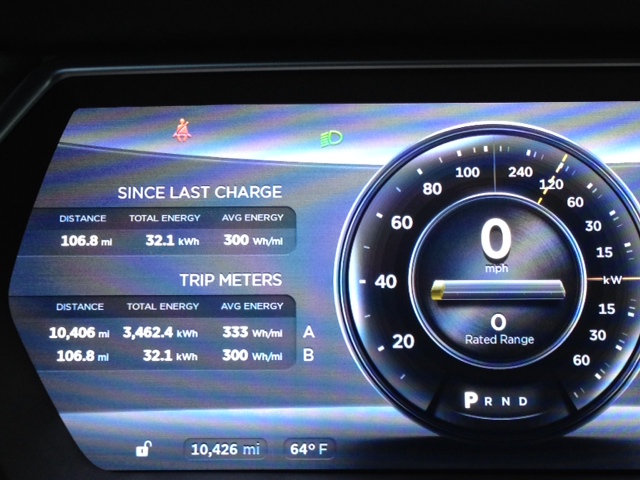 �
�
Feb 3, 2014
qwk There is hidden range under 0 rated miles.�
Feb 3, 2014
yobigd20 20% hidden? doubt it. probably a combination of imbalancing and poor software estimation for the 40kW cars.�
Feb 3, 2014
RedMatador 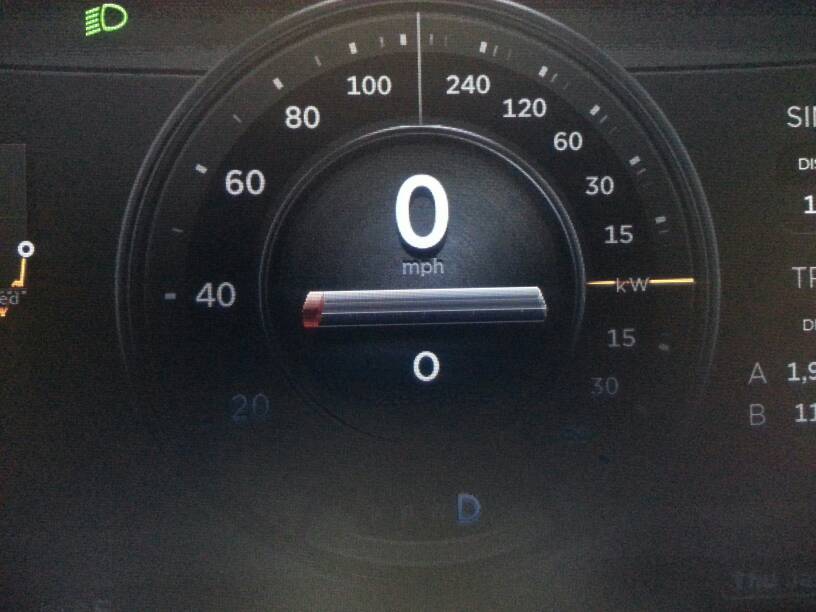
My zero mile left screen looks different. Does it vary among different battery packs or models or firmwares?�
Feb 3, 2014
bluetinc I've found my colors change by what seems to be pack temperature, though I'm basing that on outside temperatures, the colder it is the sooner the colors change.
Peter�
Feb 3, 2014
brianman Can you be more specific (different in what way)?�
Feb 3, 2014
dennis The first pic posted has a yellow battery bar, a limit line at 120kw and the words Rated Range below the 0. The second pic has a red battery bar, no limit line and no words below the 0.�
Feb 4, 2014
RedMatador Thank you dennis. Sorry for the off topic question, but I was just curious about the differences.�
Feb 4, 2014
brianman I think you're nearly on-topic, so no worries.
Also, thanks dennis!
Interesting observation.�
Feb 4, 2014
walla2 I noticed that turning on climate controls and warming a fully charged pack increased my rated range from 257 to 260. Anyone else notice this? Perhaps, try a range charge and then turn on the climate to 85 degrees while still plugged in and report back.�
Feb 4, 2014
qwk I didn't mean to imply that hidden range was solely responsible. Winter vs. summer energy usage is probably some of of the discrepancy, as well as battery pack imbalance.�
Feb 4, 2014
rallykeeper I admittedly haven't read every page of these various threads on reduced range (though I've been following it over the past several weeks both here and at tesla) , but I did have one observation vis a vis 5.8 that I don't think I've seen noted anywhere.
Could some reduced range be explained by the disabling of the low suspension setting? You obviously won't hit even ideal conditions if your aerodynamics aren't as good. Of course, I realize many posters might not have air suspensions so it doesn't explain everything.
As to my own situation...
12,900 miles, 13 month old car
85
Ideal range reduced to 289 miles (as of this morning at 50 degrees)
Rated range reduced to 256
I too have noticed the lowered dotted line in the projection section. Effectively, the projections are telling me that I need to drive even more efficiently than I used to to achieve the stated ideal/rated range. (That's what's leading me toward the air suspension explanation).
My car was in for its annual service last week and I asked about reduced range. FWIW, my service adviser said that the range calculations were impacted by my driving style. I don't think she understood my question very well. Obviously projected range is affected by driving style. Rated range after charge shouldn't be.
Apologies if this whole line of reasoning has already been explained away. If not, it gives me some hope that we might see range magically restored once low suspension settings return.�
Feb 4, 2014
dsm363 256 after a year isn't that bad. Most of the drop should be in the first year I believe. Some are seeing 240 after one year rate range so yours is probably within spec according to Tesla. Probably just keep an eye on it.�
Feb 4, 2014
deonb No. My max range charge dropped to 255 in September of last year and I was holding out from "upgrading" the software until late December. It's stayed at 255 after the upgrade, and is still at 255 today.
Car has around 12'500 miles and is 12 months old. I think 255-ish is within spec.
I haven't done any balancing.
The service advisers I've met all think that rated range is impacted by driving style. They're wrong.
I wish Tesla would give a Model S to each service center and force each new hire to drive the car for 2 months, starting off by flying them 2000 miles away from home (at least 750 of that without SuperChargers) and have them plan their own route and drive back. "Eat your own dogfood"�
Feb 4, 2014
nolngrgrsngslde I thought that one of the differences between the roadster and the S batteries is that the S does not need balancing. I also thought that one of the ways supercharging is possible is because each cell is individually charged. That means that there are leads going to each cell which would allow control to stop overcharging. The terrible part of an unbalanced pack is not the lack of charge on undercharged cell but, the extra charge on overcharged cells which can severely reduce their life. Tesla's claim to fame is the technology which increases the life span of the batteries so, they would not allow overcharging and hence they would not allow an unbalanced pack.
All this is my own conclusions based on various reads.
Finally, check out this kid, if he can build a pack that auto-balances itself, why couldn't Tesla.
https://www.youtube.com/watch?v=1e_gj4dASl0�
Feb 4, 2014
nanimac I'm at 125-126 rated miles now after 6 1/2 months and 7800 miles. I was at 144 when I got the car. I've been reading this thread and the one on the Tesla Motors forum and while the existing range is plenty for me, I am concerned as to how much more the range will decrease.�
Feb 5, 2014
bluetinc No, all multi cell packs need to be balanced. What did you see that lead you to think the S doesn't need to be balanced?
The model S has balancing built into it as part if it's BMS (battery management system). This system should balance the cells. Some of the debate now is what causes that balance cycle to kick on. In many ways that system is probably very similar to the video you linked.
Peter
�
Feb 5, 2014
deonb Watch the video in this thread, and you'll sleep much easier at night:
http://www.teslamotorsclub.com/showthread.php/27109-Why-do-Li-ion-Batteries-die-And-how-to-improve-the-situation
I do think that Tesla can do a favor to the 40 guys and instead of charging to 70%, it charges to 140 miles in range. That's just a software thing, and won't hurt any future sales, nor upset any existing non-40 users (I don't think).�
Feb 5, 2014
markb But won't that result in the battery becoming more and more unbalanced, which is not good for battery health, or is balancing irrelevant to battery health?�
Feb 5, 2014
NeedToDrive My point exactly (though I suggested 136). To markb's question: since the total charge will likely say under 70% total capacity my guess is that balancing would not be an issue. On the other hand it all depends on how the individual cells are charged. I'd like to think that that balancing is needed only as the SOC moves toward 100% to prevent maxing out individual cells. If SOC never reaches these levels, then no problem.
I hesitate to mention another explanation for the range drop that some 40kwh folks are seeing. I have no facts to support this theory and I certainly hope it is not the case. This is the possibility that, as the battery cells/components are tested during production they are split into three streams. Those that fail the test, those that pass, and those that are marginal. Obviously failed component are rejected. However, given the short supply of battery components at the time the 40's were being built, there might of been a temptation to use marginal cells in the 40's with the logic that the pack was over designed. Again, I have no data on this but we do see this sort of thing happen in production.�
Feb 5, 2014
aaron0k Same experience with my 40. Started at 140 in June, down to 126 today after 16k miles.�
Feb 9, 2014
NeedToDrive OK, so we got our cars at the same time (mine was delivered 9-May) but your mileage is more than twice mine (I just checked and have a little over 3,500 miles). With all the discussion here, I decided to do a max charge (max slider) this morning. The result is that it read 136 rated miles. It is now 134, after about 6 hours. This tends provide a counter example of partial charging cause since that is what I've been doing all along. However my case is different than Hans: 67% for him is close our max charge and I've been averaging more like 48% recently.
Some time data on my charging - which happens every night (except a 3-6 times I forgot to plug in). First charge (as a 60kWh) on 24 May produced 211 rated miles with range/max charge. 13-June produced 142 rated miles with a max charge. 12-Sep produced 139 rated miles with a max charge. 8-Oct produced 138 rated miles with a max charge. 11-Nov produced 138 rated miles with a max charge. 21-Dec produced 134 rated miles with a max charge. In looking over my records and, after the 40kwh SW limitation was implemented, I see now that many of these range/max charges were over several days (since I didn't change the slider back down right away).
So, the question is whether I can expect my range to drop 16 or so rated miles over the next 5,500 miles. Do you recall your largest odometer reading when you were at the 136 level? If it was comparable to 3,500 miles than I should expect the same drop and I'll be upset too.
In any case, I'll be watching your efforts closely and rooting for you. Your range drop is more than disappointing; it is evidence of a larger issue that Tesla needs to fix. I fully expected my range to drop over time, that was known when we got our cars. But I also know there are limits on reasonable degradation that come from a range of variables. Given everything I've read and studied about the batteries, the 40kwh limited battery has to have tighter limits on degradation than the other sizes. We just don't push the limits like the other configurations and that is a good thing when it comes to battery longevity. Seeing the opposite happen is a real concern.�
Feb 9, 2014
nanimac I'll probably be happy and less concerned if I'm still at 125-126 at 16k miles.�
Feb 9, 2014
aaron0k The drop was rapid. From 140 to 130 in ~6 weeks. I'm down to 124 now.�
Feb 9, 2014
riceuguy I realize it has been noted ad nauseum already, but I have certainly noted that my 60 seems much better now at accurately estimating cool and cold weather range. My "depleted" range (10-12 miles after 10k miles) has magically returned with the return of warm weather today in Texas. I remind folks to check their ideal range for now and if you are still having rated range problems when it is warm out, then panic! �
�
Feb 10, 2014
markb 1. My range has dropped 15%, not your 5%. Very big difference.
2. My ideal range, yes ideal range, has dropped the same 15%, from 160 to 136.
I will guess that my mileage was somewhat comparable to yours at 136, but that is only a guess. You keep way better records than I do.�
Feb 10, 2014
jtran65 Hans,
Will you let me know what service ctr said. I have been trying to address the same problems that you have. I drive 60 kwh and did a range charge . Range went from 207 to 193. My standard charge went from 187 to 173. I avg 307 kw/mile.
Tesla telling me that my battery is normal and weather and your driving habits determines your range. I have been baying my battery to prolong its longevity and only charges what I need. My round trip to work is only 35 miles. I'm hoping a new updates will address the problem. I have try various methods and still have not improve my driving range. Furthermore, the last updates makes my car regenerate less. They told me that it will lessen the wear of the rear tires. I feel that these updates are taking what we love about the cars. Hoping Tesla will address these charging problems.�
Feb 10, 2014
hans I should get the car tomorrow. I've been traveling and then sick so it's been in the shop longer than it needed to be. I will post a followup.�
Feb 10, 2014
DriverOne BS IMO! The latest update for some reason left regen very weak. I can't recall how you reset it - I think turn regen to weak then strong, then reboot the middle dash. Regen back to normal levels.�
Feb 11, 2014
fluxemag We didn't get winter this year in Phoenix, so I doubt that 64 degrees was causing a problem. That and 300Wh/mi takes all other factors out of consideration. In fact, I got more actual driving range last summer when it was 115 outside and I drove like an idiot, around 375Wh/mi. I think there is a buffer beneath 0 miles rated, inability to balance the pack and a miscalculation by the software on what percentage of the 60 capacity to give the 40 owners.
- - - Updated - - -
That is definitely different than mine, I'm on 5.8. I don't recall ever having the limiter line show up before, and it showed up at 30 miles rated remaining. Keep in mind is was a nice 64 degree afternoon.�
Feb 11, 2014
jerry33 It showed up on mine in software 4.4 (or maybe 4.2), so I believe it's been around for quite a while.�
Feb 11, 2014
glhs272 I was running FW4.5 for a long time. Have since updated to FW5.8. Regen is not significantly less. At most just doesn't ramp up as fast, but not really noticeable.
I think Tesla should kill the charge slider. Just have 3 settings: Storage (50%SOC), normal (90%SOC), and Trip/Balance (100%SOC). The people here "babying" their packs are doing more harm than good. The range numbers prove it. The 40kwh guys, well... I feel for you.
Have faith in Tesla engineering. If 90% was bad for your pack, then Tesla wouldn't use that for daily charging. Their electrolytes are good and full of the "secret sauce".
Update:
Anecdotally, it seems charging to 90% keeps the pack from getting too out of balance. It doesn't seem to balance the pack, but slows the rate of imbalance... if that makes sense. When I got my car, for a while I just did 90% charges for a few months as I got used it's range and capabilities. Then after a few months I started charging only to 60-70% thinking I was helping the pack. But, I started seeing a precipitous decline in range. After a few range charging sessions that range appears to have come back. Now for the last two months I have only been 90% daily charging. I am not seeing much if any range loss doing that. But may need more time to be sure.�
Feb 12, 2014
3mp_kwh Interesting point. Imagine you're in QC, for Tesla, with limited supply and need to set a cutoff for outright cell rejection. You already know the buffer to 60kwh, on the 40kwh, cars is enough that you can use more cells that hold marginally less voltage. I'm only noodling your statement, but it would seem reasonable not only to use the cells that test out to a bottom capacity tier, but also to allow more variation among the pack. The flip side would be a greater need for balancing, right? It may not just be a SOC, lack of full-charging, issue.
It oversimplifies, but would you rather have "40" cells with individual voltage characteristics all in an upper band, or "60" cells with lower results and potentially greater variability, set to push the capacity of "40"? I'd still be happy, as a 40kwh owner, to have the extra cells, but it depends on QC choices I am helping to create speculation about.
Owning an EV for more than one winter, and recently getting involved lithium batteries in RC cars, I can say I officially know boo about Tesla batteries. The EV's range, however, did go back up with temps last year (in a way that a great big swell of Tesla owners have yet to experience). It will be nice when Tesla's battery diagnostics are less guarded. It can't be much more than the same process, times a few thousand 18650's.�
Feb 12, 2014
fluxemag Here is attempt #2 for full charge to zero run. This one took place over several days, but the temp was between 60-75 the whole time with sleep mode, so vampire drain was minimal. I wasn't quite able to hit 300Wh/mi this time, but 302 is within reason. Starting from 126 miles rated, I reached "Charge Now" after 100.5 miles. A few moments later I got the "Battery Power Very Low, Air Conditioning Restricted" message, but I had just pulled into the charger at work so no problem. All in total I used 30.3kWh on my full charge, compared to 32.1kWh in the first attempt. I'm going to be generous and say that without vampire I could have probably gotten closer to 35kWh in both runs. Someone really needs to do the full run without stopping, I just haven't had time because I'm moving at the end of the week.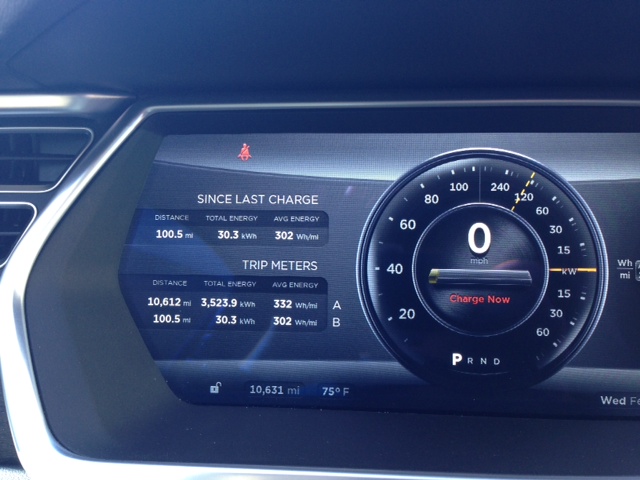
 �
�
Feb 12, 2014
SarahsDad Just another data point:
I have 6500 miles on mine over the last 6 months.
I always charge to 90% with about a half-dozen Range Charges over that time.
No "pack balancing".
Just Range Charged and still have 300 Ideal / 264 Rated miles.
Makes the "babying" argument to keep charge at 50-60% less convincing.
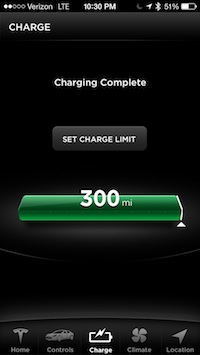
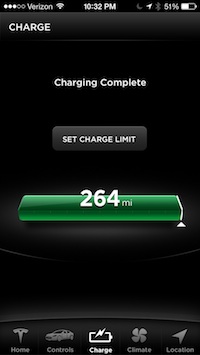 �
�
Feb 13, 2014
RodF I started at 144 when I got my 40 in June 2013. Got about 4,000 miles on the car. I usually charge it to about 59% and end the day at about 40%. Last nights charge maxed out at 130.�
Feb 13, 2014
AmpedRealtor Those of us who baby our batteries are looking at impacts several years down the road, not six months. I don't think you can draw any meaningful conclusions after only six months and 6,500 miles. There are too many other variables in play.�
Feb 13, 2014
hans Well I got my S60 back from its annual service. I specifically asked them to check out the battery for degradation.
This is what the report says:
"Concern: Customer states: Inspect battery for unusual degradation, Vehicle shows 191 rated miles immediately after completion of a full (100%) charge and 167 rated miles on a 90% charge. This is 9-10% lower than when the vehicle was new.
Cause: customer education
Correction: Battery Assembly General Diagnostics
reviewed vehicle logs and determined no issue with battery. Rated range is based on many factors (driving habits, temperature, hvac usage etc.) the range is estimated slightly lower in the current software version. This will be addressed in a future FW release"
Sounds like a repeat of the same misinformation about (estimated) rated range being effected by driving habits. In retrospect I wish I had given them the ideal range numbers and asked them to explain that reduction. They would at least have to come up with a different excuse. I tried to get a better explanation verbally but failed. I am at a loss to understand why they can't just look, see, and state that the cells in the pack are out of balance. I would have thought that information would be in their diagnostic output.
I do believe they checked out the pack and found no errors, and I do think my pack is just out of balance and has not lost the range. I'm just at a loss to understand how to re-balance my pack since charging to 100% and leaving it for a few hours doesn't do the trick for me. I will try a few more successive 100% charges to see if it makes a difference. Clearly though their is something coming in a future firmware that is related to this issue or they wouldn't have noted it in writing.�
Feb 13, 2014
glhs272 I have had success in balancing the pack by doing the 100% charge, let it sit for maybe 5 to 10 mins, then drive it back down to 90%. Also, the car won't register an improvement until the next range charge. Try doing at least 3 range charge cycles. If you don't see any improvement you might also try doing a range charge at a supercharger. If you still don't see an improvement, you may have in fact real degradation. Earlier in this thread I posted the improvement in my car when I tried this, so it should work for you too, but it's your car so feel free to ignore me.�
Feb 13, 2014
brianman Hmm.�
Feb 13, 2014
mlaureti I am glad (not to be alone) but sad knowing they served me the same response.
The following is my story: (With a 85kwh battery)
Max charge rate drop from 266 miles down to 250 miles.
I received my Model S in March 2013 (with now 15600 miles on the counter)
I used to be able to charge at 266 miles, I am now down to 250. (Service said it was software related, no issues with the battery)
Another tesla owner came to charge at my place (He got the car in November 2013) and max charged at 271 miles with the same software version!
This confirmed me it is not software related! (Thank you Thierry for charging at my place) Regardless of this information, Tesla Service keep on repeating the same story.
Software version: 5.8.4 (1.49.57) VIN: P06092
Joining the club of concerned Tesla owners.�
Feb 13, 2014
dennis Do you have an 'A' battery or a 'B' battery?�
Feb 14, 2014
mlaureti Thanks for your reply! Where can I check my battery type? (I search for Battery type and did not find anything)�
Feb 14, 2014
glhs272 mlaureti, we would also be curious to know your typical charging habits. Do you charge to 90% all the time? How often do you range charge? How often do you supercharge?
- - - Updated - - -
There is a label that shows battery type and revision number. This label is located on the battery by the front passenger side wheel well. For example, here is what mine looks like:
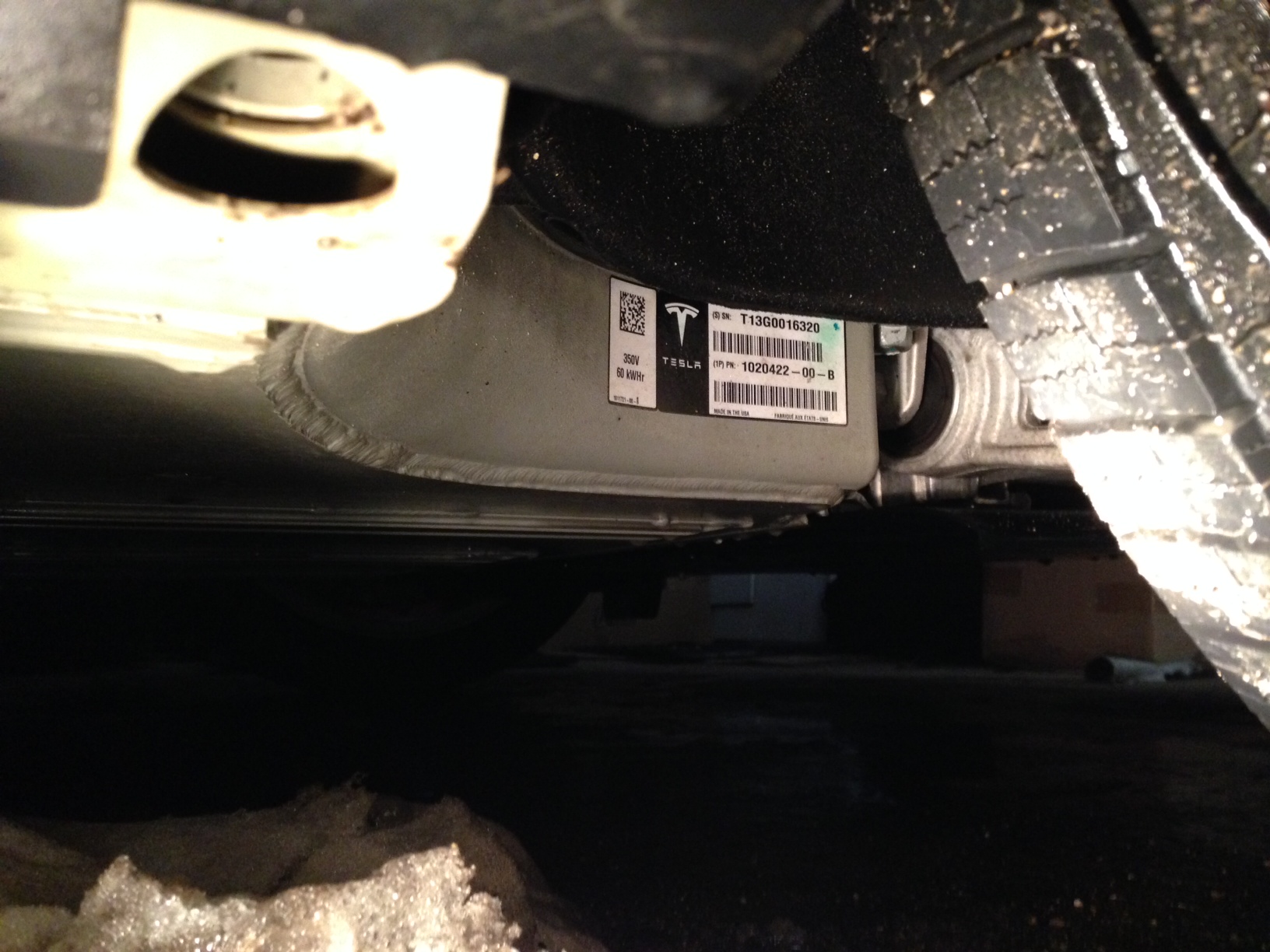 �
�
Feb 14, 2014
kjl Well ****, I saw this thread and got paranoid. I've also been babying my car (it's a 60kWh), and have been charging to 60-70% every day (about a 120 mile charge) for the last few months. I noticed that this charge level has dropped (125 down to 115 or something like that), so I did a full non-range charge to test it, and my rated range on a full charge has dropped from about 178-179 miles, where it was pretty stable for months, down to 162 miles today. That represents about a 10% capacity drop.
I've had it 7 months, 7600 miles on it. What the hell.�
Feb 14, 2014
glhs272 Yep, same for me when I was charging 60-70%. Luckily, after doing a few range charges, the range came back.
It remains to be seen what is best for long term degradation. If the range loss is only temporary, then perhaps it is still OK to only charge 60-70%. But if the range doesn't come back, then...
So to those that have seen this issue when charging to 60-70%, I would be curious to see if you can claw that range back like I was able to.
I have been studying what is best for lithium Ion cells, the question I have is what is best for the cell always = what is best for the pack? Time will tell. For now I am sticking to 90% charges and will keep reporting on any loss of range if I see it.�
Feb 14, 2014
santana338 I've got a 40 KWh MS and saw 141 as the highest rated range when I got the car back at the end of May. Currently I see a max rated range of 115 to 118. I haven't done anything about it yet even though it is about an 18% range hit. I have just assumed it has to do with the colder temps (in New England) and changes in the firmware algorithm.
I'll keep watching for more concrete info on this thread, but until it warms up, I will just be waiting and watching.
Does anyone else with a 40 see this low of a rated range? Do I win the prize for the lowest range?�
Feb 14, 2014
jtran65 Thanks for the reply. Service center is telling me the same thing. I am frustrated with these issues. Did a std charge today , temp is 70 degree. I got 172 miles and lost 4 miles to 168 after one hour of car sitting in my garage. It might be a firmware problem. I am on 5.8.4. Let me know if your range improves�
Feb 14, 2014
AmpedRealtor Looks like my battery is as good as new after six months and 5,500 miles. VIN 16XXX, P85, B revision battery.
I baby the pack and typically don't charge more than 50%-60%, don't run the car below 40-50 miles remaining... I just charged to 100% (you guys got the best of me) and here's what I see:
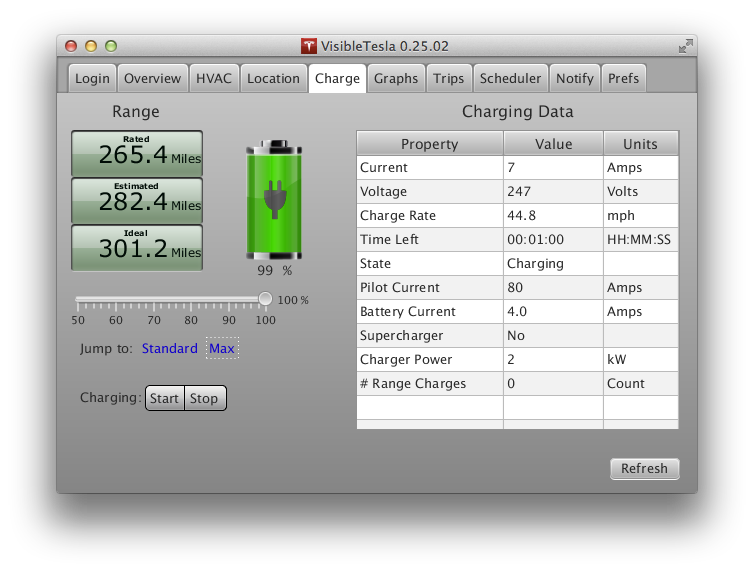 �
�
Feb 14, 2014
markb No, but I am pretty sure you are tied for first place. There are at least several of us who generally see a max charge of 116-118. And unless you are an exception, I am guessing your ideal range has plummeted as well.�
Feb 14, 2014
glhs272 That's good. At least one positive data point for charging 60-70%.�
Feb 14, 2014
kjl
I wish I knew if this degradation by charging 60-70% all the time is actually permanently bad for the battery, or is it just a temporary thing that will come back later if I need it to... That is, doing range charges is supposedly bad for the battery pack. If this 60-70% babying is only bad for the number I'm looking at when I look at the rated range, I'm not sure I want to do actual damage by doing multiple range charges just to make it look better.
Do you think I could get the range back by doing 90% charges, or do I really need to do the range charge to balance the pack or whatever it is?�
Feb 14, 2014
NoMoGas But here is my question: Did you actually LOSE mileage or does your display just say you did based on driving habits or whatever else it uses to calculate such things? We all know in ICE vehicles the rated range can swing wildly. Up for a test?
Get a friend to tow a uhaul auto transport and follow you. Fully charge the vehicle and drive at a cruise control speed of 55 until the car hits zero. What was the difference between rated and actual?
It's one thing to go crazy because the car lost actual miles, but quite another if the cars calculations are simply ultra conservative. Only one way to know. (The other would be find a station with wheel rollers so you don't actually have to go anywhere or even a track.�
Feb 14, 2014
markb No.�
Feb 14, 2014
glhs272 If the battery is simply out of balance, then the range loss is real but temporary. I firmly believe that doing a range charge does not "damage" the battery in the sense that if you do one or two range charges you will be loosing measurable range. I have done at least 16 range charges on my car at 16,000 miles. Range charging every day and leaving it there would lead to accelerated wear and possible eventual battery failure. But, that is not what I am recommending. Having a very hot battery and 100% charge is not good for it either. If you bring it up to 100% charge and then drive off the high state of charge shortly thereafter it will likely have very little impact on the long term life of the battery. A long time spent at a high state of charge is when the chemistry in the battery is building up deposits that eventually cover the electrodes to kill the cells. Tesla knows this. They use electrolytes additives that help mitigate this. They have battery cooling to keep the cells from getting too hot. And they likely have conservative limits on the maximum state of charge to prevent the insidious rapid failure of cells. Also, it is probably best to charge to max charge as quickly as possible in order to spend the least amount of time at levels above 90%. So you might even try doing this at a supercharger. Or at least set your charge rate to max amps.
With my car anyway, I have not had much luck balancing at 90%. You could give it a try and see if helps before going for full range charges. So it seems that unfortunately the most effective way to balance the battery is to do the a full range charge. That is just the double edge sword that is. Perhaps later model packs are better than earlier model packs. I am trying to keep this thread alive and get as much input from as many people as possible to get as best a picture from real world users as we can get.
I have not seen any posts here yet that state doing a few range charges have lead to significant range loss. It seems most people either don't see any benefit or they do get some range back. But keep in mind that the first range charge is not going to show "improvement". It is the difference in range between the last range charge and the next one. Assuming you did the two or three range charges at the next charging cycle. Doing a range charge and waiting 2 months to do the next one doesn't count.
If the minor loss of range due to an out of balance pack is insignificant to you, should you bother balancing the pack? Does an out of balance pack harm the pack or the cells in any way? I just don't know. It is likely that even 10 to 15 miles loss of range is not a significantly out of balance pack. How much range loss due to out of balance can the pack tolerate without any damage? Don't know that either. All very good questions. I have not heard anything official from Tesla about any of this, so it seems to be up to us owners to divine this information for ourselves through the trials and tribulations of daily use. For me however, I need the maximum range from my 60's pack. Northern Wisconsin is a charging desert. Until they install a supercharger in Wausau, I need to keep my pack tightly in balance. So all this to say it's your car so it's up to you.�
Feb 14, 2014
mlaureti Thanks for the picture, I will check my battery type tomorrow morning.
Charging habits: I charge @ 70% during winter time and 60% during summer time
Never super charged
Range charged about 8 times last summer, did about 6 this winter.
When I speak to service I always talk in terms of Ideal range because they have been saying that ideal range adjusts based on your driving habits
In ideal range I used to get 300 miles and now I am getting 285 of max charge
Like probably most owner, I babysit the battery based on Tesla's recommendations.
I registered a formal complaint because I am not satisfied with the "There is nothing abnormal with your battery pack" answer.
Apparently this is being brought up to the chef engineer responsible for our area. To be continued.�
Mar 6, 2014
kjl Just another data point for you all:
So, about 3 weeks ago (when I posted this previous message), I had been babying my battery and charging to 60-70% everyday, and noticed that my 90% charge had dropped to 162 miles(!). I did one range charge in an attempt to get it to rebalance the pack (btw, I exchanged emails with a service advisor and he said "The battery does not do any kind of rebalancing"), and it didn't do anything. But since then I've been charging up to 90% every day instead of 60-70% and my 90% charge has slowly but steadily been creeping back up. On 2/14, when I posted last, my 90% charge was 162. A few days later, the 90% charge was 163, then 164, etc.. This morning my 90% charge hit 167 miles for the first time, so I've "recovered" 5 of these lost miles in range since I stopped charging to 60-70%.
My driving habits have not changed at all over the last ~6 months, and the morning temperatures of my garage have not changed either over the last month or so (outside temperature as reported by the car is 55-60 degrees every morning - some days warmer and some days colder, but not correlated with higher or lower ranges).
I'm remaining hopeful that my range continues to creep back up from 167 back up to the low-mid 170's, but we'll see. I wish I had more information. I still have no idea if my charging to 60-70% was actually the cause of the temporary drop in range or if it was just correlated, not the cause, and if it was the cause, if the drop is just temporary or if charging to 60-70% all the time will be worse in the long run than charging to 90% every day.�
Mar 6, 2014
Jeff Miller There is some reason to believe that the displayed drop in rated range (at a fixed SOC) when you routinely charge the battery to only 60 or 70% is a) not reflective of a real drop in range or battery capacity b) not related to charge imbalances, and c) just an artifact of limitations in the algorithm that Tesla uses to estimate the battery's energy capacity. (For what little it's worth, I mostly charge to 60%.) See post 1017 and following on the "Decreasing range thread" for details:
Decreasing rated range. - Page 102�
Mar 6, 2014
Chris Naps In order to do a FULL balance - one must first charge to 100% - The original poster will not regain miles because he cannot fully charge because he has a 60 KW battery programmed for only 40 KW. The only people who can allow for him to regain battery life is Tesla.
In regards to many of the same replies to this thread - Low rated range is not bad - the battery is simply.. OUT OF BALANCE. In order to regain these miles one must charge to 100%. IT IS NOT GAURANTEED TO REGAIN 'ACTUAL' RATED RANGE THE FIRST TIME ONE CHARGES TO 100%. IT SOMETIMES TAKE 3 DAYS AT 100% TO REGAIN RATED RANGE OR CHARING TO 100% THEN DRIVING DOWN TO 0 THEN DOING IT A FEW MORE TIMES UNTIL YOU WILL BALANCE A PACK.
Charging to 100% does not hurt your battery - it only hurts it when it stays there for a long amount of time.�
Mar 6, 2014
ecarfan Like when one charges to 100% and let's the battery stay at the SOC for three days and then repeats that pattern multiple times as you recommend?
And you recommend this based on what factual evidence?�
Mar 6, 2014
hans We can hear you fine in lower case ;-)
�
Mar 7, 2014
kjl Thanks for the link - that makes me feel better. Although I don't really know anything about batteries, and apparently they are super confusing, it does make sense that charging to 60% would not be "bad" for the battery. Probably the best thing for me to do is go back to charging to 60% and stop worrying about it and stop second guessing myself.
So, I've been lurking on this forum for a while (since I got the car), and I've heard all this talk about pack rebalancing at 100% charge, about how it needs rebalancing, how one should fully charge it to 100% and leave it for an hour or two, etc. and basically took it as fact since everybody seemed in agreement that that was accurate information.
However, given the link that Jeff Miller gave, as well as the info from the service advisor I've been trading emails with who flatly wrote "the battery does not do any kind of rebalancing", I'm going to question my old beliefs. Is there a quote from a Tesla/official source that actually verifies that this 100% pack charge rebalance is a real thing, or is it all just conjecture from owners who noticed that their displayed range sometimes went up after full charges (which would be explainable either with the pack rebalancing hypothesis *or* the hypothesis that the number goes up simply because the car is better able to estimate the battery capacity after a full charge)?�
Mar 8, 2014
ecarfan Definitely not "everybody".
In my opinion it is largely conjecture. There is a great deal of confusion on this issue and there is a dearth of consistent information from Tesla representatives.�
Mar 8, 2014
jerry33 There is also a shortage of long-term field data, and it doesn't help that the batteries have had at least three revisions (A, B, and D have been spotted). Most of the data we have is really based on the Roadster, and the assumption is that the Model S will behave similarly (only better).�
Mar 8, 2014
djp The BMS definitely does pack balancing. The battery diagnostic screen shows the state of balance with high bricks in orange and low bricks in green, similar to the max and min brick voltages on the Roadster.
View attachment 42080
We don't know when the balancing happens on the Model S. On the Roadster balancing is done directly after a Standard charge or Range charge completes. The Model S no longer has a Standard mode - it's possible that Tesla removed mid-SOC balancing when they added the charge slider.
We also don't know if the range loss that owners are seeing is a result of the pack being out of balance. It could be an error in the capacity estimate algorithm or some other factor we're not even aware of.
It would be great to get access to the diagnostic screen, or reverse engineer the CAN bus to get some real data. The information coming from Tesla has been spotty or conflicting, which is a big step backwards from the excellent engineering blog they used to write for the Roadster.�
Mar 8, 2014
Chris Naps I recommend this based on the factual evidence of the technicians at Tesla. They were the ones that recommended this solution.
There is another person being told the same thing:
> My SCS told me that engineering said: [walla2]
Objection! Your Honor that is hearsay!! . . . Ok, disregard that outburst:
> 1. Charge to 100%. Leave plugged 30 minutes longer. Run down to 20%. Leave 30 minutes and then charge. Repeat 3 times.
> 2. Leave charged to 100% for 3 days without driving.
Now, when you have completed these tasks, Grasshopper, return and you will be issued more convoluted and incomprehensible chores to complete. Drink the Kool Aid, hold your head high, take a walk in the sun . . .
--�
Mar 8, 2014
jerry33 I'd agree if Tesla recommendations were consistent but they appear to vary a lot so it's not at all clear which recommendations are correct and which are not.�
Mar 8, 2014
Chris Naps I totally agree - there really needs to be a "STANDARD" set by Tesla. They should come out and openly state what they know so there isn't any confusion on this.
It is under my opinion that I believe Tesla doesn't even know what the best method of regaining miles is. (There is a way to do it we all know that, but what is the safest or should it be a weekly, monthly, quarterly, half-a-year, every year type of ritual.)
This technology is new and especially experimenting with different chemicals and molecules in the batteries to extend longevity might be tricky. I'm not a scientist and I do not know much about this technology, but I believe Tesla doesn't want to mention a standard for charging besides for certain basics such as (a plugged in Model S is a happy Model S..) or (Do not charge to 100% all the time.) These are pretty common standards and do not go into detail.
I feel by the time gen III comes out - there will be some additional standards that will be confirmed by Tesla because they will have enough information on different types of methods that Model S technicians offer. Each Model S relays information back to Tesla about SOC and charging methods, as well as additional information. As you stated they all say different things, and maybe they will by that time have a generalized way of stating everything that is centered around one main idea and method. (HOPEFULLY)�
Mar 8, 2014
AmpedRealtor All you are doing by charging to 100% and then driving the car to 0 miles is teaching the algorithm the high and low extremes of your battery. This improves the algorithm's ability to estimate range at any SOC. This is the same calibration technique officially recommended by Apple for its lithium ion laptop batteries. All this does is change the estimated range displayed by the algorithm, but it does not actually recover any miles (they have always been there, just not necessarily displayed). One data point to support this is the one and only time I charged to 100% after six months of ownership. My ideal range was 301 miles and I was able to drive 15 freeway miles at 75 MPH on flat grade before my display dropped by 1 mile. The algorithm clearly has issues.
Instead of jumping through hoops that could degrade your battery long term, why not just wait for Tesla to come up with a solution? After all, battery degradation is specifically excluded from warranty coverage. So anyone who wants to follow the 100% charge/discharge regimen does so at their own risk, and without a safety net from Tesla.�
Mar 8, 2014
jerry33 Until that time, I'm going with the following:
1. 50% is best for storage. (Based on Roadster storage mode)
2. Driving is best between 93% and 50%. (Heats the batteries less when driving)
3. If you need a range charge--just do it and don't worry about it. If possible, leave it charging for long enough to completely charge the pack. (This may take up to an hour where the App says one minute remaining.)
4. Set the timer so that your charge ends at about the same time as you start to drive. (Allows the pack to sit at the lowest charge level for the longest time)
5. Set the amps at 32 unless you need to charge faster. (Heats the pack less, easier on the grid)
6. When cold, preheat the pack. (Avoids most power and regen limiting)
7. Avoid running down to zero, and if you do start charging ASAP. (Normal LiIon recommendation)�
Mar 8, 2014
Chris Naps Let me ask this question, (I have never tested this, and probably wouldn't want to only if I was near my home or a charging station) if you are right and it is only an "algorithm issue", then technically speaking if you were rated for... 255 miles and it dropped to 245, the car would evidently still have 10 rated miles left over??? If I drove 245 miles would the WARNING: CHARGE NOW! screen pop up, even though 10 more miles were secretly there? (Lets pretend that there was NOT any battery degradation, and only an algorithm issue.)
And for the last part doesn't Tesla warranty the battery up for 70% of degradation (in 8 years time)???
Excellent pattern. Keep it up and hopefully you will be one of those people that go 15+ years with over 70% of the battery�
Mar 8, 2014
rlang59 Not in the official written warranty they don't.�

Không có nhận xét nào:
Đăng nhận xét