Feb 22, 2013
EarlyAdopter I went out of town recently and left the car unplugged in the garage, which stays 50 - 55F. This was on v4.1 with sleep enabled.
Unplugged 2/3 9:00pm: 208
Returned 2/7 1:00pm: 195
13 miles of rated range lost over 3.67 days, or 3.5 miles per day.
The car keeps asking if I want to upgrade and I keep saying no.�
Feb 22, 2013
dennis I went away for 5 days and left both cars unplugged with garage temps 45-55F. The Model S lost 55 miles and the Karma lost...zero! Is this true for other EV's such as the Roadster/Leaf/Volt? In other words, is the Model S running that much more electronics than the other EV's?�
Feb 22, 2013
Lcaudle24 Temperature is the third factor that must be accounted for as it appears to be a significant factor.
- - - Updated - - -
I understand that the answer is a resounding, unequivocal YES.�
Feb 22, 2013
Zextraterrestrial The so called 'lost miles' aren't all really lost. If you charge for much less than what is shown that was lost you will have regained your miles, say ~ 1/2 of the power is needed for 'refilling' that many miles.
If I see 6-10 miles lost overnight in 12-14 hours, I can charge back to the spot I was at in a bit less than 6 minutes (~<1 kw tot). the 6-10 miles should be 2-3 kW of power�
Feb 22, 2013
RDoc I wonder how much of that is temperature, even at 50F?�
Feb 22, 2013
theganjaguru Vampire Draw - Sleep Mode - Physical Start Button
My buddy and I were discussing the fact that while the whole process of placing your keister in the seat is what starts the MS is cool, it does take away the power/decision of the driver, and people don't like to have their power taken away. I am almost inclined to agree with my buddy. Especially if this is the cause of the vampire draw you folks are experiencing.
Would a vehicle strart button (on future builds) be an easy fix for this issue? The MS can wait for the fob only to unlock doors and run accessories from the 12 V. Then when the driver is ready to turn on the car, they press the start button. Thus the option you folks have now could be part of the tech package (which would further increase the additional options the tech package includes) personally I'd rather have a start button as I've already had issues with airbag sensors (located in my seats) malfunction in my previous car. And I like the idea that "I am in control" (ya, I have control issues lol). I'd definitely prefer a push button startup if it would resolve the issue of vampire draw when idle�
Feb 22, 2013
JRP3 Does the Karma have a temperature controlled pack? The pictures I've seen suggest not, at least no liquid cooling, and the A123 cells should need less temperature management anyway. When sleep mode is enabled again the S should use less power than it is now.�
Feb 22, 2013
strider The start button would not affect Vampire draw. It would just move the start button from the seat sensor to a physical button. Vampire Draw is happening because Tesla was having trouble with some systems going to sleep and then waking back up again correctly. So they stopped putting anything to sleep. No more bugs but now we have vampire drain. It's a serious problem and I know Tesla is working hard to eliminate it. It will be solved in time.�
Feb 23, 2013
dennis The A123 battery system in the Karma does have liquid cooling. If you recall, the first recall for the Karma (Jan. 2012) was for misaligned clamps in the battery cooling system. I have experienced the fans coming on while the car was charging, but don't know when/if it warms the battery.
I believe most/all of the 55 miles of range I lost in 5 days on the Model S was from running the electronics as opposed to conditioning the battery, given the mean 50F temperature in my garage.
- - - Updated - - -
Is that when the battery is cold and regen is showing as limited? The 11 miles/day that I lose due to the electronics does not appear to be recovered when I first start driving the car, i.e. the remaining range ticks down rather than remaining steady for the first few miles of driving.�
Feb 23, 2013
JRP3 Of course, how could I have forgotten? I guess the cooling plates must run outside of the modules since I don't see them indicated in any pictures I've seen so far.�
Feb 24, 2013
dsmith2189 My loss of 12-15 miles a day is not recovered.
When my car was delivered I had 4.0 (1.17.50) and had sleep mode enabled which was good since it took 3-4 weeks to ship it to me. It arrived with 3/4 charge. I did not notice any substantial loss for the first few days before upgrading to 4.2 (1.19.41) and then to 4.2 (1.19.42) 2 days later. After the upgrade is when I noticed the large loss overnight. I would fill to 242 miles and 24 hours later I would be down to 230 miles. I live in Hawaii so loss due to low temperature is not a consideration (average temperatures are 72F to 80F)�
Feb 24, 2013
tezco My daily recharge for idle power losses and the ideal miles lost are plotted below for the past 10 days. The S was unplugged for 5 days while I was out of town and lost 71 ideal miles and took 4 hours for a 14.99 kWh recharge (@ 20A) which equates to 211 Wh/mile. (This is the data point farthest to the left.) If you are losing LT 1 kWh per 12 hours (or LT 2 kWh in 24 hours), you are lucky; my losses are about double that, at relatively moderate temperatures. 3 kWh delivered over a 6 minute interval at 240V requires a 125A charging rate, if I'm calculating it correctly.
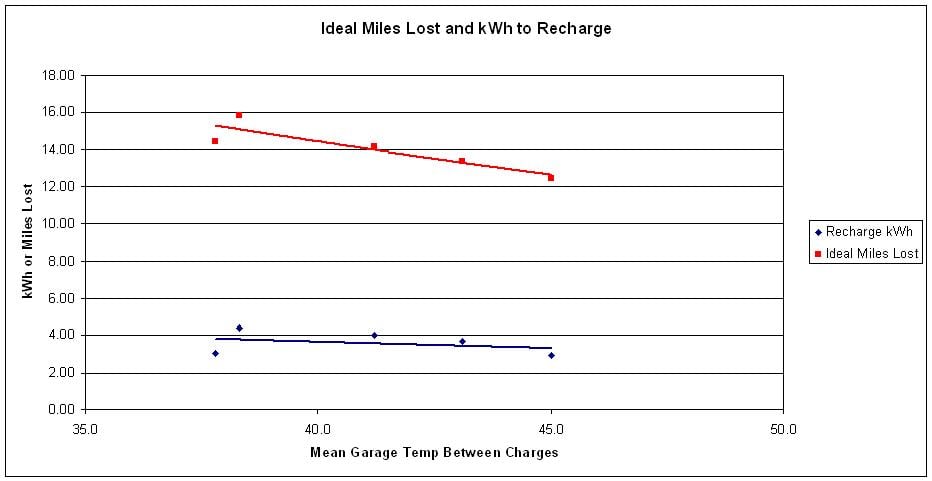 �
�
Feb 28, 2013
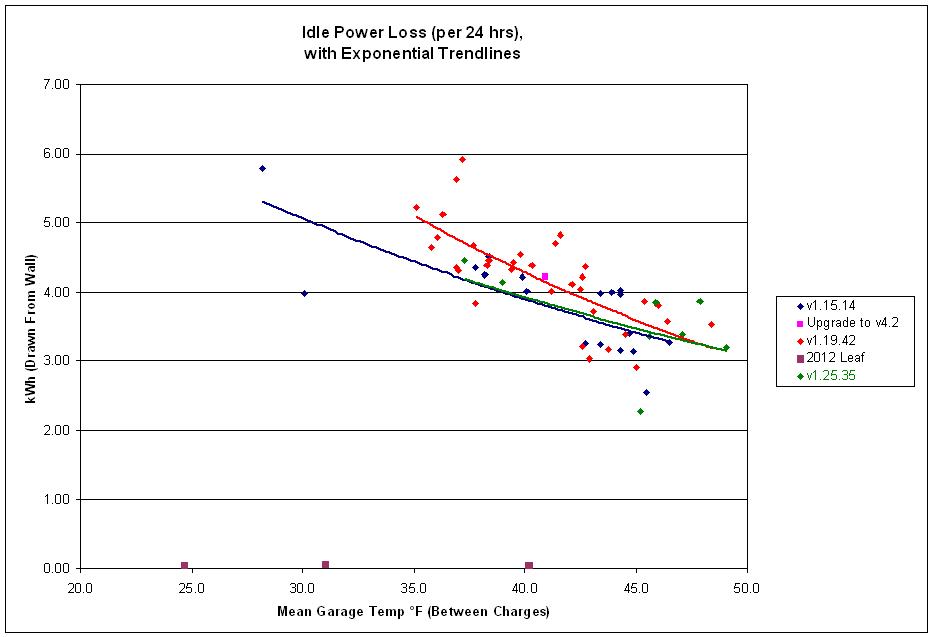
tezco There is the datafile at the end of February 2013. I was on vacation for a few days and the Leaf was outside and unplugged (mean outdoor temp approx 25�F). Over the 8.5 day period, the idle power loss was 0.4 kWh (took 9 minutes to top-off at about 11A average charging current), which equates to only 50 watt hours per day. It's the purple square on the graph. That car can really sleep, even in the cold!
In contrast, the Tesla lost 18.85 kWh over only 4.9 days, which equated to 5,630 watt hours per day. It took slightly over 4 hours to top off at 20A. If the Tesla had been unplugged for the same amount of time as the Leaf, it would have taken slightly over 7 hours to top off, using 32.63 kWh. At my cost (Windsource @ 16� / kWh) for an 8.5 day vacation the Leaf would cost 6.4� while idle, and the Tesla $5.22
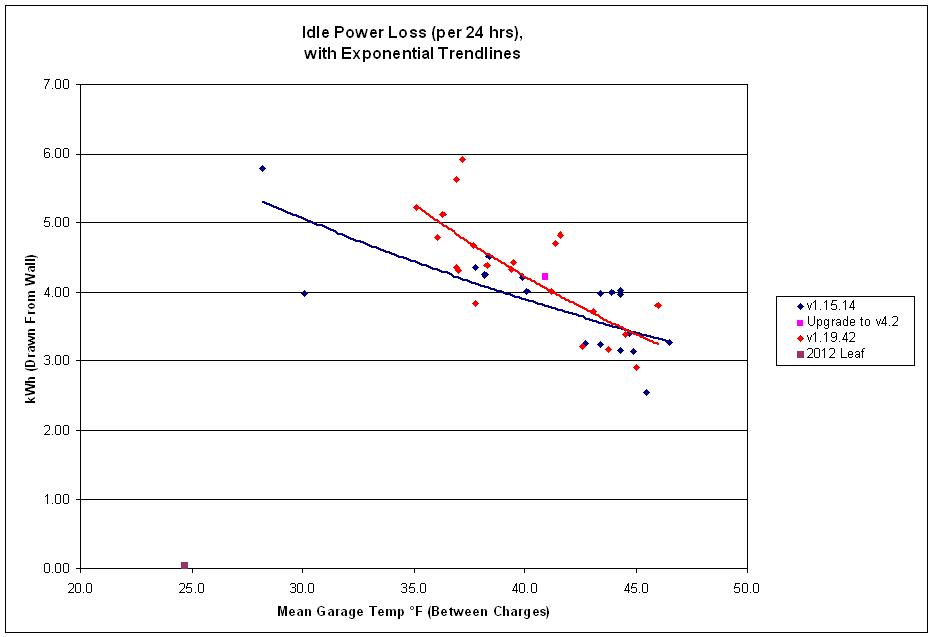
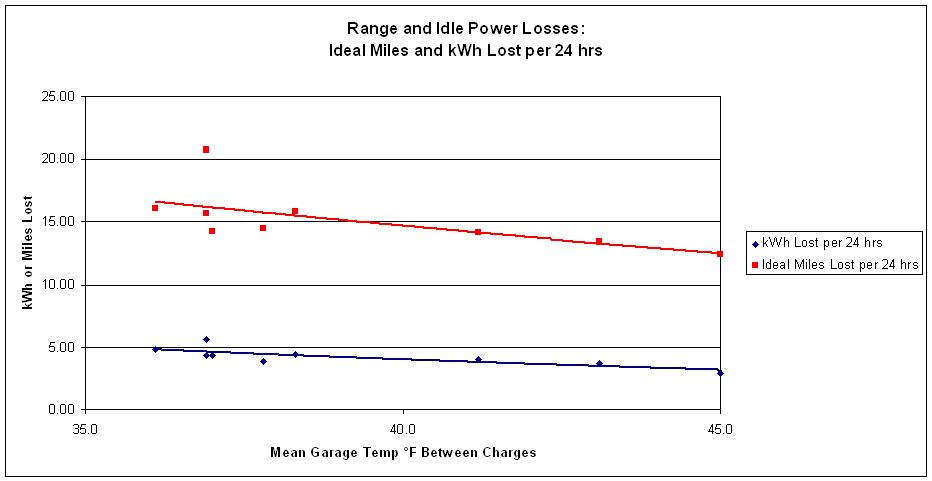
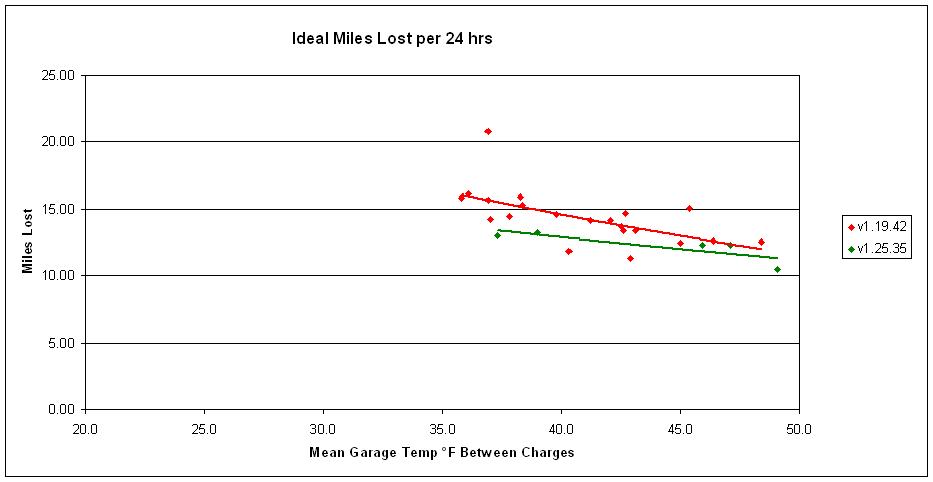
It looks like the ideal miles lost per 24 hours average from around 12.5 to 16 at these temperatures:
 �
�
Feb 28, 2013
ckessel The vampire drain is actually my biggest worry with Tesla's technology when it comes to mainstream adoption. ICE cars don't leak fuel when they're parked (though gas can go bad after prolonged periods). Other battery powered devices lose extremely little power when "off" and the Leaf seems to behave similarly. Tesla's losses are far enough beyond either ICE or battery device comparisons that it's going to surprise most people. It also seems at odds with Tesla's blog post: Plug It In | Blog | Tesla Motors
I could not leave my Tesla at an airport for a 2 week trip. Between the 40 miles there and the drain, I wouldn't have the range left to get home.�
Feb 28, 2013
J in MN So, this is the flaw in your methodology. The battery SOC was still way over 50% by the time you plugged in. It makes sense to me that MS will continue to heat the battery and power the electronics while SOC > some number, because it is such a big battery and you will still have lots of range left.
What I am looking for is someone willing to let it sit for as many days/weeks as is needed to let the battery run down to 0 miles (~5% SOC). Then we will be able to discover at what SOC it stops heating the battery or powering off some systems, and what the vampire drain is after that point.
But, time is quickly running out this winter.�
Feb 28, 2013
gregincal One thing that I do think that's confusing here is that there are multiple separate things going on. Drain due to electronics, which should be fixed with sleep mode. Apparent drain due to software not being able to correctly determine true SOC when the battery is cold. Finally, there may be some drain due to keeping the battery warm, but it's not clear to me due to the previous issue how significant this is. My understanding is that it's really only important to keep the battery warm if it's being drained or charged, but perhaps it wants to keep it somewhat warm so that it's ready to drive?�
Feb 28, 2013
RDoc Wouldn't it be a good idea for Tesla to simply publish what the characteristics of the car are in cold weather? I suspect they know.�
Feb 28, 2013
Zextraterrestrial Ok, my data , which includes 66 nights (or unplugged periods that were noted) shows that I 'see' 1.35 mph of average 'loss'.
This is at an average ambient of 45.5 F and the average time period is 12 hours. At the temps between 35 and 55 F I don't see a huge correlation but If it is closer to freezing I can drive ~ 10 miles w/out any rated change (If the car is cold to begin with)
...my temp source is what the car shows - highly inaccurate for this.
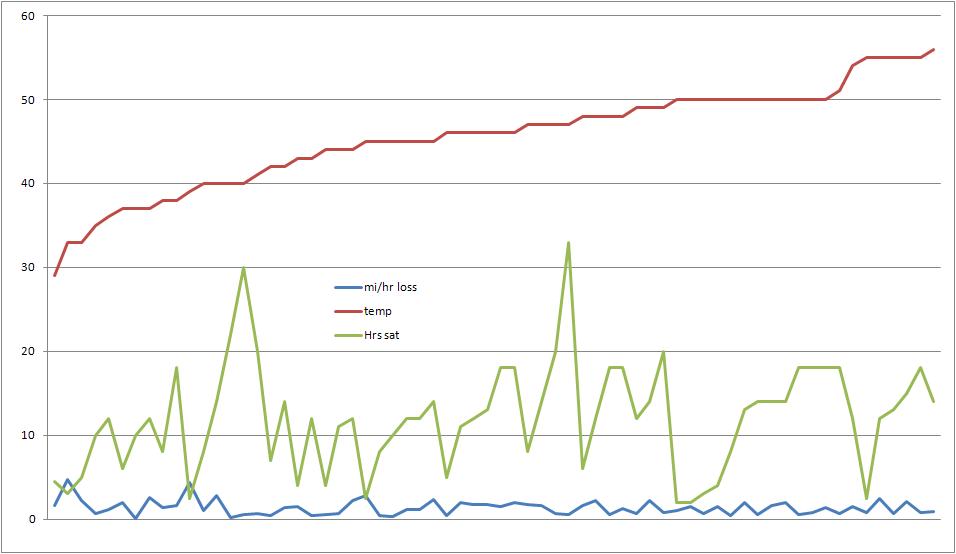
The longer Idle periods have much lower vampire draw than the short ones do. Most of the short rests actually would have kept the same rated shown after a few miles so accuracy of this is poor
How did I let her sit alone for 30 hours is my real question?�
Feb 28, 2013
strider They're not going to publish anything until Sleep mode is fixed. Once something is posted on the internet it NEVER goes away. So I'm sure they're just hoping they'll get it fixed in the next few weeks/months and it'll just go gently into this good night.�
Feb 28, 2013
tezco That's interesting. I haven't been able to document any lower rates of idle power loss after a long rest, even when the car sat for nearly a week. Your 1.35 miles per hour loss = 32 miles per 24 hrs. That's a bit more than double my rate at that temp. My car has been sitting a lot too, since I can't get in and out of my driveway right now without 4wd.�
Feb 28, 2013
Todd Burch I'm curious how we ever got to this point in the first place. Tesla has long been advertising (and publishing in the manual) just a 1% loss per day. We know it's currently far greater than that. Why?
-Is Tesla publishing this number with an unwritten "at 72 degF" in there? If so, very disingenuous.
-Did a sleep mode in an early software version (before the cars came to market) hold a 1% per day rate, but a change in the software made it much worse? (I'm not talking about the v4.2 sleep mode disappearance).
-Did Tesla only test this at comfy California temperatures?
Whatever the reason, I think it's uncool that Tesla hasn't addressed this with their existing customers. After all, these aren't insignificant idle losses, and they DO appear to be affecting people's "leave car at airport" habits.�
Feb 28, 2013
jerry33 My guess is that the calculated they sum of the components that they thought would be left on before they ever had a working car. It turned out to be higher than the calculation when the put them all together. Then they had to roll-back the sleep mode.�
Feb 28, 2013
dave I'm guessing there will always be some vampire loss from electronics. The car at a minimum will have to stay awake enough to maintain a 3G data connection for the remote app to work.�
Feb 28, 2013
Doug_G Seems to me that any sort of measurement or analysis is meaningless until Tesla re-enables Sleep Mode.�
Feb 28, 2013
tezco My Leaf can power the cellular and key fob receivers 24/7, and boot up the main computer in three or four seconds after powering up the car, all the while using 1/100th the energy required by the Tesla.
Currently this is a potential issue if you have to park your car at the airport and can't plug in. Hopefully, this data will be useful to those individuals.
There is no flaw in the methodology. The energy loss is real and fairly reproducible for the time periods measured. The data just doesn't give us an answer for your particular scenario. Very hard to find an S driver who will let such a great car sit in the driveway--I can hear mine calling out right now, begging to be driven....! I guess you might find someone who is going on a long vacation, but then they'll be getting calls from Tesla telling them their car has reached a critical state of discharge.�
Feb 28, 2013
EarlyAdopter With sleep mode enabled (I've stayed on v4.1 as an experiment), I'm seeing losses of 3.5mi/day at 50F. That's only 1.2% of ideal or 1.3% of rated range lost per day.
I'd say Tesla's estimate of 1% loss per day is right on the money.
Relax. I'm sure they'll get whatever issues that some encountered with sleep mode fixed and it'll be back plenty soon enough.�
Feb 28, 2013
tezco I'm sure it's currently their highest priority in the software engineering dept.�
Feb 28, 2013
nleggatt I had substantial loss this evening. Not to cause panic but I left my car with what I thought was 130-140 km in 5 degree weather for 4 hours and when I got back it said 100km! Never recouped those miles. Ie it didn't slow the usage as a drove home. I'm thinking of having the service center pull the logs and check if the numbers are accurate cause this concerns me. Obviously when sleep mode comes back it will be all good. But I need to know so I don't get stranded somewhere because of lack of charge to get home�
Mar 1, 2013
arg I've been wondering if the 'false loss when cold' which people have reported (range then 'coming back' as the pack heats up), might actually be a deliberate feature rather than a bug or measurement error. Perhaps it is estimating that to get the pack back to temperature is going to require use of the pack heater, and knocks off a corresponding amount of range to avoid the displayed range being optimistic? If you then manage to heat the pack by other means (eg. normal driving losses) then the range will 'come back' when the temperature adjustment is removed.
Just speculation, but maybe it fits the facts?�
Mar 1, 2013
DavidM I just recently left my Model S at the airport for 2 1/2 days. I lost 10 miles of range per 24 hour period. I would not be able to drive my car to the airport if I was traveling for a week. I hope Tesla brings back sleep mode SOON!�
Mar 1, 2013
dsm363 Which airport? Looks like Tampa has some charge stations in Valet parking
Tampa International Airport offers electric vehicle charging stations - Tampa Bay Business Journal�
Mar 1, 2013
tezco What did you have the display set to report? (Ideal, Rated or Projected miles)? I leave my display on Ideal miles and with my driving patterns I get about 60% of that. Watching projected miles in the Leaf or S just results in unecessary anxiety.�
Mar 4, 2013
Shock Last week I left my Model S in the airport for 4 days, and lost 40 "miles" of estimated range. In Phoenix and winter time so temps were cool but not cold by any definition. Sky Harbor probably has hundreds of thousands of parking spots - with 2 spots that have a public car charger. They are limited to 4 hours of use, so parking at one for long term parking is not an option. I parked near it with the idea that I could push the car over there if it was dead. (This was my first time parking multiple days without plugging in so I was concerned.)
Fortunately, losing 10 "miles" per day gives me a couple weeks of parking so I won't be so concerned next time. HOWEVER - It's not cool to have the battery draining so that all I can do is go straight home after my trip, giving up the freedom and flexibility to have a normal day when I return from a longer business trip. Sleep mode would be a desirable thing, I hate giving the anti-electric crowd more ammunition.�
Mar 4, 2013
DavidM I was at TPA (Tampa International Airport). Before my trip, I spoke to an airport manager who is in charge of parking for the entire airport. They have a charging station in valet, and a charging station in the Cell Phone Lot. Nothing in Long Term Parking, or Short Term Parking. The valet lot costs $25 a day, and you hand your keys over to an attendent. After they drive your Model S around, it's up to them to figure out how to hook up the J1772 (with adapter) to the Model S. I can just see them yanking on the charging cable to try to get it to disconnect from the car after several hours.
We also discussed the charging station in the Cell Phone Waiting Lot. I told the manager that if a car was waiting about 20 minutes to pick up a passenger, they could maybe get about 5 miles of range from that charging station, when you figure in the time it takes to plug-in and unplug. I'm sure they are wondering why it's not being used. Only reason it's there is because it's Federal money.
I did find a 110V outlet (GFCI) in the Long Term (Economy Garage). Unfortunately water from the roof was dripping into the outlet and didn't look safe.�
Mar 4, 2013
Iz Got my MS 3 days ago. Noticed range loss without even driving the vehicle. It will be interesting to see what the impact of spring and early summer temperatures have.�
Mar 5, 2013
aaron.s Iz
I generally see 12-15 miles lost overnight (not even 24 hours)... Sometimes when I start driving, the rated range holds for a bit - so not all those miles were "lost" but that doesn't happen that often....
Aaron�
Mar 5, 2013
kevincwelch Aaron,
Is this with you plugged in? I plug in every night and I can see it top off at about 239 or 240, and sometimes in the AM when I fire up the heater remotely the charge is about 228 or 230. I assume the car doesn't keep "topping off" constantly. Is there a trigger it hits in order to "top off?"�
Mar 5, 2013
gg_got_a_tesla The car supposedly wakes up every 24 hours and tops off. Never left it plugged in that long though without driving it.�
Mar 5, 2013
Cliff Hannel I've created some estimation tools to calculate actual electricity usage (including "vampire" loads) and total cost per mile and per month at EV Calculations
Here is a snapshot:
 �
�
Mar 5, 2013
tezco Mine will top off every 24 to 28 hours.�
Mar 5, 2013
scottf200 That is true. I've not heard of the Volt losing miles at night at all actually. I have owned a 2011 for just over 2 years.
As well it is instant on when I press the start button ... or very close. The 2012+ have a "READY" prompt shot up after a few seconds but that didn't exist on the 2011. None the less it is virtually instant.
The Volt does not charge the 12v unless the traction battery is also being charged. That is it would be possible to run your 12v down even if plugged in. I know the OnStar 'connection' is lost after a few (several) days. Folks have been on vacation before and were checking on their car via the iPhone/Android app when it stopped responding. It also has a standard AGM battery. From the manual you can jump it from post under the hood or jump other cars from closer to the battery in the rear.
Just a point from a long time Volt owner with a deposit on a Model X. BTW, one of the *great* things I see about Tesla is getting software updates including some enhancements. Some bug fixes in the Volt software but no enhancements every that I've seen.
[Aside: There is a quasi FAQ thread/list on gm-volt for anyone interested: Frequently Asked Questions
And for disclosure I'm a moderator there which just means I follow/ed it pretty closely. Lot more normal (vs early adopters) on the forum now tho.]�
Mar 5, 2013
RichardC Long term measurement of vampire load - I measured the power consumed by our Model S over a 4 week period during which it was not driven or used (but was was remotely monitored). During this period the car automatically topped up the battery every 24 hours and consumed 149 kWhr, or slightly more than an average of 5 kWhr per day. The software is version 4.2. The car was stored indoors, in an insulated garage with an average temperature of around 40 degrees F. On an annualized basis these losses are roughly equivalent to the power that would be used to drive approximately 6,000 miles or 10,000 km and represent power actually wasted (as opposed to temporary reductions in the stated range). The available range was the same after consuming the 149 kWhr as it was before. From my perspective this is a serious issue that TMC needs to address as soon as possible.�
Mar 5, 2013
Iz I have the 60 kWh S. Displayed 186 miles on it's maiden voyage to work this morning. Trip is ~ 33 miles. When parking at the office it read 150 miles. 9 hours later after work I get back in and it reads 131 miles. Temps were in the 40's most of the day. Drove home and range was ~ 111 miles (will have to keep logs to be accurate). I have to charge @ 110 Volts for the time being. Did not charge immediately upon returning home. Went out just after midnight and range was 92. It is now charging. Appears to charge @ 4.5 miles/hour on 110 volts. I think these issues will be addressed over time. Love the vehicle. Can't even think of getting back into the Sienna :love:
- - - Updated - - -
Noticed some of that today while driving home from work.�
Mar 6, 2013
tezco Currently losing about 12-16 ideal miles /24 hrs; takes 3-5 kWh each 24 hrs from the wall to replace.
 �
�
Mar 8, 2013
ElSupreme Looking through all of this I am thinking I shouldn't leave my Model S at the airport for 9 days and expect it to get me all the way back.
I have about 220 miles left (I am at work). Not allowed to plug in, even to 120V as I am on a client's site. Don't have the cord anyway.
I will have about 185 miles left when I get home.
I can charge for 1.5-2 hours. And get to 245 (full standard charge, but I'll be in range charge).
I'll have 215 miles after getting to the airport. I'll burn about 30 miles going to the airport.
At 8.5 days parked, I could lose up to (15 miles a day at 9 days to be safe) 135.
I have 80 miles to get back home. Which would take about 30 miles of range.
I guess even if I lost 20 miles per day I could probably still limp home.
Your thoughts? I leave for the airport at 5pm ET. Does anyone know if the vampire load gets less as the battery loses capacity?
I would obviously bring my charge cord in the car. But won't have anything to plug into.�
Mar 8, 2013
Rodolfo Paiz I might try that as long as I have both a Plan B and the time/patience to implement it if necessary.�
Mar 8, 2013
gregincal Yeah, we'd all love you to try it and report the results. Come on, take one for the team! Seriously, are there any charging stations between the airport and home that you could use in a pinch?�
Mar 8, 2013
ElSupreme The wife has basically told me she won't complain for ALL of SXSW (it is my birthday) up until we get back to our house. And knows there is a small chance of being stranded at the airport. So I will be leaving it unplugged at the airport, uncovered. I'll try to log the battery state of charge at the same time every morning for the days it is gone. So there will be some data, other than do/don't park your car outside for 9 days.
This will also alert me to getting a ride from the airport if my car is dead. And I should be able to plug it into a wall in the car lot I am going to, if it ends up being dead and leaving it parked for an additional day. So I have my plan B.
Oh and I just realized one of those days is 25 hours long. So I should be extra worried! :biggrin:�
Mar 8, 2013
drees Wow, the vampire load of the Model S really appears to be horrendous. We have multiple people confirming 3-5 kWh / day from the wall to keep the car charged, or about 90-150 kWh / month. Those data points are in cool temperatures (above freezing, below 55F). Anyone in a warm climate (Florida?) have any data?
Let's say you drive 1000 miles / month and average 3 miles / kWh which would be around 333 kWh / month. Vampire load could be decreasing your efficiency by 25-45%! That is rather insane...
The Roadster had similar issues when it was first released. Anyone have current data on the Roadster to compare?�
Mar 8, 2013
ElSupreme Yeah I did the calc yesterday night how much I would lose at the airport. And it was WAY more than I realized. But remember that there is NO sleep mode right now. I would expect 1-2kWh per week when that gets pushed out.
I think of the vampire load as running another server at home. I tend to think my server pulls about 150W continuously. I'm pretty sure my stupid cable box pulls more than that at all times.�
Mar 8, 2013
Doug_G If it doesn't need cooling, the Roadster vampire drain is tiny. A couple of miles range per day at most. It takes months to drain it.�
Mar 9, 2013
RichardC My energy losses over four weeks averaged slightly over 220 Watts for the entire period, which I have no doubt was heating the insulated garage by a few degrees C, and appears to be heating the interior of the car by around six or seven degrees C above the temperature in the garage (I monitor the outside air temperature and the temperature in the garage, in addition to the temperature inside the car).
While the current software is clearly worse than the version it replaced, I found that the losses were also quite substantial under the previous software. Even when operating version 4.1 in its lowest power consumption mode I was seeing daily losses on the order of 15 to 20 km per day, which correspond to roughly 3 kWHr per day or 90 kWHr per month. These losses were cumulative, in that the car was not being charged each day, and occurred in an insulated garage at ambient temperatures above freezing.
The difference between the vampire load of the Tesla and that of a home server is that home server is presumably performing useful functions with that power (or you could turn it off and reduce the load to zero) whereas there is no way to turn off the power wasted by the Tesla, which will continue regardless of whether the car is being used.
Incidentally, the power consumption of computers and servers is dropping such that it is possible to run a multi-terabyte home server on a little as 40 Watts (see: http://helgeklein.com/blog/2012/03/building-a-low-power-high-capacity-home-file-server/ )�
Mar 9, 2013
neroden It certainly is. While I accepted the loss -- I knew it was coming, from this forum, and I decided I wanted the car anyway -- it means I'll literallly be wasting more power with the car than I will be using driving the car. It also means I'm spending just as much in electricity as I was spending on gasoline. And as others have noted, it means that there's no way the car can be left unplugged at a distant airport (or train station) for weeks. It's a huge bug and it needs to be fixed.
- - - Updated - - -
I hate to say it, but my bet is on bad drivers from nVidia, in which case they're not going to fix this quickly.�
Mar 10, 2013
JRP3 In his recent talk in Norway I think I remember Elon saying sleep mode would be fixed before they received their cars, so that would be June or July at the latest, to give some time frame. Hopefully sooner.�
Mar 10, 2013
gg_got_a_tesla 4.3 - presumably with sleep mode available again along with the charge timer - is in beta testing with some owners already so, it's going to be much sooner than June, IMO.
It is indeed sad to see all that energy being wasted. If the chips onboard could pitch in with [email�protected] or some such distributed computing project while they are awake, that'd have been okay �
�
Mar 10, 2013
brianman I seriously read this the first time and thought "Dude, how do you know they don't know how to drive? Why did you come to that conclusion?" First time for me that context didn't make the intended meaning of "driver" obvious.�
Mar 10, 2013
shokunin The losses seem to be on the order of 150w/hr or more. They'd have to be using upwards of 10 Tegra 3's to hit that number. The TDP of Tegra 3's are between 5-20w depending on load. With the car off, the processors would be at idle even without sleep.
However, we don't know what silicon they are using for embedded systems. Regardless, it's a power hog and hope they get this under control.�
Mar 11, 2013
Kipernicus I find it interesting that the trip meter doesn't record the vampire loss. I arrived home from the Folsom supercharger yesterday with 50 miles remaining, having used 39.9kWh. This morning I had 28 rated miles (I charge at work, which is 7 miles down hill) but the trip meter still said 39.9kWh.
I think I lost more than the usual 10+ miles per night because it was recovering from the long drive.�
Mar 11, 2013
Jeff Miller I agree - vampire losses should be definitely be recorded by the car.
It seems like Tesla should easily be able to record and display is the total cumulative energy entering the car from the wall. This should be pretty much equal to what you'd record on a wall energy meter. In a sense this total is the most important number - it is what determines total fuel cost and car efficiency.
The total energy should then equal the energy used while the car is driving (what the Model S currently displays if I'm not mistaken) plus the vampire losses from the electronics and battery thermal management when the car is not being driven plus the excess energy required to charge the battery since recharging is not 100% efficient. It would be great if the Model S recorded and displayed somewhere all these numbers (total, driving loss, vampire loss, charging loss).�
Mar 11, 2013
markb1 I took a trip on Saturday. I completed a range charge just before I left. When I got back home, the trip meter said I'd used 46.5 kWh. I plugged in to do a standard charge, and when it was done, the charge screen said it added 48 kWh. That's about 7.5 kWh unaccounted for. (I'm accounting for the difference in charge modes with my 60 kWh pack.)�
Mar 11, 2013
DavidM Yes, In Florida, left my car at the airport (averaged 70 degrees daytime, 48 degrees overnight). I lost 10 miles of range per 24 hour period. I expect I would have lost more range if overnight temps were much lower. Fortunately, I was only gone 3 days, so I had plenty juice left to get home. I've got an 8 day trip coming up. I won't try it unless sleep mode comes back. With 4.1 when we had sleep mode, I only lost about 2 - 3 miles of range per 24 hour period with optimal temps.�
Mar 12, 2013
strider I wonder if they're including losses due to pack cooling and mgmt during charging?�
Mar 13, 2013
Jeff Miller I have a few questions about monitoring Vampire and charging losses.
1. Could the Model S (without the installation of additional devices, just software changes) measure and record how much energy you feed into the car? This is the number that you would read off of a wall meter if you have one. Lots of people in this and other threads measure this number
with their home meters and energy auditing devices, but seems to me that it would be better for the car to record this for you, both
for the sake of simplicity and because it would allow you to easily keep track of any charging you do away from home. I'm not sure if the car has the ability to measure this without added hardware - does anyone know?
2. Currently the only energy number the car displays on the trip meters is the total energy used while driving. You need this number when you are figuring out how far you can drive on a given state of charge, so it's an important number to know. On the other hand, it would be very interesting for the car to also keep a running tally of vampire and charging losses. If the car could measure and record total energy in, it could
obviously also calculate, record, and display vampire and charging energy losses. I think it would be interesting to have at least the option to see
these numbers on some display panel.
3. I recall reading somewhere in a 2006 Tesla paper that charging losses for Lithium Ion batteries are in the 16% range. The way I interpret this
is that to get .84 kwh of work out of the battery (propelling the car or powering electronics or whatever), you need to spend 1 kwh of energy in charging it. Some of the energy you start with is lost as heat. Just like you'll spend more energy rolling a stone up a hill than you could get out of the stone by rolling it back down again. Is this interpretation correct and are these numbers - 16% losses from charging - ball park right for the Model S batteries?�
Mar 13, 2013
JRP3 16% charge loss must include losses in the charger since the lithium batteries should be much more efficient than that. The car should be able to calculate the power used for charging since it monitors current and voltage from the wall.�
Mar 13, 2013
eelton Per this thread on the Tesla Motors forum, 4.3 does not fix the vampire load issue. That's disappointing!�
Mar 14, 2013
jerry33 But not unexpected. It's a non-trivial task to get it right.�
Mar 14, 2013
Jeff Miller JRP3, thanks for the feedback. It's good to know that the car can measure the total energy put into it (less whatever losses are
incurred in the charging cable which I would imagine are minimal). I spoke to Walter at Tesla and he estimated charging losses are only around 8%. He said there are additional dissipative losses of around 10% when the battery discharges (does work), but these are already accounted for, at least for the losses incurred by driving.
I asked Walter to pass on the suggestion that the car report and log total energy in, as it evidently does for the Roadster. He said this has been something management has discussed but there are evidently no immediate plans to implement this.�
Mar 15, 2013
dennis I was away for 12 days and left the Model S plugged into my Blink charger so I could monitor the vampire losses. The car was in an unheated garage with outside temperatures ranging from 45-75. The total was 54 kwh (from the wall), for an average of 4.5 kwh per day. Way too much.�
Mar 15, 2013
JRP3 That's a lot better than most people seem to be reporting.�
Mar 15, 2013
gregincal It's pretty much in line with Tezco's findings. 3-5kWh per day.�
Mar 15, 2013
dennis It was more than I expected for mild temperatures. I was expecting 10 rated miles/day lost range = 3kwh. So there is either a 50% charging penalty at the wall or the Model S is losing more than 10 miles of rated range per day.�
Mar 15, 2013
JRP3 D'oh, I was thinking of miles, not kWh's :redface: Never mind.�
Mar 17, 2013
eelton Another data point:
Parked my car at O'Hare airport in Chicago 36 hours ago. My charge has dropped from 173 to 138 miles during that period. So, a mile per hour of vampire losses.
Yes, it was cold (30s daytime and 20s overnight), but this is ridiculous. I'm dealing with a family illness and may need to extend my trip, but I'm starting to worry about a dead Tesla if I do so.
Next time, I'll take my Audi.
sent via Tapatalk�
Mar 17, 2013
dsm363 Do you have v4.3? It gives a more accurate reading on the range with a cold soaked battery. You should still be ok but I'm sure the added stress isn't needed. Hope everyone is ok.
If you do get really low and can't make it back, call the Chicago Service center and maybe they can tow you back to the service center and charge the car.
Once sleep mode is re-enabled, this should be less of an issue.�
Mar 17, 2013
eelton I'm on 4.2.
sent via Tapatalk�
Mar 17, 2013
qwk You will have a little more than than 138 miles left after the battery pack warms up. Having said that, the vampire load is very real, and there is no way anyone could leave the car unplugged for more of a couple of days and be worry free. I'm currently dealing with that issue with only 63 rated miles remaining. The good news is that there apparently is a way to put the car to sleep(not completely sure as I haven't woken her up yet). I will find out Monday.�
Mar 18, 2013
ElSupreme Ok so here is all my data from a 8 day sit at the Airport. Weather in Atlanta was cool/cold nights in the 30s, daytime in the 60s. The car was parked outside, uncovered.
I wasn't super great about checking the range at regular intervals or as often as I should have. It was obvious after 2 days I would have plenty of range when I got back to the airport. Times are all local (and documented) over the DST change weekend, and traveling to CT from ET. An hour here and there really shouldn't change much. Underlined marks are when I arrived and left the airport parking lot. On Friday I range charged before I went to work. All ranges were pulled from my (Tesla Connect) Windows Phone app. I rounded to the nearest mile, and nearest 5 minutes, also garnered from my phone. I had only 1 instance of range gain, and that was only a single mile gained. The descriptors are where I was, and many are the SXSW interactive sessions I was attending.
Friday Mar 8
Work: 220 @ 8:00
Leave work: 217 @14:30
Home: 190 @ 15:05
Rangecharge @ 15:05
Leave home: 252 @17:10
Airport park: 230 @18:05
CENTRAL TIME ZONE
Austin: 225 @ 21:10
Bed: 224 @ 0:40 (actually Saturday morning)
SATURDAY March 9
TESLA: 215 @11:00
Elon Keynote: 216 @13:45
Home: 215 @ 17:45
SUNDAY March 10
DAYLIGHT SAVING TIME
NASA: 208 @ 11:55
Home: 205 @21:30
MONDAY March 11
Home: 199 @ 8:25
Bionic Athletes: 197@ 13:15
TUESDAY March 12
Home: 185 @ 8:20
Hobby: 184 @ 15:30
WEDNESDAY March 13
Home: 174 @ 8:20
FRIDAY March 15
Leaving Houston: 155@ 19:30
SATURDAY March 16
On plane Austin: 146@ 16:20
EASTERN TIME ZONE
At car Atlanta: 146@ 20:55
Home: 115 @ 22:50�
Mar 18, 2013
mnx Thanks for sharing! I have a trip next week, but I don't think I have the balls to leave my car at the airport for 8 days(weather looks to be in the 30's and night and 40's during the day). It's >130km from the airport to my house.
I could probably do it, (esp. since there is a 70A charger along the route that I could use to top up on the way home) but I think I'll let this one pass and wait until sleep mode is re-enabled.�
Mar 18, 2013
carrerascott This really needs to be resolved by Tesla... it's like having an ICE car with a leaky gas tank. Hoping 4.3 or future updates can help.�
Mar 18, 2013
AnOutsider I have 4.3 and lost 10 miles from 11pm to 4pm the next day last weekend.�
Mar 18, 2013
neroden Yes. Since they already have a retrofit for the defroster issue (I'm still waiting to get it, of course), the vampire load should be their top #1 priority issue.
Well, except for the risk of explosions.
Apparently 4.3 didn't. Reducing the vampire load should be the sole goal of Tesla's programmers for 4.4.�
Mar 19, 2013
Jeff Miller I'm not sure if it should be the sole goal for 4.4 (I don't know what else is on their plate), but I agree that this should
be a very high priority. Many of us bought the car at least in part for environmental reasons and it's a bit painful to waste 3-5kwh per day for nothing.�
Mar 19, 2013
loganss David Noland at GCR wrote an article related to the Model S Vampire-Load.
Life With 2013 Tesla Model S: 'Vampire' Thirst For Electricity At Night?�
Mar 20, 2013
ddruz Details please?�
Mar 20, 2013
Todd Burch While the vampire load is high, wasteful, unnecessary, and needs to be fixed soon, remembering that the entire 85kWh battery has the energy equivalent of about 2.3 gallons of gasoline helps lessen the pain�
Mar 20, 2013
eelton True, but the article above from green car reports points out that the vampire losses are a third of what the author uses to power his whole house.
sent via Tapatalk�
Mar 20, 2013
ElSupreme Well he used a single data point, that likely had some cold battery 'losses' that really aren't losses. He estimated 8kWh lost per day, when it is probably half that, or less. So less than 1/6th of his monthly power usage.
Still significant, but not nearly as much. About $15 a month worth. Not terrible but not great either. Right now it isn't a huge issue, unless you need to park at the airport for a long trip. Otherwise it is a nuisance cost.
Hopefully they will fix it. But I would rather have a good solution than a rushed solution. No need to rush this one out.�
Mar 20, 2013
qwk I'm not going to post on how to do this as I'm sure that Tesla does not want owners tinkering with their cars. This is more of an emergency solution, which in my case was a bad UMC. It did work though. Only lost a few miles over two and a half days in 20*F weather.�
Mar 20, 2013
LuckyLuke Probably involves removing a couple of fuses?�
Mar 20, 2013
yobigd20 hmm mine seems a lot worse. I'm on 4.2 and I see mine go from about 177 miles to 149 in 10 hours and this is pretty consistent every day while I'm at work for the last 2 weeks. so about 28 miles loss in 10 hours, roughly about 3miles/hr. And it's been between 30-50 degrees during the day over the last few weeks. That's pretty significant of a vampire load. I never expected it to be that bad, but I guess that's they way it is until they fix that sleep mode thing.
My commute is 45 miles each way. I start off at 240 miles, and by the time I park I'm usually around that 177. Now, I don't drive conservatively at all. I have a lead foot, so using 63 miles to go 45 miles is expected. Perhaps I should keep cruise control lower than 83mph
To combat that, today I just started plugging into a 110V while at work and now I've gone from 177 to 211 in 10 hours, gaining 3+miles/hr. Not that I have to with the big P85, as I have more than enough energy to get home, but plugging in does actually make a BIG difference. Before I was losing 28 miles in 10 hours, now I gained 34 miles in 10 hours. That's 62 miles of energy I'll "save" myself from paying for at home.�
Mar 20, 2013
eelton The highest I've seen is 1 mile per hour of lost range, and that's with temperatures that were likely colder than you have in NJ (20s-30s). I have to think there's something more going on with your car than the usual factors.�
Mar 21, 2013
ShortArc My P85 has been in the garage for the last 2 months, always plugged in. The garage is kept at approx. 40F. Of that time I have been data logging for about 32 days. The average power consumed in a 24H period is 3.6kWh. Just wanted to add another data point to the thread....
Cheers.�
Mar 21, 2013
qwk What type of outlet is it connected to?�
Mar 21, 2013
4sevens.com you don't drive your car? lol
85 / 3.6 = about 23 days... not good
did you press the shutdown button on the big screen?�
Mar 21, 2013
waidy I am also interested to do power monitor of my HPWC. Would you share what data logger you use?�
Mar 21, 2013
yobigd20 what shutdown button?�
Mar 21, 2013
qwk I think he means Controls>E-Brake/Power Off>Turn Power Off
In my experience this doesn't change anything with the vampire load, it just shuts the screens off with the door open.�
Mar 21, 2013
ShortArc Initially to a 50A/240V outlet but the last three weeks or so to the HPWC (i.e. 80A/240V)
- - - Updated - - -
Did not get any winter tires and still have a PU for the winter months + we got ALOT more show in MA then anticipated....
Indeed the power drain is NOT good. Was going to take the car to the airport a few weeks ago (two week trip)...glad I did not!
"Shutdown button" ????
There is no power-down for the electronics. Hopefully with the next firmware "sleep mode" will be re-instated.
- - - Updated - - -
I looked at quite a few data loggers including building my own. In the end the Engage Efergy w/ hub won. Cheap, simple and accurate enough for my purposes.
- - - Updated - - -
Indeed.�
Mar 21, 2013
4sevens.com You should be able to monitor and re-startup the charging from you iphone app�
Mar 21, 2013
Iz Another vampire story... Left for a business trip Monday morning. Have the 60 kWh S. Unplugged it @ 6:00 AM Monday. It showed 192 miles, which is good considering it has shown 185 after a full standard charge. Just returned this evening and it displayed 155 miles. Temperatures have been in the mid 20's to upper 30's the past several days.
The 37 miles "lost" in 90 hours averages to 0.41 miles/hour or ~ 10 miles/day as others have reported. My house does not have a garage. The vehicle is wrapped with the Tesla outdoor cover.�
Mar 22, 2013
RichardC While I have not yet taken a sufficient number of measurements to confirm an improvement, I have seen around 4.5 kWHr vampire losses per day since upgrading to version 4.3 software. Indoor storage at 5 degrees C (41 degrees F) ambient, 10 degrees C (50 degrees F) interior temperature. I had previously seen around 5 kWHr per day under version 4.2, but the difference may be attributable to slightly lower temperatures during the prior measurement period. In either event the losses are still way too high and harm the otherwise excellent environmental pedigree of the car.�
Mar 22, 2013
ShortArc I definitely saw quite a bit of variance with temperature. I discarded those data points for this discussion (there were 6kWh days). I am also running 4.3 since it was released and in a week or so will post if I see any definitive improvements. We need sleep mode...!!!�
Mar 22, 2013
IlliniT I honestly believe that turning the power off decreases battery drain for whatever reason especially in cold weather (Chicago). I've now tried it multiple times (starting with the charging issues I was having) and it really does appear to maintain charge significantly better. Just my 2c.�
Mar 22, 2013
qwk Page 3 of the owners guide also confirms my experience, although the firmware version the car is on most likely affects it.
- - - Updated - - -
Page 3 of the owners guide also confirms my experience, although the firmware version the car is on most likely affects it.�
Mar 22, 2013
4sevens.com I have noticed that if I do "turn power off" that the fans and pumps will immediately turn off whereas if I just walk away from the car and lock it often fans and pumps will still run.
Even if it doesn't have significantly lower power consumption I think it's worth it to do it and create a habit of doing that so that when they figure out how to make it "hibernate" the habit is already there to shutdown the car when leaving it for extended periods of time.�
Mar 22, 2013
ShortArc Even though I would have to agree that "Power Off" will have some energy savings (15 mins before auto-shut down) and those savings would certainly depend on the frequency you do a complete power up / auto-powerdown, for longer term it has no practical effect what so ever. Personally I do not want to get used to shutting down anything manually�
Mar 25, 2013
yobigd20 2.76 mile/hr range loss *EVERY HOUR* while not plugged in.
Just to show everyone that I wasn't making my numbers up above, I monitored my idle loss today. Here are the pics to prove that I see close to 3 miles/hr loss while idle and unplugged. Parked my car at 6:00am and had 172 mile range left (didn't take a pic there), but I took a pic once an hour for the rest of the day until I picked up my car.
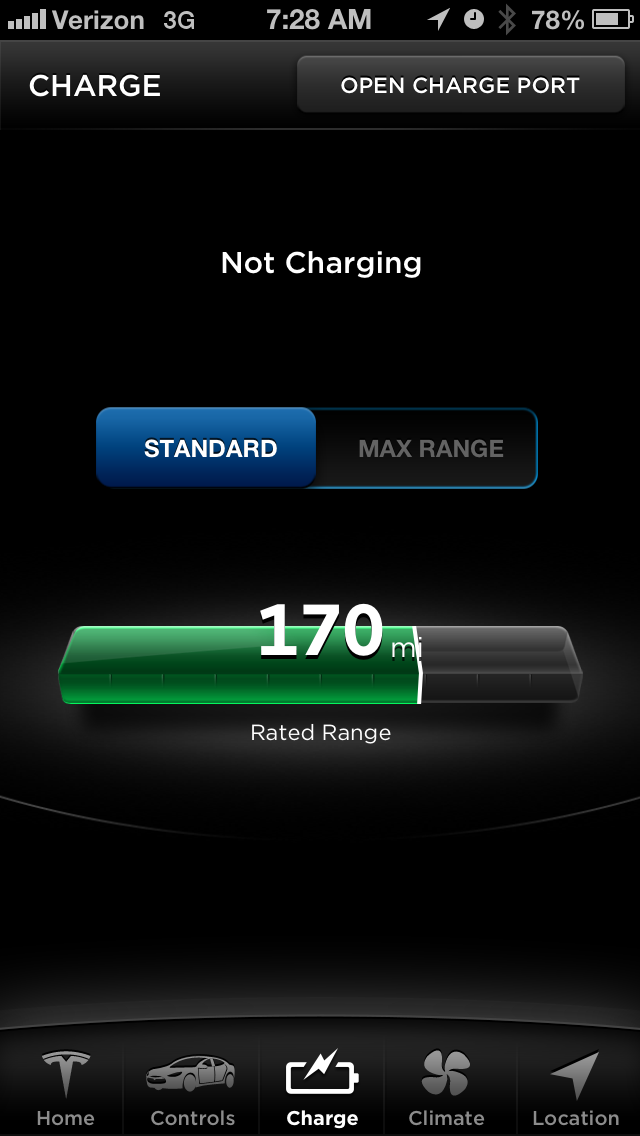
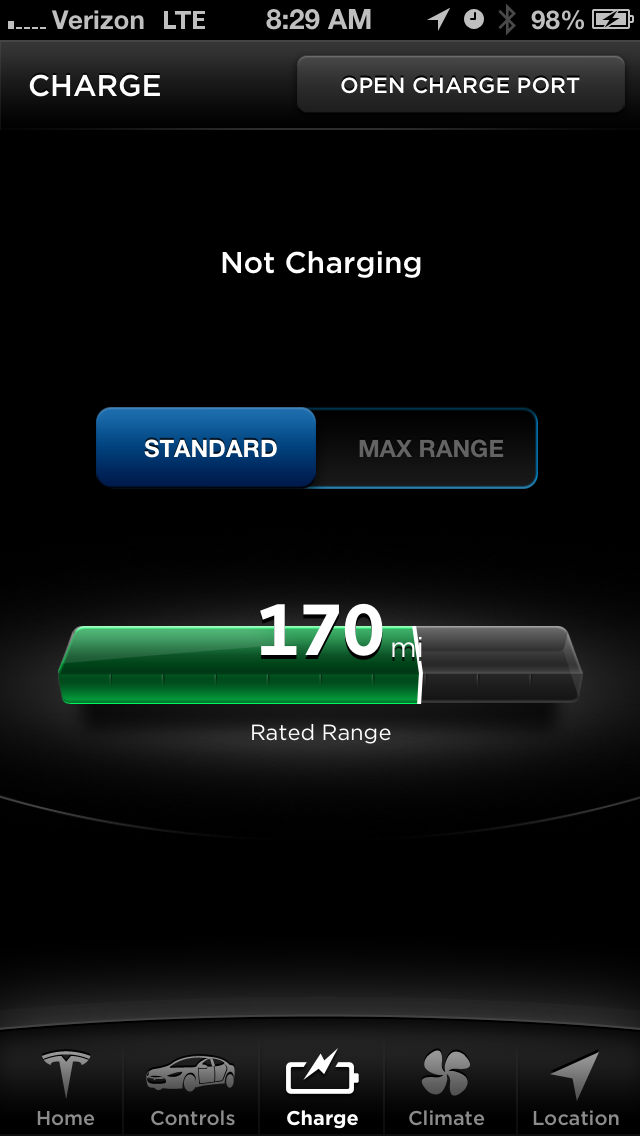
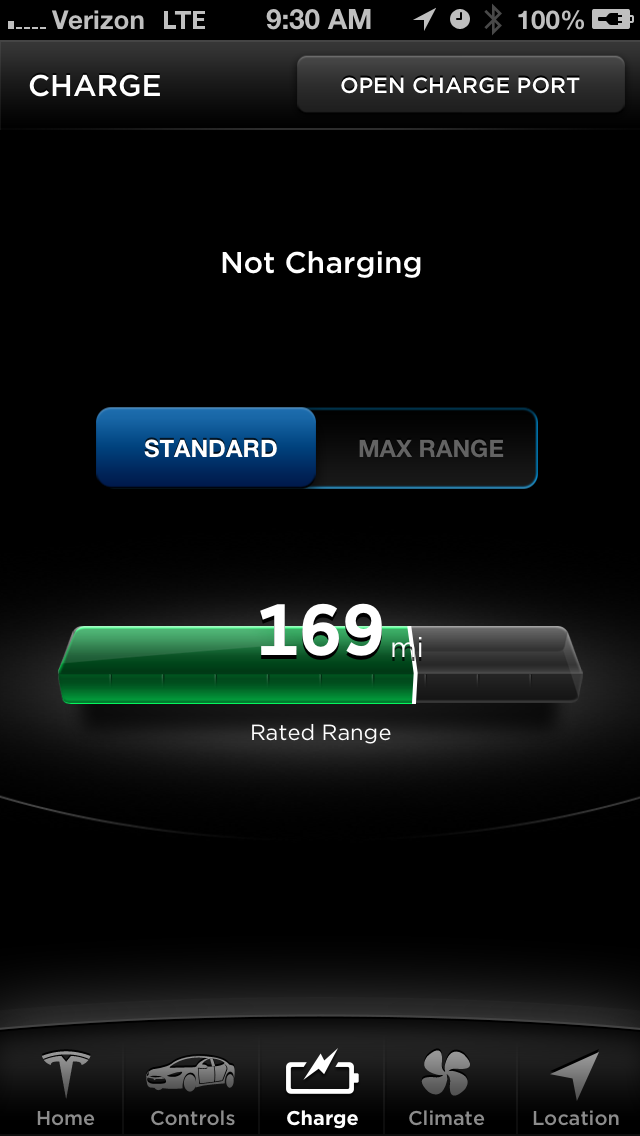
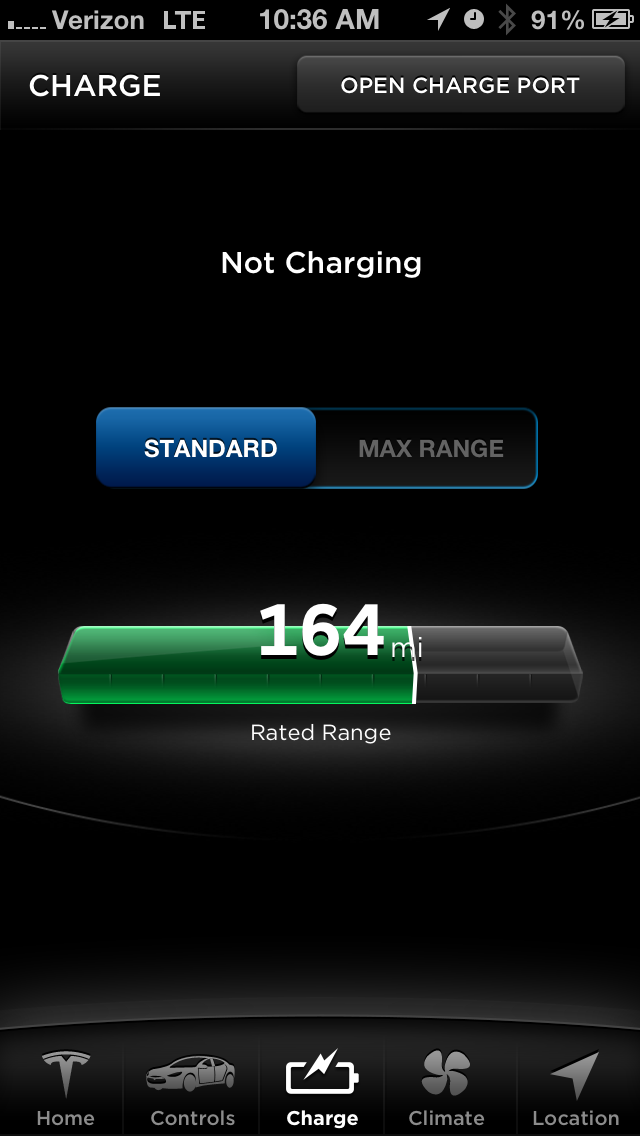
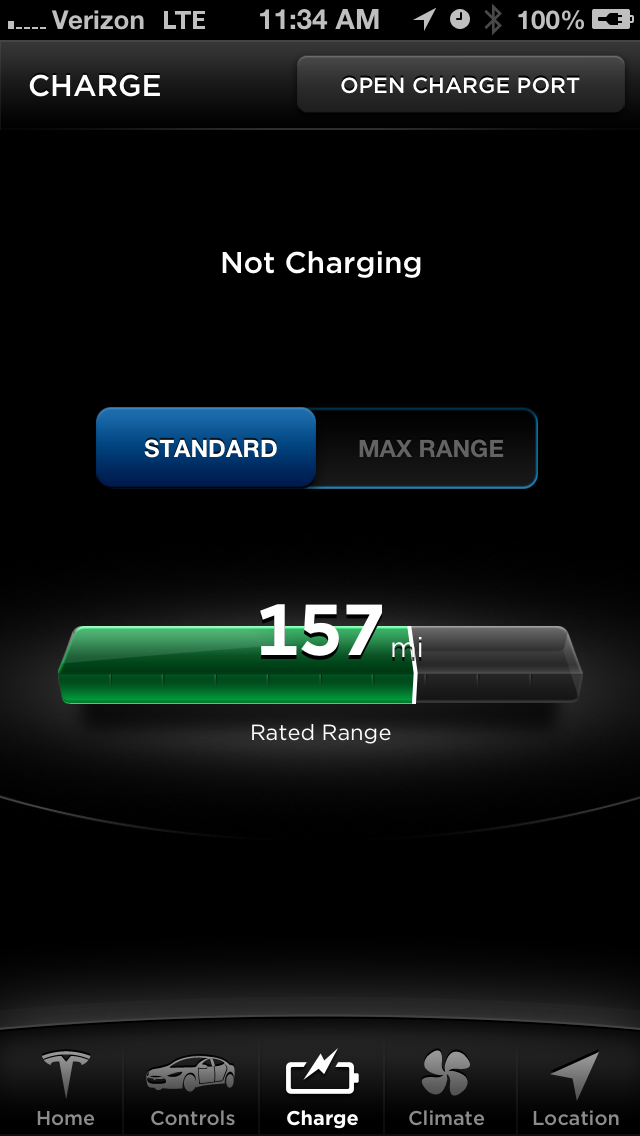
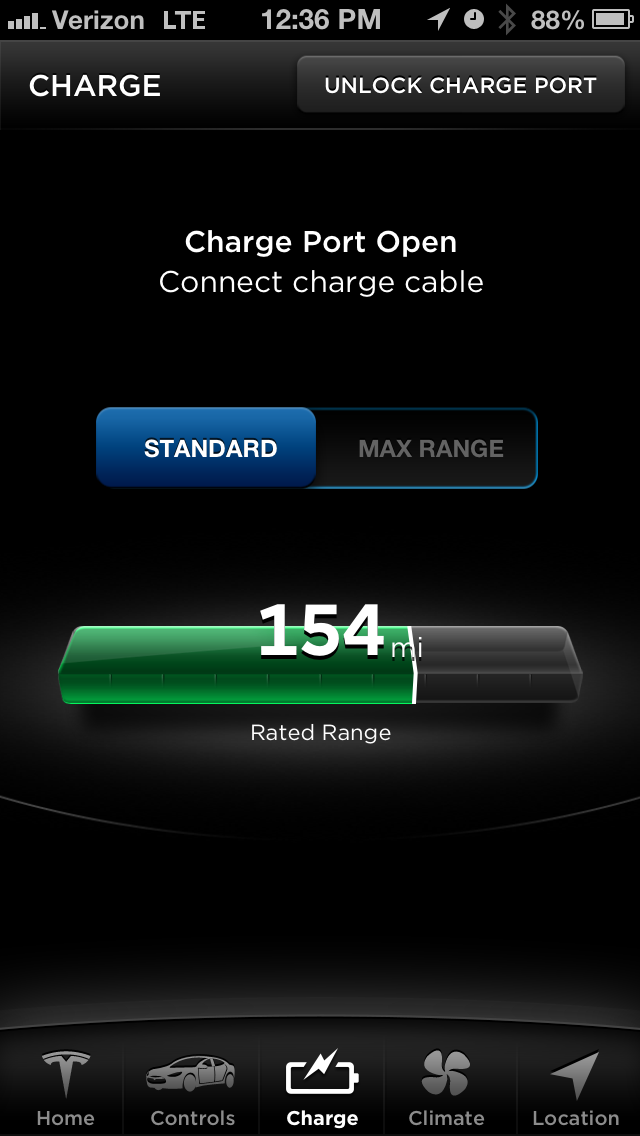
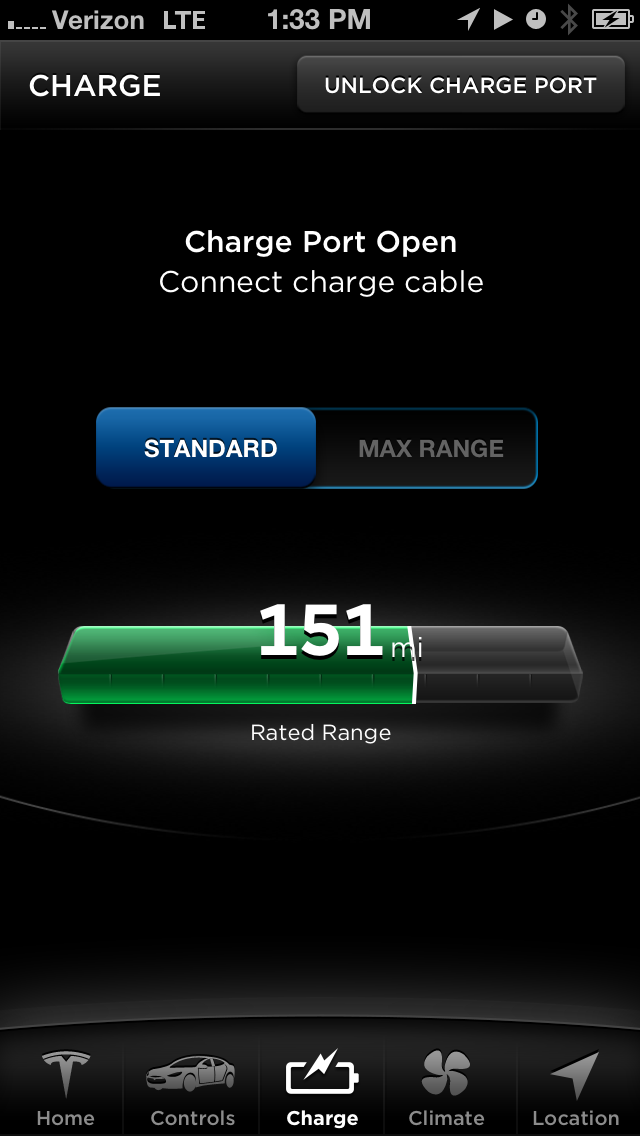
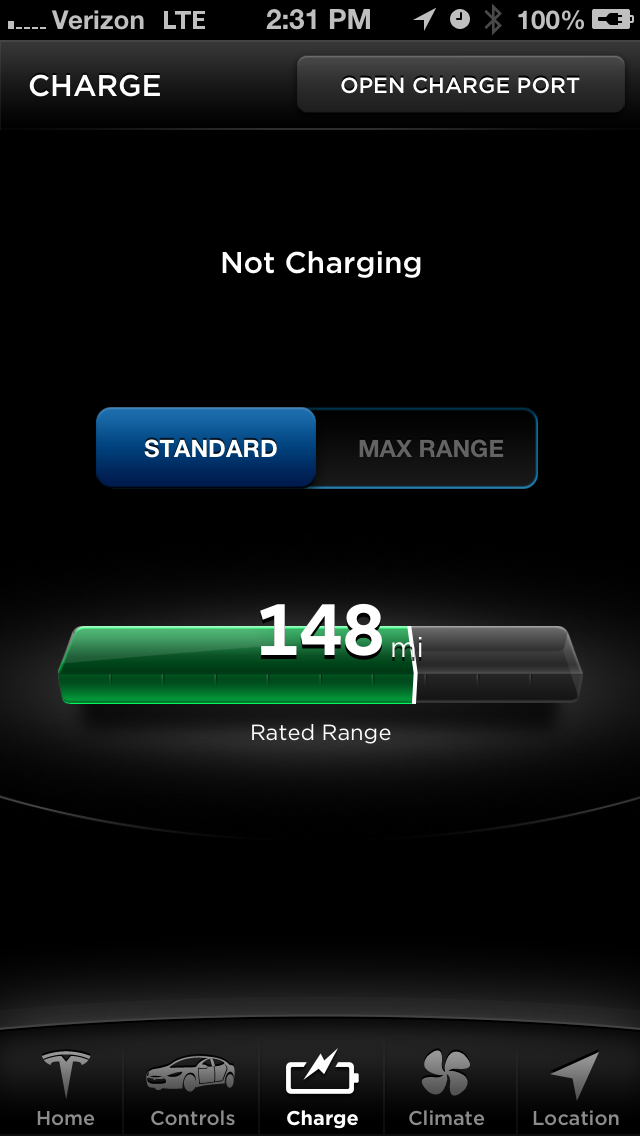
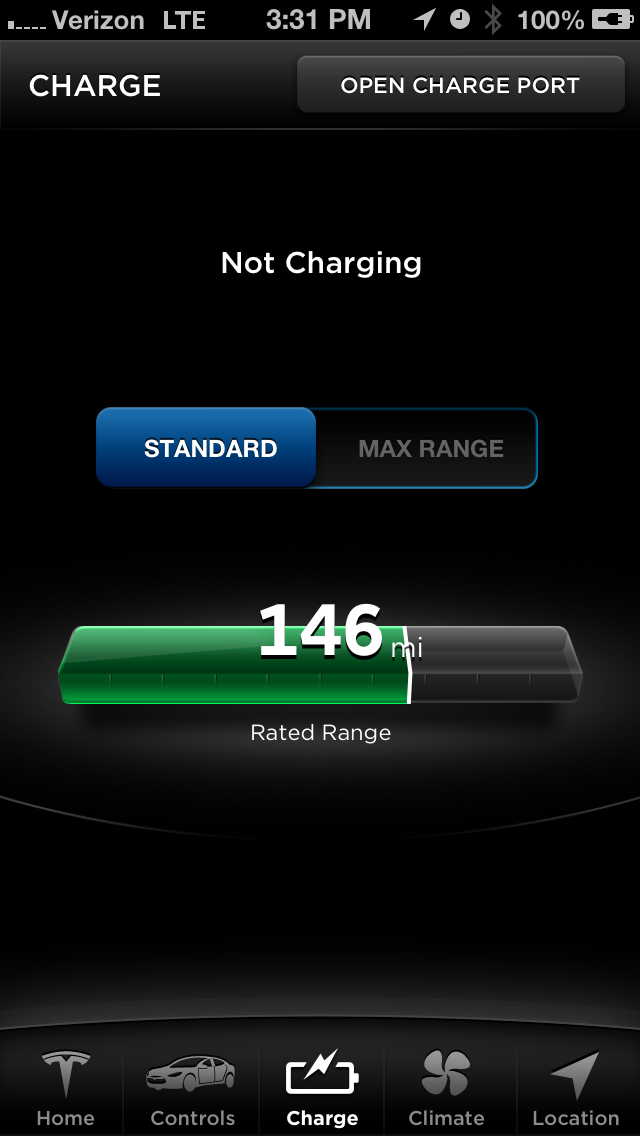
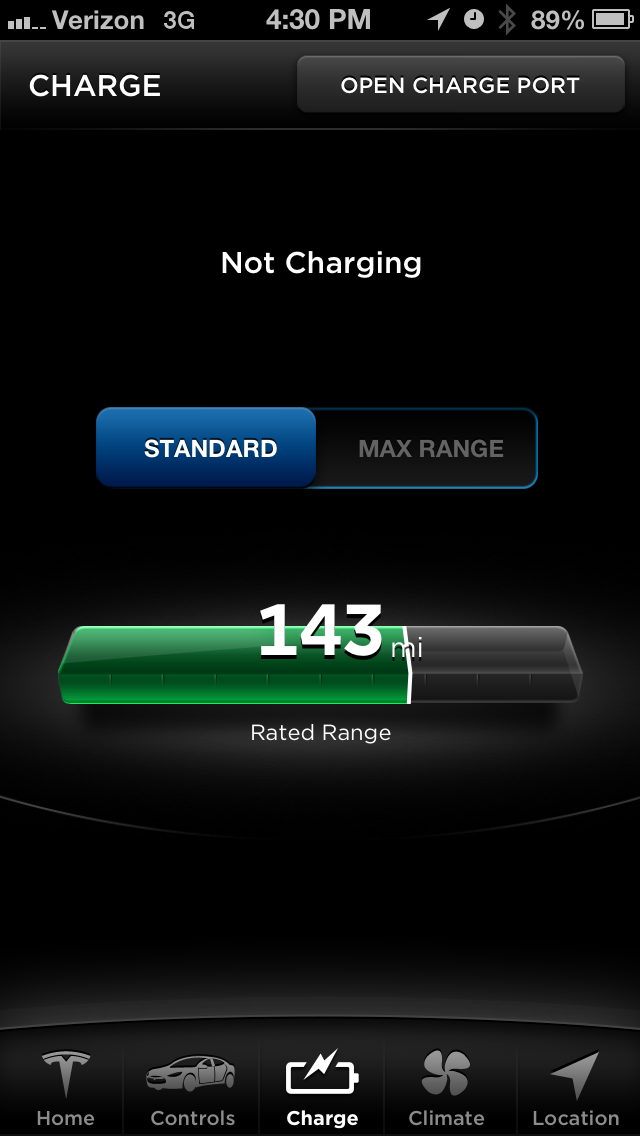
To recap, stared off 6:00am @172mile
7:28am @170mile
8:29am @170mile
9:30am @169mile
10:36am @164mile
11:34am @157mile
12:36pm @154mile
1:33pm @151mile
2:31pm @148mile
3:31pm @146mile
4:30 @ 143mile
172-143 = 29mile loss
6:00am-4:30pm = 10.5 hours
29 mile loss / 10.5 hours = 2.76 mile/hr range loss. This is what I see *EVERY DAY* I am at work. It has been about 40 degrees during the day for the last few weeks. These results are consistent daily. That's 1% loss PER HOUR.
If it continued like that for 24 hours, the loss would be about 65 miles, approximately 24-27% total battery charge loss per day. that is an absurd loss for a few hours. not happy about this, I hope they fix this problem in 4.3
also interesting to note, was that the 12:36pm and 1:33pm incorrectly showed the charge port as open. Must have been a bug in the mobile software. Also just in case anyone asks, when I got back to the car it also showed 143mile range left so there isn't any inconsistency between rate on mobile app vs the car itself. And this is self-park garage. Not valet, lol. Nobody's taking joy rides in my car. It just sits in the parking lot losing 3 miles per hour range if I don't plug it in.
- - - Updated - - -
Also, am I the highest range loss per hour that any of you know about? I'm wondering if this is normal loss for everyone else..... doesn't sound like it though.�
Mar 25, 2013
ShortArc yobigd20, those numbers are absurd. Not sure if you posted earlier but have you contacted TM tech support or your local service center? It would appear there is more going on here than the "normal" parasitic load we are all seeing.�
Mar 25, 2013
kevincwelch I get losses during the day as well. They are heavily influenced by temperature, but not as badly as you seen to have. At below freezing temperatures, I lose about 1-2 miles per hour.
I call BS on the whole claim that those miles are regained when the car heats up. I never see them return...not at these temps.
Sent via Tapatalk.�
Mar 25, 2013
SuperCoug Yobig20, do you have anything plugged into your USB ports? My buddy's Caddy was having all sort of battery problems (frequently the battery would be dead in the morning on his brand new car) but it culprit turned out to be an iPod connection kit plugged into his USB. The dealer claimed that even a USB memory stick could consume an insane amount of juice.
Just a thought.�
Mar 25, 2013
yobigd20 not yet, but based on everyone's reactions it looks like I'll be making that call now.
nope, nothing plugged into USB. I have no idea what it could be.�
Mar 25, 2013
ChadS I am sorry you don't see them return. I do see them return. Maybe our temps are different...what temps are you at? I usually lost miles overnight slightly below freezing, and they returned during the day somewhat above freezing. If you are below freezing even during the day while driving, things may be different.
Another possible difference...when I took my last road trip where I left the car out overnight, I had pretty old firmware. I'm now on 4.3 but have not tried it again. It's possible the behavior is different (in fact the release notes make it sound like 4.3 has a different means of calculating remaining capacity in the cold...but no more detail than that).
Just to be clear, the number on the range meter never goes up (at least not that I've noticed). But if you calculate how many miles you should have consumed, and compare it to how many the range meter says you used, you can see that they weren't really all lost.
Also to be clear, not ALL of the lost miles come back. There really are a few miles that get lost every day, and it's enough to be very annoying.�
Mar 25, 2013
qwk ^^^ Yes, you do lose miles, sometimes as many as 40 overnight, but the real range lost is not that drastic. I think the pack calculates capacity at whatever temp it is at that particular time. For my car, the vampire drain is around 10 miles per day above 40 degrees F, but if the temp drops to below freezing, the instrument panel can show as much as 4 times that loss(rated range). I will agree that the vampire drain is very annoying.�
Mar 26, 2013
yobigd20 Ok so this is normal behavior then. I don't want to stir up any problems with Tesla if this is expected. I am still on 4.2, haven't got the little upgrade button yet so I'll wait until then and monitor it again.�
Mar 26, 2013
ShortArc There is so much we do not know about the actual charging process and static loads...
We are told by TM that when the cars is at rest, the battery's thermal management is at rest as well. We can reason that when the temperature drops the system re-calculates the range based on that new temperature. This would seem logical as the battery has thermal mass which needs to be warmed for optimum performance. If the surrounding temperature goes up, so will the temperature of the battery pack, consequently the range values change. The only way to know if there are other "vampire loads" at work when the temperature drops is to data log power as a function of temperature while being plugged in for a few days. Maybe the car even stores this kind of information?
In any case I can not believe that yobigd20's readings are 'normal'. But maybe heating the pack really is the main contributor to the additional power drain...but that much? I would send my iphone pics to TM and asked them to comment!�
Mar 26, 2013
mknox I dunno. I traded in an '09 Cadillac CTS and I had the iPod dongle thingy too. It was never unplugged for 4 years and I never once had any battery problems with the car.
- - - Updated - - -
That is consistent with what I'm seeing (a little less when the car is in an unheated, but warmer than ambient garage). I've also never seen the range numbers "come back" and yes, they continue to deplete at a typical rate when I drive.�
Mar 26, 2013
tezco My experience is similar. Often I will start out on a trip and the ideal range figure stays nearly constant, once holding very near the starting point for nearly 30 miles. (Elevation and temperature changes were minimal.)
(v4.3 (1.25.35) is supposed to lessen this, if I understand the release notes correctly.) I have noticed that after the upgrade, my ideal miles immediately after a standard charge went from 273 to 278.
- - - Updated - - -
Here are some figures comparing the various idle power losses, depending on firmware. It looks like the latest firmware has improved slightly over v1.19.42 Note the idle power losses of the Leaf (the square purple data points on the first graph -- these represent 0.05 kWh per day idle power losses). Clearly we have a ways to go before we can park our S's for months on end without significantly depleting the battery.
 �
�
Mar 26, 2013
ShortArc Very informative tezco!
It also shows that yobigd20 static losses are way too high.
I still do not understand why there would be in increase in "kWh-Drawn From Wall" with decreasing temperature. If we can believe TM that thermal management is not enabled, so what causes this? I am somewhat lost here....�
Mar 31, 2013
tezco I'm guessing there is some battery heating taking place.�
Mar 31, 2013
RichardC Silencing the Vampire - A troubling element of the vampire losses on our Model S was the electric motor soundtrack which I heard at all times, whether the car was on charge or not, and which continued even when the car was unplugged. While it was a relatively quiet motor, it was running all the time and seemed to be somewhere in the front half of the car. Picking up on a suggestion earlier in this thread, I have taken to turning the car off (on the main screen) whenever parking it, and this past weekend measured the power consumed to keep the battery topped up. During the first 24 hour period I turned off the car without getting in and was pleased to hear that the motor noise stopped. The next daily top up used 4.3 KWHrs of electricity. While this is better than the 5.3 KWHrs/day that I measured over the course of the month of February (with the version 4.2 software) it was not much better than previous tests with the version 4.3 software. More troubling was the fact that the pesky electric motor was turned on again by the charging cycle and continued running after the charging was complete. I powered off the car again and silenced the motor and left it for another day. This time the top up used 4.03 KWHrs of electricity, which is still inexcusably wasteful, but is better than I have previously seen, and the electric motor remained off after the charging was complete.
Have others noticed the electric motor noise and/or seen any benefit from manually powering down the car whe leaving it? Does it make any difference whether you sit in the seat when powering it down (I had the impression that a number of additional systems are powered up whenever you are in the driver's seat)? The car is indoors with the temperature around 9 degrees C (or around 48 degrees F). By way of reference 5.3 KWHrs/day corresponds to around 220 Watts of continuous power consumption, 4.3 KWHrs/day corresponds to around 180 Watts of continuous power consumption, and 4.03 KWHrs/day corresponds to around 168 Watts of continuous power consumption.�

Không có nhận xét nào:
Đăng nhận xét