Jul 25, 2016
Garlan Garner That's what Elon said. It will be better and cheaper.�
Jul 25, 2016
TaoJones Wow. People still over-thinking and promoting hinky pay-per-use (ppu or poo-poo) schemes... for a 3% problem.
Time for the recurring reality check:
Entire SC network has been paid for with ZEV credits. Recent add - $20,000,000 from MGM. Pays for 60 new SCs right there.
97% of network not congested. Ever.
The converse is that maybe 3% of the network experiences periodic congestion. Except the network isn't finished yet.
Most owners don't use SCs.
Most Model 3 owners won't either.
2/3 of homes in America have garages.
Tesla has committed to DENSITY as well as to DISTANCE for over 2 years now with regard to SC network deployment.
Note that most SvCs will get public-accessible SCs (and some HPWCs - see for example Palm Springs) - perfect for density.
Once again, with rare exception, neither "locals" nor livery are the problem at density SCs - especially relative to the real clear and present problem, which is:
ICEing by our own. A disgraceful malaise exacerbated by poor SC placement (if I never see another SC at a mall, it will be too soon), a lack of recurring user education, and a lack of awareness/consideration on the part of owners.
Devising clever poo-poo schemes for a perceived problem that affects at best 3% of the network is almost comical - at least in North America.
The same sort of handwringing occurred when Costco got into the gas station business. Instead, what happened? Self-leveling. Same thing will happen in those rare areas wherein either Tesla hasn't yet finished the infrastructure or there is native density. See Orange County/North San Diego County which is STILL underserved with SCs, which has placed consistent pressure upon the ONE SC in the area (SJC). Once the OC has as many or more SCs as LA County and once North San Diego County joins the parade, there will be less pressure upon SJC.
All of the poo-poo-ers should invest in ChaDeMo networks since, if they are correct, those ChaDeMos are going to get OVERRUN. Oh noes.... and they could call it the poo-poo network and charge as much as they think the market will bear.
Meanwhile, the SC network will continue to be free or paid for up front, and all will be well.�
Jul 25, 2016
zenmaster Hopefully Tesla will address their inevitable SC network abuse problems with a pay per use model. Simple to implement and fair for all customers.�
Jul 25, 2016
TaoJones For 3% of the network? Let's figure high and call it 5% of the network.
Why add friction to a frictionless system?
Even within that 3%, and certainly LA County/Orange County qualifies, there is no problem most of the time. You could quintuple the volume of cars sold and still all would be well. Why? For the reasons referenced above, for starters.
This doesn't even begin to include the advances that will be made in capacity and in charging speed over the next 3-5
years.
It's great to have a solution in search of a problem, except when the solution is so much worse than the problem in the first place.
Tesla has access to people planning to visit Mars. Capacity management is not a hard problem to solve by comparison - especially when you can see the demand coming, and especially when the network to date and for the foreseeable future, unless Trump is elected, has already been and will be paid for.
I love a good handwringing session as much as the next guy - just ask me about the GSCW (Great Supercharger Wasteland along I-10 betweeb Tucson and San Antonio). But SC utilization network wide won't benefit from poo-poo. I've visited almost 200 SCs in the last 18 months, and live in one of the densest pair of counties on the continent with 10 or more SCs within a morning's drive (traffic willing).
It's going to be ok. There's no significant "abuse" by locals or even by livery. What there is is ICEing by our own, and even that does not require poo-poo to resolve.�
Jul 26, 2016
AZ Desert Driver Perhaps a tangent - but what was the Costco handwringing/self leveling about?
BTW - I WAS for poo-poo until the conversations put it into context. Your explanations dominated my education. Thanks for that. Keep up the good work!!�
Jul 26, 2016
TaoJones Thanks for those kind words; happy to help.
The Costco reference, which I could have expressed more clearly, was about their decision back in the day to offer gasoline to their members. Doom and gloomers predicted gridlock and loss of memberships as a result due to overwhelming demand, and even that they would have to charge more, not less, than the competition. And many of these handwringers didn't even shop at Costco. Sound familiar?
The self-leveling part comes in as people adjust when they go to get gas. Tthose darned locals choose between nearby Costco locations (I had a choice of 2 or 3 at the time, for example).
Same now with SCs. I've got a choice of 3 or 4 nearby. Some are busier than others; I go to the ones that aren't - similar to avoiding certain freeways and directions of travel during rush hour. That darned local knowledge.
There are other realities at play as well. Unlike gas pumps, SCs will only get faster and batteries larger and more efficient. And in a nod to free enterprise, there is no shortage of companies that will happily install ChaDeMo and level 2 chargers to provide alternatives. For example, AeroVironment today has a $19.95 option for each 30 days of unlimited use of their full-strength ChaDeMos; that's as close to free as it gets.�
Jul 26, 2016
tsla007 I've read all this and I don't think the charging price will drop for lifetime. It hasn't budged yet and I only think electricity prices will only go up.�
Jul 26, 2016
JeffK Last time I checked, the Model 3 wasn't out yet...
Also electricity prices in the last 25 years haven't even kept up with inflation... so, in reality, electricity is getting cheaper.�
Jul 26, 2016
JoRey [QUOTE="Also electricity prices in the last 25 years haven't even kept up with inflation... so, in reality, electricity is getting cheaper.[/QUOTE]
Install solar panels and in about seven years you'll have free electricity for the lifetime of the system.�
Jul 26, 2016
Red Sage Perhaps you didn't realize I was responding to this line:
By suggesting that people pay for the time they are at a Supercharger, you cannot simultaneously claim everyone has 'consumed' the same amount of 'resources'. Because of the reasons I stated in my previous post. Charging time will vary, regardless of the amount of charge taken on.�
Jul 26, 2016
Red Sage In general, perhaps... But thanks to the machinations of ENRON and similar companies, I think it has been well over the inflation rate since at least 2001 in the Great State of California. Of course, that is precisely what makes solar panels so attractive here.�
Jul 26, 2016
Red Sage Thank you SO much! I keep forgetting the angle that the ZEV Credit sales have more than paid for the worldwide Supercharger network on their own.�
Jul 26, 2016
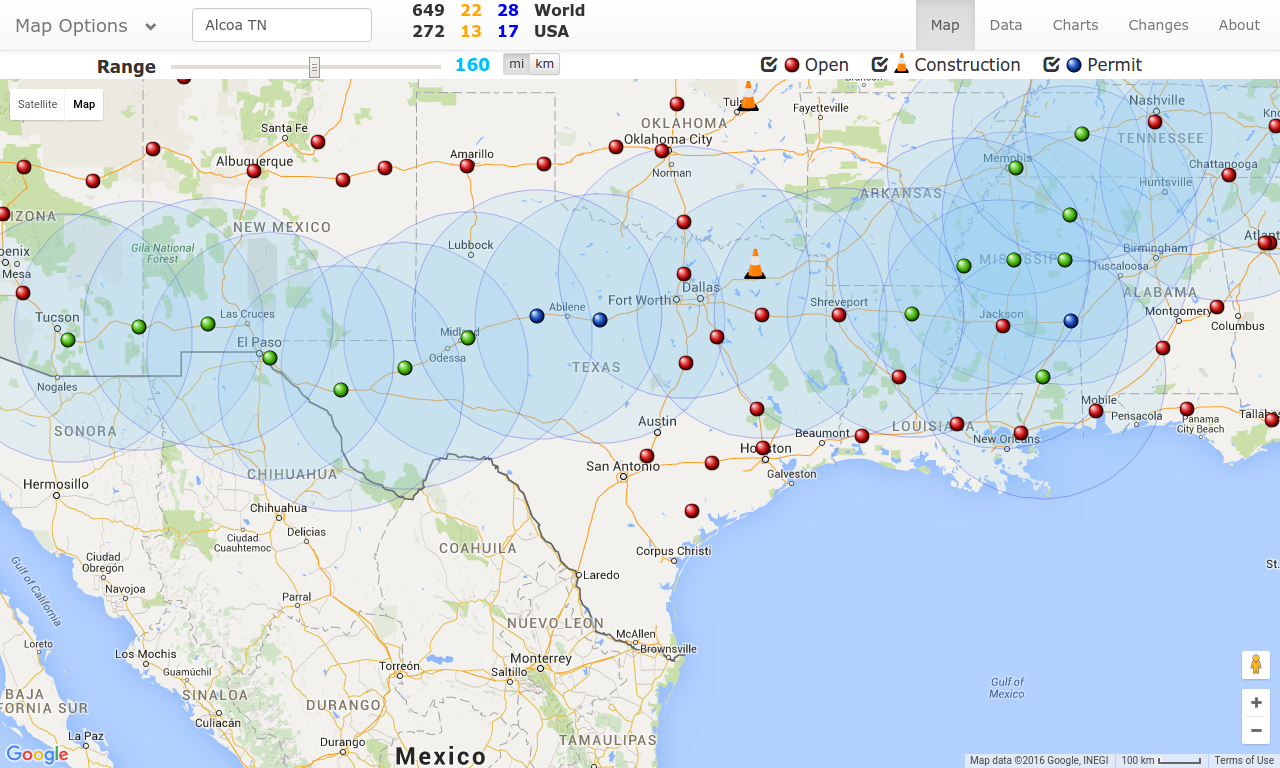
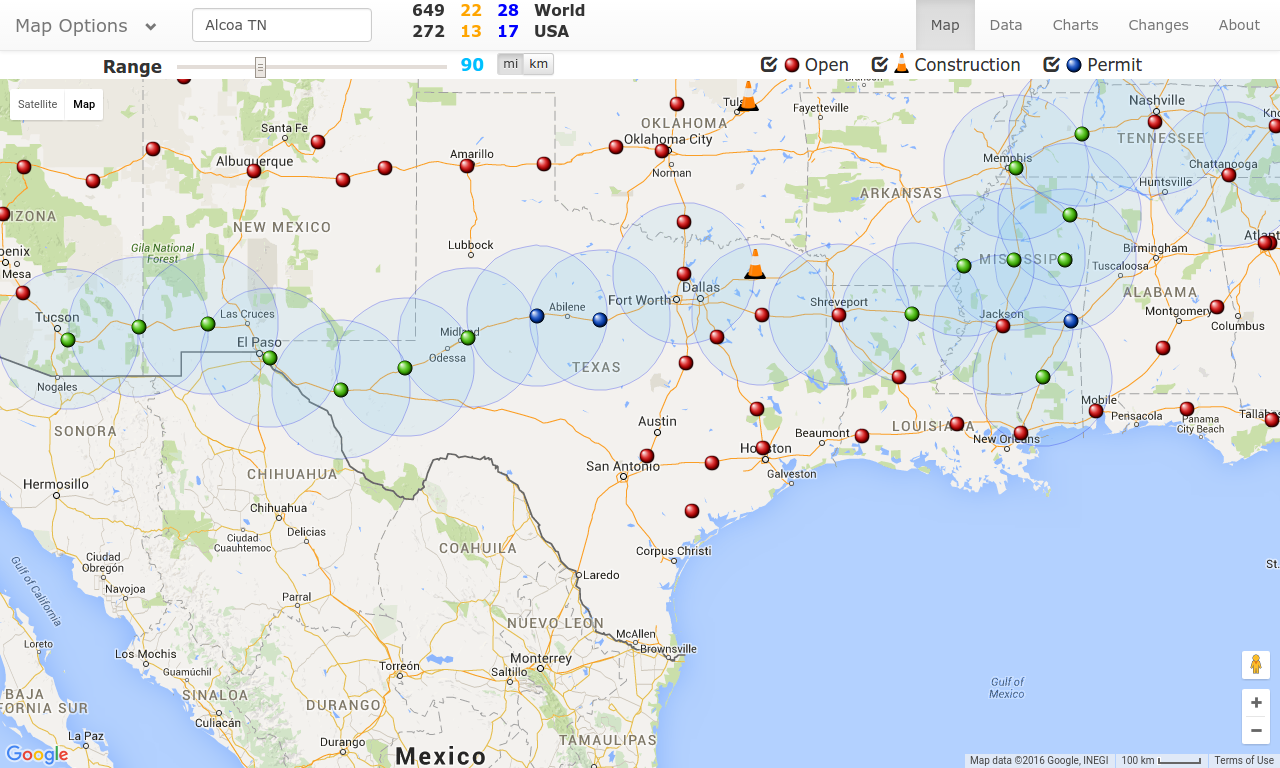
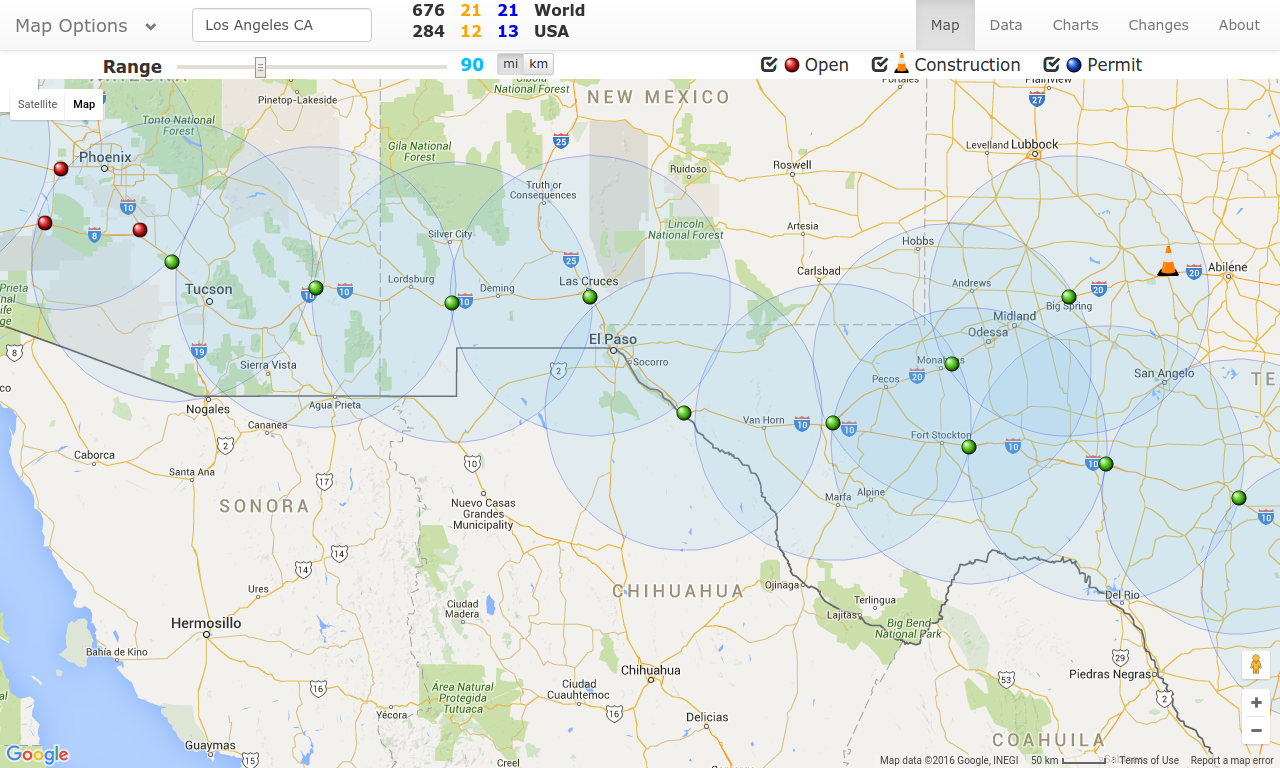
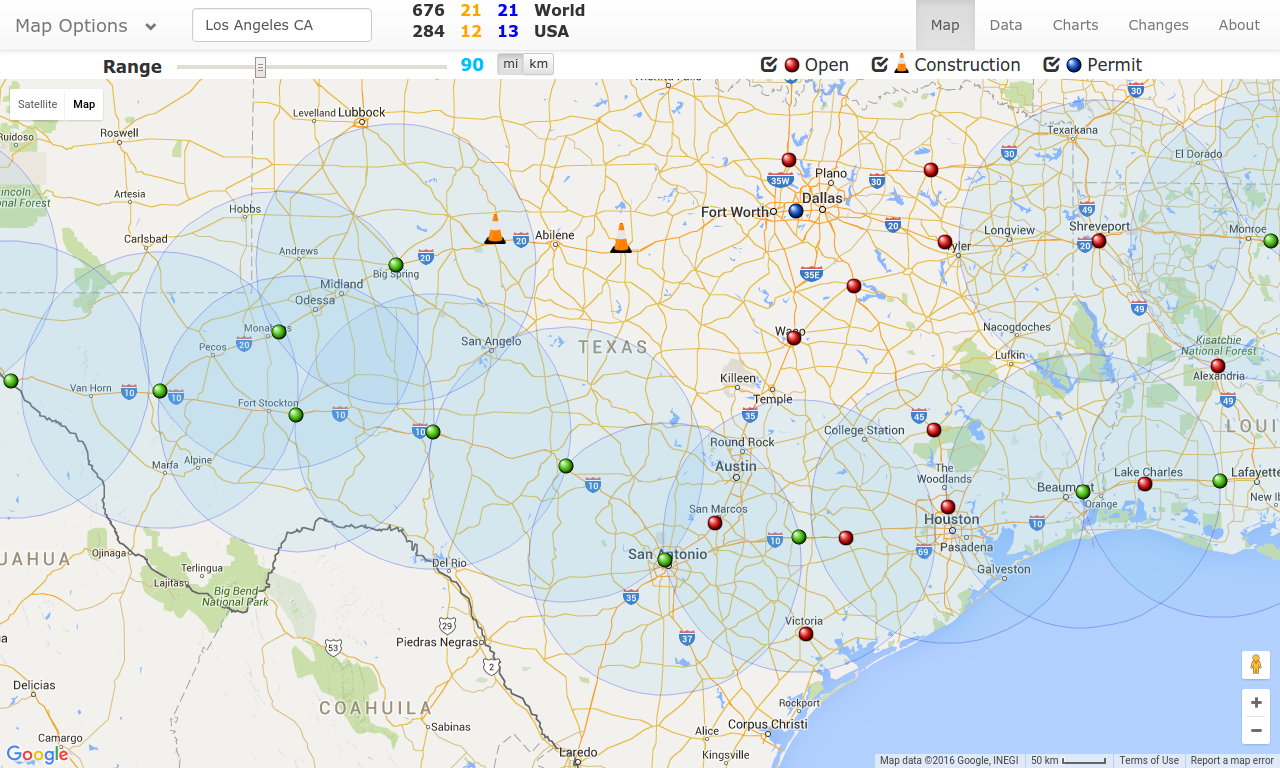
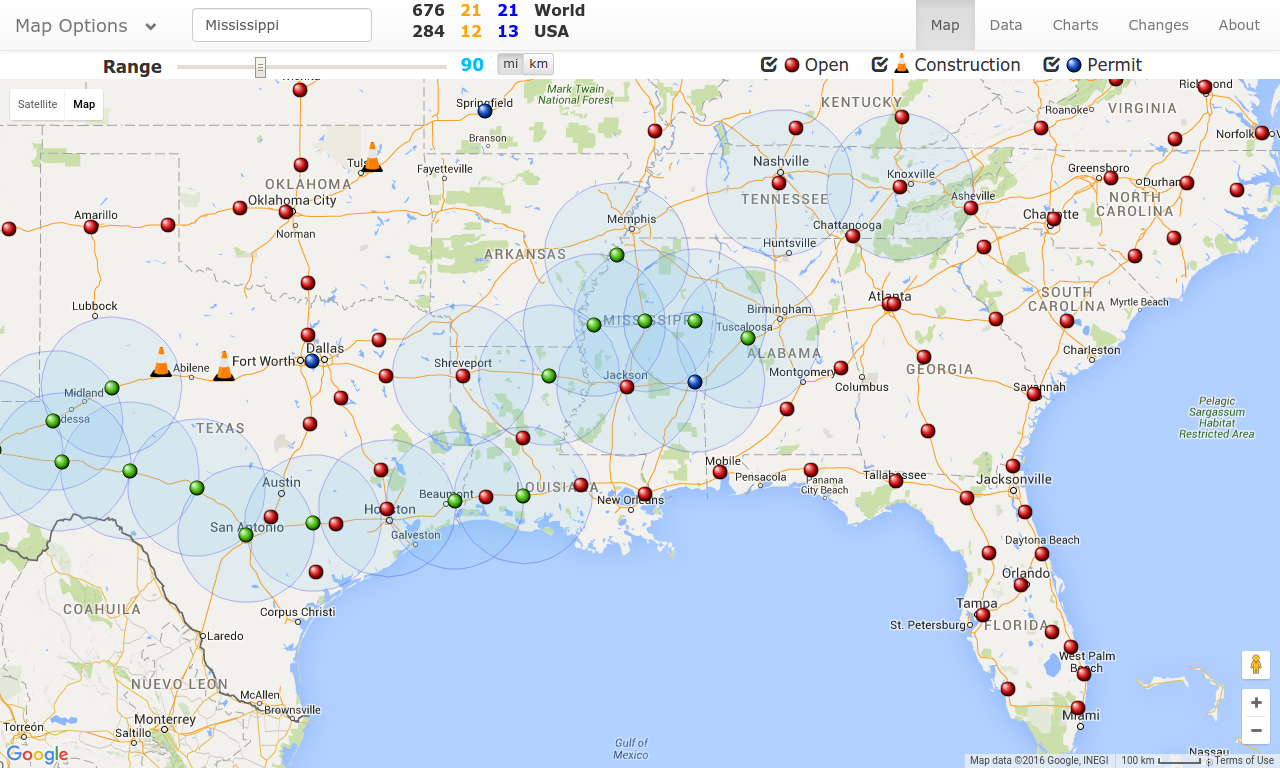
Red Sage I have been using Supercharge.info to puzzle out how certain Supercharger Wasteland areas might be resolved. Typically, I presume they will be located either every 80-to-90 miles or so, or possibly every 150-to-180 miles instead.
�
Jul 27, 2016
cpa I think that it is in Tesla's best interests and its customers best interests to place Superchargers at the shorter distances, like 50-80 miles rather than 120+ for all but the longer, desolate stretches of highways.
I do not have confidence that the average motorist who has a hectic daily life with work, family and whatever else will stop to plan Tesla trips for charging stops. They will pack the car, grab the family and leave. They will not evaluate all the outside factors that reduce range like weather and speed and elevation gains. They won't realize the cabin heater uses a lot of juice. They just want to look at the battery gauge and then determine when to stop, secure in knowing that the Supercharger network spaces them about an hour apart.�
Jul 27, 2016
AZ Desert Driver In the days of stage-coaches and pony express....towns were spaced to change horses and rest the passenger. Look at the maps of the West in the early 1900's. As I recall, that spacing was about 30 miles- and reflected a days ride. Folks USED to plan trips based on range. I don't think it is too tough to think we can't re-adapt to planning. Sure, we have become lazy and thoughtless and comfortable with just having everything right around the corner (I know I'm guilty) but I still think we can be expected to plan just a little about venturing out on long trips.�
Jul 27, 2016
JeffK Supposedly the car will warn you when you have just enough charge to get the the nearest charging station. There's not a whole lot to evaluate. Also the vast majority of people (who have homes, workplaces, or parking lots with charging stations) will not need superchargers at all.... It's a waste of money to put superchargers that close together.
If you plan a long trip a few times a year, you're going to want to plan your route anyway (gas, electric, or otherwise), or else you'd just be irresponsible... or you just love to drive and get lost in the open road.�
Jul 27, 2016
Rocky_H I think this is kind of blown out of proportion. I know some folks on here go way over the top with spreadsheets, charts, weather reports, wind speeds, and writing down measurements at every stop, and yes, that would be too much to expect of the general public, but I don�t think that stuff is all that necessary.
I�m an obsessive Tesla fanatic, but I also don�t like doing that kind of work�feels too much like homework to me. The thing is, the car gives you so much information as you drive that you basically don�t need to do all that extra work. Remember that those things you mentioned: weather, speed, elevation gains, and heater are all reflected in the energy use of the car in real time, and are instantly reflected in the % remaining number on the energy app of the screen. So at each stop, I put in the next Supercharger in nav, charge up until the % remaining looks good, and then drive to keep the % looking good�no research, no homework, no headaches. Everyone is already familiar with gas mileage being worse at high speeds, so slowing a few miles an hour to extend range is already in people�s heads.
Obviously this does need to be within the realm of somewhat reasonable Supercharger spacing. I�ve done a couple of really long adventurous runs of over 230 miles in places where there were no Superchargers, and even left my garage showing that I would arrive with -2% battery remaining. In those cases, I had done some intense looking on EVTripplanner to see if that was even possible for the expert level, but that will not be the normal thing within a few more years when Supercharger coverage fills those holes better.�
Jul 27, 2016
Rocky_H Yep, this conversation usually starts with �What if you find yourself out of energy?�
I have to step them through the questions:
Do you ever use up over 200 miles driving around town?
No.
So when you would need over 200 miles, that�s when you�re going on a trip out of town, right?
Yes.
You don�t suddenly �find yourself� out of town. You would have packed or planned some on where you�re going for the trip, right?
Yes.
So the planning consists of go to this Supercharger, then that one, then that one� And that is a reasonable level of planning the public can do and isn�t too scary.�
Jul 27, 2016
ohmman Agreed. And it only takes one or two "drive under 55mph to reach destination" messages to learn that you might want to give yourself a bit of a charging buffer.
It is a valid point, however, that many people just drive and are completely unaware of what affects range. I spoke with a very nice couple on my recent road trip. They're new X owners and they didn't know that speed impacts range. I took the opportunity to let them know about rain and wind as well - and about TMC.�
Jul 27, 2016
dgpcolorado I had much the same experience a few months ago: new X with family from Chicago at the Denver Supercharger Station. They had been driving at 90+ mph for much of the trip and charging to near full at each stop. And were nearly full for their final leg to Breckinridge, which is way more than they really needed (I showed the driver my EVtripplanner plot for the route for my car). I tried to explain that high speed has a big impact on range and that it was only necessary to charge enough to make the next station plus a buffer. And I explained about Supercharger pairing. But I expected that they would get the hang of it with time, since this was their first road trip (although I could tell that the family was getting a bit impatient with the long charge times to get to full). And I guess I can understand going 90+ through Kansas, although that doesn't lead to the fastest overall trip time.�
Jul 27, 2016
Red Sage As mentioned by others, 50 miles apart is far too close. It would be a waste of resources. Don't worry though, some have suggested every 15 miles or every 30 miles apart. All of the cars offered by Tesla Motors from now on will have a minimum range of 200 miles. Even if one presumes as much as a 50% penalty while towing, that still allows for 100 miles. So that gives a nice buffer if the Superchargers are 80-to-90 miles apart.
I think that in high speed States, or places with lots of mountains, 80-to-90 miles apart will be the norm. In the wide open flat spaces, 150-to-180 miles apart will more likely be the case. Idea being, that as the minimum range for Tesla Motors products increases, to 250 miles, 300 miles, and more...? Having them in such increments apart will allow drivers to pick and choose which Supercharger locations to leapfrog while en route to their destination.�
Jul 27, 2016
AZ Desert Driver Did your Chicago friends seem to learn - or did they blow you off like a crackpot. Some folks just CANT get it, others simply did not know and get it right away. Which camp was yours in?�
Jul 28, 2016
cpa Lemme just say how I came to my statement:
I have worked with hundreds and hundreds of clients over the years in many different accounting, income tax and auditing situations. Most of my clients are successful, intelligent, and talented. Yet many of them fail to follow directions, listen to advice or think ahead. As a result, their behavior winds up costing them more money--whether an increased accounting fee, increased but preventable income taxes, or a substantial penalty for late or underpaid income or payroll taxes. I conclude that there is a segment of the population that cannot be bothered with being proactive in matters that just are not that important to them at that moment. And this pattern of behavior extends to refueling their ICE vehicles as well--it is a mundane chore that can wait until later.
There may be generational issues at play here. There may also be personal interest issues at play here as well. Many of you on this forum are tech types or engineering types or have an insatiable thirst for Tesla matters. Those folks have the mindset to learn, adapt and modify their behaviors because driving a Tesla is really, really high on their list. Others not so much.
Finally, to drive this point home further: I am a competitive and very good duplicate bridge player. I have done well locally, regionally and nationally in tournaments over the past 30 years or so. (I am not world-class or even national champion caliber, but I do acquit myself well in most events.) I used to teach bridge and partner to experienced, but weaker players. They started with bad habits. They kept their bad habits. They never learned to recognize and solve common situations no matter how much I repeated myself and gave myriad contrasting and comparative examples. And I am not talking about something as complex as a double squeeze or a throw-in at trick 10, either.
So, we shall agree to disagree--but 50 miles is prolly too close--I would shoot for 80-100!�
Jul 28, 2016
dgpcolorado The new X driver was very friendly and eager to learn. He liked seeing my book of trip plots (especially my elevation plot of his next leg to Silverthorne) which I used to plan long trips (although the car energy plot is enough to use with experience, so I don't need the trip plots anymore on most routes).
^The Denver to Silverthorne page from my notebook.�
![[?IMG]](https://c8.staticflickr.com/9/8602/28001491503_9ff7eda70f_c.jpg)
Jul 28, 2016
AZ Desert Driver Wow...where did this beautiful plot come from? Is that part of the baked-in Tesla planning stuff, or something you developed. If it is yours...Great Job, (can I have a copy?).
Cant tell you how many times I've driven to that destination and beyond. Used to get 30 ski days in a year when I lived in Genesee.�
Jul 28, 2016
dgpcolorado That's my assembly of EVtripplanner.com results plus an elevation plot from GPSVisualizer.com (imports a route from Google maps and draws an elevation plot). I use Photoshop to merge the graphics from screenshots. Pretty simple with practice.
Nowadays I just put the EVtripplanner RM estimates in a spreadsheet and write down my actual numbers, plus comments, such as "strong headwind", as I drive. It helps with knowing how much to charge when I drive the same route again. Charging is slow in an old style S60 so optimizing charge times helps.
My S60 RM numbers wouldn't have much utility for you I would guess, but if you PM me an email address I can send you the JPEG image files for Silverthorne (and Glenwood Springs and GJ, if you wish). I've got them going all the way to Portland and Kirkland WA (near Seattle).�
Jul 31, 2016
david_42 Going back to the original question, I'd much prefer a pay-per-use, as I doubt we would use Model 3 for long-distances. We own a Sprinter van and that works extremely well for long trips. We've driven our Kia on a long trip exactly once, because the hotel the conference we were going to could not accomidate the Sprinter in their parking. At least, that's what we were told, turned out to be wrong.
As to price, $10-20 would be about right based on local electricity costs.�
Jul 31, 2016
diamond.g Would you consider
as a good option?�
Jul 31, 2016
SuperOmega Both options have its merits. For M3 reservation holders, do we cross that bridge when we come to it, or get some advance notice on price? I think it also comes down also to both current and future supercharging infrastructure and owner location, both domestic and abroad. I just read an article, IIRC, that Fremont is getting a deluxe one: Tesla is about to open its 2 biggest Supercharger stations yet, 20 stalls each�
Aug 1, 2016
raysspl I prefer not to pay for Supercharging.�
Aug 2, 2016
zenmaster Are you sure? As has been astutely pointed out several times, pay per use can be abbreviated as PPU which in turn sounds like poo-poo.�
Aug 2, 2016
SuperOmega I'm a EV newbie, I was trying to be diplomatic, LOL, so I'm ready to be "schooled." Anybody else want to chime in on this?�
Aug 2, 2016
david_42 "For less frequent chargers, our Flex plan enables consumers to access DC fast charging for a $4.95 fixed session fee plus 20 cents per minute."
This would be okay. We drive to Seattle about once a year and that's one charge up and one charge back.�
Aug 3, 2016
diamond.g Cool. That is the EVGo plan. Which would just require a chademo adapter.�
Aug 30, 2016
mhan00 I'd like Tesla to charge by time spent in the space with increasing cost per minute the longer a person is parked at a super charger to discourage people from leaving their cars there for hours. Or have the first half hour or so be free and then hit with a high per minute charge after that.�
Aug 30, 2016
Az_Rael If they could manage to navigate the various state regulations to allow for per kWh pricing, that would be completely awesome.�
Aug 30, 2016
ohmman Mod note: Some posts moved into a new thread. This update was worthy of it, and I wanted to make it a global Tesla Motors discussion preemptively.�
Aug 30, 2016
Pando I have a feeling that by building out an easy-to-use credit-based PPKWh (pay-per-kilowatthour) system, Tesla can accommodate SCs to eventually charge other non-Tesla vehicles as well. The SCs are turning into a global standard which cannot easily be dislodged by competitors, which have been asleep at the wheel so far. Getting unlimited and faster charging and/or better energy pricing for Tesla owners of course will encourage people to buy vehicles from Tesla and not from competitors.
It's very likely that in the future Tesla will make more money selling energy than selling vehicles, which may even be heavily subsidized from energy sales, similar to HP selling printers cheap and then selling ink at the premium.
Interesting times indeed.�
Aug 30, 2016
Red Sage It's not about Superchargers becoming a new revenue stream.
Assessing fees by time parked won't work until precise charging times can be determined for every car.
Superchargers are already profitable because they bring in new Customers.�
Aug 30, 2016
dsvick In order for that to work the competitors would need to enable their cars to be charged by a super charger, I'm not saying they won't, but it would be interesting to see if they do. Personally, I think it would be a great idea if they bought into it, it would be a great selling point for them. It would take some coordination though since having the CC info on MyTesla page implies it will be a prepaid system, that the other manufacturers would have to be able to access as well.
As far as being a global standard, I don't know the numbers but I think there a lot more of a couple of other types of charging stations than their are SC. Which is one reason there isn't a need to for other manufacturers to jump into the SC network.�
Aug 30, 2016
Booga Tesla adds hidden payment option to buy �Supercharger credits� in kWh blocks ahead of Model 3�
Aug 30, 2016
Garlan Garner I don't know what the SC'ing rate is going to be.... however this will keep SC's from being congested in the future. The only reason I would SC with a M3 would be if their rate is lower than my home rate.
Since I hardly ever travel long distances via car.�
Aug 30, 2016
Red Sage Ultimately this is neither a pay-as-you-go, nor a subscription plan. It is a prepaid service. Thus, the same as before. Tesla Motors wants your dough up front. Before you plug in. So no, you will not be billed once a month and you will not be payingat the pump. Exactly as I have said all along.�
Aug 30, 2016
Garlan Garner Ahhh interesting. That makes sense.�
Aug 30, 2016
Red Sage Superchargers that are on popular routes and at desirable locations will always run the risk of being congested on busy days. The exact same locations may seem unbearable around Thanksgiving and practically abandoned on Bastille Day. Tesla Motors can work toward diminishing the occurrence of inconvenience or crowding, but can never prevent or eliminate it.�
Aug 30, 2016
ohmman ...exactly?�
Aug 30, 2016
Canuck The article reads: Tesla updated its website to show a hidden payment option to buy �Supercharger credits� per KWh block.
This is not the same as before at all. There has never been: �Supercharger credits� per KWh block. There has only been Supercharger free for life of the car or not.
How can you possibly take from this article that it's not pay-as-you go or prepaid plan because Tesla wants your money up front? Many subscriptions require payments in advance, as do many pre-paid plans.
Please explain.�
Aug 30, 2016
MiamiNole ![[?IMG]](https://lh3.googleusercontent.com/blogger_img_proxy/AEn0k_u5QsOTBrjpN1-20Srq3ZFZjewrC6B4pnjDzZFzTywqYDFOIJH-fzyQ9KOCJsJVoCBvPlKikmpOTYfmcwsuTNziAWfORU3e5QG0LqCvT4NAoy4yPt82dMyQwKKYcCPJuvOJF8k=s0-d) �
�
Aug 30, 2016
ImEric He said not a subscription. He specifically said that it IS prepaid. Subscriptions are more like Netflix, where you pay a set amount and use whatever you can during that time period. Once your time is up, you pay to continue using. This is more like buying tickets to the movies in bulk instead of going to the window at theatre each time. You always have those tickets sitting in your drawer, until you use them up. Then you have to buy some more... which is exactly what I've been saying they'll do for years.�
Aug 30, 2016
JeffK Since superchargers are supposed to be networked, I wonder if, in the future, they could add a sensor to see if a car is parked in a given spot and allow users to see real time stats before even making the journey to the supercharger.�
Aug 30, 2016
ImEric They're already capable of this, and I thought the "End of range anxiety" update was supposed to integrate that into the OS Nav. Guess not.�
Aug 30, 2016
JeffK I believe that update just warns you when you are about to go out of range of a charger with the amount of energy you have left.�
Aug 30, 2016
Canuck I guess he did say it's not a subscription but at the same time he said:
I don't see it as the same as before at all. Paying once for a lifetime of service is very different than what the article reads:
So really, whatever you call it, it's very different than before, which is the main point.
This is what I thought they would do to attempt to avoid congestion at the Superchargers with the arrival of the Model 3.�
Aug 30, 2016
Red Sage I already explained. It is a PREPAID system. You pay first. For the car, or for the option. It is not a bill-me-later system, as some have requested. It is not a fee assessed at the time of plug-in as a PoS. It is a separate amount, paid ahead of time in order to use Superchargers. Just as before. The amount will likely be much lower and for a limited time, number of charges. But it will NOT be for the amount of time you are plugged in.
Now, why don't you understand that?�
Aug 30, 2016
stopcrazypp The point is that it is not the same as before. Also, given the context is the code shows up in the payment method section to remember your card information, it does not exclude a pay per use option either (I don't know where that assumption comes from).�
Aug 30, 2016
markb1 Yes, I agree with the above.
No, that's where you are wrong. What we have now is UNLIMITED supercharging for a flat fee (bundled into the price of the car). What is being discussed is METERED supercharger use. You prepay an amount that entitles you to a LIMITED amount of supercharging. That's a big difference.�
Aug 30, 2016
Canuck Because it is not the same as before. In fact, it is not at all the same as before. Before it was unlimited supercharging. This is not unlimited supercharging.
Now, why don't you understand that?
Good point. I think the only thing for certain to come from this new information is that it is not the same as before.�
Aug 30, 2016
ohmman One neat thing about TMC is that once you post something, we can refer back to it later. I really don't want to pick on you here, but you've been pretty vocal in the past about this, and finding evidence of your position isn't terribly difficult. Just a few of the first results using the search icon at the top right:
Maybe what you're trying to say is that this isn't what you've been saying all along, but you're happy with the outcome?
�
Aug 30, 2016
Pando ![[?IMG]](https://a.fastcompany.net/multisite_files/fastcompany/imagecache/inline-large/inline/2013/10/3020051-inline-popcornseinfeld.gif) �
�
Aug 30, 2016
Fred Thompson If Tesla is going to charge per kWh, I believe they will not charge more than their cost per mile in their "Charging Estimator". Therefore we can get a close estimate for a 50 kWh charge by looking at their new 100 kWh battery that goes 315 miles. If you plug 155 miles into their "Charging Estimator", they show a cost of $6.22. Therefore, an estimated cost for a 50 kWh charge would be around $6 or $.12 per kWh.
Another way to do the calculation is plug in the 215 estimate miles for the Model 3 into their "Charging Estimator" for a cost of $8.63.
I believe Tesla's current "Charging Estimator" does not take into account that the new model 3 will have a more efficient battery with more miles per kWh charge.�
Aug 30, 2016
Booga Generally, I agree that they won't want to charge too much to discourage use, but I could see them having to build in some kind of premium because they pay commercial rates, which are more routinely subject to time of use pricing and larger peak charges. 150 amps turning off and on in an instant is not easy for the electric company to provide at 2pm on a hot day and so while they will have batteries at popular locations to smooth out the grid draw from, I really wouldn't be surprised for it to be higher than residential pricing. In addition, we have to pay for the hardware and land, just like any gas station factors these into their costs.
Honestly, I wouldn't be surprised for the cost to be closer to 20-24 cents per kWh assuming a 12 cent input cost considering national averages.�
Aug 30, 2016
Pando It's possible, but unlikely. Not only can they negotiate better rates from the energy company, but they could offset their cost from Solar they can put back into the grid somewhere else.�
Aug 30, 2016
AZGirl We do plan on using the Model 3 for trips during the year so would be using the SC network. Were strongly leaning towords purchasing a "SC for life" option if available during configuration depending on the one time price. Given today's revelations about a possible pre purchase SC credits scheme I wonder if there will even be a SC for life option. Also wondering if Feds and states will be taxing the purchase credits as a way to generate funds for road maintenance, etc. to compensate the loss in gasloline tax revenue. I hope the overall cost per mile works out to be considerably less than current gas prices.�
Aug 30, 2016
Fred Thompson Tesla should be able to set the cost based on their cost for electricity and offset the cost of delivering the service in other ways like solar stations.
A more important issue is how will Tesla account for the varying cost of electricity from different states and countries. I am guessing Tesla will set your cost for a kWh based on where you live. The following link shows the retail cost of electricity by state.
www.npr.org/sections/money/2011/10/27/141766341/the-price-of-electricity-in-your-state�
Aug 30, 2016
Red Sage Read my sentences again, and you may find that is what I said. You are applying part of my statement to describe another part of my post when I have already identified what those words were meant to modify, describe, and refer to. I'll try again...
Tesla Motors has always accepted prepayment for Supercharger access. They will continue to do so. The same as before.
Howzat?�
Aug 30, 2016
Red Sage What I'm happy about is that this is NOT pay-per-use. It is prepaid. A poo-poo-4-you system would suck.�
Aug 30, 2016
Pando ![[?IMG]](https://lh3.googleusercontent.com/blogger_img_proxy/AEn0k_t-yD97sqNS4qFQfO4FAi3trjjAjwy1OPu0M3cmV7rQ6pLRYjwsoFNmxNhpnRqAPotlKcIrjZseCNad-HtYCgBF_1oqqofIEIGl4rghnj-6kze0--LWtn2JnPpyuLzIcCQA8XIzcM2C27g=s0-d)
It is prepaid pay-per-use.�
Aug 30, 2016
Red Sage Leave Patrick alone! It is prepaid... use.�
Aug 30, 2016
Alketi I have a Dunkin Donuts card. I put money on it and, when I buy a coffee, it deducts that money.
Is that pay-per-use or prepaid or both or neither? And, are you happy about that?
As an aside, I did a quick survey and 942 of your 1800+ posts (possibly not accurate numbers) were about this topic, with you mostly trying to overpower other members with a different opinion. Did you at least promise to eat your shoe or something?�
Aug 30, 2016
stopcrazypp Whether it is prepaid or post-paid, it is still pay-per-use (metered by kWh). Your long term claim was that it won't be pay per use (AKA it won't be metered at all). The recent news clear suggests that it is pay per use. Is it that hard to admit you were wrong with your prediction?�
Aug 30, 2016
Canuck Damn, I was wishing I could run up a tab, and that Tesla would also front me some cash.�
Aug 30, 2016
Pando Yes, but looks like they will also be offering Pay-Per-Use, even if it's prepaid in small increments. Are you arguing about semantics?�
Aug 30, 2016
J1mbo More likely they will use the car's network for this info. No new sensors needed!
Kinda confusing to see "kWh" in this leak. Does anyone know how many kWh they have supercharged with over the last month? I don't, but I am guessing it was several hundred. But some months, I never supercharge. Not sure I would want to prepay a big chunk of cash on the off chance I might need to supercharge.
This topic raises some interesting questions... Supercharging ability is currently controlled by a setting in the car, not by the charger. Will the car have to request charging from the mothership before it starts? What if there is no 3G/LTE access? Will the car know how much credit you have? Will a charge session be terminated as soon as you run out of credit? Can see that being annoying.
IMO, for PAYG, it would make more sense to use MyTesla just to store default CC details and have a payment confirmation screen in the car at the time of charging to allow new details to be entered.�
Aug 31, 2016
Fred Thompson 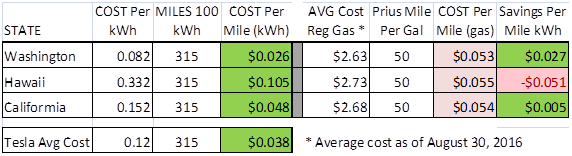
Let me know if my calculations are off? I thought it would be interested to look at the fuel cost comparison between Tesla's 100 kWh battery and a Prius that gets 50 miles to a gallon. As you can see, in Hawaii, it may not make sense to purchase a Tesla Model 3 (M3) unless Tesla allows you to charge at one of their superstations and charges the average cost of 12 cents per kWh. It also does not make sense to purchase the flat rate charge for a M3 in Hawaii because you don't travel that far on the island. In California, you only save 1/2 cent a mile when you compare the Tesla to a Prius when charging at home. Savings will increase base on the increased cost of gas and when driving a vehicle that gets less the 50 miles to a gallon.�
Aug 31, 2016
Booga If they can offset it from solar? You realize deploying solar increases the assets they need, and so yes, on an income statement basis, it would be "offset." But when you consider the required returns they will need to meet considering their balance sheet, it's not going to be impacted by how many solar panels they have. If it was that simple, gas stations would have lots of solar panels and be selling gas cheaper - just because it's electricity doesn't introduce new financial economics to the world.
Tesla may choose to purposely sell electricity below cost, but that can't go on forever, unless the cars come with a larger margin to compensate for it.
My own opinion is that their entire offering is going to be compelling enough with the Model 3 that selling supercharger access below cost isn't going to be necessary. I would rather them charge a sustainable rate that allows them to expand the charging network and keep the equipment in good condition instead of seeing it internally as only a "cost center." If it brings in revenue, it's a lot easier to justify future upgrades and expansions.
I'm expecting them to price it with a 50% margin and likely no special pricing based on location - maybe just one flat rate across the country for simplicity. Hawaii could be an exception where maybe they charged 1.5 "credits per hour" or something similar, but I expect those to be the exception.
Because I only intend on using supercharging when I'm traveling, I would have no issue effectively paying 25 cents/kwh.�
Aug 31, 2016
cronosx Yes.. but we don't really want to drive a prius, and the prius can obtain the 50 miles to gallon only if you drive like an old lady while the tesla do this simply by driving like a normal person, so be realistic, let's assume we drive like normal people and you'll see that it's not the same anymore.
And of course, at home you can have solar panel, but you can't dug a pit and expect gas to come out, so again.. take calculation with a grain of salt�
Aug 31, 2016
JeffK The car's network will not know if a Honda is parked in a supercharger spot...
I'm also interested to see if the car has to call home before supercharging... would it work if there was no network access?
What if I was to bring a cell/wifi jammer, can I charge for free or not at all?
What happens in a time of emergency/disaster if cell/wifi networks are unreachable? Can't leave the disaster zone?
Perhaps the car will actually be sent the number of credits and do the accounting onboard... therefore there'd be no need to call home unless it needs to send the usage back to Tesla later to keep the numbers in sync. With this method, it'd be much more difficult to fool it.�
Aug 31, 2016
J1mbo Exactly. I think it ultimately depends on how much Tesla really cares about protecting the revenue stream. Any system that stores credit or access rights in the car is going to be weaker than a system that manages it remotely. IMO the car is unlikely to be secure enough to stop determined hackers from giving themselves unlimited credits, and trying to keep one step ahead will be expensive.�
Aug 31, 2016
JeffK No reason you can't have it stored as an encrypted token. You can't really break it so you'd have to work around it. It might be more trouble than it's worth for the majority of people potentially bricking your car...�
Aug 31, 2016
stopcrazypp That's exactly how I think they will implement it. That will allow for offline usage. That's how most rfid bus passes work. A system that requires constant network connection would be unreliable given some stations will be in areas of poor connectivity.�
Aug 31, 2016
J1mbo Maybe, but you just have to wonder why mobile phone networks don't rely on this approach for safeguarding their PAYG products.�
Aug 31, 2016
Red Sage And we have a winner! I've been waiting for someone to bring up the 'semantics' argument! w00+! You get a NO PRIZE!
It is NOT pay per use.�
Aug 31, 2016
Red Sage Uhm... Despite the fact that numerous current Prius owners are undoubtedly going to upgrade to the Tesla Model ?... I would suggest you do your calculations based upon the cost of Premium fuel instead, because that is what the vehicles the Model ? will actually target in the marketplace use. That is, how do the Model ? and Prius compare against Acura TLX, Alfa Romeo Giulia, AUDI A4, BMW 3-Series, Cadillac ATS, Infiniti Q50, Jaguar XE, Lexus IS, and Mercedes-Benz C-Class?�
Aug 31, 2016
Red Sage They rely upon the old networking adage, "Never trust the Client."�
Aug 31, 2016
Pando You make no sense. So if he wants to compare a Prius, you are suggesting that he should compare Acura, Alfa, BMW.... etc. with premium fuel instead??
Since he wanted to compare a Prius, he compared a Prius. Mkay?�
Aug 31, 2016
Pando Lifetime supercharger use = Not pay per use, it's prepaid
Pay per kWh, even if it's prepaid in small increments = Pay per use
What part of the above is unclear to you?�
Aug 31, 2016
Red Sage OK... You seem to be a bit angry about something. I've already explained myself a few times. But I'll try again.
Tesla Motors wants your money up front. They want you to pay them first. Since you must have paid them already, before using Superchargers, that is in my strong belief the very essence of 'prepaid'.
Pay per use would be a point of sale transaction. Similar to a gas station. No monies are changed hands prior to you arriving at the gas station. Some gas stations request that you pay them after filling. Some gas stations allow you to pay-at-the-pump. Some gas stations request that you bring money inside the store to pay them, just before you fill up at the pump.
Sure, you could pull into a Supercharger stall, pull out your phone and use a mobile app to pay for a few kWh before plugging in... But I believe most people would instead do so from their personal computer at home before leaving on a road trip. That is a prepaid action. Not pay per use.
Some have stated repeatedly over the past several months that they would like to be billed instead. Meaning, they could pull up to any Supercharger they like, use it as little or as much as they want, and receive a itemized tally of times dates amounts that they would pay after receiving a bill. The system that appears to have been discovered is not that either.
Prepaid, regardless of incremental amount, is prepaid. Not pay-per-use. If it were pay-per-use, you would be paying by the number of connection sessions instead.
I do hope that is relatively clear.�
Aug 31, 2016
Red Sage I make perfect sense. You choose not to understand, or mimic misunderstanding. It is a suggestion. Not an order. Just an idea to further expand upon a premise that I believe is fundamentally correct, but could use more data to fully flesh it out. Because the advantage of a Model ? over those other vehicles would be more pronounced, instead of seeming to be rather marginal instead.�
Aug 31, 2016
Pando (emphasis mine)
The two examples above are equivalent, and I'd consider them both as pay per use.
We just have to agree to disagree and leave it at that.�
Aug 31, 2016
Alketi Pando, you can't win. Save yourself before it's too late!�
Aug 31, 2016
Pando lol
![[?IMG]](https://blogger.googleusercontent.com/img/b/R29vZ2xl/AVvXsEiAM7aPtoXnrRylz5TnrwHII3EgcdBAwzOP2q60u-nWe678WuXP4q6GoUm6mITEVl6P4Djj09fZLHAPqp0FzFR0qZIUb9fW0pLXdWkNKGxGXz9UQO-FNisAp-TvWhGXjDH2C8gk_Icsuc8/s1600/chain_of_command_3.png) �
�
Aug 31, 2016
SageBrush Looks right, but sometimes spreadsheets are too much work:
Prius: 5 cents a mile (250/50)
eV: 3 miles a kWh
Break-even: 15 cents a kWh
Addendum: my local calc for Colorado (not that it factors in to my purchase decision):
Pedestrian driver, 4 miles per kWh or 50 mpg Prius (v)agon
Petrol currently $2 a gallon using gift cards @ 10% discount
PV, non-electical-part DIY install lifetime cost: 3 cents per kWh
EV: 0.75 cents a mile
Prius: 4 cents a mile
The interesting (and positive) point here is that someone actually highly motivated by money would choose PV/EV even compared to a Prius in cheap-cheap petrol land. By fuel costs anyway ...�
Aug 31, 2016
Red Sage @Pando -- EXACTLY! The joy of the internet is that no one is ever broken. And there were always four prepaid lights. :-D�
Aug 31, 2016
Fred Thompson If your lifetime cost of 3 cents per kWh includes your cost for the solar system, that sounds like a very good deal.�
Aug 31, 2016
SageBrush Yep. One of the advantages of living in a cold, sunny, rural place is collecting ~ 1.9 kWh/watt*year from a pole mount, so about 50 kWh lifetime per watt.
Installed cost: $2 per watt
30% tax credit
140 cents for 50 kWh lifetime�
Aug 31, 2016
Fred Thompson The following link is a more current average cost of kWh by state.
www.electricchoice.com/electricity-prices-by-state/�
Aug 31, 2016
jgs I started to write a longer reply, but it all boiled down to:
1. PV mitigates expensive juice
2. Life is too short to drive a Prius�
Aug 31, 2016
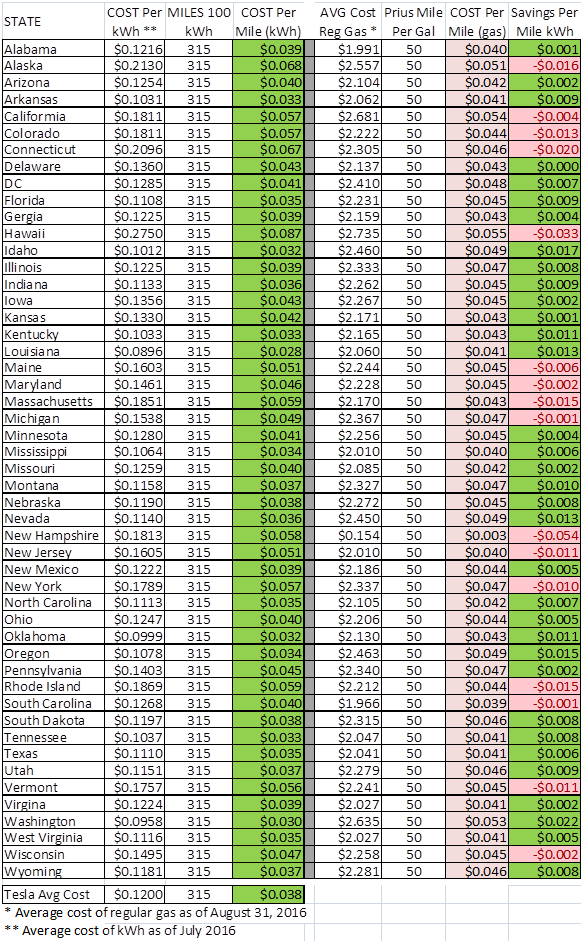
Fred Thompson I added all the states to compare the fuel cost between Tesla's 100 kWh battery and a Prius that gets 50 miles to a gallon. There are sixteen states where the electricity cost for the Tesla is greater than the cost of gas for a Prius getting 50 miles to the gallon. The comparison gets better for Tesla as the cost of gas goes up and when driving a ice vehicle that gets less than 50 miles to a gallon.
I think this supports Tesla charging an average 12 cents a kWh for all states used in their current charging estimator to determine charging cost per mile.
Link to current cost of a kWh of electricity by state
www.electricchoice.com/electricity-prices-by-state/
Link to the current average price of regular gas by state:
www.gasprices.aaa.com/
 �
�
Aug 31, 2016
zenmaster Great pay per use solution Tesla! And a very satisfying "in your face" and "feel the burn".
"...It�s a simple, elegant system. It should allow Model 3 owners to have the Supercharger access they need without paying a large fee up front. It will also mitigate congestion at Supercharger locations..." - Steve Hanley�
Aug 31, 2016
FlatSix911 The secret is out ...
Musk suggested that Supercharger access won�t be free for owners of its mass market sedan.
Tesla Model 3 �Supercharger Credits� discovered on �MyTesla� page
We�d have to preface this story by saying that the reveal does require some knowledge of HTML. Browsing to the �MyTesla� page, made only available to existing Tesla owners and reservation holders, Model 3 depositors will see a new section called �Payment Method� that has a Tesla-red �ADD CREDIT CARD� button beside it. �Inspecting� this section of HTML via ones browser will reveal a section of code referencing �Supercharger Credits� which is commented-out. Commented code is generally a placeholder put in by developers for what�s to come, though they�re not ready to present it yet.
Uncommenting this code will reveal a new section titled �Supercharger Credits� that�s directly beneath the add credit card button. One would presume that future Model 3 drivers will be given the option to purchase the amount of energy that can be drawn from its Supercharger network.
Though we have heard Tesla�s plans of offering Supercharging as an optional �package� on the Model 3, this reveal may provide further insight on the company�s plans to alleviate Supercharger congestion by adopting a pay-per-use payment plan commonly found on other charging networks.
�
![[?IMG]](http://d2odvx3v4cbpyu.cloudfront.net/wp-content/uploads/2016/08/Tesla-Model-3-Supercharger-credits-HTML-2.jpg)
![[?IMG]](http://d2odvx3v4cbpyu.cloudfront.net/wp-content/uploads/2016/08/Tesla-Model-3-Supercharger-credits.jpg)
Aug 31, 2016
ohmman If the secret you're referring to is the linked article in the portion I quoted, that "secret" has been out since June 1st (as you can see from the article date).�
Aug 31, 2016
FlatSix911 Yes, and the hidden code is a confirmation�
Aug 31, 2016
ohmman OK. We've been talking about that hidden code for a couple of days in this thread. Sorry for the confusion..�
Sep 1, 2016
dsvick
Using a regional price can't be that hard to determine and would be safer for them anyway as they'll have more control. If they use an average price they'll have to weight it based on density of ownership. I think there are more Teslas right now in CA and in the Washington DC area than other areas of the US and both of them are above the $0.12.�
Sep 1, 2016
MorrisonHiker You might want to double-check your spreadsheet. I just checked a few values and saw the cost per kWh for Colorado is incorrect and Georgia isn't spelled correctly.�
Sep 1, 2016
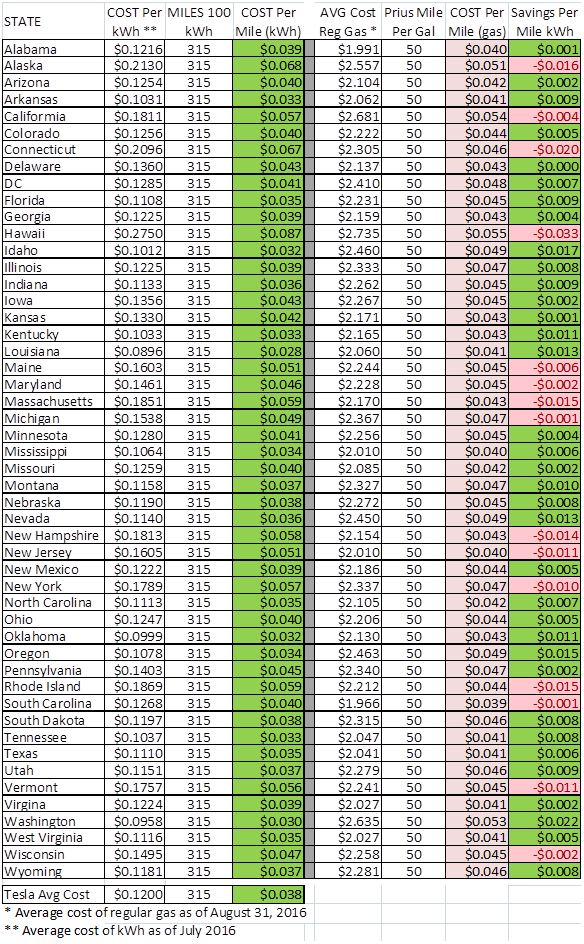
Fred Thompson THANKS MorrisonHiker, I also found the gas price entered wrong for New Hampshire. The corrected spreadsheet is below.
I added all the states to compare the fuel cost between Tesla's 100 kWh battery and a Prius that gets 50 miles to a gallon. There are sixteen states where the electricity cost for the Tesla is greater than the cost of gas for a Prius getting 50 miles to the gallon. The comparison gets better for Tesla as the cost of gas goes up and when driving a ice vehicle that gets less than 50 miles to a gallon.
I think this supports Tesla charging an average 12 cents a kWh for all states used in their current charging estimator to determine charging cost per mile.
Link to current cost of a kWh of electricity by state:
www.electricchoice.com/electricity-prices-by-state/
Link to the current average price of regular gas by state:
www.gasprices.aaa.com/
 �
�
Sep 1, 2016
Alketi OK -- I'll bite.
Why do you think Tesla would only charge $0.12 / kWh?
First, and I'm not well versed in utility structures, but I don't believe they're paying residential rates but rather business rates (which are higher) due to their 13.8kV requirements.
Second, even if they were paying a national average of $0.12, why would they choose to break-even on charging and eat all the costs of the supercharger build-out as well as any other recurring costs (lease, maintenance, etc)??�
Sep 1, 2016
MorrisonHiker Thanks for correcting things. Colorado went from red to green.�
Sep 1, 2016
stopcrazypp I had the exact same thought. People seem to think that a charging network must match residential rates. I guess they have never used a third party paid charging network (which costs significantly more than residential rates). The costs for connection (including demand charges), lease, maintenance, etc must be factored in.
At most Tesla will attempt to match a gasoline equivalent if possible, but that car would not be a Prius (but rather something like a 3 series or an A4). Many charging networks actually cost more than a gasoline equivalent. You are paying extra for the convenience. Remember, a quick charging network isn't designed as a home charging replacement, so doesn't have to match home charging rates at all (ideally it should be more expensive to encourage people to charge at home whenever possible).�
Sep 1, 2016
JeffK This goes against one of the selling points of EVs... especially for people without the ability to charge where they live.�
Sep 1, 2016
stopcrazypp I'm sure Tesla will attempt to reach some middle ground within the bounds of paying for the marginal costs (maybe a small subsidy if necessary for "advertising" purposes), but I think it is just unrealistic to expect them to match residential rates or a 50mpg car.�
Sep 1, 2016
Fred Thompson I don't think Tesla will vary the cost for electricity from what they use on their charging estimator that displays the savings you gain by driving a Tesla. If they charge more than the estimator, they will get negative press as the result.�
Sep 1, 2016
JeffK The other issue is that Tesla's original plans were to have solar panels for supercharging stations that would net energy to the grid (if you were to combine power generated at all the stations).
Granted this isn't the case yet, but if they are serious about sustainable transport then sustainable clean energy would be a start. The up front cost is major but after everything is built then energy should get cheaper.... one would think.�
Sep 1, 2016
Alketi The estimator, at least by my intuition, is there so one can determine their daily charging costs, in order to give an idea of cost of ownership.
It's not there to provide charging costs for occasional long distance supercharger trips, especially since that (pre)pay-per-use model doesn't yet exist.
Tesla needs to make money, unfortunately. Just today, news of this additional capital raise has broken and the stock is down 5%. There's a regular CNBC analyst who just accused the company of being a "cash incinerator". The path to stay in business is not to lose money on every transaction. This isn't a non-profit enterprise. They need to charge enough for supercharger access so that the business is self-sustaining, so they keep building more superchargers and can service/upgrade the ones they have. I suspect they'll be able to do that and still keep them cheaper than an equivalent gas fillup.�
Sep 1, 2016
ohmman Well said. I think Tesla will try their best to make it cheaper than gas, but there's no guarantee. If it ends up being equivalent to or more expensive than the current price of gas, it may not make sense for people without stationary (home or work) charging. Tesla will have to be OK with losing that segment initially, and target them in another way. I'd argue, though, that there are still enough pros to the Tesla driving experience where at least a portion of that segment would be willing to pay the same in fueling costs to drive one.
For the vast majority of drivers, a road trip with higher cost isn't going to flip the economic scales away from driving an EV. What Tesla charges per kWh for Supercharging is up to them and only marginally relevant to the purchase decision, so long as it's within some reasonable parameters.�
Sep 1, 2016
AZ Desert Driver As to the "Cash Incinerator" comment- building a factory to build your product does require up-front spending. Spending on Capital Improvement that builds assets is not the same as burning paper with nothing to show except heat and light. Any fellow who went through Jr. Achievement knows this basic element of business.
As I look at the SC network, I look at the convenience of travel. My ICE can get filled up many places, I need to have the confidence I can EV travel near anywhere too. When on a road trip, I don't expect the cost of gas to be the same in Calif as it is in AZ or TX. If that is where I'm headed, then thats the cost of the trip.
I could see that Tesla might have SC near cheap power sources, and some where the Utility really grabs them. I could see product managers trying to optimize the density of chargers while planning to reduce the cost at each one. Will they put in massive battery banks or solar arrays? Probably, but this capital needs to go to the Factory for now, but not forever.
I wholly accept the statement For the vast majority of drivers, a road trip with higher cost isn't going to flip the economic scales away from driving an EV. What Tesla charges per kWh for Supercharging is up to them and only marginally relevant to the purchase decision, so long as it's within some reasonable parameters.�
Sep 2, 2016
Garlan Garner I don't think Tesla wants to get into "selling power". They aren't a power company.�
Sep 2, 2016
ModelNforNerd
Unfortunately, in many states/counties/whatever jurisdictions, unless they partner with someone, they're going to have to file as a "utility" to be allowed to resell power.
I'm assuming since they're this deep into it, and have a program laid out, that they've looked into that part of it, and are either going to file, or will be partnering with various local utilities.�
Sep 2, 2016
ChadFeldheimer With Tesla's offer to buy SolarCity, it seems clear they want to get into selling power.�
Sep 2, 2016
Garlan Garner I don't think they are deep into anything.
They just installed some boxes and connected them to an outlet. Who ever stops by and uses it can use it.
That's not deep.�

Không có nhận xét nào:
Đăng nhận xét