Sep 25, 2012
rolosrevenge I can still see a lot of out of the way places putting up a few 70 A J1772 that would be very useful. Places you'd go to spend an afternoon before continuing on. With Twin chargers, you can have a full charge after thee hours or so and don't have to worry about hyper-miling.�
Sep 25, 2012
Kevin Sharpe 70A EVSE can be deployed for very little money... why not donate some to your favourite stopping locations so that everyone can benefit?
This 63A EVSE costs less then $500... you need the J1772 version but costs are about the same;
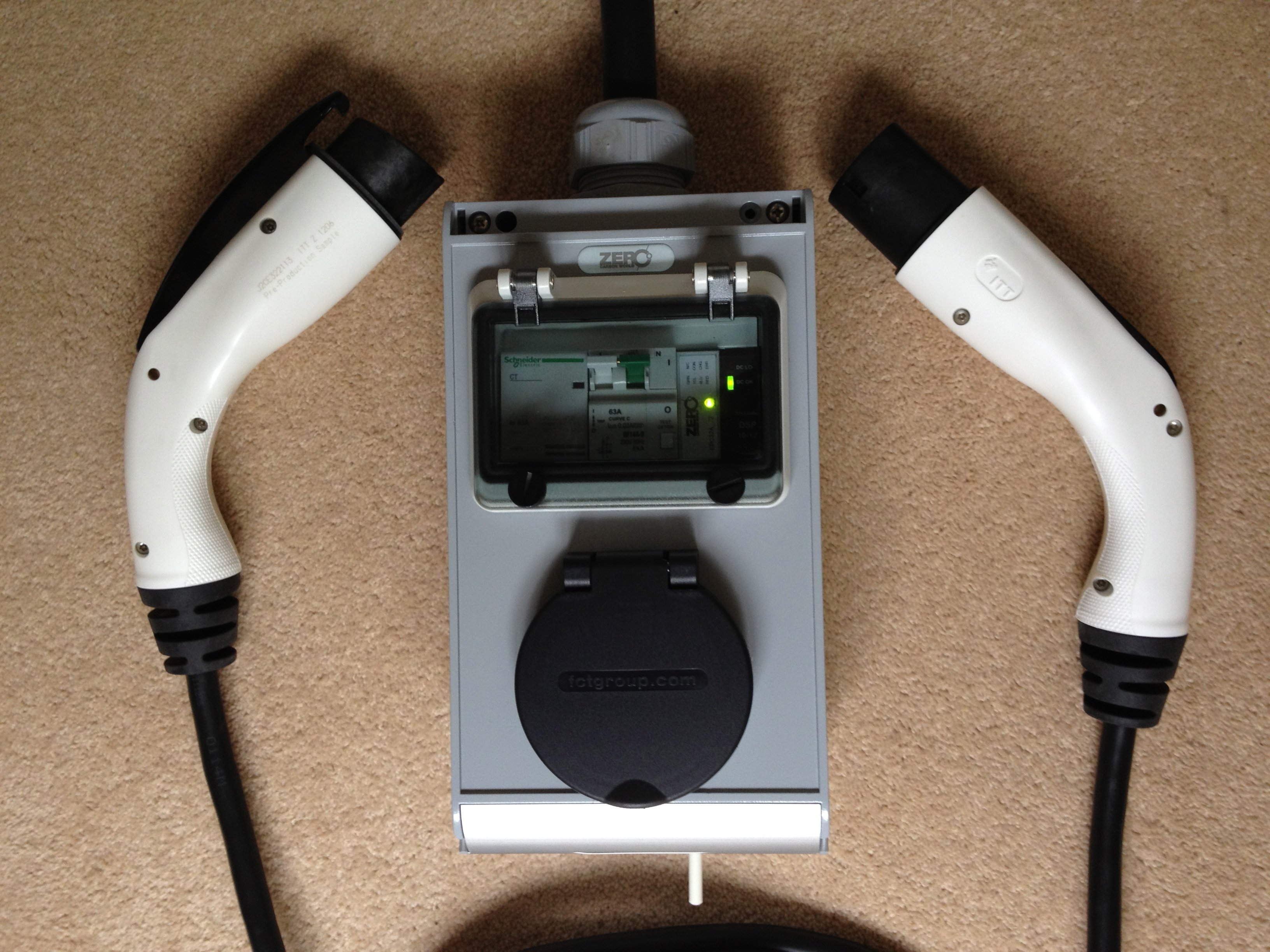 �
�
Sep 25, 2012
TEG OK, I read 1/2/3, and was about to starting questioning your comments, but then I see you clarified!
Your logic is starting to sink in...
- - - Updated - - -
I think there are various reasons why 30A seems to be common, and higher current J1772s are the exception so far.
#1: I think 30A J1772 plugs got UL approval first, so we started with 30A.
#2: To keep costs down, many manufacturers (Nissan/LEAF, Ford/FocusEV, Honda/FitEV) have chosen to include chargers that can pull no more than 30A, so a 30A EVSE will provide "full capability" to the majority of EVs that may want to use it.
#3: It is easier to find existing wiring and breakers available to provide 30A than it is for the higher currents.
#4: Acceptance is also tied to keeping the costs of the EVSEs down.
#5: Plug-in hybrids (PiP, Volt, etc.) tend to have smaller battery packs, so lower charge rates tend to be adequate for them.
(Some may conclude that they will represent a significant portion of public EVSE usage in the near term based on projected sales volumes.)�
Sep 25, 2012
dsm363 Thanks. With all of the 50A outlets at campgrounds, I would have hoped they would make things a little more future-proof and go for 40A J1772 plugs but everything you said is right. Superchargers should make this a little less of a deal.�
Sep 25, 2012
Lloyd That would be true if superchargers were everywhere you need to charge, but they are not and likely will not be for some time. I was looking at the route from Los Angeles along the coast. It is 340 miles to Gilroy along the 101. It will require at least a short charge somewhere if you choose this route. Even in the extended plan there is not a supercharger along this route. San Luis Obispo is right in the middle at about 170 miles each way and seems like a perfect location to put one. I was a little surprised that one was not allocated here. I heard their represenative was here trying to elicit some community support.
- - - Updated - - -
Those appear to be 30 amp connectors. This is 2 x 30 amps?�
Sep 26, 2012
KenEE Kevin, What model is that? Is it available in the U.S.?�
Sep 27, 2012
Kevin Sharpe In this photo the EVSE is 63A & Type 1 to Type 2 cable 32A... but the point remains, this hardware is cheap so why not donate it and create a national network?
- - - Updated - - -
Not today... we may release the Protocol Module in the US to help drive down the cost of EVSE.�
Sep 27, 2012
dpeilow There are those guys that make boxes you can buy on ebay etc that take J1772 and turn it back to a NEMA 14-50 or any other plug. It would not be hard to make one that takes two or three J1772 inputs, checks for phase difference and then outputs 60 or 80A.�
Sep 28, 2012
smorgasbord Given the recent disclosure that SuperCharging on the 60 kWh batter will cost $2000 if you haven't yet finalized, I think it's clearly better to spend $2000 for Supercharger access versus spending $1000 for the Twin Chargers. I'll bet you'll almost certainly use the SC chargers more than you'll run into people with HPCs for you to use on the road.�
Sep 28, 2012
jerry33 Twin chargers are more of a concern if you are trying to future-proof your car and believe that there will be other 70-80 amp public chargers during the lifetime of your car. Or if you get the HPWC.�
Sep 29, 2012
JackA I contacted the makers of EV charging stations deployed along the Washington State Electric Highways Initiative routes. Highest Amperage is 32 at 240 volts. So even though we reserved an 85 kWh battery we are not getting the twin charger option. At home I have plenty of time to charge, on the highway I can only get 32 Amp which the single charger will handle. Perhaps the Tesla Super Chargers will come to Washington State in the future and we can use them too. I was disappointed to learn that most RV parks are providing 110 Volt only so even if they have 30 Amp service I will be on boarding only 3,300 Watts/hour.�
Sep 29, 2012
ChadS Jack, you are correct the J1772 stations at WA's CHAdeMO location are limited; I gave the WA DOT heck for that, but they just begged Aerovironment for J1772 after the wrote the CHAdeMO contract, and that was all Aerovironment had.
HERE is a map with some 70A locations (the blue flags) on the West Coast. Some of them are J1772, some are HPCs and would require an HPC-to-Model S adapter, which Tesla has charged me for but not delivered yet.
By the way, look for campgrounds with 50A service. That runs at 240V. Not all campgrounds have it, but many do and places like KOA that attract the big rigs often have a good setup and note availability on their web site.�
Sep 29, 2012
smorgasbord Thanks for the link. I think almost all of them are J1772 now - the comments in there are a couple years old.�
Sep 29, 2012
ChadS Most of the ones in the Southern half of CA are J1772. But I think almost everything from Orland CA and North is still an HPC. (One exception: I heard the one in Blaine WA got moved to J1772). I last tried most of them in June. I don't have another trip to CA planned until Jan; I hope my HPC-to-Model S adapter is here so I can take the Model S.�
Sep 29, 2012
JackA Is it safe to say that if you can find adapters connecting the Model S travel cord to your target source outlet it will work? I am concerned about trying to charge at a location that might end up damaging the battery.�
Sep 29, 2012
mitch672 From what I understand the charging cable (UMC2) comes with a standard 120V adapter and your choice of 1 other adapter, most should get the 14-50, which is used in RV Parks, and is what Tesla is advising to be installed in your garage. There are also some 30A adapters available from Tesla.
You can build an adapter to the 14-50 for example, just remember to dial down the charging current in the Model S to whatever your circuit can support. You won't damage the Model S, but you will likely trip the circuit breaker if you draw to much current. The Tesla adapters adjust the max current automatically, but if you build your own to the Tesla 14-50, you would have to manually tell the Model S to draw less than 40A, if your circuit can't support that (example, you build an adapter to a 30A dryer circuit - just adjust the current to 24A, can't be more than %80 of circuit capacity)�
Oct 5, 2012
CarlE_P439 I ordered the Twin Chargers due to the fact that I am hopeful that there will be some chargers on the road that are more than 30-40A. I also realized (after I had configured my car) that charging with a High Power Wall Connector at a Tesla service station (or retail store) could be an option while traveling as well and in that case Twin Chargers are the way to go. I plan on taking long road trips and the Superchargers will not be on the east coast until 2015 but it looks like a number of Tesla service stations will be opening up in March of next year (if all goes as planned). At this point, I am willing to wait an hour+ for some extra juice for my battery, but not 5 hours (at 30A charger for instance!!).�
Oct 8, 2012
slyastro My Model S will definitively have the Twin Chargers !! here's why:
Here in Canada, a company called Sun Country Highway is installing RIGHT NOW J1772@ 70Amps continuous output Coast to Coast at every 200 KM !! They installed 10 of those chargers just in Prince Edward Island ... they are actually installing their 70A stations in Quebec and Ontario ...
They have the exclusive distribution rights in Canada from Clipper Creek (the only maker that makes EVSE at over 70 Amps to my knowledge)!
Tesla's 90 KW Superchargers must be VERY expensive ... does anyone have an idea of the total cost including installation? Just the power capacity must be very expensive, and not available everywhere. Moreover, they are exclusive to Tesla.
But a 70A clipper creek charger is less than 2500$, and a 90 Amps breaker is available about everywhere. In the worst case scenario, you have to add a second 200A electric panel, which cost about 2000$. Moreover, since those chargers are J1772, they work with all EV's!!
So I'm not sure that, in the short term, I will have access to the Superchargers ... that's why I will look for 70Amps @ 240V chargers ... but to really profit from that power, I will need the twin charger option.�
Oct 9, 2012
Lloyd Eaton makes a 70 A J1772 EVSE and it is available in Canada. Part Number SAR3B1000000 Wall Mount or SBR3B1000000 Pedestal Mount, network enabled. There are other descriptors to the part number depending on options you select.�
Oct 10, 2012
slyastro Thanks Lloyd! It's good to see that makers are starting to make 70 Amps EVSE !! What price can you get for the 70 Amps Eaton? What I see on the web is no less than 3500$ and even over 4000$
Lets hope that the other EVSE manufacturers do the same !!�
Oct 10, 2012
Lloyd I paid ~$3700 with credit card interface, and an option to unlock with a key fob for employees and clients. I want to support them as I was pretty vocal with them to get them to produce this unit!!�
Oct 10, 2012
ModelS1079 Any chance you know how to assemble a similar map for the East Coast? That amp is awesome.
- - - Updated - - -
Carl - Omni Hotel, New Haven, will be my J-1772 Haven.�
Oct 11, 2012
jcstp you can use Open Charge Map : The open, global database of electric vehicle charging locations
you can set connector, chargerate and much more
free to use in apps and websites
Open Charge Map : The open, global database of electric vehicle charging locations
�
Oct 11, 2012
CarlE_P439 Carl - Omni Hotel, New Haven, will be my J-1772 Haven.[/QUOTE]
Level 2 charger! I've been looking at it for years and finally may soon be able to use it!!�
Oct 11, 2012
cinergi There's also a Roadster HPC there. I'm getting the Roadster HPC -> Model S adapter so I can use it. I used it several times on my trips to/from NY ... nice garage and nice charging area.�
Oct 29, 2012
ModelS1079 So do I truly benefit from Twin chargers in charging at The Omni, heading to NYC?�
Oct 29, 2012
cinergi If you use the Tesla Roadster HPC and the Roadster HPC -> Model S adapter, yes. You'll get 70 amps. If you use the J1772 that's also there, then no.�
Oct 31, 2012
ModelS1079 Great. Thanks.�
Jun 27, 2013
brianstorms This is an old thread, but the question I still a good one now that we are starting to see a major roll-out of Superchargers.
If:
a. one anticipates their Model S to be 90% local driving with overnight 14-50 charging at home
b. 10% of longer drives that would almost always take advantage of superchargers
Then:
I am not sure why Twin Chargers is worth it as an option.
Would love to hear from some folks who've ordered their Model S's in the past few weeks/months. Did you get the Twin Chargers? No?�
Jun 27, 2013
bollar I will. It's going to be years before we have great SC coverage, and in any event, they won't cover all routes. I'm hopeful that I'll see 70 amp J1772 once in awhile, and think twin chargers is a small investment to be able to take advantage of the opportunity.�
Jun 27, 2013
evmile Reasons for twin chargers/HPWC:
1) Limited amount of low cost time on my PG&E (7 hours) E9 EV rate. To full charge a 85 kWh battery you need more than 7 hours with 10 kW.
2) Weekends I may take a long drive in the morning and want to take another long ride in the evening.
3) There are no Superchargers anywhere nearby.
4) In California and Canada there are 70 Amp J1772 EVSE.
5) I expect Tesla to offer an even larger battery pack in future which will take even longer to charge.�
Jun 27, 2013
smorgasbord You do realize that's spending $1500, plus tax, to save a few pennies per kWh, right?
How many miles total that day? Are you really going to drive 200 miles, end up at home, charge for some hours, and then drive 200 miles again. When was the last time you did that?
If you're driving 200 miles from San Jose, you are, or soon will, be passing Superchargers.
As a Roadster owner who's done road trips, I know you're not going to want to sit around charging at 70 amps. Really.
It's not battery size that matters, it's how far you've driven and when you will drive again.
With over 10,000 Model S's sold, I think it's time to hear from owners about all those times they needed the twin chargers.�
Jun 27, 2013
brianstorms Right, that's my issue in a nutshell. I am debating whether to order an option that's going to add $1620 to the cost of the car (estimated CA sales tax included).
I was planning all along to order the Twin Chargers, but since I have no plans to order the HPWC, and I expect to mainly use Super Chargers when driving long distances in California, I just don't see a compelling reason to order 'em now.�
Jun 27, 2013
mitch672 How about $3,600 later, versus $1,500 when you order the car?
Shop Tesla Gear Twin Charger with Installation
I have the twin chargers, and built my own 75A EVSE for about 1/2 the cost of the HPWC
Not that I've needed the ability to charge at 75A often, but what I do now is use the charge timer, and charge shortly before I leave for work, minimizes the time at higher SOC. I've also reduced my SOC to 170 miles (about %70), so I'm not keeping the pack at %90 full any longer since I've had the ability to lower it with 4.5
What the twin chargers give you the ability to do quickly, is to now bring it to %90 to %100 quickly, when you need it, and maintain a lower SOC for everyday use. Yes, this "babying" of the pack probably isn't required, but I'm sure long term it will result in slower pack degradation.�
Jun 28, 2013
patp This is exactly what I'm doing since 4.5.
Plus, we have some nice 70 amps chargers (SunCountry Highway) in Canada so it's quite handy to have twin chargers on the road.�
Jun 28, 2013
jerry33 The main reason is future proofing. I know several Leaf drivers who didn't purchase the faster charging port for their car because when the Leaf first came out there weren't any chargers. Now two years later, there are plenty of fast chargers and they regret not getting the fast charging port.�
Jun 28, 2013
smorgasbord The future is superchargers, not 70-80 amp Level II chargers. At least anywhere you'd want to drive to from Texas.
- - - Updated - - -
I challenge the notion that the time difference to go from Standard Mode Full to Range Mode Full has ANY measurable effect on pack degradation. Heck, given that the car automatically reduces the amperage as the battery gets full means you're not taking advantage of the second charger anyway
Even with your larger than default 90% to 100% charge, you're only talking a 15 minute saving IF there wasn't any amperage reduction. But, there is, so you're probably not saving anything at all.
Finally, as for keeping the pack at 70%, Tesla has specifically stated that keeping SOC below 95% does not really help battery life (see http://www.teslamotors.com/blog/bit-about-batteries), which says:
That was for Roadster, and if anything, Model S battery chemistry is even more tolerant and less affected.
Matter of fact, I'd argue that a 70% max charge actually means you're degrading your battery more! Why? Because foot stomping performance, which pulls more current out more quickly, is harder on packs when the SOC is lower.�
Jun 28, 2013
mitch672 Luckily I don't "stomp my foot " often, if ever. I'm 53, not 23, I don't feel the need to do that any longer.
You manage your pack how you want, I'll manage mine how I want. Until several years have gone by, and actual pack degradation can be measured, it's all conjecture. BTW, Using the "middle" SOC range is how GM & Toyota manage the Volt & Plug in Prius, and the Volt is also a thermally managed pack
Edit: GM & Toyota are on the hook for 10 year warranties on the Volt & PiP packs, because they are considered part of the drive train, for emissions purposes. Yes, they are being conservative and trying to minimize warranty claims for pack replacement before the 10 years is up. Exactly �
�
Jun 28, 2013
mnx You're right waiting around for 70A LII charging on a roadtrip would suck. What's even worse? Waiting around for 40A LII charging. LOL
I'm trying to get a 70A j1772 installed at the local track. There will never be a super charger there, at least not in my lifetime. It would be hugely beneficial, as last time I ran out of power after circling the track for 54km. Faster charging is better.�
Jun 28, 2013
scaesare I bought it primarily for situations where I would likely need to fast-turn around the car. Circumstances changing and needing to leave on a longer errand on shorter notice, etc...
I've had my car for a month, and used my twin chargers once because it was convenient (the Tesla showroom at the local mall has a HPWC @ 80 amps).
I don't yet have my home HPWC running @ 80 amps, but plan to soon. Not having it already caused a little bit of a tight schedule for me on one occasion...�
Jun 28, 2013
dsm363 If you travel to a town that has a Tesla store on occasion then the twin chargers are nice. The fast turnarounds or visiting a friend's house for dinner that has a HPWC are other times.�
Jun 28, 2013
bollar Ultimately, this is probably true, but that is not on the current SC roadmap through 2015. While travel between the major cities is covered, there are gaps to places like Shreveport, Texarkana & Lubbock. At least it's feasible to install HPWCs to share in those locations -- there is already one in Shreveport, for example.
Ask me again once the 2016 plans have been made and I'll be happy to reevaluate.�
Jun 28, 2013
dsm363 I wish Tesla would develop an access controlled version of the HPWC. That way owners could try and get one installed at a business and still allow them to charge for its use or limit access to customers who come in and buy something. Also local car clubs could do the same thing until the Supercharger is built out.�
Jun 28, 2013
mitch672 Hmm, sort of exists, how about the circuit breaker, or disconnect switch, can be "locked out" with a combination padlock.. Crude, but it would work. A higher tech version would be to install a SPST relay on the "Pilot" wire inside the HPWC, if the relay is open, it's not going to charge the car... The relay could be remote controlled via a home control system, such as a Zwave switch, or a simply running a wire inside that has a manual switch. There are various ways to accomplish this...�
Jun 28, 2013
dsm363 Didn't know all that, thanks. I sent an e-mail to ownership asking them to look into developing a more commercial version of the HPWC for sale. Doubt anything will come of it but worth asking. I'm sure there are places in the US that won't be served by Superchargers or even 30A J1772 chargers for at least the next 5 years so something that motivated car clubs or businesses can install to attract Tesla customers would be nice. Of course they can do this now with the various J1772 options so maybe there isn't a need for a Tesla version.
Anyway, sorry for getting off topic. Back to the original point, the twin chargers are useful and much easier to have installed at the factory than later (and cheaper). However, if it is something you think you'll never use and Superchargers will be along your routes in the next few years then it is one of the first options I would drop if the cost is an issue.�
Jun 28, 2013
efusco smorgas, you seem almost hostile to the idea of someone needing/wanting twin chargers...I find that hard to understand. That said, I notice you live in the SF Bay area, a location and state replete with charging options.
So, for me, the twin chargers was a no-brainer. I live in the very Southernmost part of central Missouri. We're not expected to get the first Supercharger in this state for almost 2 years. I regularly drive 200 miles+ (Kansas City, St.Louis, Tulsa, Memphis, Little Rock) and often need to do so after a day of my usual commuting, using around 70-100 miles of range. With the twin chargers and my HPWC I can top up to a max charge in 1-2 hours and be on my way...often timing is important if I'd been at work, and then need to get to my destination in time for a ball game, to catch a flight or to make a show.
Further, once I reach my destination the ability to charge more quickly determines my ability to turn around to return home or to continue on to the next destination. I've already had the "Pleasure" of sitting for 2 hours of 40 amp charging at an RV park to still arrive home with only 11 miles of rated range. A HPWC and twin chargers would have halved that wait or allowed for a much better cushion of safety for the same 2 hours.
I also think that my part of the country is likely to see 70 amp J1772s in the most rural and lesser traveled areas well before we'll see Superchargers. We like to drive to Denver on the I70 corridor...have you seen the projected timeline for that route?? If there are Tesla owners along the way with 80amp HPWCs it makes that trip doable, if I'm stuck with RV parks, it just becomes completely impractical (yes, doable, but with a family of 5 in the car sitting in an RV park every 200 miles or so for 8-10 hours will not make for a very pleasant trip.
My ability to charge at 80 amps has make things much more convenient for me on several occasions. Yes, I could have worked around the issues at 40 amps, but it just adds to the overall inconvenience and frustration. With the 80 amps I have been able to top up in time to get to my lake house after working all day to have dinner with my family. With 40 amps I'd arrive in time for bed and miss that family time completely. That has great value to me and more than makes up for the extra cost of the twin chargers and HPWC.
Not everyone needs the twin chargers...I fully agree. But then many would say that not everyone needs 200 miles of range...talk to Leaf owner. But options are good and many of use don't live in a mecca of EV chargers like you do and having as much flexibility and options as possible makes this car more versatile and practical for my daily use.�
Jun 28, 2013
jammerdjc I'm willing to bet they are leaving that to companies like Chargepoint. They currently only make 30A versions, but I have to believe it's just a matter of time. Start bothering the companies that make the equipment. I don't see Tesla wanting to get into that market. Why would they want to try and compete there. They have bigger fish to fry and others will probably be doing it soon.�
Jun 28, 2013
ChadS I agree with Smorg that very, very few people need 'em at home; in fact I've been charging Teslas in my garage for 4 years and I've never had more than 40A capacity - and I often have the amp setting lower than that because, well, it just doesn't matter. You just need it full by morning. And that battery size doesn't matter for that, only miles driven (both how many you drove that day, and how many you will need the next day). I sometimes even charge my Roadster on 110V; a lot of owners do - although there have been times (not many) when that alone would not have been enough.
But so far, the twin chargers have saved me dozens of hours of charging time in the Model S (and having similar capability in the Roadster saved me hundreds of hours). I didn't have a choice because they were bundled with my sig, but twin chargers are one of the few options I would have sprung for.
However, most of the time they have saved me has been on routes that Superchargers will theoretically cover in the next 6 months. So after that, their usefulness for me will definitely drop from the "critical to have" level.
But still, there are many places in WA, OR and BC that Superchargers will not cover. There are 70A chargers all over in BC, and owner-driven projects putting in 70A chargers in some of those areas in WA, like the Olympic Peninsula and North-central WA, so the twin chargers will still remain useful for trips to those places (although they are less common). While 70A is still painful if you are driving hundreds of miles straight through, they are very useful when you are doing a day trip to some place just out of range.
CHAdeMO stations cover most of those non-Supercharger areas, so a CHAdeMO adapter would lower the need for twin chargers even further - but that is the subject of another thread.
I personally would not buy a Model S without twin chargers. But then, I live in an area with a lot (comparatively speaking) of 70A buildout, and I don't drive gas anymore. Things are no doubt different for other owners (like smorg).�
Jun 28, 2013
Tacket Hahaha, nice! +1�
Jun 28, 2013
strider I think it's a personal choice which is why it's an option. In 2.5 years and 30,000 miles in my Roadster I have charged >40A once. So for me those would be a very expensive few hours saved.
So when it came time to order MS we didn't buy twin chargers. MS is my wife's daily driver (60 miles round trip) and if we travel long distance we'll SC. With our old house the highest power outlets we could add without a major rip and replace was 30A so we're charging at 24A and it's plenty for the daily driving we're doing. If we want to travel somewhere that doesn't have SC's then we'll take the Jeep as we're likely camping or skiing and wouldn't take the MS anyway. But we live in the Bay Area and so there are SC's close by. If you live in a different area the calculation for you may be different.
brianstorms, it sounds like you're situation is similar to ours so I wouldn't bother w/ twin chargers.�
Jun 28, 2013
jammerdjc Also think about resale down the road. It is just you using it now, but after 8 or 10 years you may want to sell it. If at that time the infrastructure is there for the >40A chargers then you have a much more sell-able and valuable car (well, $3600 worth more for your $1500 investment now).�
Jun 28, 2013
Tacket Here in the beautiful and adventurous Pacific Northwest there are far too many destinations that will never have SCs. The EV owner community here is already at work installing high Amp chargers along well travelled rural routes. I will be very happy to be able to take my Model S on these trips instead of the the ICE which will be made much more pleasurable due to having twin chargers (I also have a 60, so that helps out with the range anxiety).�
Jun 28, 2013
jerry33 Except that it will be years before there are Superchargers on routes like Hwys 377/177/77. (I don't drive on the Interstates if I can at all avoid it. I leave them for the trucks and RVs) It's possible that a few 70/80 amp chargers will be placed along those routes before superchargers. And Tesla's actual rate of installation doesn't give me a lot of hope even for the Interstates.�
Jun 28, 2013
William13 I guess that I drive a lot of long distances. I have used my home charger at 80 amps four times to effect back to back trips out of town. Northern Indiana has no charging network. I drive 100 miles to an airport, daughter's college ( boiler up ), parent's house ( my mom is currently very ill ), or Indianapolis. Often in rapid succession requiring 80 amp service. Usually I use 34 amps though.�
Jun 28, 2013
dsm363 I think if you know you'll need it or you live in an area where there are 70A+ level II EVSEs in public then it is worth getting. If there isn't one within hundreds of miles and you will never need to turn around in a few hours and take off on a long trip again then getting it really is more of an insurance policy and for future proofing purposes. If you make the wrong calculation by not getting it and need it later you still can will just pay three times the amount for it. If that is a risk you are willing not to take and the $1,500 option eases your mind then probably worth getting as well. The service centers also probably like it as they can charge your car up quickly after service.�
Jun 28, 2013
smorgasbord There are over 10,000 Model S's, with probably hundreds of millions of miles logged. If you want to shut me up, all I need to see is an outpouring of examples of the following real world conditions encoutered:
1) Have the twin chargers, needed to charge at more than 10kW in order to get enough charge in time to make the subsequent drive.
2) Do not have the twin chargers, but were at a charging station capable of putting out more than 10kW and things would have been better/faster if the car had the twin chargers.
I've read exactly one example where the twin chargers were useful (efusco's 100 mile round trip commute quickly followed by a 200 mile trip to the lake house). This reads like the exception that proves the rule. Surely if they're so useful we'd be reading about dozens and dozens of examples of twin chargers saving time or money. Don't forget, there are over 20,000 viewers of this thread.
What I have read is almost all baseless conjecture. Like we're going to see more 70 or 80 amp chargers in the wild. Or that someone in the future will pay more money for a used car because it has twin chargers. If you've got $1500 burning a hole in your wallet, try some custom paint armor or get that tech package or an aftermarket center console.
But, even those with a use take it too far:
The key phrase there is "would have." The truth is there is no HPWC at your destination, no HPWC at the RV park, so the twin chargers aren't helping. And, who's going to install a HPWC when only Teslas can use them and everyone knows Superchargers are coming?
The key phrase there is "If there are." Is there an HPWC route along I70 that people are using?�
Jun 29, 2013
djp I drove my Roadster to Montreal for a weekend, a trip that wouldn't have been possible without 70A charging.
Canada is blanketed with 70A chargers thanks to Sun Country Highway, it's only a matter of time before a similar enterprising company does the same in the US. It's a lot cheaper and easier to install high amp Level 2 than a SuperCharger, and eventually enough long range EVs will be on the roads to create demand for them.
In Canada twin chargers are already an extremely useful option. Network effects can be powerful, the more US Model S's that are sold with twin chargers, the more demand there will be for installing 70A L2 charge stations.�
Jun 29, 2013
scaesare I don't know if it's the way this is written. or if you really intended to imply you were going to go on some hostile tirade against twin chargers, but:
1) If you don't feel the option provides value to you (current or future), not selecting it seems simple enough
2) I don't "WANT" to shut you up. Ignoring folks on an interweb forum is easy enough.
3) You might wish for "an outpouring of examples", but it's nothing that any of us should "NEED" to supply you in order to participate cooperatively.
You don't see the case for twin chargers. We get it. Some of us do, including me. I provided an example you opted to ignore... take it for what it's worth or dismiss it entirely. It's up to you.�
Jun 29, 2013
gnelson For home use getting a 100 amp service can be ultra expensive. When I lived in my previous home, I had to upgrade my 150 amp service to a 200 amp service just for a 30 amp Blink charger. This required new wiring into the breaker box from the transformer. Fortunately I didn't have to replace the breaker box. Wire expense for a 100 amp receptacle from the panel to the breaker will be considerably greater than for a 40 amp receptacle.
To date the only place where I could have taken advantage of twin chargers is at the Houston Tesla store.�
Jun 29, 2013
efusco I don't want to shut you up, your opinion is welcome, I just can't comprehend the almost hostile and negative attitude. And why does there have to be an "outpouring"?? Perhaps it's only 5% of drivers who feel the need and can justify twin chargers...why must there be more? I'll read through the rest of this post, but cutting charging times in half for an 85kWh battery is HUGE for those of us who don't and won't have access to a supercharger for many years. Building up a network of HPWC owners will accommodate many of us very nicely. As I pointed out, it isn't always, in fact more often than not, about getting a that quick partial charge that will get you home or to your final destination, or to top you up after a day of driving before embarking upon a long distance trip that you otherwise couldn't make.
As I said, it may not be "necessary", but it's a nice convenience...just like 40amp charging isn't necessary, but it's a hell of a lot more convenient than 12amp charging. It's like arguing that 120kWh charging isn't necessary since we already have 90kWh charging. Or that we don't need gas pumps when you can just pour from a jug. For those who live in areas that have great infrastructure or whom don't travel 200 miles between cities of populations greater than 20,000 on a routine basis then I can understand your confusion on the issue.
Could I live without twin chargers...of course. Does it make my life easier...unquestionably. For my wife, just yesterday who drove ~200 miles from my house after running errands with the kids all morning she was able to get a MAX charge prior to leaving the house in the 45 minutes it took her to get ready and didn't have to sit around waiting to leave and then potentially be late to pick up our daughter from the girl scout camp she was at.�
Jun 29, 2013
dsm363 That's why the twin chargers are an option. A very large majority of people don't need them or will never use their full capability if they get them but for those that need them or want them, they are nice to have. I also don't understand any problem with people who want them getting them.�
Jun 29, 2013
efusco So, in the first case above there actually is an owner within about 5 miles of that RV park who, unfortunately, just wasn't available that particular day. But I'd been in contact via PlugShare and he's already considering options to allow people to use his HPWC even when he can't be there.
As far as the second, there's currently just one HPWC listed on PlugShare just East of Denver, but the midwest is fairly slow to adopt this sort of technology, in part because of the lack of infrastructure. I have no delusions that I'll be able to quickly make the trip to Denver any time soon, but I'll be glad to watch things develop over time and to be prepared to take advantage of the opportunities to charge TWICE AS FAST when I am traveling. As they say in the AT&T commercials, "More is better!"
I hope that in 3-4 years I'll have no legitimate use for the twin chargers at all because the superchargers are so ubiquitous. But for now, for my particular situation, the twin chargers allow me a convenience that I expect to use, to some small benefit, at least every month and sometimes more often than that.�
Jun 29, 2013
Al Sherman @smorgasbord. Not that you need my disclaimer; but you've been a respected member of this forum for a long time. Your insights and observations are appreciated as always. At the very least they help the "slower" members (me) consider ideas and learn.
The technology is evolving so fast that I can see a point where we all say "hey remember when we actually used/needed twin chargers?"
As for me, I don't think I've ever really needed 40 amps. My average trip is probably less than 20 miles so far.
I got the HPWC and twin chargers for maybe the worst reason (possibly the best reason depending on how you look at it) just because they were there. I just wanted them.:smile:
There seem to be valid reasons on all sides of the discussion.
�
Jun 29, 2013
smorgasbord It's not enough to simply charge at more than 10kW because the charger and you happened to be there and you could. The criteria is that you charged at more than 10kW and because of that something was better or more convenient than if you had been restricted to 10kW.
At least, that's my criteria. Clearly, others are much more lax in their rationales.�
Jun 29, 2013
jpasqua Let me start by saying that I don't "need" twin chargers, but I'm glad I have them. I have a 60kwh model.
My wife and I often drive to a beach cottage about 100 miles away. It's nice to be able to plug in when we get there and top off relatively quickly so we can go back out again and head down the coast, into the valley, or do other excursions. I also like the HPWC. In addition to charging at a higher rate, it's convenient not to have to take out and put away the UMC every time.
Necessary? No. Convenient for our use case? Yes.
Joe�
Jun 29, 2013
smorgasbord Hmm, that's what I'm thinking back at ya. Actually, I can comprehend it - I'm pointing out that for almost everyone the twin chargers are a waste of money. So, perhaps I should have expected blowback.
So far efusco and people traveling the Canadian Sun Country Highway are the lone exceptions. And yes, if you too drive 300+ miles a day in two or more trips starting/ending from your house, or drive more than 200 miles along the Sun Country Highway, then yes, you probably should get the twin chargers if you can afford them.
It's probably less than 1%. At that level, the advice should be as I've stated - don't get them unless you have a very and practical use case to get them. Do NOT get them based on speculation that more high power L2 chargers are coming (they're not). Do NOT get them based on a miles per day level you don't achieve. Do NOT get them for potential resale value of your car. Do NOT get them to pay a few pennies less on charging because your TOU cheap period runs out.
Ah, so this network doesn't yet exist. Let me ask you bluntly - how many time have you used someone else's HPWC to charge such that charging at only 10kW would have been less convenient?
Please read what I write more carefully. Convenience is the gold standard for my criteria. You provided one very valid example of driving 100 miles in a round trip commute followed in quick succession by a 200+ mile trip. Congrats, the twin chargers are for you. They're just not for the vast majority of the rest of us.
Finally, your analogies to 12amp charging and such are not appropriate, not applicable, and do not argue for twin chargers. By that same logic, you should be installing a SuperCharger in your home. Are you?
- - - Updated - - -
Do you have two HPWCs then? One at the beach cottage and one at home? Or, just at the beach cottage? How quickly do you typically go on your excursions after arriving, and how far away are they? I used to have a beach cottage about 65 miles away from my house, and the days we arrived there we'd hardly ever take a long excursion away from it. After all, being there was the whole point.
But, I ask because if the twin chargers and second HPWC are really useful to you, I would have thought putting that $3500 or so towards getting the 85kWh battery instead (which also grants you $2000 in Supercharger access) might have been a good alternative with even faster turn around time.�
Jun 29, 2013
roblab As you say, it's not for everybody. As an early adopter, there were no Supercharger stations when I started my Model S travels. I used Roadster Chargers with an adapter, many times. I use 80 amp Clipper Creek chargers. I use HPWC chargers. All belong to someone else. All are on the road, necessary for a quick top up rather than waiting for hours at an RV park. I can name probably a dozen that I use at present, and where I go, the Supercharger Network is not up, and in many places, not planned (ie: Eastern or Central Oregon). For those who do not live on a high traffic corridor, or near town, who want to do a quick 250 mile drive to Mom's house, twin chargers are a real help.
But I knew that. I always charge on 40 amps at home (14-50), but I knew where I would want to go and what chargers were available months before I even got the car. Even yet, visiting my son in Scottsdale requires use of at least two 70-80 amp chargers. So unless I didn't want to use my car for a year, I needed the higher power charger.
So it's not just Texas and Canada.�
Jun 29, 2013
smorgasbord Yes, today, people driving the Canadian Sun Country Highway should consider the twin chargers. However, note that not all of that highway's chargers are high power. Many appear to be 60 or 40 amp versions.
But, I completely disagree that there will be more high power L2 chargers coming to the states in any significant number. Tesla killed that market with "ubiquitous" superchargers "coming soon." It's a lousy business to be installing high power chargers now. And as a Roadster owner, that's a huge bummer for me, so don't think I'm enjoying this.�
Jun 29, 2013
scaesare Way to miss the point in my original post. Quoted again for you, and emphasized:
Potentially missing an appointment because I needed the range is part of MY criteria in the value of faster charging.
Thinking back, there are at least two other occasions where having faster charging would have allowed me the convenience of taking the Tesla rather than my ICE vehicle. So 3 occasions in the first month of ownership.
You seem to be picking the points that support yours, and ignoring those that don't. See also: Confirmation Bias
- - - Updated - - -
Based solely on your criteria, and not theirs.
As long as you seem to feel that anybody else's value proposition is "incorrect" if it doesn't match yours, than responding to your points is an excersize in futility.�
Jun 29, 2013
djp I think that's a fatalistic viewpoint. Sun Country Highway built their high amp network on the vision and enthusiasm of a couple of founding partners, no reason the same can't be done in the States. All it takes is a critical mass of twin charger owners to start lobbying local businesses to install high amp J1772s or an enterprising individual to start a company like Sun Country Highway.
Level 2 chargers are a fraction of the cost of a SuperCharger and are guaranteed to be more common. The total cost difference between 30A J1772 and 80A J1772 is relatively small (once you include installation), we should be encouraging businesses to make the high amp choice. 30A is fine for overnight charges, but shorter visits to malls or restaurants need a high amp charge to be attractive to EV owners.
This infrastructure can be built if enough people support it - Canada is a great example. The idea that people shouldn't buy twin chargers because there aren't enough high amp stations is short sighted and will guarantee the network never gets built.�
Jun 29, 2013
smorgasbord To use an outdated metaphor, you're putting the cart before the horse. It doesn't matter how much more expensive Superchargers are to install - Tesla's going to do it. So why would anyone put in a high powered L2 charger when most people who could take advantage of it would rather stop at a Supercharger instead?
Sun Country Highway got started before the Supercharger announcement. It's also in Canada. In the US, the tax break only requires something like 30 amps capable with no further incentive to go above that.
- - - Updated - - -
Details, man, let's have the details.
And I would note that outside of the road trips where there aren't SuperChargers yet, the cases we're hearing about require not only the $1500 twin charger, but a $1900 HPWC at home (or beach house) and its more expensive install costs.
EDIT: Since you're ascribing motives to my posts, I'll make it clear: The reason for the details is not because I don't believe you - it's so that people about to configure their Model S can map your situation to theirs. After all, there's no point in convincing you one way or the other, you've made your choice.�
Jun 29, 2013
djp The SuperCharger map in 2016 is still very sparse - not every mall, hotel and restaurant is going to install a SC. If these businesses are going to install a L2 charger anyway, why not make it a high amp J1772? It's been fairly easy for Sun Country Highway to up-sell to high amp chargers by pitching the benefits of future-proofing and faster charge rates. If enough people demand them, they will come.�
Jun 29, 2013
cinergi "need" is a strong and often-abused word. I see this as a continuum of enablement. Each one of us has varying degrees of comfort with waiting for a charge and with our schedules. None of them are "right" or "wrong" -- it's reality / perception and that's what ultimately matters when it comes to a purchase decision when you have had zero experience driving an EV. The questions are:
1) How much of a difference does it make to Tesla / the EV movement / revenue / cost to have 20 kW instead of 10 (combined with location / quantity of installations)
2) Where is the diminishing point of return for charging power in the absence of Superchargers? How about in the presence of them?
3) Even with 2016-level SC coverage, what's the purpose of an HPWC? (don't read this as "there's no purpose")
4) What's THIS community willing to put up with vs. the general public?
5) How much does the need to plan interfere with the way people work (e.g. needing to perform a range charge, or in general, make sure they're charged up enough to make a trip)?
And one statement: We're not talking about 265 miles of range (85) or 208 (60) in the real world, especially in the winter. In the winter with a spontaneous "need" to drive, I can only assume I have 180 miles on my 85.
Here's what I know ...
- I've had two occasions where an HPWC enabled me to do something I would have chosen NOT to do without them (the Broder-recreation trip and when I moved and had no way to charge at home)
- Similarly, I've chosen NOT to take a trip to South Carolina because there was no HPWC on the way (I'm sure as hell not waiting 10 hours somewhere in the virginia/north-carolina area, but others might be OK with that); yes this changes with the super-chargers but there will be trips the SC's won't enable
- I'm OK to stop and charge; my in-car guests are not
- Full SC coverage != ability to take a trip anywhere. Full coverage assumes 1) you're fully-charged at the start and 2) you're willing to detour through the SC network.
- There IS a perception problem with arriving somewhere outside the SC coverage area (or even within it -- you might pass by it and make your destination but what about travelling somewhere after your destination?) and having to wait to get enough charge to continue on to do something else. If I could tell any prospect that inter-city driving max wait is 30 minutes and destination max wait is 5 hours (most people sleep longer than this; or 55 MPH of charging is fast enough for the next intra-city plans they have) that would go a long way. Sure, will they ACTUALLY need to do it? rarely. I'm just addressing perception. SC's and battery-swapping are largely about addressing perception.
My 2 cents anyway. I tend to agree with smorgasboard -- while the statement seems inflammatory, I get the point. My point is reality != perception, and I wanted to throw in the cases where HPWC was the difference between "yes" and "no" for me ...�
Jun 29, 2013
efusco Because Tesla won't be the only EV maybe! Look, Tesla's success will breed many more EVs (or so we should all hope). But those won't be supported by the Tesla supercharger network (most likely) and thus efficient L2 chargers that are universal will be in high demand and likely distributed by companies like ChargePoint, Blink and others looking to take advantage of the growing industry. Most likely they'll target areas between superchargers and big cities with lots of other L2 options.
As stated previously, just because you've established your own criteria for who "needs" twin chargers doesn't mean that that is the standard we must all agree to follow or that is a minimum requirement. Many of us are safeguarding for the future and growth of EVs. I have kept my Prius for over 9 years and intend to do the same with the MS. I'd rather pay $1500 now for the occasional convenience immediately and the hope of increased utility in 4, 5 or 9 years than to wait and realize I need it and have to pay $3600 and have to have been inconvenienced before having the chance to have it installed.
Big picture, I'm a hell of a lot happier to have the twin charger than to have paid for a pano roof that absolutely nobody "needs"...who "needs" the performance speed? Who "needs" the tech package? At least the twin chargers offer the potential for legitimate convenience, time savings, and future proofing, the other, more expensive, options offer none of those things.
I'm very happy with my choice to get the twin chargers and wouldn't regret the choice even if I hadn't had a single opportunity to take full advantage up to now because the security of knowing that if I had a problem charging via other means that I have lots of options for using someone else's HPWC to get me out of a tight spot.�
Jun 29, 2013
jpasqua Answers to your questions:
I do have two HPWCs but that wasn't my original plan - it evolved that way. I decided I'd put the HPWC at the beach where it would be handy for a quicker charge and a 14-50 at home where overnight would be plenty fast. I liked the look and convenience of the HPWC so I got another for home.
I like to be able to go out the same day we arrive. We don't always, but I like not having to think about it.
As to 85kwh, I put a lot of thought into it at the last minute. I had misgivings about my order and mulled these very questions. At this point I'm totally satisfied with my choices, but I know it is specific to my circumstances. My neighbors got a 60 shortly after I did, don't have twin chargers, don't need them, and are as happy as clams. Anyone with one of these great cars should be�
Jun 29, 2013
smorgasbord I don't why you're so fixated on that word. I have not used that word in the way you have in this thread. It's certainly not an exact quote. What I have said is:
You've already established that having the twin chargers is occasionally more convenient for you. Congratulations on making the right choice for you, at least if those occasions happen often enough to be worth the $3500 additional cost you've paid. More importantly, by having laid that out, you've helped other people see if they might have the same situations or not, and thus can choose more intelligently. Thank you, efusco.
But, the stuff about future proofing is, in my opinion, not going to happen. Tesla has effectively killed the market for public high power L2 chargers in the US:
1) Today only Tesla EVs can actually charge at more than 10kW. I believe this will hold true through the end of this year, easily, probably 2014, too (production cars only).
2) I'll assert there are more Teslas that can Supercharge than Model S's that can charge at more than 10kW.
3) I'll assert that within 12 months there will be more Supercharging connections in the US than public high power L2 connections in the US.
4) By the time any other production EV comes out with a big enough battery (and active cooling) to handle 20kW of charging, instead of supporting a bigger charger they'll support DC quick charging (probably Chademo) instead. Heck, that's what Nissan already did with the Leaf! ($700 Chademo option, I think).
5) Here's the kicker. I predict Tesla's Gen-3 won't have a 20kW charging option. You'll be limited to 10kW or Supercharging.
Yeah, there will be exceptions, of course. A few Model S fans in the boonies might install high power L2 chargers. But for the most part, you're talking putting in Betamax players instead of VHS players when DVDs and BluRay are coming.
Feel free to check back every couple of years and chide me in this thread if my predictions turn out to be wrong. :smile:�
Jun 29, 2013
huntjo I drove to Colorado Springs and back in the same day. It saved me lots of time to stop at the Park Meadows store to charge for an hour. Technically I have made this trip before without charging, in this instance I was late to a meeting so on the trip down how shall I say this: drag forces were more significant than usual. Without my twin chargers I would have had to either drive very slow or charge very slow.
As far as the future: I envision Superchargers between destinations and 70A charging at destinations. t home I have a 14-50 but I may put a HPWC up in the mountains if I ever pick a favorite destination.�
Jun 29, 2013
scaesare So you ignored my example not because it didn't help your case,...
not because it wasn't a valid example such as you "needed",...
not because you didn't believe me...
but for the good of everybody you are trying to help make the decision?
Oh. Kay.
The details I gave are sufficient for folks to extrapolate to make a decision for themselves: I had a limited time to charge at home before needing enough range to make an appointment.
What my appointment was, why I had needed to drive prior to that, the particulars of why I wanted to take the Tesla rather than my ICE, etc... not only aren't pertinent for disabusing your assertion that there's no advantage in twin chargers, but will by necessity different for each person.
But, at least you are no longer ignoring the example just because it didn't meet your arbitrary level of detail.
(Incidentally, you'll notice there was no ascribing of motive in my post. It's the observation that you are choosing to ignore some things completely unless pointed out to you, and/or stating that you are dismissing value propositions others have stated. Why you are doing this I have no idea... but that doesn't change the fact you are.)�
Jun 29, 2013
evmile I think the important distinction is that Tesla intends Supercharging for inter-city travel and they have no intention of supporting intra-city or other locations with Superchargers. So the high power J1772 would be the charger of choice within a city or at home if time is important to your charging. Such as when you arrive at a new location and you need a charge. Wait 2 hours or 4 hours? It seems twice as fast is twice as good.
Telsa lets each owner make their own decision with all the cost pushed to the high power solution so I don't see why this is so controversial for some people. The market will decide if this is a good idea.�
Jun 29, 2013
William13 @smorgasbord,
Details, Sat MN I picked up daughter but one bag went AWOL. I arrived home at 0200 with 12 miles range. At 0630 I left to get bag from Midway. At 1030 I arrived home with 18 miles range. At 1500 I left for Purdue with daughter. She had no interest in dinner with Dad. I found a charger and ate. An L2 gave me a miserly 16 miles rated range while I ate. At 1830 I left for home arriving at 2100 with 6 miles rated range left. I left for work at 0600 the next morning. Total 660 driven miles in freezing temps used a lot of kWh.
I believe this counts for two required uses of dual chargers by your criteria. I will admit that I could have used the Prius and been sore all week instead of just Monday. The daughter claimed to need items in the AWOL bag.�
Jun 29, 2013
brianman Every single time I use less than 70A, I'm annoyed. Every. Single. Time. Not as annoyed as 110V, but annoyed nonetheless.
Note that this annoyance includes dialing back my HPWC to 60A.
If "need" was the only criteria, I'd ride the bus constantly and be hating life. So that's not my criteria for purchase decisions.�
Jun 29, 2013
Lloyd What would be really annoying is being in a hurry and having 80 amps available to charge with, and only being able to use 40 because you did not have the 2nd charger onboard.�
Jun 29, 2013
Odenator I bought my car originally with the single charger thinking that would be all that I need. After putting 18,000 miles on the car and taking frequent day trips to Portland I learned that I needed a second charger and ponied up the $3600 for it. I bought the car thinking about the magical numbers of 265 miles of range and 31 miles per hour charge. In my naivety I failed to appreciate that my speed and cold weather would drop my expected 265 mile range to 220 miles and the recharge time would be 18-24 miles per hour instead of 31 due to commercial connectors being 208V and the cold reducing charge rates. I expected my necessary charge times at Washington square to be 2-3 hours when in fact I needed almost 5 hours on a single charger to get home. That got old very quickly, especially when my wife wanted to leave and I had tell her we needed another hour of charge to get home. The supercharger in Centralia might make this a moot issue for most but I'm still glad I got the second charger even though it cost me 140% more to do it as an add-on.�
Jul 1, 2013
smorgasbord How does the second charger help this?
- - - Updated - - -
You guys, collectively, need to stop focusing on that word (pun intended). For myself, the need word incorporates any convenience benefit you might get. I'd post my criteria yet again, but a few times seems enough.�
Jul 1, 2013
dsm363 I guess I don't understand your objections. I agree that probably 90+% of people don't need twin chargers and 70A EVSEs in the wild are basically nonexistent. But if people want them and a few need them and Tesla makes good money off of providing the option then is it a problem? I agree explaining to people that it probably isn't really a useful option for most people is fine but if they want it even if only because it makes them feel better about having the ability to charge quicker on rare occasions I think that is fine.�
Jul 1, 2013
wycolo I figured it would come in handy maybe just a few times but, gee golly, being able to leave the Mall at midnight fully charged was sure a whole lot better than being captive until 3am.
What clinched it was simply not wanting to downgrade from the Roadster's stock 20kw charger.
--�
Jul 1, 2013
smorgasbord That's absolutely fine, as long as they understand the costs and actual rarity of occassions.
I object to people misfocusing on the "need" word. Convenience == Need for this thread.
I object to people thinking it'll save them more money on TOU periods than it costs, raise significant money on resale, be useful because of so many new high power L2 public stations are coming, help get more high power L2 stations installed in the US, get more power from a 40 amp station in the cold, and failing to realize that many of the actual benefits only come with the $1900 HPWC as well. That's $3400 plus tax and higher install costs.
BTW, walk into any Tesla store and ask the Product Specialists if you should get the Twin Charger. See what they say.�
Jul 1, 2013
kilpatds When I was in the store for my test drive, the only mention on twin-charging was that it likely wasn't needed. So ... still not sure what you're trying to say.�
Jul 1, 2013
brianman If you don't mean the word "need" then don't use the word need.
What you're saying is equivalent to "Do you need gravity to drive a Model S?" and then asking me to interpret gravity such that the answers are actually interesting.
Do you need to have more than 1 radio station [technically you don't even need 1]? Do you need to have more than 2 fan speeds (off and on) [technically you often don't even need 1 as long as the windows work and you live in a sane climate]?
If you want people to answer a different question, then ask a different question.�
Jul 1, 2013
scaesare If that's your criteria, than I assume you also object to:
- The Tech package
- Leather option
- Pano Roof
- 21" wheels
- The Perfomance package
- The Parcel Shelf
- etc...
And since you are being pedantic about words, I'll point out that you stated in your initial post:
So you've defined what you see to be a need. Fine. Others definitions will vary.
Oh, and by your own wording, if you "EVER" use twin chargers (even once), then it's an option worth paying for.
(As an aside, your original post is also incorrect regarding power requirements to drive twin chargers: it's 80A charging on a 100A circuit, not "something like 90amp delivery, which means over 100amp circuit" which would be less common)�
Jul 1, 2013
bond I used the online tool at tesla to determine if i should order the twin chargers and based on my driving habits it suggested i should, so i did. Based on this forum and particularly this thread, im not so sure it was the best decision.. otoh better 1500 now vs 3600 later. Its my first EV so I'm allowed to make a newbie decision!
Time will tell. Of course if i ever save even one hour with my wife on a roadtrip then it s well worth the 1500...im the guy who replaced parts that worked in a nearly vintage car to reduce failure potential!�
Jul 1, 2013
brianman If this is your mindset (and a smart one IMO), then you definitely made the right choice buying the twin charger option.�
Jul 1, 2013
bond Yup, it is. Dont get me wrong, she is great...but its my job to make things happen in the background that make our lives together focused on things like sunsets and champagne..not charging anxiety. At least thats how i operate!
Thanks!�
Jul 1, 2013
efusco Do you have ANY idea how conceited that sounds?? Do you really think the majority of people buying a $90k car are not smart enough to decide if spending the extra $1500 is a good choice or not without your criteria?
I think your good intentions of pointing out to people who are uncertain the limited utility of twin chargers has morphed into an ugly and somewhat hostile and self-rightous antagonism of what may be the only true functional option available on the car. The ability to, potentially, half charging times is HUGE and it doesn't take a rocket scientist to recognize that.�
Jul 1, 2013
brianman You're both very lucky.�
Jul 1, 2013
smorgasbord These personal attacks are getting out of hand.
- - - Updated - - -
Yeah, well, look at the date on that - 2011. I was working with info available at that time.
- - - Updated - - -
OK, since it takes one more time:
- - - Updated - - -
Half is good, but most of the time you can't get that halving when you want it, and Superchargers give you way better than half more of the time.�
Jul 1, 2013
brianman At least a dozen times at Bellevue mall. Ellensburg Roadster HPC.
Another dozen expected on the round-trip to TesLive at various Roadster HPCs.
Is that what you had in mind?�
Jul 1, 2013
dsm363 I would almost never need 80A at home but it has come in handy visiting the Tesla store and also at the service center where I was able to get enough charge to make it home in half the time. Could I have stuck around longer? Sure but I I didn't have to because of the twin chargers. I could also have found a 30A EVSE but 80A much nicer.�
Jul 1, 2013
Lloyd I have 4 within 5 miles of my house.
Tesla had a glitch with the HPWC's, deployment was delayed, and I believe that they will be more prevalent as time goes on. To take advantage of the power available with the HPWC's twin chargers will be necessary.
If I (I have twin chargers) was traveling and had a choice of having dinner at a restaurant with a 30 amp EVSE, or and 80 amp HPWC or 70 amp J1772, which one should I choose?�
Jul 1, 2013
brianman The bus driver's name is Jim.�
Jul 1, 2013
smorgasbord Are you saying the SuperCharger is not an option?
With an 80 amp HPWC it'll take something like 2.5 hours to give as much charge as 20 minutes at a SuperCharger will. Are you planning on taking 2 hours to eat during your road tip?�
Jul 1, 2013
Lloyd Sorry, Lost me there!
edit: ralated to the Rosa Parks story and the bus driver named Jim who called the cops on her?
- - - Updated - - -
Yes, In locations without a supercharger, it is not an option.�
Jul 1, 2013
smorgasbord Yeah, it took a while before BluRay made the VHS vs. Beta argument moot.
See my prediction on Superchargers versus high power L2 chargers, below (or above if you haven't set your thread order preferences).�
Jul 1, 2013
dsm363 You very well may be right in a few years but you seem to be arguing that people who want the option or find it useful shouldn't be doing it now. Are they maybe wasting their money if they look back five years from now and they never charged at 80A? Sure but not everyone with twin chargers will only charge at 40A and below given the chance. If getting the option eases their mind and makes them move forward with a Model S purchase then that probably is a good thing. If strict need is the criteria for all purchases then things like extended warranties would never be purchased either as most people probably don't use them but get them for piece of mind and 'just in case'.
It will be many years before Superchargers are in more locations and the cost to build out Superchargers is great. HPWCs or 80A J1772s can fill a gap in coverage for many years to come if people are motivated enough to deploy them. Look at what there are doing in Washington state and other places by building out higher power EVSEs in out of the way areas to make travel easier. It could be a decade before Superchargers are placed along some routes.
I don't think anyone is arguing with you that twin chargers have limited usefulness for many people most of the time or that most of the people who have them likely don't use them to their full capability but some people do or want that capability. Is there anything wrong with that? Some people actually do have very long commutes and when they come home might need or want to turn around in short order and do more driving. Getting 50 miles or range in an hour means they can do more driving around town after a short break instead of having 25 miles of range. How many people need a car that goes 0-60 in 4 seconds?
Twin chargers are one of the first options I tell people to drop if they can't make a good argument for getting it and if the extra cost means they can't or won't buy the car. If they understand that greater than 40A level II charging is limited in most areas of the country and may not improve in the future then they are informed and can make up their mind on what to do.�
Jul 1, 2013
bollar True -- about 10 years, depending on how you count. I'm pretty sure I will replace my MS by then...
In Texas, at least, SC will not get the coverage you predict before 2016. Until Tesla decides to increase the number of SCs well beyond the announced number, travel to large parts of the state will depend on other types of charges -- mainly, the four HPWCs operated by Tesla, a handful of HPWCs listed on PlugShare and a handful of 70 Amp J1772s installed by county governments hoping to attract EV traffic.
Clearly we have different ways of calculating ROI on the second charger, but $1500 seems like a reasonable price to me to knock off quite a bit of charging time when I visit Houston or Austin. Especially when the charge is while I'm off doing something else, like a client meeting, not at a SuperCharger waiting for the charge.
Your mileage obviously varies.�
Jul 1, 2013
brianman Nah. Just those old "You get on the bus at ___ location and travel for ___ miles and ... <12 paragraphs later> What's the bus driver's name?" For some reason that came to mind with your quote. I'm not saying I'm rational.
- - - Updated - - -
So you just didn't rent any movies for a few years on principle? I'm failing to see the connection.�
Jul 1, 2013
smorgasbord I guess I need to re-re-re-repeat what I've said:
Which part of that says people who've found it useful shouldn't have gotten it?
Which part of anything else that I've written says that people who've found it useful shouldn't have gotten it?
Which part of anything that I've written says that people who will find it useful shouldn't get it?
Except almost nobody is installing public 80amp L2 chargers. But, Tesla is installing SuperChargers. I don't see how extremely rare high power L2 chargers can "fill a gap in coverage for many years to come" if they aren't there today and are less likely to be there than Superchargers will. Obviously, if you know that high power L2 chargers exist or are definitely coming along routes you might take that Superchargers are not scheduled to appear for a while, then getting the twin chargers might be worthwhile for you. Perhaps I shouldn't have said "obviously," since obviously some people, like you, think I'm arguing against that.
That's exactly what I've been saying. But, when I point out that some of the reasons people are giving aren't so good, well, that gets some people going.�
Jul 1, 2013
Odenator In my situation, I have the Bellevue HPWC 75 miles north of me, the Centralia Burgerville Roadster HPWC 24 miles south of me; the Washington Square HPWC 124 miles south of me, the Ellensburg Roadster HPWC 150 miles east of me and hopefully the Port Angeles 70 amp J1772 120 miles northwest of me this summer. Other than California, I don't know know of a more dense collection of high amp EVSE's within the range of a Model S. I didn't think the lost opportunity to charge at double the rate would annoy me but after suffering through multiple >4 hour charge times and returning home after midnight, yeah, I got a little annoyed.
During the winter when I plugged into the Model S HPWC at the Tesla stores with only a single charger, my displayed charger rate consistently read between 18-24 rated miles per hour. Had I opted for the twin chargers initially, as you probably are aware, I could have charged at 38-44 rated miles per hour. I understand that regardless, I am supposedly getting 10kW if at 240v/40a and 20kW if at 240v/80a so the energy delivered should be the same. But the way the car displays this energy as miles never reached the 31m/h or 62m/h as claimed by Tesla on its website. Again I do understand that if the voltage is less than 240 or if the HPWC is throttled to 60 amps then there is no way I can achieve 31m/h or 62m/h.�
Jul 1, 2013
smorgasbord Yeah, I guess I need to be more explicit.
Imagine that 30amp L2 charging are VHS tapes.
Imagine that high power L2 charging are Beta tapes.
Imagine that twin chargers are Betamax players.
The argument for Betamax players and its better picture quality over VHS was difficult to make given the rarity of availability of titles and places from which to rent, but whatever was there went completely away with DVDs and then BluRay. Those who thought Beta would win due to its better picture were wrong, just as those who think that high power L2 charging is going to become more popular are wrong. There's no market for public high power L2 chargers, no tax incentives to go above 30 amps on a public charger, and only 1 brand of cars that can take advantage of them - and most of those can Supercharge, which is far far better, instead.
And yeah, I was trying to finesse the analogy to incorporate the availability timing factor, but I should have know not to try finesse given how I've been misread so often here.�
Jul 1, 2013
Kipernicus I wrestled with this question myself (about 11 pages back) and ended up getting the twin chargers because I felt in CA there were already some 70 amp EVSEs installed and I wanted to be able to take full advantage should the "need" arise (just a commonly used phrase here :wink
In the last 6 months I've only charged at more than 40 amps 3 times, and in hindsight I should have skipped two of those times and headed for the supercharger instead. It's worth going out of the way to use a super. Even far out of the way.
Originally I had it in my mind that I'd be using the Rabobank HPCs along the 101 to visit family in LA, but now (1) supers are coming on line and (2) I'm pretty convinced that those J1772 HPCs will be taken up by a Leaf or Volt when I pull in to use it. Before we got the car we scouted out all those HPCs and one was indeed taken and my wife asks "what would we do now if we had the Tesla? Just sit here and hope the volt owner comes back soon? They're not leaving any phone numbers!"
It is a bit of a chicken-egg problem. If no cars can use over 40 amps, why build the chargers? If there's no high power chargers, why should car manufacturers build anything more than 6.6kW? Or Tesla buyers opt for 20? I wasn't under the illusion that a ton of 80amp chargers were rolling out any time soon, and I agree with smorgasbord that it looks less and less likely to happen. Those of you along the Sun Country highway and in WA/OR are lucky.
I'm glad Tesla made it an option so each buyer can configure what's appropriate for their specific situation.�
Jul 2, 2013
brianman You omitted LaserDisc, WMV HD, and probably some others I'm forgetting.
It's nice to look back and say "yah, just skip it all for DVD or BluRay" but there's a lot of consumer time that would be stuck on 35mm projectors if you just poo-poo'd everything 'til what we have in 2013. In fact, you could probably argue we may have gotten here much later if the market didn't invest in the intermediate technologies. Heck you might even argue that lack of such adoption of intermediates is why it's taking so long for us to see something like the Model S.
So.... in summary.... critiquing people for what intermediate-tech-advance options they choose is a bit premature. IMO.�
Jul 2, 2013
dsm363 The main reason why no one is installing them is you only had a pool of 1,500 Roadster owners to install and pay the infrastructure. Once you get thousands of Model S owners and a few come together to work on projects like in Washington state then it is more likely to happen. For instance there are a few routes that don't even appear on Tesla's 5 year Supercharger map. For those people, coming together to help solve that problem would be worthwhile.
In the end does it really matter? You are right to point out the limited usefulness of the twin chargers and the fact that 10 years from now Superchargers will hopefully cover all routes but that isn't a given. If people want the twin chargers, even if they could have gotten by with 10kw, then they giving Tesla an additional $1,500 helps grow the company and allows them to improve their margins. If it makes them feel better about owning the car and that is worth $1,500 to them then I don't see that as a bad thing. As long as Tesla isn't misleading them telling them there are 80A level II chargers every 20 miles and that they are the solution to long distance travel I don't really see it as a problem. When I was taking my Roadster on longer trips I would have loved a HPC along the Texas triangle. The difference between waiting 4 hours and 10 hours makes a big difference on a 400 mile trip. Yes, few people will wait 4 hours but it is a much better option on a route without a Supercharger than a 30A J1772 EVSE.�
Jul 2, 2013
gregincal I think a CHAdeMO adaptor is more likely and much better. I think you'll see rollout of third party DC and Model S adapters long before you see any substantial numbers of high amp AC chargers.�
Jul 2, 2013
dsm363 I agree, that would be better if Tesla produces that. It is much cheaper though for local car clubs or an individual to donate a fast level 2 charger though than a CHAdeMO station. Given the choice between a DC quick charger and an 80A level 2 EVSE I don't think a single person would choose the slower option.�
Jul 2, 2013
djp The Beta/VHS comparison to L2/SC is misleading for two reasons:
- J1772 is a common standard that allows high amp stations to be used by all EVs.
- 80A J1772 is roughly $5K to install vs. $250K for a SuperCharger. Restaurants, hotels, malls and parking garages are not going to be installing SuperChargers, but customer demand can convince them to install high amp L2.
The infrastructure can be built quickly, the Sun Country Highway network didn't exist a year and a half ago. As more twin charger Model S's hit the road you'll see more grass roots initiatives to install high amp J1772s. The North Central Washington project is a great example to follow:
North Central Washington high amperage L2 Charging Project�
Jul 2, 2013
smorgasbord Imagine it's 1999 and you want something to play movies at home. Do you buy that high power L2 Beta player or do you buy that Supercharger DVD player? More movies on Beta than DVD right now, but that's changing pretty fast. And, not as much on Beta as you'd like, so you're probably stuck with 30amp VHS much of the time for a while.
It's 2013 and you want to take a road trip. Do you bother with the Beta player when there are almost none out there and very few new ones coming, or do you just go for the Supercharger?
There are arguments to be made on all the options, but buying the Beta thinking the latest box office films are going to be released on it isn't one of them.�
Jul 2, 2013
scaesare Neither the basic formula for calculating power, nor the code regarding continuous current draw requirements have changed in the last 2 years. As a matter of fact they haven't significantly deviated for decades.
Seeing as how you are opting to not respond to points that counter your arguments and are instead cherry-picking, there's not much point in responding further at this time.�
Jul 2, 2013
Tacket When you're out in the sticks and the movie store only has beta and when you really really want to watch a movie, yeah having beta as an option is good. Maybe not going to watch Avatar on beta, but...�
Jul 2, 2013
kilpatds Actually, I kinda like the Beta/VHS analogy here... with the point being that via network effects, the "technically best" answer may not win.
Tesla could face serious competition, or not. If not (case 1), then superchargers will be the only real game in town... If there is real competition (EVs succeed, there are at least 3 solid independant manufacturer's of EVs) then everyone could standardize on superchargers (case 2, strikes me as unlikely), nothing (case 3), or something else. That something else could be CHAdeMO or other high voltage DC (case 4).
Case 0: EVs (mostly) fail
If EVs max at a production rate of 50k a year, then they're only 1% of the market. In that situation, you can't expect charging solutions around every corner ... and what charging solutions do exist will likely be lower AMPs, targeting lower capacity EVs. In this case, there is likely a reduced value in dual chargers, because what charging stations you find will be 30-amp stations.
Case 1: Tesla takes over
So in case 1, odds are ... rather good ... that Tesla won't grow to be the size of the Toyota, GM, Honda, Ford, and Chrysler combined (~2/3s of the market). But if Tesla does, then there will be superchargers at every rest stop, and the charger in the car will only ever be used for home charging and there will almost never be a need to get dual chargers.
If Tesla is the only real game in town in 10 years, but is still a niche player then this just a slightly more optimistic version of case 0.
Case 2: Everyone licenses superchargers
This is easy. If all EVs with real range can charge at superchargers, then there will be superchargers all over the place, and there will (almost) never be a need to get dual chargers in your car.
Case 3: There is no single DC charging standard
If there is no suitable DC standard, then the fallback is an AC standard. AC wiring and distribution is very common, high amp AC chargers are likely cheaper than CHAdeMO (16k for a 50kw charger? Where a high amp DC charger might only be 3k). Since EVs as a class have succeeded, then there will be a large need for high AMP charging. And thus high AMP chargers will be wide spread. You will need dual chargers in this situation.
Case 4: High Voltage DC Standard
Another easy one. If everyone falls to any high-voltage DC standard, then there will be chargers that support that standard all over the place, and there will (almost) never be a need to get dual chargers in the car. Your specific car may be hosed though, if there's no adapter. (Roadster owners)
So, to summarize, all numbers WAGs pulled from my thin air:
Ignoring that the 1% of "Telsa becomes more valuable than all other manufacturer's combined" screws up the math slightly, I basically have now "0.3 * 0.1 + 0.01 * 0.01 + ... " which results in an estimate of "26% chance I'll wish I had dual chargers", basically all stemming from the "EVs succeed, but there's no one standard for DC charging" case, with a bit of "EVs don't succeed inside the life of the car, but there's some scrounging" adding in.
Case P Perc. who want dual chargers, given case 0 30%? 15% 1 1% 1% 2 20%? 1?% 3 20%? 90% 4 30%? 5% �
Jul 5, 2013
SFOTurtle I live in the SF Bay Area. I've had my 60 with twin chargers since February.
I've probably used 70A or 80A chargers 15-20 times since then. On one of these routes, today I would be able to bypass a couple of the 70A chargers and/or use new SCs. But I still have found having twin chargers very handy for trips north of SF (Tesla San Rafael service center HPWC), Davis (saved me time from having to drive an extra 30 minutes northeast to Folsom SC), and while visiting family in San Luis Obispo (including taking advantage of the 70A station in the back of Lloyd's office twice) and friends in N. Santa Barbara where I could take advantage of the Goleta 70A charger at Rabobank. Since there are no plans to have a SC on the 101 north of SF that I know of, or at least no reliable plans, the Tesla service center in San Rafael is a great option for visiting Wine Country or the Point Reyes area.
For me, I've made a good amount of use of the 70A and HPWCs on trips, and frankly made some of these trips possible. I've no problem with someone who says that it isn't worth the $$, but to say that a second charge is useless just isn't the case if you live where I do. Can't say that about other locations, but the cost of adding the option pre-delivery vs. post-delivery and whether there are any 70A or HPWCs available should at least be considered.�

Không có nhận xét nào:
Đăng nhận xét