Sep 13, 2015
EVger Reliable estimates and actual experience with MX range in light of battery size, EPA estimates, and factors such as aerodynamics, speed, head winds, outside temperature, load, and elevation change.�
Sep 14, 2015
jhs_7645 Sentence written, words placed in a particular order, more detailed words and terminology added towards end of sentence.�
Sep 14, 2015
EVger
I admire your style! But, while words were placed in a particular order in what I wrote, what I wrote is not a sentence.�
Sep 15, 2015
vandacca In that case, you should be punished. Stay tuned to find out your sentence.�
Sep 15, 2015
EVger vandacca,
I will stay tuned. I know from experience that no good deed will go unpunished. As the presentence investigation is conducted, I hope that the following facts will be taken into consideration. I am a long-time MX reservation holder and I deserve credit for the punishment inflicted to date. (Tesla seems to adhere to Lewis CarrolI�s suggestion: first the punishment then the trial.) Also, I spend considerable time on this site dealing with these sorts of comments. While not unusual, it is at times cruel.�
Sep 15, 2015
vandacca Sounds like you should get your sentence commuted for time already served. ;-)�
Sep 15, 2015
dirkhh Sorry to go off topic and back to the initial question (or sentence fragment with implied querying intent)...
I assume that the logic for the Model X will be quite similar to the Model S. So the EPA rating can be reached and quite easily extended. But a heavy foot, temperatures outside the 55-85F range, elevation changes and wind will play a significant role. My expectation would be that wind and heavy foot will have a bigger impact than in the Model S, otherwise it will be similar.
And for real data - wait until the 6400 post thread "My Model X doesn't get the range Tesla promised" which will start in 3-2-1-...�
Sep 15, 2015
scottf200 Your opening sentence makes no sense. 240 is the number from Tesla. No vehicles have been delievered. Your "in light of" and "factors" remarks are just obvious things talked about in every range discussion.�
Sep 15, 2015
EVger
My original post in this thread was intended more as a heading to indicate the type of variables that I was hoping people would discuss here, rather than to contain content itself. Unfortunately, Tesla has created a lot of uncertainty regarding MX range (along with other issues). There are numerous discussions with conflicting �facts� and speculation spread over numerous threads (regarding travel, configuration, and versus the MS) on the TMC site. I created this thread in the hopes of consolidating some of that discussion, especially as we are about to move from predictions to actual experience. I�m sure people will be pleased and displeased with actual results and I would like to hear about that.
I have seen credible descriptions of MX range between 240-256. See �New range estimate of 250? (9/14),� which now indicates 250 miles for the MX90, apparently regardless of wheel size.
I would like to start to clarify the specifics and the estimated range numbers that go with them.�
Sep 27, 2015
EVger We now have another TMC thread: �Official EPA range�
Official EPA range
That thread is consistent with other sources: See, e.g., �BREAKING: EPA Rates Tesla Model X Range � 90D 257 Miles, P90D 250 Miles�
BREAKING: EPA Rates Tesla Model X Range - 90D 257 Miles, P90D 250 Miles
The EPA range indicated for the MX is: 257 for the 90D and 250 for the P90D.
This compares with 270 for the MS 90D. The validity of the individual numbers and the MX-MS comparison remains to be seen. (I am skeptical. It seems to me that the MX does surprisingly well. The MX 90D only gets 13 miles less EPA range than the MS 90D.)�
Sep 27, 2015
MrBoylan It is encouraging, but the weird thing is that the Model S 90D apparently has the same EPA range as the Model S 85D (270 miles) which doesn't make much sense. Unless the EPA changed how they rate range between when they tested the Model S 85D and the 90D. Or the Model S 90D hasn't officially been tested yet... but the X has, which is also odd.
But in any case, 257 miles for the 90D Model X is OK with me. I'll squeeze more out of it if I can.�
Sep 27, 2015
mkjayakumar Apparently EPA never did any estimate for S90D and so the same numbers for S85D have been carried over.
So the difference of 13 miles is between S85D and X90D. So not exactly apples to apples.
At 3.5 miles/kWh the S90D will get an additional 5*3.5 = 17 (approx) miles or 287 EPA range.
So an apples to apples comparison between S and X 90D is 30 miles difference, in line with what one would expect.�
Sep 27, 2015
EVger EPA range is, of course, just a point of departure to allow some comparison among vehicles. If I weren�t so skeptical, 257 for the MX 90D would be very encouraging. It seems too good to be true. I won�t be surprised if a more valid �estimated range� is closer to 240. I�m happy that mkjayakumar thinks the current estimate is a reasonable expectation. I hope that I am wrong and he is correct. I can also usually squeeze out more efficiency than the EPA number, but the few extra miles of estimated range are important to me.
I don�t believe that EPA does the testing, the manufacturer (Tesla) does. I have seen a manufacturer submit �EPA� results for a new model without new testing and based on the results for a similar model. Tesla may have estimated the results for the MX 90D based on the MS results adjusted for the differential in MX weight, aerodynamics, battery size and anode composition.�
Sep 27, 2015
mkjayakumar All I am saying is that the difference between S and X is 30 miles and not 13 miles for a 90D.
And that 30 miles difference seems in line with expectations.
So if you can squeeze 250 miles on a full charge driving an S90D for a typical drive, you can expect to get no more than 220 from an X90D for the same drive and conditions.�
Jan 10, 2016
Craig-Y Model X Range and Trip Planning Factors
I know this thread has been cold for a while now but I think its time to resurrect it! The quote above accurately reflected my initial impression based on Tesla published information but seems to be less accurate based in comments from actual Model X owners. I have been having this discussion with Model X owners on the Model X Owners Group on Facebook:
"Model X Road Trip - I am waiting on my MX P90D VIN 000229 to arrive but I am trying to plan a road trip to visit family after it comes in. I know the "rated" range is 250 miles but have any of you MX owners taken an extended trip and determined the actual highway/interstate range per charge? My closest family is 700 miles away so it will definitely be a Supercharger tour. Thanks in advance for any feedback and congrats on your awesome new vehicles!"
The data I am looking for is the following:
1. Rated range vs. what you are actually getting since most Model X owners I have contacted are averaging around 500Wh/mile in the P90D variant which won't get you 250 miles per charge
2. Accuracy of the onboard trip planner in the Model X - I know how accurate it is for the Model S so lets get feedback for the Model X
3. If you are using EVTripPlanner.com, which Model S variant and/or factors seem to be closest to your Model X
Thanks, in advance for any feedback actual Model X owners can provide!�
Jan 10, 2016
Roamer i posted some initial numbers here;
Random Model X sightings - Page 112
I use a P85D on 21's as my EVtripplanner baseline. That seems to track very well with the P90D L on 20's. My first five hundred miles spooked me then the number started improving. The screen shots I posted include lots of below 30 degree driving. At one point the outside temp was so low I ran both heaters on HI for a while. At 12 degrees and 75 mph it stayed warm but required running the systems at higher than normal temp settings.
I also just just realized that my numbers include at least twenty test drives involving several Ludicrous power runs each. So the data I posted is pretty worst case.
- - - Updated - - -
The onboard trip planner improves with use. It learns how you drive and after a few legs it is very accurate. I use the trip graph on every travel leg and I also use the trip graph when charging. I recommend charging to a 20% buffer on the first few travel legs then dropping to 10% as it improves accuracy. I always depart with a full range charge then try to stay on the bottom of the battery as much as possible at each enroute stop. It is wasted time to charge beyond a safe margin to make the next stop. If the wheels are not turning the car should be charging.�
Jan 10, 2016
aesculus This was great information and useful to my decision on the car. Thank you.�
Jan 10, 2016
Cosmacelf Yeah I found the trip graph to be fairly accurate in the Model X. I would adjust my speed when driving to arrive with like 2-3% battery remaining.�
Jan 11, 2016
ptsagcy Thanks Roamer - excellent info - very useful.�
Jan 12, 2016
Gzrgmr Roamer, on your trip from Nephi to Beaver, you show 100 miles at 457 Wh/mi. Was that a fairly constant 75 mph or a lower average speed. Just trying to get a feel for the energy usage at different speeds. Thanks.�
Jan 12, 2016
Roamer That leg was run at 80 to 82 mph most of the run. Temps from 12 to 22 degrees. For part of the run I double tapped defrost to run everything on HI to clear the fog off all the windows as I drove thru some light fog. When I took the picture I had dropped to 75 mph because I was hitting patches of fog. Not bad but just decided to slow a little bit.
I would say that run was the coldest and fastest of the entire trip. I knew I had plenty of range to make the Beaver SC so had no reason to baby it. Roads were clear and dry. I ate dinner at the Nephi SC so I had a higher charge than normal. Glad I had the higher charge.
As a side note I am usually dealing with 100 to120 degree conditions in AZ. I don't do a great deal of cold weather driving anymore. I swear the Super Chargers really crank out the amps when it is that cold. I was getting higher amps for longer periods than I ever recall getting in Arizona in the summer.�
Jan 12, 2016
Roamer Final trip numbers
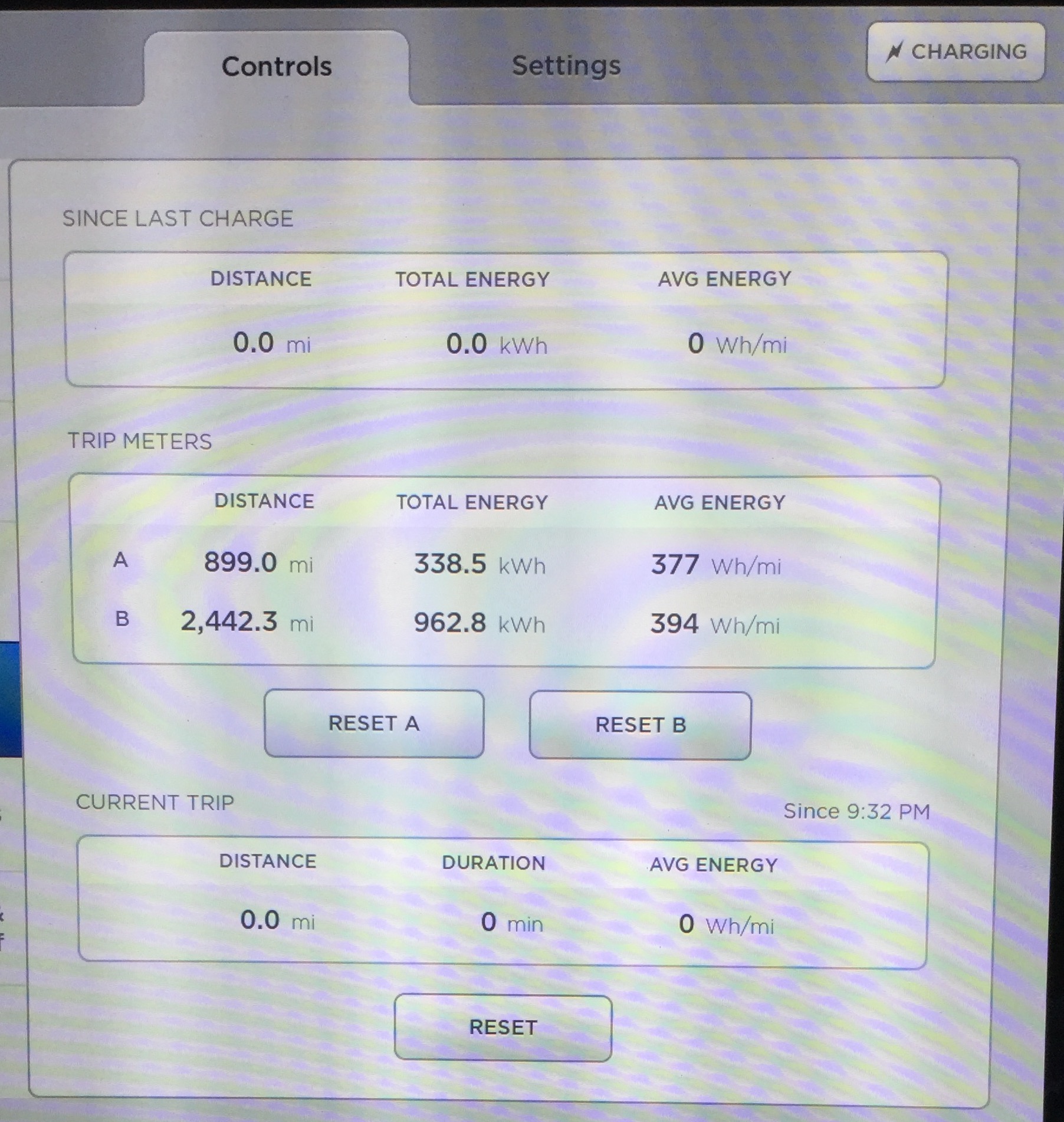
These numbers are about as worst case as I could imagine.
New tires
600 miles loaded heavy
Almost all miles run at 70 to 80 mph
1500 miles in below freezing temps
at least twenty test drives each with several Ludicrous full power runs.
Lifetime (15,000 miles) on my P85D is 352 Wh/mi. 90% highway including running the same trip in the summer I just finished in the winter in the new X.
I expect the X to average out a little higher than the P85D on staggered 21's. Based on my runs I anticipate for my Southwest freeway driving it will settle in between 355 and 365. My wife who will be primarily driving city will likely produce better numbers than my lead foot highway runs have produced.
I will let you know in 12 months if I am close on my projection.
Sorry I am not a detailed record keeper. To busy Roaming.�
Jan 13, 2016
Gzrgmr Thanks for the info. This is the best that I have seen on TMC so far. Just got notified for final payment and should be picking up mine soon. We have hills in SC but our weather is more moderate. I just hope that I can come close to your Wh/mi !�
Jan 13, 2016
Roamer Think about it before you get excited and make the final payment. I received the email on my Sig Order 594 VIN 8XX on Dec 12th. When I ordered model S cars that meant imminent delivery. So I just wired the funds. 30 days later and I still don't have a delivery date. A week later my lower reservation lower VIN car billed. Hope springs eternal and I wired the funds for that car also. Two weeks later that one delivered. So my experience is that, unlike buying an S, when buying an X getting the please pay email does not mean anything.�
Jan 16, 2016
Craig-Y Roamer! Thanks for the great information and suggestions. I'm really looking forward to getting my X and I will do as you suggest until it learns my habits. Thanks again!�
Jan 18, 2016
vangogh The X is my first Tesla and I'd like to get an idea of range reduction on different driving conditions.....
I've seen on the forum how towing a 5000lb boat can reduce the range significantly...
When I took a 75 mile trip with the same starting and finishing elevation it showed I had used close too 100 "miles" of battery charge.
Conditions - No climate control, internet engaged, Autopilot (w/o ludicrous mode not engaged) at 65 almost the entire time w/o much traffic, light rain
Can you let me know if this is normal for the S (or X if anyone has any information)...and how is % range impacted by the following based on windless flat 65mph driving
Driving Speed + 10mph
Driving Speed - 10mph
Driving Speed - 30mph
Headwind +10mph
Tailwind +10mph
Rain
Elevation Change from start to finish over full range +1000 feet
Elevation Change from start to finish over full range - 1000 feet
Elevation Change from Start to finish over full range +5000 feet
Elevation Change from start to finish over full range - 5000 feet
Ludicrous acceleration
Thanks�
Jan 18, 2016
scottf200 Model S Efficiency and Range | Tesla Motors
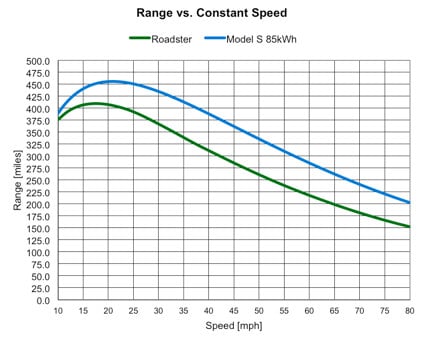 �
�
Jan 19, 2016
vangogh Thanks @scottf200...
I'm going to need to continue to watch my range....
Initial indications are noticably lower than the 250 range desired...
could be new tires, cold weather, rain etc....but need more data�
Jan 20, 2016
CO2CLEAN If you would like to get around 250 miles of range, you need to get the energy consumption around 312 Wh/mile. If i'm not mistaken, i have read somewhere else on the forum that the 90 kWh battery has around 78 kWh of usable energy. The rest is buffer to prevent bricking and such.�
Jan 20, 2016
aesculus I am new to the whole BEV/Tesla thing. I have heard of people needing to get towed in when they ran out of juice. This is the first I heard you can brick the car though.�
Jan 20, 2016
Vizir The battery is under warranty even if user error causes the damage.�
Jan 20, 2016
pvogel You can't brick it. That's the point. 90kWh battery is considered 'discharged' to zero and the car stops and makes you get it towed after 78kWH usage, leaving about 15% capacity remaining. Warnings probably start at 25% capacity remaining or earlier depending on how far you are from available charge facilities.
Discharging a Lithium battery to zero does permanent damage and significantly increases the internal resistance of the battery, reducing lifespan, reducing battery capacity prematurely and making the battery run hotter both when it is charged as well as discharged, increasing the power needed to keep the pack cooled.
It's a very vicious cycle once begun. No competently designed EV or hybrid would allow the SOC on the battery to drop below 10% remaining.
Peter+�
Jan 20, 2016
JRod0802 Just thought I'd point out this Model S thread that has a lot of useful info. Maybe some crosses over to X:
Putting some numbers on the factors that affect range
Here's a graph that shows range vs speed both with and without the heater on (for the Model S):
View attachment 15408
As you can see from the graph, if traveling at a constant 10mph, you actually spend roughly three times as much energy running the heater as you do driving the car. So that's interesting.�
Jan 21, 2016
dirkhh It boggles the mind that it is legal to advertise this as a 90kWh battery, though. That's like saying a car has 691hp when it only has 463hp. OK, bad example.
That's like selling one gallon jugs of milk that only allow you to pour out 111oz. A 12-pack of eggs with only 10.4 eggs. A six pack of beer with 5.2 bottles.
As a consumer, if I buy a 90kWh car I think it's a reasonable assumption that the battery (at least when new) can deliver between 89.5 and 90.4 kWh.�
Jan 21, 2016
CO2CLEAN I disagree, since you cannot (without damaging) deplete the battery. That is considered common knowledge. However i do think it would be a good idea for Tesla to communicate more details about the battery and its characteristics. For example: explaining that not all the battery capacity can be used and why this has a positive effect on the battery degradation (in that the degradation is less).
EDIT:
Just like it is bad to drive the gastank emtpy. It is possible, but has a negative effect on the engine (some sludge from the bottom of the tank will get in the engine). There is no protection for gasoline/diesel cars.
That is why we have the range tests from the EPA that will provide some insight in the range that is possible with the battery. Just like with gasoline/diesel cars however these tests are too optimistic.�
Jan 21, 2016
McRat If you take apart an EV battery, and count the cells and record the wH, that's the size. That's how much battery you purchased. Range is what you are actually looking for though.
Think of it like claiming a car has 400HP but when you put it on a chassis dyno, it only shows 350rwhp. Did the mfr lie? No. Actually, the engine is probably more than 400HP in reality per SAE method.
There are advantages of having a larger battery that aren't always obviously. It can handle higher discharge rates, and higher charge rates. It will have more "miles" available before replacement.
Example:
Let's say you want 50kWh usable. You have two packs with the same cells, one has more cells though. One pack is comprised of 75kWh of cells the other 60kWh of cells. The 75kWh battery is capable of 25% more HP output, and 25% more amps at charging (25% faster). The 75kWh will normally last 25% more miles.
If you advertise both cars at 50 kWh, it's not the whole story of what you're buying.�
Jan 21, 2016
vandacca Maybe it's more like buying a 64Gig Phone, where only 52.8Gig are free to the user and the rest is for the OS?�
Jan 21, 2016
ohmman A 50 amp circuit...�
Jan 21, 2016
aesculus I think this is exactly that. But they should state the useful wattage. Aircraft have a similar issue. They carry so much fuel but a lesser amount is actually useful (ie it will get to the engine).�
Jan 21, 2016
dwebb66 How many people a) can or b) would care to convert the battery size (max or actual usable) into something that would have meaning in their daily lives?
for example Charging time or Range
Using the 'marketing' number is fine for me.
�
Jan 24, 2016
inacubenearby Practical mileage on a single charge for a model x p90d
between 1580 carroll drive nw 30318 and 298 mcintosh circle hayesville nc 28904�
Jan 29, 2016
O-G Does anyone know, if you drive normally in ludicrous mode, does it use more energy than driving normally in sport mode? I'm still struggling with the actual power consumption in the MX versus the rated range. I was assuming the ludicrous mode would take more power only when demanded but maybe that's wrong.�
Jan 29, 2016
MikeL Driving "normally" in L should deliver same range. In fact, the only difference between P and non is the extra weight of the rear motor and the bigger inverter. So you should really get the same range as a 90D. EXCEPT! for the fact that you are a human being and the constant little inputs to the car from your brain and muscles (and hauling that extra weight up every hill) that you just can't help. Theoretically same, try it, let us know how it goes. :smile:�
Feb 1, 2016
O-G Took a road trip this weekend. Still can't quite figure out the range. Traveled about 150 miles each way. On the way there, consumption was 454 w/mile. On the way back, 390. Same route, Seattle to Portland. I don't think there is a big elevation change. Roughly the same outside temp. Same load in the car. Same settings. Don't know how there can be that much difference.
Edit: Forgot to mention, did 74 MPH in the 70 zones which is probably 70% of the freeway miles. Did 67 MPH in the remaining 60 zones. Same speeds both ways. 22" wheels.�
Feb 1, 2016
Blurry_Eyed Might be tires breaking in a bit more as well. What's the mileage on your X now? We have about 1,500 miles on it and it does seem as if the range is improving a bit as the tires get some miles on them.�
Feb 1, 2016
gregincal Wind speed is often the biggest factor in mystery energy consumption changes. If the windspeed is 10 mph that's a pretty light wind you wouldn't take much notice of, but at 74 mph a 10 mph headwind will make you consume energy like you are going 84 mph, which is a huge difference.�
Feb 1, 2016
Cottonwood Exactly!
The other way, with the tail wind, it is equivalent to 64 mph wind. The difference between 84 mph and 64 mph wind resistance is very large. The aerodynamic portion of the drag at 84 mph is almost twice as much as the aerodynamic drag at 64 mph aerodynamic drag scales as the square of airspeed.�
Feb 1, 2016
O-G Im at about 1500 miles myself. Do you have 22" or 20" wheels. The tesla rep told me the 22's could cost me 10-20 miles per charge. I can't get even close to the 300w/m rated range. Since inception, I'm about 420. That's a big difference.�
Feb 2, 2016
vangogh And don't try to go over 110mph...uses over 600w/m....even with the 20" wheels : )�
Feb 2, 2016
yobigd20 who ever said rated range on the X would be 300Wh/mi?? I would expect it to be closer to 360-370Wh/mi based on how much heavier it is and less aerodynamic than the S.�
Feb 2, 2016
O-G The whole system is still based on that rated range. So... When I start in the morning at 90% charge and it says 227 miles, I'm really not even close to that. 180 is probably a realistic range. If I charge to 100%, it says 248 miles but 200 is probably real. That's quite a difference. I'm planning a trip with 6 people and full luggage. Going through some mountains. I'm not even sure if we can make it between superchargers.�
Feb 2, 2016
pvogel The Model X P90D has a rated range of 250 miles, and a 90kWh pack, that puts rated average consumption at 360Wh/mile. Far from the 300 you are quoting, which is about the rated average consumption of a Model S�
Feb 2, 2016
ohmman That 90kWh pack isn't fully usable, as your math suggests. Even if it is a 90kWh pack (recent thread implies that maybe the packs aren't exactly as denoted), you're still going to have reserve capacity that isn't usable. It's definitely higher than 300Wh/mile, though - maybe more like 340-345.�
Feb 2, 2016
pvogel Good point! Derating the pack by 5% gets you to 85,500Wh, dividing by 250 you come to 342Wh/mile.�
Feb 3, 2016
Cottonwood Several posts have shown that the usable energy in the 85 kWh pack is 77 kWh. As a crude approximation, add 5 kWh to that for the 90 pack. That gives 82 kWh. 82 kWh / 250 rated miles gives 328 Wh/mi.
A better test is to do a drive of over 100 miles without stopping. You need over 100 miles to reduced the quantization noise caused by rated miles only being displayed in whole numbers. Record the rated miles at the beginning and that the end, along with the actual miles driven. Then do the normalization calculation:
Wh/Rated Mile = Actual Wh/mi * Actual miles driven / Rated miles used?
When I did this many times on my new P85 3 years ago, I got an average of 290 Wh/rated mile. That is remarkably close to 77 kWh/265 rated mile; when new, my P85 had 265 rated miles on a 100% charge.
BTW, those calculations are for Wh/rated mile out of the battery. As an example, the rough numbers for other situations on the original 85 Model S are below.
- 290 Wh/mi � Energy out of the battery while driving.
- 300 Wh/mi � DC Energy into the battery, such as at a Supercharger. About 3.3% charge/discharge loss.
- 333 Wh/mi � AC energy into the battery, such as AC charging at home. About a 10% loss in the AC chargers.
I assume that they would all scale for the Model X. If 328 Wh/rated mile is the correct number, then the other values would be:
- 328 Wh/mi � Energy out of the battery while driving.
- 339 Wh/mi � DC Energy into the battery, such as at a Supercharger. About 3.3% charge/discharge loss.
- 377 Wh/mi � AC energy into the battery, such as AC charging at home. About a 10% loss in the AC chargers.
Feb 3, 2016
AnOutsider i haven't done anywhere near that in driving, but I haven't been able to break the 400 mark either. The X does have 22's�
Feb 5, 2016
Fonguy Maybe another way to think about this is that, if there are about 80 kWh available with the 90 kWh pack and 257 rated miles for the X90D, the official ratio is about 80,000/257= about 311 wh/rated mile. Looking at it another way, the X is supposed to be about 4 % heavier than the S. Rolling friction for the S is worth about 140 wh/mile. Rolling friction is proportional to weight. Therefore the X should consume about 146 wh/mile due to rolling friction. The aerodynamic drag or air friction for the S accounts for about 180 wh/mile at 65 mph. The X has about the same drag coefficient as the S but a bigger cross-section, maybe 10% or about 200 wh/mile? The total energy used by the X at 65 mph then should be in the area of 345-350 wh/mile, about 9% more than the S. The average consumption for the S per rated mile is about 280 wh/mile so the comparable figure for the X ought to be about 305 wh per rated mile. This compares reasonably well to the official 311 number, if the 80 kWh availability is about right, considering the approximations and guesswork involved.�
Feb 7, 2016
vangogh After making many trips....I now know with my driving habits I will never get anywhere neat 250miles on a charge....
I'm planning for a max run of 150 miles (never charging above 240 and never dropping below 30)...�
Feb 7, 2016
ptsagcy Wow - that's disappointing. Is it because you drive fast, in hilly terrain, cold weather, new tires not broken in? I'm planning a couple of trips from NJ to Richmond and to Orlando in March and April. They will be a good test. I'm sure hoping for better than that. We'll see. �
�
Feb 7, 2016
Lyon At least you know it's you and not the car.�
Feb 7, 2016
ratsbew Keep it to the speed limit and you should be fine. It's better to arrive 5 minutes later than to embarrass yourself with a depleted battery.�
Feb 8, 2016
FlasherZ On the way home from the service center, my wife drove the speed limit on a nice, 55 degree day and managed to get about rated mileage. That's not *too* bad, considering what winter performance is usually like. Prior to 7.0, my Model S average in summer was 300, and 355 in winter, an average of 320 overall.
When I'm in the Model X, I can't get under 400 yet - but then again, I've only driven her on days that are 35ish degrees.
20" wheels on ours. Range mode off (although I'm trying with range mode on now to see if there's any difference).
Keep in mind I come from a single-motor P85, so range mode doesn't really do much for me in the Model S other than keep the climate control from working fully.�
Feb 8, 2016
Cosmacelf I have found that when I drive my Model X in San Diego (which seemingly doesn't have a 500' stretch that isn't uphill or downhill) I use a lot more power than when I'm diving in the desert on flat land.�
Feb 8, 2016
TarHeelModelX What's your estimated City/Highway usage? 500/370?�
Feb 14, 2016
mikevbf A nice data point from the dragtimes article:
"One interesting data point we obtained during the 65 mile trip to the supercharger was the energy used by both cars. At around 75 MPH the Model X consumed 28.3 kWh (Avg 440 Wh/mi) while the Model S used 22.7 kWh (Avg 349 Wh/mi). This is quite a difference showing how the extra weight of the X can effect range and energy usage."
Both cars are P90D's with ludicrous.�
Feb 14, 2016
Cottonwood Interesting data, but for a highway drive like this, the difference is most likely the difference in frontal areas rather than a difference in weights.�
Feb 14, 2016
AlMc 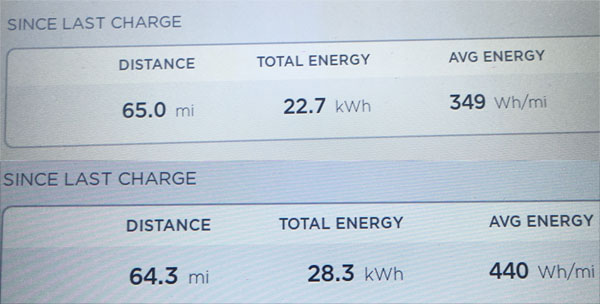
Yes. Best comparison I have seen so far. Similar speeds/same driving conditions and similar (same) drivetrains.�
Feb 14, 2016
WarpedOne Their X has newer and wider tires with considerably higher rolling resistance.�
Feb 14, 2016
AlMc If everyone gets 25-30% less than the same S motor configuratiuon would get, then I agree. ^^�
Feb 14, 2016
LargeHamCollider +1.�
Feb 14, 2016
AlMc Whatever the cause. This is fairly significant...Would you not all agree?�
Feb 14, 2016
satheesh.net
I'm just curious, who drove the Model X during the trip? Maybe @fiksegts can answer that. I know from personal experiences that I tend to drive more economical over a longer period of stretch if I know I want to test the range. But others might just use their right foot a little extra now and then.�
Feb 14, 2016
FarmerDave We can't really know how they were driven w/o seeing the energy usage chart. I'm seeing similar average energy numbers in my X, but have not had a long flat run for comparison. It seems that the glaciers long ago piled alluvial soil in lots of mounds and carved small mountains that make my energy usage chart look like a California seismograph.�
Feb 14, 2016
AlMc IIRC: The wife drove the X and her husband the S. They drove them from location 'A' (their home I assume) to the race track covering identical roads at the same time and speed.
Here is the link: https://forums.teslamotors.com/forum/forums/tesla-model-x-vs-model-s-p90d-ludicrous-%E2%80%93-world-record-set-during-husband-vs-wife-drag�
Feb 14, 2016
satheesh.net Right, so could it be that she didn't dedicate herself to drive as economical as possible? That said, it could also be that he didn't do it in the Model S as well. I'm not saying that the X could ever meet the S' range and energy usage, but maybe we could see closer values if both parties where on the same page while driving.�
Feb 14, 2016
AlMc I would also like to see some more quality side by side tests. To my knowledge this is the best, yet 'not perfectly objective/scientific' one, I have seen.
@Flasher: You got anything?�
Feb 14, 2016
aesculus The video states they topped off the cars at the same place and time which the image seems to show. Yes she could have really punched it for the 65 miles but ???
I think Roamer is the only one I know who has gone sub 400 kw/mi in his car and that was after quite a few miles of break in.
We have seen estimates that to get the 250 miles of range you will have to come in around 330 kw/mi or so on a P.�
Feb 15, 2016
FlasherZ The only thing I have right now is a data point from the delivery drive home and it wasn't measured with enough rigor for me to feel comfortable with it. My wife drove the X loaded with my family, and a good friend drove the S (RWD P85 Sig). My wife babied the X the whole way, and was being followed (same roads - lanes - etc.) in the S. I believe the numbers were 290 Wh/mi in the S, and 350ish in the X. That would place them both right at rated mileage under the same conditions.
At some point in the not-so-distant future, perhaps I'll encourage my wife to come out with me and do a side-by-side.�
Feb 17, 2016
O-G I just took a long road trip from Tacoma, WA to Ashland, OR. Roughly 425 miles each way. Six people in the car with light luggage for 3 days but the car was pretty much maxed out for space. I had to use every supercharger on the route. Terrible weather on the way down, (someone told me that rain decreases your range, not sure if that is true). Better weather on the way back. On the way down, I was 450 w/m. On the way back, I was 380 w/m. I wasn't sure that I would make it on the longest leg of 135 miles between stations. 2500 miles on the car so far and the average is 425 w/m. I can't come close to the rated 320 w/m. I think the realistic range is 150-175 miles per charge at 90%.
I'm really disappointed by this. It puts me on the edge of my daily driving for work. I'm going to have to install a HPWC at my office location for those times that I travel to my furthest business. It's significantly less range than the MS. I'd like to hear from anyone else if there is something I can do differently. Most of my miles are on the freeway at 65 mph which doesn't seem to me to be an excessive speed.�
Feb 17, 2016
AlMc You running on the 22s? The all season 20s are reported to get 10%+ better mileage.�
Feb 17, 2016
ohmman Rain and wind (and I suppose elevation) are your biggest uncontrollable enemies. Rain makes a very big difference - it's physics and it's a fact.
You've certainly got me concerned. That's a very high average. If you compare unfavorably to other MXs (hopefully they'll chime in), you can check tire pressure, alignment, and most certainly schedule a service appointment. 425 is, in my view, unacceptable. I average 296 in my MS over 30k miles with lots of varied road trip terrain and weather.�
Feb 17, 2016
AlMc This would be really bad for the 70Ds..........�
Feb 18, 2016
vandacca Roamer posted that he was getting 400+ w/m initially, but that it dropped well below 400 w/m after the tires/tyres were worn in. How many miles have you done on those tires?
Also, I assume that having 6 people in the car loaded with luggage is also going to reduce your w/m. When driving to work, do you car pool with 5 other people? If not, you should expect much better range, especially after the tires have worn in.�
Feb 18, 2016
ohmman I just put new tires on my MS and haven't had to 'break them in'. My consumption is exactly where it was prior to their installation. Seems like Roamer maybe had something else affecting early range. Has anyone else had to 'break in' their tires?�
Feb 18, 2016
vandacca Maybe that is the reason why Tesla switched from the All-Season to the Summer tires?�
Feb 18, 2016
ItsNotAboutTheMoney How have temperature, rain and climate control use been over all of your miles?
What wheel size do you have? Larger wheels are less efficient. Tires themselves also have an impact.
What tire pressures do you use? Tire pressures affect rolling resistance and so can make a noticeable difference with heavier vehicles.
What's the terrain like on your drives? Gravity has a significant effect for heavy vehicles.
65 mph isn't excessive speed, but it faster than the EPA testing average. And if you're actually not doing a steady 65mph, but TACCing a lot, that'll increase the amount of acceleration you're doing and that'll exacerbate the energy use.�
Feb 18, 2016
Fonguy
With the added, maybe 800 pounds of passengers and cargo, the rolling friction energy is bumped by 15% and it is already 10% more than the S. So that's about 26% more than roughly 140 wh/mile. That's almost 180 wh/mile to begin with. Add maybe 20% more wind resistance that could give up to about 220 wh/mile at 65 mph for a total of 400. If you had hilly terrain, rain, higher speed, 440 is not out of the ballpark.�
Feb 18, 2016
O-G Yes. 22s with the factory perelli tires. I wonder if a different tire would make a difference. I've had good luck with continentals in the past.�
Feb 18, 2016
scottf200 Pretty considerable if you look at various references.
Via: Expect Lower Mileage When It Rains | Frugal Driver
Via: Effect of wet roads on efficiency: estimated 14.5% MPG drop - Fuel Economy, Hypermiling, EcoModding News and Forum - EcoModder.com�
Feb 18, 2016
O-G Rain, wind, etc is the norm. In Washington, that's what we have all the time. Bottom line, I'm not the millionaire buying this car to sit in a showroom. I drive close to 100 miles daily and often get to the 200 miles in a day. That's part of what made the economics of this car make sense. If I'm limited to 150-175 miles and sweating if it's a windy or rainy day and can I make it home, it just doesn't work. 250 miles on a 100% charge, 225 on a standard 90% charge, these worked. Anticipating days with only 150 range doesn't work. Has anyone else worked with tesla on this issue?�
Feb 18, 2016
ohmman I strongly recommend you talk to them. It's a valid complaint and it should be at least assessed. I know they're shipping the new MXs with summer tires. You may consider that (should be fine in Tacoma year round). They may also encourage you to adopt 20" wheels, which I'd suggest anyway. Hopefully they'll do that free of charge..�
Feb 18, 2016
LargeHamCollider O-G, in your situation you really should go with the 20" wheels, also new car energy usage is 5% higher per JB.�
Feb 18, 2016
AlMc As others have suggested, talk to TM...but definitely go with 20" wheel/tire set...and realize that on those rare 200 mile days you may have to plan a charge along the way or drive at 55-60mph on the highways.�
Feb 18, 2016
MikeL Negative. the Summer tires reduce range in exchange for improved handling - reportedly. Sorry, no link (again) check the TM X design studio.�
Feb 18, 2016
FlasherZ Perhaps *some*, but not *all*. If it's anything like the Model S ramp-up, they'll use a couple of tire brands.
Our car has the CrossContact LX's.
Driving the speed limit back from delivery in 50ish degree weather, we were able to achieve rated miles.
I haven't done any more extensive tests, but it is possible to get what you need out of it.
- - - Updated - - -
Yes, the sticky tires provide more rolling resistance.�
Feb 19, 2016
andrewket 22" or 20" wheels?�
Feb 19, 2016
AlMc Upthread he said 22".�
Feb 19, 2016
timf So far the evidence suggests that Founders & Signatures get all season tires while Production P90D gets summer tires.�
Feb 19, 2016
FlasherZ The sample size isn't all that large, so I'm just cautioning against making that assumption.�
Feb 19, 2016
andrewket It just as easily be by date, which would look like sigs and founders...�
Feb 20, 2016
Blurry_Eyed Did you have the car set to Range mode? If not, that may help you gain a few more percentage points of efficiency.�
Feb 20, 2016
FlasherZ Yesterday was the first reasonable day that we've had since delivery temperature-wise... At 60 degrees all day, my wife achieved rated range (right at 340 Wh/mi) on a 100 mile trip to St. Louis and back - a mixture of state highways, Interstate highways, and city driving. It looks like there may be a bigger "winter penalty" to Model X than Model S, which makes sense because it's a bigger vehicle. As for spring/summer/autumn, it's looking like we'll be comfortable with the range.�
Feb 20, 2016
pvogel Yep. Remember. Colder air is significantly more sense than warm air, so a larger cross section with the same Cd in cold air will carry a larger penalty for thrust necessary to overcome drag.�
Feb 20, 2016
FlasherZ I knew all of that, but I didn't realize the delta between winter-summer was going to be *that much* significantly larger for Model X vs. Model S. We rather liked the ability to skip every other supercharger on our long trips in the S - not sure we can do that in the X.�
Feb 20, 2016
AlMc Thanks for that data point. :wink:�
Feb 20, 2016
ohmman Thanks. This provides a little relief - I'm hoping with my 90D+20s, I will be able to achieve similar results. Regarding skipping Superchargers, it is nice sometimes (especially if you have a longish meal at one and leave with a high SOC). Still, you can take solace in the fact that stopping at each SC should theoretically get you "there" sooner..�
Feb 20, 2016
O-G What makes you believe the rated range to be 340 Wh/mi? I was under the impression it is closer to 300. 314 sticks in my mind but I'm not sure now where I got that from. If I extrapolate actual miles and Wh/mi versus what I think is rated, it seems like the math works at the 300 level or so.�
Feb 20, 2016
aesculus I would think it's more about cabin heating and the heating of the battery. But what do I know. I don't even have 1 mile of experience with a Tesla yet. I just read the info on these forums.:wink:�
Feb 20, 2016
ohmman FlasherZ might have better math than this, but..
Assuming about 7% reserve capacity:
(0.93 * 90000Wh) / 250 mi EPA range = 334.8Wh/mi
The lower the estimated reserve, the lower the rated consumption obviously.�
Feb 20, 2016
FlasherZ Definitely not 300. Here's the graph:
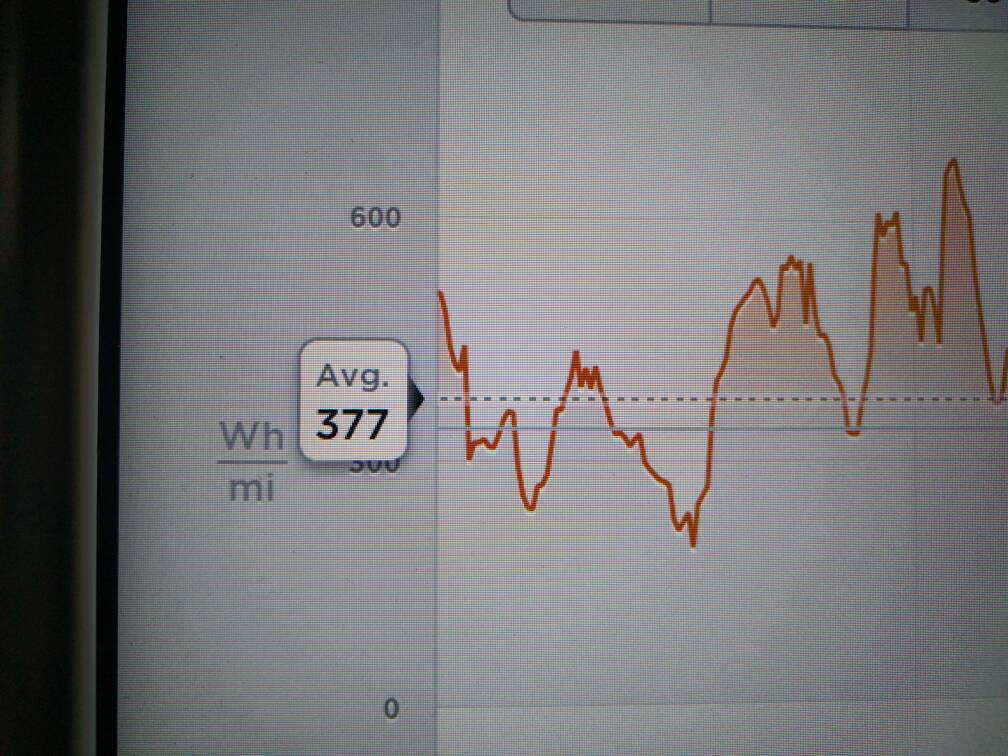
Note the rated line is a bit more than halfway between 300 and my average of 377 (don't judge, we were having fun today). That's about 340ish.�
Feb 20, 2016
aesculus What were those events that you have that are well below rated? You coming off of a mountain?�
Feb 20, 2016
O-G Does Tesla state the number for any models? Since everything seems to be based on this number, it's seems that it should be a known number. We should not be estimating based upon the lines on a graph. How does this factor into the trip system calculator?�
Feb 21, 2016
FlasherZ I live in an area that's littered with small villages along a state highway. What you see is 55 mph speed limit out of town and allowing for 35 mph in town.�
Feb 21, 2016
FlasherZ That's fine if you want 342 vs. 346, but I think lines on the graph is sufficient for knowing 340 vs. 300.�
Feb 21, 2016
O-G I just thought that since there is a line on the graph, Tesla must know the exact number. Seems like they would share it. I'll ask.�
Feb 21, 2016
FlasherZ They haven't been willing to share the Model S number, although it's been fairly easy to figure out with enough data samples.�
Feb 22, 2016
PGeer Just for another comparison, we picked up our X in Seattle and drove via Tacoma back to Port Townsend--about 120 miles. We had the heaviest rain I can remember. Two of us in car. I averaged 60 most of the way. Got home with average 385 wh/m. I was quite pleased. (20" wheels.) BTW - somehow I refrained from flooring it that whole first trip. Based on our Leaf and all other posts, single biggest factor is average speed. We're about to head down to Phoenix for a two week trip and will report averages.�
Feb 22, 2016
ohmman Agreed. Driving style also plays in - my wife and I seem to achieve different efficiency on longer trips. I find that keeping the energy consumption and regen within a tighter band makes a measurable difference, especially when there are hills involved.�
Feb 22, 2016
EcoHeliGuy Your mileage is very similar to what the model S was getting while towing, considering your reporting heavy loads in a vehicle that has a larger frontal area. Your getting exactly what I would expect and well within range of accessing supercharger distance.�
Feb 25, 2016
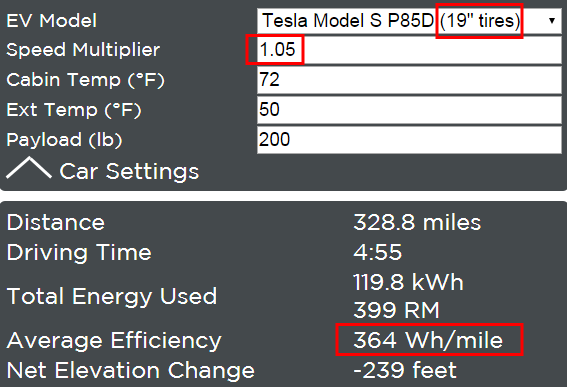
scottf200 ?Apologies if this has been discussed and I missed it but we are planning our first short road trip. I'm using EVtripplanner. Anyone figure out what options they like best. I was trying to decide on equivalent "S" drop down option of 19" or 21" and a speed multiplier that would give me a realistic "Wh/mile" estimated value for good planning. I realize there is more drag on the X vs S. As well HVAC (heat more so than A/C) has a pretty big impact. I was looking to see if other real-world users of this tool had suggestions.
Here's a couple I was thinking of:
Image: http://i.imgur.com/IYg07WX.png
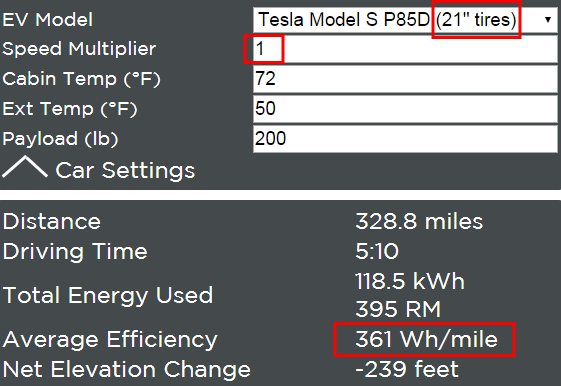
Image: http://i.imgur.com/ujIkD3M.png
From EVTripPlanner Help tab:
How It Works
EVTripPlanner uses a physics-based model to predict how much energy your EV will use along your route. It accounts for:
- Speed: this is usually the biggest contributor to variation in energy usage. We use Google Map's traffic-based estimate of current speed, which you can adjust up or down with the 'Speed Factor'.
- Air density: this varies with temperature and altitude. The same level-road trip at a higher altitude takes less energy than at sea level since the air is thinner. Similarly, the same trip (without air conditioning or heating) takes less energy when it is hotter since the air is thinner. We determine altitude over the route using the Mapquest database and use your input for temperature.
- HVAC: the heater and air conditioner, as well as any energy required to heat or cool the battery pack, use energy...even when you're not moving. We look at your cabin temperature setting and your estimate of the outside temperature.
- On-board Systems: the computers and other on-board systems use energy, even when the car isn't moving.
- Weight & Elevation Changes: the weight of the car and payload (entered) are used along with elevation changes along the route to determine energy used climbing...and recovered during downhills.
- Friction, efficiency, regeneration: each EV converts electrical energy in the battery to mechanical energy at the wheels a little differently (and vice-versa). We account for these conversions and differences.
- Your Car Model: each car has different parameters for how they use energy in the categories above. EVTripPlanner takes the best data available to match our model to the actual measurements and published charts.
Trip Settings
Setting the parameters for your trip is critical to getting an accurate estimate of the energy that will be consumed. The most important setting is your "speed factor", which is how much faster or slower than the prevailing speed
Setting the parameters for your trip is critical to getting an accurate estimate of the energy that will be consumed. The most important setting is your "speed factor", which is how much faster or slower than the prevailing speed (as estimated by Google Maps at the time of planning the route) you are going on average. Unfortunately, you can drive in different patterns and have the same average speed while consuming different amounts of energy. While these errors don't tend to be very large for long trips, the closer to "cruise control" you are at the average speed on long segments the closer the estimate will be. Also fill in payload, outside and cabin temperatures and your correct car model - these can make a significant difference.�

Không có nhận xét nào:
Đăng nhận xét