Sep 11, 2014
AEdennis Copying a post that I did to reply to Kevin Sharpe's battery degradation thread and to fork out warranty issues on this thread rather than encumber Kevin's particular case. (as was suggested by Bonnie.).
In order to be more accurate in representation of what I believe the user community should be asking of Tesla and to expound on concepts that I wrote on a post in my blog.
Clarification for each iteration of the battery helps purchasers understand their responsibilities better. Tesla's Model S Infinite Warranty made great headlines, however it was somewhat misleading with regard to degradation and it's exclusion with regard to the Model S.
[Begin a somewhat reiteration of the post from Kevin Sharpe's thread.]
Guys. I think it doesn't really matter to most of us the specifics of Kevin's car or case. What should matter is that Tesla should specify with regard to the Model S and future batteries, Model X, Model 3, AND the purported 400 mile battery an actual expected degradation.
Furthermore, I would like it if they would provide some warranty based upon that guideline for replacement under warranty AND a price list if the customer wishes to get a pack that is "newer" or refurbished to a higher capacity than their own aged/degraded battery pack.
The Battery Swap demonstration over a year ago took some of these thoughts into consideration over a year ago.
Though I bought into the hype of the Infinite Mile battery warranty for my S85, I am now questioning the disingenuous nature of that marketing and it's specific exclusions. However, as an owner, if they choose not to do something about it, I'm just stuck until my car's range is "unusable". Which in my case becomes the range of a BMW i3 BEV (i.e. A very long time). [{Added after I thought about it and moved to here} However, such a range and the distance between Superchargers will render one of the reasons that I purchased a Model S somewhat moot.]
Sadly, the topic for me remains as a request for Tesla to clarify and enhance the future battery warranty AND, if possible, the Roadster Warranty for e different classes (those that are original owners who may still be under a warranty and those of us who are under the CPO warranty, as well as those that are no longer warranted).�
Sep 12, 2014
Matias As a clarification to new readers, Tesla�s current battery warranty specifically denies covering any range degeneration;
�The Battery, like all lithium-ion batteries, will experience gradual energy or power loss with time and
use. Loss of Battery energy or power over time or due to or resulting from Battery usage, is NOT
covered under this Battery Limited Warranty.�
Source http://www.teslamotors.com/sites/default/files/blog_attachments/model_s_quick_guide_-_na_rev_d_for_web.pdf
Page 34
In the long run they are forced to give exact limit to normal degeneration, if they want to sell Gen 3 to mass market. Mass market won�t buy it, if Tesla does not tell them, what degradation entitles warranty replacement. I�m positive Tesla will eventually do this, because it is the only way to sell Gen 3 to mass market. Class action jurists would have a ball, if Tesla would try to tell customers �this is normal degradation� without defining what is normal and what is not
Limit can be adjusted so, that only few percent will be entitled to warranty replacement. Even with that kind of limit, it is reassuring to buyers, because they know, that if battery capacity drops below certain threshold in certain mileage, they get new pack.�
Sep 12, 2014
spaceballs I believe all EV manufactures should have a simple battery warranty chart like this.
*Numbers are made up.
Any battery number that the customer matches the year and mileage and if their battery % is below that, then their battery will be replaced under warranty.
Year(s) Miles
10k 20k 30k 40k 50k 60k 70k 90k 100k 1 95% 90% 85% 80% 75% 70% 65% 60% 55% 2 92% 87% 82% 77% 72% 67% 62% 57% 52% 3 89% 84% 79% 74% 69% 64% 59% 54% 49% 4 86% 81% 76% 71% 66% 61% 56% 51% 46% 5 83% 78% 73% 68% 63% 58% 53% 48% 43% 6 80% 75% 70% 65% 60% 55% 50% 45% 40% 7 77% 72% 67% 62% 57% 52% 47% 42% 37% 8 74% 69% 64% 59% 54% 49% 44% 39% 34% 9 71% 66% 61% 56% 51% 46% 41% 36% 31% �
Sep 12, 2014
ch_model_s ok one more time. tesla cant give a warranty like Nissan, or BMW does with the current setting of the model s.
This manufacturers can only give such warranties because their vehicles have all the same initial position in every country and for every customer.
for example:
1. You cant choose the charge level in a BMW I3. BMW set a fixed level and they calculated the battery life exactly with this SOC level. 100% is more likely 80-90% of the available capacity to improve the battery live. Tesla must change this also to an fixed SOC level or they say you can charge x many times over 90% in a year.
2. A german Model S which is always driven on the autobahn at top speed sees the limiter all the time. So this battery gets much more stressed. Google for cycle life test for 18650 cells with different discharge rates and you see a big difference.
BMW and Nissan solve this problem with a much lower top speed. If a I3 is driven at 75mph in the USA or at 93 mph in Germany the difference in battery life is not that big.
So Tesla has to lower the top speed or give a german Model S a crappy warranty.�
Sep 12, 2014
Matias So you believe it is better for consumers that tesla does not give any warranty regarding battery degradation?
Concerning autobahn driving, Tesla sells cars in Germany. German consumer has right to expect, that car can be used in autobahn speeds without harm to car. If that is not the case, Tesla should tell this.�
Sep 12, 2014
ch_model_s nope. i just give you some points why its hard for tesla to give such a battery warranty. I would be much easier for the customer when there is only one charge setting (90%) and a lower top speed but a warranty that covers battery degradation. Tesla just cant go back and change all this thats why i dont think this gone happen with the model s. maybe it changes with the model 3.�
Sep 12, 2014
Matias That depends of what happens, when enough people with Model S think they are entitled to battery replacement and Tesla tells they are not.
Of course with any type of warranty there will always be customers who feel that they are entitled to something that they according to warranty terms are not.
But whether Tesla will retroactively give Model S degradation warranty depends of the PR situation.
It is not long ago that Tesla decided to give extended drive train warranty when they noticed, that drive train replacement worries were starting to harm Tesla�s reputation�
Sep 12, 2014
Kevin Sharpe Just to emphasis the importance of battery warranty concerns we have two "consumer advocacy" programmes in the UK who will cover the story in the next few days.
The first is on BBC Radio 4 at 12:15 today and has an audience of 3.5 million people...
http://www.bbc.co.uk/programmes/b04gcdt8�
Sep 12, 2014
Chickenlittle Extensive discussion in roadster section of TMC. To put into perspective after years of use less than 20% reduction with an owner that has a long commute and now believes his car is unusable. There were even suggestion in that thread he should drive it especially hard to further degrade battery to strengthen his case for free replacement. I don't know any way to determine how a battery has been "treated" during the life of a car (extensive range charging, running down, extensive performance use, track use all known to hurt the first generation battery packs in roadster). He has been making his demands through an extensive campaign via TMC, twitter and now press. Many here have used the term Brodered, I think we now have the term Sharped to define this tactic. I am not speaking about the man, just his tactic.�
Sep 12, 2014
Kevin Sharpe We are trying to discuss important issues about Tesla's battery degradation warranty (see OP). We will get nowhere if your response is to start a personal hate campaign.�
Sep 12, 2014
CatB I thought there was a battery replacement plan, whereby you could sign up to buy replacement battery in 10 years or $12K, if you waited 11 years, price would go down to $11K, etc. That seemed fair to me - if I wear the battery out slower, I can save money by holding off on replacement. Was that just a rumor? or was it documented anywhere? Won't help Kevin with his Roadster, although the new 400mi battery seems like it should work for him even better.�
Sep 12, 2014
NigelM This thread isn't going to be very helpful if you just start rehashing your campaign here.�
Sep 12, 2014
ItsNotAboutTheMoney Right, I expect something like that. They can low-ball the numbers, just like Nissan.
Part of the problem is that every release has a new battery and if something goes "Honda Civic Hybrid" they don't want to end up footing a huge bill.
For Roadster owners, I expect Tesla to replace dead packs with new packs software limited to partial distance (with the option of purchase), and then to use good sheets from dead packs to replace bad sheets, until eventually they're just replacing packs.�
Sep 12, 2014
Kevin Sharpe Is it possible to have a meaningful discussion without including input from consumer organisations? I'm not discussing my specific issues in this thread but both BBC and The Sunday Times are reviewing the impact on consumers and IMO that's important.�
Sep 12, 2014
NigelM Yes but we all know that you're highlighting your own case again; part of your campaign was highlighting that in the other thread, hence the reference to 3.5m people etc.
P.S. BBC radio isn't a "consumer organization".�
Sep 12, 2014
ItsNotAboutTheMoney This raises an important point. News bias is part of the reason why people are so ignorant of real trends. (I recommend the recent TED talk Hans and Ola Rosling: How not to be ignorant about the world | Talk Video | TED.com). This allows people to use the media to manipulate opinion to get things to go their way. This is why wealthy industrialists and governments love to control the media.
The ignorance and fear then leads to negative risk assessment and businesses have to try to build trust or add an insurance charge to the price of their products. I think low-balling a-la Nissan, and trying to build trust on evaluation of everything else in between is probably the best solution.�
Sep 12, 2014
Kevin Sharpe "You and Yours" is a highly respected Consumer Affairs Programme... I'm not going to argue the point but burying your head in the sand is hardly the way to encourage Tesla to produce a battery degradation warranty IMO.�
Sep 12, 2014
Chickenlittle The tactic is fair game. All the items I mentioned in the post are noted in the tesla roadster manual to reduce battery capacity yet when brought up you only say its a personal hate campaign. Not true, I don't know you and would appreciate you pointing to any posts that indicate that I "hate you". If we are talking about battery warrantee, refer to roadster section where you referred to Nissan warrantee 30% limit. Why would you get your free battery under that by being 19% down. On your long daily commute were you range charging routinely which the manual warns against or over deplete as range was a reach for you? We're you doing performance mode frequently, was the car charged to performance mode routinely? Talking about battery warrantee would be appropriate questions to ask.�
Sep 12, 2014
Matias Please, lets keep Kevin's case out of this thread. There is own thread for that.�
Sep 12, 2014
NigelM No need to get personal. The reason I didn't participate in the other thread (and I'm giving up on this one right now) is because you insist on beating down anyone who doesn't agree with you.�
Sep 12, 2014
JRP3 The problem I have with low balling is everyone is going to focus on that low number, i.e. "Tesla packs will only have 70% capacity after X years and X miles". Plus such a warranty would not have helped in the case that sparked this discussion.�
Sep 12, 2014
Kevin Sharpe Ignore my issues, it's irrelevant here... the fundamental question is what battery degradation warranty should Tesla offer with current and new products?�
Sep 12, 2014
Chickenlittle Huh. The case is about warrantee and issues it raises. First roadster battery pack is a different issue from model s. The packs are both called battery packs but are different products. Second you could not have warrantee without defining normal activity. How many range charges allowed how far could you take battery down to whatever level. He specifically used cars for long commutes that challenged range. Still doesn't say how many range charges used or whether he relied on the small reserve that is included when you run out (roadster you can recycle key to reach this reserve). I want to emphasize none of this pertains to model s battery. I have charged to 100% in that and run low and used superchargers over 23k miles with 2 mile loss of range. I think it's important to consider battery warrantee issues for different products in different threads�
Sep 12, 2014
Kevin Sharpe It has everything to do with Model S and future products. Customers are buying the Model S today with no degradation warranty believing they are covered by a "infinite mile" warranty. This is fine until we get an outlying degradation case. Once that happens who's fault is it? The customers for not reading the small print or Tesla's?�
Sep 12, 2014
JRP3 How do you know that all customers are unaware of the lack of degradation coverage? No one reads the warranty terms?
Good question. I'd like to see your answer.�
Sep 12, 2014
Kevin Sharpe I didn't say all... the point is that some do not.
- - - Updated - - -
I haven't put much thought into this but the Nissan Leaf warranty seems to be well received and might make a good model. Really depends on whether Tesla want to lead or follow.�
Sep 12, 2014
WarpedOne 70% is a good model?
Someone is trying to make Tesla shoot into their own foot.�
Sep 12, 2014
Kevin Sharpe As I said, that figure has been well received here and would give customers confidence IMO.�
Sep 12, 2014
yobigd20 well, I have 56k miles in 18 months on my MS, and I've only seen a 2-3% degredation in max range charge. So I really don't think there's anything to worry about here. The drop in range for me happened within the first 6 months. The last 12 months I've seen 0% degredation. I believe the current MS battery pack and all future tesla battary packs are so advanced and sophisticated and intentionally built with the purpose of minimizing degredation and lasting 20+ years; outside of the roadster's original battery pack this whole discussion on worrying about degredation is pointless and moot. Per the experts these packs were designed to easily last 20 years due to their chemistry and the advanced battery management system and thermal cooling. There is nothing to worry about here. This is not a Nissan Leaf. This is Tesla. And Tesla has already accounted for this in their design such that degredation will be so small by the time there's any significant degredation 20 years later they'll be battery packs out that'll cost like $20 to replace (exaggerated of course, but you get what I mean). Theoretically with these battery packs if your charge cycles are frequent and small these packs could last forever.�
Sep 12, 2014
Johan What if Tesla is as we are speaking gathering real-life data on Model Ss in the wild. The oldest ones and the ones driven most will be the example. Tesla will use data from these cars to define what is normal degradation and will then define abnormal such as for example more than 10% more degradation than the typical case. It would be an equation that may turn out complex and take in to account calendar life, miles driven, range charges, full cycles etc (the vehicle probably stores and remembers these data).
So in effect a customer who claims warranty will be told: we have checked the data from your car and it turns out you have, OR do not have, abnormal degradation as expected from your use of the car. Seems fair to me.
In the end it will be somewhat a subjective call by Tesla. But how is that different from warranty claims with any other part of the car? Brakes? A/C? Suspension? Etc etc.�
Sep 12, 2014
omarsultan I think the difference is that the other elements are known engineering and the actuaries build reasonably accurate models. The battery pack is still new with not a lot of data--we have what 50K cars, most less than a year old. Its not reasonable to conflate Roadster pack and the Model S pack as the packs are related systems are different beasts.
I think Tesla will eventually do something, because if they have the data to back it up, they can turn low-degradation into a selling point, much as they have done with the drive unit warranty. Until that point, it seems like non-issue. I am at ~35K miles after 14 months, charge to 90% everyday, max charge and Supercharge at least once per twice a week, and last night, my car max charged to 264 miles, so not all that worried.
To be honest, the rest seems to more pot-stirring. Based on the handling of the battery shield and the drive units, if there is an actual trend that needs to be addressed, I expect Tesla will address it in an equitable manner. Kevin's single data point is not a trend.�
Sep 12, 2014
Chickenlittle Funny but maybe extremely cheap. Cars taken out of commission all the time by accidents. A totaled car could have a normal battery which could be used for replacement later. Certainly defective batteries a lot fewer than drivers who total cars�
Sep 12, 2014
scaesare Being a Model S owner... I'm certainly interested in the topic as a whole.
Clearly Tesla has a concept of what a "normal" degradation range should be. Therefore there situations that would be classified as "abnormal". Of course this also implies a specific set of conditions, such as number of charge/discharge cycles, temperature, SOC low-watermark, etc...
What would be the implications of Tesla publishing what they uses as their internal benchmark? I'd guess they'd have to do something along the lines of specifying:
- Number of miles and/or "full equivalent" charge cycles
- Logging of min/max temps battery exposed to & duration
- Logging of duration left unplugged
- Low SOC watermark
In thinking about this, existing vehicle manufacturers don't guarantee their (fanciful) mileage estimates over the life of their car either. I know a tank of fuel on my 8-yr old car doesn't go as far now as it did new... of course it's out of warranty now.. .but even within the warranty period, there is no such guarantee I am aware of. Only outright engine failure/malfunction.
Interesting discussion...�
Sep 12, 2014
omarsultan If folks really want to help, fill out the battery survey form: Plug In America
BTW, the prelim results presented at TMC:Connect were very encouraging.�
Sep 12, 2014
ecarfan That is a very interesting data point. Impressive. Based on my TMC reading over the past year I suspect a lot of the range "loss" some are reporting is because the algorithm cannot accurately calculate range when the car is not regularly charged to over 90%. But many owners worry about how consistently charging the battery to a high level will effect the longevity of the battery. At this point no one knows the answer.
I do think that at some point Tesla will have enough data that they will be able to provide specifics as to how much Model S battery degradation is "normal". But they aren't at that point yet. I doubt they will ever be specific about how much Roadster battery degradation is "normal" because the number of cars produced was very small and the cell type used is no longer in use. The Roadster was a test bed for Tesla technology, it was not a mass production car. I still want one though...�
Sep 12, 2014
apacheguy Reasonable except for temperature logging. Tesla markets the Model S as being able to operate in any climate zone of the world. It is the job of the BMS to ensure that undue degradation does not occur.
Aren't we all making this more complicated than it ought to be? Forget the absolute capacity loss. Look at it from a relative point of view. If one sheet in the pack falls far below the others, then Tesla ought to go in and repair the underperforming sheet to restore capacity. That way you don't need to worry about any of the above conditions.�
Sep 12, 2014
breser I feel somewhat responsible for this thread because Kevin asked about the Model S warranty and I responded with the link to the PDF and said that it doesn't.
I think it's pretty clear from the warranty that Tesla is not promising to warranty any battery for range loss. That doesn't mean they can't do so out of goodwill (and from what I've read here it's clear they have done massive amounts of goodwill work in other areas that doesn't qualify under their warranty). So I have to believe in some respects that if there is a vehicle with a failure in the battery that is causing abnormal battery loss that Tesla would warranty it. But as things stands they don't have any obligation to do so.
I do think that many potential buyers will not realize this until they have bought the car. I have a Model S on order. I wanted to read the warranty before I ordered. It was not particularly easy to find the warranty on their website (this was before the warranty was improved for the drive train). I will say that once I'd found it that the location seemed fairly reasonable, but wasn't something that the average buyer was likely to stumble into. On the North America site, the warranty information shows up as links off the specs page for the Model S. The United Kingdom site for instance does not. Once you have a reservation it's fairly easy to (documents section under My Tesla) find but I wonder how many people actually read this at this point.
Currently, on the North American site the main content area is about the "Infinite Mile Warranty" which links you to the blog announcing the increase of the drive train warranty to match the battery. At no point in this blog does it ever actually link to the text of the warranty. Nor does Tesla explain that degradation is not covered. Since this announcement, Tesla has been trumpeting their "Infinite Mile Warranty" on the battery and drive train. Until the drive train articles from Motor Trend and Consumer Reports the biggest fear that every Model S owner had was the battery would lose range or fail. Tesla covers the failure, but does nothing for the range.
Since reading the warranty and realizing this state I have seen multiple times where someone comes along and uses the warranty to say that you're protected from battery degradation with the Model S. I haven't bothered to keep track but this situation from reddit just yesterday comes to mind (and this one is someone that is flagged as a Investor, so I'd think they'd want to know about the warranties the company they are investing in is giving):
stevejust comments on How long will the batteries last?
I'll admit that warranties are usually very hard to find for traditional ICE vehicles on their websites. They also say things like having a bumper to bumper warranty but disclaim warranties on many things. Most of them are considerably less expensive to replace (spark plugs, tires, brakes, etc). However, the consumer public is largely aware of these limitations. Tesla is trying to be a different type of car company. A company that is better than the OEMs in the current marketplace. They can do better on this front.
So what does better mean? Better means telling people clearly what is and isn't covered in an obvious place. More than likely this means that under the Model S popup there should be a warranty page. That doesn't require finding a link on a page that's fully of technical specs and that loads up a PDF, with the warranty shoved all the way at the bottom. Include some explanation of this as part of the ordering process. Yes this might hurt sales initially. But it also means their consumers are fully aware of the risk. Nobody can say "I bought a Tesla and had no idea range degradation wasn't covered." Tesla has actually done a remarkable job of writing the warranty that is easy to read and brief. So they might be able to simply post the warranty and maybe have some bolded bullet points at the top about what is not covered.
Should Tesla cover range degradation? I don't know. I think it might be hard to define what they would cover and not cover due to the variety of ways the battery can be used. Being more up front about the warranty might force them to do something if it hurt sales. But I think in the end the company would be stronger for it. I would no longer have to tell people they should realize that the range is not warrantied.�
Sep 12, 2014
scaesare Agreed, except i was thinking of the the circumstance where a person parks the car in extreme weather for an extended period without plugging in. If, after a while, the car is forced to power down to protect the pack from bricking due to exceeding the low SOC threshold, and then cannot temp-condition itself, it might not "brick", but could have been subjected to temps that compromised it.�
Sep 12, 2014
bonnie I find it hard to believe that people are unaware of EV battery degradation. In the 3+ years of Roadster ownership, I've done countless public events and answered a b'zillion questions. When I first bought the car, I was commonly asked how soon I'd have to replace the battery - and now people register surprise to find that after 30k+ miles, the battery still is in decent shape.
I'm not talking about EV people, but just people off the street. People asking me how I charge the car and does it take a special outlet. And THEY seem to know that batteries degrade.
I've seen some claims by some here on this forum that people are unaware that batteries degrade. While I have no doubt that there are one or two naive people in every crowd, I'm not buying that battery degradation is a hidden fact. The simple fact is that all the EV fud over the last several years has used battery degradation as one of the reasons NOT to buy an electric car. So people always ask about it.
That said, there's nothing wrong with finding the information easily. Just not buying that people don't know.�
Sep 12, 2014
breser If this is directed at me, I'm not saying that people don't know that batteries degrade. I'm saying that people don't know that the warranty disclaims covering this. I am constantly seeing people say in reaction to discussions about battery degradation "Ohh well the 'Infinite Mile Warranty' means you don't have to worry about that." Which is fundamentally false. Tesla needs to fix that. We need to be clear about this when talking to other people about the risks of buying a Tesla right now.�
Sep 12, 2014
bonnie No, it wasn't directed at any specific person. It was directed at general discussion throughout the thread that the general public was not aware that batteries would degrade and there was a responsibility to make sure they knew this fact.�
Sep 12, 2014
Kevin Sharpe That is my experience in the UK.�
Sep 12, 2014
breser I just reread this thread. I don't see anyone saying that at all. Kevin has implied that he didn't know about it over on his thread, perhaps your reply was intended for that thread (which certainly has had that line of discussion).�
Sep 12, 2014
bonnie Yep, sorry. The thread has split into two discussions.�
Sep 12, 2014
smac TBH I foolishly expected the warranty to be for 120,000 miles (I have a 60), and didn't give the range degradation a second thought, assuming the thermal management of the batteries made the range losses minimal.
Am I subsequently worried about my car's range whilst I own it ? Not at all, one of the reasons I bought a 60 is I really don't do many miles. I just liked the S as a nice place to be and a handsome looking car to do my daily commute.
Am I more worried about future resale values now? Yes, of course! As I'm unlikely to do 25K miles in mine over 3 years, if mine is a "good one", like some examples I've already seen losing 3 miles over that distance, I should still have a standard range of over 160+ miles.
If I'm unlucky enough for my standard charge to drop below 150 range it crosses a perception threshold, I suspect it will have a disproportionate drop in value.
Of these two theoretical cars which would you buy on the second hand market for the same price?�
Sep 12, 2014
Doug_G There are basically three ways the range of your pack can go down:
1. Normal deterioration of Lithium Ion batteries. As we've seen from the Roadster and Model S studies from Plug-in America, for Tesla packs this is pretty consistent as a function of usage (Range is a very useful measure, but cycles is more precise). There are cars that are higher and lower than normal, but the scatter isn't huge. I don't see this as a warranty issue; it's simply a usage issue. (ICE cars also have gradual reductions in performance over time; most drivers simply don't notice because they don't have a nice clear readout showing them what is going on.)
2. One portion of the pack (e.g. sheet) can prematurely hard-fail. This may not be immediately apparent to the driver, aside from the loss of capacity caused by the defective sheet being disconnected by the BMS. To my knowledge Tesla has always repaired packs under warranty when this happens. Clearly the warranty should (and does) cover this.
3. One portion of the pack (e.g. sheet) can degrade prematurely. This effectively limits the capacity of the rest of the entire pack, due to the strings all being connected in parallel and min/max voltage levels. This is more of a judgement call - when is the degradation so great that the sheet can be considered "defective".
I would imagine the complete failure of an individual cell would be a failure. Or perhaps given the large number of parallel strings, Tesla may allow for a certain number of strings to be switched out due to failed cells. In that case a certain minimum number of disabled strings would be deemed a failure.
Given the Plug-In America statistics I find it hard to believe that a sheet would otherwise degrade at a significantly different rate than the other sheets. The exception would be when a single sheet was replaced. Tesla replaces sheets with ones that have similar usage. But they might not be able to get a perfect match; if they selected one that was much more "used" than the others it would ultimately end up limiting the capacity of the entire pack. (Maybe this is Kevin's issue?) At this point we are definitely in a grey area.�
Sep 12, 2014
omarsultan I would agree. The two things I got out of the Tom Sexton (the guy who runs the aforementioned survey):
1) At the end of the day, degradation is tied to number of full cycles you put your battery through, regardless of how you drive/charge (which actually made me a bit more aware of my efficiency, since better efficiency = fewer cycles)
2) If you BMS does not get to see the full range of your battery pack on occasion, its going to lose track of capacity and the its calculations are going to become less accurate.
Omar's Unsubstantiated Theory #1 is that some folks who's battery packs live in a narrow range are faking out their BMS - its losing track of top and bottom since it never sees either. My BMS sees 264 rated miles and 50 rated miles at least once a week so the BMS calculations are more accurate--I am not really convinced my battery pack is actually doing any better than anyone else's pack.�
Sep 12, 2014
Chickenlittle Would like to remind people posting here that the model s battery pack and warrantee are both very different from the roadster battery pack and warrantee the infinite mile warrantee on the model s does not apply to the roadster. The decrease in range that started this issue was in a roadster and not model s. We don't even know which version roadster the decrease was in. I understand that battery management didn't just improve roadster to model s but also roadster ver 1.5 to 2.0. The roadster battery is cooled by a fluid that is changed, topped off by owner there is no comparison between the cars�
Sep 12, 2014
cpa It would seem to me a sensible approach for Tesla to adopt after they have compiled enough data on real degradation would have a "pro-rated" degradation warranty. We see these all the time with ICE cars for tire wear and 12V batteries.
Tesla could create their "accepted" degradation ranges for cars over a certain age and over a certain mileage. For example, a 5-year old Model S with 75,000 miles might have a degradation parameter of up to 12%. Between 12.1% and 15% maybe 80% is paid by the owner and 20% covered by warranty. Between 15.1% and 20%, maybe the repair/replacement is covered 50-50, and so on.
Cap'n Zap correctly pointed out that there is an enormous amount of ignorance and misinformation out there when it comes to BEVs. If we assume that the Gen III car is going to be as popular as we hope and believe, this ignorance will explode in Tesla's face when new owners suddenly "lose" 10 miles of range under normal circumstances after 5 years. It could become a public relations nightmare and a legal headache if Tesla does not clearly spell out "expected" performance in battery health vs. degradation.
Better to lose a few sales at the outset through clear and definitive information and standards than to deal with the problems when/if they arrive by remaining silent.�
Sep 12, 2014
spaceballs It's in his thread, there is a picture that shows 2.0.�
Sep 12, 2014
Kevin Sharpe Thats a matter of opinion and only time will tell just how much of an improvement the Model S is.
We have a separate thread (here) if anyone wants the detail but the implication that my 2.0 Roadster has not been cared for, or is in someway sub-standard is ludicrous. Tesla motors have fully serviced and maintained the car from new over a four year period, and no expense has been spared. Indeed the last Tesla technician to drive it described it as the best Roadster he had ever driven.
Lets try and remain on topic by keeping everything realistic and answering the fundamental questions we have about battery degradation warranties for the Model S and all new products.�
Sep 12, 2014
bonnie He was on topic, imo. It is extremely relevant to point out that there is different battery chemistry between the two cars, not just a matter of opinion. You've been known to throw out plenty of smoke and mirrors. So why don't you just worry about your own posts and not try to control everyone else?�
Sep 12, 2014
Kevin Sharpe I'm posting because some members may be fooled into thinking that the Roadster is in someway substandard. It isn't and we should all try to understand that we need battery degradation warranties for Tesla to be successful in the future.�
Sep 12, 2014
bonnie I see. That intent wasn't at all clear from your previous post. I didn't pick up any tone that implied the Roadster was substandard, but of course, it's subjective. It sounded like you were trying to say something entirely different Thank you for clarifying.�
Sep 12, 2014
Mitrovic 100% right!
Me too, I have been an ambassador to the EV cars and have talked to hundreds EV enthusiasts and EV sceptics ( including my wife ). My findings:
- I have never met a human being who does not know that batteries degrade ( I think that even my dog knows it ). In fact it is the main point why people are reluctant to buy an EV.
- Everybody I met did know that the Tesla "Infinite miles" warranty is for the drive train only
- Of course it would be great for the customer ( owner ) to have a warranty for the battery, but is it feasible? I do not know.
- I like the possibility of my Renault Zoe to lease the battery. As Renault says if the capacity decreases to a given percentage, they will put another battery in the car.
- My roadster failed to proceed due to a defective battery. Tesla replaced the battery on warranty without any discussions.
- Currently, after 4 years and 50 000 Km, my battery has about 10 % less capacity then at the start. I would never assume that the manufacturer should replace it under any warranty.�
Sep 12, 2014
breser I tend to think that the Roadster does not have as good of a battery as the Model S. I expect the Model 3 to have a better battery than the Model S. That's just the nature of the technology, Tesla is going to get better with every design iteration as they learn more. We're not anywhere close to them peaking on improvements. The battery tear down that's happening over on the Model S forums shows a lot of room for improvement (not to say they have a bad design now).
Regardless of any level of quality in the design there is always the chance of problems with the materials or worksmanship. This is of course why we have warranties.
I do agree that battery degradation due to materials or workmanship that does not result in the complete failure of the battery should be covered. Your Roadster warranty clearly doesn't cover that. The S warranty seems not to cover it but is more ambiguous since it lacks the complete failure language that the Roadster warranty has. As such I think Tesla should clarify their position on this and make more of an effort to be clear about this.
I do not however, think that a battery that degrades due to normal use has to be warrantied. As others have pointed out ICE vehicles lose range, of course the difference is that ICE vehicles losing range is much more hidden by faster refueling and better infrastructure. Additionally, it's much easier to get a sense of how much repairing and ICE is going to cost. We really have no idea how much a battery pack replacement costs out of warranty. This makes the normal degradation risk difficult to quantify. One solution would be for Tesla to provide a warranty.
I think they will be more successful with a warranty, but like I said I don't think they have to do that. I do think they need to make sure that the public and owners know clearly what is or isn't covered under their warranty. Without that necessary step they risk owners being very unhappy when they run into problems that they expected to be covered and are not.�
Sep 12, 2014
Chickenlittle 1. Never implied or stated that roadster sub standard. It is different. I have both and they are different. It is fascinating to me to see the evolution to the model s. Not just in battery. Most people with model s have probably not driven or looked under the hood of a roadster
2. The model s battery is better. There has been continued evolution of the battery pack. Even early model s can't be charged at the new faster rates of the superchargers. My own and others have noted almost no decrease in the range. Even the manuals between the two cars imply the improvements. There are no warning not to range charge as much as you want in the model s. There is no issue in driving the model s hard, manual clearly states battery will be degraded with extended performance mode in roadster. Even the warranties are so different. Roadster 3 years, 36000 miles versus model s.
3. With your telling us you can no longer do your daily commute, it is a fair question to ask whether you were range charging frequently in attempt to use the car. A question you have not yet answered despite three attempts to get a response�
Sep 12, 2014
richkae Can we actually get this thread to discuss the topic?
If your new car has 265 miles of range and after 1 year and 12000 miles you only have 132 miles of range ( 50% ) do you think you should get a new battery via warranty?
I can not imagine anyone disagreeing with that. But nowhere in the warranty does it say you are entitled to a replacement in such a case.
Once we agree on that then we are just trying to decide what the exact terms should be.
I am a huge Tesla booster, I own stock and 2 cars, and plan to buy more. But I can not in good faith recommend Tesla to everyone without telling them that they may experience range loss, I have no idea how much it will be, and I have no idea how much it will cost them to replace their battery when it happens. I really hate that.�
Sep 12, 2014
Doug_G That's an exaggeration. Look at the Plug-In America graphs. They tell the story. Given the battery technology being used, there's no way the pack would degrade to 50% after 12,000 miles. It's simply not going to happen unless the pack seriously malfunctions, and that would be covered by Tesla.�
Sep 12, 2014
ElectricLove Here's my idea on this, but it requires a completely different thinking process in terms of predicted range.
Currently Tesla (and Nissan, etc.) advertises their vehicles having a particular range, they determine that range by running tests which take the battery from 100% SOC (State of Charge) down to 10% (maybe even less?) SOC which is a cycle that is very abusive to the batteries themselves, if one were to always run their cars from 100% to 10% their batteries wouldn't last as long as if they went from 90% down to 20%. As a long time EV'er I feel strongly that we need to stop pushing the batteries to their limits, when I've built and driven EVs in the past I learned there is a huge difference in long-term reliability between a 60% duty-cycle (using 60% of the capacity before charging) and a 90% duty-cycle, so much so that it becomes "ignorant" to ever use a 90% duty-cycle, as such we should never even have it in our minds that it is an option, the manufacturer should not allow it. Think about it like this; does the "Rev limiter" on a Honda Civic allow you to go to 9K RPM? The engine could handle it, a few times, it wouldn't last as long but it could do it... No, the rev limiter doesn't allow you to even get close to that high RPM, because proper engineering includes building in proper safety-nets and safety-tolerances. No EV should ever be allowed to drive a 90% duty-cycle on its batteries, its "ignorant" and John Q. Public shouldn't be expected to know that, its a new type of vehicle, the public is completely ignorant and as the "pioneers" into the industry companies like Tesla are responsible for keeping the technology safe and simple for the consumers, therefore they should limit their batteries to using 70% of total capacity (I think a "limp home" mode starting once the SOC hits 20% would be reasonable but it should be so restrictive that no one would want to regularly enter that mode, just there so you don't "have" to get it towed, this mode would be severely "power limited"). So that is what I think the problem is, on the whole...
The other side of this is the warranty, I think the manufacturer should be completely responsible for range-degradation and I also think its not as big of a problem as they might think, if they properly engineer the vehicles they are selling. The warranty should be 80% of range at initial purchase for 8yrs/100K, I'm guessing 70% would be more likely but I'd rather shoot for the stars and land in the trees than shoot for the trees and land on the ground.
To abate the degradation of batteries Tesla should eliminate "Range mode" charging and change "Range" driving mode to be only power reduction and NOT also include greater battery depletion. Their software should also build in a gradually increasing % of total capacity as usable capacity (up to a limit) to eliminate the consumer from experiencing any reduction in range at all. My example to explain this is: On day 1 a 100kwh battery pack is software limited to 70% (70 kwh) "usable (ie. charge to 90% discharge to 20%), every time the 100kwh value decreases the algorithm to determine the usable energy increases, so after 1 year maybe the capacity is 98kwh but the software is now allowing 71.4% of that as "usable" so they maintain exatcly the same usable 70kwh. At 5 years the pack may have degraded down to 90kwh and the software is now allowing 77.7% of that as usable, still 70kwh usable... ETC, ETC... To a point (maybe at 85% of available energy the software will stop allowing it to increase to prevent further long-term break-down acceleration). The main benefit of this system is that the consumer will see the exact same "range" or "usable kwh" every time they use their vehicle (to a point, maybe 8-10 years later...), when their range actually starts to decrease it would signal to them that it is time to replace the pack OR continue to drive until it becomes too low for function...
I think that sort of safety net should be incorporated by all EV manufacturers and with our newer battery technologies (higher energy density, larger packs) I think its completely reasonable to both protect the batteries from any perceived degradation and still provide desirable/usable range!
I don't think people (in general) need an EV that can drive more than ~250 miles on a charge when there are superchargers/ChaDeMo/ETC charging options available more than they want an EV that will drive the exact same 250 miles 8 years from now as it can drive today...�
Sep 12, 2014
omarsultan So, thats not quite how the limited battery warranty reads. It covers you for a malfunctioning or defective battery (i.e. a sheet does south) but it does not cover you for the normal degradation of the back as it ages and you drive. I know your example is extreme to make a point, but I think it would be hard to get to 50% loss of range in 12 months without something being actually wrong with the battery.
My guess is they have a slope mapped out based on the 50K batteries in service and can identify the outliers based on devotion from the predicted slope. Whether they feel comfortable converting that into policy is the question. From a marketing perspective, you want the threshold to be high (we guarantee 90% of capacity after 5 years) but you need to balance that against the financial impact of the warranty liability you are creating.
I am fine with their apparent strategy of dealing with it if and when it becomes an issue.�
Sep 12, 2014
JRP3 In fact the battery pack is substandard compared to what is being offered today in the Model S. The Roadster pack was built using off the shelf LiCo chemistry, the Model S pack is built using more advanced and durable NCA chemistry. Roadster chemistry cycled to around 500, S chemistry 2000+. They are vastly different, with vastly different expectations.
No question about it.�
Sep 12, 2014
apacheguy Right, and this is how I would approach a degradation warranty. I'd say if a certain sheet is 10% below the average of the other sheets then it should be replaced. However, I don't know how evenly the sheets degrade. If, for example, out of 10 sheets 9 reported a consistent capacity and 1 sheet reported 5% less then the others than I would also expect a warranty repair for that one sheet.�
Sep 12, 2014
yobigd20 AFAIK Tesla's "internal policy" is that their warranty doesn't cover "natural degradation" but it does cover "unnatural degradation" bc that signifies a defective battery pack and the number they use is that if the battery goes below 70% capacity within 8 years that is unnatural and would qualify for replacement.�
Sep 12, 2014
richkae Yes it is an exaggeration. I was trying to make a point. You say it is not possible, but if it did happen Tesla would cover it. I agree they probably would - but the warranty doesn't say they have to.
The Plug-In America Roadster survey only has data from 99 cars that did not have their packs replaced in it. 99 data points doesn't really give a lot of confidence. 19% of Roadsters in the survey have had their packs replaced. Maybe if all those packs had not failed the degradation numbers would be different.
My Roadster pack has been replaced twice. It is possible that it will fail again before I need to worry about range degradation. I love my car and I will pay to have it replaced *again* assuming that there are parts available.
We don't have hard numbers about the Model S other than we think it is "better".
Let's pick a different experiment. Suppose your range was down to 199 miles ( 75% ) of new.
What is the age ( and odometer ) after which you think Tesla should not replace the pack under warranty?
I know that is a hard question to answer without knowing all of the details that Tesla knows, but it is something I really want to be able to tell someone who I recommend a Tesla to.
- - - Updated - - -
Wouldn't people feel more comfortable buying if they had that in writing?�
Sep 12, 2014
AEdennis As well as to those of us that did buy.�
Sep 12, 2014
apacheguy IMO, that policy doesn't make sense. What if one were to lose 15% capacity in two years? Are you saying the owner would have to wait another 2-4 years for the warranty to be triggered? It needs to be "prorated" in some way.�
Sep 12, 2014
JRP3 Not entirely true. We have test data from Panasonic showing the cell chemistry full cycling 2000+ cycles and we have a few Model S owners with high mileage and minimal range loss, some of which may simply be balancing/algorithm issues and not actual capacity loss.�
Sep 12, 2014
Lerxt It is clear that Tesla have to address this issue before Model 3 comes on line. I doubt people will buy the cars without some sort of assurance on range.
The best way to handle this will be
1/ set up a reasonably priced battery replacement program
2/ set a range/cycle/km threshold where beyond which the battery will be replaced, possibly with part owner subsidy
3/ set up a battery leasing system
If they don't do this I believe it is likely that a courtcase or consumer protection laws will force them into doing it. My belief is the leasing program is best. It cheapens the initial cost of the car and people are used to paying every month for petrol/gas so it's not a big stretch of the mind.�
Sep 13, 2014
yobigd20 Yea I agree but because of the way battery imbalancing works and also because measuring actual capacity is impossible to be accurate, it's really hard to know for sure if your battery pack is really degrades or if it's just imbalanced or if it's just not accurate because you haven't done a single full cycle in years, etc. now try accounting for all that in a written policy. It's not easy. And I think Tesla's strategy here is just to defer for now and not talk about it so as to not draw attention to it.�
Sep 13, 2014
ch_model_s Where are these 2000+ cycles always coming from??2000 cycles to 80%? with which DOD? i thought only lifepo4 can do this? do you have a source for that? every spreadsheet for the panasonic nca cells shows after 400-500cycles a remainig capacity of about 80%. Ok after that up to 2000 cycles it doesnt change that much. but fact is if you charge always to 100% you have 500 cycles with the standard chemistry to 80%. teslas custom cemistry is maybe a little bit better lets say 600-700 cycles to 80%. the trick is to charge it not often to 100% to give the customers a good enough battery life.�
Sep 13, 2014
ggr I'm pretty sure I remember signing a piece of paper during the ordering or delivery process for our Roadster (and similarly for the Model S), that acknowledged that I knew that batteries degrade and that normal degradation wasn't covered by the warranty. I'm traveling at the moment and don't have access to my copies of the paperwork, though. I know that we've all been trained to "click through" a lot of stuff like this, but I still read anything on paper before signing it. Is this confabulation on my part?�
Sep 13, 2014
JRP3 Actually it's not that hard if you have access to the BMS logs, which Tesla does. Imbalanced or weak cells will show up quite clearly.
Page 20 http://www.embedded-world.eu/fileadmin/user_upload/pdf/batterie2011/Sonnemann_Panasonic.pdf
80% to around 1000 full cycles, discharging to 2.5V, which never happens in a car, 75% at 2000 cycles, and 70% isn't reached until over 2600 cycles. 1000 cycles on a 260 mile pack is over 200,000 miles even taking capacity loss into consideration.�
Sep 13, 2014
arg This is an interesting approach, but an expensive one: most cars will be driving around with a large reserve that's paid for but never used, while the 'outlier' cars will burn through their reserve in an exponential fashion (the more they degrade, the deeper they have to cycle the remaining capacity to keep the advertised range). Obviously it could be made to work with a large enough reserve, but is that price too high to pay? It also has the disadvantage of giving owners no benefit if they treat their cars nicely.
I'm also unconvinced that the problem is solved by more tightly defined warranties: if the warranty is going to state percentages, they are always going to have to be pessimistic: we will never have really good data to define the expected degradation in advance (before we have real historical data for any generation of technology, it will already have been superceded, and cycles of new technology are likely to continue for the forseeable future). So at best it's a bottom limit well below the 'expected' level, and the advantage for the consumer of being able to enforce a repair below the threshold is is offset by the disadvantage that manufacturers would probably be less likely to exercise discretion on the other side of the limit - if the limit is say 30% and you have a car at 29%, they are likely to say 'come back when it hits 30'.
I think that the underlying problem - of consumer confidence in batteries - is better solved by having more transparency on out-of-warranty repair costs. If you are able to obtain a replacement pack at any time for an published price (perhaps several published prices for new/refurbished-high-capacity/lightly-refurbished-poorer-capacity) and published trade-in allowances for packs in various conditions, then at least the costs are understood and (hopefully) manageable. With higher-volume vehicles, third party shops should be able to get into the refurbishment business, or even just the brokering business - taking degraded batteries from people who can't manage with the reduced range and selling them to people who need a cheap car without so much range.�
Sep 13, 2014
richkae With 20x as many Model S on the road as Roadsters ( and the ability to drive much longer distances via supercharging ) there should be a much wider variance of results. A handful of outliers doesn't really tell you much without a proper survey.
Tesla could be using the telemetry data to identify batteries experiencing early range loss and replacing them, so that only they know the actual performance.
That would be great, I want them to replace batteries that experience early capacity loss. So why not have transparency and put it in the warranty?
I'm going to point out again that I have 2 Teslas and I plan to keep buying them. I chose to buy without a degradation warranty. I think that when Tesla wants to expand their market they may need to address it.�
Sep 13, 2014
JRP3 Time will also solve much of this. If the packs behave the way I expect there will be plenty of examples of high mileage cars 2-3 years from now with minimal capacity loss and no examples of unexpectedly high capacity loss.
The problem with putting a specific number in a warranty is that number will have to be lower than the average expected loss, which will make pack durability look worse than it actually is.�
Sep 13, 2014
Johan
The problem here is that once degradation accelerates it really picks up the pace it seems. For example if I were to buy Kevin's car thinking it's good for me, since I never drive more than say 100 miles and can comfortably charge to only 80%, what if in just 50 or 100 cycles the battry degrades so quickly that I now can't even drive 100 miles?�
Sep 13, 2014
JohnQ But we do have a way to measure actual capacity with a reasonable degree of accuracy. If I do a 100% charge, then drive down to or around 0 miles, I have a gauge on my screen that tells me how may kWh I used. That's the usable energy in my pack. I don't care if I drove 250 miles or what my avg Wh/mi is. If I do that 3 times in a row (say, on a road trip) then there's a degree of confidence in the number. I can then compare my number from last year to my number from this year and measure true degradation.
This assumes two things: 1) the zero mile point is set consistently across firmware releases which is not strictly true. 2) The pack is reasonably balanced. I have my energy numbers from November of last year, April of this year and will do a similar measure in about a week. Should give me a sense of true losses.
Measuring this way eliminates the issue of not fully charging and discharging regularly to "calibrate" the rated miles algorithm.�
Sep 13, 2014
Johan A full cycle is the gold standard method for capacity measuring and hence for measuring degradation. But it takes time and wears on the battery.
How about if voltage sag on load is highly correlated with total pack capacity?�
Sep 13, 2014
SebastianR This! I think this debate is all a bit too excited for my taste: For whatever reason people seem to be very nervous about batteries and ignore that there are many things in an ICE car that break easily in the first 200k miles and typically mean the end of the car: transmissions/clutches, compressors and even breaks / faults in the break system often are more expensive to fix than buying a new car if you are beyond the 100k miles mark.
Tesla is clear that actual faults are dealt with under warranty, so there is no need to worry about the batteries as even a very unlikely "worst case" of driving +650.000 miles battery pack capacity (>70%) would leave you wit more juice in your pack than Nissan guarantees.
Now please don't bash me but if you want to worry about replacing something for the Model S, I would focus my worry on tires - with so much performance packed in the car some people find themselves replacing them rather often... :biggrin:�
Sep 13, 2014
CatB To JohnQ - is that true? I ask because I was at 90% drove 170 miles (range said 30 left) and only 48 kwh were "used" - I was told that that kwh number doesn't include power used for AC and other accessories.
Does anybody remember hearing about a battery replacement program? For some reason I remember you could prepurchase a battery at year 10 for $12k, or $11k at year 11...�
Sep 13, 2014
JohnQ To my knowledge, and I'll admit it's imperfect, the trip meter mileage shows total energy usage while the car is on from your last charge including accessories. So, if you let it sit after a full charge and the fans are running to help cool the battery then that would not be included but while driving, or "idling" in traffic or at a stop light, that would be included.�
Sep 13, 2014
JRP3 The power for the 12V system and all accessories comes from the main pack, so all of that is included in kwh's used.�
Sep 13, 2014
dhanson865 You could easily back it up with data if you are willing to do so. Something like:
Obviously I don't have access to real numbers and I don't know if I even named the parts correctly that I'd want in the announcement (it needs to cover cases where perceived loss due to instrumentation errors occur and shouldn't force the company to replace the most expensive part if range can be restored without doing so).
I don't see any reason they can't let people know there is an expected loss that is different than the limit that would trigger free repairs.�
Sep 13, 2014
robby As a hopeful-to-be Tesla owner, I can attest to the value it'd provide if Tesla would be more clear about what degradation should be expected and covered by warranty.
Most of our driving is 165-mile trips between Boston and the White Mountains. For most of the year this will be no problem, but if I'm to expect 70-80% battery loss, the winters will no longer be doable in one trip. That's not to say those numbers are unreasonable or unworkable, but they're numbers I'd like to know before making the purchase.�
Sep 13, 2014
yobigd20 You have to remember that two 50% cycles does not equal one 100% cycle. Similarly, four 25% cycles does not equal two 50% cycles, and so on. The smaller the cycles for the equal total amount, the better. So 500 100% cycles (~132k miles driven) might degrade the battery to 80% but 2000 25% cycles (also ~132k miles driven) might only degrade the battery to 95% (making that number up but only to illustrate the point). In the model S we will never do a full cycle because of the reserve amounts that we never touch. That alone drastically prolongs the the capacity of the battery over those 100% cycle specifications. It's also been proven that the amount of time spent at high cell temperatures plays a big role in the degradation process. However, Tesla's thermal management system keeps the temps stable within a safe range even when fast charging. That also seriously reduces battery degradation. I would be very very surprised to see any significant degradation in the model S's battery packs regardless of age and mileage. There will be some, but definitely on an totally different scale and less magnitude than those OEM Panasonic specs. Most if not all of the variation we see today across similar model S is due to differences in the battery pack balances and capacity estimation calculations - not from any actual degradation happening.�
Sep 13, 2014
Chickenlittle What started this was a roadster owner who, despite the system and manual warning not to frequently range charge did so. Does not apply to model s. For model s no such warnings, different battery chemistry, different battery management. 1/3 to 1/2 of his miles were range charged and again a different car and battery. I was concerned some would confuse roadster with model s�
Sep 13, 2014
woof Not sure with about the Roadster, but with the 3 EV's I've owned "0" doesn't mean "no power left". You really have to drive it till it won't move anymore. Even then that doesn't really drain the battery because of various anti-bricking safeguards. And there are reports that for the Model S the "0" point (and probably the "won't move point") has changed depending on firmware version.
So I get your point, but in practice it turns out to be very difficult to do.�
Sep 13, 2014
robby Yeah, I understand and the context here isn't lost on me. But I do think Tesla should clarify how much or how little degradation is expected. When Tesla increased its warranty, Elon said "If we truly believe that electric motors are fundamentally more reliable than gasoline engines, with far fewer moving parts and no oily residue or combustion byproducts to gum up the works, then our warranty policy should reflect that."
Since Tesla specifically excluded battery degradation, it's reasonable to ask what those expectations are and, if they can provide an answer with confidence, why it isn't similarly covered.�
Sep 13, 2014
JRP3 Thanks for the tip :wink:
No it probably won't, since the test protocol I linked and referenced took the cells to a lower SOC than Tesla allows. I consider the figures I used from the testing to be the worst case scenario, since as you state actual use will be more shallow cycling, which increases pack life.�
Sep 13, 2014
anticitizen13.7 I know that the battery degradation issue is a topic of interest for mobile phone users. Does anyone know what the standard is for replacement of a faltering iPhone battery when the iPhone is still within its warranty period? I wonder if the Apple approach might provide some guidance for Tesla.�
Sep 13, 2014
kbeckley If I was Tesla (and I certainly am not) as long I am supply limited I would not put any specifics around degradation %. It seems clear to me from all the reading I have done on Lithium battery chemistry that you only really know exactly how long a battery will last if you actually run it until it dies. However all the research points to very specific traps to avoid (the big one being heat at 100% charge for example). It so happens that Tesla is involved in the most diabolically massive Li-ion battery experiment of all time. On a daily basis they will be getting data that others can only dream of (which is one reason I don't think releasing their patents is not going to hurt them). So by the time the Gen 3 comes around if they feel they need to they can put, with confidence, specific numbers around what % degradation vs distance driven is "normal'.
On another note I wonder how many model S owners know what their day 1 baseline range was. I don't. Add in software updates that have seemed to tweak what 100% is without your baseline what is 80% anyway. I would seem to me that you would have to sit with your delivery specialist and agree then document "when I got the car full range was X km". Or they would have to say any new car starts with a baseline of, say 410km (yours may be better).
Anyway I think they should just keep on gathering their data and when needed to assuage future more-nervous buyers they will have a ton more confidence in stating specifics.
Finally I think that in almost 2 years and 50,000km I have lost little if any range. My driving: ~65km daily with the longer drives on most weekends.�
Sep 14, 2014
Matias Actually many ICE cars do better after 60 000km than brand new. When I read car magazines, at least 0-100 km/h values are better after 60 000km than when the same car was new. Probably friction reduces after break in.�
Sep 14, 2014
Tasdevil I think tesla is waiting for the gigafactory before committing to battery warrenty/replacement/cost etc.
I think elon will deal with this before he steps down�
Sep 14, 2014
David_Cary Of Course Nissan actually has more batteries and more numbers on degradation. They presumably monitor all the batteries and have tons of data. So Tesla's is not the most diabolically massive battery experiment - Nissan still has about 2x as many cars sold. And right now, Tesla is not selling more per month and possibly won't catch up for awhile.
Battery degradation warranties are a good idea. A stated minimum (70% at 8 years/100k is fine) would work. It could then be supplemented with 10% worse than average degradation. Base minimum could justify a new battery, the 10% worse could mean prorated replacement.
There is no prepaid option for $12k as some people seem to think. It was floated as an option but never became possible.�
Sep 14, 2014
robby Apple warranties 80% capacity after 500 complete cycles (not any 500 charges). It's 1000 cycles for laptops.
Apple - Batteries - Replacement and Recycling�
Sep 14, 2014
scaesare With 7000+ batteries per pack, versus Nissan's 192 (a 37x difference), Tesla's battery numbers already dwarf Nissan's.
If you want to say number of "packs", then you are likely correct. But I suspect that pack failures/degradation are diagnosed down to the cell level (even if repaired at the module or pack level), so Tesla already has some significant data that will help them understand what's going on.�
Sep 14, 2014
ecarfan In another thread about Kevin Sharpe's dispute with Tesla over how much battery capacity loss is acceptable before warranty coverage kicks in, @Lump posted this text from the Kia Soul EV battery warranty indicating that up to 30% capacity loss is allowed before a Kia will repair/replace the battery under warranty:
--------------------------------------------------
* Lithium-Ion Polymer Battery Capacity Coverage
The Lithium-Ion Polymer Battery (�EV Battery�) Capacity warranty coverage period is 10 years or 100,000 miles from the Date of First Service, whichever comes first, for capacity loss below 70% of the original battery capacity. This warranty covers repairs needed to return battery capacity to 70% of original battery capacity. If possible, the EV battery components will be repaired or replaced,and the original EV Battery will be returned to the vehicle. If necessary, the EV Battery will be replaced with either a new or remanufactured Lithium-Ion Polymer Battery. Any repair or replacement made under this Lithium-Ion PolymerBattery Capacity Coverage may not return your Lithium-Ion Battery to an �as new� condition with the original 100% battery capacity. However, it will provide the vehicle with an EV Battery capacity of at least 70% of the original battery capacity. This Lithium-Ion Battery Capacity Coverage is subject to the exclusions listed under the section �What is Not Covered.�
Electric Vehicle Warranty FAQ | Kia Soul EV | Kia Cars
---------------------------
That seems like a pretty clear warranty. I don't know anything about what charging controls the Kia Soul EV offers to the owner, so don't know if it is possible to do the equivalent of a "Range" charge or not.�
Sep 14, 2014
David_Cary That's certainly one way to look at it. Also on a kwh basis, Tesla has more.
In the Leaf world, average ambient temperature is the most important factor. That varies (for the most part) at the pack level. So that was my frame of reference. All behavior occurs on a pack level such as depth of discharge, time at 100%, speed of discharge, speed of charge (frequent QCs/SC).
There are certainly battery level issues also but I suspect that has more to do with manufacturer variances. There may also be positional effects of a battery in the pack but I think 192 positions for the Leaf is enough to tease out issues there.�
Sep 14, 2014
Chickenlittle 1. His decrease of 19% would not have triggered what he wanted
2. He admitted to many (90 or more range charges). The roadster (not the models) has a warning that comes up with each range charge that doing so frequently will reduce range. He continued this behavior despite experiencing decreasing range over two years. Warranties do not usually cover abuse�
Sep 14, 2014
stopcrazypp The warranty is only 1 year and the likelihood of someone exceeding 500 complete cycles (or 1000 cycles in laptops) in 1 year is quite low.
- - - Updated - - -
That's the best battery warranty I have seen so far (although as you point out, there might be the caveat of no range mode possible, so that effectively it's more like 37% capacity loss). Also, the biggest problem with Hyundai/Kia's 10 year/100k mile warranty (in general, not sure if this battery warranty is different) is that it is not transferable which kills resale value.�
Sep 14, 2014
AEdennis Actually, point 2) is not entirely correct. I have had the same Model S 60 loaner a few times over the past month and apparently it has been range/max charged all the time because a warning similar to the Roadster warning pops up before you let it charge at that rate with advice to LOWER the limit to something less than 100%. (I have not seen this on a Model S 85 loaner or on ourown car as I charge closer to 80-90 most days that I charge our Model S.�
Sep 14, 2014
physicsfita I'll just put out there that when I bought my 2007 Prius (which was almost as rare in MI then as Model S's are now), I nearly backed out of the deal when I saw that the MI warranty for the battery was 100,000 mi (which the salesman said was a federal requirement), but was 150,000 mi in CARB states. I asked the dealer why the warranty in non-CARB states wasn't also 150,000 mi, and he couldn't give a good answer. This made me wonder if maybe Toyota figured that the batteries were only good to something like 200,000 mi (but with a lot of variation), and they were giving the poorer warranty to me to reduce the number of claims overall.
Now that I'm almost at 300,000 mi, with no significant degradation, I feel a lot better. At the time however, it was the most I had ever spent on a car, by far, and the high cost of battery replacement was daunting. I went ahead with the deal when my TCO analysis showed I'd still be ahead even if I had to replace the battery every 200,000 mi. Still, even that little bit of warranty information allowed me to go ahead with the deal.
As a high-mileage user, I have to say that I would sleep a lot better if the warranty for the Model 3, which would again easily be the most I have ever spent on a car, spelled out what would be my worst-case degradation scenario, knowing full well that the actual experience would probably be a lot better than that. At least I would have something to plan around, leaving my surprises to be happy ones.�
Sep 15, 2014
Kevin Sharpe NO I DID NOT SAY THAT. I have done nothing like 90+ range charges because while my twice monthly trip would theoretically require 96 range charges I've never actually undertaken that number of trips (I've twice been away for 3+ months when the car has been in the garage in storage mode). I also made it clear that in the early days my regular trip had 32A charging while I was at the destination and that negated the need for a range charge.
Please remember that my battery degradation was apparent before the car was 18 months old and it had driven less than 19,000 miles when Tesla 'repaired' the battery. Indeed, I believe the battery has been faulty since it was new.
Lets keep the discussion of my problems in the appropriate thread and focus here on persuading Tesla to implement a degradation battery warranty that we can all trust.�
Sep 15, 2014
abasile +1. It does seem premature for Tesla to offer a capacity warranty. Overall, from what I've been reading on TMC, I am very confident in the engineering of the Model S packs. As a future Tesla buyer, I'll place greater weight on real-world user experiences than on a necessarily low number on a formal capacity warranty. If the outliers with Tesla's first-generation (Roadster) packs are still only down about 20% at 50-60K miles and four years, basically a worst-case scenario, then that's a very good sign, IMO.
At some point, as has been mentioned, it probably would be worthwhile for Tesla to provide a price on replacement packs for those who might opt to restore their original capacity. When Nissan put forth a subsidized, low price for new LEAF batteries, this instilled confidence in long term ownership of the LEAF even though they've had no actual takers as far as I know. The fact is that it doesn't make economic sense to replace a battery pack in an older EV simply on account of capacity loss; it generally makes more sense to buy a new EV and sell the old one to someone who doesn't need as much range. However, as owners, we like to know that we can keep our cars for many years *if we choose*.�
Sep 15, 2014
Kevin Sharpe The UK mainstream press are waking up to this issue. In this weekends Sunday Times they discussed battery 'fade' alongside a Model S review (full article available online).
I have also seen a complaint made to the Advertising Standards Authority regarding the "unlimited miles battery warranty". I find it extraordinary that Tesla are receiving such complaints in the UK and this is not something you want a premium brand associated with IMO.
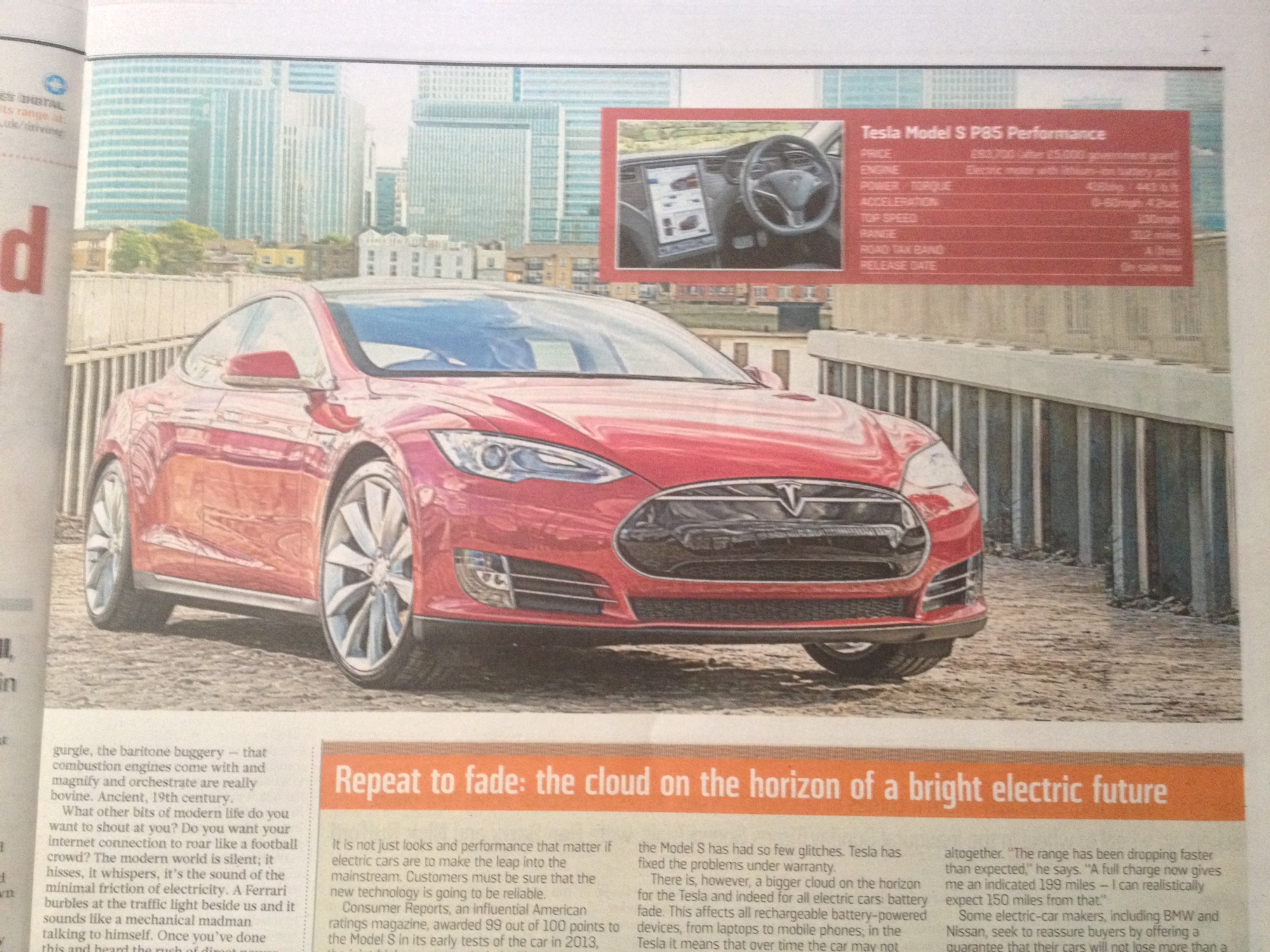 �
�
Sep 15, 2014
breser This thread isn't about Kevin's issue. This thread is about what if anything Tesla should do about warrantying battery degradation. If the consensus from this thread does nothing for Kevin it doesn't matter. This isn't about fixing Kevin's issue, that ship has sailed and Tesla isn't likely to change the Roadster warranty now.�
Sep 15, 2014
Kevin Sharpe I completely agree... the issue's being discussed are much more important than my beef with Tesla.
I feel very sorry for all my Roadster owning friends but agree Tesla have moved on :crying:�
Sep 15, 2014
Chickenlittle model s battery degradation? lets make an issue where none exists. cars with more than 100K miles without issue. this is all about attempts for sharpes revenge.�
Sep 15, 2014
brianman I think you misunderstood his post.
If there's "no way" the pack would degrade that fast then Tesla should be quite comfortable stating that in writing (with warranty backing) and ease the minds of current and potential owners.�
Sep 15, 2014
mknox What do you bet that Tesla does exactly this? If it starts becoming an issue (like drivetrain replacements did, and then turned into the unlimited mile warranty), I figure Tesla may just step up on this degradation issue in a similar fashion. If there truly is no issue, what's the harm from Tesla's perception? There would only be the upside of more positive press.�
Sep 15, 2014
neroden This isn't a problem. The mantra of getting good customer reviews: Under-promise, over-deliver.
What Tesla has been doing, of course, is over-promising and (usually) under-delivering. They're still doing very well because there aren't any other long-range electric cars on the market. But it's a bad marketing choice. It's understandable during the initial startup "we have to get some attention" phase, but it's not a good thing to do long-term.
- - - Updated - - -
266 mi. Checked the first day, just to find out.�
Sep 15, 2014
WarpedOne And never was able to repeat it. Not even on the first day.�
Sep 15, 2014
neroden The problem is that people are buying the car with *specific trips in mind*. If the car's range drops below what you need for *your specific trip*, then for you *the car has broken*, and it's not covered by warranty.
This makes it very important for buyers to know in advance how long a trip they can *reliably* take. I just assumed that my reliable range after 10 years would be 70% of 80% of the EPA range (terribly pessimistic assumptions), and that is about 148 miles. Thankfully, that's enough for me.
*But a lot of people are buying the car assuming that they can get longer ranges than that*, and they will be justifiably upset if (a) they don't get the range they need and (b) there isn't a fix for it. It's important for Tesla Motors to set expectations a bit on the low side, and instead they're setting expectations too high (how long were they advertising 300 mile range for?). It's OK if outside forums like this are more optimistic, but Tesla staff should be saying "Expect to get only 80% range after 10 years".
- - - Updated - - -
Deal with it! It's not a problem. It's true that overadvertising gets more sales, but that's not a reason to do it!
It also creates hurt, upset customers who will not come back and who will give you bad word of mouth. I've dealt with this with more companies than Tesla...
Underpromise, over-deliver. That's the way to get satsified return-customer word-of-mouth.
There should be a lowballed, warrantied range. Tesla can say outright "We find that 90% of our customers, who drive carefully and do not range charge, get better range than this." But the lowballed warranty range is the necessary caution to give, to avoid having customers who feel cheated.
- - - Updated - - -
They kind of have to do warranty repairs for severe range degradation -- implied warranties of fitness and marketability cannot be disclaimed. The thing is, who wants to get into the weeds of how much degradation makes the car "unfit"?
Most of us would agree that a 95% loss of range (within the warranty period) would require a warranty repair regardless of what the written warranty says; most of us would agree that a 5% loss of range wouldn't. It's much easier for everyone if there's some sort of well-defined line, though.
That's what I think, too; I just think it would create happier customers.
- - - Updated - - -
If this were well-publicized in advance of sales that would probably be very helpful in avoiding upset customers.�
Sep 15, 2014
Chickenlittle So care to share what it is today. Doubt significant chane�
Sep 15, 2014
NigelM Seeing as Tesla has tweaked the range calculation algorithm more than once already, and appears to have again in FW v6.0, or maybe changed the reserve, it seems almost impossible to give a warranty with a guaranteed number or percentage unless it's so low that it covers all eventualities and then it becomes pretty meaningless. Range has been, and seemingly continues to be, a moving target (no pun intended).�
Sep 15, 2014
taurusking
mknox... I really wish Tesla does that....This will be a big relief for people like us who bought the car and waiting for the delivery and reading posts about possible degradation...and also for future owners.
If Elon Musk comes with statement like how he did on the drive train...that will be awesome.. I will throw a party for Tesla�
Sep 15, 2014
robby As they should!
What's the problem with that? If Tesla (or any other company) will only guarantee X%, why shouldn't consumers plan on X%? Customers will be happier if they take Tesla's conservative estimates. If they go by averages, half of them will be disappointed in their cars.�
Sep 15, 2014
JRP3 Focusing on a worst case scenario is no more helpful or realistic than focusing on a best case scenario.�
Sep 15, 2014
stopcrazypp I have the same issue with this too. It does not help Tesla at this point to put in a hard number because the demand for the cars simply don't call for it. All I forsee will happen is negative reports about the lower number.
Nissan had to put a hard number simply because they had a lawsuit and multiple examples of cars reaching below the warrantied amount. Also, most of the EVs out there have so little range that there's really little to no buffer even for daily trips (while the Tesla in most cases offer enough range to have a decent buffer for daily trips).
I think eventually Tesla might put a hard number for the Gen 3, but it's not really necessary right now. And if they do put a number it should be when they are ready to put one higher than what the rest of the industry is doing.�

Không có nhận xét nào:
Đăng nhận xét