May 3, 2013
stopcrazypp Since there's so much discussion on the CHAdeMO adapter, I decided to post a new thread about a possible SAE J1772 DC (Combo) adapter for the Model S.
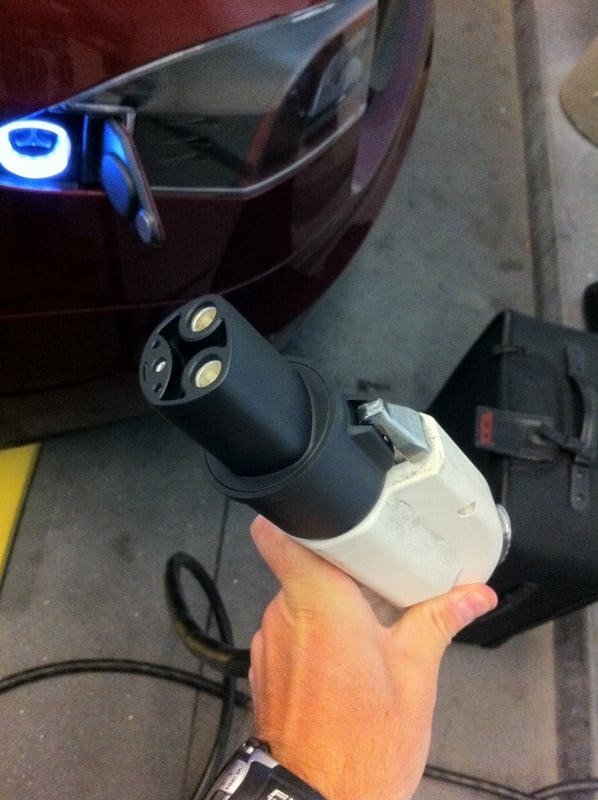
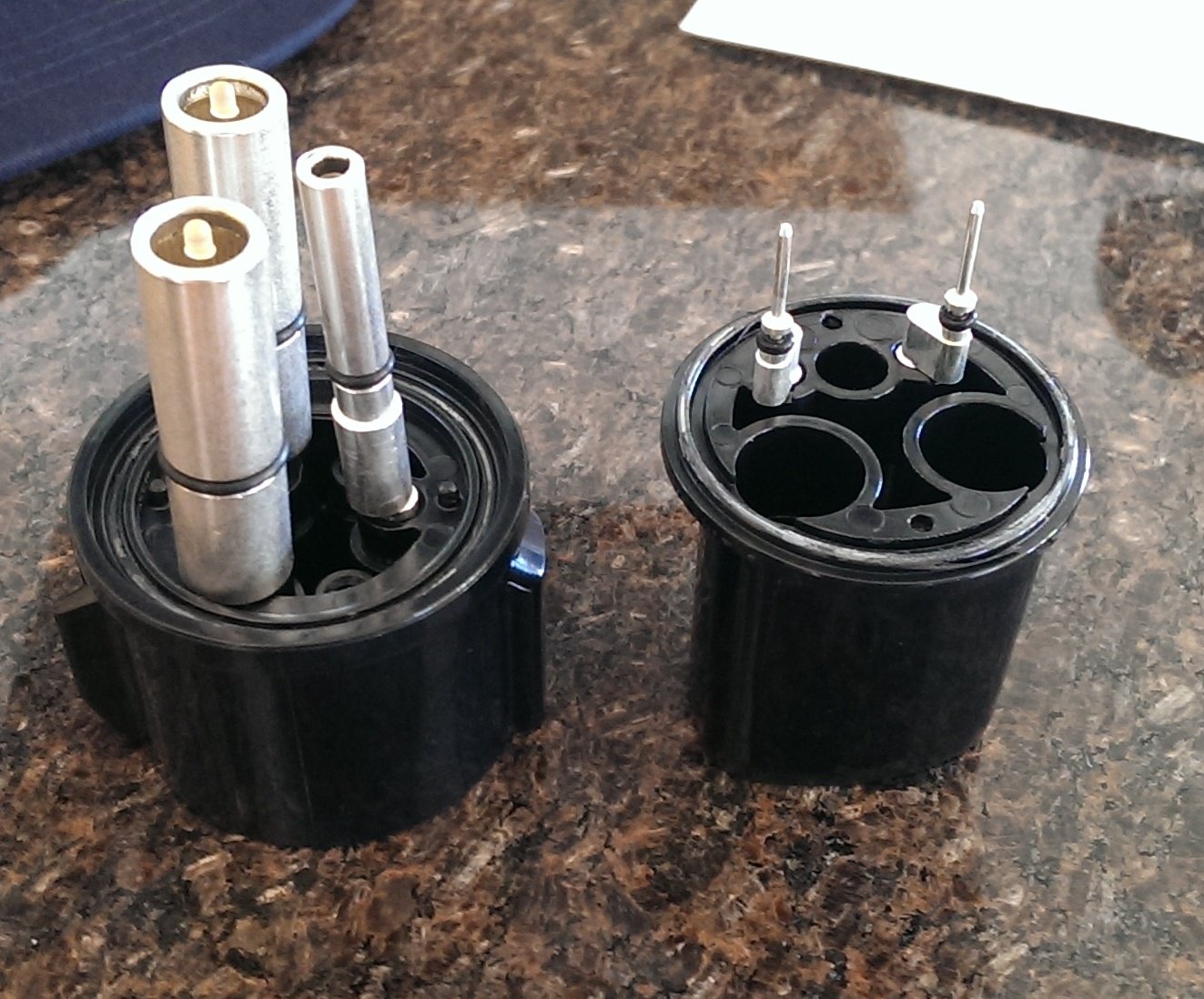
First thing to point out is what the socket and connector looks like:
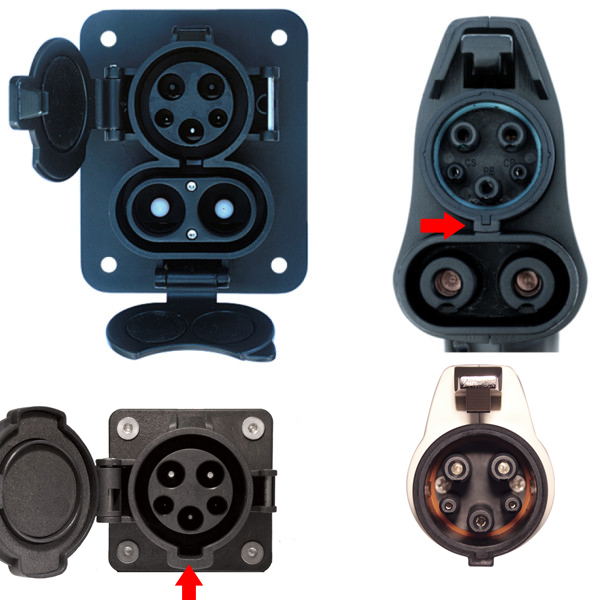
The top two are the socket and connector for J1772 DC.
The bottom two are the socket and connector for J1772 AC.
The bottom right J1772 AC connector can plug into the top left J1772 DC socket
The top left J1772 DC connector can NOT plug into the bottom left J1772 AC socket because of the plastic slot pointed out by the red arrows.
This extra plastic slot is also why the existing J1772 to Model S adapter will not directly work with the new J1772 DC connector.
Next thing to understand is that there are two DC modes:
DC Level 1 - uses only the top J1772 AC half of the socket and provides up to [email�protected] = 40kW of power
DC Level 2 - uses the bottom two extra large DC pins and provides up to [email�protected] = 100kW of power
A recent presentation by the SAE confirms a Supercharger to SAE DC Level 1 adapter can be made for less than $100! It'll basically be exactly the same as the current J1772 adapter except modifying the plastic slot previously mentioned.
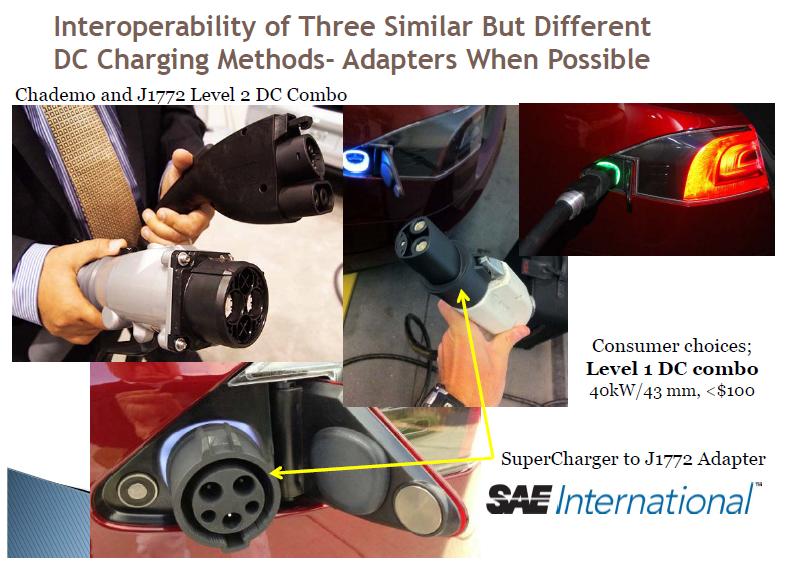
http://www.sae.org/events/gim/presen...rds_status.pdf
Making an SAE DC Level 2 adapter will be a bigger challenge since there needs to be a connection to the two large DC pins on the bottom from the two large pins in the top of the Model S connector.�
May 6, 2013
pilotSteve DC Level 1 - uses only the top J1772 AC half of the socket and provides up to [email�protected] = 40kW of power
DC Level 2 - uses the bottom two extra large DC pins and provides up to [email�protected] = 100kW of power
A recent presentation by the SAE confirms a Supercharger to SAE DC Level 1 adapter can be made for less than $100! It'll basically be exactly the same as the current J1772 adapter except modifying the plastic slot previously mentioned.
But..... can an adapter also be made to allow Model-S charging at 40kW DC from SAE/ChaDeMo (Level 2 DC EVSE) that are quite widely installed in Oregon and Washington. Is this correct?
If so this would be a great interim step for those of us with accesses to these DC chargers. I would happily pay $100-300 for such an adapter.�
May 6, 2013
highfalutintodd There are a few giant threads discussing this. The most recent can be found here:
CHAdeMO adapter frustration�
May 6, 2013
RDoc I didn't think that the simple J1772 plug could do DC charging at all. Everything I've read says it is AC only. It was my impression that DC levels 1 and 2 (and 3?) were only available in the J1772 combo plug and were done completely through the bottom two large pins. Could you provide a link to the description of how the Level 1 DC charging on the upper pins works?�
May 7, 2013
stopcrazypp Like highfalutintodd says there are plenty of other threads on CHADeMO, which is an entirely different issue:
http://www.teslamotorsclub.com/showthread.php/7107-Likelihood-of-a-CHAdeMO-adapter-for-the-Model-S
According to most people (including Ingineer who has the expertise to make one), a CHADeMO adapter will cost over $1000, probably closer to $2000. This is because the CHADeMO connector is quite expensive and you also need electronics in between to translate. CHADeMO uses a CAN bus to communicate, with 10 pins in total. J1772 and Model S uses pilot signals and PLC, with 5 pins (7-8 pins for J1772 DC).
The SAE DC adapter being discussed here is simply a pin-to-pin adapter to adapt two physically different connectors.
A typical EV with a J1772 AC socket can not do DC charging via the top smaller AC pins at all (even if you made an adapter) because those pins will be directly connected to the onboard charger and will have no possible direct path to the battery.
The Model S is different since it uses the same two power pins for both AC and DC (it already has contactors to switch between the two). I don't know however if any future Combo connector cars will also have this design.
As for how I know level 1 DC can be done on the upper pins (something I didn't expect until after I seen the slide I posted):
First clue is the rating, the current limit of J1772 DC Level 1 is 80A, exactly the same as J1772 AC Level 2, which suggests they are going through the same AC pins:
http://www.sae.org/smartgrid/chargingspeeds.pdf
Second clue is the slide I posted in the first post says "Level 1 DC Combo 40kW/43mm, <$100". J1772 43mm refers to the J1772 AC connector (it's 43mm in diameter). J1772 DC is 60-70mm.
I don't have a copy of the spec (I probably should purchase one), but I did post a presentation that showed J1772 DC only needs 5 pins to do DC charging.
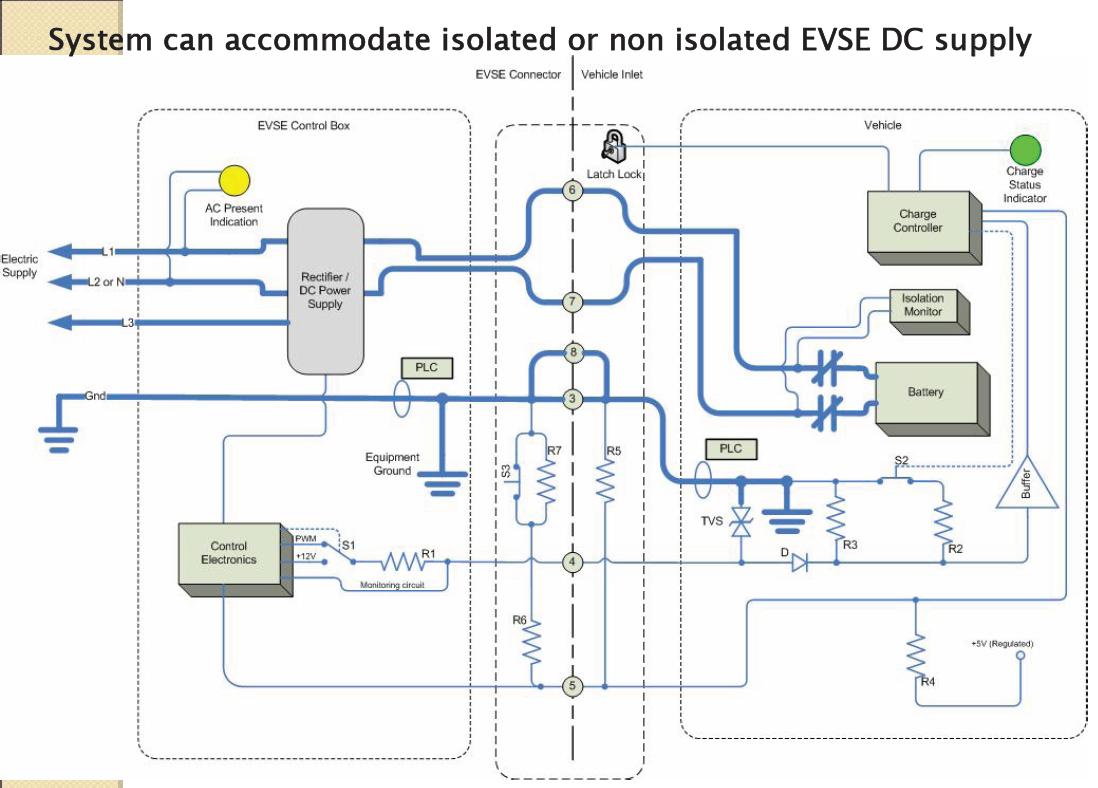
http://www.teslamotorsclub.com/showthread.php/7107-Likelihood-of-a-CHAdeMO-adapter-for-the-Model-S/page10?p=104399&viewfull=1#post104399
If you look at the J1772 AC connector: Pin 1 & 2 are the AC power pins, Pin 3 is the chassis ground, pin 4 is pilot, pin 5 is proximity. The extra pins added by J1772 DC are Pin 6 & 7 (the two large DC power pins), Pin 8 is an extra chassis ground pin. As long as SAE DC has the DC charger be able to switch between Pins 6&7 and Pins 1&2 for power (depending on level 1 DC or level 2 DC), it's possible to DC charge using only the top half of the J1772 DC connector.
https://code.google.com/p/open-evse/wiki/J1772Basics�
May 7, 2013
arg These figures make the common mistake of multiplying max voltage by max current to give power. That's OK for AC charging where the voltage is constant, but always wrong for DC charging where the charger voltage has to follow the battery voltage. So in practice you never in fact reach the full rated voltage (depending on the car's configuration for how close you get), and for all cars the voltage will be lower at the beginning of the charge; then as you approach max voltage the current will be limited by the batteries rather than the charger/connector so that even if you get close to max rated voltage you will never be taking max current at that point.
Looking at this http://www.teslamotorsclub.com/showthread.php/12078-Typical-Supercharging-rate?p=262066&viewfull=1#post262066 graph of Model S (super-)charging, the best you would get out of an 80A-limited DC charger is at about 85% state of charge: here the battery is at 400V and the current is 80A, so 32kW. Above that point, the current has to be reduced to protect the batteries and so the power delivered by the charger declines (and this area isn't of great interest as it's the Range Charge zone). Below that point (ie. most of the time), the battery voltage is lower and so the power delivered correspondingly less. With an almost empty battery, the voltage is about 360V, so the power only 29kW.
Hence the average power through a normal charging cycle with such a charger connected to a Model S through the 80A-limited connector would be in the region 30-31kW.
On the other hand, with the full "DC-level2" plug delivering 200A, it will be exactly the same as a Supercharger for anything above 50% state of charge (Supercharger doesn't exceed 200A here): about 74kW at the cross-over point. At the beginning of the charge, Supercharger is potentially delivering up to 90kW (though if that graph is typical, it doesn't always reach that level), while the SAE plug is limited to 72kW.
Tesla may continue to fiddle with the rules for maximum current (as they appear to have done at least once since the first software release that supported Supercharging), but the battery voltage isn't going to change, so an "SAE DC-level2" charger is always going to be limited to 72-74kW while charging a Model S (and even if you built a car with a battery pack optimized for the SAE charger's 500V max output, it's still going to be more like 85kW practical maximum than the 100kW claimed).
[This miscalculation is often seen in discussion of CHAdeMO charging too]�
May 7, 2013
RDoc I think we really need to see the actual SAE spec rather than trying to guess based on fragmentary power point slides.�
May 7, 2013
arg You can get one from SAE here: http://standards.sae.org/j1772_201210/
Cost is $68.
I have a copy - it confirms the points earlier in this thread - max 80A DC through the contacts common to the AC connector, 200A through the extra DC pins. It also says that pins 1,2 (the AC/DC-lev1 pins) are not present in the level 2 connector (this doesn't affect mechanical compatibility, but does mean that they have excluded the possibility of using both sets of pins in parallel).�
May 7, 2013
qwk While technically possible, I really doubt that the AC part of the J1772 connector would be able to handle much DC charging @40kw. The bottom pins are there for a reason, and I suspect that those will be used for ALL level 3 charging. The Tesla TS2 connector is a totally different animal in terms of quality(silver plated connections), and very beefy. Not so with the J1772 AC connector.�
May 7, 2013
gregincal And I don't necessarily see the utility. Yes it would make for a smaller and somewhat cheaper Model S adaptor, but at the cost of much reduced charging rate. Routing the bottom pins from the combo plug into the Tesla pins seems pretty easy even if it makes for a bulkier adaptor, since the top pins won't be used. Having an adaptor that handled both would be considerably more complicated and expensive.�
May 7, 2013
arg Well, the spec only calls for about 30kW in typical use, and that is putting exactly the same stress on those pins as the 80A AC case (eg. Model S with twin chargers charging from 80A J1772 EVSE with the adapter). So if there is really a requirement for 30kW charging, then this is a valid way of doing it.
However, the way the standard is written currently leaves a bit of an interoperability nightmare. It is possible for a car with the larger level-2 compatible connector to also support level 1 DC, that isn't mandated (at least to my reading). If it had been mandated it would have been straightforward: the car would support level 1 and level 2, and then when building the EVSE if it's under 80A (~30kW) you fit the smaller connector; over 80A you fit the bigger connector. However, the way it is now there can be cars that support DC level 2 (the other pins might be present but only support AC), so if you build an EVSE with the smaller connector it can't charge those cars.
Fortunately in the Tesla case it all ends up on the same pins anyhow, so the existing J1172 adaptor will also work fine for J1172-DC-level1 if any ever exist, and a new adapter can be made for J1772 DC level 2.
It might have been convenient to build an EVSE with the smaller connector and support both 30kW DC and 20kW AC, but that doesn't work conveniently either: the EVSE can't signal via the traditional control pilot that it offers AC while simultaneously offering DC on the PLC channel, since the standard mandates a special dummy value on the control pilot in the DC case. You would have to have a manual AC/DC select switch on the EVSE control panel, which makes this less attractive.
Personally, I'm not convinced of the practicality of charging in the ~30kW region: from the driver's point of view more power is always better, but the costs of installing the EVSE need to be proportionate and 30kW seems like the opposite of a 'sweet spot'. I think the market for public charging makes sense at the two extremes: low-cost AC charging, installed on a shoe-string and necessarily limited by whatever power is already available in the local electrical supply, and high-power charging that costs a lot to install but is sufficiently attractive that drivers will be prepared to pay for it (and travel from some distance around to use it). 30kW is on the one hand too expensive to install (the EVSE is beginning to get costly, and it almost certainly needs something special by way of an electrical supply), but on the other hand doesn't offer the 'get a full charge while you stop for lunch' benefit that Superchargers do.�
May 7, 2013
qwk ^^^
Yes, a 30kw Level 3 charger is pretty stupid. Why install something that costs big bucks, yet charges only 10kw faster than a model S using AC charging? Pretty silly.�
May 7, 2013
Banahogg I've found myself wanting a mid-trip boost of 10-20 kWh a couple of times and a 30 kW charger is materially different than a ~6 kW charger - there are a lot more places that I can enjoy spending 30 minutes in the middle of a trip than I can spending 3 hours.
I think it all comes down to how much a 30 kW DC charger installation would cost. I bet there's a "short stack" supercharger design (3-5 chargers) on an engineer's computer somewhere at Tesla already...�
May 7, 2013
stopcrazypp I'm well aware of this, but decided to post the 40kW/100kW numbers in order to be consistent with how the slides and my sources specify it. As you point out, that's how CHAdeMO is frequently specified too (the [email�protected]=62.5kW)
The advantage of a Level 1 DC adapter would be that it can be used for both DC AND AC. I bet compatibility with the Tesla connector is one of the main reasons to have Level 1 DC in the first place. It means Tesla only has to include that adapter for both AC and DC charging (it's only slightly different than the J1772 AC one; only some change to the plastic is needed).
A Level 2 DC adapter would not be usable for AC charging since the AC pins can't be connected/used in parallel, according the the SAE spec which arg has looked at. So it necessarily has to be a different adapter than the one used for AC charging. Tesla can make this adapter optional.
Disagree on the utility of a 30kW DC charger. Most EVs will not have a 20kW onboard charger (even on the Model S it costs $1.5k extra). Level 1 DC allows even a car with a 3kW or 6kW onboard charger to use 30kW, which is a huge 5-10x boost in speed.
There are 25kW CHAdeMO chargers (supposedly they cost half as much as 50kW chargers and much less to install) and the places using such chargers would be a prime target for a 30kW SAE DC charger (or connector addition/swap):
http://www.evdl.org/archive/index.html#nabble-td4659350�
May 7, 2013
gregincal OK, point taken. Assuming there are a few of these chargers and they rev the provided J1772 adaptor to work I suppose I could see it. However, I would assume people would still want the "real" adaptor to do high speed charging. Hard to say at this point which way the winds will blow.�
May 8, 2013
arg The Level 1 DC connector shape is exactly the same as the AC one (the DC section of the standard references exactly the same mechanical drawing as the AC section).
The only differences to the connectors between AC and DC level 1 are that DC requires the facility for the car to lock the connector (the lock is optional for AC), and the EVSE side must have a temperature sensor inside the connector for DC. The lock is presumably required because of the risk of arcing when breaking a DC current. Not clear why the temperature sensor is required for DC only - the risk is just the same for high-current AC as for DC level 1: perhaps they didn't feel able to introduce that requirement retrospectively.
So, the existing Tesla adapter would work electrically with DC level 1. The only question is whether the locking is sufficient to meet the requirements. The car has the ability to lock the adapter (or Tesla plug on a Supercharger) into the car, but as I understand it the J1772 handle is not locked to the adapter so you can still pull the plug out while charging.
The way the lock is supposed to work (in the pure J1772 situation) is that the EVSE-side connector latches to the car with the 'hook' on top of the connector (that moves up and down when you squeeze the handle), and then the car locks the latch by pushing out/down a locking pin above the top of the latch so that the latch can't move. I can't see a way for Tesla to make the in-car lock have the effect of locking the J1772 directly, though you could have a sliding piece on the adaptor much like the device described in this thread to ensure that you can't remove the J1772 from the adapter before removing the adapter from the car. Alternatively, I suppose you could do something like having an electrical switch that interrupts the proximity pilot when the latch is raised (and hence responds quicker than the proximity pin itself becoming disconnected).
But the fact that existing adapters will fit on J1772 DC level 1 (and the car can't tell) seems like a problem.
Agreed. Regardless of what the spec says, Tesla couldn't provide a passive adapter that connected the pins in parallel since that would leave exposed live pins if you plugged a lev1 or AC plug into this hypothetical adapter. If the spec had allowed commoning, it would have to happen inside the car with a contactor closed only when safe.
Anyhow, two Telsa adapters, one for "the big plug" and one for "the small plug" is nice and simple.
BTW, I may have been wrong when I said that you can't automatically select between AC and DC-lev1 on the standard connector: although the DC section of the spec says that "A Control Pilot duty cycle of 5% indicates that digital communication is required and must be established between the EVSE and vehicle before charging. This is required for DC charging.", the AC section says that you are allowed to do digital signalling (the PLC carrier) at the same time as signalling AC availability with the Control Pilot. So possibly the car can talk to the EVSE before starting charging and tell it to change to DC mode. There doesn't appear to be a message defined to do this, but I don't have all the specs to be completely sure.�
May 8, 2013
pilotSteve Because if that what a nearby charger provides, I'd like to able to use it! Hey, its not (yet) a Tesla-centric EV world. So lets all interoperate (and possibly have Tesla leads the 'good EV citizen' charge with an adapter as well as sent the highest bar with SuperChargers).
If there are good quality electrons available at 20-30 kW I would like to be able to use them!
Thats why....�
Dec 13, 2013
widodh Has there been any word about this from Tesla?
We are starting to see the first Combo Type 2 chargers in the Netherlands and afaik a Combo / CCS adapter would be a lot simpler then the CHAdeMO adapter.
The EU version of the Model S has a slightly modified version of the Type 2 connector where the car is "coded" for SuperCharging by adding a little pin on top of the Type 2 connector. This way the SuperCharger's connector only fits in a Model S. They could do just the same with a CCS adapter so you can't fry any car with it.�
Dec 15, 2013
Bipo The socket has space for that pin, but the actual SC plug is not different from any other Type 2 plug, as yor can see here:
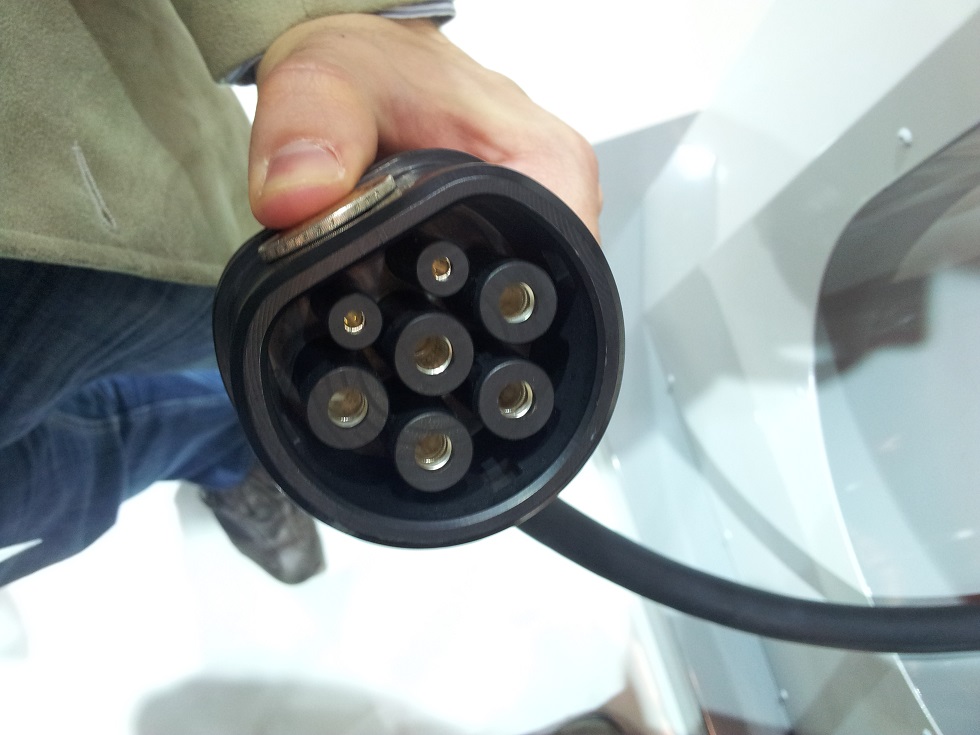 �
�
Dec 15, 2013
stopcrazypp I don't expect to hear anything on this front until at least the CHAdeMO adapter is ready (which it still isn't despite the promise of "winter" release) and where there are some more Combo stations installed (which should start happening pretty soon as I've been seeing more and more Combo chargers being UL/CE listed).�
Dec 15, 2013
cwerdna Winter hasn't even started. Google tells me that it (for the Northern Hemisphere) begins December 21st and ends March 19.�
Dec 16, 2013
Mario Kadastik I just helped my friend place an order last night and when he logged into My Tesla to go over the design again just in case we noticed that it now listed a load of extra accessories that can be ordered with the car (not visible on standard design page, only once you place the order). The things that are available there is a Type-II to Type-II cable (�450) and CHAdeMO adapter (�800) amongst other things. So now you CAN buy a Type-II cable from Tesla and they officially list CHAdeMO adapter for purchase indicating that it may well be available once his car delivers (estimated delivery indicated at late April 2014).�
Dec 17, 2013
TonyWilliams I would think that all the CHAdeMO chargers in Estonia plus whatever Suoerchargers are built will make for a very nice Tesla experience.�
Dec 18, 2013
Mario Kadastik I'd hope so indeedAlso, just probably sold another Model S as I met with a couple who'd seen my TV coverage and gotten curious. They were well more convinced when they left and asked if they could give me a call when they are ordering to confirm things
�
Dec 18, 2013
JoeNe I was told by someone from Tesla that CHAdeMO is coming to Europe in Q1 2014. Not a big surprise, I think.
He also confirms Mario, that the plug will be available when ordering a new car. So new orders will have the possibility to order a CHAdeMO plug.
The DC Combo is not yet in development. But as Tesla is a forward thinking company, I assume DC Combo will be somewhere on their "Innovation pipeline".�
Dec 18, 2013
widodh I still think that a Combo adapter could be only a physical one without any electronics or long cables.
It would also be able to do 80kW instead of 50kW, so that's a big plus imho.�
Dec 18, 2013
JoeNe I agree with you, but I also understand the CHAdeMO gets first priority. Their coverage is much higher than DC Combo.�
Jan 16, 2014
matbl I think a CCS DC adapter will be necessary for Tesla pretty soon (during 2014). European CCS DC stations will start to pop up all over the place when the big european makers (BMW, VW, etc.) start shipping their EV's in volume this year.�
Jan 26, 2014
widodh 
A picture of a CCS Combo station in the Netherlands. It's from FastNed.
It shows the EU Model S charging port with the CCS connector on the charging station.
The station says: 500V 175A. So at 370V a Model S should be able to charge there with 64kW. That would still be great.
I really do hope for a adapter!�
Jan 26, 2014
Johan I e-mailed Tesla about this last week but got a pretty blah-blah response:
I'm guessing it would be a lot simpler to make one of these adapters than a Chademo adapter. Mostly wiring and perhaps some firmware in the car to update? No need probably to emulate within the adapter?�
Jan 26, 2014
stopcrazypp Yes, it's just wiring and firmware. A physical adapter is actually not required if station/charging manufacturers support DC-mid (which supports up to 140A), but so far no one has done so (it's all DC-high/Combo):
http://www.mennekes.de/nl/latest0.html?tx_ttnews%5Btt_news%5D=851�
Jan 28, 2014
widodh So I also got an e-mail back from Tesla, they told me it is not under development.
Now I'm wondering, what if I make a adapter and only wire through the Pilot, Proximity and Ground, just to see how a Model S reacts when you connect that to a CCS charger.
I won't connect the DC pins themself to prevent frying my S, but I just want to see how the ABB charger and my Model S respond when I connect them. A simple Type2 <> Type2 cable without the resistors in the cable should work I think.�
Jan 28, 2014
JoeNe I'm looking forward to the results of your test Wido�
Jan 28, 2014
Johan Would be interesting. And if it looks like they communicate well please connect the two DC ends with some thick cables and try again�
Jan 28, 2014
widodh Yes, I'm interested as well. Only problem is that the nearest CCS charger is 200km away from my home.
Indeed, but I have to be VERY sure where the Plus and Minus should go in the Model S. I do NOT want to short circuit 500V 175A!
Another problem is that I don't have a "female" side of the CCS adapter, so I can't "receive" the two DC pins. (See the picture a couple of posts back).�
Jan 31, 2014
JoeNe Don't think the type 2 Combo is priority for Tesla after hearing J.B's answer today. It looked like they were more irritated by all the "charging standards" popping up everywhere in the world.�
Jan 31, 2014
stopcrazypp Given the CHAdeMO adapter isn't out yet (and it has way more chargers at this point, while CCS is just getting started) I can see why it's not a priority. But I do hope they get around to making one as the chargers get installed.�
Feb 1, 2014
JoeNe And they will dramatically increase density of the supercharger network, which could make third-party charging obsolete�
Feb 1, 2014
TonyWilliams
Answer from JB: Mennekes type 2? We have an adapter for CHAdeMO coming; releasing soon (and later mentioned April). There's many more CHAdeMO than the combined standard. Waiting to see adoption of the standard... Entirely possible, and we can adapt and use that.�
Feb 1, 2014
fredag JB was refering to question regarding combo/frankenplug adapter, not type2. I was in the audience at the Oslo Q&A today.
Unamerican
Perfectly reasonable that they wait and see just how widespread the combo chargers will be. However I think they'll have to make the combo adapter sooner or later anyway. Many chademo fast chargers here seems to be upgraded with both chademo and combo.�
Feb 1, 2014
TonyWilliams Good points. I wish we had the Menekkes Type 2 in the US.
Obviously, they still have their hands full with the CHAdeMO adaptor, but I suspect Frankenplug is a slight pain in the ass since they actually need a US-Frankenplug and a Euro-Frankenplug adaptor.�
Feb 1, 2014
ebullio Just like the CHAdeMO adaptor�
Feb 2, 2014
ZBB And just like the UMC...�
Feb 2, 2014
JoeNe Standards are nice... Once the fight is done. A bit the downside of being early adopters.�
Feb 2, 2014
renim There is a distinction between the car and the charger
A global spec Tesla Car has a 'type 2' port which also accepts Tesla supercharger
but
a Tesla supercharger is not a 'type 2' port (it has a discrete key, and it obviously much more powerful)
The EU is proposing a directive (law) about charging and hydrogen and natural gas etc.
Some have correctly interpreted that directive as being anti-Chademo. Perhaps they are correct, but the directive is even more anti tesla supercharger. Chademo at least has recongnition as being a pre-existing standard in the directive
Tesla supercharger is a DC fastcharger that is not the CCS Combo Frankenplug whatever it is called, for various obvious reasons
1) manufacturers can't use supercharger without payment to Tesla (even Chademo is now 'open')
2) cars with DC Combo port can't use DC supercharger (ie BMW i3)
3) EU directive has colour about required payment methods and consumers to be disuaded from peak charging etc.
perhaps this should be moved to the investors section, but the EU CPT directive has a greater threat to stifle Tesla supercharger deployment (particularly post 2020) than say Chademo depolyment.
Cars are OK, cars can have whatever ports they want, and the Tesla with AC 22kW Mennekes type 2 port is a very good option for European Teslas now and in the future. The issue is that while EU CPT directive may be bad for Chademo, its worse for Tesla Supercharger.
This should be expected, does Audi and BMW really want to pay Tesla a fee? or do they lobby against Tesla.�
Feb 2, 2014
stopcrazypp The EU directive only affects public chargers, but Tesla superchargers are not public (in both meanings: "publicly funded" or "publicly accessible").
And the detail is that recently it has been changed to having all public chargers support CCS at minimum rather than explicitly supporting CHAdeMO only chargers until 2019. So it does not disadvantage Tesla vs CHAdeMO (but ensures all public chargers will support CCS, even if it has multiple connectors supporting other standards).
Tesla's superchargers can actually support Type 2 DC (without the two extra pins) given it uses a Type 2 socket, but would need a connector swap or addition to support CCS (with the two pins).�
Feb 2, 2014
renim That was my first thought, but it was wrong, because Tesla superchargers are public chargers just like gasoline stations and diesel stations, cng stations are public stations.
No, it is not about publicly funded, the directive makes no requirements about how the chargers are to be funded or if they are to be publicly funded. The directive does not even delve into the issue of ratio between fast chargers and normal chargers. There is a target for chargers per country but no ratio setting minimum amounts for DC fast charging. (ie a country could fully comply using normal AC charging only, or perhaps a combination of normal and fast charging using AC only.)
Tesla cars are good to go as far as this legislation is concerned.
tesla superchargers are worse than Chademo as far as this legislation is concerned.�
Feb 2, 2014
stopcrazypp Not really, because superchargers don't allow any cars except for Teslas to charge at them. So basically it's a private network that Tesla owners have prepaid for. I don't see how the directive can govern something like that. The only "teeth" it has is that the EU governments will be using it to guide their funding/subsidizing of public chargers, not really making legislation to "ban" chargers that don't fit the directive. At worse, Tesla won't get any public funding or tax subsidies for their superchargers, but I don't see superchargers being banned.�
Feb 2, 2014
renim European directives result in actions like the EU suing Germany because Daimler refuses to use flammable refrigerants that make poisons gases.
Environmentally Safe Refrigerant Can Blow Up And Poison You If You Aren't Dead Already | The Truth About Cars
EU Starts Legal Proceedings Against Germany in R134a Dispute With Daimler | The Truth About Cars
The teeth the directive has is to be able to sue european government that don't comply it. It is not about the direction of public funding, it is about obligation/permission to use or phase out clean transport infrastucture. If an European country achieved the stated charging quota's with no public funding (ie using development approvals only) they would not be in breach of the directive.
The directive proposal page 3
'This proposal requires establishing a minimum number of recharging points for electric vehicles by each Member State, with 10% of them being publicly accessible. '
The directive's proposal is very much about networks like Tesla's supercharger or even the charger in someone's garage.
here is a link to the EU CPT page, http://ec.europa.eu/transport/themes/urban/cpt/
instead of reading it like a consumer, read it like BMW's / Combo's lawyer/lobbyist. It is very adversarial to Tesla's superchargers, which are treated worse than Chademo.�
Feb 2, 2014
stopcrazypp The drafter seemed to have said the directive (even when it still included the 2019 deadline for CHAdeMO) will not be banning any chargers:
http://fionahall.org.uk/en/article/2013/713537/no-electric-car-charger-ban-hall
Sure they can implement a ban for any chargers not meeting the specifications (nothing stops them from doing so), but I don't see how that makes much sense in the context of the quota for the directive (they need incentives to install chargers that meet specs, and such bans do not help). And I'm not sure if Tesla's chargers would meet that quota anyways (as it's not for general public use, but only for Tesla owners who have prepaid for service). They would have to first force Tesla to open the network to general public use and I'm sure Tesla will lobby against that.
But anyways, with the current changes that strike out any mention of CHAdeMO, the directive only favors CCS (not CHAdeMO or Tesla).�
Feb 2, 2014
renim Fiona Hall MEP Member of the European Parliament for North East England will represent the interests of England, Nissan is England's largest car manufacturer, so Fiona Hall will be batting for Chademo. Likewise the French due to their ownership of Nissan and affiliation with Mitsubishi will not be atagonisitic to Chademo, but make no mistake, the intent of the directive's drafters was to eliminate the challengers to CCS Combo, be it Chademo or Supercharger.
The different drafts are yet to merged, they will be discussed clause by clause before they are made law, so the threat remains live, even if it is diminished.
seriously, read through the EU's CPT page http://ec.europa.eu/transport/themes/urban/cpt/
http://eur-lex.europa.eu/LexUriServ/LexUriServ.do?uri=COM:2013:0018:FIN:EN
The idea of an free 24/7 elite private recharging network may not appeal to those who don't appreciate Tesla.
Superchargers are a competitive advantage for Tesla, that makes it a target.
For the next few years it is of little consequence, due to Renault's ownership Nissan has long been including AC fast charging with their European Chademo rollout, and if that is OK then Tesla can include some AC fast chargers with their European Supercharger rollout and all can stay happy....for now.. But longer term, the directive is dangerously adversarial to Tesla's supercharger and potential limits the ability of Tesla supercharger to renew inline with the renewal/growth of European highways.�
Feb 3, 2014
cwerdna Because there are so many to choose from.�
Feb 3, 2014
JoeNe
I just viewed JB's answer on the dc combo question in Amsterdam. The car is ready, but an adapter needs to be developed. But the bottom line is, why would you even pay for DC charging if you'd have a denser supercharger network where you charge for free.�
Feb 3, 2014
stopcrazypp At worse, Tesla will have to add a CCS plug (which no one will use) to the superchargers, but none of the drafts say anything about forcing non-public chargers to being public. They have to make exceptions anyways for industrial equipment (like chargers for forklifts, golf carts, baggage tractors, etc). The other strategy is just to make the superchargers "DC-mid" compatible and then lobby to say it meets the spirit of the law already (although it's unclear if CCS cars are also guaranteed to be DC-mid compatible, but it's certainly a good possibility as it's at least pin compatible).
- - - Updated - - -
The thing is, the supercharger network will never be as dense as other DC charging networks. The superchargers are designed for long distance use, while the other charging networks are designed for destination use. Therefore there will still be plenty of cases where you do want to pay for those other networks.�
Feb 3, 2014
JoeNe I agree with you on this. Allthough I'm still hoping the supercharger network will be dense enough to cover my 5% needs which cannot be fullfilled by charging at home.�
Feb 3, 2014
widodh +1
I also don't want Tesla to dictate where I have to charge my car. If there is a CCS charger on my route I want to use that and don't want to divert let's say for 30km. I don't care that it's free, I want freedom.
With FastNed deploying 201 CCS 175A chargers in the Netherlands I want to be able to charge there. The CHAdeMO goes to 125A, so I prefer the 175A CCS.�
Feb 3, 2014
JoeNe I agree. But I think CHAdeMO deserves its higher priority because of its denser network.�
Feb 3, 2014
stopcrazypp I agree with this too. Plus Tesla already promised a CHAdeMO adapter before the winter is over, so they are under pressure to meet that promise. For this reason, I don't expect them to start talking about CCS until at least the CHAdeMO adapter is out.�
Feb 3, 2014
Mario Kadastik Can someone point out in the CPT regulation that this is anything beyond public usage stations and how they define it. I doubt they could ban a private installation of propriotory tech. Just dictate all SC locations as private property and be done with it... The way I see it is they want to make CCS prevail in new installations that qualify fir the requirement. If you have beyond that non compliant installations (i.e. SC-s), then who cares...�
Feb 3, 2014
miimura I just listened to JB's answer about FastNed at the Amsterdam SC meeting. I was surprised that he did not mention "DC-Mid" as a possible way for Tesla owners to charge their cars on a public network. The Dutch owners were asking for support from Tesla so that they could make use of the aggressive build-out coming to their country. The answer for now was the CHAdeMO adapter.
To me, it does not make any sense for public networks to install Tesla SuperChargers and it does not make sense for Tesla to install anything BUT their own SuperChargers. I like the idea of the Mennekes DC-Mid interface and that is essentially what Tesla has implemented on their EU vehicles with some proprietary enhancement. However, I don't think any other automaker will actually implement this interface. It requires high current contactors to allow switchable connection to the on-board charger and battery. DC-High allows for permanent non-switchable connections. Maybe I shouldn't say permanent... it probably isn't safe to have the battery voltage always present at the vehicle inlet. I guess it would be on-off contactors, not A-B contactors.�
Feb 3, 2014
renim
page 3 under LEGAL ELEMENTS OF THE PROPOSAL http://eur-lex.europa.eu/LexUriServ/LexUriServ.do?uri=COM:2013:0018:FIN:EN
'This proposal requires establishing a minimum number of recharging points forelectric vehicles by each Member State, with 10% of them being publicly accessible. It defines minimum numbers per Member States, based on the national targets forelectric vehicles already set in many Member States, and an extrapolation to the total number to be expected for the whole Union. A larger number of electric vehicles canbe expected in Member States with a higherrate of urbanisation, as electric vehicles will be deployed predominantly in urban agglomerations, due to range limitations, and the large benficial impact on reducing pollutant emissions and noise. Electric vehicles further need to have at least two recharging points per vehicles available for full recharging, and a certain number of publicly accessible recharging points forintermittent topping-up recharging to overcome range anxiety. '
The CPT regulation covers the private low power recharging points (ie domestic etc) it also covers publicly accessible points. (Incidentially, The CPT directive actually is L1 centric and could be fulfilled without fast DC charge) The intent of the legisation is to ban non CCS DC fast chargers, that is Tesla Supercharger and Chademo, even Mennekes DC Mid will probably be illegal but I can't confirm that.
page 14 also has 'Member States shall ensure that the equipment for slow and fast recharging points as set out in Annex III.1.1 and Annex III.1.2 shall be available on fair, resasonable and non-discriminatory terms.' I would interpret that while Tesla Supercharger is fair and resonable, that it could be construed to be discriminatory to others unless it includes at least provision for occasional use and payment by competitors.
page 12 has
'(2) "Recharging point" means a slow recharging point or a fast recharging point or an installation for the physical exchange of a battery of an electric vehicle.
(3) "Slow recharging point" means a recharging point that allows for a direct supply of electricity to an electric vehicle with a power of less than or equal to 22 kW.
(4) "Fast recharging point" means a recharging point that allows for a direct supply of electricity to an electric vehicle with a power of more than 22 kW.
(5) "Publicly accessible recharging or refuelling point" means a recharging or refuelling point which provides non-discriminatory access to the users '
to me this betrays a bias against Mennekes AC 22kW. If 22kW is slow but 25kW is fast, then the authors seems to have a grudge against what is probably the most pragmatic and well supported mid range standard (ie ZOE, Tesla, Volvo etc). In later responses to the CPT proposal, slow recharging point is changed to say normal recharging point, but the CPT link is the original proposal.
Hypothetically, a member state could comply with the directive by requiring all new electrical work to include a L1 charging point at parking locations, similar to how plumbers may be required to install tempering valves is they do any plumbing work on a property......The directive leaves methods for achieving the quota to the countries, funding is not the issue or even addressed, nor is any ratio between L1 chargers or fast AC chargers or fast DC chargers, just a minimum of publicly accessible points and a minimum of recharging points, with about 90% of recharging points expected to be private.�
Feb 4, 2014
stopcrazypp About page 14 talking about fair/reasonable/non-discriminatory, it's talking about equipment manufacturers that sell chargers. It's not talking about private/public chargers (for example you can't expect all home or work chargers to be made available to general public use).
Good possibility that will happen. NY is doing something similar. The result will be Tesla adding more charging points. It's not really banning any ones though, so I think the supercharger network should be safe. Plus it's not retroactive, so existing chargers are not affected.
If there's really banning of non-Mennekes chargers, then I think CHAdeMO will be equally impacted. But I think the way it was worded previously, it's just that chargers with CHAdeMO (even if dual standard) would not meet the quota for the countries and that would hugely impact CHAdeMO adoption (as countries would focus on promoting Mennekes-only chargers). That was why there was the need to add CHAdeMO in explicitly. However, the recent amendment changed it to say that if the charger has CCS at minimum, it would meet the quota.
I think that covers mostly home or work recharging points.�
Feb 4, 2014
renim There are 3 differing L1 plugs in europe, some cars could plug into any off these three if they have the appropiate connection cable. ie a Type 2 to Type 1 cable or Type 3 to Type 2 cable etc. The directive's intent is to standardise onto Type 2 recharging points. No provision seemed to exist to exclude future private installations. Similar thinking for DC fast charge.
Unfortunately, I don't see anywhere that this is limited to meeting quota's only. I do agree that it is bad for Chademo, but there are distintives that make it worse for Supercharger. Further (and overly pedantic of me, I see it banning Mennekes mid charging over 22kW DC)
Article 4 Electricity supply for transport page 14
6. All publicly accessible recharging points for electric vehicles shall be equipped with intelligent metering systems as defined in Article 2(28) of Directive 2012/27/EU and respect the requirements laid down in Article 9(2) of that Directive.
7. Annex I.1 (h) and the last subparagraph of Annex I.2 of Directive 2009/72/EC shall apply to the consumption data and the metering system of the recharging point for electric vehicles.
8. Member States shall not prohibit electric vehicle users from buying electricity from any electricity supplier regardless of the Member State in which the supplier is registered. Member States shall ensure that consumers have the right to contract electricity simultaneously with several suppliers so that electricity supply for an electric vehicle can be contracted separately.
Point 6 & 7 would be embedded into all future publicly accessible chargers (fast or slow, Chademo/43kW AC/Combo/or even a 3kW Mennekes etc) Common sense would indicate that free charging is not burdened, but I don't see explicit recongnition for that. Actually I see intent that the proposal has no financial impact on revenue (for instance last page of document) Tesla's free for life is not the reality the directive's authors were expecting. The directive's authors are insisting all EV charging comply to their vision. There could be a problem
Legislation has a habit of resulting in some perverse outcomes, that is outcomes that are the opposite of the intent of the leglisation.
It does not take much imagination to imagine Audi lawyers using this legislation to miniminse market share losses to Tesla...
Real Politick is such that together Chademo and TeslaSupercharger in EU wide deployment, makes the long term existense of each other politically acceptable. Its similar to how Tesla at the premium market and Nissan at the economy market provides support for Californian ZEV mandates. It would've been much more difficult if only one the cars was on sale.�
Feb 4, 2014
Apoclyps so how long before someone creates a SC adapter so that they can plug in their non-Tesla car into the SC network?�
Feb 4, 2014
Cottonwood A very interesting question. The physical connector is probably easy; the real challenge is reverse engineering the signaling protocol. Wonder how serious Tesla was in their authorization; did they get serious and use a cryptographically secure algorithm?�
Feb 4, 2014
stopcrazypp Sure, it is not explicitly limited to meeting the quota, but laid out hard goals of this whole directive is meeting certain quotas. Nothing stops any country from banning specific standards (and this directive doesn't change that), but on the other hand it doesn't explicitly ban them either, but rather open-endedly leaves enforcement action up to the member states. This gives Tesla (and CHAdeMO) room to do lobbying. And I believe it has already been amended. If you look at page 35 here, the Annex III which describes EV charge standards has been changed:
http://register.consilium.europa.eu/doc/srv?l=EN&t=PDF&gc=true&sc=false&f=ST%2017004%202013%20INIT&r=http%3A%2F%2Fregister.consilium.europa.eu%2Fpd%2Fen%2F13%2Fst17%2Fst17004.en13.pdf
The "at least" part was not there before, but now it's added, so all Tesla has to do in the worse case is add a "Combo 2" socket that no one will use (given the network is not public).
I don't really see the disincentives that make it worse for Superchargers vs CHAdeMO, can you point out some examples? Again, I don't really see anywhere in the directive that would force Tesla to offer charging to non-Tesla vehicles. I think Tesla's superchargers fit under the "private" side.�
Feb 5, 2014
Mario Kadastik From what I can see from the quotes the requirements are for member states to reach a certain level. That level doesn't have to include Tesla superchargers at all so I don't see how Tesla superchargers would be disfavored, banned or limited in any way. If Tesla funds them themselves and it's for private use by Tesla vehicles, then it doesn't fall under this directive. The countries can go on with their odd standards and plugs, but it doesn't touch Tesla. Just the countries don't benefit from Tesla installing superchargers.
And with regard to SC access I'd assume it's cryptography backed considering that a software company like Tesla won't make such a rookie mistake. If someone steals the keys from some Model S, that's another matter.�
Mar 14, 2014
matbl I seriously think a CCS adapter is necessary for at least Europe.
One of the big energy companies in northern Europe (Fortum) is currently installing DC fast chargers along major routes in Norway, Sweden and Finland. I checked one out today and it is DC only, Chademo and CCS (Euro type). So although it provides easy access to 50 KW charging, it can't be used by Tesla owners.
When the Chademo adapter becomes available it can of course be used but I would really prefer a CCS adapter since it shouldn't need as much logic. In fact it might only be cables but I don't know entirely.
So this is not something to wait and see about. This charging point is up and running now.�
Mar 23, 2014
Hybris CCS adapter
we need a CCS adapter for europe. anyone know if tesla is planning that?�
Mar 23, 2014
Hybris
100% agree!!! We need CCS!�
Mar 23, 2014
Mario Kadastik During the EU trip of Elon and JB it was asked and JB said that they are finalizing the CHAdeMO adapter and that will be out soon, but right now they consider CCS non-existent and feel that they have better stuff to do with their limited engineering resources. Once the standard becomes more widely available and is looking like a decent coverage and therefore would be reasonable, then they can do it. There's nothing stopping them beyond manpower needs and right now they don't feel that it would be best spent on the adapter.
So I'd guess no adapter in 2014, if CCS picks up and we get wide enough coverage they might rethink. But I think it's a minor issue really. Do you know many CCS stations that do NOT have a CHAdeMO plug there too? I think most new stations that are buit are built CCS + CHAdeMO and never just CCS. Therefore getting the CHAdeMO adapter should be enough for now. I know in Estonia we have over 160 chargers and they are all CHAdeMO + Type-II AC. No concrete plans on CCS as the infrastructure is already there. From what I know for Latvia that is planning to build it this year the stations will be Type-II + CCS + CHAdeMO. And when Bj�rn showed in his video the new green highway chargers it was the CHAdeMO + CCS one with separate Type-II AC as well. So why precisely do we need the CCS again?�
Mar 23, 2014
matbl If I'm not misstaken, a CCS adapter would be much much cheaper since all that is needed is wiring and plastics. And software in the car of course.
Also, in theory CCS can go up to 200KW in power while chademo is stuck at much lower. While the chademo adapter was necesary to do first I don't think they shall stop but inatead continue with a CCS adapter.�
Mar 23, 2014
scottf200 Hopefully that is true:
 �
�
Mar 23, 2014
widodh There already is a topic about this: SAE J1772 DC (Combo) Connector Adapter for Model S
I recommend we continue there�
Mar 23, 2014
Mario Kadastik Scott, those that you are showing are not CCS cables
But yes, I think mods should merge the threads.�
Apr 4, 2014
jackie Ecotricity (UK) have just sent out an e-mail message. It includes their plans for CCS support.
"Things are moving at pace with the Electric Highway too.
It was only around the middle of last year that we began to roll out the fast AC and DC chargers and by the end of the year we had installed these �Ecotricity pumps� (as we like to think of them) in half of all motorway services. In February this year we completed the M4 roll out with an Ecotricity pump on every service station from London to Wales. We�ve also begun to double up now, with two pumps in each location, to cope with the additional demand that is coming.
And we�re adding a third standard to the pumps, known as CCS (Combined Charging System) � as used by BMW (the i3) and VW (the eUp and eGolf) � three new cars launched in the last few months which will be able to use the Electric Highway.
By the end of this year we expect to have installed Ecotricity pumps in every single motorway service station in Britain. That should pretty much enable electric car drivers to drive the length and breadth of our country.
There are parts of the country that the motorways don't get too close to of course, and we�re beginning now to roll out the Electric Highway to strategically important A-roads."
So by the end of this year we should have a substantial infrastructure of CCS chargers in the UK.�
Apr 4, 2014
Mario Kadastik But does any one of those "pumps" come with CCS only and no CHAdeMO? If no, then it's another point for not making a CCS adapter and just doing a CHAdeMO one...�
Apr 4, 2014
widodh They will have CCS, CHAdeMO and 63A AC. So yes, the CHAdeMO adapter works just fine.�
Apr 4, 2014
matbl Except that a ccs one should be much cheaper...
And that CCS in the future probably will come in variants well above the chademo 50 kw. And that there probably soon will start to pop up ccs only stations...�
Apr 5, 2014
Mario Kadastik Well Tesla basically said that CCS is too new and too infrequent to be worth it. So in a couple of years when it actually has stations enough and there is a real point, then they will do an adapter, but not now.�
Apr 5, 2014
nikwest Looks like in Germany they are now building lots of CCS stations. Some of them without Chademo connectors. If believing the article I read yesterday at one of the major German news sites there will be 50-100 being built by the end of the year and a lot more coming in 2015. This can get important very quickly...�
Apr 5, 2014
widodh True. But that's because Volkswagen and BMW both support CCS. No German EV supports CHAdeMO.�
Apr 5, 2014
nikwest Yeah, and that's why Tesla won't be eager to support a competitor's backed system. At least any other car company wouldn't. It is hard to say for me if that also holds for Tesla.
But another interesting tidbit from the article is that it states explicitly that things only start moving more quickly because of Elon Musk. It seems committing and actually building out the SC network fast in Europe really could give EVs a big push.
Here is the article in German:
Schnelllades�ulen f�r Elektroautos: Ausbau der Infrastruktur - SPIEGEL ONLINE�
Apr 5, 2014
matbl Unlike chademo which isn't backed by car companies?
Most major european car companies and north american ones have agreed to use ccs. With a type1 based connector in NA and type 2 based in europe. It also happens that EU seems to standardize on type 2 with chademo as an option.
So we will see a lot of ccs stations across europe really soon.
The Model S comes with a type 2 connector in europe. It just lacks the two extra dc pins.
I think it will be important for Tesla to support ccs in europe. I don' t see the ccs stations as competing with sc's. Sc's are much better but they will be few compared to the ccs stations so ccs support would be a complimentary to the sc's.
Tesla can solve this in two ways. An adapter or just start fitting the ccs inlet. Second alternative would be best from my point of view. Sc connector as well as type2 mode 3 would still fit.
But maybe hard due to space so in that case, a passive adapter would be whats needed.
I don't think Tesla can just ignore ccs in europe and think they will get increased sales in germany...�
Apr 5, 2014
miimura @matbl
I think you have a point. If CCS really does become common in Germany and Tesla sales are not meeting their expectations there, that could motivate them to make the adapter. The only reason to make it may be to remove one more objection from potential customers. It's kind of like the Japanese study that found that people don't really use DCQC as much as they think they will, but just having them around increases the daily range that people are willing to use.�
Apr 12, 2014
nlc A CCS adapter will not be just a mechanical adapter
But it's not he case. When I simulate a DC charge with my own EVSE wallbox (sending 5% duty cycle), I can clearly see the Model try to communicate to the charger on the pilot line. But the modulation sent by the Model S is absolutely not a PLC HomePlug AV/GreenPhy modulation, I detailed the signal here : Supercharger protocol for diy CHAdeMO adapter - Page 4
Will post signal screenshoot soon
Thus for a CCS adapter, it will be much complicated than for the CHAdeMO adapter. The supercharger emulation part of the adapter are the same, but to talk on the CCS charger, it needs a PLC greenphy hardware (based on QCA7000 chip for example), and a much more complicated software than the CHAdeMO adapter, which is just a CAN bus with a very simple protocol.�
Jul 3, 2014
medved CCS could be dead before it even gets a hold on the market if BMW moves to Tesla�s...
CCS could be dead before it even gets a hold on the market if BMW moves to Tesla�s system.�
Jul 3, 2014
stopcrazypp Maybe in the US, but not likely in Europe where it is having a rapidly growing stronghold (faster growth than CHAdeMO) and is written into the law.
Also it does not appear that's the article's main point. It also says that if Nissan moves to Tesla's standard, CHAdeMO might also die (as in the US at least, Nissan is pretty much the only car maker that has supported CHAdeMO in any significant volume).
I would be happy to see Tesla's standard replace the both of them, but if either one of them survives, I would pick CCS over CHAdeMO any day.�
Jul 3, 2014
RDoc While I agree that Tesla's standard may well supersede the others, I don't see why they don't just substitute a CCS adapter for the standard J1772 adapter wherever adapters are legal (not in Europe?). According to earlier discussions by Tesla engineers, it's just a hardware adapter and some internal software enhancements, not an active one as the CHAdeMO would have to be. Since it's backwards compatible with J1772, it would seem to have no down side.�
Jul 3, 2014
stopcrazypp nlc in a few posts above says that assumption is wrong, but at this point I don't think we know yet (it could be that Tesla has the SAE DC software disabled right now).
Also from my OP an adapter that serves both CCS (the full power version) and J1772 isn't really possible (because of how the power pins are routed). They would have to be separate adapters, although similar.�
Jul 4, 2014
TonyWilliams RIIIiiiiiiight..... They actually installed some vapor-ware to support Frankenplug right after the Tesla shareholder's call, when the SAE standard was pointed out to Elon Musk, he said "Yes, the SAE have a standard. But it sucks." Which is why TM went its own way.
Ya, that's what they did.
By the way, the current EU rules include "other charge standards", not just the German one. But, I have to give them an "A" for effort; GM's efforts to kill the competition through regulation failed miserably here in the USA.
Frankenplug is Dead-On-Arrival.�
Jul 4, 2014
matbl for US maybe. In Europe, the type 2 CCS is rapidly becoming the standard. BMW, VW, Audi and mercedes all use it for their just shipping or soon to ship vehicles. Infrastructure is already popping up.�
Jul 5, 2014
TonyWilliams
I'm intimately familiar with the shill for Frankenplug. Call me when you get close to the 1100 - 1200 already installed CHAdeMO stations that continue to be added in Europe, and the quickly growing fleet of Tesla Superchargers.�
Jul 5, 2014
stopcrazypp Early Tesla engineers said CHAdeMO sucked too for using a CAN bus, but the supercharger protocol ended up using a mix of both J1772 and a CAN bus, so I don't think that really says much. And I think Elon is referring more to the size and power capacity of the connector compared to the Tesla connector, not necessarily the protocol itself.
Given Tesla followed the same procedure to switch into DC mode as J1772 DC and that Tesla had full access to SAE while the standard was under development, I don't see why it's out of question that they have some support for it behind the scenes.�
Aug 11, 2014
matbl European deployments are quickly picking up speed. A CCS adapter would be very useful...
CCS/Combo Charge Map - Europe�
Aug 11, 2014
Cottonwood Very nice, but... I clicked on a couple of German stations and CCS is indicated by "Combined Charging" and is limited to 20 kW. With the CCS 200 Amp limit, it looks like a Tesla could take a max power of about 75 kW (375V*200A), and certainly start at 72 kW for a while (360V*200A). It would be nice if this network had more power; I did find a 50 kW unit in Denmark...
This looks like the J1772, 30 Amp problem in the U.S. There are a lot of EVSE's out there, but because they were built for Leaf's most are limited to 30 Amps. Teslas would really like 80 Amps!�
Apr 12, 2015
ahimberg Now that we've got chademo adapters, can we start the CCS adapter wait frustration thread?�
Apr 12, 2015
Chris TX How can you have frustration without a tease?�
Apr 12, 2015
ChadS On a slightly more serious note, I'm not sure why those of us in WA should worry about a CCS adapter. We'd need some CCS stations before one would become desirable. Plugshare shows 0 in WA, and just a handful in OR (and they are all co-located with CHAdeMO stations). As far as I know there are no plans to put CCS stations in WA. (BMW offered some low-power units at reduced prices to their three WA dealers, but the dealers apparently were not interested). We'd have to become a ZEV state to get any stations put here, but that bill went nowhere.
There are CCS stations going in to OR and CA, but as far as I know (?) they will all be co-located with CHAdeMO. There are some going in to the main ZEV corridor on the East coast; some (but not all) of those will be CHAdeMO-colocated.
On the other hand, when I got my Model S 2.5 years ago there were trips I wanted to take that had CHAdeMO stations along the way, so the promised CHAdeMO adapter could have been a big help if it had come earlier. Maybe - the first CHAdeMO station I tried on a trip (last week) didn't work.�
Apr 12, 2015
cwerdna Indeed. I'm not sure if ahimberg was serious and had actually checked Plugshare for SAE Combo DC FCs in WA.�
Apr 12, 2015
Cosmacelf Knock yourself out. But I have yet to hear ANYONE honestly say they want/need a CCS adapter. There just aren't enough stations.�
Apr 12, 2015
cwerdna Indeed, considering there are 0 CCS/SAE Combo stations in ahimberg's state of WA but yet plenty of CHAdeMO along highways in OR and WA:
West Coast Green Highway: Washington's Electric Highways
West Coast Green Highway: West Coast Electric Highway
http://www.westcoastgreenhighway.com/pdfs/WCEH_map.pdf
http://www.westcoastgreenhighway.com/pdfs/WA_OR_EVMap.pdf�
Apr 12, 2015
ahimberg I had looked and saw that WA didn't have any, but OR & CA have a fair amount now.
The appeal would be if
>> chademo locations become combo with CCS,
>> the CCS tesla adapter is much cheaper/smaller than the chademo (the current adapter is huge, and expensive, a CCS adapter if mechanical plus software support, should be relatively small and cheap)
really once Tesla has a CCS adapter it should come with the car just like the J1772 ac adapter.
...
I should be able to carry around adapters for all situations and not need to worry about type of charger, just that there is one at a destination. Personally I've got most - don't have a 6-50 (waited to long before they went away) or a roadster->S, the 6-50 I could have used once and ended up haaving to charge on a standard outlet instead�
Apr 12, 2015
cwerdna Outside of those two states (and there are HUGE holes in OR and CA), there's very little of J1772 CCS in most of the US.
In California, NRG eVgo is installing "Freedom Stations" that typically have 1 CHAdeMO DC FC + a dual-standard DC FC, due to the California settlement (SAE vs CHAdeMO - Page 33).
It's only cheap if there's sufficient demand to amortize the R&D, tooling and manufacturing costs. Tesla Gear Shop CHAdeMO Adapter is currently $450.
Would you be willing to pay rates like these to charge esp. given that there are free (as long as you paid for it) Superchargers in OR and CA?
San Francisco Bay Area - eVgo
Los Angeles Basin Plan - NRG eVgo�
Apr 12, 2015
ahimberg I'm presuming R&D on CCS should be a lot less than chademo given statements from a long time ago that the the tesla connector and sae DC are very close, just like the tesla connector and sae AC is possible with a small cheap adapter. We'll see, if CCS takes off and a market exists we'll probably see an adapter -- a little surprised Tesla hasn't already done it to put more weight against chademo even if they do have their own connector.
Superchargers are good for long distance travel when you stick to interstates, but not charging in your destination city or most state highways...
when I've driven to Portland, western & eastern washington, I'm not staying near a tesla supercharger but I have been near other DC charging options. (just got my chademo adapter, will make WA travel much easier)
I'm not against paying for charging if its going to dramatically make things more convenient. I haven't seen any other manufacturers adopting Tesla's connector so I think we will see more CCS coming when more vehicles are out there and the Leaf no longer has majority marketshare with one model.�
Apr 12, 2015
cwerdna How many of those DC charging options were CCS? How many those had CCS but NO CHAdeMO at the same location?
See numbers at Chevy Spark EV Forum View topic - DC fast charging: J1772 CCS vs CHAdeMO vs Supercharger, etc..�
Apr 12, 2015
miimura Even in California where there is starting to be a reasonable number of SAE Combo chargers, they are all co-located with CHAdeMO except at BMW stores - and those are only 25kW.
I was poking around Plugshare and discovered that some of the newer NRG Freedom stations don't have any Nissan CHAdeMO units, but have two dual standard ABB units. I was surprised - a fully redundant installation for both CCS and CHAdeMO. I didn't think that would happen this early in their deployments.
Edit: Now I can't find that site that has the pair of ABB's. I know I wasn't imagining it....�
Apr 12, 2015
stopcrazypp I think Tesla will do the European CCS adapter first. There are already people calling for a CCS adapter there. CCS is mandated by the EU as the bare minimum DC charging connector (there was some talk about Germany possibly mandating even superchargers to offer a CCS connector). Once the European CCS adapter happens, I think it'll only be natural for the US market to get the equivalent adapter (only the AC socket is different from the European version, and Tesla already has parts for that from the standard J1772-AC adapter).
There's already 856 CCS stations in Europe vs 1659 CHAdeMO.
http://ccs-map.eu/
US doesn't really push CCS as strongly, but I think dual standard installations will also become the norm pretty soon (already is starting to do so in CARB-ZEV states).
In that case, if the CCS adapter really is a simple mechanical adapter like the J1772-AC, I can see that having a lot more appeal as a solution to non-Tesla DC stations (might even be cheap enough to include with the car). Why use a large bulky $450 CHAdeMO adapter, when a far simpler one will accomplish exactly the same function?�
Apr 13, 2015
widodh I would really like to see Model 3 (or Model X) to have a native CCS port. I don't like adapters...
I made a topic about this: CCS Charging options for Model 3�
Apr 13, 2015
arg Unfortunately, those statements have turned out to be false (or at least misleading). The info available (see the Supercharger reverse engineering thread) suggests that a CCS adapter would be of comparable complexity to the CHAdeMO one - possibly harder, given that CCS puts the electro-mechanical lock on the car (and hence adapter) side rather than being in the connector attached to the cable.�
Apr 15, 2015
medved I would really like to see the ugly, huge CSS being replaced by Type 2. Why should Tesla keep adapting all the time to idiots? I don't like stupid connectors.�
Jul 18, 2015
smilepak So from this thread there no CCS SAE Combo adapter for Tesla huh?
In Southern California, there usually have both Chademo and cCS SAE Combo at the same time. This adapter would be useful if the Chademo is being used, one could connect up to the CCS SAE Combo.
Thete not too many places offering more than one station of Chademo. Which a bit sucks. Would be awesome if they are like Tesla Super Charget where they are in multiples, like 4-8 stations at a time.
I've gone so a few places where after an hour of waiting, car never moved and there only one station�
Jul 18, 2015
Cosmacelf Yes, that's why Superchargers are so awesome. Also, I suspect those combo chargers can't actually have both the Chademo and CCS port operating at the same time, so no big loss. I very much doubt Tesla will support CCS - there just aren't enough CCS stations around.�
Jul 18, 2015
scottf200 a) If the chademo charger was done charging then the CCS would certainly work so it is a big loss (Re: so no big loss)
b) It seems that "all" installation in the past year have been dual chademo and CCS (Re: aren't enough). As well they are growing fast in Europe ... they sell Tesla's outside of the USA too, right? CCS/Combo Charge Map - Europe
I would buy both chademo and a ccs charger. I never want to be stuck somewhere longer than I have to or stuck on the road while trying to go find another charger AND waste even more time. Especially when traveling with family or friends. Hope that makes sense.�
Jul 18, 2015
Cosmacelf It does make sense scott. Having said that, people on the forums should bear in mind that there is only ONE car that supports more than one DC fast charging system, and that is the Model S.�
Jul 18, 2015
smilepak Would be awesome one we have more super charger location, so tesla can rely less on Chademo stations.
Second, these super chargers can give status of availability or in use. This would save tons of time going around looking for charging spot only to find ppl leaving their car there charging for hours taking up spaces.�
Jul 18, 2015
Oba BMW i3:
Japan - CHAdeMO
N. America - SAE CCS Combo 1
Europe - Menekkes CCS combo 2�
Jul 18, 2015
Cosmacelf @oba, really? Do I really have to qualify my statement to say that in a single car specimen, only one car supports more than one DC charging standard? A North American BMW i3 that supports CCS is useless when trying to use a Chademo station. Sheesh.�
Jul 18, 2015
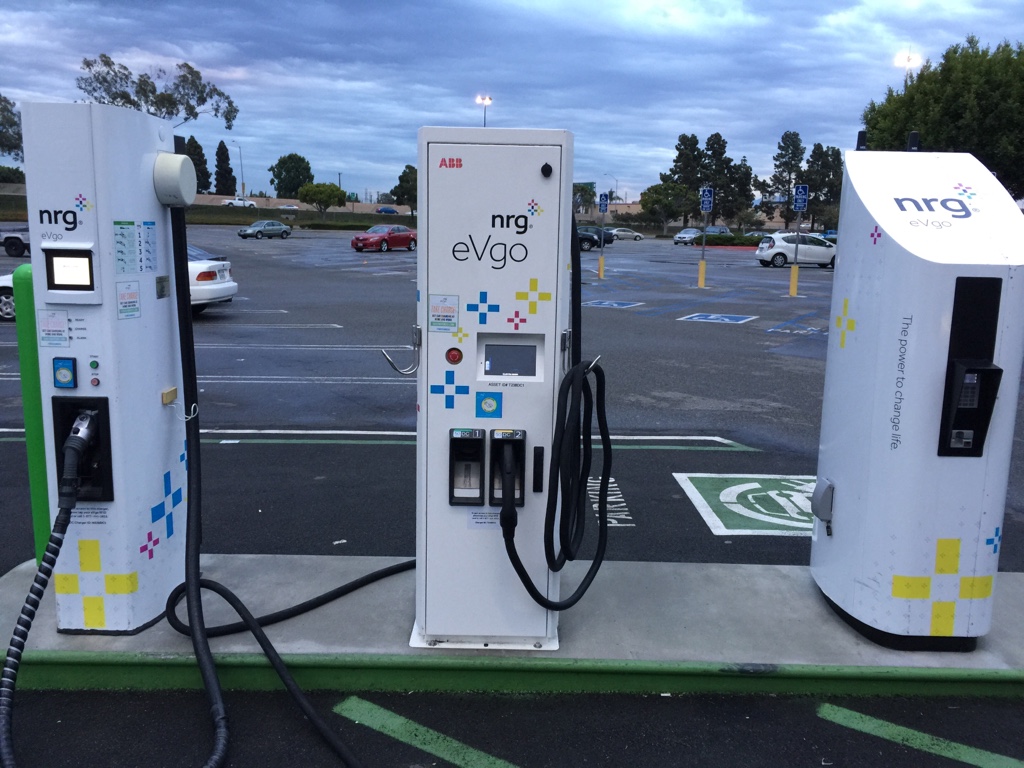
miimura Most of the NRG eVgo stations have one dedicated CHAdeMO Nissan charger plus one ABB Dual CHAdeMO/SAE Combo charger. The ABB can only charge one car at a time, but the Nissan charger is completely independent. There is one station in Northern California I know of that has two ABB Dual standard chargers. So, I don't think you're missing out on anything having only a CHAdeMO adapter. After all, no matter which charger opens up first, you can use it. Pity the i3, e-Golf, and Spark EV users that have to wait for the ABB unit to open up.�
Jul 18, 2015
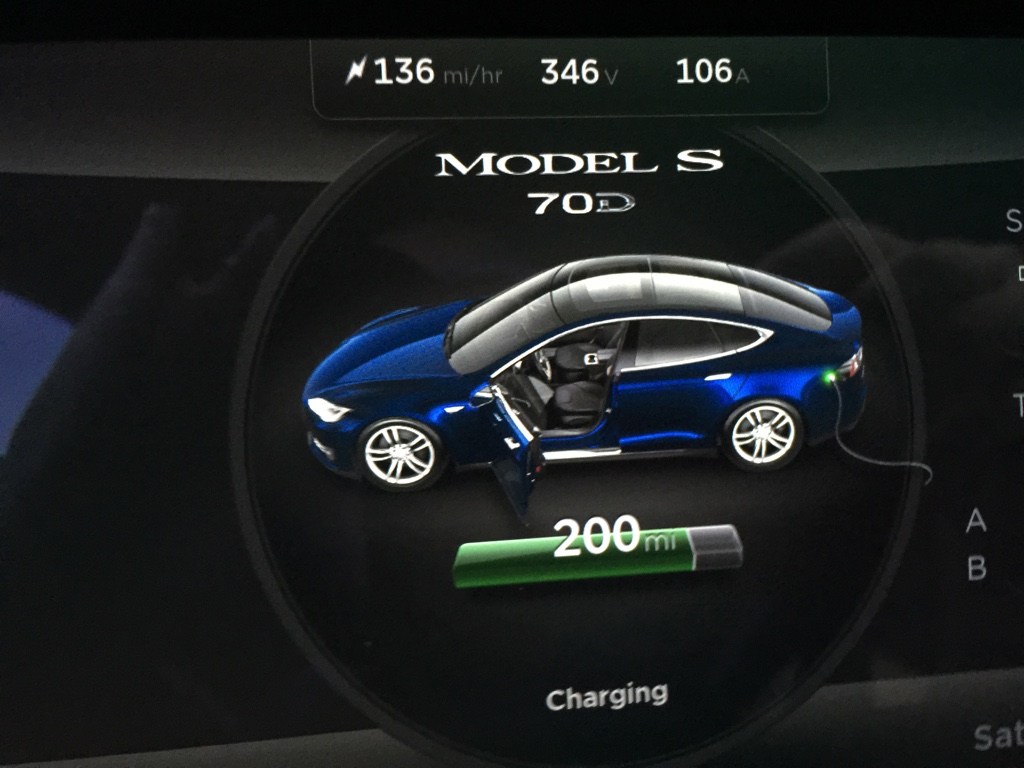
smilepak Nice. My first usage of Chademo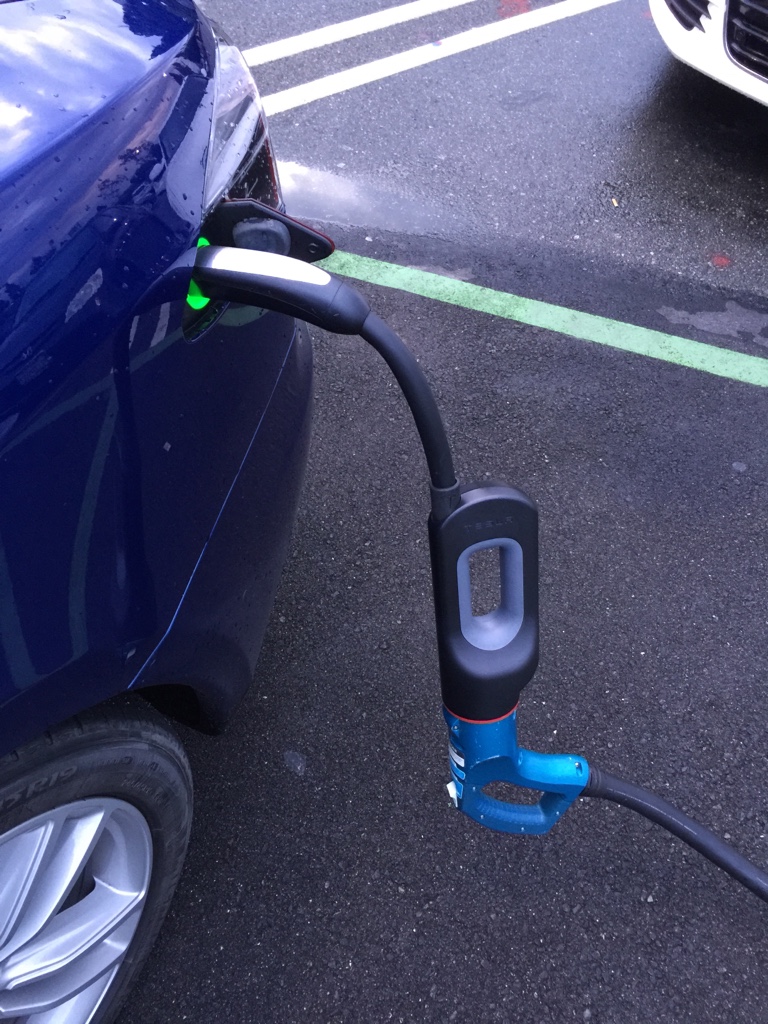
 �
�

Không có nhận xét nào:
Đăng nhận xét