Aug 29, 2015
Pete90D So around midnight I charged the car to 90%, went on a drive to get it down to 8% and then recorded all the data while doing a range charge at a supercharger. I had provided some of this before via photos, but there was another request to do <10% to >90%
Here's the link to the graphs. I could post pictures, but with these graphs you can zoom in on sections by clicking and dragging the timeline you want.
Supercharger Data
I hope this is useful.
P.S. the max battery option was never on. Just a long, calm drive.
Edit: A/C was off, music was on, no sharing of power feeds.�
Aug 29, 2015
David99 Thanks a lot! Very useful!
Q: how did you collect the data? And I love how the graphs are interactive. How is that done?�
Aug 29, 2015
LargeHamCollider "You must spread some reputation around before giving it to Pete90d again"
This is great data, looks like P90D owners will have a slight advantage when charging to more than about 235mi range, otherwise things are about equal.�
Aug 29, 2015
Pete90D I wrote some code that made use of the REST API and then just tethered my laptop to my phone and polled the API continuously.
Highcharts has great graphing libraries, they do all the heavy lifting. I just tell it how I want it to look and give it the data.�
Aug 29, 2015
apacheguy Thanks for doing this. Unfortunately this data is very difficult for me to interpret. I would need to see power (kW) v SOC in order to compare with your previous data posted.�
Aug 29, 2015
LargeHamCollider ... easy to get this from the charge rate in mph data, take mph and multiply by .308�
Aug 29, 2015
apacheguy Nah, thats the average over the session and that factor is not a constant. Trust me, I've been looking at taper curves for over 2 years.�
Aug 29, 2015
Pete90D Pairing the kW and SOC together was pretty linear so I left it out. If you want it I can add it�
Aug 29, 2015
apacheguy @Pete - Yeah that'd be great.�
Aug 29, 2015
Pete90D It's updated.�
Aug 29, 2015
apacheguy Something is very very wrong. The ways it's posted now kW power increases with SOC. This should be the opposite.
---updated---
Back on my desktop now so I can take a closer look. Seems like at 40% you were get 84 kW (based on V x A). This is about 10-15 kW lower than what I've seen 85 kwh packs get. The mystery continues.�
Aug 29, 2015
Pete90D I thought you wanted the kW that was added as the SoC increased.
Here are the options. Tell me what combinations you want
time_to_full_charge (hrs)
battery_range (mi)
charger_power (A?)
battery_current (A)
battery_level (SoC)
charge_energy_added (kW)
charge_rate (Wh/mi)
charger_voltage (V)
charge_miles_added_rated (mi)�
Aug 29, 2015
Sad You probably mean kWh instead of kW. Charger power should be in kW.�
Aug 29, 2015
CleanPower Could you post the raw data? Extra credit if it is in Excel or similar format.
Thank you for doing this... I'm very interested in figuring out how fast my future 90D is going to charge...
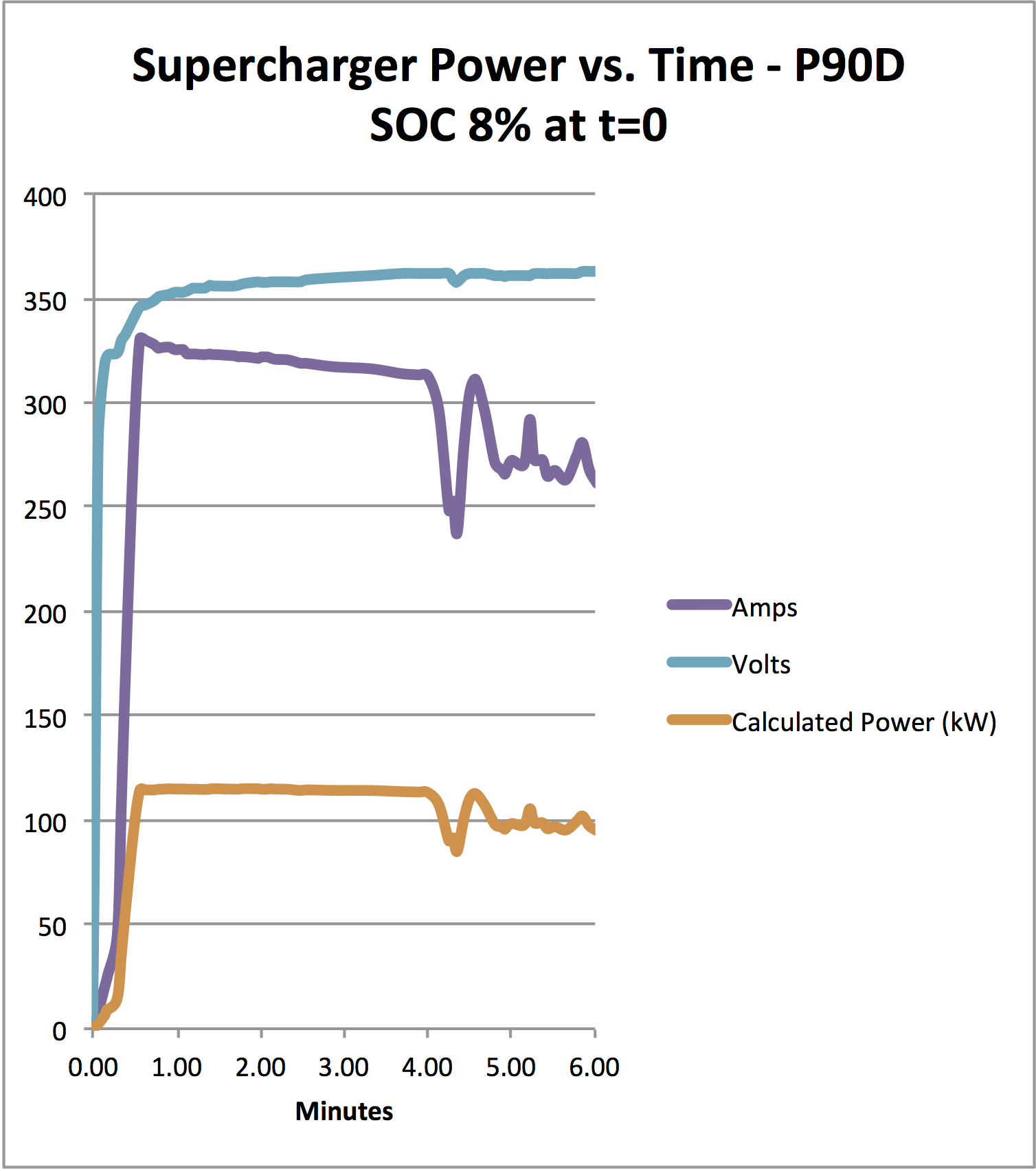
Here is Supercharger power vs. time for first 6 minutes... (I'm entering data by hand, so it is slow going...)
You are charging at 115 kW for about the first 4 minutes and averaging about 100 kW for the next 2 minutes.
 �
�
Aug 29, 2015
LargeHamCollider Pretty sure what Apache wants is charger_power (A?) * charger_voltage (V) on one axis and battery_level (SoC) on the other.
�
Aug 29, 2015
Troy Yes, I second that. If you have time vs SOC data in tabular format, can you upload an excel file or create a google sheets file. Google sheets would be better I think.
minutes SOC 1.38 min 10% 1.87 min 11% 2.32 min 12% �
Aug 29, 2015
Pete90D Update the chart with the power. Cleaned it up by only including the very first entry for each percentage.�
Aug 29, 2015
Troy Pete, in the opening message you could use the term supercharging instead charging. It is not clear this is about supercharging. In this forum messages can be edited for 24 hours. Maybe the title should be updated too but only moderators can change that.�
Aug 29, 2015
Pete90D Updated
- - - Updated - - -
Raw data in CSV�
Aug 29, 2015
Troy Thanks, that's very useful.�
Aug 29, 2015
apacheguy So something odd was happening between 15-35%. The power reading seemed very noisy from large fluctuations in the amperage. Can't say I've ever seen this before. At any rate, I'm still confused as to how the 90 kWh charges much slower than an 85 kWh for any given SOC.�
Aug 29, 2015
Pete90D I started a post asking about the amperage fluctuation that I saw at the end of a charge the other night. The dash showed it fluctuating a lot faster than on the touchscreen.
Power Fluctuation�
Aug 29, 2015
hiroshiy As apacheguy said, the taper curve seems to be steeper than 85. I have E pack 85, and at 72-75% SOC the kW crosses 50kW. Pete90D's data seems at 70% already lower than 50kW. Different chemistry?�
Aug 29, 2015
Pete90D Would heat be an issue? If they put more into the same space then maybe they are tapering differently for heat reasons.�
Aug 29, 2015
Khatsalano Well done. Keep investigating.This is pretty in-line with the knowledge base before the 90 packs came out.
- K�
Aug 29, 2015
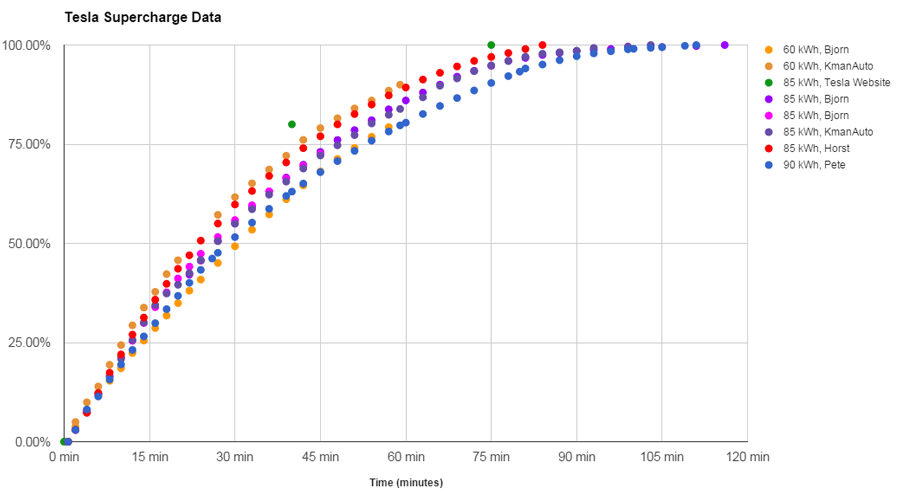
Troy I compared this data (in message #15) to data from other supercharge sessions. I created a Google document here. Anyone can edit it. This chart is from that document. I think Tesla uses 3 different pre-programmed tapering curves. This time Pete's car selected the lower curve. Links to the data sources for the other sessions are in the Google document. I added 3.94 minutes to the beginning of Pete's session to compensate for the missing first 8%.
 �
�
Aug 29, 2015
apacheguy IMO, each battery pack rev has it's own taper curve (only one). However, there exist preprogrammed offsets in the event cooling issues arise and the pack is not able to maintain the desired set point. I would find it enormously interesting if Tesla released the basics of their SpC logic.�
Sep 2, 2015
Pete90D I talked to a technician today about the fluctuation in amperage and he didn't have an answer so he's going to see if an engineer will reach out to me. I'll update when/if I have more information�
Sep 16, 2015
apacheguy So apparently the latest SW updates have been targeting the BMS among other things. Might be worthwhile to check if Tesla's gotten around to fine tuning the SpC taper for the 90 kWh.�
Sep 16, 2015
Pete90D Thanks for the heads up. I may not have a chance to record it for a couple weeks, but if I do I'll post the data.�
Nov 4, 2015
apacheguy There are plenty of 90 kWh (90D and P90D, doesn't matter) out in the wild and yet we only have one SpC taper curve from Pete. Pete's done enough already for our community. How about we get some others pitching in here?�
Nov 4, 2015
jeffro01 When I get my S90D in a couple of weeks I'll be happy to help, you'll just have to tell me how... LOL
Jeff�
Nov 4, 2015
apacheguy Instructions:
1. Arrive at a SpC with sufficiently low state of charge (35% or less).
2. Connect to SpC and log the session in your favorite app that interfaces with the Tesla API such that you track volts, amps, and kW every 2 minutes or less for the duration of charging.
If I lost you on 2, simply take screenshots of the "Charging" screen on the mobile app for every % change in SOC.
3. Post data here on TMC.�
Nov 4, 2015
jeffro01 Roger that, will be happy to do.
On number 2 since yes, I was lost... (although I shouldn't be), do you have any recommendations for an app that'll keep me from having to take screen shots?
Thanks,
Jeff�
Nov 4, 2015
apacheguy I'm the author of Tesla Mobile, which you can find here:
REST API Tools and Apps - Tesla Motors Club - Enthusiasts & Owners Forum
It's the only app I've ever used to interface with my car so that's all I can speak to. Alternatively, you may simply grab a video of the center console as shown below for an 85 kWh:
Supercharge Pack Rev E - 120kW supercharger - No Audio - YouTube�
Nov 19, 2015
liuping I'm going to try do a test tonight. I should be down around 20% (I've skipped charging for a few days now), and I'll charge to 90%, with visible Tesla graphics the data.
It will be probably around 10pm, so there should be few other people there. The outside temp should be around 58 degrees, so cooling should not be a factor. I'll leave the cabin heating off.
Any thing else I should consider?�
Nov 19, 2015
apacheguy Sounds good. Just as long as you make sure VT is logging volts, amps, and power with sufficient frequency. IIRC, for some reason VT polls charge state infrequently.�
Nov 19, 2015
liuping I'll make sure VT is in do not sleep mode.
I'll also do the low tech backup of logging the time of each 1% gain on screen.�
Nov 20, 2015
liuping I ran the test last night. I arrived with 16% and charged until 90%. It took 1 hour and 4 minutes. Outside temp was 61 degrees. There was on one other car at any given time at the sight (and they were not using my paired charger)
Visual Tesla did indeed do the sampling inconsistently. It did most about 4 minutes apart, then some just one second apart. However, I also manually logged the Time, Volts and Amps each time the % went up by one, so I think I have all the data we need.
I'm not sure the best way to add it to the existing data, since I have sample data at each % increase, and the graph data is per minute. Should I have excel plot a graphic and then resample the curve at the existing time stamps used in the google doc?
I can try to do that tonight (I'm not great at Excel, but me wife is an expert), or if anyone wants to give it a try, I put the CSV data here: https://www.dropbox.com/s/a2c3a4rmbwzkabi/supercharge.csv?dl=0�
Nov 20, 2015
apacheguy A couple things:
1. I assume the data point at 23 % was a typo since that = 150 kW. We've never seen rates above 120 kW.
2. You're 90 kWh seems to have followed the less aggressive taper that was observed by Pete90. I'll need to take a closer look for sure, but just eyeballing it, your data indicate slower charge rates for a given percentage compared to my 85 kWh.�
Nov 20, 2015
liuping Yes, you're correct 23% should be 303 Amps, not 403. I've updated the csv. Thanks for catching that.
The taper could be effected by the outside temp, it was nice an cool last night.�
Nov 21, 2015
apacheguy Maybe but doubtful. I've SpC in everything from 50 -> 90+ and not noticed much difference. Generally the cooler the better as long as the pack isn't cold soaked. I think there is something different about the cells that prevents them from being charged as quickly.
On critical point that I always look at is the 90 kW cross over. On B+ 85 packs this occurs 40-45%. Your data indicate that the mark was crossed at 33%, a whole 7-12% lower than the same taper point on an 85 kWh.
If you are interested in an example of this for comparison see:
Supercharge Pack Rev E - 120kW supercharger - No Audio - YouTube�
Nov 22, 2015
ArtInCT liuping:
I massaged your SuperCharger data, rounding UP in all cases and made this handy chart which perhaps many P90, P90D and P90DL owners may find informative when planning their SuperCharger Stops. Oops the lower image is in error... But I cannot get rid of it. :cursing:�
Nov 23, 2015
liuping Thanks. That is a very handy chart.
(To delete the incorrect image, edit the post in advanced mode, and click on the "manage attachments" button further down the page)�
Nov 23, 2015
apacheguy For further comparison, an 85 kWh takes 52 minutes to go from 16-90% (from the above referenced video). The 90 kWh, while having more capacity and thus expected to take a bit longer, in reality takes 12 additional minutes. This points to a steeper taper curve.�
Nov 23, 2015
liuping 90% on an 85kWh pack is about 85% on a 90kWh pack, which took about 56 minutes in my test.
At least that is small enough, that other factors will likely make a bigger difference in the total time stopped at the SuperChargers.�
Nov 23, 2015
sorka Another data point for a P85D. We drove from Merced, CA to Tejon Ranch just before the start of the grapevine. Arrived with 19% and charged to 96% in 60 minutes. I had only planned to charge to 90% in order to skip several super chargers so I could make it all the way to Indian Wells, CA where the hotel had an HPWC. Normally I'd charge just enough to make it to the next supercharger and leave as soon as possible, but we didn't want to rush and spent an hour at dinner across the street at this fabulous Mexican restaurant called Maricios.
Anyway, I forgot to set the charge setpoint to 90% and by the time we finished dinner and walked out, it had been exactly an hour since we plugged in and it the car was at 96%.�
Nov 23, 2015
apacheguy Yeah, Mauricio's is great to hang out at while you're juicing up.�
Jan 26, 2016
apacheguy Was just revisiting this thread when a thought popped in my head. The 85 kWh charges faster than the 60 kWh despite having increased capacity. The 90 kWh should by extension be faster as well, but in reality it is slower. Go figure.
See Bjorns video Supercharging Tesla Model S 60 kWh vs 85 kWh - YouTube�
Jan 27, 2016
Brunton As I understand it, the 90 battery has a slightly different chemistry than the 70 or 85. That probably accounts for the somewhat slower charging rate of the 90.�
Jan 27, 2016
llavalle The reason why there is such a difference between the 60/70 and the 85/90 is because the voltage of the pack is not the same. Most electrical components have a limit in Volts but more importantly, a limit in current (amps). Since the superchargers are limited to around 330amp (according to the graphs in the post) there's only so much power that can get to the pack. Power, in Watts, is voltage (volts) * current (amps).
Since the 90kWh battery has the same voltage as the 85kWh but needs more energy to be filled up, I expect it take more time to charge...especially since the fast part of supercharging (the first 5% of SOC) are probably current limited.
In theory, at equal voltage and same charging spec (C rating), a bigger cell will be able to get more current. Just google "battery C rating" and you'll get more info but basically, a battery cell is rated at a C rating for charging and a C rating for discharging. This is a ratio of the capacity...
ex : a 3200mAh battery with a charge rating of "0.5C" can be charged up to 0.5*3200mA = 1600mA max. That is called the "CC" phase, or "Constant current" phase. At one point, you hit max battery voltage and cannot put more voltage on the charger to get more amps flowing, you're now in the "CV" or Constant Voltage phase. In the case of most Lithium batteries, this voltage is 4.2V. That means that the charger will provide 4.2V to the battery cell and it stops when it see less than a specified amount of amps flowing towards the battery.
That being said, supercharging is not CC/CV, it's a super weird curve!�
Jan 27, 2016
apacheguy
Oh, undoubtedly it's due to the different chemistry. Just confused why Tesla went in the opposite direction of progress in this instance.
Good points, but not sure I follow here. At equal voltage, the 90 kWh pack draws less current than the 85 kWh.
Also, note that a 70 kWh exceeds 330 amp draw on the low end.�
Jan 27, 2016
supratachophobia I wish I had known this before getting the battery upgrade. This is one of those pieces of info that Tesla could have disclosed so that customers could make a more informed decision. An extra 12min at a supercharger is huge.�
Jan 27, 2016
AWDtsla Known what exactly? I don't see why everybody is comparing battery percentage and ignoring that the 90 has 6.4% more usable kWh than the 85 which is also 6.4% more range per percent. Need to remove 6.4% time the 90 times, or better yet, compare range added.�
Jan 27, 2016
apacheguy Sure, I'll take you up on that. In the above referenced video, an 85 went from 16->90% and added 193 miles in 52 minutes. Can you top that?�
Jan 28, 2016
Cottonwood Having done a lot of runs with Superchargers spaced at every 100-130 miles, the comparison that makes the most sense to me is how long does it take to charge from 25 to 200 rated miles, giving 175 rated miles to make it to the next Supercharger. Make the metric how long it takes to add a fixed number of rated miles, rather than percentage or absolute energy; rated miles are the closest metric that we have that relates to actual range. Also, I like to plan on a low number of rated miles on arrival at a Supercharger, but 25 rated miles is as low as I want to normally arrive.�
Jan 31, 2016
supratachophobia Known that it appears, according to the charging percentage rates, as though the s90 teachers longer to put the same amount of miles into the car. So while it goes 6.4% farther, it takes longer to charge.�
Jan 31, 2016
AWDtsla Your statement is contradictory. If it takes the same amount of time to charge the same amount of range, then it is not slower. Percentage be damned. To me it looks like it takes less time, and I don't see anything directly contradictory above. Waiting for someone to point out this data.�
Jan 31, 2016
supratachophobia Twelve extra minutes for one of the most popular charge ranges.....
16-90% 52 min compared to 64 min. That's more than 6%longer.�
Jan 31, 2016
ohmman So it takes 6% longer to get about 6.4% more range.. or am I missing your point?�
Mar 8, 2016
Oyvind.H If 16-90% takes 52 min with 85 and 64 min with 90 then it takes about 23% longer to charge. In return you get 6% more energy (according to Tesla).
And if the 90 pack is only 3-4kWh bigger than the 85 pack, then it takes 23% longer to get 4-5% more range.�
Mar 8, 2016
apacheguy Just because a pack has more capacity does not mean it should take longer to SpC. The 85 kWh actually charges much faster than the 60 kWh.�
Mar 17, 2016
Oyvind.H But with the 90kWh pack this seems to be the case. I would have expected the opposite - higher average charging power, when in reality the 90kWh seems to taper much quicker. Disappointing.�
Jun 29, 2016
Oyvind.H Correction: with new software the 90D supercharger speed has increased a lot.
From 75-80kW @45% soc to 105kW @45%.
Now it charges as expected�
Jun 30, 2016
supratachophobia What is this you say?�
Jun 30, 2016
AWDtsla Or you got the new 90 pack... and all the old 90 owners are bag holders.�
Jun 30, 2016
apacheguy Hah! Is this the whole A pack debacle all over again?�
Jul 3, 2016
Oyvind.H Don't think so. My pack charged slower than 85 packs earlier. With software update it now charges way faster than 85 packs. Both in time and energy.�
Jul 3, 2016
David99 Can you tell me what the difference is? Some number so I can get an idea. For example, how much power do you get at 30% or at 50% or at 80%. I have a 2 year old 85 and it would be interesting to see how much of an improvement the 90 battery is.�
Jul 5, 2016
apacheguy Could be possible they updated the taper algo and all cars. Anyone with an 85 checked?�
Jul 7, 2016
ScottUK �
Jul 7, 2016
David99 I watched that video and it seems while it is a little faster, I wouldn't use the words 'way faster'. More an incremental improvement. It would also be interesting to test the 85 again after the new software. I think Bjorn took the old 85 data from some time ago. It could be possible that the new software also helps with the 86 battery.�
Jul 7, 2016
Oyvind.H I`ve recorded charging power for about three years. Because of the introduction of % instead of km/miles to measure capacity, my old numbers are in range, not percent.
In other words it`s hard to be precise.
But what I can say is that my 2013 S85 had its highest supercharger-speed when it was new.
Back i 2013-beginning of 2014 it had about 95kW @45% (@about 166,5tkm range)
In 2015 it was down to about 85kW @45%.
Some probably because of sw updates, and some due to degradation/capacity loss/higher internal resistance.
With my new 2016 90D I previously got 75kW @45%
Now I get 105kW @45%.
I think Bj�rn has compared 85 with new software to older software and found no increase like the 90 got. However - his numbers are not the same as mine. He seems to get a bit lower power than me at low SOC, and he got a dip that I didn`t see when I tested. But I`m going to visit several superchargers the next week so I`ll know more then
All in all, maybe not "way faster". But definitively faster�
Jul 7, 2016
apacheguy @Oyvind.H - On which firmware specifically did you notice the speed bump?�
Jul 7, 2016
Oyvind.H It believe it was the old speed with 2.17.37. Tested 11th of June.
And new speed with 2.24.86. Tested 29th of June.
That's the only two data points i have with and without speed update. So it's somewhere in between�
Jul 7, 2016
David99 Thanks for the info, that's very interesting. It matches my experience. Supercharging has definitely become slower for me as well. Mine is a 2014 s85 with 82k miles. If lucky I get 77 kW at 45%. That's it. I just finished a 4400 miles road trip and had plenty of opportunity to watch Supercharging. Several times it was slower than normal (not being paired). And those times it was normal speed it just isn't as fast as it used to be.�
Jul 8, 2016
ArtInCT Back in May, after a leg of a trip I pulled into a Supercharger and began to video tape my charging progress.
Sadly that video is gone, however I did watch the video and transcribe the data into a spreadsheet for future analysis.
I was on firmware 2.18.77 at the time and the external air temperature was 63F.
The S was warm due to a 110+ mile highway run.
The Supercharger was in Auburn, MASS and of the 8 stalls I was the only one there...
Oh ya.... my S is called The Silver Surfer (Marvel Comics Character from the Fantastic Four).
The minutes show the elapsed minutes of the charge session.
About 1/4 of the way into the supercharge I heard the fans turn on which was something I had
not experienced before. This was my first supercharger charge btw.
Here is the data...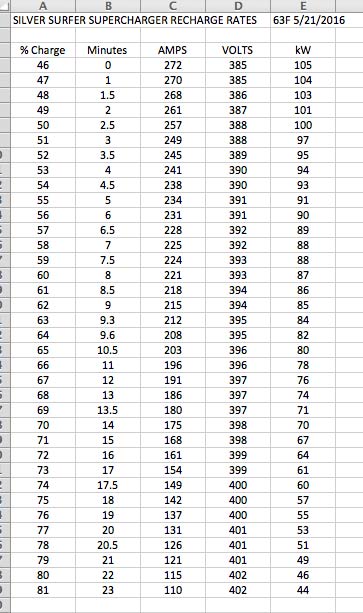 �
�
Jul 8, 2016
Oyvind.H Another test today
112kW @47% soc.�
Jul 8, 2016
apacheguy Those are rates I certainly have never seen before. I'm on 2.20.x at the moment.�
Jul 8, 2016
David99 Did you just plug in at 47%? I noticed when I plug in at a Supercharger the charge rate is very high for a moment and then it adjusts down quickly.�
Jul 8, 2016
apacheguy It seems odd to me that Tesla started out so conservative with the 90 kWh taper - even compared to the 85 and then all of sudden decided to substantially increase the power delivery rate later into the charge.
FWIW, at 47% SOC the highest I've seen for my S85 is 86 kW.�
Jul 9, 2016
ArtInCT Just wondering.... is it the car that specifies the taper OR is it the Supercharger that specifies the taper?�
Jul 9, 2016
apacheguy The car specifies the max charge rate it can handle and it will take whatever the SpC outputs. There is constant communication between the two end points.�
Jul 9, 2016
David99 That's done by the car. Battery temperature and state of charge are the two main factors that are considered. The car will tell the Supercharger how much power it needs. The Supercharger might not be able to deliver enough when it's paired with another car but the car is always in charge of setting the power.�
Jul 10, 2016
Oyvind.H Started at 42%.�
Jul 10, 2016
apacheguy Are you currently the only 90 kWh owner who is experiencing the faster charge rate? I'm surprised there isn't more interest in this. 2 years ago this would have been a separate thread with at least 100 replies. Times have changed on TMC. We are far less technically savvy than we once were.�
Jul 10, 2016
Blurry_Eyed I have an December 2015 build P90DL Model X and have also noticed with recent software updates my Supercharging rate has significantly improved. At 50% SOC in April my charge rate was only about 64 kW (I made sure I was the only car on the charger pair and the charger was working fine - started initially delivering 114 kW at 13% SOC). Yesterday at 50% SOC my car was still charging at 110kW and the power taper was much more gentle than before. The car is currently running version 2.24.86 firmware.�
Jul 10, 2016
apacheguy @Blurry-Eyed - wow that is nearly a 2 fold increase!�
Jul 10, 2016
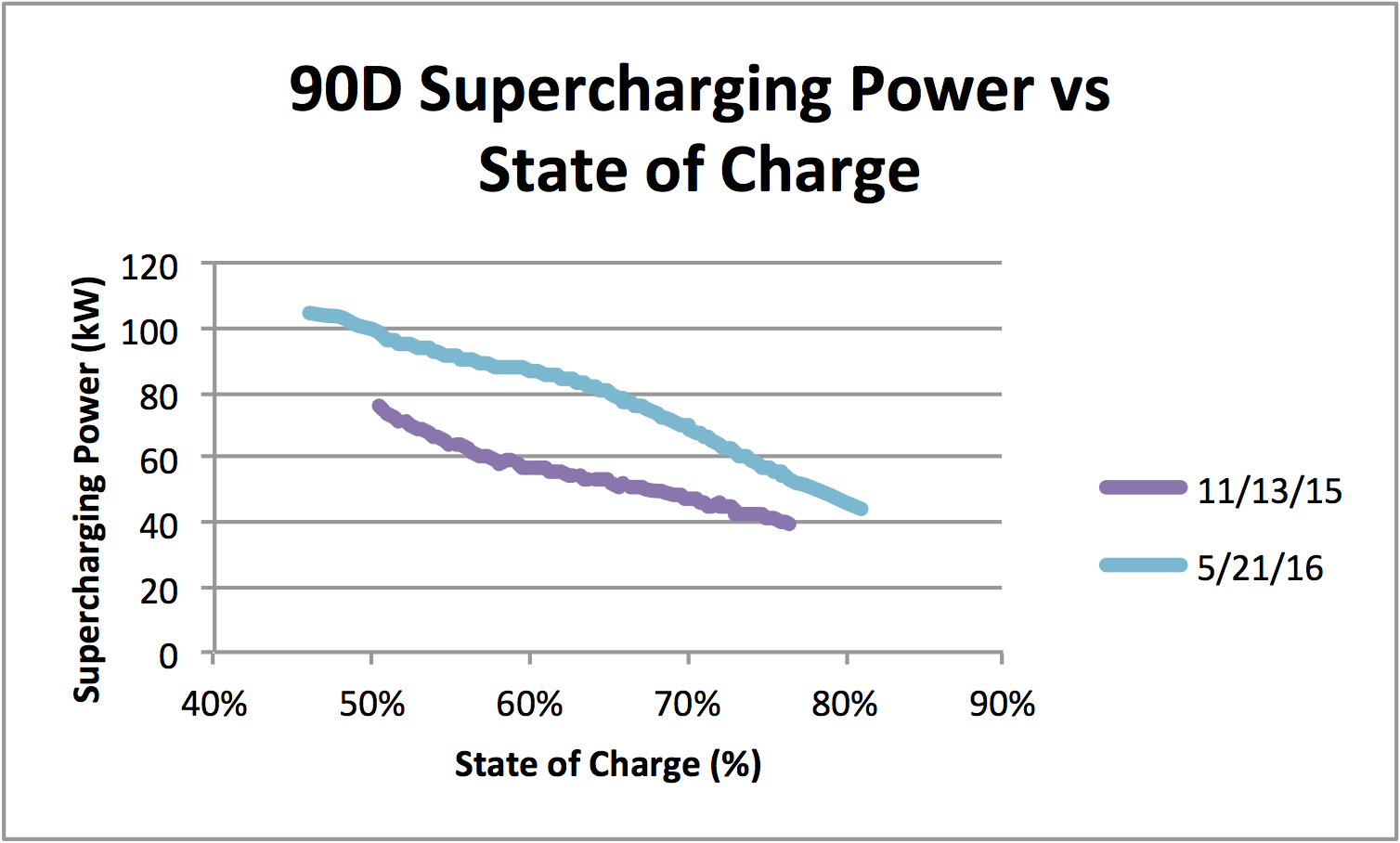
CleanPower I graphed your data and compared it to the data I captured from supercharging my 90D in West Springfield, MA on November 13, 2015.
Temperature was 53 degrees F.
You are charging substantially faster than I was in November.
 �
�
Jul 10, 2016
Blurry_Eyed Yes. It was a bit disappointing when I took the X in a road trip from Seattle to the Bay Area in March to have such slow Supercharging rates. I also have an S and have done the same trip and it was much faster to charge thr S compared to the X. But now, on a road trip I just took from Seattle to Vancouver B.C. It seemed like my X charged quicker than I remember my November 2012 build P85+ did on the same trip. It's more convenient to have the faster charge rate for those road trips!�
Jul 11, 2016
2virgule5 I'm going to try to map that out one of those days on my refresh 90D - what is best, measuring SC power vs SOC or more simply SOC vs time starting as close a possible to zero?�
Jul 11, 2016
apacheguy SpC power vs SOC please.
Are any 85s on 2.24.x? If so, have you noticed the bump as well?�
Jul 14, 2016
apacheguy Looking at the firmware tracker it seems that several 85s have 2.24.x. Should be pretty simple to discern whether or not there is a difference in SpC rate. Anyone?�
Jul 18, 2016
2virgule5 Too bad I didn't do this on my S85 before switching to 90D refresh. Anyway here is my graph - note another 90D was charging at the same time at the SC when I arrived, but the car had left for the last data points. Charging felt faster that what I remember, from 59 miles to 195 miles in 29 minutes.
Edit: added a second SC at the same supercharger.
�
Jul 18, 2016
apacheguy Thanks. For some reason it says I don't have permission to view within the album�
Jul 18, 2016
2virgule5 Ok let's try "file upload". Do you see it now?�
Jul 18, 2016
apacheguy I see the data
Wow that is really incredible. You are still pulling 100 kW at 60% SOC. It's almost hard for me to believe the cells are capable of withstanding those rates without lasting damage/degradation.
Perhaps @Ingineer, @wk057, or @okashira can comment on the charging limits of the cells?�
Jul 18, 2016
David99 100 kW is about 1C charging rate. At 60% that isn't a crazy number at all, especially when you actively cool the battery. So far Tesla has been very careful and conservative with the Supercharging rate. It seems they now have enough real world evidence from all cars over the past years that they can safely increase the charging rate on the new cells. Frankly I was expecting the faster charge rates to come earlier.�
Jul 20, 2016
trils0n Wow I'm surprised too. Somehow, I just noticed this thread. This is significant news, surprised this thread has so few replies.
Do only the new 90 packs show this reduced charging taper or are the 75 packs faster as well?�
Jul 20, 2016
apacheguy It is unclear. If anyone with firmware >= 2.24 on an 85, 75, 60 wants to check their charge rates then we can know for sure. It makes sense to me that they would update the taper on all cars at the same time, but I'm not sure if this is the case�
Jul 21, 2016
2virgule5 @David99 did you monitor your 2014 S85 recently and did you see an increase as well?�
Jul 21, 2016
David99 I have not gotten any software updates recently. I did a 4400 mile road trip recently and did not see an increase in charge rate. If anything it was slower in several cases. Compared to my data from about 1.5 years ago my car charges about 5 kW slower now.�
Jul 21, 2016
hiroshiy 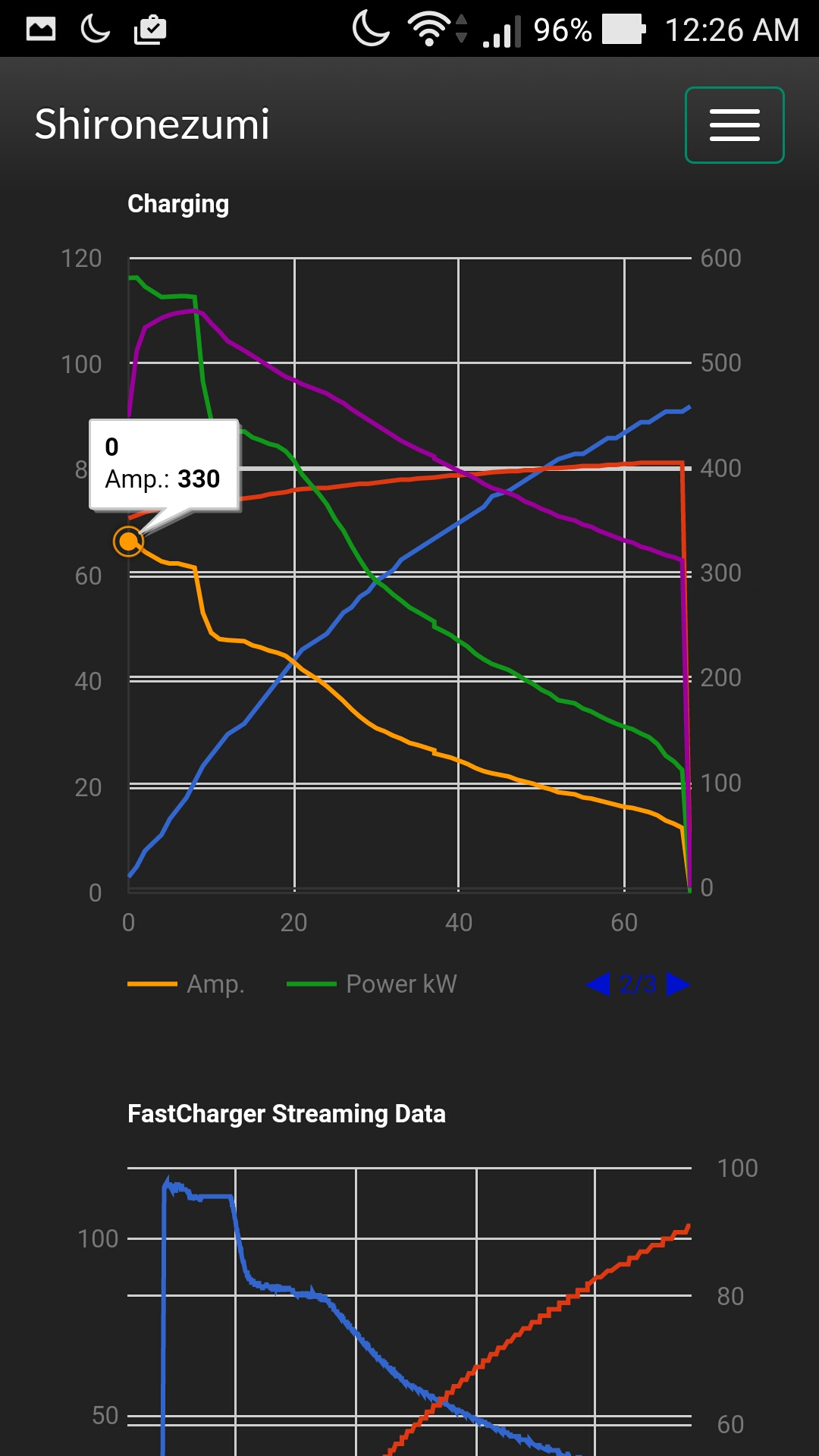
Just one data point with my 2014 P85, 2.28.19. No change in Superchargers rates, at newly opened Hamamatsu Supercharger in Japan.�
Jul 22, 2016
2virgule5 Hi Hiroshiy, would you mind sharing the name of the App you are using? Cheers�
Jul 22, 2016
apacheguy @hiroshiy - seems like you had a paired stall. The precipitous decline right around 10 min is indicative of another user on your cabinet�
Jul 22, 2016
hiroshiy I'm using TeslaLog.�
Jul 22, 2016
hiroshiy Hmmm, I was there like a bit over one hour so I didn't really check my other stall. Does it affect my charging rates, considering I'm the one who started charging first? I always thought that the second car in the pair always get remaining power of 135kW... for example if I'm pulling 90kW, then 135-90=45kW would be available to the 2nd car.�
Jul 22, 2016
apacheguy In theory, the one to plug in first should not be affected, but my experience contradicts this. I always see some power dips from another user sharing my cabinet.
At any rate, the taper curve you posted does not look "clean" to me so perhaps there were other factors.�
Jul 22, 2016
apacheguy Also, I can't tell by looking at the graph. What is the blue trace? What SOC % did you start and end with?
Ah I see now. It appears that blue is SOC�
Jul 23, 2016
hiroshiy Yes, the blue is SOC and I started charging from 6km of rated range, or about 1.5% of charge. Anyway it seems that only cars with Silicon anode batteries, i.e. new 60D 70D 75D 90Ds got benefited by the recent firmware upgrade for faster supercharging.�
Jul 23, 2016
apacheguy This would be odd. Firstly, because Tesla was much, much more aggressive with the taper on the newer chemistry from the outset. Only recently did they decide to relax the taper... And by quite a bit - all in one go. Perhaps they didn't like the perception that the 90 kWh charges more slowly than the 85 so they just forced a much more lenient taper?
Secondly, we know from @wk057 that there is considerable room for improvement on the taper for the 85s. But again Tesla may hold back on implementing this because they only want to support the newer models. Hope I'm wrong.�

Không có nhận xét nào:
Đăng nhận xét