Jan 10, 2014
DJ Frustration Interesting development.
Tesla to Upgrade Wall Adapters After Reports of Garage Fires - Bloomberg
"Tesla Motors Inc., which is under investigation by U.S. regulators over fires in its Model S sedan after battery punctures, will upgrade wall charger adapters following reports of overheating in garages.
The charger connectors, which connect Tesla-issued cables with wall outlets, will be mailed out in the next two weeks, Chief Executive Officer Elon Musk said in an interview today."
Anyone have a link to the interview from Elon?�
Jan 10, 2014
Rainbow Tesla to Upgrade Wall Adapters After Reports of Garage Fires
Tesla to Upgrade Wall Adapters After Reports of Garage Fires
Tesla to Upgrade Charger Adapters After Reports of Garage Fires - Businessweek�
Jan 10, 2014
AprilDelivery?? Which wall adapter is that? The 120v adapter? Or the 40 amp adapter?�
Jan 10, 2014
pgiralt I wonder why we haven't heard anything about this from Tesla directly. From reading the article, it seems like a good idea - add a thermal fuse in the plug so if it gets too hot, it shuts off. This should deal with any bad wiring in the outlet like what probably happened in the garage fire.�
Jan 10, 2014
drees Typical overblown headline corrected by the first sentence of the article.
That said, it's good that Tesla is doing this. Now if only they'd beef up the adapter pins and/or the way the adapter attaches to the plug at the same time...
I would have to assume it's going into all the adapters. That'd be the best way to detect overheating at both sides of the adapter.�
Jan 10, 2014
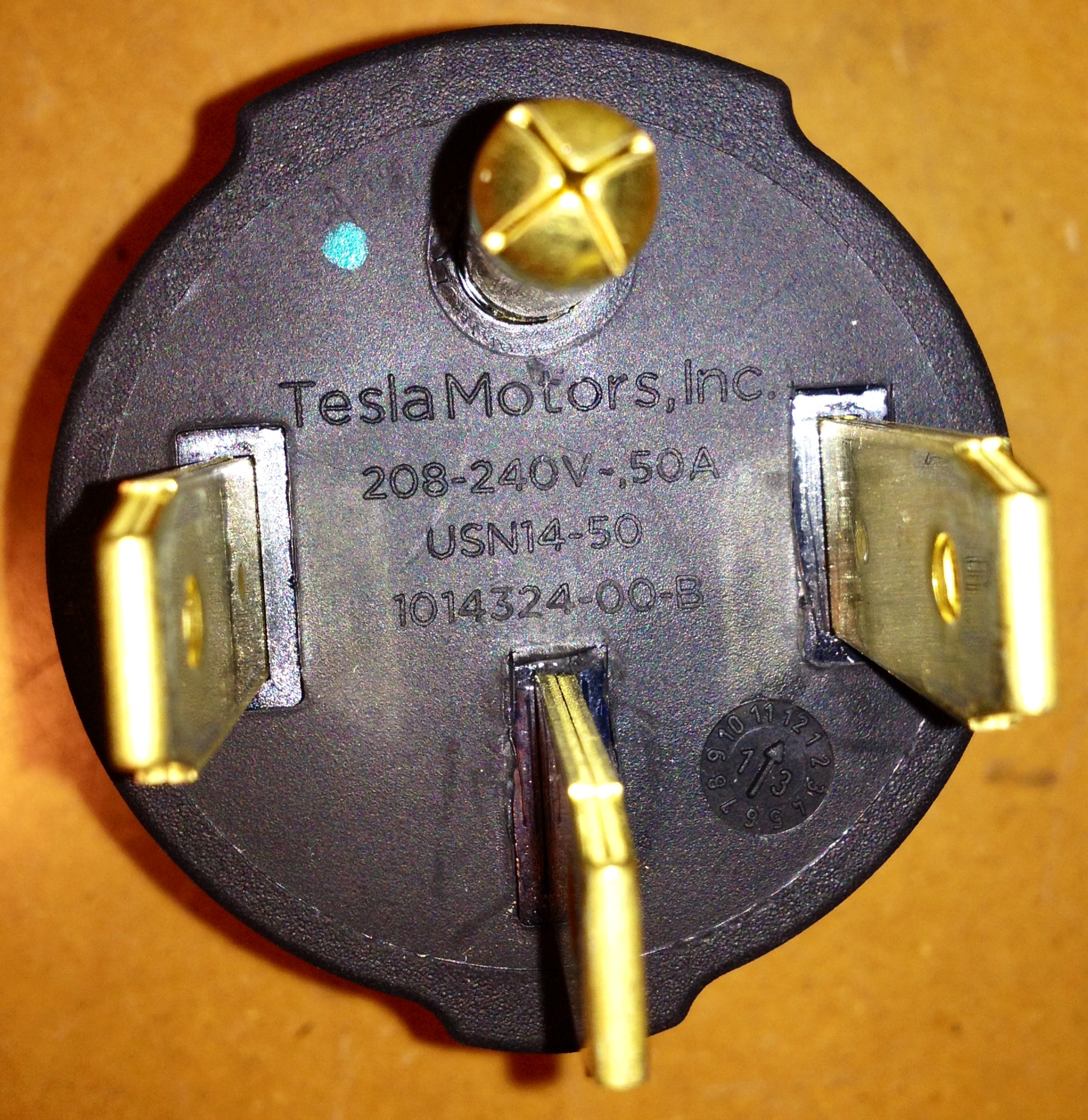
liuping I had a problem with my 14-50 connect not locking in place last weekend. I brought it to the service center and they replaced both the UMC (the locking pin was not quite grabbing the adaptor) and the 14-50, even though the old 14-50 locked in place fine. They said they just got in batch of new, improved 14-50s last week.
You can tell if they are the new version, if it has a green dot on the side that plugs into the wall.�
Jan 10, 2014
Rainbow So this is the third version? If I understand correctly, the first and second versions have had problems overheating. So would the one with the green dot be a second or third version?�
Jan 10, 2014
brianstorms Let Bloomberg know how misleading and damaging their article's headline is.
Reporter: Jeff Plungis
Twitter: @jplungis
Email: [email�protected]
Editor: Bernard Kohn
Email: [email�protected]�
Jan 10, 2014
ibcs Sent both of them comments over the sensationalism of the title.�
Jan 10, 2014
efusco So, will it just be the NEMA 14-50 Adapter? What about those of us who purchased/received with the car the NEMA 6-50? What about the various 30 amp adapters?�
Jan 10, 2014
Rainbow What is misleading?
It's wrong to smear sources to cover up safety hazards.�
Jan 10, 2014
mitch672 Unknown currently, but likely only for the 50A adapters right now, I bet they eventually have thermal fuses in ALL of the adapters.�
Jan 10, 2014
ckessel I was wondering the same thing. Though, I'm not even sure if it's the UMC or the HPWC that's being changed.�
Jan 10, 2014
Trnsl8r I would have to agree. Other than a mistaken plural (I only know of one garage fire), it's pretty descriptive.�
Jan 10, 2014
NigelM Discussion in the Model S Battery & Charging sub-forum: Tesla-to-Upgrade-Wall-Adapters-After-Reports-of-Garage-Fires�
Jan 10, 2014
Rainbow There was only one that I know about that there was a formal fire investigation by a fire department. However there have been others that have been reported to Tesla and on this forum. There is only one that I know of that was open flames, but the others could also be classified as fires because they were hot enough to melt and rapidly oxidized (aka burn/fire). Also a Tesla owner alleged that they were burned disconnecting the overheating charge connections.�
Jan 10, 2014
aviators99 Btw, if I try to unplug my HPWC during charge or right after charge, it is impossible to do without burning my hand. I mean the type of burn that leaves redness for several hours. I now have an oven mitt next to the car.�
Jan 10, 2014
Lloyd My daily use adapter is the 6-50, not the 14-50.
- - - Updated - - -
The HPWC should not get that hot. You have an issue and need to notify customer care.�
Jan 10, 2014
liuping The green dot is the new one the service center received last week, so I assume it's the very latest.�
Jan 10, 2014
Trnsl8r Gotcha, thanks. Then I have no problems with the headline.�
Jan 10, 2014
Kalud Get that replaced, mine is barely warm after 3h of 80A charging... The cable is a bit warmer but nothing to worry about... Like 95F...�
Jan 10, 2014
ibcs Agreed mine is warm, but it would never leave your hand red. The extra (s) in the fire statement was not accidental. Reporters want to get as much out of their headline as possible.�
Jan 10, 2014
araxara I had the exact issue with my HPWC. Tesla provided me with a new plug/cable (which I installed myself). The new plug only gets slightly warm. The only reason I knew to ask about this was that I have a HPWC at another house and it would never get very hot. Only issue now with the new pug/cable is that the charge port opening is erratic.�
Jan 10, 2014
100thMonkey Wow, I strongly urge anyone who is seeing this kind of heat to stop using the UMC and notify Tesla immediately, that kind of heat is super dangerous and suggests much higher than normal resistance. a litttle bit of warmth is normal, but scorching heat is exactly what is melting and leading to potential fire hazard, it's definitely not working properly.�
Jan 10, 2014
Rockster
My HPWC handle barely gets warm. Something seems wrong with your setup.�
Jan 10, 2014
Rainbow They shouldn't get too hot to touch. If they are that hot on the outside, then they're likely much hotter on the inside. If they get that hot there is a risk of fire. That's too hot to safely use, contact Tesla ASAP. It's a fire hazard.�
Jan 10, 2014
afilm_guy I reported heating that I thought was unreasonable
Tesla adapter system for the UMC
since day one has been questionable.
I reported heating that I thought was unreasonable
when I took delivery of my car October, 2 years ago.
My recommendation would be to install smoke detectors over the charging cable
as a minimum safety requirement.
I think we should start talking about chopping off the factory connections.
And re-terminate the wires with a more suitable connector.
Keeping in mind we have to provide the proper resistance
on a sensing pins to set the power profile.
Is Tesla going to really address this problem.
Or should informed owners modify their own equipment for fire safety?
Curious to hear your thoughts, it's the end plugged into the wall socket were talking about.�
Jan 10, 2014
Cottonwood Same with me, no excessive heat, and I regularly charge at 80 Amps with my HPWC. If your HPWC or UMC connector to the car, the UMC adapter plugging into the wall, or any other component gets uncomfortably hot, figure out why, or get someone (Tesla or your electrician) to figure out why.
I once plugged my UMC into a 14-50 with that got really hot. I stopped the charge, turned off the breaker and opened up the 14-50. The lug screws to the wires were very loose. I tightened them up, put things back together, and the heat problem went away.
If any part of the charging system is uncomfortably hot, there is most likely a problem that should be corrected. Don't fool around! The first time you use a new charging setup. Check for hot components 5 and then 15 minutes into the charge.�
Jan 10, 2014
100thMonkey Seriously folks, if you have to use an oven mitt to unplug your car, call 24 hour Customer care (866) 998-3752. I am quite sure Tesla will gladly overnight an upgraded replacement to you!�
Jan 10, 2014
PhilBa Yes, and don't use it again until you have a replacement.
What i want to know is which wall adapter are they talking about? HPWC is the only wall adapter they have but all the reports are about the UMC. My guess is Bloomberg is using imprecise terminology and it's the UMC they are referring to.�
Jan 10, 2014
techmaven I'm really puzzled why we are hearing this from Bloomberg. For a company that is so social media savvy, hosts its own website, has its own forums, is on Twitter, why haven't we heard anything direct?
As a result, we get incorrect and partial information - what Bloomberg is famous for when it comes to anything it doesn't like.�
Jan 10, 2014
100thMonkey Maybe Tesla is convinced that the real problem even when the plug melts is the wall side so rather than seeing it as "fixing" their product, they are merely upgrading it to detect faulty wiring, which is different than a recall of a faulty product. It's clear that the media would jump on anything that looks like a recall and "stoke the flames" so to speak so I guess it's understandable that they are trying to stay under the radar, though I agree that a notice directly to owners would be nice.�
Jan 10, 2014
techmaven If that is the case, it is even more important that they directly control the message through the well established means they've used in the past so effectively. Why let this one come out garbled and incomplete through Bloomberg?�
Jan 10, 2014
Rainbow Huh? Bloomberg quoted Elon Musk, as saying adapter. I also would like to know what peace or pieces of hardware is specifically being talked about.
I think the problem might be more complicated than a single type of adapter.
I think there may be more than one problem involved here. I think there are probably several risk factors that are adding up under some circumstances.
The Swiss Cheese model of accident causation.
Swiss cheese model - Wikipedia, the free encyclopedia
- - - Updated - - -
It seems many of you are out to scapegoat the media. When Tesla and Elon Musk were previously confronted about these problems, they denied that there was a problem. Instead they tried to blame house wiring and the media.
The article has some shortcomings, but it seems to be better than Tesla and Elon Musk. It's seriously wrong to try to cover up safety issues.�
Jan 10, 2014
ggr I just sent the following to ownership:
�
Jan 10, 2014
TexasEV The article seems clear to me. "The charger connectors, which tether Tesla-issued cables to wall outlets..." can only mean the UMC adapters such as the 14-50 adapter. Not the UMC itself and not the HPWC.�
Jan 10, 2014
Rainbow I think there might be several components in the charging system that may be inadequate for such high currents, for such long durations and other factors.
�
Jan 10, 2014
EarlyAdopter And yet there have been 0, zero, zip, nada, none, no problems with the UMC itself. It's been rock solid bullet proof from everything I've read here. For a year and half now, over 20,000+ of them in service.
No, the only problems have been in the adapters, wall side wiring, and some fuse problems in early HPWC's.
- - - Updated - - -
I think it's pretty clear they mean the $45 NEMA 14-50 socket adapter you plug in on the wall side of the UMC. You know, the one that's had a few melting issues of its own. Putting a thermistor in it is a sound engineering move.�
Jan 10, 2014
Rockster FWIW, I just ran a quick test on my HPWC using an infrared thermometer.
After 40 minutes charging at 240v/80 amps, with ambient temperature low 50's (F) in the garage:
Charging handle: 68 degrees F at charging port
Charging cable: 54-58 along length of cable
Body of HPWC: 78 degrees max
Later that same day...
Running the same test on the UMC:
After 30 minutes charging at 240v/40 amps with the UMC, with ambient temperature low to mid 60's (F) in the garage:
Charging handle: 65-73 degrees F, taking readings around the entire surface
Charging cable: 72-82 degrees F, along length of cable
Universal connector of UMC: 78-86 degrees F, taking readings around the entire surface
14-50 adapter: 83-89 degrees F, taking readings around the entire surface�
Jan 10, 2014
DriverOne My 40A plug gets pretty hot to the touch in 90+�F temps. I haven't measured the temperature; it's not enough to burn but hot is an accurate description. I've dialed the amps down to 36A, and now its winter anyway so...�
Jan 10, 2014
Lawsteve The announcement is on the Tesla Website: Tesla Provides Customers with Upgraded Charging Software and Adapter | Press Releases | Tesla Motors�
Jan 10, 2014
glhs272 They mention 14-50 adapters. What about the 6-50 adapter? I only every use the 6-50 as this is what my house and garage was already wired for.�
Jan 10, 2014
efusco Will the thermal fuse be something that is resetable? What if it trips/burns out while you're on a road trip?�
Jan 10, 2014
pgiralt I imagine it would be non-resetable, but also think it's probably not going to blow until it gets extremely hot bordering on being unsafe.�
Jan 10, 2014
Cottonwood The protection does not hurt, and probably is a good idea just like a GFCI. If the thermal fuse really is non-resettable, then carrying the old 14-50 adapter, or a second new adapter, with you might not be a bad idea.
As I said, I follow the practice of looking for hot spots at any new location at 5-15 minutes after starting charging. There are just too many old loose receptacles out there... What amazes me is how cool the cable and adapter on a Supercharger runs!�
Jan 10, 2014
efusco I imagine the same, but that's going to leave you stranded. I'm thinking, if I'm at an RV park charging and it's a bad outlet, the fuse blows before I have a significant charge and I can't reset, I can't move to another outlet and will be stranded.
- - - Updated - - -
Indeed, I'll probably just keep my "old"/current one as a backup.�
Jan 10, 2014
AlMc They could use a resettable thermal fuse: http://www.digikey.com/product-highlights/us/en/bourns-mfrm-resettable-fuses/3173�
Jan 10, 2014
CanuckS#69 It seems to me as if there is a great deal of faulty wiring out there. My UMC and 14-50 adapter don't ever get beyond warm on my home plug. However, I've even had 110 outlets fail to charge when travelling. The charging of a car uses the maximum safe continuous load for the wiring, which has probably never been done on some outlets. Proper wire gauge and tight connections are extremely important to avoid heat issues. I don't think that it is fair to attempt to lay the blame on the adapter when the problem is very likely to be caused by the outlet.�
Jan 10, 2014
AlMc If you read the press release I believe TM did a good job of indicating that it was a house wiring issue and about 80% of the release focused on how they made a quick software upgrade that allows the car to sense any problem and react accordingly. At the very end of the press release they mentioned an added safety feature, the thermal fused adapter, would be made available/sent at no charge to all model S owners with Nema 14-50 adapters.
I think this was a well thought out/presented press release.�
Jan 10, 2014
aviators99 I will call them about the HPWC. Is there any chance that this could cause a problem with the battery itself? I have been using the HPWC since late January/Early February every night and if there's a chance it could have caused any battery damage I would like to get rid of this horribly degraded "A" pack.�
Jan 10, 2014
xhawk101 What about us 6-50 plug users?�
Jan 10, 2014
DriverOne Mine's been charging for a little over an hour at 40A on a 14-50. It's measuring 46�C (115�F) on the top of the adapter. A little lower on the UMC. Ambient temp 20� (68�F).�
Jan 10, 2014
jerry33 I've found that at RV parks, if the charge is going to fail, it does so in the first 15 minutes. Not really enough time for it to get hot. Also I've had better results by dialing the amps down to 38 from 40.�
Jan 10, 2014
rlang59 I doubt that, most thermal fuses self reset when they cool. No reason to expect otherwise here.�
Jan 10, 2014
Fedderman That's what I'm hoping for... especially since I already swapped my damaged (overheated/melted) UMC & adapter for a new one a couple weeks ago. There is a related thread: http://www.teslamotorsclub.com/showthread.php/25444-Melted-Charging-Adapter-Cord
Here's a pic of the new 14-50 adapter, with the "green dot" referred to above:
 �
�
Jan 10, 2014
Rainbow Late is better than never. Much of the article is partly a snow job. It is a reactive response rather than a proactive response as they claim. It would have been proactive to have suitable hardware and protective software in the initial design.
I disagree with the claim the software update fully addresses the problem. Allegedly there still is overheating issues. The software update is a Band-Aid. The hardware issues are the underlining problems.
I'm sure there is bad wiring out there, however most, if not all of the Tesla overheated wires, adapters and connectors that I have seen, Tesla hardware seems to be at fault.
Even if an outlet fails, it doesn't necessarily mean that outlet is at fault. The way Tesla charger connections are typically configured, puts more stress on an outlet. That's one of the reasons why fire departments and engineers typically frown on devices similar to Tesla's adapter. The increased force can fracture socket insulators and can unspring receptacle connector prongs.
Also the way Tesla configures its connections, it concentrates the heat by locating several connections in close proximity. So the connectors and wall outlet is more likely to overheat. That's another one of the reasons why fire departments and engineers typically frown on such configurations.
Tesla also falsly indicated it got a 5.4 star safety rating in other press releases. Tesla & Elon Musk have creditability issues.
What press release? Are you misrepresenting the press release? You changing "can" into "it was"?
I'm sure there is bad wiring out there, however most, if not all of the Tesla overheated wires, adapters and connectors that I have seen, Tesla hardware seems to be at fault.�
Jan 10, 2014
SteveW25561 Did they change the title and body of the text? I just read the article for the first time right now (610pm PST) and it looks like the word "fire" has been replaced by "overheating."
Congrats to readers and likely Tesla for reaching out and correcting this. Regardless if the words it's important safety issues are addressed definitively.�
Jan 10, 2014
Rainbow That looks like it might have started to overheat and melt.�
Jan 10, 2014
AlMc Yep http://www.digikey.com/product-highlights/us/en/bourns-mfrm-resettable-fuses/3173�
Jan 10, 2014
JohnQ Good thing it has a "-B" suffix on the part number; it will charge at full power :biggrin:�
Jan 10, 2014
NoMoreGas I think it's how the electrical sockets were installed. I haven't had any heat problems with my wall socket. Ok, I've only been using it for three weeks. But, I have touched it after it's been charging my MS for a while. And I can say no issues to report.�
Jan 10, 2014
brianman Indeed. Please do this sooner rather than later.
- - - Updated - - -
He said HPWC...
- - - Updated - - -
I wouldn't call the HPWC a wall adapter. To me adapter means "widget between two things", which lines up better with UMC than HPWC.
Don't be confused by the word "wall"; most sockets are on the wall.�
Jan 10, 2014
Larry Chanin Tesla Provides Customers with Upgraded Charging Software and Adapter
Larry�
Jan 10, 2014
JPP [FONT=Arial, Helvetica, sans-serif]What about NEMA 14-30? Less current? Less heat? Fewer out there to worry about? And I assume that all of the others at 120V are less of an issue.
BTW I assume that TM will need to get all of the old adapters back from owners--wonder if they will have a return label/tracking system. And what about folks like me who own 2 of the NEMA 14-50?[/FONT]�
Jan 10, 2014
Larry Chanin Posting #58
Larry�
Jan 10, 2014
AlMc I also have two. Assume they have records and will give you and I two replacements.�
Jan 10, 2014
miimura Yes, a 30 amp connection (through which Tesla will draw 24 amps) with high resistance like an improperly torqued wire on the back of the socket will generate much less heat than one passing 40 amps through a 50 amp socket.�
Jan 10, 2014
purplewalt Your continual ranting about this topic is permitting you to generate suspect credibility.
To whit:
You are viewing a photograph of a plug head, AND respectfully I disagree with your assessment.
No melting is noticed.
Additionally our comment about overheating is frankly inflammatory (pun intended) and beyond the pale.
You do not know that it is starting to overheat, you are only ass-u-ming and speculating, and I suggest you stick to known facts.
In my real world experiences, I have encountered times in RV Parks where the outlet devices overheated and tripped the breaker.
When the same breaker tripped the third time, I told the ground-crew that it was worn out and needed to be replaced (it was).
And then I went to another charging outlet location, the outlet face was ALREADY cracked before I plugged in.
As I plugged into my car, the ring showed red, not blue or green, indicating a faulty ground.
The car is that smart that it detected the ground fault.
That outlet needed to be replaced.
At the third outlet, I was finally able to get a charge without any incident.
I charge my Model S every night in my garage at a 14-50, installed by a qualified electrician.
Yes, it does get mildly warm while charging.
But never hot.
Maybe after you have actually owned a Model S and charged it every day, perhaps then you will be able to generate a comment with genuine merit.
But at the moment, your tendency toward drama is provocative and in my opinion unwarranted.�
Jan 10, 2014
wcalvin http://www.teslamotors.com/about/press/releases/tesla-provides-customers-upgraded-charging-software-and-adapter
It is only the NEMA 14-50 adapter that they are replacing.�
Jan 10, 2014
Fedderman Nope - this adapter is new and pristine. No overheating, no melting.�
Jan 10, 2014
Martini This seems to me inherently a problem with using a 14-50 plug, which does not demand a positive locked connection to operate. A heavy cord and adapter can back out slightly leaving a poor connection that heats. The thermal fuse seems like a good patch, but the fundamental problem really cannot be addressed without losing the "plug in anywhere" advantage of supporting a 14-50 plug. This is a good reason to get a HPWC instead of using a UMC.�
Jan 11, 2014
reddy My experience differs. I had a charge fail 5 hours in, at a KOA in Abilene. I was running 40 amps. The bad part is that it failed at 4 am, so it wasn't discovered right away. By the time I discovered it, the socket was cool. The breaker wasn't tripped and resetting it didn't help so I suspected the problem was upstream. An adjacent unit was available 1 foot away and worked fine. Having a disconnect text like my Leaf gets would have been useful here.�
Jan 11, 2014
andrewket This is not normal. Get your HPWC replaced. I charge at 80A almost every day and the handle is not warm. The cable is slightly.�
Jan 11, 2014
scaesare I appreciate the one pic of the new adapter.
I am, however, puzzled by some of the recent discussion here regarding the outlet-blade side of the new adapter. Just about all of the reports of overheating/failure I've seen with the UMC have been on the OTHER side of the adapter where it mates with the UMC cable head. I am assuming that side is what has been redesigned... either the phsical seating/locking configuration, or the electrical interface itself. Or perhaps both.
Any chance we can get a pic of that side of the new adapter?
Thanks.�
Jan 11, 2014
artsci Imagine if the headline was written truthfully without the sensationalism: "Tesla voluntarily upgrades wall adapters to prevent overheating of plug-in connections." The media is addicted to sensationalizing everything they write about. And they give no truthful attention to the matters they are really important, such as the huge risk facing civilization because of climate change. They deserve absolutely no respect.�
Jan 11, 2014
ItsNotAboutTheMoney That would be inaccurate, the correct headline would add "... after they investigate following media reports of a garage fire caused by overheating behind or at the socket, or in the adapter." It's not like there weren't already reports of overheating problems.�
Jan 11, 2014
vgrinshpun Just to clarify, the add-onn is inaccurate.
Overheating behind the socket = overheating in the socket = overheating in the adapter as all of these components are in close proximity to each other with current carrying copper conductors in each tightly connected to another. Metal is very good conductor of heat. All of these parts will have approximately the same temperature. Overheating of one invariably leads to overheating the others.�
Jan 11, 2014
Chris TX The heat builds up at the bottleneck. There are three connection points that can cause this at the 14-50 wall outlet:
1. Wires not torqued properly to the connector lugs (inside the wall)
2. 14-50 plug not pushed all the way into the outlet
3. UMC not plugged properly into the 14-50 outlet
The problem with one of these resistance points, is when heat does arise, it is easily conducted (transferred) to the other points of potential resistance. Heat itself causes additional resistance, causing the condition to worsen.
I wonder if this new 14-50 adapter has a resettable thermal protection. Also, at what temperature it trips and if leaving that adapter in the frunk of a Texas MS in the middle of the summer will cause it to trip (permanently?). Hopefully it's not like a turkey thermometer. I'm keeping the old adapter, just in case.�
Jan 11, 2014
jerry33 What would be nice would be an additional replaceable thermal sensor (the kind that changes colours) so that you could tell what the hottest temperature was. That would give you some early warning before things actually got to the tripping stage. House wiring doesn't go from "perfect" to "failed" overnight, it degrades over time.
The thermal sensor needs to be replaceable so that an over-temperature colour change doesn't impact future use. That is the colour change needs to be permanent, and then you replace the heat sensitive material once the wiring problem is rectified.�
Jan 11, 2014
vgrinshpun There are two other potential problems that can contribute to the overheating.
First is related to the gauge of wire installed between the panelboard breaker and the wall NEMA 14-50 outlet. According to National Electric Code (NEC) it is supposed to be #6AWG for 50A circuit, but electricians are routinely confused and install #8 AWG (American Wire Gauge). For a given current #8 AWG will run hotter than #6 AWG, contributing to overall heat build-up, particularly in the outlet-adapter.
The second is that NEC Tables used for sizing of all current carrying conductors are based on ambient temperature of 30 Deg C (86 Deg F). The typical installation in the garage, however, will see higher temperatures during the summer. This will require further derating of the current carrying conductors between the panelboard and the wall NEMA 14-50 outlet.�
Jan 11, 2014
swaltner You're wanting a Telatemp Irreversible Temperature Label. Robinson Helicopter puts these on bearings all over their helicopters for just the reason you're talking about. Warn of impending failure and they are cheap to replace and very easy to check before every flight. They are less than $2 each, although direct from telatemp they have a minimum order size of 20.
Irreversible Temperature Tags and Labels | Telatemp
As to which temperature ranges would be best to use for this application, I don't know...�
Jan 11, 2014
vgrinshpun Per NEC the default (unless stamped otherwise) temperature rating of the terminations used in circuits less than 100A is 60 Deg C (140 Deg F). The temperature of the surface of the Nema 14-50 wall outlet or an adapter will be lower, but the 60 Deg C should be a good starting point for the warning. I would go with 110-2 (60 DegC to 88 Deg C).�
Jan 11, 2014
Lou Olsen Just for the record, I've had my MS for almost a year now and have charged it nearly 300 times at home using the standard adapter with absolutely no issues. Not even warm to the touch.�
Jan 11, 2014
stevezzzz Similar experience for me. I took delivery at the end of September 2012, and charge with the UMC and a NEMA 14-50 every night for the last 15 months. My Service Center called me once in the first few months to see if I was having any overheating problems with the adapter at the wall (I wasn't). Mine is barely above ambient temperature to the touch.�
Jan 11, 2014
Doug_G I can report the same. I've been charging daily on my UMC for over a year and no issues.�
Jan 11, 2014
AlMc Same here. I have 14-50 installed at home and work so two different circuits and two different charging cords...no issues.�
Jan 11, 2014
vgrinshpun Ditto here. My adapter is warm to touch when in operation, but is not overheating and does not show any signs of degradation due to heat exposure neither on the outlet nor the UMC side. I have put about 11,000 miles in a little less than 6 month and am charging daily in my garage using the NEMA 14-50 outlet and UMC.
For the record, I worked with my electrician to make sure that he installed #6 AWG wires between the panelboard and the outlet.�
Jan 11, 2014
drees ~26C/50F rise over ambient is borderline unsafe. Typically safe limits are defined as 30C/54F rise. I suspect you have a high resistance connection in there somewhere.�
Jan 11, 2014
Cottonwood My reading of the NEC says that for 75?C and 90?C rated insulations, #8 copper wire is approved for a 50 Amp circuit. See Table 310.15(B)(16) from the 2014 NEC below. On the other hand, I agree with you; for lower Voltage drops and more thermal margin, when I have had 50 Amp circuits installed, I have requested #6 wire be used.
Also, you can see that #3 copper wire is sufficient for a 100 Amp circuit; I have installed two HPWC's, and two CS-90's; in each location, I have requested the use of #2 copper because it is often cheaper and more available than the less common #3, but more importantly, because it provides extra margin for the install.
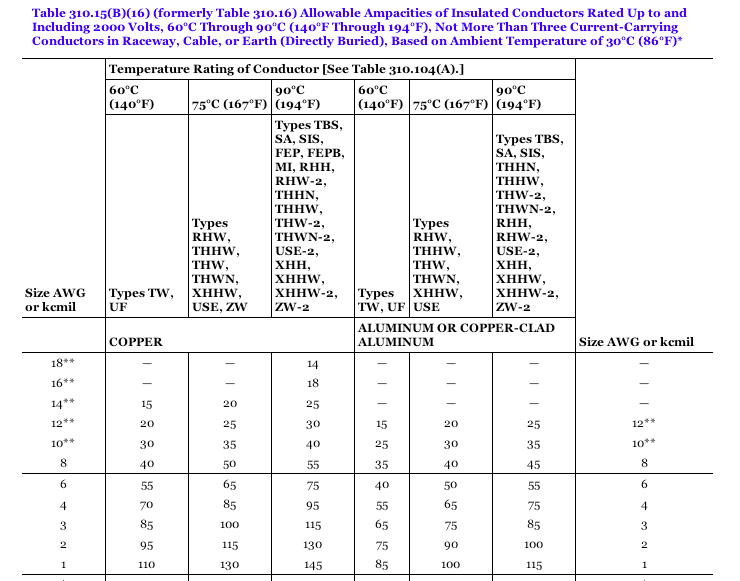
BTW, Table 310.15(B)(2)(a) does provide derating factors for ambient temperatures other than 30?C, 86?F, and for a 40?C, 104?F, garage and for the most common 75?C insulation, #6 copper would be required.�
Jan 11, 2014
lloyds Had my car since early last year and now I'm onto 13k miles. I supercharge once every week and about 4 times @ home. No problems so far and only slightly warm to the touch when I am unplugging.�
Jan 11, 2014
xhawk101 Rainbow you are totally off base and biased here suggesting "Elon has credibility issues".
You are the one with credibility issues.�
Jan 11, 2014
FlasherZ This is incorrect. #8 AWG is good to 50 amps when used at 75 degree rating. If you use type NM cable, which requires you use the 60 degree column, you are correct in that #6 is needed. However, #8 AWG in conduit is just fine for 50A feeding a 14-50 outlet. (NEC table 310.15(B)(16))
It is very rare that you need to do derating and an AHJ will hardly ever require you to do so, unless you're running in an attic. I have never seen an in-wall or garage installation require derating. Even if it did require de-rating, the factor is going to be .91 (NEC 310.15(B)(2)(a), ambient 40 deg rating), which would still easily allow for a #6. However, I've never seen an AHJ require that.
- - - Updated - - -
As mentioned, this is typically required in attic or other high-temperature special cases only. In-wall or garage will not require derating under normal conditions unless your AHJ is a complete idiot -- in which case, you should escalate to his supervisor or file an emergency appeal to the supervisory board. This will usually cause him/her to rethink his position and learn the code.
- - - Updated - - -
I've been gone for a little bit dealing with various things, but I'm back to read through things. I have had the same experience as mentioned earlier with my HPWC (the car's coupling connector was extremely hot - over 120 deg F). Tesla came out and replaced the cord set from the HPWC to the car and it cleared things up; I was told that if that didn't fix it, they would replace the connector on the car.�
Jan 11, 2014
vgrinshpun According to the NEC the conductors need to be selected not only based on temperature rating of the conductor INSULATION but also based on the temperature rating of the TERMINATIONS. Refer to NEC Section 110.14 (C)(1) Electrical Connections-Temperature Limitations-Equipment Provisions. This section essentially states that regardless the temperature rating of the insulation, the conductors must be sized based on the temperature ratings of the terminations. The default rating of the terminations for 600V and below circuits less than 100A is 60?C. So unless all of the terminations of all of the components of the circuit (panelboard breaker, Nema 14-50 wall outlet, Tesla plug adapter, tesla plug on UMC adapter side) have terminations rated higher then 60?C, the proper conductor sizing must be based on 60?C column of the table 310.15(B)(16) as appropriately modified by 310.15(B)(7).
The problem is that a lot of electricians as well as electircal engineers are confused with this requirement and size conductors improperly. I participated in writing Cable Size Selection Guide for a major corporation which design and build power plants, and experienced this confusion among many engineers I delt with first hand.
The subject is addtionally clouded by the fact that majority of the low voltage breakers rated less than 100A are nowadays have terminations rated 75?C. Based on this a lot of people jump the gun and size conductors based on 75?C, forgetting that other components of the circuit may be rated 60?C, and in fact, according to the NEC must be assumed to be rated at 60?C unless listed and marked otherwise. The most common NEMA 14-50 outlet, Leviton 279-C00 linked below has rating of 60?C (30?C temperature rise over 30?C ambient)
http://www.leviton.com/OA_HTML/ProductDetail.jsp?partnumber=279-C00§ion=42418&minisite=10251
I am willing to bet that majority of the overheating adapters are linked with the wiring installation using undersized conductors. This could be further exacerbated by the improperly tightened connections, improperly seated Tesla adapter, etc.
Tesla is doing the right thing providing redundant ways (software + replacing the adapters) to fix the potential problems with the equipment installation which has nothing to do with their design, because explaining these intricacies to a wider audience is a loosing battle.
- - - Updated - - -
Sorry, Flasher, you are wrong on this one, see my post #93. The proper minimum size of the conductors to use for 14-50 outlet, regardles of the rating of insulation is #6AWG. It must be based on the lowest temperature rating of the TERMINATIONS, which is commonly 60?C for NEMA 14-50 outlet.
This demonstrates the problem with confusion about the proper sizing of the conductors based on temperature rating of the terminations. I have read quite a few of your posts which are excellent, but you unfortunately just wrong on this one. Given my experience with fellow engineers and electricians, I am surprised that adapter overheating is not a more common that it seems to be.�
Jan 11, 2014
FlasherZ Yes, and most equipment built after the 1980's has 75 degree termination rating. Certainly all new stuff does.
My home was built in 1991 and not a single device in the whole house is listed at less than 75 degree termination.
The specs you quote are incorrect and completely out of context. The listing sheet says that the max temperature rise is 30 deg C max after 50 cycles of outlet at 150% rated current. That does not refer to the termination temperature, but rather to the outlet's quality after a failure.
I just happen to have a 279-C00 in my garage and here's what it looks like... note the 75 deg C termination. (Also, just so you don't take exception to the statement, on the right side, just below this warning - and quite out of focus - is the notice that this device has a 75 deg C termination.)
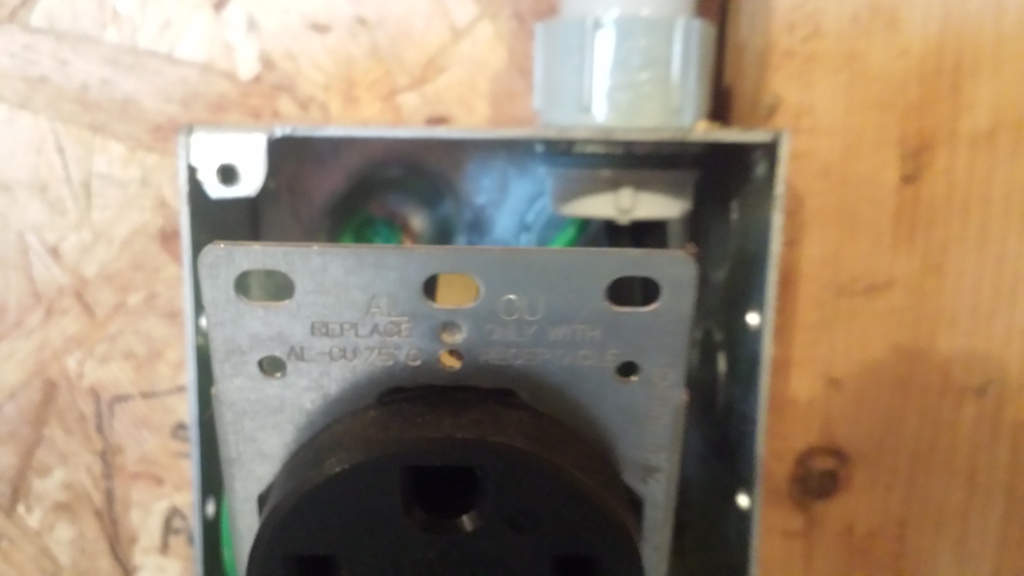
- - - Updated - - -
I beg to differ; in this one you are incorrect, quite incorrect. Years of experience with residential and commercial wiring, and inspections performed by many competent inspectors prove that. If I am so incorrect, then why have tens of inspectors cleared all this wiring done by so many electricians and engineers?
#8 AWG is fine when THHN/THWN is used in conduit with 75 degree breakers and 75 degree outlets, which are all commonly used today. When you use NM cable, you must use #6.
As I demonstrated to you on the 279-C00, the termination temperature of almost every new device made is 75 deg C.
I do know what I am talking about. I hate to say this so strongly, but please stop giving incorrect information.�
Jan 11, 2014
Fedderman Attached as requested. I believe you are correct that this is the side where the majority of the adapter issues have been - this is where my heat problem was, damaging both the adapter and the UMC where it plugs in. The new design seems to prevent bending the retention clip if the button is depressed when inserting the adapter.�
Jan 11, 2014
FlasherZ It looked like standard manufacturing molding to me, but that's just my opinion. New molded appliance plugs look like that too - dryer cords, for example.
- - - Updated - - -
That's the same adapter I have had for about 8 months or so - same part #, same revision. I'm not sure that's the "new" adapter.�
Jan 11, 2014
Fedderman You seem to be looking for something that is simply not there. The photo shows some reflections of color which simply are not on the adapter. I have it in my hands, so believe me when I tell you it is "pristine".
- - - Updated - - -
It may not be. It is the one my local SC (Palo Alto) gave me two weeks ago when I brought in my original (damaged) adapter & UMC. It has the green dot referred to by someone in an earlier post.�
Jan 11, 2014
FlasherZ Certainly, anything is possible, but from my experience, Tesla tends to update part numbers and revisions pretty religiously in MCO's. Perhaps the green dot represents a different manufacturer or tighter tolerances, but the design is likely to be the same. Either way, it seems that adapters that are replaced tend to work better, at least for a while. You might get another one in the mail soon. �
�
Jan 11, 2014
Electricfan No way should you have to use an oven mitt. Either the house wiring is defective in some way or the charge cord is. I hope you get this sorted before there's a fire.�
Jan 11, 2014
Lyon Unless they insist on taking the old one back just throw it in as a back-up.�
Jan 11, 2014
bonnie A number of posts have been moved to Snippiness. As always, apologies to the innocent bystanders.�
Jan 11, 2014
Merrill Thank you Bonnie, I think sometime people lose perspective on certain subjects. This forum should be for decemination of information, everyone has a point of view and it may not be shared by everyone. Keep it civil. You may want to look at the "Older Tesla's limited to 90kw" thread also.�
Jan 11, 2014
tezco It may bear repeating that voltage drop in longer runs may also require larger wire size. Here are a couple of comments regarding automatic charging current reductions that seem to be the result of the software upgrade that detects fluctuations in the input power to the vehicle. (see also Tesla Motors Press Release Jan 10, 2014) Might want to make sure your voltage drop is less than 5% (if this is how the MS senses problems).
(From False Positives With FW 5.8.4 Charge Current Reduction?
�
Jan 12, 2014
scaesare Excellent, thank you....�
Jan 12, 2014
ToddRLockwood I suggest lowering your charge rate to 60A until you get a ranger over to check this out. This is not normal HPWC behavior.�
Jan 12, 2014
vgrinshpun I am going to repeat it one more time � your statement is incorrect. I do not want to beat the dead horse, but proper installation is important, because Tesla potentially can be undeservedly done much harm. There is a lot of confusion and few issues that need to be addressed here. I am going to do it step by step.
- Code requirements.
- Equipment ratings
- How improper wiring can cause overheating of Tesla NEMA 14-50 adapter.
- Tesla Motors recommendation for installation of Nema 14-50 outlet
Code Requirements
Per my original post NEC requires to consider temperature rating of terminations and possible derating of the circuit if temperature for continuous operation is going to exceed 30�C (86�F). Your general recommendation that #8 AWG in conduit is just fine for 50A feeding a 14-50 outlet is wrong and misleading because you are ignoring these two NEC requirements. The #8 AWG might work for some circuits, but certainly not for all of them, in fact not even for the majority.
You argument for ignoring the temperature rating of the terminations (NEC 110.14(C)) is that most equipment built after the 1980's has 75 degree termination rating. Certainly all new stuff does. This requirement is still need to be considered if the installation happens to have equipment with terminations rated at 60 �C. In fact the wording in the Code by default requires assuming 60 �C rated terminations unless the equipment is listed and marked otherwise (NEC 110.14(C)(1)).
Once it is established that all equipment has 75 �C rated terminations (by observing that each piece of equipment stamped for use with 75 �C conductors), sizing of the conductors for installation of NEMA 14-50 outlet requires considering the ambient temperature. You seem to suggest that this requirement is irrelevant because �I have never seen an in-wall or garage installation require derating.� This does not constitute good reason to dismiss this requirement. The NEMA 14-50 installation for charging is different than any other installation because this circuit will be used continuously at 100% rating of the circuit and typical temperature in garage WILL be above 30� (86�F) during summer for at least half of the US, especially considering that two car garage might have ICE car parked in it, releasing massive amount of heat after it is driven and a Tesla which during charging on NEMA 14-50 will be equivalent to continuously operating 1500W heater (assuming 85% efficiency of the charger and ignoring the efficiency of the battery).
The problem with using #8 AWG even when all of the terminations are rated for 75 �C is that at 75�C allowable ampacity for #8 AWG is exactly 50A (NEC Table 310.15(B)(16) and will not allow for any derating for ambient temperature that for a lot of locations will most likely be higher than 30 �C (86 �F).
To conclude, between these two NEC requirements, the majority of installations in US will require using #6 for the NEMA 14-50 outlet.
That is why the default recommendation for the NEMA 14-50 circuit should be #6AWG, and that what is now recommended by Tesla Motors (more on this later)/
Equipment ratings
I agree that majority of terminations for circuits 100A and less are currently rated at 75 �C. But it is certainly not true for older equipment. It is also not true for all equipment manufactured since 1980-ies.
While Leviton NEMA 14-50 outlet which I linked in my previous post indeed is rated for use with 75 �C conductors, this is not true for all equipment.
As an example, main panel in my house (built in 1986) is rated only for 60 �C conductors #14 to #2 AWG.
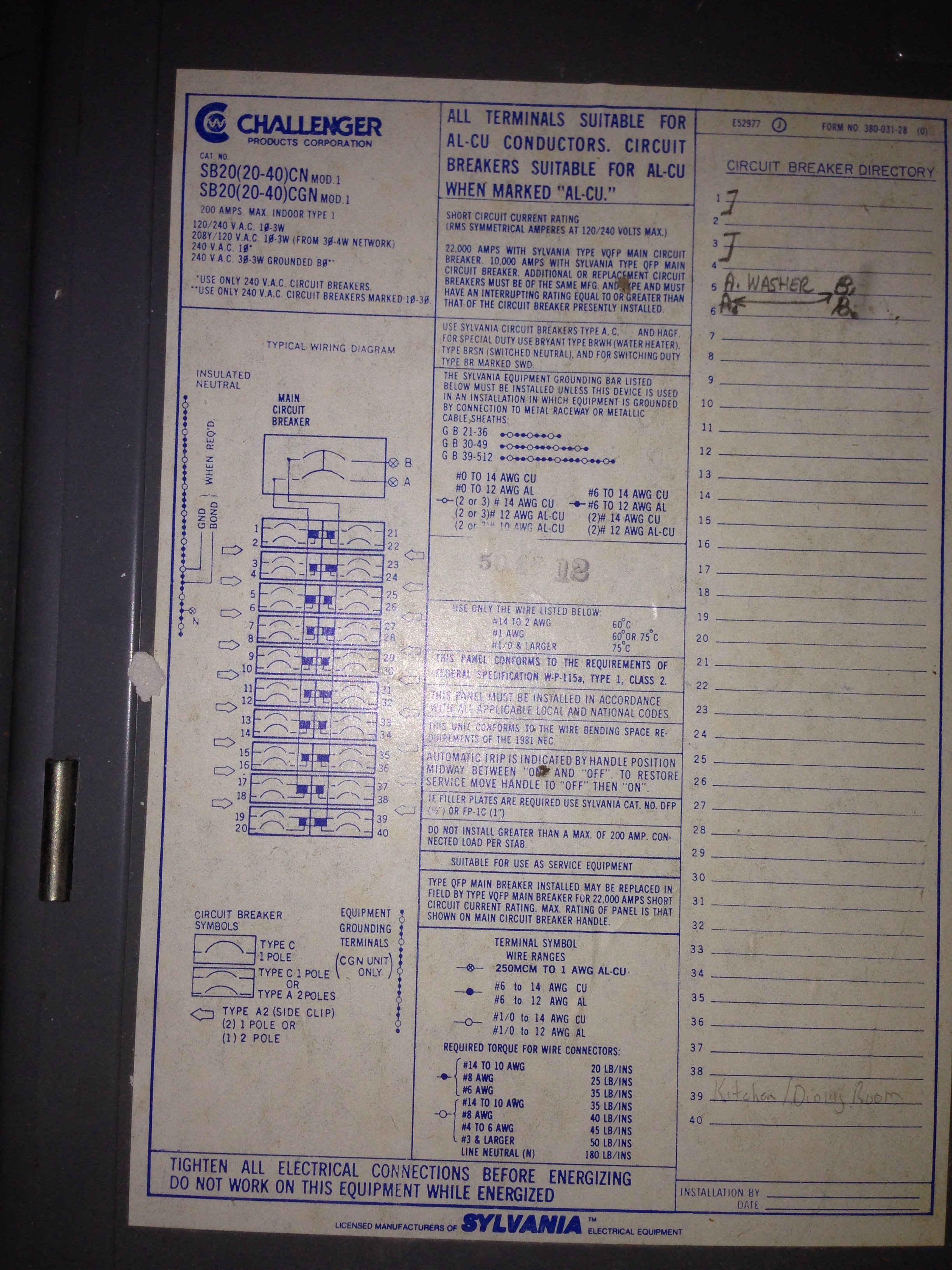
How improper wiring can cause overheating of Tesla NEMA 14-50 adapter.
The undersized conductors used for NEMA 14-50 outlet will lead to all parts of the circuit operating at the temperature which is higher than the temperature they are designed for, creating a fire hazard. When coupled with improperly tightened connections at the NEMA 14-50 outlet, or incompletely seated NEMA 14-50 adapter, the situation becomes even more onerous.
Tesla Motors recommendation for installation of Nema 14-50 outlet
Originally, when looking through the Tesla NEMA 14-50 installation requirements sheet, I was surprised that they did not include any requirements for conductor sizing. As mentioned before it is now my belief that improperly sizing NEMA 14-50 circuit conductors is quite common and contribute to the NEMA 14-50 adapter overheating problems, so I thought about writing to Tesla Motors suggesting that they should include more detailed requirements on conductor sizing in their NEMA 14-50 installation sheet. It turns out that this will not be required: The recommendation on using #6AWG for NEMA 14-50 installation was apparently added to the installation sheet, which now states:
Circuit installation should meet National Electric Code (NEC) wire and breaker ratings. In general, this means 6 AWG wire for installations under 100 feet
http://www.teslamotors.com/sites/default/files/downloads/US/universalmobileconnector_nema_14-50.pdf
_________________________________________________________________________________________________
In order to eliminate confusion I would suggest that you either remove or modify all your posts that include blanket statement that it is ok to use #8AWG for NEMA 14-50 installation
�
Jan 12, 2014
miimura How is this true when we are talking about 50A breakers and circuit sizing and the Mobile Connector (or other EVSE) only draws up to 40A? This is the standard 20% de-rating for continuous draw applications, right?
I'm interested because I just had a house built in 2012 and the electrical contractor put "E123775 8/3 W/G TYPE NM-B 600V (UL)" in the wall without conduit for my two 14-50's. This is Red/White/Black insulated 7 strand copper with a solid bare ground wire with the 4 wires sheathed in black plastic. I have since changed one of the 14-50's to a 6-50 for use with my Leviton EVB40 40A EVSE.�
Jan 13, 2014
drees Think of it this way: A continuous load must be used on a circuit rated to at least 125% of the continuous load.
Your electrician installed wire insufficient for the application and not to code.
All NM-B wire (aka romex) must be used under the 60C temperature rating. In other words, 8/3 NM-B is only good for a 40A circuit, or 32A when charging an electric vehicle. You should have 6/3 NM-B installed.
I do not recommend charging above 32A until that is corrected.
From what I understand for most residential installs, temperature derating based on "ambient" temperature is generally overlooked. However, if you were to follow the NEC guidelines you would look up the ASHRAE 2% design temperature and use that as your ambient temperature.
Mountain View is next door to Los Altos and has a temperature of 84F. This is not hot enough to require any additional temperature derating (need to exceed 86F).
Correction table can be found here: Wire Current Ampacities NEC Table 310-16
Ambient temperature can be found here: Building Wire - Outdoor and Rooftop Temperatures for Selected U.S and Canadian Locations�
Jan 13, 2014
Rainbow That's dangerous advice. A plug that is so hot that it burns a person, should not be used. It could still be dangerous at 60 amps. It is dangerous to use electrical equipment with known safety faults.
Another mentioned practice that can be very dangerous, is unplugging a charger during a charge. This can damage connectors, charging system and injure the user. It can burn the connectors, it could send thousands of volts through the charging system, and could cause molten metal to be ejected. The arc also could cause a fire or explosion.
I certainly would hope that Tesla would have been proactive on delivery of the vehicles by providing instructions advising against unsafe usage. IE Advising against using Chargers after connections have get excessively hot and/or connections that are burned. Advising against unplugging charge connections, while the charger is still charging.
I think it would be safer to hard wire HPWCs.�
Jan 13, 2014
FlasherZ I appreciate your enthusiasm, but as I mentioned I do have quite a bit of experience and will not be doing so. I never include a blanket statement that it's ok, I mention that #8 is good up to 50A for conductors-in-conduit, the big common exception being when NM cable is present. I have talked to hundreds of AHJ's, who are the local authorities who are required to know the code, apply the code, and pass appropriate local judgment. You are the only person in my 20 years of experience with the electric code, residential and commercial wiring who has disputed what the code says (that #8 is fine up to 50A). You make a very big deal out of ambient derating, as if the temperature sensitivity is tenths of a degree; however, it is not, and again I state that in my experience never has an AHJ determined that a garage will need special derating for ambient temperatures. I've even seen several installations in Phoenix where the AHJ did not require ambient temperature derating. There is plenty of headroom in the code for this.
To those of you reading this, there is one lesson to be taken away from this -- there are a lot of people who have a lot of opinions (mine included); the authoritative source here is NOT an internet poster (including me), the NEC or some other book or academic material, but rather your appropriate zoning/building authority (the Authority Having Jurisdiction, or AHJ). They are the ones who interpret and apply the code, apply local amendments, and most importantly they are the ones who pass inspections... they are the ones your insurance company will want records from should anything happen. Even if you don't have inspections in your jurisdiction, they will provide guidance to you -- it may be that they simply tell you to trust a licensed electrician you hire. You have to listen to the AHJ; you can escalate to his superiors, then the town council or county board, but if they uphold it, you're required to support his demands unless you feel like using the courts.
The one place I have seen electricians and AHJ's use the ambient derating is when wiring is present in the attic of a home, up away from the insulated ceiling. In that case, drees' reference to the ASHRAE table is used to determine the derating factor, and in that case, #8 in conduit would not be acceptable for 50A.
In my uncooled/unheated garage, even when it is 40 degrees C outside, the internal temperature does not justify ambient temperature correction. I live roughly at the midpoint of the US population.
I think it's important to note that you did quite insist that the Leviton outlet was 60 deg C rated, and that was the reason you insisted #6 had to be used. Again, I appreciate your enthusiasm, but such a blatantly wrong answer is only harmful to people who read this.�
Jan 13, 2014
techmaven I find this discussion both educational and fascinating. One takeaway I have is that given the disagreements amongst experts, the reality of thousands of installs is that someone is bound to get it wrong. Maybe a TMC handbook on what to ask the electrician, how to verify that the electrician did proper work, and basic safety tips. Like not putting newspaper near the outlet. I'm sure quite a few installs are not inspected, especially 14-50's.
�
Jan 13, 2014
vgrinshpun Please note, that as I've posted in #106 above Tesla did add requirement on sizing conductors for NEMA 14-50 install to their installation sheet, it is now explicitly states that the recommended conductor size is #6 AWG. The Falsher's opinion is not just different than mine, at this point it is direct contradiction to the recommendation put out by Tesla.
Circuit installation should meet National Electric Code (NEC) wire and breaker ratings. In general, this means 6 AWG wire for installations under 100 feet
http://www.teslamotors.com/sites/default/files/downloads/US/universalmobileconnector_nema_14-50.pdf
�
Jan 13, 2014
FlasherZ Indeed, which is why the FAQ exists.
Even in the liquid fuel world, we see plenty of people getting it wrong, both accidental and purposely. I've seen quite a few rigged installations to deliver flammable fuels in a way that they shouldn't be delivered -- farmers are especially good at this.
The FAQ can't address everything, though - and I don't want it to be a collection of warning stickers that are obvious to most individuals. In almost every case, the installation of any charging equipment, whether a 14-50 or an HPWC, requires adherence to the NEC (in the US) with any local amendments approved by the local authority (e.g., wire-in-conduit only in Chicago, outdoor outlets above 48" in areas with heavy snow, etc.) In most cases, it requires an inspection unless you're simply replacing an existing outlet. If you know what you're doing, the AHJ is your reference point; if you don't, hopefully an electrician is your reference point (and will manage the relationship with the AHJ for you).
Because the AHJ is the official authority, I can't tell you what is black-and-white right or wrong, I can just use my experience to tell you what most AHJ's have done. You may find an AHJ that has an extreme view on the technicality of the code... the difference is that you MUST listen to him/her.
- - - Updated - - -
vgrinshpun, you have a rather interesting way of interpreting the English language.
I can appreciate that you really, really want to be right. Tesla says specifically that circuit installation should meet NEC wire and breaker ratings. The NEC says that #8 wire in conduit does conform to the code for a 40A continuous load. Bottom line, Tesla defers to the NEC. Tesla notes in addition that generally, it means 6 AWG wire -- but we don't know their assumptions for "generally". In my experience, this is because the average installation uses NM cable, which would require 6 AWG. It is not "direct contradiction".
To avoid this from being taken off track any further, I won't respond any more to this argument.
The summary is this:
1. It is perfectly legal by NEC standards to connect a 14-50 intended for a 40A continuous load with #8 AWG wire in conduit (subject to conduit fill requirements, current-carrying conductor requirements, et al); it is not legal to use #8 NM-B cable.
2. The super-technical interpretation of the NEC suggesting derating for ambient temperatures in a typical garage does not square with experience in the field.
3. Most electricians will run #6 anyway, to give some headroom and to keep the number of cable spools on the truck to a minimum. I recommend the same and my own installation uses #6 in conduit, but I would never force someone to rip out #8 if installed properly in conduit.
4. The AHJ serving your jurisdiction is the authority -- ask him or have your electrician do so.
The last point is the most important. A good Internet forum rule is that you don't have to trust me and you shouldn't solely rely upon my recommendations, because you and the AHJ are the two most important people in this installation.�
Jan 13, 2014
techmaven Ah, yes, I do remember going over that FAQ now. Thanks.
My local inspector insisted that, as part of my install, the it wasn't sufficient to have just a sub panel in the garage. I had to get a service disconnect near my other panels so that there was one place in the house to turn off all the circuits. Prudent, but it cost me about another $300.
I did manage to get 200A dedicated service installed with a separate meter and Schedule EV billing for the future that I might have more than 1 Tesla charging in the garage.�
Jan 13, 2014
FlasherZ I suspect this is because you would have had unfused conductors from the base of your EV meter to the main lugs of the garage's subpanel. That's considered a big no-no around here, not only for the building disconnect rules, but from a safety standpoint -- you want to limit unfused service conductors running in/near the building as much as possible.
My service was upgraded from 200A on 2/0 conductors (yikes!) to 400A on 350 kcmil by the PoCo, and I put a subpanel in the garage designed for 1 HPWC, 1 14-50.�
Jan 13, 2014
J in MN My garage routinely goes to 55 C in summer during the afternoon, so I did calculate the derating when installing the wiring (some 3 years ago now). However, at 4 am in the morning (when charging), the temperature is always below 30 C.
I went with 6 AWG, mostly for wanting 48 A continuous, and, as I recall, 2 pair of 6 AWG is the max you can put inside 3/4 " EMT.�
Jan 13, 2014
qwk Guys, this is a moot argument, as no competent electrician is going to recommend, and install #8 wire for a 50A outlet that will be used for continuously charging an EV. The difference in copper cost is so little, that you will make up for it in less than a years resistance loss on your electric bill. Using #8 for a 50A EV outlet is just stupid. It's tripping over dollars to pick up pennies.�
Jan 13, 2014
FlasherZ I agree that most electricians are going to use #6. I recommend the same. What I said is that a #8 installation is perfectly legal (for example, if you had an RV outlet already in that location) and that I wouldn't rip out an installation done with #8 if your goal is to minimize cost to install. I have seen a number of RV outlets fed with #8, and I want to be clear that there's nothing wrong with them.
But I can't pass up a good math problem, either. Let's assume 100 ft. run, so 200 ft. of conductor length in the circuit. Let's assume kWh cost is national average of $0.13ish.
8 AWG is .06282 ohms / 100 ft, 6 AWG is .03951 ohms / 100 ft. Difference is .02331 ohms one-way, or .04662 ohms for the (200 ft) circuit.
P=(I^2)*R, so @ 40A, loss difference across 8 AWG vs. 6 AWG in this circuit is 74.59W. This means you'd waste 1 kWh every 13.41 hours of charging.
I used 2 suppliers on eBay as my price comparison point. mwscable has #8 THHN @ 1000 ft. for $298, cableall has #8 THHN @ 1000 ft. for $366; mwscable has #6 THHN @ 1000 ft. for $450, cableall has #6 THHN @ 1000 ft. for $561. We'll use the less expensive of the two suppliers (mwscable), and the price difference ratio for both suppliers checks out at ~2:3 for #8 to #6. This means that 200 ft. (circuit length) of #8 will cost $59.60, #6 will cost $90. The difference is $30.40 with the cable bought in bulk. Of course, if you use an electrician, he might charge a mark-up, but I'll be extra conservative and give us the benefit of the doubt.
$30.40 will pay for 233.8 kWh of electricity, or 3,135 hours of #8 vs. #6 loss while charging. You'd have to charge 8.59 hours a day @ 40A, every day, to recover it in a year, which would mean roughly a daily drive of 266.3 miles @ 31 rated miles/hour of charging, or ~97,200 miles a year.
So it's probably more like 6 years at 16k mi/yr, or 8 years at 12k mi/yr... but you will get a return at some point.
- - - Updated - - -
Just curious - what's the outside ambient air temp when your garage goes to 55 deg C (130 deg F)? Our max tends to be 105 degree days outside, and my attic makes it to 120 degrees or so on the hottest days (fan-ventilated). What's the factor that drives it up -- do you have heavy use of glass? My garage -- 3 bays, 2 standard double-hung windows -- doesn't even make it to the outside ambient temp.
In your case, I would say that you should adjust for those factors, although I suspect the AHJ wouldn't even consider it during the inspection.�
Jan 13, 2014
qwk Yes, it's legal per the NEC, and most RV parks use #8, especially the older installations. I ran the calculations when I had my outlet installed, and the cost difference came out to less than $20 difference in materials to run #6 in 1 inch conduit. Since I will be using this outlet for many years, it was a no brainer.�
Jan 13, 2014
J in MN Don't recall exact numbers, but in the 30 to 33 deg C range. I have some glass in the doors (less than 1/8 of the surface area), but they do face SW. Main culprits are zero ventilation and heat generated by 6 kW PV inverter running full tilt.
He did not. But then, I had to brief him on the requirements of article 625.�

Không có nhận xét nào:
Đăng nhận xét