Aug 6, 2015
SteveG3 First, to be clear, this is speculative exploration. Elon did not say Tesla will create their own Uber-like service yesterday. I don't see it as a material catalyst for the stock at this point.
That said, I've started thinking about how profitable such a service could be and how it could push forward the mission of Tesla Motors, and my initial quick look suggests to me it is likely a VERY compelling opportunity for Tesla. I thought we could try to flesh this out.
I just started with the idea that they might go for a Model 3 or smaller car for massive urban centers, like NY, London, Tokyo, Beijing, etc. Given the vehicle's usage, it may be cheaper to make than a privately owned Model 3.
I lived in NY for years... and a $5 cab ride for 15 minutes, or about 3 miles, of NY driving would be a very good value ($0 Tesla tip included). As a quick reference, just getting in a cab without going a foot costs $2.50, and costs $.50 per minute when stopped or in slow traffic (details on NYC cab fares, with various surcharges and per 1/5 mile rates at the bottom of the page). So, that 15 minute ride in a cab in NY would be at least $12 or so with tip and surcharges.
My quick estimate is that in these huge urban centers, in a day at the rate I've suggested, such a vehicle would bring in about $180 (I assumed 50% usage for 12 hours of the day, and 25% usage the other 12 hours).
That's $65,700 a year.
What are the costs? The car itself, $30K (possibly less given it's intended use), but, of course only for year 1. Some kind of refueling and service centers. The cost of programming and maintaining the application for the service. Insurance. License to offer cab services (can be very expensive, but there would be an environmental payoff to the cities that might help here).
These are quick numbers I looked at, but it seems potentially a hugely profitable business. Think about the return once the car has been paid for... or from a different perspective, a single conventional cab probably pays two drivers' salaries, and contributes profit to its owner, each year.
What about Tesla's mission?
1) If it were a massive new profit center, it would greatly augment Tesla's ability to invest in battery and vehicle plants.
2) If it is extremely profitable it would also spur the programs at Google and likely Apple. Anything pushing forward Google and Apple's involvement with EVs will be a huge validation and incentive for incumbents to join in.
3) It would replace gasoline vehicles and their emissions in dense urban areas. There are likely complications here though, as there may well be a concern about such a cheaper option moving some people from mass transit to individual vehicles.
4) It would be a built in market for Tesla to expand more confidently, and offer an easy place to move refurbished or traded in battery packs.
5) It would expand the amount of first hand experience consumers have with EVs.
I never quite got why Elon was so determined to lead the way on automated vehicles. Perhaps such a service has been part of what Elon's seen for years. It also fits nicely with recent Tesla comments about the goal of a million mile drivetrain. What's more, when Elon said he saw Tesla getting to Apple's market cap by 2025, I looked at stationary storage and the vehicle business and it seemed to me Elon would have to invent a new chess piece to grow so big so fast... there might be enough demand for those businesses, but Tesla (or anyone frankly) just doesn't look capable of scaling up that fast when you think about the number of battery and vehicle factories needed. I even started a thread at the time about the idea that Elon's Apple comment may mean he has a new chess piece we don't know about,
http://www.teslamotorsclub.com/showthread.php/42586-What-Would-It-Take-for-Tesla-to-Reach-Apples-Market-Cap-in-2025
Here's that list of NYC cab rates,
Metered Fare Information
- The initial charge is $2.50.
- Plus 50 cents per 1/5 mile or 50 cents per 60 seconds in slow traffic or when the vehicle is stopped.
- In moving traffic on Manhattan streets, the meter should �click� approximately every four downtown blocks, or one block going cross-town (East-West).
- There is a 50-cent MTA State Surcharge for all trips that end in New York City or Nassau, Suffolk, Westchester, Rockland, Dutchess, Orange or Putnam Counties.
- There is a 30-cent Improvement Surcharge.
- There is a daily 50-cent surcharge from 8pm to 6am.
- There is a $1 surcharge from 4pm to 8pm on weekdays, excluding holidays.
- Please tip your driver for safety and good service.
�
Aug 6, 2015
austinEV Good analysis. I think it is super clear it is a good business, and a natural fit once you have self driving cars. For my part, I consider this all non-news because I always figured that TM would have the option of deploying a uber-type service. Or rather, if you believe self-driving cars are coming, ANY car company could. UBER or taxis will simply be obsolete across the board. When I heard the Uber CEO say he wanted to buy all of 2020's production I thought, "yeah right. Your company will be worthless in 2020." Whether it's Tesla or any other maker, making a car self-driving is 99.999% of the work of making an automated taxi service. Adding on dispatch and payment is an afterthought at that point. So what does Uber think is going to happen? Tesla will make a self driving car, doing 99.999% of the work and have Uber slap their branding on a car, add their website and take all the profit? Tesla can just do that last 0.001% and take all the business.
When Elon refused to answer that question, I heard it as "of course we would just do it at that point." But, he has zero need to boast about such future business endeavors right now.�
Aug 6, 2015
ludicrousspeed I never even thought about Tesla providing a driving service after reading the Uber article when it was reported. The way Musk answered may imply that they've thought about it and he definitely didn't rule it out. This could be wishful thinking, but the new Charger Prototype video that came out today could be technology they've been developing mainly for driving services. Taxi/Uber customers obviously don't fill up gas cars, so who would charge Teslas? It has a long way to go but making a charger like that requires a lot of effort and I'm not sure if they'd pursue it just because it's "cool."�
Aug 6, 2015
ecarfan Speculative Tesla owned Uber-like service impact on Tesla's Mission and Valua...
To me that analyst's question, and Elon's response ("That is a very insightful question") was the the most interesting part of the earnings call. He was right not to provide an answer.
Oh yes they would. [emoji3]
It is possible that Elon had not thought about the idea of Tesla becoming a ride service company and the question made him realize that it was worth considering at some point in the future, so it was best to say nothing.�
Aug 6, 2015
SteveG3 So, maybe for some time you've been on to one of those cards Tesla's not been showing us.
I come back to the idea that even with massive demand and resources to pay for expansion are available, it's extremely hard to see Tesla going from GF 1 ~2020 to ~10-20 GFs and 5-10 new vehicle plants by 2020. I think that's what it would take for Apple Market cap, and I don't think anyone or any company could oversee that kind of volume of massive infrastructure building. I really think it's very probable there's some "new chess piece" and this Uber type business seems like a terrific cash generating chess piece. It's just to hard to do it operationally via stationary storage and vehicles alone even if there is market demand.
fwiw, here's that chess piece comment Elon made years ago,
"Business is like a multidimensional probabilistic chessboard. The rules aren't set, and the same moves don't always make you win. A lot of people can be really good in a set-piece battle; my biggest differentiating skill is I can invent new pieces."
I agree about it making sense for any manufacturer who becomes capable of making an autonomous car. Like you say that is by far the biggest piece of the puzzle.
Beyond just being more adventurous than the incumbents, Tesla still does have a few advantages in the field...
-lower fuel cost for EV vs. ICE
- simpler, much longer lasting, and cheaper to maintain drivetrain than ICE (certainly by 2020 I hope Tesla has that down)
- EVs environmentally far more attractive to local residents, and governments, so may be incentivized (or ICE carbon taxed, etc).�
Aug 6, 2015
RichardL There was a very good talk at Connect about how compelling the financial case for such a service is and how disruptive it could be - he did the analysis of how much a car would have to cost in order to require Uber's current cost per mile, and on the other hand, how much that cost could drop as the cost of the autonomous vehicle dropped, while keeping the same profit margin.�
Aug 6, 2015
SteveG3 Interesting... was the talk by someone here at TMC or outside?�
Aug 6, 2015
RichardL https://www.teslamotorsclub.com/connect/sessions/who-will-win-the-coming-autonomous-vehicle-revolution/
Eric Bergerson�
Aug 6, 2015
bh1783 It would make a lot of sense for Tesla to get involved in this industry. Uber is currently valued at over $50 billion:
http://www.forbes.com/sites/chrismyers/2015/05/13/decoding-ubers-50-billion-valuation-and-what-it-means-for-you/�
Aug 6, 2015
Thumper The concept fits with the new metal charging snake. An autonomous car needs autonomous charging.�
Aug 6, 2015
Quant Credit to Elon for not answering the question! With Steve Jurvetson and other Silicon Valley types on the Board, I am sure Elon is wondering how come after so many years building something really great at Tesla, and manufacturing it from scratch, Uber is already worth about than 2 times Tesla's market cap! Must make Musk mad! No wonder he is not returning the calls of Uber CEO!
I say take on Uber, straight up!
But, do it in stealth mode! It's gonna be about 5 years before a fully autonomous car is approved by the various federal and govt entities to surf the roads and freeway without any humans on board.
I'd like to see Tesla put a team together to build something that would put governmental and public at ease, for example some sort of manned central post which monitors all Tesla driverless cars in real time , kind of like a ATC control tower, but with less staff and less cost. With greater automation and AI built in to real time monitoring and control.
i suggest a full line up cars from S, to X and Model 3 versions and let customers have a choice at the time of booking and offer a great price.
The numbers would be far greater than suggested above, on a per car basis, and this would actually help with the broad customer education, and market recognition by a worldwide target population. NY cab drivers are not buying medallions for a million dollars and getting such low annual revenue numbers, as suggested above!
Also, given Tesla's nationwide super charger network on the highways coast to coast, there would be great demand and great revenue opportunity in long distance services as well.....where people have to rent hotels so they can rest.
Overall, if I were Elon ( and I am not even 1 PC of his smarts ) , I would put a team of about 25-50 smart guys, engineers, business model experts, logistics experts etc to design a strategy and business plan to take Uber head on!
Given Lyft's 2015 recent capital raise round that valued it at about $2.5 Billion, maybe even buy out Lyft for $5-$7.5 Bilion.
Its a classic build vs buy decision, but at this time, I would say just build your own and leapfrog Uber and Lyft 3-4 years from now!
smoke them I say!
yeah, do the capital raise ( another 1.5 Billion $ of equity) and use up to $0.5 billion to take on Uber!
Could return 10 to 20 fold minimum in 3-4 years in implied incremental market cap to Tesla once launched!�
Aug 6, 2015
tkizzy So here's an interesting take. Elon is about making the world better. Cramming the streets full of cars, whether they're electric or not, would be "bad" for the world - congestion etc. Having dedicated fleets that don't function outside of their taxi duties would do just that - congest the world. A more efficient model would be to have multi-purpose vehicles that were both personal and livery.
What if there was a future subsidized Tesla purchasing model where your purchase cost went down dramatically because you agreed to make your car available for automated livery services. You made a commitment for your car to be available a certain number of hours a month in exchange for the price decrease. Your car would be back home and charged at a recurring time you specified. Alternatively there could be a pricing tier where, in addition to a steep discount, you also share in some of the profit. You can always "call your vehicle home" if you need to get somewhere, and if for some reason your vehicle is on a longer trip, Tesla would send another fleet/personal hybrid-purpose vehicle to you at no charge.
-obviously the vehicles would charge themselves accordingly and take trip distances into account with charge state before having a specific vehicle pick someone up, and if there was no destination entered there would be a minimum charge amount for a vehicle to pickup a passenger with a unknown destination. Also, tesla would take care of service as part of this plan. Even if they barely break above even with this model, they're still fulfilling their mission and making the world a better place, incentivizing sales of their vehicles in the process.
Boom! You're welcome, world.�
Aug 6, 2015
SteveG3 Well, I was trying to be conservative, as the numbers at first blush look off the charts compelling even being conservative.
I assumed a potential Tesla's service would only charge about 40% of the cost of a cab ride. They could certainly charge far more than 40% and still be cheaper than Uber or conventional cabs. Moreover, I assumed 50% usage for half the day and 25% usage for the other half the day, and for many cities those are probably conservative (my memory of NY is that a strong majority of cabs passing me during the day were full, but NY may have one of the most favorable usage rates).
Bottom line, yes, my $67,000 in revenues per year might be VERY conservative. Tesla might easily make double this... all for an initial ~$30K investment in the car and annual expenses that may well be $15K or less.
I may be missing something big here, but it really looks roughly in the scale of Tesla investing $30K in building such a car, and seeing over 100% return in year one, and perhaps, 400% return each following year for something like a decade plus... let's call it 4,000% return vs. roughly 10-15% net margins if they simply sell the car to a consumer. There may be a hole in this initial sketch of a model, but this business may be super bananas off the hook profitable to borrow a few of Elon's favorite words. Even if Tesla ends up charging half of what cabs do, it's still roughly a 2000% payout over 10 years on the initial cost to build the car. As a reality check of this gargantuan scale, consider that a $30K investment replaces a conventional cab that throws off enough revenue to support two drivers salaries, and make a profit for the owner of the cab (all at a much higher cost of fuel with ICE cabs in congested urban driving conditions). Thus, it seems reasonable that Tesla could make something like $60-120K a year off each car in such a service.
If Tesla merely dedicated 10,000 cars to such a program it could result in $500 million to a billion in profits a year. 100,000 vehicles could mean $5-10 billion in profits. For perspective, that 100,000 vehicle profit estimate is roughly the equivalent of Tesla selling 1-2 million Model 3 per year for a decade at $5K profit each. This just seems like a staggering opportunity.
The one potentially large challenge to this business would be requirements to buy "medallions", basically the right to operate as a cab. However, the little bit I've been reading today, some cities have moved away from this, and the market for medallions, which have been as high as $1 million has been dropping and may fall steeply in coming years. The initial research I've done attributes this to the emergence of Uber. Here's an article about Medallions,
Why I'm shorting a taxi medallion lender | Crain's New York Business
One other thing Quant... yes, this is about Tesla doing it on their own, not a partnership with Uber.�
Aug 6, 2015
Quant
Re Medallions in NYC , the prices are crashing because Bloomberg set up and allowed a different set of cabs to operate in the boroughs outside of Manhattan, due to supply vs demand issues in those outer boroughs - since the yellow cabs found it to be more profitable to stay within Manhattan!
Anyways, I can't see any Tesla operation set up as a yellow cab type operation on NYC, and so it would have to come under the NYC Livery Commission that includes limos and sedans which require a separate company and reservation/ booking prior to pick up. And these kinds of livery type services and the new green cabs in boroughs like Queens cannot pick up in Manhattan on the return. They can only bring clients into Manhattan on a prearranged basis and only Livery services can pick up prearranged rides within Manhattan ( as best I know....all I've ever been is a customer for all of them both personally and through my corporate life on Wall Street since after grad school... So I'm familiar with this now for decades).
Finally, I can't see how an autonomous driven car could do pick ups in Manhattan without allowing its system ( in the software code ) to break current laws ( such as temporary double parking for pick up or drop off etc.) or just being able to work the traffic. I really believe this needs a human until more than say 25 PC of the cars in NYC are autonomous driven vehicles ( so that is way way into the future).
i think TSLA for the first several years should stay clear of such cities where the only way, frankly for a yellow cab, livery service or just a john or Joan q Public to drive and manouver is to routinely break the letter of the law multiple times an hour!�
Aug 7, 2015
RationalOptimist A fourth key benefit for a city: quieter! In one move a city could invite in a service that would immediately and v noticeably reduce noise pollution.�
Aug 7, 2015
schonelucht I am wondering what does Tesla bring to the table that is unique to them? I mean uber can just buy the cars from Tesla and run a service that is 100% the same. Both will have to finance the cost of having a huge car fleet so neither has a big financial advantage. But Uber already has the customer base which is, like every connected service, strategic advantage #1. Personally I think Tesla can make much better ROI by investing that money in expanding their car sales and production facilities. Let others deal with actually owning the cars, which frankly doesn't seem a business where you can make a big difference.�
Aug 7, 2015
ludicrousspeed Tesla can certainly offer more attractive prices for customers. And who's to say that Tesla doesn't have a loyal customer base? If Uber can purchase these cars and still make a good profit, then it would be extremely profitable for Tesla, if they "cut out the middle man," as the analyst suggested in the question. I firmly believe that if Tesla fully pursued this opportunity, they can slowly run Uber out of business. They can also have a phone app more compatible with their cars that you can directly navigate the car, control the music, etc. By owning the self-driving cars on the road, there are numerous advantages Tesla would have over Uber, many of which are hard to even recognize this early in the game.�
Aug 7, 2015
SteveG3 Good point to raise. This may well be somewhat of an issue, but,
1. The current warranty on the vehicle excludes commercial use of the vehicle. Uber would be on their own for finding capable and cost effective service. It's nearly certain Tesla will always have the most capable and cost efficient service, and replacement parts at the cheapest rates.
2. I don't know the law on this... but is Tesla legally allowed to refuse a sale? This may be illegal with private individuals, but fleet sales to a business? They might be allowed to refuse. If they were legally required to sell, they likely could push out a large order a year or so, perhaps helping to get first mover advantage in key cities.
3.as ludicrousspeed suggested, Tesla would seem better positioned to outlast Uber in a margin killing price competition. For Tesla this is one potential arm of their business... for Uber it's their bread and butter.
Still, you do raise a good question. I wonder about the legal right to refuse an order.�
Aug 7, 2015
pGo Uber has so far raised $5B and is valued at higher than $50b.
Uber Valued at More Than $50 Billion - WSJ
If Tesla decides to come to this business, it will be 10 years later than Uber which by then should be the undisputed leader by huge margin if current situation persists.
With current Model, Uber is just an app, and hence most of the funding goes to direct marketing, regulatory, compliance and court fees. If Uber or any other company is to own the fleet, that will require enormous upfront investment (aka yellow cab minus drivers). And for Tesla it will be a lot more to spend in marketing and making inroads into this industry. There may be new competition as well.
Tesla owners with autonomous driving capabilities can easily offer their car to the leader Uber when they don't need the car, hence lowering the need to buy the fleet. Same can be done by Tesla, but there is a lot more to this business and which is why Lyft and others are not successful against Uber.
My thought from what Elon said in cc is that he is really not sure and has not given much thoughts. I hope people don't start valuing this potential business as a win and add $s per share earnings just yet.�
Aug 7, 2015
aznt1217 He isn't sure because Autonomous driving needs to be perfected first for all corner cases in that respect. I wouldn't commit to a time line either. If Tesla were to do this -- I see it as part of the mission to make human's more productive. Instead of stopping "productive" work to get to where you have to go via driving... just have the thing pick you up and get you there... no worries no hassle.�
Aug 7, 2015
SteveG3 pGo, a self-driving vehicle completely disrupts the economics of the business. The service provider does not need to pay a driver. This means a dramatic change in pricing and profits... tbd how it is split between the two. Tesla will be Netflix to Uber's Blockbuster.
- - - Updated - - -
I may have this wrong, but hasn't Elon basically said autonomous driving in 5 years or less, regulatory okay guess another 3-5 years? My recollection is Elon recently indicated the timeline has been shrinking, and seems to continue to shrink.�
Aug 7, 2015
pGo I edited my comments tobadd one more important point. People who buy Tesla autonomous vehicles can register their fleet with Uber as they do now, but with self driving, the owner gets paid and Uber makes money too. I am saying Tesla does not being anything different to this market. Self driving feature can be utilized by Uber free of fleet.�
Aug 7, 2015
pGo I agree about autonomous driving around the corner in 5 years as MBLY also said recently they don't see regulatory hurdles. This may open up new businesses but if we say people will stop buying cars, I can see the argument in favor of Tesla. However, I believe that cars are personal, practice, shows independence, and very handy application which won't go away easily.�
Aug 7, 2015
SteveG3 Entire coordinated fleet built and scaled to the exclusive dedicated purpose of serving a specific region's need for pay per ride will be more efficient than an unpredictable scale of private vehicle owner's splitting the vehicle's use between personal and service usage. Moreover, their are the inherent advantages to Tesla I mentioned in post 18.�
Aug 7, 2015
pGo I see your view Steve, and seeing Elon one cannot discount what can he offer, so it will be interesting to see what his thoughts are in coming years. Cheers.�
Aug 7, 2015
SteveG3 pGo, this is actually not about people no longer buying cars, but rather switching from service vehicles like taxis driven by people to automated vehicles.
Last year about 82 million were vehicles were sold, and by 2020 it's expected to reach 100 million. The more that switch the better for Tesla's bottom line, however, I see a $200 billion market cap for just this part of the business if Tesla can reach a fleet of 100,000 such service vehicles. We're talking about a very small part of the market... and there's already a far larger number of taxis globally than this so, it's not even really about switching anyone's behavior or attitudes.�
Aug 7, 2015
SteveG3 Starting to see where the profits I was projecting run into "too good to be true." Tesla can only command that kind of return while they are effectively the lone supplier of self-driving cars in a market. It's possible Tesla may have a couple of years lead on competitors, but eventually it would seem the savings of automating the job of the driver will largely be passed on to the consumer rather than retained by the vehicle owner when multiple players can provide these fleets and supply and demand set a price. Tesla may create a moat for a period of time in some specific cities if they can lock up a period of exclusivity for offering an entire fleet before anyone else has something to offer. This may be a nice added business for Tesla, but unlikely on the scale of my initial estimates. Maybe there's another model where the business gets that big, but it would probably involve consumers who currently purchase cars switching to pay-per-ride.�
Aug 7, 2015
pGo The way I see this business evolving is consumers will still want to purchase autonomous cars. But while sitting idle, some users may want to take advantage of the feature and have it added to the most popular service available where they get the best dime for offering their service.
Consumers will buy Tesla autonomous cars, and other MBLY implementations from manufacturers. So, for me, for example, my car drops me off to work and is now ready to pick someone up using Uber (naming only because that'll be the most likely popular company based on current situation) and it will be ready by the time I want to leave from work.
As a note, Uber has many competitors in every region of the world and it is not easy to compete with them. To rationalize a bit, Lyft is a similar service with 1/10th valuation as Uber. Lyft was founded in 2012 while Uber 3 years before that. Uber has been growing exponentially (while also making huge losses, but gaining huge marketshare) while Lyft needs a lift. If we think that Tesla can just outmuscle Uber 5-7 years from now, and that thought can be valued today, I would have to disagree.�
Aug 7, 2015
Johan Great thread Steve. During my reading of it I gradually came to the same conclusion you just did: if there's a 1000% gross margin business (just picking a ridiculous number) the natural thing that happens is someone goes in and undercuts your pricing settling for "only" 500% gross margin thereby stealing your customers.
The only way to avoid this is by having a monopoly, either when it comes to EV manufacturing or autonomy. A type of monopoly in either of these fields seems very is unlikely for Tesla to be able to sustain for more than a short period of time.�
Aug 7, 2015
SteveG3 That kind of personal vehicle/service vehicle you described may have a place in some markets, but as I described in post 24 a dedicated service fleet has inherent advantages.
As to "outmuscling" Uber, I disagree. This is no more Tesla replicating Uber's business than Netflix was a replication of Blockbuster. The fundamental disruption is removing the overwhelming majority of costs of pay-per-ride, the drivers' salary, with an autonomous vehicle.
- - - Updated - - -
Thanks Johan.
Perhaps if Tesla's first to market they'll cut some deals splitting this massive added value between themselves and cash strapped city governments that can offer Tesla exclusivity in taking care of the city's pay-per-ride vehicle supply for X years. I guess a municipal government authorized monopoly. This would look something like a steep reduction of fares for the consumer's benefit (~50%), huge profits for Tesla, with the local government taking something like 15-40% of gross profits in a licensing arrangement.
It's never been clearer to me why Elon is so focused on being in the lead with a driverless car in the middle of his trying to turn the automotive world upside-down in terms of electric drivetrains. That's my hunch anyway.�
Aug 8, 2015
Ludus Uber seems structured for the autonomous car revolution in much the same way Netflix was structured for streaming even when it's business was just mailing DVDs. On Uber's platform, Tesla or other autonomous cars could be introduced in any of it's markets around the world with little extra effort. Uber has an enormous advantage in already dominating the market with an evolved app and a large loyal customer base. At most duplicating Uber's system would gain Tesla an extra 20% revenue share over putting it's cars into Uber's system, though there's definitely an opportunity in taking some position other than just selling cars to Uber or selling them to third parties who place them into the Uber system.
If Autonomous Tesla Model 3 is the best available option, Uber could certainly use it but Tesla has been designing cars for owner/drivers and the vehicles needed for this purpose will be different.
The fast automated battery swap system is a natural for a Tesla "Ubercar". It doesn't make much sense with the current system but for large fleets of autonomous vehicles operating in a confined geography 24/7 it's perfect. Whenever it needs it, an Ubercar goes to the nearest facility and swaps out it's battery so it's ready in 5 minutes for another 200 or 300 miles. A few facilities would cover a whole city. They don't have to be in prime locations. Battery ownership isn't an issue for commercial fleets. There might also be Ubercar stands for them to use snake chargers when things are slow and there isn't enough demand for all of them.
It makes sense for Ubercars to come in several sizes from Googlecar 2 seaters to minivans to small city buses. It doesn't make much sense for them to be designed like conventional cars to appeal to the owner/driver's ego or sense of style since they are essentially taxis or public transport. They should have no driver controls, just passenger interaction by voice and touchscreen.
One thing Uber has proven to be really good at is just going in and doing things that seemed legally and politically dangerous and stupid and fighting their way through the consequences. That's like a dry run for introducing autonomous vehicles. It will take fearless companies like Uber with lot's of lawyers and battlescars. Commentators often note how unsettled liability and insurance issues are. Players like Uber will work it out by just doing it and seeing what happens. The law will follow the facts on the ground.�
Aug 9, 2015
Ludus It seems like Tesla and Uber have 4 options with fully autonomous vehicles. 1) Uber could just buy the cars as Kalanick commented, 2) Tesla could develop it's own Uber like system 3) Both Uber and Tesla could support 3rd party owners who buy the cars from Tesla and operate them on Uber or 4) Uber and Tesla could partner to create a company that acts as the third party. The 4th option seems to be the most profitable for both companies. In this case Tesla would sell the cars at full retail price to the new company call it Ubercar. Tesla would cooperate to make it's software fully compatible with Uber and Ubercar. Uber would operate the network booking rides and collecting money. Ubercar would physically own and operate the cars and charging/swapping system. Uber would keep it's 20% share of revenue off the top. Ubercar would collect the other 80% of revenue and pay expenses splitting profits to the parents.
Until the question came up at the quarterly call, I assumed option 3 as the default. Both companies would just keep up as before and third parties would start putting the cars to work. The question and Elon's response made me realize how big the new business model could be. The cars couldn't operate under the model without extensive support and cooperation by both Uber and Tesla so it's their choice, third parties can't force it.
Much of the advantage of the model comes from aspects of Tesla's technical approach. Automated battery swapping and fast charging are important.�
Aug 9, 2015
forumman83 I disagree. To me, Elon's comment implied that he felt that somebody had tipped the analyst off with insider information. Elon was almost saying "that's an insightful question. how did you know that we at Tesla have considered our own Uber-like service?"�
Aug 10, 2015
Ludus On further thought it makes sense to me that what I was calling option 2, Tesla keeping it all in-house and creating a competitor to Uber, may be a strong case. Elon has been willing before to go ahead and develop stuff in house even when this seemed very difficult. Tesla built it's own operating system, it's own corporate software and is doing autonomous car engineering on it's own.
If they created a joint third party company with Uber, it would be leaving the majority of the money on the table. What they'd get for it, not having to replicate Uber's system may not be worth that much. Simply replicating the software functions isn't hard. Tesla already has a lot of legal battles to fight and it can hire folks from Uber and learn from Uber's experience. The biggest barrier to Uber's competitors is just scale and familiarity. Tesla would roll out a competitor market by market and the free publicity would be overwhelming in the target markets. Elon could launch in a new market by taking 30 seconds to send a tweet.
A crude estimate of the revenue based on Uber is that a single car can reasonably earn $120K/yr. This assumes it's available 24/7 obviously requiring more than one driver. Of this about $24k would go to Uber off the top. If Tesla partnered with Uber it would also give up half the profit from the remains 80%. That lion's share may not be justified compared to what Tesla's costs would be to just do it.
The current paradigm for automakers of selling to owner/drivers or to fleet operators like rental companies at a discount might hope to clear $8k on a $40k car sale under ideal circumstances. If Tesla put an autonomous car to work in it's own Uber like system it could clear 5X that much, literally making 100% profit or more on every car it builds.
Another point against partnering with Uber is that Uber has a major conflict of interest with it's current drivers if it starts competing directly with them using robots. Tesla has no such conflict.�
Aug 10, 2015
Ludus The approach you suggest is what really got me interested in this. I read Elon's pause and lack of response like this. That lead me to seriously consider the idea.
Tesla's designs may be especially well suited to full autonomy. While Elon's past comments about "autopilot" and a gradual approach to adding control features makes perfect sense for it's business over the next 5 years and selling to owner/drivers in general, there may be an enormous opportunity for fully driverless cars with a business model that builds them to operate them and sells car transportation as a service rather than the current model of selling hardware.
This approach also suits the mission of advancing sustainable technology. Each car Tesla builds to operate this way would displace multiple ICE vehicles rather than just one. The massive boost in profitability would support Tesla's need for capital to build new plants. The approach creates greater efficiencies by eliminating lots of infrastructure. It has a lot of visionary green cred while potentially making a lot of money.�
Aug 10, 2015
SteveG3 Ludus, the crazy compelling returns of doing it alone? That's where we've gotten with this thread. There is a "too good to be true" part though... it's unclear how long Tesla can sustain those kinds of massive profits. Others will catch up with autonomous driving (it's not a lock that Tesla gets there first for that matter). At that point pricing of the service will be impacted by other autonomous vehicle offerings... consumers very likely will be the huge beneficiary here. An autonomous cab ride for a few miles may drop from ~$12, to the couple dollars it costs now to take the bus, or even less. I've suggested upthread a scenario where consumers, large cities (in the form of exclusive licensing fees), and Tesla all come out big winners by splitting the value added by this automation.
In my view, Tesla's capacity to command huge profits will depend on 1) how quickly other manufacturers match them in autonomous technology, 2) how aggressively Tesla's peers supply the market (Google I'd expect to dive in... it's the whole point of their vehicle effort, Daimler, for example, may get there technically but may well be more conservative about rolling out an Uber like business), and 3) how wide the market is. As to point 3), dense urban centers seem like a no brainer, it's a hassle to have and park a car. Areas in between urban and suburban, ? re the interest, suburban sprawl double ?... in these places we are getting into people changing their views about car ownership, and that's hard to predict. Conceivably the market will extend in scope to the point that even with competitors Tesla will be able to command profits far better than the vehicle business for a long time.
There's a lot of variables that are hard to predict for where such a business goes long term. That said, even a 2-3 year lead in getting to fully autonomous could generate enough profits to build a few more gigafatories and auto plants.�
Aug 10, 2015
Quant I seriously doubt that Elon Musk is going to think just 3-5 years out....and try to become somewhat of an Uber competitor.
That's ust not in his make-up.....I suspect he will do a throw back ( mentally ) to his Pay Pal days and think of Tesla as an asset heavy business model, and whatever his reincarnation of an Uber like business is....it will likely be a layering of the asset heavy Tesla business with an asset light Uber type business.
And, I doubt he will try to share the financial opportunity in an asset light, recurring revenue service business model with Uber!
it will be designed from scratch and from the ground up.....and leap frog Uber by around 2020.
That's not to say that Uber will not also evolve and meet any challenge from Tesla.....just saying Elon is not gonna just copy Uber and do some light weight thinking !�
Aug 10, 2015
SteveG3 Yes. At this point, I think we've all come to the conclusion Jonas' question was "insightful" as Elon put it. There's no need for Uber... it's the autonomous vehicle that transforms this kind of service business, and that is an asset Tesla is working furiously and effectively to develop, not an Uber asset.�
Aug 10, 2015
dakh Few things to add to the mix. Folks keep talking about battery swap, but that doesn't look necessary to me. Peak demand will be served off of vehicles with maxed out batteries, as soon as demand drops some of them are going back to charging stations and then rotate.
Another idea is if the biggest challenge is city driving we might see them implement limited routes to parking lots just off highway exits as a start.�
Aug 17, 2015
SteveG3 Not surprisingly it's Adam Jonas drawing the market's attention to this potential third head of Tesla's potential profit making monster.
Jonas is not only drawing attention to this, given his assigning huge value to the potential business today, clearly he thinks the kind of issues in the post above will break Tesla's way.
�We view this business opportunity as potentially additive to Tesla�s existing model of selling human-driven cars to private owners and see potential for this model to conceivably more than triple the company�s potential revenues by 2029,� said the note. �That is, selling miles in addition to selling cars.�
The company is building unparalleled infrastructure for charging and other services, and can quickly adjusted to a shared mobility model. The company is introducing sensor and software capabilities in the Model X next month that could set the standard for self-driving technology.
�These are early days, but it is the view of the Morgan Stanley global auto team that Tesla may be best positioned to advance the state of the art in shared autonomy,� said the note.
The price target of $465 represents the midpoint of Morgan Stanley�s new base of $319 and bull case $611 valuation, reflecting its expectation that a mobility app will be announced in the next 12 to 18 months. The target is about 81% above Tesla's current trading level."
Tesla stock surges as Morgan Stanley says company will lead in self-driving technology - MarketWatch
"Here's a look at how this new mobility segment plays into the price target. It adds $244 a share, the second largest contributor behind the traditional Tesla Motors."
Jonas is being extremely aggressive adding so much value today (consider that most analyst's have added $30 or less for Tesla Energy which Tesla is known to have already worked on for years, clearly is pursuing and is talking about several billion in revenues from in 2017, vs. the "mobility segment" which Tesla has not officially indicated they will pursue, and potential big revenues are years further out if they do). He's more conservative than I've been about the timeline of full automated mobility... my guess has been 8-10 years, but he's apparently saying at least 10 years.
It will be interesting to see pushback on Jonas. There will be tons of press that he's nuts, but other analyst reaction will be interesting. I'm sure some will come close to saying he's nuts, at least for pricing in such a high probability of huge success, some will be non-committal, and some may validate what he's saying (hope the other AJ is at least somewhat in this camp).�
Aug 17, 2015
brucet999 A Tesla-based autonomous Uber-like service has, I think, one fatal flaw to it. A rider wants to go from Rockefeller Center to Wall Street and Nav routes them through Bayonne NJ supercharger. �
�
Aug 18, 2015
MichFin I really think that the real winner of this is going to be google as they already have autonomous cars and proven they can put that in just about any kind of car. They are years ahead in testing and are going to be the first to market.
Now that being said, they're going to need an electric car that has excellent range and quick charging capability at a reasonable cost. Can you say model 3.�
Aug 18, 2015
SteveG3 I see what you are saying MichFin. I read most of the Morgan Stanley report last night, and they say Google is looking to have an autonomous fleet on the road by 2017/2018. That said, 1) as Elon has said repeatedly, there's two components to the timeline, executing the technology, AND persuading regulators to allow it on the road. Elon estimates the latter will take 3-5 years IIRC. 2) as you alluded to, the little google buggy we've seen thus far is a different kind of animal than what Tesla builds.
Jonas does offer some helpful ways to look at the potential market, and some good research, but he also has a fundamental premise that, while revealing, he reads too much into in my view, and a massive assumption about consumer behavior that seems far far too large to take for granted (and to me unlikely). I'll have more to say when I finish reading the report.
- - - Updated - - -
lols, too true today from what I've heard. fwiw, on the earnings call last week, if I understood correctly, Elon was saying that they find current mapping (from everyone, Google, etc) inadequate for autonomous, and so they are going to send out their own effort to record all roads in substantially greater detail.
"The fact of the matter is, there's no publicly available data that is sufficiently accurate for autopilot, as far as navigation data, suite data, it's too coarse. So, it looks like we don't really have much choice but to create our own data set for driving in the long-term in order to provide a high quality product experience. It's just the only way we can think of to do it." -Elon
http://www.thestreet.com/story/13246464/5/tesla-motors-tsla-earnings-report-q2-2015-conference-call-transcript.html�
Aug 18, 2015
ItsNotAboutTheMoney What happened was that Elon Musk was asked about mapping company purchases and whether Tesla were planning to do anything. It led to him saying that it _was clear_ that current mapping wasn't good enough for autonomous so they'd have to do their own.
Didn't say they _are_ doing anything, or when they'd need to do it. A leap to suggest that Tesla's building a Supermap any time soon.�
Aug 18, 2015
SteveG3 yes, if my comment was not clear, I agree with ItsNotAboutTheMoney- Elon did not indicate anything about the timing of such an effort.�
Aug 19, 2015
9837264723849 He did say "So, it looks like we don't really have much choice but to create our own data set for driving in order to... uh uh uh in the long-term... uh uh in order to provide a high quality autopilot experience. It's just the only way we can think of to do it"
[video]https://youtu.be/SG9MNWXn9mU?t=23m15s[/video]�
Aug 24, 2015
Ludus I agree. It's difficult to guess how long the Tesla advantage would last. Still, it seems unlikely that any of the existing car makers would act on this until forced by circumstances. What's a huge and profitable opportunity to Tesla (or Apple or Google) is a nightmare to the existing industry. It is after all a wholesale destruction of their market and business model. The global car market might be expected to shrink by 80% and the much of the remaining market dominated not by sales but vertically integrated production for cars-as-a-service companies that existing car makers have no experience whatever with.
While it would be possible to use ICE cars or hybrids as autonomous fleet vehicles they would have disadvantages from higher energy, maintenance and support costs. Tesla's platform is ideally suited by being capable of both battery swap and fast charging as well as having the most advanced battery system. Tesla is closest to having a pure drive by wire system. Existing car companies could in theory compete but it would involve a pivot from being happy with the world as it is to assuming that world is doomed and actively working to destroy it faster. Apple and Google OTOH have many of the same positioning advantages as Tesla, especially if they take Musk up on the offer to use/license the Tesla powertrain instead of trying to reinvent it themselves.�
Aug 24, 2015
Ludus Battery swap makes sense for a mature system partly because it works well when you're talking about a fleet operating in a confined geography that's owned and operated by the same entity. There would be a "Fleet Management System" FMS that knows everything about every car under it's control second by second. The FMS could choose for every car whether to swap or move it to a nearby snake charger location (if it's not needed it might as well charge if a spot is available) or maybe reposition cruise it to where more business is anticipated based on lots of data and analytics. The big barrier with driver/owner cars is the ownership and handling of the packs. An FMS owns and manages everything. While there is a slow time of the day and an FMS will often choose to just pull a car up to a snake charger there will also be times that taking a car out of service for 5 minutes instead of 30 will make sense. A service area might have only a single automated swap station but a lot of snake chargers distributed in public places. I'd assume that both would be available for a fee to Tesla owners and the FMS would be managing their use requests and directing them also.
I agree that swap isn't necessary for it to work, it's just useful to optimize a mature system.�
Aug 31, 2015
Familial Rhino I just read this article in the WaPo about an encounter between a Google self-driving car and a cyclist at an intersection. Both of them stop. The cyclist is doing a track stand. Hilarity ensues.
It's a fascinating read. The changes to our world that will be brought about by technologies being developed as we speak will be dramatic. The revolution is happening right under our noses, but the vast majority of people (including myself) don't have a feel for what it will actually be like once the tech becomes mainstream. This little story drove this point home for me.
It also shows how far ahead Google is when it comes to self-driving software. I am confident Tesla will pull it off eventually, but it's not going to be a walk in the park.�
Sep 1, 2015
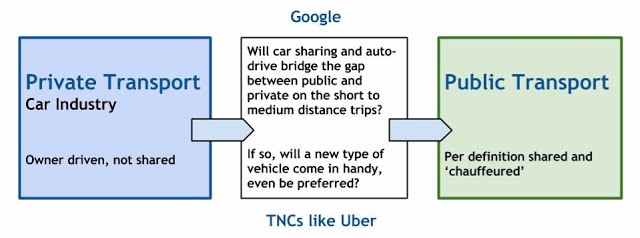
voyager BIG question is: will shared mobility programs affect sales and jeopardize Elon Musk's goal to hit break-even by 2020? The more Teslas will be shared, the less will be owner-bought... Or will it require Tesla to make even more cars, in the sense that Tesla will be offering a service (other car makers aren't), and will be needing more cars in order to meet demand? If there's one company that seems to understand The Bigger Picture best, then it is Google. Self-driving combined with shared use - that's no less than an 'attack' on public transport for the short to medium distance trips...
 �
�
Sep 3, 2015
electracity Not really an issue for this decade. Tesla hasn't been able to release, on a timely basis, much less complicated software.�
Sep 25, 2015
9837264723849 Elon's answer yesterday at BMWI indicates TM is not considering launching its own mobility service:
At 59m38s:
�
Sep 26, 2015
Ludus I didn't get that from his response at all. Asked about whether Tesla will get into ridesharing services he basically laughed and deflected the question saying hey we're just struggling to survive doing what we do now. I 'd say this exchange has zero relevance to whether Tesla is contemplating this for 5 years in the future.�
Sep 29, 2015
schonelucht To be honest, this whole speculative idea that Tesla one day will go into car sharing services comes from an equally vague exchange with Elon where he basically deflected the question too. Since that hasn't stopped people from taking their own ideas way too seriously, I won't hold back either. Tesla will not go into car sharing. Not now and not in 5 years down this line. If Tesla's is involved it will be as supplier of cars purchased from them.�
Sep 29, 2015
9837264723849 +1. The (expected) SDK will allow on-demand companies to install their application on the car dashboard. Far into the future, when Tesla produce millions of almost-fully autonomous cars, perhaps they'll consider competing in this area. In the meantime, as Elon said, they're just trying to expand by selling cars to people - not algorithms.�
Oct 8, 2015
Ludus You are right of course that it's all completely speculative. I am curious though why you think Tesla and other carmakers would stay out of car sharing assuming completely self driving cars. There is growing bubble of speculation about this. A lot of informed sources including Musk have said complete autonomy is less than 5 years away. Starting with this assumption it seems reasonable to see the entire business model of the auto industry disrupted. BEVs, autonomy, networked vehicles and ride sharing seem to merge as a new model. Car companies could of course stick to their traditional role selling cars to whoever wants to buy them but they'd be giving up enormously larger profits. There are lots of background assumptions we aren't used to questioning about how the car business works that change pretty dramatically as soon as cars can really drive themselves.�
Oct 9, 2015
schonelucht Compare with the reason why traditional car makers are so hesitant in bringing out EVs. Today they are a leader in their field : they have the know how, the brands, etc... to sell ICEs in a mature market that is difficult to enter. Throwing that away opens them up to vicious new competition from upstarts like Tesla.
Same thing, car sharing will be a threat to the established model of selling a car and pocketing a direct margin at sale time. In the future, Uber can, without reservations, go all out in the message : you don't need to own a car, you just need the service to make mobility happen. Tesla (and other car manufacturers) can't : they stand to loose their individual sales.
Finally, I think car manufacturers will have a criticaly competitive disadvantage should they offer a mobility service : they are married to their own cars. Meanwhile, Uber and other players can pick and choose which car is best suited. Maybe in California it's a Tesla, maybe in Munchen it's an BMW, maybe in China it's a BYOD, maybe for executives it's a Mayback, maybe foor poor student folks it's a cut down skoda etc... Or even, maybe in Amsterdam city center it isn't a car at all but something else. Uber has a liberty of picking how it is going to provide its mobility service that Tesla (or other manufacturers) have not.�
Oct 11, 2015
electracity The first licensed autonomous car is likely a low speed urban taxi: a Google car. Tesla has no natural advantage in that business. The Google car itself can be a comfortable, safe golf cart. No ludicrous mode or falcon wing doors required or wanted.
About a hundred companies are believed to be working on autonomous car software. We don't know, and can't know, how Tesla is doing compared to other efforts.
I think that any company releasing an autonomous car within ten years that can operate at higher speeds off highway is unlikely.�
Oct 16, 2015
Ludus We definitely have different expectations. It seems like the Tesla autopilot 7.0 is pretty close to your 10 year prediction, what...3 days later? I'm sure it's not exactly what you meant but the flood of data now for machine learning and iteration will make for pretty visible and rapid improvements. By the end of 2016 Tesla will have a billion miles of real world road data. Starting now everyone will have a very good idea who is in the lead and how fast they are progressing. It will be Tesla and the other 99 who haven't even gotten to the point of putting out a beta product and starting mass data collection.
Tesla's natural advantage is that it already has a polished attractive prestigious ultra-safe zero emission vehicle to use with it's level 4 IT when it arrives. Google doesn't. For quite awhile a Google car and a Model X might cost about the same for a ride. I know a few people who would prefer the model X. Falcon wing doors may not be needed but it's an exaggeration to say they're not wanted.�
Nov 3, 2015
SteveG3 Jonas at it again. All but directly gets Elon to say Tesla is looking at this.
I think Tesla is keeping quiet for competitive reasons in addition to the lack of a fully baked strategy Elon referred to.
update: this can end up being something of a race to lock in market share with a particular kind of large customer. Tesla likely neither wants to highlight (to the other potential players) the race for this group of customers, nor Tesla's strategy to reach deals with these customers. I'll follow Elon's lead and not write more about this here, though I suspect Jonas has been and will continue to think about this extensively, and write about it.�
Nov 3, 2015
ludicrousspeed Agreed. I think another key reason Elon wants to keep it under wraps for now is to avoid another "pie-in-the-sky" aspect of the business that will bring in profits some day in the future. Tons of people see some of Tesla's vision as something that will happen so far down the line and completely ignore it when assigning value to the company. Tesla is so forward-thinking that the average person can't see past the short-term events (like a vehicle delay) and Elon knows that. He wants Tesla to present it at a time where they can announce it and have the public be excited about a driverless ride system happening in the near term and feel comfortable/safe with it. If Elon confirmed their mission to compete directly with companies like Uber through driverless cars, I can already see the amount of ridicule they could face from such a presumably far-fetched idea.�
Nov 4, 2015
electracity I think the last thing Tesla should be doing is managing a bunch of Uber drivers and their customers.
I think Tesla would sell MX to Uber or Lyft.
I think it is Tesla providing MX as the premium car to an existing service. Tesla gets a lot of volume, and people get to ride in a Tesla. It would be a nice way to sell thousands of vehicles and spread that production out over several years. The market is particularly focused on Tesla's unit production numbers. This gives good numbers.
The simpler answer is usually correct.
Also, the falcon door and windshield make more sense if their purpose is to impress strangers.�
Nov 4, 2015
SteveG3 I think this is about possible services years off into the future and would not happen until they have an autonomous car and regulatory approval. Tesla would not be managing a bunch of drivers if I am correct about this.
Tesla does not find it advisable to discuss what they are exploring on this. I've come to realize they likely have very good reason for this and I will follow their lead on keeping quiet. I'll simply say that at this point, without getting into details of what Tesla may be planning, my main takeaway on this as an investor, is that the potential of such a business makes me more comfortable about the biggest risk I see for Tesla- the risk that comes with their being a pioneer in bringing cars in the real world closer to autonomy.
Frankly, when Tesla announced autopilot last year, I was excited and concerned. Anyone following the press on Tesla the past few years can see there is a sizable interest in seizing on any opportunity to derail Tesla whether based on fact or fiction. If there are lawsuits brought against Tesla claiming autopilot was responsible for accidents, I would be surprised if these same interests did not bring the kind of deluge of sensationalized articles we see about nearly every Tesla development. Those interests seem to want to drown out facts with a flood of fiction. I appreciate that Tesla exists because of the risk-taking and technological forwardness of the people there, but it seemed to me putting their necks on the line with autopilot was unnecessarily putting the mission of Tesla to accelerate the adoption of sustainable transport at risk. Now I see a potential huge financial payoff to that risk... success will mean a very material increase in the funds Tesla has to build battery and vehicle plants. Tesla may have gone after being among the pioneers in autonomous cars without this, but this potential payoff makes me feel better about what this effort can do for Tesla's mission and us shareholders.�
Nov 5, 2015
ChadFeldheimer My analysis:
No automaker will have a first mover advantage when it comes to autonomous car service, unless they choose to abstain from selling autonomous vehicles. If they sell autonomous vehicles to the public, then they have the public (private persons, uber, lyft, taxi companies, limo services, etc) to compete with.
I believe no automaker will be so bold as to abstain from selling cars.
So I do not believe being the first to an autonomous car will present much of a first mover advantage.
Looking slightly longer term (i.e. once autonomous driving is more or less commonplace), the primary competitive advantage an autonomous car service could have is a low amortized operating cost. That is, cost of the vehicle, cost of energy to operate the vehicle, cost of repairs/maintenance. Tesla currently has advantage in the cost of energy, but it comes at the expense of the other two. Hybrid cars from traditional automakers put up a mean fight here, as witnessed by current taxicab fleet makeup.
I think automakers would be more inclined to continue to focus on their core competency: building and selling cars. Just like they don't currently dabble in car rental services (hertz, alamo, etc) and car sharing services (zipcar, etc).
Summary: cheap and reliable cars are the cornerstone of dominating the car share market of the future. Tesla has a hat in the ring, but they have much work to do before they are competitive. Autonomous driving capability is obviously necessary, but I don't believe it creates significant advantage.�
Nov 5, 2015
SteveG3 I hope all the automakers other than Tesla see it precisely as you do Chad.�
Nov 5, 2015
ChadFeldheimer Don't know about automakers other than Tesla, but I'm confident Tesla shares the belief that total cost of ownership is (and will continue to be) key. Therefore, Gigafactory.�
Nov 5, 2015
Rarity Some of the automakers have in part relegated themselves to design and assembly. The cars are being made by the parts suppliers and being sold by the dealers. I question what their core competencies really are.
Regarding car sharing endeavors, I think that you are forgetting Car2Go, which is owned by Daimler.�
Nov 5, 2015
electracity I think electrifying the drivetrain is the last chapter of a hundred year story. This last chapter may be 20-30 years long, but in 5-10 years it will be obvious how much automation will change many things.
In Bob Lutz's crystal ball, Apple, Google may win�
Nov 5, 2015
mikevbf Looks like Tesla might not be the only one looking at alternative models:
Electric car startup Faraday Future plans $1 billion auto factory investment - LA Times
�
Nov 27, 2015
MikeC Article from a few weeks ago by the guy who just got Founders Model X #13: HaaS and the future of TSLA… — Medium
�
Jan 4, 2016
schonelucht GM just made a substantial and strategic investment in Lyft. Explicit goal is to leverage the Lyft platform for developing autonomous vehicles. This may make it likelier for Tesla to also enter the game but I still think the best way would be through a partnership with a company that already has the users. Uber being the most obvious candidate.�
Jan 4, 2016
Johan As a more general thought I believe customer loyalty in this market is very low. Uber one day, Lyft the next, Tesla Transport Inc. in the future? Customers will be very flexible and move to the provider with the best price, comfort, safety and software solution.�
Jan 4, 2016
doctoxics Not likely that GM, Ford, Uber, Lyft, etc. will be able to compete with an autonomous ride sharing service offered by Tesla Motors with the Model 3. Elon is prioritizing the development of autonomous software to match the mass production of Model 3, sometime in 2018. That should be the time frame to expect Tesla to begin a ride sharing service that competitors cannot match. I suspect that the Model 3s will be driven at first and then transitioned into a driverless mode.�
Jan 4, 2016
stealthology Correct. At least in DC, Uber started doing some ridiculous surge pricing pretty often, at which point I would open up Lyft and there would never be a "surge" type additional fee. Uber has gotten better since. I heard 13x surge for New Year's�
Jan 10, 2016
ivengo Did you see Elon Musk tweet today "In ~2 years, summon should work anywhere connected by land & not blocked by borders, eg you're in LA and the car is in NY"
I think that is pretty significant as an indicator of a foundational block of mobility service�
Jan 10, 2016
jhm  �
�
Jan 10, 2016
Cattledog Yup. The question is when does it go from 'summon your car' to 'summon a car'.�
Jan 11, 2016
ev-enthusiast From a technical point of view the difference might be pretty small. I could imagine small incremental steps towards an Uber-like service.�
Jan 12, 2016
dakh Over from short-term thread:
Yes you're right, I didn't do the math correctly. Cycle life depends a lot on how far the cell is charged and discharged and also on the temperature, so if the fleet is getting a more battery-friendly depth of charge it can hit 1M.�
Jan 12, 2016
dakh Over from short-term thread:
Not that demand is going to allow 100% utilization but it should be quite a bit higher when limitations of human driver productivity are removed.�
Feb 19, 2016
Dollardragon The first time it comes back full of vomit is the last time you do it. I would hate to need my car for a scheduled event and be force to do a massive clean on short order or any time for that matter. On the other hand, for some it could be done as a business with no problems.
I like the idea of driverless car service, the snag in this is the customer who is distructive by nature. They exist. So it would need to be much like UBER in that there is no customer anonymity, and there would need to be interior sensors to monitor for smells and such to take a car offline for a quick clean when necessary. This would be neither expensive nor difficult in the big picture.�
Apr 21, 2016
Johan Time to resurrect this thread?!?
Elon's comments when in Norway yesterday were interesting, to say the least, when considering this topic. I'll just make a cross-post here of my translation of one of the news articles from Norwegian media mentioning his comments, that were vague to say the least but nevertheless...
�
Apr 22, 2016
jhm Yes, I think Musk is thinking more about reinventing public transport than following the Uber paradigm. So my vision is to have an autonomous vans with 2, 3 or 4 compartments that each hold upto three occupants. Each compartment is enclosed for privacy, safety, and social comfort. So while the vehicle is able to transport multiple riders at the same time to distinct destinations, you have your own private compartmemt. You can play your own music, watch your own video, have your own conversations, etc.This alone makes it much nicer than than taking a bus. The compartments may also be separated with bulletproof materials and hospital grade HEPA filters for added physical safety from violence and airborne microbes. Because this is an autonomous vehicle, there is no driver present to assure a level of saftey. So if you're going to carry multiple groups of passengers, you've got to design safety and privacy into the vehicle itself. People need to feel very safe sharing the vehicle with strangers. So it's not enough just to put a Model X into public service. The design needs to be optimized for public service.
In addition to separate compartments, I would expect this van to have falcon wing doors for each compartment. This makes for optimal ease of access which is important for accomodating passengers who may have physical limitations. Indeed a ramp can come out below while the door opens above, allowing passengers to roll right in if need be. Also with doors opening vertically rather than horizontally, this maximizes the horizontal space for entering parallel compartments. All this optimizes the process of loading and unloading. It needs to be quick and easy to minimize time and aggrivation to all riders. An ordinary van is actually quite difficult to load and unload. Riders need to be physically nimble enough to contort their way into a back seat. This is why shuttles and busses have much more vertical space. So if you want a good public vehicle at the size of a van, smaller than a shuttle, you need very good design efficiency. So falcon wing doors could have enormous design advantages. The whole roof above a compartment can be lifted to provide vertical space while loading and unloading.�
Apr 22, 2016
9837264723849 Could it be also optimized for freight? Elon could re-invent the concept of containerization by applying it to pods for both passengers and cargo.
How many miles are driven to transport goods vs persons? Once the cost per mile is significantly lower for EV compared to ICE, delivery companies could switch faster than individuals. If Elon's idea is modular and can transport both people and goods at once, it could trigger a nice virtuous circle.�
Apr 28, 2016
ludicrousspeed
Came across this this video today, not affiliated with Tesla but still cool to see how it could look.�
May 25, 2016
9837264723849
At 15:29, he shares his vision of a world with autonomous fleet of electric vehicles:
Note that he's now Tesla's director of autopilot programs.�
Jul 20, 2016
SteveG3 with SMP2, Elon has made it clear ride sharing by owners and a dedicated Tesla fleet in some urban areas are part of the plan.
there are some aspects that still may not be in our interest to call attention to, but if anyone's curious, Adam Jonas mentioned what in my view is the one key word in a report a few weeks ago. it's no accident that other automakers are setting up alliances in this area... there is a mammoth business opportunity out there, and it will be likely be fiercely competed for at a surprising pace (I think the pace of competition here will be absurdly faster than the incumbents foot dragging towards EVs).�

Không có nhận xét nào:
Đăng nhận xét