Aug 23, 2011
mpt Thanks, I'm still keen to do a nice conv.�
Aug 23, 2011
TEG Tomsax seems to want to do "everything right" in terms of implementing all the J safety / reliability features.
From what I have seen, even some mainstream vehicles & EVSEs aren't necessarily doing thing to "full spec" in terms of disconnecting on button press...
Maybe I am wrong, but it seems to me when I press the unlatch button on Coulomb Chargepoints attached to my Leaf it still shows current flow on the EL display until I actually start to pull the plug out of the socket. Perhaps some implementations depend on the hope that the pilot pins disconnect before power rather than following the button/latch?
Similar behavior is observed when using the Nissan portable EVSE (modified to allow 240V charging). Maybe my early production Leaf has old firmware that doesn't stop charging on the "delatch" signal?�
Aug 23, 2011
strider Thanks for the update Tom. Is the cable going to support both generations of connectors (on the Tesla side) or will you have to do 2 different versions?�
Aug 23, 2011
tomsax We are working on two different cables. The 1.5 Roadsters need a short cable with an expensive twist-lock connector on the Tesla side. The 2.x Roadsters need a much longer cable that just ends in terminal lugs.�
Aug 25, 2011
W.Petefish I think if the Model S has the J1772 connector I will convert the roadster. But I would only do that with the help of a Tesla Ranger.�
Aug 25, 2011
dsm363 I agree but I'm pretty sure the Tesla Rangers wouldn't help you with the conversion since it wouldn't be officially supported.�
Sep 10, 2011
W.Petefish You would be surprised. The rangers were actually keen on the idea and were willing to give pointers. They said that you need to immediately do a 90 degree turn with the wire assembly in order to avoid some clearance issues as well as fabricate an aluminum plate to convert the boss from the Tesla Connector to the J1772. A simple task, but a time consuming one.
(FYI you get more information out of the rangers if they had a long drive and you buy their lunch for them.:biggrin �
�
Sep 11, 2011
tomsax Tell me about it. Nine months and counting. I hope to get the first real cable built this month.�
Sep 12, 2011
W.Petefish I mean it is a simple task once I have measurements to fabricate an adaptor plate. Once my In-Wall EVSE is complete, still waiting on the GFCI, I'll start to work on an adaptor plate.
The first plate will be made out of polycarbonate (1/4" lexan) for a prototype. (Emphasis on Prototype)�
Sep 12, 2011
tomsax Although the LEAF still indicates that it is charging, it stops drawing current when the J1772 latch is opened. This has been confirmed by a friend who has his EVSE powered through a utility meter: when the latch switch is pressed, the wheel on the meter stops spinning even though the lights on the LEAF continue to blink.�
Sep 12, 2011
tomsax If you are interested, you can see the adapter plate Cathy designed here.�
Sep 13, 2011
W.Petefish Oh boy, am I interested. What about a stl or dxf file? There are several metal fab shops around here I could run it by and see if they can mill it out. (or even RCAM at SMU)
FYI ModularEVPower beat ya'll to the proximity wire phase, I think.�
Sep 13, 2011
tomsax I don't think it can be milled because of the hex nut insets. We've put a lot of work into the measurements and the design, so I'm not super excited about just giving the CAD file away at this stage of the game.
What do you hope to accomplish by making an instance of our bracket?
I didn't know it was a race, but we had ours breadboarded in April. Also, their board requires an external power supply from the vehicle, ours does not as we do not want to pull power from the Roadster. We want a solution that has little impact on the car as possible. That is the tricky bit for this particular application.�
Sep 13, 2011
W.Petefish There is a lot you can do with 5 axis milling. I was hoping to do a trial fit with the bracket and my 2.5.
The Proximity latch is a good investment either way. Your board has multiple advantages over ModularEVPower's including being self-powered. I was just pointing out a time difference.�
Sep 14, 2011
tomsax You said you'd only do the conversion with the help of a Tesla Ranger. If you're willing to tear your car apart enough to test the bracket, that's the same as just doing the conversion give or take a couple of screws connecting the wires to the PEM.
Do you have the J inlet? Without that, you won't really be able to test the bracket. Unless you want to roll your own, I'd recommend waiting until we have a 2.x solution as it mostly likely will be a custom-built inlet cable assembly, not something you just slap onto the inlet you can buy directly.
We'll do 2.x testing with our bracket locally so we can make any required adjustments to the design. I don't expect any issue there as I don't think those parts changed.
Send me a private message with your email if you want to be an early adopter of our solution.�
Sep 14, 2011
W.Petefish Message sent. Along with some info.�
Dec 31, 2011
tomsax We have some progress on the J1772 upgrade cable for 2008 (v1.5) Roadsters. Here are a couple of photos of the first prototype cable.
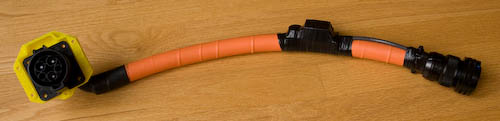
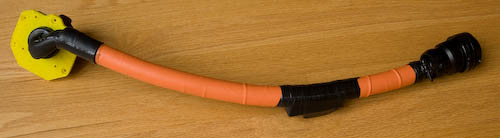
There's one niggling issue left to solve with the pin termination on the PEM side of the cable. Also, the production units will use orange shrink tubing to seal up the proximity board. In the sample above, the proximity board is wrapped in black silicone tape which is strong enough to work as a temporary fix for a leaking pipe, but I think the shrink tubing will provide a better seal.�
Dec 31, 2011
Mycroft You should try Self-fusing Silicone tape. Good stuff!�
Dec 31, 2011
tomsax That's what's on that cable. The orange shrink tube will be better: better seal and the correct color for a high voltage line.�
Jan 2, 2012
strider Tom,
Glad to hear you all are pressing forward with this project. Although Model S will continue with a proprietary connector, I'm still interested in doing this for my Roadster. Keep us posted!�
Feb 10, 2012
Kevin Sharpe any progress you can tell us about Tom?�
Feb 11, 2012
tomsax As long as I had to have the cable rebuilt for the problem with the pins, I wanted to also do a new revision of the bracket plate.
We were supposed to get a 3-D printer at the end of December, so I've been waiting for that. That got delayed, so I've been stalling on solving the pin problem. We finally got most of the kit for the printer yesterday (we're early adopters for a friend who is starting a business selling kits for the printer he designed, a RepRap variant that's relatively easy to build and produces very nice output).
I'm swamped with other projects until the end of the month. After that I expect this project will start moving again.
We are getting a lot of public J1772 charging stations in the Seattle area and also in areas where I travel and stay overnight, so conversion is becoming more appealing. Is that happening in other areas as well?�
Feb 11, 2012
dhrivnak Yes in Tennessee there are now hundreds of J-1772 options in city garages, Cracker Barrel , Nissan dealers etc. But I have yet to see my first Roadster plug. But this is not a big deal with my adapter plug.�
Feb 11, 2012
mpt In the North East, they're popping up everywhere; I'm back to considering the J1772 again. Thanks to the ActiveE I have a J1772 EVSE in my garage and am feeling the urge to standardize.�
Feb 11, 2012
dsm363 Yeah. A Central Market (grocery store) in the area just installed 4 ChargePoint chargers and they're showing up a movie theaters as well. Of course they don't have signs and ICE cars park there.�
Feb 11, 2012
Lloyd I had this signage made for my office.
 �
�
Feb 11, 2012
strider Definitely here in the Bay Area. Lots of L2 J1772 around. I've only needed to charge outside of my own garage once but why not convert the Roadster and my UMC just in case I need it someday (different job, longer commute, etc). Also, J1772 plugs are lighter weight than the Roadster one so less chance of knocking myself out if I drop it while unhooking it from the ceiling in my garage�
Sep 12, 2012
tomsax I'm finally back to making some progress on this long-running project. I have an improved bracket that both fits better and is much sturdier than previous prototypes. Now, I need to go back to the cable guys and get another prototype cable made.
With an eye toward getting a production run going, who is interested in getting a cable to upgrade their v1.5 Roadster to J1772?
There are a number of variables, but I expect the cost of the cable+board+bracket+hardware to be around $450, give or take.
If you're interested, send me a private message with your name, email address and answers to these questions:
1. Are you interested in being a beta tester and trying one of the first few, or would you prefer to wait until others have tested it out?
2. Are you willing to take a dremel to your car's inlet mounting cup to cut out a notch to accomodate the J1772 connector (or pay someone to do so)?
3. What existing charging equipment will you need to convert from a Tesla plug to J1772?
Again, please send me this info via private message, not just posting to this thread. I don't want deposits or anything, I just want to get an idea of how many cables I'll need to have made. (Costs go down a little with more orders.)�
Sep 13, 2012
hjr IMHO give up on it and buy Henry Sharpe's adapter which is simple, and small. J1772 plugs cannot handle 70A so why limit yourself to that lousy standard? Spend the time hacking a better head unit than Alpine's!�
Sep 13, 2012
Lloyd Your statement is not true. J1772 plugs can and do handle 70 amps plus.�
Sep 13, 2012
hjr They can handle it but J1772 was not designed for 70A. You won't get killed, but its not optimal or recommended.�
Sep 13, 2012
DrComputer Not true. The J1772 standard can handle up to 75A. ClipperCreek offers a 75A J1772 upgrade kit for existing Tesla HPCs.�
Sep 13, 2012
Lloyd From Wiki: The CARB regulation of 2001 mandated the usage of SAE J1772-2001 beginning with the 2006 model year. Later requirements asked for higher currents to be used than the Avcon connector could provide. This process led to the proposal of a new round connector design by Yazaki which allows for an increased power delivery of up to 19.2 kW delivered via single phase 120�240 V AC at up to 80 amperes. In 2008 the CARB published a draft amendment to section 1962.2 Title 13 that mandated the usage of the oncoming SAE J1772 standard beginning with the 2010 model year.[5]
J1772 also has attained UL certification for connectors to 75 amps. Other connectors have not attained this . Does Henry Sharpes adapter you refer to have UL certification at ANY LEVEL??�
Sep 13, 2012
Doug_G Dude... not only do fully certified 70A J1772s exist, I haveone sitting in my office waiting to be installed!�
Sep 14, 2012
wycolo > fully certified 70A J1772s exist [Doug_G]
Ok, it would appear that J1772 capability exists in the eye of the beholder, i.e. look at the one in your hand:
a. My Clipper Creek CS-40 EVSE (a 30Amp device) has a Yazaki "30Amp" plug.
b. My CAN from HCSharp (second batch) has a "70Amp" ITT socket on one end. The other end is a Tesla
plug which presumably is good for 90Amps, the Roadster standard, but no writing visible as it is covered
by the CAN housing.
--�
Sep 14, 2012
hcsharp I wanted to wait before responding to this. While the J1772 standard technically allows up to 80A, that doesn't necessarily mean it's a good idea to use it for that. I've done a fair amount of testing with it up to 70A. Based on my own direct test results, I can tell you that the pins get fairly warm, not hot, at 70A under ideal conditions. The pins/sleeves in the Tesla connector do not get warm because they are substantially larger and have a correspondingly much larger contact surface area. This is an automotive application which generally means it's a good idea to oversize things. The contacts can get dirty and/or worn out. When that happens it becomes very easy for them to get hot, not just warm, because the small pins are already at the limit of what they can handle under ideal conditions. This information is not based on any wiki articles. It's based on direct, first hand test results.
The first SAE J1772 standard was based on a target of 32A and the pins and sleeves were considered a little over-sized for that, as they should be for an automotive application. My understanding is that when it was later scaled up to 80A the SAE discussed whether to develop a different standard that could better handle 19kW, or try to use the more popular existing round connector. (I can't find the source for that right now and don't have time to look, perhaps someone else has it.) They chose what they felt was the best compromise between these competing demands.
Would I want to convert my car to J1772? No because J1772 is not as robust as the existing proprietary connector with much larger pins/sleeves, and for those times I need it, I have a quick and easy adapter. Where I live the most powerful charging stations all use Tesla connectors. If you convert your car to J1772, you can no longer use Tesla connectors. Those are my priorities. There are some good arguments to converting if your priorities are different. Tom for example lives where J1772 is more common, he might have other vehicles that would benefit from a common plug in his garage, and he probably doesn't charge at 70A all that often, and probably doesn't care about the few remaining public roadster connecters in the wild anymore. In his case convenience is a bigger factor.
Disclosure: I make a little bit of money (although it's mostly a labor of love) selling short and sweet J1772 -> Roadster adapters.�
Sep 14, 2012
tomsax Hi Henry,
I'm certainly not trying to talk anyone into converting their car to J1772, nor to talk anyone out of buying your awesome can adapter.
I want to convert my Roadster to J1772 so that I don't have to use an adapter in the most common charging scenarios in the travelling I do.
Additionally, I'd like to ensure that my car complies with the full J1772 spec, specifically that no one can unplug my car in the middle of a charge and potentially cause arcing damage to the pins on my car's inlet. I'd prefer not to lock the J1772 connector to my car, denying others the opportunity to use the charger after my charge has finished. The conversion cable I'm working on includes a clever little board that Cathy designed to monitor the proximity pin and interrupt the pilot signal when the latch on the J1772 connector is opened, and does so without drawing any power from the Roadster.
If other owners are of the same mind, then I'm happy to share my method for doing the conversion.
To make sure everyone has the information they need to make an informed decision about how they want to deal with charging, as the deployment of new HPCs drops to zero, I'd like to correct a few things you said.
I have no intention of giving up the ability to use Tesla HPCs. Although there are very few around, they are strategically placed and are extremely convenient for road trips I do a few times a year. I'll use the original Tesla inlet cable assembly I remove from my car to make a Tesla-to-J1772 adapter. I'm still working on the most cost effective way to do this robustly. I'll have more to say about that when I decide on a strategy, but there are several ways to do it.
The original 32A J1772 standard was used for the old Avcon connectors. The new J1772 connectors were designed for the new standard. The ITT-Canon cable has been UL tested and certified. Clipper Creek has been using that connector for the CS-100 and most of the public HPCs in Calfornia have been converted to use the ITT-Canon 70A J1772 connector. I haven't heard a single complaint about any issue with the connector. (The CS-100 has to be derated from 75A to 70A for Roadster compatibility, but that's a Roadster bug, not an issue with the connector.)�
Sep 15, 2012
vfx I had planned to put a J1772 in my Roadster until Henry's Can became available.
When all the Tesla 1.0 stations out in the world are gone, (I only know of Barstow left in SoCal and the Cosmopolitanism in Vegas), having a Tesla-to-J1772 adapter made would cover future road trips that may stop at those sites and Roadster owners homes, but honestly I think the future is in having an adapter to from a Tesla 1.0 to a Tesla 2.0 plug and lastly having a 2.0 in the Roadster as the end solution.
It has been said the Supercharger sites will have two regular chargers on site as well. I'm guessing the will not be Roadster plugs.�
Oct 21, 2012
mg012 Well, I just bought the Can from Henry and used it at two charging stations last week. One was at a Nissan dealership, which was a waste of time because their chargers are so wimpy (maybe 24 amps) and then at a ChargePoint public charger which offered 30 amps. The Can is so easy and takes up almost no room, worked perfectly, and is lockable. Thanks Henry for your impeccable design and finished product.�
Dec 5, 2012
jcstp Maybe some thread considering reading
about high amperages in j1772
My Nissan Leaf Forum View topic - Blink / Rav4 Blows Out a Contactor Pin (with gory pics)
Some considering installing roadster or model S plug instead of j1772�
Dec 5, 2012
tomsax I'll only build a J1772 conversion cable with high quality ITT/Canon parts and assembled with industrial crimping tools by accomplished professionals. I'll test complete empty to full range mode 70A charging before letting anyone else use it.
I've done a fair amount of Roadster charging at 30A from J1772 stations and have never had a problem. I use a homemade J1772-to-Roadster adapter that uses a cheap J inlet that Cathy and I soldered ourselves. The right way to do this is with industrial crimping tools, something we didn't have available when we built our prototype adapter in 2010.
J1772 Charging for the Tesla Roadster - Tom Saxton's Blog
For overnight charging on a road trip, I typically do a standard mode charge to 87% overnight, then kick off a full range mode charge two hours before we're ready to leave. That sets us up to leave with maximum charge. If the timing is right, I'll just do a full range mode in one session. In the first case, there's usually a few hours between when the first charge ends and the second starts.
I've done two complete empty-to-full Roadster charges at a Blink station at the Portland Crown Plaza: 42 kWh and 33+8 kWh. Likewise at the AeroVironment station in Wolf Creek, OR: 23+8 kWh. At a ChargePoint station at the Four Points Sheraton in Emeryville, CA we did 15.3 kWh from 120V, then over about 30 hours in three sessions we did 12.7+24.5+9 kWh from the J1772 port.
We've done several more sessions around 10 kWh at various Blink and ChargePoint stations.
I've never had a problem with the J1772 connector getting hot. Obviously, I don't have a ton of data points since most of our charging has been from either Tesla charging stations or NEMA 14-50 outlets using a mobile connector.�
Dec 5, 2012
Kevin Sharpe I've used Henry's Can and a Type 2 ("mennekes") cable with a Type 1 ("J1772") connector everyday for the past 5 months. I usually charge at 7A from solar during winter days and overnight at 24A/32A as required. I'm using ITT connectors and have never had a problem.�
Dec 6, 2012
jcstp In the test they did after the incident they discovered that the blink connectors get verry hot during prolongued high A charging!
This caused the melting of j1772 plug & socket
Apparently the way the cable of the chargingstation is connected to the plug is not donne correctly by blink, causing in the longrun that the plug gets toooooo hot (melting and possible ..........)
The converted Leaf with the 6,6kw charger has the same problem with this charger
To be sure this not happening again they are installing a thermostat in the j1772 socket (car-side) My Nissan Leaf Forum View topic - Blink / Rav4 Blows Out a Contactor Pin (with gory pics)
interupting charging when the plug gets too hot
The fit-ev has this already installed from factory
Model S's, using the adapter are less prone to this because the adapter reacts as a heatsink and dissipates the heat
Probably the can from hcsharp does the same�
Dec 16, 2012
adelman Btw, until recently I had an experimental AVCON connector in my garage that could handle 80A (it had a second, larger, set of contacts, that were originally proposed for DC fast charging). It went to the copper-recycler a month ago when I converted tzero2 to the current J1772 receptacle.
Ken�
Jan 20, 2014
tomsax I've updated the first post on the thread to update the project's status: suspended.�
Jan 20, 2014
Doug_G In light of that, do you still want the thread to be pinned?�
Jan 20, 2014
tomsax It's perhaps still an interesting issue that owners may ask about. It came up in another thread today. I'd hate to have someone embark on the same project and have to rediscover/reproduce all of the work Cathy and I did.�
Jan 23, 2014
jeremyz This was a really cool project. It's too bad that the production cable assembly never happened. I saw that EVWest makes a little box for dealing with the Proximity signal like you guys built (J1772 Active Vehicle Control, EV West - Electric Vehicle Parts, Components, EVSE Charging Stations, Electric Car Conversion Kits). I wonder if they might be interested in manufacturing the cable assembly as well.�
Jan 23, 2014
drees They actually just re-sell that particular product from here: Modular EV Power�
Jan 23, 2014
tomsax Cathy's board has the advantage that it doesn't draw any power except when the car is charging, so no vampire load on the 12V system when the car isn't charging.�

Không có nhận xét nào:
Đăng nhận xét