Oct 12, 2014
wk057 So... 691HP. That's 515,278.6 watts assuming 100% efficiency.
Assuming a fully charged pack, and no voltage sag (impossible!), that would be roughly 1300A. Realistically, this would be closer to 1500A.
Either way, the main pack fuse on the 85kWh pack is 630A.
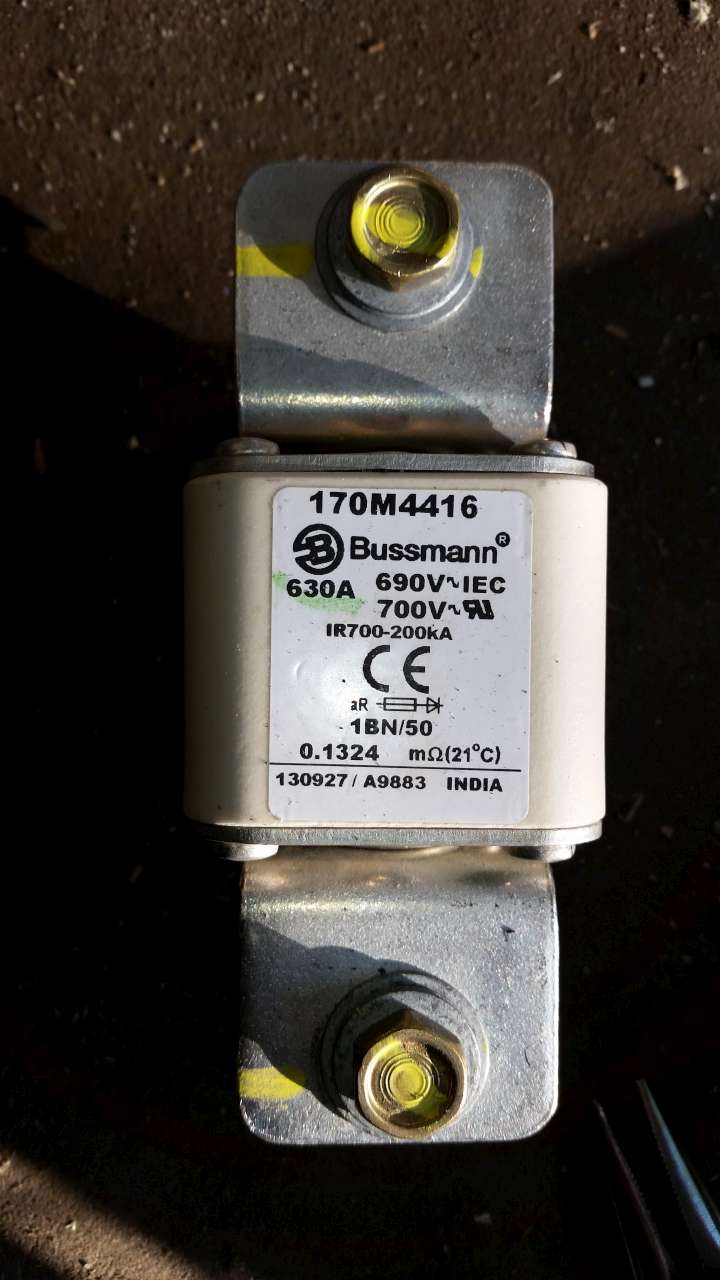
Looking up this part number, this is a fast acting fuse. So, I would think that much over 630A for multiple seconds would pop this fuse.
630A at nominal voltage of 355V is about 225kW, even less than the current P85 draw.
Originally spec'd P85 was 416HP. So, 310kW. That's already 85kW over this fuse's rating.
The P85D, that's 290kW over... more than double even under ideal conditions.
Now, in my testing for my off-grid solar project using the Tesla pack (see thread on this forum for details), I've run this fuse at 410A. It gets *hot* quick. FLIR cam registered it at over 250 degrees fahrenheit. Not enough to pop it, but I'm pretty certain that over 630A would do it.
So, this doesn't add up, for the P85 or the P85D especially. Reaching for explanations...
One might be that the extra juice comes from the precharge capacitors. From my pack tear down, I know there is a precharge resistor, which means there are capacitors somewhere in the inverter/drive unit. Would these be enough to make up for the full power acceleration? Math time...
I've done a top speed run in my P85....... shhhh.... and a manual count was at least 7 seconds of the bar around 320kW. That means 2240000 watt seconds, or about 622Wh for that period. Assuming the pack is delivering the max fuse rating, or around 225kW, that leaves 185Wh that is needed to make up the difference.
OK, so maybe there are 185Wh worth of capacitors somewhere? That's 666,000 joules. That would be about 8.33 farads at 400V... 3333 coulombs.
The best ultracapacitors I could find setup for this would weigh over 100 lbs, and cost somewhere in the $10,000 range... so, this is doubtful.
So... how are they pulling this power out of the pack without popping the main pack fuse? :cursing:�
Oct 12, 2014
TEG That fuse shows 630A @ ~700V. Model S pack it about half that voltage, so does the fuse allow higher amps at lower volts?�
Oct 12, 2014
miimura I thought you previously said that the fuse has an accessible cover. If that is the case, it is possible that S85, P85, P85D use different fuses, even if the cells and wiring inside are the same.�
Oct 12, 2014
mitch672 This. And, they could come up with another Rev of the packs, so far we've seen A, B, C and D revisions.
whose to say they haven't designed a pack with larger internal wiring & fusing? no one has seen one in the wild up close yet...�
Oct 12, 2014
Bighorn Do we know that there is a time when both motors are creating peak HP simultaneously? Is it even possible? Is 691 HP a marketing tactic rather than a real world figure? Do the three modes that Elon mentioned that included "Insane" relate to how the motors can draw their power, similar to a launch mode that is only allowed a certain number of times? I'm not sure we'll have solid answers until the December builds start getting tested.�
Oct 12, 2014
wk057 It is accessible from the top of the pack, so, only while not installed. Guess that makes sense at production perhaps, but, would make battery swaps complicated...�
Oct 13, 2014
Sad Is this 691 bhp figure mentioned anywhere else than the Design Studio? I find it weird that neither Elon or the blog mentions this number, which would kind of be something to brag about. I'm leaning towards marketing tactic! I desperately hope I am wrong.�
Oct 13, 2014
pgiralt Only explanation I ca think of is if there were two of these fuses in parallel somewhere, but you would have found them in your breakdown of the pack.�
Oct 13, 2014
wk057 Nope, definitely only the one. Broke the pack down to the aluminum casing...�
Oct 13, 2014
tom66 No, the fuse doesn't "care" what the voltage of the pack is. The 700V rating is a safe interrupt rating limit. For example at 1000V fault the fuse could arc over and not be a fuse any more - which would be bad.
The 630A rating for that fuse is nominal, and likely the continuous operating rating (or up to 30 minutes.) We know the P85 limits to 160kW after a lot of excursion, which would put it within that fuse rating.
P85D (and all other -D models) will likely use a different battery pack, maybe an -E variant, to get the additional power. And they will have to get the power to the front motor. They could use the routing system currently used for the HVAC/DC-DC (which is something like 15kW and so has "thin" cables), but that would have to be increased in size considerably, and may not fit through the current channel requiring bodywork changes (which is always expensive -- additional crash testing may be necessary.) So maybe they now have a front battery connector (which internally is wired to the same battery, but cabling length is reduced.)�
Oct 13, 2014
yobigd20 nobody here yet knows if they made battery pack changes to achieve the required power draw. what battery pack "version" is that fuse from? A/B? you know they are up to D packs and nobody yet knows if the new dual motor battery packs have changes in them (I wouldn't be surprised if they do) and they are now on something like 'E' or 'F' packs....�
Oct 13, 2014
Todd Burch The D likely uses a slightly different pack.
As for the numbers being a marketing ploy: Guys, we're talking about accelerating a nearly 5,000 lb sedan to 60 mph in 3.2 seconds, faster than a 700+ hp Hellcat. Do you really think that 691 hp number is far from reality?�
Oct 13, 2014
wk057 The fuse was from a D pack.�
Oct 13, 2014
JRP3 Don't know if this would explain it but acceleration requires torque, to produce torque the motor requires current, and until the motor approaches base speed the current from the inverter to the motor should be higher than the current from the pack, while the voltage to the motor from the inverter is lower than the pack.�
Oct 13, 2014
Johan I agree with tom66 in that likely both the 60D, 85D and P85D will have two high voltage connectors to the battery: one aft and one rear so to speak. If the horsepower rating was just a marketing ploy, as in "the combined rated horsepower of the two motors is 691 but they can never output that much in reality in unison since there is not enough current available", then there's no way the P85D could do 0-100 in 3.2 seconds as opposed to about 4.0 for the P85. That kind of performance boost could never come from just having torque on both axes and different gearing but not higher total output. Unless the P85 could already do it but was that much grip limited, which it is likely not.�
Oct 13, 2014
Sad As a matter of fact, 691 bhp is far from necessary to achieve that, as traction is a big factor, see GT-R to see how a relatively heavy car manages 3.0 secs with 500 bhp. For the P85D, there's the added advantage that maximum torque can be applied from the start, more torque in total can be produced compared to the P85 (thanks to the two engines) and more torque can effectively be supported by the tires thanks to the AWD. And let's keep in mind that for the P85, peak power (so ~400 bhp) is not achieved before 40 mph.�
Oct 13, 2014
scaesare Well, the GT-R weighs ~3,800lbs, as opposed to The D's ~5,000lbs.
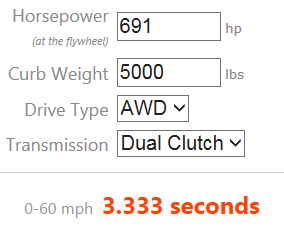
According to one calculator you need all of that HP to get that 3.2 sec 0-60 time... (I used "dual clutch" as the trans type, as that seemed to be the closest thing to no shifts at all):
And as for the original question... I agree that the pack is likely a revised model...I suspect there are a few places where the need to accomodate ~50% more power draw has necessitated changes...�
Oct 13, 2014
tom66 Secondary school physics:-
Acceleration = 3.2s / 60mph = 8.382 ms^2
Force = mass * acceleration = 2270 kg * 8.382ms^2 = 19.02 kN
Displacement = 0.5vt (initial velocity zero) = 42.92 metres
Power = Fd/T ((force * displacement) / time) = 255kW
So MINIMUM required power (assuming 100% could be put on the road) = 342 hp
This ignores air resistance and tyre slippage.�
Oct 13, 2014
Saghost It also assumes you can apply the same amount of power during the entire acceleration event - which is quite impossible since that would result in infinite acceleration/torque during the first moment of movement.
Actually, the Model S will do most of the 0-60 run in a constant torque situation with power increasing linearly throughout (In the existing single motor cars, the S60 and P85 went power limited (first achieved peak power) at about 43 mph, while the S85 was about 55 mph.)
If that's the case, the peak power would be twice the average power - 510 kW/684 HP. It actually probably is slightly less than that, because it likely hits peak power 2/3 the way through the run and then the torque drops off - but you need integrals to model that correctly instead of simple math.
I'm operating under the assumption (as I stated in another thread) that Tesla has made a revised high power draw pack version (call it an 85 kWh "E" pack until we know better) specifically for the P85D. It'll be interesting to see if P85s get it too - available information suggests that they are currently limited by pack dynamics rather than motor/inverter ones.
Walter�
Oct 13, 2014
Cottonwood A couple of small corrections:
- You have calculated the average power needed assuming constant acceleration with no power limit. In fact, power is the product of force and speed. To maintain the same acceleration, the power goes up with speed. 60 mph is 26.8 m/s, so the power needed at 60 mph is 19.2 kN*26.8ms = 515 kW or 690 hp. Very interesting, is the power of the P85D just enough to maintain constant acceleration to 60 mph?
- Other losses include DC-DC conversion from the battery to the motor and resistive losses in the motor, etc, especially at low speed.
Oct 13, 2014
Sad Fun to play around with numbers :smile:. If I assume flat higher torque, i.e. linear power progression, until 40 km/h (instead of the current 65 km/h), then flat 300 kW power between 40 and 100, I arrive to a 0-100 km/h time of 3.4 seconds... which is exactly what Tesla is quoting. Replacing 40 by 65 yields 4.2, which is not too far from what the P85 can do...
The assumption behind the 40 km/h peak torque is that the higher torque produced by the two engines allow peak power to be reached much quicker.
My simplistic math:
Kinetic energy at 100 km/h: 0.24 kWh
I assume an average of half the power between 0 and 40, i.e. 150kW, which requires 0.93 seconds to make it to 40
I then assume a constant power of 300 kW to move from 40 to 100, i.e. provide 0.20 kWh of kinetic energy, that will require 2.45 seconds.
So maybe the car can make it by having peak 350 kWh (what my current MS is rated at in Switzerland), after accounting for losses.�
Oct 13, 2014
kennybobby Hey WK i've been struggling with what you've brought up also. The datasheet for the fuse is cryptic and not clear at all, but on further investigation i found the following curve data. Bussmann claims the fuse is good to operate below the A-A line, which indicates it can withstand about 1900 Amps for 30 seconds! Seems unbelievable. It can run at the 630 rated amps continuously although it is drawing 80 watts--hence the sort of FLIR temperature data you measured.�
Oct 13, 2014
Cottonwood Well, that seems to be good for 690 hp for a couple of 0-60 runs...�
Oct 13, 2014
dan-l Kennybobby is right, and hats off to you sir on reading that curve. Personally I find the data sheet much less crypticthis lists the I2t as 52k which means the fuse will begin to arc when current x time go above the number 52,000. So 1900a x 30s =57,000=fuse blown. But 1900a for 10-20s and you're OK.. You've just got a really hot fuse.
�
Oct 13, 2014
Perfect_Flaw The Charger Hellcat is certified to run a 0-60 time in 2.9 seconds. Not sure where Tesla came up with the "fastest sedan in the world" thing, but maybe they have yet to hear about the Hellcat. Not to mention, a Hellcat from a 60 roll will absolutely destroy a P85D and trap at over 126-128MPH in the 1/4 mile, where the P85D will be lucky to hit 112-113MPH as the power curve falls off a cliff after 60mph. P85's are quick out of the hole, but after that, they really lose power quickly.
Also, the Hellcat will run a 10.8 second 1/4 mile with drag radials and 11.2 on street tires. The P85D claims a 11.8 1/4 mile time. How can Tesla claim "fastest production sedan in the world" when clearly the Hellcat beat them to the punch? Sounds like Tesla's marketing team needs to be sat down and talked to.�
Oct 13, 2014
wk057 Ah very nice, I wasn't able to find this. That makes a lot of sense then. As long as the software is able to appropriately limit the power draw then this would work.�
Oct 13, 2014
EarlyAdopter Could this be the root of power limiting after a few spirited laps on the track? Is the car going into limp mode to keep this fuse from overheating and blowing?�
Oct 13, 2014
Todd Burch Nobody claims the P85D is faster than the Hellcat in the quarter mile. We're talking 0-60 here.
The Hellcat's own website claims Quickest Sedan Ever, but they explicitly are referring to quarter mile time. Yes, the Hellcat has a faster quarter mile time. Tesla claims quickest 0-60, and it likely is.
As for 0-60, the Hellcat website itself claims "low 3-second range" for 0-60. Road & Track measured 3.7 sec for the Hellcat 0-60 (source), and Motor Trend measured 3.7 sec (source). And here, Motor Trend said Dodge claims 3.7 sec. Recall that Tesla's performance specs tend to be a little on the conservative side (for example, in 2013 the P85 clocked in at 0-60 in 3.9 sec). No matter how you look at 0-60, they are both extremely close. On street tires, the P85D's numbers are slightly faster. Of course we'll have to wait for Youtube Hellcat vs. P85D videos, but the key difference is that Tesla is claiming quickest 0-60 (which is likely is) and Dodge based on quarter mile (which it surely is).�
Oct 13, 2014
Perfect_Flaw I would assume it is the battery pack getting hot. Full EV's have a LONG time to go before they can hit the track for a few laps, or even complete a single lap around the Nurburgring before going into limp mode. Even a Ford Focus could run much better times on the Nurburgring than a Model S P85. The Model S is a great street car made for some 0-60 bursts and occasional 1/4 mile sprints, thats it fellas.�
Oct 13, 2014
Todd Burch Source? There are two videos/articles about a Model S on the Nurburgring that I know of. One, part of a "journalist" review, was actually using a 60 kWh model. In other words, a useless piece of journalism. The other was of Bjorn Nyland, who a) was not racing or driving aggressively and b) is not a professional driver.
Don't get me wrong...I agree that the Model S really isn't a track car...but it sure as hell will beat a Ford Focus.�
Oct 13, 2014
Perfect_Flaw Most car enthusiasts agree, 0-60 times are a worthless indicator of a cars performance because of so many variables. Its a marketing gimmick that caters to non-enthusiasts as a standard benchmark number.
How anyone can call a car the 'fastest-anything-in-the-world' based off of 0-60 times is just plain stupid, sorry. Sure, its quick out of the hole- but thats it- it is not fast over 100MPH, it tops out at 155MPH (the Hellcat can reach 200MPH+), its 1/4 mile time is equal to most 500-550HP ICE sports sedans, and it most certainly cannot run a quick lap time around a track comparable to most any sports sedan out there from BMW M, AMG, Porsche, etc. Remind me again how the P85D is "the fastest production sedan in the world" when the only metric being used is 0-60 times??? Sorry, if it can't beat another production sedan around a track in a single lap, or hit as high of a top speed as another sedan, than it is NOT the fastest anything in the world.
When you see something claiming "Fastest PLANE in the world" or "Fastest car in the world" what metric do they use? TOP SPEED people.
Be happy with your P85's and if buying a new Tesla, buy a used P85 because the premium for a P85D is simply not worth it for a quicker 0-60 time. Better yet, you want fast? Buy a used P85 (since many will be flooding the used market soon) as a daily driver and an SRT Hellcat for $60K as a fun track car with your 2.9 second 0-60 times, 10 second quarter miles, and 200MPH top speed.
- - - Updated - - -
Wheres your source for a Ford Focus getting beat by a Model S?
Fact of the matter is, the Model S gets too hot to run a quick 14 mile lap around the Nurburgring.
Heres the video showing you how the Model S overheated and went into limp mode, and they did use a P85.
Nürburgring Proves Too Much For Tesla Model S: Video
- - - Updated - - -
Oh, by the way, heres a video of a Ford Focus RS running a 7:58 lap in the Nurburgring- the P85 ran an almost 11 minute lap, and if it didn't overheat they THINK it MIGHT run a 9 minute laptop time. Ouch.
https://www.youtube.com/watch?v=GFHm3qga9bA&safe=active�
Oct 13, 2014
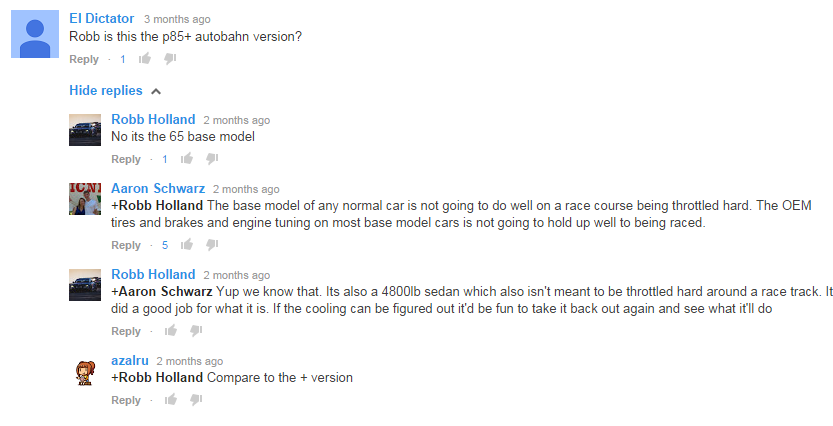
Todd Burch Nope. That's the very video I was referring to. Look in the comments, and the driver (Robb Holland) mentions that he was driving the 60 kWh base model:
 �
�
Oct 13, 2014
EarlyAdopter We still don't know. This is a new piece of information. Would be nice if someone could run the numbers and see if this could be the weak link for track limiting.
The battery is liquid cooled with radiators up front. I've got to believe that battery heat isn't the issue here. Or, if it is, that would be readily addressable aftermarket.
If by "a LONG time to go" you mean a year and a half ago, then ok. Otherwise, I think you missed this:
Electric SLS sets new Nurburgring record - BBC Top Gear
Last time I checked, the Model S was a great street car made for a whole lot of other reasons, like filling up at home, hauling my wife, 2 kids, and parents at the same time, the environment, etc.�
Oct 14, 2014
stopcrazypp Maybe it's a marketing gimmick, but it's a benchmark number that everyone looks at (even more so than 1/4 mile times) and practically every manufacturer provides.
Perhaps "fastest" is not the best term, but "quickest" would describe 0-60 perfectly. However, a lot of times these terms are used interchangeably.
Driver said car showed 190 miles of range when fully charged, so a 60kWh for sure, not 85kWh.
http://jalopnik.com/too-smart-for-me-the-car-originally-showed-around-190-1601938374�
Oct 14, 2014
J1mbo Pretty sure they call it the quickest four-door sedan. Hellcat is a two door car, right?
So how long and how far do we think the D cars can run at 155mph from full to flat?�
Oct 14, 2014
JST You can get the Hellcat engine in either the Challenger (2 door) or Charger (4 door).�
Oct 14, 2014
arg This is supposed to be one of the respects in which P85D will be superior to P85, due to the different gearing on the front motor and (assumed) higher maximum total power.
We don't yet have any figures to say exactly how much so.�
Oct 14, 2014
JRP3 Not true, as the already posted Merc example shows. Plus there are higher C rate battery chemistries available that would allow a full speed Ring run, if that were an important goal, which it is not. 0-60 times are the most often compared performance times between vehicles, so your claim otherwise does not meet with reality. 0-60 times can actually be used in the real world, where top speed and 1/4 mile speeds are much less useful.�
Oct 14, 2014
mknox Yeah, but it's a fuse. What happens if you do more than a couple of runs? Battery pack replacement?�
Oct 14, 2014
Cottonwood The car could easily log current vs time and model the cooling of the fuse. Maybe protecting the fuse is one of the things that causes a Tesla MS to go into "wimp" mode on the track...�
Oct 14, 2014
JST
That's an interesting thought.
- - - Updated - - -
Number of times I have used my car's hole shot capability to my advantage in city driving? Every day.
Number of times I have needed to go faster than 155 mph? Zero.
0-60 is a datapoint, nothing more, but for the kind of driving that I use my Tesla for, it is far more relevant than top speed. Actually, a street start (5-60) is even more relevant for me, since that tends to eliminate clutch dumping and launch control. That's a number that I am sure the P85D will simply dominate compared to nearly anything else on the road.�
Oct 14, 2014
mknox True. Early traction control systems (and for all I know, current ones) that modulate the brakes do something similar to prevent brake overheating.�
Oct 14, 2014
scaesare Indeed. And I'll add:
The number of times I've needed to accelerate flat-out for 1/4 mile: Zero
Number of times I've needed it for several hundred yards: innumerable.�
Oct 14, 2014
wk057 That's what I expect the car would be doing. I haven't heard of any fuses popping...�
Oct 14, 2014
Thud I think Elon mentioned it in the unveiling event. And the number sounds about right for what it would take to get a car that heavy to go 0-60 in 3.2 seconds.�
Oct 14, 2014
Sad In the 14 minutes video published by Tesla?�
Oct 14, 2014
scaesare Given that 1C is the discharge rate for 1 hour, then anything over 4C would have to be less than 1/4th of an our, correct?
A 4.2 discharge would imply draining the battery in about 14 minutes or so...
Not that 2 minutes makes that much of a difference.�
Oct 14, 2014
mitch672 which is about the same amount of time the Veyron can run at top speed, before running out of fuel.
of course it's top speed is higher (267MPH), but you'll probably need a new set of $25K tires and the $70K tire mounting service in France after that run as well
Bugatti Veyron @ Top Speed�
Oct 14, 2014
EarlyAdopter I know, right?
The battery is liquid cooled. The fuse is not. It would be a bad idea to connect a thermally activated fuse to a heat sink.
I think we may have found our track fun limiting component. Still waiting to hear whether several miles of track driving would be enough to approach thermal thresholds for that fuse.�
Oct 14, 2014
Johan Ghetto solution: replace fuse with 1/2" nail�
Oct 14, 2014
Cottonwood To support these kinds of currents, you probably need more like a 1" diameter copper rod...�
Oct 14, 2014
wk057 Go around the track a bit then look at the front passanger corner of the pack with a FLIR? The top cover for the fuse might be visible from somewhere near the frunk...
- - - Updated - - -
All of the current in the pack runs through a 2/0 gauge copper wire down the center... which is not 1" diameter. They just seem to have calculated the thermal limits of the components to work well under normal conditions.�
Oct 14, 2014
EarlyAdopter Any photos of the exposed battery with a pointer to where the fuse is?
I have a FLIR and do track events from time to time...�
Oct 14, 2014
wk057 See my tear down thread.
It's under the black plastic cover in the front of the pack on the passanger side.�
Oct 14, 2014
beun One solution to getting both the 0-60 acceleration and the improved range is to use a different gearing for the front and rear motors. A shorter gear at the rear will improve acceleration just like Saleen has done. At cruising speed a taller front gearing should be able to lead to a higher top speed and a better efficiency as well. Since the motors are independently controlled the different gearing should not be a problem�
Oct 14, 2014
EarlyAdopter Ah, yeah - I see it. Hmmm, it's sealed in a plastic housing (orange) with a plastic cover (black). That's going to make getting on IR read on the fuse itself impossible. Dangit.�
Oct 14, 2014
wk057 Ah yeah, a direct reading would be impossible without removing that cover... although it is pretty close to the cover, so it wouldn't surprise me if that entire area of the pack heated over time.�
Oct 14, 2014
EarlyAdopter If the housing and cover were metal, yeah we could get a decent indirect read through the radiated and conducted heat. But not so with plastic. It's a poor heat conductor.�
Oct 14, 2014
linkster we called them "Texas fuses"�
Oct 14, 2014
linkster Not so fast there Perfect,
I am somewhat of a fan of the Hellcat. However, that Hellcat will, in no way, run in the 10's without a drag strip launch "pad" (usually concrete) sprayed down with Moose Juice on the factory equipped tires. I am looking forward to this real-world street drag race. It just might be closer than you think.�
Oct 14, 2014
Bighorn Watch The Fast Lane video on Youtube trying to do 0-60 runs in the Challenger Hellcat. Staff couldn't break 5 seconds and the pro from Dodge couldn't beat 4.7. Makes all the commenters putting down the Model S saying the Dodge can do 2.9 seem a wee bit delusional. Traction and the 1st-2nd transition seemed to be bugaboos. Launch control showed no benefit.
We test the 2015 Dodge Challenger Hellcat from 0-60 MPH over over again - YouTube�
Oct 14, 2014
Todd Burch Ouch! So easy to put up consistent (and faster) times with the S.
(How were they struggling to even get a time slower than the P85?!?)�
Oct 14, 2014
linkster WOW! Thanks for the YouTube link. I hadn't seen this video. The Hellcat will be lucky to get 0-60 in under 6 secs. on the street. I can't tell y'all enough how much stickier that concrete prepped drag launch strip is with rubber and VHT vs. plain ol' street asphalt.�
Oct 15, 2014
Olle Is your pack with the 650A fuse from an 85 or a P85?�
Oct 15, 2014
Olle So the hellcat does 0-60 in 4.7 with street tires and P85D 3.2. No contest. With radials the hellcat did 2.9, once. I wouldn't be surprised if the P85D would do 2.5 on tires optimized for the strip. Imagine the ultra precise traction control on four wheels and all that torque on four wheels.
In real life its pretty nice with 0-60 as well as passing power 40-70. I hope the P85D will shine there, even more so than the P85 which is already brilliant. 1/4 mile and ability to go a few laps on the track is fun, but seriously, who buys a 5 to 7 seater to do that?�
Oct 15, 2014
Juanmax wrong. The 85 does not need 300kW+ to keep up to top speed. he said while accelerating to top speed he saw it at max power during 7 seconds.
I do not assume that it needs north of 80kW to keep the speed. So it actually gets around 120miles on a charge at full speed.
I actually drove an 85 loaner as my roadster was getting sport suspension, and maxed it in the German autobahns. I cannot say for sure the number, but I am pretty confident it was below 100kW.�
Oct 15, 2014
WarpedOne My previous car had 88kW and 120mph max speed.�
Oct 15, 2014
wk057 I'll have to video next time... but no, it was not a constant 320kW. Pretty sure it was under 100kW holding top speed also.�
Sep 19, 2015
Torben_E Interesting how this thread died out long ago... I find it more interresting than ever....
We definitfly know that the P85D does not deliver more than 420 kW (before inverter/motor losses) by now. And that a 1.500 A is needed over the 1.300 A fuse to deliver more power. And that current in Ludicrous is still not going to deliver the 691 hk claimed in for the Insane.
WK057... i see a missing link between 630 A and the 1.300 A and now the 1.500 A. To be honest I assumed it was 2 x 630 A fuses... but you restated that it is only 1x630 A, right ?
Why then did EM say we have replaced the 1.300 A with a 1.500 A ?
Torben_E�
Sep 19, 2015
PRJIM the fuses are slow-blow, i believe tesla is stating the max fuse rating rather than the nominal current.�
Sep 19, 2015
tom66 They are fast blow fuses. But all fuses have an I2t curve, which means the rated current can be exceeded for some time without failure. Generally, a fuse is specified with two main specifications: a guaranteed to withstand current (for this one it would be ~500A or so) and a guaranteed to interrupt current (e.g. 5000A will blow in 0.1 seconds.) The 630A rating will generally be some specification like 30 seconds continuous operation, 175C case temp, worst case rating etc. depending on the manufacturer.
This is why the electronic fuse that Tesla are introducing is necessary, to get that extra 1500A out of the pack would require changing the fuse but that would compromise things like the short circuit blow time, which could (potentially) lead to a fire or serious battery pack damage due to shorted inverter etc.�
Sep 19, 2015
lolachampcar Drove ludicrous two days ago. Was #1 on the upgrade list before the test drive and told the manager I'm definitely keeping that position.
The PD performs and the PDL ups the game by performing significantly better above 30 mph then my PD.
..... not really sure how the fuse size plays into the game but, given all the controversy over ratings and the such, I'll simply continue to base my decisions on experience and quoted performance (0-60, 1/4 mile) when I can not test drive before committing.�
Sep 19, 2015
darthy001 Dang, I was secretly hoping that you would be disappointed with it
I assume this was a P90D?
Any news on the actual upgrade timing?�
Sep 20, 2015
lolachampcar It was a PDL. The upgrade works for me but you may have different requirements/standards. Definitely test drive it first.
As for timing, the Service Center still had no clue so it remains "Tesla Soon". I try not to concern myself with when anymore and try to look at it simply as a treat I will get in the future.�
Sep 20, 2015
darthy001 As pointed out by you and several others my quota of buying without testing with Tesla is over
So hopefully we will get some P90Ds or upgraded P85Ds to test here in Norway soon.
The difference must be very noticable for me to even consider this expence given my level of "satisfaction" with Tesla at the moment. Of course they could give me a nice deal due to the seat-fiasco and I would consider it that much more�
Sep 21, 2015
Torben_E
Thx Tom66, very usefull.
Torben_E�
Oct 10, 2015
Zetopan I am unsure who your "we" is, but I am pretty sure that it does not include me. Firstly, as was quite correctly previously stated, fuse ratings actually allow for relatively short term overloads that far exceed their nominal ratings. Hence the fuses that Tesla is using on the P85D allows for up to about 1,300 amps for many seconds without self destructing (see message #22). Tesla had to limit the maximum current draw to 1,300 amps on the P85D because most fuses have a rather wide resistance and I^2*R tolerances. The "typical" fuse would handle higher current than 1,300 amps, but for reliability the worst case has to be used in the design. If that were not the case some Tesla owners could find themselves stranded with blown fuses even though the "typical" fuse would have easily survived under the exact same conditions. Tesla did not replace a 1,300 amp fuse with a 1,500 amp fuse. They replaced a wide tolerance fuse (having a much lower nominal rating than 1,300 amps) with a much tighter tolerance fuse. The latter fuse, because of its tighter tolerances, lets Tesla increase the current and still avoid blowing the fuse with worst case fuse resistance and I^2*R tolerances.
Secondly, lets do a little simple math. 691 HP = 515486 KW (I am using a slightly higher wattage per HP than reality due to rounding). Now we can divide that wattage by 1,500 amps since that is the maximum current draw. The result is 344 volts (rounded). That assumes 100% efficiency for the inverters and motors. Induction AC motors with copper rotors (what Tesla uses) are more efficient that most industrial motors and this is why Tesla actually manufactures their own motors. A very good industrial induction motor can be 97% efficient at its maximum load. I don't know the efficiency of the Tesla inverters but I suspect that it is very good. Lets assume for the sake of argument that it is only 90% (it is likely better than that). Given those numbers, the battery voltage would need to be 394VDC (rounded) to deliver
691 HP.
If I instead use 95% efficiency for the motors and 95% for the inverter, the battery voltage would have to be 381 VDC. Note that the nominal terminal voltage of the P85D battery is 400 VDC. At that voltage and 1,500 amps the battery output power is 600 KW but it will drop pretty rapidly from there to a slightly lower voltage under load. That electrical power translates to 804 HP. Since the P90D "Ludicrous Mode" rating is 762 HP, that allows for only a 2% efficiency loss, unless the terminal voltage has increased somewhat on the higher capacity battery.
Manufacturer internal combustion engine HP and torque ratings are measured at the crankshaft, these do not include the losses due to the transmission and drive axel gearbox (usually a locked up differential). Since Teslas have a simple gearbox rather than a complex transmission the motor gearbox transmission losses will be lower than your common automotive internal combustion engine power transmission losses. Hence the Tesla will be placing more of the generated power to the automobile axels than an internal combustion engine.�
Oct 10, 2015
lolachampcar Zeto,
First, thanks for taking the time to show that Tesla's numbers may be possible on the existing L battery.
Second, I somehow came away from the Elon fuse discussion thinking Tesla was employing active "pyro" fuses which have circuitry on board to monitor instantaneous current (within the sample time frame of the circuit) and "blow" the fuse link in a fault condition. It is my understanding that these fuses allow (1) much lower resistance values as you are using pyrotechnics to sever the link instead of I2R losses to melt it and (2) higher continuous loads due to the active nature of the fuse allowing you to run much closer to your fault point without the fuse melting. Do you have a reference for the fuses still being set to 1300 amps?�
Oct 10, 2015
wk057 Just a technical note.
I don't think you, like many others, understand how voltage drop works in the battery. Under a 1500A load the voltage of the pack as a whole is going to plummet due to the internal resistance of the cells. It's not "slightly lower under load," it's MUCH lower under this load, nearly 100V lower by my calculations.
I would redo this with kW as the measure, but we all know 1 HP = 746W, so here is the graph I made that takes into account voltage drop of the battery pack:
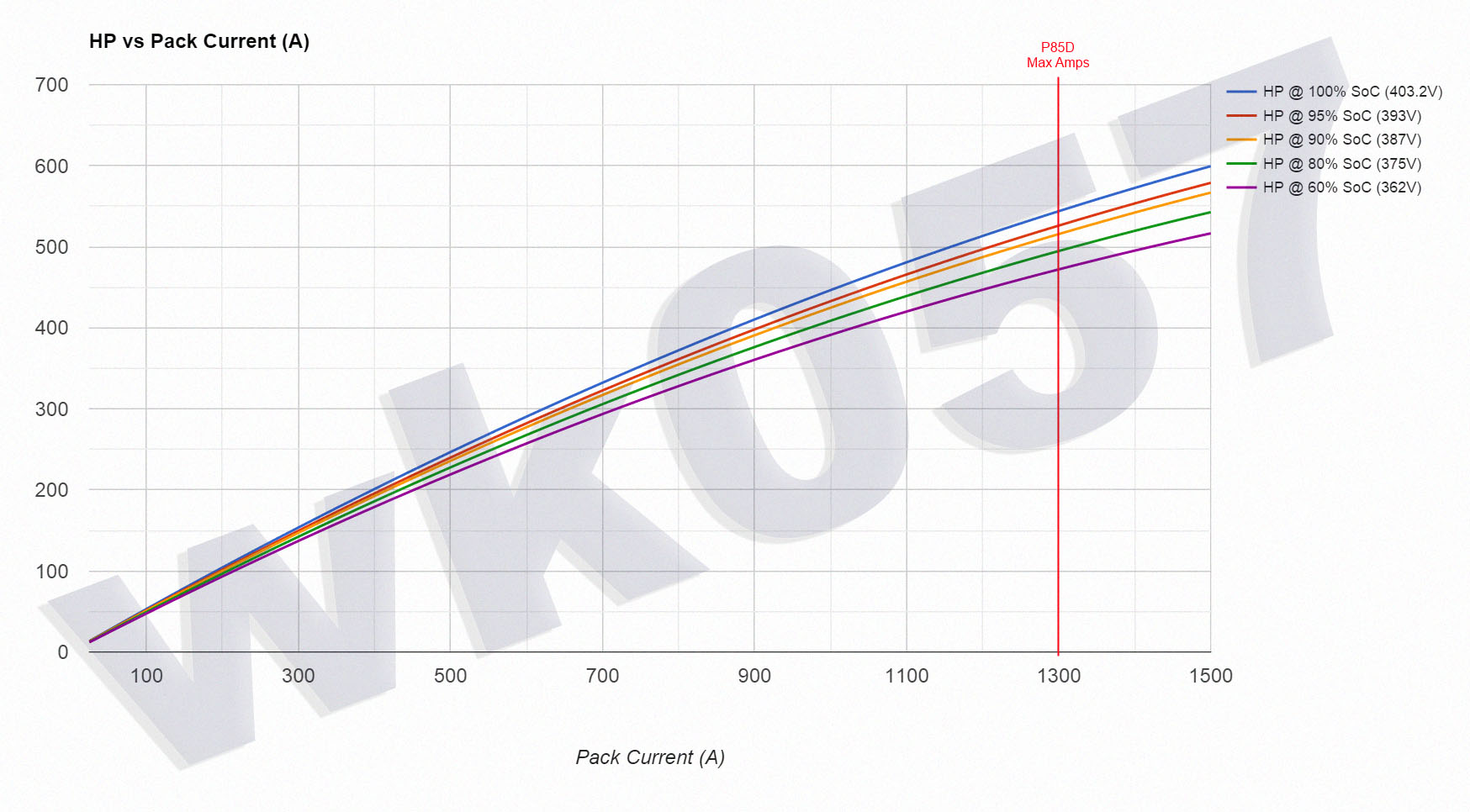
First thing you'll notice is that this curve is not V*A linear. You'll see that at a full charge, under 1500A load, the voltage drop is going to cause the power output to be around 600 HP max, or around 450kW. You'll never see 691 HP out of the pack because that would require amperage beyond what the cell level fuses can handle, literally destroying the entire pack as a whole almost instantly. Once one pops it increases the load on the other 74 in the group and a chain reaction would ensue in every group until they were all popped.
This is data from the 85 kWh pack cells, so the 90 kWh pack would be about 5% better, in theory. They may also have beefed up the cell level fuses in the 90 pack as well, I don't know. However the 1500A cap puts the power cap around 600HP/450kW from the battery, and I'll say +/- 5% to account for potential differences in the 90 kWh pack cell chemistry.
I should probably do up a technical thread on battery voltage drop.�
Oct 10, 2015
Lanber And please note, 600 HP is from the battery, then it goes to the inverter to change into AC power and then to the motor, then a transmission and out to the tires.
It`s anyone`s guess as to losses combined there. 15% minimum. 20+% in reality.�
Oct 10, 2015
Zetopan Firstly, my original posting had some errors in it that I need to correct. While the power dissipated in a passive fuse is I^2*R the actual critical value is I^2*T.
I used I^2*R in some places where I should have been using I^2*T. That could just add to the confusion, sorry about that.
The resistance obviously has a tolerance, but that can be pretty well controlled in manufacturing by using what is known as a Kelvin connection to accurately monitor the resistance as a QC check. What has the greatest source of error is the I^2*T, a measure of how long it takes the fuse to blow.
As a simple example, take two fuses that have identical resistances but slightly different geometries. One fuse is slightly thinner and shorter, with the other obviously being slightly thicker and longer. The thicker longer fuse will be able to dissipate slightly more power before self destructing since it has more mass and a larger cross sectional surface area to conduct heat to the non-fusing regions as well as slightly more surface area to the air. These small differences can cause relatively large changes in the time that the fuse takes to do its intended job.
To get a tighter tolerance on the I^2*T Tesla employes active circuitry to monitor the voltage drop across the relatively accurate resistance of the fuse. When the desired I^2*T has occurred the pyro is activated to blow the fuse, which could have otherwise taken too long or too short of time to blow due to the thermal characteristics of the material and geometry variations. You get the T component in the measurement by integrating, also known a filtering. Computing I^2 is not a difficult task these days since the circuitry measures a current proxy (the voltage) and squares it. The result is then filtered and then thresholded to establish the I^2*T limit that is desired. By tightening the I^2*T tolerance in this way the actual current threshold can be increased much closer to the desired limit without suffering from premature fusing.
[QUOTEDo you have a reference for the fuses still being set to 1300 amps?[/QUOTE]
These are not 1,300 amp fuses, they are much lower than that when subjected to a continuous current. The 1,300 amps is the fusing current when subjected to higher currents for relatively shorter time intervals. Musk has publically stated that the original (I^2*T) fusing was set to 1,300 amps because of the tolerance problems and by using pyro with active circuitry the limit could be raised to 1,500 amps (without risk of premature destruction).�
Oct 10, 2015
Zetopan Let's not wander too far into irrelevancies here. The manufacturer's HP rating of their internal combustion engines are done at the crankshaft and do not take into account the power transmission losses at all. Change the elevation and the output power varies, likewise for a less than pristine air filter, different fuels, etc. When someone has their vehicle power measured on a rolling dyno, the dynamometer measures the wheel torque and computes the power by including the RPM, and then they use a lot of fudge factors to estimate the crankshaft torque and power based on assumed losses in the transmission and differential gearing. That is why dynos rarely agree even when the same vehicle is measured, even at similar altitudes. (HP = torque in pounds-feet times RPM divided by 5252, in archaic units. This is why HP = torque at 5252 RPM.)
As previously stated, technically speaking the Tesla does not have a transmission, it has a gearbox. For those who are unfamiliar with the difference: a gearbox has a fixed gear ratio that cannot be changed without dismantling the gearbox. A transmission has multiple gear ratios available that can be selected from. When multiple ratios are required most people seem to prefer having the latter rather that the former and having to stop and dismantle it to change the ratios. The latter has more gears in mesh and thus greater losses that the former, with everything else being equal. Correctly made straight cut gears could lose about 2% per meshing pair. Oftentimes the gears are not straight cut to reduce meshing noise and this is essentially always the case for the large ratio reduction in a differential. However, non-straight cut gears are also less efficient.�
Oct 11, 2015
jpet First, a big thank you for educating us on this subject!
Does the above mean that the core fuse is essentially the same as before but by adding "active" measuring circuitry, it is now possible to safely get closer to the short burst limit of the fuse?
Before your write up, I thought they had introduced a completely new type of fuse that could be programmed to blow at a variable amp rate, allowing to go beyond 1500A in the future via a simple software update.�
Oct 11, 2015
lolachampcar I do not know anything about pyro fuses nor do I play one on TV.
That being said, if I were designing one, I would use a much lower resistance value to lower I2R losses in use then use my active I monitoring to integrate energy and blow the fuse according to a look up table (Energy v. Time). Why keep a thinner piece of copper with losses when you can have a thicker piece with less loss and a much wider operation/blow range set in software? I'd manufacture a few, each of which covered a very wide range of amperages.�
Oct 11, 2015
jpet Indeed, that's what I thought Tesla did but I haven't got a clue if it is "that simple"... It sort of gave me hope there would be a chance Tesla could be increasing the 1500A to 1600A etc... in the future so that the 691 figure would be achievable given the motor power of our P85D.�
Oct 11, 2015
lolachampcar Even if they did do as I suspect, I can not imagine that fuse ratings would be anything other than established as a one time programmable function at manufacture. The cost and complexity of having the battery's fuses sitting on the CAN bus allowing for field updating would seem prohibitive.�
Oct 11, 2015
Torben_E
Hi Zetopan...
I am not quite sure I can follow you with the explanation that the battery can deliver the 691 hk to the two motors. Please see this link with our own investigation about the subject.
http://teslaforum.dk/p85d/battery-technology/
http://teslaforum.dk/p85d/
It basically suggest that when you have an internal resistanse of the battery pack og 0,051 Ohm, an 70 V drop will occur on the battery terminals and thus it is not 400 VDC x 1.300 A but only 330 VDC x 1.300 A.
This is also in line with what se see from the REST data.
Thus I suggest that when the internal resistance is taken into account the battery pack cannot deliver the 691 hk to the two motors.
Torben_E�
Oct 11, 2015
Zetopan �
Oct 11, 2015
AWDtsla This graph doesn't line up with Tesla's claims that the lowest cell resistance is NOT at 100% SOC, along with member's results. Voltage sag should be higher and power output should be lower at 100% SOC.
- - - Updated - - -
New fuse is microprocessor controlled anyway. I don't see a company like tesla making anything in the car that has software not be remotely programmable.�
Oct 11, 2015
kennybobby And don't forget the #29 AWG aluminum bond wires on each cell that add a resistance of ~7 mOhms per cell, so that at 1300 A they would drop 11.6 Volts off of the pack voltage.
It's unbelievable to me that those tiny bond wires can survive 17.5 A (1300A pack), but evidently they do since there have been no reports of packs replaced for opened cell fuses. And maybe they went to #28 bond wires to increase margin at the cells for 1500 A.
Why do you suppose that they would want to go to an active main fuse and add the risk of a false positive that fires the pyro and disables the car and probably damages the contactors in the process? i'm thinking it might be a pyro wire cutter with inconel anvils such as is used in aerospace launch vehicles. oops getting off topic...�
Oct 11, 2015
wk057 Using the loose cells I have I was unable to verify Tesla's claim that 100% SoC isn't the best. The internal resistance is virtually unchanged through the entire SoC range. At most it moves +/-0.5% in either direction vs average, low enough to simply ignore. The graph I made is based on data from the actual cells from the 85 kWh pack.�
Oct 11, 2015
Matias Can you please provide a source for that claim.�
Oct 11, 2015
AWDtsla I think it was Elon video, can't find it now. Claimed best performance was at ~90% SOC
- - - Updated - - -
Under load?�
Oct 11, 2015
stopcrazypp Might be Straubel more likely. I remember someone posting about an engineer saying that, not from a video. Might be able to dig it up when I have free time.�
Oct 12, 2015
wk057
It was Elon Musk during some Q&A call if I recall correctly. Might even have been the "Three Dog Day" call. Not sure, but I did hear the claim that around 90% SoC was optimal.
I was unable to replicate this though.
Yes, I've tested the cells at loads as high as 8C (equivalent to a 2000A draw at the pack level). As I said, the internal resistance is pretty constant across the SoC range, regardless of load. Perhaps this is different with the new cells in the 90 kWh pack, but I don't know because I don't have any of those to torture... er, test.�
Oct 12, 2015
JRP3 It makes sense, since I can't think of any changes in the cell related to SOC that would change the effective internal resistance.�
Oct 12, 2015
Zetopan Could you please post pointers to where you are getting your numbers from? I am working relatively blind here since I have not seen some of the numbers that are being quoted and I would like access to the relevant Tesla data. For example, I know that each cell is separately fused but I have not seen any Tesla data about the bond wire details, and likewise for the internal resistance of the cells vs their state of charge and temperature. Thank you.�
Oct 12, 2015
lolachampcar search on wk posts using the battery for home storage....�
Oct 13, 2015
arg Maybe there's another factor reducing the performance above 90% compared to the theoretical limit - ie. they aren't prepared to draw the full 1300A above 90%.
One possibility is that the temperature rise from a 1300A discharge would be considered unacceptable at 100% charge (admittedly it wouldn't still be at 100% afterwards). Or something around this - as I understand it, the cells need to be warm to hit the numbers at 90%, maybe it won't let the cells get that warm at 100%.�
Oct 13, 2015
Matias Plan: Off grid solar with a Model S battery pack at the heart�
Oct 13, 2015
kennybobby Tesla cell-level fuse bondwire material?
Aluminum
0.28 mm diameter
8 mm length�
Oct 17, 2015
Zetopan The only verification that I have found for the 90% number had nothing to do with the battery resistance. Elon has stated that the regenerative braking had the best response when the batteries were not charged to more than 90%. Since the regenerative braking tries to charge the battery and a fully charged battery cannot accept any more charge, the regenerative braking can't really function and the non-regenerative (conventional friction) braking must be used under those conditions instead. None of that has anything to do with the battery internal series resistance being lowest at a 90% charge. Hence, it is unsurprising that you have not found any correlation with the "a 90% charge exhibits the lowest battery resistance" claim in your testing.�
Oct 17, 2015
Dennis87 Best performance at 90% is the answer from Tesla on the 691 hp issue.
Email Elon | P85D Owners Missing Performance�
Oct 17, 2015
JRP3 I would love to know the physics supporting this claim.�
Oct 17, 2015
kennybobby AC/DC
AC testing at 1kHz gives cell impedance, which is a different value from the DC load test measurement of resistance.
Two different test methods give different results yet both are correct. From battery university,
Smaller batteries often use the popular 1000-hertz (Hz) ohm test method. A 1000Hz signal excites the battery, and the Ohm�s law calculates the resistance. It is important to note that the AC method shows different values to the DC load, and both readings are correct. For example, Li-ion in an 18650 cell produces about 36mOhm with a 1000Hz AC signal and roughly 110mOhm with a DC load. Since both readings are correct, and yet they are so far apart, the user needs to consider the application.
The pulse DC load method provides valuable readings for a DC application such as driving a motor or powering a light, while the 1000Hz method better reflects the performance requirements of a digital load, such as portable computing and mobile phones that rely to a large extent on the capacitive characteristics of a battery. Most resistance values indicate the test method used.
The Physics:
When a cell is 100% full it won't accept the positive-going half of the 1kHz sinewave as well as if it is partially discharged (e.g. 90%), which allows current flow in both directions.�
Oct 17, 2015
JRP3 But does that have any real world relevance to DC current flow?�
Oct 31, 2015
kennybobby The Winning Guess...
Congratulations to Jason for being the first whiz-kid (wk057) on the block to identify the 691hp issue, report it, and stand up to abuse to the point of banishment to defend his position without caving. We should all send him a prize of sorts, but he already has more toys than anybody else...LOL!�
Oct 31, 2015
lolachampcar Second but I'm afraid I'm going to have to see that toy list before I sign up for the second half of that statement�
Nov 1, 2015
Zybane Anyone else notice the Ludicrous HP is now listed as a maximum of 532 HP due to battery constraints on the Tesla web site?�
Nov 1, 2015
Canuck I read the posts where he was banned and it had nothing to do with him identifying "the 691hp issue, report it, and stand up to abuse". It had to do with him being extremely rude and condescending thus breaking forum rules.�
Nov 1, 2015
wk057 You realize this is completely off-topic here, right? I'm getting pretty tired of your repeated accusations and slander on this topic (and others where you feel the need to single me out for one reason or another). You were not a party to any of the conversations that resulted in my ban, nor were all of the conversations involved publicly presented and preserved.
So, respectfully, just stop and mind your own business.�
Nov 1, 2015
Canuck I posted in response to kennybobby who said "(wk057) on the block to identify the 691hp issue, report it, and stand up to abuse to the point of banishment." That was not a correct statement and I corrected it. Nothing I have said is slanderous although you probably meant libelous since slander is spoken and libel is written. In any event, it's a public forum so I will not be minding my own business. But I will always post the truth, as I see it, and in a respectful manner. Sorry if that offends you.�
Nov 1, 2015
llavalle
Hats off to you wk057.�
Nov 1, 2015
wk057 Canuck has now been successfully added to your ignore list.
This is most certainly the only viable option since derailing topics by attacking people doesn't seem to matter around here much. There's no value in it whatsoever and it contributes nothing useful to the conversation.�

Không có nhận xét nào:
Đăng nhận xét