Aug 8, 2014
bigez1 Tesla Model S 85 kWh 0 to 60 MPH Tests - Video�
Aug 8, 2014
efusco After all this time, I think that's the first official test of the non-perf. 85. Very impressive.�
Aug 8, 2014
pete8314 Interesting that the limit line appeared after a couple of seconds (at 27s in the video), but the car continued to slightly exceed it until he lifted off. Must try that later.
Less interesting is the choice of music, Carley Rae Jepsen.�
Aug 8, 2014
spaghetti Nice! 0.5s better than Tesla's official time could be due to starting off with less than half a tank of juice :biggrin:�
Aug 8, 2014
Stoneymonster I do wonder if it's one of the more recent, allegedly lighter models.�
Aug 8, 2014
yobigd20 it is. you can tell by the thinner bezel around the console which was a very recent change.�
Aug 8, 2014
ecarfan I don't understand why they didn't do that run with a fully charged battery.�
Aug 8, 2014
jerry33 They want to be conservative so that no one complains they didn't meet the advertised numbers.�
Aug 8, 2014
eRandall38 How normal is it for an 85 to beat its expected 5.4 time? Is this MS modified at all?
Also, I noticed this:
�While this is well ahead of Tesla�s quoted numbers, we think it will do even better with a full charge.�
So it could be even faster? Geez.�
Aug 8, 2014
jerry33 It seems to be normal because this is not the first 4.9 recorded.�
Aug 8, 2014
gmontem Was the 4.9 second record achieved with 21" performance tires, or with 19" all season LRR tires, or does that not matter at all?�
Aug 8, 2014
jerry33 It's not likely to matter, but the S85 comes with 19" tires.�
Aug 8, 2014
gmontem I should know considering I own an S85. :wink:
But there is nothing stopping them from ordering an S85 with 21" tires. My last loaner car was indeed an S85 with 21" silver wheels.�
Aug 8, 2014
eRandall38 I thought I read something on here about the bigger 21" tires help with better traction... and thus better off the line? Is that wrong?
On a similar note. When I test drove the tesla, I never was comfortable flooring it from a dead stop. I did not want to peel out or fish it with the tesla employee in the car. Can that be an issue with it or is it taken care of? I have another rather powerful car and it has an ASR on it that eliminates any spin. But boy, if you turn off the ASR I feel like I am driving on ice! Sorry for the ignorance, but what is the reason to turn ASR off in a car like that?�
Aug 8, 2014
yobigd20 if you're talking about 19" goodyear vs 21" continental, yes.
if you're talking about 19" vs 21" in general, no. the right 19" tire that has just enough grip will beat the same 21" every time in a straight drag race for a bunch of reasons. less unsprung weight for one. less tread width and thus less rolling resistance for another.
i'd like to see a P85 with 21" cont's or P85+ with 21" michelins beat my P85 with 19" Michelin Pilot Sport A/S 3's in a quarter mile. not gonna happen �
�
Aug 8, 2014
apacheguy Would be curious to see the power output achieved. My S85 achieves a non-limited 305 kW max. Others have reported 320 kW in an S85 but I have never reached that level.�
Aug 8, 2014
Olle What does non-limited 305 kW mean?�
Aug 8, 2014
apacheguy See the limiter that shows up in the video when they're approaching the max output? It's because of the SOC of the battery. I'm saying that I get 305 kW max at higher SOC when the orange limiter does not appear.�
Aug 8, 2014
Olle Elon said the current MS is several hundred pounds lighter than the initial cars. Several hundred could be 10% of the several thousand curb weight of the MS. So it makes sense that S85 is now accelerating 10% (=0.5s) faster than the original cars did.
Question is: Since Dragtimes ran an early P85 at 3.9 s, would a current P85 cut 10% of that to 3.5 s?�
Aug 8, 2014
brianman With dry non-bumpy pavement, this is a non-issue pretty reliably. Traction Control takes care of it. FYI.
As for the Tesla employee in the front passenger seat... When taking my test drive they told me to floor it. I did without hesitation. That said, I lifted pretty quickly because I don't like tickets.
- - - Updated - - -
There are multiple factors, not just the SOC.�
Aug 8, 2014
Zextraterrestrial my P85 w/19" PSS (285) might beat your A/S. not sure. I know my 19" A/S hook up better than summers on the strip but they are all 245s�
Aug 9, 2014
jerry33 That is true today but it wasn't always so, so the majority of S85s don't have 21" tires.
- - - Updated - - -
The nominal section width is 245 on both tires, however the tread width is different. This basically means the 19" (with the slightly narrower tread width) will hook up better all things being equal (which they often aren't).�
Aug 9, 2014
mgboyes This run was with traction control on. Is that considered the best way to get 0-60 times in the Model S?�
Aug 9, 2014
matbl I've seen slightly over 320 in my S85. Vin 40xxx.�
Aug 9, 2014
brianman It's probably the best way to get consistent times. Put another way, turning off TC will give you more variability which might mean you get a better "hit" or lots of worse "misses".�
Aug 9, 2014
yobigd20 except that these brand new generation A/S 3's are so damn good that they are even blowing away the summer performance tires too, per tirerack's review!
I am running with 255/45ZR19's though...so slightly greater tread width.�
Aug 9, 2014
eRandall38
Is there a reason to have traction control turned off?�
Aug 9, 2014
bollar In many ICE cars, a human can squeeze a better drag time than the computer can. On the Model S, I have never been able to beat the "traction control on" time, and I have burned off a fair amount of rubber trying.�
Aug 9, 2014
apacheguy Yeah, my hunch is that it's the drive unit. Even a crippled 85 kW A pack can supply power in excess of 350 kW as evidenced by Sig P85s. But maybe there's something different about Sig S85 drive inverters.�
Aug 9, 2014
brianman For city / highway driving, I have yet to find a good reason (for me).
For track driving (lapping / autocross), it can be useful but it has its own risks as well.�
Aug 9, 2014
MustangMicha Impressive!! I'am very interested in a S85 vs P85 0-60 test..�
Aug 9, 2014
pete8314 Thanks for your dedication�
Aug 9, 2014
AmpedRealtor When Elon says "early cars" were heavier, what is the cutoff for "early"? My car is a year old. Is my 16XXX VIN considered early, and therefore, heavier?�
Aug 9, 2014
eRandall38 I was reading "Owning Model S" by Nick J. Howe. In chapter two, he talks about the weight of the MS and its effect on range. If there is a drop of 10% in curb weight, then there should be an increase of 10% in range.
So with this recent revelation of the car being several hundred pounds lighter (maybe 10% as you mentioned)... shouldn't we be seeing that increase in range? Or maybe owners here who just took delivery are seeing that?�
Aug 9, 2014
bollar The sacrifices I'm willing to made to advance scientific knowledge and the common good know no bounds.�
Aug 9, 2014
green1 Elon specifically addressed this when he talked about the decrease in weight, he said it doesn't have as big an effect as you'd think.
Basically weight is only one part of the equation, a 10% reduction in weight does not equal a 10% decrease in rolling resistance, and has zero effect on air resistance. It also has no effect on resistive heating losses, or power usage in systems other than the drivetrain. As such the weight reduction only has a minimal impact on range.
It's actually likely to have a much bigger impact on acceleration than range though (but even here it will be fairly minimal)�
Aug 9, 2014
Sparky IIRC, the rolling resistance equation is: F = Crr * M * g ? Seems if M drops by 10%, F drops by 10%. Do you have a significantly different equation for rolling resistance? Agree that M doesn't contribute to the other main force acting against the car (aero drag).�
Aug 9, 2014
green1 My bad, I was thinking that the tire drag doesn't decrease, but you are correct that although the rolling resistance coefficient doesn't change, total rolling resistance does in fact decrease by 10%, but all other losses remain unchanged. Aerodynamic drag is the biggest thing sucking range though (at speeds where we care about range) and other losses (conversion losses, resistive heating losses, and use by non-drivetrain components) do not change.�
Aug 10, 2014
chickensevil There is. That is specifically what they change from the S to P. It is a "hand spun" drive inverter. That is actually one of the key components that needs to get improved if we ever want it to go any faster than 4 seconds on a performance. Based on comments from Elon that seems to be one of the big things holding them back from n ever quicker time. Only the s60 is battery limited.�
Aug 10, 2014
Tasdevil All I can say is; bring on model 3 drag times!�
Aug 10, 2014
Matias With heavier car you need more energy during acceleration. More energy means bigger current which means bigger conversion losses and resistive heating losses.�
Aug 10, 2014
Todd Burch Higher mass also means more energy available to recover during regen.�
Aug 10, 2014
Matias You can't recovery that energy, which has allready been lost during acceleration. And energy recovery is never 100% effective.�
Aug 10, 2014
Todd Burch I'm not claiming that you can recover the energy lost due to heat during acceleration. But you CAN recover about 85% of whatever kinetic energy you have through regen.
Point is, the statement that a 10% drop in weight yields a 10% improvment in range is not correct.�
Aug 10, 2014
brianman My interpretation of this is that it's a statement regarding continuous evolution.
Meaning 1 is likely heavier than 1001, 1001 is likely heavier than 2001, etc. (Assuming 1/1001/2001/... are equivalently configured.)
I don't think we'll ever know the exact transition numbers -- and there may be some overlap on the production line making it "complicated". Also, if we knew the numbers I suspect they would only be complete for like a week or a month and then a new entry in the "weight reduced" timepoints would be added.�
Aug 10, 2014
HyperMiler Have any recently delivered Model S been put on a vehicle scale? Sounds doable.
If a few owners would do it, one could probably even do the maths on configuration items.�
Aug 10, 2014
chickensevil I know there is a truck scale near me I could take my car to and then subtract out my weight. I had to use it before when I was doing a travel claim in the military.
I have Vin 33xxx so it will give you a data point from a March production. The only thing is that the different configurations likely make the car vary pretty decently in weight. Like pana roof vs not. Sound package. Dual Chargers. Kid seats. The list goes on. I am willing to bet that there is a couple hundred pounds difference between a base 85 and a fully loaded P85+ with every option.�
Aug 11, 2014
Username That's impressive!�
Aug 12, 2014
AWDtsla Take your car to a road scale. For Science.�
Aug 13, 2014
eledille My S85, delivered Sep 2013, slightly exceeds 320 kW on the power meter.
A reputable Norwegian tuning shop (RS Tuning Bergen) recently dynoed a 60, S85 and P85 and got 305 hp from the 60, 405 hp from the S85 and 424 from the P. None of them were fully charged. To be fair, they had trouble measuring the P at lower speeds, and got a reading of 440 hp for a brief moment before the test equipment shut down due to overload. Article in Norwegian
I can feel the performance difference between 50 and 90 % SoC. I wish someone would test power and acceleration at 90 % SoC...�
Aug 13, 2014
AWDtsla Maybe this is a surprise to most of you, but kW measures the exact same thing as horsepower. 320kW = 429HP, at the inverter. Dyno is just effectively measuring efficiency, when it's not overloaded.�
Aug 14, 2014
matbl Nope, no surprise. The suprise is that the S85 reports slightly over 320 KW in some cases. Either what it reports is wrong or it really can output ~430 HP for a short time. If it's inverter numbers, that might explain part of it since the inverter to motor output isn't loss-less.�
Aug 14, 2014
chickensevil Having watched a few episodes of Top Gear Australia now, I was rather surprised and found it a bit weird to hear them giving the specs of all the cars they were testing in kW instead of HP and since I am not familiar with the conversion it made it difficult to put in perspective... But yeah, who knew? Electricity compared to the power of a horse.�
Aug 14, 2014
iKhalid Lighter?�
Aug 14, 2014
Matias Elon said in conference call, that a Tesla Model S built today is hundreds pounds lighter than the first cars.
Quote " The Model S has gotten steadily lighter over time. It's really like, you know, it's quarter a pound here, half pound there, but the Model S in production today is at least a few hundred pounds less than that in the start of production. And we'll continue to see improvements over time."�
Aug 14, 2014
chickensevil By the way these numbers would indicate natural improvements in the inverter. If you notice 305 is actually pretty close to the ratings posted by Tesla... clearly the power is limited by the battery. But the other two, while I realize you get a better inverter in your P85 both are significantly improved in performance outside of their rated numbers.
For quick comparison:
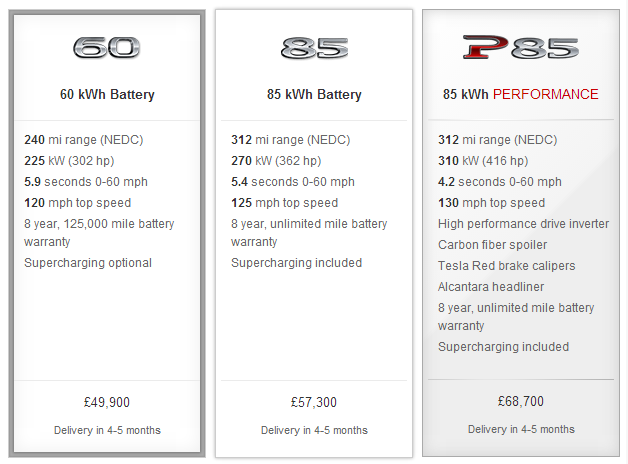
I went with the GB chart just so people also get a feel for the rated kW performance as well, but you can clearly see these tested numbers post well above the listing.
I hope when they do an update to the site that they publish this information and they should also make a news briefing about it. "We retested our Model S for 2015 and this is the newest specifications" or something like that. It has been said before, but I really wonder what the threshold is before they are required to update their specifications, and when would they potentially have to send it back to get crash tested again due to the weight changes and such.�
Aug 14, 2014
Ssssly It's actually a significant improvement for the S85 which based on these tests is an 11.9% increase compared to the P85 using the higher of the outputs is 5.8%. Seems that the S85 is an outlier and more tests are warranted to support the Norwegians testing.
Of course, I do hope the testing is accurate as it supports my purchase choice.�
Aug 14, 2014
scaesare Hmmm, that S85 output is significantly higher than rated... if that's accurate, I'd like ot know what they would have ultimately measured the P85 at if they hadn't had problems.
It takes significantly more that 35 more HP to move a ~4700# load to 60MPH @ 3.9secs rather than 4.9...�
Aug 14, 2014
apacheguy When I said that my S85 has never exceeded 305 kW I was referring to the values obtained from the streaming API. Having said that, I have never seen the needle exceed the 320 kW mark on the dash either. It might be worthwhile to check what the true values are in your case because I am very surprised as well that you are able to exceed 320 kW in an S85.�
Aug 14, 2014
chickensevil There was a dyno test of a P85 done in Canada which had the P85 come in at 436 HP at the wheel.
But know that there is a difference between peaking over 320kW from the inverter and what power you actually get to the wheels.
- - - Updated - - -
Oh, I also sent an email to ownership about this asking they review the real stats on the car from their own testing and update the website to reflect (including the recent comments about the changes in the weight of the car) and got a pretty fast response back stating that they would submit it as a feature request. So maybe we will see updated numbers posted to the website to better reflect this�
Aug 14, 2014
iKhalid Anyone knows when the weight became lighter? My model S left the factory in Feb 2014... Did I get the lighter version? (I doubt it)�
Aug 14, 2014
chickensevil Ok, so for those who hadn't heard or keeping tabs on this one, the weight has been modified slowly over time. As they have improved different parts, the weight has just naturally dropped. There is no definitive way to say what you have and don't have. The comment from the Earnings Call (feel free to go listen to it or read a transcript!) was that the car the released in 2012 and the car today are two different cars in terms of weight. They have shed "a couple hundred" pounds... but it wasn't noticeable changes from week to week, but rather small adjustments over time. Hope that helps�
Aug 14, 2014
RiverBrick 1) Could you mean 436 HP or even 336 kW? In another test last year they got 428 HP.
2) In an ICE vehicles specs, is the listed horsepower at the wheels?�
Aug 14, 2014
JST
No, generally vehicle specs (including the Tesla, AFAIK) are not done at the wheels, but rather at the output shaft of the motor/engine. In an ICE vehicle, the general rule of thumb is that there are between 15 and 20 percent driveline losses between the engine output (measured out of the car on an engine dynamometer) and the power you'll measure on a dyno at the wheels.
The parasitic loss for a Tesla is presumably a lot less, since there isn't a transmission, but it's also not zero since there is still a gearbox and U-joints between the motor and the wheels.
That said, wheel dynos are notoriously fraught with their own inaccuracies, so comparing pulls from one dyno to another is really not that instructive.�
Aug 14, 2014
brianman And there you have it folks...
Even Tesla enthusiasts complain when Tesla beats expectations.�
Aug 14, 2014
iKhalid Thanks for the clarification. Now I feel better�
Aug 14, 2014
chickensevil Sorry yes, I was flipping back and forth between windows to get the right values and I think I just typed the wrong thing. I have corrected the post to say 436HP
I believe manufacturer specs are always listed as coming from the source, not the wheels. But all a normal person is able to test is power at the wheels. So this is why I was suggesting that while we likely are only going to see HP somewhere around 436-440, the real power being able to pull through the inverter is much higher. There is likely some loss as that power goes into the motor, and then some more loss as it comes out of the motor and spins the wheels (although not nearly as much as the motor loss). I believe the motor was something like 80-85% efficient at power conversion so taking the better of that (85%) would put the power off the inverter somewhere around, 512HP or 382kW, is that about what people are seeing on their Performance cars?
So I pulled some screen grabs from youtube videos and they all seem to cap at around the same point on the dial:
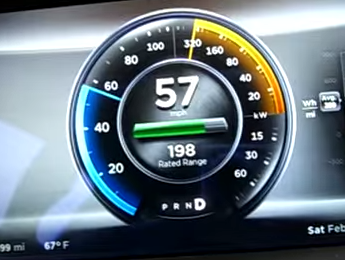
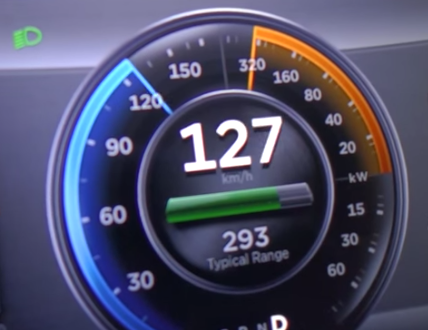
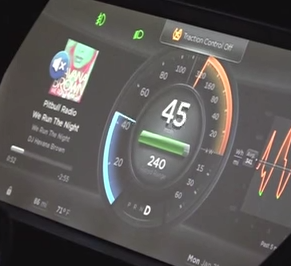
You are welcome to try to guess what that actual value is... it is a Log scale, so being slightly above 320 is quite significant.
- - - Updated - - -
Using some rough guesses, The top of the gauge would be 640. Based on the two visible tick marks and the spacing of the line on the current read out, I can make a guess that it is pretty close to the equivalent of one tick mark up from the 320 point with there being 6 ticks to get to the top. The middle point would be 480 so one tick would be ~53.3 kW. So, based on that, if it is one tick up (or pretty dang close) that would be a whopping 373kW off the inverter (assuming that is where this readout is being pulled from). That puts me pretty close to what I was guessing up above using what I could recall about the inefficiency of the motor being 85%. If you max at 373kW you would be pulling 500HP.
Again, these are just guesses... without seeing Tesla's real numbers. But it would line up with what we know and see happening.
- - - Updated - - -
Who was complaining? I thought people were thrilled that they were getting better than advertised? Just trying to figure out what the real value is�
Aug 14, 2014
eledille I don't know why any of this would be surprising. But just as fuel consumption is a very imprecise indicator of performance, so is power at the battery. If we accept that the power meter is accurate, then the dyno measures efficiency, but I would say that is a very interesting measurement
About >320 kW being more than rated - yes, and by no small amount either. But that is before all the losses, probably right at the battery. I think it's measured at the battery because it clearly shows power being used when the AC or the battery heater is running.
I assumed that Tesla listed the power at the motor shaft in the 362 hp figure, which would yield an efficiency of about 84 % - not bad at full power. When RS Tuning measures 405 hp, that would be more like 94 %, which is stunningly good. And as if that wasn't enough, that number includes the mechanical losses in the gearbox and differential! The percentages should be reduced a little, by the way, as the power meter is showing more than 320. The next number on the scale would have been 640. Maybe it's showing 350?
*edit* I agree with chickensevil's estimate. If it's taking 370 kW (496 hp) from the battery and the measurement of 405 hp at the wheels is correct, then the efficiency would be 82%, which may be a realistic figure.
My display looks exactly like the middle one in chickensevil's post above.�
Aug 14, 2014
apacheguy See this thread:
Peak KW on S60, S85, and P85
brianman reported circa 367 kW on his P85. Don't have time to look it up now.
Previously, the highest an S85 saw was 320 kW, but now we have reports of an S85 exceeding 320 kW power draw.�
Aug 14, 2014
eledille If you look at the DragTimes video, you will see that his SoC is fairly low, around 40 %. Even so it almost reaches 320 kW. It actually limits power and does 0-60 in 4.9 anyway.
When I get the dashed "power limited" line I can feel that it's slower (ehrm - less quick) than usual, and I think I can feel it before the dashed line actually appears. I think it has to have a high state of charge and the battery must not be cold to go over 320.�
Aug 15, 2014
matbl Yes. I've only seen over 320 in my S85 once or twice. ~90% SOC, beginning of trip (a couple of 100 m from home) and ~25 deg C outside. I'd say it looks exactly like the screenshots above. But on an S85 and not P85.
- - - Updated - - -
Ehm. No. If the scale is logarithmic, then the middle mark between 640 and 320 wouldn't be 480. It would be lower. Or do you assume that the scale is linear between each printed number?�
Aug 15, 2014
eledille Oops. I said I agreed, but you're right, of course.
I did some testing today. I charged from 80 % to 90 % on a supercharger while buying lunch, disconnected and parked away from the chargers as it was finished when I got back. Then I ate for about 20 minutes and left. Ambient temp about 20 deg C. Accelerating from 100 to 125 km/h it would repeatedly hit 320 and stay there, but the needle did not completely clear the 320 mark. It edged above the mid-point of the mark every time, though. Later, at about 75 % SoC, it stopped a pixel or two below 320.
I swear I've seen it pass the 320 mark by several pixels on earlier occasions, but I could not make it do it today.
I'm convinced SoC affects how much power you get.�
Aug 15, 2014
matbl Try that with 90% but from 30-90 km/h and I think you will see it edge past 320.�
Aug 15, 2014
eledille Yes, I had the same idea. From somewhere around 120 km/h power started to drop again, it may be past the power peak at 110. If so, it may not have reached full power before well past the peak.�
Aug 15, 2014
chickensevil You are right, hrmmm if only there way a way to sort out the scale... I am not aware enough about log math to get the right number... Hrmmmm.�
Aug 15, 2014
apacheguy Guys, just read the actual value from the API and there is no sorting out that needs to be done. Grab yourself a copy of VT or write your own.�
Aug 16, 2014
matbl Will it record it when it when it's only a few seconds long event?�
Aug 16, 2014
brianman While driving, the streaming API provides data 4 times / second.�
Aug 16, 2014
chickensevil Hmmm I have that and never realized that was a value that was captured
Seems like you would have to go test it a couple times in order to hit it within the 4 second window.�
Aug 16, 2014
scott jones It NEVER made sense to me mathematically that a 60, S85 and P85 would have the times Tesla lists.
It's my opinion their claimed GAP between S85 and P85 is not true.
There's a 60 "hp" difference between the S60 and S85, with a .5 second difference in 0-60 times. (5.9 v 5.4)
Yet between the S85 and P85 there's only a 56 "hp" difference (from memory) between the two.
And YET, there's a HUGE 1.2 second difference in 0-60 times! (5.4 v 4.2) BS!!!
My bet is, they wanted it to look like a huge difference when trying to sell the more expensive P85.
Here are my armchair guestimations. They should be far more evenly spaced.
S60 = 5.8 (or better. I think it's under-rated) I've driven a 5.8 second car, and this is faster.
S85 = 4.9 (The testers figures. And the S85 is a hell of a lot faster than the claimed 5.4. This would make it .9 seconds faster than S60.)
P85 = 4.2 (Tesla's rating. That makes sense given the slightly less "hp" increase and extra weight of the car which gives it a .7 increase)
Now doesn't this make more sense! Sorry if this repeats what anyone else said.�
Aug 16, 2014
jerry33 Various testers have shown the P85 to get 3.9, so basically (for easy remembering) 5.9--4.9--3.9. Tesla makes the numbers more conservative to avoid complaints (my guess).�
Aug 16, 2014
scott jones That is definitely easier to remember, but my personal opinion is they didn't do it to avoid complaints, but to make the Performance version looks far better for sales.
Otherwise most people wouldn't pony up the Extra $ for a car if they both did in the 4's!
Their only .5 second difference between a much bigger battery (S85 to S60) just never made ANY sense to me the day I saw it.
I was a math minor and new instantly that couldn't be. I don't doubt many P85 customers also got faster than the 4.2.
But I think the biggest error/claim Telsa made was the S85 being just slightly faster than the 60, and MUCH slower than the P85.
If someone tests each on the same day, same condition, I would love to see it! Waiting for this rain to clear up, so I can drive Tessy. That's right, no rain for my S85 because the finish spots too easily.�
Aug 16, 2014
eledille jerry33, notice how in the 4.9 video SoC is so low that it limits power, and the power needle stops well short of 320 kW. Redo that run with 90 % SoC hot off the charger and you'll get a much better time. At 100 % SoC it would be even faster.�
Aug 16, 2014
chickensevil Ok, well I tried using VT to capture the data, but for some reason I get a lot of gaps in the driving logs. I was out from around my last update at 12:30 till now driving around and yet have only about 14 miles worth of data
In any case there is definitely a power difference between 90% SOC and 45% SOC (what I ended with) but I never could get mine to go over 320kW on the meter. It would only go there and then stop. I had to be careful how much I was doing this because traffic was a pain in the butt today... (gotta love I95!!!) In any case the reason for my journey was to obtain a weight measurement for you all as well. so here it is.
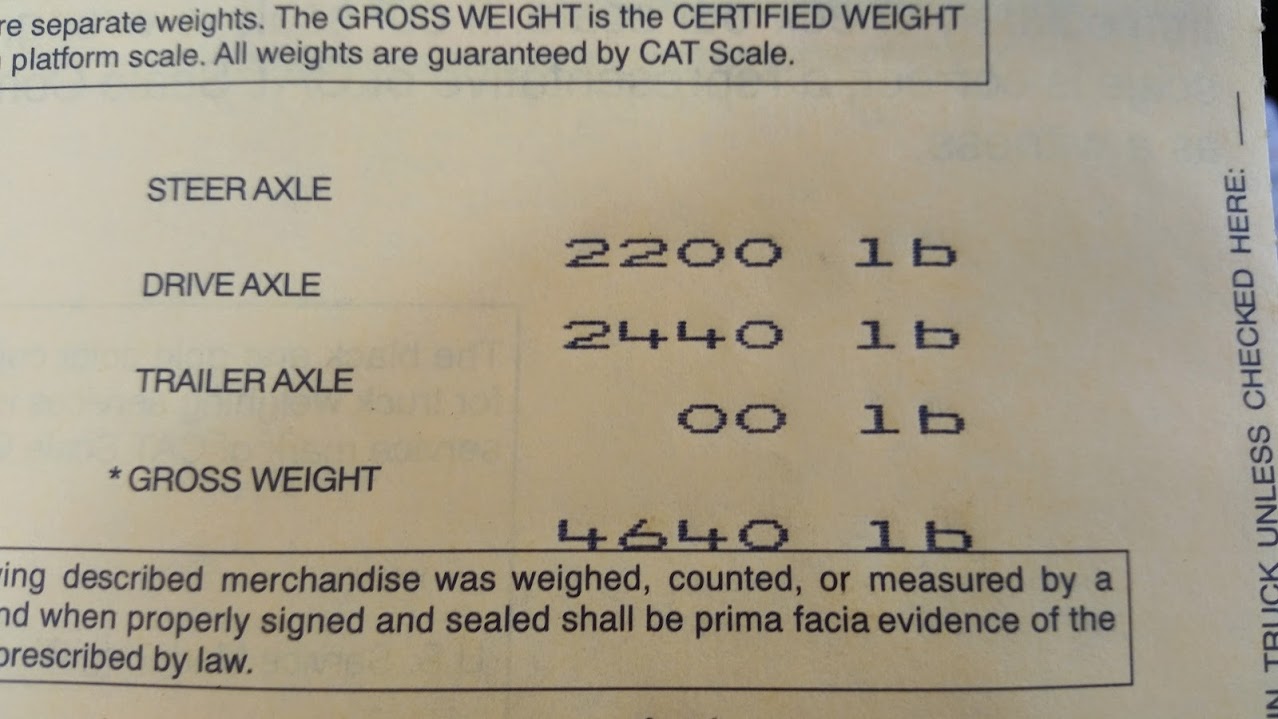
That was about 4 hours and 10$ for you guys! hope it is helpful! Their spec sheet has said 4647 for ever. I had a mostly empty car minus my own weight of about 150 pounds (I am rather skinny) and the mobile connector and some other misc stuff. Car was made in March 2014 VIN 33XXX�
Aug 16, 2014
apacheguy Hmm. So the question I'm left with now is under what circumstances will the power draw exceed 320 kW in an S85. I charged up to 90% this morning floored it and recorded a 309 kW ceiling, which was sustained for 1 second before falling back down (I.e. Foot off the accelerator).
I'm not convinced that it's a pack/SOC limitation. Reason being that P85s have the same battery and are consistently able to exceed 320 kW under rapid acceleration even at lower SOC.�
Aug 16, 2014
eledille apacheguy: At what speed? I assume that reading was from the log - what did the display show?
Electrical components are usually current limited. E.g. there may be a max current rating for the battery, inverter, motor etc. The software will then likely limit based on amps, without regard to voltage. That means that you may, depending on how things are wired and programmed, get more power at a higher battery voltage.
Assume some system has a max current of 100 A and a battery consisting of 100 cells in series. At cell voltage = 3.8 V we get 38 kW, at cell voltage = 3.5 we get only 35 kW.
So the fact that the P85 gets more power from the same battery does not mean that the S85 is not affected by battery voltage.�
Aug 16, 2014
chickensevil Air Conditioner? I never floored it at hit SOC with the AC on, I don't think...maybe try that.
About the P vs S there is a different inverter. My guess is that the S inverter is capped at (for example) 200A so as the Voltage drops on the pack you get less overall power. The better inverter in the P might be capped at 300A (again example) but now you need to up the electronics on some other part to get even higher performance...
Based on the comments from Elon, the speed and power limitation on the MS is not caused by the batteries. Someone had specifically asked if the performance will improve when they start using new cells in the MS (just as performance improved from the Roadster to the S). If you want the full comments it was in the annual shareholder video.�
Aug 16, 2014
apacheguy I see. I was thinking it was a power output limitation. I didn't think about it being tied to the current and not the voltage.
@eledille - I was in the 50-60 mph region when I reached the max output. The dash needle was just a hair short of 320, in line with the value read through the API. A/C was on.
Can anyone confirm power > 320 kW in an S85 at any pack voltage/SOC? chickensevil's post has got me thinking that the answer is no. Prove me wrong.�
Aug 16, 2014
chickensevil For clarification my thoughts on the inverter and the limitations on the power output are just guesses, but it makes the most sense for why and how one car is faster than the other... And also explains the performance loss as you go lower on the SOC %. I also know that the voltage is fixed on each cell and is tied to the charge % whereas the current/amps vary depending on how much power you want to pull out at once.
My question is, the charge and discharge rate of the battery is supposed to be capped at a 2C rate, or so I thought... Anything more than that and you are damaging the cells... So if you are pulling 320kW (or more) from an 85kW pack, isn't this WAY over that limit? So if 2C is not the limit, then what is? And does this mean we could see a 320kW supercharger in the future?�
Aug 16, 2014
Beckler Just watched that video, and as an aside, was really surprised Musk didn't know what the question was about. The person was just referring to the capacity of the 18650 cell in mAh (though he did state 'milliamps' instead.) Thought Musk would instantly catch on but instead he thought he was talking about power output. Maybe he was super-tired...certainly seemed like it.�
Aug 17, 2014
doctorwho Wow! The old bezel must have been amazingly heavy�
Aug 17, 2014
jerry33 LOL. When the sun is just in the right position, the old bezel is blinding. I wish they'd made it flat black or some other colour rather than silver as I'm pretty sure the new one will still be uncomfortably bright.�
Aug 17, 2014
eledille The cells tolerate much higher discharge current than charge current.
@apacheguy - when I tested this the other day I did have the AC on, but set at 20 deg C. Outside temp was also 20 degrees C, so it shouldn't have been doing anything.�
Aug 17, 2014
eledille There are five marks, 20, 40, 80, 160, 320. Divide the numbers by ten and you have the five first powers of two. Example: The fourth mark has the value 10 * 2[sup]4[/sup] = 160. The midpoint between 320 and 640 is 10 * 2[sup]5.5[/sup], which is 453. One quarter above 320 is 10 * 2[sup]5.25[/sup], which is 381.�
Aug 17, 2014
apacheguy Right, so it's a log base 2 scale. I think that's what chickensevil meant to say but some got confused that he meant log base 10.�
Aug 17, 2014
chickensevil *claps* thank you! I knew there was a way, it has just been such a long time since I have used log math. The most I use it for these days is the charting features in Microsoft Office
So then each "tick mark" is 1/6th of the way, so you would want 10 * 2^5.8333333 = ~359.
So that makes what was observered here pretty close to what everyone should be getting in their performance cars:
In any case, I don't think anyone is getting more than 320 on a S85. If someone can prove otherwise I would appreciate either a picture/video or the logs from VT to confirm what you actually peaked out at and then what your VIN is so we can figure out where the delineation is�
Aug 17, 2014
eledille Looking at the middle picture in chickensevil's post, I'd say it's somewhere around 10 to 15 % of the way to the next mark. So it's showing somewhere between 340 to 355 kW.�
Aug 17, 2014
mgboyes Do we actually know what the figure shown in the power meter represents? Power delivered from battery? Power output from the drive inverter? Power at motor shaft? Power at the wheels?
I've always assumed that the quoted figure on the Model S specs page (310kW) is motor shaft, since that would be directly comparable to ICE stats. But I'm not aware of any official statement on what the numbers in the instrument cluster actually mean.�
Aug 17, 2014
eledille It certainly shows the power consumption of both AC and battery heater, so it's not exclusively the drive inverter. *edit* I just checked - I can see the consumption of the power steering. Just switch off AC and turn the wheel left and right while parked, you can easily see the needle twitch. So it's measuring power from the battery.�
Aug 17, 2014
qwk I have an S85, and get more than 320kw in certain conditions. Vin in the mid 6k range. Give me a few days, and I'll try to get a pic or video.�
Aug 17, 2014
chickensevil I would love to know what conditions allow this. I had even tried doing a full excelleration going downhill and still nothing...�
Aug 18, 2014
HyperMiler
Thank you very much for doing this for us. Very kind of you!�
Aug 18, 2014
chickensevil Point of correction that I should make, it looks like I actually did manage to get off the scale in time before the guy weighed it, so that is pretty close to the full weight of the car. But from the other thread dealing with the weight, it would seem that the 4647 number was supposed to be based on the base model which in this case should be the 60kW. So even though mine is 4640, that is with the addition of the bigger battery, pano roof, twin chargers, and the other tiny upgrades including the titanium plate which someone said that adds 20lbs.
Clearly they have dropped the weight over time, so that being said, on the topic of 0-60 times, is there an app or some such that will let you easily get a time reading on the car based one speed? Or do I just have to record the dash and count the seconds myself? I have a couple areas around me where I can safely do this I just don't have a good means to get accurate times. At 90% SOC it is very likely to be 4.8 seconds which would be amazing!
- - - Updated - - -
You are quite welcome, hopefully if we can get enough data points we can pin down how much weight they have dropped over time�
Aug 18, 2014
HyperMiler There are a couple of ICE age iPhone apps that I am aware of, BMW M Power Meter and Harry's lap timer, and /or others, that might be of help here.�
Aug 18, 2014
chickensevil The BMW one you suggested seems to point toward an app called "dynomaster" which seems like it would do what I want it to do, 0-60. 60ft, 1/8 mile and 1/4 mile all for around 2$ I think it was... Would be a small price to pay if it is as good as it seems to indicate. Just have to hope the GPS on my phone is good enough to get accurate data.
The other suggestion is far more expensive but 100 times more awesome. It is too bad that I don't actually get to track my car or I would look to get it. Unfortunately there are no public race tracks near me as far as I can tell...�
Aug 19, 2014
JST Are you in NoVA? There are a fair number of tracks around here within reasonable driving distance.
Here's a drag strip finder, if you are looking for 1/4 miles:
Dragstrip Finder
If you want actual corners, there's Summit Point (though I've sworn that one off because of deer strikes) and NJ Motorsports Park in south Jersey, which isn't too far. Of course, VIR in Danville is also fairly close, and is a GREAT track.�
Aug 19, 2014
scaesare I've seen the gauge on my S85 swing briefly past 320 on occasion...�
Aug 19, 2014
chickensevil Yes, I was referring to an actual track not a drag strip, There is a drag strip in Fredericksburg, VA (or somewhere close to there). I was referring to the app being useful for a race track. I overlooked Summit Point, although given it's location would lose a solid 30 miles on the top and bottom of the battery to get to and from Hagerstown to recharge... although Charles Town is pretty progressive so I wouldn't get totally stranded. Deer Strikes? Why isn't the track fenced off? And New Jersey seems a bit far and I would have to fight DC and Baltimore traffic... I might consider it.�
Aug 19, 2014
JST Traffic is a pain, but NJMP is a nice (set of) tracks with good sight lines and lots of run-off, and it's surprisingly close. Easy weekend trip. There are places to spin, but no real trees to hit.
VIR is the real deal. Super, super fun, and the new Supercharger at South Hill is perfectly placed to get there. It's a more intense experience than either Thunderbolt or Lightning (the two tracks at NJMP), but so worth it.
I'm not sure what charging facilities are available at either place, though...a quick google didn't reveal anything.�
Aug 19, 2014
chickensevil Well as long as I leave enough charge to get back to a supercharger I should be fine... How fast do you actually blow through your battery on a track? I forgot that South Hill coming online gives decent access to that track... But that one is definitely a drive haha!
But in any case hopefully this weekend I can give a nice 0-60 run to see what the power is like at 90%�
Aug 19, 2014
apacheguy
@scaesare, @qwk - Power output values from the API and the corresponding SOC would be greatly appreciated. In fact, even if it doesn't go beyond 320 I'd still love to see your max motor outputs at any SOC.�
Aug 19, 2014
JST I've never taken the Tesla to the track, but in my Boxster I'd go through a bit more than a full tank of fuel in four 20 min sessions (ie, one day of your typical DE). I'd do about 100 miles in a day, which worked out to about 5 mpg.
I suspect to have any fun at all you'd want to find at least a 50A charger somewhere at the track to get some juice in between sessions. I believe that NJMP has RV parking and VIR may, too, so that might give you a NEMA 14-50, but I know there are some tracks where Roadster owners put in Roadster HPCs.�
Aug 19, 2014
chickensevil I mean the track in CA that everyone always uses got so popular that I think Tesla has one of those temporary superchargers they put up there... Mostly because I think Tesla themselves uses that track to test cars a lot but I would think if we could petition Tesla to pick a track or two on the east coast to do the same thing it would be really awesome!
The New Jersey track is in a pretty great middle point for DC and NY... But of course the NC one would be more in the middle of the east coast... I wonder what it would take to convince them to do this?
I any case I think getting and HPWC or two set up at one of the tracks might also work... Just got to get with the track owners to get them on board.�

Không có nhận xét nào:
Đăng nhận xét