Apr 3, 2016
rhambus Hey all,
I am a proud reservation holder for the Model 3, and am interested in getting the home charging station tax credit that expires at the end of 2016. I could just install a Tesla charger, but want to look at alternatives, as if I have a friend over with another car that is not a Tesla, maybe they will want to charge with J1772. Plus, looks like there is a adapter so you can charge Teslas with a J1772, but not the other way around. What are people using to charge? I like the idea of a connected charger like the wifi 40A Juicebox, but it's not UL listed, which I am not 100% thrilled about. What are people using to charge if they are not using the Tesla charger? Any suggestions? Also, maybe this is more appropriate for the Model S forum, but its a question about what to get for a Model 3, so I am putting it here!
Here's a link to the Juicebox I am talking about: Amazon.com: JuiceBox Pro 40A WiFi-equipped Plug-in Electric Vehicle Charger / Charging Station with 24-foot cable and NEMA 14-50 plug: Electric Motor Werks, Inc.�
Apr 3, 2016
Seir I bought the GE EV Charger for my Leaf a couple years ago, works fine, nothing fancy and certainly not quick but works great for an overnight charge. Imagine I'll stick with it once the M3 appears....�
Apr 3, 2016
Krohleder The Tesla charger comes with the Model 3. Why would you want to pay extra?�
Apr 3, 2016
Bimbels I think he's referring to a wall charger, in which case the Tesla HPWC is not included.
You really don't need a wall charger with a Tesla. A regular dryer plug is enough for home charging. I spent a lot of time researching chargers before we bought our S only to be told that it wasn't necessary.�
Apr 3, 2016
MrJima I think you'll find you won't need the wall charger. My advice is to wait until you're about to receive your Model 3 and then have an electrician install a 240 volt (50 amp) outlet. The 240 outlet doesn't charge as quickly as the Tesla wall charger but it charges fast enough. I've had my Model S for 3.5 years and have never needed a faster charging setup at home. Further, I set the amperage well below the maximum capable on the 240 to charge more slowly. Other Model S owners can weigh in here but I believe the majority of Model S owners have gone 240 rather than the Tesla wall charger. Save your cash for the fancy options!�
Apr 3, 2016
Bimbels It's definitely fast enough. My commute is 190 miles, I am usually rolling in with about 16% charge. I plug it in when I get home to charge overnight - It takes about 4.5 hours to charge to 90%. I'm not even exactly sure because it doesn't matter since it's fully charged in the morning.
I agree - save the money on options! Does your tax credit ONLY apply to wall chargers, or wall chargers and electrician cost, or would they subsidize the cost of the electrician just to install a 220v outlet?�
Apr 3, 2016
jerry33 Correct. The HPWC's advantages are:
1. Longer cable.
2. Hardwired (one less connection to have problems with).
3. Cable is heavier (less resistance) than the UMC's cable.
4. Potentially faster charging. Potentially means that to get the full charging rate a 100 amp circuit is required. This often means an expensive panel change and possibly service change as well. There are dip switches to lower the maximum rate so that a panel change isn't required, but then you don't get the full rate. This usually isn't an issue for normal charging but if you want to PlugShare it's suboptimal.
I use the UMC, and the cable length is the main disadvantage for me. (Can't park and charge in both possible parking locations.)�
Apr 3, 2016
skip8jj T�
Apr 3, 2016
colganc I'm using the wall charger as a base line to plan for the "snake" charger. Depending on the reasoning for trying to get a tax credit now, it may be fun to wait and see what is announced over the next 18 months before deliveries start.�
Apr 3, 2016
skip8jj The HPWC is also a good solution when your electrical service is inadequate. We have 70 amp disconnect main box and our load calculation limited us to the installation of circuit with a 40 amp disconnect which results in 32 amps continuous, at 240 volts of course. Should our service ever be upgraded to say 200 amps, everything is in place and the dip switches in the HPWC can be changed to a higher amperage.�
Apr 3, 2016
Krohleder Thanks for that clarification.�
Apr 3, 2016
TexasEV To the OP, you're really jumping the gun here. Why not wait until the charging specifications for Model 3 are announced?�
Apr 3, 2016
Az_Rael If you are looking to get a EVSE ("wall charger"), that can charge multiple types of EVs, I recommend Clipper Creek. They make very reliable EVSEs for not too much money. All come with the J1772 plug, so any friends could use it as well.
As far as connected EVSEs go, I am not up on the latest there, but Juicebox makes a product called the Wattbox that wires into any regular 240 outlet. You can then monitor all power draw data from a website.
As far as the credit goes, you should check your taxes to make sure you can actually get it. It is subject to the AMT and some other restrictions, so that it is harder to get than the main $7500 credit. I would fill out the form using your 2015 tax data and see if you could even have claimed the credit last year. If not, I wouldn't bother installing anything until the 3 is closer to release.
https://www.irs.gov/pub/irs-access/f8911_accessible.pdf�
Apr 3, 2016
AZ Desert Driver Did I just hear that the Model S has a timer/control to both start charging when Time-of-Use is favorable, and to limit the charge rate (so not to blow an undersized breaker). I can't find a source for the timer question.�
Apr 3, 2016
TexasEV The model S doesn't know your time of use rates, but you can set both the time to start charging and the amps. It will remember both settings for that location.�
Apr 3, 2016
CuriousG Don't forget to fully utilize the HPWC, you'll need dual chargers. Otherwise it's a waste of money if you only have a single charger (which is the norm) plus you don't even know if dual charger is an option for the Model 3. UMC is more than adequate. Another note if anyone plans on going with a more universal EVSE J1772, it's a hassle to hold on to the adapter that Tesla supplies to remove it from the car. So assuming you charge your car every night, you have to hold on to the adapter along with the charger handle to release both at once. That gets old real quick.
Dryer plug adapters are more than adequate. Problem is Tesla stopped making the most popular ones which were only $45. This is assuming you have some type of dryer plug in your garage. You can find them online but not made by Tesla so you'll have to manually set the amperage charge or risk tripping a breaker or worse start a fire. Otherwise, NEMA 14-50 is your best bet.�
Apr 3, 2016
AZ Desert Driver OK - so I CAN start charging whenever I wish, and at a rate I wish. Can I also turn off the charging just before the rates spike?�
Apr 3, 2016
Xminus6 Yes. Absolutely. It's a pretty common feature in most EVs except our Toyota RAV4 which tried some stupid scheme where you can only enter your departure and it uses its own calculation to start its charge. The Tesla can control the timing and the amperage draw.�
Apr 3, 2016
AZ Desert Driver Hope I'm in the right place for this question---Summon Mode.
Looks like the car can enter a garage and leave a garage using its sensors. But - I thought one would want to plug in the car in the garage so you could leave with a full charge. Is there some magical snake that plugs in the car in tight quarters, and unplugs when the car is summoned? How does summon and recharge fit?�
Apr 3, 2016
AZ Desert Driver Thanks. Now that it has ben confirmed, it seems obvious that refueling has start/stop and "valve" position. Perhaps the obvious is not always obvious.�
Apr 3, 2016
Az_Rael Oh, good. I got the impression in another thread that the Model S wouldn't do this (turn off charging at a particular time).
Hmm, upon closer inspection of the manual, I think you can only set the charge start time. So you have to do the math to make sure it won't bleed into the peak rates the next day. I hope they update that with the 3. I can input my TOU rate times into my Volt, and it will charge only during off peak - it's a nice feature.�
Apr 3, 2016
GaryREM You can set the start time, the target charge level for the battery, and the rate at which you charge.
I'm not aware of any capability in the Tesla to set a stop time. It stops charging when the target is met.
It is possible to use a 3rd party application to stop charging at a time.�
Apr 3, 2016
Model S M.D. I've had my Model S for about 4 months. A 240V outlet in my garage has worked just fine for me, which charges my car at about 29-30 mph. My commute is about 10 miles each way and I drive 50-100 miles/day on weekends. Like others have stated, to take full advantage of the HPWC (and charge at 60 mph) you need dual chargers on your car and electrical capacity/capability in your home.
If the length of the cord is a problem (the HPWC cord is a bit longer than the UMC), you can always use a heavy duty camco extension cord.�
Apr 3, 2016
AZ Desert Driver So my intent was to plug in two EV's - two 14-50 sockets side by side off a single breaker. Start #1 and when done Start #2. Timers seems an obvious way to avoid overlap. Not clear how to start #2 when target for #1 is met.
You smart guys have any solution to this "simple" problem?�
Apr 3, 2016
BrokerDon [QUOTE="As far as the credit goes, you should check your taxes to make sure you can actually get it. It is subject to the AMT and some other restrictions, so that it is harder to get than the main $7500 credit. I would fill out the form using your 2015 tax data and see if you could even have claimed the credit last year. If not, I wouldn't bother installing anything until the 3 is closer to release.
https://www.irs.gov/pub/irs-access/f8911_accessible.pdf[/QUOTE]
This is ABSOLUTELY correct !!! The IRS does offer a home charging station credit but you'll probably not qualify for it. We got a Tesla HPWC with our inventory P85D in July and paid to have it installed. After entering all our home charging station costs into TurboTax Premier, we got ZERO tax savings. OUCH. My guess is you'd actually get tax savings if you qualify for ObamaCare credits... and if you did you'd probably not be able to afford a Tesla. Catch 22.�
Apr 3, 2016
GaryC They are working on a "magic snake" charger
�
Apr 3, 2016
Rockster OP,
There's no rush. You might have moved in two years or you may wish you'd made a different purchasing decision once you hear the charging requirements. Plus, buying now means it's likely out of warranty before you really use it.�
Apr 3, 2016
jgs I don't think anyone has mentioned one of the advantages of using either the UMC or the HPWC � you get a button on the handle to pop the charging port door. Of course, it's not exactly onerous to tap the charge port door with your finger to open it to use a J1772 EVSE but the experience with the Tesla EVSE is slicker and more pleasant.
Also, I think tax advice you get on the Internet for free is worth about as much as you paid for it. If you actually want to know, figure it out for yourself taking your own tax situation into account.�
Apr 3, 2016
itsnice2be I have a NEMA 6-50P plug in my garage. Is there any problem with using this NEMA 14-50R to 6-59P adapter?NEMA 14-50R to 6-50P Adapter
Thanks�
Apr 3, 2016
itsnice2be NEMA 14-50R to 6-50P adapter�
Apr 3, 2016
TexasEV This will work fine. Tesla used to make a 6-50 adapter for the UMC which would avoid the need for the 3rd party adapter with a 14-50. Perhaps you can find an owner who isn't using theirs and wants to sell it.�
Apr 3, 2016
MP3Mike I believe that code doesn't allow multiple outlets on the same breaker when it is intended to charge cars.
There are some two-headed EVSEs that will handle splitting the load between two cars, either one first then the other, or to split so they both charge at 50%.�
Apr 3, 2016
Tree95 Yes, you can start the charging time and set the rate. You can also set the percentage charge you desire. The battery lifetime is reduced if fully charged every charge, especially if the car sits fully charged without being driven soon after. Telsa recommends a max 90% charge max on a daily basis.
You can't directly set a time to stop charging. You have have to diddle the charging rate and/or the stop percentage. Once charging has started, the car and the mobile app both show 'time to charge', so you can twiddle the percent charge to affect the stop time. Unfortunately, today, the app can't be used to change the charge rate. That can only be done, today, from within the car. Model 3 may be different. Maybe Tesla will eventually bless us X and S owners with the ability to change the rate from the app without having to trek to the garage.�
Apr 3, 2016
rhambus Lots of answers, thanks folks. The reason I wanted the wall charger is that I assume the car will come with one "cord" (I have been assuming it is the Mobile Connector) but it seems silly to be yanking the thing out of the wall every day and throwing it in the trunk. I could leave it in the garage, but then if am somewhere with an ordinary plug and I need to charge the car, that won't be possible, right? Given that the Mobile Connector is $650 I feel like I'd rather have a permanent wall connector in my garage and get some tax credit for it (assuming I am eligible, which I should be). To be clear, there is no way to use a Tesla HPWC on a "normal" electric car, right?
Honestly, probably none of this will be a problem but I do have a friend with a Volt already, so it could happen. He plugged into my normal outlet and got the usual .002 miles of range per year or whatever.�
Apr 3, 2016
CuriousG I think I'll relay that answer to this thread
Home made charging adapters
In the first post is a PDF that pretty much has all the information you would ever want on adapters. It was last updated the end of January of this year which mentions the two adapters Tesla no longer sells. Wonder if they may bring this back with the Model 3 unveiling.�
Apr 3, 2016
ww73 When we leased a Nissan Leaf in 2012, we had a free Blink J1772 charger installed at home on a 40A circuit.
Now that we have an S, we simply got a J1772 extension cord and an extra adapter, and the Blink charger works fine. The other J1772 adapter and the mobile charger always stays in the car.
We actually bought a HPWC but never had it installed b/c it would require running the lines to support 80A/100A.
I think the J1772 works great. It's compatible with just about any EV and is fast enough for home charging.�
Apr 3, 2016
keydiver Actually, the AC portion of the Tesla connector uses J1772 compatable signals, so I have seen guys make an adapter that allows the HPWC to charge an EV with a J1772 socket. It would require though that you buy the female Tesla socket, like from a wrecked Tesla S, to wire it up.
However, it does work just fine the other way. I installed a Schneider 30 amp charger when I bought my 2012 Leaf, and I use it now on my S 70D with no issues. I do not have the dual-charger option, so the HPWC would only provide 10 amps more, which has never been a problem. As far as unplugging from my S with the J1772 adapter, it was a little tricky to learn when I first used it, but now I basically:
1) do the "Tesla Dance", which means walking up to the driver's door with the key fob in my pocket, which wakes the car up.
2) push the release button on my J1772 handle, which turns the ring around the charge port white, meaning it has stopped charging and is releasing the charging plug.
3) I quickly take my thumb off of the release button on the J1772 handle, which reattaches the handle to the adapter.
4) Quickly unplug the complete assembly (J1772 handle + the Tesla adapter) from the charge port, as one piece. I don't need 2 hands to do this.�
Apr 3, 2016
Xminus6 I personally don't see the point of the HPWC. Even when one of us has to do client visits we can charge it from under 50 miles range left to 80% before we wake up in off peak time.
Maybe it's just our lifestyle but I just never run into a situation when I need to charge it up super fast and I'm at home to do it.�
Apr 3, 2016
skip8jj
@WW 73
Using an HPWC does not require an 80 or 40 amp service. I believe it can be used will any service from about 15 to 100 amps. We have ours wired to a 40 amp disconnect and the HPWC set at 32 amps continuous. Charge rate is about 23 miles / hr.�
Apr 3, 2016
Andyw2100 The sense I get from having read threads on TMC for the last 18 months or so is that a lot of Model S owners have sprung for the HPWC. Whether it is a majority or not I can't say, but there are certainly a lot of HPWCs installed. See my response to the below for one of the reasons.
While the above is true, the ability to charge quickly is not the only reason to install the HPWC.
Assuming you want to always have the UMC with you in the car, just to be safe, to charge with it at home you will constantly be packing it up and unpacking it. Or you'll wind up purchasing a second UMC. There was a time when the HPWC cost quite a bit more than a UMC, but now the cost difference is minimal. So rather than buy a second UMC, people are buying and installing an HPWC. There's value in not having to constantly pack and unpack the UMC that you'd like to keep in the car, and value to always having one in the car, just to be safe.
The HPWC may not be for everyone, and if the OP is interested in charging non-Tesla vehicles, a different manufacturer's charger is almost certainly a better alternative, since the HPWC would not provide that option. I just wanted to point out some of the reasons other than charging speed that people opt for the HPWC.�
Apr 3, 2016
Andyw2100 I see you have received some responses to these questions in this thread. Some are correct, some are incorrect, and some are incomplete.
I had answered a similar question you posted in another thread here: Reservation tracker for Model 3
Here is part of what I wrote in that response:
--
The Model S does allow you to plug in, and set the time when you want the charge to start, and in all likelihood the Model 3 will as well. But what I mean about being careful about what Desert Driver may have been asking, the Model S does not allow for a feature I have seen requested, which is for true Time Of Use (TOU) tables to be entered, and then for the car to only charge intelligently during the low rate periods. For example, the feature I have seen requested might have a low rate ending at 7:00 AM, and then starting again at 5:00 PM, and the user would like the TOU charging system to stop the charge at 7:00 AM if it has not completed by that time, and to then resume it at 5:00 PM, when the rates are low again. The Model S --DOES NOT-- have a system that allows for this, so if that is what Desert Driver meant when he asked about a TOU charging system, then the answer would be no.
Again, we can plug in, and delay the time the charge starts. It is also pretty easy to make the charge end at a given time by setting the charge level and estimating how fast the charge will occur. So if you knew that after 1.5 hours you'd be getting into a higher rate, and wanted your charge to stop before then, you would just adjust the state of charge percentage that you were shooting for such that the car would finish charging at about that time. Just please be careful and don't call this TOU charging, because I believe the people looking for that feature want to be able to enter a table of times and then have the car start and stop charging as needed such that it charges only during the low-rate times�
Apr 3, 2016
AndreSF OP,
Like others said, it's likely a bit premature to install an EVSE now, as there will be more devices in a couple of years, but I would personally recommend taking a look at OpenEVSE (OpenEV Store - OpenEV Store ). I think it's the most affordable EVSE with options to adjust to your specific power capabilities. This is a device I would likely use myself if/when my current Voltec (EVSE I've installed and have used for Volt for 3+ years) dies.
IMO there is definitely some value in having a dedicated device from convenience perspective, as well as redundancy (EVSE + UMC)�
Apr 3, 2016
Tree95 The advantage of the HPWC isn't just the higher possible charge rate. Mine is hooked to a 50A breaker, so it's no faster than the UMC included with the car. But, my HPWC is wall mounted, and the cable is both longer and more sturdy than the one on the UMC. I leave the UMC and a pile of adapters in the frunk for traveling.
The HPWC can be mounted outdoors in the weather no problem for those without covered parking.�
Apr 4, 2016
CuriousG That may be the case for anyone outside of California just like the CHAdeMO adapter. I have never felt the need to carry the UMC around. I was under the impression that most people don't have HPWC. It is a sweet looking EVSE though.�
Apr 4, 2016
jerry33 Not automatically. You can turn it off with the App, you can install some kind of timer, or you can charge fast enough that it's always done before TOU is over.�
Apr 4, 2016
jerry33 I always carry the UMC on trips. Places like B&Bs are more likely to have a 14-50 than an HPWC and RV parks will only have 14-50s. I've never bothered with the CHAdeMO.�
Apr 4, 2016
CuriousG Well with only what appears to be 11 chargers in all of Texas with the 12th under construction, I can see why given the size of the state. I guess not everything is bigger in Texas (Superchargers).�
Apr 4, 2016
hill Probably for the same reason the model x onboard question threads drew such large numbers. Evan as the reveal came out that it had a 48 amp onboard setup - it was discovered in the configuration menu - there was a 75 amp available too. Yet back & forth & back again, the threads continued to get beat to death. That the very reason I'd posed a thread, "what amperage onboard charger to you hope to see".
.�
Apr 4, 2016
Snow Drift From Tesla Wiki
Q: Why should I buy a High Power Wall Connector (HPWC) - Tesla Motors Wiki
�
Apr 4, 2016
Bimbels No, a tesla HPWC will only work with a Tesla.
While it would be convenient to have something that lives in the garage, we have had zero problems using the UMC solely and throwing it back in the trunk. Yes, it needs to live in the car if you need to plug in to any charger/plug other than a SC. Depending on your driving habits, you won't necessarily charging every single night - but even if you are, it's still totally fine. I would say try it out and if you find it cumbersome, then get a wall charger.
We don't have a garage, only a single parking space outside our back door. Our plug is mounted onto our shed - it just seemed overkill to install a HPWC or any other wall charger. But after using it for a while, we've found it to be totally fine. Even if we had a garage, I'm not sure we'd put one in. We would install a second plug, however, if we had a place to park our (future) 2 teslas. �
�
Apr 4, 2016
Snow Drift Are there any safety benefits (outside of supporting the shorter cord) of the HPWC over 14-50 w/ UMC? Does the HPWC monitor for anomalies? Or home owners insurance benefits of HPWC over UMC?�
Apr 4, 2016
CuriousG That FAQ is outdated.
Tesla � Wall Connector
Tesla � Mobile Connector Bundle
There is only $100 difference between the two now ($750 vs $650). If you need your UMC when you travel, may as well get the HPWC to future proof your setup, assuming your panel can handle it. This may also help people that have a shorter window for Time of Use (TOU) from their electric company, assuming you have dual chargers.�
Apr 4, 2016
pedriscoll No self attaching/detaching connector yet. Might be a future option.�
Apr 4, 2016
TexasEV That comparison is misleading because the UMC comes with the car. It's only $650 if you buy a second one. Most people who use UMC keep it plugged in and hanging in the garage, and only take it with them on out of town trips when they may plug in away from home.�
Apr 4, 2016
CuriousG That was my point "if you need your UMC when you travel". I just assumed that meant to everybody that if you need another UMC for travel purposed, get HPWC instead for your home.
I guess I should revise it to say if you're lazy to take it off the wall every time you travel, get HPWC instead of another UMC.�
Apr 4, 2016
jgs Unless your needs are kind of unusual you won't be yanking it out of the wall every day. The experience of almost every S owner I've seen comment is that they worry about this before delivery (I did) but after delivery they find they almost never use the UMC other than in the comfort of their own garage. That has been my own experience in a year of ownership -- I do pull the UMC off the wall and take it with me on road trips. So far I've used it on a road trip exactly once, and that time it was optional, I could have done without. Remember that you can charge at a public J1772 station without the UMC, all you need is the little adapter. And remember you can always buy a second UMC later if you find you want it after driving your car for a month or two.
Also, note that you can get the EVSE tax benefit for installing a NEMA 14-50. (But free tax advice on the Internet is no substitute for an actual accountant's input or running the numbers yourself!)�
Apr 4, 2016
diamond.g Has Tesla improved the reliability of the UMC? I recall seeing threads where folks have had to get them replaced. Since I have to charge outside I figure the HPWC (or a J1772 EVSE) would be more reliable since you are not constantly plugging and unplugging it.�
Apr 4, 2016
ABCCBA We have a Tesla HPWC on a 100A circuit. We also have a 14-50 outlet on a 50A circuit. With the 14-50, we can charge just about any EV and the HPWC covers the Tesla(s). I put both close to the panel to avoid the extra costs of long runs of large current carrying conductors.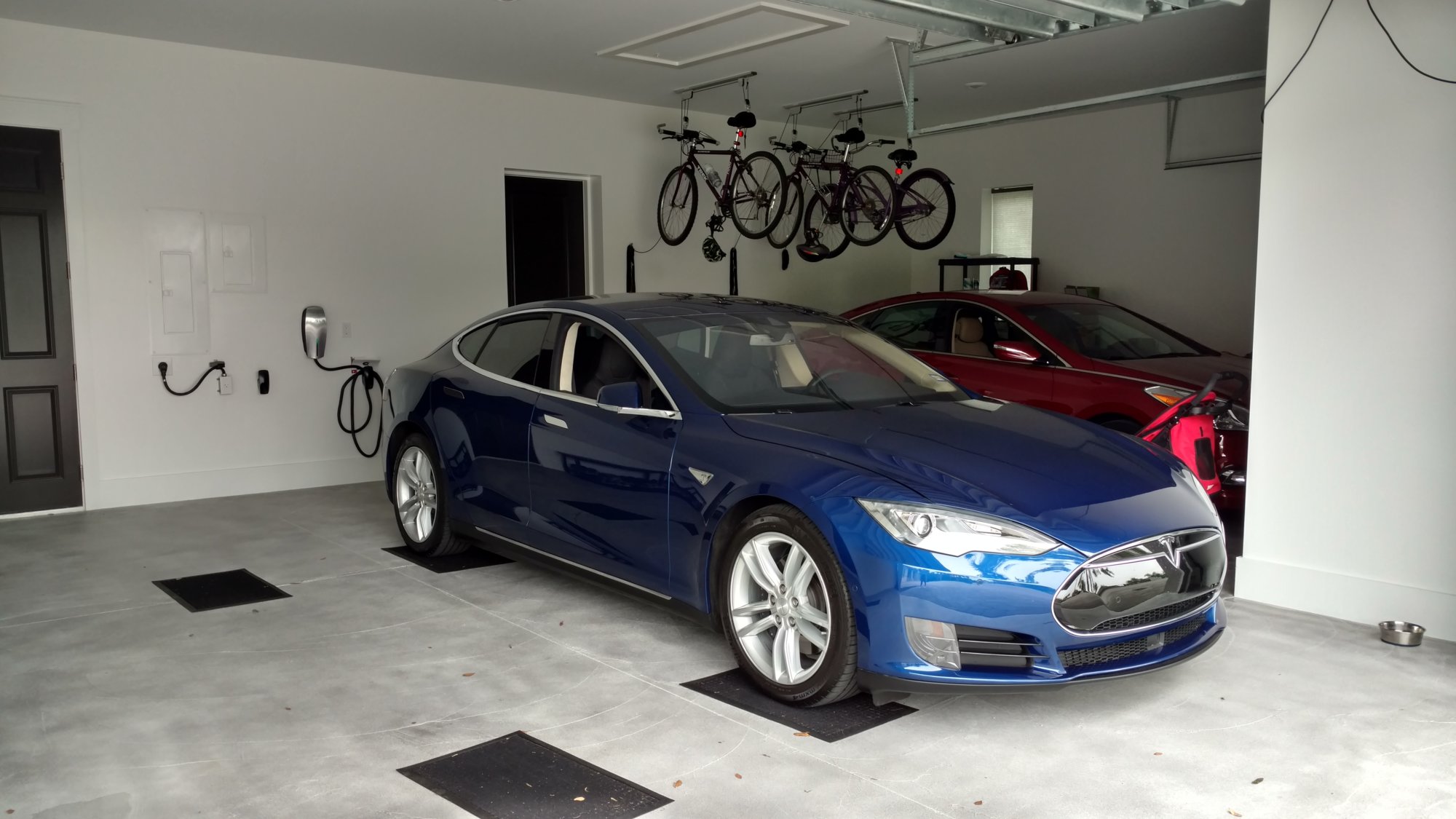 �
�
Apr 4, 2016
AndreSF Just curious, how can you charge "just about any EV" with 14-50 outlet? If you had J1772 EVSE, I can understand that...�
Apr 4, 2016
Xminus6 That's a fair point. My situation is affected by the fact that we've always owned one other non-Tesla EV at the same time. So an EVSE for only one manufacturer never made sense for us. That said, my 40 amp Leviton has worked just fine and I've never felt like I was waiting on my car. But we lived a pretty well-scheduled life.�
Apr 4, 2016
Xminus6 Many mobole charge cables for EVs come with an adapter for those plus. My co-worker with a new Volvo XC90 T8 actually asked me if he was supposed to have a regular 110 plug on his cable, not realizing that the adapter was already attached, converting and covering his 110 plug.�
Apr 4, 2016
AndreSF Well, I have different experience. Before Tesla, I have not seen any EVs with multiple adapters for mobile connectors... Most obviously have mobile EVSE included, but those I saw all were for basic household 110V outlet.�
Apr 4, 2016
neptune2000 Tesla used to have the HPWC as an "option" when you configured the Tesla Model S. They dropped it as an option, as they now recommend the UMC: at 240V / 40A, or 26-29mph, will charge 210-232mi overnight in 8 hours. The UMC only needs two 50/50 breaker (which means no change in your electrical panel) and installing a NEMA 14-50 is normally around $500. For people that need a longer length than the UMC, this is available to do the job at only $55 on Amazon:
Amazon.com: Camco 55194 50 AMP 15' PowerGrip Extension Cord: Automotive�
Apr 4, 2016
RFC1 I have been using my Voltec charger from when I owned a Volt. It has a maximum of 15 Amp draw and a J1772 plug and I can charge my Model S at 10-11 miles per hour. I do have the duel chargers on my Tesla and have been looking at options to upgrade. Clearly the fastest option is the wall charger but I was trying to figure out what the charge rate would be with a 50amp upgrade using the mobile charger. I believe it maxes out at 40 amps and the website seems to imply that with duel chargers, this would be 58 mi/ hour charge rate. Can anyone confirm this?�
Apr 4, 2016
ABCCBA We have a TurboCord Dual for the wife's Volvo. It has a J1772 connector. I rigged a 20A 240V outlet on a stove cord so the it runs off of the 14-50. Anyone who has a 14-50 adapter can plug directly into the 14-50 and pull up to 50A at 240V.�
Apr 4, 2016
Justicepool Convenience. I have two houses and didn't want to constantly take the mobile cord in and out of the trunk. I had an HPWC installed in both houses. I had 100 amp service installed at the house I stay in the during the week (due to work), but only 40 amp service in the other house and they both suit my individual needs. I drive a lot during the week and the 60-61 miles per hour of charge has come in handy. It's all about ones individual driving needs. The mobile cord and a Nema 14-50 work just fine. I prefer the HPWC for convenience and the ability to charge at a higher rate when needed.�
Apr 4, 2016
ABCCBA We have a new XC90 T8. The PowerCord Dual has two (dual) voltage capabilities. 120V @15A or 240V @ 20A.�
Apr 4, 2016
Andyw2100 I do not believe Tesla dropping the HPWC as an option when ordering the car means that they are no longer "recommending" it.
When one purchased the HPWC along with the car, it came with a three-year warranty. If purchased separately it carried only a one-year warranty. I was planning on purchasing two, and specifically asked if I could purchase both with the car, in order to benefit from the additional warranty period, and I was told that I could not.
I am guessing the reasons that Tesla is no longer offering the HPWC as a configurable item that can be purchased along with the car has a lot to do with that extra warranty period, and also possibly that they don't want to give potential buyers the impression that the HPWC is required, which could potentially scare them off of the purchase entirely.
But back to my main point, I definitely do not believe that Tesla's removal of the HPWC from the car ordering page represents a shift in policy with respect to what Tesla recommends with respect to charging.�
Apr 4, 2016
MP3Mike I think it has more to do with how few people were ordering the HPWC with a car. Same reason they made the dual chargers an after purchase option.�
Apr 4, 2016
rhambus That is great. I had not seen that before. Thanks!�
Apr 4, 2016
AndreSF I don't believe you can get 58mi/hr with UMC, it tops at 29mi/hr.
https://www.teslamotors.com/sites/default/files/pdfs/en_US/Charging_at_Home.pdf
I'm also using Voltec, and even at 10mi/hr it works for my daily needs, as car is able to replenish battery to 90% (daily level) nightly with my regular driving pattern. Anything out of that pattern for me would be caused by a long distance trip, so SC is what I rely on then (did a few long-ish 200+ miles trips since a got my MS70 in March).�
Apr 4, 2016
AndreSF Keep in mind that you would need an EVSE device as well as J1772 cable (sold separately in their web store), but I have not been able to find a more economical solution with these many selectable options for supplying pwr circuit.�
Apr 4, 2016
ABCCBA 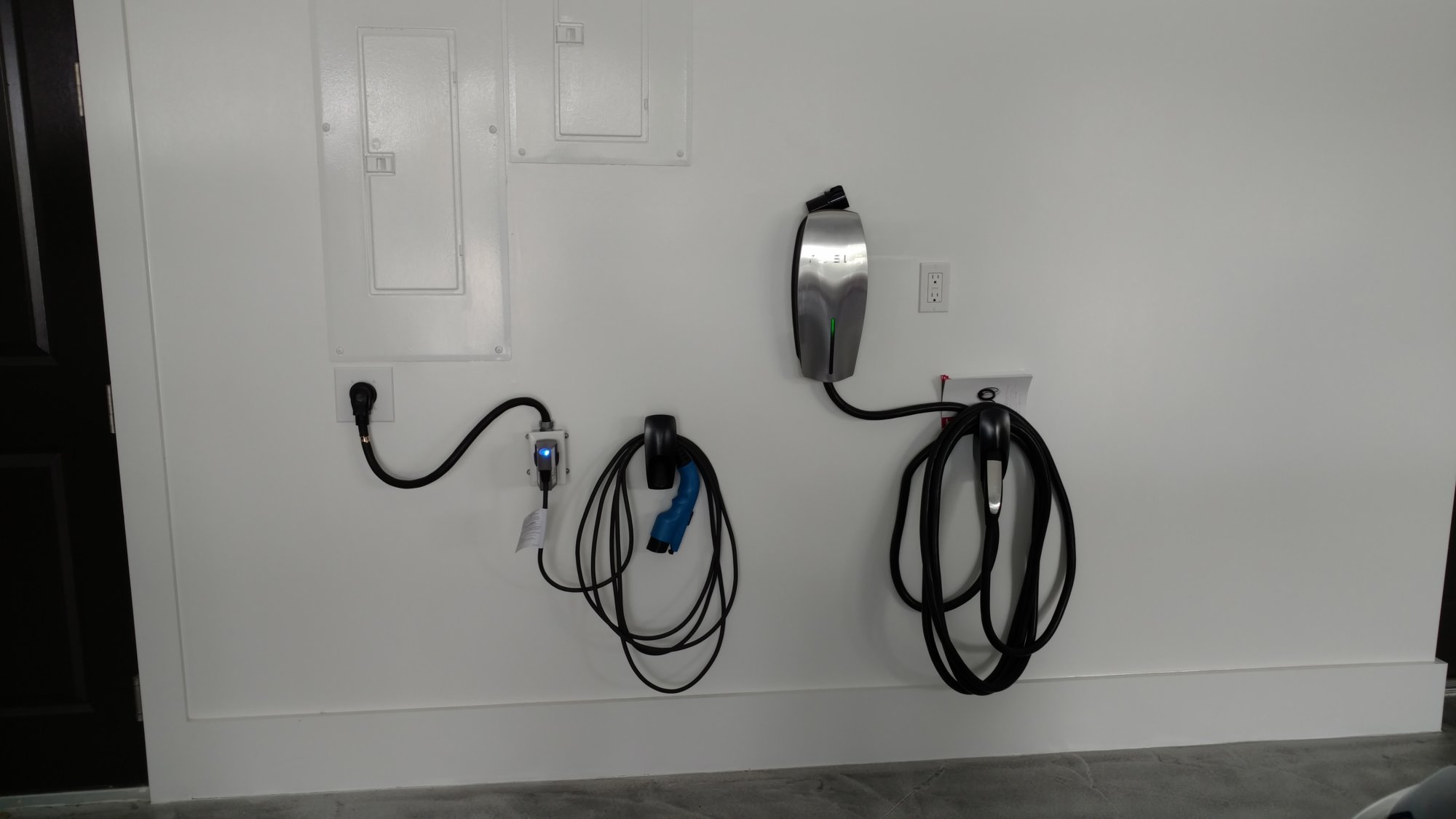 �
�
Apr 4, 2016
AndreSF Oh, I get it now! You do have an EVSE. Nice setup BTW, looks like you can charge 3 EVs or perhaps 2 EVs and a Zero cycle (including trickle charging via 110v outlet�
Apr 4, 2016
Andyw2100 Yes, the 29 mi/hr* rate is for 40 amps, and is the maximum the UMC is capable of.
The HPWC is capable of charging at 80 amps if the car has dual chargers, and you have 100 amp service available to the HPWC. This is what will get you 58 mi/hr.*
* both the 29 mi/hr and the 58 mi/hr rate are actually a little lower on some of the performance models. Those numbers were based on the original EPA estimates of the original Model S 85s, I believe.�
Apr 4, 2016
Beryl A HPWC is installed at my home for the same reasons already mentioned -- longer cord, no packing/unpacking adapters, and the occasional need or desire to fully charge from near empty in less than 4 hours.�
Apr 4, 2016
Az_Rael Slightly OT: it always bugs me that Tesla doesn't use any of the standard acronyms for their stuff like the rest of the EV market. It just causes confusion it seems like. The Mobile Connector would be an EVSE for any other car manufacturer as would the HPWC. They are just Tesla proprietary EVSEs vs J1772 or chademo, or CCS.
Calling your HPWC EVSE a wall "charger" on other forums will get you corrected as quickly as referring to your Tesla "dealer" here.
/end OT pointless rant.�
Apr 5, 2016
MB30 Can someone with twitter ask a question of Musk for me regarding this subject? Since he seems to be answering all sorts of things, i'd like him to answer if the Tesla Wall Connector will work with the Model 3. I want to assume that it will work with it, but at the same time i dont want to buy it and find out later that they have a separate unit that they are recommending for the 3. My goal is to set up my charging station in the garage before the year is over so that i can take advantage of the tax credit. I e-mailed Tesla but i got a somewhat expected reply:
"Unfortunately, the charging system of the Model 3 has not been released, so I am unable to confirm any of those details at this time."
If anyone has any information or input on the matter or if they could send a tweet at Musk, i would greatly appreciate it. Thanks�
Apr 5, 2016
ABCCBA I hate to point out the obvious, but the Superchargers and HPWC connectors are the same. The Model S and Model X have the same charging port to accept the Tesla connector. So, why would Tesla make the Model 3 with anything other than the Tesla proprietary charging port? Sorry if I misunderstood your question.�
Apr 5, 2016
TexasEV Tesla is the EV market so they get to name things in a way that makes sense to the public. Do you think any normal person knows what an EVSE is?�
Apr 5, 2016
MB30 I know it seems obvious, but wouldnt it suck to buy and set something up only to find out that it is not the best situation. Also, if it's so straight forward, why wouldnt the manager at tesla just say that it would work with it. Im more concerned about the rates of charge and things like that than the connector itself.�
Apr 5, 2016
diamond.g They were pretty quiet about the dual charger option on the Model X, so I suspect they may not be quite sure what rate the base charging (assuming there is a dual option at all) is capable of.
I think in the X the base is capable of 48 Amps, whereas the S is only capable of 40 Amps, though when you do the dual charging upgrade I think the x tops out at 72 Amps whereas the S is 80 Amps.�
Apr 5, 2016
MP3Mike Technically the Model X only has a single charger. You just have a, one time, choice, at build time, of getting the standard 48A charger, or you could upgrade to the 72A charger.
The Model S comes with a single 40A charger, but you can add a second 40A charger at any time.
I hope the Model 3 is like the Model X and has a 72A option.�
Apr 5, 2016
diamond.g Right, my bad. And that option wasn't readily apparent either, so it makes you wonder how many folks actually asked for the 72A option.
EDIT: and based on the X forum, the HPWC doesn't actually have an option to support the 48A rate, you have to go up one size. Maybe they are going to be releasing a new version that has support (the older version did then they changed the dip switches removing options).�
Apr 5, 2016
Skotty If you want to support charging other electric cars, a J1772 L2 charger is not a bad option. That's what I use. I have a GE Wattstation that can do up to 32 amps, which is good enough. But there are others that can do upwards of 80 amps or so if you want to support faster charge rates. Avoid the ones that are limited to 16 amps, that's just not enough.
Also, if you go with J1772 with Tesla adapter, I recommend ordering an extra J1772 adapter. Keep one attached to the L2 charger and keep the other with your UMC in the car.
240v @ 32 amps recharges about 21 miles of range per hour on a Model S.
The GE Wattstation does "hum" a bit while charging (though I got mine about 3 years ago now; new ones could be different if they have done any redesign). It was louder when I first got it, and got quieter over time, but it still hums. This is something I would try to investigate in advance when trying to choose an L2 charger, but it's hard to find good information on. Also consider cord length.�
Apr 5, 2016
Gilzo
Good stuff. Much appreciated.�
Apr 5, 2016
Lloyd Its up to all of us to educate them!�
Apr 5, 2016
CuriousG Can you even get tax credit for an EVSE without an electric vehicle? You didn't state whether you currently have one. From what I've read most people won't even qualify for that credit.
Wouldn't make sense for Tesla to change how their L2 charging works. On the other hand, do you need to have an HPWC installed since the Model 3 will certainly have the UMC which is all you need to charge your car assuming you have the right 240V outlet.�
Apr 5, 2016
MP3Mike I didn't see anything on the tax form where you have to indicate that you own a EV... And not everyone that owns an EV would have qualified for the EV credit, so unless they audit you they would have no way of knowing. (And like I said I didn't see anything about having to own an EV. After all a business can get the credit for putting a charging station in for other people to use. Just make sure to list it on plugshare.�
Apr 5, 2016
Garlan Garner I'm going to give the wireless charger a try. I've already put down my $240 that will save me approx. $1K on the purchase price. This would work great with - auto parking.
Meet the Plugless Level 2 wireless EV charging station�
Apr 5, 2016
SureValla Tesla needs to get on creating a wireless charging option to compete�
Apr 5, 2016
RFC1 Does it work with Tesla? According to website, only leaf, volt and Cadillac EV.�
Apr 5, 2016
MP3Mike They recently announced a version for the rear wheel drive Model S, with a version for the AWD Model S coming later this summer.�
Apr 5, 2016
jgs I can confirm that I did successfully claim the credit w/o an electric vehicle -- in addition to what MP3Mike said, consider when a person installs an EVSE in December of tax year X but takes delivery of their EV in January (or, in my case, March) of tax year X+1.
As for what you've read about what most people can or can't qualify for -- it just depends on your personal situation. Doesn't matter what "most people" can do, it only matters what you can claim on your return. Probably if you expect to pay AMT you're not going to benefit from it. Otherwise, you probably are. (I am not a tax or any other kind of accountant.)�
Apr 5, 2016
jgs I can't say whether it's company policy, but when I ordered my car in October of 2014 my sales guy tried pretty hard to downsell me off of the dual chargers. I got them anyway and have never used them in anger, but it still makes me feel happy to know that I could if I needed to.
It was unique in my experience to have a car salesman trying to talk me out of buying options.�
Apr 5, 2016
JPP Agree with the above, and will add 1 additional comment. Even though I do not unplug my UMC all that often to take it with me, I was concerned about the durability/longevity of my NEMA 14-50R receptacle with repeated removal/insertion cycles. I bought a 2nd UMC NEMA 14-50 adapter. I leave 1 in the receptacle and 1 in the black mesh bag. When I disconnect, I do so at the adapter. Quick and easy. If for some reason the adapter fails, easy to fix. The NEMA 14-50R would require my electrician to come out. YMMV.�
Apr 5, 2016
ABCCBA Yes, you can get a credit for any alternative fuel station. I believe it is $600 max. You don't have to have a EV. I did my HPWC in 2015 and entered it for 2015 tax return. My EV credit will be on 2016 tax return.�
Apr 5, 2016
RFC1 That's great to know. Will keep an eye out for the plug less option.�
Apr 5, 2016
AndreSF The same applies, me thinks, to HPWC and UMC...�
Apr 5, 2016
Andyw2100 I just want to point out, for anyone casually looking into wireless charging, that one major downside is inefficiency. In a nutshell you wind up paying for a lot of electricity that never makes it into the battery pack. This isn't a big deal when you're talking about charging your cell phone, (and where I understand the losses are smaller because the phone can rest on the pad), but when you are talking about charging one of our cars' traction packs, the efficiency losses can really add up.
Just something to be aware of, and perhaps research a bit. That's all.�
Apr 5, 2016
Craig9080 I would be interested to see that, with wireless charging, an EV may indeed be worse for the environment than a high-efficiency ICE. Considering that in states that use coal as a main producer of electricity EV's barely break even with regular hybrids on carbon emissions, this may be interesting.�
Apr 6, 2016
diamond.g is this an outdoor installation? I think permanent EVSE stations would be a better option for outdoor charging no?�
Apr 6, 2016
FlatSix911 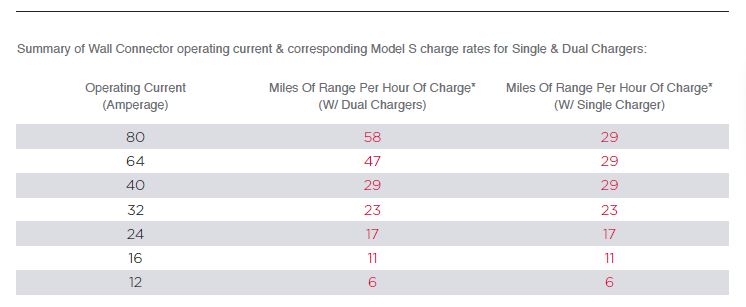 �
�
Apr 6, 2016
brucet999 Tesla wall charger is a 240V/208V device. It is faster than the UMC only if you have equipped your car with dual chargers to handle 80A charge rate. With the usual single on-board charger the Tesla Wall Charger runs at 40A, just like the UMC. The only advantage to the wall charger is that you can keep your UMC in the car all the time instead of unplugging it from the wall and packing it when going somewhere with destination charging.�
Apr 6, 2016
brucet999 Yes you can get a tax credit for installing an EVSE without owning an electric vehicle. Consider the owner of a business who installs an EVSE for employee or customers' use or a homeowner who provides one for visitors. The tax form does not ask about EV ownership when taking the credit.�
Apr 6, 2016
Thomas Edison I thought the model x had like an 80amp single onboard charger.
�
Apr 6, 2016
brucet999 Not 80A. There was some talk about a 72A option on the X, but this is a Model 3 forum and a 60kWh battery will not need more than the 40A charge rate of a NEMA 14-50.�
Apr 6, 2016
Thomas Edison Well I'm hoping there's a larger battery option than 60kw
�
Apr 7, 2016
diamond.g It is likely that the base charger will be 48 amps like the X. They may give us an option to go to a 72A charger again like the X (and also probably hidden). So the UMC, unless they change it, will be shorting folks 8A which is like what 3 additional MPH of charge?�
Apr 7, 2016
SureValla I can confirm this. I went back into my turbotax return that I filed already for this year and played with the EVSE tax credit section. All it asked me was a) where did I install it and b) how much did I spend. I ended up getting back a portion of whatever # I put in for how much I spent. I do not own an EV currently.�
Apr 7, 2016
SureValla I should have added I am not subject to the AMT.�

Không có nhận xét nào:
Đăng nhận xét