Dec 21, 2011
WhiteKnight When traveling at 75 mph (highway speeds) you get only 70% of the range you would receive at 55 mph. In addition the battery capacity is reduced by 30% after 6-9 years.
Therefore your highway range (@ 75 mph) with an 85 kWh pack will be 210 miles initially and around the time the warranty expires it will be down to 150 miles.
For the 60 kWh pack it's even worse. 230 miles is 160 to start, dropping to 115 or so.
And for the 40 kWh pack you start at 115 on the highway and go to about 80 miles in range by year 8.
The Tesla Model S, even with the biggest battery pack, is more of an intra-city car than an inter-city car.
Under the best case scenario if you take the Model S on the highway you can drive for 2 hours and 50 minutes before you have to pull over for 1 hour to recharge. That's the biggest battery pack on the day that you bought the car. It only goes downhill from there. This is not going to be your road trip car.
Source: Roadster Efficiency and Range | Blog | Tesla Motors (see spreadsheet)�
Dec 21, 2011
Tommy WhiteKnight, your assumptions may be correct or they may be incorrect. The information you state as facts is taken from a 2008 blog posted about driving conditions for the Roadster; Can the same parameters can be assigned to the Model S? Drivetrain loses, tire rolling resistance, batteries and aerodynamics have all improved from when that data was collected. Sorry, but I don't make the connection on how the Roadster performed with its off the shelf cells in 2008 to a car engineered from the ground up to be an EV.�
Dec 21, 2011
NielsChr Lets see some real live numbers before we make any conclutions. afaik. the roadster owners is still satifyed with the range and haven't complaied about highway range.
Tesla is still delivering the best perfomance/range EV car made jet of any car maker.
2' to Tesla is the Leaf afaik., but this car have only 24 KWh battery compared to Tesla 85 Kwh battery - that is more than 3 times the capacity. Im pretty shure I know witch of the 2 will run out of juice first �
�
Dec 21, 2011
VolkerP Sure, old data, but we can do some guesswork.
CdA is same for Roadster and Model S so we can reuse the aerodynamic drag Wh/mile figure from the Roadster (cyan line).
At 55mph aerodynamic drag is responsible for 100 of 230 Wh/mile = 43%. Energy lost to aerodynamic drag will increase by square of speed, that is by 86% when going from 55mph to 75mph. Other losses are mostly independent of speed. Thus I arrive at 37% increase of energy consumption, or 1/1,37 = 73% reduced range. The OPs figure of 70% is in the same ballpark.
Edit: I am aware that Model S might have higher ratio of rolling resistance vs. drag at 55mph due to increased vehicle mass. That would diminish the effect of going faster, though.�
Dec 21, 2011
Doug_G Let's take my typical Ottawa-Toronto trip, a roughly four-hour ICE drive. With the Roadster I have to drive about 10 mph slower than I usually would, and do a two hour NEMA 14-50 charge. That's a bit inconvenient as it turns a ~4 hour trip into a ~7 hour trip.
Part of the problem is that the KOA is poorly sited so I have to go to full Range mode, which is slower. If it were closer to the midpoint I could knock at least half an hour off. If that was an HPC instead it would be an hour, tops.
With a Supercharger I could drive full speed, stop for a quick lunch/bio break, and be on my way. That's not even taking into account the larger range of the Model S. Even if the pack lost some capacity over time, it would just increase my Supercharger time modestly.�
Dec 21, 2011
WhiteKnight Just to be crystal clear, though, what we are trying to discern is the RATIO between 55 mph and 75 mph. The 300 mile figure (at 55 mph) for the Model S is given to us by Tesla and it incorporates new battery cells, new drivetrain, new tires, etc.
As VolkerP has illustrated with the Roadster graph from the spreadsheet, the major change in Wh/mile from 55 mph to 75 mph, comes from wind resistance/aerodynamics. The Model S has a much lower coefficient of drag than the Roadster (like ~0.22 vs ~0.34) BUT the Model S is also a much bigger car so the CdA (taking Area into account) could very well be equal.
VolkerP did you get that CdA factoid from Tesla? I had not heard before that the increase in Area of the Model S Almost exactly offset the decrease in the coefficient of drag, even though it is easy to believe.�
Dec 21, 2011
VolkerP WhiteKnight,
the CdA guesswork was in a TMC forum thread:
�
Dec 21, 2011
WhiteKnight I am not down on the Model S, I like it a great deal and hope to buy one. BUT I realize if I buy the 40 kWh pack with a stated 160 miles range, I still can NOT drive from Atlanta to Birmingham, AL (146 miles on I-20). If I go 55 mph on I-20 I will die after being rear ended by a semi. If I drive 65 or 70 mph, I will run out of range. If there is a charger halfway, I can drive for 60 minutes, stop for 30 minutes, drive for 60 minutes, stop for 30 minutes. Not really the way I like to travel.
Imagine if I wanted to go to Disney World in Orlando? That's not my idea of an enjoyable road trip even IF there are chargers along the way.
Compare that with a BMW 535i which gets 31 mpg on highway and has an 18 gallon tank. You could drive 550 miles stop for 5 minutes to fill up and drive another 550 miles.
The Deloitte study said something like 90%+ of Americans drive less than 50 miles per day and yet 90%+ of Americans want 300+ miles of range. The Model S promises 300 miles but does not deliver at highway speeds (when you really want the range). But that's okay because you are hardly ever going to need it anyway! Take the minivan to Grandma's house.�
Dec 21, 2011
Todd Burch WhiteKnight, I see what you're saying...I usually drive about 70-75 mph on the highway, like most people.
However I realise that I'm making a compromise in one area (refueling speed) in order to get many benefits in other areas. With the superchargers, I still see the 85kWh pack as a road trip car. Yes, I'll have to drive a little slower (might take rural roads which typically have a speed limit around 55mph).
Will it take me longer to get to my destination? Yes.
Will I be forced to stop for about an hour every 3 hours? Yes.
Is it still worth it to me for my relatively infrequent road trips? Yes.
So this is really a very personal opinion that people need to formulate based on their own goals an experiences...�
Dec 21, 2011
WhiteKnight Okay, I promise not to be "that guy" that responds to every post, but this is a great example.
Let's assume for argument's sake that Tesla decides that between Toronto and Montreal they need two Superchargers instead of one, because 542km / 336 miles needs two charge points approximately 180 km / 112 miles apart. So they locate one charger in Prescott, ON and another one in Belleville, ON (I've never been to Ontario but these look like good points on the map). So it's 112 miles from Prescott to Montreal and 112 miles from Belleville to Toronto.
If I purchase the 160 mile pack I am only going to get 112 miles at 120 km / 75 mph. So I've got to drive slower than highway speeds just to have some range on either end of my journey for the local portion. And then I've got to stop at each Supercharger for the full 60 minutes or more (depending on the charge rate). So best case scenario is I start with 100% charge - drive 2 hours - stop for 1 hour - drive for 2 hours - stop for 1 hour - drive for 2 hours - and finally charge again for local range or arrive at my overnight destination. Total trip time 8 hours+ compared to an ICE car at 4.5 hours on one tank of gas with lots of room to spare. And by the way, within a few years I will not be able to even do this do to lost battery capacity (unless you want to turn on your flashing hazard lights and go like 80 km/50 mph).
With a 60 kWh pack I could travel about 260 km / 160 miles at 120 km / 75 mph. So I can move at highway speeds between Superchargers BUT I cannot skip a Supercharger, I have to stop at every single one. If I want to drive at 55 mph then I should have just enough juice to skip one of the Superchargers but that is only when my pack is brand new. Once the pack is 6-9 years old I will have the bare minimum of capacity to make it between Superchargers while traveling at (near) highway speeds. So again, you're looking at a 6.5 - 7.5 hour journey compared to 4.5 in an ICE vehicle.
With the 85 kWh pack you can skip one Supercharger location while maintaining 120 km / 75 mph highway speeds but you cannot make it the whole way without stopping at least once to charge. So at a bare minimum you are adding mandatory 30-45 minutes to your trip time. Once 6-9 years have elapsed you will have to hit every Supercharger along the way (a mandatory 60-90 minutes) or you can revert back to slower speeds in order to stretch out your range. With the 85 kWh pack though you've paid over $12,000 more than a comparably equipped BMW 535i which is every bit as fast and nice and gets over 550 miles in range and takes 5 minutes to recharge.
You can see from this narrative that the 40 kWh packs are really not big enough to seriously consider for highway driving (other than your daily commute). The 60 kWh packs are big enough to start if you're willing to deal with with the hassle of frequent stops to recharge. The 85 kWh packs are the only ones that come close to supplying the freedom of the open road (and that unfortunately dissipates over time).
I love the Model S for what it is (the best EV on the planet by far) but it is not the car you pick for a major road trip.�
Dec 21, 2011
bint2k nice post whiteknight, totally makes me think twice about this car - I was still planning to keep my ICE car for road trips, but still....�
Dec 21, 2011
Doug_G Sure. I will use my Model S for most of my road trips. Maybe once a year I might take a longer road trip through areas with little or no charging available; for that, there's a car rental place two minutes from my house, and they pick you up.�
Dec 21, 2011
Waverider My thinking exactly WhiteKnight. This is the second biggest obstacle keeping me from putting a deposit right now. The first being it's about $20-30k more than I realistically should be paying for a car. The bells and whistles and the EV coolness just can't get this car over the line in my mind. I live out in the middle of the desert. The 160mile version would be perfect for my daily commute (maybe 15-20 miles round trip) but I'd be trapped in town if something were to happen to my other ICE car. Yes this scenario is very improbable, but it happened to me last Christmas when my primary car was in an accident and I had to rely on the second daily commuter for the road trip to the in-laws.�
Dec 21, 2011
daxz I've figured the CdA by taking the dimensions and images from web site and calculated how much area the silhouette took.
W x H x percent area of silhouette x Cd = CdA
77.3" x 56.5" x .81 x .225 = 5.53 Model S
72.9" x 44.35" x .8 x .35 = 6.29 Roadster
Then I calculated the formulas from the roadster efficiency and range spread sheet and used the CdA ratios above
Wh/mile =
(179.9*v^-1.002) Ancillary Wh/mi
+ (-0.0003* v^2+0.0936*v +51.871) Tires Wh/mi
+ (0.02899* v^2 ) Aero Wh/mi [roadster has .0309 *v^2]
+ (0.006 * v^2 + 0.1669*v+51.667) Drivetrain Wh/mi
+ (24 Wh/mi) RoadsterToSAdjustment Wh/mi (57Wh/mi for 85kWh pack = 300miles @ 55mph)
This diving by pack size yields a mileage graph like:
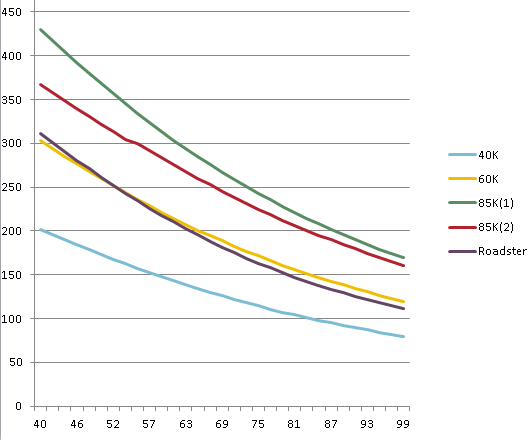
At 75 Mph range is
40kWh= 114 miles
60kWh= 171 miles
85kWh= 243 or 225 miles -- the 85kWh pack was calculated 2 ways.
Where the 55 miles = 300 miles and where the Ancillary+Tires+Drive Train curves had the same adjustment factor (+24w above Roadster) as the 40 & 60 kWh packs.
For hypothetical trip of 340 miles 60kWh pack would need only 1 stop traveling at 70mph wasting .7 hours charging including 15 minutes to get get hooked up. You would need a charger at 190-210 mile mark though. The time you wait for long trips makes up for all the short 5+ minute detours to gas station currently.�
Dec 21, 2011
Alan I do about 90% of my driving in my Roadster and about 10% in my Audi for those times I need more seats or more range (I dont include my Lotus Esprit in this as I drive that just for fun).
If I swapped the Roadster for a 40kwh / 160 mile Model S then I think that would cover about 95% of my driving needs (extra seats sorted) so I would still need a car for long distances / road trips. With the 85kwh / 300 mile version it would be OK for 99% of my driving needs. I am down to probably two or three times per year where I would would be delayed by the need to recharge on route. I think thats the level where I would not need a second car - a few times a year it would be cheaper to hire or borrow a car off a friend (swap for a few days).
The point I am making is that electric cars have huge advantages (fun to drive, low running costs, low CO2 etc) but you have to consider whether they work as your only car. If you regularly drive close to the max range per day then you will be disappointed as you have chosen the wrong car for you. Look at it another way - lets say that twice a year you visit a friend who lives on a rural farm with no proper road and for this you need a 4 wheel drive off road vehicle. Does that mean you must only consider 4 wheel drive off road vehicles as your daily driver? Perhaps its better to have the perfect car 99% of the time and use/hire something else for 1% (which will then remind you what is so good about your Tesla). Getting too worried about a small number of road trips per year and you could end up driving the wrong car for 99% of the time.�
Dec 21, 2011
goyogi That's the way I look at it too, Alan. I'll have zero problems finding someone to swap cars with when I need to haul some big items or go on a long road trip where the charging infrastructure isn't present yet. Anything longer than 3-4 hours I'll fly.�
Dec 22, 2011
dsm363 Me too. In Texas you basically can't leave the state without a 10 hour drive so really a 230 mile journey is the farthest I'd need to drive. I'll fly anywhere else.�
Dec 22, 2011
WhiteKnight I think you hit the nail on the head with your illustration. And I love the last line about driving the wrong car 99% of the time.
In the process of writing this post, I've almost talked myself down from the 60 kWh pack to the 40 kWh because I realize now I won't be doing any inter-city driving in the Model S so why pay for range I'll never use? And you can get a 40kWh model that is identical to the 85 kWh in every respect except range and slightly slower 0-60 (again, I'm only drag racing 1% of the time and $20,000 would buy a lot of time at the track).�
Dec 22, 2011
Alan Sorry to steer you back towards 60kWh and spend $20K of your hard earned cash for you, but think again about the slightly slower 0 to 60.
You almost never use a cars top speed so the 110mph vs 120mph difference between the 40 & 60kWh packs is no worry. Accelerating from 0 to 60 is something you do all the time and its far more fun doing it in a fast electric car than in a fast ICE car. So far even our government has not managed to make accelerating fast illegal.
You will notice a difference between 0 to 60 in 6.5 vs 5.9 and that difference is something you will enjoy every time you use the car. I dont know if anyone has figures for say 50 to 80mph but that makes a lot of difference when it comes to overtaking so is something I would want to know about when choosing between the different models.�
Dec 22, 2011
Todd Burch In the US in most (all?) states you can get a ticket for exhibition of speed if you gun it from a stoplight, even if you're not racing anyone.�
Dec 22, 2011
dsm363 I think the 60 kWh pack is the sweet spot as well and is the way Tesla is positioning it. I agree with Alan.�
Dec 22, 2011
WhiteKnight Set aside a little money for a car rental fund and then you don't have to worry. Like Alan said, you'll be loving the Model S 99% of the time!!�
Dec 22, 2011
Robert.Boston Alan, you raise a great point. 0-60 mph isn't particularly useful in every-day driving (although there're a few places at toll plazas where 10-70 mph is safe and fun). 0-40 mph is what I use most around the city; 50-80 mph is what I care about for highway.
If we assume that the powertrain is identical among the (non-sport) versions, the lower 0-60 performance is a result of limited current draw. Therefore, it's likely that 0-30 performance will be nearly identical across all three (or even slightly better with a smaller, lighter battery); the difference will lie entirely in the 30-60 half of the split. Which would further suggest a very stark difference in the 50-80 overtaking time among the three battery packs.�
Dec 22, 2011
daxz I've figured the CdA by taking the dimensions and images from web site and calculated how much area the silhouette took.
W x H x percent area of silhouette x Cd = CdA
77.3" x 56.5" x .81 x .225 = 5.53 Model S
72.9" x 44.35" x .8 x .35 = 6.29 Roadster
Then I calculated the formulas from the roadster efficiency and range spread sheet and used the CdA ratios above
Wh/mile =
(179.9*v^-1.002) Ancillary Wh/mi
+ (-0.0003* v^2+0.0936*v +51.871) Tires Wh/mi
+ (0.02899* v^2 ) Aero Wh/mi [roadster has .0309 *v^2]
+ (0.006 * v^2 + 0.1669*v+51.667) Drivetrain Wh/mi
+ (24 Wh/mi) RoadsterToSAdjustment Wh/mi (57Wh/mi for 85kWh pack = 300miles @ 55mph)
dividing by pack size yields a mileage graph like:
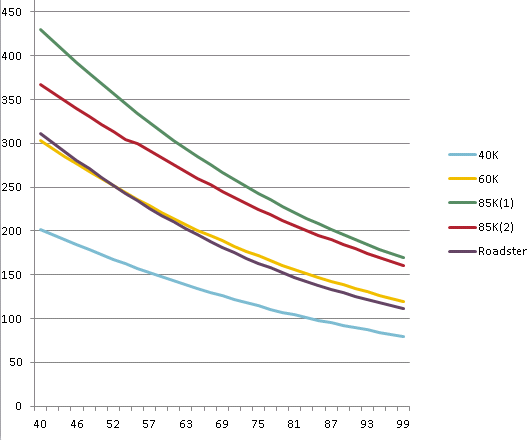
At 75 Mph range is
40kWh= 114 miles
60kWh= 171 miles
85kWh= 243 or 225 miles -- the 85kWh pack was calculated 2 ways.
Where the @55mph = 300 miles and where the Ancillary+Tires+Drive Train curves had the same adjustment factor as the 40 & 60 kWh packs.�
Dec 22, 2011
ChadS I completely get that it will not be your road-trip car.
But if Tesla builds out the Superchargers or allows access to CHAdeMO stations, it absolutely will be my road trip car. This is not because I do not understand how the car will perform on the road. It's because my current road trip car is a Roadster, and the Model S has more room and a little more range, both of which are very small peeves with the Roadster. The Roadster's charging speed is my only big peeve, and with Superchargers or at least CHAdeMO, it will be far better.
If you'd rather rent a gas car for long trips, I'm totally OK with that. But I'd rather spend some time along the way doing something outside of the car (which my wife would insist on even if we were in a gas car; and even by myself I often want to sleep, eat, visit friends, get exercise, etc). If I was in enough of a hurry so that didn't work, I'd fly.�
Dec 22, 2011
ljbad4life Totally Agree. 250 mile range is perfect for my situation and many others. If it doesn't work for you move on.�
Dec 22, 2011
dpeilow Just flagging this post as it was caught in the trap.�
Jan 22, 2012
neroden Having just discovered this thread through a pointer...
You clearly all live somewhere where the speed limits are higher.
...looking at this, I think the model S is *exactly the right* road trip car for me.
First of all, New York State has a top speed limit of 65 on expressways. Forget 75.
Second, I already take rural roads -- speed limit 55 -- *by preference* over expressways. A drive down the uncrowded 5-and-20 to Cooperstown is a relaxing event, where one can comfortably pull off at any number of interesting tourist spots/shop/restaurants/etc. as one notices them, bringing back thoughts of classic road trips from the 20s to the 50s. A drive down the NYS Thruway (the parallel expressway) is a miserable slog interrupted only by taking an exit to an asphalt wasteland to get chain fast food....
Those of you who take fast expressways -- or even more extreme, autobahns -- for point-to-point trips will have to contend with the reduced range. For me, I think I'm going to get that full 320 mile range (with aero wheels).�
Jan 22, 2012
stopcrazypp Virginia (where Todd lives) raised their max speed limit to 70 (it was previously 65).
http://www.virginiadot.org/info/faq-speedlimits.asp
I live in California, where most roads have an absolute top speed limit of 65 (with 70mph only where posted, which is rare), yet most people drive 70-75mph anyways (especially in the far left fast lane; don't even try driving at 65mph in that lane, you will definitely get honked at). And CA isn't even one of those states that have explicit tolerance to adjust for speedometer error (a cop can pull you over for doing 66mph in a 65mph zone, although in real practice cops don't bother unless you are noticeably faster than the flow of traffic or at least 10mph over the posted limit). I guess in NY, people actually obey the speed limit (maybe the police actually enforce it strictly).
I know people who also take rural roads by preference. Its usually to avoid possible traffic jams from commuters/accidents on major highways. The rural roads take longer vs an ideal situation on typical highways, but you are pretty much 99% guaranteed to make the trip in the estimated time on a rural road, while on a highway the chance of a jam can be quite high (I've been caught in a few before).�
Jan 22, 2012
JohnQ This will be the hardest adjustment for me. I drive I-95 most often and I-81 through PA, usually between 75 and 80 mph depending on traffic conditions and speed limit. I've found that as long as I'm within 15 mph of the speed limit I'm not bothered.
Having grown up in SE Michigan, that speed is ingrained in me. Go to Detroit and drive to Ann Arbor or Jackson. If you're below 75 mph (the speed limit is 70 most of the way) you're getting your doors blown off.�
Jan 22, 2012
Adstein In my experience average highway speed in NY is 5-10 mph over the posted limit so 75 is quite typical.�
Jan 22, 2012
AnOutsider I thought ny was 55 top speed?�
Jan 22, 2012
Robert.Boston MIT researchers recently posted a helpful summary of state highway speed limits.�
Jan 22, 2012
bonnie I've took my Roadster on a 1-week road trip last summer that put approx 1300m on the car (and that was more 'drive to destination, hang out the majority of the week, drive home'). I'm not going to say it was without challenge (always had a backup charging plan), BUT it was simple enough that I decided to go 100% electric by adding either the Model S or Model X and getting rid of my Prius.
Before I bought my Roadster, I was worrying about range, 'what will I do if' scenarios flooding my head. But a good friend who has one of the early Roadsters kind of barked at me (thanks, Steve): "When you fly a plane, you plan where you're going to refuel. Don't make a big deal out of this, don't over think it."
My roadtrip was uneventful, I took plenty of side trips, I charged at every opportunity, and it convinced me I didn't need an ICE. Don't over think this. Get the Model S (or whatever BEV you are lusting after), drive it, and then decide if you need an ICE or not. We all have different needs.�
Jan 22, 2012
JohnQ Indeed, but I can refuel a plane in 20 minutes from touchdown to takeoff if I select the right airport. Until quick chargers are in place it's a little more complicated. I haven't lived it the way you have with the Roadster but hanging out at a campground for 2-3 hours to pick up another few hours driving is a bit of a drag.�
Jan 22, 2012
brianman Cue TEG to link some EV planes.�
Jan 22, 2012
AnOutsider We have to also remember that the average joe is going to find that plotting out a course for every trip is a big negative of EVs. Not everyone has the patience or dedication. There's also the instances like the leaf driver that ran into out of service chargers.
Once the network is beefier and/or charge times come down, it should get easier though. I can only imagine what it was like before gas stations became ubiquitous.�
Jan 22, 2012
brianman Image: Model of Hummer H2 horse-drawn carriage by artist Jeremy Dean for his work, , size: 1024 x 663, type: gif, posted on: January 24, 2010, 4:31 am - The Car Connection
 �
�
Jan 22, 2012
AnOutsider Curious if the rims were still spinners.�
Jan 22, 2012
Todd Burch It's also important to note that the EV road trip experiences from those on the US West Coast are going to be less challenging in general than others. Nowhere else in the country is the EV infrastructure (for charging faster than NEMA 14-50) better supported.�
Jan 22, 2012
bonnie I'm sure you stop in for a quick bite or cup of coffee, use the facilities, stretch your legs, etc. That 20 minutes from touchdown to takeoff is extremely rare. Possible, but unlikely.
Quick chargers are becoming a reality. I didn't have that luxury, but I did charge at every restaurant, get coffee while using a 70amp charger, plug into wimpy 110v for overnight while visiting family and and and.
Once I get rid of my ICE, if I have a real need to take a road trip along a route without charging options, I'll probably rent a vehicle. But when I look at my driving habits over the last several years, those situations are more a figment of 'OMG what if ... ' rather than reality. For me. Your situation may be different.
How often do you really take a new route/trip? I usually look up hotels anyway, so it doesn't seem like a big deal to add charging points. But again, it's not all that often that I'd need to do that. I have referenced my iPhone apps for charging points, especially when I'm in SF for the day - can't believe how many are popping up everywhere from just a year ago.
It's a bit of a leap to move to new technology. EVs may be too much of a leap for some, at least for now. And for others, their driving habits may mean they need to stick with an ICE until the infrastructure is fully in place.�
Jan 22, 2012
neroden I always plan my trip routes anyway, and I usually plan my hotels. It's nice to have room for variations and side trips, but it's not nice to find yourself 50 miles from the nearest gas station, restaurant, or hotel; the problems with electric car road trips are different merely in quantity, not in quality. I agree that people who don't like to do trip planning may not be ready to go to EVs yet, but a lot of us *do* pick our hotels in advance already.
Regarding driving habits: I know people drive 5-10 miles over the speed limit on expressways in upstate NY and PA, but if you stay in the right lane you can comfortably cruise at the speed limit plus or minus 5 mph, and people won't give you any trouble. It's not like the Midwest or California, where you can be practically forced to speed (I've driven Ohio, Indiana, Illinois, Wisconsin, Minnesota, and California, and people *will* tailgate you for going the speed limit). Wisconsin was the worst, actually; just after the national speed limit was removed, people started cruising at 90 mph. (Note that Wisconsin's speed limit was still 65!) Finally the cops came out in force and speeds went back down to 75, but seriously!
On four-lane rural roads, nobody in NY will give you *any* trouble for driving the 55 mph speed limit in the right lane. On two-lane rural roads, sometimes I just have to pull into a side road or driveway to let the speed demons by; it's not safe to drive 75 on those roads, but you will find that one guy doing it. In the dark. In the snow. With a blown headlight.
I'm getting an overspecified car so I really think *for me* it's not going to be an issue. The large battery with aero wheels should get me to Philadelphia or New York in one shot with range to spare, even if I do end up going over the speed limit for a while and get poor Wh/mi. I hardly ever even go that far. I've been scheming over trips to Michigan and Ohio, but those would require substantial, careful planning even if using a gas car, just to make sure the scheduling worked.�
Jan 22, 2012
Doug_G I drive into NY once or twice a year. From what I've seen everyone drives within 5 mph of the speed limit, and speed traps are everywhere. I've even seen someone pulled over for talking on their cellphone (they have the same laws here, but I've never seen it actually happen). Strangely enough there doesn't seem to be nearly as much enforcement at night, and the traffic is faster.
I've also seen the exact same pattern in VT.�
Jan 22, 2012
neroden Yep yep yep, sounds like my experience to a tee, including the faster driving at night.�
Jan 23, 2012
strider I think someone else posted this but whenever people ask me about this I point to the change from horses to cars. Back in the day gas stations were few and far between so you had to plan your route carefully. Now stations are ubiquitous so we don't think about it. EVs are the same way. If you want to be an early adopter then you have to put forth a little effort but to say that EVs are NEVER going to catch on because of lack of infrastructure is just as stupid as saying ICE's will NEVER catch on because of a lack of infrastructure.�
Jan 23, 2012
brianman Actually, it's more stupid... since we have the historical example of gas stations showing it can be done.�
Jan 23, 2012
Robert.Boston And because we already have the electricity infrastructure; we just need to install charge points. All much simpler than having to construct, from scratch, the equivalent of drilling rigs, pipelines, oil tankers, refineries, distribution pipelines/tankers, distribution storage facilities, gasoline trucks, and dedicated stations that the ICE requires. Everything's already done, except for adding a few plugs and, in some areas, making minor improvements to the distribution grid.�
Jan 23, 2012
Lyon Amen!�
Jan 26, 2012
PeterW I agree with what you said regarding the 40 and 60 kwh packs, they would not be suitable for long road trips.
I do have a few questions for you about the 85 kwh pack.
Do you really think that a 30min stop to recharge would be necessary?
I would not have thought that a supercharger would require any more than 15mins to recharge 112 miles and if you stopped at the 2nd location then 15mins would be plenty to take you the last 112 miles.
Does a BMW 535i really go over 550 miles on one tank?
I do not know for sure but this seems a long way to me.
Even if it can, would it go over 550 miles on one tank at 70-75 mph?
Apples to apples.
Lastly; can you really pull into a gas station, put say 12-15 gallons of gas in, pay, and leave in 5mins?
Even without having to wait in line?�
Jan 26, 2012
mnx I'll answer a couple of those. You can for sure fill up a car in <5 minutes if you pay at the pump with a credit card. I timed it once because there were naysayers on this forum.
I seriously doubt a 535 gets 550 miles on a tank.... My 335d can maybe go ~ 600 miles @ 120km/h.�
Jan 26, 2012
JohnQ I think about this from an optimization standpoint. If I have to drive 300 miles between CT and DC I have a few choices. I can travel 55mph or so with an 85kWh pack and nurse it into the hotel (assumes 300 mi at 55mph). Note that this is below the posted speed limit along a fair portion of the route. Or, I can drive more quickly and stop for a quick charge. Ignoring all other factors (line for the charge, time to exit and enter the highway, etc), there is some optimal speed for this trip taking into account the power consumption curve and recharge time. While I don't have a desire to calculate the numbers right now I'm sure I'll do so at some point to understand how to approach a trip like that.�
Jan 26, 2012
drees It has a 18.5 gallon tank - probably can't use all of it, but let's say you can fill it up with 17.5 gallons from empty. EPA rates it at 31 mpg highway which is typically pretty accurate at a constant 70 mph. So 17.5 * 31 = 542.5 miles.�
Jan 26, 2012
brianman I would call drees' math optimistic:
- "EPA rates it at 31mpg...accurate at constant 70mph": I thought the EPA numbers were at 55 not 75, and were generally regarded as in a vacuum with perfect weather on a frictionless flat road kind of thing (aka fantasy)
- constant 70 mph: show me any stretch of road that's 550 miles where I can go 70mph unimpeded, and I'm taking a road trip
- 70mph vs. 70-75mph: if we do any more than exactly 70 the numbers adjust
Even with that, he calculates 542.5 miles which is less than "over 550".
So, to PeterW, "no, it wouldn't."�
Jan 26, 2012
drees Please do some research on EPA fuel economy testing before you call my numbers a fantasy.�
Jan 26, 2012
brianman For the record, I was calling the EPA data fantasy. Relax.
Random web search...
- 28mpg not 31mpg: Fuel Economy of the 2011 BMW 535i
- highway test doesn't go above 60mph: Detailed Test Information
I'd be happy to have more faith in the EPA numbers but, frankly, I don't. If any vehicle I drive gets 2/3rd of the EPA rating on mileage I consider that par for the course.�
Jan 26, 2012
Robert.Boston Because you're driving I-95, you'll have access to SuperChargers. Therefore, the likely optimal will simply to be drive with the traffic flow, stop at a SuperCharger site for a refreshment break (that's about a 6-hour drive, so you'll want one anyway), recharge yourself and the car, and then go on to DC.�
Jan 26, 2012
mnx I thought the new EPA tests are fairly accurate and also fairly easy to beat if you drive lightly. FYI They have a high speed test where they run the car up to 80mph and use more aggressive acceleration and braking.
Detailed Test Information
�
Jan 26, 2012
brianman Perhaps the 2008 adjustments made things better. I would presume they would apply to vehicles for model year 2010...
On a sunny day, my 2010 vehicle set at 55mph on cruise control and no additional passengers doesn't reach the EPA highway rating. It gets about 3/4 IIRC. I'll try it again to see if maybe the car needed breaking in or somesuch.�
Jan 26, 2012
brianman Derp. Corrected.�
Jan 26, 2012
stopcrazypp The average speed of that test (US06) is still only 48.37mph. If you look at the actual test cycle only 92 seconds out of the 600 second test is at or above 70mph (so 15.3% or less than 1/6 of it is above 70mph):
http://www.epa.gov/nvfel/methods/us06col.txt
http://www.epa.gov/nvfel/testing/dynamometer.htm
Add that fact that they take the normal highway test as a baseline (which never goes above 60mph and also has an average speed of 48.3mph) before using the US06 to "adjust" it, it becomes pretty clear the testing cycle overall is far from simulating a 70mph average speed.
Now, it is still possible for a 70mph trip in an ICE car to average out to the same as the EPA number (depending specifically on the how the efficiency of your engine is at various RPMs and on how your car is geared at 70mph), but that is definitely not the general case.
In any case, for the 535i, I get 28mpg x 18.5 gal = 518 miles. So you can claim 500+ miles at highway speeds (what speed exactly is unknown). But I think arguing over this is pointless. There is a certain amount of miles where the total range is relatively insignificant because it is "good enough" already (how many 535i owners will run their tanks to empty on a single trip?). I think ~200 miles is "good enough" for a good amount of of people, ~300 miles even more, ~400 miles pretty much everyone already. The only people who may want more are frequent road trippers.�
Jan 26, 2012
Tesla 940 I find all these stories of actual mpg below EPA ratings to be very surprising. I have a 2006 Toyota Tundra 4x4. It is rated 13 city, 16 highway, 15 combined. In 5 years and 135k miles my lifetime mpg is over 17. This includes approx 50k of cross-country driving at 80+ mph, 5k of cross-country driving towing a trailer with my Tesla on it (13mpg), numerous 4x4 trips going up steep fire roads with 6 people and loaded with gear, and the rest of the miles in true city driving. And oh ya - I finally just replaced my original spark plugs.�
Jan 26, 2012
brianman Sorry to be picky but the original question was 550+ miles, hence my answer of "No."�
Jan 26, 2012
stopcrazypp Your results will be different depending on your specific car (for highway, hugely dependent on gearing and efficiency at different rpms). There is no general rule that says everyone will get better than EPA ratings or worse.�
Jan 26, 2012
drees Fuel Economy of the 2012 BMW 535i
Which is why they don't use the raw numbers from the test but adjust them. (Of course never mind that the EPA doesn't actually test every single car but relies on the manufacturers to tell the truth with random checks here and there).
This used to be the case before the EPA adjusted all the numbers to compensate for "typical" driving patterns.�
Jan 26, 2012
brianman Well they didn't compensate effectively. Or perhaps my 2010 model year vehicle was exempted from the 2008 change.�
Feb 5, 2012
stopcrazypp Just to add another data point about the accuracy of the EPA test as applicable to 70-75mph highway driving:
http://www.popularmechanics.com/cars/news/fuel-economy/mileage-moment-of-truth-we-put-40-mpg-claims-to-the-test-6651300-2
It's the Elantra vs the Focus. PM measured the gasoline by the weight of the car using a scale and used GPS tracking to determine distance traveled and speed. They didn't use any AC or heating. It's not entirely scientific given it was just one trip (they didn't try to redo the dyno test), so repeatability may be a question.
But anyways both cars exceeded the city rating (although the city test done by PM seemed it like didn't have much stop and go), and was able to easily exceed the highway rating by traveling at 55mph. However, at 70mph, both cars were below the highway rating (Elantra only slightly below with 39.3 vs 40mpg, while the Focus was significantly below with 33.5 vs 40mpg, even lower than the city test).
The difference may have to do with gearing and aerodynamics (Elantra has Cd of 0.28, Focus is 0.295).�
Feb 5, 2012
neroden Ah. Of course you have only 70% of the energy efficiency if you go at 70 mph instead of 55 mph... I remember something about that from back when I was a kid.... "55. It saves gas. It saves lives. And remember, it's not just a good idea: it's the law." Some things aren't different between gas and electric cars.�
Feb 5, 2012
brianman That was the sales pitch, yes. IIRC, only the saves gas part remains of that theory. And that's arguably because vehicles were tuned accordingly.�
Feb 5, 2012
neroden It's a little odd that I remember it verbatim.
It actually did reduce death rates. Not much, though -- and as far as I can tell from later studies this was mostly due to reducing the number of people driving at 80 mph and up (which can make for quite extraordinary crashes). And, as you note, it's not the law any more.
It still seems to save gas, and I suspect the reason is that 55 is approximately the point after which increasing aerodynamic drag due to speed becomes the overwhelming factor in energy use.�
Feb 5, 2012
brianman It did, and it didn't. Depends which study you prefer.
Once again, Wikipedia offers an interesting read.
National Maximum Speed Law - Wikipedia, the free encyclopedia
�
Feb 10, 2012
ckessel In reading some comments elsewhere on the Model X, I frequently see people say things like "Yea, that X/Y/Z mile range is ok until you get stuck in traffic!" They're stuck in the mindset that not moving is still burning fuel. EVs typically get better range at slow speeds and even in stop-n-go traffic the range isn't going to drop much. There's some burn for HVAC, but that's not terribly significant.�
Feb 10, 2012
AnOutsider Speaking of this topic, Tesla had a great interactive (touchscreen) display in the reservation tent. It allowed you to select your speed, battery pack, windows up, down etc and see a realistic range (including city vs highway driving). They also had a road trip calculator that you could tell how many miles you wanted to travel and it would show you how far you'd go at X speed before needing to stop and recharge for Y hours (even broke it out by charger type).
I really hope they put it on the TM site at some point.�
Feb 10, 2012
WhiteKnight Yes! It really was a great interactive display. I spoke with Emily from Tesla who was the person in charge of creating the display and she said it will be in all the stores and eventually make it to the website.
It basically took the Roadster Spreadsheet and made it interactive and easy to calculate your range under multiple scenarios.
I encouraged her to allow it to go up to 75 mph, instead of stopping at 65 mph, because most people are traveling above the speed limit (including parts of Montana where there is no limit).
She seemed to think that at 75 mph the penalty would be less than 30% like it is for the Roadster so that was some good news for Model S owners looking to take road trips.�
Feb 10, 2012
dsm363 There are highways in the US where the speed limit is technically 75 mph, right? They should do that then.�
Feb 10, 2012
ElSupreme You didn't push for 80mph? You might not be able to stay in the left lane around town. :wink:�
Feb 10, 2012
Lloyd They should make this an Ipad app, and/or availale in the car to help new owners transition.�
Feb 11, 2012
jimbakker666 That would be very helpful, they should definitely put it up there.�
Feb 11, 2012
drbradfo Unfortunately or fortunately, depending on you POV, Montana eliminated the 'no speed limit' years ago. But that doesn't stop people from driving very fast.
---
I am here: Google Maps�
Feb 11, 2012
Lloyd Yes but they still don't enforce it like California. I took a drive for the Model X release. Between Santa Maria and Buelleton i counted 7 different CHP officers, and at least 4 were writing tickets. Wow!�
Feb 11, 2012
Robert.Boston California needs to balance its budget somehow, Lloyd!�
Feb 11, 2012
Lloyd Yep! Call it a speed tax!�
Feb 12, 2012
Trnsl8r 80 even:
Source: Speed limits in the United States - Wikipedia, the free encyclopedia�
Oct 13, 2012
EV_de Since a few Model S are on the Road ... do we have any "Real World" Range Data on Highway Speed ( 75 - 80 mph ) ?�
Oct 13, 2012
KenEE In Texas we have stretches at 85 MPH!
Anyone else concerned that people seeing Model S's puttering along in the slow lane at 55-65 will be extremely bad PR?
I mean the fact the S is on par with a BMW M5 is selling S's no doubt, so isn't it reasonable to think getting passed by Yugo's on the highway will have the opposite effect?
I plan to drive no further than possible at normal to normal+ speeds.�
Oct 13, 2012
EV_de I DO have concerns .. that why i'am asking ... 75 mph is almost minimum Speed on the Autobahn .. 85 mph is normal ...�
Oct 13, 2012
dsm363 I haven't tested it but from this, I'd guess 160-180 miles in range mode with AC or heat on.
Model S Efficiency and Range | Blog | Tesla Motors�
Oct 13, 2012
JakeP Yes, this is going to look quite foolish, and will only be eliminated when there are Superchargers every 150 or 100 miles along the interstates. While EV enthusiasts will be more than willing to adjust their behaviors to extend range, I fear that the "average American" buyer doesn't want to adjust much of anything, and will require range capabilities that allow them to continue to drive 80mph on long highway trips.
Fortunately for us, this is just further incentive for Tesla to build out the Supercharger network, as it will directly drive new sales.�
Oct 13, 2012
setritt I really see a majority of the model S being used as an intracity car rather than intercity. The people who are going to only have EVs are the committed and others just simply won't. Good example is my house where I am getting the model S but my wife is adamantly opposed. She has no interest in stopping for 30 minutes every 150 miles with kids in the car to save a few hundred bucks for the few road trips we are going to take. As she said, go ahead and get it for yourself but you've lost your mind if you think we are taking that on a trip out of town (I.e. requiring a charge in between stops)�
Oct 13, 2012
Robert.Boston I think that this depends sharply on your personal driving habits which, in large part, depends on where you live. We do a lot of inter-city driving, but in the Northeast, "inter-city" means something very different that it does to a Kansan. For example, one can drive to the state capitols of four New England states on a single range charge of the 85kWh (270 miles); if you'd risk 291, I can add Albany NY! If you only had an EV, but needed to drive longer distances occasionally, a rental car might be appropriate.
Your point about children is a sound one. With one in college and the other nearly so, the prospect of a pleasant lunch while charging is real. If we had young kids? Not so much.�
Oct 13, 2012
JakeP Mine will definitely be used inter-city (200 or even 300+ miles one-way), for work and family trips. I find when you are traveling that far, you always stop for a half hour anyway. I will be happy to do so, provided there are superchargers. Until the Teslobelisks land here in the East, I admit we will likely stick with the ICE for the family trips, as the children will certainly not tolerate a multi-hour charge stop.�
Oct 13, 2012
wstuff This really sounds like a lot of arguments comparing apples to oranges, if you like apples BUY APPLES, if you prefer ORANGES, BUY ORANGES. My S at the time of delivery will likely be my only car. If I want to take a trip I will plan my route for charge points, stop when I need to, enjoy the ride and the solitude, and enjoy an ORANGE as I smile and watch the ICE mobiles fly by burning their $6 or $7 dollar a gallon fuel. The ICE driver will choose to refuel @ $100 + per tank. I will chose to fill up for free. It's not a competition, its a lifestyle, sit back and enjoy it.�
Oct 13, 2012
swegman I don't think people are eager to take rest breaks. Neither I nor my friends want to do that, especially when taking a 500+ mile trip. We all want to get to the final destination asap. As they say, time is money. Until an EV is able to go 500/600 miles on a single charge, the ICE car will remain king. A 5 minute stop to refuel and you are back on the road.�
Oct 13, 2012
Robert.Boston As @wstuff noted, apples and oranges. If you're looking for a road-tripping car, don't buy an EV, at least not in 2012. But with my driving (and that of the vast majority of drivers), I'll spend less time waiting for my Model S to charge than I've spent refueling my Audi. Sure the Audi only takes 5 minutes, but normally the Model S takes 5 seconds -- the time it takes to plug it in, but there's no need to stand there and watch it charge while I eat dinner and sleep. Once or twice a year, I'll need to spend 30 minutes at a supercharger. If I refuel weekly (about right for me), that's 5*52 = 260 minutes refueling > 2*30 = 60 minutes recharging on the road. YMMV.�
Oct 14, 2012
dsm363 I agree. This is highly dependent on preferences, family situation and many other things. EVs definitely are not the perfect road trip car right now for most people but work fine for others. Buy the car that fits your lifestyle.�
Oct 14, 2012
jkirkebo Well, people are surely very different minded
The last thing I ever want to do is drive 5-600 miles with no rest stops. We do not do that in ICE cars now, and would not in a 1000 mile EV either. We always take nice breaks, to stretch our legs, have some food etc. Often at places there are something to see. We have 180 miles to our cabin and always have at least one 30 minute stop (avg. speed is only 45mph though so it's a 4 hour drive).
If I want to go 5-600 miles as fast as possible, I just hop on a plane. MUCH faster than any ICE even at 90mph.�
Oct 14, 2012
jerry33 LOL
My thought is that having to stop around 150 miles for 30 minutes is really going to improve safety. Denise and I typically stop every couple of hours anyway even though the range on trips is just shy of the 620 mile typical day's drive. So only one of the stops includes getting gas.
I don't know about much faster. By the time you take an hour or more to get to the airport, two hours at the airport going through security and waiting to board, an hour sitting on the runway because the flight is delayed (with luck you won't have to change flights), and then another hour to get luggage and rental car, you could be a long way towards your destination. And then there's the bad food and cramped seating next to strangers... Overall, it's an unpleasant experience, and only a significant body of water between myself and my destination would convince me to fly these days. (I did far too much flying during a former life.)�
Oct 14, 2012
kevincwelch Same wife?�
Oct 14, 2012
jkirkebo Possibly the experience is quite different between Norway/Europe and the US ? I usually arrive at the airport 1-1.5 hour(s) before departure, the flights are very seldom delayed and my luggage is often ready in less than 15 minutes after arrival. I haven't ever rented a car at my destination, we mostly have extensive public transport available around our larger cities in Europe.
Meals are only included on longer flights, since Europe is small I seldom take flights longer than two hours except when we go to Cyprus.�
Oct 14, 2012
ElSupreme Well just this past weekend I flew to Ft. Lauderdale and back in the same day. To test drive the Model S. When I was there I put in my house into the Google maps, and got 600.2 mile drive to my suburban town center. That drive would have taken 9-10 hours hauling down the interstate. But I woke up at 7:30am, and got back to my house around 12:30am. That included two meals in Ft Laudredale, a coffee, and about 2.5 hours driving and looking at Model Ss. If I drove I don't even think I could have made it before the store closed.
And not to mention it would have taken more than $100 in fuel each way.�
Oct 14, 2012
Doug_G Flying used to be like that in the US. Now it's bordering on torture. I'm really surprised when I manage to get home without a missed connection or flight cancellation along the way. I've had a trip go smoothly without any kind of hassle a couple of times in the last few years.
Needless to say I now avoid airplanes as much as I can. If i have the option of a "90 minute" flight or a 7 hour drive, I'll take the car every time! If we can get some decent charging infrastructure in upstate New York then I'll be able to do that in my Tesla!�
Oct 14, 2012
dsm363 I even had a 90 min delay on a direct flight this week. Including getting to the airport admittedly early (2 hours) and waiting 45 min for hotel shuttle, it was almost 8 hours for a 3 hour flight. Driving really wasn't an option for this trip though. Flying is horrible now in US.�
Oct 14, 2012
Robert.Boston Hmm. I guess we all have different experiences. I live 12 minutes from Logan airport by cab (by choice; I travel a fair bit). I can't recall a single serious delay (>30 min) or flight cancellation this year, with >50k miles logged. Charmed, I guess; you all just need to make sure you book the same flights I do!
Once you own a Tesla, though, the problem with the fly/rent-car strategy is that you end up driving an ICE instead of your beautiful car!�
Oct 14, 2012
setritt Funny how the highway range topic derailed into complaining about flying...I actually prefer to fly on any trip over 6 hours but neither here nor there.
Agree on the depends on where you live and supercharges for range issues. In the southeast we aren't going to see a supercharger for a while so that might dictate flying vs driving tesla vs driving ICE. In Atlanta u can fly anywhere direct - its unlikely to get a 8 hour trip for what should be a 3 hour one.�
Oct 16, 2012
newlookproperty intercity travel
As far as replacing your regular in all situations, I know we all realize that this cant be done yet until supercharger are at most gas stations. Cross country trips is out. But I am in Albany. Based on the fact that 65 to 70 is the norm on most highways, I think that has to be expected on even day trips. So if a 300 mile range is really rated at 265 but based on highway speeds it drops to 80% of that (something I heard), I cant really drive to see a yankee game or go to Boston for the day. a 2.5 hours trip without arranging for an overnight stay. Even then my charge will will most likely be someones 110volt outlet. With the smaller battery pack I am not sure I can even get there.
If you are plugging in overnight at your house even 180 miles is probably more than enough for almost everyone. What people need to know for now is, assuming all or most highway mileage, how far can you go round trip on a daytrip and make it home. And if you need to go more than that, what is your charge time at a regular outlet, which is all you are likely to find without careful planning, to extend your range.�
Oct 16, 2012
dsm363 It's variable of course but driving 65mph with AC or heat on you should be able to get well over 200 miles range. I'd say 220 or so. If Tesla ever posts that online range calculator, that will help. 110V is better than nothing but not really useful for a day trip since it will only add about 3 miles of range an hour of charging. You should be able to find public 30A J1772 chargers though so that would help. Tesla also has a store in NY so maybe that would be an option to charge at 80A.
Looks like Albany to NYC is 150 miles. If you are able to charge at 30A for 4-5 hours you should be able to make it back.�
Oct 16, 2012
Jules Honestly, I've found that everywhere I travel I can take the back-roads and arrive within 5 minutes of the time I would have arrived at my destination had I taken the highway. So I will have no problem extending my range without going over 55�
Oct 16, 2012
swegman The Beltway in the DC area is 55 mph, but no one travels at that speed. I was on it yesterday, and almost everyone was doing 74 mph, with many cars going faster. Once outside the DC area, the speed limit becomes 65 mph and people usually go about 10 mph over that limit. On the NJ Turnpike, people tend to drive 75/80 mph plus. Anyone driving 55 mph is looking to be hit.
Guess what I am saying is that rating the range on driving at 55 mph is unrealistic; it should be based on at least a 65 mph speed, if not higher, as many, many parts of the US have 70, 75 and even 80 mph speed limits.
It will be years before Superchargers are located everywhere in the US. Tesla says they will have Superchargers installed within 2 years. Bassed on past experience, I think that is optimistic outside CA. Thus, for the immediate future, an ICE car will still be needed.�
Oct 16, 2012
cinergi 65 MPH in the Model S 85 kWh is 265 miles of range (19" wheels, windows up, heat off, ...) -- see the chart here: Model S Efficiency and Range | Blog | Tesla Motors�
Oct 16, 2012
swegman Realistic rating would be one rating with AC on and another with heat on. If the windows are up, odds are you are going to be cooling or heating the interior.
So you say it is 265 miles with no heating or cooling at 65 mph. What is it when the heating and AC system is on? I asked the tesla rep this question several months ago with respect to a 75mph driving speed and was told that the range would drop from the 300 mile range (based on the original testing method) to about 225 miles on a brand new battery pack.�
Oct 16, 2012
dsm363 The link Cinergi posted goes into the other factors like heat and AC with the impact they have on range with a 10-15% reduction on range at 55mph. I'd assume more at higher speeds of course.�
Oct 16, 2012
drees HVAC will have less effect at higher average speeds since it will be run for less time.
Compare the effect of HVAC use at 25 mph and 100 mph as an example. At 25 mph HVAC might reduce range by 40% but at 100 mph the effect might only be a couple %.�
Oct 17, 2012
cinergi And it's going to depend on the temperature difference you're trying to achieve. If you have the heat set for 70 but it's 40F outside, you're not going to consume much. If it's 0F outside, it'll be closer to that 10-15% hit on your range (but again, depending on your speed, like drees mentioned).�
Oct 17, 2012
Jaff True Jules (BTW, welcome to the forum)...the problem often is the temptation to drive faster though... :wink::biggrin:
�
Oct 17, 2012
Robert.Boston If you're truly spending the day in Boston, there are dozens of J1772 EVSEs scattered around the city, many of the free or free-with-paid-parking. For example, 100 Clarendon has 10 free Chargepoint chargers and sits next to the Back Bay Orange Line/Amtrak station, 2 blocks from Copley Square, and an easy walk to Fenway Park. Now, if you want to go to Salem or Marblehead, say, then you'll need to get creative.�

Không có nhận xét nào:
Đăng nhận xét