Nov 29, 2014
ratsbew With the introduction of the dual motor Model S, Tesla now has quite a few different motor/inverter options. Let's take a look.
From the S60 & S85:
380HP Rear Unit
From the 85D:
188HP Front Unit
188HP Rear Unit
From the P85D:
221HP Front Unit
470HP Rear Unit
What can we speculate about the Gen 3's powertrain from this?
Base Model 3:
188HP Front Unit Only - More power than most modern 4 cylinder turbocharged engine options
Mid Model 3:
221 HP Front Unit Only - V6 power
AWD Model 3D:
188HP Front Unit - V8 sports coupe power
188HP Rear Unit
Performance Model 3:
380 or 470HP Rear Unit - High performance sedan
Performance+ Model 3P+:
470HP Rear Unit - Supercar beating
221HP Front Unit
Obviously just complete speculation. I don't know if front wheel drive or rear wheel drive will be the standard (I'd hope FWD).�
Nov 29, 2014
trils0n I'd assume it would be RWD. Model 3 is supposed to compete with the BMW 3 series. Those are either RWD or AWD. No reason to go FWD. FWD is generally a cost saving measure for ICE cars. No cost savings going FWD in a car designed to be an electric car.�
Nov 29, 2014
ratsbew FWD is nice in snow because the steering wheels are powered. It's true that electric negates many of the benefits FWD provide to an ICE.�
Nov 29, 2014
linkster I would like to reserve the:
3PD ++ Hyper-Car
470HP Rear Unit
470HP Front Unit :biggrin::biggrin:�
Nov 29, 2014
JRP3 Highly unlikely that the 3 will be FWD. I'm inclined to say 0% chance.�
Nov 29, 2014
ecarfan Possibly the Base 3 will be the 188HP with a 45kW battery that they will be able to get 200 miles of range out of at 65mph, just barely. Of course there will be a larger battery available, maybe a 75. I'm just guessing wildly, of course.
Then a Dual motor version with two 188HP.
Then a P version with a 380HP, and P D version with a 380 and a 188.
Just speculating. But certain that all the single motor versions will be RWD.�
Nov 29, 2014
stopcrazypp FWD will allow it to get better regen (helps in city efficiency), but other than that, I think the segment will accept RWD a lot better than FWD.�
Nov 29, 2014
JRP3 Marginally, and only if the pack can accept a higher C rate. I don't think current regen levels are traction limited.�
Nov 29, 2014
Tasdevil The base model 3 will match the model S60 in performance.
There's no reason to make it as slow as a leaf or fwd.
Elon has repeatably said tesla want to show that an electric car can be better than a gas car in every area.
The modelS has a winning formula and tesla won't change it when all their chips are on the model 3.�
Nov 29, 2014
Model 3 No, the ICE FWD is nice in snow because the engine is right on top of the drive-wheels. Just at it is with a RWD and rear engine.
In a car with the electric motor between the wheels on the driving axle, there is almost no benefits for the FWD, especially not with a low, flat and heavy battery pack between the axles.
- - - Updated - - -
In basic we are only talking about two different motors. The "old" and the "new". By making small adjustment to them, and adjust the inverter, they can take out what they want (within some limits) of power and torque.
We know that the motor(s) to be used by the Model 3 will be of the "new" type. The "old" motor is for Gen-II (and maybe Gen-IV/V?). And it was said that the motor(s) on Gen-II will be *based* on this new motor architecture. So we will probably not see 188HP or 221HP on Model 3. Model 3 P-D may have 240HP rear and 150HP front, M3-D 150HP x2 and M3 170HP RWD. Or something else...�
Nov 29, 2014
Tasdevil his point has to do with the fact that a fwd drive car just lets the rear wheels roll, which can be easier to control the car in slippery conditions.
Eg; rwd doing donuts compared to fwd doing donuts.�
Nov 30, 2014
Model 3 The differences is if it is the front wheels or the rear wheels that will slip. Oversteering vs understeering. My personal preferences is to let the wheels that you are steering the car with roll free.
Yes, I live a place with long winters and lots of snow/slippery conditions. Yes, I have driven a lot with RWD and FWD. My current cars are both FWD, but that is not because I prefer FWD, just that it dos not mater too much, so I really don't care on way or another. The downside of FWD is having to drive in reverse up steep slippery slopes.�
Nov 30, 2014
JRP3 To me a RWD car is more predictable in it's behavior, and thus easier to control.�
Nov 30, 2014
TES-E All else being equal, I will always choose RWD over FWD.
The vast majority of race cars are RWD... wonder why?�
Nov 30, 2014
30seconds My guess is that they will want to keep the number of variants down for production efficiency standpoint. With that said I think we will get similar set to current S line up - a base RWD, an AWD version and a performance AWD version with the higher rated motors. I kind of doubt that they have stopped trying to improve the motors and inverters so I would expect different HP options then those currently available.�
Nov 30, 2014
Red Sage I have said for some time that the base version of the Model ? would likely be rear wheel drive and use a refined version of the motor from the Tesla Model S 60. That was originally a 302 HP powerplant, and is now rated at 380 HP instead. So I guess the refining process has been completed already for what would be powering a Tesla Model ? 60.
I had previously stated that a performance version of the Model ? would have a higher capacity battery pack and would be 500 HP with dual motor all wheel drive. With the advent of the Tesla Model S P85D, it seems I may have been rather conservative with that estimate. 707 HP (260+447) would be just fine in my Tesla Model ? P135D Coupe with Falcon Wing Doors.
In between I imagine a Model ? 85D at 442 HP (221+221) and maybe a Model ? P85D at 568 HP (188+380).
There will not be a front wheel drive version of the Model ?.
JRP3 wrote, "Highly unlikely that the 3 will be FWD. I'm inclined to say 0% chance."
Precisely. I keep wondering why people keep suggesting a front wheel drive Model ?, when Tesla Motors has repeatedly said the cars will go after the BMW 3-Series. I do not believe Tesla Motors will ever release a front wheel drive car for use in the United States of America. There is the outside chance that they may deign to release small city cars as a Generation IV vehicle for very crowded locations in Asia and Europe that have narrow streets and where residents have no specific need to go on road trips at all.
ecarfan wrote, "Possibly the Base 3 will be the 188HP with a 45kW battery that they will be able to get 200 miles of range out of at 65mph, just barely."
Tesla Motors wants to achieve more than 200 miles of range, as a minimum -- not a maximum, for Generation III vehicles, as rated by the EPA. If you presume that about 10% of the battery pack is a reserve, to prevent bricking, that would mean only 40.5 kWh would be available for driving. So over 200 miles you would have to average 202.5 Wh per mile.
This is made harder by the fact the EPA rates cars' energy efficiency based upon how much energy they figure would be supplied from the wall, including induction losses. So they would say the car used ~53 kWh to travel that distance, and rate it at 265 WH per mile instead. Thus, they would post its range as 170 miles.
Please note that current owners of the Tesla Model S say they typically achieve a 280 Wh to 320 Wh average per mile, but the EPA rated the car at 380 Wh per mile instead. It simply will not do to engineer the Tesla Model ? to 'just barely' reach 200 miles in the real world, because the EPA will say you missed anyway.�
Jan 7, 2015
Yggdrasill I think FWD on the base Model 3 seems likely. This is because in the smaller Model 3, space utilization will be important. If the Model 3 can't have 5 seats and a lots of space in the back (maybe even 2 rearward facing seats), that will impact popularity a lot more than FWD vs RWD. A little bit of space in the back and a little bit of space in the frunk isn't nearly as versitile as one big space at the back. Performance version will definitely have AWD, and less space in the back.
I think Tesla is pragmatic above all else. Even BMW is rolling out a bunch of FWD cars based on the UKL platform.�
Jan 7, 2015
JRP3 I don't know why you'd think the smaller Model 3 motor would not fit easily in the same location in the rear as the Model S motor. It will fit under the trunk area and will not impact the seating area.�
Jan 7, 2015
tga ...because manufacturing costs for an ICE are reduced by FWD. You can install the entire drivetrain as a single unit, rather than in pieces (engine/tranny, rear axle, then driveshaft). This isn't really an issue for Tesla, since the drive units are installed as a single unit, front or rear.
Cars built on the UKL platforms are low-cost, entry-level vehicles. Cost control is, presumably, paramount.�
Jan 7, 2015
Yggdrasill That depends on the shape of the Model 3. By what Elon Musk says, the Model 3 will be unlike any other car, and thus, it will not simply be a scaled down Model S. Necessarily, any space that the rear wheel drive unit will take up is space that could otherwise have been used to get a larger passenger or cargo space at the back. It would make more sense to put the drive unit at the front, where it's more out of the way.�
Jan 7, 2015
Yggdrasill There probably isn't a car model in the world where cost control is more of an issue than with the Model 3. $35k is an absurdly low price for a premium EV with more than 200 miles range. Some naysayers have estimated that the Model 3 will cost $70-80k.
The UKL platform was simply an example of how even BMW can be pragmatic, at the cost of RWD. Tesla will also be pragmatic, at the cost of RWD, if the facts speak for it. And I can certainly see reasons for choosing it:
1. Space considerations. The tiny frunk that you would have in a scaled down Model S would be mostly useless. Better to integrate this into the passenger compartment.
2. Cost reductions. You could install a 188 hp motor at the front, and have this be exactly the same on every Model 3. That simplifies things.
3. Unlike with ICE cars, its actually possible to combine an entry-level FWD model with a high-end AWD model on the same platform without any significant compromises. It's fairly simple when it comes to weight distribution and space allocation.�
Jan 7, 2015
mspisars That is not what he said. He was ambiguous in what he said, but he definitely did NOT say "any other car". He said, and I quote "It won't look like other cars". Big difference, because "other cars" was never defined in the conversation, we do not have enough info to truly speculate!
Link to post with screenshot: Model 3 won't look like other cars�
Jan 7, 2015
Yggdrasill True, he didn't say any other car. But from my point of view, the only way it can be intrepreted is that "other cars" means somewhere between "any other car" and "any other mass-produced premium car". I really can't see any way to interpret it in a way that allows the Model 3 to be very similar to the Model S.�
Jan 7, 2015
Kevin Harney I see no reason - compelling or not - to make Model 3 FWD. There is absolutely no sports car that I know of that they have picked FWD. AFAIK the reason for that is that the performance of FWD flat out stinks. Why use crap ?!?�
Jan 7, 2015
Yggdrasill A ground-up EV can't be directly compared to ICE cars. The rules are different for EVs in some regards. And it can be mentioned that the Model 3 is not intended to be a sports car, it is intended to be a sporty and luxurious family car. It is intended to appeal to as wide a segment of the population as possible.
But I have mentioned several reasons, whether you find them compelling or not.�
Jan 7, 2015
Kevin Harney Really?!?!?! Can you find a quote fron TM that supports that ? TM has said several times that Model 3 will compete with BMW 3 series, Mercedes C class and Audi A4/5. Which one of those is not a sports car ? Which of those uses inferior technology to save $$. This car has to be better than all of them according to Elon. How is that even remotely possible with FWD ? All of those cars are designed to not only be a sedan but a coupe, wagon and convertible as well as having a high end performance version. Model 3 must be able to beat and M3/4 and and Audi A4/5S and whatever a C class performance vehicle is (AMG 65 ?) Not gonna happen with FWD.�
Jan 7, 2015
Yggdrasill The cars you mention are not sports cars, no.
As to how it will be better, as long as the AWD Model 3 knocks the socks of the competition, that's all that matters. The entry-level BMW 3-series 116d does 0-60 in 10.9 seconds. Is that sporty?�
Jan 7, 2015
TEG (Obvious, but) Model 3 will be smaller and very cost reduced compared to Model S, so:
I assume battery pack and motors will be similarly smaller and may not have the same ultra high performance found in Model S.
With that said, I hope they do offer AWD option even though it would be more expensive than RWD.
A 60kWh dual 221hp top line version sounds attractive to me.
I would guess that the 470HP unit is too big for the Model 3 chassis.
Some (German) AWD ICE cars in this segment:
Audi S4 Quattro
BMW 335i xDrive
Daimler C300 4MATIC�
Jan 7, 2015
Kevin Harney The point is that even the base level of those cars is RWD. They are designed that way because they must support the upper versions as well like the BMW M3/4, Audi A4/5S etc. There is really no reason to have a FWD car except to save $ at the expense of performance. Once you have a trim level that demands performance you need to have RWD and then the next level up is AWD. FWD is the bottom of the barrell and only used in really cheap cars that do not offer any performance at all. Elon is a car guy at heart and TM will never produce that type of vehicle. TM is striving to be the BEST car in every category that it attempts. FWD simply is not that.�
Jan 7, 2015
tga You completely missed my point. I never said or implied that the Model 3 isn't cost sensitive. What I said is that ICE cars use front wheel drive (assuming front-engine layout) because it is cheaper to build a front engine/front drive car then a front engine/rear drive car, due to reduced labor costs (and some reduction in parts cost). Any other advantages (better snow handling, no driveshaft hump, etc.) is all secondary (and mostly marketing fluff, anyway).
This advantage does not apply to the Model 3, since they won't build a front motor/rear wheel drive layout. It will be front motor/FWD or rear motor/RWD. There's no cost advantage either way. The drivetrain is compact and integrated and can fit in either end. An ICE is more limited, because you have an engine and transmission that takes up much more space.
As an aside, rear engine/RWD ICE cars are equally easy to build as a front engine/FWD ICE. An experienced mechanic can drop a 911's drivetrain and re-install in an hour or less. But most cars don't use this layout, because the rear weight balance makes the car prone to oversteer, which is dangerous for the average (unskilled) driver.
...and lose a big portion of the crumple zone, compromising safety. I don't see this happening.
As discussed above, there is no cost benefit to FWD vs RWD in a Tesla.
Umm, huh? What about FWD and AWD versions of the A3/A4/Golf?�
Jan 7, 2015
Yggdrasill Yes, and this is completely different for EVs. The entry level Model 3 doesn't need to be RWD for the high end Model 3 to be great. With the ICE technology, you can't simply take a FWD car and add a second ICE at the back of the car. This is different with EVs, it's completely unproblematic to take a FWD car and add a second motor at the back.
AWD is better than RWD, so why even offer it? If Tesla can make an AWD Model 3 at a lower cost than an RWD ICE car with equal performance, why on earth would Tesla instead make a RWD Model 3? Most of the power needs to be on the rear wheels, so going from an entry level RWD Model 3 to an AWD Model 3, you need to both add a second motor at the front as well as install a different motor at the back. If you start with a FWD Model 3, however, all you need to do is add the second motor at the back.
The $35k entry-level Model 3 simply can't be best at everything. Even so, I'm sure that a $35k FWD Model 3 will be a lot more attractive than a $35k RWD BMW 3 series for very many people. Some things are more important than performance, including >200 mile range, everyday practicality, environmental and energy security considerations, etc.�
Jan 7, 2015
stopcrazypp I think you misunderstand the architecture of the Model S. S60/S85 has a large motor in the back. 85D has small motor in the front AND back. P85D has large motor in back, small in front.
So design-wise, Tesla can just as easily put the small motor in the back as they can in the front. The trade offs will be: FWD will have slightly better regen braking, RWD will allow the full "frunk" space. Market-wise, RWD is seen as more premium and sportier than FWD. There is minimal to no cost advantage for Tesla to use FWD.�
Jan 7, 2015
JRP3 Not to any meaningful degree, unless you think there is a chance the Model 3 will offer a third row of seating. I don't. Plus, look at the layout of the D, the front motor/inverter needs to be in a more vertical position to fit, where the rear motor/inverter lays down taking up LESS space. If you want to maximize interior space you would not use a front motor.�
Jan 7, 2015
Kevin Harney Yes but you are missing the logic. If FWD and RWD are both easily doable then why pick the one that makes the worst car ?
No one said AWD and RWD cost the same. I am suggesting that RWD will be the base car and AWD will be in the P85D version equivalent to the BMW M3/4 model. The rear motor needs to be the larger doing most of the work not the front. FWD performs inadequately when compared to RWD. Not opinion just fact. Ask any professional driver.
Why can't it be the best of everything ? The $35K car is likely not going to outperform something in another class such as a BMW M3/4 or an Audi A4/5S but if you compare apple to apples it will be the best. If you are suggesting that a $35K FWD Model 3 would be more attractive than a RWD BMW 328 then I think you would get a LOT of arguments on that one and MOST people would pick the BMW. If you are aiming to build the best car possible then FWD is not the right choice. It has absolutely no benefit except cost and that benefit does not apply to Tesla because it does not use the extra parts and labor in the first place so there is no savings.
I am 99.9% sure that the Model 3 will be RWD and AWD if it is not I will not be buying it. Regardless I will be getting the AWD version if at all possible.�
Jan 7, 2015
Yggdrasill I'll certainly agree that the cost savings are significantly less than going from front motor/RWD to front motor/FWD, but there will still be cost savings involved. When the space only needs to accomodate a single configuration, you can eliminate a lot of parts and documentation. The software will also be simpler. Whether these cost savings are significant, I don't know, but they are one factor in the considerations.
Even with a shorter nose, the Model 3 would most likely be safer than other cars in the same class. The electric motor takes less space than an ICE, so you can get an equivalent crumple zone with less space to work with. There *will* be compromises when it comes to the Model 3.
Significant compromises have been made. You always have unutilized space, less ideal weight distribution or cost-inflating solutions.
- - - Updated - - -
It's not a given that Tesla will offer a small motor at the back. They may offer just two drive train configurations, FWD and dual motor AWD. Cutting down on configurations is one way to cut costs, and this solution would allow them to have just two different drive units, while still adressing both the low end, and high end of the market.
- - - Updated - - -
*I* said AWD and RWD may cost the same. At least for a given level of performance. Accepted truths regarding ICE cars may not be as true when it comes to EVs. It's a brave new world and auto makers will need to experiment a bit to determine the best way to do things. Tesla may already know the answer.
There are savings, as explained above.
Exactly, if Tesla does things the way I suggest they will, you will still be a happy customer.�
Jan 7, 2015
stopcrazypp You are talking about a configuration of FWD small motor and AWD small+big motor. However, in the more likely case of a dual small motor configuration option (it's not a given the Model 3 can fit the larger motor in the back), there is no configuration savings to having FWD. And I doubt the amount of savings from eliminating such a configuration (given it already exists in the Model S) will outweigh the loss of sales from making the car FWD.�
Jan 7, 2015
JohnQ A major reason to offer FWD rather than rear wheel drive? Fear. Many people are frightened to death of driving a rear wheel drive car in the snow. You can argue about great traction control algorithms and such but it's a big deal and an easier sell in the mass market.
The A4 and BMW 3-series are decidedly not sports cars. It would be generous to call the mid-level performance sedans. S and M trims are a different matter but that's what different trim levels on the Model 3 are for. And, the A4 options are FWD or AWD. No RWD option.
Put a RWD in the base Model 3 and either it will be handicapped or the vast majority of folks will try and upgrade to the AWD model ... if they can afford to do so.�
Jan 7, 2015
Yggdrasill First I would say that if the Model 3 would only use the small motors, I'd agree that it would be more likely that the base model 3 would be RWD. But if it only used the small motors, that would be a bit disappointing. It would then have around 400 hp maximum, which isn't mind-blowing. 600-700 hp, however, that would be mind-blowing. (0-60 in 2.8 seconds, anyone?) I think you could fit the large motor in the back, although you might need to redesign it somewhat. I also think you would be able to fit a battery pack greater than 85 kWh, given progress on the battery tech as well as the new battery cell format. You might have the versions 70 kWh FWD, 70 kWh AWD and 90 kWh AWD Performance, for instance.
And I think that it's not a given that there will be a measurable effect on sales from the base model being FWD. In the $35k price range people aren't as consumed by RWD vs FWD. 188 hp won't be amazing whether we are talking about FWD, RWD or AWD. Some people would of course be put off, but they have the option of going for a Model S, and I think Tesla would still be supply-limited, in any case.�
Jan 7, 2015
Kevin Harney Can you please give logical reasons why you are all bent on this being FWD ? I believe that you are wrong and have stated many reasons as have others but you have no concrete reasons other than "I said so".
You stated that if they wanted a AWD car that the lesser version should be FWD rather than RWD but WHY? Please elaborate cause I am missing your point. I would need a REALLY good reason to pick a lesser and inferior technology. Can you list some reasons please.....
AND can you name even one car that will be in the class of the Model 3 that has 700-800 hp please. I think most people with cars this size would be VERY happy with 400 hp. Even the Model S P85D only has 691 hp and that is a MUCH larger car and has AMAZING performance.�
Jan 7, 2015
PokerBroker 400hp in a midsize is absolutely mind blowing�
Jan 7, 2015
Kevin Harney +100000 That is in the range of a BMW M3 (425 hp) and with more and instant torque it would blow it away. And the BMW M3 most certainly is not a typical mid size car. Audi S4 only has 333 hp AFAIK. Which is more in line with the BMW 335i coming in about 315 or so. Mustang GT 435 hp.�
Jan 7, 2015
Yggdrasill Several reasons have been stated repeatedly, by myself and others:
- Better space utilization.
- Cost reductions.
- Better regen.
- Better reputation in snowy regions.
Firstly, I said 600-700 hp, not 700-800 hp. Secondly, no, I can't name a single car in the Model 3 class that has 600-700 hp. That's why it's mind-blowing and that's why Tesla will probably do it. (600 hp seems about right.)�
Jan 7, 2015
JRP3
Why would you think that Tesla is going to target insane levels of power in their mass market affordable car, even the higher end version? They should leave that for the next generation Roadster, and I expect they will.
No, as has been explained.
No, as has been explained.
Slightly better in limited situations.
That's what the AWD versions will provide. Besides, the RWD Model S has a pretty good reputation for snow handling.
Not likely, for reasons stated above. Plus with the low end torque provided by electric drive you don't need those types of HP levels to provide great acceleration numbers, especially in a lighter vehicle.�
Jan 7, 2015
Yggdrasill Because they can. Because there will be demand. Implementing insane levels of power in an EV is relatively cheap, compared to doing so in an ICE. Playing to one's strengths is just smart.
They might. We'll see.
Opinions clearly differ.�
Jan 7, 2015
tga Several of us have made compelling arguments why the old ICE mantra of "FWD is cheaper" shouldn't apply. I still haven't heard you explain your side, beyond stating "Several reasons have been stated repeatedly, by myself and others" without references (without references, that statement doesn't really count, IMHO).
You seem to feel that if the config is FWD/AWD, then FWD means "small motor in front" and AWD means "add a motor to the rear with the same front motor", and if the config is RWD/AWD, then RWD means big motor in the rear and AWD means (different) small motor in the rear and small motor in the front. Therefore you conclude that RWD/AWD is more complicated because of the need to support 2 different rear motors.
We've seen no evidence to support this argument. I could just as easily state that a FWD car will have a big motor, and and an AWD version will have 2 smaller motors, necessitating supporting 2 front motor sizes.
Whatever. I'm done tilting at this windmill. Others can take up the charge if they care.�
Jan 7, 2015
JRP3 In this case it's counter to the purpose of the Model 3, as well as unnecessary.
Sure, but you stated cost reductions and space gains as fact, when not only is it not necessarily so but there is good evidence to suggest it's not. The large rear S motor does not impact the usable area of the car but the small front motor does, which is in direct conflict with your premise.�
Jan 7, 2015
mspisars Lets try facts, Tesla Model S is known and shown to be an AWESOME (this is standard RWD... not the D) winter driving car.
People in Norway know cold, there are many video's on YouTube and there are several articles on this subject, I am just posting a couple links:
Tesla Model S Cold Weather Range Test Norway ENGLISH SUB - YouTube
and
Can a Tesla electric car handle the harsh winter of Norway? : TreeHugger
You do have to watch the videos.... they specifically talk about handling in there.
Please stop with the BS that FWD is better for winter/snowy/icy driving.
Tesla has insane ability to control traction at the sub-second level for each wheel.
Agree that FWD on an ICE (internal combustion engine) car FWD is "better" for winter, but even then you will find cars and people that can prove that statement wrong.�
Jan 7, 2015
Yggdrasill I guess you missed this post, given that you haven't responded: Gen 3 Powertrain Speculation (based on current drive units) - Page 4
Also, in a discussion, the opponent is the judge of whether an argument is compelling.
You haven't quite gotten my position right. I believe that you will have at least two configurations, but probably three configurations.
1. A single small motor
2. Two small motors (could possibly be dropped)
3. Small motor in front, big motor at rear.
And I think it is more likely than not that in the first configuration, the small motor will be in the front. If this is the case, the front of the car will be identical across all three configurations. If the small motor is at the rear, I think you would also need to be able to accomodate a big motor at the rear in the high end configuration, which adds complexity.�
Jan 8, 2015
Yggdrasill I disagree that it is counter to the purpose of the Model 3. Tesla shouldn't make a glorified Leaf. The high-end version should be mind-blowing, generate lots of PR and really sell the low-end version. Just like the P85D helps in selling the 85D.
There's no evidence that's been presented in this thread. Some arguments have been made which I have objected to.
That said, I did not present the elements as fact. These are my opinions which I restated at the request of Kevin Harney. (He apparently missed them the first few times I stated them.) It is quite obvious that a thread such as this (as well as this subforum) will be rife with opinion and speculation.
That's a ridiculous statement. The Model S isn't sold with FWD only, so you have absolutely no idea how much useable space one would get at the back with FWD only. Furthermore, it is a fact that the volume of the rear DU is greater than the volume of the front DU, so it is reasonable to expect that a FWD Model S would get more luggage space at the back than it would lose at the front.
But even if the volume taken up by each DU was identical, there are benefits to having the volume as one big space rather than two smaller spaces. When carrying a big object, it's not too easy to put a third of the object in the frunk and two thirds of the object in the trunk. These considerations will be a lot more important on the Model 3, given that there is less space to work with in the first place. The frunk is a luxury that I think the Model 3 would be better off without.
- - - Updated - - -
I never said the RWD Model S was bad on snow. I merely said that FWD has a better *reputation* on snow, just as RWD has a better *reputation* for sportiness. Actual handling characteristics may vary.�
Jan 8, 2015
stopcrazypp I think JRP3 already alluded to the reasons in a previous post. The front motor necessitates a more vertical (higher) positioning of the motor because of proximity of the steering components.
http://www.myperfectautomobile.com/wp-content/uploads/2012/02/Tesla-Motor.jpg
On the other hand, the RWD drivetrain fits low between the rear axle. You might be able to gain a bit more space under the load floor right behind the rear seats, but you need a rear axle there anyways, so the savings look to be very minimal.
http://www.wired.com/wp-content/uploads/blogs/magazine/wp-content/images/2105testimages/electriccars_large.jpg
In daily use, a frunk seems to have more use because it's a convenient enclosed space that's relatively high up in the vehicle (perfect for groceries).
Also in terms of commonality, they would have to specially carve out the extra space there too to accommodate the trunk space vs AWD version. How is this different from accommodating the space difference of a smaller motor vs a larger one (which actually has a much smaller difference)?�
Jan 8, 2015
Yggdrasill It's obvious from the first picture that with a slightly different sized battery pack, you would be able to rotate the front DU back, so that the widest portion is facing down, at an angle towards the battery pack. From the second picture it is obvious that if you didn't have the rear motor there, you could lower the load floor by about as much as the radius of the inverter, and get more space in the main storage area. Of course, the issue is not how things are currently in the Model S, but how they will be in the Model 3. Tesla has a lot of options for moving things around to utilize the space as optimally as possible. Tesla doesn't have to use a straight rear axle if they go for FWD. It's currently more common to go for a split axle, allowing you to use the space at the rear all the way down.
Tesla has a lot of freedom, but the primary limitation is the space requirement of the DU, which is similar regardless of where you place it.
The question is, how big would the frunk of the Model 3 be? I would guesstimate that the frunk of the Model 3 would be tiny; maybe big enough for two bags of groceries. Is it worth it, at the cost of a smaller luggage space at the back? I'm leaning towards no.�
Jan 8, 2015
Yggdrasill Actually, when I think about it, doesn't the Model S already have a split axle? So, once you rip out the drive axle, you can use the space all the way down with minimal modification.
Edit: Yes, looking at the schematics, the load-bearing seems to be done by three suspension joints mounted to the drive unit frame. You could dispense with the drive axle without using a solid rear axle. This means that you can remove the guts of the drive unit and use the space for storage. You would need to redesign the drive unit frame and suspension to use the whole width, though.�
Jan 8, 2015
ratsbew The fact is that FWD DOES perform MUCH better in the snow. With FWD you have power to the steering wheels and they can claw away at the fresh snow. With RWD you have to push non-driven wheels through the fresh snow and they are more like skis. This is a FACT. I'm sure many of you don't have vast experience driving in snow.
I find this whole conversation funny though, because this isn't a track car where you need RWD. FWD is just fine for a mass market car. The AWD model will address those of us (myself included) who want better performance and traction.
- - - Updated - - -
What if Tesla throws a curve ball and moves to independent hub based motors? This eliminates differentials and transmissions all together and would provide SUPERIOR traction control to anything ever seen before. It would be a departure from what we've seen to date and would allow TONS of internal storage volume both front and rear.
This doesn't solve the FWD vs RWD argument, but I honestly think it could be Tesla style of engineering.�
Jan 8, 2015
Yggdrasill I unfortunately only have experience with FWD and AWD in the snow, so I can't say anything about how bad RWD is in the snow. But I'm sure the actual experiences will depend on the circumstances. The Model S is reportedly great for getting up hills and such in the snow, because the traction control is great. If we're talking about fine manouvering at low speeds on supersmooth ice covered in snow, like I sometimes have to do when getting out of my driveway, I would expect that the Model S wouldn't be too great. I would expect the front wheels to get covered in compacted snow and be fairly useless.
I strongly doubt it. Hub-motors are terrible because of unsprung weight. The top speed would probably also be pretty bad. And I'm not sure if there are any three phase induction hub motors on the market. Tesla might have to toss out all their technology from the Roadster and Model S and start from scratch.
I think the next Roadster could have four (internally mounted) motors and torque vectoring, though.�
Jan 8, 2015
ratsbew I was thinking something along the line of a pancake motor mounted to the frame with a short driveshaft to each wheel. There could be a planetary gearset to take care of speed reduction.
I can imagine a Model S sized frunk and a rear storage area that goes under the rear passenger seats.�
Jan 8, 2015
Yggdrasill Then you're not talking about hub motors, but more a configuration like the Rimac Concept One or Mercedes SLS AMG Electric Drive.�
Jan 8, 2015
JRP3 Which of course they will not, and to even suggest such a comparison is absurd and only further weakens your argument. 600-700 hp is not necessary to avoid making a "glorified LEAF", which has 110 hp.
Actually you do, it would be some fraction of the rear motor and gear drive volume. That would only provide a small well behind the rear seat. How many people pack their car to the roof where that little bit of space would make a meaningful difference?
Not that's not reasonable since a single motor FWD S would have to use the same sized large motor in the front for similar performance. Though because of weight transfer a FWD S would not have the same traction and thus less acceleration. There is a reason no drag racers use FWD.
Please describe this large object that takes up all the rear space but also drops down into the small well left by the rear motor/gear drive removal.�
Jan 8, 2015
Kevin Harney OH I finally see where you are coming from. I would suggest that if this were to happen yes the middle option would be dropped or never implemented in the first place really and you shou7ld have 2 configurations left and larger motor in the rear and an optional smaller one in the front for the AWD version. That being said you argument has no further advantages.
- - - Updated - - -
The reason a FWD performs better in the snow is that it has a heavy ICE over the wheels. And this is not true for an EV so that benefit is lost. It is also true that a FWD performs worse when there is not a lot of snow (for most of us 99% of the time). FWD has no benefits here like an ICE. Cost is not saved and winter handling are lost. Be careful what you post as fact when it is mostly blatantly wrong.�
Jan 8, 2015
Yggdrasill The comparison to the Leaf was perhaps an exaggeration, but as others pointed out earlier, the competition has around 400 hp, so Tesla should aim to beat that by a good margin in the Model 3. If Tesla designs the Model 3 to beat the BMW M3 (425 hp) with an equal margin that the P85D (691 hp) beats the M5 (560 hp), the Model 3 should have 524 hp. That would also be sufficiently mind-blowing, in my view. Around 400 hp, however, would be a bit disappointing.
Looking at the picture stopcrazypp posted: http://www.wired.com/wp-content/uploads/blogs/magazine/wp-content/images/2105testimages/electriccars_large.jpg
I would estimate that you could increase the size of the space behind the rear seats (between the parcel shelf and the load floor) by around 50%, by dropping the entire load floor right down to the bottom of the car. In my view, that's significant. Now, this would require not only removing the motor/inverter/reduction gear, but you would also need to redesign the suspension and the frame. This is not ideal on the Model S, but completely unproblematic when designing the Model 3 from scratch.�
Jan 8, 2015
Kevin Harney I do not think 425 hp with instant 400+ ftlbs of torque would be even remotely disappointing. In fact I think it would quite the opposite. Most ICEs in this category have about 400 ft/lbs of torque but it is not instant or efficiently used.�
Jan 8, 2015
tdelta1000 I would prefer to see the following:
RWD 380HP Motor
AWD 188HP & 380HP motors
Performance
Dual 380HP Motors only�
Jan 8, 2015
Kevin Harney :biggrin:�
Jan 8, 2015
stopcrazypp This assumption completely kills your original premise which is that FWD has better parts commonality as it saves from having a third DU configuration (using your assumption of large motor for the rear). Now you would need to build two completely different rear suspensions and frames for the FWD vs AWD which I imagine is a whole lot more expensive than simply having two different size motors in the rear (which they are already doing for the Model S anyways).
In a situation where they keep a similar rear suspension and frame setup for both FWD and AWD, it appears the extra space you get in the rear would only be a fraction (less than 50%, maybe even 25%) of the DU, while for the front, it seems you can recover most of it.
And as JRP3 points out, extra space under the load floor doesn't have as much common use. Just thinking from experience with cars with such spaces, most of the time it is used to store emergency supplies (usually tire kit) and other items not used everyday. And to create a flat floor with seats folded down (which is what usually happens when there is a need to store large cargo), there is usually a cover/divider on top (adjustable for the better designs, fixed for others).
And thinking more closely, I don't think the premise works that well, it would mean:
221hp for the base model
691hp for the higher models
That's a huge gap in between.�
Jan 8, 2015
JRP3 Simply comparing hp numbers fails to show the true performance differences between ICE and EV. The full torque available from 0 RPM completely changes the way a vehicle performs, and you should focus on torque numbers and the shape of the torque curve, not HP. At similar hp numbers the EV will outperform the ICE at 0-60 launches.
That picture is misleading, look at the other picture he posted: http://www.myperfectautomobile.com/wp-content/uploads/2012/02/Tesla-Motor.jpg
The frame rails obviously cut down any available space gains from removing the motor, and the smaller, narrower Model 3 will have even less space. You'll end up with a small sub floor storage bin.�
Jan 8, 2015
Yggdrasill No, you simply design a more compact rear suspension setup that works with both configurations. The Model S has never needed this as there has never been any plan to bring out a FWD version. (Other car makers are able to make compact suspensions without great difficulty.)
I'll agree that it would be a good idea to have a cover so that you have a flat floor with the rear seats folded down. But you could make this cover so that it could lie at the bottom of the cargo space when the rear seats are folded up, but then when you fold the seats flat you could attatch the cover in the raised position. Like you already have on the Model S, only for the entire load floor: Tesla Model S P85D delivery walkthrough - part 1 - YouTube
Having given it more thought, I think my ideal situation with regards to configurations would be:
~188 hp FWD
~409 hp AWD (~188 hp front motor, ~221 hp rear motor)
~568 hp AWD (~188 hp front motor, ~380 hp rear motor)
This does mean that there will be three different configurations at the back, but in return, the configuration at the front will always be the same. The alternative would be to have:
~188 hp RWD
~376 hp AWD (~188 hp front motor, ~188 hp rear motor)
~568 hp AWD (~188 hp front motor, ~380 hp rear motor)
Then you would have two different configurations for both the front and rear. Or even:
~188 hp RWD
~409 hp AWD (~188 hp front motor, ~221 hp rear motor)
~568 hp AWD (~188 hp front motor, ~380 hp rear motor)
Then you would have two different configurations at the front and three different configurations at the back.
- - - Updated - - -
0-60 isn't everything. I think the Model 3 should be able to keep up with the others up to around 100 mph.
As I said in the block of text you quoted, you would need to redesign the suspension and frame.�
Jan 8, 2015
qwk Those are not facts, only opinions. There are too many variables to consider when comparing FWD and RWD cars. Yes a FWD car, is much better on snow/ice than a 70's or 80's RWD vehicle. No comparison really. When you compare a FWD with the Roadster or Model S, the FWD pretty much sucks on snow/ice. The traction/ABS/stability control on the Model S will outperform a FWD the majority of the time(speaking from experience), although a bit of this may be because the Model S is quite heavy.�
Jan 8, 2015
glhs272 I have owned many front wheel drive vehicles and a few rear wheel drive vehicles. For which I have driven them in all conditions including snow. As others have posted I find it very unlikely but not impossible that the model 3 will be FWD. Unless the Model 3 will feature a radically new platform, the current model S\X platform is not amenable to the FWD configuration. Balance. With a skateboard platform sporting a near 50/50 balance, a FWD design has lost its advantages. If the platform was redesigned to make the car front heavy, then I can see a better case for a FWD version. Another big downside to a FWD vehicle is torque steer. An electric motor with oodles of torque really exacerbates the problem.
On the flip side, a rear wheel drive Model 3 with a front heavy weight distribution would also be a poor performer.
My experience with the Model S is that RWD with 50/50 balance and fantastic traction control creates a decent handling winter vehicle. Only AWD would be better.�
Jan 8, 2015
PokerBroker It's seems that everyone's arguments on both sides of the RWD vs FWD argument are based on past experiences with ICE vehicles. How bout we all just admit that we have no idea how these dynamics change with an EV??�
Jan 8, 2015
Yggdrasill I completely agree, at least when it comes to driving dynamics.
When it comes to economics, I know from experience in working with the production of high-tech products that fewer configurations means less complexity and reduced costs. Standing on the outside, it's impossible to determine exactly how great the costs will be in introducing additional configurations, but Tesla certainly seems intent on cutting down on the number of configurations. The 40, the 60D and the P85+ have all gotten the axe. They've also recently gotten rid of a bunch of options.�
Jan 8, 2015
Kevin Harney Then why propose all these configurations ..... when one would do the trick. Single Rear Motor and adding motor to front for performance version.
Having given it more thought, I think my ideal situation with regards to configurations would be:
~188 hp FWD
~409 hp AWD (~188 hp front motor, ~221 hp rear motor)
~568 hp AWD (~188 hp front motor, ~380 hp rear motor)
This does mean that there will be three different configurations at the back, but in return, the configuration at the front will always be the same. The alternative would be to have:
~188 hp RWD
~376 hp AWD (~188 hp front motor, ~188 hp rear motor)
~568 hp AWD (~188 hp front motor, ~380 hp rear motor)
Then you would have two different configurations for both the front and rear. Or even:
~188 hp RWD
~409 hp AWD (~188 hp front motor, ~221 hp rear motor)
~568 hp AWD (~188 hp front motor, ~380 hp rear motor)
Then you would have two different configurations at the front and three different configurations at the back.
Your posts seem to contradict themselves through this whole thread......
A simplier solution is the 380 in the rear for all cars (amazing performance for a standard car)
with the 221 in the front for a D
and the 380 in the front for the PD�
Jan 8, 2015
glhs272 Well I am including my experience with my EV (Model S), so I do have some idea.�
Jan 8, 2015
Yggdrasill You need *some* configurations to adress as much of the market as possible. Two configurations seems insufficient to do that. How would you do it?
~188 hp RWD
~376 hp AWD (~188 hp front motor, ~188 hp rear motor)
= no high-end version
~188 hp FWD
~568 hp AWD (~188 hp front motor, ~380 hp rear motor)
= no mid-range version
~380 hp RWD
~568 hp AWD (~188 hp front motor, ~380 hp rear motor)
= no low-end version�
Jan 8, 2015
dhanson865
I'd vote for
~188 hp RWD
~376 hp AWD (~188 hp front motor, ~188 hp rear motor)
~568 hp AWD (~188 hp front motor, ~380 hp rear motor)
so what call them
Model 3xx
Model 3xxD
Model Pxx3
replacing the xx with the kwh of the battery?
I really hope Tesla web site and the people on this board stop calling the Model S85 the "85". You already see so many people saying the 85 has better range than the P85. Change that to the S85 has better range than the P85 and there is less confusion. What if down the road there is a X85 and 385 and we have hundreds or thousands of ambiguously worded posts about the S85? For that matter will it be less confusing to say 385, 3-85, or 3/85? Now add the D, do you like 385D, 3-85D, or 3/85D?
Entirely possible that the gen 3 car doesn't share a battery size and reduces the confusion, possible for X as well. But I think that it's wishful thinking to expect people not to write confusing posts no matter the battery size. Still I'll toss it out there.�
Jan 8, 2015
Kevin Harney I added an edit at the bottom that apparently hit after you read it.�
Jan 8, 2015
Yggdrasill Okay, so you propose dropping the low-end version entirely. How on earth does that make sense for Tesla's mass market car?�
Jan 8, 2015
Kevin Harney I would keep the naming the same as the Model S
Model 3XX
Model 3 PXX
Model 3 PXXD
- - - Updated - - -
The size of the motor has minimal impact on the cost of the car. Especially if TM already has it in production and can just raise its usage therefore getting better deals on the parts needed. But the use of 2 motors would raise the price thus using them in the upgraded versions where they are paid for by the user.�
Jan 8, 2015
glhs272 I would suggest keeping to the 221HP version motor at a minimum on the single motor base model variant. I don't think Tesla wants to be caught making an inferior performing vehicle.�
Jan 8, 2015
dhanson865 Maybe you disagree on the models but like the naming convention?
I see the Model 3 as only having two or three models options being
~188 hp RWD
~376 hp AWD (~188 hp front motor, ~188 hp rear motor) (this won't be marketed as a P it would be the equivalent to the S85D not the P85)
~568 hp AWD (~188 hp front motor, ~380 hp rear motor)
or just two of those three (you could argue against the single motor or the mid power dual motor but I like both, I'd rather drop the P model myself and force the people that want a P model to look at the Model S instead).
I'd also say if you are putting a space between 3 and P you need the space between 3 and xx to keep formatting the same.
That gives us
Model 3 xx
Model 3 xxD
Model 3 PxxD
- - - Updated - - -
easy way to do that with 188 hp motor instead is to just not sell a single motor version and have the Model 3 xxD and Model 3 PxxD as the only two options.
- - - Updated - - -
no reason for the larger front motor that is less effecient it raises price and lowers range.
I think the disconnect is you expect this to be all about performance and we expect there to be a cheap option with decent range.�
Jan 8, 2015
Kevin Harney Actually it is the other way around. A larger electric motor is MORE efficient than a smaller one or two smaller ones. And imagine that the base Model 3 outperforms an M3/4
- - - Updated - - -
Yes that was a typo on my part I meant to have a space too and corrected the post.�
Jan 8, 2015
Yggdrasill Given identical gearing, a larger motor can be more efficient than two smaller motors. That's not necessarily the case however with different gearing on the two motors.
- - - Updated - - -
I don't think the cost will be sufficiently low. If you look how they've industrialized the 188/221 hp motor, I think Tesla would be insane not to use it on the base model 3. This is the most modern motor they have made. http://www.teslamotors.com/blog/factory-upgrade�
Jan 8, 2015
dhanson865 Only true if you are using maximum power output and/or operating outside the efficiency range of the smaller motor.
There is still an up front cost increase and an all the time weight increase. At lower speeds the larger motor could reduce range by having more additional weight and no significant gain in efficiency.
Imagine a car that is cheaper than a M3/4 :biggrin:�
Jan 8, 2015
Model 3
Especially not when you can idle one motor as desired.
But I see you counting on that the Model 3 will get the same performance out of this new motors. They may be able to scale it to eg 100hp, or 288hp? Or anything in between. The thing we know it that they have a new and more effective motor architecture where they are able to get different performance number out off. How low or high it is able to go, we don't know, but at least down to 188hp and up to 221hp. Probably more in both ends.
My guess is that they will only use this new motor in the Gen-III cars (maybe except the Roadster).
So, how low is the lowest they can have to give the base version an acceptable performance? That where you will find the 2WD base version. (ok, +20%(early rumors was mention about 150hp for the base version, but no, I cant find a link now, so take it only as a rumor)
And how hight will you be able to get with 2 of this new motors? Thats where you find the PxxD. Yes, I guess we are at last on 400+hp maybe more?
Any midt-range version will be in between this two.
...
And I would love to be able to configure the Model 3 as FWD or RWD or AWD
Eg:
- Pick a motor for the front wheels. [ ] 150hp | [ ] 190hp | [ ] 221hp | [ ] 256hp
- Pick a motor for the rear wheels. [ ] 150hp | [ ] 190hp | [ ] 221hp | [ ] 256hp
*You have to select at least one motor...
�
Jan 8, 2015
gregincal 150hp seems way too low to me. The base BMW 320 has 180hp, and this will be a heavier car. I would make a WAG of 200hp minimum for the base model. This is an easy way to make it superior to the 3 series in the same way that the Model S hp exceeds the BMW 528 and 535 specs. 221 seems pretty reasonable.�
Jan 9, 2015
Model 3 Maybe your right. I mostly just trow out some numbers to show that it didn't have to be exactly 188/221. On the other hand - 2x150hp would be more then enough for a none-performance mass-marked dual-drive.�
Jan 9, 2015
Kevin Harney I would settle for a 221 in the back
with a 188 in the front for the P
and another 221 in the front for the PD
ie..
Model 3 xx 221 in Rear
Model 3 PXX 221 in rear and 188 in front
Model 3 PXXD 221 in front and rear�
Jan 9, 2015
Yggdrasill My guess is that 221 hp is right at the top of what the motor can do. And I'm not sure if they can do 221 hp without negatively affecting top speed or efficiency (without being used together with a differently geared second motor). Lowering the hp is of course no problem, the easiest way to do it is to limit it in the software. I can't see any reason why they would do it, however.
It's certainly possible they will stick to the new motor exclusively, but I think only having around 400 hp on the top spec is a bit low. We might see them roll out a high-power version of the new motor to replace the older 380 hp motor, or they might simply continue using the 380 hp motor. Time will tell.�
Jan 9, 2015
Model 3 221 hk * 2 = 442 hk (hmm... That number reminds me of a muscle car�
Jan 9, 2015
dhanson865 I think you are confused on the naming convention again. You have a car with two motors without the D in the model name. If they made those models it would be
Model 3 xx 221 in Rear
Model 3 XXD 221 in rear and 188 in front
Model 3 PXXD 221 in front and rear
though I expect the base motor to be the lower HP motor and your mid choice isn't far enough difference from the top choice, doesn't make sense if the power difference is that small might as well not bother with the 3rd config.�
Jan 10, 2015
Yggdrasill 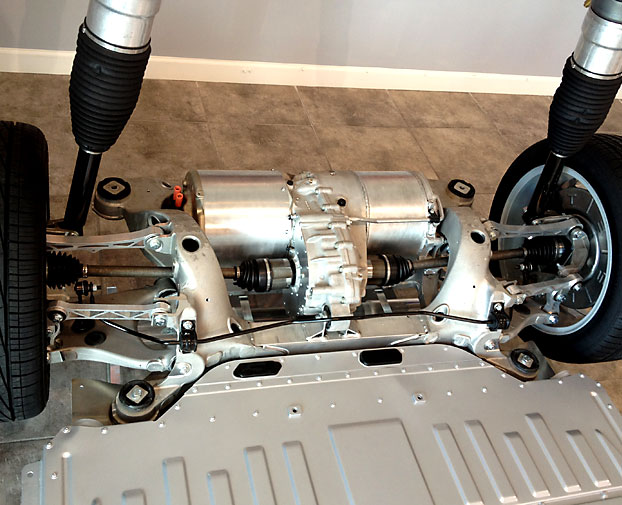
By my estimate you could make the suspension and frame at least 20 cm more compact on each side. If you did this, the Model 3 could be 1.57 meters wide (mirrors folded) and still be able to fit the 380 hp motor. The BMW 3 series is 1.81 meters wide without mirrors. To make the Model 3 the same width as the 3-series you'd need to cut out about 8 cm on each side, which would be easy, to say the least.�
Jan 10, 2015
Model 3 Yes, I see from that picture that you probably right that they can get room for the old motor in Model 3. It looks here more compact then on the picture I remembered in my head
But still, I don't believe that they will use the old motor on Gen-III.�
Jan 12, 2015
Kevin Harney Oops . You are correct with the naming. I meant that I would settle for that if I had to. I would prefer a 380 in the rear with a 221 in the front and a higher option of a 380 in the front. But I would settle for this if I had to. I think it would still perform well enough for me.
- - - Updated - - -
If you are speaking of the Oldsmobile 442 I was wanting one of them too. Funny bit of trivia is that 442 did not stand for the engine size it stood for 4 barrel carb, 4 disc brakes and dual exhaust.�
Jan 13, 2015
dhanson865 As long as it outperforms the Prius, Leaf, Volt, Bolt, Spark, etcetera crowd I don't care if it is only 100HP front and 100HP rear. Pick the most efficient motors (cost and range wise) that get the job done faster than the $20K-$30K crowd it will be better than and I'm fine no matter what the 0-60 time or top speed is. Just make sure it's nicer to drive and support supercharging and I'm good.
so the possible lists are
188 hp Model 3 xx 188 hp rear motor
376 hp Model 3 XXD 188 hp front, 188 hp rear motor
409 hp Model 3 XXDY 188 hp front, 221 hp rear motor
442 hp Model 3 PXXD 221 hp front, 221 hp rear motor
568 hp Model 3 PXXDY 188 hp front, 380 hp rear motor
601 hp Model 3 PXXDKH 221 hp front, 380 hp rear motor
Pick 2 or 3 from the list and chop off the Y or KH for the poster that preferred that config and call it good.�
Jan 23, 2015
igotzzoom I don't think there will be quite that many powertrain variations on the Model III. I think there will probably be three.
220 (ish) hp base - rear drive
300 hp - rear drive
400 hp - dual motor, AWD
Possibly a hotter one (500+ hp) down the road, but I think it will launch with at most three basic powertrain variations.�
Jan 23, 2015
Kevin Harney I'd say the same but I would go with the 300, 400, 500 options.�
Jan 23, 2015
mackgoo Actually I think it was 4 barrel, 4 spd, dual exhaust.�
Jan 23, 2015
igotzzoom 300 hp for $35,000? I'm in! :biggrin:�
Jan 23, 2015
dhanson865 I'm sorry I'm not sure how much clearer I can be than to say "Pick 2 or 3 from the list". What part of that is confusing?
OK so you think 220ish, 300ish, and 400ish the three closest would be
221 hp Model 3 XX 221 hp rear motor
376 hp Model 3 XXD 188 hp front, 188 hp rear motor
409 hp Model 3 PXXD 188 hp front, 221 hp rear motor
we don't have any other HP motors to choose from to give us something between 221 and 376 HP so to get your 200ish HP model you either have to go for a single motor at 188HP or 221HP and then jump all the way past 300ish to the 376HP option.
That is unless you think there is a motor in play that hasn't been covered in the thread. But if you think so you need to specify a source and not just be saying it because you want a round number or think they should do it. We've only seen 4 motors in use and the thread title specifies "(based on current drive units)".
Please
376 hp Model 3 XXD 188 hp front, 188 hp rear motor
409 hp Model 3 XXD 188 hp front, 221 hp rear motor
568 hp Model 3 PXXD 188 hp front, 380 hp rear motor
but I have a hard time believing they won't offer a single motor version.
I also think you are stretching things by asking for more than 2 dual motor versions.
My guess is the base trim will have a single motor, front or rear, 188hp or 221hp. Given the Model S60 has a 380 HP motor it'd make sense to go for something closer to 300HP in the Model 3 that is supposed to be 80% the size. Right now 221HP looks like the entry level option.
next trim would be a dual motor as cheap as possible, I'd expect the 376hp in that slot
finally a top of the line PxxD trim with the biggest rear motor they can fit in the design. Will the 380HP motor fit in the rear of the 80% smaller car? I'm thinking it will since they put a 470hp rear motor in the Model S P85D. So I'm thinking
221 hp Model 3 XX 221 hp rear motor
376 hp Model 3 XXD 188 hp front, 188 hp rear motor
568 hp Model 3 PXXD 188 hp front, 380 hp rear motor
I think it's overkill for to have the 380hp rear motor but I also think they'll do it because they have paying customers demanding overkill.�
Jan 24, 2015
Model 3 We know that Tesla can use the inverter to reduce the power of a motor to what they want it to deliver (or the limitation may be in the battery). So given a motor able to produce 188hp, it may very well be delivered in a package where it is limited to say 150hp or 120hp if they want to - "(based on current drive units)".
�
Jan 24, 2015
Yggdrasill The thing is, they probably wouldn't reduce the cost by very much just by limiting the output. They could possibly save a little bit if they made a Model 3-specific low power inverter, but we're talking maybe $500. And simply increasing the volume of the production of the inverter for the 188/221 hp option might save as much. In my opinion, they'll most likely stick with motor/inverter configurations that are similar to their current configuration. If they introduce a new motor, I think it will most likely replace the 380 hp motor, as the design of this motor is a few years old, and the new 188/221 hp motor seems to be based on a new and improved design.�
Jan 24, 2015
Model 3 Correct. But as shown by the list in the post I was replaying to, it was a big gap between the low-end "221 hp Model 3 XX 221 hp rear motor" and the next possible configuration "376 hp Model 3 XXD 188 hp front, 188 hp rear motor". It may be reasonable to fill this gap with a around 300hp configuration with about 150hp front and rear. And that without constructing a new motor. That was I had in mind.
Agree - if they can't get more power out of the 221hp motor. I still don't believe that they will use the "old" motors on the Gen-III cars (maybe except the next Roadster).�
Jan 24, 2015
Yggdrasill The gap in horsepower is irrelevant. What matters is if there is a gap in the price range, because you want each buyer to stretch as much as possible for the next step up. And this gap in the price range will be there if you have two 150 hp motors that are almost identical to the 188 hp motors, or two 188 hp motors.
You can basically choose between:
221 hp Model 3 XX 221 hp rear motor = ~35,000 USD
376 hp Model 3 XXD 188 hp front, 188 hp rear motor = ~40,000 USD
Or:
221 hp Model 3 XX 221 hp rear motor = ~35,000 USD
300 hp Model 3 XXD 150 hp front, 150 hp rear motor = ~39,500 USD
Tesla would be far better off going for the former option because most people would be willing to pay 500 USD for an extra 76 hp - that's extremely good value for money.�
Jan 24, 2015
Model 3 Obviously, and it was well really what I was referring to, although I only mentioned horsepower.
My point was not that it would necessarily get an engine configuration at just exactly 150hp, but that they are not limited to the numbers 188 and 221. If they have the ability to increase the performance of some of these engines is unknown (but possible!), but we know with certainty that they can reduce them to get the desired performance in horsepower and torque for every price range they want to sell in.
So one is not limited to guess at various combinations of 188 and 221 (or for that matter sake 380) horsepower although sticking to the thread topic of "based on current drive units". Any combination of one or two engines where no motor exceeds 221hp will in my opinion be valid (although there are limits to how far down you can believe they will go).�
Jan 26, 2015
igotzzoom You're operating on the assumption that one of the currently-existing or publicly-announced motors is what will be used in the Model 3. While that's quite probable, it's certainly not a foregone conclusion. I only put those figures out there for ballpark numbers that I think most consumers would expect in that market segment in price range, not necessarily specific outputs. No need to go thermo-nuclear on me!�
Jan 26, 2015
dhanson865 1. I listed a ton of options (the list is up to 7 now) and said pick 2 or 3 of them
2. you said3. I asked what part of pick 2 or 3 confused you.
4. you post about publicly announced motors without addressing the pick 2 or 3 vs you think 3.
You may not see it as confusion but my first read is that you ignored the pick two or three statement and thought I was suggesting there would be a ton of various models. I simply replied to make it clear I don't think there will be a ton of various models.�

Không có nhận xét nào:
Đăng nhận xét